EP4402084B1 - Trommelanordnung - Google Patents
Trommelanordnung Download PDFInfo
- Publication number
- EP4402084B1 EP4402084B1 EP22782830.8A EP22782830A EP4402084B1 EP 4402084 B1 EP4402084 B1 EP 4402084B1 EP 22782830 A EP22782830 A EP 22782830A EP 4402084 B1 EP4402084 B1 EP 4402084B1
- Authority
- EP
- European Patent Office
- Prior art keywords
- cable
- reel
- drum
- main
- arrangement
- Prior art date
- Legal status (The legal status is an assumption and is not a legal conclusion. Google has not performed a legal analysis and makes no representation as to the accuracy of the status listed.)
- Active
Links
Images

Classifications
-
- B—PERFORMING OPERATIONS; TRANSPORTING
- B65—CONVEYING; PACKING; STORING; HANDLING THIN OR FILAMENTARY MATERIAL
- B65H—HANDLING THIN OR FILAMENTARY MATERIAL, e.g. SHEETS, WEBS, CABLES
- B65H75/00—Storing webs, tapes, or filamentary material, e.g. on reels
- B65H75/02—Cores, formers, supports, or holders for coiled, wound, or folded material, e.g. reels, spindles, bobbins, cop tubes, cans, mandrels or chucks
- B65H75/34—Cores, formers, supports, or holders for coiled, wound, or folded material, e.g. reels, spindles, bobbins, cop tubes, cans, mandrels or chucks specially adapted or mounted for storing and repeatedly paying-out and re-storing lengths of material provided for particular purposes, e.g. anchored hoses, power cables
- B65H75/38—Cores, formers, supports, or holders for coiled, wound, or folded material, e.g. reels, spindles, bobbins, cop tubes, cans, mandrels or chucks specially adapted or mounted for storing and repeatedly paying-out and re-storing lengths of material provided for particular purposes, e.g. anchored hoses, power cables involving the use of a core or former internal to, and supporting, a stored package of material
- B65H75/44—Constructional details
- B65H75/4449—Arrangements or adaptations to avoid movable contacts or rotary couplings, e.g. by the use of an expansion chamber for a lenght of the cord or hose
- B65H75/4452—Simultaneous winding and unwinding of the material, e.g. winding or unwinding on a stationary drum while respectively unwinding or winding on a rotating drum using a planetary guiding roller
-
- B—PERFORMING OPERATIONS; TRANSPORTING
- B60—VEHICLES IN GENERAL
- B60L—PROPULSION OF ELECTRICALLY-PROPELLED VEHICLES; SUPPLYING ELECTRIC POWER FOR AUXILIARY EQUIPMENT OF ELECTRICALLY-PROPELLED VEHICLES; ELECTRODYNAMIC BRAKE SYSTEMS FOR VEHICLES IN GENERAL; MAGNETIC SUSPENSION OR LEVITATION FOR VEHICLES; MONITORING OPERATING VARIABLES OF ELECTRICALLY-PROPELLED VEHICLES; ELECTRIC SAFETY DEVICES FOR ELECTRICALLY-PROPELLED VEHICLES
- B60L53/00—Methods of charging batteries, specially adapted for electric vehicles; Charging stations or on-board charging equipment therefor; Exchange of energy storage elements in electric vehicles
- B60L53/10—Methods of charging batteries, specially adapted for electric vehicles; Charging stations or on-board charging equipment therefor; Exchange of energy storage elements in electric vehicles characterised by the energy transfer between the charging station and the vehicle
- B60L53/14—Conductive energy transfer
- B60L53/18—Cables specially adapted for charging electric vehicles
-
- B—PERFORMING OPERATIONS; TRANSPORTING
- B60—VEHICLES IN GENERAL
- B60L—PROPULSION OF ELECTRICALLY-PROPELLED VEHICLES; SUPPLYING ELECTRIC POWER FOR AUXILIARY EQUIPMENT OF ELECTRICALLY-PROPELLED VEHICLES; ELECTRODYNAMIC BRAKE SYSTEMS FOR VEHICLES IN GENERAL; MAGNETIC SUSPENSION OR LEVITATION FOR VEHICLES; MONITORING OPERATING VARIABLES OF ELECTRICALLY-PROPELLED VEHICLES; ELECTRIC SAFETY DEVICES FOR ELECTRICALLY-PROPELLED VEHICLES
- B60L53/00—Methods of charging batteries, specially adapted for electric vehicles; Charging stations or on-board charging equipment therefor; Exchange of energy storage elements in electric vehicles
- B60L53/30—Constructional details of charging stations
-
- H—ELECTRICITY
- H02—GENERATION; CONVERSION OR DISTRIBUTION OF ELECTRIC POWER
- H02G—INSTALLATION OF ELECTRIC CABLES OR LINES, OR OF COMBINED OPTICAL AND ELECTRIC CABLES OR LINES
- H02G11/00—Arrangements of electric cables or lines between relatively-movable parts
- H02G11/02—Arrangements of electric cables or lines between relatively-movable parts using take-up reel or drum
Definitions
- the invention relates to a drum arrangement according to the features of claim 1.
- Drum arrangements for the winding accommodation of electrical cables are known, in which the electrical energy is transmitted to the rotating drum arrangement via slip rings.
- Slip ring bodies are often a limiting factor for the transmission of electrical power, especially for charging electric vehicles of any kind.
- the invention is based on the object of demonstrating a drum arrangement in which the limitation by slip ring bodies is eliminated, in particular in order to transmit higher charging powers.
- the DE 21 59 496 C2 discloses a drum arrangement according to the preamble of claim 1 for winding or unwinding a supply cable for height-adjustable lights.
- the cable winding device comprises a double drum with a first and a second sub-drum, of which the second sub-drum has a significantly smaller diameter than the first.
- the supply cable is guided from a fixed connection first around the smaller, second sub-drum, then around the first sub-drum and to the light.
- the double drum is driven by a servomotor. driven so that the winding or unwinding speed of the cable from the larger, first sub-drum is equal to the height adjustment speed of the lamp on the trailer.
- the DE 29 00 187 A1 discloses a winding device for winding and unwinding cables.
- the winding device has several spirally wound cable sections in separate winding spaces on a single winding drum.
- An electrical supply cable leads from a stationary connection to the winding drum.
- a discharge cable serves to connect to a movable connection.
- the drum-side ends of the electrical supply and discharge cables are directly connected to each other.
- one or more pneumatic or hydraulic lines are arranged on the winding drum.
- the drum assembly according to the invention completely dispenses with a slip ring arrangement. It is a slip-ringless drum assembly.
- the drum assembly has a main drum and a secondary drum on a common drum axis.
- the main drum and the secondary drum are moved synchronously, i.e., always in the same direction of rotation and at the same rotational speed.
- the main drum and the secondary drum are connected to each other.
- the reel assembly includes a cable to be wound.
- the cable has a first stationary cable end. From there, the cable initially runs via a cable loop to the secondary reel, where it is wound and unwound. The cable then continues to the main reel. It is attached to the main reel and/or the secondary reel. The cable can be wound and unwound over the main reel so that its free end can be connected to a power outlet, for example, an electric vehicle.
- the drum arrangement is designed such that the secondary drum has a smaller winding diameter than the main drum.
- the drum arrangement according to the invention is used in such a way that the cable is first guided to the secondary drum without a slip ring and is wound there from the radial outside.
- the winding of the main drum and/or the secondary drum can be spiral or helical.
- a first length of the cable is wound onto the secondary drum.
- the winding diameter of the main drum, to which the same cable is subsequently guided, is, however, larger than the winding diameter of the secondary drum. This means that for the same number of rotations of the drums, a longer length of cable is wound onto the main drum than onto the secondary drum. Since the length of cable on the secondary drum is also limited by the fixed cable loop, when the drums are unwound, the cable loop is enlarged, but at the same time a considerably longer section of cable is unwound from the main drum.
- Such a drum arrangement does not require any slip ring assembly.
- the charging power is therefore not limited by slip ring bodies.
- the only limiting factor is the charging infrastructure and, if applicable, the maximum cable length that can be wound up.
- a certain length of cable is required for the secondary drum, this length is comparatively short compared to the cable length that can be unwound from the main drum, especially when there are large differences in winding diameters.
- a further advantage of the drum arrangement according to the invention is that a uniform cable can be used from one end to the other of the cable to be wound up in the drum arrangement. No interfaces are required between the rotating drum and a stationary installation.
- the secondary drum is spirally wound, while the main drum is cylindrically wound.
- a spirally wound secondary drum has a very narrow axial width, only slightly larger than the diameter of the cable.
- Such a secondary drum can be arranged directly next to the main drum, saving considerable space. Since the main drum already has a larger winding diameter, the larger diameter end wall of the drum can also be used as the drum wall for the secondary drum.
- the two drums are therefore preferably arranged directly next to each other.
- the secondary drum is, in particular, directly connected to the main drum. This also has the advantage that only a short cable length is required to route the cable from the secondary drum to the main drum.
- the cable is accommodated radially inside the drum body of the secondary drum and is then routed to the main drum, where it is guided, in particular, in a cylindrical winding.
- the cable loop ensures proper winding under the influence of a tension force directed against the winding direction of the secondary reel.
- the tension force pulls on the cable loop in such a way that the cable is always wound correctly in a spiral.
- the cable loop is influenced by a gravity-induced tension force.
- the cable loop is pulled vertically downwards by a weight suspended from the cable loop.
- a weight is connected to the cable loop so that it can be moved longitudinally along the cable. This can be a roller block that rolls over the cable and always hangs at the lowest point of the cable loop.
- the drum arrangement according to the invention is preferably designed such that a cable section on the secondary drum has a shorter winding length than a cable section on the main drum, so that when the main drum is unwound in a first direction of rotation, the winding direction on the secondary drum is reversed.
- the drum arrangement is therefore used in particular such that for unwinding in a first direction of rotation, e.g. counterclockwise, both the cable from the main drum and the cable from the secondary drum are unwound.
- the unwound cable sections are each located on the side of the two drums facing in the direction of rotation.
- the cable section connected to the secondary drum is pulled to the other side, so that the cable on the secondary drum no longer unwinds, but winds up again, while the direction of rotation remains the same.
- there are two winding phases on the secondary drum namely a first phase in which the secondary drum is also unwound and then a second phase in which the The cable is wound back onto the secondary drum.
- This winding process can only be continued until the cable loop has reached its shortest length.
- the winding diameters of the main drum and the secondary drum are preferably coordinated so that the cable section on the secondary drum is completely wound when the main drum is fully wound and when it is fully unwound. The difference, however, is that to reach the fully unwound main drum, the second winding phase must be completed last, and to reach the fully wound main drum, the first winding phase of the winding process on the secondary drum must be completed last.
- the drum arrangement is in particular provided with a drive which is connected to the main drum and/or the secondary drum and via which one drum drives the other.
- the drive is designed to rotate the main drum and the secondary drum simultaneously.
- it can be an internal drive within the drum arrangement, wherein sufficient space is available to accommodate a drive, particularly within the main drum due to the large winding diameter.
- the drive is mounted on a fixed axle.
- it is particularly expedient to arrange the main drum and the secondary drum directly next to one another and also to connect them directly to one another so that the drive force is transmitted from one drum to the other.
- the cable serves in particular to transmit electrical energy to a mobile consumer.
- the drum arrangement comprises in particular a suspension which is configured such that the drum arrangement can preferably be suspended above a mobile consumer in order to lower a cable end from above to the consumer.
- High-hanging drum arrangements make it possible to keep interfering cable ends away from the ground. This prevents plugs from being driven over and damaged and facilitates maneuvering.
- the cable section of the cable loop can be guided freely downwards.
- the drum arrangement according to the invention is therefore preferably located at a height at which the cable loop can hang freely downwards.
- a line within the meaning of the invention can be configured to conduct energy and/or signals and/or fluids, e.g., gases, liquids, free-flowing solids, and/or mixtures of fluids and/or solids.
- Hybrid lines are also possible, comprising multiple lines for different conduction purposes, such as a data line and a line for energy transmission.
- Multiple lines can also be connected to form a line within the meaning of the invention, for example, a pair of lines, which can also be visually identified as a pair of lines.
- the term line does not necessarily mean that a specific substance must be conducted from one end to the other and then exits the line again. Cooled lines can also be used, in which, for example, a coolant cools an electrical conductor and both enters and exits at the beginning of the line.
- drum arrangements according to the invention can be used wherever a temporary sagging of the connecting cable or cable loop is not a problem. Possible applications include drum arrangements for special types of communication, including fiber optic cable winding. Such a drum arrangement is preferably used for electrical cables for charging an electric vehicle.
- the Figure 1 shows a drum arrangement 1 with a main drum 2 and a secondary drum 3.
- the main drum 2 and the secondary drum 3 are connected to one another and mounted on a common drum axis 4.
- the drum axis 4 is arranged horizontally.
- the drum arrangement 1 carries a cable 5 to be wound up. This is an electrical cable for charging a motor vehicle.
- the cable comprises a cable loop 6 with a stationary first cable end 7, which opens into a junction box 8 adjacent to the secondary drum 3.
- the junction box 8 and the drum axis 4 are connected to a suspension 9, which is arranged between the junction box 8 and the drum axis 4.
- the suspension 9 has a horizontal support arm 10, which is connected to a horizontal beam 11.
- the support arm 10 can be stationary connected to the horizontal beam 11. It is possible to arrange the support arm 10 so as to be displaceable in the longitudinal direction of the horizontal support 11 in order to bring the drum arrangement 1 into the desired position.
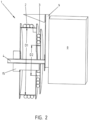
- the Figure 2 shows a longitudinal section through the drum arrangement of the Figure 1 in the area of the drum axis 4.
- the secondary drum 3 takes the cable 5 spirally winding.
- the cable 5 is then guided to the cylindrically winding main drum 2.
- a drive 15 is mounted on the drum axis 4 and serves to set the drum assembly 1 in motion. This is an electric drive, via which the main drum 2 and the secondary drum 3 are mounted.
- the main drum 2 has a winding diameter D1 which is larger than the winding diameter D2 of the secondary drum 3. Even if the winding diameter D2 of the secondary drum 3 increases with the number of windings due to the spiral winding, it is in no case as large as the winding diameter D1 of the main drum 2. This means that with one revolution of the main drum 2 a larger cable section is always unwound than from the secondary drum 3. This principle is explained below using the Figures 3 to 8 explained.
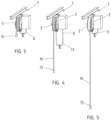
- the Figure 3 shows the starting position as shown in the Figures 1 and 2
- the cable 5 is fully wound.
- the cable loop 6 is as short as possible.
- the plug 14 is in its upper end position.
- the drive 15 is actuated and rotates the drum assembly 1 counterclockwise, so that a cable section 16 is unwound from the main drum 2.
- the cable loop 6 lengthens because the secondary drum 3 is also unwound.
- the cable section 17 unwound from the secondary drum 3 is shorter than the cable section 16 from the main drum 3 due to the smaller winding diameter D2.
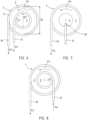
- the Figure 6 is a highly simplified side view of the drum assembly 1.
- the secondary drum 3 faces the viewer, while the main drum is located behind it.
- the secondary drum 3 has the smaller winding diameter D2.
- the main drum 2 has the larger winding diameter D1.
- Cable 5 is unwound from the main drum 2 in the counterclockwise direction of arrow P1.
- Arrow P2 shows how the cable end 16 of cable 5 is unwound downward.
- the cable section 17 of the secondary drum 3 is also unwound.
- Arrow P3 on cable section 17 points in the same direction as arrow P2.
- the Figure 7 shows a position of the secondary drum 3 in which a radially inner cable connection 18, which is arranged on the secondary drum 3, points radially downwards.
- the cable 5 or the cable section 17 is not wound onto the secondary drum 3.
- the loop, to which the cable section 17 belongs has its maximum length.
- the first winding phase of the secondary drum 3 is completed.
- the second winding phase begins, as shown in Figure 8 is shown.
- the drum assembly 1 is further rotated in the direction of arrow P1, so that the cable connection 18 is displaced to the right in the image plane and now the cable section 17 is wound or is wound in the opposite direction to the cable section 16.
- the arrow P4 which indicates the direction of movement of the cable section 17, accordingly points to the drum assembly 1 and not, as the arrow P3 in Figure 6 , away from the drum assembly 1.
- the cable section 16 of the main drum 2 continues to be unwound, while the cable section 17 of the secondary drum 3 is wound up until the position of the Figure 5 is achieved.
- the winding of the main drum 2 is carried out in the reverse order.
- the directions of all arrows in the Figures 6 to 8 reverse accordingly.
Landscapes
- Engineering & Computer Science (AREA)
- Power Engineering (AREA)
- Transportation (AREA)
- Mechanical Engineering (AREA)
- Storing, Repeated Paying-Out, And Re-Storing Of Elongated Articles (AREA)
Description
- Die Erfindung betrifft eine Trommelanordnung gemäß den Merkmalen des Patentanspruches 1.
- Es sind Trommelanordnungen zur wickelnden Aufnahme von elektrischen Leitungen bekannt, bei welchen die elektrische Energie über Schleifringe in die rotierende Trommelanordnung übertragen wird. Oftmals sind die Schleifringkörper ein limitierender Faktor für die Übertragung einer elektrischen Leistung, insbesondere zum Laden von Elektrofahrzeugen jeglicher Art.
- Der Erfindung liegt die Aufgabe zugrunde, eine Trommelanordnung aufzuzeigen, bei welcher die Limitierung durch Schleifringkörper entfällt, insbesondere um höhere Ladeleistungen zu übertragen.
- Die
DE 21 59 496 C2 offenbart eine Trommelanordnung nach dem Oberbegriff des Anspruchs 1, zum Auf- oder Abwickeln eines Versorgungskabels für höhenverstellbare Leuchten. Die Kabelaufwickelvorrichtung weist eine Doppeltrommel mit einer ersten und einer zweiten Teiltrommel auf, von denen die zweite Teiltrommel einen wesentlich kleineren Durchmesser hat als die erste. Das Versorgungskabel wird von einem feststehenden Anschluss aus zunächst um die kleinere, zweite Teiltrommel geführt, dann um die erste Teiltrommel und zu der Leuchte. Die Doppeltrommel wird von einem Stellmotor angetrieben, so dass die Auf- bzw. Abwickelgeschwindigkeit des Kabels von der größeren, ersten Teiltrommel gleich der Höhenverstellgeschwindigkeit der Leuchte am Hänger ist. - Die
DE 29 00 187 A1 offenbart eine Wickelvorrichtung zum Auf- und Abwickeln von Leitungen. Die Wickelvorrichtung weist mehrere spiralig wickelnde Leitungsbereiche in getrennten Wickelräumen auf einer einzigen Wickeltrommel auf. Von einem feststehenden Anschluss führt ein elektrisches Zuleitungskabel zu der Wickeltrommel. Ein Ableitungskabel dient zur Verbindung mit einem beweglichen Anschluss. Die trommelseitigen Enden der elektrischen Zuleitungs- und Ableitungskabel sind unmittelbar einander verbunden. In gleicher Weise sind ein oder mehrere Pneumatik- bzw. Hydraulikleitung auf der Wickeltrommel angeordnet. - Die Aufgabe wird durch eine Trommelanordnung mit den Merkmalen des Patentanspruches 1 gelöst.
- Die Unteransprüche betreffen vorteilhafte Weiterbildungen der Erfindung.
- Die erfindungsgemäße Trommelanordnung verzichtet komplett auf eine Schleifringanordnung. Es handelt sich um eine schleifringlose Trommelanordnung. Die Trommelanordnung besitzt eine Haupttrommel und eine Nebentrommel auf einer gemeinsamen Trommelachse. Die Haupttrommel und die Nebentrommel werden synchron, d.h. stets in dieselbe Drehrichtung und mit derselben Drehgeschwindigkeit bewegt. Insbesondere sind die Haupttrommel und die Nebentrommel miteinander verbunden.
- Die Trommelanordnung umfasst eine aufzuwickelnde Leitung. Die Leitung besitzt ein erstes ortsfestes Leitungsende. Die Leitung verläuft von dort kommend zunächst über eine Leitungsschlaufe zu der Nebentrommel, um dort auf- und abgewickelt zu werden. Die Leitung wird im weiteren Verlauf zur Haupttrommel geleitet. Sie ist an der Haupttrommel und/oder der Nebentrommel befestigt. Die Leitung kann über die Haupttrommel auf- und abgewickelt werden, so dass ihr freies Ende an einen Anschluss angeschlossen werden kann, beispielsweise an ein Elektrofahrzeug.
- Die Trommelanordnung ist so ausgebildet, dass die Nebentrommel einen kleineren Wickeldurchmesser als die Haupttrommel aufweist. Die erfindungsgemäße Trommelanordnung wird derart verwendet, dass die Leitung schleifringlos zunächst zur Nebentrommel geführt wird und dort von radial außen kommend aufgewickelt wird. Die Wicklung der Haupttrommel und/oder der Nebentrommel kann spiralig oder wendelförmig sein. Auf die Nebentrommel wird eine erste Leitungslänge der Leitung gewickelt. Der Wickeldurchmesser der Haupttrommel, zu der dieselbe Leitung anschließend geführt wird, ist jedoch größer als der Wickeldurchmesser der Nebentrommel. Das bedeutet, dass bei einer gleichen Anzahl von Drehungen der Trommeln eine größere Leitungslänge auf der Haupttrommel aufgewickelt wird als auf der Nebentrommel. Da die Leitungslänge auf der Nebentrommel zudem durch die fixierte Leitungsschlaufe begrenzt ist, wird beim Abwickeln der Trommeln zwar die Leitungsschlaufe vergrößert, jedoch gleichzeitig ein wesentlich längerer Leitungsabschnitt von der Haupttrommel abgewickelt.
- Eine solche Trommelanordnung kommt vollkommen ohne Schleifringübertrager aus. Die Ladeleistung ist daher auch nicht durch Schleifringkörper limitiert. Der limitierende Faktor liegt einzig in der Ladeinfrastruktur und ggf. in der maximal aufwickelbaren Kabellänge. Es wird zwar eine gewisse Länge der Leitung für die Nebentrommel benötigt, allerdings ist diese Länge gerade bei größeren Unterschieden der Wickeldurchmesser vergleichsweise gering im Verhältnis zu der von der Haupttrommel abwickelbaren Leitungslänge. Ein weiterer Vorteil der erfindungsgemäßen Trommelanordnung ist es, dass auf eine einheitliche Leitung von einem Ende zum anderen Ende der aufzuwickelnden Leitung der Trommelanordnung zurückgegriffen werden kann. Es sind keine Schnittstellen zwischen der sich drehenden Trommel und einer ortsfesten Installation notwendig.
- Die Nebentrommel ist spiralig wickelnd und die Haupttrommel ist zylindrisch wickelnd ausgeführt. Eine spiralig wickelnde Nebentrommel besitzt in Axialrichtung eine sehr geringe Breite, die nur wenig größer ist als der Durchmesser der Leitung. Eine solche Nebentrommel kann ausgesprochen platzsparend unmittelbar neben der Haupttrommel angeordnet werden. Da die Haupttrommel ohnehin einen größeren Wickeldurchmesser hat, kann die im Durchmesser daher auch größere stirnseitige Trommelwand gleichzeitig als Trommelwand für die Nebentrommel genutzt werden.
- Die beiden Trommeln sind daher vorzugsweise unmittelbar nebeneinander angeordnet. Die Nebentrommel ist insbesondere unmittelbar mit der Haupttrommel verbunden. Das hat zudem den Vorteil, dass nur wenig Leitungslänge benötigt wird, um die Leitung von der Nebentrommel zur Haupttrommel zu führen. Die Leitung wird radial innen in dem Trommelkörper der Nebentrommel aufgenommen und wird von dort zur Haupttrommel geleitet, wo sie insbesondere zylindrisch wickelnd geführt ist.
- Die Kabelschlaufe steht für einen ordnungsgemäßen Wickelvorgang unter dem Einfluss einer Spannkraft, die gegen die Wickelrichtung der Nebentrommel gerichtet ist. Mit anderen Worten zieht die Spannkraft derart an der Leitungsschlaufe, dass die Leitung stets ordnungsgemäß spiralig gewickelt wird. Die Leitungsschlaufe steht unter dem Einfluss einer schwerkraftbedingten Spannkraft. Die Leitungsschlaufe wird durch einen Gewichtskörper, der an der Leitungsschlaufe hängt, direkt vertikal nach unten gezogen. Ein solcher Gewichtskörper ist in Längsrichtung der Leitung verschiebbar mit der Leitungsschlaufe verbunden. Es kann sich hierüber um einen Rollenblock handeln, der über die Leitung abrollt und stets am tiefsten Punkt der Leitungsschlaufe hängt.
- Die erfindungsgemäße Trommelanordnung ist vorzugsweise derart ausgebildet, dass ein Leitungsabschnitt auf der Nebentrommel eine kleinere Wickellänge als ein Leitungsabschnitt auf der Haupttrommel aufweist, so dass sich beim Abwickeln der Haupttrommel in eine erste Drehrichtung die Wickelrichtung auf der Nebentrommel umkehrt. Die Trommelanordnung wird daher insbesondere derart verwendet, dass zum Abwickeln in eine erste Drehrichtung z.B. gegen den Uhrzeigersinn sowohl die Leitung von der Haupttrommel als auch die Leitung von der Nebentrommel abgewickelt werden. Die abgewickelten Leitungsbereiche befinden sich jeweils auf der in Drehrichtung weisenden Seite der beiden Trommeln. Wenn nun der kürzere Leitungsabschnitt auf der Nebentrommel komplett abgewickelt worden ist und beide Trommeln weiter bewegt werden, wird der Leitungsabschnitt, der mit der Nebentrommel verbunden ist, auf die andere Seite gezogen, so dass sich die Leitung auf der Nebentrommel bei gleichbleibender Drehrichtung nun nicht mehr abwickelt, sondern wieder aufwickelt. Es gibt also beim reinen Abwickeln der Haupttrommel zwei Wickelphasen auf der Nebentrommel, nämlich eine erste Phase, in der auch die Nebentrommel abgewickelt wird und anschließend eine zweite Phase, in der die Leitung auf die Nebentrommel wieder aufgewickelt wird. Dieser Aufwickelvorgang kann nur solange fortgesetzt werden, bis die Leitungsschlaufe ihre kürzeste Länge erreicht hat. Vorzugsweise sind die Wickeldurchmesser der Haupttrommel und der Nebentrommel so aufeinander abgestimmt, dass bei vollständig aufgewickelter und bei vollständig abgewickelter Haupttrommel der Leitungsabschnitt auf der Nebentrommel jeweils vollkommen aufgewickelt ist. Der Unterschied besteht allerdings darin, dass zum Erreichen der vollkommen abgewickelten Haupttrommel die zweite Wickelphase zuletzt durchlaufen werden muss und zum Erreichen der vollkommen aufgewickelten Haupttrommel die erste Wickelphase des nebentrommelseitigen Wickelvorganges als letzte durchlaufen werden muss.
- Die Trommelanordnung ist insbesondere mit einem Antrieb versehen, der mit der Haupttrommel und/oder der Nebentrommel verbunden ist und über die eine Trommel die jeweils andere Trommel antreibt. Der Antrieb ist dazu eingerichtet, die Haupttrommel und die Nebentrommel gleichzeitig zu drehen. Es kann sich insbesondere um einen innen liegenden Antrieb innerhalb der Trommelanordnung handeln, wobei insbesondere innerhalb der Haupttrommel aufgrund des großen Wickeldurchmessers hinreichend Bauraum zur Aufnahme eines Antriebs zur Verfügung steht. Der Antrieb wird auf einer feststehenden Achse montiert. Wie vorstehend erwähnt, ist es besonders zweckmäßig, die Haupttrommel und die Nebentrommel unmittelbar nebeneinander anzuordnen und auch direkt miteinander zu verbinden, so dass die Antriebskraft von einer Trommel auf die andere übertragen wird.
- Die Leitung dient insbesondere zur Übertragung elektrischer Energie an einen mobilen Verbraucher. Die Trommelanordnung umfasst insbesondere eine Aufhängung, die derart eingerichtet ist, dass die Trommelanordnung bevorzugt oberhalb eines mobilen Verbrauchers aufhängbar ist, um ein Leitungsende von oben kommend zum Verbraucher herab zu lassen. Hochhängende Trommelanordnungen ermöglichen es, störende Leitungsenden vom Boden fern zu halten. Das verhindert ein Überfahren und Beschädigen von Steckern und erleichtert das Rangieren. Zudem kann der Leitungsabschnitt der Leitungsschlaufe frei nach unten geführt werden. Die erfindungsgemäße Trommelanordnung befindet sich daher vorzugsweise in einer solchen Höhe, in welcher die Leitungsschlaufe frei nach unten hängen kann.
- Die Trommelanordnung ist nicht auf einen bestimmten Leitungstyp beschränkt. Eine Leitung im Sinne der Erfindung kann eingerichtet sein zur Durchleitung von Energie und/oder Signalen und/oder Fluiden, z.B. Gasen, Flüssigkeiten, fließfähigen Feststoffen und/oder von Gemischen von Fluiden und/oder Feststoffen. Auch Hybridleitungen sind möglich, die mehrere Leitungen für unterschiedliche Leitungszwecke aufweisen, beispielsweise eine Datenleitung und eine Leitung zur Energieübertragung. Auch können mehrere Leitungen zu einer Leitung im Sinne der Erfindung miteinander verbunden werden, beispielsweise ein Leitungspaar, das als solches auch optisch als Leitungspaar zur erkennen ist. Der Begriff Leitung bedeutet nicht zwangsläufig, dass ein bestimmter Stoff von einem Ende zum anderen Ende geleitet werden muss, um dort wieder aus der Leitung auszutreten. Es kann sich auch um gekühlte Leitungen handeln, bei denen beispielsweise ein Kühlmittel einen elektrischen Leiter kühlt und am Leitungsbeginn sowohl eintritt und austritt.
- Die erfindungsgemäßen Trommelanordnungen können überall dort eingesetzt werden, wo ein kurzzeitiges Durchhängen der Anschlussleitung bzw. der Leitungsschlaufe kein Problem darstellt. Ein möglicher Anwendungsbereich wären beispielsweise Trommelanordnungen für besondere Kommunikationsarten bis hin zur Lichtwellenleiteraufwicklung. Bevorzugt wird eine solche Trommelanordnung für Elektroleitungen zum Laden eines Elektrofahrzeuges verwendet.
- Die Erfindung wird nachfolgend anhand von Zeichnungen erläutert. Die Zeichnungen sind rein schematisch und nicht maßstäblich. Sie dienen lediglich zur Verdeutlichung des Funktionsprinzips. Es zeigen:
- Figur 1
- eine perspektivische Ansicht einer Trommelanordnung;
- Figur 2
- die Trommelanordnung der
Figur 1 in einem Querschnitt; - Figur 3
- die Trommelanordnung der
Figur 1 aus einer anderen Perspektive; - Figur 4
- die Trommelanordnung der
Figur 3 während des Abwickelns; - Figur 5
- die Trommelanordnung der
Figur 3 im abgewickelten Zustand; - Figur 6
- einen Querschnitt durch die Trommelanordnung der
Figur 1 in einer ersten Wickelphase; - Figur 7
- die Trommelanordnung der
Figur 6 im Übergang von der ersten zur zweiten Wickelphase und - Figur 8
- die Trommelanordnung der
Figur 6 in einer zweiten Wickelphase. - Die
Figur 1 zeigt eine Trommelanordnung 1 mit einer Haupttrommel 2 und einer Nebentrommel 3. Die Haupttrommel 2 und die Nebentrommel 3 sind miteinander verbunden und auf einer gemeinsamen Trommelachse 4 gelagert. Die Trommelachse 4 ist horizontal angeordnet. Die Trommelanordnung 1 trägt eine aufzuwickelnde Leitung 5. Es handelt sich um eine elektrische Leitung zum Laden eines Kraftfahrzeuges. Die Leitung umfasst eine Leitungsschlaufe 6 mit einem ortsfesten ersten Leitungsende 7, das benachbart zur Nebentrommel 3 in einen Anschlusskasten 8 mündet. Der Anschlusskasten 8 und die Trommelachse 4 sind mit einer Aufhängung 9 verbunden, die zwischen dem Anschlusskasten 8 und der Trommelachse 4 angeordnet ist. Oberhalb der Trommelanordnung 1 besitzt die Aufhängung 9 einen horizontalen Tragarm 10, der mit einem Horizontalträger 11 verbunden ist. Der Tragarm 10 kann ortsfest mit dem Horizontalträger 11 verbunden sein. Es ist möglich, den Tragarm 10 in Längsrichtung des Horizontalträgers 11 verschiebbar anzuordnen, um die Trommelanordnung 1 in die gewünschte Position zu bringen. - Die Leitungsschlaufe 6 hängt nach unten und wird durch den Gewichtskörper 7 nach unten gezogen. Wenn die Leitungsschlaufe 6 verlängert wird, wird der Gewichtskörper 7 in eine andere Position verlagert, und zwar immer zum tiefsten Punkt der Leitungsschlaufe 6. Hierfür sorgt ein Rollenblock 12, der einerseits den Gewichtskörper 7 trägt und andererseits in Längsrichtung auf der Leitungsschlaufe 6 abrollt. Die Leitung 5 erstreckt sich von dem ersten Leitungsende 7 über die Leitungsschlaufe 6 zunächst zur Nebentrommel 3 und über einen radial inneren Weg von der Nebentrommel 3 zur Haupttrommel 4 bis zum zweiten Leitungsende 13 mit einem Stecker 14. Nachfolgend wird das Funktionsprinzip erläutert.
- Die
Figur 2 zeigt einen Längsschnitt durch die Trommelanordnung derFigur 1 im Bereich der Trommelachse 4. Die Nebentrommel 3 nimmt die Leitung 5 spiralig wickelnd auf. Anschließend wird die Leitung 5 zu der zylindrisch wickelnden Haupttrommel 2 geleitet. Ein Antrieb 15 ist auf der Trommelachse 4 befestigt und dient dazu, die Trommelanordnung 1 in Bewegung zu setzen. Es handelt sich um einen elektrischen Antrieb, über den die Haupttrommel 2 und die Nebentrommel 3 gelagert sind. - Wesentlich für die Erfindung ist, dass die Haupttrommel 2 einen Wickeldurchmesser D1 aufweist, der größer ist als der Wickeldurchmesser D2 der Nebentrommel 3. Auch wenn der Wickeldurchmesser D2 der Nebentrommel 3 aufgrund der spiraligen Wickelung mit zunehmender Anzahl der Wicklungen größer wird, ist er doch in keinem Fall so groß, wie der Wickeldurchmesser D1 der Haupttrommel 2. Das bedeutet, dass bei einer Umdrehung der Haupttrommel 2 immer ein größerer Leitungsabschnitt abgewickelt wird als von der Nebentrommel 3. Dieses Prinzip wird nachfolgend anhand der
Figuren 3 bis 8 erläutert. - Die
Figur 3 zeigt die Ausgangsposition, wie sie in denFiguren 1 und2 dargestellt ist. Die Leitung 5 ist vollständig aufgewickelt. Die Leitungsschlaufe 6 ist so kurz wie möglich. Der Stecker 14 befindet sich in seiner oberen Endlage. - Nun wird der Antrieb 15 betätigt und dreht die Trommelanordnung 1 gegen den Uhrzeigersinn gedreht, so dass ein Leitungsabschnitt 16 von der Haupttrommel 2 abgewickelt wird. Gleichzeitig verlängert sich die Leitungsschlaufe 6, weil auch die Nebentrommel 3 abgewickelt wird. Der Leitungsabschnitt 17, der von der Nebentrommel 3 abgewickelt wurde, ist aufgrund des geringeren Wickeldurchmessers D2 kürzer als der Leitungsabschnitt 16 von der Haupttrommel 3.
- Wenn nun das zweite Leitungsende 13 weiter abgewickelt wird (
Figur 5 ), bis es die dort dargestellte Endposition erreicht, wird die Leitungsschlaufe 6 wieder auf ihre ursprüngliche Leitungslänge verkürzt. Das ist darauf zurückzuführen, dass der Leitungsabschnitt 17 auf der Nebentrommel 3 eine kleinere Wickellänge aufweist als der Leitungsabschnitt 16 auf der Haupttrommel 2. Dadurch kehrt sich beim Abwickeln der Haupttrommel 2 in eine erste Drehrichtung die Wickelrichtung auf der Nebentrommel 3 ab einem bestimmten Punkt um. DieFiguren 6 bis 8 verdeutlichen dieses Prinzip. - Die
Figur 6 ist eine Seitenansicht der Trommelanordnung 1 in stark vereinfachter Darstellung. Die Nebentrommel 3 ist dem Betrachter zugewandt, die Haupttrommel liegt dahinter. Die Nebentrommel 3 besitzt den kleineren Wickeldurchmesser D2. Die Haupttrommel 2 besitzt den größeren Wickeldurchmesser D1. - Die Leitung 5 wird in Drehrichtung des Pfeils P1 gegen den Uhrzeigersinn von der Haupttrommel 2 abgewickelt. Der Pfeil P2 zeigt, wie das Leitungsende 16 der Leitung 5 nach unten abgewickelt wird. Gleichzeitig wird auch der Leitungsabschnitt 17 der Nebentrommel 3 abgewickelt. Der Pfeil P3 am Leitungsabschnitt 17 weist in dieselbe Richtung wie der Pfeil P2.
- Die
Figur 7 zeigt eine Position der Nebentrommel 3, bei welcher ein radial innerer Leitungsanschluss 18, der an der Nebentrommel 3 angeordnet ist, radial nach unten weist. In dieser Position ist die Leitung 5 bzw. der Leitungsabschnitt 17 nicht auf die Nebentrommel 3 gewickelt. Die Schlaufe, zu der der Leitungsabschnitt 17 zählt, besitzt ihre maximale Länge. In dieser Position ist die erste Wickelphase der Nebentrommel 3 abgeschlossen. Nach diesem Umkehrpunkt beginnt die zweite Wickelphase, wie sie inFigur 8 dargestellt ist. Die Trommelanordnung 1 wird weiterhin in Richtung des Pfeils P1 gedreht, so dass der Leitungsanschluss 18 in der Bildebene nach rechts verlagert wird und nunmehr der Leitungsabschnitt 17 gegensinnig zum Leitungsabschnitt 16 gewickelt wird bzw. gewickelt ist. Der Pfeil P4, der die Bewegungsrichtung des Leitungsabschnittes 17 anzeigt, weist dementsprechend zur Trommelanordnung 1 und nicht, wie der Pfeil P3 inFigur 6 , von der Trommelanordnung 1 weg. Der Leitungsabschnitt 16 der Haupttrommel 2 wird weiterhin abgewickelt, während der Leitungsabschnitt 17 der Nebentrommel 3 aufgewickelt wird, bis die Position derFigur 5 erreicht wird. - Das Aufwickeln der Haupttrommel 2 erfolgt dementsprechend in umgekehrter Reihenfolge. Die Richtungen aller Pfeile in den
Figuren 6 bis 8 kehren sich dementsprechend um. -
- 1 -
- Trommelanordnung
- 2 -
- Haupttrommel
- 3 -
- Nebentrommel
- 4 -
- Trommelachse
- 5 -
- Leitung
- 6 -
- Leitungsschlaufe
- 7 -
- erstes Leitungsende
- 8 -
- Anschlusskasten
- 9 -
- Aufhängung
- 10 -
- Tragarm
- 11 -
- Horizontalträger
- 12 -
- Rollenblock
- 13 -
- zweites Leitungsende
- 14 -
- Stecker
- 15 -
- Antrieb
- 16 -
- Leitungsabschnitt der Haupttrommel
- 17 -
- Leitungsabschnitt der Nebentrommel
- 18 -
- Leitungsanschluss
- D1
- Wickeldurchmesser der Haupttrommel
- D2
- Wickeldurchmesser der Nebentrommel
- P1
- Drehrichtung
- P2
- Bewegungsrichtung von 16
- P3
- Bewegungsrichtung von 17
- P4
- Bewegungsrichtung von 17
Claims (10)
- Trommelanordnung (1) mit einer Haupttrommel (2) und einer Nebentrommel (3) auf einer gemeinsamen Trommelachse (4) und mit einer aufzuwickelnden Leitung (5), wobei die Leitung (5) von einem ortsfesten ersten Leitungsende (7) über eine Leitungsschlaufe (6) zu der Nebentrommel (3) verläuft, um dort auf- und abgewickelt zu werden, wobei die Leitung (5) anschließend zur Haupttrommel (2) geleitet wird und an der Haupttrommel (2) und/oder der Nebentrommel (3) befestigt ist, wobei die Nebentrommel (3) einen kleineren Wickeldurchmesser (D2) als die Haupttrommel (2) aufweist, wobei die Leitungsschlaufe (6) unter dem Einfluss einer schwerkraftbedingten Spannkraft steht, die gegen die Wickelrichtung der Nebentrommel (3) gerichtet ist, dadurch gekennzeichnet, dass zur Erzeugung der Spannkraft ein Gewichtskörper (7) in Längsrichtung der Leitung (7) verschiebbar mit der Leitungsschlaufe verbunden ist, wobei die Nebentrommel (3) spiralig wickelnd ist und die Haupttrommel (2) zylindrisch wickelnd ist, wobei die Spannkraft derart an der Leitungsschlaufe (6) zieht, dass die Leitung (5) stets ordnungsgemäß spiralig gewickelt wird.
- Trommelanordnung (1) nach Anspruch 1, dadurch gekennzeichnet, dass ein Leitungsabschnitt (17) auf der Nebentrommel (3) eine kleinere Wickellänge als ein Leitungsabschnitt (16) auf der Haupttrommel (2) aufweist, so dass sich beim Abwickeln der Haupttrommel (2) in eine erste Drehrichtung (P1) die Wickelrichtung auf der Nebentrommel (3) umkehrt.
- Trommelanordnung (1) nach Anspruch 2, dadurch gekennzeichnet, dass die Wickeldurchmesser (D1,D2) so eingerichtet sind, dass bei vollständig aufgewickelter Haupttrommel (2) und bei vollständig abgewickelter Haupttrommel (2) der Leitungsabschnitt (17) auf der Nebentrommel (3) jeweils vollkommen aufgewickelt ist.
- Trommelanordnung (1) nach einem der Ansprüche 1 bis 3, dadurch gekennzeichnet, dass ein Antrieb (15) mit der Haupttrommel (2) und/oder der Nebentrommel (3) verbunden ist, der dazu eingerichtet ist, die Haupttrommel (2) und die Nebentrommel (3) zu drehen.
- Trommelanordnung (1) nach einem der Ansprüche 1 bis 4, dadurch gekennzeichnet, dass die Nebentrommel (3) und die Haupttrommel (2) unmittelbar nebeneinander angeordnet sind.
- Trommelanordnung (1) nach einem der Ansprüche 1 bis 5, dadurch gekennzeichnet, dass die Leitung (5) zur Übertragung elektrischen Energie zu einem mobilen Verbraucher ausgebildet ist.
- Trommelanordnung (1) nach einem der Ansprüche 1 bis 6, gekennzeichnet durch, eine zur Aufhängung (9), die derart eingerichtet ist, dass die Trommelanordnung (1) oberhalb eines mobilen Verbrauchers aufhängbar ist, um ein Leitungsende (13) von oben kommend zum Verbraucher herabzulassen.
- Trommelanordnung (1) nach einem der Ansprüche 1 bis 7, dadurch gekennzeichnet, dass die Leitung (5) eingerichtet ist zur Durchleitung von Energie und/oder Signalen und/oder Fluiden, nämlich Gasen, Flüssigkeiten, fließfähigen Feststoffen und/oder von Gemischen von Fluiden und/oder Feststoffen.
- Trommelanordnung (1) nach einem der Ansprüche 1 bis 8, dadurch gekennzeichnet, dass die Leitung (5) eine Hybridleitung ist mit mehrere Leitungsbereichen für unterschiedliche Leitungszwecke.
- Verwendung einer Trommelanordnung (1) nach einem der Ansprüche 1 bis 9 für eine Elektroleitung zum Laden eines Elektrofahrzeuges.
Applications Claiming Priority (2)
| Application Number | Priority Date | Filing Date | Title |
|---|---|---|---|
| DE102021123843.9A DE102021123843B4 (de) | 2021-09-15 | 2021-09-15 | Trommelanordnung |
| PCT/DE2022/100685 WO2023041117A1 (de) | 2021-09-15 | 2022-09-14 | Trommelanordnung |
Publications (3)
| Publication Number | Publication Date |
|---|---|
| EP4402084A1 EP4402084A1 (de) | 2024-07-24 |
| EP4402084C0 EP4402084C0 (de) | 2025-05-14 |
| EP4402084B1 true EP4402084B1 (de) | 2025-05-14 |
Family
ID=83508618
Family Applications (1)
| Application Number | Title | Priority Date | Filing Date |
|---|---|---|---|
| EP22782830.8A Active EP4402084B1 (de) | 2021-09-15 | 2022-09-14 | Trommelanordnung |
Country Status (4)
| Country | Link |
|---|---|
| US (1) | US20240317541A1 (de) |
| EP (1) | EP4402084B1 (de) |
| DE (1) | DE102021123843B4 (de) |
| WO (1) | WO2023041117A1 (de) |
Families Citing this family (1)
| Publication number | Priority date | Publication date | Assignee | Title |
|---|---|---|---|---|
| DE102024119075A1 (de) * | 2024-07-04 | 2026-01-08 | Audi Aktiengesellschaft | Verbindungsvorrichtung, Ladevorrichtung und Fahrzeug |
Family Cites Families (6)
| Publication number | Priority date | Publication date | Assignee | Title |
|---|---|---|---|---|
| DE2159496C2 (de) * | 1971-12-01 | 1982-04-22 | Fa. Bernhard Deltschaft Inh. Dipl.-Ing. Hans Michael Wörwag, 1000 Berlin | Kabelaufwickelvorrichtung |
| DE2900187A1 (de) * | 1979-01-04 | 1980-07-17 | Stemmann Ohg A | Wickelvorrichtung zum auf- und abwickeln von leitungen |
| SE9404094L (sv) * | 1994-11-25 | 1996-04-01 | Tadeusz Groszek | Lindningsanordning för en elektrisk kabel innefattande två lindningstrummor på en gemensam axel |
| GB2330823A (en) * | 1997-10-30 | 1999-05-05 | Gec Alsthom Ltd | Cable storage apparatus |
| JP2015182838A (ja) * | 2014-03-20 | 2015-10-22 | 株式会社ハイレックスコーポレーション | 充電ケーブル収納装置 |
| DE102020200003B3 (de) * | 2020-01-02 | 2021-02-25 | Volkswagen Aktiengesellschaft | Kabeltrommel für ein elektrisch angetriebenes oder antreibbares Kraftfahrzeug |
-
2021
- 2021-09-15 DE DE102021123843.9A patent/DE102021123843B4/de active Active
-
2022
- 2022-09-14 US US18/579,767 patent/US20240317541A1/en active Pending
- 2022-09-14 EP EP22782830.8A patent/EP4402084B1/de active Active
- 2022-09-14 WO PCT/DE2022/100685 patent/WO2023041117A1/de not_active Ceased
Also Published As
| Publication number | Publication date |
|---|---|
| DE102021123843A1 (de) | 2023-03-16 |
| DE102021123843B4 (de) | 2025-07-03 |
| EP4402084A1 (de) | 2024-07-24 |
| EP4402084C0 (de) | 2025-05-14 |
| WO2023041117A1 (de) | 2023-03-23 |
| US20240317541A1 (en) | 2024-09-26 |
Similar Documents
| Publication | Publication Date | Title |
|---|---|---|
| DE69318291T2 (de) | Verfahren und einrichtung zur herstellung eines verbindungskabels | |
| DE102016204832B3 (de) | Führungseinrichtung und Röntgeneinrichtung | |
| DE202016102087U1 (de) | Leitungsführungssystem für mindestens eine auf- und abspulbare Versorgungsleitung sowie Drehführung hierfür | |
| DE202019101862U1 (de) | Kompakte Wickelvorrichtung für eine flexible Leitung | |
| EP3626662A1 (de) | Kabeltrommel | |
| WO2015128487A1 (de) | Kabel, insbesondere induktionskabel, verfahren zum verlegen eines solchen kabels und verlegehilfe | |
| EP4402084B1 (de) | Trommelanordnung | |
| DE3438749A1 (de) | Kabeltrommel mit elektromotorischem antrieb | |
| EP3392176B1 (de) | Bereitstellung im wesentlichen linienförmiger nutzlasten an einem transportzielort | |
| DE2757202C2 (de) | ||
| EP0537212B1 (de) | Vorrichtung zum verstauen eines dicken kabels | |
| EP0118025A1 (de) | Kabelanschluss zu einer zentralen Bordnetzversorgungsanlage auf Flughäfen | |
| EP0163025B1 (de) | Vorrichtung zum Verstauen des Anschlusskabels einer zentralen Bordnetzversorgungsanlage | |
| EP2720970B1 (de) | Vorrichtung zum ab- und aufwickeln einer oder mehreren leitungen | |
| DE69809024T2 (de) | Wickelmaschine | |
| DE10017599C2 (de) | Schleppkabelwinde | |
| EP3052255B1 (de) | Vorrichtung zum wickeln eines bandmaterials zu einem coil | |
| EP0895505B1 (de) | Aufwickeleinrichtung | |
| DE1945295B2 (de) | Vorrichtung zur energiezuleitung zu auf kreisfoermigen bahnen beweglichen verbrauchern | |
| EP2329896A1 (de) | Vorrichtung zum kontinuierlichen Wellen eines metallischen Rohres | |
| DE202014105940U1 (de) | Haspelvorrichtung für mindestens eine Leitung und Versorgungseinrichtung mit dieser Haspelvorrichtung | |
| DE202023106460U1 (de) | Leitungsführungsvorrichtung zum Überbrücken eines variablen Abstands zwischen zwei Anschlusspunkten | |
| DE2632283C2 (de) | Vorrichtung zum Vorformen von Drähten für bewickelte Schläuche | |
| DE2900187A1 (de) | Wickelvorrichtung zum auf- und abwickeln von leitungen | |
| DE8303469U1 (de) | Verstauvorrichtung für das Anschlußkabel einer zentralen Bordnetzversorgungsanlage |
Legal Events
| Date | Code | Title | Description |
|---|---|---|---|
| STAA | Information on the status of an ep patent application or granted ep patent |
Free format text: STATUS: UNKNOWN |
|
| STAA | Information on the status of an ep patent application or granted ep patent |
Free format text: STATUS: THE INTERNATIONAL PUBLICATION HAS BEEN MADE |
|
| PUAI | Public reference made under article 153(3) epc to a published international application that has entered the european phase |
Free format text: ORIGINAL CODE: 0009012 |
|
| STAA | Information on the status of an ep patent application or granted ep patent |
Free format text: STATUS: REQUEST FOR EXAMINATION WAS MADE |
|
| 17P | Request for examination filed |
Effective date: 20231128 |
|
| AK | Designated contracting states |
Kind code of ref document: A1 Designated state(s): AL AT BE BG CH CY CZ DE DK EE ES FI FR GB GR HR HU IE IS IT LI LT LU LV MC MK MT NL NO PL PT RO RS SE SI SK SM TR |
|
| DAV | Request for validation of the european patent (deleted) | ||
| DAX | Request for extension of the european patent (deleted) | ||
| GRAP | Despatch of communication of intention to grant a patent |
Free format text: ORIGINAL CODE: EPIDOSNIGR1 |
|
| STAA | Information on the status of an ep patent application or granted ep patent |
Free format text: STATUS: GRANT OF PATENT IS INTENDED |
|
| RIC1 | Information provided on ipc code assigned before grant |
Ipc: H02G 11/02 20060101ALI20250127BHEP Ipc: B60L 53/18 20190101ALI20250127BHEP Ipc: B60L 53/30 20190101ALI20250127BHEP Ipc: B65H 75/44 20060101AFI20250127BHEP |
|
| INTG | Intention to grant announced |
Effective date: 20250225 |
|
| GRAS | Grant fee paid |
Free format text: ORIGINAL CODE: EPIDOSNIGR3 |
|
| GRAA | (expected) grant |
Free format text: ORIGINAL CODE: 0009210 |
|
| STAA | Information on the status of an ep patent application or granted ep patent |
Free format text: STATUS: THE PATENT HAS BEEN GRANTED |
|
| AK | Designated contracting states |
Kind code of ref document: B1 Designated state(s): AL AT BE BG CH CY CZ DE DK EE ES FI FR GB GR HR HU IE IS IT LI LT LU LV MC MK MT NL NO PL PT RO RS SE SI SK SM TR |
|
| REG | Reference to a national code |
Ref country code: GB Ref legal event code: FG4D Free format text: NOT ENGLISH |
|
| REG | Reference to a national code |
Ref country code: CH Ref legal event code: EP |
|
| REG | Reference to a national code |
Ref country code: IE Ref legal event code: FG4D Free format text: LANGUAGE OF EP DOCUMENT: GERMAN |
|
| REG | Reference to a national code |
Ref country code: DE Ref legal event code: R096 Ref document number: 502022003985 Country of ref document: DE |
|
| U01 | Request for unitary effect filed |
Effective date: 20250606 |
|
| U07 | Unitary effect registered |
Designated state(s): AT BE BG DE DK EE FI FR IT LT LU LV MT NL PT RO SE SI Effective date: 20250616 |
|
| PG25 | Lapsed in a contracting state [announced via postgrant information from national office to epo] |
Ref country code: ES Free format text: LAPSE BECAUSE OF FAILURE TO SUBMIT A TRANSLATION OF THE DESCRIPTION OR TO PAY THE FEE WITHIN THE PRESCRIBED TIME-LIMIT Effective date: 20250514 |
|
| PG25 | Lapsed in a contracting state [announced via postgrant information from national office to epo] |
Ref country code: NO Free format text: LAPSE BECAUSE OF FAILURE TO SUBMIT A TRANSLATION OF THE DESCRIPTION OR TO PAY THE FEE WITHIN THE PRESCRIBED TIME-LIMIT Effective date: 20250814 Ref country code: GR Free format text: LAPSE BECAUSE OF FAILURE TO SUBMIT A TRANSLATION OF THE DESCRIPTION OR TO PAY THE FEE WITHIN THE PRESCRIBED TIME-LIMIT Effective date: 20250815 |
|
| PG25 | Lapsed in a contracting state [announced via postgrant information from national office to epo] |
Ref country code: PL Free format text: LAPSE BECAUSE OF FAILURE TO SUBMIT A TRANSLATION OF THE DESCRIPTION OR TO PAY THE FEE WITHIN THE PRESCRIBED TIME-LIMIT Effective date: 20250514 |
|
| U20 | Renewal fee for the european patent with unitary effect paid |
Year of fee payment: 4 Effective date: 20250905 |
|
| PG25 | Lapsed in a contracting state [announced via postgrant information from national office to epo] |
Ref country code: HR Free format text: LAPSE BECAUSE OF FAILURE TO SUBMIT A TRANSLATION OF THE DESCRIPTION OR TO PAY THE FEE WITHIN THE PRESCRIBED TIME-LIMIT Effective date: 20250514 |
|
| PG25 | Lapsed in a contracting state [announced via postgrant information from national office to epo] |
Ref country code: RS Free format text: LAPSE BECAUSE OF FAILURE TO SUBMIT A TRANSLATION OF THE DESCRIPTION OR TO PAY THE FEE WITHIN THE PRESCRIBED TIME-LIMIT Effective date: 20250814 |
|
| PG25 | Lapsed in a contracting state [announced via postgrant information from national office to epo] |
Ref country code: IS Free format text: LAPSE BECAUSE OF FAILURE TO SUBMIT A TRANSLATION OF THE DESCRIPTION OR TO PAY THE FEE WITHIN THE PRESCRIBED TIME-LIMIT Effective date: 20250914 |
|
| PG25 | Lapsed in a contracting state [announced via postgrant information from national office to epo] |
Ref country code: SM Free format text: LAPSE BECAUSE OF FAILURE TO SUBMIT A TRANSLATION OF THE DESCRIPTION OR TO PAY THE FEE WITHIN THE PRESCRIBED TIME-LIMIT Effective date: 20250514 |
|
| PG25 | Lapsed in a contracting state [announced via postgrant information from national office to epo] |
Ref country code: CZ Free format text: LAPSE BECAUSE OF FAILURE TO SUBMIT A TRANSLATION OF THE DESCRIPTION OR TO PAY THE FEE WITHIN THE PRESCRIBED TIME-LIMIT Effective date: 20250514 |
|
| PG25 | Lapsed in a contracting state [announced via postgrant information from national office to epo] |
Ref country code: SK Free format text: LAPSE BECAUSE OF FAILURE TO SUBMIT A TRANSLATION OF THE DESCRIPTION OR TO PAY THE FEE WITHIN THE PRESCRIBED TIME-LIMIT Effective date: 20250514 |
|
| PLBE | No opposition filed within time limit |
Free format text: ORIGINAL CODE: 0009261 |
|
| STAA | Information on the status of an ep patent application or granted ep patent |
Free format text: STATUS: NO OPPOSITION FILED WITHIN TIME LIMIT |
|
| REG | Reference to a national code |
Ref country code: CH Ref legal event code: L10 Free format text: ST27 STATUS EVENT CODE: U-0-0-L10-L00 (AS PROVIDED BY THE NATIONAL OFFICE) Effective date: 20260325 |
|
| 26N | No opposition filed |
Effective date: 20260217 |
|
| REG | Reference to a national code |
Ref country code: CH Ref legal event code: H13 Free format text: ST27 STATUS EVENT CODE: U-0-0-H10-H13 (AS PROVIDED BY THE NATIONAL OFFICE) Effective date: 20260425 |