EP4397383B1 - Gleitendes puzzlespielzeug - Google Patents
Gleitendes puzzlespielzeug Download PDFInfo
- Publication number
- EP4397383B1 EP4397383B1 EP23214654.8A EP23214654A EP4397383B1 EP 4397383 B1 EP4397383 B1 EP 4397383B1 EP 23214654 A EP23214654 A EP 23214654A EP 4397383 B1 EP4397383 B1 EP 4397383B1
- Authority
- EP
- European Patent Office
- Prior art keywords
- block
- separable
- sliding
- recessed
- slot
- Prior art date
- Legal status (The legal status is an assumption and is not a legal conclusion. Google has not performed a legal analysis and makes no representation as to the accuracy of the status listed.)
- Active
Links
Images






Classifications
-
- A—HUMAN NECESSITIES
- A63—SPORTS; GAMES; AMUSEMENTS
- A63F—CARD, BOARD, OR ROULETTE GAMES; INDOOR GAMES USING SMALL MOVING PLAYING BODIES; VIDEO GAMES; GAMES NOT OTHERWISE PROVIDED FOR
- A63F9/00—Games not otherwise provided for
- A63F9/06—Patience; Other games for self-amusement
- A63F9/08—Puzzles provided with elements movable in relation, i.e. movably connected, to each other
- A63F9/0826—Three-dimensional puzzles with slidable or rotatable elements or groups of elements, the main configuration remaining unchanged, e.g. Rubik's cube
- A63F9/083—Three-dimensional puzzles with slidable or rotatable elements or groups of elements, the main configuration remaining unchanged, e.g. Rubik's cube with vacant positions or gap migration
-
- A—HUMAN NECESSITIES
- A63—SPORTS; GAMES; AMUSEMENTS
- A63F—CARD, BOARD, OR ROULETTE GAMES; INDOOR GAMES USING SMALL MOVING PLAYING BODIES; VIDEO GAMES; GAMES NOT OTHERWISE PROVIDED FOR
- A63F9/00—Games not otherwise provided for
- A63F9/06—Patience; Other games for self-amusement
- A63F9/08—Puzzles provided with elements movable in relation, i.e. movably connected, to each other
- A63F9/0826—Three-dimensional puzzles with slidable or rotatable elements or groups of elements, the main configuration remaining unchanged, e.g. Rubik's cube
- A63F9/0857—Three-dimensional puzzles with slidable or rotatable elements or groups of elements, the main configuration remaining unchanged, e.g. Rubik's cube with elements slidably connected to a visible central body, e.g. beads in grooves
-
- A—HUMAN NECESSITIES
- A63—SPORTS; GAMES; AMUSEMENTS
- A63F—CARD, BOARD, OR ROULETTE GAMES; INDOOR GAMES USING SMALL MOVING PLAYING BODIES; VIDEO GAMES; GAMES NOT OTHERWISE PROVIDED FOR
- A63F9/00—Games not otherwise provided for
- A63F9/06—Patience; Other games for self-amusement
- A63F9/08—Puzzles provided with elements movable in relation, i.e. movably connected, to each other
- A63F2009/0892—Puzzles provided with elements movable in relation, i.e. movably connected, to each other with an extra element for the final vacant space
Definitions
- the present disclosure relates to the technical field of toys, particularly to a sliding puzzle toy.
- sliding puzzle toys include two types: flat puzzle toys and sliding puzzle toys.
- sliding puzzle toys generally include a main body and a plurality of sliders. The plurality of sliders slide on the surface of the main body to create corresponding patterns. Because the slider gap on the surface of the main body is only one grid, in order to achieve the goal of creating a complete pattern, the slider must be cleverly moved. Therefore, this type of toy is both interesting and can exercise intelligence of user, especially for inspiring children's intelligence. However, due to the presence of a slider gap, not only dust and other impurities can easily enter the main body, but also affect the overall aesthetics of the sliding puzzle toy.
- separable puzzle unit blocks are provided on the main body to open or close the slider gap, such as a puzzle toy disclosed in patent document CN203469438U .
- the US patent discloses a ball-shaped puzzle, which relates to a ball-shaped puzzle including a spherical support element and a plurality of movable puzzle elements which all have substantially the same size and shape, the movable puzzle elements being slidably engaged in a trajectory on the outside of the spherical support element, the trajectory defining a plurality of predetermined positions on the outside of the spherical support element between which the puzzle elements are movable.
- the spherical support element comprises a core and a plurality of trajectory forming elements (15; 45-46) which form the trajectory (2; 32), the trajectory forming elements being fixed onto the core by a snap-fitting arrangement.
- the US patent discloses an extension for rotatable puzzle piece.
- the extension for a rotatable puzzle piece that is used with a sliding puzzle, and a sliding puzzle that uses the same.
- the puzzle has an extension for a rotatable puzzle piece, comprising a housing including a backing frame and a front member connected one to the other.
- the backing frame is formed with a fixedly disposed first recess defined by walls formed on the backing frame.
- a fixedly disposed second recess is defined by the front member.
- the puzzle also includes a plurality of puzzle pieces disposed in the second recess, wherein each of the pieces is individually slidably movable in the second recess, whereby the pieces are movable so as to be arranged in a desired solution in the second recess.
- a channel operatively communicates with the second recess such that the pieces can be moved into the channel and rotated therein, thereby rotationally reorienting the pieces.
- the rotationally reoriented pieces can be moved into the second recess in an attempt to solve the puzzle.
- the separable puzzle unit blocks are connected to the cylinder (i.e. the main body) through an open structure, which is complex and not conducive to simplifying assembly materials, reducing manufacturing costs, and also not conducive to improving the assembly efficiency of the puzzle toy.
- the present disclosure aims to solve at least one of the technical problems existing in the existing technology. Therefore, this present disclosure provides a sliding puzzle toy, aiming to solve the problem of complex connection structure between separable puzzle unit blocks and the main body in existing puzzle toys, which is not conducive to reducing costs and improving work efficiency.
- a sliding puzzle toy including a main body and a plurality of sliders slidably connected to the main body, wherein the main body comprises two bottom walls and a side wall connected between the two bottom walls, at least one of the two bottom walls is provided with a recessed slot and a separable block, one side of the recessed slot is connected to the side wall, an arc transition is provided at a connection between the recessed slot and the side wall, and the separable block is movably or detachtably connected to the recessed slot; an outer surface of the side wall is provided with a plurality of sliding grooves that intersects with each other along circumferential and longitudinal directions, the sliding grooves are movably connected to the sliders, and one of the longitudinal sliding grooves passes through a connection between the recessed slot and the side wall and extends towards a bottom wall of the recessed slot;
- two side walls opposite each other in the recessed slot are respectively provided with a connection slot
- two side walls opposite each other of the separable block are respectively provided with snap bulges
- the snap bulges are arranged corresponding to the connection slot and is detachably connected in the connection slot.
- a bottom wall of the recessed slot is provided with a positioning slot adjacent to the connection slot, the two side walls opposite each other of the separable block protrude towards a position of the positioning slot to form snap blocks, and the snap blocks match with the positioning slot and detachably connected to the positioning slot.
- the separable block is connected to the bottom wall through a connection strip
- the connection strip is accommodated and connected between the separable block and the bottom wall, and the two ends of the connection strip are respectively pivoted to the separable block and the bottom wall.
- any separable block is provided with the guide slot on the side wall adjacent to the moving block.
- a bottom wall of the receiving cavity is further provided with a moving cavity
- the moving block is provided with a connection post on the side wall corresponding to the moving cavity, and the connection post is movably connected within the moving cavity.
- the bottom wall of the receiving cavity is connected to the moving block and/or a bottom wall of the moving cavity is connected to the connection post through at least one elastic member.
- a side wall of the moving cavity are circumferentially provided with a plurality of guiding ribs at intervals, and each end of the guiding ribs is provided with a first inclined surface, the first inclined surface is arranged in an inclined Z-shaped shape, and the connection post is movably connected to the moving cavity through a pushing block and a limit block;
- the pushing block is fixed to the connection post and is slidably connected between the plurality of guiding ribs, and an end of the pushing block in the moving cavity is provided with serrated claws in a circumferential direction;
- the limit block is connected to a bottom wall of the moving cavity through an elastic member, and an outer wall of the limit block is provided with a plurality of positioning ribs; each positioning rib is slidably connected between any two guiding ribs, each positioning rib is provided with a second inclined surface at an end opposite to the serrated claws, the second inclined surface contacts with the serrated claws, and an inclination direction and an inclination angle of each second
- the bottom wall of the moving cavity is provided with a mounting hole, and the connection post is movably connected to the moving cavity through a restriction block and a restriction rod;
- the side wall is a closed curved surface, or the side wall includes at least three closed connected planes, and each two adjacent planes are connected by an arc-shaped transition surface.
- each slider includes a plate and a base pillar arranged along a vertical direction, the plate is exposed to the side wall, the base pillar is movably connected in the sliding groove, a positioning piece is slidably sleeve on the base pillar, the positioning piece is movably connected to the sliding groove and contacts with an inner wall of the sliding groove, and an elastic member is connected between the positioning piece and an end of the base pillar.
- the pattern formed by the splicing of several sliders on the side wall is not limited by the separable block (pattern), and the relative position of the splicing pattern on the side wall can be changed at any time, making the sliding puzzle toy more playable and lasting appeal.
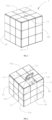
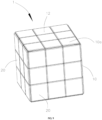
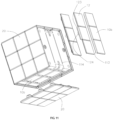
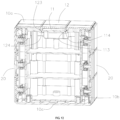
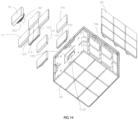
- the first embodiment provides a sliding puzzle toy 1, which includes a main body 10 and a plurality of sliders 20 that can be slidably connected to the main body 10.
- the main body 10 is roughly arranged in a square shape, including two bottom walls 10a and a side wall 10b connected between the two bottom walls 10a.
- the two bottom walls 10a are correspondingly arranged as squares
- the side walls 10b include four closed connected planes 101, wherein each two adjacent planes 101 are connected with an arc-shaped transition surface 102 to enable the sliders 20 to move more smoothly on the side walls 10b.
- the side length of bottom wall 10a is equal to the sum of the side length of side wall 10b and the thickness of two sliders 20. so as to make the outer surface of the sliding puzzle toy 1 smooth and tidy when the slider 20 is connected to the main body 10, making it easy to play.
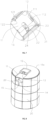
- the main body 10 can also be arranged in other cylindrical structures, such as a cylinder (a sliding puzzle toy provided by the second embodiment as shown in FIG. 8 ), a triangular prism, or other multi prism structures.
- a cylinder a sliding puzzle toy provided by the second embodiment as shown in FIG. 8
- the side wall 10b is a closed curved surface
- the bottom wall 10a is a triangle or other polygon
- the side wall 10b includes three or a corresponding number of planes 101.
- the length or diameter of the bottom wall 10a and the side wall 10b should be adjusted adaptively based on the principle of making the outer surface of the sliding puzzle toy 1 smooth and tidy.
- one of the bottom walls 10a is provided with a recessed slot 11 and a separable block 12.
- One side of the recessed slot 11 is connected to the side wall 10b to enable the recessed slot 11 to serve as a slider gap, and the connection between the recessed slot 11 and the side wall 10b has an arc-shaped transition to enable sliders 20 to move more smoothly between the recessed slot 11 and the side wall 10b.
- it is not limited to setting recessed slots 11 and separable blocks 12 on only one bottom wall 10a, but can also set recessed slots 11 and separable blocks 12 on both bottom walls 10a simultaneously.
- the number of recessed slots 11 and separable blocks 12 on each bottom wall 10a can also be two, three, or more.
- connection slots 111 and two positioning slots 112 are also recessed inside the recessed slot 11.
- the two connection slots 111 are located on opposite sides of the walls inside the recessed slot 11, which are detachably connected to the part of the separable block 12.
- the two positioning slots 112 are located on the bottom wall of recessed slot 11 and are adjacent to one connection slot 111, respectively, which are detachably connected to another part of the separable block 12.
- the recessed slot 11 may not be equipped with a connection slot 111 and/or a positioning slot 112.
- the separable block 12 is matched with the recessed slot 11, and one side of the separable block 12 is detachably connected to the open side of the recessed slot 11.
- the other side of the separable block 12 is pivoted to the side wall of the recessed slot 11 through the connection strip 13.
- the connection strip 13 is accommodated and connected between the separable block 12 and the bottom wall 10a, and the two ends of the connection strip 13 are respectively pivoted with the separable block 12 and the bottom wall 10a.
- the setting of the connection strip 13 allows the separable block 12 to have a high degree of rotational freedom relative to the bottom wall 10a.
- the separable block 12 can also be directly pivoted with the side wall of the recessed slot 11.
- the separable block 12 matches with the recessed slot 11 can also be directly and detachably connected to the recessed slot 11.
- the slider gap can be opened or closed by placing the separable block 12 in the recessed slot 11 or disassembling and separating the separable block 12 from the recessed slot 11.
- the two side walls opposite each other of the separable block 12 are respectively provided with one snap bulge 121 and one snap block 122, wherein the snap bulge is arranged corresponding to the connection slot 111 and is detachably connected to the connection slot 111, which is used to enable the separable block 12 to be stably connected to the recessed slot 11 when the sliding puzzle toy 1 is idle, preventing the separable block 12 from detaching from the recessed slot 11 under gravity.
- the snap block 122 is located on the side facing the positioning slot 112 on the side wall of the separable block 12.
- the snap block 122 is matched with the positioning slot 112 and is detachably connected to the positioning slot 112, playing a role in positioning and fixing the separable block 12 and the recessed slot 11 in collaboration with the snap bulge 121 and the connection slot 111.
- the separable block 12 when there is no connection slot 111 and/or positioning slot 112 in the recessed slot 11, the separable block 12 is also not provided with a snap bulge 121 and/or a snap block 122.
- the structural design of setting the recessed slot 11 and separable block 12 on the bottom wall 10a has the advantage of a more streamlined and compact connection structure between the separable block 12 and the bottom wall 10a compared to the structure of setting the separable puzzle unit blocks on the side wall in existing technology, which is beneficial for reducing production costs and improving assembly efficiency.
- setting the recessed slot 11 and the separable block 12 on the bottom wall 10a not only facilitates the operation of flipping the separable block 12, but also enables the slider 20 to move on the side wall 10b without being limited by the pattern of the separable block 12.
- the outer surface of the side wall 10b is provided with a plurality of the sliding grooves which are intersected with each other along the circumferential and longitudinal directions, and the sliding groove is movably connected with a part structure of slider 20.
- the sliding groove includes three circumferential sliding grooves 14 and twelve longitudinal sliding grooves 15, wherein one longitudinal sliding groove 15 passes through the connection between the recessed slot 11 and the side wall 10b and extends towards the bottom wall of the recessed slot 11 to enable the slider 20 to enter and exit the recessed slot 11 under the guidance of the longitudinal sliding groove 15.
- the number of circumferential sliding grooves 14 and longitudinal sliding grooves 15 can be adaptively adjusted according to the number and arrangement of sliders 20.
- Each slider 20 includes a plate 21 and a base pillar 22 arranged in a vertical direction, wherein the plate 21 is exposed on the side wall 10b and matched with the side wall 10b, that is, when the side wall 10b is a closed curved surface, the plate 21 is an arc-shaped plate; when the side wall 10b is connected by multiple closed planes, the plate 21 is a flat plate.
- a pattern can be set on the plate 21 through spraying, adhesive connection, snap-fit connection, buckle connection, threaded connection, bolt connection, or magnetic connection.
- the patterns of several plates 21 can be spliced to form a complete large pattern, and the game can be played by restoring the disrupted patterns of several plates 21.
- the base pillar 22 passes through the sliding groove to movably connect the slider 20 within the sliding groove.
- a positioning piece 23 is slidably sleeved on the base pillar 22, and the positioning piece 23 is movably connected in the sliding groove along with the base pillar 22 and contacts with the inner wall of the sliding groove.
- an elastic member 24 (such as a spring, etc.) connected between the positioning piece 23 and the end of the base pillar 22, which is used for providing an extra space for slider 20 to move smoothly on the main body 10 when the slider 20 crosses the connection between the recessed slot 11 and the side wall 10b and when the slider 20 crosses any arc-shaped transition surface 102, ensuring that the sliding puzzle toy 1 has a good gaming feel.
- the slider 20 can also adopt other structures to achieve the purpose of being movable and connected within the sliding groove, for example, a magnet may be provided fixed at the end of the base pillar 22 in each slider 20, and the magnet is movably connected in the sliding groove along with the base pillar 22. At this time, a magnetic film is set on the outer side on the side wall 10b opposite to the magnet, and the magnetic film is magnetically connected to the magnet to slidably connect the slider 20 to the main body 10.
- the separable block 12 is rotated to open the recessed slot 11.
- the base pillar 22 is driven to move between the circumferential sliding grooves 14 and the longitudinal sliding grooves 15 which are intersected with each other, in order to change the relative position of any slider 20 on the side wall 10b, until the disrupted large pattern is restored to end the game.
- a sliding puzzle toy 1 of the third embodiment of the present disclosure is provided, which differs from the first embodiment in that the separable block 12 can be slidably connected within the recessed slot 11.
- the length of the separable block 12 is equal to the length of the recessed slot 11.
- the other side of the recessed slot 11 is connected to the outside, making the recessed slot 11 a straight structure with both ends intercommunicated.
- the recessed slot 11 can be opened or closed.
- the other side of the recessed slot 11 can also be intercommunicated to the side wall 10b at the same time.
- the recessed slot 11 can be can opened to increase the utilization convenience of the sliding puzzle toy.
- the other side of the recessed slot 11 can also be set only to be connected to the outside.
- a guide slot 113 is provided on the side wall of the recessed slot 11 along the movement direction of the separable block 12.
- the separable block 12 is provided with a first sliding plate 123 on the side wall opposite to the guide slot 113, and the first sliding plate 123 and the guide slot 113 are in a concave-convex sliding fit.
- the bottom wall of the recessed slot 11 is further provided with a limit slot 114 along the movement direction of the separable block 12.
- the separable block 12 is provided with a second sliding plate 124 on the side wall opposite to the limit slot 114, and the second sliding plate 124 and the limit slot 114 are in a concave-convex sliding fit.
- the bottom wall of the recessed slot 11 may not be equipped with a limited slot 114, and at this time, the separable block 12 may not be correspondingly equipped with a second sliding plate 124.
- a sliding puzzle toy 1 of the fourth embodiment of the present disclosure is provided, which differs from the third embodiment is that in the fourth embodiment, the length of the separable block 12 is smaller than the length of the recessed slot 11.
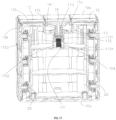
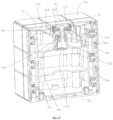
- the part of the recessed slot 11 far away from the side wall 10b is recessed to form a receiving cavity 115, and the receiving cavity 115 is connected to a moving block 16 through an elastic member (such as the first spring 103).
- the moving block 16 moves within the receiving cavity 115, the moving block 16 has a first state adjacent to the separating block 12 and a second state overlapped with the separating block 12. Therefore, when the moving block 16 moves downwards towards the receiving cavity 115, it can still move the separating block 12 within the recessed slot 11 to the second state overlapped with the moving block 16, achieving the opening of the recessed slot 11.
- the receiving cavity 115 in the recessed slot 11 can also be set adjacent to the side wall 10b according to different shapes and structures of the puzzle toy.
- the moving block 16 can also be movably connected to the receiving cavity 115 through other means, such as a structure with concave-convex moving fit, a structure with meshing moving fit, etc.
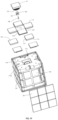
- the recessed slot 11 includes two sub slots 110 that intersect with each other in a cross shape.
- the intersection position of the two sub slots 110 is recessed to form a receiving cavity 115, and each sub slot 110 is sliding with two separable blocks 12.
- the recessed slot 11 can be opened, so as to increase the utilization convenience of the sliding puzzle toy. It can be understood that since recessed slot 11 is composed of two cross intersecting sub slots 110, four separable blocks 12 are respectively moved and set at the midpoint positions of the four sides of the bottom wall 10a on one bottom wall 10a of the main body 10.
- the recessed slot 11 may also include three or more intersecting sub slots 110. At this time, the intersection position of any two sub slots 110 is recessed to form a receiving cavity 115, and at least one separable block 12 is sliding inside each sub slot 110.
- the moving block 16 is provided with a connection post 161 on the side wall corresponding to the moving cavity 1152, and the connection post 161 can be movably connected within the moving cavity 1152.
- the receiving cavity 115 may not be provided with a moving cavity 1152, accordingly, the moving block 16 is not provided with a connection post 161.
- the bottom wall of the moving cavity 1152 and the connection post 161 can also be connected through an elastic member (such as a spring) to enhance the ability of the moving block 16 to reset automatically.
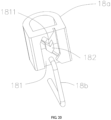
- the restriction block 18a is fixed and slidably connected to the connection post 161 in the mobile cavity 1152.
- One side of the wall of the restriction block 18a is provided with a channel 181.
- an arrow-shaped raised rib 182 is arranged in the middle of the channel 181, to make a M-shaped passage form inside the channel 181.
- the channel 181 is provided with a recessed point 1811 which is recessed downwards.
- the side walls of the channel 181 are equipped with inclined planes that are guided in conjunction with the raised ribs 182.
- channel 181 may not be limited to the M-shaped passage configuration in this embodiment, and the channel 181 may also be configured in other shapes with a recessed point 1811.
- restriction rod 18b One end of the restriction rod 18b is fixed in the mounting hole 1155, and the other end of the restriction rod 18b corresponds to a raised rib 182 and can be movably connected in the channel 181, so that the end of the restriction rod 18b can move with the movement of the restriction block 18a, and move to the recessed point 1811 of the channel 181 to engage or separate, thereby achieving the positioning and resetting of the moving block 16.
- the process of the moving block 16 moving within the moving cavity 1152 through the restriction block 18a and the restriction rod 18b is roughly as follows: as shown in FIG 20 and FIG. 21 , if the moving block 16 is pressed, the connection post 161 will drive the restriction block 18a to move within the moving cavity 1152. At this time, the end of the restriction rod 18b moves to clamp with the recessed point 1811 of the channel 181 under the guidance of the raised rib 182 and the side wall of the channel 181, so that the moving block 16 can be positioned and fixed in the receiving cavity 115, at this point, the first spring 103 is in a compressed state.
- the restriction block 18a moves with the connection post 161 in the moving cavity 1152, so that the end of the restriction rod 18b can move to separate from the recessed point 1811 of the channel 181 under the guidance of the raised rib 182 and the side wall of the channel 181. Therefore, when the external force on the moving block 16 is withdrawn, the end of the restriction rod 18b can move again in the channel 181, finally, under the force of the first spring 103, the moving block 16 is driven to move and reset (as shown in FIG 21 ).
Landscapes
- Engineering & Computer Science (AREA)
- Multimedia (AREA)
- Toys (AREA)
Claims (9)
- Schiebepuzzle-Spielzeug, umfassend einen Hauptkörper (10) und eine Vielzahl von Schiebern (20), die verschiebbar mit dem Hauptkörper (10) verbunden sind, wobei der Hauptkörper (10) eine untere Wand, eine obere Wand (10a) und eine Seitenwand (10b) umfasst, die zwischen der einen unteren Wand und der einen oberen Wand (10a) verbunden ist, wobei mindestens eine der einen unteren Wand und der einen oberen Wand (10a) mit einem vertieften Schlitz (11) und einem trennbaren Block (12) versehen ist, wobei eine Seite des vertieften Schlitzes (11) mit der Seitenwand (10b) verbunden ist, wobei ein Bogenübergang an einer Verbindung zwischen dem vertieften Schlitz (11) und der Seitenwand (10b) vorgesehen ist, und wobei der trennbare Block (12) beweglich oder lösbar mit dem vertieften Schlitz (11) verbunden ist; wobei eine äußere Oberfläche der Seitenwand (10b) mit einer Vielzahl von Gleitnuten versehen ist, die einander entlang von Umfangs- und Längsrichtungen schneiden, wobei die Gleitnuten beweglich mit den Schiebern (20) verbunden sind und eine der Gleitnuten in der Längsrichtungen durch eine Verbindung zwischen dem vertieften Schlitz (11) und der Seitenwand (10b) hindurchgeht und sich zu einer Bodenwand des vertieften Schlitzes (11) erstreckt, dadurch gekennzeichnet, dass,der trennbare Block (12) gleitend innerhalb des vertieften Schlitzes (11) verbunden ist, wobei eine Länge des trennbaren Blocks (12) gleich oder kleiner als eine Länge des vertieften Schlitzes (11) ist;wobei die Länge des trennbaren Blocks (12) geringer als die Länge des vertieften Schlitzes (11) ist, wobei ein Teil des vertieften Schlitzes (11) vertieft ist, um einen Aufnahmehohlraum (115) zu bilden, wobei ein beweglicher Block (16) beweglich innerhalb des Aufnahmehohlraums (115) verbunden ist und der bewegliche Block (16) einen ersten Zustand angrenzend an den trennbaren Block (12) und einen zweiten Zustand, der sich mit dem trennbaren Block (12) überlappt, aufweist;wobei eine Seitenwand des vertieften Schlitzes (11) mit einem Führungsschlitz (113) entlang einer Bewegungsrichtung des trennbaren Blocks (12) versehen ist, wobei der trennbare Block (12) mit einer ersten Gleitplatte (123) an der dem Führungsschlitz (113) gegenüberliegenden Seitenwand versehen ist und die erste Gleitplatte (123) und der Führungsschlitz (113) in einer konkav-konvexen Gleitpassung sind; undwobei die vertieften Schlitze (11) mindestens zwei Teilschlitze (110) umfassen, die sich miteinander kreuzen, wobei eine Kreuzungsposition von zwei beliebigen Teilschlitzen (110) vertieft ist, um den Aufnahmehohlraum (115) zu bilden, und wobei jeder Teilschlitz (110) mit mindestens einem abtrennbaren Block (12) gleitend versehen ist.
- Schiebepuzzle-Spielzeug nach Anspruch 1, dadurch gekennzeichnet, dass der trennbare Block (12) mit dem vertieften Schlitz (11) übereinstimmt, wobei eine Seite des trennbaren Blocks (12) lösbar mit einer offenen Seite des vertieften Schlitzes (11) verbunden ist und eine andere Seite des trennbaren Blocks (12) schwenkbar an einer Seitenwand des vertieften Schlitzes (11) befestigt ist.
- Schiebepuzzle-Spielzeug nach Anspruch 2, dadurch gekennzeichnet, dass der trennbare Block (12) über einen Verbindungsstreifen (13) mit der Bodenwand (10a) verbunden ist, wobei der Verbindungsstreifen (13) zwischen dem trennbaren Block (12) und der Bodenwand untergebracht und verbunden ist und die beiden Enden des Verbindungsstreifens (13) jeweils mit dem trennbaren Block (12) und der Bodenwand (10a) schwenkbar verbunden sind.
- Schiebepuzzle-Spielzeug nach Anspruch 1, dadurch gekennzeichnet, dass jeder trennbare Block (12) an der dem beweglichen Block (16) benachbarten Seitenwand mit dem Führungsschlitz (113) versehen ist.
- Schiebepuzzle-Spielzeug nach Anspruch 1, dadurch gekennzeichnet, dass eine Bodenwand des Aufnahmehohlraums (115) ferner mit einem beweglichen Hohlraum (1152) versehen ist und der bewegliche Block (16) mit einem Verbindungspfosten (161) an der dem beweglichen Hohlraum (1152) entsprechenden Seitenwand versehen ist und der Verbindungspfosten (161) beweglich innerhalb des beweglichen Hohlraums (1152) verbunden ist.
- Schiebepuzzle-Spielzeug nach Anspruch 5, dadurch gekennzeichnet, dass die Bodenwand des Aufnahmehohlraums (115) mit dem beweglichen Block (16) und/oder eine Bodenwand des beweglichen Hohlraums (1152) mit dem Verbindungspfosten (161) durch mindestens ein elastisches Element (24) verbunden ist.
- Schiebepuzzle-Spielzeug nach Anspruch 5, dadurch gekennzeichnet, dass eine Seitenwand des beweglichen Hohlraums (1152) in Umfangsrichtung in Abständen mit einer Vielzahl von Führungsrippen (1153) versehen ist und jedes Ende der Führungsrippen (1153) mit einer ersten geneigten Oberfläche (1154) versehen ist, wobei die erste geneigte Oberfläche (1154) in einer geneigten Z-Form angeordnet ist und der Verbindungspfosten (161) durch einen Schubblock (17a) und einen Begrenzungsblock (17b) beweglich mit dem beweglichen Hohlraum (1152) verbunden ist;wobei der Schubblock (17a) an dem Verbindungspfosten (161) befestigt ist und gleitend zwischen der Vielzahl von Führungsrippen (1153) verbunden ist, und wobei ein Ende des Schubblocks (17a) in dem beweglichen Hohlraum (1152) mit gezackten Klauen (171) in einer Umfangsrichtung versehen ist; undwobei der Begrenzungsblock (17b) mit einer Bodenwand des beweglichen Hohlraums (1152) durch ein elastisches Element (24) verbunden ist und eine Außenwand des Begrenzungsblocks (17b) mit einer Vielzahl von Positionierungsrippen (172) versehen ist; wobei jede Positionierungsrippe (172) gleitend zwischen zwei beliebigen Führungsrippen (1153) verbunden ist, wobei jede Positionierungsrippe (172) an einem den gezackten Klauen (171) gegenüberliegenden Ende mit einer zweiten geneigten Fläche (173) versehen ist, wobei die zweite geneigte Fläche (173) mit den gezackten Klauen (171) in Kontakt steht, und wobei eine Neigungsrichtung und ein Neigungswinkel jeder zweiten geneigten Fläche (173) die gleichen wie die der ersten geneigten Fläche (1154) sind.
- Schiebepuzzle-Spielzeug nach Anspruch 6, dadurch gekennzeichnet, dass die Bodenwand des beweglichen Hohlraums (1152) mit einem Montageloch (1155) versehen ist und der Verbindungspfosten (161) über einen Sperrblock (18a) und eine Begrenzungsstange (18b) beweglich mit dem beweglichen Hohlraum (1152) verbunden ist;wobei der Sperrblock (18a) an dem Verbindungspfosten (161) befestigt und gleitend in dem beweglichen Hohlraum (1152) verbunden ist, wobei eine Seite des Sperrblocks (18a) mit einem Kanal (181) versehen ist, wobei der Kanal (181) mit einer nach unten vertieften Punkt (1811) versehen ist; undwobei ein Ende der Begrenzungsstange (18b) im Montageloch (1155) befestigt ist und ein anderes Ende der Begrenzungsstange (18b) beweglich im Kanal (181) verbunden ist und mit dem vertieften Punkt (1811) verbunden oder von diesem getrennt ist.
- Schiebepuzzle-Spielzeug nach Anspruch 1-8, dadurch gekennzeichnet, dass jeder Schieber (20) eine Platte (21) und eine Basissäule (22) umfasst, die entlang einer vertikalen Richtung angeordnet sind, wobei die Platte (21) der Seitenwand (10b) freiliegt, wobei die Basissäule (22) beweglich in der Gleitnut verbunden ist, wobei ein Positionierstück (23) gleitend auf der Basissäule (22) gelagert ist, wobei das Positionierstück (23) beweglich mit der Gleitnut verbunden ist und eine Innenwand der Gleitnut berührt, und ein elastisches Element (24) zwischen dem Positionierstück (23) und einem Ende der Basissäule (22) verbunden ist.
Applications Claiming Priority (2)
| Application Number | Priority Date | Filing Date | Title |
|---|---|---|---|
| CN202320056772.1U CN219185786U (zh) | 2023-01-09 | 2023-01-09 | 滑动拼图玩具 |
| CN202322716462.0U CN221155333U (zh) | 2023-10-10 | 2023-10-10 | 拼图玩具的开合结构和立体拼图玩具 |
Publications (3)
| Publication Number | Publication Date |
|---|---|
| EP4397383A1 EP4397383A1 (de) | 2024-07-10 |
| EP4397383B1 true EP4397383B1 (de) | 2025-07-09 |
| EP4397383C0 EP4397383C0 (de) | 2025-07-09 |
Family
ID=89121700
Family Applications (1)
| Application Number | Title | Priority Date | Filing Date |
|---|---|---|---|
| EP23214654.8A Active EP4397383B1 (de) | 2023-01-09 | 2023-12-06 | Gleitendes puzzlespielzeug |
Country Status (3)
| Country | Link |
|---|---|
| US (1) | US12383817B2 (de) |
| EP (1) | EP4397383B1 (de) |
| JP (1) | JP3245553U (de) |
Family Cites Families (18)
| Publication number | Priority date | Publication date | Assignee | Title |
|---|---|---|---|---|
| DE3039513A1 (de) * | 1980-10-20 | 1982-05-19 | Mandl, Klaus, Dipl.-Ing., 8900 Augsburg | Permutationsspiel oder puttzlespiel |
| US4526372A (en) * | 1982-01-20 | 1985-07-02 | Kikis Evangelos T | Puzzle toy |
| FR2549381B1 (fr) * | 1983-07-22 | 1987-02-20 | Gueytron Jean Claude | Perfectionnements aux jeux dits " casse-tete " |
| GB2176410A (en) * | 1985-06-17 | 1986-12-31 | Chow Hwa Ong | Cube puzzle |
| US4872682A (en) * | 1987-11-17 | 1989-10-10 | Ravi Kuchimanchi | Cube puzzle with moving faces |
| WO1994027694A1 (fr) * | 1993-05-26 | 1994-12-08 | Lopez Victor Hugo | Puzzle a trois dimensions |
| DE9418860U1 (de) * | 1994-11-24 | 1995-02-23 | Feller, Erhard, 59555 Lippstadt | Schiebespiel mit (Ent-) Sicherungsklappe |
| FR2790972A1 (fr) * | 1999-03-17 | 2000-09-22 | Bruno Mutel | Cube a plaques coulissantes |
| FR2797195A1 (fr) * | 1999-08-02 | 2001-02-09 | Jean Marc Huguet | Jeu logique en forme de ballon dont la surface est composee d'elements mobiles |
| US7243918B2 (en) * | 2003-06-05 | 2007-07-17 | Robert D Vernon | Extension for rotatable puzzle piece |
| US7918457B2 (en) * | 2005-02-25 | 2011-04-05 | Dpt | Ball-shaped puzzle |
| US7547019B2 (en) * | 2007-03-19 | 2009-06-16 | Ying-Jen Chen | Three-dimensional DIY assembly intelligence structure |
| DE202008002004U1 (de) * | 2008-02-13 | 2008-04-17 | Scherpe, Andreas, Dr. | Logisches Stereospielzeug |
| US8387984B2 (en) * | 2010-04-07 | 2013-03-05 | Bahry Uri Management Ltd. | Manipulative three-dimensional puzzle |
| CN203469438U (zh) | 2013-07-18 | 2014-03-12 | 广州灵动创想文化科技有限公司 | 一种拼图玩具 |
| TWI630017B (zh) * | 2017-04-28 | 2018-07-21 | 楊儒勳 | 多軸旋轉拼圖益智玩具 |
| KR102062307B1 (ko) * | 2017-06-13 | 2020-01-03 | 울산과학기술원 | 미로 형태의 큐브 블록 |
| JP2021533935A (ja) * | 2018-08-18 | 2021-12-09 | ツァオ、ヤンCAO, Yang | 再構築可能な経路を備えた空間迷路パズル |
-
2023
- 2023-12-05 US US18/529,959 patent/US12383817B2/en active Active
- 2023-12-06 EP EP23214654.8A patent/EP4397383B1/de active Active
- 2023-12-07 JP JP2023004399U patent/JP3245553U/ja active Active
Also Published As
| Publication number | Publication date |
|---|---|
| JP3245553U (ja) | 2024-02-05 |
| EP4397383A1 (de) | 2024-07-10 |
| EP4397383C0 (de) | 2025-07-09 |
| US12383817B2 (en) | 2025-08-12 |
| US20240226711A1 (en) | 2024-07-11 |
Similar Documents
| Publication | Publication Date | Title |
|---|---|---|
| CN108568089B (zh) | 磁力定位魔方 | |
| EP4094814A1 (de) | Magischer magnetschwebewürfel | |
| US20160317911A1 (en) | Device with multi-directional moving members | |
| CN112996577A (zh) | 具有可重新配置路径的空间迷宫 | |
| JP7393037B2 (ja) | 立体パズル | |
| EP4397383B1 (de) | Gleitendes puzzlespielzeug | |
| US11007425B2 (en) | Sliding intelligence toy | |
| KR102937106B1 (ko) | 자석 블럭완구 | |
| US4418915A (en) | Puzzle of stacked segments | |
| CN218572800U (zh) | 一种拼图 | |
| KR100524154B1 (ko) | 패널형 자석놀이완구 | |
| KR20240022966A (ko) | 변형 가능한 장난감 | |
| CN219185786U (zh) | 滑动拼图玩具 | |
| EP3456396B1 (de) | Klappspielzeug | |
| US5542673A (en) | Intersecting manipulable puzzle | |
| RU226313U1 (ru) | Раздвижная игрушка-головоломка | |
| CN215538363U (zh) | 一种磁力定位及磁力减速魔方棱块结构 | |
| JPH11300026A (ja) | 回転式球体嵌め合わせ玩具 | |
| US12434132B2 (en) | Detachable sliding toy | |
| JP2016083182A (ja) | 立体パズル | |
| CN113952704A (zh) | 魔方的可调磁力结构 | |
| US12383816B2 (en) | Sliding puzzle | |
| CN101002987A (zh) | 可转动球体拼图 | |
| CN221673404U (zh) | 一种棱块及魔方 | |
| TWI832446B (zh) | 迷宮盒 |
Legal Events
| Date | Code | Title | Description |
|---|---|---|---|
| PUAI | Public reference made under article 153(3) epc to a published international application that has entered the european phase |
Free format text: ORIGINAL CODE: 0009012 |
|
| STAA | Information on the status of an ep patent application or granted ep patent |
Free format text: STATUS: REQUEST FOR EXAMINATION WAS MADE |
|
| 17P | Request for examination filed |
Effective date: 20231230 |
|
| AK | Designated contracting states |
Kind code of ref document: A1 Designated state(s): AL AT BE BG CH CY CZ DE DK EE ES FI FR GB GR HR HU IE IS IT LI LT LU LV MC ME MK MT NL NO PL PT RO RS SE SI SK SM TR |
|
| GRAP | Despatch of communication of intention to grant a patent |
Free format text: ORIGINAL CODE: EPIDOSNIGR1 |
|
| STAA | Information on the status of an ep patent application or granted ep patent |
Free format text: STATUS: GRANT OF PATENT IS INTENDED |
|
| INTG | Intention to grant announced |
Effective date: 20250324 |
|
| GRAS | Grant fee paid |
Free format text: ORIGINAL CODE: EPIDOSNIGR3 |
|
| GRAA | (expected) grant |
Free format text: ORIGINAL CODE: 0009210 |
|
| STAA | Information on the status of an ep patent application or granted ep patent |
Free format text: STATUS: THE PATENT HAS BEEN GRANTED |
|
| AK | Designated contracting states |
Kind code of ref document: B1 Designated state(s): AL AT BE BG CH CY CZ DE DK EE ES FI FR GB GR HR HU IE IS IT LI LT LU LV MC ME MK MT NL NO PL PT RO RS SE SI SK SM TR |
|
| REG | Reference to a national code |
Ref country code: GB Ref legal event code: FG4D |
|
| REG | Reference to a national code |
Ref country code: CH Ref legal event code: EP |
|
| REG | Reference to a national code |
Ref country code: IE Ref legal event code: FG4D |
|
| U01 | Request for unitary effect filed |
Effective date: 20250710 |
|
| U07 | Unitary effect registered |
Designated state(s): AT BE BG DE DK EE FI FR IT LT LU LV MT NL PT RO SE SI Effective date: 20250717 |
|
| PG25 | Lapsed in a contracting state [announced via postgrant information from national office to epo] |
Ref country code: IS Free format text: LAPSE BECAUSE OF FAILURE TO SUBMIT A TRANSLATION OF THE DESCRIPTION OR TO PAY THE FEE WITHIN THE PRESCRIBED TIME-LIMIT Effective date: 20251109 |
|
| PG25 | Lapsed in a contracting state [announced via postgrant information from national office to epo] |
Ref country code: NO Free format text: LAPSE BECAUSE OF FAILURE TO SUBMIT A TRANSLATION OF THE DESCRIPTION OR TO PAY THE FEE WITHIN THE PRESCRIBED TIME-LIMIT Effective date: 20251009 |
|
| PG25 | Lapsed in a contracting state [announced via postgrant information from national office to epo] |
Ref country code: HR Free format text: LAPSE BECAUSE OF FAILURE TO SUBMIT A TRANSLATION OF THE DESCRIPTION OR TO PAY THE FEE WITHIN THE PRESCRIBED TIME-LIMIT Effective date: 20250709 |
|
| PG25 | Lapsed in a contracting state [announced via postgrant information from national office to epo] |
Ref country code: GR Free format text: LAPSE BECAUSE OF FAILURE TO SUBMIT A TRANSLATION OF THE DESCRIPTION OR TO PAY THE FEE WITHIN THE PRESCRIBED TIME-LIMIT Effective date: 20251010 |
|
| PG25 | Lapsed in a contracting state [announced via postgrant information from national office to epo] |
Ref country code: PL Free format text: LAPSE BECAUSE OF FAILURE TO SUBMIT A TRANSLATION OF THE DESCRIPTION OR TO PAY THE FEE WITHIN THE PRESCRIBED TIME-LIMIT Effective date: 20250709 |
|
| PG25 | Lapsed in a contracting state [announced via postgrant information from national office to epo] |
Ref country code: RS Free format text: LAPSE BECAUSE OF FAILURE TO SUBMIT A TRANSLATION OF THE DESCRIPTION OR TO PAY THE FEE WITHIN THE PRESCRIBED TIME-LIMIT Effective date: 20251009 |
|
| PG25 | Lapsed in a contracting state [announced via postgrant information from national office to epo] |
Ref country code: ES Free format text: LAPSE BECAUSE OF FAILURE TO SUBMIT A TRANSLATION OF THE DESCRIPTION OR TO PAY THE FEE WITHIN THE PRESCRIBED TIME-LIMIT Effective date: 20250709 |
|
| U20 | Renewal fee for the european patent with unitary effect paid |
Year of fee payment: 3 Effective date: 20260101 |
|
| PG25 | Lapsed in a contracting state [announced via postgrant information from national office to epo] |
Ref country code: SM Free format text: LAPSE BECAUSE OF FAILURE TO SUBMIT A TRANSLATION OF THE DESCRIPTION OR TO PAY THE FEE WITHIN THE PRESCRIBED TIME-LIMIT Effective date: 20250709 |