EP4388066B1 - Verfahren zum schmieren eines fahrzeug- oder industriegetriebes - Google Patents
Verfahren zum schmieren eines fahrzeug- oder industriegetriebes Download PDFInfo
- Publication number
- EP4388066B1 EP4388066B1 EP22777037.7A EP22777037A EP4388066B1 EP 4388066 B1 EP4388066 B1 EP 4388066B1 EP 22777037 A EP22777037 A EP 22777037A EP 4388066 B1 EP4388066 B1 EP 4388066B1
- Authority
- EP
- European Patent Office
- Prior art keywords
- automotive
- gear oil
- industrial gear
- oil
- thiadiazole
- Prior art date
- Legal status (The legal status is an assumption and is not a legal conclusion. Google has not performed a legal analysis and makes no representation as to the accuracy of the status listed.)
- Active
Links
Classifications
-
- C—CHEMISTRY; METALLURGY
- C10—PETROLEUM, GAS OR COKE INDUSTRIES; TECHNICAL GASES CONTAINING CARBON MONOXIDE; FUELS; LUBRICANTS; PEAT
- C10M—LUBRICATING COMPOSITIONS; USE OF CHEMICAL SUBSTANCES EITHER ALONE OR AS LUBRICATING INGREDIENTS IN A LUBRICATING COMPOSITION
- C10M169/00—Lubricating compositions characterised by containing as components a mixture of at least two types of ingredient selected from base-materials, thickeners or additives, covered by the preceding groups, each of these compounds being essential
- C10M169/04—Mixtures of base-materials and additives
-
- C—CHEMISTRY; METALLURGY
- C10—PETROLEUM, GAS OR COKE INDUSTRIES; TECHNICAL GASES CONTAINING CARBON MONOXIDE; FUELS; LUBRICANTS; PEAT
- C10M—LUBRICATING COMPOSITIONS; USE OF CHEMICAL SUBSTANCES EITHER ALONE OR AS LUBRICATING INGREDIENTS IN A LUBRICATING COMPOSITION
- C10M157/00—Lubricating compositions characterised by the additive being a mixture of two or more macromolecular compounds covered by more than one of the main groups C10M143/00 - C10M155/00, each of these compounds being essential
- C10M157/06—Lubricating compositions characterised by the additive being a mixture of two or more macromolecular compounds covered by more than one of the main groups C10M143/00 - C10M155/00, each of these compounds being essential at least one of them being a sulfur-, selenium- or tellurium-containing compound
-
- C—CHEMISTRY; METALLURGY
- C10—PETROLEUM, GAS OR COKE INDUSTRIES; TECHNICAL GASES CONTAINING CARBON MONOXIDE; FUELS; LUBRICANTS; PEAT
- C10M—LUBRICATING COMPOSITIONS; USE OF CHEMICAL SUBSTANCES EITHER ALONE OR AS LUBRICATING INGREDIENTS IN A LUBRICATING COMPOSITION
- C10M133/00—Lubricating compositions characterised by the additive being an organic non-macromolecular compound containing nitrogen
- C10M133/02—Lubricating compositions characterised by the additive being an organic non-macromolecular compound containing nitrogen having a carbon chain of less than 30 atoms
- C10M133/04—Amines, e.g. polyalkylene polyamines; Quaternary amines
- C10M133/06—Amines, e.g. polyalkylene polyamines; Quaternary amines having amino groups bound to acyclic or cycloaliphatic carbon atoms
- C10M133/08—Amines, e.g. polyalkylene polyamines; Quaternary amines having amino groups bound to acyclic or cycloaliphatic carbon atoms containing hydroxy groups
-
- C—CHEMISTRY; METALLURGY
- C10—PETROLEUM, GAS OR COKE INDUSTRIES; TECHNICAL GASES CONTAINING CARBON MONOXIDE; FUELS; LUBRICANTS; PEAT
- C10M—LUBRICATING COMPOSITIONS; USE OF CHEMICAL SUBSTANCES EITHER ALONE OR AS LUBRICATING INGREDIENTS IN A LUBRICATING COMPOSITION
- C10M157/00—Lubricating compositions characterised by the additive being a mixture of two or more macromolecular compounds covered by more than one of the main groups C10M143/00 - C10M155/00, each of these compounds being essential
- C10M157/08—Lubricating compositions characterised by the additive being a mixture of two or more macromolecular compounds covered by more than one of the main groups C10M143/00 - C10M155/00, each of these compounds being essential at least one of them being a phosphorus-containing compound
-
- C—CHEMISTRY; METALLURGY
- C10—PETROLEUM, GAS OR COKE INDUSTRIES; TECHNICAL GASES CONTAINING CARBON MONOXIDE; FUELS; LUBRICANTS; PEAT
- C10M—LUBRICATING COMPOSITIONS; USE OF CHEMICAL SUBSTANCES EITHER ALONE OR AS LUBRICATING INGREDIENTS IN A LUBRICATING COMPOSITION
- C10M2215/00—Organic non-macromolecular compounds containing nitrogen as ingredients in lubricant Compositions
- C10M2215/02—Amines, e.g. polyalkylene polyamines; Quaternary amines
- C10M2215/04—Amines, e.g. polyalkylene polyamines; Quaternary amines having amino groups bound to acyclic or cycloaliphatic carbon atoms
-
- C—CHEMISTRY; METALLURGY
- C10—PETROLEUM, GAS OR COKE INDUSTRIES; TECHNICAL GASES CONTAINING CARBON MONOXIDE; FUELS; LUBRICANTS; PEAT
- C10M—LUBRICATING COMPOSITIONS; USE OF CHEMICAL SUBSTANCES EITHER ALONE OR AS LUBRICATING INGREDIENTS IN A LUBRICATING COMPOSITION
- C10M2215/00—Organic non-macromolecular compounds containing nitrogen as ingredients in lubricant Compositions
- C10M2215/02—Amines, e.g. polyalkylene polyamines; Quaternary amines
- C10M2215/04—Amines, e.g. polyalkylene polyamines; Quaternary amines having amino groups bound to acyclic or cycloaliphatic carbon atoms
- C10M2215/042—Amines, e.g. polyalkylene polyamines; Quaternary amines having amino groups bound to acyclic or cycloaliphatic carbon atoms containing hydroxy groups; Alkoxylated derivatives thereof
-
- C—CHEMISTRY; METALLURGY
- C10—PETROLEUM, GAS OR COKE INDUSTRIES; TECHNICAL GASES CONTAINING CARBON MONOXIDE; FUELS; LUBRICANTS; PEAT
- C10M—LUBRICATING COMPOSITIONS; USE OF CHEMICAL SUBSTANCES EITHER ALONE OR AS LUBRICATING INGREDIENTS IN A LUBRICATING COMPOSITION
- C10M2219/00—Organic non-macromolecular compounds containing sulfur, selenium or tellurium as ingredients in lubricant compositions
- C10M2219/02—Sulfur-containing compounds obtained by sulfurisation with sulfur or sulfur-containing compounds
- C10M2219/022—Sulfur-containing compounds obtained by sulfurisation with sulfur or sulfur-containing compounds of hydrocarbons, e.g. olefines
-
- C—CHEMISTRY; METALLURGY
- C10—PETROLEUM, GAS OR COKE INDUSTRIES; TECHNICAL GASES CONTAINING CARBON MONOXIDE; FUELS; LUBRICANTS; PEAT
- C10M—LUBRICATING COMPOSITIONS; USE OF CHEMICAL SUBSTANCES EITHER ALONE OR AS LUBRICATING INGREDIENTS IN A LUBRICATING COMPOSITION
- C10M2219/00—Organic non-macromolecular compounds containing sulfur, selenium or tellurium as ingredients in lubricant compositions
- C10M2219/08—Thiols; Sulfides; Polysulfides; Mercaptals
- C10M2219/082—Thiols; Sulfides; Polysulfides; Mercaptals containing sulfur atoms bound to acyclic or cycloaliphatic carbon atoms
-
- C—CHEMISTRY; METALLURGY
- C10—PETROLEUM, GAS OR COKE INDUSTRIES; TECHNICAL GASES CONTAINING CARBON MONOXIDE; FUELS; LUBRICANTS; PEAT
- C10M—LUBRICATING COMPOSITIONS; USE OF CHEMICAL SUBSTANCES EITHER ALONE OR AS LUBRICATING INGREDIENTS IN A LUBRICATING COMPOSITION
- C10M2223/00—Organic non-macromolecular compounds containing phosphorus as ingredients in lubricant compositions
- C10M2223/02—Organic non-macromolecular compounds containing phosphorus as ingredients in lubricant compositions having no phosphorus-to-carbon bonds
- C10M2223/04—Phosphate esters
- C10M2223/045—Metal containing thio derivatives
-
- C—CHEMISTRY; METALLURGY
- C10—PETROLEUM, GAS OR COKE INDUSTRIES; TECHNICAL GASES CONTAINING CARBON MONOXIDE; FUELS; LUBRICANTS; PEAT
- C10N—INDEXING SCHEME ASSOCIATED WITH SUBCLASS C10M RELATING TO LUBRICATING COMPOSITIONS
- C10N2010/00—Metal present as such or in compounds
- C10N2010/04—Groups 2 or 12
-
- C—CHEMISTRY; METALLURGY
- C10—PETROLEUM, GAS OR COKE INDUSTRIES; TECHNICAL GASES CONTAINING CARBON MONOXIDE; FUELS; LUBRICANTS; PEAT
- C10N—INDEXING SCHEME ASSOCIATED WITH SUBCLASS C10M RELATING TO LUBRICATING COMPOSITIONS
- C10N2030/00—Specified physical or chemical properties which is improved by the additive characterising the lubricating composition, e.g. multifunctional additives
- C10N2030/04—Detergent property or dispersant property
-
- C—CHEMISTRY; METALLURGY
- C10—PETROLEUM, GAS OR COKE INDUSTRIES; TECHNICAL GASES CONTAINING CARBON MONOXIDE; FUELS; LUBRICANTS; PEAT
- C10N—INDEXING SCHEME ASSOCIATED WITH SUBCLASS C10M RELATING TO LUBRICATING COMPOSITIONS
- C10N2030/00—Specified physical or chemical properties which is improved by the additive characterising the lubricating composition, e.g. multifunctional additives
- C10N2030/40—Low content or no content compositions
- C10N2030/42—Phosphor free or low phosphor content compositions
-
- C—CHEMISTRY; METALLURGY
- C10—PETROLEUM, GAS OR COKE INDUSTRIES; TECHNICAL GASES CONTAINING CARBON MONOXIDE; FUELS; LUBRICANTS; PEAT
- C10N—INDEXING SCHEME ASSOCIATED WITH SUBCLASS C10M RELATING TO LUBRICATING COMPOSITIONS
- C10N2030/00—Specified physical or chemical properties which is improved by the additive characterising the lubricating composition, e.g. multifunctional additives
- C10N2030/40—Low content or no content compositions
- C10N2030/43—Sulfur free or low sulfur content compositions
-
- C—CHEMISTRY; METALLURGY
- C10—PETROLEUM, GAS OR COKE INDUSTRIES; TECHNICAL GASES CONTAINING CARBON MONOXIDE; FUELS; LUBRICANTS; PEAT
- C10N—INDEXING SCHEME ASSOCIATED WITH SUBCLASS C10M RELATING TO LUBRICATING COMPOSITIONS
- C10N2030/00—Specified physical or chemical properties which is improved by the additive characterising the lubricating composition, e.g. multifunctional additives
- C10N2030/54—Fuel economy
-
- C—CHEMISTRY; METALLURGY
- C10—PETROLEUM, GAS OR COKE INDUSTRIES; TECHNICAL GASES CONTAINING CARBON MONOXIDE; FUELS; LUBRICANTS; PEAT
- C10N—INDEXING SCHEME ASSOCIATED WITH SUBCLASS C10M RELATING TO LUBRICATING COMPOSITIONS
- C10N2040/00—Specified use or application for which the lubricating composition is intended
- C10N2040/04—Oil-bath; Gear-boxes; Automatic transmissions; Traction drives
-
- C—CHEMISTRY; METALLURGY
- C10—PETROLEUM, GAS OR COKE INDUSTRIES; TECHNICAL GASES CONTAINING CARBON MONOXIDE; FUELS; LUBRICANTS; PEAT
- C10N—INDEXING SCHEME ASSOCIATED WITH SUBCLASS C10M RELATING TO LUBRICATING COMPOSITIONS
- C10N2060/00—Chemical after-treatment of the constituents of the lubricating composition
- C10N2060/10—Chemical after-treatment of the constituents of the lubricating composition by sulfur or a compound containing sulfur
-
- C—CHEMISTRY; METALLURGY
- C10—PETROLEUM, GAS OR COKE INDUSTRIES; TECHNICAL GASES CONTAINING CARBON MONOXIDE; FUELS; LUBRICANTS; PEAT
- C10N—INDEXING SCHEME ASSOCIATED WITH SUBCLASS C10M RELATING TO LUBRICATING COMPOSITIONS
- C10N2060/00—Chemical after-treatment of the constituents of the lubricating composition
- C10N2060/12—Chemical after-treatment of the constituents of the lubricating composition by phosphorus or a compound containing phosphorus, e.g. PxSy
-
- C—CHEMISTRY; METALLURGY
- C10—PETROLEUM, GAS OR COKE INDUSTRIES; TECHNICAL GASES CONTAINING CARBON MONOXIDE; FUELS; LUBRICANTS; PEAT
- C10N—INDEXING SCHEME ASSOCIATED WITH SUBCLASS C10M RELATING TO LUBRICATING COMPOSITIONS
- C10N2060/00—Chemical after-treatment of the constituents of the lubricating composition
- C10N2060/14—Chemical after-treatment of the constituents of the lubricating composition by boron or a compound containing boron
Definitions
- the disclosed technology relates to a lubricant composition for automotive or industrial gears, as well as axles and bearings, the automotive or industrial gear oil containing an oil of lubricating viscosity, a particular sulfurized olefin, a hydroxyalkylamine containing booster, and either a metal thiophosphate compound, such as zinc dialkyldithiophosphate, a thiadiazole functionalized dispersant, or a mixture thereof, and an optional phosphate and/or thiophosphate compound, as well as a method of improving automotive or industrial gear operating efficiency and temperature by lubricating such automotive or industrial gears with the automotive or industrial gear oil.
- a metal thiophosphate compound such as zinc dialkyldithiophosphate, a thiadiazole functionalized dispersant, or a mixture thereof
- an optional phosphate and/or thiophosphate compound as well as a method of improving automotive or industrial gear operating efficiency and temperature by lubricating such automotive or industrial gears with the
- Driveline power transmitting devices (such as gears or transmissions) present highly challenging technological problems and solutions for satisfying the multiple and often conflicting lubricating requirements, while providing durability and cleanliness.
- Improving operating efficiency is a common goal shared by both original equipment manufacturers and lubricant manufacturers.
- Original equipment manufacturers may focus on using mechanical processing methods to reduce surface roughness in an effort to improve operating efficiency and reduce power loss. These mechanical processing methods include honing, top polishing, and vibratory finishing.
- lubricant manufacturers often target optimizing rheology and friction in their efforts to optimize operating efficiency.
- Current mechanical processing methods can be expensive and time consuming to implement for large scale automotive gear production. Therefore, there is a desire to improve operating efficiency by modifying fluid properties, instead of relying on mechanical processes to achieve this goal.
- WO 20201101969 A1 discloses a lubricant composition comprising a. an oil of lubricating viscosity; b. 0.5 to 2.0 wt% of an amine alkyl(thio)phosphate compound, and c. 0.1 to 2 wt% of a metal alkylthiophosphate.
- % efficiency [(power in - power loss)/power in] *100%.
- Efficiency, or power loss can also be related to operating temperature, as has been reported in the literature ( Barton, W.
- One aspect of the technology is therefore directed to an automotive or industrial gear oil comprising an oil of lubricating viscosity, from 0.01 to 10 wt.% of a sulfurized olefin, from 100 to 10,000 ppm, or 150 ppm to 9,000 ppm, or 200 ppm to 8,000 ppm, or 250 ppm to 7,000 ppm, or 300 ppm to 5,000 ppm or 600 ppm to 3,000 ppm of a hydroxyalkylamine containing hydroxyalkylamine containing booster, and at least one of: from 0.1 to 2 wt.%, or 0.2 to 1.9 wt.%, or 0.2 to 1 wt.%, or 1.0 to 1.8 wt.% of a metal alkylthiophosphate, from 0.1 to 8 wt.%, or 0.3 to 4 wt.
- a sulfurized olefin from 100 to 10,000 ppm, or 150 ppm to 9,000 ppm, or 200
- the lubricant can optionally include from 0.5 to 2.0 wt.% of an amine alkyl(thio)phosphate compound.
- the sulfurized olefin can be the reaction product of an olefin containing from two to six carbon atoms reacted with hydrogen sulfide and sulfur under super-atmospheric pressure in the presence of a catalyst.
- the sulfurized olefin can be a mixture of sulfurized olefins of formula R 1 -S x -R 2 where R 1 and R 2 separately are derived from 2 to 6 carbon atom containing olefins and x is an integer of between 1 and 10, with the proviso that the sulfurized olefin will have a sulfur content of from about 10 to about 50 wt.%.
- the hydroxyalkylamine containing booster includes those of structure I: where: R 5 is a C 4 to C 30 hydrocarbyl group; R 3 and R 4 are individually H or a C 1 to C 6 hydrocarbyl group.
- the metal alkylthiophosphate in the automotive or industrial gear oil can include a zinc dialkyldithiophosphate.
- the zinc dialkyldithiophosphate can be a secondary zinc dialkyldithiophosphate.
- the thiadiazole-functionalized dispersant can be a mixture prepared by a method including heating, reacting or complexing a thiadiazole compound with a dispersant substrate.
- the optional amine alkyl(thio)phosphate can be simply an amine alkylphosphate. In other embodiments, the optional amine alkyl(thio)phosphate can be an amine alkylthiophosphate. In further embodiments, the optional amine alkyl(thio)phosphate can include a combination of both amine phosphate and amine alkylthiophosphate. In embodiments, the optional amine alkylthiophosphate can be a dialkyldithiophosphate.
- the lubricant can include an amine phosphate that is a substantially sulfur-free alkyl phosphate amine salt having at least about 30 mole percent of the phosphorus atoms in an alkyl pyrophosphate salt structure.
- at least about 80 mole percent of the alkyl groups in such a sulfur-free alkyl phosphate can be secondary alkyl groups of about 3 to about 12 carbon atoms.
- at least about 25 mole percent of the alkyl groups in such a sulfur-free alkyl phosphate can be primary alkyl groups of about 3 to about 12 carbon atoms.
- the automotive or industrial gear oil can also contain other additives.
- the automotive or industrial gear oil can include other sulfur containing additives in an amount to provide the composition with a total sulfur level of about 0.75 to about 5 wt.%.
- the automotive or industrial gear oil can have a total phosphorus level of about 0.01 to about 0.5 wt.% or about 0.02 to about 0.4 wt.%, or about 0.08 to about 0.3 wt.%, or about 0.1 to about 0.25 wt.%, or even about 0.02 to about 0.10 wt.%, or about 0.025 to about 0.07 wt.%.
- Another aspect of the technology encompasses a method of lubricating a driveline power transmitting device by supplying to the driveline power transmitting device an automotive or industrial gear oil as described, and operating the driveline power transmitting device.
- the driveline power transmitting device can be, for example, an axle, a bearing, a transmission or a gear.
- One aspect of the invention is an automotive or industrial gear oil containing (a) an oil of lubricating viscosity, (b) sulfurized olefin or mixtures thereof, (c) hydroxyalkylamine containing booster, and (d) at least one of: (i) metal alkylthiophosphate, (ii) thiadiazole-functionalized dispersant, or (iii) mixtures thereof, and optionally, (e) at least one amine alkyl(thio)phosphate.
- the base oil may be selected from any of the base oils in Groups I-V of the American Petroleum Institute (API) Base Oil Interchangeability Guidelines (2011), namely Base Oil Category Sulfur (%) Saturates (%) Viscosity Index Group I >0.03 and/or ⁇ 90 80 to less than 120 Group II ⁇ 0.03 and ⁇ 90 80 to less than 120 Group III ⁇ 0.03 and ⁇ 90 ⁇ 120 Group IV All polyalphaolefins (PAOs) Group V All others not included in Groups I, II, III or IV
- Groups I, II and III are mineral oil base stocks. Other generally recognized categories of base oils may be used, even if not officially identified by the API: Group II+, referring to materials of Group II having a viscosity index of 110-119 and lower volatility than other Group II oils; and Group III+, referring to materials of Group III having a viscosity index greater than or equal to 130.
- the oil of lubricating viscosity can include natural or synthetic oils and mixtures thereof. Mixtures of mineral oil and synthetic oils, e.g., polyalphaolefin oils and/or polyester oils, may be used.
- the oil of lubricating viscosity has a kinematic viscosity at 100 °C by ASTM D445 of 1.5 to 7.5, or 2 to 7, or 2.5 to 6.5, or 3 to 6 mm 2 /s. In one embodiment the oil of lubricating viscosity comprises a poly alpha olefin having a kinematic viscosity at 100 °C by ASTM D445 of 1.5 to 7.5 or any of the other aforementioned ranges.
- the sulfurized olefins employed in the present technology encompass mixtures, the compositions of which are not easily described aside from the reaction used to prepare them.
- the sulfurized olefins are about 80% polysulfides, mostly di-t-butyl polysulfides, with a range of sulfur atoms of between 2 or 3 and 8, mostly centered around 3 and 5 or 3 and 4 carbon atoms.
- the mixtures may be generically represented by the formula: R 1 -S x -R 2 , where R 1 and R 2 separately are derived from 2 to 6 carbon atom containing olefins and x is an integer of between 1 and 10, or 2 to 9 or 3 to 8 or 3 to 7, with the proviso that the sulfurized olefin will have a sulfur content of from about 10 to about 50 wt.%.
- the sulfurized olefins are the reaction products of olefins containing from two to six carbon atoms reacted with hydrogen sulfide and sulfur under super-atmospheric pressure in the presence of a catalyst.
- Olefinic compounds which may be sulfurized by the method of this invention are diverse in nature and may be substituted or un-substituted.
- the nature of the substituents if/when the olefin is substituted is not normally a critical aspect of the technology and any such substituent is useful so long as it is or can be made compatible with lubricating environments and does not interfere under the contemplated reaction conditions.
- substituted compounds which are so unstable as to deleteriously decompose under the reaction conditions employed are not contemplated.
- certain substituents such as keto or aldehyde can desirably undergo sulfurization. The selection of suitable substituents is within the skill of the art or may be established through routine testing.
- substituents include any of the above-listed moieties as well as ester, carboxylate, hydroxy, amidine, amino, sulfonyl, sulfinyl, sulfonate, nitro, phosphate, phosphite, alkali metal mercapto and the like.
- Example olefins from which the sulfurized olefin can be prepared can contain from 2 to 30 carbon atoms. In some cases the olefins can contain two to 16 carbon atoms. Often, the olefins can contain two to six carbon atoms.
- the sulfurized olefin may also be prepared from an olefin containing from three to five carbon atoms.
- the olefin can be butylene.
- the olefin can also be isobutylene.
- Amylene may also be employed as the olefin.
- the olefin may also be isoamylene.
- the olefin may also be diisobutylene.
- Sulfurized olefins suitable for use herein may be prepared from mixtures of any of the foregoing olefins.
- the other two reagents which are essential in the method for preparing the sulfurized olefin, sulfur and hydrogen sulfide, are well known and are commercially available. Commercial sources of all these reagents are normally used, and impurities normally associated therewith may be present without adverse results.
- the amounts of sulfur and hydrogen sulfide per mole of olefinic compound are, respectively, about 0.3-2.0 molar equivalents and about 0.1-1.5 molar equivalents.
- the preferred ranges are about 0.5-1.5 molar equivalents and about 0.4-1.25 molar equivalents respectively, and the most desirable ranges are about 0.7-1.2 molar equivalents and about 0.4-0.8 molar equivalents respectively.
- the temperature range in which the sulfurization reaction is carried out is generally about 50°-350° C.
- the preferred range is about 100°-200° C, with about 125°-180° C being especially suitable.
- the reaction is conducted under superatmospheric pressure; this may be and usually is autogenous pressure (i.e., the pressure which naturally develops during the course of the reaction) but may also be externally applied pressure.
- the exact pressure developed during the reaction is dependent upon such factors as the design and operation of the system, the reaction temperature, and the vapor pressure of the reactants and products and it may vary during the course of the reaction.
- materials useful as sulfurization catalysts may be acidic, basic or neutral.
- Useful neutral and acidic materials include acidified clays such as "Super Filtrol", p-toluenesulfonic acid, dialkyl-phosphorodithioic acids, and phosphorus sulfides such as phosphorus pentasulfide.
- the preferred catalysts are basic materials. These may be inorganic oxides and salts such as sodium hydroxide, calcium oxide and sodium sulfide. The most desirable basic catalysts, however, are nitrogen bases including ammonia and amines.
- the amines includes primary, secondary and tertiary hydrocarbyl amines wherein the hydrocarbyl radicals are alkyl, aryl, aralkyl, alkaryl or the like and contain about 1-20 carbon atoms.
- Suitable amines include aniline, benzylamine, dibenzylamine, dodecylamine, butylamine, 2-ethylhexylamine, naphthylamine, tallow amines, N-ethyldipropylamine, N-phenylbenzylamine, N,N-diethylbutylamine, m-toluidine and 2,3-xylidine.
- heterocyclic amines such as pyrrolidine, N-methylpyrrolidine, piperidine, pyridine and quinoline.
- the preferred basic catalysts include ammonia and primary, secondary, or tertiary alkylamines having about 1-8 carbon atoms in the alkyl radicals.
- Representative amines of this type are methylamine, dimethylamine, trimethylamine, ethylamine, diethylamine, triethylamine, di-iso-propylamine, di-n-butylamine, tri-n-butylamine, bis-2-ethylhexylamine, 2-ethylhexylamine, tri-sec-hexylamine and tri-n-octylamine. Mixtures of these amines can be used, as well as mixtures of ammonia and amines.
- the amount of catalytic material used is generally about 0.05-2.0% of the weight of the olefinic compound.
- the amount of catalytic material used is generally about 0.05-2.0% of the weight of the olefinic compound.
- about 0.0005-0.5 mole per mole of olefin is preferred, and about 0.001-0.1 mole is especially desirable.
- the exact chemical nature of the sulfurized olefins is not known with certainty, and it is most convenient to describe them in terms of the method for their preparation. It appears, however, that when prepared from olefins containing less than 7 carbon atoms, they may comprise some disulfides, but principally, trisulfides and tetrasulfides, and may include some pentasulfides.
- the sulfur content of these sulfurized compositions is sufficient to deliver a predominantly tri and tetrasulfurised olefin.
- the sulfur content is usually about 10-50% by weight, or even about 15-50% by weight, or 20-48% by weight or 25-46% by weight. In some embodiments the sulfur content can be about 30-50% or 40-50% by weight. In some embodiments the sulfur content of these sulfurized compositions can be about 18-32% by weight, or 20-30% by weight.
- oligomeric polysulfides of C 4 S x (C 4 S y ) b C 4 where b can be 0 to 8, and x and y can be 1 to 3, such as those prepared by the processes taught, for example, in U.S. Patent Nos. 2,708,199 and 3,697,499 .
- oligomeric polysulfides are prepared by forming an adduct between 1 to 2 moles of olefin and a sulfur halide, followed by reacting the adduct with an alkali metal sulfide, optionally in the presence of free sulfur.
- the amount of sulfurized olefin in the automotive or industrial gear oil may be 0.01 to 10 percent by weight. Alternative amounts of the sulfurized olefin may be 0.1 to 8 percent, or 0.2 to 6 percent, or 0.5 to 5 percent by weight.
- the amount of sulfurized olefin present may be suitable to provide sulfur to the lubricant formulation in an amount of 0.5 to 3 wt% sulfur. The amount may also be suitable to provide the lubricant formulation from 0.75 to 2.75 wt% sulfur. The amount may also be suitable to provide the lubricant formulation from 1 to 2.5 wt% sulfur.
- the sulfurized olefin will typically comprise a mixture of various individual chemical species.
- Reference herein to a sulfurized olefin will be understood by those of ordinary skill to encompass mixtures of such compounds as may be prepared by the described syntheses.
- the lubricant will also include at least one hydroxyalkylamine containing booster at from about 25 ppm to about 10,000 ppm, or from about 50 ppm to about 9,000 ppm, or even at from about 75 ppm to about 8,000 ppm, or even 100 ppm to 7,000 ppm, or even 200 ppm to 4000 ppm, or even 300 ppm to 3000 ppm, or 400 ppm to 2500 ppm, or 700 ppm to 2000 ppm.
- at least one hydroxyalkylamine containing booster at from about 25 ppm to about 10,000 ppm, or from about 50 ppm to about 9,000 ppm, or even at from about 75 ppm to about 8,000 ppm, or even 100 ppm to 7,000 ppm, or even 200 ppm to 4000 ppm, or even 300 ppm to 3000 ppm, or 400 ppm to 2500 ppm, or 700 ppm to 2000 ppm.
- Hydroxyalkylamine containing boosters suitable for use in the lubricant include those of structure I: where: R 5 is a C 4 to C 30 hydrocarbyl group; R 3 and R 4 are individually H or a C 1 to C 6 hydrocarbyl group.
- the hydroxyalkylamine may be a reaction product of a di-cocoalkyl amine (or di-cocoamine) with glycolic acid.
- the hydroxyalkylamine may be derived from the reaction product of a carboxylic acid or a reactive equivalent thereof with an aminoalcohol, wherein the hydroxyalkylamine contains at least two hydrocarbyl groups, each containing at least 6 carbon atoms.
- a more detailed description of such a hydroxyalkylamine is disclosed in International Publication WO04/007652 in paragraphs 8 and 9 to 13.
- the hydroxyalkylamine may be an alkoxylated alcohol.
- suitable alkyoxylated alcohols is described in paragraphs 19 and 20 of US Patent Application 2005/0101497 .
- the alkoxylated amines are also described in US Patent 5,641,732 in column 7, line 15 to column 9, line 10.
- the hydroxyalkylamine may be a hydroxyl amine compound as defined in column 37, line 19, to column 39, line 38 of US Patent 5,534,170 .
- the hydroxyl amine may be borated as such products are described in column 39, line 39 to column 40 line 8 of US Patent 5,534,170 .
- ETHOMEEN TM C/12 bis[2-hydroxyethyl]-coco-amine
- ETHOMEEN TM C/20 polyoxyethylene[10]cocoamine
- ETHOMEEN TM S/12 bis[2-hydroxyethyl]soyamine
- ETHOMEEN TM T/12 bis[2-hydroxyethyl]-tallow-amine
- ETHOMEEN TM T/15 polyoxyethylene-[5]tal-lowamine
- ETHOMEEN TM 0/12 bis[2-hydroxyethyl]oleyl-amine
- ETHOMEEN TM 18/12 bis[2-hydroxyethyl]octadecylamine
- ETHOMEEN TM 18/25 polyoxyethylene[15]octadecylamine
- the hydroxyalkylamine is bis(2-hydroxyethyl) tallow alkyl amine, known by the trademark ETHOMEEN TM T/12.
- the automotive or industrial gear oil can also include a metal alkylthiophosphate compound.
- the metal alkylthiophosphate compound can be represented by the formula: wherein R 25 and R 26 are independently hydrogen, hydrocarbyl groups or mixtures thereof, provided that at least one of R 25 and R 26 is a hydrocarbyl group, preferably an alkyl or cycloalkyl with 1 to 30, or 2 to 20 and in some cases 2 to 15 carbon atoms.
- R 25 and R 26 can be secondary alkyl groups of 2 to 8 carbon atoms, or even from 3 to 6 carbon atoms, such as, for example, those derived from 4-methylpentan-2-ol or isopropanol.
- R 25 and R 26 can be secondary alkyl groups of 3 carbon atoms.
- R 25 and R 26 can be secondary alkyl groups of 6 carbon atoms.
- M is a metal, and n is an integer equal to the available valence of M.
- M is mono- or di- or trivalent, preferably divalent, more preferably a divalent transition metal, and most preferably zinc.
- metal alkylthiophosphates include zinc isopropyl methylamyl dithiophosphate, zinc isopropyl isooctyl dithiophosphate, zinc di(cyclohexyl)dithiophosphate, zinc isobutyl 2-ethylhexyl dithiophosphate, zinc isopropyl 2-ethylhexyl dithiophosphate, zinc isobutyl isoamyl dithiophosphate, zinc isopropyl n-butyl dithiophosphate, calcium di(hexyl)dithiophosphate, barium di(nonyl)dithiophosphate, zinc di(isobutyl) dithiophosphate, zinc isopropyl secondary-butyl dithiophosphate, zinc isopropyl dithiophosphate, zinc isopropyl 4-methylpentan-2-ol dithiophosphate, zinc 4-methylpentan-2-ol dithiophosphate, copper
- the metal alkylthiophosphate may be a zinc dialkyldithiophosphate.
- Zinc dialkyldithiophosphates may be described as primary zinc dialkyldithiophosphates or as secondary zinc dialkyldithiophosphates, depending on the structure of the alcohol used in its preparation.
- the automotive or industrial gear oil can include a primary zinc dialkyldithiophosphate.
- the automotive or industrial gear oil can include a secondary zinc dialkyldithiophosphate.
- the automotive or industrial gear oil can include a mixture of primary and secondary zinc dialkyldithiophosphates.
- Metal from the metal alkylthiophosphate such as zinc, may be supplied at a concentration of from about 0.02 to about 0.095 wt% zinc, or from about 0.025 to 0.085 wt%, or even from about 0.03 to about 0.075 wt% zinc. Such levels may be associated with a metal alkylthiophosphate concentration of from about 0.15 to about 0.8 wt%, from about 0.2 to 0.75 wt%, or even from about 0.25 to about 0.70 wt%.
- Metal from the metal alkylthiophosphate such as zinc, may also be supplied at a concentration of from about 0.02 to about 0.2 wt% zinc, or from about 0.025 to 0.19 wt%, or even from about 0.03 to about 0.18 wt% zinc or even from about 0.03 to about 0.12 wt% zinc. Such levels may be associated with a metal alkylthiophosphate concentration of from about 0.2 to about 2 wt%, or from about 0.25 to 1.9 wt%, or even from about 0.3 to about 1.8 wt%.
- the metal alkylthiophosphate can provide from 0.01 or from 0.02 to about 0.095 wt% phosphorus, or from about 0.022 to 0.085 wt%, or even from about 0.025 to about 0.075 wt% phosphorus.
- the metal alkylthiophosphate can provide from 0.01 or from 0.02 to about 0.2 wt% phosphorus, or from about 0.022 to 0.19 wt%, or even from about 0.025 to about 0.18 wt% phosphorus.
- the automotive or industrial gear oil may further include a thiadiazole-functionalized dispersant.
- the thiadiazole-functionalized dispersant can be a mixture prepared by a method including heating, reacting or complexing a thiadiazole compound with a dispersant substrate. While the resultant mixture may not be fully known or readily analyzable, it is believed the thiadiazole compound may be covalently bonded, salted, complexed or otherwise solubilized with a dispersant.
- the ppm concentration of sulfur contributed by the thiadiazole-containing dispersant to the fully formulated fluid is 30 to 2480 ppm, 90 to 1240 ppm, 110 to 930 ppm, 500 to 900 ppm, or 600 to 800 ppm.
- the thiadiazole-functionalized dispersant is present in the lubricating composition in ranges including about 0.1 wt % to about 8 wt %, or about 0.3 wt % to about 4 wt %, or about 0.35 wt % to about 3 wt % of the lubricating composition.
- Examples of a thiadiazole include 2,5-dimercapto-1,3,4-thiadiazole, 2,5-di-mercapto-1,3,4-thiadiazole, or oligomers thereof, a hydrocarbyl-substituted 2,5-dimercapto-1,3,4-thiadiazole, a hydrocarbylthio-substituted 2,5-dimercapto-1,3,4-thiadiazole, or oligomers thereof.
- oligomers of hydrocarbyl-substituted 2,5-dimercapto-1,3,4-thiadiazole typically form by forming a sulphur-sulphur bond between 2,5-dimercapto-1,3,4-thiadiazole units to form oligomers of two or more of said thiadiazole units.
- the number of carbon atoms on the hydrocarbyl substituents includes ranges of about 1 to about 30, about 2 to about 20 or about 3 to about 16.
- the thiadiazole compound e.g., hydrocarbyl-substituted mercaptothiadiazoles (as well as the unsubstituted materials)
- the total number of carbon atoms in the hydrocarbyl-substituents which tend to promote solubility, will generally be about 8 or more, or about 10 or more, or at least about 12.
- each substituent will contain about 8 or fewer carbon atoms.
- the thiadiazole compound e.g. hydrocarbyl-substituted mercaptothiadiazoles (as well as the unsubstituted materials)
- non-polar media such as an oil of lubricating viscosity.
- the total number of carbon atoms in the hydrocarbyl-substituents which tend to promote solubility, will generally be fewer than about 8, or about 6, or about 4. If there are multiple hydrocarbyl substituents, typically each substituent will contain about 4 or fewer carbon atoms
- the thiadiazole compound e.g, a dimercaptothiadiazole (DMTD) compound
- DMTD dimercaptothiadiazole
- a suitable hydrocarbon oil of lubricating viscosity in which the solubility may be evaluated is Chevron TM RLOP 100 N oil
- the specified amount of the DMTD or substituted DMTD is mixed with the oil and the solubility may be evaluated by observing clarity versus the appearance of residual sediment after, e g., 1 week of storage.
- Examples of a suitable thiadiazole compound include at least one of a dimercaptothiadiazole, 2,5-dimercapto-1,3,4-thiadiazole, 3,5-dimercapto-1,2,4-thiadiazole, 3,4-di-mercapto-1,2,5-thiadiazole, or 4-5-dimercapto-1,2,3-thiadaizole.
- the number of carbon atoms on the hydrocarbyl-substituent group includes about 1 to about 30, about 2 to about 25, about 4 to about 20, about 6 to about 16, or about 8 to about 10.
- thiadiazole compounds include 2-alkyldithio-5-mercapto-1,3,4-thiadiazoles, 2,5-bis(alkyldithio)-1,3,4-thiadiazoles, 2-alkyl-hydroxyphenylmethylthio-5-mercapto-1,3,4-thiadiazoles, and mixtures thereof.
- Examples of further suitable thiadiazole compounds include 2-octyldithio-5-mercapto-1,3,4-thiadiazole, 2-nonyldithio-5-mercapto-1,3,4-thiadiazole, 2-dodecydithio-5-mercapto-1,3,4-thiadiazole, or 2,5-dimercapto-1,3,4-thiadiazole.
- Examples of suitable 2,5-bis(alkyl-dithio)-1,3,4-thiadiazoles) include 2,5-bis(tert-octyldithio)-1,3,4-thiadiazole, 2,5-bis(tert-nonyldithio)-1,3,4-thiadiazole, 2,5-bis(tert-decyldithio)-1,3,4-thiadiazole, 2,5-bis(tert-undecyldithio)-1,3,4-thiadiazole, 2,5-bis(tert-dodecyldithio)-1,3,4-thiadiazole, 2,5-bis(tert-tridecyldithio)-1,3,4-thiadiazole, 2,5-bis(tert-tetradecyldithio)-1,3,4-thiadiazole, 2,5-bis(tert-pentadecyldithio)-1,3,4-thiadiazole
- the hydrocarbyl-substituted 2,5-dimer-capto-1,3,4-thiadiazole comprises at least one of 2,5-bis(tert-octyldithio)-1,3,4-thiadiazole 2,5-bis(tert-nonyldithio)-1,3,4-thiadiazole, or 2,5-bis(tert-decyldithio)-1,3,4-thiadiazole.
- the thiadiazole compound includes at least one of 2,5-bis(tert-octyldithio)-1,3,4-thiadiazole, 2,5-bis(tert-nonyldithio)-1,3,4-thiadiazole, or 2,5-bis(tert-decyldithio)-1,3,4-thiadiazole.
- the dispersant substrate includes a succinimide dispersant (for example, N-substituted long chain alkenyl succinimides), a Mannich dispersant, an ester-containing dispersant, a condensation product of a fatty hydrocarbyl monocarboxylic acylating agent with an amine or ammonia, an alkyl amino phenol dispersant, a hydrocarbyl-amine dispersant, a polyether dispersant, a polyetheramine dispersant, a viscosity modifier containing dispersant functionality (for example polymeric viscosity index modifiers (VMs) containing dispersant functionality), or mixtures thereof.
- the dispersant substrate includes a succinimide dispersant, an ester-containing dispersant or a Mannich dispersant
- the borating agent includes various forms of boric acid (including metaboric acid, HBO 2 , orthoboric acid, H 3 BO 3 , and tetraboric acid, H 2 B 4 O 7 ), boric oxide, boron trioxide, and alkyl borates, such as those of the formula (RO) x B(OH) y wherein x is about 1 to about 3 and y is about 0 to about 2, the sum of x and y being 3, and where R is an alkyl group containing about 1 to about 10 carbon atoms.
- the boron compound can be an alkali or mixed alkali metal and alkaline earth metal borate.
- These metal borates are generally hydrated particulate metal borates which are known in the art.
- the metal borates include mixed alkali and alkaline earth metal borates. The metal borates are available commercially.
- the phosphorus acid compound typically contains an oxygen atom and/or a sulfur atom as its constituent elements, and is typically a phosphorus acid or anhydride.
- This component includes phosphorous acid, phosphoric acid, hypophosphoric acid, polyphosphoric acid, phosphorus trioxide, phosphorus tetroxide, phosphorus pentoxide (P 2 O 5 ), phos-phorotetrathionic acid (H 3 PS 4 ), phosphoromonothionic acid (H 3 PO 3 S), phosphorodithionic acid (H 3 PO 2 S 2 ), phosphorotrithionic acid (H 3 PO 2 S 3 ), and P 2 S 5 .
- phosphorous acid and phosphoric acid or their anhydrides are typically used.
- a salt such as an amine salt of a phosphorus acid compound may also be used. It is also possible to use a plurality of these phosphorus acid compounds together.
- the phosphorus acid compound is often phosphoric acid or phosphorous acid or their anhydride.
- the phosphorus acid compound includes phosphorus compounds with a phosphorus oxidation of +3 or +5, such as phosphates, phosphonates, phos-phinates, or phosphine oxides.
- phosphorus compounds with a phosphorus oxidation of +3 or +5 such as phosphates, phosphonates, phos-phinates, or phosphine oxides.
- the thiadiazole-functionalized dispersant can be a succinimide prepared as described in Examples 26 to 35 of U.S. Pat. No. 4,136,043
- the dispersants of the type disclosed in U.S. Pat No. 4,136,043 may be derived from a polyisobutylene succinic anhydride prepared by a chlorine mediated process.
- a dispersant prepared from a chlorine mediated process have about 50 mole % to about 100 mole %, or about 60 to about 100 mole % of the dispersant molecules having a carbocyclic ring.
- the dispersant may be derived from a polyisobutylene succinic anhydride prepared by an "ene” reaction.
- the "ene” reaction mechanism and general reaction conditions are summarized in " Maleic Anhydride", pages, 147-149, Edited by B. C. Trivedi and B. C. Culbertson and Published by Plenum Press in 1982 .
- the dispersant substrate is prepared by an "ene” reaction
- about 0 mole % to less than about 50 mole %, or about 0 to less than about 30 mole % of the dispersant molecules contain a carbocyclic ring.
- the thiadiazole-functionalized dispersant can be an ester-containing dispersant.
- the thiadiazole-functionalized dispersant is typically prepared by reacting a polyisobutylene succinic anhydride with a polyol or mixtures thereof.
- the polyol includes for example, pentaerythritol.
- the thiadiazole-functionalized dispersant is prepared by reacting a polyisobutylene succinic anhydride with both a polyol and an amine.
- a suitable amine include polyamines such as diethylene triamine, triethylene tetramine, tetraethylene pentamine, pentaethylene hexamine or, in one embodiment, polyamine still bottoms.
- the lubricant of the disclosed technology may include at least one amine alkyl(thio)phosphate.
- thio the inclusion of "thio" in the parenthesis means that the phosphate may or may not contain sulfur atoms.
- the amine alkyl(thio)phosphate can include an amine phosphate, that is, a phosphate that is substantially sulfur-free.
- substantially sulfur free it is meant that sulfur is not intentionally added to the amine phosphate, and preferably the amine phosphate is completely free of sulfur.
- sulfur contamination levels may be less than 2.5%, or 1%, 0.1%, or 0.01% by weight to be considered substantially sulfur free.
- the amine phosphate may include at least 30 mole percent of the phosphorus atoms in an alkyl pyrophosphate structure, as opposed to an orthophosphate (or monomeric phosphate) structure.
- the percentage of phosphorus atoms in the pyrophosphate structure may be 30 to 100 mole %, or 40 to 90 % or 50 to 80% or 55 to 70 % or 55 to 65%.
- the remaining amount of the phosphorus atoms may be in an orthophosphate structure or may consist, in part, in unreacted phosphorus acid or other phosphorus species.
- up to 60 or up to 50 mole percent of the phosphorus atoms are in mono- or di-alkyl-orthophosphate salt structure.
- the amine phosphate as present in the pyrophosphate form, may be represented in part by a half neutralized salt of formula (I) and/or a fully neutralized salt as in formula (II).
- the extent of neutralization of the amine phosphate in practice may be 50% to 100%, or 80% to 99%, or 90% to 98%, or 93% to 97%, or about 95%.
- Variants of these materials may also be present, such as a variant of formula (I) or formula (II) wherein the -OH group (in (I) is replaced by another -OR 1 group or wherein one or more -OR 1 groups are replaced by -OH groups, or wherein an R 1 group is replaced by a phosphorus-containing group, that is, those comprising a third phosphorus structure in place of a terminal R 1 group.
- Illustrative variant structures may include the following:
- the pyrophosphate salts may be distinguished from orthophosphate salts of the general structure which optionally may also be present in amounts as indicated above.
- the amine phosphate may also include some amount of partial esters including mono- and diesters of the orthophosphate structure and diesters of the pyrophosphate structure.
- each R 1 is independently an alkyl group of 3 to 12 carbon atoms.
- the alkyl groups may be primary or secondary groups, or a mixture of both primary and secondary.
- at least 80 mole percent, or at least 85, 90, 95, or 99 percent, of the R 1 alkyl groups will be secondary alkyl groups.
- at least 25 mole percent, or at least 30, 40, 50, 60, 70, 80 or 90 or even 99 mole percent, of the R 1 alkyl groups will be primary alkyl groups.
- the alkyl groups will have 3 or 4 to 12 carbon atoms, or 3 to 8, or 4 to 6, or 5 to 10, or 6 to 8 carbon atoms.
- the alkyl groups can be straight chain, branched, cyclic or aromatic.
- Such groups include 2-butyl, 2-pentyl, 3-pentyl, 3-methyl-2-butyl, 2-hexyl, 3-hexyl, cyclohexyl, 4-methyl-2-pentyl, and other such secondary groups and isomers thereof having 6, 7, 8, 9, 10, 11, or 12 carbon atoms as well as propyl, butyl, isobutyl, pentyl, 3-methylbutyl, 2-methylbutyl, hexyl, heptyl, octyl, nonyl, decyl, undecyl, dodecyl, phenethyl, and other such primary groups and isomers thereof having 3, 4, 5, 6, 7, 8, 9, 10, 11, or 12 carbon atoms.
- the amine alkyl(thio)phosphate may also be an amine alkylthiophosphate, wherein the alkylthiophosphate is represented by the formula (R'O) 2 PSSH, wherein each R' is independently a hydrocarbyl group containing from about 3 to about 30, preferably from about 3 up to about 18, or from about 3 up to about 12, or from up to about 8 carbon atoms.
- Example R' groups can include isopropyl, isobutyl, n-butyl, sec-butyl, the various amyl, n-hexyl, methylisobutyl carbinyl, heptyl, 2-ethylhexyl, isooctyl, nonyl, behenyl, decyl, dodecyl, and tridecyl groups.
- Illustrative lower alkylphenyl R' groups include butylphenyl, amylphenyl, heptylphenyl, etc.
- mixtures of R' groups include: 1-butyl and 1-octyl; 1-pentyl and 2-ethyl-1-hexyl; isobutyl and n-hexyl; isobutyl and isoamyl; 2-propyl and 2-methyl-4-pentyl; isopropyl and sec-butyl; and isopropyl and isooctyl.
- the alkylthiophosphate of the amine alkylthiophosphate may be reacted with an epoxide or a polyhydric alcohol, such as glycerol.
- This reaction product may be used alone, or further reacted with a phosphorus acid, anhydride, or lower ester.
- the epoxide is generally an aliphatic epoxide or a styrene oxide. Examples of useful epoxides include ethylene oxide, propylene oxide, butene oxide, octene oxide, dodecene oxide, styrene oxide, etc. Ethylene oxide and propylene oxide are preferred.
- the glycols may be aliphatic glycols having from 2 to about 12, or from about 2 to about 6, or from 2 or 3 carbon atoms.
- Glycols include ethylene glycol, propylene glycol, and the like.
- the alkylthiophosphate, glycols, epoxides, inorganic phosphorus reagents and methods of reacting the same are described in U.S. Pat. Nos. 3,197,405 and 3,544,465 which are incorporated herein by reference for their disclosure to these.
- the amine component of the amine alkyl(thio)phosphate may be represented by R 2 3 N, where each R 2 is independently hydrogen or a hydrocarbyl group or an ester-containing group, or an ether-containing group, provided that at least one R 2 group is a hydrocarbyl group or an ester-containing group or an ether-containing group (that is, not NH 3 ).
- Suitable hydrocarbyl amines include primary amines having 1 to 18 carbon atoms, or 3 to 12, or 4 to 10 carbon atoms, such as methylamine, ethylamine, propylamine, isopropylamine, butylamine and isomers thereof, pentylamine and isomers thereof, hexylamine and isomers thereof, heptylamine and isomers thereof, octylamine and isomers thereof such as iso-octylamine and 2-ethylhexylamine, as well as higher amines.
- Other primary amines include n-octylamine and n-decylamine, and dodecylamine, fatty amines, n-dodecylamine, n-tetradecylamine, n-hexadecylamine, n-octadecylamine and oleylamine.
- fatty amines include commercially available fatty amines such as "Armeen ® " amines (products available from Akzo Chemicals, Chicago, Ill.), such as Armeen ® C, Armeen ® O, Armeen ® OL, Armeen ® T, Armeen ® HT, Armeen ® S and Armeen ® SD, wherein the letter designation relates to the fatty group, such as coco, oleyl, tallow, or stearyl groups.
- Secondary amines that may be used include dimethylamine, diethylamine, dipropylamine, dibutylamine, diamylamine, dihexylamine, diheptylamine, methylethyl-amine, ethylbutylamine, bis-2-ethylhexylamine, N-methyl-1-amino-cyclohexane, Armeen ® 2C, and ethylamylamine.
- the secondary amines may be cyclic amines such as piperidine, piperazine and morpholine.
- Suitable tertiary amines include tri-n-butylamine, tri-n-octylamine, tri-decylamine, tri-laurylamine, tri-hexadecylamine, and dimethyloleylamine (Armeen ® DMOD). Triisodecylamine or tridecylamine and isomers thereof may be used.
- mixtures of amines include (i) an amine with 11 to 14 carbon atoms on tertiary alkyl primary groups, (ii) an amine with 14 to 18 carbon atoms on tertiary alkyl primary groups, or (iii) an amine with 18 to 22 carbon atoms on tertiary alkyl primary groups.
- tertiary alkyl primary amines include tert-butylamine, tert-hexylamine, tert-octylamine (such as 1,1-dimethylhexylamine), tert-decylamine (such as 1,1-dimethyloctylamine), tert-dodecylamine, tert-tetradecylamine, tert-hexadecylamine, tert-octadecylamine, tert-tetracosanylamine, and tert-octacosanylamine.
- a useful mixture of amines includes "Primene ® 81R” or “Primene ® JMT.”
- Primene ® 81R and Primene ® JMT may be mixtures of C11 to C14 tertiary alkyl primary amines and C18 to C22 tertiary alkyl primary amines, respectively.
- the amine may be an ester-containing amine such as an N-hydrocarbyl-substituted ⁇ - or 6-amino(thio)ester, which is therefore a secondary amine.
- the ester-containing amine may, for example, be prepared by Michael addition of a primary amine, typically having a branched hydrocarbyl group, with an ethylenically unsaturated ester or thio ester, or, for example, by reductive amination of the esters of 5-oxy substituted carboxylic acids or 5-oxy substituted thiocarboxylic acids.
- esters of 5-halogen substituted carboxylic acids or 5-halogen substituted thiocarboxylic acids may also be prepared by amination of the esters of 5-halogen substituted carboxylic acids or 5-halogen substituted thiocarboxylic acids, or by reductive amination of the esters of 2-amino substituted hexanedioic acids, or by alkylation of the esters of 2-aminohexanedioic acids.
- the amine of whatever type, will be reacted to neutralize the acidic group(s) on the phosphorus ester component, to prepare the amine alkyl(thio)phosphate.
- the amine alkyl(thio)phosphate may be a phosphate amine of formulas (I) or (II), or variants thereof, with the amine being 2-ethylhexylamine.
- the amine alkyl(thio)phosphate may be an amine phosphate of formulas (I) or (II), or variants thereof, with the amine being an N-hydrocarbyl-substituted ⁇ - or ⁇ -amino(thio)ester.
- the amine alkyl(thio)phosphate can be an amine alkylthiophosphate that is the reaction product of a C 14 to C 18 alkylated dialkyldithiophosphoric acid with Primene 81R TM (produced and sold by Dow) which is a mixture of C 11 to C 14 tertiary alkyl primary amines.
- the amine alkyl(thio)phosphate can include combinations of amine phosphates, combinations of amine alkylthiophosphates, and combinations of amine phosphates with amine alkylthiophosphates.
- the amount of amine alkyl(thio)phosphate in the automotive or industrial gear oil may be 0.01 to 5 percent by weight.
- Alternative amounts of the amine alkyl(thio)phosphate may be 0.2 to 3 percent, or 0.6 to 2 percent, or even 0.7 to 1.75 percent, or 0.2 to 1.2 percent, or 0.5 to 2.0 percent, or 0.55 to 1.4 percent, or 0.6 to 1.3 percent, or 0.7 to 1.2, or 1 to 2, or even 1.5 to 2, or 1.2 to 1.8 percent by weight or even from 1.8 to 2.2 percent by weight.
- the amount may be suitable to provide phosphorus to the lubricant formulation in an amount of 200 to 3000 parts per million by weight (ppm), or 400 to 2000 ppm, or 300 to 2000, or 600 to 1500 ppm, or 700 to 1100 ppm, or 900 to 1900, or 1100 to 1800 ppm, or 1200 to 1600 ppm or 1500 to 2000 ppm.
- ppm parts per million by weight
- amine alkyl(thio)phosphate will typically comprise a mixture of various individual chemical species.
- Reference herein to an amine alkyl(thio)phosphate will be understood by those of ordinary skill to encompass mixtures of such compounds as may be prepared by the described syntheses.
- Other materials may be present in the automotive or industrial gear oil in their conventional amounts including, for example, viscosity modifiers, dispersants, including functionalized dispersants, such as borated dispersants, pour point additives, extreme pressure agents, antifoams, copper anticorrosion agents (such as dimercaptothiadiazole compounds), iron anticorrosion agents, friction modifiers, dyes, fragrances, optional detergents and antioxidants, and color stabilizers, for example.
- viscosity modifiers such as borated dispersants, pour point additives, extreme pressure agents, antifoams, copper anticorrosion agents (such as dimercaptothiadiazole compounds), iron anticorrosion agents, friction modifiers, dyes, fragrances, optional detergents and antioxidants, and color stabilizers, for example.
- dispersants including functionalized dispersants, such as borated dispersants, pour point additives, extreme pressure agents, antifoams, copper anticorrosion agents (such as dimercaptothiadiazole compounds), iron anticorrosion agents, friction modifier
- An automotive or industrial gear oil refers to an automotive or industrial gear oil having sufficient levels of additive to lubricate an industrial gear or driveline power transmitting device, including an automotive gear, such as a gear, bearing or axle, or a transmission.
- an automotive or industrial gear oil can be distinguished from other lubricants, such as engine oil lubricants, based on levels of sulfur and phosphorus.
- the automotive or industrial gear oil can have a total sulfur level of about 0.75 to about 5 wt.% based on the weight of the automotive or industrial gear oil. In some embodiments, the total sulfur level can be from about 0.8 to about 4 wt.%, or even about 0.9 to about 3.5 wt.% or about 1 to about 3 wt.%.
- the automotive or industrial gear oil can also have a total phosphorus level of about 0.01 to about 0.5 wt.%, or 0.03 to about 0.35 wt.%, or even about 0.05 to about 0.3 wt.%.
- the automotive or industrial gear oil can also have a total boron level of about 1 to about 500 ppm, or from about 5 to about 450 ppm, or even from about 10 to about 400 ppm, or from about 25 to about 350 ppm, or even from about 50 to about 300 ppm.
- the phosphorus can be brought to the automotive or industrial gear oil, for example, from the amine alkyl(thio)phosphate discussed above, or other phosphorus containing compounds.
- Such other phosphorus containing compounds can include, for example, phosphites or phosphonates. Suitable phosphites or phosphonates include those having at least one hydrocarbyl group with 3 or 4 or more, or 8 or more, or 12 or more, carbon atoms.
- the phosphite may be a mono-hydrocarbyl substituted phosphite, a di-hydrocarbyl substituted phosphite, or a tri-hydrocarbyl substituted phosphite.
- the phosphonate may be a mono-hydrocarbyl substituted phosphonate, a di-hydrocarbyl substituted phosphonate, or a tri-hydrocarbyl substituted phosphonate.
- the phosphite is sulphur-free i.e., the phosphite is not a thiophosphite.
- the phosphite or phosphonate may be represented by the formulae: wherein at least one R may be a hydrocarbyl group containing at least 3 carbon atoms and the other R groups may be hydrogen. In one embodiment, two of the R groups are hydrocarbyl groups, and the third is hydrogen. In one embodiment every R group is a hydrocarbyl group, i.e., the phosphite is a tri-hydrocarbyl substituted phosphite.
- the hydrocarbyl groups may be alkyl, cycloalkyl, aryl, acyclic or mixtures thereof.
- R groups in formula XII is an H group
- the compound would generally be considered a phosphite, but such a compound can often exist in between the tautomers of formula XI and XII, and thus, could also be referred to as a phosphonate or phosphite ester.
- the term phosphite as used herein, will be considered to encompass both phosphites and phosphonates.
- the R hydrocarbyl groups may be linear or branched, typically linear, and saturated or unsaturated.
- the other phosphorus-containing compound can be a C 3-8 hydrocarbyl phosphite, or mixtures thereof, i.e., wherein each R may independently be hydrogen or a hydrocarbyl group having 3 to 8, or 4 to 6 carbon atoms, typically 4 carbon atoms.
- each R may independently be hydrogen or a hydrocarbyl group having 3 to 8, or 4 to 6 carbon atoms, typically 4 carbon atoms.
- the C 3-8 hydrocarbyl phosphite comprises dibutyl phosphite.
- the phosphorus-containing compound can be a C 12-22 hydrocarbyl phosphite, or mixtures thereof, i.e., wherein each R may independently be hydrogen or a hydrocarbyl group having 12 to 24, or 14 to 20 carbon atoms, typically 16 to 18 carbon atoms.
- each R may independently be hydrogen or a hydrocarbyl group having 12 to 24, or 14 to 20 carbon atoms, typically 16 to 18 carbon atoms.
- the C 12-22 hydrocarbyl phosphite comprises a C 16-18 hydrocarbyl phosphite.
- alkyl groups for R 3 , R 4 and R 5 include octyl, 2-ethylhexyl, nonyl, decyl, undecyl, dodecyl, tridecyl, tetradecyl, pentadecyl, hexadecyl, heptadecyl, octadecyl, octadecenyl, nonadecyl, eicosyl or mixtures thereof.
- the C 12-22 hydrocarbyl phosphite may be present in the automotive or industrial gear oil at about 0.05 wt.% to about 4.0 wt.% of the automotive or industrial gear oil, or from about 0.05 wt.% to about 3 wt.%, or from about 0.05 wt.% to about 1.5 wt.%, or from about 0.05 wt.% to about 1 wt.%, or from about 0.1 wt.% to about 0.5 wt.%, or from about 0.7 wt.% to about 1.4 wt.% of the automotive or industrial gear oil.
- the other phosphorus containing compound can include both a C 3-8 and a C 12 to C 24 hydrocarbyl phosphite.
- the phosphite ester comprises the reaction product of (a) a monomeric phosphoric acid or an ester thereof with (b) at least two alkylene diols; a first alkylene diol (i) having two hydroxy groups in a 1,4 or 1,5 or 1,6 relationship; and a second alkylene diol(ii) being an alkyl-substitute 1,3-propylene glycol.
- Sulfur containing phosphites can include, for example, a material represented by the formula [R 1 O(OR 2 )(S)PSC 2 H 4 (C)(O)OR 4 O]P(OR 5 ) 2-n (O)H, wherein R 1 and R 2 are each independently hydrocarbyl groups of 3 to 12 carbon atoms, or 6 to 8 carbon atoms, or wherein R 1 and R 2 together with the adjacent O and P atoms form a ring containing 2 to 6 carbon atoms; R 4 is an alkylene group of 2 to 6 carbon atoms or 2 to 4 carbon atoms; R 5 is hydrogen or a hydrocarbyl group of 1 to about 12 carbon atoms; and n is 1 or 2.
- the C 12-22 hydrocarbyl phosphite may be present in the automotive or industrial gear oil at about 0.05 wt.% to about 1.5 wt.%, or from about 0.7 wt.% to about 1.4 wt.% of the automotive or industrial gear oil, or from about 0.1 wt.% to about 1.0 wt.% of the automotive or industrial gear oil.
- the other phosphorus containing compound can be a phosphorus containing amide.
- Phosphorus containing amides can be prepared by reaction of dithiophosphoric acid with an unsaturated amide.
- unsaturated amides include acrylamide, N,N'-methylene bisacrylamide, methacrylamide, crotonamide and the like.
- the reaction product of the phosphorus acid and the unsaturated amide may be further reacted with a linking or a coupling compound, such as formaldehyde or paraformaldehyde.
- the phosphorus containing amides are known in the art and are disclosed in U.S. Pat. Nos. 4,670,169, 4,770,807 and 4,876,374 which are incorporated by reference for their disclosures of phosphorus amides and their preparation.
- the automotive or industrial gear oil can also include a rust inhibitor.
- Rust inhibitors include organic compounds having one or more of an amine group, an ether group, a hydroxyl group, a carboxylic acid, ester, or salt group, or a nitrogen-containing heterocyclic group.
- Examples include fatty amines such as oleylamine, hydroxyamines such as isopropanolamine; condensates of hydroxyamines with fatty acids (such as the product of tall oil fatty acid with diethanolamine or with N-hydroxyethylethylenediamine), carboxylic acids, esters, and salts (such as alkyl substituted succinic acids, esters, and amine or ammonium salts, e.g., the mono- or diester from a succinic acid and propylene oxide), and compounds with multiple functionalities. Examples of the latter include sarcosine derivatives, having amide and acid functionality (e.g., R 1 CO--NR 2 --CH 2 --COOH).
- Materials with nitrogen-containing heterocyles include triazole compounds such as tolyltriazole and triazine salts.
- Other rust inhibitors include ethoxylated phenols.
- Other rust inhibitors include various oxygenated materials that may be formed by partial oxidation of waxes or oils. Examples include paraffinic oil oxidates, wax oxidates, and petroleum oxidates.
- Other rust inhibitors include organic boron compounds such as long chain alkenyl amide borates.
- alkali metal sulfonates such as sodium sulfonates and sodium alkylbenzenesulfonates.
- esters of hydroxy-acids such as tartaric acid, citric acid, malic acid, lactic acid, oxalic acid, glycolic acid, hydroxypropionic acid, and hydroxyglutaric acid.
- esters including tartrate esters (that is, especially the diesters), formed from C 6-12 or C 6-10 or C 8-10 alcohols, e.g., isotridecyl tartrate, 2-ethylhexyl tartrate, and mixed tartrate esters of C 12-14 linear alcohol/C 13 branched alcohol (e.g., 80:20 to 95:5 ratios or 90:10 ratio). Amides and imides of such materials may also be useful.
- polyethers include polyalkylene oxides such as polyethylene oxide, polypropylene oxide, and copolymers of ethylene oxide and propylene oxide. Such polyethers may be capped at one end with an alkyl group such as a butyl group. Materials of this type are commercially available and are believed to be butyl-capped polypropylene oxides or butyl-capped ethylene oxide-propylene oxide copolymers. Such materials, if they contain a hydroxy group at one end of the chain, may also be referred to as polyether alcohols or polyether polyols.
- the rust inhibitor can be a polyether.
- the rust inhibitor can be one or more of a fatty amine, a condensate of a hydroxyamine with a fatty acid, a carboxylic acid, ester, or salt, a sarcosine derivative, a triazole compound, an ethyoxylated phenol, a partially oxidized wax or oil, a long chain alkenyl amide borate, an ester of a hydroxy acid, or a sodium sulfonate.
- the rust inhibitor can be present from 0.02 to 2 percent by weight of the automotive or industrial gear oil and in alternative embodiments 0.05 to 1wt% or 0.1 to 0.5wt% or 0.1 to 0.2wt%.
- the automotive or industrial gear oil may have a kinematic viscosity at 100 °C by ASTM D445 of between 2 and 25 cSt.
- the automotive or industrial gear oil may have a kinematic viscosity at 100 °C by ASTM D445 of between 2 and 15 cSt.
- the automotive or industrial gear oil may have a kinematic viscosity at 100 °C by ASTM D445 of between 2 and 12 cSt.
- the automotive or industrial gear oil may have a kinematic viscosity at 100 °C by ASTM D445 of between 2 and 9 cSt.
- the automotive or industrial gear oil may have a kinematic viscosity at 100 °C by ASTM D445 of between 2 and 7 cSt.
- the automotive or industrial gear oil may have a kinematic viscosity at 100 °C by ASTM D445 of between 2 and 6 cSt.
- the automotive or industrial gear oil may have a kinematic viscosity at 100 °C by ASTM D445 of between 2 and 5 cSt.
- the automotive or industrial gear oil may have a kinematic viscosity at 100 °C by ASTM D445 of between 3 and 6.5 cSt.
- the automotive or industrial gear oil may have a kinematic viscosity at 100 °C by ASTM D445 of between 3 and 5.5 cSt.
- the disclosed technology in general provides a method of minimizing power loss and reducing operating temperature in an automotive or industrial gear by providing to an automotive or industrial gear the automotive or industrial gear oil, and operating the automotive or industrial gear.
- the technology also provides a method of improving the operating efficiency of a gear, by lubricating the gear with the automotive or industrial gear oil and operating the gear.
- the technology provides a method of improving the operating efficiency of a new gear, by lubricating the gear with the automotive or industrial gear oil and operating the gear.
- new gear it means a gear that has not been previously used in operation. Efficiency may also be improved in a used gear that was previously operated under a fluid outside the composition taught herein.
- the disclosed technology provides a method of lubricating a driveline power transmitting device, comprising supplying thereto an automotive or industrial gear oil as described herein, that is, an automotive or industrial gear oil containing (a) an oil of lubricating viscosity, (b) the sulfurized olefins discussed herein, (c) hydroxyalkylamine containing booster, and (d) either: (i) metal alkylthiophosphate, (ii) thiadiazole functionalized dispersant, or (iii) a mixture thereof, or in some instance, (a) an oil of lubricating viscosity, (b) the sulfurized olefins discussed herein, (c) hydroxyalkylamine containing booster, (d) either: (i) metal alkylthiophosphate, (ii) thiadiazole functionalized dispersant, or (iii) a mixture thereof, and (e) amine alkyl(thio)phosphate, and operating the driveline power transmitting the
- the driveline power transmitting device may comprise at least two gears as in a gearbox of a vehicle (e.g., a manual transmission) or in an axle or differential, or in other driveline power transmitting devices.
- the driveline power transmitting device may also include bearings.
- the rolling elements of the bearings may be cylindrical or ball in design.
- Lubricated gears may include spur gears or planetary gears as well as amboid, or spiral bevel, or more commonly hypoid gears, such as those for example in a drive axle.
- the axles may have a gear ratio of 2:1 to 8:1, and the ring gear maybe be approximately 13 to 64 cm in diameter.
- the axle may incorporate an open differential or some type of traction enabling device.
- the axle may be part of a drivetrain with one or more drive axles, such as a tandem or tridem design, in which the axles may be coupled together with a power divider.
- Application of these axles includes light, medium and heavy duty vehicles (e.g. vocational or line haul service), and could be used on or off highway.
- the axle may be from a traditional petroleum powered vehicle, may be from an electrically driven vehicle, or a hybrid thereof.
- the electrically driven axle can combine an electric motor, power electronics and transmission in a unit directly powering the vehicle's axle.
- the lubricant should be able to meet the other aspects expected of it in normal operation of the driveline power transmitting device.
- condensation product is intended to encompass esters, amides, imides and other such materials that may be prepared by a condensation reaction of an acid or a reactive equivalent of an acid (e.g., an acid halide, anhydride, or ester) with an alcohol or amine, irrespective of whether a condensation reaction is actually performed to lead directly to the product.
- an acid e.g., an acid halide, anhydride, or ester
- a particular ester may be prepared by a transesterification reaction rather than directly by a condensation reaction.
- the resulting product is still considered a condensation product.
- each chemical component described is presented exclusive of any solvent or diluent oil, which may be customarily present in the commercial material, that is, on an active chemical basis, unless otherwise indicated.
- each chemical or composition referred to herein should be interpreted as being a commercial grade material which may contain the isomers, by-products, derivatives, and other such materials which are normally understood to be present in the commercial grade.
- hydrocarbyl substituent or “hydrocarbyl group” is used in its ordinary sense, which is well-known to those skilled in the art. Specifically, it refers to a group having a carbon atom directly attached to the remainder of the molecule and having predominantly hydrocarbon character.
- hydrocarbyl groups include:
- Sample 1 contains the listed hydroxyalkylamine.
- Sample 2 contains an alkyldiamine.
- Sample 3 does not contain any hydroxyalkylamine or related hydroxy or amine compounds.
- Samples 4 and 5 contain a tertiary alkanolamine and simple hydrocarbyl amine. While the weight percent of hydroxyl/amine booster and/or comparative amines added varies from one formulation to the next, the listed hydroxyl/amine booster and/or comparative amines were added at the same molar concentration to the finished fluids (0.052 mmol).
- Table 2 is a speed-load map that represents 16 sets of conditions that includes 4 different pinion speeds and 5 different pinion loads.
- the test runs sequentially through each stage 1-16. One cycle is completed after the fluid has been subjected once to all 16 stages. The test is repeated for 10 cycles. The power loss and fluid temperature are measured after each stage and recorded. The power loss and temperature data reported here are for stages 7, 11 and 16 of the procedure. If the operating temperature reaches 160°C, then cooling water is applied to hold the temperature no higher than 160°C for the remainder of that stage. Stage 16 exposes the fluid to the both the highest speed and highest load conditions. As it is the highest power stage, it shows the difference in power loss and operating temperature more dramatically than other stages. Data from cycle 1, cycle 3 and cycle 10 is reported for each fluid. Selected tests were run in duplicate or in triplicate where indicated. Minimization of both power loss and operating temperature is most desirable.
- the sample 1, containing the hydroxyalkylamine booster exhibited the lowest power loss and the lowest operating temperatures.
- the transitional term "comprising,” which is synonymous with “including,” “containing,” or “characterized by,” is inclusive or open-ended and does not exclude additional, un-recited elements or method steps.
- the term also encompass, as alternative embodiments, the phrases “consisting essentially of” and “consisting of,” where “consisting of” excludes any element or step not specified and “consisting essentially of” permits the inclusion of additional un-recited elements or steps that do not materially affect the essential or basic and novel characteristics of the composition or method under consideration.
- the expression “consisting of” or “consisting essentially of,” when applied to an element of a claim, is intended to restrict all species of the type represented by that element, notwithstanding the presence of "comprising" elsewhere in the claim.
Landscapes
- Chemical & Material Sciences (AREA)
- Chemical Kinetics & Catalysis (AREA)
- General Chemical & Material Sciences (AREA)
- Oil, Petroleum & Natural Gas (AREA)
- Organic Chemistry (AREA)
- Lubricants (AREA)
Claims (14)
- Kraftfahrzeug- oder Industriegetriebeöl, umfassenda. ein Öl mit Schmierviskosität;b. zu 0,01 bis 10 Gew.-% ein geschwefeltes Olefin, umfassend eine Mischung von geschwefelten Olefinen der Formel R1-SX-R2, wobei R1 und R2 getrennt von Olefinen, die 2 bis 6 Kohlenstoffatome enthalten, abgeleitet sind und x eine ganze Zahl zwischen 1 und 10 ist, mit der Maßgabe, dass das geschwefelte Olefin einen Schwefelgehalt von etwa 10 bis etwa 50 Gew.-% aufweist,c. zu 100 bis 10.000 ppm einen hydroxyalkylaminhaltigen Booster, wobei der hydroxyalkylaminhaltige Booster ein Alkanolamin der Formel I umfasst, im Wesentlichen daraus besteht oder daraus besteht:
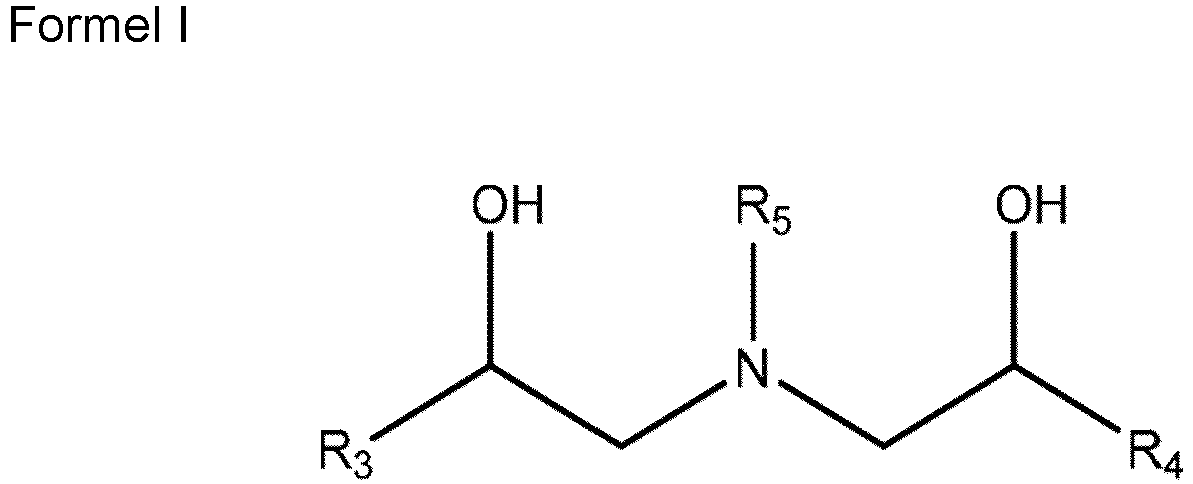
R5 eine C4 bis C30-Hydrocarbylgruppe ist; R3 und R4 unabhängig H oder eine C1 bis C6-Hydrocarbylgruppe sind undd. mindestens eines von:i. zu 0,1 bis 2 Gew.-% ein Metallalkylthiophosphat,ii. zu 0,1 bis 8 Gew.-% ein Thiadiazol-funktionalisiertes Dispergiermittel, Mischungen aus (i) und (ii). - Kraftfahrzeug- oder Industriegetriebeöl nach Anspruch 1, wobei das Hydroxyalkylamin Bis(2-hydroxyethyl)talgalkylamin umfasst.
- Kraftfahrzeug- oder Industriegetriebeöl nach Anspruch 1, ferner umfassend zu 0,01 bis 5,0 Gew.-% eine Aminalkyl(thio)phosphatverbindung.
- Kraftfahrzeug- oder Industriegetriebeöl nach einem der vorstehenden Ansprüche, wobei das Metallalkylthiophosphat Zinkdialkyldithiophosphat umfasst.
- Kraftfahrzeug- oder Industriegetriebeöl nach Anspruch 4, wobei das Zinkdialkyldithiophosphat ein sekundäres Zinkdialkyldithiophosphat umfasst, im Wesentlichen daraus besteht oder daraus besteht.
- Kraftfahrzeug- oder Industriegetriebeöl nach Anspruch 4 oder 5, wobei das Zinkdialkyldithiophosphat dem Kraftfahrzeug- oder Industriegetriebeöl von 0,02 bis 0,2 Gew.-% Zink bereitstellt.
- Kraftfahrzeug- oder Industriegetriebeöl nach Anspruch 1, wobei das geschwefelte Olefin eine Mischung von geschwefelten Olefinen der Formel R1-SX-R2 umfasst, wobei R1 und R2 getrennt von Olefinen, die 3 bis 5 Kohlenstoffatome enthalten, abgeleitet sind und x eine ganze Zahl zwischen 3 und 7 ist, mit der Maßgabe, dass das geschwefelte Olefin einen Schwefelgehalt von etwa 40 bis etwa 50 Gew.-% aufweist.
- Kraftfahrzeug- oder Industriegetriebeöl nach einem der vorstehenden Ansprüche, wobei das Thiadiazol-funktionalisierte Dispergiermittel durch ein gemeinsames Erhitzen von Bestandteilen hergestellt wird, umfassend: (i) ein Dispergiermittelsubstrat; (ii) eine Thiadiazolverbindung; (iii) gegebenenfalls ein Borierungsmittel; und (iv) gegebenenfalls eine Phosphorsäureverbindung, wobei das Erhitzen ausreicht, um ein Produkt aus (i), (ii) und gegebenenfalls (iii) und gegebenenfalls (iv) bereitzustellen, das in einem Öl mit Schmierviskosität löslich ist.
- Kraftfahrzeug- oder Industriegetriebeöl nach einem der vorstehenden Ansprüche, wobei das Schmiermittel einen Gesamtschwefelgehalt von etwa 0,75 bis etwa 5 Gew.-% umfasst.
- Kraftfahrzeug- oder Industriegetriebeöl nach einem der vorstehenden Ansprüche, wobei das Schmiermittel einen Gesamtphosphorgehalt von etwa 0,01 bis etwa 0,5 Gew.-% umfasst.
- Kraftfahrzeug- oder Industriegetriebeöl nach einem der vorstehenden Ansprüche, wobei das Schmiermittel einen Gesamtborgehalt von etwa 1 ppm bis etwa 500 ppm umfasst.
- Verwendung eines Kraftfahrzeug- oder Industriegetriebeöls wie in einem der vorstehenden Ansprüche definiert, um Leistungsverluste in einer Antriebsstrangkraftübertragungsvorrichtung zu minimieren, die Verwendung umfassend das Bereitstellen des Kraftfahrzeug- oder Industriegetriebeöls an die Antriebsstrangkraftübertragungsvorrichtung und ein Betreiben der Antriebsstrangkraftübertragungsvorrichtung.
- Verwendung eines Kraftfahrzeug- oder Industriegetriebeöls wie in einem der Ansprüche 1 bis 10 definiert, um Betriebstemperaturen eines Getriebes zu minimieren, die Verwendung umfassend ein Schmieren des Getriebes mit dem Kraftfahrzeug- oder Industriegetriebeöl und das Betreiben des Getriebes.
- Verwendung eines Kraftfahrzeug- oder Industriegetriebeöls wie in einem der Ansprüche 1 bis 10 definiert, um die Betriebseffizienz eines Getriebes zu erhöhen, die Verwendung umfassend das Schmieren des Getriebes mit dem Kraftfahrzeug- oder Industriegetriebeöl und das Betreiben des Getriebes.
Applications Claiming Priority (2)
| Application Number | Priority Date | Filing Date | Title |
|---|---|---|---|
| US202163233952P | 2021-08-17 | 2021-08-17 | |
| PCT/US2022/040164 WO2023022931A1 (en) | 2021-08-17 | 2022-08-12 | Method of lubricating an automotive or industrial gear |
Publications (2)
| Publication Number | Publication Date |
|---|---|
| EP4388066A1 EP4388066A1 (de) | 2024-06-26 |
| EP4388066B1 true EP4388066B1 (de) | 2025-06-18 |
Family
ID=83188344
Family Applications (2)
| Application Number | Title | Priority Date | Filing Date |
|---|---|---|---|
| EP22777037.7A Active EP4388066B1 (de) | 2021-08-17 | 2022-08-12 | Verfahren zum schmieren eines fahrzeug- oder industriegetriebes |
| EP22764554.6A Pending EP4388065A1 (de) | 2021-08-17 | 2022-08-12 | Verfahren zum schmieren eines fahrzeug- oder industriegetriebes |
Family Applications After (1)
| Application Number | Title | Priority Date | Filing Date |
|---|---|---|---|
| EP22764554.6A Pending EP4388065A1 (de) | 2021-08-17 | 2022-08-12 | Verfahren zum schmieren eines fahrzeug- oder industriegetriebes |
Country Status (6)
| Country | Link |
|---|---|
| US (2) | US12577494B2 (de) |
| EP (2) | EP4388066B1 (de) |
| JP (2) | JP2024531336A (de) |
| CN (2) | CN117813366A (de) |
| CA (2) | CA3229306A1 (de) |
| WO (2) | WO2023022931A1 (de) |
Families Citing this family (1)
| Publication number | Priority date | Publication date | Assignee | Title |
|---|---|---|---|---|
| EP4368687B1 (de) | 2022-11-10 | 2025-06-25 | Afton Chemical Corporation | Korrosionsinhibitor und industrielles schmiermittel damit |
Family Cites Families (33)
| Publication number | Priority date | Publication date | Assignee | Title |
|---|---|---|---|---|
| US2708199A (en) | 1951-10-24 | 1955-05-10 | Continental Oil Co | Preparation of organic polysulfides |
| US3197405A (en) | 1962-07-09 | 1965-07-27 | Lubrizol Corp | Phosphorus-and nitrogen-containing compositions and process for preparing the same |
| US3544465A (en) | 1968-06-03 | 1970-12-01 | Mobil Oil Corp | Esters of phosphorodithioates |
| US3697499A (en) | 1969-05-15 | 1972-10-10 | Mobil Oil Corp | Polysulfurized olefins |
| US3819521A (en) * | 1971-06-07 | 1974-06-25 | Chevron Res | Lubricant containing dispersed borate and a polyol |
| US4136043A (en) | 1973-07-19 | 1979-01-23 | The Lubrizol Corporation | Homogeneous compositions prepared from dimercaptothiadiazoles |
| CA1064463A (en) | 1975-03-21 | 1979-10-16 | Kirk E. Davis | Sulfurized compositions |
| US4344854A (en) | 1975-03-21 | 1982-08-17 | The Lubrizol Corporation | Sulfurized compositions |
| US4119549A (en) | 1975-03-21 | 1978-10-10 | The Lubrizol Corporation | Sulfurized compositions |
| US4119550A (en) * | 1975-03-21 | 1978-10-10 | The Lubrizol Corporation | Sulfurized compositions |
| US4086172A (en) * | 1976-04-01 | 1978-04-25 | Chevron Research Company | Lubricating oil additive composition |
| US4670169A (en) | 1985-05-03 | 1987-06-02 | The Lubrizol Corporation | Coupled phosphorus-containing amides, precursors thereof and lubricant compositions containing same |
| US4770807A (en) | 1985-07-31 | 1988-09-13 | Commissariat A L'energie Atomique | Novel extraction agents and novel propane diamides |
| US4741848A (en) | 1986-03-13 | 1988-05-03 | The Lubrizol Corporation | Boron-containing compositions, and lubricants and fuels containing same |
| US4764297A (en) | 1987-03-20 | 1988-08-10 | The Lubrizol Corporation | Protic solvent in a dehydrohalogenation process, the product obtained therefrom and lubricant compositions containing same |
| US4876374A (en) | 1987-05-22 | 1989-10-24 | The Lubrizol Corporation | Process for manufacturing amides |
| US5534170A (en) | 1988-06-24 | 1996-07-09 | Exxon Chemical Patents Inc. | Mixed phosphorus- and sulfur-containing reaction products useful in power transmitting compositions |
| US5089156A (en) * | 1990-10-10 | 1992-02-18 | Ethyl Petroleum Additives, Inc. | Ashless or low-ash synthetic base compositions and additives therefor |
| US5641732A (en) | 1995-07-17 | 1997-06-24 | Exxon Chemical Patents Inc. | Automatic transmission fluids of improved viscometric properties |
| GB9521352D0 (en) * | 1995-10-18 | 1995-12-20 | Exxon Chemical Patents Inc | Power transmitting fluids of improved antiwear performance |
| US6103673A (en) | 1998-09-14 | 2000-08-15 | The Lubrizol Corporation | Compositions containing friction modifiers for continuously variable transmissions |
| US6303547B1 (en) | 2000-09-19 | 2001-10-16 | Ethyl Corporation | Friction modified lubricants |
| KR101022920B1 (ko) | 2002-07-12 | 2011-03-16 | 더루우브리졸코오포레이션 | 변속기용 윤활유에 항진동 성능 향상과 높은 정지 마찰을제공하기 위한 마찰 개질제 |
| US20050101497A1 (en) | 2003-11-12 | 2005-05-12 | Saathoff Lee D. | Compositions and methods for improved friction durability in power transmission fluids |
| CA2659250C (en) | 2006-07-27 | 2014-12-23 | The Lubrizol Corporation | Lubricating compositions comprising thiadiazole-functionalized dispersants |
| CA2809816C (en) * | 2010-08-31 | 2019-06-04 | The Lubrizol Corporation | Star polymer and lubricating composition thereof |
| WO2015048719A1 (en) * | 2013-09-30 | 2015-04-02 | The Lubrizol Corporation | Method of friction control |
| CN108431189A (zh) * | 2015-11-06 | 2018-08-21 | 路博润公司 | 低粘度齿轮润滑剂 |
| US10316712B2 (en) | 2015-12-18 | 2019-06-11 | Exxonmobil Research And Engineering Company | Lubricant compositions for surface finishing of materials |
| CN109715765B (zh) * | 2016-07-20 | 2022-09-30 | 路博润公司 | 用于润滑剂中的烷基磷酸酯胺盐 |
| JP2021509929A (ja) * | 2018-01-04 | 2021-04-08 | ザ ルブリゾル コーポレイションThe Lubrizol Corporation | ホウ素含有自動車用ギア油 |
| US20210363456A1 (en) | 2018-11-12 | 2021-11-25 | The Lubrizol Corporation | Method of Lubricating an Automotive or Industrial Gear |
| JP7759894B2 (ja) | 2020-04-27 | 2025-10-24 | ザ ルブリゾル コーポレイション | 自動車又は工業用歯車を潤滑する方法 |
-
2022
- 2022-08-12 EP EP22777037.7A patent/EP4388066B1/de active Active
- 2022-08-12 WO PCT/US2022/040164 patent/WO2023022931A1/en not_active Ceased
- 2022-08-12 JP JP2024509367A patent/JP2024531336A/ja active Pending
- 2022-08-12 WO PCT/US2022/040162 patent/WO2023022930A1/en not_active Ceased
- 2022-08-12 CA CA3229306A patent/CA3229306A1/en active Pending
- 2022-08-12 CN CN202280056189.9A patent/CN117813366A/zh active Pending
- 2022-08-12 CA CA3229308A patent/CA3229308A1/en active Pending
- 2022-08-12 JP JP2024509366A patent/JP2024531335A/ja active Pending
- 2022-08-12 US US18/684,356 patent/US12577494B2/en active Active
- 2022-08-12 US US18/684,406 patent/US20240254406A1/en active Pending
- 2022-08-12 CN CN202280056195.4A patent/CN117836395A/zh active Pending
- 2022-08-12 EP EP22764554.6A patent/EP4388065A1/de active Pending
Also Published As
| Publication number | Publication date |
|---|---|
| WO2023022931A1 (en) | 2023-02-23 |
| CN117836395A (zh) | 2024-04-05 |
| EP4388065A1 (de) | 2024-06-26 |
| JP2024531336A (ja) | 2024-08-29 |
| CA3229306A1 (en) | 2023-02-23 |
| EP4388066A1 (de) | 2024-06-26 |
| CN117813366A (zh) | 2024-04-02 |
| CA3229308A1 (en) | 2023-02-23 |
| US12577494B2 (en) | 2026-03-17 |
| US20240254406A1 (en) | 2024-08-01 |
| WO2023022930A1 (en) | 2023-02-23 |
| US20240352374A1 (en) | 2024-10-24 |
| JP2024531335A (ja) | 2024-08-29 |
Similar Documents
| Publication | Publication Date | Title |
|---|---|---|
| US8153565B2 (en) | Lubricant composition for a final drive axle | |
| US20120208731A1 (en) | Lubricating Composition Containing an Ester | |
| EP2430133B1 (de) | Verfahren zum schmieren mit einer schmiermittelzusammensetzung enthaltend ein apfelsäurederivat | |
| US12195690B2 (en) | Method of lubricating an automotive or industrial gear | |
| EP1910505B1 (de) | Zinkfreies ackerschlepperfluid | |
| EP4388066B1 (de) | Verfahren zum schmieren eines fahrzeug- oder industriegetriebes | |
| CA2739428C (en) | Lubricating composition containing metal carboxylate | |
| EP2576740B1 (de) | Schmiermittelzusammensetzung | |
| WO2024006103A1 (en) | Method of lubricating an automotive or industrial gear | |
| US20110143982A1 (en) | Additive System for Lubricating Fluids |
Legal Events
| Date | Code | Title | Description |
|---|---|---|---|
| STAA | Information on the status of an ep patent application or granted ep patent |
Free format text: STATUS: UNKNOWN |
|
| STAA | Information on the status of an ep patent application or granted ep patent |
Free format text: STATUS: THE INTERNATIONAL PUBLICATION HAS BEEN MADE |
|
| PUAI | Public reference made under article 153(3) epc to a published international application that has entered the european phase |
Free format text: ORIGINAL CODE: 0009012 |
|
| STAA | Information on the status of an ep patent application or granted ep patent |
Free format text: STATUS: REQUEST FOR EXAMINATION WAS MADE |
|
| 17P | Request for examination filed |
Effective date: 20240314 |
|
| AK | Designated contracting states |
Kind code of ref document: A1 Designated state(s): AL AT BE BG CH CY CZ DE DK EE ES FI FR GB GR HR HU IE IS IT LI LT LU LV MC MK MT NL NO PL PT RO RS SE SI SK SM TR |
|
| DAV | Request for validation of the european patent (deleted) | ||
| DAX | Request for extension of the european patent (deleted) | ||
| GRAP | Despatch of communication of intention to grant a patent |
Free format text: ORIGINAL CODE: EPIDOSNIGR1 |
|
| STAA | Information on the status of an ep patent application or granted ep patent |
Free format text: STATUS: GRANT OF PATENT IS INTENDED |
|
| P01 | Opt-out of the competence of the unified patent court (upc) registered |
Free format text: CASE NUMBER: APP_397/2025 Effective date: 20250106 |
|
| INTG | Intention to grant announced |
Effective date: 20250116 |
|
| GRAS | Grant fee paid |
Free format text: ORIGINAL CODE: EPIDOSNIGR3 |
|
| GRAA | (expected) grant |
Free format text: ORIGINAL CODE: 0009210 |
|
| STAA | Information on the status of an ep patent application or granted ep patent |
Free format text: STATUS: THE PATENT HAS BEEN GRANTED |
|
| AK | Designated contracting states |
Kind code of ref document: B1 Designated state(s): AL AT BE BG CH CY CZ DE DK EE ES FI FR GB GR HR HU IE IS IT LI LT LU LV MC MK MT NL NO PL PT RO RS SE SI SK SM TR |
|
| REG | Reference to a national code |
Ref country code: GB Ref legal event code: FG4D |
|
| REG | Reference to a national code |
Ref country code: CH Ref legal event code: EP |
|
| REG | Reference to a national code |
Ref country code: DE Ref legal event code: R096 Ref document number: 602022016183 Country of ref document: DE |
|
| REG | Reference to a national code |
Ref country code: CH Ref legal event code: EP |
|
| REG | Reference to a national code |
Ref country code: IE Ref legal event code: FG4D |
|
| PG25 | Lapsed in a contracting state [announced via postgrant information from national office to epo] |
Ref country code: FI Free format text: LAPSE BECAUSE OF FAILURE TO SUBMIT A TRANSLATION OF THE DESCRIPTION OR TO PAY THE FEE WITHIN THE PRESCRIBED TIME-LIMIT Effective date: 20250618 |
|
| PGFP | Annual fee paid to national office [announced via postgrant information from national office to epo] |
Ref country code: DE Payment date: 20250827 Year of fee payment: 4 |
|
| REG | Reference to a national code |
Ref country code: LT Ref legal event code: MG9D |
|
| PG25 | Lapsed in a contracting state [announced via postgrant information from national office to epo] |
Ref country code: GR Free format text: LAPSE BECAUSE OF FAILURE TO SUBMIT A TRANSLATION OF THE DESCRIPTION OR TO PAY THE FEE WITHIN THE PRESCRIBED TIME-LIMIT Effective date: 20250919 Ref country code: NO Free format text: LAPSE BECAUSE OF FAILURE TO SUBMIT A TRANSLATION OF THE DESCRIPTION OR TO PAY THE FEE WITHIN THE PRESCRIBED TIME-LIMIT Effective date: 20250918 |
|
| PG25 | Lapsed in a contracting state [announced via postgrant information from national office to epo] |
Ref country code: BG Free format text: LAPSE BECAUSE OF FAILURE TO SUBMIT A TRANSLATION OF THE DESCRIPTION OR TO PAY THE FEE WITHIN THE PRESCRIBED TIME-LIMIT Effective date: 20250618 |
|
| PG25 | Lapsed in a contracting state [announced via postgrant information from national office to epo] |
Ref country code: HR Free format text: LAPSE BECAUSE OF FAILURE TO SUBMIT A TRANSLATION OF THE DESCRIPTION OR TO PAY THE FEE WITHIN THE PRESCRIBED TIME-LIMIT Effective date: 20250618 |
|
| PGFP | Annual fee paid to national office [announced via postgrant information from national office to epo] |
Ref country code: AT Payment date: 20251020 Year of fee payment: 4 Ref country code: FR Payment date: 20250825 Year of fee payment: 4 |
|
| PG25 | Lapsed in a contracting state [announced via postgrant information from national office to epo] |
Ref country code: RS Free format text: LAPSE BECAUSE OF FAILURE TO SUBMIT A TRANSLATION OF THE DESCRIPTION OR TO PAY THE FEE WITHIN THE PRESCRIBED TIME-LIMIT Effective date: 20250918 |
|
| REG | Reference to a national code |
Ref country code: NL Ref legal event code: MP Effective date: 20250618 |
|
| PG25 | Lapsed in a contracting state [announced via postgrant information from national office to epo] |
Ref country code: LV Free format text: LAPSE BECAUSE OF FAILURE TO SUBMIT A TRANSLATION OF THE DESCRIPTION OR TO PAY THE FEE WITHIN THE PRESCRIBED TIME-LIMIT Effective date: 20250618 |
|
| PG25 | Lapsed in a contracting state [announced via postgrant information from national office to epo] |
Ref country code: NL Free format text: LAPSE BECAUSE OF FAILURE TO SUBMIT A TRANSLATION OF THE DESCRIPTION OR TO PAY THE FEE WITHIN THE PRESCRIBED TIME-LIMIT Effective date: 20250618 |
|
| PG25 | Lapsed in a contracting state [announced via postgrant information from national office to epo] |
Ref country code: PT Free format text: LAPSE BECAUSE OF FAILURE TO SUBMIT A TRANSLATION OF THE DESCRIPTION OR TO PAY THE FEE WITHIN THE PRESCRIBED TIME-LIMIT Effective date: 20251020 |
|
| REG | Reference to a national code |
Ref country code: AT Ref legal event code: MK05 Ref document number: 1804200 Country of ref document: AT Kind code of ref document: T Effective date: 20250618 |
|
| PG25 | Lapsed in a contracting state [announced via postgrant information from national office to epo] |
Ref country code: IS Free format text: LAPSE BECAUSE OF FAILURE TO SUBMIT A TRANSLATION OF THE DESCRIPTION OR TO PAY THE FEE WITHIN THE PRESCRIBED TIME-LIMIT Effective date: 20251018 |
|
| PG25 | Lapsed in a contracting state [announced via postgrant information from national office to epo] |
Ref country code: AT Free format text: LAPSE BECAUSE OF FAILURE TO SUBMIT A TRANSLATION OF THE DESCRIPTION OR TO PAY THE FEE WITHIN THE PRESCRIBED TIME-LIMIT Effective date: 20250618 Ref country code: SM Free format text: LAPSE BECAUSE OF FAILURE TO SUBMIT A TRANSLATION OF THE DESCRIPTION OR TO PAY THE FEE WITHIN THE PRESCRIBED TIME-LIMIT Effective date: 20250618 |
|
| PG25 | Lapsed in a contracting state [announced via postgrant information from national office to epo] |
Ref country code: CZ Free format text: LAPSE BECAUSE OF FAILURE TO SUBMIT A TRANSLATION OF THE DESCRIPTION OR TO PAY THE FEE WITHIN THE PRESCRIBED TIME-LIMIT Effective date: 20250618 |
|
| PG25 | Lapsed in a contracting state [announced via postgrant information from national office to epo] |
Ref country code: PL Free format text: LAPSE BECAUSE OF FAILURE TO SUBMIT A TRANSLATION OF THE DESCRIPTION OR TO PAY THE FEE WITHIN THE PRESCRIBED TIME-LIMIT Effective date: 20250618 |
|
| PG25 | Lapsed in a contracting state [announced via postgrant information from national office to epo] |
Ref country code: EE Free format text: LAPSE BECAUSE OF FAILURE TO SUBMIT A TRANSLATION OF THE DESCRIPTION OR TO PAY THE FEE WITHIN THE PRESCRIBED TIME-LIMIT Effective date: 20250618 |
|
| PG25 | Lapsed in a contracting state [announced via postgrant information from national office to epo] |
Ref country code: SK Free format text: LAPSE BECAUSE OF FAILURE TO SUBMIT A TRANSLATION OF THE DESCRIPTION OR TO PAY THE FEE WITHIN THE PRESCRIBED TIME-LIMIT Effective date: 20250618 |
|
| PG25 | Lapsed in a contracting state [announced via postgrant information from national office to epo] |
Ref country code: ES Free format text: LAPSE BECAUSE OF FAILURE TO SUBMIT A TRANSLATION OF THE DESCRIPTION OR TO PAY THE FEE WITHIN THE PRESCRIBED TIME-LIMIT Effective date: 20250618 |
|
| PG25 | Lapsed in a contracting state [announced via postgrant information from national office to epo] |
Ref country code: RO Free format text: LAPSE BECAUSE OF FAILURE TO SUBMIT A TRANSLATION OF THE DESCRIPTION OR TO PAY THE FEE WITHIN THE PRESCRIBED TIME-LIMIT Effective date: 20250618 |
|
| REG | Reference to a national code |
Ref country code: CH Ref legal event code: H13 Free format text: ST27 STATUS EVENT CODE: U-0-0-H10-H13 (AS PROVIDED BY THE NATIONAL OFFICE) Effective date: 20260324 |