EP4375673A1 - Dispositif d'analyse automatique et procédé d'ajustement de l'inclinaison de celui-ci - Google Patents
Dispositif d'analyse automatique et procédé d'ajustement de l'inclinaison de celui-ci Download PDFInfo
- Publication number
- EP4375673A1 EP4375673A1 EP22845698.4A EP22845698A EP4375673A1 EP 4375673 A1 EP4375673 A1 EP 4375673A1 EP 22845698 A EP22845698 A EP 22845698A EP 4375673 A1 EP4375673 A1 EP 4375673A1
- Authority
- EP
- European Patent Office
- Prior art keywords
- tilt
- tilt sensor
- automatic analyzer
- mechanism base
- adjuster
- Prior art date
- Legal status (The legal status is an assumption and is not a legal conclusion. Google has not performed a legal analysis and makes no representation as to the accuracy of the status listed.)
- Granted
Links
Images



Classifications
-
- G—PHYSICS
- G01—MEASURING; TESTING
- G01N—INVESTIGATING OR ANALYSING MATERIALS BY DETERMINING THEIR CHEMICAL OR PHYSICAL PROPERTIES
- G01N35/00—Automatic analysis not limited to methods or materials provided for in any single one of groups G01N1/00 - G01N33/00; Handling materials therefor
- G01N35/00584—Control arrangements for automatic analysers
- G01N35/0092—Scheduling
-
- G—PHYSICS
- G01—MEASURING; TESTING
- G01N—INVESTIGATING OR ANALYSING MATERIALS BY DETERMINING THEIR CHEMICAL OR PHYSICAL PROPERTIES
- G01N35/00—Automatic analysis not limited to methods or materials provided for in any single one of groups G01N1/00 - G01N33/00; Handling materials therefor
- G01N35/00584—Control arrangements for automatic analysers
- G01N35/00594—Quality control, including calibration or testing of components of the analyser
- G01N35/00613—Quality control
- G01N35/00623—Quality control of instruments
-
- G—PHYSICS
- G01—MEASURING; TESTING
- G01N—INVESTIGATING OR ANALYSING MATERIALS BY DETERMINING THEIR CHEMICAL OR PHYSICAL PROPERTIES
- G01N35/00—Automatic analysis not limited to methods or materials provided for in any single one of groups G01N1/00 - G01N33/00; Handling materials therefor
- G01N35/00584—Control arrangements for automatic analysers
- G01N35/00594—Quality control, including calibration or testing of components of the analyser
- G01N35/00693—Calibration
-
- G—PHYSICS
- G01—MEASURING; TESTING
- G01N—INVESTIGATING OR ANALYSING MATERIALS BY DETERMINING THEIR CHEMICAL OR PHYSICAL PROPERTIES
- G01N35/00—Automatic analysis not limited to methods or materials provided for in any single one of groups G01N1/00 - G01N33/00; Handling materials therefor
- G01N35/10—Devices for transferring samples or any liquids to, in, or from, the analysis apparatus, e.g. suction devices, injection devices
- G01N35/1002—Reagent dispensers
-
- G—PHYSICS
- G01—MEASURING; TESTING
- G01N—INVESTIGATING OR ANALYSING MATERIALS BY DETERMINING THEIR CHEMICAL OR PHYSICAL PROPERTIES
- G01N35/00—Automatic analysis not limited to methods or materials provided for in any single one of groups G01N1/00 - G01N33/00; Handling materials therefor
- G01N2035/00346—Heating or cooling arrangements
- G01N2035/00356—Holding samples at elevated temperature (incubation)
- G01N2035/00386—Holding samples at elevated temperature (incubation) using fluid heat transfer medium
- G01N2035/00396—Holding samples at elevated temperature (incubation) using fluid heat transfer medium where the fluid is a liquid
-
- G—PHYSICS
- G01—MEASURING; TESTING
- G01N—INVESTIGATING OR ANALYSING MATERIALS BY DETERMINING THEIR CHEMICAL OR PHYSICAL PROPERTIES
- G01N35/00—Automatic analysis not limited to methods or materials provided for in any single one of groups G01N1/00 - G01N33/00; Handling materials therefor
- G01N2035/00465—Separating and mixing arrangements
- G01N2035/00534—Mixing by a special element, e.g. stirrer
-
- G—PHYSICS
- G01—MEASURING; TESTING
- G01N—INVESTIGATING OR ANALYSING MATERIALS BY DETERMINING THEIR CHEMICAL OR PHYSICAL PROPERTIES
- G01N35/00—Automatic analysis not limited to methods or materials provided for in any single one of groups G01N1/00 - G01N33/00; Handling materials therefor
- G01N35/02—Automatic analysis not limited to methods or materials provided for in any single one of groups G01N1/00 - G01N33/00; Handling materials therefor using a plurality of sample containers moved by a conveyor system past one or more treatment or analysis stations
- G01N35/04—Details of the conveyor system
- G01N2035/0439—Rotary sample carriers, i.e. carousels
- G01N2035/0443—Rotary sample carriers, i.e. carousels for reagents
-
- G—PHYSICS
- G01—MEASURING; TESTING
- G01N—INVESTIGATING OR ANALYSING MATERIALS BY DETERMINING THEIR CHEMICAL OR PHYSICAL PROPERTIES
- G01N35/00—Automatic analysis not limited to methods or materials provided for in any single one of groups G01N1/00 - G01N33/00; Handling materials therefor
- G01N35/02—Automatic analysis not limited to methods or materials provided for in any single one of groups G01N1/00 - G01N33/00; Handling materials therefor using a plurality of sample containers moved by a conveyor system past one or more treatment or analysis stations
- G01N35/04—Details of the conveyor system
- G01N2035/0439—Rotary sample carriers, i.e. carousels
- G01N2035/0444—Rotary sample carriers, i.e. carousels for cuvettes or reaction vessels
-
- G—PHYSICS
- G01—MEASURING; TESTING
- G01N—INVESTIGATING OR ANALYSING MATERIALS BY DETERMINING THEIR CHEMICAL OR PHYSICAL PROPERTIES
- G01N35/00—Automatic analysis not limited to methods or materials provided for in any single one of groups G01N1/00 - G01N33/00; Handling materials therefor
- G01N35/10—Devices for transferring samples or any liquids to, in, or from, the analysis apparatus, e.g. suction devices, injection devices
- G01N35/1009—Characterised by arrangements for controlling the aspiration or dispense of liquids
- G01N2035/1025—Fluid level sensing
Definitions
- the present invention relates to an automatic analyzer and a tilt adjustment method thereof.
- the automatic analyzer determines a reagent to be dispensed depending on a component to be measured in a sample such as blood or urine, and dispenses the sample and the reagent using a dispensing mechanism into a reaction container arranged in a reaction tank storing liquid kept at a constant temperature.
- the sample and the reagent are stirred using a stirrer in the reaction container to form a reaction solution.
- concentration of the component to be measured is qualitatively and quantitatively analyzed.
- a water level sensor that can detect the liquid level is arranged in the reaction tank, and whether to supply or discharge water is determined depending on whether the water level sensor is detected to keep the water level constant.
- the reaction tank is tilted, there is a difference in water level between a position where the water level sensor is detected and a position where the water level sensor is not detected. Therefore, four adjuster feet arranged in a device lowermost portion are adjusted to execute the leveling of the reaction tank.
- the adjustment of the adjuster feet and tilt measurement using a measuring instrument such as a level are required to be repeated at a plurality of positions. Therefore, time and effort is required for the work.
- PTL 1 discloses a method in which a liquid level detection means using a dispensing probe is used, a liquid level is detected at at least three predetermined positions of a reaction tank using the dispensing probe, and a height adjustment amount for executing the leveling of the reaction tank is calculated.
- An object of the invention is to provide an automatic analyzer in which a tilt sensor is provided on a mechanism base for supporting each of mechanisms that executes analysis and the tilting of the reaction tank can be automatically checked within a short period of time without interference with the analysis operation, and a tilt adjustment method thereof.
- An automatic analyzer includes: a frame including a frame upper surface and a frame bottom surface having a rectangular shape; a plurality of adjuster feet arranged on the frame bottom surface and supporting the frame; a mechanism base supported by the frame upper surface; a reaction tank which is arranged on the mechanism base and in which a reaction container storing a mixed liquid of reagent and a sample is arranged; a tilt sensor arranged on the mechanism base; and an analysis unit determining whether a tilt amount of the mechanism base based on sensing data from the tilt sensor exceeds an allowable amount, in which the tilt sensor is arranged at a position not overlapping with the adjuster foot in top view.
- a tilt amount of an automatic analyzer can be continuously monitored without affecting an analysis operation. Objects, configurations, and effects other than those described above will be clarified by describing the following embodiments.
- Fig. 1A shows an overall configuration example of an automatic analyzer.
- the automatic analyzer includes, as a major configuration, a sample transport mechanism 19, a reagent disk 11 on which reagent bottles 12 are mounted, a reaction disk 1 on which reaction containers 2 are mounted, sample dispensing mechanisms 13 and 14, reagent dispensing mechanisms 7, 8, 9, and 10, stirring mechanisms 5 and 6, a spectral photometer 4, a cleaning mechanism 3, cleaning tanks 15, 16, 30, 31, 32, and 33, a reagent pump 20, a sample pump 21, and a cleaning pump 22, and is arranged above or below a mechanism base 35 supported by adjuster feet 37.
- Fig. 1A shows that the adjuster feet 37 are directly attached to the mechanism base 35, and a support structure of the mechanism base 35 will be described below.
- the automatic analyzer includes a control unit 41 that controls each of the units of the automatic analyzer, a data storage unit 42 that accumulates various data, an input unit 43 that inputs necessary data is input to the data storage unit 42 from an external source, a measurement unit 44 that calculates an absorbance from a light quantity obtained by the spectral photometer 4, an analysis unit 45 that determines component amounts from the absorbance, and an output unit 46 that externally displays and outputs analyzed component amount data or the like.
- the analysis unit 45 executes, for example, determination of a tilt state of the automatic analyzer as described below.
- the sample transport mechanism 19 transports a rack (transportation member) 18 where one or more sample containers 17 storing a sample (liquid) to be analyzed can be mounted.
- a rack (transportation member) 18 where one or more sample containers 17 storing a sample (liquid) to be analyzed can be mounted.
- a plurality of reagent bottles 12 storing a reagent (liquid) used for analyzing the sample are arranged in a circumferential direction.
- a plurality of reaction containers 2 where the sample and the reagent are mixed to react with each other are arranged in a circumferential direction in a reaction tank 36.
- the reaction solution in the reaction container 2 is kept at a constant temperature by liquid filled in the reaction tank 36.
- the water level of the reaction tank 36 is kept constant by a water level sensor 38.
- Each of the sample dispensing mechanisms 13 and 14 dispenses the sample into the reaction container 2 from the sample container 17 transported to a sample dispensing position by the sample transport mechanism 19.
- Each of the reagent dispensing mechanisms 7, 8, 9, and 10 dispenses the reagent into the reaction container 2 from the reagent bottle 12.
- the stirring mechanisms 5 and 6 stir the mixed liquid (reaction solution) of the sample and the reagent dispensed into the reaction container 2.
- the spectral photometer 4 receives transmitted light or scattered light obtained from a light source (not shown) through the reaction solution of the reaction container 2.
- the cleaning mechanism 3 cleans the used reaction container 2.
- the sample nozzle cleaning tanks 15 and 16 are arranged in operating ranges of the sample dispensing mechanisms 13 and 14, and clean sample nozzles 13a and 14a with cleaning water, respectively.
- the reagent nozzle cleaning tanks 30, 31, 32, and 33 are arranged in operating ranges of the reagent dispensing mechanisms 7, 8, 9, and 10, and cleans reagent nozzles 7a, 8a, 9a, and 10a with cleaning water, respectively.
- a tilt sensor 60 that measures a tilt amount of the mechanism base 35 is arranged between the reagent dispensing mechanisms 7 and 8.
- Fig. 1B shows an example of the support structure of the mechanism base 35 in the automatic analyzer.
- a bottom plate (frame bottom surface) 72a and an upper plate (frame upper surface) 72b are fixed to columns 71a and 71b.
- a space 74 divided by the bottom plate 72a and the upper plate 72b parallel to an XY plane and the frame 70 as a structure formed by the columns 71 extending in a Z direction not only the pumps 20, 21, and 22 described above but also mechanisms such as a water supply mechanism, a water discharge mechanism, a power supply, and a computer functioning as the control unit 41 are accommodated.
- the four adjuster feet 37 described above are provided in the bottom plate 72a.
- the mechanism base 35 is supported by support columns 73 provided on the upper plate 72b.
- the positions of the support columns 73 are affected by the arrangement of the mechanisms arranged on the mechanism base 35 but the support columns 73 are arranged such that the weights of the mechanism base 35 and the mechanisms arranged on the mechanism base 35 are distributed on the upper plate 72b as uniformly as possible.
- the analysis of the component amounts of the sample is executed in the following procedure.
- the sample in the sample container 17 loaded on the rack 18 that is transported to the vicinity of the reaction disk 1 by the sample transport mechanism 19 is dispensed into the reaction container 2 on the reaction disk 1 by the sample nozzle 13a (14a) of the sample dispensing mechanism 13 (14).
- the reagent used for the analysis is dispensed by the reagent nozzle 7a (8a, 9a, 10a) of the reagent dispensing mechanism 7 (8, 9, 10) from the reagent bottle 12 on the reagent disk 11 into the reaction container 2 into which the sample is previously dispensed.
- the mixed liquid of the sample and the reagent in the reaction container 2 is stirred by the stirring mechanism 5 (6).
- the measurement unit 44 irradiates the reaction container 2 storing the stirred mixed liquid with light emitted from the light source, measures the light intensity of transmitted light or scattered light using the spectral photometer 4, and accumulates the obtained absorbance data in the data storage unit 42.
- the analysis unit 45 analyzes the accumulated absorbance data based on calibration curve data and the Beer-Lambert law. Through this analysis, the component amounts in the sample can be analyzed. Data required for the control of each of the units of the automatic analyzer or the analysis is input from the input unit 43 to the data storage unit 42. In addition, various kinds of data or the analysis result is displayed and/or output from the output unit 46.
- the configuration of Fig. 1A is a configuration example where the automatic analyzer executes biochemical analysis, and the measurement mechanism varies depending on the content of the analysis that is executed by the automatic analyzer.
- a measurement method used in the automatic analyzer for example, an analysis method (colorimetric analysis) of using a reagent that reacts with an analysis target component in a sample such that the color of the reaction solution changes or an analysis method (immunological analysis) of counting markers using a reagent obtained by adding the marker to a material that is specifically bonded directly or indirectly to an analysis target component in a sample is known.
- Both of the methods include a step of dispensing a sample stored in the sample container or a reagent stored in the reagent bottle into the reaction container using the dispensing mechanism and mixing the sample and the reagent.
- the present embodiment is applicable to automatic analyzers that can execute analysis including a dispensing step.
- Fig. 2A shows a state of the mechanism base 35 and the tilt sensor 60, the reagent dispensing mechanisms 7 and 8, the reaction disk 1, the reagent disk 11, and the reaction tank 36 mounted on the mechanism base 35 when the level of the entire device is not maintained (the right side is lowered) due to sinking of a floor where the automatic analyzer is provided or adjustment failure of the adjuster feet.
- Fig. 2B shows, as an example where the effect of the tilting of the reaction tank 36 is the strongest, an arrangement example where the water level sensor 38 is arranged on the right side of the reaction tank 36 and the stirring mechanism 5 is arranged on the left side of the reaction tank 36 to face the water level sensor 38.
- the water level sensor 38 includes detection units 38a having different lengths to detect the water level of the reaction tank 36. In this example, the water level of the reaction tank 36 can be detected in two stages.
- the stirring mechanism 5 includes a stirring element 5a and a reflection plate 5b, ultrasonically vibrates the stirring element 5a to generate an ultrasonic wave, and stirs the reaction solution in the reaction container 2 (not shown) positioned to be interposed between the stirring element 5a and the reflection plate 5b.
- the stirring element 5a may be partially exposed from the water surface of the reaction tank 36.
- the stirring element 5a is designed to vibrate in water. Therefore, in this case, when vibrating in air having a low resistance, the stirring element 5a vibrates excessively, which causes a malfunction of the stirring mechanism 5.
- Fig. 3A shows a state of the mechanism base 35 and the tilt sensor 60, the reagent dispensing mechanisms 7 and 8, the reaction disk 1, the reagent disk 11, and the reaction tank 36 mounted on the mechanism base 35 when the entire device is lowered to the left side.
- the reaction tank 36 shown in Fig. 3B is tilted to the lower left side, the level of the liquid in the reaction tank is maintained (parallel to the XY plane). Therefore, even when the water level sensor 38 detects that the water level of the reaction tank 36 is appropriate, liquid overflows from the reaction tank 36 to the surroundings, which causes a malfunction of the device.
- Fig. 4A shows a state of the mechanism base 35 and the tilt sensor 60, the reagent dispensing mechanisms 7 and 8, the reaction disk 1, the reagent disk 11, and the reaction tank 36 mounted on the mechanism base 35 when adjuster feet 37a, 37b, 37c, and 37d are adjusted to appropriate heights and the level of the entire device is maintained.
- Fig. 4B the levels of the reaction tank 36 and the liquid in the reaction tank 36 are maintained, and the entire stirring element 5a is appropriately positioned in the liquid by the water level sensor 38.
- Fig. 1C shows the tilt sensor 60 arranged on the upper surface of the mechanism base 35. It is desirable that the tilt sensor 60 has a small size and a high sensitivity. From this viewpoint, the tilt sensor 60 is preferably a MEMS sensor.
- the tilt sensor 60 detects the tilting of the measured object from the difference of the acceleration sensors.
- the tilt sensor 60 is a tilt sensor capable of detecting tilting of two axes including an X-axis direction and a Y-axis direction, and it is assumed that a clockwise direction in the axis direction is a positive direction and a counterclockwise direction in the axis direction is a negative direction.
- the tilt sensor 60 detects the tilting in the positive direction around a Y-axis in the example of Fig. 2A , the tilt sensor 60 detects the tilting in the negative direction around the Y-axis in the example of Fig. 3A , and the tilt sensor 60 does not detect the tilting in an X-axis and the Y-axis in the example of Fig. 4A .
- positions 77a to 77d overlapping with the adjuster feet 37a to 37d in top view are indicated by circles of a broken line.
- the automatic analyzer is in contact with the floor surface through the adjuster feet 37. Therefore, the tilting of the mechanism base 35 is determined depending on the heights of the positions 77a to 77d.
- the mechanism base 35 is tilted with a distortion.
- the effect of the distortion of the mechanism base 35 is predominant, and even when the tilt sensor 60 is arranged, the tilting of the mechanism base 35 cannot be detected.
- the tilt sensor 60 is arranged at a position not overlapping with the adjuster feet 37a to 37d in top view.
- the frame upper surface 72b and the frame bottom surface 72a have a rectangular shape, and the adjuster feet 37a to 37d are arranged at at least four corners of the frame bottom surface 72a, respectively. From the viewpoint of the sensitivity with which the tilting is detected, it is desirable that the tilt sensor 60 is arranged on the inner side of the adjuster feet 37a to 37d arranged at four corners of the frame bottom surface 72a in top view.
- the tilt sensor 60 includes an external terminal 61 that is connected to an external device and can execute power supply and communication such that the tilting of the device can be detected even in a state where power is not supplied to the automatic analyzer.
- the tilt sensor 60 operates as a sensor by the power supply and control from the external device.
- the adjustment of the adjuster feet 37 is executed in a state where the power of the device is interrupted. However, even in a state where the power of the device is interrupted, the tilting of the device can be checked by the tilt sensor 60.
- Fig. 5 shows an example of a tilt check flow by the tilt sensor 60.
- the control unit 41 executes the tilt check as a part of a preparation operation when a user starts the analysis operation, or automatically executes the tilt check in the background during the analysis (S501).
- Sensing data representing a tilt amount acquired from the tilt sensor and acquisition time of the sensing data are stored in the data storage unit 42 (S502).
- the output unit 46 displays the tilt amount and the acquisition time such that the user can check the tilt amount and the acquisition time (S503).
- the analysis unit 45 determines whether the tilt amount exceeds a predetermined allowable amount (S504).
- the allowable amount is predetermined as a range in which the water level of the reaction tank 36 detected by the water level sensor 38 allows the reaction tank 36 and the stirring mechanism 5 to operate appropriately.
- an alarm is output, and the occurrence of abnormality in the tilting is notified to the user (S507). Further, the occurrence of abnormality is reported to a service sector to urge maintenance work (S508).
- the analysis unit 45 calculates the tilt amount prediction based on updated time series data of the data storage unit 42 (S505), and determines whether the allowable amount is exceeded until a scheduled date of next maintenance (S506).
- the control unit 41 automatically reports the predicted schedule to the service sector to urge maintenance work (S508).
- the tilt check ends (S509).
- Step S508 the output unit 46 may display an alarm urging the user to report the occurrence of abnormality to the service sector.
- Fig. 6 shows an example of the time series data of the sensing data of the tilt sensor 60 stored in the data storage unit 42.
- Time series data 80 includes an acquisition time 81, an item 82, a determination result 83, and sensing data 84 and 85.
- the sensing data 84 and 85 show the tilt amounts of the two axes output from the tilt sensor 60, and the determination result 83 stores a comparison result to the allowable amount in Step S504.
- the acquisition time 81 shows only the date but may also include the time. Through the tilt check flow, the latest tilt amount of the device is automatically monitored, and whether the tilt amount is in the allowable range is determined. As a result, the device can ensure the execution of the analysis while maintaining appropriate levelness.
- Fig. 7 shows an example of an exceeding date prediction flow in which the analysis unit 45 predicts the date on which the tilt amount of the device exceeds the allowable amount.
- the analysis unit 45 compares current sensor data acquired from the tilt sensor 60 with previous sensor data acquired from the tilt sensor 60, and checks whether the tilt amount of the device changes (S701). When the tilt amount does not change, the exceeding date prediction flow ends as it is (S509). When the tilt amount changes, the analysis unit 45 calculates a change amount of tilting, and stores the change amount in the data storage unit 42 (S702).
- the analysis unit 45 calculates a difference between a previous change amount of tilting and a current change amount of tilting, and stores the result in the data storage unit 42 (S704). Based on information stored in the data storage unit 42 such as a period where tilting initially occurs, the change amount of tilting at that time, and a difference in the change amount of tilting after that time, the analysis unit 45 acquires temporal dependence of the tilt amount by executing curve approximation as in Fig. 8 (S705).
- a timing at which the allowable amount exceeds a predicted tilt amount is calculated, and whether the allowable amount is exceeded until the scheduled date of next maintenance is determined (S506).
- the timing at which the predicted tilt amount exceeds the allowable amount is the 40th day. Therefore, the tilt amount on the 40th day and the tilt amount on the scheduled date of next maintenance are compared to each other. This way, a period where the leveling of the reaction tank 36 is required can be predicted. Therefore, by executing the leveling before a malfunction occurs in the reaction tank 36, the occurrence of a problem can be avoided in advance.
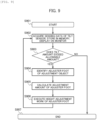
- Fig. 9 shows a tilt adjustment flow of the automatic analyzer.
- the tilt adjustment flow is executed by a terminal that is held by a maintenance worker except for the operation of the adjuster feet.
- the maintenance worker connects the terminal and the external terminal 61 of the tilt sensor 60 to each other, and gives an instruction to start maintenance through a user interface such as a touch panel (S901).
- the maintenance is executed in a state where electric power of the automatic analyzer is not turned on. Sensing data is acquired from the tilt sensor 60, and is stored in a memory in the terminal.
- the tilt amount is displayed on a monitor of the terminal such that the maintenance worker can check the tilt amount (S902).
- the terminal determines whether the tilt amount detected by the tilt sensor 60 exceeds the allowable amount (S903), and executes the tilt adjustment of the device when the tilt amount exceeds the allowable amount.
- a tilt adjustment method will be described with reference to Fig. 10 .
- the mechanism base 35 is divided into four regions around the tilt sensor 60 by the two axes (X-axis and Y-axis).
- the adjuster foot 37a is positioned in the lower left section
- the adjuster foot 37b is positioned in the lower right section
- the adjuster foot 37c is positioned in the upper left section
- the adjuster foot 37d is positioned in the upper right section.
- an adjuster foot to be adjusted is identified by combining positive and negative symbols of the tilting of the X-axis and the tilting of the Y-axis of the tilt sensor 60 (S904).
- the symbols of tilting of the two axes (x,y) are (+,-) .
- the symbols are (+,+)
- the adjuster foot to be adjusted is selected depending on the combination of the symbols of tilting.
- the adjustment amount of the selected adjuster foot is calculated (S905).
- the terminal stores in advance a change amount of the sensing data of the tilt sensor 60 caused by adjusting each of the adjuster feet in advance.
- adjustment tables 91 to 94 store a change amount of tilting of each of the X-axis and the Y-axis whenever the adjuster foot is lifted by 1 mm.
- the adjustment amount of the height of the adjuster foot is calculated and displayed on the monitor of the terminal such that the tilt amounts of the two axes of the tilt sensor acquired in Step S902 are offset from each other with reference to the adjustment table of the adjuster foot to be adjusted.
- the maintenance worker executes a height adjustment work of the adjuster foot according to the display result (S906). After the work, the process returns to Step S902 again, and the flow is repeated. When the tilt amount is the allowable amount or less in Step S903, the tilt adjustment flow ends (S907).
Landscapes
- Physics & Mathematics (AREA)
- Health & Medical Sciences (AREA)
- Life Sciences & Earth Sciences (AREA)
- Chemical & Material Sciences (AREA)
- Analytical Chemistry (AREA)
- Biochemistry (AREA)
- General Health & Medical Sciences (AREA)
- General Physics & Mathematics (AREA)
- Immunology (AREA)
- Pathology (AREA)
- Engineering & Computer Science (AREA)
- Quality & Reliability (AREA)
- Automatic Analysis And Handling Materials Therefor (AREA)
Applications Claiming Priority (2)
| Application Number | Priority Date | Filing Date | Title |
|---|---|---|---|
| JP2021119196 | 2021-07-20 | ||
| PCT/JP2022/022317 WO2023002761A1 (fr) | 2021-07-20 | 2022-06-01 | Dispositif d'analyse automatique et procédé d'ajustement de l'inclinaison de celui-ci |
Publications (3)
| Publication Number | Publication Date |
|---|---|
| EP4375673A1 true EP4375673A1 (fr) | 2024-05-29 |
| EP4375673A4 EP4375673A4 (fr) | 2025-06-18 |
| EP4375673B1 EP4375673B1 (fr) | 2026-05-06 |
Family
ID=84979144
Family Applications (1)
| Application Number | Title | Priority Date | Filing Date |
|---|---|---|---|
| EP22845698.4A Active EP4375673B1 (fr) | 2021-07-20 | 2022-06-01 | Dispositif d'analyse automatique et procédé d'ajustement de l'inclinaison de celui-ci |
Country Status (5)
| Country | Link |
|---|---|
| US (1) | US20240175885A1 (fr) |
| EP (1) | EP4375673B1 (fr) |
| JP (1) | JP7595174B2 (fr) |
| CN (1) | CN117501128A (fr) |
| WO (1) | WO2023002761A1 (fr) |
Families Citing this family (1)
| Publication number | Priority date | Publication date | Assignee | Title |
|---|---|---|---|---|
| EP4357785A1 (fr) * | 2022-10-21 | 2024-04-24 | F. Hoffmann-La Roche AG | Instrument de laboratoire |
Family Cites Families (10)
| Publication number | Priority date | Publication date | Assignee | Title |
|---|---|---|---|---|
| JPH03285170A (ja) * | 1990-04-02 | 1991-12-16 | Hitachi Ltd | 自動分析装置 |
| JP4427461B2 (ja) * | 2005-01-21 | 2010-03-10 | 株式会社日立ハイテクノロジーズ | 化学分析装置及び分析デバイス |
| JP2007248413A (ja) * | 2006-03-20 | 2007-09-27 | Toshiba Corp | 自動分析装置及びその水平出し方法 |
| JP4829335B2 (ja) * | 2009-11-04 | 2011-12-07 | 株式会社東芝 | 搬送コンベアの診断装置及びその診断システム |
| JP2016183913A (ja) * | 2015-03-26 | 2016-10-20 | 株式会社日立ハイテクノロジーズ | 自動分析装置 |
| JP6788965B2 (ja) * | 2015-12-17 | 2020-11-25 | シスメックス株式会社 | 検体分析装置および検体分析方法 |
| JP6891140B2 (ja) * | 2018-03-14 | 2021-06-18 | 株式会社日立ハイテク | 自動分析装置 |
| EP4033251B1 (fr) * | 2019-09-19 | 2024-05-22 | Hitachi High-Tech Corporation | Dispositif d'analyse automatisé et procédé permettant de mettre à niveau celui-ci |
| CN111701731A (zh) * | 2020-06-28 | 2020-09-25 | 陈龙刚 | 一种干细胞分离用离心机 |
| CN213161338U (zh) * | 2020-08-11 | 2021-05-11 | 德爱(广州)健康产业有限公司 | 一种翻袋离心机 |
-
2022
- 2022-06-01 US US18/575,803 patent/US20240175885A1/en active Pending
- 2022-06-01 CN CN202280040468.6A patent/CN117501128A/zh active Pending
- 2022-06-01 JP JP2023536639A patent/JP7595174B2/ja active Active
- 2022-06-01 EP EP22845698.4A patent/EP4375673B1/fr active Active
- 2022-06-01 WO PCT/JP2022/022317 patent/WO2023002761A1/fr not_active Ceased
Also Published As
| Publication number | Publication date |
|---|---|
| EP4375673A4 (fr) | 2025-06-18 |
| JPWO2023002761A1 (fr) | 2023-01-26 |
| CN117501128A (zh) | 2024-02-02 |
| JP7595174B2 (ja) | 2024-12-05 |
| US20240175885A1 (en) | 2024-05-30 |
| WO2023002761A1 (fr) | 2023-01-26 |
| EP4375673B1 (fr) | 2026-05-06 |
Similar Documents
| Publication | Publication Date | Title |
|---|---|---|
| US8911685B2 (en) | Automated analyzer | |
| US9080972B2 (en) | Automatic analyzer | |
| CN103884851A (zh) | 用于管理散装液体和/或固体的系统 | |
| US11143665B2 (en) | Automatic analyzer | |
| EP4375673B1 (fr) | Dispositif d'analyse automatique et procédé d'ajustement de l'inclinaison de celui-ci | |
| US20230341425A1 (en) | Automatic analyzer and dispensing method of reagent | |
| JP7061686B2 (ja) | 自動分析装置 | |
| JP6766155B2 (ja) | 自動分析装置 | |
| JP2006275962A (ja) | 自動分析装置 | |
| CN104487848B (zh) | 维护支持系统 | |
| JP2011027480A (ja) | 自動分析装置と自動分析装置における試薬容器の試薬量管理方法 | |
| US20190369130A1 (en) | Automatic Analyzer | |
| JP7153803B2 (ja) | 自動分析装置およびその水平出し方法 | |
| JP7342129B2 (ja) | 自動分析装置 | |
| JP7301764B2 (ja) | 自動分析装置 | |
| JP2015215367A (ja) | 自動分析装置 | |
| JP6396085B2 (ja) | 自動分析装置 | |
| JP2008003057A (ja) | 分析装置と分析方法 | |
| JP2017151054A (ja) | 自動分析装置 | |
| EP4600655A1 (fr) | Dispositif d'analyse automatisé | |
| JP7538877B2 (ja) | 自動分析装置 | |
| JP6976781B2 (ja) | 自動分析装置 | |
| JP5388745B2 (ja) | 自動分析装置 | |
| JP2025068865A (ja) | 自動分析装置及びその分析方法 | |
| JP2008122204A (ja) | 医用光度計 |
Legal Events
| Date | Code | Title | Description |
|---|---|---|---|
| STAA | Information on the status of an ep patent application or granted ep patent |
Free format text: STATUS: THE INTERNATIONAL PUBLICATION HAS BEEN MADE |
|
| PUAI | Public reference made under article 153(3) epc to a published international application that has entered the european phase |
Free format text: ORIGINAL CODE: 0009012 |
|
| STAA | Information on the status of an ep patent application or granted ep patent |
Free format text: STATUS: REQUEST FOR EXAMINATION WAS MADE |
|
| 17P | Request for examination filed |
Effective date: 20231229 |
|
| AK | Designated contracting states |
Kind code of ref document: A1 Designated state(s): AL AT BE BG CH CY CZ DE DK EE ES FI FR GB GR HR HU IE IS IT LI LT LU LV MC MK MT NL NO PL PT RO RS SE SI SK SM TR |
|
| DAV | Request for validation of the european patent (deleted) | ||
| DAX | Request for extension of the european patent (deleted) | ||
| A4 | Supplementary search report drawn up and despatched |
Effective date: 20250516 |
|
| RIC1 | Information provided on ipc code assigned before grant |
Ipc: G01N 35/10 20060101ALI20250512BHEP Ipc: G01N 35/04 20060101ALI20250512BHEP Ipc: G01N 35/00 20060101AFI20250512BHEP |
|
| GRAP | Despatch of communication of intention to grant a patent |
Free format text: ORIGINAL CODE: EPIDOSNIGR1 |
|
| STAA | Information on the status of an ep patent application or granted ep patent |
Free format text: STATUS: GRANT OF PATENT IS INTENDED |
|
| INTG | Intention to grant announced |
Effective date: 20251209 |
|
| RIC1 | Information provided on ipc code assigned before grant |
Ipc: G01N 35/00 20060101AFI20251201BHEP Ipc: G01N 35/04 20060101ALI20251201BHEP Ipc: G01N 35/10 20060101ALI20251201BHEP |
|
| RIN1 | Information on inventor provided before grant (corrected) |
Inventor name: SAKATA, KENSHIRO Inventor name: SUZUKI, YOICHIRO Inventor name: TAKAHASHI, TAKUYA Inventor name: KABE, YOSHIHIRO |
|
| GRAS | Grant fee paid |
Free format text: ORIGINAL CODE: EPIDOSNIGR3 |
|
| GRAA | (expected) grant |
Free format text: ORIGINAL CODE: 0009210 |
|
| STAA | Information on the status of an ep patent application or granted ep patent |
Free format text: STATUS: THE PATENT HAS BEEN GRANTED |
|
| AK | Designated contracting states |
Kind code of ref document: B1 Designated state(s): AL AT BE BG CH CY CZ DE DK EE ES FI FR GB GR HR HU IE IS IT LI LT LU LV MC MK MT NL NO PL PT RO RS SE SI SK SM TR |
|
| REG | Reference to a national code |
Ref country code: CH Ref legal event code: F10 Free format text: ST27 STATUS EVENT CODE: U-0-0-F10-F00 (AS PROVIDED BY THE NATIONAL OFFICE) Effective date: 20260506 Ref country code: GB Ref legal event code: FG4D |
|
| REG | Reference to a national code |
Ref country code: DE Ref legal event code: R096 Ref document number: 602022036547 Country of ref document: DE |
|
| REG | Reference to a national code |
Ref country code: IE Ref legal event code: FG4D |
|
| PGFP | Annual fee paid to national office [announced via postgrant information from national office to epo] |
Ref country code: DE Payment date: 20260623 Year of fee payment: 5 |
|
| PGFP | Annual fee paid to national office [announced via postgrant information from national office to epo] |
Ref country code: AT Payment date: 20260714 Year of fee payment: 5 |
|
| PGFP | Annual fee paid to national office [announced via postgrant information from national office to epo] |
Ref country code: FR Payment date: 20260624 Year of fee payment: 5 |