EP4366124A1 - Steuerschaltung, leiterplattenanordnung und batterieparallelsystem - Google Patents
Steuerschaltung, leiterplattenanordnung und batterieparallelsystem Download PDFInfo
- Publication number
- EP4366124A1 EP4366124A1 EP22831321.9A EP22831321A EP4366124A1 EP 4366124 A1 EP4366124 A1 EP 4366124A1 EP 22831321 A EP22831321 A EP 22831321A EP 4366124 A1 EP4366124 A1 EP 4366124A1
- Authority
- EP
- European Patent Office
- Prior art keywords
- current
- battery
- switch tube
- positive electrode
- turn
- Prior art date
- Legal status (The legal status is an assumption and is not a legal conclusion. Google has not performed a legal analysis and makes no representation as to the accuracy of the status listed.)
- Pending
Links
Images


Classifications
-
- H—ELECTRICITY
- H02—GENERATION; CONVERSION OR DISTRIBUTION OF ELECTRIC POWER
- H02J—CIRCUIT ARRANGEMENTS OR SYSTEMS FOR SUPPLYING OR DISTRIBUTING ELECTRIC POWER; SYSTEMS FOR STORING ELECTRIC ENERGY
- H02J1/00—Circuit arrangements for DC mains or DC distribution networks
- H02J1/10—Parallel operation of DC sources
- H02J1/102—Parallel operation of DC sources being switching converters
-
- H02J7/62—
-
- H—ELECTRICITY
- H02—GENERATION; CONVERSION OR DISTRIBUTION OF ELECTRIC POWER
- H02H—EMERGENCY PROTECTIVE CIRCUIT ARRANGEMENTS
- H02H9/00—Emergency protective circuit arrangements for limiting excess current or voltage without disconnection
- H02H9/02—Emergency protective circuit arrangements for limiting excess current or voltage without disconnection responsive to excess current
-
- H—ELECTRICITY
- H02—GENERATION; CONVERSION OR DISTRIBUTION OF ELECTRIC POWER
- H02J—CIRCUIT ARRANGEMENTS OR SYSTEMS FOR SUPPLYING OR DISTRIBUTING ELECTRIC POWER; SYSTEMS FOR STORING ELECTRIC ENERGY
- H02J7/00—Circuit arrangements for charging or depolarising batteries or for supplying loads from batteries
- H02J7/34—Parallel operation in networks using both storage and other DC sources, e.g. providing buffering
-
- H—ELECTRICITY
- H02—GENERATION; CONVERSION OR DISTRIBUTION OF ELECTRIC POWER
- H02J—CIRCUIT ARRANGEMENTS OR SYSTEMS FOR SUPPLYING OR DISTRIBUTING ELECTRIC POWER; SYSTEMS FOR STORING ELECTRIC ENERGY
- H02J2207/00—Indexing scheme relating to details of circuit arrangements for charging or depolarising batteries or for supplying loads from batteries
- H02J2207/20—Charging or discharging characterised by the power electronics converter
-
- H02J7/94—
Definitions
- Embodiments of the present application relate to the field of circuit design, in particular to a control circuit, a circuit board assembly, and a battery parallel system.
- the plurality of batteries are operating in parallel, no matter in a process that the plurality of batteries in parallel discharge to the load jointly or in a process that the plurality of batteries in parallel are charged by an external power source, the current on a connection line between each battery and a busbar used to connect the load or the external power source is usually too high, and the battery will often work in an overcurrent operation state, resulting in short service life and low reliability.
- an embodiment of the present application provides a control circuit, disposed between a battery and a busbar.
- the control circuit includes an acquisition unit, a control unit, and a current-limiting circuit; a positive electrode of the battery is connected to a first end of the current-limiting circuit, a second end of the current-limiting circuit is connected to a positive electrode of the busbar, a negative electrode of the busbar is connected to a third end of the current-limiting circuit, a fourth end of the current-limiting circuit is connected to a negative electrode of the battery, an input end of the acquisition unit is connected to the positive electrode of the battery, an output end of the acquisition unit is connected to an input end of the control unit, and an output end of the control unit is connected to the current-limiting circuit; the acquisition unit is used to acquire a current of the positive electrode of the battery; and the control unit is used to start timing when the current of the positive electrode of the battery is greater than a preset threshold, and reduce, after a duration in which the current of the positive electrode of the battery is greater
- An embodiment of the present application further provides a circuit board assembly, including the above control circuit.
- An embodiment of the present application further provides a battery parallel system, including each battery for parallel operation, the above circuit board assembly, a busbar connected to each battery through each circuit board assembly, and an upper computer connected to each circuit board assembly.
- FIG. 1 An embodiment of the present application relates to a control circuit.
- the control circuit 100 is disposed in a battery parallel system, specifically disposed between each battery 200 for parallel operation and a busbar 300 connected to each battery 200.
- the control circuit 100 is used to control a current of each battery 200 for parallel operation to be within a normal range.
- the control circuit 100 specifically includes an acquisition unit 1, a control unit 2, and a current-limiting circuit 3.
- a positive electrode of the battery 200 is connected to a first end 301 of the current-limiting circuit 3
- a second end 302 of the current-limiting circuit 3 is connected to a positive electrode of the busbar 300
- a negative electrode of the busbar 300 is connected to a third end 303 of the current-limiting circuit 3
- a fourth end 304 of the current-limiting circuit 3 is connected to a negative electrode of the battery 200
- an input end 1 of the acquisition unit 1 is connected to the positive electrode of the battery 200
- an output end 12 of the acquisition unit 1 is connected to an input end 21 of the control unit 2
- an output end 22 of the control unit 2 is connected to the current-limiting circuit 3.
- the acquisition unit 1 acquires a current of the positive electrode of the battery, and the control unit 2 starts timing when the current of the positive electrode of the battery 200 is greater than a preset threshold, and reduces, after the duration in which the current of the positive electrode of the battery 200 is greater than the preset threshold is greater than a preset time, the current of the positive electrode of the battery 200 by means of controlling the current-limiting circuit 3, until the current of the positive electrode of the battery 200 is less than or equal to the preset threshold.
- control circuit a circuit board assembly, and the battery parallel system are provided, which can control a current of batteries in parallel operation to be within a normal range, prolong the service life of the batteries, and improve circuit reliability.
- the control circuit is disposed between the battery and the busbar.
- the control circuit may acquire the current of the positive electrode of the battery, and the control unit may start timing when the current of the positive electrode of the battery is greater than the preset threshold, and reduce, after the duration in which the current of the positive electrode of the battery is greater than the preset threshold is greater than a preset time, the current of the positive electrode of the battery by means of controlling the current-limiting circuit, until the current of the positive electrode of the battery is less than or equal to the preset threshold.
- the present application can effectively monitor and adjust the current of the positive electrode of the battery by disposing the control circuit. Moreover, since the current of the positive electrode of the battery is not always stable, for example, in a process of connecting an external power source to the battery through the busbar, the current of the positive electrode of the battery may be greater than the preset threshold for a short time, but when the current of the positive electrode of the battery is stabilized, the current of the positive electrode of the battery may be not greater than the preset threshold.
- the present application adjusts the preset time and reduces the current of the positive electrode of the battery by means of controlling the current-limiting circuit through the control unit after the current of the positive electrode of the battery is greater than the preset threshold and lasts for the preset time, so as to adjust the current of the positive electrode of the battery after it is determined that the battery is stably operated under an overvoltage operating state or an overcurrent operating state, thereby ensuring the efficiency of transmitting the electrical energy between the battery and the busbar to a certain extent.
- This implementation can effectively monitor and adjust the current of the positive electrode of the battery to be within the normal range by disposing the control circuit, thereby prolonging the service life of the battery, improving the circuit reliability, and meanwhile, improving the output efficiency of the battery.
- the control circuit 100 further includes a voltage stabilizing capacitor C.
- a first end of the voltage stabilizing capacitor C is connected to a positive electrode of the busbar 300, a second end of the voltage stabilizing capacitor C is connected to a negative electrode of the busbar 300, or the first end of the voltage stabilizing capacitor C is connected to the positive electrode of the battery 200, and the second end of the voltage stabilizing capacitor C is connected to the negative electrode of the battery 200. It may also be possible to dispose the voltage stabilizing capacitor C between the positive electrode and the negative electrode of the busbar 300 as well as between the positive electrode and the negative electrode of the battery 200 to stabilize a voltage. Fig.
- the voltage stabilizing capacitor C is disposed between the positive electrode and the negative electrode of the busbar 300.
- the voltage stabilizing capacitors at both ends of the busbar can be effectively stabilized.
- the voltage stabilizing capacitors at both ends of the battery can be effectively stabilized, further improving the reliability of the circuit.
- the control circuit 100 further includes: a first switch tube K1, a second switch tube K2, a first diode D1, and a second diode D2.
- the first switch tube K1 and the second switch tube K2 may be MOSs.
- the positive electrode of the battery 200 is connected to the first end 301 of the current-limiting circuit 3 through the first switch tube K1, the second end 302 of the current-limiting circuit 3 is connected to the positive electrode of the busbar 300 through the second switch tube K2, a positive electrode/negative electrode of the first diode D1 is connected to the positive electrode of the battery 200, a negative electrode/positive electrode of the first diode D1 is connected to the first end 301 of the current-limiting circuit 3, a negative electrode/positive electrode of the second diode D2 is connected to the second end 302 of the current-limiting circuit 3, a positive electrode/negative electrode of the second diode D2 is connected to the positive electrode of the busbar 300, and the output end of the control unit 2 is further connected to a control end of the first switch tube K1 and a control end of the second switch tube K2 respectively.
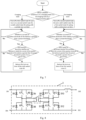
- the control unit 2 may turn on/turn off the first switch tube K1 and turn off/turn on the second switch tube K2 when determining that the battery 200 is in a charging state; and turn off/turn on the first switch tube K1 and turn on/turn off the second switch tube K2 when determining that the battery 200 is in a discharging state.
- a control flow diagram of the control unit 2 in Fig. 3 which is illustrated by taking directions of D1 and D2 in Fig. 2 as an example.
- control unit 2 may turn on the first switch tube K1 and turn off the second switch tube K2 when determining that the battery 200 is in the charging state; and turn off the first switch tube K1 and turn on the second switch tube K2 when determining that the battery 200 is in the discharging state.
- this embodiment further provides a specific implementation for the control unit to determine that the battery is in the charging/discharging state.
- the input end of the control unit 2 is further connected to an upper computer 400 for outputting a charging instruction or a discharging instruction, specifically, the input end of the control unit 2 is connected to the upper computer through a communication line.
- the communication line may be CAN/485/SCI.
- the control unit 2 may determine that each battery 200 is currently in the charging state after receiving the charging instruction output by the upper computer 400; and determine that each battery 200 is currently in the discharging state after receiving the discharging instruction output by the upper computer 400.
- the present application disposes the first switch tube and the first diode connected in parallel, as well as the second switch tube and the second diode connected in parallel, in a transmission line between the battery and the busbar.
- the directions of the current that can be turned on by the first diode and the second diode are opposite, and the control unit may only form a turn-on path from the busbar to the battery by controlling the on/off state of the first switch tube and the second switch tube when the battery is in the charging state, and similarly only form a turn-on path from the battery to the busbar when the battery is in the discharging state, thereby effectively reducing the internal friction generated by mutual charging between the batteries and improving the charging and discharging efficiency of the entire battery parallel system.
- the current-limiting circuit 3 includes: a first inductor L1, a third switch tube K3, and a fourth switch tube K4.
- the third switch tube K3 and the fourth switch tube K4 may be MOSs.
- a circuit connection structure is as follows: a first end of the first inductor L1 serves as the first end 301 of the current-limiting circuit 3, a second end of the first inductor L1 serves as the second end 302 of the current-limiting circuit 3, a first end of the third switch tube K3 is connected to the first end of the first inductor L1, a second end of the third switch tube K3 serves as the fourth end 304 of the current-limiting circuit 3, a first end of the fourth switch tube K4 is connected to the second end of the first inductor L1, a second end of the fourth switch tube K4 serves as the third end 303 of the current-limiting circuit 3, the second end of the third switch tube K3 is connected to the second end of the fourth switch tube K4, and the output end of the control unit 2 is respectively connected to a control end of the third switch tube K3 and a control end of the fourth switch tube K4.
- the control unit 2 may start timing when the battery 200 is in the charging state and the current of the positive electrode of the battery 200 is greater than the preset threshold, and turn off the third switch tube K3 and turn on the fourth switch tube K4 after the duration of the current of the positive electrode of the battery 200 greater than the preset threshold is greater than the preset time; and remain the on/off state of the third switch tube K3 and the fourth switch tube K4 unchanged after the current of the positive electrode of the battery 200 is less than or equal to the preset threshold, or the duration, obtained by timing, of the current of the positive electrode of the battery 200 greater than the preset threshold is less than or equal to the preset time.
- the control unit 2 may start timing when the battery 200 is in the discharging state and the current of the positive electrode of the battery 200 is greater than the preset threshold, and turn on the third switch tube K3 and turn off the fourth switch tube K4 after the duration of the current of the positive electrode of the battery 200 greater than the preset threshold is greater than the preset time; and remain the on/off state of the third switch tube K3 and the fourth switch tube K4 unchanged after the current of the positive electrode of the battery 200 is less than or equal to the preset threshold, or the duration, obtained by timing, of the current of the positive electrode of the battery 200 greater than the preset threshold is less than or equal to the preset time.
- both the third switch tube K3 and the fourth switch tube K4 are controlled to be in a turn-off state, regardless of whether the battery 200 is in the charging state or the discharging state, transmission may be directly performed between the battery 200 and the busbar 300 at this time, and the first inductor L1 only controls the gradual increase or decrease of the current on the connection line to avoid the impact of sudden increase and sudden decrease of the current on the service life of the battery. At this time, the current-limiting circuit 3 does not work.
- the control unit 2 may control only the fourth switch tube K4 to be turned on, and a portion of the current flowing from the positive electrode of the busbar 300 may directly flow back to the negative electrode of the busbar 300 from the fourth switch tube K4, thus limiting the amount of the current transmitted from the busbar 300 to the battery 200.
- the electrical energy is transmitted from the battery 200 to the busbar 300.
- control unit 2 may control only the third switch tube K3 to be turned on, and a portion of the current flowing from the positive electrode of the battery 200 may directly flow back to the negative electrode of the battery 200 from the third switch tube K3, thus limiting the amount of the current transmitted from the battery 200 to the busbar 300.
- the control circuit for limiting the current of the positive electrode of the battery is provided.
- the current-limiting circuit specifically includes a first inductor, used to limit the gradual increase or decrease of the current on the connection line between the battery and the busbar, avoiding the impact of the sudden increase and sudden decrease of the current on the service life of the battery. If the current of the positive electrode of the battery is within the preset threshold, or if the duration, obtained by timing, of the current of the positive electrode of the battery greater than the preset threshold is within the preset time, that is, if the battery is not continuously in an overcurrent state, the control unit may turn off the third switch tube and the fourth switch tube, and the battery is only connected to the busbar through the first inductor.
- the control unit may control only the fourth switch tube to be turned on. At this time, the current output by the busbar may flow back to the busbar through the fourth switch tube, without flowing to the battery, thereby effectively ensuring that the battery may not continuously in the overcurrent state.
- the control unit may control only the third switch tube to be turned on. At this time, the current output by the battery may flow back to the battery through the third switch tube, without flowing to an outside load, thereby effectively ensuring that the load may not continuously in the overcurrent state, and improving the reliability of the circuit.
- the current-limiting circuit 3 includes: a second inductor L2, a fifth switch tube K5, and a third diode D3.
- the fifth switch tube K5 may be an MOS.
- a circuit connection structure is as follows: a first end of the second inductor L2 serves as the first end 301 of the current-limiting circuit 3, a second end of the second inductor L2 serves as the second end 302 of the current-limiting circuit 3, a first end of the fifth switch tube K5 is connected to the second end of the second inductor L2, a second end of the fifth switch tube K5 serves as the fourth end 304 of the current-limiting circuit 3, a negative electrode of the third diode D3 is connected to the second end of the second inductor L2, a positive electrode of the third diode D3 serves as the third end 303 of the current-limiting circuit 3, the positive electrode of the third diode D3 is connected to the second end of the fifth switch tube K5, the negative electrode of the first diode D1 is connected to the positive electrode of the battery 200, the positive electrode of the first diode D1 is connected to the first end 301 of the current-limiting circuit 3, the positive electrode of the second diode D2 is connected to the second end 302 of
- control unit 2 may turn off the first switch tube K1 and the fifth switch tube K5 when the battery 200 is in the charging state, and adjust the current output to the positive electrode of the battery 200 only by controlling the turn-on or turn-off of the second switch tube K2; and the control unit 2 may further turn on the first switch tube K1 and turn off the second switch tube K2 when the battery 200 is in the discharging state, and adjust the current output to the positive electrode of the busbar 300 only by controlling the turn-on or turn-off of the fifth switch tube K5.
- the control unit 2 turns off the first switch tube K1 and the fifth switch tube K5.
- the control unit 2 controls the second switch tube K2 to be turned on
- the current flows out of the positive electrode of the busbar 300, and flows to the positive electrode of the battery 200 after sequentially passing through the second switch tube K2, the second inductor L2, and the first diode D1.
- the second inductor L2 begins to be charged, causing the current of the positive electrode of the battery 200 to gradually increase, and when the current of the positive electrode of the battery 200 is greater than or equal to a preset value (less than a current of the positive electrode of the busbar 300), the control unit 2 may control the second switch tube K2 to be turned off.
- the second inductor L2, the first diode D1, the battery 200, and the third diode D3 may form a turn-on loop, and only the second inductor L2 discharges in this turn-on loop until the current of the positive electrode of the battery 200 is less than the preset value.
- the control unit 2 then controls the second switch tube K2 to be turned on, so as to increase the current of the positive electrode of the battery 200.
- the current of the positive electrode of the battery 200 may vary around a range less than the preset value of the current of the positive electrode of the busbar 300.
- Technicians can limit the current of the positive electrode of the battery 200 by controlling a turn-on time of the second switch tube K2.
- the control unit 2 When the battery 200 is in the discharging state, the control unit 2 turns on the first switch tube K1 and turns off the second switch tube K2.
- the control unit 2 controls the fifth switch tube K5 to be turned on, the current flows out of the positive electrode of the battery 200, and flows to the negative electrode of the battery 200 after sequentially passing through the first switch tube K1, the second inductor L2, and the fifth switch tube K5.
- the second inductor L2 begins to be charged.
- the control unit 2 may control the fifth switch tube K5 to be turned off.
- electrical energy on the second inductor L2 and electrical energy output by the positive electrode of the battery 200 may be jointly output to the positive electrode of the busbar 300 through the second diode D2, so that the current of the positive electrode of the busbar 300 is greater than or equal to the preset value (greater than the current of the positive electrode of the battery 200).
- the control unit 2 may control the fifth switch tube K5 to be turned on, and continue to charge the second inductor L2 by the battery 200.
- the current of the positive electrode of the busbar 300 may vary around a range greater than the preset value of the current of the positive electrode of the battery 200.
- Technicians can limit the current of the positive electrode of the busbar 300 by controlling a turn-on time of the fifth switch tube K5.
- the present application forms a bidirectional direct-current converting circuit by setting the second inductor, the fifth switch tube, and the third diode, together with the first switch tube, the second switch tube, the first diode, and the second diode which are disposed to prevent backflow.
- the bidirectional direct-current converting circuit is specifically used to reduce the current on a busbar side and then output the same to a battery side by controlling the second switch tube to be turned on or turned off when the battery is in the charging state, and increase the current on the battery side and then output the same to the busbar side by controlling the fifth switch tube to be turned on or turned off when the battery is in the discharging state.
- the control unit can control the magnitude of the current transmitted by the busbar to the battery, or the magnitude of the current transmitted by the battery to the busbar.
- the present application directly utilizes the first switch tube, the second switch tube, the first diode, and the second diode which are used to prevent backflow together to form the bidirectional direct-current converting circuit, which simplifies a topology structure of the circuit to some extent and reduces costs.
- the current-limiting circuit 3 includes: a third inductor L3, a sixth switch tube K6, and a fourth diode D4.
- the sixth switch tube K6 may be an MOS.
- a circuit connection structure is as follows: a first end of the third inductor L3 serves as the first end 301 of the current-limiting circuit 3, a second end of the third inductor L3 serves as the second end 302 of the current-limiting circuit 3, a first end of the sixth switch tube K6 is connected to the first end of the third inductor L3, a second end of the sixth switch tube K6 serves as the third end 303 of the current-limiting circuit 3, a negative electrode of the fourth diode D4 is connected to the first end of the third inductor L3, a positive electrode of the fourth diode D4 serves as the fourth end 304 of the current-limiting circuit 3, the second end of the sixth switch tube K6 is connected to the positive electrode of the fourth diode D4, and the output end of the control unit 2 is connected to a control end of the sixth switch tube K6.
- the negative electrode of the first diode D1 is connected to the positive electrode of the battery 200
- the positive electrode of the first diode D1 is connected to the first end 301 of the current-limiting circuit 3
- the positive electrode of the second diode D2 is connected to the second end 302 of the current-limiting circuit 3
- the negative electrode of the second diode D2 is connected to the positive electrode of the busbar 300.
- control unit 2 may turn off the first switch tube K1 and turn on the second switch tube K2 when the battery 200 is in the charging state, and adjust the current output to the positive electrode of the battery 200 only by controlling the turn-on or turn-off of the sixth switch tube K6; and turn off the second switch tube K2 and the sixth switch tube K6 when the battery 200 is in the discharging state, and adjust the current output to the positive electrode of the busbar 300 only by controlling the turn-on or turn-off of the first switch tube K1.
- the control unit 2 turns off the first switch tube K1 and turns on the second switch tube K2.
- the control unit 2 controls the sixth switch tube K6 to be turned on
- the current flows out of the positive electrode of the busbar 300, and flows to the negative electrode of the busbar 300 after sequentially passing through the second switch tube K2, the third inductor L3, and the sixth switch tube K6.
- the third inductor L3 begins to be charged.
- the control unit 2 may control the sixth switch tube K6 to be turned off.
- electrical energy on the third inductor L3 and electrical energy output by the positive electrode of the busbar 300 may be jointly output to the positive electrode of the battery 200 through the first diode D1, so that the current of the positive electrode of the battery 200 is greater than or equal to the preset value (greater than the current of the positive electrode of the busbar 300).
- the control unit 2 may control the sixth switch tube K6 to be turned on, and continue to charge the third inductor L3 by the busbar 300.
- the current of the positive electrode of the battery 200 may vary around a range greater than the preset value of the current of the positive electrode of the busbar 300.
- Technicians can limit the current of the positive electrode of the battery 200 by controlling a turn-on time of the sixth switch tube K6.
- the control unit 2 When the battery 200 is in the discharging state, the control unit 2 turns off the second switch tube K2 and the sixth switch tube K6.
- the control unit 2 controls the first switch tube K1 to be turned on, the current flows out of the positive electrode of the battery 200, and flows to the positive electrode of the busbar 300 after sequentially passing through the first switch tube K1, the third inductor L3, and the second diode D2.
- the third inductor L3 begins to be charged, causing the current of the positive electrode of the busbar 300 to gradually increase, and when the current of the positive electrode of the busbar 300 is greater than or equal to a preset value (less than the current of the positive electrode of the battery 200), the control unit 2 may control the first switch tube K1 to be turned off.
- the third inductor L3, the second diode D2, the busbar 300, and the fourth diode D4 may form a turn-on loop, and only the third inductor L3 discharges in this turn-on loop until the current of the positive electrode of the busbar 300 is less than the preset value.
- the control unit 2 then controls the first switch tube K1 to be turned on, so as to increase the current of the positive electrode of the busbar 300.
- the current of the positive electrode of the busbar 300 may vary around a range less than the preset value of the current of the positive electrode of the battery 200.
- Technicians can limit the current of the positive electrode of the busbar 300 by controlling a turn-on time of the first switch tube K1.
- the present application forms a bidirectional direct-current converting circuit by setting the third inductor, the sixth switch tube, and the fourth diode, together with the first switch tube, the second switch tube, the first diode, and the second diode which are disposed to prevent backflow.
- the bidirectional direct-current converting circuit is specifically used to increase the current on a busbar side and then output the same to a battery side by controlling the sixth switch tube to be turned on or turned off when the battery is in the charging state, and reduce the current on the battery side and then output the same to the busbar side by controlling the first switch tube to be turned on or turned off when the battery is in the discharging state.
- the control unit can control the magnitude of the current transmitted by the busbar to the battery, or the magnitude of the current transmitted by the battery to the busbar.
- the present application directly utilizes the first switch tube, the second switch tube, the first diode, and the second diode which are used to prevent backflow together to form the bidirectional direct-current converting circuit, which simplifies a topology structure of the circuit to some extent and reduces costs.
- the current-limiting circuit 3 includes: a first inductor L1 and a full-bridge direct-current converting circuit.
- a circuit connection structure is as follows: please refer to Fig. 8 , a first end of the full-bridge direct-current converting circuit serves as the first end 301 of the current-limiting circuit 3, a second end of the full-bridge direct-current converting circuit is connected to a first end of the first inductor L1, a second end of the first inductor L1 serves as the second end 302 of the current-limiting circuit 3, a third end of the full-bridge direct-current converting circuit serves as the third end 303 of the current-limiting circuit 3, a fourth end of the full-bridge direct-current converting circuit serves as the fourth end 304 of the current-limiting circuit 3, and the control unit 2 is connected to each switch tube of the full-bridge direct-current converting circuit.
- the first end of the first inductor L1 serves as the first end 301 of the current-limiting circuit 3
- the second end of the first inductor L1 is connected to the first end of the full-bridge direct-current converting circuit
- the second end of the full-bridge direct-current converting circuit serves as the second end 302 of the current-limiting circuit 3
- the third end of the full-bridge direct-current converting circuit serves as the third end 303 of the current-limiting circuit 3
- the fourth end of the full-bridge direct-current converting circuit serves as the fourth end 304 of the current-limiting circuit 3
- the control unit 2 is connected to each switch tube of the full-bridge direct-current converting circuit.
- Each switch tube may be an MOS, and the control unit 2 is specifically connected to a gate of each MOS.
- the control unit 2 may control the turn-on or turn-off of each switch tube of the full-bridge direct-current converting circuit with a fixed turn-on duty cycle after the current of the positive electrode of the battery 200 is less than or equal to the preset threshold, or the duration of the current of the positive electrode the battery 200 greater than the preset threshold is less than the preset time; and control the turn-on or turn-off of each switch tube of the full-bridge direct-current converting circuit with a preset turn-on duty cycle after the current of the positive electrode of the battery 200 is greater than the preset threshold and lasts for a preset time, wherein the preset turn-on duty cycle is less than the fixed turn-on duty cycle.
- the full-bridge direct-current converting circuit specifically includes: please refer to Fig. 8 or Fig. 9 , a transformer 31, eight switch tubes K7 to K14, and eight diodes D5 to D12.
- a negative electrode of the D5 serves as the first end of the full-bridge direct-current converting circuit, the negative electrode of the D5 is connected to a second end of the K7, a second end of the K8, and a negative electrode of the D6 respectively, a positive electrode of the D5 is connected to a first end of the K7, and a positive electrode of the D6 is connected to a first end of the K8.
- a positive electrode of the D7 serves as the fourth end of the full-bridge direct-current converting circuit, the positive electrode of the D7 is connected to a first end of the K9, a first end of the K10, and a positive electrode of the D8 respectively, and a negative electrode of the D7 is connected to a second end of the K9.
- the second end of the K9 is connected to the first end of the K7, a negative electrode of the D8 is connected to a second end of the K10, the second end of the K10 is connected to the first end of the K8, a negative electrode of the D10 serves as the second end of the full-bridge direct-current converting circuit, the negative electrode of the D10 is connected to a second end of the K12, a second end of the K11, and a negative electrode of the D9 respectively, and a positive electrode of the D10 is connected to a first end of the K12.
- a positive electrode of the D9 is connected to a first end of the K11, a positive electrode of the D12 serves as the third end of the full-bridge direct-current converting circuit, the positive electrode of the D12 is connected to a first end of the K14, a first end of the K13, and a positive electrode of the D11 respectively, and a negative electrode of the D12 is connected to a second end of the K14.
- the second end of the K14 is connected to the first end of the K12
- a negative electrode of the D11 is connected to a second end of the K 13, and the second end of the K13 is connected to the first end of the K11.
- Two ends of a first coil of the transformer 31 are connected to the first end of the K7 and the first end of the K8 respectively.
- Two ends of a second coil of the transformer 31 are connected to the first end of the K12 and the first end of the K11 respectively.
- the control unit 2 is connected to control ends of the K7 to the K14 respectively.
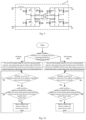
- control unit 2 Please refer to the control flow diagram of the control unit 2 in Fig. 10 , which is illustrated by taking directions of D1 and D2 in Fig. 2 as an example.
- the control strategy is as follows: the control unit 2 simultaneously controls the turn-on or turn-off of the K7, the K10, the K12, and the K13, and the control unit 2 simultaneously controls the complementary turn-on of the K8, the K9, the K11 and the K14 with the K7, the K10, the K12 and the K13.
- the control unit 2 simultaneously controls the turn-on of the K7, the K10, the K12 and the K13, energy can be transmitted between the first coil and the second coil.
- a transmission direction is to transmit the energy from the busbar 300 to the battery 200
- the control unit 2 simultaneously controls the turn-on of the K8, the K9, the K11 and the K14
- the energy can also be transmitted between the first coil and the second coil.
- the transmission direction is to transmit the energy from the battery 200 to the busbar 300.
- the battery 200 is in the charging state, by reducing the turn-on time of the K7, the K10, the K12 and the K13, that is, by reducing the turn-on duty cycle, the time for transmitting the electrical energy from the busbar 300 to the battery 200 can be reduced to limit the current of the positive electrode of the battery 200.
- the current of the positive electrode of the busbar 300 can also be limited.
- the current-limiting circuit may specifically include the full-bridge direct-current converting circuit, and the control unit can limit the magnitude of the transmitted current by reducing the turn-on duty cycle of each switch tube in the full-bridge direct-current converting circuit.
- the control circuit 10 is internally provided with the first switch tube K1, the second switch tube K2, the first diode D1, and the second diode D2, mutual charging among different energy storage states can be effectively avoided. Therefore, the battery parallel system may be provided with different types of batteries 200, such as a lithium battery and a lead-acid battery, and may also be provided with different current-limiting circuits 3.
- batteries 200 such as a lithium battery and a lead-acid battery
- An embodiment of the present application relates to a circuit board assembly, including the control circuit of any embodiment.
- An embodiment of the present application relates to a battery parallel system, please refer to Fig. 1 , including each battery 200 for parallel operation, the circuit board assembly in the above embodiment, a busbar connected to each battery 200 through the circuit board assembly, and an upper computer 400 connected to the circuit board assembly.
Landscapes
- Engineering & Computer Science (AREA)
- Power Engineering (AREA)
- Charge And Discharge Circuits For Batteries Or The Like (AREA)
Applications Claiming Priority (2)
| Application Number | Priority Date | Filing Date | Title |
|---|---|---|---|
| CN202110738427.1A CN115549227A (zh) | 2021-06-30 | 2021-06-30 | 控制电路、电路板组件及电池并联系统 |
| PCT/CN2022/085165 WO2023273490A1 (zh) | 2021-06-30 | 2022-04-02 | 控制电路、电路板组件及电池并联系统 |
Publications (2)
| Publication Number | Publication Date |
|---|---|
| EP4366124A1 true EP4366124A1 (de) | 2024-05-08 |
| EP4366124A4 EP4366124A4 (de) | 2024-11-20 |
Family
ID=84692443
Family Applications (1)
| Application Number | Title | Priority Date | Filing Date |
|---|---|---|---|
| EP22831321.9A Pending EP4366124A4 (de) | 2021-06-30 | 2022-04-02 | Steuerschaltung, leiterplattenanordnung und batterieparallelsystem |
Country Status (4)
| Country | Link |
|---|---|
| US (1) | US20240266846A1 (de) |
| EP (1) | EP4366124A4 (de) |
| CN (1) | CN115549227A (de) |
| WO (1) | WO2023273490A1 (de) |
Families Citing this family (3)
| Publication number | Priority date | Publication date | Assignee | Title |
|---|---|---|---|---|
| CN115833330B (zh) * | 2023-01-09 | 2023-04-18 | 北京宏光星宇科技发展有限公司 | 一种适用于通信基站的电池管理系统 |
| CN117895929B (zh) * | 2023-12-29 | 2024-10-22 | 无锡市稳先微电子有限公司 | 智能电子开关、集成电路芯片、芯片产品和电子设备 |
| CN117748690B (zh) * | 2024-02-19 | 2024-05-24 | 西安图为电气技术有限公司 | 电池的充放电电路和电池的充放电方法 |
Family Cites Families (10)
| Publication number | Priority date | Publication date | Assignee | Title |
|---|---|---|---|---|
| CN102025182B (zh) * | 2010-11-30 | 2012-10-31 | 梁一桥 | 多功能电动汽车动力电池组模块化充放电系统 |
| US9263968B2 (en) * | 2011-06-22 | 2016-02-16 | Eetrex, Inc. | Bidirectional inverter-charger |
| CN102437628A (zh) * | 2011-10-22 | 2012-05-02 | 华北电力大学(保定) | 蓄电池化成充放电变流电路 |
| CN102751772B (zh) * | 2012-07-05 | 2015-08-05 | 西安交通大学 | 一种蓄电池充放电电路拓扑 |
| CN103023351B (zh) * | 2012-12-04 | 2015-01-21 | 上海交通大学 | 电动汽车充放储一体化电站功率流动三级变流装置 |
| CN104614674A (zh) * | 2014-10-14 | 2015-05-13 | 蓝方文 | 高效节电型的环保电池检测设备 |
| CN207426995U (zh) * | 2017-12-04 | 2018-05-29 | 黑龙江大学 | 小功率高频双向ac-dc双管变换器 |
| CN111546939A (zh) * | 2020-05-22 | 2020-08-18 | 广东维可特科技有限公司 | 电动汽车车载动力电池智能检测系统 |
| CN112636597B (zh) * | 2020-12-03 | 2022-03-22 | 成都芯源系统有限公司 | 电源管理电路和集成电路及其过流保护方法 |
| CN112769153A (zh) * | 2020-12-28 | 2021-05-07 | 山东鲁能软件技术有限公司智能电气分公司 | 一种高功率密度双向充放电电路、控制方法及电源 |
-
2021
- 2021-06-30 CN CN202110738427.1A patent/CN115549227A/zh active Pending
-
2022
- 2022-04-02 EP EP22831321.9A patent/EP4366124A4/de active Pending
- 2022-04-02 US US18/564,065 patent/US20240266846A1/en active Pending
- 2022-04-02 WO PCT/CN2022/085165 patent/WO2023273490A1/zh not_active Ceased
Also Published As
| Publication number | Publication date |
|---|---|
| EP4366124A4 (de) | 2024-11-20 |
| US20240266846A1 (en) | 2024-08-08 |
| CN115549227A (zh) | 2022-12-30 |
| WO2023273490A1 (zh) | 2023-01-05 |
Similar Documents
| Publication | Publication Date | Title |
|---|---|---|
| EP4366124A1 (de) | Steuerschaltung, leiterplattenanordnung und batterieparallelsystem | |
| US10270282B2 (en) | Solar charger comprising a charging unit for charging a power battery to a high voltage, a photo-sensitive unit for detecting light intensity, a switch unit for regulating connection between the charging unit and the power battery, and a control unit for regulating the charging of the power battery based on a saturation level and the light intensity | |
| US11804730B2 (en) | Energy storage system and power supply method thereof | |
| US20230361582A1 (en) | Control circuit apparatus of battery system and battery management system | |
| CN110138217B (zh) | 一种三端口dc-dc变换器及其控制方法 | |
| WO2023155325A1 (zh) | 储能系统 | |
| EP4228120A1 (de) | Stromversorgungssystem, ladeverfahren und entladeverfahren | |
| US20230208182A1 (en) | Power supply system and method | |
| US20230198280A1 (en) | Charging circuit, terminal device, adapter, and charging system and method | |
| US12224614B2 (en) | Charging system, method and device for controlling charging system, and electronic device | |
| CN212627186U (zh) | 多路输出式主路电流可变的锂电池充电器 | |
| CN216134279U (zh) | 一种基于4g平台基带芯片的手机充电系统 | |
| CN112510787A (zh) | 一种基于金属空气电池的升压电源及金属空气电池 | |
| CN223613048U (zh) | 电压保持电路 | |
| CN220822640U (zh) | 一种基于微网成组技术的动力电池系统 | |
| CN218920042U (zh) | 一种电池管理系统 | |
| CN115800420B (zh) | 储能系统和储能系统的调节方法 | |
| CN218958570U (zh) | 储能系统的变换器和储能系统 | |
| CN216016462U (zh) | 城市轨道交通变电所并联冗余蓄电池组 | |
| CN114987239B (zh) | 电动车及其充放电控制系统 | |
| EP4451502A1 (de) | Batteriemodul mit vollstromsteuerung und energiespeichersystem mit vollstromsteuerung | |
| CN216794695U (zh) | 一种充电电路、充电器和充电系统 | |
| CN211830284U (zh) | 高效率的锂电开关充电装置 | |
| US20250047201A1 (en) | Power converter and power conversion method capable of balancing energy and hybrid power supply | |
| WO2023115779A1 (zh) | 充电架构、充电控制方法、充电芯片及终端设备 |
Legal Events
| Date | Code | Title | Description |
|---|---|---|---|
| STAA | Information on the status of an ep patent application or granted ep patent |
Free format text: STATUS: THE INTERNATIONAL PUBLICATION HAS BEEN MADE |
|
| PUAI | Public reference made under article 153(3) epc to a published international application that has entered the european phase |
Free format text: ORIGINAL CODE: 0009012 |
|
| STAA | Information on the status of an ep patent application or granted ep patent |
Free format text: STATUS: REQUEST FOR EXAMINATION WAS MADE |
|
| 17P | Request for examination filed |
Effective date: 20231213 |
|
| AK | Designated contracting states |
Kind code of ref document: A1 Designated state(s): AL AT BE BG CH CY CZ DE DK EE ES FI FR GB GR HR HU IE IS IT LI LT LU LV MC MK MT NL NO PL PT RO RS SE SI SK SM TR |
|
| DAV | Request for validation of the european patent (deleted) | ||
| DAX | Request for extension of the european patent (deleted) | ||
| REG | Reference to a national code |
Ref country code: DE Ref legal event code: R079 Free format text: PREVIOUS MAIN CLASS: H02J0007040000 Ipc: H02H0009020000 |
|
| A4 | Supplementary search report drawn up and despatched |
Effective date: 20241023 |
|
| RIC1 | Information provided on ipc code assigned before grant |
Ipc: H02J 7/00 20060101ALN20241017BHEP Ipc: H02J 1/10 20060101ALI20241017BHEP Ipc: H02H 9/02 20060101AFI20241017BHEP |