EP4362003A1 - Lernhilfe zum erlernen der muskel-skelett-struktur des menschlichen körpers - Google Patents
Lernhilfe zum erlernen der muskel-skelett-struktur des menschlichen körpers Download PDFInfo
- Publication number
- EP4362003A1 EP4362003A1 EP22828640.7A EP22828640A EP4362003A1 EP 4362003 A1 EP4362003 A1 EP 4362003A1 EP 22828640 A EP22828640 A EP 22828640A EP 4362003 A1 EP4362003 A1 EP 4362003A1
- Authority
- EP
- European Patent Office
- Prior art keywords
- model
- muscle
- elastic band
- teaching aid
- elastic
- Prior art date
- Legal status (The legal status is an assumption and is not a legal conclusion. Google has not performed a legal analysis and makes no representation as to the accuracy of the status listed.)
- Pending
Links
Images


Classifications
-
- G—PHYSICS
- G09—EDUCATION; CRYPTOGRAPHY; DISPLAY; ADVERTISING; SEALS
- G09B—EDUCATIONAL OR DEMONSTRATION APPLIANCES; APPLIANCES FOR TEACHING, OR COMMUNICATING WITH, THE BLIND, DEAF OR MUTE; MODELS; PLANETARIA; GLOBES; MAPS; DIAGRAMS
- G09B23/00—Models for scientific, medical, or mathematical purposes, e.g. full-sized devices for demonstration purposes
- G09B23/28—Models for scientific, medical, or mathematical purposes, e.g. full-sized devices for demonstration purposes for medicine
- G09B23/30—Anatomical models
- G09B23/32—Anatomical models with moving parts
-
- G—PHYSICS
- G06—COMPUTING OR CALCULATING; COUNTING
- G06Q—INFORMATION AND COMMUNICATION TECHNOLOGY [ICT] SPECIALLY ADAPTED FOR ADMINISTRATIVE, COMMERCIAL, FINANCIAL, MANAGERIAL OR SUPERVISORY PURPOSES; SYSTEMS OR METHODS SPECIALLY ADAPTED FOR ADMINISTRATIVE, COMMERCIAL, FINANCIAL, MANAGERIAL OR SUPERVISORY PURPOSES, NOT OTHERWISE PROVIDED FOR
- G06Q50/00—Information and communication technology [ICT] specially adapted for implementation of business processes of specific business sectors, e.g. utilities or tourism
- G06Q50/10—Services
- G06Q50/20—Education
-
- G—PHYSICS
- G09—EDUCATION; CRYPTOGRAPHY; DISPLAY; ADVERTISING; SEALS
- G09B—EDUCATIONAL OR DEMONSTRATION APPLIANCES; APPLIANCES FOR TEACHING, OR COMMUNICATING WITH, THE BLIND, DEAF OR MUTE; MODELS; PLANETARIA; GLOBES; MAPS; DIAGRAMS
- G09B5/00—Electrically-operated educational appliances
- G09B5/02—Electrically-operated educational appliances with visual presentation of the material to be studied, e.g. using film strip
Definitions
- the present disclosure relates to a teaching aid for learning the musculoskeletal structure of the human body and, more particularly, to a teaching aid for learning the musculoskeletal structure of the human body, which enables effective learning of the movement of the muscles and joints of the human body.
- the human body has a tremendous number of muscles to support and maintain its frame and move its joints.
- Educational institutions such as medical schools, nursing schools, and allied health programs are required to teach students about attachment points, functions, and characteristics of the muscles.
- Korean Laid-Open Patent No. 2019-0078297 Korean Laid-Open Patent No. 2019-0078297 (Patent Document 1) suggested "Muscle tights for learning human muscles", which allow LED bulbs to emit light from a muscle part selected by an app on a smartphone when learning about the muscles of the human body, the muscle tights including: tights made of spandex, that are formed of an upper garment and a lower garment representing human muscles and have an opening-closing member allowing the tights to be worn as a single unit on upper and lower parts of the human body; an LED line installed between knitted fabric of the tights and disposed along the shape and form of the muscles on the upper and lower bodies, for identifying the shape and form of the muscles and their contractions and relaxations by light emitted from LED bulbs; and a power supply part for selectively controlling the turn on/off of the LED bulbs by a switch.
- teaching aids and materials only make it possible to learn about large muscles exposed to surfaces, but not about small stable muscles near joints. Moreover, they cannot implement agonist muscles and antagonist muscles, including the direction of movement of joints through muscle contractions and relaxations, and are hard to identify muscle layers. In addition, they do not allow a trainee to practice with muscle models, like attaching or removing them themselves. For these reasons, these teaching aids and materials have limitations in clearly understanding the shape or form of the muscles and the direction and status of movement of them.
- the present disclosure is directed to solving the above-mentioned problems occurring in the conventional art and providing a teaching air for learning the musculoskeletal structure of the human body, which allows a trainee to install a muscle model formed of a stretchable elastic band on their own, at positions corresponding to attachment points (an origin point and an insertion point) of the muscle on a skeletal model of the human body so as to enable three-dimensional visual learning through the movement of joints or multi-joints while enabling learning about the origin point and the insertion point displayed on the skeletal model by identifying the shape, form, direction of movement, and condition of the muscle and its layers, and which therefore allows the trainee to find and learn about how the joints are linked to each other by implementing functional movements the human body makes in daily life.
- An embodiment of the present disclosure provides a teaching air for learning the musculoskeletal structure of the human body including: a skeletal model having fixing rings provided at positions corresponding to an origin point and an insertion point of the muscle; and a muscle model having elasticity in the longitudinal direction and having both ends connected to the fixing rings at the positions of the origin point and insertion point, respectively.
- the muscle model may be formed of a stretchable elastic band, and a fastening ring portion formed by bending an end of the elastic band may be formed at one end and the other end of the elastic band and connected to the fixing rings.
- the muscle model may further include an elastic band having elasticity, a first fastening ring connected to one end of the elastic band, and a second fastening ring connected to the other end, the first fastening ring and the second fastening ring being connected to the fixing rings.
- a stopper may be provided at a predetermined position on the elastic band to adjust the distance between the one end of the elastic band and the other end of thereof, whereby the musculoskeletal structure and contractions and relaxations of the muscle are implemented through the movement of the muscle model in response to the joint movement of the skeletal model.
- the teaching aid for learning the musculoskeletal structure of the human body According to the teaching aid for learning the musculoskeletal structure of the human body according to the present disclosure, trainees are visually annoyed by an origin point and an insertion point of the muscle indicated by rings on a skeletal model of the human body, and the trainees can do practices by manually fastening a muscle model formed of a stretchable elastic band onto the rings at the origin point and insertion point of the skeletal model, with a stopper mounted to an attachment point of the muscle. Therefore, this teaching aid can be utilized for education prior to clinical training on cadavers, which may improve the quality of training and make it possible to expect a quality improvement in actual clinical training and actual clinical therapies (such as muscle exercise and workout).
- contractions and relaxations of agonist muscles, antagonist muscles, and synergistic muscles can be implemented by adjusting the length of the muscle module formed of a stretchable elastic band, thereby enabling visual learning about three-dimensional functional movements.
- an identification code e.g., QR code
- a label e.g., tag
- a teaching aid for learning the musculoskeletal structure of the human body may include: a human body skeletal model having a plurality of fixing rings provided at the positions of an origin point and an insertion point of the muscle, respectively; and a muscle model having elasticity in the longitudinal direction and having both ends connected to the fixing rings at the positions of the origin point and insertion point, respectively. Therefore, the musculoskeletal structure can be implemented through the movement of the muscle model in response to the joint movement of the skeletal model.
- the muscle model may be formed of a stretchable elastic band, and a fastening ring portion formed by bending an end of the elastic band may be formed at one end and the other end of the elastic band and connected to the fixing rings.
- the muscle model may further include an elastic band having elasticity, a first fastening ring connected to one end of the elastic band, and a second fastening ring connected to the other end, the first fastening ring and the second fastening ring being connected to the fixing rings.
- a stopper may be provided at a predetermined position on the elastic band to adjust the distance between the one end of the elastic band and the other end thereof.
- a plurality of spacing markings may be provided at equal intervals on the elastic band.
- the elastic band may include two or more different types of elastic bands, and the elastic band may be placed in such a way as to have different elasticities for different positions on the skeletal model, corresponding to different muscle sizes.
- the elastic band may come in two colors for a flexor muscle and an extensor muscle, and the skeletal model may be set up in such a way that the color of the elastic band differs for different positions corresponding to the flexor muscle and the extensor muscle.
- a plurality of elastic bands may constitute a single muscle model, wherein a connecting member may be provided between one end and the other end of each elastic band to hold the plurality of elastic bands together.
- a plurality of elastic bands may constitute a single muscle model, wherein one ends and the other ends of the elastic bands may be held together to form respective knots, and each of the knots at opposite ends may be connected to one fixing ring.
- a plurality of elastic bands may constitute a single muscle model, wherein one ends of the elastic bands may be held together to form a knot, the knot being connected to one fixing ring, and the other ends of the plurality of elastic bands may be respectively connected to a plurality of fixing rings.
- first fastening ring may be connected to the knot
- second fastening ring may be connected to the other end of each of the elastic bands.
- a tag may be provided on one side of the muscle model to provide a link to the human body's muscle information, whereby the muscle information can be obtained by scanning an identification code shown on the tag with a wireless communication terminal.
- the fixing rings may be further provided on the end of a bone model and the end of a next other bone model at a joint part of the skeletal model, respectively, and a ligament model may be further provided whose opposite ends are respectively connected to the fixing rings at the two ends of each bone model, wherein the ligament model may be a non-elastic material.
- present disclosure may be changed in various manners and may have various embodiments.
- exemplary embodiments of the present disclosure are illustrated and the present disclosure is described in detail based on the embodiments.
- this is not intended to limit the present disclosure to illustrated configurations, and the spirit and technical scope of the present disclosure include common changes, equivalents and/or substitutes of the illustrated forms.
- the one part when it is described that one part is “connected” to the other part, the one part may be “directly connected” to the other part or may be “indirectly connected” to the other part with an element interposed therebetween.
- an element when it is said that an element is “included”, the word “include” means that other element may be added not the exclusion of other element, unless explicitly described to the contrary.
- FIG. 1 is a front view schematically showing a teaching aid for learning the musculoskeletal structure of the human body according to an embodiment of the present disclosure.
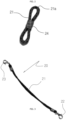
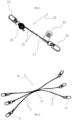
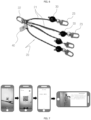
- FIGS. 2 through 6 are views of a muscle model, in a teaching aid for learning the musculoskeletal structure of the human body according to an embodiment of the present disclosure.
- FIG. 7 sequentially shows a process of linking to a video through a smartphone, in a teaching aid for learning the musculoskeletal structure of the human body according to an embodiment of the present disclosure.
- the teaching aid for learning the musculoskeletal structure of the human body largely includes a skeletal model 10 for implementing the human skeleton and a muscle model 20 provided to implement a human muscle.
- the skeletal model 10 has fixing rings 11 provided at positions corresponding to actual attachment points of the muscle, i.e., an origin point and an insertion point.
- the muscle model 20 has elasticity in the longitudinal direction to implement contractions and relaxations of the muscle and has both ends connected to the fixing rings 11 at the positions of the origin point and insertion point, respectively.
- the musculoskeletal structure and contractions and relaxations of the muscle can be implemented through the movement (stretching and flexing) of the muscle model 20 in response to the joint movement of the skeletal model 10.
- the movement of the supraspinatus may be predicted through the movement of the muscle model 20 when the arm is lifted or lowered.
- the muscle model 20 may be manufactured in various structures, taking into account that there are various kinds of human muscles, such as parallel, convergent, fusiform, pennate, and aponeurosis muscles, depending on the shape or size of the muscle.
- the muscle model 20 may be formed of an elastic band 21 having elasticity in response to a stretching or flexing of the muscle, a fastening ring portion 21a formed by bending an end of the elastic band may be formed at one end and the other end of the elastic band 21 so that the fastening ring portion 21 a is connected to the fixing ring 11, and the elastic band 21 may be manufactured in varying sizes.
- the muscle model 20 may further include an elastic band 21 having elasticity, a first fastening ring 22 connected to one end of the elastic band 21, and a second fastening ring 23 connected to the other end, wherein the first fastening ring 22 and the second fastening ring 23 may be connected to the fixing rings 11.
- the muscle model 20 may be formed of a combination of a plurality of elastic bands 21.
- one ends and the other ends of the elastic bands 21 may be held together to form respective knot
- the first fastening ring 22 and the second fastening ring 23 may be respectively connected to the knots at opposite ends
- each of the knots at opposite ends may be connected to one fixing ring 11, thereby forming a fusiform muscle model.
- a stopper 30 may be provided at a predetermined position on the elastic band 21 to adjust the distance between one end and the other end of the elastic band 21. That is, the stopper 30 may be configured to release, when necessary, the force by which two parts of the elastic band 21 are fastened, so as to decrease or increase the entire length of the elastic band 21 by pulling or releasing either part of the elastic band and then to fasten the two parts of the elastic band 21 back together.
- the stopper 30 is not limited to what is illustrated in the drawing, but it may have any structure as long as it is capable of decreasing or increasing the entire length of the elastic band 21 as desired.
- the length of the elastic band 21 may be adjusted freely as required.
- the length of the elastic band 21 may be adjusted according to the actual length of the muscle or according to the distance between the fixing rings 11 in the skeletal model 10, and accordingly, the degree of contraction and relaxation of the muscle may be adjusted.
- a plurality of spacing markings 25 may be provided at equal intervals of 1 cm, for example, on the elastic band 21. In this case, the muscle elasticity can be visually observed since the distance between the spacing markings 25 changes when the elastic band 21 lengthens or shortens.
- muscle models 20, for example, corresponding to biceps and triceps working to stretch or flex the elbow may be mounted to the skeletal model 10.
- the muscle model 20 corresponding to the biceps shortens and at the same time, the muscle model 20 corresponding to the triceps lengthens
- the muscle model 20 corresponding to the triceps shortens
- the muscle model 20 corresponding to the triceps shortens.
- the elastic band 21 may be manufactured in two or more different types that differ in elasticity, by taking into account that the number of myofibrils differs for global muscles and local muscles.
- a elastic band may be made by twisting multiple elastic yarns.
- the elastic band 21 may be made by twisting 9 or 12 elastic yarns to vary the thickness of the elastic band 21, or other methods may be used to vary the elasticity of the elastic band 21.
- electric bands 21 of different thicknesses may be placed in such a way as to have different elasticities for different positions on the skeletal model 10, corresponding to different sizes of muscles (global muscles and local muscles).
- the elastic band 21 may come in two colors for a flexor muscle and an extensor muscle since the muscles are classified into flexor muscles and extensor muscles, and, in the skeletal model 10, the elastic band 21 may have different colors for different positions corresponding to the flexor muscle and the extensor muscle. That is, an elastic band 21 for a muscle model 20 corresponding to the flexor muscle may be red, and an elastic band 21 for a muscle model 20 corresponding to the extensor muscle may be blue.
- a tag 40 may be provided on one side of the muscle model 20 to provide a link to the human body's muscle information.
- the tag 40 may have an identification code such as a QR code printed on it, and the identification code may store information for linking to information on a particular muscle.
- a muscle model 20 at a particular position, for example, a supraspinatus muscle model 20
- a wireless communication terminal such as a smartphone
- information related to the supraspinatus muscle is displayed on the wireless communication terminal, thereby enabling in-depth learning about that muscle.
- the muscle model 20 may be formed of a combination of a plurality of elastic bands 21.
- a connecting member 24 may be provided between one end and the other end of each elastic band 21 to hold the plurality of elastic bands 21 together, thereby forming a parallel muscle model.
- the muscle model 20 may be formed of a combination of a plurality of elastic bands 21.
- one ends of the elastic bands 21 may be held together to form a knot, the knot being connected to one fixing ring 11, whereas, the other ends of the elastic bands 21 may be respectively connected to a plurality of fixing rings 11, thereby forming a convergent or pennate muscle model.
- one first fastening ring 22 may be connected to the knot, and the second fastening ring 23 may be connected to the other end of each of the elastic bands.
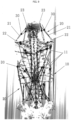
- FIG. 8 is a photograph showing how a ligament model and a linea alba model are set up, in a teaching aid for learning the musculoskeletal structure of the human body according to an embodiment of the present disclosure.
- the skeletal model 10 may further include a ligament model 50 and a linea alba model 60.
- a ligament is the tissue that connects two bones to form a joint. Unlike muscles, ligaments do not contract and relax.
- the linear alba is a line formed by the union of aponeuroses along the midline of the anterior abdominal wall, which attaches to the xiphoid process superiority, and to the pubic symphysis inferiorily, along the middle of the abdomen. Unlike muscles, the linea alba does not contract and relax.
- the fixing rings 11 may be placed at one end and the other end of a bone model at a joint part of the skeletal model 10, respectively, and one end and the other end of a ligament model 50 formed of a non-elastic band may be connected to the fixing rings 11 at the ends of the bone model, thereby installing the ligament model 50 to the skeletal model 10.
- a linea alba model 60 may be further placed at the front of the skeletal model 10, which is a non-elastic band that vertically joins the xiphoid process and the pubic bone.
- the linea alba model 60 may have a predetermined width and be divided into left and right halves being joined together in the middle with a zipper 61, whereby the left and right halves may be separated from each other or joined together through lowering or raising the zipper 61, thereby implementing diastasis rectus abdominis.
- diastasis rectus abdominis refers to a separation of the two sides of the rectus abdominis muscle which occurs when the linea alba becomes stretched during pregnancy.
- the linea alba model 60 may be divided into two halves, and the zipper 61 may be centered between the two halves, so that two sides of the linea alba model 60 may be separated from each other or held together as necessary, thereby enabling visual learning about diastasis rectus abdominis.
- FIG. 9 is a photograph of an actual product which shows a usage status of a teaching aid for the musculoskeletal structure of the human body according to an embodiment of the present disclosure.
- a plurality of fixing rings 11 may be installed at positions corresponding to an origin point and an insertion point on a skeletal model 10 that embodies the skeleton of the human body, a muscle model 20 including an elastic band 21 may be connected to each fixing ring 11, and such a muscle model 20 may be a combination of elastic bands which may differ in length and number according to the shape of the muscle.
- the muscle model 20 allows for adjusting the length of the elastic band 21 by a stopper 30, and the muscle model 20 may come in two colors, red and blue, for different positions of a flexor muscle and an extensor muscle.
- the user is able to install a muscle model 20 representing the actual shape of a muscle to a skeletal model 10 through a teaching aid for the musculoskeletal structure according to the present disclosure, and to visually observe the movement of the muscle model 20 by moving a joint part of the skeletal model 20, thereby enhancing the effect of learning about functional anatomy and utilizing the teaching aid as an alternative to training on cadavers.
Landscapes
- Engineering & Computer Science (AREA)
- Business, Economics & Management (AREA)
- General Physics & Mathematics (AREA)
- Physics & Mathematics (AREA)
- Theoretical Computer Science (AREA)
- Educational Technology (AREA)
- Educational Administration (AREA)
- Health & Medical Sciences (AREA)
- General Health & Medical Sciences (AREA)
- Tourism & Hospitality (AREA)
- Chemical & Material Sciences (AREA)
- Medical Informatics (AREA)
- Mathematical Physics (AREA)
- Pure & Applied Mathematics (AREA)
- Computational Mathematics (AREA)
- Algebra (AREA)
- Mathematical Optimization (AREA)
- Medicinal Chemistry (AREA)
- Mathematical Analysis (AREA)
- Economics (AREA)
- Human Resources & Organizations (AREA)
- Marketing (AREA)
- Primary Health Care (AREA)
- Strategic Management (AREA)
- General Business, Economics & Management (AREA)
- Instructional Devices (AREA)
Applications Claiming Priority (2)
| Application Number | Priority Date | Filing Date | Title |
|---|---|---|---|
| KR1020210082018A KR102287632B1 (ko) | 2021-06-24 | 2021-06-24 | 인체의 근골격 학습용 교구 |
| PCT/KR2022/007970 WO2022270793A1 (ko) | 2021-06-24 | 2022-06-07 | 인체의 근골격 학습용 교구 |
Publications (2)
| Publication Number | Publication Date |
|---|---|
| EP4362003A1 true EP4362003A1 (de) | 2024-05-01 |
| EP4362003A4 EP4362003A4 (de) | 2025-04-23 |
Family
ID=77315069
Family Applications (1)
| Application Number | Title | Priority Date | Filing Date |
|---|---|---|---|
| EP22828640.7A Pending EP4362003A4 (de) | 2021-06-24 | 2022-06-07 | Lernhilfe zum erlernen der muskel-skelett-struktur des menschlichen körpers |
Country Status (4)
| Country | Link |
|---|---|
| US (1) | US20250078684A1 (de) |
| EP (1) | EP4362003A4 (de) |
| KR (1) | KR102287632B1 (de) |
| WO (1) | WO2022270793A1 (de) |
Families Citing this family (1)
| Publication number | Priority date | Publication date | Assignee | Title |
|---|---|---|---|---|
| KR102287632B1 (ko) * | 2021-06-24 | 2021-08-06 | 강효실 | 인체의 근골격 학습용 교구 |
Family Cites Families (10)
| Publication number | Priority date | Publication date | Assignee | Title |
|---|---|---|---|---|
| JP3766499B2 (ja) * | 1997-02-18 | 2006-04-12 | 学校法人早稲田大学 | 顎運動装置 |
| GB2394111A (en) * | 2002-10-08 | 2004-04-14 | David Martin Williams | Locomotor teaching device comprising model limbs. |
| JP2006323103A (ja) * | 2005-05-18 | 2006-11-30 | Matsuuchi:Kk | 骨格模型に取着可能な筋肉模造体及び筋肉骨格模型 |
| US8469715B2 (en) * | 2007-09-26 | 2013-06-25 | Rose Marie Ambrozio | Dynamic human model |
| JP3157322U (ja) * | 2009-11-25 | 2010-02-12 | 耕一 中川 | 関節脱臼整復疑似体験装置 |
| EP2620935A4 (de) * | 2010-10-25 | 2015-09-02 | Shuhei Takasu | Muskelmodell zum lernen und lehrverfahren damit |
| JP5571605B2 (ja) * | 2011-03-01 | 2014-08-13 | 株式会社モリタ製作所 | 医療用実習装置および実習管理システム |
| JP2016114881A (ja) * | 2014-12-17 | 2016-06-23 | 明一 牛久保 | 動物模型 |
| KR102015195B1 (ko) | 2017-12-26 | 2019-08-27 | 부산가톨릭대학교 산학협력단 | 인체 근육 학습용 머슬 타이즈 |
| KR102287632B1 (ko) * | 2021-06-24 | 2021-08-06 | 강효실 | 인체의 근골격 학습용 교구 |
-
2021
- 2021-06-24 KR KR1020210082018A patent/KR102287632B1/ko active Active
-
2022
- 2022-06-07 EP EP22828640.7A patent/EP4362003A4/de active Pending
- 2022-06-07 US US18/574,004 patent/US20250078684A1/en active Pending
- 2022-06-07 WO PCT/KR2022/007970 patent/WO2022270793A1/ko not_active Ceased
Also Published As
| Publication number | Publication date |
|---|---|
| WO2022270793A1 (ko) | 2022-12-29 |
| EP4362003A4 (de) | 2025-04-23 |
| US20250078684A1 (en) | 2025-03-06 |
| KR102287632B1 (ko) | 2021-08-06 |
Similar Documents
| Publication | Publication Date | Title |
|---|---|---|
| US8469715B2 (en) | Dynamic human model | |
| EP4362003A1 (de) | Lernhilfe zum erlernen der muskel-skelett-struktur des menschlichen körpers | |
| US8496483B1 (en) | Educational toy with interchangeable spheres | |
| KR102670319B1 (ko) | 봉합 스킬 수술 트레이닝 모델 | |
| EP2620935A1 (de) | Muskelmodell zum lernen und lehrverfahren damit | |
| US20020098467A1 (en) | Muscle learning assemblage | |
| JP3157322U (ja) | 関節脱臼整復疑似体験装置 | |
| US12075867B2 (en) | Behavior enhancement and goal-setting system and sleeve arrangement | |
| Smith | Findings show lesson study can be an effective model for professional development of 4-H volunteers | |
| Althoff et al. | Posture screening: a program that works | |
| JP2006323103A (ja) | 骨格模型に取着可能な筋肉模造体及び筋肉骨格模型 | |
| Chan | The use of low-tech models to enhance the learning of anatomy | |
| JP6900031B2 (ja) | パーソナルトレーナースーツ、姿勢計測装置、姿勢計測方法、及び、トレーニングシャツ | |
| GB2590349A (en) | Behavior enhancement and goal-setting system and apparatus | |
| GB2591140A (en) | An educative garment | |
| Lenková et al. | Functional disorders of the muscular system of university students in the study program special physical training in security forces | |
| van Munster et al. | Physical education and visual impairment: Collaborative communication for effective inclusion | |
| Wontaisong | The innovation of deltoid muscle injection models | |
| Szark-Eckardt et al. | Somatic characteristics and motor capacity of 10-year swimming pools from basic school no. 60 in Bydgoszcz | |
| CN104368140A (zh) | 蝶泳学习器 | |
| Thornalley | THE DREADED PHYSICAL EDUCATION LESSONS | |
| Arp et al. | Educational Opportunity for Showing Market Animals by Breed: AN250/AN250, 8/2010 | |
| CN201845494U (zh) | 缝合练习腿 | |
| CN202538257U (zh) | 一种辅助运动器材 | |
| Nicolás et al. | Study of the bones and their importance for our organism: Sequence of activities for kindergarten education |
Legal Events
| Date | Code | Title | Description |
|---|---|---|---|
| STAA | Information on the status of an ep patent application or granted ep patent |
Free format text: STATUS: THE INTERNATIONAL PUBLICATION HAS BEEN MADE |
|
| PUAI | Public reference made under article 153(3) epc to a published international application that has entered the european phase |
Free format text: ORIGINAL CODE: 0009012 |
|
| STAA | Information on the status of an ep patent application or granted ep patent |
Free format text: STATUS: REQUEST FOR EXAMINATION WAS MADE |
|
| 17P | Request for examination filed |
Effective date: 20231221 |
|
| AK | Designated contracting states |
Kind code of ref document: A1 Designated state(s): AL AT BE BG CH CY CZ DE DK EE ES FI FR GB GR HR HU IE IS IT LI LT LU LV MC MK MT NL NO PL PT RO RS SE SI SK SM TR |
|
| DAV | Request for validation of the european patent (deleted) | ||
| DAX | Request for extension of the european patent (deleted) | ||
| A4 | Supplementary search report drawn up and despatched |
Effective date: 20250321 |
|
| RIC1 | Information provided on ipc code assigned before grant |
Ipc: G06Q 50/20 20120101ALI20250317BHEP Ipc: G09B 5/02 20060101ALI20250317BHEP Ipc: G09B 23/32 20060101AFI20250317BHEP |
|
| STAA | Information on the status of an ep patent application or granted ep patent |
Free format text: STATUS: EXAMINATION IS IN PROGRESS |
|
| 17Q | First examination report despatched |
Effective date: 20260102 |