EP4351887B1 - Reifen für nutzfahrzeugräder - Google Patents
Reifen für nutzfahrzeugräder Download PDFInfo
- Publication number
- EP4351887B1 EP4351887B1 EP22733477.8A EP22733477A EP4351887B1 EP 4351887 B1 EP4351887 B1 EP 4351887B1 EP 22733477 A EP22733477 A EP 22733477A EP 4351887 B1 EP4351887 B1 EP 4351887B1
- Authority
- EP
- European Patent Office
- Prior art keywords
- main
- grooves
- groove
- main groove
- pairs
- Prior art date
- Legal status (The legal status is an assumption and is not a legal conclusion. Google has not performed a legal analysis and makes no representation as to the accuracy of the status listed.)
- Active
Links
Images


Classifications
-
- B—PERFORMING OPERATIONS; TRANSPORTING
- B60—VEHICLES IN GENERAL
- B60C—VEHICLE TYRES; TYRE INFLATION; TYRE CHANGING; CONNECTING VALVES TO INFLATABLE ELASTIC BODIES IN GENERAL; DEVICES OR ARRANGEMENTS RELATED TO TYRES
- B60C11/00—Tyre tread bands; Tread patterns; Anti-skid inserts
- B60C11/03—Tread patterns
- B60C11/0302—Tread patterns directional pattern, i.e. with main rolling direction
-
- B—PERFORMING OPERATIONS; TRANSPORTING
- B60—VEHICLES IN GENERAL
- B60C—VEHICLE TYRES; TYRE INFLATION; TYRE CHANGING; CONNECTING VALVES TO INFLATABLE ELASTIC BODIES IN GENERAL; DEVICES OR ARRANGEMENTS RELATED TO TYRES
- B60C11/00—Tyre tread bands; Tread patterns; Anti-skid inserts
- B60C11/03—Tread patterns
- B60C11/12—Tread patterns characterised by the use of narrow slits or incisions, e.g. sipes
- B60C11/1236—Tread patterns characterised by the use of narrow slits or incisions, e.g. sipes with special arrangements in the tread pattern
-
- B—PERFORMING OPERATIONS; TRANSPORTING
- B60—VEHICLES IN GENERAL
- B60C—VEHICLE TYRES; TYRE INFLATION; TYRE CHANGING; CONNECTING VALVES TO INFLATABLE ELASTIC BODIES IN GENERAL; DEVICES OR ARRANGEMENTS RELATED TO TYRES
- B60C11/00—Tyre tread bands; Tread patterns; Anti-skid inserts
- B60C11/03—Tread patterns
- B60C11/13—Tread patterns characterised by the groove cross-section, e.g. for buttressing or preventing stone-trapping
- B60C11/1376—Three dimensional block surfaces departing from the enveloping tread contour
- B60C11/1392—Three dimensional block surfaces departing from the enveloping tread contour with chamfered block edges
-
- B—PERFORMING OPERATIONS; TRANSPORTING
- B60—VEHICLES IN GENERAL
- B60C—VEHICLE TYRES; TYRE INFLATION; TYRE CHANGING; CONNECTING VALVES TO INFLATABLE ELASTIC BODIES IN GENERAL; DEVICES OR ARRANGEMENTS RELATED TO TYRES
- B60C11/00—Tyre tread bands; Tread patterns; Anti-skid inserts
- B60C11/03—Tread patterns
- B60C2011/0337—Tread patterns characterised by particular design features of the pattern
- B60C2011/0339—Grooves
- B60C2011/0341—Circumferential grooves
- B60C2011/0344—Circumferential grooves provided at the equatorial plane
-
- B—PERFORMING OPERATIONS; TRANSPORTING
- B60—VEHICLES IN GENERAL
- B60C—VEHICLE TYRES; TYRE INFLATION; TYRE CHANGING; CONNECTING VALVES TO INFLATABLE ELASTIC BODIES IN GENERAL; DEVICES OR ARRANGEMENTS RELATED TO TYRES
- B60C11/00—Tyre tread bands; Tread patterns; Anti-skid inserts
- B60C11/03—Tread patterns
- B60C2011/0337—Tread patterns characterised by particular design features of the pattern
- B60C2011/0339—Grooves
- B60C2011/0341—Circumferential grooves
- B60C2011/0346—Circumferential grooves with zigzag shape
-
- B—PERFORMING OPERATIONS; TRANSPORTING
- B60—VEHICLES IN GENERAL
- B60C—VEHICLE TYRES; TYRE INFLATION; TYRE CHANGING; CONNECTING VALVES TO INFLATABLE ELASTIC BODIES IN GENERAL; DEVICES OR ARRANGEMENTS RELATED TO TYRES
- B60C11/00—Tyre tread bands; Tread patterns; Anti-skid inserts
- B60C11/03—Tread patterns
- B60C2011/0337—Tread patterns characterised by particular design features of the pattern
- B60C2011/0339—Grooves
- B60C2011/0374—Slant grooves, i.e. having an angle of about 5 to 35 degrees to the equatorial plane
Definitions
- the present invention relates to a tyre for commercial vehicle wheels, in particular an "all season" tyre.
- So-called "all season" tyres are suitable for use in both winter and summer and, due to this specific feature, which does not require the user to have two sets of dedicated tyres, each suitable for a specific season, they are highly regarded and in demand by users.
- Light duty vehicles such as vans or commercial vehicles, are generally medium-sized vehicles, heavier than cars and/or which, in any case, are suitable for transporting even high loads.
- This type of vehicle requires tyres which, despite having similar dimensions to those of passenger car tyres, are characterised by greater structural strength and a higher load index.
- the Applicant has observed that, generally, in order to attempt to influence the performance of the tyres, the greatest possible amount of rubber on the ground is provided in the area of contact of the tyre with the ground (footprint area): a requirement that is clearly opposed to that of all-season-type tyres of having high number of grooves, notches and/or sipes.
- the Applicant has therefore tackled the problem of producing all-season tyres, especially for vans or commercial vehicles, capable of guaranteeing low noise, regular wear, high performance levels, braking and traction, without, at the same time, reducing drainage qualities and safe driving on wet and snowy surfaces.
- the Applicant started from a directional type configuration of the tread pattern, namely, a pattern configured for tyres fitted on a vehicle in such a way as to rotate in a preferential direction of travel, as described, for example, in patent application WO 2020/012277 .
- a directional type configuration of the tread pattern namely, a pattern configured for tyres fitted on a vehicle in such a way as to rotate in a preferential direction of travel, as described, for example, in patent application WO 2020/012277 .
- said configuration the presence of two types of grooves extending from the central region to the shoulder region of the tread is envisaged, with the formation of blocks mutually facing in pairs in the central region.
- the present invention relates to a a tyre for vehicle wheels according to claim 1.
- said tyre comprises a tread band on which a first shoulder region and a second axially opposite shoulder region and a central region interposed between said first and second shoulder regions are defined.
- the tread band comprises a plurality of pairs of first blocks and second blocks, arranged in regular succession along the circumferential development of said central region.
- Each first block and each second block of each of said pairs are preferably at least partially aligned with each other along an axial direction defined on said tread band.
- the tread band comprises a plurality of first pairs of main grooves, arranged in regular succession along the circumferential development of said tread band to partially delimit said first and said second blocks.
- Each first pair of main grooves is preferably formed by a first main groove extending from said first shoulder region towards said central region and by a second main groove extending from said second shoulder region towards said central region.
- the tread band comprises a plurality of second pairs of main grooves, arranged in regular succession along the circumferential development of said tread band in an alternating position with said first pairs of main grooves.
- Each second pair of main grooves is preferably formed by a third main groove extending from said first shoulder region towards said central region and by a fourth main groove extending from said second shoulder region towards said central region.
- said second main groove comprises an axially internal end connected with said first main groove.
- said first main groove comprises a terminal segment, axially internal, connected with a second main groove circumferentially subsequent to said second main groove, so as to axially separate a first block and a second block of one of said pairs of first and second blocks.
- said third and said fourth main groove comprise respective axially internal ends .
- first pairs of secondary grooves is formed on said tread band, arranged in regular succession along the circumferential development of said tread band to at least partially delimit said first and said second blocks from their axially outer side.
- Each first pair of secondary grooves preferably comprises a first secondary groove extending from a first main groove and a second secondary groove extended from a second main groove.
- the axially internal ends are extended by respective first sipes and connected to said terminal segment of said first main groove, so as to circumferentially separate said first and said second block into respective first and second portions of block.
- the Applicant has verified that the tyre according to the invention, fitted on light duty vehicles, has very good performances on different road surfaces, together with the desired regularity of wear.
- the behaviour of the tyre results to be balanced both in traction and in cornering and guarantees very good and rapid evacuation of water from the tread band.
- the provision of the main grooves allows for a rapid outflow of water from the central region towards the opposing shoulder regions.
- this action is performed by the first pairs of main grooves which, at their axially internal ends, are connected to each other and to the first pairs of successive transverse grooves. In such way a network of channels is formed in which water can be collected and conveyed to the shoulder regions.
- the present invention may further exhibit one or more of the following additional preferred features.
- said first and second main grooves comprise respective first segments having a curvilinear course, extending starting from said first and said second shoulder region towards an equatorial plane of said tread band, and having a generally decreasing inclination starting from said first and said second shoulder region towards said central region.
- This configuration favours the evacuation of water when driving on wet ground.
- said third and fourth main grooves have a curvilinear course, starting from said first and said second shoulder region towards an equatorial plane of said tread band, with a generally decreasing inclination starting from said first and said second shoulder region towards said central region.
- This configuration favours the evacuation of water when driving on wet surfaces.
- said third and fourth main grooves have a substantially symmetrical course with respect to a circumferential direction, so as to maintain the directional configuration of the tread pattern.
- the ends of said third and fourth main grooves are tapered in width to form the sipes connected to said terminal segment of said first main groove.
- a gradual reduction in width advantageously allows for the reduction of the presence of abrupt variations in stiffness in the central area of the tread band, which could trigger irregular wear phenomena.
- said first and second blocks of each pair have mutually facing concavities.
- said first and second blocks of each pair are axially offset. In this way, an interlock is formed between the blocks present in the central area of the tread band, so as to have an adequate stiffness for the purposes of traction and braking performance.
- At least one of said first and second block portions has a substantially quadrangular shape.
- said first secondary groove intersects a third main groove.
- said second secondary groove intersects a fourth main groove.
- a plurality of second pairs of secondary grooves are formed in said tread band, arranged in regular succession along the circumferential development of said tread band, each second pair of secondary grooves being formed by a third secondary groove, extended in said first shoulder region by a first main groove and by a fourth secondary groove, extended in said second shoulder region from a second main groove.
- said third secondary groove intersects a third main groove.
- said fourth secondary groove intersects a fourth main groove.
- said first and second pairs of main grooves and said first and second pairs of secondary grooves axially delimit a plurality of shoulder blocks.
- second sipes are formed on said first and second blocks, having a course substantially parallel to said first, second, third or fourth main grooves.
- third sipes are formed on said shoulder blocks having a course substantially parallel to said first, second, third or fourth main grooves.
- At least some of said first and second blocks, and/or at least some of said shoulder blocks have at least one chamfered transverse edge.
- equatorial plane of the tyre it is meant a plane perpendicular to the axis of rotation of the tyre and which subdivides the tyre in two equal parts.
- circumferential direction it is meant a direction generally arranged according to the direction of rotation of the tyre, or, at most, slightly inclined with respect to the direction of rotation of the tyre.
- axial direction it is meant a direction substantially parallel to the axis of rotation of the tyre, or, at most, slightly inclined with respect to this axis of rotation of the tyre.
- the axial direction is generally perpendicular to the circumferential direction.
- tread it is meant a recess made in a portion of tread band, having a width greater than or equal to 1.5 mm and preferably with a depth greater than 3 mm.
- tread it is meant a recess made in a portion of tread band, having a width of less than 1.5 mm, preferably less than or equal to 1 mm.
- the inclination of a transverse groove with respect to a circumferential direction identified on the tread band is defined by the acute angle formed by the groove with the circumferential direction.
- a transverse groove extended parallel to the axis of the tyre will have an inclination of 90° with respect to the circumferential direction.
- Two (or more) transversal grooves are inclined "in a concordant way" when their trend is, for both, increasing or decreasing, when considered on a Cartesian plane positioned on the tread band (tangential to it) with the ordinate axis parallel to the circumferential direction and the abscissa axis parallel to the axis of the tyre.
- Two grooves are "successive" to each other when they are arranged on the tread surface one after the other, considering the rotation of the tyre in either direction of rotation.
- two grooves of the same type are successive to each other when no other grooves of that type are provided between them.
- tread pattern it is meant the overall configuration of the tread band as defined by the set of grooves and blocks delimited by them.
- a “module” of the tread pattern is defined by the minimum portion of the tread band the configuration of which is repeated in succession along the circumferential development of the tread pattern to form said tread pattern. Furthermore, whilst maintaining an identical basic configuration, the modules can have a circumferential dimension (referred to as "pitch") slightly different from each other; for example, on a tread band, it is possible to use modules with two, three or four different pitches, variously combined with each other.
- pitch circumferential dimension
- a module can be formed by two or more elementary portions (or submodules), extended between the two axial ends of the tread band and arranged in the same sequence within each module.
- each elementary portion may have, in different modules, the same basic configuration but circumferential dimensions (i.e., "pitches") slightly different from each other, so that each module can be formed by elementary portions with different pitch.
- Modules having two elementary portions are also referred to as “double-pitch modules”, whilst modules that do not include at least two elementary portions (or, in other words, modules that include a single sub-module coinciding with the module) are also referred to as “single-pitch modules”.
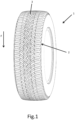
- reference numeral 1 generally indicates a tyre for vehicle wheels made in accordance with the present invention.
- the tyre (1) comprises a tyre structure in itself conventional, not shown in the attached figures, as well as a tread band (2) on which a tread surface (3) is defined, arranged in a position radially external to the tread band (2) and intended for contact with a road surface.
- the tyre (1) has a conventional generally toroidal shape developed around a rotation axis, defining, on the tread surface, 3 an axial direction parallel to it, and crossed by an equatorial plane (X), perpendicular to the axis of rotation and defining on the tread surface 3 a circumferential direction parallel to it.
- the tyre (1) is a directional type tyre, in which a preferential rolling direction of the tyre is defined, indicated in the figures by the arrow (F).
- a plurality of first pairs of main grooves are defined on the tread band (2), arranged in regular succession along the circumferential development of the tread band (2).
- Each second secondary groove (60) preferably extends according to a direction inclined with respect to the circumferential direction by an angle less than or equal to 30°, in a discordant way with respect to the inclination of the first segments (21) of the second main grooves (20) that it intersects.
- each second secondary groove (60) has a maximum width smaller than the maximum width of the second main grooves (20).
- each second secondary groove 60 can have a width (possibly variable along its extension) comprised between 2 mm and 5 mm.
- the first pairs of secondary grooves (50), (60) can axially delimit the central region (6) of the tread band (2).
- the first, second, third and fourth main grooves, (10), (20), (30), (40), as well as the first pairs of secondary grooves (50), (60) form a plurality of pairs of first blocks (7) and second blocks (8) arranged in regular succession.
- a first block (7) and a second block (8) are at least partially aligned with each other along the axial direction.
- the respective projections along the axial direction of the first and second block (7), (8) of each pair of blocks result in a partial overlap.
- first block (7) and the second block (8) have respective concavities facing each other, said cavities being formed by the broken line, zigzagging, defined by the internal end portion (22) of the second main groove (20), by the inner end portion (15) of the first main groove (10), by the first portion (13) of the terminal segment (12) of the first main groove (10), by the second portion (14) of the terminal segment (12) of the first main groove (10).
- the first and second blocks, (7), (8) are also axially offset, so that a portion of the first block (7) can be at least partially received in the concavity of the corresponding second block (8) and a portion of the second block 8 can be at least partially received in the concavity of the corresponding first block (7).
- the first and second blocks, (7) and (8), of each pair are partially interlocked with each other.
- the third and fourth main grooves (30), (40) end within the first and second blocks (7), (8) with their axially internal ends (30b), (40b).
- a connection is made with the terminal segment (12) of each first main groove (10), so as to circumferentially separate the first and said second block (7), (8) into respective first portions of block (7a), (8a) and second portions of block (7b), (8b).
- the first portions of block (7a), (8a) preferably have a substantially quadrangular shape.
- the second portions of block (7b), (8b) can have a substantially quadrangular shape, but for a protruding portion thereof formed by the ends (30b), (40b) tapered in width.
- a plurality of second pairs of secondary grooves (70), (80) are arranged in regular succession along the circumferential development of the tread band (2).
- Each second pair of secondary grooves is formed by a third secondary groove (70), extending into the first shoulder region (4) from a respective first main groove (10) and by a fourth secondary groove (80) extending into the second shoulder region (5) from a respective second main groove (20).
- two third secondary grooves (70) extend into the first shoulder region (4) starting from two first main grooves (10) subsequent to each other.
- these two third secondary grooves (70) can be arranged in a way not aligned with each other, for example along directions substantially parallel to each other.
- each third secondary groove (70) intersects a third main groove (30) at an intermediate portion thereof.
- Each third secondary groove (70) extends preferably according to a direction inclined with respect to the circumferential direction by an angle less than or equal to 40°, in a discordant way with respect to the inclination of the first segments (11) of the first main grooves (10) from which it departs.
- each third secondary groove (70) has a maximum width less than the maximum width of the first main grooves (10).
- each third secondary groove (70) has a maximum width greater than the maximum width of the first secondary grooves (50).
- each third secondary groove (70) can have a width (possibly variable along its extension) comprised between 3 mm and 5 mm.
- the fourth secondary grooves (80) are substantially mirrored to the third secondary grooves (70) with respect to the equatorial plane (X).
- two fourth secondary grooves (80) extend into the second shoulder region (5) starting from two second main grooves (20) subsequent to each other.
- these two fourth secondary grooves (80) can be arranged in a way not aligned with each other, for example, along directions that are substantially parallel to each other.
- each fourth secondary groove 80 intersects a fourth main groove (40) at an intermediate portion thereof.
- Each fourth secondary groove (80) preferably extends in direction inclined with respect to the circumferential direction of an angle of less than or equal to 40°, in a discordant way with respect to the inclination of the first segments (21) of the second main grooves (20) from which it departs.
- each fourth secondary groove (80) has a maximum width smaller than the maximum width of the second main grooves (20).
- each fourth secondary groove (80) has a maximum width greater than the maximum width of the second secondary grooves (60).
- each fourth secondary groove (80) can have a width (possibly variable along its extension) comprised between 3 mm and 5 mm.
- shoulder blocks 9a and 9b remain defined.
- the shoulder blocks (9a) are delimited by the first and second pairs of main grooves (10, 30 or 20, 40) as well as by the first and second pairs of secondary grooves (50, 70 or 60, 80).
- the shoulder blocks (9b) are delimited by the first and second pairs of main grooves (10, 30 or 20 and 40), by the second pairs of secondary grooves (70 or 80) and by the lateral edges of the tread band. On the blocks indicated above sipes are preferably formed, which favour the performance of the tyre in snowy conditions.
- second sipes (90) are formed, which have a course substantially parallel to said first, second, third or fourth main grooves (10), (20), (30), (40).
- first and second main grooves (10), (20), (30), (40) are formed on the first and second blocks (7 and 8) (preferably on each of the portions of block (7a, 7b, 8a, 8b), which have a course substantially parallel to said first, second, third or fourth main grooves (10), (20), (30), (40).
- the second sipes (90) have a course substantially parallel to the first and second main grooves (10), (20), whilst on the second portions of block (7b), (8b) the second sipes (90) have a trend substantially parallel to the third and fourth main grooves (30), (40), with a respective deviation which follows the tapered portion of the ends (30b), (40b).
- Third sipes (91) are also formed on the shoulder blocks (9a), (9b), which have a trend substantially parallel to said first, second, third or fourth main grooves (10), (20), (30), (40).
- the second and/or third sipes (90), (91) can have variable depth along their extension. Furthermore, they can have a three-dimensional conformation, i.e. they cause, in the walls of the blocks on which they are formed, the formation of protrusions and corresponding recesses.
- the second and/or third sipes (90), (91) form protrusions (and corresponding recesses) having a substantially pyramidal conformation, comprising an apex connected to an extension plane of the respective sipe by means of substantially flat connecting surfaces, as described, for example, in patent application WO 2017/212399 in the name of said Applicant. Even more preferably, in each second and/or third sipe (90), (91) these projections all face in the opposite direction with respect to the preferential rolling direction (F) of the tyre (1).
- the first and second blocks (7), (8) and/or at least some of said shoulder blocks (9a), (9b) have at least one chamfered transverse edge.
- the block portions (7a), (8a), (7b), (8b), as well as the shoulder blocks (9a), (9b) have a chamfered portion on their respective edge arranged in the opposite direction to the preferential rolling direction of the tyre (1) indicated by the arrow (F).
- the second and/or third sipes (90), (91) can also have at least one chamfered transverse edge.
- the tread pattern results formed by the repetition in continuous succession of a single module (M) formed by the portion of the tread band comprised between two subsequent first pairs of main grooves (10) and (20), as better shown in figure 3 .
- Each module (M) is formed by a first elementary portion, extended from a first pair of main grooves (10) and (20) up to the second pair of main grooves (30) and (40) and by a second elementary portion, extended from the second pair of main grooves (30) and (40) up to the subsequent first pair of main grooves (10) and (20).
- Each first elementary portion and each second elementary portion can have a circumferential dimension corresponding to a long pitch, or of a measure corresponding to a short pitch, smaller than the long pitch.
- Each module (M) can be formed by a first and a second elementary portion with a short pitch or a long pitch variously combined with each other, so that on the tread pattern modules are provided having both the first and the second elementary portion with a long pitch, or modules having both the first and the second elementary portion with a short pitch, or modules with the first elementary portion with a short pitch and the second elementary portion with a long pitch, or, lastly, modules with the first elementary portion with a long pitch and the second elementary portion with a short pitch.
Landscapes
- Engineering & Computer Science (AREA)
- Mechanical Engineering (AREA)
- Tires In General (AREA)
Claims (15)
- Reifen für Fahrzeugräder, umfassend ein Laufflächenband (2), auf dem Folgendes definiert ist:- ein erster Schulterbereich (4) und ein zweiter Schulterbereich (5), die einander axial entgegengesetzt sind;- ein Zentralbereich (6), der zwischen dem ersten und zweiten Schulterbereich eingefügt ist;- eine Vielzahl von Paaren von ersten Blöcken (7) und zweiten Blöcken (8), die in regelmäßiger Abfolge entlang der Umfangserstreckung des Zentralbereichs (6) angeordnet sind, wobei jeder erste Block (7) und jeder zweite Block (8) von jedem der Paare zumindest teilweise in einer axialen Richtung, die an dem Laufflächenband definiert ist, aneinander ausgerichtet sind,- eine Vielzahl von ersten Paaren von Hauptrillen (10, 20), die in regelmäßiger Abfolge entlang der Umfangserstreckung des Laufflächenbandes (2) angeordnet sind, um die ersten und die zweiten Blöcke (7, 8) teilweise zu begrenzen, wobei jedes erste Paar von Hauptrillen durch eine erste Hauptrille (10), die sich von dem ersten Schulterbereich (4) zu dem Zentralbereich (6) hin erstreckt, und durch eine zweite Hauptrille (20) gebildet wird, die sich von dem zweiten Schulterbereich (5) zu dem Zentralbereich (6) hin erstreckt,- eine Vielzahl von zweiten Paaren von Hauptrillen (30, 40), die in regelmäßiger Abfolge entlang der Umfangserstreckung des Laufflächenbandes in einer mit den ersten Paaren von Hauptrillen (10, 20) abwechselnden Position angeordnet sind, wobei jedes zweite Paar von Hauptrillen durch eine dritte Hauptrille (30), die sich von dem ersten Schulterbereich (4) zu dem Zentralbereich (6) hin erstreckt, und durch eine vierte Hauptrille (40) gebildet wird, die sich von dem zweiten Schulterbereich (5) zu dem Zentralbereich (6) hin erstreckt, wobei in jedem ersten Paar von Hauptrillen die zweite Hauptrille (20) ein axial inneres Ende (20b) umfasst, das mit der ersten Hauptrille (10) verbunden ist,und wobei in jedem ersten Paar von Hauptrillen die erste Hauptrille (10) ein axial inneres Endsegment (12) umfasst, das mit einer zweiten Hauptrille (20) verbunden ist, die umlaufend auf die zweite Hauptrille folgt, um so einen ersten Block (7) und einen zweiten Block (8) eines der Paare von ersten und zweiten Blöcken axial zu trennen, undwobei in jedem zweiten Paar von Hauptrillen die dritte (30) und die vierte (40) Hauptrille jeweils ein axial inneres Ende umfassen (30b, 40b) und in dem eine Vielzahl von ersten Paaren von Sekundärrillen (50, 60) in dem Laufflächenband gebildet sind, die in regelmäßiger Abfolge entlang der Umfangserstreckung des Laufflächenbandes (2) angeordnet sind, um die ersten und die zweiten Blöcke (7, 8) auf der axial äußeren Seite davon zumindest teilweise zu begrenzen, wobei jedes erste Paar von Sekundärrillen eine erste Sekundärrille (50) umfasst, die sich von einer ersten Hauptrille (10) aus erstreckt, und eine zweite Sekundärrille (60), die sich von einer zweiten Hauptrille (20) aus erstreckt,dadurch gekennzeichnet, dass die axial inneren Enden (30b, 40b) durch jeweilige erste Lamellen (30c, 40c) ausgestreckt sind, und mit dem Endsegment (12) der ersten Hauptrille (10) verbunden sind, um so den ersten und den zweiten Block (7, 8) umlaufend in jeweilige erste (7a, 8a) und zweite (7b, 8b) Blockabschnitte zu trennen.
- Reifen nach Anspruch 1, wobei die erste und zweite Hauptrille (10, 20) jeweils ein erstes Segment (11, 21) mit einem kurvilinearen Verlauf umfassen, das sich aus dem ersten und dem zweiten Schulterbereich (4, 5) zu einer Äquatorialebene (X) des Laufflächenbandes hin erstreckt, und das ausgehend von dem ersten und dem zweiten Schulterbereich (4, 5) zu dem Zentralbereich (6) hin eine allgemein abnehmende Neigung aufweist, und/oder wobei die dritte und vierte Hauptrille (30, 40) einen kurvilinearen Verlauf aufweisen, ausgehend von dem ersten und dem zweiten Schulterbereich (4, 5) zu einer Äquatorialebene (X) des Laufflächenbandes hin, mit einer allgemein abnehmenden Neigung ausgehend von dem ersten und dem zweiten Schulterbereich (4, 5) zu dem Zentralbereich (6) hin.
- Reifen nach Anspruch 2, wobei das Endsegment (12) der ersten Hauptrille (10) einen ersten Abschnitt (13) umfasst, der sich als eine Fortsetzung des ersten Segments (11) der ersten Hauptrille zu dem ersten Schulterbereich (4) hin erstreckt, sowie einen zweiten Abschnitt (14), der sich als eine Fortsetzung des ersten Abschnitts (13) zu dem zweiten Schulterbereich (5) hin erstreckt.
- Reifen nach Anspruch 3, wobei der erste Abschnitt (13) und der zweite Abschnitt (14) des Endsegments eine Äquatorialebene (12) des Laufflächenbandes überspannen.
- Reifen nach Anspruch 3 oder Anspruch 4, wobei der erste Abschnitt (13) des Endsegments (12) sich über die Erstreckung der vierten Hauptrille (40) erstreckt.
- Reifen nach einem der Ansprüche 3 bis 5, wobei der zweite Abschnitt (14) des Endsegments (12) sich über die Erstreckung der dritten Hauptrille (30) erstreckt.
- Reifen nach einem der vorstehenden Ansprüche, wobei die dritte und vierte Hauptrille (30, 40) ein im Wesentlichen symmetrisches Profil in Bezug auf die Umfangsrichtung aufweisen.
- Reifen nach einem der vorstehenden Ansprüche, wobei die Enden (30b, 40b) der dritten und vierten Hauptrille (30, 40) in der Breite verjüngt sind, um die Lamellen (30c, 40c) zu bilden, die mit dem Endsegment (12) der ersten Hauptrille (10) verbunden sind.
- Reifen nach einem der vorstehenden Ansprüche, wobei in jedem der ersten Paare von Sekundärrillen die erste Sekundärrille (50) eine dritte Hauptrille (30) schneidet und die zweite Sekundärrille (60) eine vierte Hauptrille (40) schneidet.
- Reifen nach einem der vorstehenden Ansprüche, wobei eine Vielzahl von zweiten Paaren von Sekundärrillen (70, 80) in dem Laufflächenband gebildet sind und in regelmäßiger Abfolge entlang der Umlaufserstreckung des Laufflächenbandes angeordnet sind, wobei jedes zweite Paar von Sekundärrillen durch eine dritte Sekundärrille (70), die sich in dem ersten Schulterbereich (4) aus einer ersten Hauptrille (10) erstreckt, und durch eine vierte Sekundärrille (80), die sich in dem zweiten Schulterbereich (5) aus einer zweiten Hauptrille (20) erstreckt, gebildet wird.
- Reifen nach Anspruch 10, wobei in jedem der zweiten Paare von Sekundärrillen die dritte Sekundärrille (70) eine dritte Hauptrille (30) schneidet und die vierte Sekundärrille (80) eine vierte Hauptrille (40) schneidet.
- Reifen nach Anspruch 10 oder 11, wobei das erste und zweite Paar von Hauptrillen (10, 20, 30, 40) und das erste und zweite Paar von Sekundärrillen (50, 60, 70, 80) eine Vielzahl von Schulterblöcken (9a, 9b) axial begrenzen.
- Reifen nach einem der vorstehenden Ansprüche, bei dem an den ersten und zweiten Blöcken (7, 8) zweite Lamellen (90) gebildet sind, die einen Verlauf aufweisen, der im Wesentlichen parallel zu der ersten, zweiten, dritten oder vierten Hauptrille (10, 20, 30, 40) ist.
- Reifen nach Anspruch 12 oder 13, wobei dritte Lamellen (91) an den Schulterblöcken (9a, 9b) gebildet sind, die einen Verlauf aufweisen, der im Wesentlichen parallel zu der ersten, zweiten, dritten oder vierten Hauptrille (10, 20, 30, 40) ist.
- Reifen nach einem der Ansprüche 12 bis 14, wobei zumindest einige der ersten und zweiten Blöcke (7, 8) und/oder zumindest einige der Schulterblöcke (9a, 9b) zumindest eine abgeschrägte Querkante aufweisen.
Applications Claiming Priority (2)
| Application Number | Priority Date | Filing Date | Title |
|---|---|---|---|
| IT102021000014642A IT202100014642A1 (it) | 2021-06-08 | 2021-06-08 | Pneumatico per ruote di veicoli per trasporto leggero |
| PCT/IB2022/055047 WO2022259085A1 (en) | 2021-06-08 | 2022-05-30 | Tyre for commercial vehicle wheels |
Publications (3)
| Publication Number | Publication Date |
|---|---|
| EP4351887A1 EP4351887A1 (de) | 2024-04-17 |
| EP4351887B1 true EP4351887B1 (de) | 2025-03-12 |
| EP4351887C0 EP4351887C0 (de) | 2025-03-12 |
Family
ID=77412245
Family Applications (1)
| Application Number | Title | Priority Date | Filing Date |
|---|---|---|---|
| EP22733477.8A Active EP4351887B1 (de) | 2021-06-08 | 2022-05-30 | Reifen für nutzfahrzeugräder |
Country Status (6)
| Country | Link |
|---|---|
| US (1) | US20240359506A1 (de) |
| EP (1) | EP4351887B1 (de) |
| CN (1) | CN117460630A (de) |
| IT (1) | IT202100014642A1 (de) |
| MX (1) | MX2023013706A (de) |
| WO (1) | WO2022259085A1 (de) |
Families Citing this family (3)
| Publication number | Priority date | Publication date | Assignee | Title |
|---|---|---|---|---|
| DE102023200378A1 (de) * | 2023-01-18 | 2024-07-18 | Continental Reifen Deutschland Gmbh | Laufstreifen für einen Fahrzeugreifen |
| USD1084969S1 (en) * | 2023-12-19 | 2025-07-22 | The Goodyear Tire & Rubber Company | Tire |
| USD1084968S1 (en) * | 2023-12-19 | 2025-07-22 | The Goodyear Tire & Rubber Company | Tire |
Family Cites Families (24)
| Publication number | Priority date | Publication date | Assignee | Title |
|---|---|---|---|---|
| JP2644499B2 (ja) * | 1987-07-31 | 1997-08-25 | 株式会社ブリヂストン | 高速用空気入りラジアルタイヤ |
| DE9000204U1 (de) * | 1990-01-10 | 1991-02-21 | Uniroyal Englebert Reifen GmbH, 5100 Aachen | Fahrzeugluftreifen |
| JP3127172B2 (ja) * | 1992-05-14 | 2001-01-22 | 株式会社ブリヂストン | 空気入りタイヤ |
| AT400425B (de) * | 1993-01-28 | 1995-12-27 | Semperit Ag | Fahrzeugreifen |
| JP3718021B2 (ja) | 1997-02-21 | 2005-11-16 | 株式会社ブリヂストン | オール・シーズン乗用車用空気入りラジアル・タイヤ |
| US7814951B2 (en) | 2003-09-05 | 2010-10-19 | Bridgestone Corporation | Pneumatic tire having tread including convexly curved fine grooves |
| US20060185776A1 (en) * | 2005-02-24 | 2006-08-24 | Kun Lu | Pneumatic tire tread |
| US8261790B2 (en) | 2008-08-18 | 2012-09-11 | The Goodyear Tire & Rubber Company | Directional tread for a tire |
| BR112012012276B1 (pt) | 2009-11-23 | 2020-04-07 | Compagnie Generale Des Etablissements Michelin | pneu com sulco lateral tendo um chanfro para desempenho na neve melhorado |
| US20140230980A1 (en) * | 2011-09-29 | 2014-08-21 | Michelin Recherche Et Technique S.A. | Tire with tread having improved snow and dry traction |
| WO2014118659A1 (en) * | 2013-01-29 | 2014-08-07 | Pirelli Tyre S.P.A. | A tyre for vehicle wheels |
| FR3011512B1 (fr) * | 2013-10-07 | 2017-02-24 | Michelin & Cie | Bande de roulement comportant une sculpture directionnelle |
| EP3157764B1 (de) | 2014-06-19 | 2019-08-28 | Pirelli Tyre S.p.A. | Autoreifen |
| FR3033145B1 (fr) | 2015-02-27 | 2017-02-24 | Michelin & Cie | Pneumatique avec bande de roulement directionnelle comportant des blocs incurves pourvus de chanfreins |
| FR3034355B1 (fr) * | 2015-03-31 | 2018-07-27 | Compagnie Generale Des Etablissements Michelin | Bande de roulement pour pneumatique comportant des canaux |
| DE102015224288A1 (de) * | 2015-12-04 | 2017-06-08 | Continental Reifen Deutschland Gmbh | Fahrzeugluftreifen |
| EP3468816B1 (de) | 2016-06-10 | 2020-10-21 | Pirelli Tyre S.p.A. | Winterreifen |
| JP6737112B2 (ja) * | 2016-09-30 | 2020-08-05 | 住友ゴム工業株式会社 | 空気入りタイヤ |
| DE102017203219A1 (de) * | 2017-02-28 | 2018-08-30 | Continental Reifen Deutschland Gmbh | Fahrzeugluftreifen |
| DE102017203225A1 (de) * | 2017-02-28 | 2018-08-30 | Continental Reifen Deutschland Gmbh | Fahrzeugluftreifen |
| JP7091702B2 (ja) * | 2018-02-23 | 2022-06-28 | 住友ゴム工業株式会社 | 冬用タイヤ |
| WO2020012279A1 (en) * | 2018-07-13 | 2020-01-16 | Pirelli Tyre S.P.A. | Tyre for vehicle wheels |
| IT201800007188A1 (it) | 2018-07-13 | 2020-01-13 | Pneumatico per ruote di veicoli | |
| JP7159968B2 (ja) * | 2019-04-26 | 2022-10-25 | 横浜ゴム株式会社 | 空気入りタイヤ |
-
2021
- 2021-06-08 IT IT102021000014642A patent/IT202100014642A1/it unknown
-
2022
- 2022-05-30 CN CN202280041253.6A patent/CN117460630A/zh active Pending
- 2022-05-30 MX MX2023013706A patent/MX2023013706A/es unknown
- 2022-05-30 WO PCT/IB2022/055047 patent/WO2022259085A1/en not_active Ceased
- 2022-05-30 EP EP22733477.8A patent/EP4351887B1/de active Active
- 2022-05-30 US US18/566,432 patent/US20240359506A1/en active Pending
Also Published As
| Publication number | Publication date |
|---|---|
| EP4351887A1 (de) | 2024-04-17 |
| CN117460630A (zh) | 2024-01-26 |
| US20240359506A1 (en) | 2024-10-31 |
| MX2023013706A (es) | 2023-12-11 |
| WO2022259085A1 (en) | 2022-12-15 |
| IT202100014642A1 (it) | 2022-12-08 |
| EP4351887C0 (de) | 2025-03-12 |
Similar Documents
| Publication | Publication Date | Title |
|---|---|---|
| EP4351887B1 (de) | Reifen für nutzfahrzeugräder | |
| RU2427476C1 (ru) | Пневматическая шина | |
| EP2570271B1 (de) | Reifenlauffläche für hohe Laufleistung | |
| US5198047A (en) | Winter type tire tread | |
| EP2546075B1 (de) | Lauffläche für einen Luftreifen | |
| EP4263238B1 (de) | Fahrzeugreifen | |
| KR20100132907A (ko) | 공기 타이어 | |
| EP1270271B1 (de) | Spikeloser Reifen | |
| RU2764232C1 (ru) | Шина для колес транспортных средств | |
| KR101296700B1 (ko) | 대형차량 타이어용 트레드 | |
| EP2748017A1 (de) | Winterreifen | |
| EP2039533B1 (de) | Luftreifen | |
| JP3113388B2 (ja) | 空気入りタイヤ | |
| US7464738B2 (en) | Tyre for a vehicle wheel including zigzag circumferential grooves and blind transverse cuts | |
| EP0485884B1 (de) | Feineinschnitte für Reifenlauffläche | |
| EP1813446B1 (de) | Luftreifen | |
| WO2023119080A1 (en) | Car tyre | |
| CA2084741C (en) | Block pattern tire with optimized groove depth ratios, sipe depth and length ratios | |
| CN220562484U (zh) | 一种轿车轮胎花纹 | |
| WO2024127203A1 (en) | Tyre for vehicle wheels | |
| WO2024200145A1 (en) | Tire with an improved tread pattern | |
| AU648681B2 (en) | An asymmetric tread for a high performance low aspect ratio radial tire | |
| WO2001039993A1 (en) | Tyre for vehicle wheels, particularly for heavy duty vehicles such as lorries and the like | |
| JPH0396405A (ja) | 重荷重用空気入りタイヤ |
Legal Events
| Date | Code | Title | Description |
|---|---|---|---|
| STAA | Information on the status of an ep patent application or granted ep patent |
Free format text: STATUS: UNKNOWN |
|
| STAA | Information on the status of an ep patent application or granted ep patent |
Free format text: STATUS: THE INTERNATIONAL PUBLICATION HAS BEEN MADE |
|
| PUAI | Public reference made under article 153(3) epc to a published international application that has entered the european phase |
Free format text: ORIGINAL CODE: 0009012 |
|
| STAA | Information on the status of an ep patent application or granted ep patent |
Free format text: STATUS: REQUEST FOR EXAMINATION WAS MADE |
|
| 17P | Request for examination filed |
Effective date: 20231204 |
|
| AK | Designated contracting states |
Kind code of ref document: A1 Designated state(s): AL AT BE BG CH CY CZ DE DK EE ES FI FR GB GR HR HU IE IS IT LI LT LU LV MC MK MT NL NO PL PT RO RS SE SI SK SM TR |
|
| DAV | Request for validation of the european patent (deleted) | ||
| DAX | Request for extension of the european patent (deleted) | ||
| GRAP | Despatch of communication of intention to grant a patent |
Free format text: ORIGINAL CODE: EPIDOSNIGR1 |
|
| STAA | Information on the status of an ep patent application or granted ep patent |
Free format text: STATUS: GRANT OF PATENT IS INTENDED |
|
| INTG | Intention to grant announced |
Effective date: 20241011 |
|
| GRAS | Grant fee paid |
Free format text: ORIGINAL CODE: EPIDOSNIGR3 |
|
| GRAA | (expected) grant |
Free format text: ORIGINAL CODE: 0009210 |
|
| STAA | Information on the status of an ep patent application or granted ep patent |
Free format text: STATUS: THE PATENT HAS BEEN GRANTED |
|
| AK | Designated contracting states |
Kind code of ref document: B1 Designated state(s): AL AT BE BG CH CY CZ DE DK EE ES FI FR GB GR HR HU IE IS IT LI LT LU LV MC MK MT NL NO PL PT RO RS SE SI SK SM TR |
|
| REG | Reference to a national code |
Ref country code: GB Ref legal event code: FG4D |
|
| REG | Reference to a national code |
Ref country code: CH Ref legal event code: EP |
|
| REG | Reference to a national code |
Ref country code: DE Ref legal event code: R096 Ref document number: 602022011765 Country of ref document: DE |
|
| REG | Reference to a national code |
Ref country code: IE Ref legal event code: FG4D |
|
| U01 | Request for unitary effect filed |
Effective date: 20250312 |
|
| U07 | Unitary effect registered |
Designated state(s): AT BE BG DE DK EE FI FR IT LT LU LV MT NL PT RO SE SI Effective date: 20250320 |
|
| U20 | Renewal fee for the european patent with unitary effect paid |
Year of fee payment: 4 Effective date: 20250527 |
|
| PG25 | Lapsed in a contracting state [announced via postgrant information from national office to epo] |
Ref country code: RS Free format text: LAPSE BECAUSE OF FAILURE TO SUBMIT A TRANSLATION OF THE DESCRIPTION OR TO PAY THE FEE WITHIN THE PRESCRIBED TIME-LIMIT Effective date: 20250612 |
|
| PG25 | Lapsed in a contracting state [announced via postgrant information from national office to epo] |
Ref country code: ES Free format text: LAPSE BECAUSE OF FAILURE TO SUBMIT A TRANSLATION OF THE DESCRIPTION OR TO PAY THE FEE WITHIN THE PRESCRIBED TIME-LIMIT Effective date: 20250312 |
|
| PG25 | Lapsed in a contracting state [announced via postgrant information from national office to epo] |
Ref country code: NO Free format text: LAPSE BECAUSE OF FAILURE TO SUBMIT A TRANSLATION OF THE DESCRIPTION OR TO PAY THE FEE WITHIN THE PRESCRIBED TIME-LIMIT Effective date: 20250612 |
|
| PG25 | Lapsed in a contracting state [announced via postgrant information from national office to epo] |
Ref country code: HR Free format text: LAPSE BECAUSE OF FAILURE TO SUBMIT A TRANSLATION OF THE DESCRIPTION OR TO PAY THE FEE WITHIN THE PRESCRIBED TIME-LIMIT Effective date: 20250312 |
|
| PG25 | Lapsed in a contracting state [announced via postgrant information from national office to epo] |
Ref country code: GR Free format text: LAPSE BECAUSE OF FAILURE TO SUBMIT A TRANSLATION OF THE DESCRIPTION OR TO PAY THE FEE WITHIN THE PRESCRIBED TIME-LIMIT Effective date: 20250613 |
|
| PG25 | Lapsed in a contracting state [announced via postgrant information from national office to epo] |
Ref country code: SM Free format text: LAPSE BECAUSE OF FAILURE TO SUBMIT A TRANSLATION OF THE DESCRIPTION OR TO PAY THE FEE WITHIN THE PRESCRIBED TIME-LIMIT Effective date: 20250312 |
|
| PG25 | Lapsed in a contracting state [announced via postgrant information from national office to epo] |
Ref country code: PL Free format text: LAPSE BECAUSE OF FAILURE TO SUBMIT A TRANSLATION OF THE DESCRIPTION OR TO PAY THE FEE WITHIN THE PRESCRIBED TIME-LIMIT Effective date: 20250312 |
|
| PG25 | Lapsed in a contracting state [announced via postgrant information from national office to epo] |
Ref country code: CZ Free format text: LAPSE BECAUSE OF FAILURE TO SUBMIT A TRANSLATION OF THE DESCRIPTION OR TO PAY THE FEE WITHIN THE PRESCRIBED TIME-LIMIT Effective date: 20250312 |
|
| PG25 | Lapsed in a contracting state [announced via postgrant information from national office to epo] |
Ref country code: SK Free format text: LAPSE BECAUSE OF FAILURE TO SUBMIT A TRANSLATION OF THE DESCRIPTION OR TO PAY THE FEE WITHIN THE PRESCRIBED TIME-LIMIT Effective date: 20250312 |
|
| PG25 | Lapsed in a contracting state [announced via postgrant information from national office to epo] |
Ref country code: IS Free format text: LAPSE BECAUSE OF FAILURE TO SUBMIT A TRANSLATION OF THE DESCRIPTION OR TO PAY THE FEE WITHIN THE PRESCRIBED TIME-LIMIT Effective date: 20250712 |