EP4350041A2 - Ensemble électrode à membrane, cellule électrochimique, empilement, électrolyseur et procédé de fabrication d'ensemble électrode à membrane - Google Patents
Ensemble électrode à membrane, cellule électrochimique, empilement, électrolyseur et procédé de fabrication d'ensemble électrode à membrane Download PDFInfo
- Publication number
- EP4350041A2 EP4350041A2 EP23194922.3A EP23194922A EP4350041A2 EP 4350041 A2 EP4350041 A2 EP 4350041A2 EP 23194922 A EP23194922 A EP 23194922A EP 4350041 A2 EP4350041 A2 EP 4350041A2
- Authority
- EP
- European Patent Office
- Prior art keywords
- diffusion layer
- electrode assembly
- membrane electrode
- electrolyte membrane
- membrane
- Prior art date
- Legal status (The legal status is an assumption and is not a legal conclusion. Google has not performed a legal analysis and makes no representation as to the accuracy of the status listed.)
- Pending
Links
Images







Classifications
-
- C—CHEMISTRY; METALLURGY
- C25—ELECTROLYTIC OR ELECTROPHORETIC PROCESSES; APPARATUS THEREFOR
- C25B—ELECTROLYTIC OR ELECTROPHORETIC PROCESSES FOR THE PRODUCTION OF COMPOUNDS OR NON-METALS; APPARATUS THEREFOR
- C25B1/00—Electrolytic production of inorganic compounds or non-metals
- C25B1/01—Products
- C25B1/02—Hydrogen or oxygen
- C25B1/04—Hydrogen or oxygen by electrolysis of water
-
- C—CHEMISTRY; METALLURGY
- C25—ELECTROLYTIC OR ELECTROPHORETIC PROCESSES; APPARATUS THEREFOR
- C25B—ELECTROLYTIC OR ELECTROPHORETIC PROCESSES FOR THE PRODUCTION OF COMPOUNDS OR NON-METALS; APPARATUS THEREFOR
- C25B9/00—Cells or assemblies of cells; Constructional parts of cells; Assemblies of constructional parts, e.g. electrode-diaphragm assemblies; Process-related cell features
- C25B9/17—Cells comprising dimensionally-stable non-movable electrodes; Assemblies of constructional parts thereof
- C25B9/19—Cells comprising dimensionally-stable non-movable electrodes; Assemblies of constructional parts thereof with diaphragms
-
- C—CHEMISTRY; METALLURGY
- C25—ELECTROLYTIC OR ELECTROPHORETIC PROCESSES; APPARATUS THEREFOR
- C25B—ELECTROLYTIC OR ELECTROPHORETIC PROCESSES FOR THE PRODUCTION OF COMPOUNDS OR NON-METALS; APPARATUS THEREFOR
- C25B1/00—Electrolytic production of inorganic compounds or non-metals
- C25B1/01—Products
- C25B1/02—Hydrogen or oxygen
-
- C—CHEMISTRY; METALLURGY
- C25—ELECTROLYTIC OR ELECTROPHORETIC PROCESSES; APPARATUS THEREFOR
- C25B—ELECTROLYTIC OR ELECTROPHORETIC PROCESSES FOR THE PRODUCTION OF COMPOUNDS OR NON-METALS; APPARATUS THEREFOR
- C25B11/00—Electrodes; Manufacture thereof not otherwise provided for
- C25B11/02—Electrodes; Manufacture thereof not otherwise provided for characterised by shape or form
- C25B11/03—Electrodes; Manufacture thereof not otherwise provided for characterised by shape or form perforated or foraminous
- C25B11/031—Porous electrodes
- C25B11/032—Gas diffusion electrodes
-
- C—CHEMISTRY; METALLURGY
- C25—ELECTROLYTIC OR ELECTROPHORETIC PROCESSES; APPARATUS THEREFOR
- C25B—ELECTROLYTIC OR ELECTROPHORETIC PROCESSES FOR THE PRODUCTION OF COMPOUNDS OR NON-METALS; APPARATUS THEREFOR
- C25B11/00—Electrodes; Manufacture thereof not otherwise provided for
- C25B11/04—Electrodes; Manufacture thereof not otherwise provided for characterised by the material
- C25B11/051—Electrodes formed of electrocatalysts on a substrate or carrier
- C25B11/052—Electrodes comprising one or more electrocatalytic coatings on a substrate
-
- C—CHEMISTRY; METALLURGY
- C25—ELECTROLYTIC OR ELECTROPHORETIC PROCESSES; APPARATUS THEREFOR
- C25B—ELECTROLYTIC OR ELECTROPHORETIC PROCESSES FOR THE PRODUCTION OF COMPOUNDS OR NON-METALS; APPARATUS THEREFOR
- C25B11/00—Electrodes; Manufacture thereof not otherwise provided for
- C25B11/04—Electrodes; Manufacture thereof not otherwise provided for characterised by the material
- C25B11/051—Electrodes formed of electrocatalysts on a substrate or carrier
- C25B11/055—Electrodes formed of electrocatalysts on a substrate or carrier characterised by the substrate or carrier material
- C25B11/056—Electrodes formed of electrocatalysts on a substrate or carrier characterised by the substrate or carrier material consisting of textile or non-woven fabric
-
- C—CHEMISTRY; METALLURGY
- C25—ELECTROLYTIC OR ELECTROPHORETIC PROCESSES; APPARATUS THEREFOR
- C25B—ELECTROLYTIC OR ELECTROPHORETIC PROCESSES FOR THE PRODUCTION OF COMPOUNDS OR NON-METALS; APPARATUS THEREFOR
- C25B11/00—Electrodes; Manufacture thereof not otherwise provided for
- C25B11/04—Electrodes; Manufacture thereof not otherwise provided for characterised by the material
- C25B11/051—Electrodes formed of electrocatalysts on a substrate or carrier
- C25B11/055—Electrodes formed of electrocatalysts on a substrate or carrier characterised by the substrate or carrier material
- C25B11/057—Electrodes formed of electrocatalysts on a substrate or carrier characterised by the substrate or carrier material consisting of a single element or compound
- C25B11/061—Metal or alloy
- C25B11/063—Valve metal, e.g. titanium
-
- C—CHEMISTRY; METALLURGY
- C25—ELECTROLYTIC OR ELECTROPHORETIC PROCESSES; APPARATUS THEREFOR
- C25B—ELECTROLYTIC OR ELECTROPHORETIC PROCESSES FOR THE PRODUCTION OF COMPOUNDS OR NON-METALS; APPARATUS THEREFOR
- C25B11/00—Electrodes; Manufacture thereof not otherwise provided for
- C25B11/04—Electrodes; Manufacture thereof not otherwise provided for characterised by the material
- C25B11/051—Electrodes formed of electrocatalysts on a substrate or carrier
- C25B11/073—Electrodes formed of electrocatalysts on a substrate or carrier characterised by the electrocatalyst material
- C25B11/075—Electrodes formed of electrocatalysts on a substrate or carrier characterised by the electrocatalyst material consisting of a single catalytic element or catalytic compound
- C25B11/089—Alloys
-
- C—CHEMISTRY; METALLURGY
- C25—ELECTROLYTIC OR ELECTROPHORETIC PROCESSES; APPARATUS THEREFOR
- C25B—ELECTROLYTIC OR ELECTROPHORETIC PROCESSES FOR THE PRODUCTION OF COMPOUNDS OR NON-METALS; APPARATUS THEREFOR
- C25B9/00—Cells or assemblies of cells; Constructional parts of cells; Assemblies of constructional parts, e.g. electrode-diaphragm assemblies; Process-related cell features
- C25B9/17—Cells comprising dimensionally-stable non-movable electrodes; Assemblies of constructional parts thereof
- C25B9/19—Cells comprising dimensionally-stable non-movable electrodes; Assemblies of constructional parts thereof with diaphragms
- C25B9/23—Cells comprising dimensionally-stable non-movable electrodes; Assemblies of constructional parts thereof with diaphragms comprising ion-exchange membranes in or on which electrode material is embedded
-
- C—CHEMISTRY; METALLURGY
- C25—ELECTROLYTIC OR ELECTROPHORETIC PROCESSES; APPARATUS THEREFOR
- C25B—ELECTROLYTIC OR ELECTROPHORETIC PROCESSES FOR THE PRODUCTION OF COMPOUNDS OR NON-METALS; APPARATUS THEREFOR
- C25B9/00—Cells or assemblies of cells; Constructional parts of cells; Assemblies of constructional parts, e.g. electrode-diaphragm assemblies; Process-related cell features
- C25B9/70—Assemblies comprising two or more cells
- C25B9/73—Assemblies comprising two or more cells of the filter-press type
- C25B9/77—Assemblies comprising two or more cells of the filter-press type having diaphragms
-
- C—CHEMISTRY; METALLURGY
- C25—ELECTROLYTIC OR ELECTROPHORETIC PROCESSES; APPARATUS THEREFOR
- C25B—ELECTROLYTIC OR ELECTROPHORETIC PROCESSES FOR THE PRODUCTION OF COMPOUNDS OR NON-METALS; APPARATUS THEREFOR
- C25B11/00—Electrodes; Manufacture thereof not otherwise provided for
- C25B11/02—Electrodes; Manufacture thereof not otherwise provided for characterised by shape or form
-
- Y—GENERAL TAGGING OF NEW TECHNOLOGICAL DEVELOPMENTS; GENERAL TAGGING OF CROSS-SECTIONAL TECHNOLOGIES SPANNING OVER SEVERAL SECTIONS OF THE IPC; TECHNICAL SUBJECTS COVERED BY FORMER USPC CROSS-REFERENCE ART COLLECTIONS [XRACs] AND DIGESTS
- Y02—TECHNOLOGIES OR APPLICATIONS FOR MITIGATION OR ADAPTATION AGAINST CLIMATE CHANGE
- Y02E—REDUCTION OF GREENHOUSE GAS [GHG] EMISSIONS, RELATED TO ENERGY GENERATION, TRANSMISSION OR DISTRIBUTION
- Y02E60/00—Enabling technologies; Technologies with a potential or indirect contribution to GHG emissions mitigation
- Y02E60/30—Hydrogen technology
- Y02E60/50—Fuel cells
-
- Y—GENERAL TAGGING OF NEW TECHNOLOGICAL DEVELOPMENTS; GENERAL TAGGING OF CROSS-SECTIONAL TECHNOLOGIES SPANNING OVER SEVERAL SECTIONS OF THE IPC; TECHNICAL SUBJECTS COVERED BY FORMER USPC CROSS-REFERENCE ART COLLECTIONS [XRACs] AND DIGESTS
- Y02—TECHNOLOGIES OR APPLICATIONS FOR MITIGATION OR ADAPTATION AGAINST CLIMATE CHANGE
- Y02P—CLIMATE CHANGE MITIGATION TECHNOLOGIES IN THE PRODUCTION OR PROCESSING OF GOODS
- Y02P70/00—Climate change mitigation technologies in the production process for final industrial or consumer products
- Y02P70/50—Manufacturing or production processes characterised by the final manufactured product
Definitions
- Embodiments described herein relate generally to a membrane electrode assembly, an electrochemical cell, a stack, an electrolyzer, and a manufacturing method of the membrane electrode assembly.
- PEMEC Polymer electrolyte Water electrolysis cells
- Ir iridium
- a membrane electrode assembly includes a first diffusion layer; a second diffusion layer; an electrolyte membrane provided between the first diffusion layer and the second diffusion layer; a first catalyst layer provided between the first diffusion layer and the electrolyte membrane; and a second catalyst layer provided between the second diffusion layer and the electrolyte membrane, wherein the first diffusion layer includes a first surface facing the first catalyst layer, and the first surface includes a chamfered portion, and a second surface provided on an opposing side of the first surface, and the second surface includes a protrusion protruding from the side of the first surface toward the side of the second surface.
- the physical property values herein are values at 25 [° C.] and at 1 [atom].
- the thickness of each member is an average value of the distances in the lamination direction.
- a membrane electrode assembly includes a first diffusion layer; a second diffusion layer; an electrolyte membrane provided between the first diffusion layer and the second diffusion layer; a first catalyst layer provided between the first diffusion layer and the electrolyte membrane; and a second catalyst layer provided between the second diffusion layer and the electrolyte membrane, wherein the first diffusion layer includes a first surface facing the first catalyst layer, and the first surface includes a chamfered portion, and a second surface provided on an opposing side of the first surface, and the second surface includes a protrusion protruding from the side of the first surface toward the side of the second surface.
- the electrolyzer of the embodiment can be used for the electrolyzer of ammonia.
- the membrane electrode assembly of the embodiment can be used as the membrane electrode assembly of the electrolyzer for synthesizing ammonia.
- the electrolyzer of the embodiment is available for the electrolyzer used for the electrolysis of ammonia synthesis in which ultrapure water is supplied to the anode, the water is decomposed at the anode to produce proton and oxygen, the produced proton passes through the electrolyte membrane, and nitrogen supplied to the cathode, the proton and the electron are connected to produce ammonia.
- the electrolyzer of the embodiment can be used in the electrolyzer in which ammonia is electrolyzed to produce hydrogen.
- the membrane electrode assembly 1 can be used in a device for electrolyzing ammonia to produce hydrogen.
- the electrolyzer is available for the electrolyzer used for electrolysis for ammonia decomposition in which ammonia is supplied to the cathode, ammonia is decomposed at the cathode to produce protons and nitrogen, produced protons pass through the electrolyte membrane, and protons and electrons are combined at the anode to produce hydrogen.
- FIG. 1 is a schematic cross-sectional view of the membrane electrode assembly 100 according to the present embodiment.
- FIG. 2 is a schematic cross-sectional view of the first diffusion layer 4 of the present embodiment.
- FIG. 3 is a schematic top view of the first diffusion layer of the present embodiment.
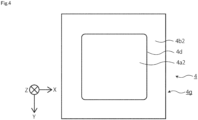
- FIG. 4 is a schematic bottom view of the first diffusion layer of the present embodiment.
- the membrane electrode assembly 100 of the present embodiment will be described with reference to FIGS. 1 to 4 .
- the membrane electrode assembly 100 includes a first electrode 2, a second electrode 12, and an electrolyte membrane 20.
- the first electrode 2 is, for example, the anode electrode.
- the first electrode 2 has the first diffusion layer 4 and the first catalyst layer 6.
- the second electrode 12 is, for example, the cathode electrode.
- the second electrode 12 includes the second diffusion layer 14 and the second catalyst layer 16.
- the electrolyte membrane 20 is provided between the first diffusion layer 4 and the second diffusion layer 14.
- the first catalyst layer 6 is provided between the first diffusion layer 4 and the electrolyte membrane 20.
- the second catalyst layer 16 is provided between the second diffusion layer 14 and the second catalyst layer 16.
- the X-direction (X-axis), the Y-direction (Y-axis) intersecting perpendicularly to the X-direction (X-axis), and the Z-direction (Z-axis) intersecting perpendicularly to the X-direction (X-axis) and the Y-direction (Y-axis) are defined.
- the flattening portion 4a of the first diffusion layer 4, the electrolyte membrane 20, the second diffusion layer 14 of the second electrode 12, and the second catalyst layer 16 extend, for example, in the X-direction and the Y-direction.
- the flattening portion 4a of the first diffusion layer 4, the electrolyte membrane 20, the second diffusion layer 14 of the second electrode 12, and the second catalyst layer 16 extend, for example, in the X-direction and the Y-direction.
- the first electrode 2, the electrolyte membrane 20, and the second electrode 12 are stacked in the Z-direction, for example.
- the first diffusion layer 4 is preferably porous and highly conductive.
- the first diffusion layer 4 is a porous member that passes through gases and fluids.
- the first diffusion layer 4 is, for example, a carbon paper or a metal mesh.
- a porous substrate of the valve metal is preferable.
- the porous substrate of the valve metal is preferably the porous substrate containing one or more metals selected from the group consisting of titanium, aluminum, tantalum, niobium, hafnium, zirconium, zinc, tungsten, bismuth, and antimony, or the porous substrate of one metal selected from the group consisting of titanium, aluminum, tantalum, niobium, hafnium, zirconium, zinc, tungsten, bismuth, and antimony.
- the first diffusion layer 4 of the present embodiment is a porous substrate of a titanium-containing valve metal.
- the standard of titanium of the first diffusion layer 4 is, for example, type 1 standard or type 2 standard of JIS(Japanese Industrial Standards) standards.
- the first diffusion layer 4 has a first surface 4a1 facing the first catalyst layer 6 and having a chamfered portion 4f, and a protrusion 4g provided on an opposing side of the first surface 4a1 and protruding from the side of the first surface 4a1 toward the side of the second surface 4a2.
- Such first diffusion layer 4 is particularly preferably formed, for example, by performing the shear processing of the first diffusion layer 4, which is a titanium-containing porous substrate of the valve metal.
- the manufacturing process of the first diffusion layer 4 is not particularly limited to those described above.
- the protrusion 4g is provided around the second surface 4a2 so as to completely surround the second surface.
- the film thickness t of the first diffusion layer 4 (the flattening portion 4a film thickness t) is preferably 100 ⁇ m or more and 2000 ⁇ m or less. If the thickness t of the first diffusion layer 4 (the thickness t of the flattening portion 4a) is less than 100 ⁇ m, then the shapes of the first diffusion layer 4 are likely to have unintended distortion because they are too thin. On the other hand, if the film thickness t of the first diffusion layer 4 (the thickness t of the flattening portion 4a) is larger than 2000 ⁇ m, the film thickness t is too thick, which makes it difficult to diffuse water/oxygen.
- the flattening portion 4a has a first surface 4a1 facing the first catalyst layer 6 and a second surface 4a2 provided on an opposing side of the first surface 4a1.
- the first surface 4a1 is, for example, in direct contact with the first catalyst layer 6.
- a first connecting portion 4c is provided around the first surface 4a1.
- a second connecting portion 4d is provided around the second surface 4a2.
- the first distance L1 between the first end portion 4b3 of the third surface 4b1 and the first surface 4a1 is preferably 10% or more and 40% or less with respect to the film thickness t1 of the first diffusion layer 4 (the film thickness t1 of the flattening portion 4a).
- the electrolyte membrane 20 may be damaged by the first connecting portion 4c, and current concentration may occur in the membrane electrode assembly 100.
- the first distance L1 is larger than 40% with respect to the film thickness t1 of the first diffusion layer 4 (the film thickness t1 of the flattening portion 4a), there is a possibility that the first electrode 2 is not successfully crimped to the electrolyte membrane 20 when the membrane electrode assembly 100 is formed by the thermocompression bonding.
- the second distance L2 between the second end portion 4b4 of the protrusion 4g of the fourth surface 4b2 and the second surface 4a2 is preferably 50% or less of the thickness t2 of the electrolyte membrane. If the second distance L2 is larger than 50% of the thickness t2 of the electrolyte membrane, when forming the membrane electrode assembly 100 by the thermocompression bonding, there is a possibility that the first electrode 2 is not successfully crimped to the electrolyte membrane 20.
- the third distance L3 between the first connecting portion 4c and the first end portion 4b3 is preferably 20% or more and 60% or less of the film thickness t1 of the first diffusion layer 4 (the film thickness t1 of the flattening portion 4a). If the third distance L3 is less than 20% of the film thickness t1 of the first diffusion layer 4 (the film thickness t1 of the flattening portion 4a), the electrolyte membrane 20 may be damaged by the first connecting portion 4c, and current concentration may occur in the membrane electrode assembly 100.
- the third distance L3 is larger than 60% of the film thickness t1 of the first diffusion layer 4 (the film thickness t1 of the flattening portion 4a), when forming the membrane electrode assembly 100 by the thermocompression bonding, there is a possibility that the first electrode 2 is not successfully crimped to the electrolyte membrane 20.
- the fourth distance L4 between the second connecting portion 4d and the second end portion 4b4 is preferably 50% or less of the thickness t2 of the electrolyte membrane. If the fourth distance L4 is larger than 50% of the thickness of the electrolyte membrane, the first connecting portion 4c may damage the electrolyte membrane 20 and cause current concentration in the membrane electrode assembly 100.
- the first distance L1, the second distance L2, the third distance L3, the fourth distance L4, and the like can be measured by observing, for example, an optical microscope.
- the type of the optical microscope is not particularly limited, but, for example, a digital microscope VHX-2000 (manufactured by Keyence Corporation) can be used.
- the first catalyst layer 6 includes catalyst metal or metal-oxide.
- the first catalyst layer 6 includes a particle of catalyst metal or metal-oxide, wherein the catalyst metal is not supported on the carrier.
- the first catalyst layer 6 is preferably the porous catalyst layer.
- the catalyst metal or the metal-oxide are not particularly limited, and preferably contains, for example, one or more selected from the group consisting of Ir, Ru and Pt.
- the catalyst metal is preferably a metal, an alloy or a metal-oxide.
- the metallic content per area of the first catalyst layer 6 is preferably 0.02[mg/cm2] or more and 1.0[mg/cm2] or less, more preferably 0.05[mg/cm2] or more and 0.5[mg/cm2] or less.
- the sum of the masses can be measured, for example, with a ICP mass spectrometer (Inductively Coupled Plasma-Mass Spectrometer:ICP-MS).
- the film thickness of the first catalyst layer 6 is preferably 2 ⁇ m or less. This is because when the thickness of the first catalyst layer 6 is 20 ⁇ m or more, the gases generated in the first catalyst layer 6 may diffuse slowly, causing voltage-rise, and the catalyst layer and the electrolyte interface may be peeled off.
- the porosity of the first catalyst layer 6 is preferably 10 [%] or more and 90 [%] or less, more preferably 30 [%] or more and 70 [%] or less.
- the electrolyte membrane 20 is a proton-conducting membrane.
- the electrolyte membrane 20 is preferably a fluorine-based polymer or an aromatic hydrocarbon-based polymer having at least one or more selected from the group consisting of a sulfonate group, a sulfonimide group, and a sulfate group.
- the electrolyte membrane 20 is preferably a fluorine-based polymer having a sulfonate group.
- fluorine-based polymer including a sulfonic acid group for example, Nafion (trademark, manufactured by DuPont Corporation), Flemion (trademark, manufactured by Asahi Kasei Co.), Selemion (trademark, manufactured by Asahi Kasei Co.), Aquavion (aquivion) (trademark, Solvay Specialty Polymers Co.), or Aciplex (trademark, manufactured by Asahi Glass Co.), etc.
- Nafion trademark, manufactured by DuPont Corporation
- Flemion trademark, manufactured by Asahi Kasei Co.
- Selemion trademark, manufactured by Asahi Kasei Co.
- Aquavion aquivion
- Aciplex trademark, manufactured by Asahi Glass Co.
- the thickness of the electrolyte membrane 20 can be appropriately determined in view of properties such as permeation properties and durability of the membrane. From the viewpoint of strength, dissolution resistance, and power properties of the MEA, the thickness of the electrolyte membrane 20 is preferably 20 [ ⁇ m] or more and 300 [ ⁇ m] or less, more preferably 50 [ ⁇ m] or more and 200 [ ⁇ m] or less, and even more preferably 80 [ ⁇ m] or more and 150 [ ⁇ m] or less.
- the second diffusion layer 14 it is preferable to use a porous and highly conductive material.
- the second diffusion layer 14 is a porous member that passes through gases and fluids.
- the second diffusion layer 14 is, for example, the carbon paper or the metal mesh.
- As the metal mesh a porous substrate of the valve metal is preferable.
- the porous substrate of the valve metal is preferably the porous substrate containing one or more metals selected from the group consisting of titanium, aluminum, tantalum, niobium, hafnium, zirconium, zinc, tungsten, bismuth, and antimony, or the porous substrate of one metal selected from the group consisting of titanium, aluminum, tantalum, niobium, hafnium, zirconium, zinc, tungsten, bismuth, and antimony.
- the second catalyst layer 16 includes catalyst metal.
- the second catalyst layer 16 may include a particle of the catalyst metal, and the catalyst metal may be supported on the carrier.
- the second catalyst layer 16 is preferably the porous catalyst layer.
- the catalyst metal is not particularly limited, and includes, for example, one or more selected from the group consisting of Pt, Rh, Os, Ir, Pd and Au. It is preferable for the catalyst metal to include at least one selected from the group consisting of such catalyst materials.
- the metallic content per area of the second catalyst layer 16 is preferably 0.02[mg/cm2] or more and 1.0[mg/cm2] or less, more preferably 0.05[mg/cm2] or more and 0.5[mg/cm2] or less.
- the sum of the masses can be measured, for example, with a ICP mass spectrometer (Inductively Coupled Plasma-Mass Spectrometer:ICP-MS).
- the porosity of the second catalyst layer 16 is preferably 10 [%] or more and 90 [%] or less, and more preferably 30 [%] or more and 70 [%] or less.
- the membrane electrode assembly of the present embodiment is manufactured by performing a shear processing of a diffusion layer plate, forming a first diffusion layer including a first surface including a chamfered portion, a second surface provided on an opposing side of the first surface, and a protrusion connected to the second surface, the protrusion protruding from the side of the first surface toward the side of the second surface; and forming the membrane electrode assembly by performing a thermocompression bonding of the first surface of the first diffusion layer, an electrolyte membrane, and a first catalyst layer provided between the first surface and the electrolyte membrane.
- the membrane electrode assembly of the present embodiment is further manufactured, wherein the membrane electrode assembly is formed by performing the thermocompression bonding of a second diffusion layer, the electrolyte membrane, and a second catalyst layer provided between the second diffusion layer and the electrolyte membrane.
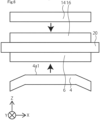
- FIGS. 5A-B and FIG. 6 are schematic diagrams for explaining the manufacturing process of the membrane electrode assembly of the present embodiment.
- the diffusion layer plate 90 is a plate material for obtaining the first diffusion layer 4.
- the shear processing of the present embodiment can be preferably performed by, for example, the cutter 1000 (see FIG.5A ).
- the shear processing of the present embodiment can be performed by moving the cutter 1000 in -Z direction. It should be noted that the method and the instrument used in the shear processing of the present embodiment are not limited to the cutter 1000.
- the first diffusion layer 4 obtained by the shear processing includes the first surface 4a1 including the chamfered portion 4f and facing the first catalyst layer 6, and the protrusion 4g provided on an opposing side of the first surface 4a1 and protruding from the side of the first surface 4a1 toward the side of the second surface 4a2.
- thermocompression bonding of the first surface 4a1 of the first diffusion layer 4, the electrolyte membrane 20, and the first catalyst layer 6 is performed.
- second thermocompression bonding of the second diffusion layer 14, the electrolyte membrane 20, and the second catalyst layer 16 is performed.
- the first thermocompression bonding and the second thermocompression bonding may be performed separately or simultaneously.
- the first catalyst layer 6 may be in contact with the electrolyte membrane 20 prior the first thermocompression bonding.
- the first catalyst layer 6 may be in contact with the first diffusion layer 4 prior to the first thermocompression bonding.
- the second catalyst layer 16 may be in contact with the electrolyte membrane 20 prior to the second thermocompression bonding.
- the second catalyst layer 16 may be in contact with the second diffusion layer 14 prior to the second thermocompression bonding.
- FIGS. 7A-B and FIG. 8 are schematic diagrams illustrating a manufacturing process of the membrane electrode assembly 800 as a comparative embodiment of the present invention.
- the diffusion layer plate 90 is processed by lasers 1100 ( FIG. 7A ) to obtain the diffusion layer 804 ( FIG. 7B ).
- a sharp-edged 4e is formed at the end of the diffusion layer 804. Processing by the lasers 1100 is used to facilitate processing when the diffusion layer 804 is the porous substrate of titanium-containing valve metal.
- the gasket 80 is provided around the first catalyst layer 6.
- the gasket 82 is provided around the second catalyst layer 16.
- the electrolyte membrane 20 is damaged because 4e is sharp. Also, since the damaged part of the electrolyte membrane 20 has a higher electric conductivity when using the membrane electrode assembly having the damaged electrolyte membrane 20, current concentration is likely to occur. Therefore, the membrane electrode assembly having a long life cannot be obtained.
- the membrane electrode assembly of the present embodiment includes a first diffusion layer; a second diffusion layer; an electrolyte membrane provided between the first diffusion layer and the second diffusion layer; a first catalyst layer provided between the first diffusion layer and the electrolyte membrane; and a second catalyst layer provided between the second diffusion layer and the electrolyte membrane, wherein the first diffusion layer includes a first surface facing the first catalyst layer, and the first surface includes a chamfered portion, and a second surface provided on an opposing side of the first surface, and the second surface includes a protrusion protruding from the side of the first surface toward the side of the second surface.
- the membrane electrode assembly of the present embodiment since the protrusion 4g is provided, damage to the electrolyte membrane 20 is suppressed. Therefore, according to the membrane electrode assembly of the present embodiment, the membrane electrode assembly with a long life can be obtained. Further, according to the method of manufacturing the membrane electrode assembly according to the present embodiment, the membrane electrode assembly having a long life can be manufactured.
- FIG. 9 is a schematic cross-sectional view of the first diffusion layer 4 of the present embodiment.
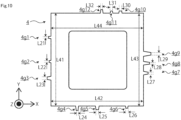
- FIG. 10 and FIG. 11 are schematic top views of the first diffusion layer 4 of the present embodiment.
- protrusions 4g1, 4g2, 4g3, 4g4, 4g5, 4g6, 4g7, 4g8, 4g9, 4g10, 4g11 and 4g12 are shown in FIG. 10 .
- Such protrusions 4g can be formed when the diffusion layer plate 90 is processed with a water stream to obtain the first diffusion layer 4.
- the protrusion 4g of the present embodiment protrudes in -z direction.
- the protrusion 4g is connected to the second surface 4a2 by the second connecting portion 4d.
- the fifth distance L5 between the side surface 4h of the first diffusion layer 4 and the second end portion 4b4 of the fourth surface 4b2 of the protrusion 4g is preferably 50% or less of the thickness t2 of the electrolyte membrane 20. If the fifth distance L5 is larger than 50% of the thickness of the electrolyte membrane, the first connector 4c may damage the electrolyte membrane 20 and cause current concentration in the membrane electrode assembly 100.
- the membrane electrode assembly with a long life can be obtained. Further, according to the method of manufacturing the membrane electrode assembly of the present embodiment, the membrane electrode assembly with a long life can be obtained.
- the electrochemical cell of the present embodiment is the electrochemical cell including the membrane electrode assembly of the first embodiment or the second embodiment.
- descriptions of contents overlapping with those of the first embodiment and the second embodiment will be omitted.
- FIG. 12 is a schematic cross-sectional view of the electrochemical cell 200 according to the present embodiment.
- the electrochemical cell 200 will be described below using water electrolysis as an example, but hydrogen can be generated by decomposing ammonia or the like in addition to water.
- the electrochemical cell 200 of the present embodiment includes the membrane electrode assembly 100, the separator 23, and the separator 24.
- water is supplied to the first electrode 2.
- protons, oxygens, and electrons are generated from water.
- the protons produced in the first electrode 2 react with electrons to produce hydrogen.
- One or both of the generated hydrogen and oxygen are used as fuel for a fuel cell, for example.
- the membrane electrode assembly 100 is tightened in the Z-direction and -Z direction.
- the electrolyte membrane 20 is damaged when the edge 4e (for example, FIGS. 7 and 8 ) contacts the electrolyte membrane 20.
- the membrane electrode assembly having the damaged electrolyte membrane 20 since the damaged part of the electrolyte membrane 20 has a higher electric conductivity, current concentration is likely to occur. Therefore, the electrochemical cell 200 having a long life cannot be obtained.
- the tightening direction may deviate from the Z direction and-Z direction.
- the electrolyte membrane 20 is damaged due to the edge 4e.
- the electrochemical cell 200 of the present embodiment includes the membrane electrode assembly 100 having the first diffusion layer 4. Therefore, damage to the electrolyte membrane 20 is suppressed. Therefore, the electrochemical cell 200 having a long life can be obtained.
- a stack of the present embodiment is the stack including the membrane electrode assembly of the first embodiment or the second embodiment.
- descriptions of contents overlapping with those of the first embodiment and the second embodiment will be omitted.
- FIG. 13 is a schematic cross-sectional view showing the stack 300 of the present embodiment.
- the stack 300 includes a plurality of the membrane electrode assembly 100 or the electrochemical cell 200 connected in series.
- the clamping plate 31 and the clamping plate 32 are attached to either end of the membrane electrode assembly 100 or the electrochemical cell 200.
- the electrolyte membrane 20 is damaged when the edge 4e (for example, FIGS. 7 and 8 ) contacts the electrolyte membrane 20 by the clamping plate 31 and the clamping plate 32. Also, when using the membrane electrode assembly having the damaged electrolyte membrane 20, since the damaged part of the electrolyte membrane 20 has a higher electric conductivity, current concentration is likely to occur. Therefore, the stack 300 having a long life cannot be obtained.
- the stack 300 of the present embodiment includes the membrane electrode assembly 100 including the first diffusion layer 4 or the electrochemical cell 200. Therefore, damage to the electrolyte membrane 20 is suppressed. Therefore, the stack 300 having a long life can be obtained.
- a fourth embodiment relates to the electrolyzer. Descriptions of the contents overlapping with those of the first to third embodiments will be omitted.
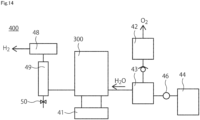
- FIG. 14 is a schematic diagram of the electrolyzer 400 according to the present embodiment.
- the electrolyzer 400 is, for example, a hydrogen-generating device.
- the electrolyzer 400 includes the electrochemical cell 200 or the stack 300.
- the electrolyzer 400 is, for example, the electrolyzer for water electrolysis.
- the power supply 41 is attached to the stack 300.
- the power supply 41 applies a voltage to the stack 300.
- a gas-liquid separator 42 and a mixing tank 43 are connected to the anode-side of the stack 300 to separate the generated gases from the unreacted water.
- the mixing tank 43 is pumped by a pumping device 46 from an ion exchanged water producing apparatus 44 which supplies water. From the gas-liquid separator 42 through the check valve 47, the mixture is mixed at the mixing tank 43 and circulated to the anode.
- a hydrogen purification device 49 connected to the gas-liquid separator 48 is used to produce high-purity hydrogen from the cathode. Impurities are discharged through a path having a valve 50 connected to the hydrogen purification device 49. In order to stably control the operating temperature, it is possible to heat the stack and the mixing tank and to control the current density at the time of thermal decomposition.
- the electrolyzer 400 of the present embodiment a long-life the electrolyzer 400 can be obtained.
- a Ti nonwoven substrate sized 25[cm] ⁇ 25[cm] and having a thickness of 200 [ ⁇ m] was prepared as the diffusion layer plate 90.
- the diffusion layer plate 90 was sputtered with nickel/iridium by sputtering to form sheet layers. Then, only nickel was sputtered to form a gap layer. Laminated structure was obtained so that the step of forming the sheet layer and the gap layer was repeated 40 times so that Ir per area was 0.2[mg/cm2]. Subsequently, it was washed with sulfuric acid to obtain a nickel-removed catalytic structure (the first catalyst layer 6). The first diffusion layer 4 and the first catalyst layer 6 were then cut using a cutter. As a result, the first electrode 2 was obtained.
- the carbon paper Toray060 (manufactured by Toray Industries, Inc.) having a 25[cm] ⁇ 25[cm] and a thickness of 190 [ ⁇ m] was prepared as the second diffusion layer 14.
- the catalyst layer having a laminated structure including void layers was formed by a sputtering method so as to have a Pt (platinum)-catalyst loading-density 0.1[mg/cm2], and the catalyst layer having the porous catalyst layer was formed. This was cleaved to give the second electrode 12.
- the first electrode 2, the second electrode 12 and the electrolyte membrane 20 described above were then placed in a hot press. Pressing was performed at 160[°C], 20[kg/cm2] for 3 minutes. Thereafter, press-cooling was performed at 25 [°C] and 20[kg/cm2] for 3 minutes. As a result, the membrane electrode assembly 100 was obtained.
- the membrane electrode assembly 100 was subjected to steady-state water electrolysis at 80 [°C] and a current density of 2 [A/cm2].
- the anodes were fed with ultrapure water at flow rate of 0.05[L/min]. Then, the cell voltage (V1) after 24 hours of operation was measured. Compared to the pre-evaluation cell voltage (VC), the voltage rise rate (V1)/ (VC) was determined.
- Comparative Example 1 Comparative Example 5, and Comparative Example 6, a crimp failure occurred between the first electrode 2 and the electrolyte membrane 20. Therefore, the steady operation of the water electrolysis could not be performed.
- Comparative Example 2 Comparative Example 2, Comparative Example 3, and Comparative Example 4, the electrolyte membrane 20 was damaged and current concentration occurred. Therefore, the steady operation of the water electrolysis for 24 hours could not be performed.
- a membrane electrode assembly including:
- a second distance L2 between a second end portion of the protrusion and the second surface is 50% or less of a film thickness t2 of the electrolyte membrane.
- the membrane electrode assembly according to any one of technical proposals 1 to 6, wherein the first diffusion layer includes titanium.
- a number of the protrusions whose second distance L2 between a second end portion of the protrusion and the second surface in a plane parallel to the second surface is 60 ⁇ m or more and 100 ⁇ m or less is two or less per length 1mm .
- An electrochemical cell including the membrane electrode assembly according to any one of technical proposals 1 to 10.
- a method of manufacturing a membrane electrode assembly including:
Landscapes
- Chemical & Material Sciences (AREA)
- Engineering & Computer Science (AREA)
- Chemical Kinetics & Catalysis (AREA)
- Electrochemistry (AREA)
- Materials Engineering (AREA)
- Metallurgy (AREA)
- Organic Chemistry (AREA)
- Inorganic Chemistry (AREA)
- Electrolytic Production Of Non-Metals, Compounds, Apparatuses Therefor (AREA)
- Electrodes For Compound Or Non-Metal Manufacture (AREA)
Applications Claiming Priority (1)
| Application Number | Priority Date | Filing Date | Title |
|---|---|---|---|
| JP2022159824A JP2024053491A (ja) | 2022-10-03 | 2022-10-03 | 膜電極接合体、電気化学セル、スタック、電解装置、及び膜電極接合体の製造方法 |
Publications (2)
| Publication Number | Publication Date |
|---|---|
| EP4350041A2 true EP4350041A2 (fr) | 2024-04-10 |
| EP4350041A3 EP4350041A3 (fr) | 2025-03-12 |
Family
ID=87929336
Family Applications (1)
| Application Number | Title | Priority Date | Filing Date |
|---|---|---|---|
| EP23194922.3A Pending EP4350041A3 (fr) | 2022-10-03 | 2023-09-01 | Ensemble électrode à membrane, cellule électrochimique, empilement, électrolyseur et procédé de fabrication d'ensemble électrode à membrane |
Country Status (4)
| Country | Link |
|---|---|
| US (1) | US20240117506A1 (fr) |
| EP (1) | EP4350041A3 (fr) |
| JP (1) | JP2024053491A (fr) |
| AU (1) | AU2023222837B2 (fr) |
Family Cites Families (9)
| Publication number | Priority date | Publication date | Assignee | Title |
|---|---|---|---|---|
| WO2002045196A2 (fr) * | 2000-11-30 | 2002-06-06 | Mti Microfuel Cells, Inc. | Membrane de pile a combustible et systeme a separateur de gaz integre |
| US7211344B2 (en) * | 2003-05-14 | 2007-05-01 | The Gillette Company | Fuel cell systems |
| JP4824298B2 (ja) * | 2003-12-04 | 2011-11-30 | パナソニック株式会社 | 燃料電池用ガス拡散層、電極及び膜電極接合体及びその製造方法 |
| JP2007149454A (ja) * | 2005-11-25 | 2007-06-14 | Matsushita Electric Ind Co Ltd | ガス拡散層、ガス拡散電極、膜電極接合体及び高分子電解質形燃料電池 |
| JP5673684B2 (ja) * | 2010-09-16 | 2015-02-18 | トヨタ自動車株式会社 | 膜電極接合体およびそれを用いた燃料電池、膜電極接合体の製造方法 |
| CN102956904A (zh) * | 2011-08-25 | 2013-03-06 | 夏普株式会社 | 碱性燃料电池和碱性燃料电池系统 |
| JP5810860B2 (ja) * | 2011-11-17 | 2015-11-11 | 日産自動車株式会社 | 燃料電池用電極触媒層 |
| ES2727129T3 (es) * | 2014-06-16 | 2019-10-14 | Siemens Ag | Capa de difusión gaseosa, celda electrolítica tipo PEM con una tal capa de difusión gaseosa, así como electrolizador |
| JP7212090B2 (ja) * | 2021-03-22 | 2023-01-24 | 本田技研工業株式会社 | 燃料電池 |
-
2022
- 2022-10-03 JP JP2022159824A patent/JP2024053491A/ja active Pending
-
2023
- 2023-08-28 AU AU2023222837A patent/AU2023222837B2/en active Active
- 2023-09-01 EP EP23194922.3A patent/EP4350041A3/fr active Pending
- 2023-09-01 US US18/459,630 patent/US20240117506A1/en active Pending
Also Published As
| Publication number | Publication date |
|---|---|
| EP4350041A3 (fr) | 2025-03-12 |
| AU2023222837A1 (en) | 2024-04-18 |
| JP2024053491A (ja) | 2024-04-15 |
| US20240117506A1 (en) | 2024-04-11 |
| AU2023222837B2 (en) | 2025-07-24 |
Similar Documents
| Publication | Publication Date | Title |
|---|---|---|
| US8343321B2 (en) | Membrane electrode unit for the electrolysis of water | |
| EP1427048B1 (fr) | Assemblage membrane-électrode pour une pile à combustible à électrolyte polymère | |
| EP3378970A1 (fr) | Membrane électrolytique multicouches, ensemble membrane-électrode, cellule d'électrolyse de l'eau, empilement et appareil d'électrolyse de l'eau | |
| EP2990109A1 (fr) | Électrode et la couche de catalyseur d'électrode de pile à combustible la contenant | |
| KR101520119B1 (ko) | 촉매층 | |
| EP4421211A1 (fr) | Structure d'électrode d'électrolyse de l'eau, ensemble électrode à membrane d'électrolyse de l'eau et dispositif d'électrolyse de l'eau | |
| US20230203679A1 (en) | Membrane electrode assembly for pem water electrolysis capable of improving the electrical conductivity of the electrode layer and method of manufacturing thereof | |
| EP3267521B1 (fr) | Matériau en titane, séparateur, pile à combustible à haut polymère solide et procédé de fabrication d'un matériau en titane | |
| EP1986258B1 (fr) | Ensemble film-couches catalytiques, ensemble film-electrode et pile à combustible du type à electrolyte polymère | |
| US20080057371A1 (en) | Separator for Fuel Cell and Method for Producing Same | |
| EP4343032A2 (fr) | Catalyseur stratifié, électrode, ensemble membrane-électrode, cellule électrochimique, empilement et électrolyseur | |
| EP4497847A1 (fr) | Procédé d'électrolyse de l'eau, cellule d'électrolyse de l'eau et système d'électrolyse de l'eau | |
| US7851095B2 (en) | Anode structure | |
| EP4350041A2 (fr) | Ensemble électrode à membrane, cellule électrochimique, empilement, électrolyseur et procédé de fabrication d'ensemble électrode à membrane | |
| EP4350040A2 (fr) | Ensemble électrode à membrane, cellule électrochimique, empilement et électrolyseur | |
| EP4350047A2 (fr) | Électrode, ensemble électrode à membrane, cellule électrochimique, empilement et électrolyseur | |
| JP2004250736A (ja) | 水電解装置 | |
| EP4350039A2 (fr) | Électrode, ensemble électrode à membrane, cellule électrochimique, empilement et électrolyseur | |
| EP4350045A2 (fr) | Électrode, ensemble électrode à membrane, cellule électrochimique, empilement et électrolyseur | |
| EP4442861A1 (fr) | Structure d'électrode et électrolyseur d'eau | |
| EP4534730A2 (fr) | Structure d'électrode | |
| EP4350046A2 (fr) | Électrode, ensemble électrode à membrane, cellule électrochimique, empilement et électrolyseur | |
| JP2026056493A (ja) | 基材、電極、膜電極接合体、電気化学セル、スタック、電解装置及び基材の製造方法 |
Legal Events
| Date | Code | Title | Description |
|---|---|---|---|
| PUAI | Public reference made under article 153(3) epc to a published international application that has entered the european phase |
Free format text: ORIGINAL CODE: 0009012 |
|
| STAA | Information on the status of an ep patent application or granted ep patent |
Free format text: STATUS: REQUEST FOR EXAMINATION WAS MADE |
|
| 17P | Request for examination filed |
Effective date: 20230901 |
|
| AK | Designated contracting states |
Kind code of ref document: A2 Designated state(s): AL AT BE BG CH CY CZ DE DK EE ES FI FR GB GR HR HU IE IS IT LI LT LU LV MC ME MK MT NL NO PL PT RO RS SE SI SK SM TR |
|
| PUAL | Search report despatched |
Free format text: ORIGINAL CODE: 0009013 |
|
| AK | Designated contracting states |
Kind code of ref document: A3 Designated state(s): AL AT BE BG CH CY CZ DE DK EE ES FI FR GB GR HR HU IE IS IT LI LT LU LV MC ME MK MT NL NO PL PT RO RS SE SI SK SM TR |
|
| RIC1 | Information provided on ipc code assigned before grant |
Ipc: C25B 11/052 20210101ALI20250131BHEP Ipc: C25B 11/032 20210101ALI20250131BHEP Ipc: C25B 11/02 20210101ALI20250131BHEP Ipc: C25B 9/77 20210101ALI20250131BHEP Ipc: C25B 9/23 20210101ALI20250131BHEP Ipc: C25B 1/04 20210101AFI20250131BHEP |