EP4342591A1 - Layered product - Google Patents
Layered product Download PDFInfo
- Publication number
- EP4342591A1 EP4342591A1 EP21940832.5A EP21940832A EP4342591A1 EP 4342591 A1 EP4342591 A1 EP 4342591A1 EP 21940832 A EP21940832 A EP 21940832A EP 4342591 A1 EP4342591 A1 EP 4342591A1
- Authority
- EP
- European Patent Office
- Prior art keywords
- functional layer
- porous functional
- thermoplastic resin
- water
- particles
- Prior art date
- Legal status (The legal status is an assumption and is not a legal conclusion. Google has not performed a legal analysis and makes no representation as to the accuracy of the status listed.)
- Pending
Links
- 239000002346 layers by function Substances 0.000 claims abstract description 103
- 229920005992 thermoplastic resin Polymers 0.000 claims abstract description 58
- XLYOFNOQVPJJNP-UHFFFAOYSA-N water Substances O XLYOFNOQVPJJNP-UHFFFAOYSA-N 0.000 claims abstract description 54
- 239000005871 repellent Substances 0.000 claims abstract description 41
- 239000002245 particle Substances 0.000 claims description 70
- 238000000576 coating method Methods 0.000 claims description 58
- 239000011248 coating agent Substances 0.000 claims description 57
- 239000007788 liquid Substances 0.000 claims description 39
- 239000010419 fine particle Substances 0.000 claims description 34
- 229920005672 polyolefin resin Polymers 0.000 claims description 21
- 230000002940 repellent Effects 0.000 claims description 11
- 239000002904 solvent Substances 0.000 claims description 11
- 239000006185 dispersion Substances 0.000 claims description 10
- 238000004519 manufacturing process Methods 0.000 claims description 10
- 239000011164 primary particle Substances 0.000 claims description 9
- 239000010410 layer Substances 0.000 abstract description 32
- 239000011859 microparticle Substances 0.000 abstract description 4
- 239000010408 film Substances 0.000 description 100
- 238000000034 method Methods 0.000 description 47
- VYPSYNLAJGMNEJ-UHFFFAOYSA-N Silicium dioxide Chemical compound O=[Si]=O VYPSYNLAJGMNEJ-UHFFFAOYSA-N 0.000 description 46
- 230000002209 hydrophobic effect Effects 0.000 description 38
- 230000000052 comparative effect Effects 0.000 description 34
- 239000003921 oil Substances 0.000 description 32
- 235000019198 oils Nutrition 0.000 description 32
- 229920005989 resin Polymers 0.000 description 31
- 239000011347 resin Substances 0.000 description 31
- 239000011246 composite particle Substances 0.000 description 20
- 229910002012 Aerosil® Inorganic materials 0.000 description 17
- 238000001035 drying Methods 0.000 description 16
- -1 polyethylene Polymers 0.000 description 16
- 238000010438 heat treatment Methods 0.000 description 13
- 238000012360 testing method Methods 0.000 description 12
- 230000008569 process Effects 0.000 description 11
- GWEVSGVZZGPLCZ-UHFFFAOYSA-N Titan oxide Chemical compound O=[Ti]=O GWEVSGVZZGPLCZ-UHFFFAOYSA-N 0.000 description 10
- LFQSCWFLJHTTHZ-UHFFFAOYSA-N Ethanol Chemical compound CCO LFQSCWFLJHTTHZ-UHFFFAOYSA-N 0.000 description 9
- CERQOIWHTDAKMF-UHFFFAOYSA-M Methacrylate Chemical compound CC(=C)C([O-])=O CERQOIWHTDAKMF-UHFFFAOYSA-M 0.000 description 9
- OKTJSMMVPCPJKN-UHFFFAOYSA-N Carbon Chemical compound [C] OKTJSMMVPCPJKN-UHFFFAOYSA-N 0.000 description 8
- 239000004743 Polypropylene Substances 0.000 description 8
- 239000000463 material Substances 0.000 description 8
- 229920001155 polypropylene Polymers 0.000 description 8
- 239000005026 oriented polypropylene Substances 0.000 description 7
- 229920000098 polyolefin Polymers 0.000 description 7
- ZWEHNKRNPOVVGH-UHFFFAOYSA-N 2-Butanone Chemical group CCC(C)=O ZWEHNKRNPOVVGH-UHFFFAOYSA-N 0.000 description 6
- KFZMGEQAYNKOFK-UHFFFAOYSA-N Isopropanol Chemical compound CC(C)O KFZMGEQAYNKOFK-UHFFFAOYSA-N 0.000 description 6
- YXFVVABEGXRONW-UHFFFAOYSA-N Toluene Chemical compound CC1=CC=CC=C1 YXFVVABEGXRONW-UHFFFAOYSA-N 0.000 description 6
- 229920001577 copolymer Polymers 0.000 description 6
- 229910052751 metal Inorganic materials 0.000 description 6
- 239000002184 metal Substances 0.000 description 6
- 239000004006 olive oil Substances 0.000 description 6
- 235000008390 olive oil Nutrition 0.000 description 6
- 239000011148 porous material Substances 0.000 description 6
- 239000000853 adhesive Substances 0.000 description 5
- 230000001070 adhesive effect Effects 0.000 description 5
- 238000005516 engineering process Methods 0.000 description 5
- 239000004645 polyester resin Substances 0.000 description 5
- 229920001225 polyester resin Polymers 0.000 description 5
- 229920000139 polyethylene terephthalate Polymers 0.000 description 5
- 239000005020 polyethylene terephthalate Substances 0.000 description 5
- 229910052814 silicon oxide Inorganic materials 0.000 description 5
- 239000004698 Polyethylene Substances 0.000 description 4
- XLOMVQKBTHCTTD-UHFFFAOYSA-N Zinc monoxide Chemical compound [Zn]=O XLOMVQKBTHCTTD-UHFFFAOYSA-N 0.000 description 4
- 239000012298 atmosphere Substances 0.000 description 4
- 229920001684 low density polyethylene Polymers 0.000 description 4
- 239000004702 low-density polyethylene Substances 0.000 description 4
- 229920000728 polyester Polymers 0.000 description 4
- 229920000573 polyethylene Polymers 0.000 description 4
- 239000000843 powder Substances 0.000 description 4
- 239000007787 solid Substances 0.000 description 4
- 238000003756 stirring Methods 0.000 description 4
- 229920000178 Acrylic resin Polymers 0.000 description 3
- 239000004925 Acrylic resin Substances 0.000 description 3
- 229910002016 Aerosil® 200 Inorganic materials 0.000 description 3
- OKKJLVBELUTLKV-UHFFFAOYSA-N Methanol Chemical compound OC OKKJLVBELUTLKV-UHFFFAOYSA-N 0.000 description 3
- DNIAPMSPPWPWGF-UHFFFAOYSA-N Propylene glycol Chemical compound CC(O)CO DNIAPMSPPWPWGF-UHFFFAOYSA-N 0.000 description 3
- 229920002433 Vinyl chloride-vinyl acetate copolymer Polymers 0.000 description 3
- 238000005299 abrasion Methods 0.000 description 3
- 150000001408 amides Chemical class 0.000 description 3
- 230000015572 biosynthetic process Effects 0.000 description 3
- 239000002981 blocking agent Substances 0.000 description 3
- 239000005038 ethylene vinyl acetate Substances 0.000 description 3
- 229920001903 high density polyethylene Polymers 0.000 description 3
- 239000004700 high-density polyethylene Substances 0.000 description 3
- 230000001965 increasing effect Effects 0.000 description 3
- 238000005259 measurement Methods 0.000 description 3
- 229910044991 metal oxide Inorganic materials 0.000 description 3
- 150000004706 metal oxides Chemical class 0.000 description 3
- 238000002156 mixing Methods 0.000 description 3
- 238000012986 modification Methods 0.000 description 3
- 230000004048 modification Effects 0.000 description 3
- TWNQGVIAIRXVLR-UHFFFAOYSA-N oxo(oxoalumanyloxy)alumane Chemical compound O=[Al]O[Al]=O TWNQGVIAIRXVLR-UHFFFAOYSA-N 0.000 description 3
- 238000004806 packaging method and process Methods 0.000 description 3
- 238000007789 sealing Methods 0.000 description 3
- 238000004381 surface treatment Methods 0.000 description 3
- HWSSEYVMGDIFMH-UHFFFAOYSA-N 2-[2-[2-(2-methylprop-2-enoyloxy)ethoxy]ethoxy]ethyl 2-methylprop-2-enoate Chemical compound CC(=C)C(=O)OCCOCCOCCOC(=O)C(C)=C HWSSEYVMGDIFMH-UHFFFAOYSA-N 0.000 description 2
- SVTBMSDMJJWYQN-UHFFFAOYSA-N 2-methylpentane-2,4-diol Chemical compound CC(O)CC(C)(C)O SVTBMSDMJJWYQN-UHFFFAOYSA-N 0.000 description 2
- CSCPPACGZOOCGX-UHFFFAOYSA-N Acetone Chemical compound CC(C)=O CSCPPACGZOOCGX-UHFFFAOYSA-N 0.000 description 2
- XKRFYHLGVUSROY-UHFFFAOYSA-N Argon Chemical compound [Ar] XKRFYHLGVUSROY-UHFFFAOYSA-N 0.000 description 2
- IJGRMHOSHXDMSA-UHFFFAOYSA-N Atomic nitrogen Chemical compound N#N IJGRMHOSHXDMSA-UHFFFAOYSA-N 0.000 description 2
- VGGSQFUCUMXWEO-UHFFFAOYSA-N Ethene Chemical compound C=C VGGSQFUCUMXWEO-UHFFFAOYSA-N 0.000 description 2
- LYCAIKOWRPUZTN-UHFFFAOYSA-N Ethylene glycol Chemical compound OCCO LYCAIKOWRPUZTN-UHFFFAOYSA-N 0.000 description 2
- VZCYOOQTPOCHFL-OWOJBTEDSA-N Fumaric acid Chemical compound OC(=O)\C=C\C(O)=O VZCYOOQTPOCHFL-OWOJBTEDSA-N 0.000 description 2
- WOBHKFSMXKNTIM-UHFFFAOYSA-N Hydroxyethyl methacrylate Chemical compound CC(=C)C(=O)OCCO WOBHKFSMXKNTIM-UHFFFAOYSA-N 0.000 description 2
- 238000003848 UV Light-Curing Methods 0.000 description 2
- 150000004703 alkoxides Chemical class 0.000 description 2
- 229920006378 biaxially oriented polypropylene Polymers 0.000 description 2
- 239000011127 biaxially oriented polypropylene Substances 0.000 description 2
- 239000011230 binding agent Substances 0.000 description 2
- 230000005540 biological transmission Effects 0.000 description 2
- 239000003795 chemical substances by application Substances 0.000 description 2
- 239000011247 coating layer Substances 0.000 description 2
- 239000002537 cosmetic Substances 0.000 description 2
- 238000010586 diagram Methods 0.000 description 2
- 229910001873 dinitrogen Inorganic materials 0.000 description 2
- 238000009826 distribution Methods 0.000 description 2
- 239000003814 drug Substances 0.000 description 2
- 239000011888 foil Substances 0.000 description 2
- 235000013305 food Nutrition 0.000 description 2
- 239000011521 glass Substances 0.000 description 2
- 238000005469 granulation Methods 0.000 description 2
- 230000003179 granulation Effects 0.000 description 2
- ZSIAUFGUXNUGDI-UHFFFAOYSA-N hexan-1-ol Chemical compound CCCCCCO ZSIAUFGUXNUGDI-UHFFFAOYSA-N 0.000 description 2
- 239000000203 mixture Substances 0.000 description 2
- 239000003960 organic solvent Substances 0.000 description 2
- 239000005022 packaging material Substances 0.000 description 2
- 239000000123 paper Substances 0.000 description 2
- 229920001200 poly(ethylene-vinyl acetate) Polymers 0.000 description 2
- 229920000642 polymer Polymers 0.000 description 2
- 239000000565 sealant Substances 0.000 description 2
- 150000003377 silicon compounds Chemical class 0.000 description 2
- 239000000377 silicon dioxide Substances 0.000 description 2
- 238000005507 spraying Methods 0.000 description 2
- 239000000758 substrate Substances 0.000 description 2
- 239000012756 surface treatment agent Substances 0.000 description 2
- 229920003002 synthetic resin Polymers 0.000 description 2
- 239000000057 synthetic resin Substances 0.000 description 2
- 229920001187 thermosetting polymer Polymers 0.000 description 2
- OGIDPMRJRNCKJF-UHFFFAOYSA-N titanium oxide Inorganic materials [Ti]=O OGIDPMRJRNCKJF-UHFFFAOYSA-N 0.000 description 2
- VZCYOOQTPOCHFL-UHFFFAOYSA-N trans-butenedioic acid Natural products OC(=O)C=CC(O)=O VZCYOOQTPOCHFL-UHFFFAOYSA-N 0.000 description 2
- 229920002554 vinyl polymer Polymers 0.000 description 2
- 239000011787 zinc oxide Substances 0.000 description 2
- OAYXUHPQHDHDDZ-UHFFFAOYSA-N 2-(2-butoxyethoxy)ethanol Chemical compound CCCCOCCOCCO OAYXUHPQHDHDDZ-UHFFFAOYSA-N 0.000 description 1
- SMZOUWXMTYCWNB-UHFFFAOYSA-N 2-(2-methoxy-5-methylphenyl)ethanamine Chemical compound COC1=CC=C(C)C=C1CCN SMZOUWXMTYCWNB-UHFFFAOYSA-N 0.000 description 1
- JAHNSTQSQJOJLO-UHFFFAOYSA-N 2-(3-fluorophenyl)-1h-imidazole Chemical compound FC1=CC=CC(C=2NC=CN=2)=C1 JAHNSTQSQJOJLO-UHFFFAOYSA-N 0.000 description 1
- NIXOWILDQLNWCW-UHFFFAOYSA-N 2-Propenoic acid Natural products OC(=O)C=C NIXOWILDQLNWCW-UHFFFAOYSA-N 0.000 description 1
- JMMZCWZIJXAGKW-UHFFFAOYSA-N 2-methylpent-2-ene Chemical compound CCC=C(C)C JMMZCWZIJXAGKW-UHFFFAOYSA-N 0.000 description 1
- 229910002014 Aerosil® 130 Inorganic materials 0.000 description 1
- 229910002018 Aerosil® 300 Inorganic materials 0.000 description 1
- 229910002019 Aerosil® 380 Inorganic materials 0.000 description 1
- 239000004215 Carbon black (E152) Substances 0.000 description 1
- XDTMQSROBMDMFD-UHFFFAOYSA-N Cyclohexane Chemical compound C1CCCCC1 XDTMQSROBMDMFD-UHFFFAOYSA-N 0.000 description 1
- 239000004831 Hot glue Substances 0.000 description 1
- CERQOIWHTDAKMF-UHFFFAOYSA-N Methacrylic acid Chemical compound CC(=C)C(O)=O CERQOIWHTDAKMF-UHFFFAOYSA-N 0.000 description 1
- OFBQJSOFQDEBGM-UHFFFAOYSA-N Pentane Chemical compound CCCCC OFBQJSOFQDEBGM-UHFFFAOYSA-N 0.000 description 1
- ALQSHHUCVQOPAS-UHFFFAOYSA-N Pentane-1,5-diol Chemical compound OCCCCCO ALQSHHUCVQOPAS-UHFFFAOYSA-N 0.000 description 1
- OFOBLEOULBTSOW-UHFFFAOYSA-N Propanedioic acid Natural products OC(=O)CC(O)=O OFOBLEOULBTSOW-UHFFFAOYSA-N 0.000 description 1
- 239000006087 Silane Coupling Agent Substances 0.000 description 1
- BOTDANWDWHJENH-UHFFFAOYSA-N Tetraethyl orthosilicate Chemical compound CCO[Si](OCC)(OCC)OCC BOTDANWDWHJENH-UHFFFAOYSA-N 0.000 description 1
- 235000010724 Wisteria floribunda Nutrition 0.000 description 1
- 239000000654 additive Substances 0.000 description 1
- 230000001464 adherent effect Effects 0.000 description 1
- 239000012790 adhesive layer Substances 0.000 description 1
- 239000004840 adhesive resin Substances 0.000 description 1
- 229920006223 adhesive resin Polymers 0.000 description 1
- 230000002411 adverse Effects 0.000 description 1
- 239000005456 alcohol based solvent Substances 0.000 description 1
- 150000001298 alcohols Chemical class 0.000 description 1
- 239000000956 alloy Substances 0.000 description 1
- 229910045601 alloy Inorganic materials 0.000 description 1
- 229910052782 aluminium Inorganic materials 0.000 description 1
- XAGFODPZIPBFFR-UHFFFAOYSA-N aluminium Chemical compound [Al] XAGFODPZIPBFFR-UHFFFAOYSA-N 0.000 description 1
- PNEYBMLMFCGWSK-UHFFFAOYSA-N aluminium oxide Inorganic materials [O-2].[O-2].[O-2].[Al+3].[Al+3] PNEYBMLMFCGWSK-UHFFFAOYSA-N 0.000 description 1
- 238000004458 analytical method Methods 0.000 description 1
- 230000003373 anti-fouling effect Effects 0.000 description 1
- 229910052786 argon Inorganic materials 0.000 description 1
- 239000003849 aromatic solvent Substances 0.000 description 1
- 235000013361 beverage Nutrition 0.000 description 1
- QHIWVLPBUQWDMQ-UHFFFAOYSA-N butyl prop-2-enoate;methyl 2-methylprop-2-enoate;prop-2-enoic acid Chemical compound OC(=O)C=C.COC(=O)C(C)=C.CCCCOC(=O)C=C QHIWVLPBUQWDMQ-UHFFFAOYSA-N 0.000 description 1
- 150000001732 carboxylic acid derivatives Chemical class 0.000 description 1
- 238000006243 chemical reaction Methods 0.000 description 1
- 238000005229 chemical vapour deposition Methods 0.000 description 1
- 239000003086 colorant Substances 0.000 description 1
- 239000002131 composite material Substances 0.000 description 1
- 238000001816 cooling Methods 0.000 description 1
- 238000003851 corona treatment Methods 0.000 description 1
- 238000000151 deposition Methods 0.000 description 1
- 238000007606 doctor blade method Methods 0.000 description 1
- 238000004043 dyeing Methods 0.000 description 1
- 238000004049 embossing Methods 0.000 description 1
- 230000002708 enhancing effect Effects 0.000 description 1
- 229920006242 ethylene acrylic acid copolymer Polymers 0.000 description 1
- 229920005648 ethylene methacrylic acid copolymer Polymers 0.000 description 1
- 229920006244 ethylene-ethyl acrylate Polymers 0.000 description 1
- 238000011156 evaluation Methods 0.000 description 1
- 239000002657 fibrous material Substances 0.000 description 1
- 239000001530 fumaric acid Substances 0.000 description 1
- 239000007789 gas Substances 0.000 description 1
- 230000005484 gravity Effects 0.000 description 1
- 238000007756 gravure coating Methods 0.000 description 1
- 239000012793 heat-sealing layer Substances 0.000 description 1
- BYTZSXLPLBPFBR-UHFFFAOYSA-N hexane methylcyclohexane Chemical compound CCCCCC.CC1CCCCC1 BYTZSXLPLBPFBR-UHFFFAOYSA-N 0.000 description 1
- 229940051250 hexylene glycol Drugs 0.000 description 1
- 229930195733 hydrocarbon Natural products 0.000 description 1
- 150000002430 hydrocarbons Chemical class 0.000 description 1
- WGCNASOHLSPBMP-UHFFFAOYSA-N hydroxyacetaldehyde Natural products OCC=O WGCNASOHLSPBMP-UHFFFAOYSA-N 0.000 description 1
- 239000011261 inert gas Substances 0.000 description 1
- 239000004615 ingredient Substances 0.000 description 1
- 239000010954 inorganic particle Substances 0.000 description 1
- 238000010884 ion-beam technique Methods 0.000 description 1
- 229920000554 ionomer Polymers 0.000 description 1
- 239000005453 ketone based solvent Substances 0.000 description 1
- 239000004922 lacquer Substances 0.000 description 1
- 239000002648 laminated material Substances 0.000 description 1
- 229920000092 linear low density polyethylene Polymers 0.000 description 1
- 230000007774 longterm Effects 0.000 description 1
- VZCYOOQTPOCHFL-UPHRSURJSA-N maleic acid Chemical compound OC(=O)\C=C/C(O)=O VZCYOOQTPOCHFL-UPHRSURJSA-N 0.000 description 1
- 239000011976 maleic acid Substances 0.000 description 1
- FPYJFEHAWHCUMM-UHFFFAOYSA-N maleic anhydride Chemical compound O=C1OC(=O)C=C1 FPYJFEHAWHCUMM-UHFFFAOYSA-N 0.000 description 1
- 229920001179 medium density polyethylene Polymers 0.000 description 1
- 239000004701 medium-density polyethylene Substances 0.000 description 1
- 238000002844 melting Methods 0.000 description 1
- 230000008018 melting Effects 0.000 description 1
- 150000002739 metals Chemical class 0.000 description 1
- LVHBHZANLOWSRM-UHFFFAOYSA-N methylenebutanedioic acid Natural products OC(=O)CC(=C)C(O)=O LVHBHZANLOWSRM-UHFFFAOYSA-N 0.000 description 1
- 239000011259 mixed solution Substances 0.000 description 1
- 239000000178 monomer Substances 0.000 description 1
- 239000004745 nonwoven fabric Substances 0.000 description 1
- 230000001590 oxidative effect Effects 0.000 description 1
- 230000002688 persistence Effects 0.000 description 1
- 230000000704 physical effect Effects 0.000 description 1
- 229920006350 polyacrylonitrile resin Polymers 0.000 description 1
- 229920006122 polyamide resin Polymers 0.000 description 1
- 229920001083 polybutene Polymers 0.000 description 1
- 229920006267 polyester film Polymers 0.000 description 1
- 239000011118 polyvinyl acetate Substances 0.000 description 1
- 229920002689 polyvinyl acetate Polymers 0.000 description 1
- 229920000915 polyvinyl chloride Polymers 0.000 description 1
- 239000004800 polyvinyl chloride Substances 0.000 description 1
- 239000002356 single layer Substances 0.000 description 1
- 238000002791 soaking Methods 0.000 description 1
- 239000000243 solution Substances 0.000 description 1
- 239000007921 spray Substances 0.000 description 1
- 238000000992 sputter etching Methods 0.000 description 1
- 239000010935 stainless steel Substances 0.000 description 1
- 229910001220 stainless steel Inorganic materials 0.000 description 1
- 239000000126 substance Substances 0.000 description 1
- 229920002803 thermoplastic polyurethane Polymers 0.000 description 1
- 239000002562 thickening agent Substances 0.000 description 1
- 239000010409 thin film Substances 0.000 description 1
- 239000004408 titanium dioxide Substances 0.000 description 1
- 125000000026 trimethylsilyl group Chemical group [H]C([H])([H])[Si]([*])(C([H])([H])[H])C([H])([H])[H] 0.000 description 1
- 238000009281 ultraviolet germicidal irradiation Methods 0.000 description 1
- 125000000391 vinyl group Chemical group [H]C([*])=C([H])[H] 0.000 description 1
- 239000011800 void material Substances 0.000 description 1
- 239000001993 wax Substances 0.000 description 1
- 239000002023 wood Substances 0.000 description 1
- 239000002759 woven fabric Substances 0.000 description 1
Images

Classifications
-
- B—PERFORMING OPERATIONS; TRANSPORTING
- B32—LAYERED PRODUCTS
- B32B—LAYERED PRODUCTS, i.e. PRODUCTS BUILT-UP OF STRATA OF FLAT OR NON-FLAT, e.g. CELLULAR OR HONEYCOMB, FORM
- B32B5/00—Layered products characterised by the non- homogeneity or physical structure, i.e. comprising a fibrous, filamentary, particulate or foam layer; Layered products characterised by having a layer differing constitutionally or physically in different parts
- B32B5/16—Layered products characterised by the non- homogeneity or physical structure, i.e. comprising a fibrous, filamentary, particulate or foam layer; Layered products characterised by having a layer differing constitutionally or physically in different parts characterised by features of a layer formed of particles, e.g. chips, powder or granules
-
- B—PERFORMING OPERATIONS; TRANSPORTING
- B05—SPRAYING OR ATOMISING IN GENERAL; APPLYING FLUENT MATERIALS TO SURFACES, IN GENERAL
- B05D—PROCESSES FOR APPLYING FLUENT MATERIALS TO SURFACES, IN GENERAL
- B05D5/00—Processes for applying liquids or other fluent materials to surfaces to obtain special surface effects, finishes or structures
- B05D5/08—Processes for applying liquids or other fluent materials to surfaces to obtain special surface effects, finishes or structures to obtain an anti-friction or anti-adhesive surface
-
- B—PERFORMING OPERATIONS; TRANSPORTING
- B05—SPRAYING OR ATOMISING IN GENERAL; APPLYING FLUENT MATERIALS TO SURFACES, IN GENERAL
- B05D—PROCESSES FOR APPLYING FLUENT MATERIALS TO SURFACES, IN GENERAL
- B05D3/00—Pretreatment of surfaces to which liquids or other fluent materials are to be applied; After-treatment of applied coatings, e.g. intermediate treating of an applied coating preparatory to subsequent applications of liquids or other fluent materials
- B05D3/02—Pretreatment of surfaces to which liquids or other fluent materials are to be applied; After-treatment of applied coatings, e.g. intermediate treating of an applied coating preparatory to subsequent applications of liquids or other fluent materials by baking
-
- B—PERFORMING OPERATIONS; TRANSPORTING
- B05—SPRAYING OR ATOMISING IN GENERAL; APPLYING FLUENT MATERIALS TO SURFACES, IN GENERAL
- B05D—PROCESSES FOR APPLYING FLUENT MATERIALS TO SURFACES, IN GENERAL
- B05D3/00—Pretreatment of surfaces to which liquids or other fluent materials are to be applied; After-treatment of applied coatings, e.g. intermediate treating of an applied coating preparatory to subsequent applications of liquids or other fluent materials
- B05D3/02—Pretreatment of surfaces to which liquids or other fluent materials are to be applied; After-treatment of applied coatings, e.g. intermediate treating of an applied coating preparatory to subsequent applications of liquids or other fluent materials by baking
- B05D3/0254—After-treatment
-
- B—PERFORMING OPERATIONS; TRANSPORTING
- B05—SPRAYING OR ATOMISING IN GENERAL; APPLYING FLUENT MATERIALS TO SURFACES, IN GENERAL
- B05D—PROCESSES FOR APPLYING FLUENT MATERIALS TO SURFACES, IN GENERAL
- B05D5/00—Processes for applying liquids or other fluent materials to surfaces to obtain special surface effects, finishes or structures
-
- B—PERFORMING OPERATIONS; TRANSPORTING
- B05—SPRAYING OR ATOMISING IN GENERAL; APPLYING FLUENT MATERIALS TO SURFACES, IN GENERAL
- B05D—PROCESSES FOR APPLYING FLUENT MATERIALS TO SURFACES, IN GENERAL
- B05D7/00—Processes, other than flocking, specially adapted for applying liquids or other fluent materials to particular surfaces or for applying particular liquids or other fluent materials
- B05D7/02—Processes, other than flocking, specially adapted for applying liquids or other fluent materials to particular surfaces or for applying particular liquids or other fluent materials to macromolecular substances, e.g. rubber
- B05D7/04—Processes, other than flocking, specially adapted for applying liquids or other fluent materials to particular surfaces or for applying particular liquids or other fluent materials to macromolecular substances, e.g. rubber to surfaces of films or sheets
-
- B—PERFORMING OPERATIONS; TRANSPORTING
- B32—LAYERED PRODUCTS
- B32B—LAYERED PRODUCTS, i.e. PRODUCTS BUILT-UP OF STRATA OF FLAT OR NON-FLAT, e.g. CELLULAR OR HONEYCOMB, FORM
- B32B27/00—Layered products comprising a layer of synthetic resin
- B32B27/32—Layered products comprising a layer of synthetic resin comprising polyolefins
-
- B—PERFORMING OPERATIONS; TRANSPORTING
- B32—LAYERED PRODUCTS
- B32B—LAYERED PRODUCTS, i.e. PRODUCTS BUILT-UP OF STRATA OF FLAT OR NON-FLAT, e.g. CELLULAR OR HONEYCOMB, FORM
- B32B5/00—Layered products characterised by the non- homogeneity or physical structure, i.e. comprising a fibrous, filamentary, particulate or foam layer; Layered products characterised by having a layer differing constitutionally or physically in different parts
- B32B5/02—Layered products characterised by the non- homogeneity or physical structure, i.e. comprising a fibrous, filamentary, particulate or foam layer; Layered products characterised by having a layer differing constitutionally or physically in different parts characterised by structural features of a fibrous or filamentary layer
- B32B5/028—Net structure, e.g. spaced apart filaments bonded at the crossing points
-
- B—PERFORMING OPERATIONS; TRANSPORTING
- B32—LAYERED PRODUCTS
- B32B—LAYERED PRODUCTS, i.e. PRODUCTS BUILT-UP OF STRATA OF FLAT OR NON-FLAT, e.g. CELLULAR OR HONEYCOMB, FORM
- B32B9/00—Layered products comprising a layer of a particular substance not covered by groups B32B11/00 - B32B29/00
-
- C—CHEMISTRY; METALLURGY
- C08—ORGANIC MACROMOLECULAR COMPOUNDS; THEIR PREPARATION OR CHEMICAL WORKING-UP; COMPOSITIONS BASED THEREON
- C08J—WORKING-UP; GENERAL PROCESSES OF COMPOUNDING; AFTER-TREATMENT NOT COVERED BY SUBCLASSES C08B, C08C, C08F, C08G or C08H
- C08J7/00—Chemical treatment or coating of shaped articles made of macromolecular substances
- C08J7/04—Coating
- C08J7/0427—Coating with only one layer of a composition containing a polymer binder
-
- C—CHEMISTRY; METALLURGY
- C08—ORGANIC MACROMOLECULAR COMPOUNDS; THEIR PREPARATION OR CHEMICAL WORKING-UP; COMPOSITIONS BASED THEREON
- C08J—WORKING-UP; GENERAL PROCESSES OF COMPOUNDING; AFTER-TREATMENT NOT COVERED BY SUBCLASSES C08B, C08C, C08F, C08G or C08H
- C08J7/00—Chemical treatment or coating of shaped articles made of macromolecular substances
- C08J7/04—Coating
- C08J7/043—Improving the adhesiveness of the coatings per se, e.g. forming primers
-
- C—CHEMISTRY; METALLURGY
- C08—ORGANIC MACROMOLECULAR COMPOUNDS; THEIR PREPARATION OR CHEMICAL WORKING-UP; COMPOSITIONS BASED THEREON
- C08J—WORKING-UP; GENERAL PROCESSES OF COMPOUNDING; AFTER-TREATMENT NOT COVERED BY SUBCLASSES C08B, C08C, C08F, C08G or C08H
- C08J7/00—Chemical treatment or coating of shaped articles made of macromolecular substances
- C08J7/04—Coating
- C08J7/054—Forming anti-misting or drip-proofing coatings
-
- B—PERFORMING OPERATIONS; TRANSPORTING
- B05—SPRAYING OR ATOMISING IN GENERAL; APPLYING FLUENT MATERIALS TO SURFACES, IN GENERAL
- B05D—PROCESSES FOR APPLYING FLUENT MATERIALS TO SURFACES, IN GENERAL
- B05D1/00—Processes for applying liquids or other fluent materials
- B05D1/26—Processes for applying liquids or other fluent materials performed by applying the liquid or other fluent material from an outlet device in contact with, or almost in contact with, the surface
-
- B—PERFORMING OPERATIONS; TRANSPORTING
- B05—SPRAYING OR ATOMISING IN GENERAL; APPLYING FLUENT MATERIALS TO SURFACES, IN GENERAL
- B05D—PROCESSES FOR APPLYING FLUENT MATERIALS TO SURFACES, IN GENERAL
- B05D2201/00—Polymeric substrate or laminate
- B05D2201/02—Polymeric substrate
-
- B—PERFORMING OPERATIONS; TRANSPORTING
- B05—SPRAYING OR ATOMISING IN GENERAL; APPLYING FLUENT MATERIALS TO SURFACES, IN GENERAL
- B05D—PROCESSES FOR APPLYING FLUENT MATERIALS TO SURFACES, IN GENERAL
- B05D2252/00—Sheets
-
- B—PERFORMING OPERATIONS; TRANSPORTING
- B05—SPRAYING OR ATOMISING IN GENERAL; APPLYING FLUENT MATERIALS TO SURFACES, IN GENERAL
- B05D—PROCESSES FOR APPLYING FLUENT MATERIALS TO SURFACES, IN GENERAL
- B05D2401/00—Form of the coating product, e.g. solution, water dispersion, powders or the like
- B05D2401/10—Organic solvent
-
- B—PERFORMING OPERATIONS; TRANSPORTING
- B05—SPRAYING OR ATOMISING IN GENERAL; APPLYING FLUENT MATERIALS TO SURFACES, IN GENERAL
- B05D—PROCESSES FOR APPLYING FLUENT MATERIALS TO SURFACES, IN GENERAL
- B05D2507/00—Polyolefins
-
- B—PERFORMING OPERATIONS; TRANSPORTING
- B05—SPRAYING OR ATOMISING IN GENERAL; APPLYING FLUENT MATERIALS TO SURFACES, IN GENERAL
- B05D—PROCESSES FOR APPLYING FLUENT MATERIALS TO SURFACES, IN GENERAL
- B05D2601/00—Inorganic fillers
- B05D2601/20—Inorganic fillers used for non-pigmentation effect
- B05D2601/22—Silica
-
- B—PERFORMING OPERATIONS; TRANSPORTING
- B05—SPRAYING OR ATOMISING IN GENERAL; APPLYING FLUENT MATERIALS TO SURFACES, IN GENERAL
- B05D—PROCESSES FOR APPLYING FLUENT MATERIALS TO SURFACES, IN GENERAL
- B05D2602/00—Organic fillers
-
- B—PERFORMING OPERATIONS; TRANSPORTING
- B05—SPRAYING OR ATOMISING IN GENERAL; APPLYING FLUENT MATERIALS TO SURFACES, IN GENERAL
- B05D—PROCESSES FOR APPLYING FLUENT MATERIALS TO SURFACES, IN GENERAL
- B05D5/00—Processes for applying liquids or other fluent materials to surfaces to obtain special surface effects, finishes or structures
- B05D5/02—Processes for applying liquids or other fluent materials to surfaces to obtain special surface effects, finishes or structures to obtain a matt or rough surface
-
- B—PERFORMING OPERATIONS; TRANSPORTING
- B32—LAYERED PRODUCTS
- B32B—LAYERED PRODUCTS, i.e. PRODUCTS BUILT-UP OF STRATA OF FLAT OR NON-FLAT, e.g. CELLULAR OR HONEYCOMB, FORM
- B32B2264/00—Composition or properties of particles which form a particulate layer or are present as additives
- B32B2264/10—Inorganic particles
-
- B—PERFORMING OPERATIONS; TRANSPORTING
- B32—LAYERED PRODUCTS
- B32B—LAYERED PRODUCTS, i.e. PRODUCTS BUILT-UP OF STRATA OF FLAT OR NON-FLAT, e.g. CELLULAR OR HONEYCOMB, FORM
- B32B2264/00—Composition or properties of particles which form a particulate layer or are present as additives
- B32B2264/10—Inorganic particles
- B32B2264/105—Metal
-
- B—PERFORMING OPERATIONS; TRANSPORTING
- B32—LAYERED PRODUCTS
- B32B—LAYERED PRODUCTS, i.e. PRODUCTS BUILT-UP OF STRATA OF FLAT OR NON-FLAT, e.g. CELLULAR OR HONEYCOMB, FORM
- B32B2307/00—Properties of the layers or laminate
- B32B2307/70—Other properties
- B32B2307/73—Hydrophobic
-
- C—CHEMISTRY; METALLURGY
- C08—ORGANIC MACROMOLECULAR COMPOUNDS; THEIR PREPARATION OR CHEMICAL WORKING-UP; COMPOSITIONS BASED THEREON
- C08J—WORKING-UP; GENERAL PROCESSES OF COMPOUNDING; AFTER-TREATMENT NOT COVERED BY SUBCLASSES C08B, C08C, C08F, C08G or C08H
- C08J2323/00—Characterised by the use of homopolymers or copolymers of unsaturated aliphatic hydrocarbons having only one carbon-to-carbon double bond; Derivatives of such polymers
- C08J2323/02—Characterised by the use of homopolymers or copolymers of unsaturated aliphatic hydrocarbons having only one carbon-to-carbon double bond; Derivatives of such polymers not modified by chemical after treatment
- C08J2323/04—Homopolymers or copolymers of ethene
- C08J2323/06—Polyethene
-
- C—CHEMISTRY; METALLURGY
- C08—ORGANIC MACROMOLECULAR COMPOUNDS; THEIR PREPARATION OR CHEMICAL WORKING-UP; COMPOSITIONS BASED THEREON
- C08J—WORKING-UP; GENERAL PROCESSES OF COMPOUNDING; AFTER-TREATMENT NOT COVERED BY SUBCLASSES C08B, C08C, C08F, C08G or C08H
- C08J2323/00—Characterised by the use of homopolymers or copolymers of unsaturated aliphatic hydrocarbons having only one carbon-to-carbon double bond; Derivatives of such polymers
- C08J2323/02—Characterised by the use of homopolymers or copolymers of unsaturated aliphatic hydrocarbons having only one carbon-to-carbon double bond; Derivatives of such polymers not modified by chemical after treatment
- C08J2323/10—Homopolymers or copolymers of propene
- C08J2323/12—Polypropene
-
- C—CHEMISTRY; METALLURGY
- C08—ORGANIC MACROMOLECULAR COMPOUNDS; THEIR PREPARATION OR CHEMICAL WORKING-UP; COMPOSITIONS BASED THEREON
- C08J—WORKING-UP; GENERAL PROCESSES OF COMPOUNDING; AFTER-TREATMENT NOT COVERED BY SUBCLASSES C08B, C08C, C08F, C08G or C08H
- C08J2367/00—Characterised by the use of polyesters obtained by reactions forming a carboxylic ester link in the main chain; Derivatives of such polymers
- C08J2367/02—Polyesters derived from dicarboxylic acids and dihydroxy compounds
-
- C—CHEMISTRY; METALLURGY
- C08—ORGANIC MACROMOLECULAR COMPOUNDS; THEIR PREPARATION OR CHEMICAL WORKING-UP; COMPOSITIONS BASED THEREON
- C08J—WORKING-UP; GENERAL PROCESSES OF COMPOUNDING; AFTER-TREATMENT NOT COVERED BY SUBCLASSES C08B, C08C, C08F, C08G or C08H
- C08J2423/00—Characterised by the use of homopolymers or copolymers of unsaturated aliphatic hydrocarbons having only one carbon-to-carbon double bond; Derivatives of such polymers
- C08J2423/02—Characterised by the use of homopolymers or copolymers of unsaturated aliphatic hydrocarbons having only one carbon-to-carbon double bond; Derivatives of such polymers not modified by chemical after treatment
- C08J2423/10—Homopolymers or copolymers of propene
- C08J2423/12—Polypropene
-
- C—CHEMISTRY; METALLURGY
- C08—ORGANIC MACROMOLECULAR COMPOUNDS; THEIR PREPARATION OR CHEMICAL WORKING-UP; COMPOSITIONS BASED THEREON
- C08J—WORKING-UP; GENERAL PROCESSES OF COMPOUNDING; AFTER-TREATMENT NOT COVERED BY SUBCLASSES C08B, C08C, C08F, C08G or C08H
- C08J2423/00—Characterised by the use of homopolymers or copolymers of unsaturated aliphatic hydrocarbons having only one carbon-to-carbon double bond; Derivatives of such polymers
- C08J2423/26—Characterised by the use of homopolymers or copolymers of unsaturated aliphatic hydrocarbons having only one carbon-to-carbon double bond; Derivatives of such polymers modified by chemical after-treatment
-
- C—CHEMISTRY; METALLURGY
- C08—ORGANIC MACROMOLECULAR COMPOUNDS; THEIR PREPARATION OR CHEMICAL WORKING-UP; COMPOSITIONS BASED THEREON
- C08J—WORKING-UP; GENERAL PROCESSES OF COMPOUNDING; AFTER-TREATMENT NOT COVERED BY SUBCLASSES C08B, C08C, C08F, C08G or C08H
- C08J2467/00—Characterised by the use of polyesters obtained by reactions forming a carboxylic ester link in the main chain; Derivatives of such polymers
- C08J2467/02—Polyesters derived from dicarboxylic acids and dihydroxy compounds
Definitions
- the present invention relates to layered product having water and oil repellent properties.
- Water or oil repellent technologies have been widely studied for anti-adhesion and mold release applications.
- products have been developed with super water repellent treatment having a contact angle with water of 150° or more, or super oil repellent treatment showing a contact angle with oil of 150° or more.
- super water-repellent and super oil-repellent properties are realized by modification of chemical properties by coating or modification of physical properties by imparting minute irregularities.
- Patent Literature 1 discloses that a thin metal film is formed on the surface of a base material, and subsequently hydrophobic microparticles are deposited on the surface by CVD method using an organic silicon compound, and then the metal film and hydrophobic microparticles or hydrophobic microparticles each other are combined by exposure to an atmosphere containing a similar organic silicon compound to form a water repellent layer with excellent durability.
- Patent Literature 2 a technology is proposed to form a water repellent layer with excellent durability in which hydrophobic fine particles do not easily come off by treating a water repellent layer containing hydrophobic fine particles and a binder (metal alkoxide), and to enable heat sealing by treating the water repellent layer with an adhesive layer.
- Patent Literatures 3 and 4 it is disclosed that a water-repellent surface with excellent durability is formed by imparting fine surface irregularities to a surface of a substrate by a nanoimprinting method (UV curing method, thermosetting method).
- the UV curing method is used, and a mold with a concave structure existing at a pitch of several hundred nm is pressed against UV curable resin, and the resin is cured by UV irradiation to form convex pillars at a pitch of several hundred nm.
- Patent Literature 4 suggests that a thermosetting method is used, and a mold in which a concave structure exists at a pitch of several hundred nm is pressed against thermoplastic resin and cooled after forming convex pillars.
- Patent Literature 1 needs a process for depositing and growing hydrophobic particles after forming a metallic thin film. Accordingly, Patent Literature 1 requires large-scale facilities while making mass production difficult.
- a super water repellant layer is formed by the nanoimprint method, but the productivity of the nanoimprint method is low compared to surface modification by coating, and is not suitable for production on an industrial scale.
- the main object of the present invention is to provide a laminate that can be mass-produced and has a water-repellent and/or oil-repellent layer that is difficult to peel off or drop off.
- the inventor has completed the present invention after diligently studying the problems of the conventional technology and finding that the above-mentioned object can be achieved by employing a specific layer structure.
- the present invention relates to the following laminated body.
- the present invention it is possible to provide a laminate that can be mass-produced and has a water-repellent and/or oil-repellent layer that is difficult to peel off or drop off.
- the laminate of the present invention has a porous functional layer containing thermoplastic resin in which functional particles form a three-dimensional network structure, and has a non-uniform structure (preferably a gradient structure) in which the porosity of the porous functional layer is lower near the base film and higher near the surface of the porous functional layer.
- a non-uniform structure preferably a gradient structure
- the adhesion between the base film and the porous functional layer is increased, and both layers form an integrated structure.
- the porous functional layer can effectively be suppressed or prevented from peeling or falling off from the base film. Therefore, the porous functional layer can exhibit a certain degree of durability against relatively strong frictional forces.
- Such a laminate can be formed, for example, by using a specific coating liquid as described below. As a result, it is possible to more efficiently provide a laminate that can effectively sustain the desired water and/or oil repellency.
- the laminated body (the laminate of the invention) is a laminated body in which a porous functional layer including a thermoplastic resin and a three-dimensional network structure comprising water-repellent and/or oil-repellent fine particles adhered to each other is formed on a base film, wherein the porous functional layer has, in the thickness direction, a porosity from greater than or equal to 1 volume% to less than or equal to 50 volume% in the region from the bottom of the porous functional layer to 50% thickness of the porous functional layer, and a porosity from greater than or equal to 50 volume% to less than or equal to 99 volume% in the region from more than 50% thickness of the porous functional layer to the surface of the porous functional layer.
- FIG. 1 is a schematic diagram showing an example of the layer structure of the laminate of the invention.
- the laminate 10 has a porous functional layer 12 formed on a base film 11.
- This porous functional layer 12 is supported by being fixed (adhered) on the base film 11.
- the porous functional layer 12 includes a three-dimensional network structure comprising water-repellent and/or oil-repellent fine particles 13 (hereinafter referred to as "functional particles" unless otherwise specified) adhered to each other and thermoplastic resin 14.
- the thermoplastic resin 14 may be included either in the periphery or inside of the three-dimensional network structure, but is preferably included at least in the voids of the three-dimensional network structure as shown in Figure 1 .
- the porous functional layer 12 has a porosity of 1 volume% or more and 50 volume% or less in a region from the porous functional layer bottom 12a to 50% thickness (t/2) of the porous functional layer in a direction of the thickness t (hereinafter referred to as "region B"), and a porosity of 50 volume% or more and 99 volume% or less in the region from exceeding 50% thickness of the porous functional layer to the porous functional layer surface 12b.
- the structure of the porous functional layer 12 is such that the density of the functional particles and thermoplastic resin is higher in region B, which is closer to the base film, and the density is lower in region A, which is closer to the porous functional layer surface.
- the thickness t of the porous functional layer can be calculated by the following formula based on the position of the bottom surface 11a of the base film 11, where the horizontal position of the functional particle at the lowest position of the three-dimensional network structure is the bottom surface 12a of the porous functional layer and the horizontal position of the functional particle at the highest position of the three-dimensional network structure is the surface 12b of the porous functional layer, as shown in Figure 1 .
- Thickness of the porous functional layer t distance from bottom surface 11a to porous functional layer surface 12b difference in height ⁇ distance from bottom surface 11a to porous functional layer bottom surface 12a difference in height
- laminate 10 of the present invention it is desirable that part of the aforementioned porous functional layer 12 (especially the three-dimensional network structure) is embedded in the base film 11. This can enhance the adhesion of the porous functional layer to the base film.
- the base film functions as a support layer that supports the porous functional layer in the laminate of the invention. Therefore, as long as it has such a function, its material is not particularly limited, and can be made of resins (e.g., synthetic resins such as polyester, polyethylene, polypropylene, etc.), fibrous materials (e.g., paper, synthetic paper, nonwoven fabric, woven fabric, wood board, etc.), metals or alloys (e.g., metal foil such as aluminum foil, etc.), glass (glass plate) or the like. In addition to single materials, composite materials, laminated materials, etc. of these materials can be exemplified.
- resins e.g., synthetic resins such as polyester, polyethylene, polypropylene, etc.
- fibrous materials e.g., paper, synthetic paper, nonwoven fabric, woven fabric, wood board, etc.
- metals or alloys e.g., metal foil such as aluminum foil, etc.
- glass plate glass plate
- At least one type of resin film selected from the group consisting of polypropylene film, polyethylene film and polyester film can be suitably used as a base film in the present invention.
- the base material film is a resin film
- the resin film may be either a stretched film or an unstretched film.
- both uniaxially oriented film or biaxially oriented film can be used for the stretched film.
- Various types of resin films with surface treatment such as corona treatment, for example, can also be used as the base film.
- the thickness of the base film is not limited, but can be set appropriately according to the material of the base film, the application of the present invention laminate, and other factors. Generally, however, it can be set appropriately within the range of 20 to 80 ⁇ m, but is not limited thereto.
- the surface (especially the surface on which the porous functional layer is laminated) of the base film may be treated with a surface treatment. This can further enhance the adhesion (bonding) between the base film and the porous functional layer.
- the aforementioned surface treatment includes, for example, unevenness treatment by additives (preferably filled particles), unevenness treatment by embossing, or the like.
- the height of the unevenness is not limited, but it is particularly preferred to be 5 to 60 ⁇ m, and 20 to 50 um is more preferred.
- the base film may be either a single layer or multiple layers.
- a laminated film consisting of a heat seal layer on at least one side of a resin film can be used as the base film.
- the heat sealant used to form the heat seal layer can include ingredients used in known or commercially available adhesives such as lacquer type adhesives, easy peel adhesives, and hot melt adhesives, as well as components of sealant films known or commercially available.
- the main constituting the heat seal layer are not particularly limited to, and include, for example, low-density polyethylene, medium-density polyethylene, high-density polyethylene, linear (linear) low-density polyethylene, polypropylene, ethylene-vinyl acetate copolymer, ionomer resin, ethylene -acrylic acid copolymer, vinyl chloride-vinyl acetate-acrylic ester copolymer, ethylene-ethyl acrylate copolymer, ethylene-methacrylic acid copolymer, ethylene-propylene copolymer, acid-modified polyolefin resin in which polyolefin such as methylpentene polymer, polybutene polymer, polyethylene or polypropylene, or the like is modified with unsaturated carboxylic acid such as acrylic acid, methacrylic acid, maleic acid, maleic anhydride, fumaric acid, itaconic acid, or the like, polyvinyl acetate resins
- an anti-blocking agent can be suitably used in the present invention.
- an anti-blocking agent there are no particular limitations, and at least one selected from the group consisting of polyethylene wax, polypropylene wax, silica, inorganic particles, synthetic resin particles, etc. can be suitably added, for example.
- the porous functional layer in the laminate of the invention is a layer having water and/or oil repellency.
- the porous functional layer includes a three-dimensional network structure consisting of functional particles adhered to each other and a thermoplastic resin.
- the functional particles form a three-dimensional network structure because individual functional particles contact and are fixed to each other.
- the three-dimensional network structure is porous (agglomerate) and has voids (pores) formed between the functional particles. These pores may be independent pores, continuous pores, or both independent and continuous pores.
- the porosity of the porous functional layer is characterized in that the porosity of region A is relatively higher than that of region B when region B is compared with region A.
- the functional particles and thermoplastic resin are more densely packed on the base film side of the functional layer.
- Such pore distribution (density distribution) together with the presence of thermoplastic resin makes the porous functional layer to be more adherent to the base film and contributes to the long-term persistence of high water and/or oil repellency due to the high porosity of the functional layer surface (existence of surface unevenness and air layer) .
- the amount of the porous functional layer can be set appropriately according to, for example, the desired water and/or oil repellency, the type of thermoplastic resin used or the like and can be set to be within the range of the amount of functional particles as shown below. For example, it can be set within the range of about 0.6 to 5 g/m 2 (especially 1 to 3 g/m 2 ), but is not limited to this.
- the degree of water and/or oil repellency of the porous functional layer is not limited, but the following properties are preferred.
- the contact angle with water can be 150 degrees or higher (so-called super water repellency).
- the contact angle with oil can be 150 degrees or more (so-called super oil repellency).
- the thickness of the porous functional layer is not particularly limited, but can normally be in the range of 1 to 20 um, and especially 1 to 5 um is preferred. By setting the thickness within such a range, it is possible to obtain even higher water or oil repellency.
- the functional particles constituting the porous functional layer are not restricted as long as the particles have water and/or oil repellency.
- hydrophobic oxide particles can be suitably used.
- At least one type of particles (powder) selected from the group consisting of silicon oxide, titanium oxide, aluminum oxide, zinc oxide, or the like can be used as hydrophobic oxide particles.
- silicon oxide particles are preferred.
- the hydrophobic oxide particles preferably have an average primary particle diameter of 5 to 50 nm, more preferably 7 to 30 nm.
- the aforementioned measurement of the average primary particle diameter can be performed using a transmission electron microscope or a scanning electron microscope. More specifically, the average primary particle diameter can be obtained by taking pictures with a transmission electron microscope or scanning electron microscope, measuring the diameters of 200 pieces or more particles on the pictures, and calculating the arithmetic mean value.
- Nano-level oxide particles as described above can be made from known or commercially available products.
- silica the product names "AEROSIL R972,” “AEROSIL R972V,” “AEROSIL R972CF,” “AEROSIL R974,” “AEROSIL RX200,” “AEROSIL RY200” (manufactured by AEROSIL Japan Co.), "AEROSIL R202", “AEROSIL R805", “AEROSIL R812”, “AEROSIL R812S” (manufactured by Evonik Degussa), “Silohovic 100", “Silohovic 200", “Silohovic 603” (manufactured by Fuji Silicia Chemical Co.).
- titania examples include the product name "AEROXIDE TiO 2 T805" (manufactured by Evonik Degussa).
- alumina examples include AEROXIDE Alu C (Evonik Degussa) or the like treated with a silane coupling agent to make the particle surface hydrophobic.
- hydrophobic silica particles can be used suitably.
- hydrophobic silica particles having trimethylsilyl groups on the surface are preferred in that they provide better non-adhesive properties.
- Corresponding commercial products include, for example, the aforementioned AEROSIL R812 and AEROSIL R812S (both manufactured by Evonik Degussa).
- a particle having oil-repellent properties for example, a composite particle obtained by surface-treating an oxide fine particle as a core in order to impart hydrophobic properties to the particle can be suitably used.
- At least one type of particle (powder) selected from the group consisting of silicon oxide, titanium oxide, aluminum oxide, zinc oxide, or the like can be used as the oxide fine particle for the core.
- silicon oxide particles are preferred.
- AEROSIL 200 AEROSIL
- AEROSIL 130 AEROSIL 300
- AEROSIL 50 AEROSIL 200 FAD
- AEROSIL 380 all manufactured by AEROSIL Japan Co., Ltd.
- titanium dioxide product names such as “AEROXIDE TiO 2 T805" (manufactured by Evonik Degussa)
- aluminum oxide examples include “AEROXIDE Alu C 805" (manufactured by Evonik Degussa).
- the method of producing the composite particle is not particularly limited, and the covering layer may be formed on the metal oxide particle (powder) by, for example, a known coating method or granulation method, with using a polyfluoroalkyl methacrylate resin as the coating material. More specifically, the composite particle can be favorably produced by a production method comprising a step (the coating step) of coating the metal oxide particle with a coating liquid in which a liquid polyfluoroalkyl methacrylate resin is dissolved or dispersed in a solvent.
- a polyfluoroalkyl methacrylate resin in liquid form at room temperature (25 °C) and under normal pressure can be advantageously used.
- a copolymer of polyfluorooctyl methacrylate, 2-N,N-diethylaminoethyl methacrylate, 2-hydroxyethyl methacrylate, and 2,2'-ethylenedioxydiethyl dimethacrylate, or the like can be suitably used. Commercially available products can be used.
- the solvent used for the coating liquid is not restricted, and in addition to water, organic solvents such as alcohols and toluene can be used, but water is preferred in the present invention. In other words, it is preferable to use a coating liquid in which the polyfluoroalkyl methacrylate resin is dissolved and/or dispersed in water.
- the content of polyfluoroalkyl methacrylate resin in the above coating liquid is not particularly limited, it is generally set at about 10 to 80% by weight, and especially 15 to 70% by weight, of which 20 to 60% by weight is more preferred.
- the method of coating the coating liquid on the surface of the oxide particles can follow any known method, for example, a spray method, soaking method, agitated granulation method, or the like can be employed.
- a spray coating method is particularly preferred because of its superiority in terms of uniformity or the like.
- the composite particles can be obtained by removing the solvent by heat treatment.
- the heat treatment temperature is usually about 150 to 250°C, especially 180 to 200°C is preferred.
- the atmosphere for heat treatment is not limited, an inert gas (non-oxidizing) atmosphere such as nitrogen gas, argon gas or the like is desirable. Further, for example, if necessary, a series of processes consisting of the coating process and the heat treatment process can be conducted one or more times. This makes it possible to advantageously control the amount of coating or the like.
- the surface of the composite particle thus obtained contains a polyfluoroalkyl methacrylate resin.
- a strong coating layer having relatively high adhesiveness can be formed on the surface of the oxide particles because the coating layer has excellent affinity with the oxide particles, and at the same time, higher water or oil repellency can be achieved.
- the amount of functional particles adhered may be sufficient to form a three-dimensional network structure in particular, but usually 0.01 to 10 g/m 2 is preferred, especially 0.2 to 1.5 g/m 2 is more preferred, among them, 0.2 to 1 g/m 2 is most preferred.
- thermoplastic resin contained in the porous functional layer mainly functions to strengthen the adhesion (bonding) between the porous functional layer and the base film, and between the functional particles each other in the porous functional layer.
- thermoplastic resin is not limited as long as it exhibits adhesiveness to the base film.
- polyolefin resins polyamide resins, polyester resins, urethane resins, acrylic resins, and other resins can be used.
- the base film is a polypropylene film
- a polyolefin resin especially a polypropylene resin or a modified polypropylene resin
- the base film is polyethylene terephthalate (PET) film
- PET polyethylene terephthalate
- an acrylic resin and a polyester resin can be suitably used as the thermoplastic resins.
- thermoplastic resins by selecting a thermoplastic resin having higher adhesion to the base film to be used, it is possible to further enhance the adhesion performance between the porous functional layer and the base film.
- the softening point of the thermoplastic resin to be used is not particularly limited, but may normally be in the range of 60 to 150°C.
- the laminate of the invention can be suitably produced by the following method, for example. That is, a method for producing a laminated body having water and/or oil repellency, comprising the steps of: (1) applying a coating liquid containing water and/or oil repellent fine particles and a thermoplastic resin to a base film (coating film forming process); and (2) heat-treating the coated film obtained in the preceding step (heat treating process) can be advantageously employed.
- a coating liquid containing water-repellent and/or oil-repellent fine particles and a thermoplastic resin is applied to a base film.
- the coating liquid usually contains functional particles, a thermoplastic resin and a solvent.
- the types of functional particles and thermoplastic resin and the ratio of both are as described above.
- the solvent is not limited and can be selected according to the type of thermoplastic resin used or the like.
- organic solvents such as alcohol solvents (ethanol, methanol, isopropyl alcohol (IPA), hexyl alcohol, etc.), ketone solvents (acetone, ketone, methyl ethyl ketone (MEK), etc.), hydrocarbon solvents (cyclohexane, normal pentane, normal hexanemethyl cyclohexane (MCH), etc.), aromatic solvents (toluene, etc.), glycol solvents (propylene glycol, hexylene glycol, butyldiglycol, pentamethylene glycol, etc.) can be used as appropriate.
- alcohol solvents ethanol, methanol, isopropyl alcohol (IPA), hexyl alcohol, etc.
- the thermoplastic resin and the like may be dissolved in a solvent to form a solution, but it is especially desirable that the functional particles and thermoplastic resin particles be in the form of a dispersion in which they are dispersed in a solvent.
- the functional particles and thermoplastic resin particles are applied homogeneously, thus enhancing the adhesion between the functional particles each other as well as between the porous functional layer and the base film, while maintaining the properties of the functional particles.
- the method of coating is not particularly limited, and known methods such as roll coating, various gravure coatings, bar coaters, doctor blade coatings, comma coaters, spray coatings, brush coatings or the like can be employed as appropriate.
- the drying method is not restricted and may be either natural drying or heat drying.
- the temperature is usually 60 to 100°C, especially 80 to 90°C.
- the heating time can be set according to the heating temperature or the like, and is usually 3 to 30 seconds, but not limited to this.
- the coating film obtained in the coating film formation process described above is heat treated.
- the functional particles and thermoplastic resin are bonded in the porous functional layer, and the thermoplastic resin and the base film are bonded, as a result, a laminate having excellent adhesion between the base film and the porous functional layer can be obtained.
- a portion of the functional particles and/or thermoplastic resin can be embedded in the base film during the heat treatment process, higher adhesion can be obtained and the base film and porous functional layer can be made into an integrated structure more effectively.
- the heat treatment temperature in a temperature range lower than the heat resistance temperature of the base film and not lower than the temperature at which the thermoplastic resin contained in the porous functional layer softens.
- the heat treatment temperature can be set to about 120-145°C (or about 125-140°C, for example).
- the heat treatment time may be sufficient time to obtain the desired adhesion, and be 10 seconds to 10 minutes for example, but not limited to that.
- the laminate of the invention can be used for various applications requiring anti-adhesion performance, antifouling properties, water and/or oil repellency or the like.
- it can be preferably used as a packaging material for packaging or sealing food, pharmaceuticals, cosmetics or the like.
- various contents can be loaded into a packaging bag formed by using the laminate of the invention with its porous functional layer positioned on the inside, thereby sealed packaging products can be provided. Examples
- a commercially available film (biaxially oriented polypropylene film (OPP)) with a thickness of 40 um was used as the base film.
- OPP biaxially oriented polypropylene film
- a coating liquid for forming a porous functional layer was prepared. Hydrophobic oxide particles with water repellency (product name “AEROSIL R812S”, Evonik Degussa, BET specific surface area: 200 m 2 /g, average primary particle diameter: 7 nm) and thermoplastic resin (modified polyolefin resin, product name "Zyxene A”, Sumitomo Seika Co. were added to ethanol. And then, a stirrer was used to stir the mixture at 2000 rpm for 5 minutes. The coating liquid was thus obtained. The mass ratio of hydrophobic oxide particles to thermoplastic resin in the coating liquid was 50:50, and the total solid content of hydrophobic oxide particles and thermoplastic resin in the coating liquid was 5 mass%.
- Hydrophobic oxide particles with water repellency product name "AEROSIL R812S”, Evonik Degussa, BET specific surface area: 200 m 2 /g, average primary particle diameter: 7 nm
- thermoplastic resin modified polyolefin resin, product
- the resulting coating liquid was applied to the above film using a bar coater, and dried at 120°C for 60 seconds to form the porous functional layer.
- the coating amount of the porous functional layer after drying was 2.5 g/m 2 .
- a laminate with a porous functional layer formed on the surface of the base film was thus prepared.
- a laminate was prepared by the same method as in Example 1, except that surface-modified silica particles obtained by the following procedure were used instead of hydrophobic oxide particles.
- hydrophilic silica particles product name "AEROSIL 200", manufactured by AEROSIL Japan, BET specific surface area: 200 m 2 /g, average primary particle diameter: 12 nm
- AEROSIL 200 manufactured by AEROSIL Japan
- BET specific surface area 200 m 2 /g
- average primary particle diameter 12 nm
- a Laminate was prepared in the same manner as in Example 1, except that ethylene vinyl acetate copolymer resin (product name: "SEPORJON VA", manufactured by Sumitomo Seika Co.
- a Laminate was prepared in the same manner as in Example 2, except that ethylene vinyl acetate copolymer resin (product name: "SEPORJON VA", manufactured by Sumitomo Seika Co.
- a commercially available film (biaxially stretched polyethylene terephthalate film (PET)) with a thickness of 25 um was used as the base film.
- Copolymerized polyester resin product name "SEPORJON ES", manufactured by Sumitomo Seika Co., Ltd.) (polyester) was used instead of modified polyolefin resin. Except for these conditions, the laminate was prepared by the same method as in Example 1.
- a laminate was prepared in the same manner as in Example 5, except that the surface-modified silica particles described in Example 2 were used in place of the hydrophobic oxide particles.
- Example 1 A commercial film (low-density polyethylene film (LDPE)) with a thickness of 30 um was used as the base film.
- Polyolefin resin product name "SEPORJON G", manufactured by Sumitomo Seika Co., Ltd.
- polyolefin B was used instead of the modified polyolefin resin. Except for these conditions, a laminate was produced by the same manner as in Example 1.
- a laminate was prepared by the same method as in Example 7, except that the surface-modified silica particles described in Example 2 were used instead of the hydrophobic oxide particles.
- a commercially available film (biaxially stretched polypropylene film (OPP)) with a thickness of 40 um was used as the base film.
- a dispersion was prepared by mixing 10 parts by weight of high-density polyethylene particles (HDPE, average particle diameter D50: 12 um, melting point: 136°C, density: 0.94 g/cm 3 ) to 100 parts by weight of a commercial polyolefin resin coating agent (heat-sealing coating agent).
- the dispersion liquid was applied to the corona-treated side of the aforementioned film by a bar coater and dried at 80°C for 10 seconds to form a heat seal layer containing the filled particles and a heat seal agent.
- the adhesion amount of the heat seal layer after drying was 3.0 g/m 2 .
- a coating liquid for forming the porous functional layer was prepared.
- Hydrophobic oxide particles with water repellency product name “AEROSIL R812S,” Evonik Degussa; BET specific surface area: 200 m2/g; average primary particle diameter: 7 nm
- thermoplastic resin modified polyolefin resin, product name "Zyxene A,” Sumitomo Seika Co were added to ethanol, and a stirrer was used to stir the mixture at 2000 rpm for 5 minutes.
- the coating liquid was thus obtained.
- the mass ratio of hydrophobic oxide particles to thermoplastic resin in the coating liquid was 50:50, and the total solid content of hydrophobic oxide particles and thermoplastic resin in the coating liquid was 5 mass%.
- the resulting coating liquid was applied to the heat-sealing layer described above by a bar coater, and then dried at 120°C for 60 seconds to form the porous functional layer.
- the coating amount of the porous functional layer after drying was 2.5 g/m 2 .
- a laminate was prepared in the same manner as in Example 9, except that the surface-modified silica particles described in Example 2 were used in place of the hydrophobic oxide particles.
- a laminate was prepared by the same method as in Example 1, except that the mass ratio of hydrophobic oxide particles and modified polyolefin resin in the coating liquid was made to be 90:10.
- a laminate was prepared by the same method as in Example 2, except that the mass ratio of surface modified silica particles to modified polyolefin resin in the coating liquid was 90:10.
- a laminate was prepared by the same method as in Example 1, except that the mass ratio of hydrophobic oxide particles to modified polyolefin resin in the coating liquid was made to be 40:60.
- a laminate was prepared by the same method as in Example 2, except that the mass ratio of surface modified silica particles to modified polyolefin resin in the coating liquid was made to be 40:60.
- a laminate was prepared by the same method as in Example 1, except that the adhesion amount of the coating liquid after drying was 10.0 g/m 2 .
- a laminate was made by the same method as in Example 2, except that the adhesion amount of the coating liquid after drying was 10.0 g/m 2 .
- a laminate was made by the same method as in Example 1, except that the adhesion amount of the coating liquid after drying was set to 0.3 g/m 2 .
- a laminate was made by the same method as in Example 2, except that the adhesion amount of the coating liquid after drying was 0.3 g/m 2 .
- a laminate was prepared by the same manner as in Example 1, except that a polyester resin was used instead of the modified polyolefin resin.
- a laminate was prepared by the same method as in Example 2, except that a polyester resin was used instead of the modified polyolefin resin.
- a laminate was made by the same method as in Example 1, except that a vinyl chloride-vinyl acetate copolymer resin was used in place of the modified polyolefin resin.
- a laminate was prepared by the same method as in Example 2, except that a vinyl chloride-vinyl acetate copolymer resin was used in place of the modified polyolefin resin.
- a laminate was prepared by the same method as in Example 1, except that a copolymerized amide resin was used in place of the modified polyolefin resin.
- a laminate was prepared by the same method as in Example 2, except that a copolymer amide resin was used in place of the modified polyolefin resin.
- a commercially available film (biaxially oriented polypropylene film (OPP)) with a thickness of 40 um was used as the base film.
- OPP biaxially oriented polypropylene film
- a dispersion of oil-repellent metal oxide composite particles (product name AEROSIL 200, manufactured by AEROSIL Japan, BET specific surface area: 200 m 2 /g, average primary particle diameter: 12 nm) was prepared by adding it to ethanol.
- the solid content in the dispersion was 5 mass%.
- the above dispersion was applied to the above film using a bar coater, and dried at 120°C for 60 seconds to form the oil-repellent layer.
- the coating amount of the oil-repellent layer after drying was 2.5 g/m 2 .
- a smooth cross-section was prepared by Ar ion beam irradiation using an ion milling device at an arbitrary point in plan view, and the formation of a porous functional layer containing a three-dimensional network structure was confirmed by observing the treated sample with a scanning electron microscope (SEM).
- SEM scanning electron microscope
- the porous functional layer at an arbitrary location in plan view was observed using FIB-SEM (NX5000, Hitachi High-Technologies Corporation) under the following conditions: electron emission current 21900 nA, working distance 4.0 mm, magnification 15,000x, and observation was made at every 50 nm pitch in the thickness direction. A total of 100 observation images were prepared.
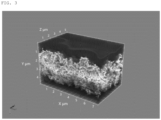
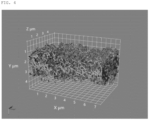
- the observed images were imported into commercially available image analysis software ("Image Pro + 3D module” (Media Cybernetics, Inc., USA), threshold condition: smart analysis, dark, automatic) to create a 3D image of 5 um ⁇ 5 um ⁇ 7 um size, and then the percentage of space occupied by functional particles in area A and area B was analyzed. More specifically, the 3D images were sliced every 400 nm in the thickness direction from the surface of the porous functional layer, and the porosity was defined as the area ratio of the void area to the total area of the sliced image. The aforementioned area ratio was calculated from the color tone (shading) of each slice image using the aforementioned image analysis software.
- the slice images were prepared by slicing to the areas where the porosity was form 0% to 100%.
- a 3D image of the porous functional layer prepared using FIB-SEM in the laminate of Example 1 is shown in Figure 3 .
- Figure 4 also shows an analytical image of the area where only the porous functional layer is present in the aforementioned 3D image.
- Water and olive oil were used to evaluate water and oil repellency.
- the water- and oil-repellent surface of each sample was used as the test surface, and water or olive oil was dripped onto the test surface to check the state of the droplets.
- the test surface was placed on a slope with an inclination of 10 degrees so that the test surface faces up, and 1 mL of water or olive oil was dripped onto the test surface.
- a droplet slid off it was marked " ⁇ "; when a small amount of droplet remained but slid off, it was marked " ⁇ "; and when no droplet slid off, it was marked " ⁇ ".
- Pure water was used as water.
- the olive oil used was commercially available product "AJINOMOTO Olive Oil” (edible olive oil) (Ajinomoto Co., Ltd.).
- a Gakushin-Type Dyeing and Rubbing fastness tester (YASUDA SEIKI SEISAKUSHO, LTD.) was used for durability evaluation. Each sample was cut to 15 mm ⁇ 150 mm, the stainless steel surface was brought into contact with the sample, and the durability test was conducted under the following conditions: load: 4.9 N, friction distance: 100 mm, speed: 30 round trips/min. When the water and oil repellency was remained after 100 round-trips, the test was judged as " ⁇ ”. When the water and oil repellency was no longer effective after 50 to 100 round-trips, the test was judged as " ⁇ ”. When the water and oil repellency was no longer effective after less than 50 round-trips, the test was judged as " ⁇ ".
- Table 1 Base film thermoplastic resin functional particle mixing ratio coating amount Porosity water and oil repellency abrasion resistance Region A Region B water oil
- Example 1 OPP modified polyolefin Hydrophobic oxide fine particles 50:B0 2.5 68 41 ⁇ ⁇ ⁇ Example 2
- Example 8 Oxide composite particle 50:50 2.5 62 41 ⁇ ⁇ ⁇
- Example 7 LDPE polyolefin B
- Example 8 Oxide composite particle 50:50 2.5 70 47 ⁇ ⁇ ⁇
- Example 9 OPP + Seal layer modified polyolefin Hydrophobic oxide fine particles 50:50 2.6
- Example 1 to Example 10 when the porosity of the outermost surface side in the porous functional layer (Region A) is between not less than 50% and not more than 99% and the porosity of the base film side (Region B) is between not less than 1% and not more than 50%, it is found that the porous functional layer is strongly bonded to the base film and the outermost surface side has voids, as a result, the super water-repellent layer and super oil-repellent layer with excellent durability can be obtained.
- Comparative Examples 1-4 it can be seen that, when the ratio of functional fine particles and thermoplastic resin is changed, sufficient performance cannot be obtained. In other words, increasing the ratio of functional fine particles results in poor adhesion between the base film and the porous functional layer, and increasing the ratio of thermoplastic resin results in non-performance of the porous functional layer.
- Comparative Examples 5-8 it is found that, when the amount of adhesion of the mixed solution after drying, the adhesion strength between the porous functional layer and the base film is sufficient, but water and oil repellency cannot be obtained. It is found that, if the amount of adhesion is too large, a uniform film cannot be formed in the drying process, thereby few voids are formed. It is found that, if the amount of adhesion is too little, the performance of the functional agent itself cannot exhibit.
Landscapes
- Chemical & Material Sciences (AREA)
- Health & Medical Sciences (AREA)
- Chemical Kinetics & Catalysis (AREA)
- Medicinal Chemistry (AREA)
- Polymers & Plastics (AREA)
- Organic Chemistry (AREA)
- Life Sciences & Earth Sciences (AREA)
- Engineering & Computer Science (AREA)
- Wood Science & Technology (AREA)
- Laminated Bodies (AREA)
Abstract
Description
- The present invention relates to layered product having water and oil repellent properties.
- Water or oil repellent technologies have been widely studied for anti-adhesion and mold release applications. In particular, for the purpose of reducing adhesion of contents to packaging materials for foods, beverages, pharmaceuticals, cosmetics or the like, products have been developed with super water repellent treatment having a contact angle with water of 150° or more, or super oil repellent treatment showing a contact angle with oil of 150° or more. In general, super water-repellent and super oil-repellent properties are realized by modification of chemical properties by coating or modification of physical properties by imparting minute irregularities.
- For example, Patent Literature 1 discloses that a thin metal film is formed on the surface of a base material, and subsequently hydrophobic microparticles are deposited on the surface by CVD method using an organic silicon compound, and then the metal film and hydrophobic microparticles or hydrophobic microparticles each other are combined by exposure to an atmosphere containing a similar organic silicon compound to form a water repellent layer with excellent durability.
- In addition, in
Patent Literature 2, a technology is proposed to form a water repellent layer with excellent durability in which hydrophobic fine particles do not easily come off by treating a water repellent layer containing hydrophobic fine particles and a binder (metal alkoxide), and to enable heat sealing by treating the water repellent layer with an adhesive layer. - According to
Patent Literatures 3 and 4, it is disclosed that a water-repellent surface with excellent durability is formed by imparting fine surface irregularities to a surface of a substrate by a nanoimprinting method (UV curing method, thermosetting method). InPatent Literature 3, the UV curing method is used, and a mold with a concave structure existing at a pitch of several hundred nm is pressed against UV curable resin, and the resin is cured by UV irradiation to form convex pillars at a pitch of several hundred nm. Patent Literature 4 suggests that a thermosetting method is used, and a mold in which a concave structure exists at a pitch of several hundred nm is pressed against thermoplastic resin and cooled after forming convex pillars. -
- [Patent Literature 1] Patent Application Publication
JP 2014-152389 - [Patent Literature 2] Patent Application Publication
JP 2017-100778 - [Patent Literature 3] Patent Application Publication
JP 2018-187767 - [Patent Literature 4] Patent Application Publication
JP 2018-95799 - However, the method of Patent Literature 1 needs a process for depositing and growing hydrophobic particles after forming a metallic thin film. Accordingly, Patent Literature 1 requires large-scale facilities while making mass production difficult.
- In the technology of
Patent Literature 2, hydrophobic fine particles are mixed with tetraethoxysilane (metal alkoxide) as a binder to form an ultra water repellant layer, but the adhesive strength between the ultra water repellant layer and a substrate is weak, and the ultra water repellant layer itself may peel off relatively easily. - In the methods of
Patent Literatures 3 and 4, a super water repellant layer is formed by the nanoimprint method, but the productivity of the nanoimprint method is low compared to surface modification by coating, and is not suitable for production on an industrial scale. - Therefore, the main object of the present invention is to provide a laminate that can be mass-produced and has a water-repellent and/or oil-repellent layer that is difficult to peel off or drop off.
- The inventor has completed the present invention after diligently studying the problems of the conventional technology and finding that the above-mentioned object can be achieved by employing a specific layer structure.
- In other words, the present invention relates to the following laminated body.
- 1. A laminated body in which a porous functional layer including a thermoplastic resin and a three-dimensional network structure comprising water-repellent and/or oil-repellent fine particles adhered to each other is formed on a base film, wherein
the porous functional layer has, in the thickness direction, a porosity from greater than or equal to 1 volume% to less than or equal to 50 volume% in the region from the bottom of the porous functional layer to 50% thickness of the porous functional layer, and a porosity from greater than or equal to 50 volume% to less than or equal to 99 volume% in the region from more than 50% thickness of the porous functional layer to the surface of the porous functional layer. - 2. The laminated body according to the above 1, wherein the voids of the three-dimensional network structure at least in the region from the bottom of the porous functional layer to 50% thickness of the porous functional layer are filled with the thermoplastic resin.
- 3. The laminated body according to the above 1 or 2, wherein a portion of the porous functional layer is embedded in the base film.
- 4. The laminated body according to any one of the above 1 to 3, wherein the average primary particle diameter of the fine particles is 5 to 50 nm.
- 5. The laminated body according to any one of the above 1 to 4, wherein the mass ratio of the fine particles to the thermoplastic resin is 50:50 to 80:20.
- 6. The laminated body according to any one of the above 1 to 5, wherein the thermoplastic resin includes a polyolefin resin.
- 7. A method for producing a laminated body having water and/or oil repellency, comprising the steps of:
- (1) applying a coating liquid containing water and/or oil repellent fine particles and a thermoplastic resin to a base film; and
- (2) heat-treating the coated film obtained in the preceding step.
- 8. The manufacturing method according to the above 7, wherein the coating liquid is a dispersion liquid in which comprising water-repellent and/or oil-repellent fine particles and thermoplastic resin particles are dispersed in a solvent.
- According to the present invention, it is possible to provide a laminate that can be mass-produced and has a water-repellent and/or oil-repellent layer that is difficult to peel off or drop off.
- In particular, the laminate of the present invention has a porous functional layer containing thermoplastic resin in which functional particles form a three-dimensional network structure, and has a non-uniform structure (preferably a gradient structure) in which the porosity of the porous functional layer is lower near the base film and higher near the surface of the porous functional layer. By employing such a structure, the adhesion between the base film and the porous functional layer is increased, and both layers form an integrated structure. As a result, the porous functional layer can effectively be suppressed or prevented from peeling or falling off from the base film. Therefore, the porous functional layer can exhibit a certain degree of durability against relatively strong frictional forces. Such a laminate can be formed, for example, by using a specific coating liquid as described below. As a result, it is possible to more efficiently provide a laminate that can effectively sustain the desired water and/or oil repellency.
-
-
Fig. 1 : A schematic diagram (image) of an example of the layer structure of the laminate of the invention. -
Fig. 2 : An image of the layer structure of the laminate produced in Example 1, as observed with a scanning electron microscope. -
Fig. 3 : A 3D image of the porous functional layer in the laminate of Example 1, created using FIB-SEM. -
Fig. 4 : An analytical image of the porous functional layer extracted inFig. 3 . - The laminated body (the laminate of the invention) is a laminated body in which a porous functional layer including a thermoplastic resin and a three-dimensional network structure comprising water-repellent and/or oil-repellent fine particles adhered to each other is formed on a base film, wherein
the porous functional layer has, in the thickness direction, a porosity from greater than or equal to 1 volume% to less than or equal to 50 volume% in the region from the bottom of the porous functional layer to 50% thickness of the porous functional layer, and a porosity from greater than or equal to 50 volume% to less than or equal to 99 volume% in the region from more than 50% thickness of the porous functional layer to the surface of the porous functional layer. -
Figure 1 is a schematic diagram showing an example of the layer structure of the laminate of the invention. As shown inFig. 1 , thelaminate 10 has a porousfunctional layer 12 formed on abase film 11. This porousfunctional layer 12 is supported by being fixed (adhered) on thebase film 11. The porousfunctional layer 12 includes a three-dimensional network structure comprising water-repellent and/or oil-repellent fine particles 13 (hereinafter referred to as "functional particles" unless otherwise specified) adhered to each other andthermoplastic resin 14. In thepresent laminate 10, thethermoplastic resin 14 may be included either in the periphery or inside of the three-dimensional network structure, but is preferably included at least in the voids of the three-dimensional network structure as shown inFigure 1 . - The porous
functional layer 12 has a porosity of 1 volume% or more and 50 volume% or less in a region from the porous functional layer bottom 12a to 50% thickness (t/2) of the porous functional layer in a direction of the thickness t (hereinafter referred to as "region B"), and a porosity of 50 volume% or more and 99 volume% or less in the region from exceeding 50% thickness of the porous functional layer to the porousfunctional layer surface 12b. In other words, the structure of the porousfunctional layer 12 is such that the density of the functional particles and thermoplastic resin is higher in region B, which is closer to the base film, and the density is lower in region A, which is closer to the porous functional layer surface. By employing this structure, the porous functional layer can be fixed to the base film with greater force, and as a result, water and oil repellency can be maintained for a longer period. - In the present invention, the thickness t of the porous functional layer can be calculated by the following formula based on the position of the
bottom surface 11a of thebase film 11, where the horizontal position of the functional particle at the lowest position of the three-dimensional network structure is thebottom surface 12a of the porous functional layer and the horizontal position of the functional particle at the highest position of the three-dimensional network structure is thesurface 12b of the porous functional layer, as shown inFigure 1 .
- Also as shown in
Fig. 1 , inlaminate 10 of the present invention, it is desirable that part of the aforementioned porous functional layer 12 (especially the three-dimensional network structure) is embedded in thebase film 11. This can enhance the adhesion of the porous functional layer to the base film. - In the following, each of the layers constituting the laminate of the invention as well as the materials, etc. constituting each layer will be described respectively.
- The base film functions as a support layer that supports the porous functional layer in the laminate of the invention. Therefore, as long as it has such a function, its material is not particularly limited, and can be made of resins (e.g., synthetic resins such as polyester, polyethylene, polypropylene, etc.), fibrous materials (e.g., paper, synthetic paper, nonwoven fabric, woven fabric, wood board, etc.), metals or alloys (e.g., metal foil such as aluminum foil, etc.), glass (glass plate) or the like. In addition to single materials, composite materials, laminated materials, etc. of these materials can be exemplified.
- In particular, at least one type of resin film selected from the group consisting of polypropylene film, polyethylene film and polyester film can be suitably used as a base film in the present invention.
- In particular, when the base material film is a resin film, the resin film may be either a stretched film or an unstretched film. Furthermore, both uniaxially oriented film or biaxially oriented film can be used for the stretched film. Various types of resin films with surface treatment such as corona treatment, for example, can also be used as the base film.
- The thickness of the base film is not limited, but can be set appropriately according to the material of the base film, the application of the present invention laminate, and other factors. Generally, however, it can be set appropriately within the range of 20 to 80 µm, but is not limited thereto.
- The surface (especially the surface on which the porous functional layer is laminated) of the base film may be treated with a surface treatment. This can further enhance the adhesion (bonding) between the base film and the porous functional layer. The aforementioned surface treatment includes, for example, unevenness treatment by additives (preferably filled particles), unevenness treatment by embossing, or the like. The height of the unevenness is not limited, but it is particularly preferred to be 5 to 60 µm, and 20 to 50 um is more preferred.
- The base film may be either a single layer or multiple layers. For example, a laminated film consisting of a heat seal layer on at least one side of a resin film can be used as the base film.
- In this case, the heat sealant used to form the heat seal layer can include ingredients used in known or commercially available adhesives such as lacquer type adhesives, easy peel adhesives, and hot melt adhesives, as well as components of sealant films known or commercially available.
- The main constituting the heat seal layer are not particularly limited to, and include, for example, low-density polyethylene, medium-density polyethylene, high-density polyethylene, linear (linear) low-density polyethylene, polypropylene, ethylene-vinyl acetate copolymer, ionomer resin, ethylene -acrylic acid copolymer, vinyl chloride-vinyl acetate-acrylic ester copolymer, ethylene-ethyl acrylate copolymer, ethylene-methacrylic acid copolymer, ethylene-propylene copolymer, acid-modified polyolefin resin in which polyolefin such as methylpentene polymer, polybutene polymer, polyethylene or polypropylene, or the like is modified with unsaturated carboxylic acid such as acrylic acid, methacrylic acid, maleic acid, maleic anhydride, fumaric acid, itaconic acid, or the like, polyvinyl acetate resins, poly(meth)acrylic resins, polyacrylonitrile resins, polyvinyl chloride resins, other thermally adhesive resins, as well as copolymers including combinations of monomers constituting these resins, modified resins of these resins, or the like can be used.
- Other components may be included in the base film as long as they do not substantially adversely affect the advantages of the present invention. For example, adhesive agents, anti-blocking agents, colorants, thickening agents, or the like may be included. In particular, an anti-blocking agent can be suitably used in the present invention. As an anti-blocking agent, there are no particular limitations, and at least one selected from the group consisting of polyethylene wax, polypropylene wax, silica, inorganic particles, synthetic resin particles, etc. can be suitably added, for example.
- The porous functional layer in the laminate of the invention is a layer having water and/or oil repellency. The porous functional layer includes a three-dimensional network structure consisting of functional particles adhered to each other and a thermoplastic resin.
- The functional particles (particle groups) form a three-dimensional network structure because individual functional particles contact and are fixed to each other. In particular, the three-dimensional network structure is porous (agglomerate) and has voids (pores) formed between the functional particles. These pores may be independent pores, continuous pores, or both independent and continuous pores.
- In the present invention, the porosity of the porous functional layer is characterized in that the porosity of region A is relatively higher than that of region B when region B is compared with region A. In other words, the functional particles and thermoplastic resin are more densely packed on the base film side of the functional layer. Such pore distribution (density distribution) together with the presence of thermoplastic resin makes the porous functional layer to be more adherent to the base film and contributes to the long-term persistence of high water and/or oil repellency due to the high porosity of the functional layer surface (existence of surface unevenness and air layer) .
- The amount of the porous functional layer can be set appropriately according to, for example, the desired water and/or oil repellency, the type of thermoplastic resin used or the like and can be set to be within the range of the amount of functional particles as shown below. For example, it can be set within the range of about 0.6 to 5 g/m2 (especially 1 to 3 g/m2), but is not limited to this.
- The degree of water and/or oil repellency of the porous functional layer is not limited, but the following properties are preferred. For water repellency, the contact angle with water can be 150 degrees or higher (so-called super water repellency). For oil repellency, the contact angle with oil can be 150 degrees or more (so-called super oil repellency).
- The thickness of the porous functional layer is not particularly limited, but can normally be in the range of 1 to 20 um, and especially 1 to 5 um is preferred. By setting the thickness within such a range, it is possible to obtain even higher water or oil repellency.
- The functional particles constituting the porous functional layer are not restricted as long as the particles have water and/or oil repellency. For example, hydrophobic oxide particles can be suitably used.
- For example, at least one type of particles (powder) selected from the group consisting of silicon oxide, titanium oxide, aluminum oxide, zinc oxide, or the like can be used as hydrophobic oxide particles. Among these, silicon oxide particles are preferred.
- The hydrophobic oxide particles preferably have an average primary particle diameter of 5 to 50 nm, more preferably 7 to 30 nm. The aforementioned measurement of the average primary particle diameter can be performed using a transmission electron microscope or a scanning electron microscope. More specifically, the average primary particle diameter can be obtained by taking pictures with a transmission electron microscope or scanning electron microscope, measuring the diameters of 200 pieces or more particles on the pictures, and calculating the arithmetic mean value.
- Nano-level oxide particles as described above can be made from known or commercially available products. For example, as silica, the product names "AEROSIL R972," "AEROSIL R972V," "AEROSIL R972CF," "AEROSIL R974," "AEROSIL RX200," "AEROSIL RY200" (manufactured by AEROSIL Japan Co.), "AEROSIL R202", "AEROSIL R805", "AEROSIL R812", "AEROSIL R812S" (manufactured by Evonik Degussa), "Silohovic 100", "Silohovic 200", "Silohovic 603" (manufactured by Fuji Silicia Chemical Co.). As titania, examples include the product name "AEROXIDE TiO2 T805" (manufactured by Evonik Degussa). Examples of alumina include AEROXIDE Alu C (Evonik Degussa) or the like treated with a silane coupling agent to make the particle surface hydrophobic.
- Among these, hydrophobic silica particles can be used suitably. In particular, hydrophobic silica particles having trimethylsilyl groups on the surface are preferred in that they provide better non-adhesive properties. Corresponding commercial products include, for example, the aforementioned AEROSIL R812 and AEROSIL R812S (both manufactured by Evonik Degussa).
- As a particle having oil-repellent properties, for example, a composite particle obtained by surface-treating an oxide fine particle as a core in order to impart hydrophobic properties to the particle can be suitably used.
- At least one type of particle (powder) selected from the group consisting of silicon oxide, titanium oxide, aluminum oxide, zinc oxide, or the like can be used as the oxide fine particle for the core. Among them, silicon oxide particles are preferred.
- Commercially available products can also be used for the oxide fine particles that serve as the core. As silicon oxide, for example, the product name "AEROSIL 200" ("AEROSIL" is a registered trademark; the same applies hereinafter), "AEROSIL 130", "AEROSIL 300", "AEROSIL 50", "AEROSIL 200 FAD", and "AEROSIL 380" (all manufactured by AEROSIL Japan Co., Ltd.) can be used. For titanium dioxide, product names such as "AEROXIDE TiO2 T805" (manufactured by Evonik Degussa) can be used. For aluminum oxide, examples include "AEROXIDE Alu C 805" (manufactured by Evonik Degussa).
- The method of producing the composite particle is not particularly limited, and the covering layer may be formed on the metal oxide particle (powder) by, for example, a known coating method or granulation method, with using a polyfluoroalkyl methacrylate resin as the coating material. More specifically, the composite particle can be favorably produced by a production method comprising a step (the coating step) of coating the metal oxide particle with a coating liquid in which a liquid polyfluoroalkyl methacrylate resin is dissolved or dispersed in a solvent.
- In the above manufacturing method, a polyfluoroalkyl methacrylate resin in liquid form at room temperature (25 °C) and under normal pressure can be advantageously used. As such polyfluoroalkyl methacrylate resins, a copolymer of polyfluorooctyl methacrylate, 2-N,N-diethylaminoethyl methacrylate, 2-hydroxyethyl methacrylate, and 2,2'-ethylenedioxydiethyl dimethacrylate, or the like can be suitably used. Commercially available products can be used.
- The solvent used for the coating liquid is not restricted, and in addition to water, organic solvents such as alcohols and toluene can be used, but water is preferred in the present invention. In other words, it is preferable to use a coating liquid in which the polyfluoroalkyl methacrylate resin is dissolved and/or dispersed in water.
- Although the content of polyfluoroalkyl methacrylate resin in the above coating liquid is not particularly limited, it is generally set at about 10 to 80% by weight, and especially 15 to 70% by weight, of which 20 to 60% by weight is more preferred.
- The method of coating the coating liquid on the surface of the oxide particles can follow any known method, for example, a spray method, soaking method, agitated granulation method, or the like can be employed. In the present invention, a spray coating method is particularly preferred because of its superiority in terms of uniformity or the like.
- After coating with the coating liquid, the composite particles can be obtained by removing the solvent by heat treatment. The heat treatment temperature is usually about 150 to 250°C, especially 180 to 200°C is preferred. Although the atmosphere for heat treatment is not limited, an inert gas (non-oxidizing) atmosphere such as nitrogen gas, argon gas or the like is desirable. Further, for example, if necessary, a series of processes consisting of the coating process and the heat treatment process can be conducted one or more times. This makes it possible to advantageously control the amount of coating or the like.
- The surface of the composite particle thus obtained contains a polyfluoroalkyl methacrylate resin. By including such a resin, a strong coating layer having relatively high adhesiveness can be formed on the surface of the oxide particles because the coating layer has excellent affinity with the oxide particles, and at the same time, higher water or oil repellency can be achieved.
- The amount of functional particles adhered (weight after drying) may be sufficient to form a three-dimensional network structure in particular, but usually 0.01 to 10 g/m2 is preferred, especially 0.2 to 1.5 g/m2 is more preferred, among them, 0.2 to 1 g/m2 is most preferred.
- In the laminate of the invention, the thermoplastic resin contained in the porous functional layer mainly functions to strengthen the adhesion (bonding) between the porous functional layer and the base film, and between the functional particles each other in the porous functional layer.
- The type of thermoplastic resin is not limited as long as it exhibits adhesiveness to the base film. For example, polyolefin resins, polyamide resins, polyester resins, urethane resins, acrylic resins, and other resins can be used.
- In particular, for example, when the base film is a polypropylene film, a polyolefin resin (especially a polypropylene resin or a modified polypropylene resin) can be suitably employed as the thermoplastic resin. For example, when the base film is polyethylene terephthalate (PET) film, an acrylic resin and a polyester resin can be suitably used as the thermoplastic resins. In this way, by selecting a thermoplastic resin having higher adhesion to the base film to be used, it is possible to further enhance the adhesion performance between the porous functional layer and the base film.
- The softening point of the thermoplastic resin to be used is not particularly limited, but may normally be in the range of 60 to 150°C.
- The content of the thermoplastic resin is not particularly limited, but when the total of the functional particles and the thermoplastic resin is 100% by mass, it is preferable to set the functional particles: the thermoplastic resin = about 50 mass%: 50 mass% to 80 mass%: 20 mass%. This makes it possible to achieve better adhesion between the base film and the porous functional layer, and at the same time, higher water or oil repellency.
- The laminate of the invention can be suitably produced by the following method, for example. That is, a method for producing a laminated body having water and/or oil repellency, comprising the steps of: (1) applying a coating liquid containing water and/or oil repellent fine particles and a thermoplastic resin to a base film (coating film forming process); and (2) heat-treating the coated film obtained in the preceding step (heat treating process) can be advantageously employed.
- In the coating film formation process, a coating liquid containing water-repellent and/or oil-repellent fine particles and a thermoplastic resin is applied to a base film.
- The coating liquid usually contains functional particles, a thermoplastic resin and a solvent. The types of functional particles and thermoplastic resin and the ratio of both are as described above. The solvent is not limited and can be selected according to the type of thermoplastic resin used or the like. For example, organic solvents such as alcohol solvents (ethanol, methanol, isopropyl alcohol (IPA), hexyl alcohol, etc.), ketone solvents (acetone, ketone, methyl ethyl ketone (MEK), etc.), hydrocarbon solvents (cyclohexane, normal pentane, normal hexanemethyl cyclohexane (MCH), etc.), aromatic solvents (toluene, etc.), glycol solvents (propylene glycol, hexylene glycol, butyldiglycol, pentamethylene glycol, etc.) can be used as appropriate.
- In the coating liquid, the thermoplastic resin and the like may be dissolved in a solvent to form a solution, but it is especially desirable that the functional particles and thermoplastic resin particles be in the form of a dispersion in which they are dispersed in a solvent. As a result, when the coating liquid is applied to the base film, the functional particles and thermoplastic resin particles are applied homogeneously, thus enhancing the adhesion between the functional particles each other as well as between the porous functional layer and the base film, while maintaining the properties of the functional particles. When the dispersion is applied to the base film, most of the functional particles and thermoplastic resin particles move downward (in the direction of gravity), so the porosity of the porous functional layer becomes lower in area B which is closer to the base film of the porous functional layer, and the porosity becomes higher in area A. In this way, a porous functional layer with a gradient structure can be effectively formed.
- The method of coating is not particularly limited, and known methods such as roll coating, various gravure coatings, bar coaters, doctor blade coatings, comma coaters, spray coatings, brush coatings or the like can be employed as appropriate.
- After coating, a drying process may be performed if necessary. The drying method is not restricted and may be either natural drying or heat drying. In the case of heat drying, the temperature is usually 60 to 100°C, especially 80 to 90°C. The heating time can be set according to the heating temperature or the like, and is usually 3 to 30 seconds, but not limited to this.
- In the heat treatment process, the coating film obtained in the coating film formation process described above is heat treated. By heat treatment, the functional particles and thermoplastic resin are bonded in the porous functional layer, and the thermoplastic resin and the base film are bonded, as a result, a laminate having excellent adhesion between the base film and the porous functional layer can be obtained. Furthermore, since a portion of the functional particles and/or thermoplastic resin can be embedded in the base film during the heat treatment process, higher adhesion can be obtained and the base film and porous functional layer can be made into an integrated structure more effectively.
- It is desirable to set the heat treatment temperature in a temperature range lower than the heat resistance temperature of the base film and not lower than the temperature at which the thermoplastic resin contained in the porous functional layer softens. Thus, for example, if the heat resistance temperature of the base film is 150°C and the softening temperature of the thermoplastic resin is 120°C, the heat treatment temperature can be set to about 120-145°C (or about 125-140°C, for example).
- The heat treatment time may be sufficient time to obtain the desired adhesion, and be 10 seconds to 10 minutes for example, but not limited to that.
- The laminate of the invention can be used for various applications requiring anti-adhesion performance, antifouling properties, water and/or oil repellency or the like. For example, it can be preferably used as a packaging material for packaging or sealing food, pharmaceuticals, cosmetics or the like. For example, various contents can be loaded into a packaging bag formed by using the laminate of the invention with its porous functional layer positioned on the inside, thereby sealed packaging products can be provided. Examples
- Examples and Comparative examples are given below to more concretely explain the features of the present invention. However, the scope of the invention is not limited to the Examples.
- A commercially available film (biaxially oriented polypropylene film (OPP)) with a thickness of 40 um was used as the base film.
- A coating liquid for forming a porous functional layer was prepared. Hydrophobic oxide particles with water repellency (product name "AEROSIL R812S", Evonik Degussa, BET specific surface area: 200 m2/g, average primary particle diameter: 7 nm) and thermoplastic resin (modified polyolefin resin, product name "Zyxene A", Sumitomo Seika Co. were added to ethanol. And then, a stirrer was used to stir the mixture at 2000 rpm for 5 minutes. The coating liquid was thus obtained. The mass ratio of hydrophobic oxide particles to thermoplastic resin in the coating liquid was 50:50, and the total solid content of hydrophobic oxide particles and thermoplastic resin in the coating liquid was 5 mass%.
- The resulting coating liquid was applied to the above film using a bar coater, and dried at 120°C for 60 seconds to form the porous functional layer. The coating amount of the porous functional layer after drying was 2.5 g/m2. A laminate with a porous functional layer formed on the surface of the base film was thus prepared.
- A laminate was prepared by the same method as in Example 1, except that surface-modified silica particles obtained by the following procedure were used instead of hydrophobic oxide particles.
- 5 g of hydrophilic silica particles (product name "AEROSIL 200", manufactured by AEROSIL Japan, BET specific surface area: 200 m2/g, average primary particle diameter: 12 nm) were placed in a reaction tank and sprayed with 500 g of a commercial surface treatment agent while stirring under a nitrogen gas atmosphere, followed by stirring at 200°C for 30 minutes, then cooling it. Thus, a powder of surface modified silica particles (oxide composite particles) was obtained. As the above surface treatment agent, a water dispersion of copolymer of polyfluorooctyl methacrylate, 2-N,N-diethylaminoethyl methacrylate, 2-hydroxyethyl methacrylate and 2,2'-ethylenedioxydiethyl dimethacrylate (solid content: 20 mass%) was used.
- A Laminate was prepared in the same manner as in Example 1, except that ethylene vinyl acetate copolymer resin (product name: "SEPORJON VA", manufactured by Sumitomo Seika Co.
- A Laminate was prepared in the same manner as in Example 2, except that ethylene vinyl acetate copolymer resin (product name: "SEPORJON VA", manufactured by Sumitomo Seika Co.
- A commercially available film (biaxially stretched polyethylene terephthalate film (PET)) with a thickness of 25 um was used as the base film. Copolymerized polyester resin (product name "SEPORJON ES", manufactured by Sumitomo Seika Co., Ltd.) (polyester) was used instead of modified polyolefin resin. Except for these conditions, the laminate was prepared by the same method as in Example 1.
- A laminate was prepared in the same manner as in Example 5, except that the surface-modified silica particles described in Example 2 were used in place of the hydrophobic oxide particles.
- A commercial film (low-density polyethylene film (LDPE)) with a thickness of 30 um was used as the base film. Polyolefin resin (product name "SEPORJON G", manufactured by Sumitomo Seika Co., Ltd.) (polyolefin B) was used instead of the modified polyolefin resin. Except for these conditions, a laminate was produced by the same manner as in Example 1.
- A laminate was prepared by the same method as in Example 7, except that the surface-modified silica particles described in Example 2 were used instead of the hydrophobic oxide particles.
- A commercially available film (biaxially stretched polypropylene film (OPP)) with a thickness of 40 um was used as the base film.
- A dispersion was prepared by mixing 10 parts by weight of high-density polyethylene particles (HDPE, average particle diameter D50: 12 um, melting point: 136°C, density: 0.94 g/cm3) to 100 parts by weight of a commercial polyolefin resin coating agent (heat-sealing coating agent). The dispersion liquid was applied to the corona-treated side of the aforementioned film by a bar coater and dried at 80°C for 10 seconds to form a heat seal layer containing the filled particles and a heat seal agent. The adhesion amount of the heat seal layer after drying was 3.0 g/m2.
- Next, a coating liquid for forming the porous functional layer was prepared. Hydrophobic oxide particles with water repellency (product name "AEROSIL R812S," Evonik Degussa; BET specific surface area: 200 m2/g; average primary particle diameter: 7 nm) and thermoplastic resin (modified polyolefin resin, product name "Zyxene A," Sumitomo Seika Co were added to ethanol, and a stirrer was used to stir the mixture at 2000 rpm for 5 minutes. The coating liquid was thus obtained. The mass ratio of hydrophobic oxide particles to thermoplastic resin in the coating liquid was 50:50, and the total solid content of hydrophobic oxide particles and thermoplastic resin in the coating liquid was 5 mass%.
- The resulting coating liquid was applied to the heat-sealing layer described above by a bar coater, and then dried at 120°C for 60 seconds to form the porous functional layer. The coating amount of the porous functional layer after drying was 2.5 g/m2.
- A laminate was prepared in the same manner as in Example 9, except that the surface-modified silica particles described in Example 2 were used in place of the hydrophobic oxide particles.
- A laminate was prepared by the same method as in Example 1, except that the mass ratio of hydrophobic oxide particles and modified polyolefin resin in the coating liquid was made to be 90:10.
- A laminate was prepared by the same method as in Example 2, except that the mass ratio of surface modified silica particles to modified polyolefin resin in the coating liquid was 90:10.
- A laminate was prepared by the same method as in Example 1, except that the mass ratio of hydrophobic oxide particles to modified polyolefin resin in the coating liquid was made to be 40:60.
- A laminate was prepared by the same method as in Example 2, except that the mass ratio of surface modified silica particles to modified polyolefin resin in the coating liquid was made to be 40:60.
- A laminate was prepared by the same method as in Example 1, except that the adhesion amount of the coating liquid after drying was 10.0 g/m2.
- A laminate was made by the same method as in Example 2, except that the adhesion amount of the coating liquid after drying was 10.0 g/m2.
- A laminate was made by the same method as in Example 1, except that the adhesion amount of the coating liquid after drying was set to 0.3 g/m2.
- A laminate was made by the same method as in Example 2, except that the adhesion amount of the coating liquid after drying was 0.3 g/m2.
- A laminate was prepared by the same manner as in Example 1, except that a polyester resin was used instead of the modified polyolefin resin.
- A laminate was prepared by the same method as in Example 2, except that a polyester resin was used instead of the modified polyolefin resin.
- A laminate was made by the same method as in Example 1, except that a vinyl chloride-vinyl acetate copolymer resin was used in place of the modified polyolefin resin.
- A laminate was prepared by the same method as in Example 2, except that a vinyl chloride-vinyl acetate copolymer resin was used in place of the modified polyolefin resin.
- A laminate was prepared by the same method as in Example 1, except that a copolymerized amide resin was used in place of the modified polyolefin resin.
- A laminate was prepared by the same method as in Example 2, except that a copolymer amide resin was used in place of the modified polyolefin resin.
- A commercially available film (biaxially oriented polypropylene film (OPP)) with a thickness of 40 um was used as the base film.
- A dispersion of oil-repellent metal oxide composite particles (product name AEROSIL 200, manufactured by AEROSIL Japan, BET specific surface area: 200 m2/g, average primary particle diameter: 12 nm) was prepared by adding it to ethanol. The solid content in the dispersion was 5 mass%.
- The above dispersion was applied to the above film using a bar coater, and dried at 120°C for 60 seconds to form the oil-repellent layer. The coating amount of the oil-repellent layer after drying was 2.5 g/m2.
- In the obtained laminate, a smooth cross-section was prepared by Ar ion beam irradiation using an ion milling device at an arbitrary point in plan view, and the formation of a porous functional layer containing a three-dimensional network structure was confirmed by observing the treated sample with a scanning electron microscope (SEM). As a representative example, the cross-sectional image of the laminate of Example 1 is shown in
Figure 2 . - In the laminate, the porous functional layer at an arbitrary location in plan view was observed using FIB-SEM (NX5000, Hitachi High-Technologies Corporation) under the following conditions: electron emission current 21900 nA, working distance 4.0 mm, magnification 15,000x, and observation was made at every 50 nm pitch in the thickness direction. A total of 100 observation images were prepared.
- The observed images were imported into commercially available image analysis software ("Image Pro + 3D module" (Media Cybernetics, Inc., USA), threshold condition: smart analysis, dark, automatic) to create a 3D image of 5 um × 5 um × 7 um size, and then the percentage of space occupied by functional particles in area A and area B was analyzed. More specifically, the 3D images were sliced every 400 nm in the thickness direction from the surface of the porous functional layer, and the porosity was defined as the area ratio of the void area to the total area of the sliced image. The aforementioned area ratio was calculated from the color tone (shading) of each slice image using the aforementioned image analysis software. The slice images were prepared by slicing to the areas where the porosity was form 0% to 100%. As an example, a 3D image of the porous functional layer prepared using FIB-SEM in the laminate of Example 1 is shown in
Figure 3 .Figure 4 also shows an analytical image of the area where only the porous functional layer is present in the aforementioned 3D image. - Water and olive oil were used to evaluate water and oil repellency. The water- and oil-repellent surface of each sample was used as the test surface, and water or olive oil was dripped onto the test surface to check the state of the droplets. Specifically, the test surface was placed on a slope with an inclination of 10 degrees so that the test surface faces up, and 1 mL of water or olive oil was dripped onto the test surface. As a result, when a droplet slid off, it was marked "○"; when a small amount of droplet remained but slid off, it was marked "△"; and when no droplet slid off, it was marked "×". The results are shown in Tables 1 to 2. Pure water was used as water. The olive oil used was commercially available product "AJINOMOTO Olive Oil" (edible olive oil) (Ajinomoto Co., Ltd.).
- A Gakushin-Type Dyeing and Rubbing fastness tester (YASUDA SEIKI SEISAKUSHO, LTD.) was used for durability evaluation. Each sample was cut to 15 mm × 150 mm, the stainless steel surface was brought into contact with the sample, and the durability test was conducted under the following conditions: load: 4.9 N, friction distance: 100 mm, speed: 30 round trips/min. When the water and oil repellency was remained after 100 round-trips, the test was judged as "○". When the water and oil repellency was no longer effective after 50 to 100 round-trips, the test was judged as "△". When the water and oil repellency was no longer effective after less than 50 round-trips, the test was judged as "×". The durability results are shown in Tables 1 through 2.
Table 1 Base film thermoplastic resin functional particle mixing ratio coating amount Porosity water and oil repellency abrasion resistance Region A Region B water oil Example 1 OPP modified polyolefin Hydrophobic oxide fine particles 50:B0 2.5 68 41 ○ × ○ Example 2 Oxide composite particle 50:50 2.5 63 38 ○ ○ ○ Example 3 polyolefin A Hydrophobic oxide fine particles 50:50 2.5 57 37 Δ × ○ Example 4 Oxide composite particle 50:50 2.5 72 43 Δ Δ ○ Example 5 PET polyester Hydrophobic oxide fine particles 50:50 2.5 59 40 ○ × ○ Example 8 Oxide composite particle 50:50 2.5 62 41 ○ ○ ○ Example 7 LDPE polyolefin B Hydrophobic oxide fine particles 50:50 2.5 88 48 ○ × Δ Example 8 Oxide composite particle 50:50 2.5 70 47 ○ ○ Δ Example 9 OPP + Seal layer modified polyolefin Hydrophobic oxide fine particles 50:50 2.6 68 41 ○ × ○ Example 10 Oxide composite particle 50:50 2.5 70 42 ○ O ○ Table 2 Base film thermoplastic resin functional particle mixing ratio coating amount Porosity water and oil repellency abrasion resistance Region A Region B water oil Comparative Example 1 OPP modified polyolefin Hydrophobic oxide fine particles 90:10 2.5 85 63 O × × Comparative Example 2 Oxide composite particle 90:10 2.6 78 68 ○ ○ × Comparative Example 3 Hydrophobic oxide fine particles 40:60 2.5 24 39 × × ○ Comparative Example 4 Oxide composite particle 40:60 2.5 38 46 × × ○ Comparative Example 5 Hydrophobic oxide fine particles 50: 50 10 43 43 × × ○ Comparative Example 6 Oxide composite particle 50:50 10 46 41 × × ○ Comparative Example 7 Hydrophobic oxide fine particles 50:50 0.3 NG NG × × × Comparative Example 8 Oxide composite particle 50:50 0.3 NG NG × × × Comparative Example 9 polyester Hydrophobic oxide fine particles 50:50 2.6 72 60 ○ × × Comparative Example 10 Oxide composite particle 50:50 2.5 69 58 ○ ○ × Comparative Example 11 Vinyl chloride-vinyl acetate copolymer Hydrophobic oxide fine particles 50:50 2.5 63 63 ○ × × Comparative Example 12 Oxide composite particle 50:50 2.5 60 59 ○ ○ × Comparative Example 13 copolymerized amide Hydrophobic oxide fine particles 50:50 2.5 70 54 ○ × × Comparative Example 14 Oxide composite particle 60:60 2.6 62 57 ○ ○ × Comparative Example 15 non Oxide composite particle 0:100 2.5 62 63 ○ ○ ×-× - As is clear from Tables 1 and 2, in Example 1 to Example 10, when the porosity of the outermost surface side in the porous functional layer (Region A) is between not less than 50% and not more than 99% and the porosity of the base film side (Region B) is between not less than 1% and not more than 50%, it is found that the porous functional layer is strongly bonded to the base film and the outermost surface side has voids, as a result, the super water-repellent layer and super oil-repellent layer with excellent durability can be obtained.
- In contrast, in Comparative Examples 1-4, it can be seen that, when the ratio of functional fine particles and thermoplastic resin is changed, sufficient performance cannot be obtained. In other words, increasing the ratio of functional fine particles results in poor adhesion between the base film and the porous functional layer, and increasing the ratio of thermoplastic resin results in non-performance of the porous functional layer.
- In Comparative Examples 5-8, it is found that, when the amount of adhesion of the mixed solution after drying, the adhesion strength between the porous functional layer and the base film is sufficient, but water and oil repellency cannot be obtained. It is found that, if the amount of adhesion is too large, a uniform film cannot be formed in the drying process, thereby few voids are formed. It is found that, if the amount of adhesion is too little, the performance of the functional agent itself cannot exhibit.
- In Comparative Examples 7-11, it can be seen that, if a thermoplastic resin with poor adhesion to the base film (OPP) is selected, the performance as a porous functional layer is obtained, but the adhesion to the base film is low.
Claims (8)
- A laminated body in which a porous functional layer including a thermoplastic resin and a three-dimensional network structure comprising water-repellent and/or oil-repellent fine particles adhered to each other is formed on a base film, wherein
the porous functional layer has, in the thickness direction, a porosity from greater than or equal to 1 volume% to less than or equal to 50 volume% in the region from the bottom of the porous functional layer to 50% thickness of the porous functional layer, and a porosity from greater than or equal to 50 volume% to less than or equal to 99 volume% in the region from more than 50% thickness of the porous functional layer to the surface of the porous functional layer. - The laminated body according to claim 1, wherein the voids of the three-dimensional network structure at least in the region from the bottom of the porous functional layer to 50% thickness of the porous functional layer are filled with the thermoplastic resin.
- The laminated body according to claim 1 or 2, wherein a portion of the porous functional layer is embedded in the base film.
- The laminated body according to any one of claims 1 to 3, wherein the average primary particle diameter of the fine particles is 5 to 50 nm.
- The laminated body according to any one of claims 1 to 4, wherein the mass ratio of the fine particles to the thermoplastic resin is 50:50 to 80:20.
- The laminated body according to any one of claims 1 to 5, wherein the thermoplastic resin includes a polyolefin resin.
- A method for producing a laminated body having water and/or oil repellency, comprising the steps of:(1) applying a coating liquid containing water and/or oil repellent fine particles and a thermoplastic resin to a base film; and(2) heat-treating the coated film obtained in the preceding step.
- The manufacturing method according to claim 7, wherein the coating liquid is a dispersion liquid in which comprising water-repellent and/or oil-repellent fine particles and thermoplastic resin particles are dispersed in a solvent.
Applications Claiming Priority (1)
| Application Number | Priority Date | Filing Date | Title |
|---|---|---|---|
| PCT/JP2021/019274 WO2022244218A1 (en) | 2021-05-20 | 2021-05-20 | Layered product |
Publications (2)
| Publication Number | Publication Date |
|---|---|
| EP4342591A1 true EP4342591A1 (en) | 2024-03-27 |
| EP4342591A4 EP4342591A4 (en) | 2025-04-02 |
Family
ID=84141179
Family Applications (1)
| Application Number | Title | Priority Date | Filing Date |
|---|---|---|---|
| EP21940832.5A Pending EP4342591A4 (en) | 2021-05-20 | 2021-05-20 | LAMINATED PRODUCT |
Country Status (4)
| Country | Link |
|---|---|
| EP (1) | EP4342591A4 (en) |
| KR (1) | KR20240032712A (en) |
| CN (1) | CN117177862A (en) |
| WO (1) | WO2022244218A1 (en) |
Family Cites Families (20)
| Publication number | Priority date | Publication date | Assignee | Title |
|---|---|---|---|---|
| DE10022246A1 (en) * | 2000-05-08 | 2001-11-15 | Basf Ag | Coating agent for the production of difficult to wet surfaces |
| JP5793936B2 (en) * | 2011-04-25 | 2015-10-14 | 凸版印刷株式会社 | Heat-sealable film and method for producing the same |
| JP5848058B2 (en) * | 2011-08-05 | 2016-01-27 | 昭和電工パッケージング株式会社 | Contents adhesion prevention lid material and manufacturing method thereof |
| JP5885471B2 (en) * | 2011-11-15 | 2016-03-15 | 昭和電工パッケージング株式会社 | Packaging material having non-adhesive surface and method for producing the same |
| US10137660B2 (en) * | 2012-12-07 | 2018-11-27 | Denka Company Limited | Water-repellent, thermoplastic resin sheet, and molded article |
| JP6142562B2 (en) | 2013-02-13 | 2017-06-07 | 国立大学法人名古屋大学 | Super water-repellent material manufacturing method and super water-repellent material |
| JP6485993B2 (en) * | 2013-02-15 | 2019-03-20 | 凸版印刷株式会社 | Lid and its manufacturing method |
| JP2015081129A (en) * | 2013-10-23 | 2015-04-27 | 凸版印刷株式会社 | Packaging material sealant having water repellency and method for producing the same |
| JP6401043B2 (en) * | 2014-12-24 | 2018-10-03 | 株式会社きもと | Auxiliary sheet for laser dicing |
| WO2016158875A1 (en) * | 2015-03-27 | 2016-10-06 | 東罐興業株式会社 | Structure having hydrophobic surface, and method for manufacturing same |
| JP2018187767A (en) | 2015-09-29 | 2018-11-29 | 綜研化学株式会社 | Water-repellent member and manufacturing method thereof |
| JP6657871B2 (en) | 2015-12-02 | 2020-03-04 | 凸版印刷株式会社 | Packaging materials and packaging containers |
| JP6368331B2 (en) * | 2016-03-04 | 2018-08-01 | 桜宮化学株式会社 | Water repellent heat seal film, water repellent heat seal structure, method for producing water repellent heat seal film, and method for producing water repellent heat seal structure |
| JP7153434B2 (en) * | 2016-10-11 | 2022-10-14 | 大和製罐株式会社 | Water-repellent paint, water-repellent laminated material, water-repellent bag-like container, and method for forming water-repellent coating film |
| JP2018086786A (en) * | 2016-11-29 | 2018-06-07 | 東洋製罐グループホールディングス株式会社 | Liquid repellent structure |
| JP2018095799A (en) | 2016-12-16 | 2018-06-21 | 三井化学株式会社 | Molding |
| JP6895747B2 (en) * | 2016-12-27 | 2021-06-30 | デンカ株式会社 | Liquid-repellent resin sheet and articles using it |
| JP7166046B2 (en) * | 2017-02-23 | 2022-11-07 | 大日本印刷株式会社 | WATER-REPELLENT LAMINATE FOR ICE CREAM PACKAGE AND ICE CREAM PACKAGE |
| JP6996897B2 (en) * | 2017-07-31 | 2022-01-17 | 東洋アルミニウム株式会社 | Laminate |
| JP2019171805A (en) * | 2018-03-29 | 2019-10-10 | 大日本印刷株式会社 | Laminate for forming water-repellent laminate film and water-repellent laminate film |
-
2021
- 2021-05-20 KR KR1020237036906A patent/KR20240032712A/en active Pending
- 2021-05-20 CN CN202180097358.9A patent/CN117177862A/en active Pending
- 2021-05-20 WO PCT/JP2021/019274 patent/WO2022244218A1/en not_active Ceased
- 2021-05-20 EP EP21940832.5A patent/EP4342591A4/en active Pending
Also Published As
| Publication number | Publication date |
|---|---|
| CN117177862A (en) | 2023-12-05 |
| WO2022244218A1 (en) | 2022-11-24 |
| EP4342591A4 (en) | 2025-04-02 |
| KR20240032712A (en) | 2024-03-12 |
Similar Documents
| Publication | Publication Date | Title |
|---|---|---|
| EP2762537B1 (en) | Water- and oil-repellent coating film and article containing same | |
| CN106164196B (en) | Bonding sheet | |
| JP6454282B2 (en) | Process sheet | |
| EP2865520B1 (en) | Electrostatically adsorptive sheet and method for producing the same | |
| EP3263477B1 (en) | Packaging material and method for manufacturing same | |
| KR20150065684A (en) | Adhesive sheet and method for manufacturing adhesive sheet | |
| JP7133929B2 (en) | Casting paper for synthetic leather and method for producing synthetic leather | |
| KR20090014400A (en) | Surface irregularities tape or sheet composed of the polymer member and the polymer member having an incompatible material ubiquitous polymer layer | |
| EP4342591A1 (en) | Layered product | |
| JP7638068B2 (en) | Laminate | |
| EP4091815A1 (en) | Laminated film | |
| JP7729729B2 (en) | Optical laminate, method for manufacturing optical laminate, optical member, optical device, method for manufacturing optical member, and method for manufacturing optical device | |
| EP3444312A1 (en) | Granular adhesive | |
| JP7308673B2 (en) | Casting paper for synthetic leather and method for producing synthetic leather | |
| JP7729730B2 (en) | Optical laminate, method for manufacturing optical laminate, optical member, optical device, method for manufacturing optical member, and method for manufacturing optical device | |
| WO2024195690A1 (en) | Laminate | |
| JP7324108B2 (en) | Coating liquid, base material with film, and method for producing the same | |
| JP7478005B2 (en) | Process Film | |
| WO2023189866A1 (en) | Laminate | |
| KR101980212B1 (en) | Method for producing film of uniform thickness using heterogeneous particle and film produced by the same | |
| TW202513309A (en) | Laminated body | |
| JP2022155375A (en) | Optical laminate, manufacturing method of optical laminate, optical member, optical device, manufacturing method of optical member and manufacturing method of optical device | |
| JP2017066193A (en) | Adhesive sheet and manufacturing method of adhesive sheet |
Legal Events
| Date | Code | Title | Description |
|---|---|---|---|
| STAA | Information on the status of an ep patent application or granted ep patent |
Free format text: STATUS: THE INTERNATIONAL PUBLICATION HAS BEEN MADE |
|
| PUAI | Public reference made under article 153(3) epc to a published international application that has entered the european phase |
Free format text: ORIGINAL CODE: 0009012 |
|
| STAA | Information on the status of an ep patent application or granted ep patent |
Free format text: STATUS: REQUEST FOR EXAMINATION WAS MADE |
|
| 17P | Request for examination filed |
Effective date: 20231218 |
|
| AK | Designated contracting states |
Kind code of ref document: A1 Designated state(s): AL AT BE BG CH CY CZ DE DK EE ES FI FR GB GR HR HU IE IS IT LI LT LU LV MC MK MT NL NO PL PT RO RS SE SI SK SM TR |
|
| DAV | Request for validation of the european patent (deleted) | ||
| DAX | Request for extension of the european patent (deleted) | ||
| A4 | Supplementary search report drawn up and despatched |
Effective date: 20250227 |
|
| RIC1 | Information provided on ipc code assigned before grant |
Ipc: B05D 5/02 20060101ALN20250221BHEP Ipc: B05D 1/26 20060101ALN20250221BHEP Ipc: B05D 7/04 20060101ALI20250221BHEP Ipc: B05D 5/08 20060101ALI20250221BHEP Ipc: C08J 7/054 20200101ALI20250221BHEP Ipc: C08J 7/043 20200101ALI20250221BHEP Ipc: C08J 7/04 20200101ALI20250221BHEP Ipc: B05D 3/02 20060101AFI20250221BHEP |