EP4340211A1 - Leistungswandler - Google Patents
Leistungswandler Download PDFInfo
- Publication number
- EP4340211A1 EP4340211A1 EP22807014.0A EP22807014A EP4340211A1 EP 4340211 A1 EP4340211 A1 EP 4340211A1 EP 22807014 A EP22807014 A EP 22807014A EP 4340211 A1 EP4340211 A1 EP 4340211A1
- Authority
- EP
- European Patent Office
- Prior art keywords
- power
- calculating
- phase error
- frequency
- value
- Prior art date
- Legal status (The legal status is an assumption and is not a legal conclusion. Google has not performed a legal analysis and makes no representation as to the accuracy of the status listed.)
- Pending
Links
Images





Classifications
-
- H—ELECTRICITY
- H02—GENERATION; CONVERSION OR DISTRIBUTION OF ELECTRIC POWER
- H02P—CONTROL OR REGULATION OF ELECTRIC MOTORS, ELECTRIC GENERATORS OR DYNAMO-ELECTRIC CONVERTERS; CONTROLLING TRANSFORMERS, REACTORS OR CHOKE COILS
- H02P21/00—Arrangements or methods for the control of electric machines by vector control, e.g. by control of field orientation
- H02P21/14—Estimation or adaptation of machine parameters, e.g. flux, current or voltage
- H02P21/18—Estimation of position or speed
-
- H—ELECTRICITY
- H02—GENERATION; CONVERSION OR DISTRIBUTION OF ELECTRIC POWER
- H02P—CONTROL OR REGULATION OF ELECTRIC MOTORS, ELECTRIC GENERATORS OR DYNAMO-ELECTRIC CONVERTERS; CONTROLLING TRANSFORMERS, REACTORS OR CHOKE COILS
- H02P21/00—Arrangements or methods for the control of electric machines by vector control, e.g. by control of field orientation
- H02P21/22—Current control, e.g. using a current control loop
-
- H—ELECTRICITY
- H02—GENERATION; CONVERSION OR DISTRIBUTION OF ELECTRIC POWER
- H02P—CONTROL OR REGULATION OF ELECTRIC MOTORS, ELECTRIC GENERATORS OR DYNAMO-ELECTRIC CONVERTERS; CONTROLLING TRANSFORMERS, REACTORS OR CHOKE COILS
- H02P21/00—Arrangements or methods for the control of electric machines by vector control, e.g. by control of field orientation
- H02P21/24—Vector control not involving the use of rotor position or rotor speed sensors
-
- H—ELECTRICITY
- H02—GENERATION; CONVERSION OR DISTRIBUTION OF ELECTRIC POWER
- H02P—CONTROL OR REGULATION OF ELECTRIC MOTORS, ELECTRIC GENERATORS OR DYNAMO-ELECTRIC CONVERTERS; CONTROLLING TRANSFORMERS, REACTORS OR CHOKE COILS
- H02P27/00—Arrangements or methods for the control of AC motors characterised by the kind of supply voltage
- H02P27/04—Arrangements or methods for the control of AC motors characterised by the kind of supply voltage using variable-frequency supply voltage, e.g. inverter or converter supply voltage
- H02P27/06—Arrangements or methods for the control of AC motors characterised by the kind of supply voltage using variable-frequency supply voltage, e.g. inverter or converter supply voltage using DC to AC converters or inverters
Definitions
- This invention relates to power conversion devices.
- Patent Documents 1 Japanese Unexamined Patent Publication No. 2006-197712
- the technology described in the literature 1 calculates two kinds of reactive power (Q and Q hat) and calculates frequency estimates of the inverter to set the deviation ⁇ Q to zero. This allows the frequency estimates to be less sensitive to temperature changes in the magnet motor winding resistance, resulting in highly accurate control characteristics.
- the first motor frequency is estimated so that the deviation ⁇ Q is zero by calculating two types of reactive power using the technology of Patent Document 1.
- the medium to high speed range for example, another technique is used to estimate the phase error (phase of control and magnet motor) using the extended induced voltage, and the second motor frequency is estimated by PI control to follow the zero.
- the purpose of this invention is to provide a power conversion device with stable and accurate control characteristics that can prevent torque shock when the motor frequency changes and does not require adjustment of electrical circuit parameters.
- Present invention is a power conversion device comprising a power converter outputting signals to the motor to vary the output frequency, output voltage and output current of the motor, a control unit controlling the power converter wherein the control unit is calculating the first power from the output voltage and the output current, calculating the second power from the output current, electrical circuit parameters and a frequency estimates, calculating the first phase error estimate in a first frequency domain so that the first power follows the second power, calculating the second phase error estimate in a second frequency domain different from the first frequency domain, controlling the frequency estimates so that the first phase error estimate or the second phase error estimate follows the command value of the phase error estimate.
- the invention can prevent torque shock when the motor frequency changes, as well as provide stable and highly accurate control characteristics without the need to adjust electrical circuit parameters.
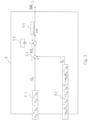
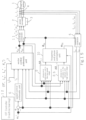
- Fig. 1 shows the system configuration with power conversion device and magnet motor in example 1.
- the power conversion device in this example achieves stable and highly accurate control characteristics even in the low-speed range, which is about 10% of the base frequency from standstill, in position sensor-less control that omits encoders and other devices that detect the magnet motor's magnet phase.
- Magnet motor 1 outputs motor torque that is a composite of the torque component due to the magnetic flux of the permanent magnet and the torque component due to the inductance of the armature winding.
- Power converter 2 is equipped with semiconductor devices as switching elements. Power converter 2 inputs 3-phase ac voltage command values v u *, v v * and v w * and outputs voltage values proportional to 3-phase ac voltage command values v u *, v v * and v w *. Based on the output of power converter 2, magnet motorl is driven and the output voltage value, output frequency value and output current of magnet motorl are controlled variably. Insulated gate bipolar transistor (IGBT) may be used as switching element.
- IGBT Insulated gate bipolar transistor
- DC power supply 3 supplies DC voltage and DC current to power converter 2.
- the current detector 4 outputs i uc , i vc and i wc , which are the detected three phases AC currents i u , i v and i w of the magnet motor 1.
- the current detector 4 also detects the three phases AC currents of two of the magnet motorl, e.g., phase u and phase w.
- the current detector 4 is shown in the power conversion device, but it can also be located outside the power conversion device.
- the control unit includes coordinate conversion unit 5, speed control arithmetic unit 6, vector control arithmetic unit 7, phase error estimation in the medium and high-speed range 8, phase error estimation unit in the low-speed range .9, frequency and phase estimation unit10, and coordinate conversion unit11.
- the control unit controls the output of power converter 2 so that the output voltage value, output frequency value and output current of magnet motorl are controlled variably.
- the control section is composed of semiconductor integrated circuits (arithmetic and control means) such as microcomputer and digital signal processor (DSP). Any or all of the control section can be implemented by hardware such as an ASIC (Application Specific Integrated Circuit) or FPGA (Field Programmable Gate Array).
- the CPU Central Processing Unit
- the control section reads a program held in a memory or other recording device and executes the processing of each part such as the coordinate conversion unit 5 described above.
- Coordinate conversion unit 5 outputs d-axis and q-axis current detection values i dc and i qc from the detected values i uc , i vc , and i wc of the three phase AC currents i u , i v , and i w and the phase estimate ⁇ dc .
- the speed control arithmetic unit 6 calculates the torque command value ⁇ * based on the frequency command value ⁇ r * and frequency estimates ⁇ dc , and outputs the q-axis current command value i q * by dividing by the torque factor.
- the frequency command value ⁇ r * is used to determine the medium to high speed range and low speed range, and frequency estimates ⁇ dc corresponds to the motor speed estimate (motor rotation speed estimate).
- Vector control arithmetic unit 7 outputs d-axis and q-axis current command values i d *, i q *, current detection values i dc , i qc , frequency estimates ⁇ dc and d-axis and q-axis voltage calculated based on the electrical circuit parameters of magnet motorl command value v dc ** and v qc ** are output.
- the phase error estimation in the medium and high-speed range 8 uses the voltage command values v dc **, v qc **, frequency estimates ⁇ dc , current detection values i dc , i qc and electrical circuit parameters of magnet motor 1 for the d c and q c axes, which are control axes.
- the estimated value ⁇ c_H of phase error ⁇ which is the deviation between the phase ⁇ dc of control in the medium and high speed range and the phase ⁇ d of the magnet motor 1 is output.
- the phase error estimation unit in the low-speed range 9 uses the voltage command values v dc **, v qc ** , frequency estimates ⁇ dc , current detection values i dc , i qc and electrical circuit parameters of magnet motor1 for the d c and q c axes, which are control axes.
- the estimated value ⁇ c_L of the phase error ⁇ which is the deviation between the phase ⁇ dc of the control and the phase ⁇ d of the magnet motorl in the low speed range, is calculated.
- the frequency and phase estimation unit 10 is based on the phase error estimates at low speeds ⁇ c_L or the estimated phase error in the medium and high speed range ⁇ c_H , frequency estimates ⁇ dc and phase estimates ⁇ dc are output.
- the coordinate conversion unit 11 outputs the voltage command values v u *, v v * and v w * for 3-phase AC from the voltage command values v dc ** and v qc ** for the d c and q c axes and the phase estimate value ⁇ dc .
- the speed control arithmetic unit 6 calculates the torque command ⁇ * and the q-axis current command i q * according to (Formula 1) using proportional control and integral control so that the frequency estimates ⁇ dc follow the frequency command value ⁇ r *.
- K sp proportional gain of speed control
- K si integral gain of speed control
- P m pole logarithm
- K e induced voltage coefficient
- L d d-axis inductance
- L q q-axis inductance
- * set value
- s Laplace operator
- the vector control arithmetic unit 7 firstly uses the electrical circuit parameters of the permanent magnet motor 1: the set value of winding resistance R*, the set value of d-axis inductance L d *, the set value of q-axis inductance L q *, the value of induced voltage coefficient K e *, the current command values i d * and i q * for the d c axes and q c axes and frequency estimates ⁇ dc to output the voltage reference values v dc * and v qc * for the d c and q c axes according to (Formula 2).
- vector control arithmetic unit 7 calculates the voltage correction values ⁇ v dc and ⁇ v qc for the d c and q c axes according to (Formula 3) using proportional and integral control so that the current detection values i dc and i qc for each component follow the current command values i d * and i q * for the d c and q c axes.
- vector control arithmetic unit 7 calculates the voltage command values v dc ** and v qc ** for the d c and q c axes according to (Formula 4).
- v dc * * v dc * + ⁇ v dc
- v qc * * v qc * + ⁇ v qc
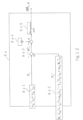
- Fig. 2 shows the block of phase error estimation in the medium and high-speed range 8.
- Phase error estimation in the medium and high-speed range 8 is based on the voltage command values v dc **, v qc ** of dc axis and qc and current detection values i dc and i qc and the electrical circuit parameters of magnet motor 1 (R* and L q *), the calculation section 81 of the phase error estimates in the medium and high-speed range using the extended induced voltage method calculates the phase error estimates ⁇ c_H in the medium and high-speed range according to (Formula 5).
- ⁇ c _ H tan ⁇ 1 v dc * * ⁇ R * i dc + ⁇ dc L q * i qc v qc * * ⁇ R * i qc ⁇ dc L q * i dc
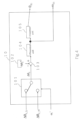
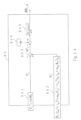
- FIG. 3 shows the blocks of the phase error estimation unit in the low-speed range 9.
- the phase error estimation unit in the low-speed ranges calculates the first reactive power Q qc ** in the first reactive power calculation unit91 using the voltage command values v dc ** of the d c axis and v of the q c axis as the output voltage of magnet motorl and the voltage command values v of the q axis as the output current of magnet motorl
- the first reactive power Q c is calculated according to (Formula 6) using the current detection values i dc of the d c axis and i qc of the q c axis as the output current of magnet motorl.
- Q c v dc * * i qc ⁇ v qc * * i dc
- the second reactive power calculation section 92 calculates the second reactive power Q c ⁇ using the current detection values i dc of the d c axis and the current detection values i qc of the q c axis, frequency estimates ⁇ dc and the electrical circuit parameters of magnet motorl (L d * , L q * and K e * ) according to (Formula 7) .
- Q c ⁇ ⁇ ⁇ dc L d * i dc 2 + L q * i qc 2 ⁇ ⁇ dc K e * i dc
- the first reactive power Q c and second reactive power Q c ⁇ are input to the subtraction section 93, and the deviation, ⁇ Q c , is calculated.
- the deviation of reactive power, ⁇ Q c is input to PI control calculation section 95 (hereinafter referred to as PI control section) to follow the command value of reactive power deviation 94 which is "0.”
- the PI control section 95 calculates the estimated-value of phase error ⁇ c_L of the phase error ⁇ in the low speed range according to (Formula 8) using P (proportional) + I (integral) control calculation.
- ⁇ c _ L K p ⁇ + K i ⁇ s 0 ⁇ ⁇ Q c
- K p ⁇ proportional gain of the phase error estimation calculation
- K i ⁇ integral gain of the phase error estimation calculation
- Fig. 4 shows the blocks of frequency and phase estimation unit 10.
- the switching section 101 receives the phase error estimates ⁇ c_L in the low-speed range, the phase error estimates ⁇ c_H in the medium- to high-speed range, and the frequency command value ⁇ r *.
- the deviation between the phase error estimate ⁇ c and ⁇ c * is input to the PI control section 104 so that the aforementioned phase error estimates ⁇ c tracks the phase error command value ⁇ c * 102.
- the PI control section 104 uses P (proportional) + I (integral) control operations to the frequency estimates ⁇ dc is calculated according to (Formula 9).
- the I control arithmetic section (I control section) 105 calculates the phase estimate ⁇ dc according to (Formula 10) based on the output of the PI control section 104.
- ⁇ dc Kp pll + Ki pll s ⁇ c * ⁇ ⁇ c
- Kp pll proportional gain of PLL control
- Ki pll integral gain of PLL control
- ⁇ dc 1 s ⁇ ⁇ dc
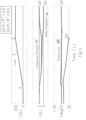
- Fig. 5 shows the control characteristics when the phase error estimation unit in the low-speed range 9 is not used ( ⁇ Q c_H is used).
- the upper row shows the load torque T L
- the middle row shows the frequency command ⁇ r * and the motor frequency ⁇ r
- the lower row shows the phase error ⁇ .
- the load torque in the form of a ramp begins to be applied at time point A in the figure and is varied to 100% at time point B. The load torque remains applied from the right after point B.
- first reactive power Q c is calculated from (Formula 6) using the voltage command values v dc **, v qc ** and current detection values i dc , i qc of the d c and q c axes.
- second reactive power Q c ⁇ is calculated from (Formula 7) using the current detection values i dc , i qc , frequency estimates ⁇ dc of the d c and q c axes and the set values of the electrical circuit parameters of magnet motorl (L d *, L q *, K e *).
- phase error estimates ⁇ c_L in the low-speed range are automatically adjusted from (Formula 8) to track the deviation between Q c ⁇ and Q c to zero, which is the result of the calculation, and the estimated value ⁇ _cL is used in the frequency and phase estimation unitl0 to reduce sensitivity to the resistance value, thereby improving control characteristics.
- the control characteristics can be improved.
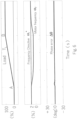
- the frequency command value ⁇ r * is accelerated from 2% to 20% of the base frequency and decelerated from 20% to 2%. At this time, the frequency command value ⁇ r * switches between the slow speed range and the estimated phase error in the medium and high speed range with a magnitude of 10%.
- the low-speed range where ⁇ r * is less than 10% of the base frequency is calculated using (Formula 8).
- the medium- to high-speed range where ⁇ r * is 10% or more of the base frequency is calculated using (Formula 5).
- the switching characteristics from the low-speed range to the medium-high-speed range or from the medium-high-speed range to the low-speed range in this example are shown in Figure 7 .
- ⁇ r * is switched between the low speed range and the estimated phase error in the medium and high speed range at a magnitude of 10% of the base frequency, but there is no problem if ⁇ r * is switched at values above zero and below 10% of the base frequency.
- phase error estimates at low speeds ⁇ c_L may also be multiplied by a taper gain G _L that varies between "1" and "0" and the estimated phase error in the medium and high speed range ⁇ c_H may be the taper gain G _H may be multiplied, respectively, and the average value of the phase error estimates may be ⁇ c .
- voltage detector 21 and current detector 22 are attached to the power conversion device 20 that drives magnet motor 1, and encoder 23 is attached to the shaft of magnet motor 1. Encoder 23 is attached to the shaft of magnet motor 1.
- phase error ⁇ _cal is calculated using (Formula 11).
- the power conversion device in position sensor-less control that omits encoder, etc. to detect magnet motor magnet phase, even in the low speed range from stop to about 10% of the base frequency, without adjustment of magnet motor electric circuit parameters and control gain to be set in the control section (controller), the power conversion device can achieve stable and highly accurate control characteristics.
- this example estimates the phase error as in the medium- and high-speed range from the deviation of two types of reactive power. With such a configuration, it is possible to estimate the motor frequency (motor rotation speed) so that the phase error estimates follow its command value in the low-speed range as well as in the medium- and high-speed range, thereby preventing torque shock.
- Fig. 9 shows the system configuration with power conversion device and magnet motor in example 2.
- the phase error estimation unit in the low-speed range 9 calculated the first reactive power Q c from the voltage command values v dc ** and v qc ** of the d c and q c axes and the current detection values i dc and i qc .
- the first reactive power calculation section 9a1 calculates first reactive power Q c as the output voltage of magnet motor 1 by using the amplitude value V 1 * of the voltage command for one phase of three-phase AC, the amplitude value i 1 of the current detection and the sine signal of the phase difference ⁇ vi between the voltage command and current detection values.
- the magnet motorl to phase error estimation in the medium and high-speed, range 8, frequency and phase estimation unit 10, and coordinate conversion unit 11 in Fig 9 are identical to those in Fig. 1 .
- the same details as in example 1 are omitted.
- Fig. 10 shows the phase error estimation unit 9a in the low-speed range in this example.
- the functional block in Fig. 10 corresponds to the phase error estimation unit in the low-speed range 9 in Fig. 2 .
- the second reactive power calculation section 9a2, subtraction section 9a3, command value of deviation of reactive power 9a4, and PI control section 9a5 in Fig. 10 are identical to the second reactive power calculation section 92, subtraction section 93, command value of deviation of reactive power 94, and PI control section 95 in Fig. 3 .
- the first reactive power calculation section 9a1 calculates the amplitude value V 1 * of the voltage command of three-phase AC from (Formula 12), the amplitude value i 1 of the current detection value from (Formula 13), and the phase ⁇ vi from (Formula 14). Then, using (Formula 15), reactive power Q c is calculated using the voltage amplitude value V 1 * of one phase of three-phase AC as the output voltage of magnet motorl, the current amplitude value i 1 and the sine signal of the phase difference between the voltage command and current detection value ⁇ vi .
- the amount of calculation can be reduced because there are fewer parameters to calculate first reactive power Q c than in example 1.
- This example which is an AC quantity, can be used to achieve the same high-precision control characteristics as in example 1.
- Fig. 11 shows a system configuration diagram with a power conversion device and magnet motor in example 3.
- the phase error estimates ⁇ c_H in the medium and high-speed range are calculated in the phase error estimation in the medium and high-speed range 8 according to (Formula 5).
- the estimation calculation section 8a of the phase error in the medium and high-speed range calculates the first active power P c from the voltage command values v dc ** and v qc ** of the d c and q c axes and the current detection values i dc and i gc .
- Fig. 12 shows the configuration of the phase error estimation calculation section 8a in the medium and high-speed range in example 3.
- Fig. 12 corresponds to phase error estimation in the medium and high-speed range8 in Fig. 1 .
- Fig. 11 is identical to those in Fig. 1 .
- Fig. 11 is the same as Fig. 1 .
- the same contents as in example 1 or example 2 are omitted.
- the second active power calculation section 8a2 calculates the second active power P c ⁇ according to (Formula 17) using the current detection values i dc , i qc , frequency estimates ⁇ dc , and electrical circuit parameters of magnet motorl (R* , L d *, L q * , K e * ) for the d c and q c axes.
- P c ⁇ R * i dc 2 + i qc 2 + ⁇ dc L d * ⁇ L q * i dc i qc + ⁇ dc K e * i qc
- the first active power P c and second active power P c ⁇ are input to the subtraction section 8a3, and the deviation ⁇ P c , is calculated.
- the difference between the deviation of the active power ⁇ P c and the command value of the deviation of the active power is input to the PI control section 8a5 so that the deviation of the active power ⁇ P c , follows "0" which is the command value of the deviation of the active power 8a4.
- the PI control section 8a5 calculates the estimated value ⁇ c_H of the phase error ⁇ in the medium to high speed range according to (Formula 18) by P(proportional)+I(integral) control.
- ⁇ c _ H K p ⁇ + K i ⁇ s 0 ⁇ ⁇ P c
- K p ⁇ proportional gain of the phase error estimation calculation
- K i ⁇ integral gain of the phase error estimation calculation
- the.estimation calculation of the phase error in the medium to high speed range can be performed without being affected by the estimation error of inductance because the set value of inductance is not used. It also has the same effect as in example 1.
- Fig. 13 shows the system configuration with power conversion device and magnet motor in example 4.
- first active power P c was calculated from the voltage command values v dc ** and v qc ** of the d c and q c axes and current detection values i dc and i qc .
- the first active power calculation unit 9b1 calculates the first active power P c using the amplitude value V 1 *of the three-phase AC voltage command and the cosine signals of the amplitude value ii and phase ⁇ vi of the current detection. The same details as in examples 1 through 3 are omitted.
- Fig. 14 shows the phase error estimation calculation section 8b in the medium and high-speed range in example 3.
- Fig. 14 corresponds to the phase error estimation in the medium and high-speed range 8 in Fig. 2 .
- magnet motor 1 to vector control arithmetic unit 7 and phase error estimation unit in the low-speed range 9 to coordinate conversion unit 11 are identical to those in Fig. 1 .
- Fig. 13 is identical to Fig. 1 .
- the second active power calculation section 8b2, subtraction section 8b3, command value of deviation of active power 8b4, and PI control section 8b5 in Fig. 14 are identical to the second active power calculation section 8a2, subtraction section 8a3, command value of deviation of active power 8a4, and PI control section 8a5 in Fig. 12 .
- the estimation calculation of the phase error in the medium to high-speed range can be performed without being affected by the estimation error of the inductance, compared to example 1.
- This example can be used to achieve the same high-precision control characteristics as in example 1.
- Fig. 15 shows a system configuration diagram with power conversion device, magnet motor, and internet of things (IOT) controller in example 5.
- IOT internet of things
- the electrical circuit parameters of magnet motor 1 are set in the controller of the power converter (e.g., microcomputer), but in this example, the control state quantities are feedback to the upper IOT controller and the machine-learned electrical circuit parameters are re-set to the power converter controller.
- the controller of the power converter e.g., microcomputer
- IOT controller 12 is an IOT controller that performs machine learning. The same details as in examples 1 through 4 are omitted.
- the voltage command values v dc **, v qc ** and current detection values i dc , i qc , phase error estimates ⁇ c are feedback to the higher-level IOT controller 12 for machine learning from current detection waveforms and other data.
- the machine-learned electric circuit parameters (R*, L d *, L q *, K e *) are re-set to the controller of power converter2, the control unit.
- the electrical circuit parameters can be re-set from the higher-level IOT controller 12 through machine learning of the operating conditions.
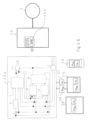
- Fig. 16 is a system configuration diagram with power conversion device, magnet motor, personal computers, tablets, smartphones, and other devices in example 6.
- This example is the application of this example to a magnet motor drive system.
- the components magnet motor 1, coordinate conversion unit 5 to coordinate conversion unit 11 are identical to those in Fig. 1 .
- the same contents as in examples 1 to 5 are omitted from the explanation.
- Magnet motor 1 a component of Fig. 16 , is driven by power conversion device 20.
- Power conversion device 20 includes coordinate conversion unit 5, speed control arithmetic unit 6, vector control arithmetic unit 7, phase error estimation in the medium and high-speed range 8, and phase error estimation unit in the low-volume range 9.
- frequency and phase estimation unit10, and coordinate conversion unit11 of Fig.1 are implemented as software 20a.
- the power converter 2, DC power supply 3, and current detector 4 of Fig. 1 are implemented as hardware in the power conversion device 20.
- the software 20a "switching frequency in the low-speed/medium-high-speed range.26 ⁇ chg " and “phase error control response in the slow range.27, ⁇ c " can be set and changed by higher-level devices such as the digital operator 20b, personal computers 28, tablets 29, smartphones 30, etc.
- the switching frequency in the low-speed/medium-high-speed range 26, ⁇ chg is input to the frequency and phase estimation unit10 shown in Fig. 4 from a higher-level device such as personal computers 28, tablets 29 and smartphones 30.
- the frequency and phase estimation unit 10 is configured to including compare part which compare the frequency command value ⁇ r * input to the frequency and phase estimation unit 10 and the switching frequency in the low-speed/medium-high -speed range 26, ⁇ chg .
- phase errorcontrol response in the slow range.27, ⁇ c is input to the phase error estimation unit in Fig. 3 from a higher-level device such as personal computers 28, tablets 29, smartphones 30, etc.
- the gains of the PI control unit 95, Kp pll (proportional gain of PLL control) and Ki pll (integral gain of PLL control) in (Formula 9), can be controlled based on the phase error control response in the slow range ⁇ c
- the ⁇ c " may be set up on a fieldbus such as a programmable logic controller, a local area network connecting to a computer, or an IOT controller.
- the configuration of the power conversion device is not limited to example 1 but may use the configurations of examples 2 through 5.
- setting values such as switching frequency in the low-speed/medium-high-speed range26 can be changed from outside the power conversion device. Also in this example, as in example 1, more stable and precise control characteristics can be achieved.
- the current detection values i dc and i qc were used for first reactive power Q c (Formula 6) and second reactive power Q c ⁇ (Formula 7), but the current command values i d * and i q * may be used.
- the current detection values i dc and i qc were used for the first active power P c (Formula 16) and second active power P c ⁇ (Formula 17), but the current command values i d * and i q * may also be used.
- examples 1 through 5 the operations shown in (Formula 4) were performed to create voltage correction values ⁇ v dc and ⁇ v qc from current command values i d *, i q * and current detection values i dc , i qc and to add these voltage correction values and the voltage reference value for vector control.
- intermediate current command values i d ** and i q ** shown in (Formula 20) used for vector control calculation are created from current command values i d * and i q * and current detection values i dc and i qc
- vector control calculation shown in (Formula 21) may be performed using frequency estimates ⁇ dc and magnet motorl electric circuit parameters.
- the voltage correction values ⁇ v d_p * for the proportional component of d c axis, ⁇ v d_i * for the integral component of d c axis, ⁇ v q_p * for the proportional component of q c axis, and ⁇ v q_i * for the integral component of q c axis are created using (Formula 22) and the estimated frequency value ⁇ dc and the electrical circuit parameters of magnet motorl may be used to perform the vector control operations shown in (Formula 23).
- the vector control operation shown in (Formula 24) may also be performed using the primary delay signal i qctd of the current command value i d * of the d c axis and the current detection value i qc of the q c axis, frequency estimates ⁇ dc and the electrical circuit parameters of magnet motor 1.
- the switching device that constitutes power converter 2 may be a Si (silicon) semiconductor device or a wide bandgap semiconductor device such as SiC (silicon carbide) or GaN (gallium nitride).
Landscapes
- Engineering & Computer Science (AREA)
- Power Engineering (AREA)
- Control Of Ac Motors In General (AREA)
- Control Of Motors That Do Not Use Commutators (AREA)
- Amplifiers (AREA)
- Polarising Elements (AREA)
- Inverter Devices (AREA)
Applications Claiming Priority (2)
| Application Number | Priority Date | Filing Date | Title |
|---|---|---|---|
| JP2021082831A JP7649196B2 (ja) | 2021-05-14 | 2021-05-14 | 電力変換装置 |
| PCT/JP2022/002487 WO2022239307A1 (ja) | 2021-05-14 | 2022-01-24 | 電力変換装置 |
Publications (2)
| Publication Number | Publication Date |
|---|---|
| EP4340211A1 true EP4340211A1 (de) | 2024-03-20 |
| EP4340211A4 EP4340211A4 (de) | 2025-04-02 |
Family
ID=84028336
Family Applications (1)
| Application Number | Title | Priority Date | Filing Date |
|---|---|---|---|
| EP22807014.0A Pending EP4340211A4 (de) | 2021-05-14 | 2022-01-24 | Leistungswandler |
Country Status (6)
| Country | Link |
|---|---|
| US (1) | US12341448B2 (de) |
| EP (1) | EP4340211A4 (de) |
| JP (1) | JP7649196B2 (de) |
| CN (1) | CN116830450A (de) |
| TW (1) | TWI796948B (de) |
| WO (1) | WO2022239307A1 (de) |
Families Citing this family (2)
| Publication number | Priority date | Publication date | Assignee | Title |
|---|---|---|---|---|
| JP2024074575A (ja) * | 2022-11-21 | 2024-05-31 | 株式会社日立産機システム | 電力変換装置 |
| JP2025078406A (ja) * | 2023-11-08 | 2025-05-20 | 株式会社日立産機システム | 電力変換装置 |
Family Cites Families (14)
| Publication number | Priority date | Publication date | Assignee | Title |
|---|---|---|---|---|
| EP1769410A1 (de) * | 2004-07-01 | 2007-04-04 | International Rectifier Corporation | Anfahrverfahren und system für einen permanentmagnet-synchronmotorantrieb |
| JP4402600B2 (ja) | 2005-01-13 | 2010-01-20 | 株式会社日立製作所 | 同期電動機の駆動システム及び同期電動機の駆動方法 |
| JP4655871B2 (ja) * | 2005-10-19 | 2011-03-23 | 株式会社日立製作所 | 永久磁石同期電動機の弱め界磁ベクトル制御装置及びモジュール |
| JP4654217B2 (ja) * | 2007-04-25 | 2011-03-16 | 日立オートモティブシステムズ株式会社 | 永久磁石モータの弱め界磁制御装置及びそれを用いた電動パワーステアリング |
| CN105591583B (zh) * | 2010-03-08 | 2019-06-28 | 江森自控科技公司 | 具有自适应磁链估计的马达控制系统和方法 |
| MX2013000965A (es) * | 2010-07-23 | 2013-04-24 | Mitsubishi Electric Corp | Aparato de control y metodo de control para maquina giratoria de ca. |
| JP5413400B2 (ja) | 2011-04-20 | 2014-02-12 | 株式会社安川電機 | 交流電動機の制御装置 |
| JP5644820B2 (ja) * | 2012-08-17 | 2014-12-24 | 株式会社安川電機 | モータ制御装置 |
| JP6767213B2 (ja) | 2016-09-05 | 2020-10-14 | 東芝インフラシステムズ株式会社 | インバータ制御装置および電動機駆動システム |
| JP7699908B2 (ja) | 2018-11-20 | 2025-06-30 | 株式会社日立産機システム | 電力変換装置 |
| TWI686047B (zh) * | 2018-12-13 | 2020-02-21 | 台達電子工業股份有限公司 | 旋轉電機控制裝置及其控制方法 |
| JP7194069B2 (ja) * | 2019-04-18 | 2022-12-21 | 株式会社日立産機システム | 監視装置、および監視方法 |
| JP7449204B2 (ja) * | 2020-09-09 | 2024-03-13 | 株式会社日立産機システム | 電力変換装置 |
| CN112332445B (zh) | 2020-09-29 | 2022-11-18 | 广西大学 | 基于指令电流补偿的lcl并网逆变器间接电流控制方法 |
-
2021
- 2021-05-14 JP JP2021082831A patent/JP7649196B2/ja active Active
-
2022
- 2022-01-24 US US18/274,509 patent/US12341448B2/en active Active
- 2022-01-24 WO PCT/JP2022/002487 patent/WO2022239307A1/ja not_active Ceased
- 2022-01-24 CN CN202280014888.7A patent/CN116830450A/zh active Pending
- 2022-01-24 EP EP22807014.0A patent/EP4340211A4/de active Pending
- 2022-02-11 TW TW111105077A patent/TWI796948B/zh active
Also Published As
| Publication number | Publication date |
|---|---|
| TW202245402A (zh) | 2022-11-16 |
| CN116830450A (zh) | 2023-09-29 |
| EP4340211A4 (de) | 2025-04-02 |
| JP2022175990A (ja) | 2022-11-25 |
| US20240097589A1 (en) | 2024-03-21 |
| US12341448B2 (en) | 2025-06-24 |
| JP7649196B2 (ja) | 2025-03-19 |
| WO2022239307A1 (ja) | 2022-11-17 |
| TWI796948B (zh) | 2023-03-21 |
Similar Documents
| Publication | Publication Date | Title |
|---|---|---|
| JP5595835B2 (ja) | 電動機の駆動装置 | |
| CN103155399B (zh) | Pm电动机的电流控制增益调整方法、电流控制方法以及控制装置 | |
| EP4340211A1 (de) | Leistungswandler | |
| CN110235355B (zh) | 感应电动机的速度推测方法和使用它的电力转换装置 | |
| WO2015056541A1 (ja) | 電動機の駆動装置 | |
| EP4213370A1 (de) | Leistungswandler | |
| JP6199776B2 (ja) | 電動機の駆動装置 | |
| EP4554081A1 (de) | Leistungswandler | |
| JP7620286B2 (ja) | 電動機の駆動装置 | |
| Dinh et al. | Improved scalar control based on slip compensation from virtual speeds in three-phase induction motor drives | |
| US12334847B2 (en) | Power converter apparatus | |
| EP4510443A1 (de) | Leistungswandler | |
| EP4625808A1 (de) | Leistungswandler | |
| JP7689941B2 (ja) | 同期電動機の磁極位置補正量算出装置及び方法並びに同期電動機の制御装置 | |
| JP5456873B1 (ja) | 同期機制御装置 | |
| JP6497584B2 (ja) | 永久磁石形同期電動機の制御装置 | |
| Sharifi et al. | Analysis of Induction Machine Drivers in Stationary Reference Frame with Time-Delay Model of Voltage Source Inverters | |
| CN120642203A (zh) | 电力转换装置 | |
| JP2025025869A (ja) | 電動機の駆動装置 | |
| WO2022137612A1 (ja) | 電力変換装置 | |
| Mangindaan | Study on Simplified Speed Sensorless Vector Control Systems for Induction Motors | |
| IONEL et al. | Control systems for high power Induction machines |
Legal Events
| Date | Code | Title | Description |
|---|---|---|---|
| STAA | Information on the status of an ep patent application or granted ep patent |
Free format text: STATUS: THE INTERNATIONAL PUBLICATION HAS BEEN MADE |
|
| PUAI | Public reference made under article 153(3) epc to a published international application that has entered the european phase |
Free format text: ORIGINAL CODE: 0009012 |
|
| STAA | Information on the status of an ep patent application or granted ep patent |
Free format text: STATUS: REQUEST FOR EXAMINATION WAS MADE |
|
| 17P | Request for examination filed |
Effective date: 20231214 |
|
| AK | Designated contracting states |
Kind code of ref document: A1 Designated state(s): AL AT BE BG CH CY CZ DE DK EE ES FI FR GB GR HR HU IE IS IT LI LT LU LV MC MK MT NL NO PL PT RO RS SE SI SK SM TR |
|
| RIN1 | Information on inventor provided before grant (corrected) |
Inventor name: TAGUCHI, YOSHIYUKI Inventor name: IWASE, YUTA Inventor name: TOBARI, KAZUAKI |
|
| DAV | Request for validation of the european patent (deleted) | ||
| DAX | Request for extension of the european patent (deleted) | ||
| A4 | Supplementary search report drawn up and despatched |
Effective date: 20250303 |
|
| RIC1 | Information provided on ipc code assigned before grant |
Ipc: H02P 21/22 20160101ALI20250225BHEP Ipc: H02P 27/06 20060101ALI20250225BHEP Ipc: H02P 21/24 20160101ALI20250225BHEP Ipc: H02P 6/18 20160101ALI20250225BHEP Ipc: H02P 21/18 20160101AFI20250225BHEP |
|
| GRAP | Despatch of communication of intention to grant a patent |
Free format text: ORIGINAL CODE: EPIDOSNIGR1 |
|
| STAA | Information on the status of an ep patent application or granted ep patent |
Free format text: STATUS: GRANT OF PATENT IS INTENDED |
|
| INTG | Intention to grant announced |
Effective date: 20251110 |