EP4337484B1 - Akkuträger für ein elektrofahrzeug und elektrofahrzeug mit einem akkuträger und - Google Patents
Akkuträger für ein elektrofahrzeug und elektrofahrzeug mit einem akkuträger und Download PDFInfo
- Publication number
- EP4337484B1 EP4337484B1 EP22706584.4A EP22706584A EP4337484B1 EP 4337484 B1 EP4337484 B1 EP 4337484B1 EP 22706584 A EP22706584 A EP 22706584A EP 4337484 B1 EP4337484 B1 EP 4337484B1
- Authority
- EP
- European Patent Office
- Prior art keywords
- battery holder
- base plate
- opposing
- electric vehicle
- shaped
- Prior art date
- Legal status (The legal status is an assumption and is not a legal conclusion. Google has not performed a legal analysis and makes no representation as to the accuracy of the status listed.)
- Active
Links
Images


Classifications
-
- B—PERFORMING OPERATIONS; TRANSPORTING
- B60—VEHICLES IN GENERAL
- B60K—ARRANGEMENT OR MOUNTING OF PROPULSION UNITS OR OF TRANSMISSIONS IN VEHICLES; ARRANGEMENT OR MOUNTING OF PLURAL DIVERSE PRIME-MOVERS IN VEHICLES; AUXILIARY DRIVES FOR VEHICLES; INSTRUMENTATION OR DASHBOARDS FOR VEHICLES; ARRANGEMENTS IN CONNECTION WITH COOLING, AIR INTAKE, GAS EXHAUST OR FUEL SUPPLY OF PROPULSION UNITS IN VEHICLES
- B60K1/00—Arrangement or mounting of electrical propulsion units
- B60K1/04—Arrangement or mounting of electrical propulsion units of the electric storage means for propulsion
-
- B—PERFORMING OPERATIONS; TRANSPORTING
- B60—VEHICLES IN GENERAL
- B60K—ARRANGEMENT OR MOUNTING OF PROPULSION UNITS OR OF TRANSMISSIONS IN VEHICLES; ARRANGEMENT OR MOUNTING OF PLURAL DIVERSE PRIME-MOVERS IN VEHICLES; AUXILIARY DRIVES FOR VEHICLES; INSTRUMENTATION OR DASHBOARDS FOR VEHICLES; ARRANGEMENTS IN CONNECTION WITH COOLING, AIR INTAKE, GAS EXHAUST OR FUEL SUPPLY OF PROPULSION UNITS IN VEHICLES
- B60K17/00—Arrangement or mounting of transmissions in vehicles
- B60K17/22—Arrangement or mounting of transmissions in vehicles characterised by arrangement, location, or type of main drive shafting, e.g. cardan shaft
- B60K17/24—Arrangement of mountings for shafting
-
- H—ELECTRICITY
- H01—ELECTRIC ELEMENTS
- H01M—PROCESSES OR MEANS, e.g. BATTERIES, FOR THE DIRECT CONVERSION OF CHEMICAL ENERGY INTO ELECTRICAL ENERGY
- H01M50/00—Constructional details or processes of manufacture of the non-active parts of electrochemical cells other than fuel cells, e.g. hybrid cells
- H01M50/20—Mountings; Secondary casings or frames; Racks, modules or packs; Suspension devices; Shock absorbers; Transport or carrying devices; Holders
- H01M50/249—Mountings; Secondary casings or frames; Racks, modules or packs; Suspension devices; Shock absorbers; Transport or carrying devices; Holders specially adapted for aircraft or vehicles, e.g. cars or trains
-
- B—PERFORMING OPERATIONS; TRANSPORTING
- B60—VEHICLES IN GENERAL
- B60K—ARRANGEMENT OR MOUNTING OF PROPULSION UNITS OR OF TRANSMISSIONS IN VEHICLES; ARRANGEMENT OR MOUNTING OF PLURAL DIVERSE PRIME-MOVERS IN VEHICLES; AUXILIARY DRIVES FOR VEHICLES; INSTRUMENTATION OR DASHBOARDS FOR VEHICLES; ARRANGEMENTS IN CONNECTION WITH COOLING, AIR INTAKE, GAS EXHAUST OR FUEL SUPPLY OF PROPULSION UNITS IN VEHICLES
- B60K17/00—Arrangement or mounting of transmissions in vehicles
- B60K17/22—Arrangement or mounting of transmissions in vehicles characterised by arrangement, location, or type of main drive shafting, e.g. cardan shaft
-
- B—PERFORMING OPERATIONS; TRANSPORTING
- B60—VEHICLES IN GENERAL
- B60K—ARRANGEMENT OR MOUNTING OF PROPULSION UNITS OR OF TRANSMISSIONS IN VEHICLES; ARRANGEMENT OR MOUNTING OF PLURAL DIVERSE PRIME-MOVERS IN VEHICLES; AUXILIARY DRIVES FOR VEHICLES; INSTRUMENTATION OR DASHBOARDS FOR VEHICLES; ARRANGEMENTS IN CONNECTION WITH COOLING, AIR INTAKE, GAS EXHAUST OR FUEL SUPPLY OF PROPULSION UNITS IN VEHICLES
- B60K1/00—Arrangement or mounting of electrical propulsion units
- B60K1/04—Arrangement or mounting of electrical propulsion units of the electric storage means for propulsion
- B60K2001/0405—Arrangement or mounting of electrical propulsion units of the electric storage means for propulsion characterised by their position
- B60K2001/0438—Arrangement under the floor
-
- B—PERFORMING OPERATIONS; TRANSPORTING
- B60—VEHICLES IN GENERAL
- B60Y—INDEXING SCHEME RELATING TO ASPECTS CROSS-CUTTING VEHICLE TECHNOLOGY
- B60Y2200/00—Type of vehicle
- B60Y2200/40—Special vehicles
- B60Y2200/41—Construction vehicles, e.g. graders, excavators
-
- B—PERFORMING OPERATIONS; TRANSPORTING
- B62—LAND VEHICLES FOR TRAVELLING OTHERWISE THAN ON RAILS
- B62D—MOTOR VEHICLES; TRAILERS
- B62D21/00—Understructures, i.e. chassis frame on which a vehicle body may be mounted
- B62D21/02—Understructures, i.e. chassis frame on which a vehicle body may be mounted comprising longitudinally or transversely arranged frame members
- B62D21/03—Understructures, i.e. chassis frame on which a vehicle body may be mounted comprising longitudinally or transversely arranged frame members transverse members providing body support
-
- H—ELECTRICITY
- H01—ELECTRIC ELEMENTS
- H01M—PROCESSES OR MEANS, e.g. BATTERIES, FOR THE DIRECT CONVERSION OF CHEMICAL ENERGY INTO ELECTRICAL ENERGY
- H01M2220/00—Batteries for particular applications
- H01M2220/20—Batteries in motive systems, e.g. vehicle, ship, plane
-
- H—ELECTRICITY
- H01—ELECTRIC ELEMENTS
- H01M—PROCESSES OR MEANS, e.g. BATTERIES, FOR THE DIRECT CONVERSION OF CHEMICAL ENERGY INTO ELECTRICAL ENERGY
- H01M50/00—Constructional details or processes of manufacture of the non-active parts of electrochemical cells other than fuel cells, e.g. hybrid cells
- H01M50/20—Mountings; Secondary casings or frames; Racks, modules or packs; Suspension devices; Shock absorbers; Transport or carrying devices; Holders
- H01M50/204—Racks, modules or packs for multiple batteries or multiple cells
- H01M50/207—Racks, modules or packs for multiple batteries or multiple cells characterised by their shape
- H01M50/209—Racks, modules or packs for multiple batteries or multiple cells characterised by their shape adapted for prismatic or rectangular cells
-
- H—ELECTRICITY
- H01—ELECTRIC ELEMENTS
- H01M—PROCESSES OR MEANS, e.g. BATTERIES, FOR THE DIRECT CONVERSION OF CHEMICAL ENERGY INTO ELECTRICAL ENERGY
- H01M50/00—Constructional details or processes of manufacture of the non-active parts of electrochemical cells other than fuel cells, e.g. hybrid cells
- H01M50/20—Mountings; Secondary casings or frames; Racks, modules or packs; Suspension devices; Shock absorbers; Transport or carrying devices; Holders
- H01M50/289—Mountings; Secondary casings or frames; Racks, modules or packs; Suspension devices; Shock absorbers; Transport or carrying devices; Holders characterised by spacing elements or positioning means within frames, racks or packs
- H01M50/291—Mountings; Secondary casings or frames; Racks, modules or packs; Suspension devices; Shock absorbers; Transport or carrying devices; Holders characterised by spacing elements or positioning means within frames, racks or packs characterised by their shape
Definitions
- a fundamental problem that must be solved in the design of electric vehicles is the arrangement and mounting of the electrical energy storage devices, i.e., the batteries, on the vehicle. This applies particularly to vehicles that are subsequently converted into electric vehicles. It should be noted at this point that the term "electric vehicle,” as used in this description, also includes hybrid vehicles and therefore does not apply only to purely electrically powered vehicles.
- the object of the invention is therefore to provide a retrofittable battery carrier which is particularly improved with regard to the use of the installation space and which is particularly suitable for commercial vehicles with an inclined drive shaft, as well as to provide an electric vehicle equipped with such a battery carrier.
- This object is achieved by a battery carrier having the features of patent claim 1 and an electric vehicle having the features of patent claim 9.
- Advantageous developments of the invention are the subject of the dependent claims.
- the battery carrier according to the invention is particularly suitable for retrofitting a vehicle to an electric vehicle. It has both a U-shaped base plate, which faces the road when the battery carrier is installed as intended, and a U-shaped cover, preferably also designed as a plate.
- the U-shaped cover is arranged opposite the base plate and preferably parallel to it.
- the base plate and cover plate can in principle be composed of several parts, but are preferably each designed as a single piece.
- the base plate and cover are preferably oriented relative to one another such that the open side of the U faces in the same direction.
- the connecting section does not necessarily have to be curved, as is usually the case with the printed letter "U,” but can also be straight, as is typical of typical U-profiles, for example.
- both the total lengths of the base plate and the lid and the total widths of the base plate and the lid are preferably identical.
- the battery carrier also features wall sections that connect the U-shaped base plate and the U-shaped lid, creating a U-shaped battery carrier interior with legs and a connecting section.
- the wall sections are preferably perpendicular to both the base plate and the lid. Overall, this creates a battery carrier box in whose interior the batteries and associated electronics and sensors can be safely arranged. With appropriate design, this box can stabilize the entire vehicle and improve safety for vehicle occupants in the event of an accident.
- a special feature of this battery carrier or battery carrier box is that, due to the U-shape of the base plate and lid, it has a slot on one side, which conveniently faces the driven axle when the battery carrier is installed, in which a section of an inclined drive shaft can run freely, even when the vehicle is compressed or extended.
- the base plate of the battery carrier according to the invention provides a barrier between the battery carrier and the road surface, which minimizes air resistance on the underbody caused by the airstream while driving and stabilizes the handling. Furthermore, the base plate protects the battery modules and parts of the drive shaft from damage from below.
- the battery carrier is designed in such a way that it does not excessively increase the axle load on the rear wheels and continues to a high load can be applied to the rear axle. This effect can be further enhanced by a clever selection of materials, as described below.
- the opposing, spaced-apart legs of the base plate are shorter than the opposing, spaced-apart legs of the lid, so that a stabilizing section of the U-shaped base plate is present between the legs of the U-shaped battery carrier interior, which does not form a boundary surface of the U-shaped battery carrier interior. Accordingly, with the same length of the base plate and lid, the length of the connecting section of the base plate is greater than that of the connecting section of the lid.
- These different U-shapes of base plate and lid are preferably created by introducing a gap of different length between the two legs of a U into two initially identically shaped plates, which are then made into the base plate and lid, whereby the gap starts from the same edge area of both plates.
- This stabilizing section protects the section of the drive shaft running above it and also improves the support of the two legs of the battery carrier against each other, which improves crash behavior in the event of a lateral force acting on the tips of the legs of the battery carrier.
- At least one cross brace is arranged, which of course only extends as far upwards, i.e., toward the vehicle floor, without impeding the free running of the drive shaft. If more than one cross brace is arranged on the stabilizing section between opposing wall sections, and the height of adjacent cross braces increases toward the connecting section of the battery carrier's interior, the strength of the cross braces can be further optimized by taking into account the resulting slanted course of the drive shaft.
- the battery carrier represents a dimensionally stable and compact unit that optimally utilizes the limited installation space provided by the free space below the vehicle and around the drive shaft and can accommodate a maximum number of battery modules and, if necessary, control and monitoring electronics.
- a particularly advantageous material from which the battery carrier is at least partially made is aluminum foam.
- at least the base plate of the battery carrier, and ideally the entire battery carrier, should be made of this mechanically highly resilient and lightweight material.
- This material is also rust-proof, non-flammable, and meets the fire protection standard DIN EN 45545-2, achieving fire resistance classes E30, DIN EN 13501-2, and DIN EN 1363-1. It can be welded without the generation of toxic gases, allowing any damage to be easily repaired. It also provides good electromagnetic shielding, which is beneficial for passing EMC tests by the TÜV (German Technical Inspection Association), and effectively reduces vibrations.
- the lid, base plate, and wall sections are connected and sealed to each other so that the interior of the battery carrier is watertight.
- this can be achieved, for example, by welding or gluing the wall sections to the lid and base plate, preferably fitting them into grooves provided in the lid or base plate.
- the battery carrier has mounting points for mounting on the side of the frame, on the front axle frame, on a leaf spring mount and/or in the middle of the frame of a vehicle, the battery carrier can also be retrofitted or installed very easily and inexpensively.
- An electric vehicle has a vehicle frame, a motor arranged at one end of the electric vehicle, a driven axle arranged at the end of the electric vehicle opposite the motor, and a drive shaft driven by the motor to transmit the drive power to the driven axle.
- end of the vehicle is used here in the sense that, in a conventional motor vehicle with a front engine, the engine is arranged at the front end, whereas, in a conventional motor vehicle with a rear engine, the engine is arranged at the rear end. Therefore, the word “end” should not be understood as an end point or boundary, but rather as an end region.
- the drive shaft runs diagonally from top to bottom from the motor to the driven axle, i.e., from the motor, diagonally toward the roadway.
- the electric vehicle also has an electric drive that can be powered by batteries arranged in a battery carrier. It is essential to the invention that the battery carrier is a battery carrier according to the invention and that the drive shaft traverses the area between the legs of the battery carrier interior at least in sections.
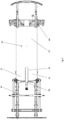
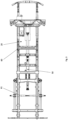
- the one in the Figures 1 to 4 shown battery carrier 1, as can be seen particularly well in the view of the Figure 2 sees a U-shaped base plate 10, which in particular has two opposite legs 11, 12 spaced apart from one another by a slot 14 and a connecting section 13 which connects the two opposite, spaced apart legs 11, 12 to one another at their end facing the motor.
- the base plate 10 which is preferably made of aluminum foam, is constructed in one piece and forms a smooth surface on the side facing the roadway during normal use, which has a positive effect on air resistance.
- the end of a drive shaft 50 facing the driven axle 61 protrudes through the slot 14.
- the connection between the drive shaft 50 and the driven axle 61 is established, for example, via a differential gear (not shown here).
- the battery carrier 1 still has a Figure 1 clearly visible U-shaped cover 20, which has two opposing legs 21, 22 spaced apart by a slot 24, and a connecting section 23 that connects the two opposing, spaced-apart legs 21, 22 at their ends facing the motor.
- the cover 20 is made up of several parts.
- the U-shaped base plate 10 and the U-shaped lid 20 are connected to one another on all sides by wall sections 30 extending from the edges of the U-shaped lid 20 essentially perpendicular to the base plate, so that the battery carrier 1 is formed by a (battery) box that is closed on all sides, which is U-shaped and has a U-shaped battery carrier interior with legs and a connecting section.
- This interior is accordingly available for accommodating the batteries or battery modules not shown in the figures, as well as optionally also their control and monitoring electronics.
- the floor area and shape of the interior are essentially determined by the shape of the lid 20, so that the legs of the U-shaped battery carrier interior form the areas in which the legs 21, 22 of the lid form the ceiling of the U-shaped battery carrier interior and the connecting section of the U-shaped battery carrier interior is the area in which the connecting section 23 forms the ceiling of the U-shaped battery carrier interior.
- the basic geometric shape of base plate 10 and cover 20 is essentially identical, which applies in particular to the respective overall length and overall width.
- the essential difference between these shapes arises from the fact that the slots 14 and 24 are the same width and originate from the same edge sections, but the slot 14 in the base plate 10 is shorter than the slot 24 in the cover 20.
- This also results in the opposing, spaced-apart legs 11, 12 of the base plate 10 being shorter than the opposing, spaced-apart legs 21, 22 of the cover 20, so that between the legs of the U-shaped battery carrier interior there is a stabilizing section 15 of the U-shaped base plate 10 which does not form a boundary surface or wall of the U-shaped battery carrier interior.
- this stabilizing section 15 protects the drive shaft 50 from damage from below; on the other hand, it also supports the legs of the battery carrier against each other, thereby stiffening the latter.
- the latter effect is further enhanced by the fact that cross braces 16a, 16b, 16c, 16d are arranged on the stabilizing section 15 between opposing wall sections of the facing inner sides of the legs, with the height of adjacent cross braces 16a, 16b, 16c, 16d increasing toward the connecting section of the battery carrier interior.
- the cross struts 16a, 16b each have a recess on their side facing away from the ground to ensure that the drive shaft 50 can rotate freely at all times.
- the battery carrier 1 has a plurality of mounting points 62 for mounting laterally on the frame 60, in particular on one on the front axle frame, on a leaf spring mount and/or centrally on the frame 60 of the electric vehicle.
Landscapes
- Engineering & Computer Science (AREA)
- Chemical & Material Sciences (AREA)
- Combustion & Propulsion (AREA)
- Transportation (AREA)
- Mechanical Engineering (AREA)
- Chemical Kinetics & Catalysis (AREA)
- Electrochemistry (AREA)
- General Chemical & Material Sciences (AREA)
- Aviation & Aerospace Engineering (AREA)
- Arrangement Or Mounting Of Propulsion Units For Vehicles (AREA)
- Battery Mounting, Suspending (AREA)
- Secondary Cells (AREA)
- Inorganic Chemistry (AREA)
Description
- Ein grundlegendes Problem, das bei der Konstruktion von Elektrofahrzeugen zu lösen ist, ist die Anordnung und Halterung der Speicher für die elektrische Energie, also der Akkus, am Fahrzeug. Dies gilt in besonderem Maße für Fahrzeuge, die erst nachträglich durch eine Umrüstung in ein Elektrofahrzeug umgewandelt werden sollen. Angemerkt sei an dieser Stelle, dass der Begriff "Elektrofahrzeug", in dem Sinne, wie er in dieser Beschreibung verwendet wird, auch Hybridfahrzeuge einschließt, also nicht nur auf rein elektrisch angetriebene Fahrzeuge angewendet wird.
- Eine solche Umrüstung ist insbesondere bei Nutzfahrzeugen, beispielsweise Transportern, oft erwägenswert. Dafür sind zwei Gründe verantwortlich: Erstens sind Nutzfahrzeuge regelmäßig ohnehin für deutlich höhere Zuladungen ausgelegt als konventionelle PKW. Die Gewichtszunahme durch die Hinzufügung der Antriebskomponenten für den elektrischen Fahrbetrieb ist daher leichter zu verkraften als bei Fahrzeugen, deren zulässiges Gesamtgewicht auch ohne zusätzliche Komponenten für einen Elektroantrieb bereits das Leergewicht des Fahrzeugs nur noch um wenige hundert kg überschreitet. Zweitens bietet sich für die Akkus, die typischerweise relativ schwere Fahrzeugkomponenten darstellen, an, sie unterhalb des Fahrzeugs anzuordnen, um den Fahrzeugschwerpunkt niedrig zu halten. Nutzfahrzeuge, insbesondere Transporter haben aber oft eine größere Bodenfreiheit als PKWs.
- Bei der Konstruktion von Elektrofahrzeugen und der Umwandlung eines Fahrzeugs zu einem Elektrofahrzeug oder dessen Nachrüstung zu einem Hybridfahrzeug kommt es regelmäßig zu Konkurrenz mit anderen Fahrzeugkomponenten um den verfügbaren Bauraum. Dies gilt in besonderem Maße für Elektrofahrzeuge, bei denen ein Motor an einem Fahrzeugende angeordnet ist, beispielsweise im Frontbereich, aber zum Antrieb einer Achse am anderen Fahrzeugende, beispielsweise der Hinterachse, verwendet wird, so dass eine Antriebswelle zur Kraftübertragung auf die Hinterachse verwendet wird. Der Verlauf der Antriebswelle ist dabei im Wesentlichen vorgegeben und kann nur in geringen Grenzen angepasst werden.
- Aus der
DE 10 2012 220 074 A1 ist es bekannt, eine Batterieeinheit mit einem Akku unter der Bodenplatte eines Elektrofahrzeugs anzuordnen, die eine Vertiefung zur Aufnahme der Kardanwelle aufweist. Dieses Arrangement ist aber für schräg verlaufende Kardanwellen, wie sie für Nutzfahrzeuge typisch sind, ungeeignet. - Aus der
DE 10 2014 219 224 A1 ist es bekannt, zwei Batterieeinheiten mit Akkus auf gegenüberliegenden Seiten der Antriebswelle anzuordnen und mit einer Verbindungseinheit miteinander zu verbinden. Dabei wird aber wertvoller Bauraum verschenkt. - Weitere Strukturen zur Anordnung von Akku-Zellen bei Hybrid- und/oder Elektrofahrzeugen werden z.B. in
DE 10 2018 206 253 A1 ,DE 10 2019 204 787 A1 ,DE 10 2018 202 191 A1 ,DE 10 2015 100 244 A1 ,DE 10 2018 100 555 A1 ,DE 10 2013 208 682 A1 ,DE 10 2017 101 110 A1 undDE 10 2018 131 824 A1 offenbart.US 2012/312 612 A1 offenbart den Oberbegriffs des Anspruchs 1. - Die Aufgabe der Erfindung besteht daher darin, einen insbesondere hinsichtlich der Ausnutzung des Bauraums verbesserten, nachrüstbaren Akkuträger, der insbesondere auch für Nutzfahrzeuge mit schräg verlaufender Antriebswelle geeignet ist, sowie ein mit einem solchen Akkuträger ausgestattetes Elektrofahrzeug bereitzustellen. Diese Aufgabe wird gelöst durch einen Akkuträger mit den Merkmalen des Patentanspruchs 1 und ein Elektrofahrzeug mit den Merkmalen des Patentanspruchs 9. Vorteilhafte Weiterbildungen der Erfindung sind Gegenstand der abhängigen Ansprüche.
- Der erfindungsgemäße Akkuträger ist insbesondere für die Nachrüstung eines Fahrzeugs zu einem Elektrofahrzeug geeignet. Er weist sowohl eine U-förmige Bodenplatte, die bei bestimmungsgemäßer Installation des Akkuträgers der Straße zugewandt ist, als auch einen U-förmigen, bevorzugt ebenfalls als Platte ausgestalteten Deckel. Der U-förmige Deckel ist gegenüber der Bodenplatte und bevorzugt parallel zu dieser angeordnet. Bodenplatte und Deckelplatte können grundsätzlich aus mehreren Teilen zusammengesetzt sein, sind aber bevorzugt jeweils einstückig ausgeführt. Bodenplatte und Deckel sind ferner vorzugsweise derart zueinander orientiert angeordnet, dass die offene Seite des U in dieselbe Richtung zeigt.
- Wie sich aus der U-Form dieser Komponenten ergibt, weisen sie jeweils zwei sich gegenüberliegende, voneinander beabstandete Schenkel und einen Verbindungsabschnitt, der die beiden sich gegenüberliegenden, voneinander beabstandeten Schenkel an einem Ende miteinander verbindet, auf. Dabei muss der Verbindungsabschnitt nicht zwingend eine Krümmung aufweisen, wie es der Druckbuchstabe "U" meist tut, sondern er kann auch gerade ausgeführt sein, wie man es beispielsweise von typischen U-Profilen kennt.
- Insbesondere sind vorzugsweise sowohl die Gesamtlängen der Bodenplatte und des Deckels als auch die Gesamtbreiten der Bodenplatte und des Deckels identisch.
- Noch weiter weist der Akkuträger Wandabschnitte auf, die die U-förmige Bodenplatte und den U-förmigen Deckel miteinander verbinden, so dass ein U-förmiger Akkuträgerinnenraum mit Schenkeln und einem Verbindungsabschnitt entsteht. Die Wandabschnitte stehen dabei bevorzugt senkrecht sowohl auf der Bodenplatte als auch auf dem Deckel. Insgesamt entsteht dadurch eine Akkuträgerkiste, in deren Innenraum die Akkus sowie zugehörige Elektronik und Sensorik geschützt angeordnet werden können und die bei geeigneter Auslegung eine Stabilisierung des gesamten Fahrzeugs und Verbesserung der Sicherheit für Insassen des Fahrzeugs bei Unfällen bewirken kann.
- Eine Besonderheit dieses Akkuträgers bzw. dieser Akkuträgerkiste ist, dass sie wegen der U-Form von Bodenplatte und Deckel an einer Seite, die zweckmäßigerweise bei installiertem Akkuträger der angetriebenen Achse zugewandt ist, einen Schlitz aufweist, in dem ein Abschnitt einer schräg verlaufenden Antriebswelle frei verlaufen kann, und dies auch beim Ein- bzw. Ausfedern des Fahrzeugs.
- Insbesondere wird bei dem erfindungsgemäßen Akkuträger durch die Bodenplatte ein Abschluss des Akkuträgers in Richtung auf die Fahrbahn hin erzielt, der bei der Fahrt den Luftwiderstand auf den Unterboden durch den Fahrtwind minimiert und das Fahrverhalten stabilisiert. Zudem schützt die Bodenplatte die Module des Akkus und Teile der Antriebswelle gegen Beschädigung von unten.
- Zudem ist der Akkuträger schon durch seine Formgebung, die seinen Schwerpunkt nach vorne, also bei installiertem Akkuträger in Richtung Motor verlagert, so ausgelegt, dass er die Achslast auf die Hinterräder nicht übermäßig erhöht und weiterhin eine hohe Zuladung auf die Hinterachse erfolgen kann. Dieser Effekt kann vorzugsweise durch eine weiter unten beschriebene geschickte Materialauswahl noch weiter verstärkt werden.
- Gemäß der Erfindung ist vorgesehen, dass die sich gegenüberliegenden, voneinander beabstandeten Schenkel der Bodenplatte kürzer sind als die sich gegenüberliegenden, voneinander beabstandeten Schenkel des Deckels, so dass zwischen den Schenkeln des U-förmigen Akkuträgerinnenraums ein Stabilisierungsabschnitt der U-förmigen Bodenplatte vorhanden ist, der keine Grenzfläche des U-förmigen Akkuträgerinnenraums bildet. Dementsprechend ist bei gleicher Länge von Bodenplatte und Deckel die Länge des Verbindungsabschnitts der Bodenplatte größer als die des Verbindungsabschnitts des Deckels.
- Diese unterschiedlichen U-Formen von Bodenplatte und Deckel entstehen bevorzugt dadurch, dass in zwei zunächst identisch geformte Platten, die zu Bodenplatte und Deckel gemacht werden, jeweils ein hinsichtlich seiner Länge unterschiedlicher Spalt, der zwischen den beiden Schenkeln eines U vorhanden ist, eingebracht wird, wobei der Spalt jeweils von demselben Randbereich beider Platten ausgeht.
- Dieser Stabilisierungsabschnitt schützt den über ihm verlaufenden Abschnitt der Antriebswelle, und verbessert zudem die Abstützung der beiden Schenkel des Akkuträgers gegeneinander, was das Crashverhalten bei einer seitlichen Krafteinwirkung im Bereich der Spitzen der Schenkel des Akkuträgers verbessert.
- Weiter verstärkt wird dieser Effekt dadurch, mindestens eine Querverstrebung angeordnet ist, die sich natürlich nur so weit nach oben, also in Richtung auf den Fahrzeugboden hin, erstrecken darf, dass der freie Lauf der Antriebswelle nicht beeinträchtigt wird. Wenn dabei auf dem Stabilisierungsabschnitt zwischen einander gegenüberliegenden Wandabschnitten mehr als eine Querverstrebung angeordnet ist und die Höhe benachbarter Querverstrebungen in Richtung auf den Verbindungsabschnitt des Akkuträgerinnenraums hin zunimmt, kann durch resultierenden Berücksichtigung des schrägen Verlaufs der Antriebswelle folgend die Stärke der Querverstrebungen weiter optimiert werden.
- Dadurch, dass mindestens eine Querverstrebung an ihrer vom Boden weg zeigenden Seite eine Ausnehmung aufweist, kann sichergestellt werden, dass trotz der Querverstrebungen der Lauf der Antriebswelle nicht beeinträchtigt wird.
- Als Konsequenz aus der gewählten geometrischen Konfiguration ist somit sichergestellt, dass der Akkuträger eine formstabile und kompakte, den durch den Freiraum unterhalb des Fahrzeugs und um die Antriebswelle herum vorgegebenen beschränkten Bauraum optimal ausnutzende Einheit darstellt und eine maximale Anzahl von Batteriemodulen und gegebenenfalls Steuer- und Überwachungselektronik aufnehmen kann.
- Ein besonders vorteilhaftes Material, aus dem der Akkuträger zumindest teilweise gefertigt ist, ist Aluminiumschaum. Insbesondere sollte vorzugsweise zumindest die Bodenplatte des Ackuträgers und idealerweise der gesamte Akkuträger aus diesem mechanisch hoch belastbaren und leichten Material gefertigt werden. Dieses Material ist zudem rostfrei, nicht brennbar und erfüllt die Brandschutznorm DIN EN 45545-2, wobei die Feuerwiderstandsklassen E30, DIN EN 13501-2 bzw. DIN EN 1363-1 erreicht werden. Es kann ohne Entstehung toxischer Gase geschweißt werden, so dass etwaige Beschädigungen leicht repariert werden können. Zudem bietet es eine gute elektromagnetische Abschirmung, was sich vorteilhaft beim Bestehen von EMV-Prüfungen durch den TÜV auswirkt, und reduziert effektiv Schwingungen.
- Vorzugsweise sind Deckel, Bodenplatte und Wandabschnitte so miteinander verbunden und abgedichtet, dass der Akkuträgerinnenraum wasserdicht ist. Konkret kann diese beispielsweise dadurch erreicht werden, dass die Wandabschnitte mit Deckel und Bodenplatte verschweißt oder verklebt sind, wobei sie vorzugsweise zusätzlich in in den Deckel bzw. in die Bodenplatte eingebrachte Nuten eingepasst sind.
- Wenn der Akkuträger Montagepunkte zur Montage seitlich am Rahmen, am Vorderachsrahmen, an einer Blattfederaufnahme und/oder mittig am Rahmen eines Fahrzeugs aufweist, kann der Akkuträger zudem sehr einfach und kostengünstig nachgerüstet bzw. installiert werden.
- Ein erfindungsgemäßes Elektrofahrzeug hat einen Fahrzeugrahmen, einen an einem Ende des Elektrofahrzeugs angeordneten Motor, eine an dem dem Motor gegenüberliegenden Ende des Elektrofahrzeugs angeordnete angetriebenen Achse und eine Antriebswelle, die vom Motor angetrieben wird, um die Antriebskraft auf die angetriebene Achse zu übertragen. Anzumerken ist dabei, dass der Begriff "Ende des Fahrzeugs" hier in dem Sinne verwendet wird, dass bei einem üblichen Kraftfahrzeug mit einem Frontmotor der Motor an dessen vorderen Ende angeordnet ist, während bei einem üblichen Kraftfahrzeug mit einem Heckmotor der Motor an dessen hinterem Ende angeordnet ist. Insofern ist das Wort "Ende" hier nicht als ein Endpunkt oder eine Grenze, sondern als ein Endbereich zu verstehen.
- Dabei verläuft die Antriebswelle vom Motor zur angetriebenen Achse schräg von oben nach unten, also ausgehend vom Motor schräg auf die Fahrbahn zu. Das Elektrofahrzeug weist ferner einen Elektroantrieb, der über in einem Akkuträger angeordnete Akkus mit Strom versorgt werden kann, auf. Erfindungswesentlich ist, dass der Akkuträger ein erfindungsgemäßer Akkuträger ist und dass die Antriebswelle den Bereich zwischen den Schenkeln des Akkuträgerinnenraums zumindest abschnittsweise durchquert.
- Die Erfindung wird nachfolgend anhand von Figuren, die ein Ausführungsbeispiel zeigen, näher erläutert. Es zeigt:
- Fig.1:
- Ein Ausführungsbeispiel eines Akkuträgers,
- Fig.2:
- einen Blick von unten auf den Rahmen eines Elektrofahrzeugs mit daran befestigtem Akkuträger gemäß Figur 1,
- Fig.3:
- einen Blick von oben auf den Rahmen eines Elektrofahrzeugs mit daran befestigtem Akkuträger gemäß Figur 1, und
- Fig.4:
- eine Seitenansicht des Rahmens eines Elektrofahrzeugs mit daran befestigtem Akkuträger gemäß
Figur 1 . - Der in den
Figuren 1 bis 4 dargestellte Akkuträger 1 hat, wie man besonders gut in der Ansicht derFigur 2 sieht, eine U-förmigen Bodenplatte 10, die insbesondere zwei sich gegenüberliegende, durch einen Schlitz 14 voneinander beabstandete Schenkel 11,12 und einen Verbindungsabschnitt 13, der die beiden sich gegenüberliegenden, voneinander beabstandeten Schenkel 11,12 an ihrem dem Motor zugewandten Ende miteinander verbindet. Wie man ebenfalls in der Darstellung derFigur 2 gut erkennt, ist die Bodenplatte 10, die vorzugsweise aus Aluminiumschaum gefertigt ist, einstückig ausgeführt und bildet auf der bei bestimmungsgemäßem Gebrauch der Fahrbahn zugewandten Seite eine glatte Ebene, was den Luftwiderstand positiv beeinflusst. Durch den Schlitz 14 ragt das der angetriebenen Achse 61 zugewandte Ende einer Antriebswelle 50. Die Verbindung zwischen Antriebswelle 50 und angetriebener Achse 61 erfolgt beispielsweise über ein hier nicht dargestelltes Differentialgetriebe. - Der Akkuträger 1 hat weiterhin einen in
Figur 1 gut erkennbaren U-förmigen Deckel 20, der zwei sich gegenüberliegende, durch einen Schlitz 24 voneinander beabstandete Schenkel 21,22 und einen Verbindungsabschnitt 23, der die beiden sich gegenüberliegenden, voneinander beabstandeten Schenkel 21,22 ihrem dem Motor zugewandten Ende miteinander verbindet. Im hier gezeigten Beispiel ist der Deckel 20 mehrteilig. - Wie die
Figuren 1 und4 besonders gut zeigen, sind die U-förmige Bodenplatte 10 und der U-förmige Deckel 20 allseitig durch sich von den Rändern des U-förmigen Deckels 20 im Wesentlichen senkrecht zur Bodenplatte verlaufende Wandabschnitte 30 miteinander verbunden, so der Akkuträger 1 durch eine nach allen Seiten in abgeschlossene (Akku-) Kiste gebildet wird, die U-förmig ist und einen U-förmigen Akkuträgerinnenraum mit Schenkeln und einem Verbindungsabschnitt aufweist. Dieser Innenraum steht dementsprechend für die Aufnahmen der in den Figuren nicht dargestellten Akkus bzw. Batteriemodule sowie optional auch deren Steuer- und Überwachungselektronik zur Verfügung. Grundfläche und Form des Innenraums sind im Wesentlichen durch die Form des Deckels 20 vorgegeben, so dass die Schenkel des U-förmigen Akkuträgerinnenraums die Bereiche sind, in denen die Schenkel 21,22 des Deckels die Decke des U-förmigen Akkuträgerinnenraums bilden und der Verbindungsabschnitt des U-förmigen Akkuträgerinnenraums der Bereich ist, in dem der Verbindungsabschnitt 23 die Decke des U-förmigen Akkuträgerinnenraums bildet. - Wie man in
Figur 1 gut erkennt, ist in diesem Ausführungsbeispiel die geometrische Grundform von Bodenplatte 10 und Deckel 20 im Wesentlichen identisch, was insbesondere für die jeweilige Gesamtlänge und Gesamtbreite gilt. Der wesentliche Unterschied zwischen diesen Formen kommt dadurch zustande, dass die Schlitze 14 und 24 zwar gleich breit sind und von gleichen Randabschnitten ausgehen, aber der Schlitz 14 in der Bodenplatte 10 kürzer ist als der Schlitz 24 im Deckel 20. Daraus resultiert dann auch, dass die sich gegenüberliegenden, voneinander beabstandeten Schenkel 11,12 der Bodenplatte 10 kürzer sind als die sich gegenüberliegenden, voneinander beabstandeten Schenkel 21,22 des Deckels 20, so das zwischen den Schenkeln des U-förmigen Akkuträgerinnenraums ein Stabilisierungsabschnitt 15 der U-förmigen Bodenplatte 10 vorhanden ist, der keine Grenzfläche oder Wand des U-förmigen Akkuträgerinnenraums bildet. - Einerseits wird durch diesen Stabilisierungsabschnitt 15 die Antriebswelle 50 gegen Beschädigung von unten geschützt, andererseits stützt er auch die Schenkel des Akkuträgers gegeneinander ab und versteift diesen dadurch. Der letztgenannte Effekt wird noch dadurch verstärkt, dass auf dem Stabilisierungsabschnitt 15 zwischen einander gegenüberliegenden Wandabschnitten der einander zugewandten Schenkelinnenseiten Querverstrebungen 16a,16b,16c,16 angeordnet sind, wobei die Höhe benachbarter Querverstrebungen 16a,16b,16c,16d in Richtung auf den Verbindungsabschnitt des Akkuträgerinnenraums hin zunimmt.
- Dabei weisen die Querverstrebungen 16a,16b an ihrer vom Boden weg zeigenden Seite jeweils eine Ausnehmung auf, um sicherzustellen, dass die Antriebswelle 50 jederzeit frei drehen kann.
- In
Figur 1 erkennt man ferner, dass der Akkuträger 1 eine Vielzahl von Montagepunkten 62 zur Montage seitlich am Rahmen 60, insbesondere an einem am Vorderachsrahmen, an einer Blattfederaufnahme und/oder mittig am Rahmen 60 des Elektrofahrzeugs aufweist. -
- 1
- Akkuträger
- 10
- Bodenplatte
- 11,12
- Schenkel
- 13
- Verbindungsabschnitt
- 14
- Schlitz
- 15
- Stabilisierungsabschnitt
- 16a,16b,16c,16d
- Querverstrebung
- 20
- Deckel
- 21,22
- Schenkel
- 23
- Verbindungsabschnitt
- 24
- Schlitz
- 30
- Wandabschnitt
- 50
- Antriebswelle
- 60
- Rahmen
- 61
- angetriebene Achse
- 62
- Montagepunkt
Claims (8)
- Akkuträger (1) für die Nachrüstung eines Fahrzeugs zu einem Elektrofahrzeug, wobei der Akkuträger (1)- eine U-förmige Bodenplatte (10), die zwei sich gegenüberliegende, voneinander beabstandete Schenkel (11,12) und einen Verbindungsabschnitt (13), der die beiden sich gegenüberliegenden, voneinander beabstandeten Schenkel (11,12) an einem Ende miteinander verbindet, aufweist,- einen U-förmigen Deckel (20), der zwei sich gegenüberliegende, voneinander beabstandete Schenkel (21,22) und einen Verbindungsabschnitt (23), der die beiden sich gegenüberliegenden, voneinander beabstandeten Schenkel (21,22) an einem Ende miteinander verbindet, aufweist, und- Wandabschnitte (30) aufweist, die die U-förmige Bodenplatte (10) und den U-förmigen Deckel (20) miteinander verbinden, so dass ein U-förmiger Akkuträgerinnenraum mit Schenkeln und einem Verbindungsabschnitt entsteht,dadurch gekennzeichnet, dass die sich gegenüberliegenden, voneinander beabstandeten Schenkel (11,12) der Bodenplatte (10) kürzer sind als die sich gegenüberliegenden, voneinander beabstandeten Schenkel (22,23) des Deckels (20, so dass zwischen den Schenkeln des U-förmigen Akkuträgerinnenraums ein Stabilisierungsabschnitt (15) der U-förmigen Bodenplatte (10) vorhanden ist, der keine Grenzfläche des U-förmigen Akkuträgerinnenraums bildet.
- Akkuträger (1) nach Anspruch 1,
dadurch gekennzeichnet, dass auf dem Stabilisierungsabschnitt (15) zwischen einander gegenüberliegenden Wandabschnitten (30) mindestens eine Querverstrebung (16a,16b,16c,16d) angeordnet ist. - Akkuträger (1) nach Anspruch 2,
dadurch gekennzeichnet, dass auf dem Stabilisierungsabschnitt (15) zwischen einander gegenüberliegenden Wandabschnitten (30) mehr als eine Querverstrebung (16a,16b,16c,16d) angeordnet ist und dass die Höhe benachbarter Querverstrebungen (16a,16b,16c,16d) in Richtung auf den Verbindungsabschnitt (15) der Bodenplatte (10) hin zunimmt. - Akkuträger (1) nach einem der Ansprüche 2 oder 3,
dadurch gekennzeichnet, dass mindestens eine Querverstrebung (16a,16b) an ihrer vom Boden weg zeigenden Seite eine Ausnehmung aufweist. - Akkuträger (1) nach einem der vorstehende Ansprüche,
dadurch gekennzeichnet, dass der Ackuträger (1) zumindest teilweise aus Aluminiumschaum gefertigt ist. - Akkuträger (1) nach einem der vorstehenden Ansprüche,
dadurch gekennzeichnet, dass der Ackuträgerinnenraum wasserdicht ist. - Akkuträger (1) nach einem der vorstehenden Ansprüche,
dadurch gekennzeichnet, dass der Ackuträger (1) Montagepunkte (62) zur Montage seitlich am Rahmen (60), am Vorderachsrahmen, an einer Blattfederaufnahme und/oder mittig am Rahmen (60) eines Fahrzeugs aufweist. - Elektrofahrzeug mit einem Rahmen (60), mit einem an einem Ende des Elektrofahrzeugs angeordneten Motor, mit einer an dem dem Motor gegenüberliegenden Ende des Elektrofahrzeugs angeordneten angetriebenen Achse (61) und mit einer Antriebswelle (50), die, wenn sie vom Motor angetrieben wird, Antriebskraft auf die angetriebene Achse (61) übertragen kann, wobei die Antriebswelle (50) vom Motor zur angetriebenen Achse (61) schräg von oben nach unten verläuft, wobei das Elektrofahrzeug ferner einen Elektroantrieb, der über in einem Akkuträger (1) angeordnete Akkus mit Strom versorgt werden kann, aufweist,
dadurch gekennzeichnet, dass der Ackuträger (1) ein Akkuträger (1) nach einem der Ansprüche 1 bis 7 ist und dass die Antriebswelle (50) den Bereich zwischen den Schenkeln des Akkuträgerinnenraums zumindest abschnittsweise durchquert.
Applications Claiming Priority (2)
| Application Number | Priority Date | Filing Date | Title |
|---|---|---|---|
| DE102021112253.8A DE102021112253B3 (de) | 2021-05-11 | 2021-05-11 | Akkuträger für ein Elektrofahrzeug und Elektrofahrzeug mit einem Akkuträger |
| PCT/EP2022/053870 WO2022238026A1 (de) | 2021-05-11 | 2022-02-17 | Akkuträger für ein elektrofahrzeug und elektrofahrzeug mit einem akkuträger und |
Publications (2)
| Publication Number | Publication Date |
|---|---|
| EP4337484A1 EP4337484A1 (de) | 2024-03-20 |
| EP4337484B1 true EP4337484B1 (de) | 2025-05-14 |
Family
ID=80624052
Family Applications (1)
| Application Number | Title | Priority Date | Filing Date |
|---|---|---|---|
| EP22706584.4A Active EP4337484B1 (de) | 2021-05-11 | 2022-02-17 | Akkuträger für ein elektrofahrzeug und elektrofahrzeug mit einem akkuträger und |
Country Status (6)
| Country | Link |
|---|---|
| US (1) | US20240270059A1 (de) |
| EP (1) | EP4337484B1 (de) |
| JP (1) | JP7822403B2 (de) |
| CN (1) | CN117241958A (de) |
| DE (1) | DE102021112253B3 (de) |
| WO (1) | WO2022238026A1 (de) |
Family Cites Families (20)
| Publication number | Priority date | Publication date | Assignee | Title |
|---|---|---|---|---|
| US1309164A (en) | 1919-07-08 | Motor vehicle | ||
| US1678033A (en) * | 1924-02-23 | 1928-07-24 | Autocar Company | Storage-battery container |
| DE102010024320B4 (de) | 2010-06-18 | 2020-11-26 | Audi Ag | Vorrichtung zum Halten einer Batterie in einer Fahrzeugkarosserie |
| US9108497B2 (en) | 2011-06-13 | 2015-08-18 | Albert W. Harrison, III | Structural enclosure for packaging power electronics for vehicle battery modules and methods of servicing and manufacturing vehicles using same |
| JP5483293B2 (ja) | 2011-11-29 | 2014-05-07 | 富士重工業株式会社 | ハイブリッド自動車の車体構造 |
| DE102013208682A1 (de) * | 2013-05-13 | 2014-11-13 | Bayerische Motoren Werke Aktiengesellschaft | Vorrichtung zur Halterung zumindest eines Energiemoduls für ein Kraftfahrzeug sowie entsprechendes Montageverfahren |
| KR101793852B1 (ko) * | 2013-10-03 | 2017-11-03 | 닛산 지도우샤 가부시키가이샤 | 배터리 온도 조절 장치 |
| US9139074B2 (en) | 2014-01-16 | 2015-09-22 | Ford Global Technologies, Llc | Methods and devices for positioning a traction battery on a hybrid or electric vehicle |
| DE102014010491B4 (de) | 2014-07-15 | 2019-04-25 | Audi Ag | Kraftfahrzeug und Aufnahmevorrichtung zur Aufnahme von elektrischen Energiespeicherzellen |
| DE102014219224B4 (de) | 2014-09-24 | 2025-10-02 | Bayerische Motoren Werke Aktiengesellschaft | Montage und produktionsoptimierter Hybridantrieb |
| US9673433B1 (en) * | 2016-01-26 | 2017-06-06 | Ford Global Technologies, Llc | Deformable battery pack enclosure |
| DE102016203740B4 (de) | 2016-03-08 | 2025-08-07 | Bayerische Motoren Werke Aktiengesellschaft | Hybridkraftfahrzeug mit einem Antriebsbatteriegehäuse |
| US10749156B2 (en) * | 2016-08-01 | 2020-08-18 | Nio Usa, Inc. | Battery module structural integration |
| DE102018100555A1 (de) | 2018-01-11 | 2019-07-11 | Dr. Ing. H.C. F. Porsche Aktiengesellschaft | Bodenbaugruppe eines Kraftfahrzeugs |
| DE102018202191A1 (de) | 2018-02-13 | 2019-08-14 | Bayerische Motoren Werke Aktiengesellschaft | Kraftfahrzeug mit mehreren Batteriemodulen |
| DE102018206253A1 (de) | 2018-04-24 | 2019-10-24 | Audi Ag | Batterieanordnung für ein Kraftfahrzeug und Kraftfahrzeug |
| DE102018131824B4 (de) * | 2018-12-11 | 2020-12-31 | Kirchhoff Automotive Deutschland Gmbh | Batteriegehäuse sowie Hybridfahrzeug mit einem solchen Batteriegehäuse |
| DE102019204787B4 (de) | 2019-04-04 | 2024-04-18 | Audi Ag | Elektrisch angetriebenes Fahrzeug |
| JP7327246B2 (ja) | 2020-03-31 | 2023-08-16 | マツダ株式会社 | 車両の下部構造 |
| US11926207B2 (en) * | 2020-10-09 | 2024-03-12 | Hexagon Purus North America Holdings Inc. | Battery and auxiliary components for vehicle trailer |
-
2021
- 2021-05-11 DE DE102021112253.8A patent/DE102021112253B3/de active Active
-
2022
- 2022-02-17 US US18/290,250 patent/US20240270059A1/en active Pending
- 2022-02-17 CN CN202280032515.2A patent/CN117241958A/zh active Pending
- 2022-02-17 JP JP2023569840A patent/JP7822403B2/ja active Active
- 2022-02-17 WO PCT/EP2022/053870 patent/WO2022238026A1/de not_active Ceased
- 2022-02-17 EP EP22706584.4A patent/EP4337484B1/de active Active
Also Published As
| Publication number | Publication date |
|---|---|
| EP4337484A1 (de) | 2024-03-20 |
| JP2024518502A (ja) | 2024-05-01 |
| WO2022238026A1 (de) | 2022-11-17 |
| US20240270059A1 (en) | 2024-08-15 |
| CN117241958A (zh) | 2023-12-15 |
| DE102021112253B3 (de) | 2022-07-21 |
| JP7822403B2 (ja) | 2026-03-02 |
Similar Documents
| Publication | Publication Date | Title |
|---|---|---|
| EP3617039B1 (de) | Vorrichtung zum tragen mindestens einer batterie für ein kraftfahrzeug | |
| DE102018115436B4 (de) | Fahrzeugkörperfrontabschnittaufbau | |
| EP3588609B1 (de) | Batteriegehäuse sowie kraftfahrzeug mit einem solchen batteriegehäuse | |
| DE102016203209B4 (de) | Zumindest teilweise elektrisch betreibbares Kraftfahrzeug | |
| DE69408068T2 (de) | Fahrzeugrahmen, insbesondere für Kraftfahrzeuge | |
| DE102017118515B3 (de) | Fahrzeuglängsträgeranordnung | |
| DE102017104360A1 (de) | Batteriegehäuse | |
| DE102016004577B4 (de) | Tragrahmenstruktur zum Befestigen wenigstens eines Energiespeichers an einem Kraftfahrzeugrohbau | |
| DE102016212297B4 (de) | Kraftfahrzeug | |
| DE4326270A1 (de) | Kraftfahrzeug mit einer steifen Bodenstruktur | |
| DE102013106141A1 (de) | Lagerrahmen für ein elektrisch angetriebenes Kraftfahrzeug | |
| DE102018206118A1 (de) | Kraftfahrzeugkarosserieanordnung mit einer Speicherzellenbaueinheit | |
| DE2845548A1 (de) | Fahrzeug, insbesondere pkw | |
| DE102016010353A1 (de) | Schutzeinrichtung für eine Personenkraftwagenkarosserie | |
| DE102013218811B4 (de) | Anordnung zur Lagerung mindestens eines, in einer Aufnahmevorrichtung angeordneten Antriebsenergiespeichers in einem Kraftfahrzeug | |
| DE2151827C3 (de) | Vorrichtung an Kraftfahrzeugen zum Absorbieren von kinetischer Energie bei einem Fahrzeugaufprall | |
| DE102021004896A1 (de) | Seitenschweller für eine Kraftwagenkarosserie sowie Baukastensystem | |
| WO2018041471A1 (de) | Achsträger | |
| DE102011001861A1 (de) | Tragstruktur für ein Kraftfahrzeug | |
| DE102016005264B4 (de) | Rohbau eines Kraftfahrzeugs | |
| DE112006000425T5 (de) | Struktur eines Fahrzeugendabschnitts | |
| DE102016203210A1 (de) | Zumindest teilweise elektrisch betreibbares Kraftfahrzeug | |
| DE102020001726A1 (de) | Schutzeinrichtung für eine Personenkraftwagenkarosserie | |
| EP4337484B1 (de) | Akkuträger für ein elektrofahrzeug und elektrofahrzeug mit einem akkuträger und | |
| DE102018130070A1 (de) | Elektrisch oder teilelektrisch antreibbares Fahrzeug |
Legal Events
| Date | Code | Title | Description |
|---|---|---|---|
| STAA | Information on the status of an ep patent application or granted ep patent |
Free format text: STATUS: UNKNOWN |
|
| STAA | Information on the status of an ep patent application or granted ep patent |
Free format text: STATUS: THE INTERNATIONAL PUBLICATION HAS BEEN MADE |
|
| PUAI | Public reference made under article 153(3) epc to a published international application that has entered the european phase |
Free format text: ORIGINAL CODE: 0009012 |
|
| STAA | Information on the status of an ep patent application or granted ep patent |
Free format text: STATUS: REQUEST FOR EXAMINATION WAS MADE |
|
| 17P | Request for examination filed |
Effective date: 20231017 |
|
| AK | Designated contracting states |
Kind code of ref document: A1 Designated state(s): AL AT BE BG CH CY CZ DE DK EE ES FI FR GB GR HR HU IE IS IT LI LT LU LV MC MK MT NL NO PL PT RO RS SE SI SK SM TR |
|
| DAV | Request for validation of the european patent (deleted) | ||
| DAX | Request for extension of the european patent (deleted) | ||
| GRAP | Despatch of communication of intention to grant a patent |
Free format text: ORIGINAL CODE: EPIDOSNIGR1 |
|
| STAA | Information on the status of an ep patent application or granted ep patent |
Free format text: STATUS: GRANT OF PATENT IS INTENDED |
|
| INTG | Intention to grant announced |
Effective date: 20250103 |
|
| GRAS | Grant fee paid |
Free format text: ORIGINAL CODE: EPIDOSNIGR3 |
|
| GRAA | (expected) grant |
Free format text: ORIGINAL CODE: 0009210 |
|
| STAA | Information on the status of an ep patent application or granted ep patent |
Free format text: STATUS: THE PATENT HAS BEEN GRANTED |
|
| AK | Designated contracting states |
Kind code of ref document: B1 Designated state(s): AL AT BE BG CH CY CZ DE DK EE ES FI FR GB GR HR HU IE IS IT LI LT LU LV MC MK MT NL NO PL PT RO RS SE SI SK SM TR |
|
| REG | Reference to a national code |
Ref country code: GB Ref legal event code: FG4D Free format text: NOT ENGLISH |
|
| REG | Reference to a national code |
Ref country code: CH Ref legal event code: EP |
|
| REG | Reference to a national code |
Ref country code: IE Ref legal event code: FG4D Free format text: LANGUAGE OF EP DOCUMENT: GERMAN |
|
| REG | Reference to a national code |
Ref country code: DE Ref legal event code: R096 Ref document number: 502022003947 Country of ref document: DE |
|
| P01 | Opt-out of the competence of the unified patent court (upc) registered |
Free format text: CASE NUMBER: APP_27154/2025 Effective date: 20250606 |
|
| REG | Reference to a national code |
Ref country code: NL Ref legal event code: MP Effective date: 20250514 |
|
| PG25 | Lapsed in a contracting state [announced via postgrant information from national office to epo] |
Ref country code: PT Free format text: LAPSE BECAUSE OF FAILURE TO SUBMIT A TRANSLATION OF THE DESCRIPTION OR TO PAY THE FEE WITHIN THE PRESCRIBED TIME-LIMIT Effective date: 20250915 Ref country code: ES Free format text: LAPSE BECAUSE OF FAILURE TO SUBMIT A TRANSLATION OF THE DESCRIPTION OR TO PAY THE FEE WITHIN THE PRESCRIBED TIME-LIMIT Effective date: 20250514 Ref country code: FI Free format text: LAPSE BECAUSE OF FAILURE TO SUBMIT A TRANSLATION OF THE DESCRIPTION OR TO PAY THE FEE WITHIN THE PRESCRIBED TIME-LIMIT Effective date: 20250514 |
|
| REG | Reference to a national code |
Ref country code: LT Ref legal event code: MG9D |
|
| PG25 | Lapsed in a contracting state [announced via postgrant information from national office to epo] |
Ref country code: GR Free format text: LAPSE BECAUSE OF FAILURE TO SUBMIT A TRANSLATION OF THE DESCRIPTION OR TO PAY THE FEE WITHIN THE PRESCRIBED TIME-LIMIT Effective date: 20250815 Ref country code: NO Free format text: LAPSE BECAUSE OF FAILURE TO SUBMIT A TRANSLATION OF THE DESCRIPTION OR TO PAY THE FEE WITHIN THE PRESCRIBED TIME-LIMIT Effective date: 20250814 |
|
| PG25 | Lapsed in a contracting state [announced via postgrant information from national office to epo] |
Ref country code: NL Free format text: LAPSE BECAUSE OF FAILURE TO SUBMIT A TRANSLATION OF THE DESCRIPTION OR TO PAY THE FEE WITHIN THE PRESCRIBED TIME-LIMIT Effective date: 20250514 Ref country code: PL Free format text: LAPSE BECAUSE OF FAILURE TO SUBMIT A TRANSLATION OF THE DESCRIPTION OR TO PAY THE FEE WITHIN THE PRESCRIBED TIME-LIMIT Effective date: 20250514 |
|
| PG25 | Lapsed in a contracting state [announced via postgrant information from national office to epo] |
Ref country code: BG Free format text: LAPSE BECAUSE OF FAILURE TO SUBMIT A TRANSLATION OF THE DESCRIPTION OR TO PAY THE FEE WITHIN THE PRESCRIBED TIME-LIMIT Effective date: 20250514 |
|
| PG25 | Lapsed in a contracting state [announced via postgrant information from national office to epo] |
Ref country code: HR Free format text: LAPSE BECAUSE OF FAILURE TO SUBMIT A TRANSLATION OF THE DESCRIPTION OR TO PAY THE FEE WITHIN THE PRESCRIBED TIME-LIMIT Effective date: 20250514 |
|
| PG25 | Lapsed in a contracting state [announced via postgrant information from national office to epo] |
Ref country code: RS Free format text: LAPSE BECAUSE OF FAILURE TO SUBMIT A TRANSLATION OF THE DESCRIPTION OR TO PAY THE FEE WITHIN THE PRESCRIBED TIME-LIMIT Effective date: 20250814 |
|
| PG25 | Lapsed in a contracting state [announced via postgrant information from national office to epo] |
Ref country code: IS Free format text: LAPSE BECAUSE OF FAILURE TO SUBMIT A TRANSLATION OF THE DESCRIPTION OR TO PAY THE FEE WITHIN THE PRESCRIBED TIME-LIMIT Effective date: 20250914 |
|
| PG25 | Lapsed in a contracting state [announced via postgrant information from national office to epo] |
Ref country code: LV Free format text: LAPSE BECAUSE OF FAILURE TO SUBMIT A TRANSLATION OF THE DESCRIPTION OR TO PAY THE FEE WITHIN THE PRESCRIBED TIME-LIMIT Effective date: 20250514 |
|
| PG25 | Lapsed in a contracting state [announced via postgrant information from national office to epo] |
Ref country code: SM Free format text: LAPSE BECAUSE OF FAILURE TO SUBMIT A TRANSLATION OF THE DESCRIPTION OR TO PAY THE FEE WITHIN THE PRESCRIBED TIME-LIMIT Effective date: 20250514 Ref country code: DK Free format text: LAPSE BECAUSE OF FAILURE TO SUBMIT A TRANSLATION OF THE DESCRIPTION OR TO PAY THE FEE WITHIN THE PRESCRIBED TIME-LIMIT Effective date: 20250514 |
|
| PG25 | Lapsed in a contracting state [announced via postgrant information from national office to epo] |
Ref country code: CZ Free format text: LAPSE BECAUSE OF FAILURE TO SUBMIT A TRANSLATION OF THE DESCRIPTION OR TO PAY THE FEE WITHIN THE PRESCRIBED TIME-LIMIT Effective date: 20250514 |
|
| PG25 | Lapsed in a contracting state [announced via postgrant information from national office to epo] |
Ref country code: EE Free format text: LAPSE BECAUSE OF FAILURE TO SUBMIT A TRANSLATION OF THE DESCRIPTION OR TO PAY THE FEE WITHIN THE PRESCRIBED TIME-LIMIT Effective date: 20250514 |
|
| PG25 | Lapsed in a contracting state [announced via postgrant information from national office to epo] |
Ref country code: SK Free format text: LAPSE BECAUSE OF FAILURE TO SUBMIT A TRANSLATION OF THE DESCRIPTION OR TO PAY THE FEE WITHIN THE PRESCRIBED TIME-LIMIT Effective date: 20250514 |
|
| PG25 | Lapsed in a contracting state [announced via postgrant information from national office to epo] |
Ref country code: IT Free format text: LAPSE BECAUSE OF FAILURE TO SUBMIT A TRANSLATION OF THE DESCRIPTION OR TO PAY THE FEE WITHIN THE PRESCRIBED TIME-LIMIT Effective date: 20250514 |
|
| REG | Reference to a national code |
Ref country code: DE Ref legal event code: R097 Ref document number: 502022003947 Country of ref document: DE |
|
| REG | Reference to a national code |
Ref country code: CH Ref legal event code: U11 Free format text: ST27 STATUS EVENT CODE: U-0-0-U10-U11 (AS PROVIDED BY THE NATIONAL OFFICE) Effective date: 20260301 |
|
| PLBE | No opposition filed within time limit |
Free format text: ORIGINAL CODE: 0009261 |
|
| STAA | Information on the status of an ep patent application or granted ep patent |
Free format text: STATUS: NO OPPOSITION FILED WITHIN TIME LIMIT |
|
| REG | Reference to a national code |
Ref country code: CH Ref legal event code: L10 Free format text: ST27 STATUS EVENT CODE: U-0-0-L10-L00 (AS PROVIDED BY THE NATIONAL OFFICE) Effective date: 20260325 |
|
| PGFP | Annual fee paid to national office [announced via postgrant information from national office to epo] |
Ref country code: GB Payment date: 20260219 Year of fee payment: 5 |
|
| PGFP | Annual fee paid to national office [announced via postgrant information from national office to epo] |
Ref country code: DE Payment date: 20260323 Year of fee payment: 5 |
|
| PGFP | Annual fee paid to national office [announced via postgrant information from national office to epo] |
Ref country code: AT Payment date: 20260301 Year of fee payment: 5 |
|
| PGFP | Annual fee paid to national office [announced via postgrant information from national office to epo] |
Ref country code: FR Payment date: 20260219 Year of fee payment: 5 |
|
| 26N | No opposition filed |
Effective date: 20260217 |
|
| PGFP | Annual fee paid to national office [announced via postgrant information from national office to epo] |
Ref country code: CH Payment date: 20260301 Year of fee payment: 5 |