EP4334868B1 - Inventarverwaltungsverfahren und -system mit synchronisierter regalvorrichtungen und sensoraktivierung - Google Patents
Inventarverwaltungsverfahren und -system mit synchronisierter regalvorrichtungen und sensoraktivierung Download PDFInfo
- Publication number
- EP4334868B1 EP4334868B1 EP22727902.3A EP22727902A EP4334868B1 EP 4334868 B1 EP4334868 B1 EP 4334868B1 EP 22727902 A EP22727902 A EP 22727902A EP 4334868 B1 EP4334868 B1 EP 4334868B1
- Authority
- EP
- European Patent Office
- Prior art keywords
- sensor
- shelf
- command
- inventory management
- shelf devices
- Prior art date
- Legal status (The legal status is an assumption and is not a legal conclusion. Google has not performed a legal analysis and makes no representation as to the accuracy of the status listed.)
- Active
Links
Images
Classifications
-
- G—PHYSICS
- G06—COMPUTING OR CALCULATING; COUNTING
- G06Q—INFORMATION AND COMMUNICATION TECHNOLOGY [ICT] SPECIALLY ADAPTED FOR ADMINISTRATIVE, COMMERCIAL, FINANCIAL, MANAGERIAL OR SUPERVISORY PURPOSES; SYSTEMS OR METHODS SPECIALLY ADAPTED FOR ADMINISTRATIVE, COMMERCIAL, FINANCIAL, MANAGERIAL OR SUPERVISORY PURPOSES, NOT OTHERWISE PROVIDED FOR
- G06Q10/00—Administration; Management
- G06Q10/08—Logistics, e.g. warehousing, loading or distribution; Inventory or stock management
- G06Q10/087—Inventory or stock management, e.g. order filling, procurement or balancing against orders
-
- G—PHYSICS
- G06—COMPUTING OR CALCULATING; COUNTING
- G06Q—INFORMATION AND COMMUNICATION TECHNOLOGY [ICT] SPECIALLY ADAPTED FOR ADMINISTRATIVE, COMMERCIAL, FINANCIAL, MANAGERIAL OR SUPERVISORY PURPOSES; SYSTEMS OR METHODS SPECIALLY ADAPTED FOR ADMINISTRATIVE, COMMERCIAL, FINANCIAL, MANAGERIAL OR SUPERVISORY PURPOSES, NOT OTHERWISE PROVIDED FOR
- G06Q30/00—Commerce
- G06Q30/06—Buying, selling or leasing transactions
Definitions
- the field of the invention is the one of inventory management systems and methods for warehouses or retail stores.
- the invention relates more particularly to localizing shelf devices using sensors arranged in such warehouses or retail stores, in order for instance to initialize or update a planogram indicating the placement of goods in a fixture.
- Inventory management systems based on computer-vision technologies are known which capture images of electronic shelf labels (referred to below as ESLs) arranged within a sales area to create a real-time planogram (realogramm) of the current placement of articles on the shelves of the sales area. Automatic shelf monitoring may then recognize and mark missing stocks directly in a visual representation of the shelves, thereby improving on-shelf availability by triggering re-orders of the articles.
- ESLs electronic shelf labels
- realogramm real-time planogram
- an ESL localization process is implemented which consists in controlling an ESL so that it emits an optical signal, such as a specific flashing sequence, which is captured by a camera.
- Image processing techniques are then used to recognize, within the images captured by the camera, the ESL which emits the optical signal and to derive from this recognition a position in the sales area for an article associated with the ESL.
- this localization process is to be implemented for each of the ESLs arranged within the sales area.
- ESLs and cameras are powered by means of embedded batteries which service life is by definition limited. Maintaining this service life as long as possible is therefore crucial to avoid unexpected replacement costs.
- the invention aims at meeting this need and proposes to this effect an inventory management method which comprises the steps of :
- Controlling the shelf devices comprises sending a device command to each of said shelf devices.
- the device command includes a localization process execution time and causes each of said shelf devices to have been switched from a sleep mode to a wake-up mode at the localization process execution time and to emit a localization signal before switching back to the sleep mode.
- Controlling the sensor comprises sending a sensor command to the sensor (CAM).
- the sensor command includes the localization process execution time and causes the sensor to have been switched from a sleep mode to a wake-up mode at the localization process execution time and to capture the localization signal emitted by each of said shelf devices before switching back to the sleep mode.
- shelf devices capable to display article information for customers and/or personnel of a sales area, for instance ESLs.
- ESLs electronic sales area
- the invention described below can also be considered for instance for stock management in a warehouse using shelf devices which are not necessary part of a system for display of information related to products of a sales area but which nevertheless can, in certain embodiments, be located in areas where specific articles are expected to be retrieved.
- the shelf devices are ESLs arranged in a sales area and localizing the ESLs may be used for updating or initializing a realogram database which memorizes a correspondence between a "matching area" visible in an acquired image of a fixture (for instance a gondola) and an ESL also visible in said image.
- the matching area of an ESL is an area of the gondola wherein the articles associated with the ESL are expected to be shown. Predetermined rules for automated recognition of the matching area of the gondola, starting from a given ESL localization, can indeed be used.
- a rule for identifying a matching area can be defined as follows: for a given detected ESL in a gondola, the zone which is situated immediately above said ESL, and situated between said ESL and the consecutive ESL on the right side, is determined as the matching area of said ESL in the gondola.
- the problem can also be considered in reverse: for a given area of a gondola which is meant to show articles, the corresponding ESL is the nearest ESL situated in the row immediately below said area of the gondola, on the left side.
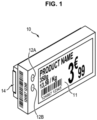
- An exemplary electronic shelf label 10 with light emission capability is represented in Figure 1 .
- Said ESL has a unique label identifier which unmistakably identifies said ESL.
- said label identifier is visible on the ESL, typically in the form of a scannable barcode.
- the label identifier is a 8-digit hexadecimal string, which is shown in numerical form, and in barcode form, on a right side of the ESL.
- ESL 10 comprises on the front side a screen display 11, typically a liquid crystal display or a LED display, for showing information related to an article. This information typically comprises the price of the article, in compliance with regulatory requirements, along with other required information such as price per kilo.
- ESL 10 also comprises a casing 14 on the rear side, containing the electronics required for operating the ESL.
- Said electronics comprises a RF (radiofrequency) chip and may further comprise a short-range communication peripheral such as a NFC (Near Field Communications) or a RFID (Radio Frequency Identification) chip.
- RF radio frequency
- the casing 14 also comprises a microcontroller for translating received RF signals into electronic signals for controlling the screen display 11.
- ESL 10 also comprises light-emitting means.
- the light- emitting means can comprise two or more light-emitting indicators 12A and 12B. Said two light-emitting indicators are able to emit light signals, not necessarily within the visible range, in response to an instruction transmitted via radiofrequency to ESL 10.
- Said two light-emitting indicators can typically be LED sources, or alternatively, the light-emitting indicators can be any other kind of light sources able to briefly emit a detectable light signal. In the case of ESL 10, said two light-emitting sources are located on the front side of the ESL.
- an ESL comprising only one light- emitting indicator could also be used for the methods which will be described below.
- the light-emitting indicators 12A and 12B of ESL 10 are connected to a control circuit which is configured to receive electronic signals from the RF peripheral of the ESL.
- the light- emitting means in this case the light-emitting indicators 12A and 12B, can light up in response to an instruction transmitted to ESL 10 via radiofrequency.
- the light-emitting means are configured to emit light signals in one or more colors. For instance, the indicator 12A can emit in blue and the indicator 12B can emit in red.
- one or more light-emitting indicators can emit light with a predetermined timing pattern (that is, a sequence of emissions of light signals for predefined durations), in order to facilitate recognition of the ESLs emitting an optical signal for recognition, or in order to allow discriminating several ESLs sending optical signals simultaneously.
- a predetermined timing pattern that is, a sequence of emissions of light signals for predefined durations
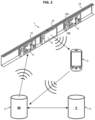
- FIG. 2 A system for showing article information in a gondola of a sales area is shown in Figure 2 .
- This system comprises an electronic shelf labelling sub-system 1 disposed on one or a plurality of gondolas, an ESL management server 2 (also referred below as a shelf device management server) and an inventory management server 4 which can be part of the system of the sales area or external to the sales area.
- ESL management server 2 also referred below as a shelf device management server
- Inventory management server 4 which can be part of the system of the sales area or external to the sales area.
- Both servers 2, 4 are capable of communicating together, via a wired or wireless connection or a mixed thereof.
- the electronic shelf labelling sub-system 1 comprises three ESLs 10 arranged on a shelf rail 13 located on the edge of a shelf for showing articles, situated in a row of the gondola.
- Other shelf rails similar to shelf rail 13, on which ESLs are mounted, are preferably spread all over the sales area, so that the article information provided in the whole area is consistent with information stored in the ESL management server 2.
- Each of the ESLs 10 corresponds to one article on sale, which can itself be identified by a specific article identifier, such as a EAN code.
- a mobile terminal 3, typically a smartphone, may be used both to acquire a label identifier of an ESL and to communicate remotely with the ESL management server 2.
- Communication between the mobile terminal 3 and the ESL management server 2 can be carried out according to any communication network such as Wi-Fi, 3G or 4G, or DECT.
- the mobile terminal 3 can be able to acquire a label identifier of an ESL by image reading of a barcode situated on the ESL, or alternatively, by short-range communication with the ESL, such as NFC shot-range communication with the NFC chip of the ESL.
- the ESL management server 2 is able to communicate via radiofrequency with each of the ESLs 10. Indeed, the ESL management server 2 can transmit a RF signal (radiofrequency signal) comprising a label identifier, so that the information contained in the RF signal is specifically received by the ESL identified by said label identifier.
- RF signal radiofrequency signal
- RF communication between the ESL management server 2 and the ESLs can be carried out in any known radio frequency range.
- the ESL management server 2 can communicate with the ESLs 10 within a range of 700 to 1000 MHz, especially in frequencies of 779 MHz, 868 MHz or 915 MHz.
- said frequency range can correspond to very high frequencies, such as 2.4 GHz frequency (Wi-Fi frequency).
- said frequency range can correspond to low frequencies, of fewer than 40 KHz.
- the ESL management server shown in Figure 2 comprises a central file DB storing association information between ESLs present in the sales area and articles on sale, for instance in the form of table associations between a unique label identifier and a EAN number of an article.
- the inventory management server 4 comprises a realogram database P which comprises association information between shelf spaces and label identifiers of ESLs.
- the realogram database P can also comprise association information between shelf spaces fields and article identifiers, such as EAN numbers of articles.
- Each shelf space may be identified by three numerical indices.
- the first index i corresponds to a gondola of the sales area, which can comprise one or a plurality of rows which are stacked one on top of each other parallelly.
- the second index j corresponds to a particular row j of the gondola i.
- the third index k corresponds to a particular electronic shelf label within the row j.
- the combination of indices i, j, k in a triplet (i,j,k) allow unambiguous identification of a single area of the gondola, matched with a single ESL.
- the unique label identifier, identifying one ESL of the sales area, associated with the shelf space (i,j,k) of gondola i in realogram database P can be noted P ijk .
- each shelf space (i,j,k) is also preferably associated with an article identifier, which can be noted P'i jk .
- the unique label identifier P ijk is thus associated in the central file DB of the inventory management server 4 with the article identifier P' ijk .
- the inventory management server 4 is distinct from the ESL management server 2.
- the function of communication with the electronic shelf labels 10 and of management (access and modification) of the central file DB, and the other function of management (access and modification) of the realogram database P are provided by two distinct servers.
- the ESLs management server 2 is accessible by the personnel of the sales area, for management of the ESLs 10 and the central file DB
- the inventory management server 4 is not necessarily accessed by the personnel of the sales area, depending on whether said personnel is also in charge of the management of the realogram database P. It is possible that the realogram database P is solely used by an administrator of the inventory management server 4, without an administrator of the ESLs management server 2 being able to modify the realogram database P.
- management for the central file DB and management of the realogram database P can alternatively be carried out by the same server (be it the ESLs management server 2 or the inventory management server 4).
- controlling said shelf devices comprises sending a device command D-Cd to each of said shelf devices AID.
- the device command includes a localization process execution time and causes each of said shelf devices to have been switched from a sleep mode SLPd to a wake-up mode WU-BLK at the localization process execution time and, while in the wake-up mode, to emit a localization signal before switching back to the sleep mode.
- controlling said (at least one) sensor comprises sending a sensor command C-Cd to the sensor CAM.
- the sensor command includes the localization process execution time and causes the sensor to have been switched from a sleep mode SLPc to a wake-up mode WU-CAP at the localization process execution time and, while in the wake-up mode, to capture the localization signal emitted by each of said shelf devices before switching back to the sleep mode.
- This controlling may involve controlling all the shelf devices and all the sensors arranged in a specific area, such as all the shelf devices and sensors arranged in a sales area, for instance all the shelf devices and sensors arranged in a retail store.
- all shelf devices and the sensor(s) are caused to wake up at around to same time to perform the localization process of all the shelf devices concurrently and to thereafter switch back to sleep. This helps minimizing the waking time of the shelf devices and of the sensor(s), thus minimizing their battery consumption and improving their service life.
- the sensor command C-Cd is sent from a synchronisation server CS to the sensor CAM (typically wirelessly, for instance based on cellular technologies such as 4G or 5G or based on WiFi technologies) and the device command D-Cd is sent (for instance wirelessly, based on a store/warehouse RF network) to each of said shelf devices AID from a shelf device management server AIDMS (e.g. the ESL management server 2 shown on figure 2 ) following receipt by the shelf device management server AIDMS of a management command M-Cd from the synchronization server CS.
- the synchronisation server CS may be distinct or not from the inventory management server 4 shown on figure 2 .
- the sensor command C-Cd is sent from the synchronisation server CS to the sensor CAM and the device command D-Cd is sent from the sensor CAM to shelf devices AID arranged into proximity with the sensor following receipt by the sensor CAM of the management command M-Cd from the synchronization server CS.
- the sensor and the shelf devices are equipped with suitable means, such as a nearfield radio, to enable communication between the sensor and the nearby shelf devices.
- a sensor command C-Cd may be sent to each sensor individually for instance based on a wake-up cycle of the sensor.
- the synchronisation server CS may be configured to allow a user to set the localization process execution time (for instance at 11pm) and to select shelf devices which should perform the localization process (such as for instance all the ESLs arranged in a specific store section).
- the synchronisation server CS may further be configured to allow a user to select at least one sensor which should be involved in the localization process.
- the synchronisation server CS is further configured to initialise the localisation process by elaborating the sensor command with information indicative of the localization process execution time together, if need be, with information identifying the selected sensor(s) and of elaborating the management command with information indicative of the localization process execution time together, if need be, with information identifying the selected shelf devices.
- the sensor command and the management command are sent by the synchronisation server at a predetermined period before the localization process execution time (for instance 10 minutes before the localization process execution time).
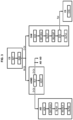
- the shelf device management server AIDMS Upon receipt of the management command M-Cd, the shelf device management server AIDMS sends the device command (box RLY in figure 3 ), for instance by relaying the management command, to each shelf device AID that should execute the localization process, as for instance indicated within the management command.
- the device command may be a broadcast command sent to all the shelf devices that are to be involved in the synchronization (for instance a signal of duration long enough to cover a wake-up period of each shelf device) or a selective multicast or unicast command based for instance on an identifier of a shelf device or on a wake-up cycle of the shelf device.
- the shelf device management server AIDMS then waits for receiving an acknowledgement (box ACK? in figure 3 ) from each shelf device to which a device command was sent and which should execute the localization process.
- an acknowledgement box ACK? in figure 3
- the shelf devices management server AIDMS resends the device command to the shelf device which failed to acknowledge reception of the device command.
- the device command may be resent a plurality of times until it is acknowledged that the shelf device received the device command.
- a shelf device AID Upon receipt of the device command, a shelf device AID is configured to switch from the sleep mode to the wake-up mode. The shelf device then sends an acknowledgement (box ACK in figure 3 ) to the shelf device management server AIDMS and schedules (box DEF-WUd) a wake-up event based on a device command arrival time and the localization process execution time before switching back to the sleep mode (box SLPd1).
- the shelf device AID may calculate the time difference (for instance in milliseconds) between the time at which it receives the device command and the localization process execution time, and set an internal timer based on the calculated difference to wake up when the localization process execution time is reached. When the internal timer is counted to zero, the shelf device wakes up (box WU-BLK), performs the localization process and goes back to sleep afterwards (box SLPd2).
- the synchronisation server CS After sending the sensor command C-Cd, the synchronisation server CS waits for receiving an acknowledgement from the sensors to which a sensor command was sent. In the absence of an acknowledgement being received from a sensor, typically after a preset period of time, the synchronisation server resends the sensor command to the sensor which failed to acknowledge reception of the sensor command. The sensor command may be resent a plurality of times until it is acknowledged that the sensor received the sensor command.
- a sensor CAM Upon receipt of the device command, a sensor CAM is configured to switch from the sleep mode to the wake-up mode. The sensor then sends an acknowledgement (box ACK in figure 3 ) to the synchronization server and schedules (box DEF-WUc) a wake-up event based on a sensor command arrival time and the localization process execution time before switching back to the sleep mode (box SLPc1).
- the sensor CAM may calculate the time difference (for instance in milliseconds) between the time at which it receives the sensor command and the localization process execution time, and set an internal timer based on the calculated difference to wake up when the localization process execution time is reached. When the internal timer is counted to zero, the sensor wakes up (box WU-CAP), performs the localization process (box DTC) and goes back to sleep afterwards (box SLPc2).
- the optical signal emitted by a shelf device may be emitted in the visible range or within the invisible range such as in the infrared range.
- the optical signal emitted by a shelf device may include distinctive (i.e. unique to the shelf device) temporal and/or spatial patterns of optical changes, such as changes in intensity or spectrum, for instance a distinctive series of light pulses.
- Determining a position of each of said shelf devices within the captured images may comprise the camera detecting (box DTC in figure 3 ) the optical signal emitted by each of said shelf devices at a corresponding position within the captured images.
- optical signal detection is performed directly in the camera rather than in the synchronisation server, which proves useful to avoid bandwidth issues that would otherwise arise when transmitting video streams from multiple cameras to the synchronisation server.
- the synchronisation server may then check whether any detected optical signal is a valid optical signal that matches a signal to be emitted by a shelf device during the localization process. If yes, the synchronisation server can associate the shelf device to its corresponding position within the captured images of the fixture and, based on a known location of the camera, derive therefrom its localisation within the sales area/warehouse.
- the shelf devices are article matching devices, e.g. ESLs, arranged on shelves of the fixture so that an article localization is derivable from a localization of an associated article matching device.
- the synchronisation server CS may identify (box CHC in figure 3 ) an article matching device identifier stored in a database based on a detected optical signal within the report file (typically when the detected optical signal is unique to the article matching device) and localizes an article area based on determining an article identifier associated to the article matching device identifier. The localized article area may then be used to fill a planogram indicating the placement of articles in the fixture.
- Additional image processing steps may be performed based on the images captured by the camera, for instance to check for the presence of articles within a localized area (where identification of an empty area may be carried out by color recognition with respect to a predetermined pattern of the fixture), to check whether the articles in the localized area are the correct ones (for instance based on image comparison between the images and product pictures), to count products, etc.
Landscapes
- Business, Economics & Management (AREA)
- Engineering & Computer Science (AREA)
- Economics (AREA)
- Accounting & Taxation (AREA)
- Finance (AREA)
- Marketing (AREA)
- Strategic Management (AREA)
- Physics & Mathematics (AREA)
- General Business, Economics & Management (AREA)
- General Physics & Mathematics (AREA)
- Development Economics (AREA)
- Theoretical Computer Science (AREA)
- Entrepreneurship & Innovation (AREA)
- Human Resources & Organizations (AREA)
- Operations Research (AREA)
- Quality & Reliability (AREA)
- Tourism & Hospitality (AREA)
- Management, Administration, Business Operations System, And Electronic Commerce (AREA)
- Warehouses Or Storage Devices (AREA)
- Display Racks (AREA)
Claims (12)
- Inventarverwaltungsverfahren, das die folgenden Schritte umfasst:- Steuern von Regalvorrichtungen (AID), die an Regalen einer Einrichtung eingerichtet sind, um die Regalvorrichtungen zu veranlassen, einen Lokalisierungsprozess zu implementieren;- Steuern eines Sensors (CAM), um während des Lokalisierungsprozesses Sensorsignale zu erfassen; und- Lokalisieren jeder der Regalvorrichtungen basierend auf den erfassten Sensorsignalen;wobei das Verfahren dadurch gekennzeichnet ist:- dass das Steuern der Regalvorrichtungen das Senden eines Vorrichtungsbefehls (D-Cd) an jede der Regalvorrichtungen (AID) umfasst, wobei der Vorrichtungsbefehl einen Lokalisierungsprozess-Ausführungszeitpunkt umfasst und jede der Regalvorrichtungen veranlasst, zum Lokalisierungsprozess-Ausführungszeitpunkt von einem Ruhemodus (SLPd) in einen Aufwachmodus (WU-BLK) umgeschaltet zu werden und vor dem Zurückschalten in den Ruhemodus ein Lokalisierungssignal auszusenden; und- dass das Steuern des Sensors das Senden eines Sensorbefehls (C-Cd) an den Sensor (CAM) umfasst, wobei der Sensorbefehl den Lokalisierungsprozess-Ausführungszeitpunkt umfasst und den Sensor veranlasst, zum Lokalisierungsprozess-Ausführungszeitpunkt von einem Ruhemodus (SLPc) in einen Aufwachmodus (WU-CAP) geschaltet zu werden und vor dem Zurückschalten in den Ruhemodus das von jeder der Regalvorrichtungen ausgesendete Lokalisierungssignal zu erfassen.
- Inventarverwaltungsverfahren nach Anspruch 1, wobei der Sensorbefehl von einem Synchronisierungsserver (CS) an den Sensor gesendet wird und wobei der Vorrichtungsbefehl von einem Regalvorrichtungsverwaltungsserver (AIDMS) im Anschluss an den Empfang eines Verwaltungsbefehls (M-Cd) von dem Synchronisierungsserver (CS) durch den Regalvorrichtungsverwaltungsserver an jede der Regalvorrichtungen gesendet wird.
- Inventarverwaltungsverfahren nach Anspruch 2, wobei der Sensorbefehl und der Verwaltungsbefehl durch den Synchronisierungsserver in einer vorbestimmten Periode vor dem Lokalisierungsprozess-Ausführungszeitpunkt gesendet werden.
- Inventarverwaltungsverfahren nach Anspruch 1, wobei beim Empfang des Vorrichtungsbefehls jede der Regalvorrichtungen ein Aufwachereignis basierend auf einem Vorrichtungsbefehlsankunftszeitpunkt und dem Lokalisierungsprozess-Ausführungszeitpunkt plant (DEF-WUd).
- Inventarverwaltungsverfahren nach Anspruch 1, wobei beim Empfang des Sensorbefehls der Sensor ein Aufwachereignis basierend auf einem Sensorbefehlsankunftszeitpunkt und dem Lokalisierungsprozess-Ausführungszeitpunkt plant (DEF-WUc).
- Inventarverwaltungsverfahren nach Anspruch 1, wobei der Sensor eine Kamera ist, die eingerichtet ist, um Bilder der Einrichtung während des Lokalisierungsprozesses aufzunehmen, wobei das Lokalisierungssignal, das von jeder der Regalvorrichtungen während des Lokalisierungsprozesses ausgesendet wird, ein optisches Signal ist und wobei das Lokalisieren jeder der Regalvorrichtungen das Bestimmen einer Position von jeder der Regalvorrichtungen innerhalb der aufgenommenen Bilder umfasst.
- Inventarverwaltungsverfahren nach Anspruch 6, wobei das Bestimmen einer Position von jeder der Regalvorrichtungen innerhalb der aufgenommenen Bilder umfasst, dass die Kamera das optische Signal, das von jeder der Regalvorrichtungen ausgesendet wird, an einer entsprechenden Position innerhalb der aufgenommenen Bilder ermittelt (DTC).
- Inventarverwaltungsverfahren nach Anspruch 7, das ferner umfasst, dass die Kamera jedes ermittelte optische Signal mit ihrer entsprechenden Position innerhalb einer Berichtsdatei verknüpft und die Berichtsdatei (Rpt) vor dem Zurückschalten in den Ruhemodus (SLPc) an einen Inventarverwaltungsserver sendet.
- Inventarverwaltungsverfahren nach Anspruch 8, wobei die Regalvorrichtungen Artikelabgleichvorrichtungen sind, die an Regalen der Einrichtung eingerichtet sind, derart dass eine Artikellokalisierung von einer Lokalisierung einer verknüpften Artikelabgleichvorrichtung ableitbar ist, und wobei der Inventarverwaltungsserver eine Artikelabgleichvorrichtungskennung, die in einer Datenbank gespeichert ist, basierend auf einem ermittelten optischen Signal innerhalb der Berichtsdatei identifiziert (CHC) und einen Artikelbereich basierend auf dem Bestimmen einer Artikelkennung lokalisiert, die mit der Artikelabgleichvorrichtungskennung verknüpft ist.
- Inventarverwaltungsverfahren nach Anspruch 9, wobei der lokalisierte Artikelbereich zum Befüllen eines Planogramms verwendet wird, das die Platzierung von Artikeln in der Einrichtung angibt.
- Computerprogrammprodukt, das Anweisungen umfasst, die, wenn das Programm von einem Computer ausgeführt wird, bewirken, dass der Computer die Steuerungsschritte des Verfahrens nach Anspruch 1 durchführt.
- Inventarverwaltungsserver, der eine Verarbeitungseinheit umfasst, die dazu ausgestaltet ist, die Steuerungsschritte des Verfahrens nach Anspruch 1 zu implementieren.
Priority Applications (1)
| Application Number | Priority Date | Filing Date | Title |
|---|---|---|---|
| EP25169851.0A EP4604035A1 (de) | 2021-05-07 | 2022-05-06 | Inventarverwaltungsverfahren und -system mit synchronisierter regalvorrichtungen und sensoraktivierung |
Applications Claiming Priority (2)
| Application Number | Priority Date | Filing Date | Title |
|---|---|---|---|
| FR2104843A FR3122761B1 (fr) | 2021-05-07 | 2021-05-07 | Système et procédé de gestion des stocks avec activation synchronisée de dispositifs de rayons et de capteurs |
| PCT/EP2022/062264 WO2022234075A1 (en) | 2021-05-07 | 2022-05-06 | Inventory management method and system with synchronized shelf devices and sensors activation |
Related Child Applications (2)
| Application Number | Title | Priority Date | Filing Date |
|---|---|---|---|
| EP25169851.0A Division EP4604035A1 (de) | 2021-05-07 | 2022-05-06 | Inventarverwaltungsverfahren und -system mit synchronisierter regalvorrichtungen und sensoraktivierung |
| EP25169851.0A Division-Into EP4604035A1 (de) | 2021-05-07 | 2022-05-06 | Inventarverwaltungsverfahren und -system mit synchronisierter regalvorrichtungen und sensoraktivierung |
Publications (4)
| Publication Number | Publication Date |
|---|---|
| EP4334868A1 EP4334868A1 (de) | 2024-03-13 |
| EP4334868C0 EP4334868C0 (de) | 2025-04-30 |
| EP4334868B1 true EP4334868B1 (de) | 2025-04-30 |
| EP4334868B8 EP4334868B8 (de) | 2025-06-11 |
Family
ID=76730761
Family Applications (2)
| Application Number | Title | Priority Date | Filing Date |
|---|---|---|---|
| EP22727902.3A Active EP4334868B8 (de) | 2021-05-07 | 2022-05-06 | Inventarverwaltungsverfahren und -system mit synchronisierter regalvorrichtungen und sensoraktivierung |
| EP25169851.0A Pending EP4604035A1 (de) | 2021-05-07 | 2022-05-06 | Inventarverwaltungsverfahren und -system mit synchronisierter regalvorrichtungen und sensoraktivierung |
Family Applications After (1)
| Application Number | Title | Priority Date | Filing Date |
|---|---|---|---|
| EP25169851.0A Pending EP4604035A1 (de) | 2021-05-07 | 2022-05-06 | Inventarverwaltungsverfahren und -system mit synchronisierter regalvorrichtungen und sensoraktivierung |
Country Status (9)
| Country | Link |
|---|---|
| US (1) | US12541740B2 (de) |
| EP (2) | EP4334868B8 (de) |
| JP (1) | JP2024517140A (de) |
| CN (1) | CN117321616A (de) |
| AU (1) | AU2022268623A1 (de) |
| CA (1) | CA3214733A1 (de) |
| FR (1) | FR3122761B1 (de) |
| TW (1) | TW202244808A (de) |
| WO (1) | WO2022234075A1 (de) |
Families Citing this family (2)
| Publication number | Priority date | Publication date | Assignee | Title |
|---|---|---|---|---|
| FR3122764B1 (fr) * | 2021-05-07 | 2024-06-28 | Captana Gmbh | Dispositif d’imagerie d’étagère pour un support d’étagère et un système d’étagère comprenant le dispositif d’imagerie d’étagère |
| WO2026039079A2 (en) * | 2024-07-04 | 2026-02-19 | Qualcomm Incorporated | Electronic shelf label (esl) radio location estimation |
Family Cites Families (14)
| Publication number | Priority date | Publication date | Assignee | Title |
|---|---|---|---|---|
| JP4583950B2 (ja) * | 2005-01-28 | 2010-11-17 | 株式会社エヌ・ティ・ティ・データ | 荷物管理装置およびrfタグ |
| US8189855B2 (en) * | 2007-08-31 | 2012-05-29 | Accenture Global Services Limited | Planogram extraction based on image processing |
| US20110084951A1 (en) * | 2008-02-22 | 2011-04-14 | Marisense Oy | Display device with selectable operational modes, method in a display device and a control device to alter operational mode of a display device |
| JP5213656B2 (ja) * | 2008-11-20 | 2013-06-19 | シャープ株式会社 | 端末システム |
| JP2015024046A (ja) * | 2013-07-26 | 2015-02-05 | 株式会社イシダ | 電子棚札および電子棚札システム |
| JP6202216B2 (ja) * | 2014-09-30 | 2017-09-27 | 日本電気株式会社 | 情報処理装置、棚札管理システム、制御方法、及びプログラム |
| EP3032459A1 (de) * | 2014-12-10 | 2016-06-15 | Ricoh Company, Ltd. | Realogrammszenenanalyse von bildern auffinden von regal und etikett |
| US9582977B2 (en) | 2014-12-23 | 2017-02-28 | Intel Corporation | Systems and methods for monitoring consumption |
| US10558943B2 (en) * | 2016-04-20 | 2020-02-11 | Wishelf Ltd. | System and method for monitoring stocking shelves |
| FR3071341B1 (fr) * | 2017-09-19 | 2019-09-20 | Ses-Imagotag | Procede mis en oeuvre par camera de controle de disposition d'articles pour des etageres equipees d'etiquettes electroniques de gondole |
| US10922646B1 (en) * | 2017-09-26 | 2021-02-16 | Amazon Technologies, Inc. | Multi-echelon inventory planning under dynamic fulfillment policies |
| FR3072492B1 (fr) | 2017-10-13 | 2019-11-08 | Ses-Imagotag | Procede pour initialiser ou mettre a jour une base de donnees de realogramme pour un lineaire, en utilisant des signaux optiques emis par des etiquettes electroniques de gondole |
| ES2951128T3 (es) * | 2018-11-07 | 2023-10-18 | Wuerth Int Ag | Sistema de gestión de almacenes, con detección de posición de artículos y áreas de almacén asociadas |
| US12160671B2 (en) * | 2021-03-31 | 2024-12-03 | Target Brands, Inc. | Shelf-mountable imaging system |
-
2021
- 2021-05-07 FR FR2104843A patent/FR3122761B1/fr active Active
-
2022
- 2022-05-06 TW TW111117189A patent/TW202244808A/zh unknown
- 2022-05-06 CA CA3214733A patent/CA3214733A1/en active Pending
- 2022-05-06 EP EP22727902.3A patent/EP4334868B8/de active Active
- 2022-05-06 US US18/289,629 patent/US12541740B2/en active Active
- 2022-05-06 AU AU2022268623A patent/AU2022268623A1/en active Pending
- 2022-05-06 WO PCT/EP2022/062264 patent/WO2022234075A1/en not_active Ceased
- 2022-05-06 CN CN202280033570.3A patent/CN117321616A/zh active Pending
- 2022-05-06 JP JP2023565462A patent/JP2024517140A/ja active Pending
- 2022-05-06 EP EP25169851.0A patent/EP4604035A1/de active Pending
Also Published As
| Publication number | Publication date |
|---|---|
| EP4334868A1 (de) | 2024-03-13 |
| US12541740B2 (en) | 2026-02-03 |
| EP4604035A1 (de) | 2025-08-20 |
| CA3214733A1 (en) | 2022-11-10 |
| FR3122761B1 (fr) | 2024-07-19 |
| US20240242176A1 (en) | 2024-07-18 |
| EP4334868C0 (de) | 2025-04-30 |
| TW202244808A (zh) | 2022-11-16 |
| FR3122761A1 (fr) | 2022-11-11 |
| EP4334868B8 (de) | 2025-06-11 |
| WO2022234075A1 (en) | 2022-11-10 |
| CN117321616A (zh) | 2023-12-29 |
| AU2022268623A1 (en) | 2023-11-09 |
| JP2024517140A (ja) | 2024-04-19 |
Similar Documents
| Publication | Publication Date | Title |
|---|---|---|
| US11143737B2 (en) | Method for locating a radio tag | |
| CA3003836C (en) | ASSET LABELING AND METHODS AND DEVICES FOR RESTORING AND TRACKING ASSET | |
| US6366205B1 (en) | System for detecting missing golf clubs | |
| KR100936353B1 (ko) | 근거리 무선 통신을 이용한 매장 관리 시스템 | |
| EP4334868B1 (de) | Inventarverwaltungsverfahren und -system mit synchronisierter regalvorrichtungen und sensoraktivierung | |
| US20190362300A1 (en) | Method For Locating Electronic Shelf Labels In A Retail Area | |
| WO2019073063A1 (en) | METHOD FOR INITIALIZING OR UPDATING REALOGRAMS DATABASE DATA FOR RADIANCE SPACE, USING OPTICAL SIGNALS ISSUED BY ELECTRONIC SHELF LABELS | |
| EP4220658A1 (de) | Etiketten für ortungssystem einer medizinischen einrichtung | |
| US11125427B2 (en) | Systems and methods for using a hybrid lighting and inventory system for motion detection | |
| KR101872373B1 (ko) | 비콘을 이용한 물류 출고 관리 시스템 및 방법, 이를 수행하기 위한 기록 매체 | |
| WO2021110974A1 (en) | Associating product types and electronic labels using a camera | |
| HK40129812A (en) | Inventory management method and system with synchronized shelf devices and sensors activation | |
| US20240331016A1 (en) | Method of guiding a person to products | |
| JP2011076333A (ja) | 物品管理システム及びこれに用いる無線タグ及び無線タグ通信装置 | |
| US20240330854A1 (en) | Method for logically linking an electronic display unit to a product | |
| US20230028355A1 (en) | Controlling output of electronic labels from a camera | |
| EP3699881B1 (de) | Vorrichtungen und verfahren zur bestimmung eines inventars unter verwendung eines hybriden beleuchtungs- und inventarsystems | |
| CN210515308U (zh) | 一种智能餐具读写控制装置 | |
| HK40114396A (zh) | 用於将电子显示单元与产品进行逻辑关联的方法 |
Legal Events
| Date | Code | Title | Description |
|---|---|---|---|
| STAA | Information on the status of an ep patent application or granted ep patent |
Free format text: STATUS: UNKNOWN |
|
| STAA | Information on the status of an ep patent application or granted ep patent |
Free format text: STATUS: THE INTERNATIONAL PUBLICATION HAS BEEN MADE |
|
| PUAI | Public reference made under article 153(3) epc to a published international application that has entered the european phase |
Free format text: ORIGINAL CODE: 0009012 |
|
| STAA | Information on the status of an ep patent application or granted ep patent |
Free format text: STATUS: REQUEST FOR EXAMINATION WAS MADE |
|
| 17P | Request for examination filed |
Effective date: 20231201 |
|
| AK | Designated contracting states |
Kind code of ref document: A1 Designated state(s): AL AT BE BG CH CY CZ DE DK EE ES FI FR GB GR HR HU IE IS IT LI LT LU LV MC MK MT NL NO PL PT RO RS SE SI SK SM TR |
|
| DAV | Request for validation of the european patent (deleted) | ||
| DAX | Request for extension of the european patent (deleted) | ||
| REG | Reference to a national code |
Ref country code: HK Ref legal event code: DE Ref document number: 40107134 Country of ref document: HK |
|
| REG | Reference to a national code |
Ref legal event code: R079 Ref country code: DE Ref document number: 602022013929 Country of ref document: DE Free format text: PREVIOUS MAIN CLASS: G06Q0010080000 Ipc: G06Q0010087000 |
|
| GRAP | Despatch of communication of intention to grant a patent |
Free format text: ORIGINAL CODE: EPIDOSNIGR1 |
|
| STAA | Information on the status of an ep patent application or granted ep patent |
Free format text: STATUS: GRANT OF PATENT IS INTENDED |
|
| RIC1 | Information provided on ipc code assigned before grant |
Ipc: G06Q 30/06 20230101ALI20250115BHEP Ipc: G06Q 10/087 20230101AFI20250115BHEP |
|
| INTG | Intention to grant announced |
Effective date: 20250122 |
|
| GRAS | Grant fee paid |
Free format text: ORIGINAL CODE: EPIDOSNIGR3 |
|
| GRAA | (expected) grant |
Free format text: ORIGINAL CODE: 0009210 |
|
| STAA | Information on the status of an ep patent application or granted ep patent |
Free format text: STATUS: THE PATENT HAS BEEN GRANTED |
|
| AK | Designated contracting states |
Kind code of ref document: B1 Designated state(s): AL AT BE BG CH CY CZ DE DK EE ES FI FR GB GR HR HU IE IS IT LI LT LU LV MC MK MT NL NO PL PT RO RS SE SI SK SM TR |
|
| REG | Reference to a national code |
Ref country code: CH Ref legal event code: EP Ref country code: GB Ref legal event code: FG4D |
|
| REG | Reference to a national code |
Ref country code: CH Ref legal event code: PK Free format text: BERICHTIGUNG B8 |
|
| REG | Reference to a national code |
Ref country code: IE Ref legal event code: FG4D |
|
| REG | Reference to a national code |
Ref country code: DE Ref legal event code: R096 Ref document number: 602022013929 Country of ref document: DE |
|
| RAP4 | Party data changed (patent owner data changed or rights of a patent transferred) |
Owner name: VUSIONGROUP DEUTSCHLAND GMBH |
|
| U01 | Request for unitary effect filed |
Effective date: 20250513 |
|
| U07 | Unitary effect registered |
Designated state(s): AT BE BG DE DK EE FI FR IT LT LU LV MT NL PT RO SE SI Effective date: 20250519 |
|
| PGFP | Annual fee paid to national office [announced via postgrant information from national office to epo] |
Ref country code: IE Payment date: 20250526 Year of fee payment: 4 |
|
| PG25 | Lapsed in a contracting state [announced via postgrant information from national office to epo] |
Ref country code: ES Free format text: LAPSE BECAUSE OF FAILURE TO SUBMIT A TRANSLATION OF THE DESCRIPTION OR TO PAY THE FEE WITHIN THE PRESCRIBED TIME-LIMIT Effective date: 20250430 |
|
| PG25 | Lapsed in a contracting state [announced via postgrant information from national office to epo] |
Ref country code: GR Free format text: LAPSE BECAUSE OF FAILURE TO SUBMIT A TRANSLATION OF THE DESCRIPTION OR TO PAY THE FEE WITHIN THE PRESCRIBED TIME-LIMIT Effective date: 20250731 Ref country code: NO Free format text: LAPSE BECAUSE OF FAILURE TO SUBMIT A TRANSLATION OF THE DESCRIPTION OR TO PAY THE FEE WITHIN THE PRESCRIBED TIME-LIMIT Effective date: 20250730 |
|
| PG25 | Lapsed in a contracting state [announced via postgrant information from national office to epo] |
Ref country code: PL Free format text: LAPSE BECAUSE OF FAILURE TO SUBMIT A TRANSLATION OF THE DESCRIPTION OR TO PAY THE FEE WITHIN THE PRESCRIBED TIME-LIMIT Effective date: 20250430 |
|
| PG25 | Lapsed in a contracting state [announced via postgrant information from national office to epo] |
Ref country code: HR Free format text: LAPSE BECAUSE OF FAILURE TO SUBMIT A TRANSLATION OF THE DESCRIPTION OR TO PAY THE FEE WITHIN THE PRESCRIBED TIME-LIMIT Effective date: 20250430 |
|
| PG25 | Lapsed in a contracting state [announced via postgrant information from national office to epo] |
Ref country code: RS Free format text: LAPSE BECAUSE OF FAILURE TO SUBMIT A TRANSLATION OF THE DESCRIPTION OR TO PAY THE FEE WITHIN THE PRESCRIBED TIME-LIMIT Effective date: 20250731 |
|
| PG25 | Lapsed in a contracting state [announced via postgrant information from national office to epo] |
Ref country code: IS Free format text: LAPSE BECAUSE OF FAILURE TO SUBMIT A TRANSLATION OF THE DESCRIPTION OR TO PAY THE FEE WITHIN THE PRESCRIBED TIME-LIMIT Effective date: 20250830 |
|
| U21 | Renewal fee for the european patent with unitary effect paid with additional fee |
Year of fee payment: 4 Effective date: 20251014 |
|
| REG | Reference to a national code |
Ref country code: CH Ref legal event code: H13 Free format text: ST27 STATUS EVENT CODE: U-0-0-H10-H13 (AS PROVIDED BY THE NATIONAL OFFICE) Effective date: 20251223 |
|
| PG25 | Lapsed in a contracting state [announced via postgrant information from national office to epo] |
Ref country code: SM Free format text: LAPSE BECAUSE OF FAILURE TO SUBMIT A TRANSLATION OF THE DESCRIPTION OR TO PAY THE FEE WITHIN THE PRESCRIBED TIME-LIMIT Effective date: 20250430 |
|
| PG25 | Lapsed in a contracting state [announced via postgrant information from national office to epo] |
Ref country code: CH Free format text: LAPSE BECAUSE OF NON-PAYMENT OF DUE FEES Effective date: 20250531 |
|
| PG25 | Lapsed in a contracting state [announced via postgrant information from national office to epo] |
Ref country code: CZ Free format text: LAPSE BECAUSE OF FAILURE TO SUBMIT A TRANSLATION OF THE DESCRIPTION OR TO PAY THE FEE WITHIN THE PRESCRIBED TIME-LIMIT Effective date: 20250430 |
|
| PG25 | Lapsed in a contracting state [announced via postgrant information from national office to epo] |
Ref country code: SK Free format text: LAPSE BECAUSE OF FAILURE TO SUBMIT A TRANSLATION OF THE DESCRIPTION OR TO PAY THE FEE WITHIN THE PRESCRIBED TIME-LIMIT Effective date: 20250430 |
|
| PG25 | Lapsed in a contracting state [announced via postgrant information from national office to epo] |
Ref country code: MC Free format text: LAPSE BECAUSE OF FAILURE TO SUBMIT A TRANSLATION OF THE DESCRIPTION OR TO PAY THE FEE WITHIN THE PRESCRIBED TIME-LIMIT Effective date: 20250430 |
|
| PLBE | No opposition filed within time limit |
Free format text: ORIGINAL CODE: 0009261 |
|
| STAA | Information on the status of an ep patent application or granted ep patent |
Free format text: STATUS: NO OPPOSITION FILED WITHIN TIME LIMIT |
|
| REG | Reference to a national code |
Ref country code: CH Ref legal event code: L10 Free format text: ST27 STATUS EVENT CODE: U-0-0-L10-L00 (AS PROVIDED BY THE NATIONAL OFFICE) Effective date: 20260311 |
|
| 26N | No opposition filed |
Effective date: 20260202 |