EP4333409A1 - Elektronische vorrichtung - Google Patents
Elektronische vorrichtung Download PDFInfo
- Publication number
- EP4333409A1 EP4333409A1 EP22794729.8A EP22794729A EP4333409A1 EP 4333409 A1 EP4333409 A1 EP 4333409A1 EP 22794729 A EP22794729 A EP 22794729A EP 4333409 A1 EP4333409 A1 EP 4333409A1
- Authority
- EP
- European Patent Office
- Prior art keywords
- rear cavity
- housing portion
- component
- electronic device
- connecting hole
- Prior art date
- Legal status (The legal status is an assumption and is not a legal conclusion. Google has not performed a legal analysis and makes no representation as to the accuracy of the status listed.)
- Granted
Links
Images




Classifications
-
- H—ELECTRICITY
- H04—ELECTRIC COMMUNICATION TECHNIQUE
- H04M—TELEPHONIC COMMUNICATION
- H04M1/00—Substation equipment, e.g. for use by subscribers
- H04M1/02—Constructional features of telephone sets
- H04M1/0202—Portable telephone sets, e.g. cordless phones, mobile phones or bar type handsets
- H04M1/026—Details of the structure or mounting of specific components
-
- H—ELECTRICITY
- H04—ELECTRIC COMMUNICATION TECHNIQUE
- H04M—TELEPHONIC COMMUNICATION
- H04M1/00—Substation equipment, e.g. for use by subscribers
- H04M1/02—Constructional features of telephone sets
- H04M1/0202—Portable telephone sets, e.g. cordless phones, mobile phones or bar type handsets
- H04M1/0206—Portable telephones comprising a plurality of mechanically joined movable body parts, e.g. hinged housings
- H04M1/0208—Portable telephones comprising a plurality of mechanically joined movable body parts, e.g. hinged housings characterized by the relative motions of the body parts
- H04M1/0235—Slidable or telescopic telephones, i.e. with a relative translation movement of the body parts; Telephones using a combination of translation and other relative motions of the body parts
-
- H—ELECTRICITY
- H04—ELECTRIC COMMUNICATION TECHNIQUE
- H04M—TELEPHONIC COMMUNICATION
- H04M1/00—Substation equipment, e.g. for use by subscribers
- H04M1/02—Constructional features of telephone sets
- H04M1/0202—Portable telephone sets, e.g. cordless phones, mobile phones or bar type handsets
- H04M1/026—Details of the structure or mounting of specific components
- H04M1/0266—Details of the structure or mounting of specific components for a display module assembly
- H04M1/0268—Details of the structure or mounting of specific components for a display module assembly including a flexible display panel
-
- H—ELECTRICITY
- H04—ELECTRIC COMMUNICATION TECHNIQUE
- H04M—TELEPHONIC COMMUNICATION
- H04M1/00—Substation equipment, e.g. for use by subscribers
- H04M1/02—Constructional features of telephone sets
- H04M1/03—Constructional features of telephone transmitters or receivers, e.g. telephone hand-sets
- H04M1/035—Improving the acoustic characteristics by means of constructional features of the housing, e.g. ribs, walls, resonating chambers or cavities
Definitions
- This application pertains to the field of communications device technologies, and in particular, to an electronic device.
- volume of a rear cavity of a sound generating module is limited by the internal space of the electronic device, and available space in the rear cavity of the sound generating module is becoming increasingly constrained.
- the volume of the rear cavity determines sounding performance of the sound generating module, and a decrease in volume of the rear cavity leads to poor sound performance of the electronic device.
- This application discloses an electronic device to solve the problem of poor sound performance of electronic devices.
- An electronic device includes a device housing and a sound generating module, where the device housing includes a first housing portion and a second housing portion, the first housing portion is movably disposed on the second housing portion to enable the electronic device to switch between a first state and a second state, the sound generating module is located on either the first housing portion or the second housing portion, and the sound generating module is provided with a first rear cavity and a first connecting hole communicating with the first rear cavity, where the electronic device is able to form a second rear cavity, where
- the sound generating module is provided with a first rear cavity, and the electronic device is further able to form a second rear cavity, to fully utilize the internal space of the electronic device.
- the first rear cavity communicates with the second rear cavity, which in turn increases the volume of the rear cavity of the sound generating module and improves sound performance, resulting in a more mellow and full sound.
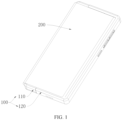
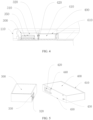
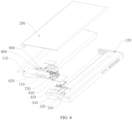
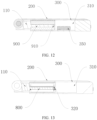
- this application provides an electronic device including a device housing 100 and a sound generating module 300.
- the device housing 100 is capable of providing a mounting base for other components of the electronic device.
- the device housing 100 includes a first housing portion 110 and a second housing portion 120.
- the first housing portion 110 is movably disposed on the second housing portion 120 to enable the electronic device to switch between a first state and a second state.
- One of the first state and the second state is an expanded state, and the other is a contracted state.
- the electronic device In a case that the first housing portion 110 and the second housing portion 120 are relatively far away from each other, the electronic device is in the expanded state, and in a case that they are relatively close to each other, the electronic device is in the contracted state.
- the sound generating module 300 may be a receiver module, a speaker module, or any other sound-generating apparatus. A specific type of sound generating module 300 is not limited in the embodiments of this application.
- the sound generating module 300 is provided on one of the first housing portion 110 and the second housing portion 120.
- the sound generating module 300 is provided with a first rear cavity 310 and a first connecting hole 320 that communicates with the first rear cavity 310.
- the electronic device is able to form a second rear cavity 410.
- the first rear cavity 310 communicates with the second rear cavity 410 via the first connecting hole 320, and the first rear cavity 310 and the second rear cavity 410 that communicate with each other jointly form a rear cavity of the sound generating module 300.
- This increases the volume of the rear cavity of the sound generating module 300, thereby improving the sound performance of the sound generating module 300.
- the first connecting hole 320 is blocked, and only the first rear cavity 310 functions as the rear cavity of the sound generating module 300.
- the first connecting hole 320 can be blocked by a dedicated blocking cover plate or by another functional component 800 of the electronic device.
- the blocking method can vary, and this embodiment of this application does not impose restrictions on this.
- the sound generating module 300 is provided with a first rear cavity 310, and the electronic device is further able to form a second rear cavity 410, to fully utilize the internal space of the electronic device.
- the first rear cavity 310 communicates with the second rear cavity 410, which in turn increases the volume of the rear cavity of the sound generating module 300 and improves sound performance, resulting in a more mellow and full sound.
- the electronic device further includes a flexible display 200, and the flexible display 200 is provided on the device housing 100.
- a first end of the flexible display 200 is connected to the first housing portion 110, and a second end of the flexible display 200 is connected to the second housing portion 120.
- the first end of the flexible display 200 is capable of moving along with the movement of the first housing portion 110
- the second end of the flexible display 200 is capable of moving along with the movement of the second housing portion 120.
- the first housing portion 110 moves relative to the second housing portion 120
- the first end of the flexible display 200 also moves relative to the second end of the flexible display 200, thereby changing a display area between the first end and the second end of the flexible display 200.
- the electronic device has a relatively large display area, it provides a better visual experience to user, and in a case that the electronic device has a relatively small display area, it is more convenient for portability.
- the first end of the flexible display 200 can be accommodated in the first housing portion 110 or can extend from the first housing portion 110, and/or the second end of the flexible display 200 can be accommodated in the second housing portion 120 or can extend from the second housing portion 120.
- the flexible display 200 is provided with a first region and a second region connected to the first region.
- the first region and the second region are at least partially exposed to the electronic device.
- the electronic device has a relatively large display area, and the first rear cavity 310 is connected to the second rear cavity 410 via the first connecting hole 320.
- the first rear cavity 310 and the second rear cavity 410 in communication jointly form the rear cavity of the sound generating module 300, fully utilizing the internal space of the electronic device. This increases the volume of the rear cavity of the sound generating module 300 and improves the sound performance of the sound generating module 300.
- the first region is exposed to the electronic device, and the second region is accommodated in the device housing 100.
- the electronic device has a relatively small display area, and the first connecting hole 320 is blocked.
- the large display area provides a better visual experience to user.
- the second rear cavity 410 communicates with the first rear cavity 310 to jointly form the rear cavity of the sound generating module 300, which in turn increases the volume of the rear cavity of the sound generating module 300 and improves the sound performance of the sound generating module 300, thus providing a better auditory experience to the user.
- the electronic device In the case that the electronic device has a relatively large display area, it can be used as a tablet, which requires higher sound performance.
- the second rear cavity 410 communicates with the first rear cavity 310 to jointly form the rear cavity of the sound generating module 300, which in turn increases the volume of the rear cavity of the sound generating module 300, improving the sound performance of the sound generating module 300, thereby meeting requirements for the sound performance of an electronic device with a relatively large display area.
- the electronic device includes a cavity structure 400.
- the cavity structure 400 is provided with a second rear cavity 410 and a second connecting hole 420 that communicates with the second rear cavity 410
- the sound generating module 300 is provided with the first rear cavity 310 and the first connecting hole 320 that communicates with the first rear cavity 310.
- One of the sound generating module 300 and the cavity structure 400 is located on the first housing portion 110, and the other is located on the second housing portion 120.
- the sound generating module 300 and the cavity structure 400 can relatively slide along with relative movement between the first housing portion 110 and the second housing portion 120.
- the first connecting hole 320 and the second connecting hole 420 are in sealed alignment, and the first rear cavity 310 communicates with the second rear cavity 410 via the sealed alignment between the first connecting hole 320 and the second connecting hole 420.
- the second rear cavity 410 communicates with the first rear cavity 310 to jointly form the rear cavity of the sound generating module 300, so as to fully utilize the internal space of the electronic device. Communicating the second rear cavity 410 and the first rear cavity 310 increases the volume of the rear cavity of the sound generating module 300 and improves the sound performance of the sound generating module 300.
- the first connecting hole 320 and the second connecting hole 420 are misaligned.
- the cavity structure 400 blocks the first connecting hole 320.
- a side wall of the cavity structure 400 is precisely moved to align with the first connecting hole 320 to block the first connecting hole 320, and the first rear cavity 310 functions as the rear cavity of the sound generating module 300 alone.
- the second rear cavity 410 of the cavity structure 400 in the first state, can communicate with the first rear cavity 310 via the second connecting hole 420, thereby increasing the volume of the rear cavity of the sound generating module 300; and in the second state, the cavity structure 400 blocks the first connecting hole 320 to seal the first rear cavity 310, so that the first rear cavity 310 functions as the rear cavity of the sound generating module 300 alone.
- one of the sound generating module 300 and the cavity structure 400 is provided with a first positioning structure 430 and a second positioning structure 440 that are spaced apart, and the other is provided with a third positioning structure 330.
- the first positioning structure 430 and the third positioning structure 330 cooperate with each other.
- the sound generating module 300 and the cavity structure 400 are relatively fastened, so that the first connecting hole 320 and the second connecting hole 420 are aligned, thereby communicating the second rear cavity 410 and the first rear cavity 310.
- the second positioning structure 440 and the third positioning structure 330 cooperate with each other.
- the sound generating module 300 and the cavity structure 400 are relatively fastened, so that the first connecting hole 320 and the cavity structure 400 are aligned.
- the first connecting hole 320 faces the side wall of the cavity structure 400
- the cavity structure 400 blocks the first connecting hole of the first rear cavity 310 to seal the first rear cavity 310, so that the first rear cavity 310 functions as the rear cavity of the sound generating module 300 alone.
- the positioning structures can be used to position the sound generating module 300 and the cavity structure 400 to prevent relative sliding.
- the positioning structures can take various forms, such as concave-convex positioning structures and magnetic positioning structures.
- concave-convex positioning structures are used as an example for description.
- Both the first positioning structure 430 and the second positioning structure 440 are positioning protrusions, and the third positioning structure 330 is a positioning groove.
- the first positioning structure 430 and the second positioning structure 440 are positioning grooves, and the third positioning structure 330 is a positioning protrusion.
- the positioning protrusion enters the positioning groove, achieving the positioning of the sound generating module 300 and the cavity structure 400.
- the sound generating module 300 is fixed on one of the first housing portion 110 and the second housing portion 120, and the cavity structure 400 is movably disposed in the other of the first housing portion 110 and the second housing portion 120.
- the electronic device further includes a first elastic member 610.
- the first elastic member 610 is connected between the cavity structure 400 and the first housing portion 110 or between the cavity structure 400 and the second housing portion 120.
- the first elastic member 610 drives the cavity structure 400 to move towards the sound generating module 300.
- the first elastic member 610 may be a leaf spring, a coil spring, a cushion, or other elastic members.
- Disposing the first elastic member 610 ensures a better fit between the cavity structure 400 and the sound generating module 300, so that the second rear cavity 410 communicates with the first rear cavity 310 in the first state, and the cavity structure 400 seals the first connecting hole 320 in the second state.
- the disposing of the first elastic member 610 facilitates concave-convex positioning fit between the positioning structures. Due to the relative sliding between the cavity structure 400 and the sound generating module 300 during switching between the two states, the positioning protrusion needs to slide out of one positioning groove and then slide into another positioning groove.
- the cavity structure 400 compresses the first elastic member 610, moving relatively away from the sound generating module 300 in the convex direction of the positioning protrusion. After the positioning protrusion slides into the positioning groove, the first elastic member 610 compresses the cavity structure 400, driving the cavity structure 400 to move towards the sound generating module 300, ensuring a better fit between the cavity structure 400 and the sound generating module 300.
- the cavity structure 400 is provided with a guiding protrusion 121, and one of the first housing portion 110 and the second housing portion 120 is provided with a guiding groove 450, where the guiding protrusion 121 matches with the guiding groove 450.
- the cavity structure 400 is provided with a guiding groove 450, and the first housing portion 110 or the second housing portion 120 is provided with a guiding protrusion 121, where the guiding protrusion 121 and the guiding groove 450 are matched.
- Disposing the guiding protrusion 121 and the guiding groove 450 can better guide the cavity structure 400 to move a given distance relative to the sound generating module 300 in the convex direction of the positioning protrusion in a case that the positioning protrusion slides into or out of the positioning groove.
- Limiting fit between the cavity structure 400 and the first housing portion 110 or between the cavity structure 400 and the second housing portion 120 in the moving direction of the first housing portion 110 can ensure that the cavity structure 400 moves synchronously with one of the first housing portion 110 and the second housing portion 120 in a moving direction of the first housing portion 110, avoiding relative movement between the cavity structure 400 and the first housing portion 110 or between the cavity structure 400 and the second housing portion 120 in the moving direction of the first housing portion 110 caused by friction between the sound generating module 300 and the cavity structure 400.
- This ensures precise alignment between the first connecting hole 320 of the first rear cavity 310 and the second connecting hole 420 of the second rear cavity 410 each time the first housing portion 110 and the second housing portion 120 relatively move to the first state.
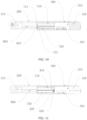
- the electronic device includes a first rear cavity component 710 and a second rear cavity component 720.
- the first rear cavity component 710, the second rear cavity component 720, and the sound generating module 300 are all disposed on one of the first housing portion 110 and the second housing portion 120.
- the other of the first housing portion 110 and the second housing portion 120 is provided with a functional component 800.
- the functional component 800 can be a circuit board, a battery, or another functional component.
- the second rear cavity 410 in the expanded state, is enclosed by at least the first rear cavity component 710 and the second rear cavity component 720.
- the second rear cavity 410 can be enclosed solely by the first rear cavity component 710 and the second rear cavity component 720, or can be enclosed by a combination of the first rear cavity component 710, the second rear cavity component 720, and another structure.
- At least one of the first rear cavity component 710 and the second rear cavity component 720 has a second connecting hole 420 formed.
- the first rear cavity component 710 has the second connecting hole 420, or that the second rear cavity component 720 has the second connecting hole 420, or that the first rear cavity component 710 and the second rear cavity component 720 each have a half-hole, and the two half-holes cooperate to form the second connecting hole 420.
- the second connecting hole 420 communicates with the second rear cavity 410.
- the first rear cavity 310 communicates with the second rear cavity 410 via the sealed alignment of the first connecting hole 320 and the second connecting hole 420.
- the second rear cavity 410 and the first rear cavity 310 in communication j ointly form the rear cavity of the sound generating module 300, fully utilizing the internal space of the electronic device. Communicating the second rear cavity 410 and the first rear cavity 310 increases the volume of the rear cavity of the sound generating module 300 and improves the sound performance of the sound generating module 300.
- the functional component 800 moves to a position between the first rear cavity component 710 and the second rear cavity component 720, and the functional component 800 blocks the first connecting hole 320.
- the first rear cavity component 710 and the second rear cavity component 720 provide an installation space for the functional component 800, fully utilizing the space between the first rear cavity component 710 and the second rear cavity component 720 to arrange the functional component 800 in the electronic device.
- the functional component 800 can block the first connecting hole 320, further utilizing the functional component 800, allowing the functional component 800 to serve multiple purposes, not only performing own function of the functional component 800 but also blocking the first connecting hole 320.
- the space between the first rear cavity component 710 and the second rear cavity component 720 is a reused space.
- the first rear cavity component 710 and the second rear cavity component 720 enclose the second rear cavity 410.
- Communicating the second rear cavity 410 and the first rear cavity 310 increases the volume of the rear cavity of the sound generating module 300 and improves the sound performance of the sound generating module 300.
- the functional component 800 can be accommodated between the first rear cavity component 710 and the second rear cavity component 720, fully utilizing the space between the first rear cavity component 710 and the second rear cavity component 720.
- the functional component 800 positioned between the first rear cavity component 710 and the second rear cavity component 720 can also block the first connecting hole 320.
- the first rear cavity component 710 is movably arranged relative to the second rear cavity component 720, and the functional component 800 is capable of moving along with one of the first housing portion 110 and the second housing portion 120.
- the first rear cavity component 710 moves to a position at which it aligns with the second rear cavity component 720 to form the second rear cavity 410
- the functional component 800 is located outside the second rear cavity 410.
- the second rear cavity 410 and the first rear cavity 310 in communication jointly form the rear cavity of the sound generating module 300. Communicating the second rear cavity 410 and the first rear cavity 310 increases the volume of the rear cavity of the sound generating module 300 and improves the sound performance of the sound generating module 300.
- the functional component 800 moves to the position between the first rear cavity component 710 and the second rear cavity component 720, the functional component 800 blocks the first connecting hole 320, and the first rear cavity component 710 is separated from the second rear cavity component 720.
- the electronic device further includes a separating member 900.
- the separating member 900 is fixed relative to the functional component 800 and is provided with a tip 910. In the expanded state, the joint region of the first rear cavity component 710 and the second rear cavity component 720 is positioned facing the tip 910. In the contracted state, the separating member 900 is supported between the first rear cavity component 710 and the second rear cavity component 720.
- the separating member 900 can extend into the joint region of the first rear cavity component 710 and the second rear cavity component 720 via the tip 910, and then separate the first rear cavity component 710 and the second rear cavity component 720, so the functional component 800 can be accommodated in the space between the first rear cavity component 710 and the second rear cavity component 720.
- the separating member 900 may alternatively be another functional component of the electronic device.
- the separating member 900 is fixed relative to the functional component 800.
- the first rear cavity component 710 is provided with a first chamfered surface 711
- the second rear cavity component 720 is provided with a second chamfered surface 721.
- the first chamfered surface 711 and the second chamfered surface 721 form a guiding space.
- An end portion or the tip 910 of the separating member 900 can extend into the guiding space formed by the first chamfered surface 711 and the second chamfered surface 721.
- a width of the guiding space decreases in a direction away from the separating member 900, where the width refers to a dimension of the guiding space in an alignment direction of the first rear cavity component 710 and the second rear cavity component 720.
- the first rear cavity component 710 and the second rear cavity component 720 can form a cylindrical cavity structure 400.
- the cylindrical cavity structure 400 is provided with holes at both ends, where the hole at the first end can be the second connecting hole 420, and the hole at the second end is for the extension of the functional component 800.
- the functional component 800 can extend into the hole at the second end to enclose the second rear cavity 410 together with the first rear cavity component 710 and the second rear cavity component 720.
- the functional component 800 can further extend into the hole at the first end and block the first connecting hole 320.
- the functional component 800 fits with the cylindrical cavity structure 400 functions in a manner similar to a piston and a piston rod.
- the first rear cavity component 710 and the second rear cavity component 720 can be separated along with relative movement between the first housing portion 110 and the second housing portion 120. In this case, other components of the electronic device can be accommodated between the first rear cavity component 710 and the second rear cavity component 720. Alternatively, the first rear cavity component 710 and the second rear cavity component 720 can keeping abutting against each other without a structure to separate the first rear cavity component 710 and the second rear cavity component 720, thus simplifying the structure of the electronic device and facilitating the assembly.
- a second elastic member 620 can be provided to drive the first rear cavity component 710 to move.
- the second elastic member 620 is provided between the first rear cavity component 710 and the first housing portion 110 or between the first rear cavity component 710 and the second housing portion 120.
- the second elastic member 620 can drive the first rear cavity component 710 to move towards the second rear cavity component 720, so that the first rear cavity component 710 abuts against the second rear cavity component 720.
- the second elastic member 620 may be a leaf spring, a coil spring, a cushion, or other elastic members.
- a third elastic member 630 can be provided to drive the second rear cavity component 720 to move.
- the third elastic member 630 is provided between the second rear cavity component 720 and the first housing portion 110 or between the second rear cavity component 720 and the second housing portion 120.
- the third elastic member 630 can drive the second rear cavity component 720 to move towards the first rear cavity component 710, so that the second rear cavity component 720 abuts against the first rear cavity component 710.
- the third elastic member 630 may be a leaf spring, a coil spring, a cushion, or other elastic members.
Landscapes
- Engineering & Computer Science (AREA)
- Signal Processing (AREA)
- Physics & Mathematics (AREA)
- Acoustics & Sound (AREA)
- Telephone Set Structure (AREA)
Applications Claiming Priority (2)
| Application Number | Priority Date | Filing Date | Title |
|---|---|---|---|
| CN202110451686.6A CN113099014B (zh) | 2021-04-26 | 2021-04-26 | 电子设备 |
| PCT/CN2022/088087 WO2022228258A1 (zh) | 2021-04-26 | 2022-04-21 | 电子设备 |
Publications (3)
| Publication Number | Publication Date |
|---|---|
| EP4333409A1 true EP4333409A1 (de) | 2024-03-06 |
| EP4333409A4 EP4333409A4 (de) | 2024-10-30 |
| EP4333409B1 EP4333409B1 (de) | 2025-06-25 |
Family
ID=76679893
Family Applications (1)
| Application Number | Title | Priority Date | Filing Date |
|---|---|---|---|
| EP22794729.8A Active EP4333409B1 (de) | 2021-04-26 | 2022-04-21 | Elektronische vorrichtung |
Country Status (6)
| Country | Link |
|---|---|
| US (1) | US20240056518A1 (de) |
| EP (1) | EP4333409B1 (de) |
| JP (1) | JP7645400B2 (de) |
| CN (1) | CN113099014B (de) |
| ES (1) | ES3037720T3 (de) |
| WO (1) | WO2022228258A1 (de) |
Families Citing this family (3)
| Publication number | Priority date | Publication date | Assignee | Title |
|---|---|---|---|---|
| CN112398986A (zh) * | 2020-11-16 | 2021-02-23 | Oppo广东移动通信有限公司 | 电子设备 |
| CN112769989B (zh) * | 2021-01-05 | 2023-04-28 | 深圳市锐尔觅移动通信有限公司 | 发声装置及电子设备 |
| CN113099014B (zh) * | 2021-04-26 | 2023-03-21 | 维沃移动通信有限公司 | 电子设备 |
Family Cites Families (24)
| Publication number | Priority date | Publication date | Assignee | Title |
|---|---|---|---|---|
| JP4777316B2 (ja) * | 2007-08-29 | 2011-09-21 | パナソニック株式会社 | 携帯端末 |
| KR101427264B1 (ko) * | 2007-12-17 | 2014-08-06 | 엘지전자 주식회사 | 휴대 단말기 |
| US8213659B2 (en) * | 2009-06-30 | 2012-07-03 | Nokia Corporation | Apparatus with adjustable speaker arrangement |
| US8711566B2 (en) * | 2011-09-02 | 2014-04-29 | Microsoft Corporation | Expandable mobile device |
| CN202818539U (zh) * | 2012-09-29 | 2013-03-20 | 广州三星通信技术研究有限公司 | 便携式终端的拉伸式音箱 |
| US9386134B2 (en) * | 2013-10-22 | 2016-07-05 | Nokia Corporation | Speaker back cavity |
| US9807483B1 (en) * | 2016-12-07 | 2017-10-31 | BassCase LLC | Mobile device case with foldable speaker system |
| CN110714976A (zh) * | 2018-07-13 | 2020-01-21 | Oppo广东移动通信有限公司 | 折叠式电子设备及折叠式电子设备的控制方法 |
| CN109324780B (zh) * | 2018-09-27 | 2021-01-15 | 联想(北京)有限公司 | 提升声音输出效果的方法及电子设备 |
| CN109769052B (zh) * | 2019-03-06 | 2020-09-08 | Oppo广东移动通信有限公司 | 电子设备 |
| CN211127868U (zh) * | 2020-03-23 | 2020-07-28 | 西安易朴通讯技术有限公司 | 移动终端 |
| CN111526453B (zh) * | 2020-04-26 | 2022-01-07 | 维沃移动通信有限公司 | 电子设备 |
| CN113645535B (zh) * | 2020-04-27 | 2022-09-09 | 华为技术有限公司 | 移动终端 |
| CN111770221B (zh) * | 2020-07-07 | 2021-07-16 | 维沃移动通信有限公司 | 电子设备 |
| CN212519077U (zh) * | 2020-08-28 | 2021-02-09 | 维沃移动通信有限公司 | 电子设备 |
| CN112055107B (zh) * | 2020-09-09 | 2022-05-10 | 维沃移动通信有限公司 | 电子设备 |
| WO2022080540A1 (ko) * | 2020-10-16 | 2022-04-21 | 엘지전자 주식회사 | 플렉서블 디스플레이 장치 |
| CN112291399B (zh) * | 2020-10-28 | 2022-08-12 | 维沃移动通信有限公司 | 发声模组、电子设备及其控制方法和控制装置 |
| CN112291397B (zh) * | 2020-10-30 | 2023-05-23 | 维沃移动通信有限公司 | 电子设备、其控制方法和控制装置及可读存储介质 |
| CN112398986A (zh) * | 2020-11-16 | 2021-02-23 | Oppo广东移动通信有限公司 | 电子设备 |
| CN112600963B (zh) * | 2020-12-11 | 2023-03-21 | 维沃移动通信有限公司 | 一种电子设备 |
| CN112615950B (zh) * | 2020-12-18 | 2023-06-30 | 维沃移动通信有限公司 | 电子设备 |
| CN113114818B (zh) * | 2021-04-16 | 2024-01-05 | 维沃移动通信有限公司 | 电子设备 |
| CN113099014B (zh) * | 2021-04-26 | 2023-03-21 | 维沃移动通信有限公司 | 电子设备 |
-
2021
- 2021-04-26 CN CN202110451686.6A patent/CN113099014B/zh active Active
-
2022
- 2022-04-21 JP JP2023565415A patent/JP7645400B2/ja active Active
- 2022-04-21 ES ES22794729T patent/ES3037720T3/es active Active
- 2022-04-21 WO PCT/CN2022/088087 patent/WO2022228258A1/zh not_active Ceased
- 2022-04-21 EP EP22794729.8A patent/EP4333409B1/de active Active
-
2023
- 2023-10-24 US US18/492,847 patent/US20240056518A1/en active Pending
Also Published As
| Publication number | Publication date |
|---|---|
| CN113099014A (zh) | 2021-07-09 |
| ES3037720T3 (en) | 2025-10-06 |
| WO2022228258A1 (zh) | 2022-11-03 |
| EP4333409A4 (de) | 2024-10-30 |
| US20240056518A1 (en) | 2024-02-15 |
| JP7645400B2 (ja) | 2025-03-13 |
| CN113099014B (zh) | 2023-03-21 |
| JP2024514970A (ja) | 2024-04-03 |
| EP4333409B1 (de) | 2025-06-25 |
Similar Documents
| Publication | Publication Date | Title |
|---|---|---|
| US20240056518A1 (en) | Electronic device | |
| US7158818B2 (en) | Slide type mobile terminal and sliding mechanism thereof | |
| EP3211507B1 (de) | Kameraanordnung und elektronische vorrichtung | |
| EP4117255B1 (de) | Elektronische vorrichtung | |
| CN112306149B (zh) | 柔性屏用折叠装置和移动终端 | |
| CN112995469B (zh) | 拍摄装置及电子设备 | |
| US10062985B2 (en) | Connector module and portable electronic device | |
| US20250133327A1 (en) | Core modules and electronic devices | |
| US20250117093A1 (en) | Electronic devices | |
| US20250119678A1 (en) | Core modules and electronic devices | |
| KR102258860B1 (ko) | 보이스 코일 모터, 조립 방법 및 이를 갖는 카메라 모듈 | |
| US20250126402A1 (en) | Core modules and electronic devices | |
| CN110518741B (zh) | 电子设备 | |
| EP4546626A1 (de) | Kameramotor, kameramodul und elektronische vorrichtung | |
| CN114793258B (zh) | 一种摄像头模组及终端设备 | |
| CN210469392U (zh) | 电子设备 | |
| KR20020088214A (ko) | 슬라이드 모듈이 적용된 휴대폰 단말기 | |
| US20250122997A1 (en) | Electronic devices | |
| CN221946408U (zh) | 一种电子设备 | |
| US20250133320A1 (en) | Electronic devices | |
| CN117233915B (zh) | 光学元件驱动装置 | |
| US20250125104A1 (en) | Electronic devices | |
| US20250126403A1 (en) | Core modules and electronic devices | |
| US20250126395A1 (en) | Electronic devices | |
| US20250126385A1 (en) | Electronic devices |
Legal Events
| Date | Code | Title | Description |
|---|---|---|---|
| STAA | Information on the status of an ep patent application or granted ep patent |
Free format text: STATUS: THE INTERNATIONAL PUBLICATION HAS BEEN MADE |
|
| PUAI | Public reference made under article 153(3) epc to a published international application that has entered the european phase |
Free format text: ORIGINAL CODE: 0009012 |
|
| STAA | Information on the status of an ep patent application or granted ep patent |
Free format text: STATUS: REQUEST FOR EXAMINATION WAS MADE |
|
| 17P | Request for examination filed |
Effective date: 20231019 |
|
| AK | Designated contracting states |
Kind code of ref document: A1 Designated state(s): AL AT BE BG CH CY CZ DE DK EE ES FI FR GB GR HR HU IE IS IT LI LT LU LV MC MK MT NL NO PL PT RO RS SE SI SK SM TR |
|
| DAV | Request for validation of the european patent (deleted) | ||
| DAX | Request for extension of the european patent (deleted) | ||
| A4 | Supplementary search report drawn up and despatched |
Effective date: 20240930 |
|
| RIC1 | Information provided on ipc code assigned before grant |
Ipc: H04M 1/03 20060101ALI20240924BHEP Ipc: H04M 1/02 20060101AFI20240924BHEP |
|
| GRAP | Despatch of communication of intention to grant a patent |
Free format text: ORIGINAL CODE: EPIDOSNIGR1 |
|
| STAA | Information on the status of an ep patent application or granted ep patent |
Free format text: STATUS: GRANT OF PATENT IS INTENDED |
|
| RIC1 | Information provided on ipc code assigned before grant |
Ipc: H04M 1/03 20060101ALI20250205BHEP Ipc: H04M 1/02 20060101AFI20250205BHEP |
|
| INTG | Intention to grant announced |
Effective date: 20250219 |
|
| GRAS | Grant fee paid |
Free format text: ORIGINAL CODE: EPIDOSNIGR3 |
|
| GRAA | (expected) grant |
Free format text: ORIGINAL CODE: 0009210 |
|
| STAA | Information on the status of an ep patent application or granted ep patent |
Free format text: STATUS: THE PATENT HAS BEEN GRANTED |
|
| AK | Designated contracting states |
Kind code of ref document: B1 Designated state(s): AL AT BE BG CH CY CZ DE DK EE ES FI FR GB GR HR HU IE IS IT LI LT LU LV MC MK MT NL NO PL PT RO RS SE SI SK SM TR |
|
| REG | Reference to a national code |
Ref country code: GB Ref legal event code: FG4D |
|
| REG | Reference to a national code |
Ref country code: CH Ref legal event code: EP |
|
| REG | Reference to a national code |
Ref country code: CH Ref legal event code: EP |
|
| REG | Reference to a national code |
Ref country code: IE Ref legal event code: FG4D |
|
| REG | Reference to a national code |
Ref country code: DE Ref legal event code: R096 Ref document number: 602022016583 Country of ref document: DE |
|
| REG | Reference to a national code |
Ref country code: NL Ref legal event code: FP |
|
| REG | Reference to a national code |
Ref country code: ES Ref legal event code: FG2A Ref document number: 3037720 Country of ref document: ES Kind code of ref document: T3 Effective date: 20251006 |
|
| PG25 | Lapsed in a contracting state [announced via postgrant information from national office to epo] |
Ref country code: FI Free format text: LAPSE BECAUSE OF FAILURE TO SUBMIT A TRANSLATION OF THE DESCRIPTION OR TO PAY THE FEE WITHIN THE PRESCRIBED TIME-LIMIT Effective date: 20250625 |
|
| REG | Reference to a national code |
Ref country code: LT Ref legal event code: MG9D |
|
| PG25 | Lapsed in a contracting state [announced via postgrant information from national office to epo] |
Ref country code: NO Free format text: LAPSE BECAUSE OF FAILURE TO SUBMIT A TRANSLATION OF THE DESCRIPTION OR TO PAY THE FEE WITHIN THE PRESCRIBED TIME-LIMIT Effective date: 20250925 Ref country code: GR Free format text: LAPSE BECAUSE OF FAILURE TO SUBMIT A TRANSLATION OF THE DESCRIPTION OR TO PAY THE FEE WITHIN THE PRESCRIBED TIME-LIMIT Effective date: 20250926 |
|
| PG25 | Lapsed in a contracting state [announced via postgrant information from national office to epo] |
Ref country code: BG Free format text: LAPSE BECAUSE OF FAILURE TO SUBMIT A TRANSLATION OF THE DESCRIPTION OR TO PAY THE FEE WITHIN THE PRESCRIBED TIME-LIMIT Effective date: 20250625 |
|
| PG25 | Lapsed in a contracting state [announced via postgrant information from national office to epo] |
Ref country code: HR Free format text: LAPSE BECAUSE OF FAILURE TO SUBMIT A TRANSLATION OF THE DESCRIPTION OR TO PAY THE FEE WITHIN THE PRESCRIBED TIME-LIMIT Effective date: 20250625 |
|
| PG25 | Lapsed in a contracting state [announced via postgrant information from national office to epo] |
Ref country code: RS Free format text: LAPSE BECAUSE OF FAILURE TO SUBMIT A TRANSLATION OF THE DESCRIPTION OR TO PAY THE FEE WITHIN THE PRESCRIBED TIME-LIMIT Effective date: 20250925 |
|
| PG25 | Lapsed in a contracting state [announced via postgrant information from national office to epo] |
Ref country code: LV Free format text: LAPSE BECAUSE OF FAILURE TO SUBMIT A TRANSLATION OF THE DESCRIPTION OR TO PAY THE FEE WITHIN THE PRESCRIBED TIME-LIMIT Effective date: 20250625 |
|
| PG25 | Lapsed in a contracting state [announced via postgrant information from national office to epo] |
Ref country code: PT Free format text: LAPSE BECAUSE OF FAILURE TO SUBMIT A TRANSLATION OF THE DESCRIPTION OR TO PAY THE FEE WITHIN THE PRESCRIBED TIME-LIMIT Effective date: 20251027 |
|
| REG | Reference to a national code |
Ref country code: AT Ref legal event code: MK05 Ref document number: 1807840 Country of ref document: AT Kind code of ref document: T Effective date: 20250625 |
|
| PG25 | Lapsed in a contracting state [announced via postgrant information from national office to epo] |
Ref country code: IS Free format text: LAPSE BECAUSE OF FAILURE TO SUBMIT A TRANSLATION OF THE DESCRIPTION OR TO PAY THE FEE WITHIN THE PRESCRIBED TIME-LIMIT Effective date: 20251025 |
|
| PG25 | Lapsed in a contracting state [announced via postgrant information from national office to epo] |
Ref country code: AT Free format text: LAPSE BECAUSE OF FAILURE TO SUBMIT A TRANSLATION OF THE DESCRIPTION OR TO PAY THE FEE WITHIN THE PRESCRIBED TIME-LIMIT Effective date: 20250625 Ref country code: SM Free format text: LAPSE BECAUSE OF FAILURE TO SUBMIT A TRANSLATION OF THE DESCRIPTION OR TO PAY THE FEE WITHIN THE PRESCRIBED TIME-LIMIT Effective date: 20250625 |
|
| PG25 | Lapsed in a contracting state [announced via postgrant information from national office to epo] |
Ref country code: CZ Free format text: LAPSE BECAUSE OF FAILURE TO SUBMIT A TRANSLATION OF THE DESCRIPTION OR TO PAY THE FEE WITHIN THE PRESCRIBED TIME-LIMIT Effective date: 20250625 |
|
| PG25 | Lapsed in a contracting state [announced via postgrant information from national office to epo] |
Ref country code: PL Free format text: LAPSE BECAUSE OF FAILURE TO SUBMIT A TRANSLATION OF THE DESCRIPTION OR TO PAY THE FEE WITHIN THE PRESCRIBED TIME-LIMIT Effective date: 20250625 |
|
| PG25 | Lapsed in a contracting state [announced via postgrant information from national office to epo] |
Ref country code: EE Free format text: LAPSE BECAUSE OF FAILURE TO SUBMIT A TRANSLATION OF THE DESCRIPTION OR TO PAY THE FEE WITHIN THE PRESCRIBED TIME-LIMIT Effective date: 20250625 |
|
| PG25 | Lapsed in a contracting state [announced via postgrant information from national office to epo] |
Ref country code: SK Free format text: LAPSE BECAUSE OF FAILURE TO SUBMIT A TRANSLATION OF THE DESCRIPTION OR TO PAY THE FEE WITHIN THE PRESCRIBED TIME-LIMIT Effective date: 20250625 |