EP4325829B1 - Verfahren zur durchführung von transformationen von farbdaten - Google Patents
Verfahren zur durchführung von transformationen von farbdaten Download PDFInfo
- Publication number
- EP4325829B1 EP4325829B1 EP23191426.8A EP23191426A EP4325829B1 EP 4325829 B1 EP4325829 B1 EP 4325829B1 EP 23191426 A EP23191426 A EP 23191426A EP 4325829 B1 EP4325829 B1 EP 4325829B1
- Authority
- EP
- European Patent Office
- Prior art keywords
- colour
- color
- values
- components
- combination
- Prior art date
- Legal status (The legal status is an assumption and is not a legal conclusion. Google has not performed a legal analysis and makes no representation as to the accuracy of the status listed.)
- Active
Links
Images


Classifications
-
- H—ELECTRICITY
- H04—ELECTRIC COMMUNICATION TECHNIQUE
- H04N—PICTORIAL COMMUNICATION, e.g. TELEVISION
- H04N1/00—Scanning, transmission or reproduction of documents or the like, e.g. facsimile transmission; Details thereof
- H04N1/46—Colour picture communication systems
- H04N1/54—Conversion of colour picture signals to a plurality of signals some of which represent particular mixed colours, e.g. for textile printing
-
- H—ELECTRICITY
- H04—ELECTRIC COMMUNICATION TECHNIQUE
- H04N—PICTORIAL COMMUNICATION, e.g. TELEVISION
- H04N1/00—Scanning, transmission or reproduction of documents or the like, e.g. facsimile transmission; Details thereof
- H04N1/46—Colour picture communication systems
- H04N1/56—Processing of colour picture signals
- H04N1/60—Colour correction or control
- H04N1/6016—Conversion to subtractive colour signals
- H04N1/6022—Generating a fourth subtractive colour signal, e.g. under colour removal, black masking
- H04N1/6025—Generating a fourth subtractive colour signal, e.g. under colour removal, black masking using look-up tables
Definitions
- the present invention relates to a method for carrying out transformations of color data from a source color space with n colors into a target color space with m values using a transformation rule TRV.
- the starting point is digital layouts, which can contain, for example, color images from photographs or scans, illustrations and text. These layouts are templates that are intended to be reproduced in the form of printed products. Such a layout is designed or developed in whatever form and, in terms of color appearance, represents what is desired for the respective intended purpose.
- a layout usually comprises several layout objects. Each individual layout object therefore has a color appearance that can be clearly identified. As is well known, color appearances are created by mixing just a few colors; for printed products, for example, by simply overprinting rasterized printing inks, with each color making a certain contribution through its effect and the final result being created through the interaction of the different color layers.
- each individual layout object is defined by its color values (of image pixels, outline colors, or fill colors), which represent the data source. In the case of image pixels, these are often millions of pixels, each with its own color values. These source color values always refer to a source color space with a specific number of colors.
- each object in the layout is assigned a color space, which usually has a relationship to a device, often a very specific RGB color space such as sRGB or Adobe RGB, or a CMYK color space, just black (grayscale), or another printing color space.
- the object color values are numbered accordingly as RGB values, CMYK or grayscale values (0-100% color), or other color values.
- the total number of device colors in the source color space is denoted here by n.
- ICC color profiles (ISO 15076-1:2010), layouts by PDF and PDF/X files (ISO 15930 series), which can contain or reference these ICC color profiles.
- the layout may need to be reproduced for a variety of reasons and motives.
- a wide variety of printing processes and printing presses are available for reproduction. These have the ability to apply a specific number of colors to a substrate in a specific way. These are the device colors of the printing system. These define or form the basis of the target color space, which in turn includes all conceivable combinations of the printing system's device colors. These are referred to as the m device colors of the target color space. Transformations into device-independent values are also often necessary, such as Lab or spectral colors (see below), for example to be able to check the results of subsequent print measurements or to provide a device-independent database for display on any device. This is why we generally speak of the m values of the target color space.
- Standardized color spaces are often used as source color spaces in layout design, but printing takes place using specific output systems with their own unique color behavior. Therefore, for each screen point in the layout, it is necessary to transform the given combination of the n device colors of the source color space into a combination of the m device colors of the target color space required for printing.
- the goal is to produce a print result that is as close as possible to the original, i.e., the digital layout, and ideally, to create the same appearance for the viewer.
- a raster point or pixel is each point in a layout resulting from a predefined rasterization of the layout objects. This, in turn, is related to the so-called resolution of the display, for example, for creating the printing form. If a raster with i rows and j columns is placed over a layout, the resulting resolution is i x j pixels. Each individual pixel can then be identified based on its color composition.
- Color transformations are used to convert layout data into printable data for a desired set of printing colors. This creates, for example, consistent, pure CMYK data. for offset printing. Color transformations are also used to accurately simulate the color appearance of this print data before printing. The color appearance is usually described device-independently in the CIELAB color space (Lab for short) or using spectral reflectance factors. The print data is transformed with its assigned color space into these device-independent color data. These are displayed on a calibrated screen or with special test printing systems (a so-called "proof", usually with inkjet systems). Related to this is the task of adapting print data for other printing processes, i.e., using a transformation to create new print data for other printing inks from existing print data while preserving the original color impression as closely as possible.
- Machines with 7-10 color units are not uncommon in flexographic, offset, and gravure printing.
- Designers of branded goods can select their printing inks from thousands of spot colors, including over 2,000 shades in the PANTONE® system. These printing inks are produced and supplied by ink manufacturers.
- Digital printing uses inkjet and toner-based printing machines, which often contain 6-8 color units but are operated with fixed ink sets, as inkjet inks and colored toners often require very specific, machine-dependent processing properties, or the change is technically impossible. would be too complicated.
- Typical color sets contain CMYK supplemented by orange or red, green, blue or violet, and white.
- Digital printing processes are currently slower than conventional printing processes, but since no printing plates need to be created and inks are not changed, the setup effort is much lower, making short runs more economical and personalized printing possible.
- the desire here is therefore to print packaging that was initially produced conventionally in short runs or even personalized (run of 1) as needed, but with the color appearance being as identical as possible to previously printed products that were produced with individual spot colors. This is because different batches can be placed next to each other on the sales shelf.
- the print data available for the conventional printing process is converted from its source color space into a target color space that describes the digital printing process.
- personalized printing different source data must be transformed for each copy, which then becomes a bottleneck.
- the color transformations mentioned above convert from a source color space Q (for example, with n device colors) to another target color space Z with m values (for example, device colors or the three CIELAB values L, a, b).
- a transformation rule TRV This can be a calculation formula, transformation models, or transformation tables already created based on the TRV. They often have to be applied per pixel, so high throughput is important (millions of pixels per second).
- interpolation takes place in a custom table, such as the ICC industry standard.
- the table is structured for combinations of n color values. Each of the n input colors can assume values between 0 and 100% ink coverage. The table cannot list all combinations, but samples each input color at a specific, predefined resolution.
- the generation of transformation tables involves familiar Measures. They are based, for example, on spectrometric measurements of printed colors, calculations for estimation and/or interpolation, and the like.
- a model is usually a mathematically based transformation rule. This allows the Lab color value of an overprint to be estimated from the individual printing colors. This happens, for example, when displaying layouts or PDF files on screen and is fast, but inaccurate.
- the ICC enhancement iccMAX proposes calculating individual colors spectrally, or using tables for the CMYK content and modifying their value for each additional color. In all cases, adding individual Colors are too inaccurate because it does not or insufficiently takes into account the interaction of the colors in overprints in which these colors are involved.
- the color characterization of superimposed inks is mapped using tables that transform the ink components on the input side into m device-independent values (e.g., CIELAB color values or reflectance spectra) or into m device color values of another output device.
- m device-independent values e.g., CIELAB color values or reflectance spectra
- m device color values of another output device e.g., CIELAB color values or reflectance spectra
- These output-side values are tuples, e.g., 3 Lab components, m ink components, or m spectral value components (for m wavelength bands). Calculations on these tuples are performed component by component.
- CMYK test charts are frequently used to accurately sample the color gamut of these four important colors.
- CMYK is supplemented with additional process colors to expand the color gamut, orange or red (here O), green (G), blue, or violet (here V) are often used. These colors are intended to expand a hue sector (ECG, Expanded Color Gamut).
- Equinox TM uses CMYK test charts and replaces one color with its complementary color in the print. This creates, for example, test charts for OMYK (C replaced by O), CGYK (M replaced by G), CMVK (Y replaced by V), and thus also the transformation tables for the color groups CMYK, OMYK, CGYK, and CMVK.
- Trapping is the enlargement of the contours of adjacent vector objects in the layout to avoid registration-related "flashing" in conventional printing processes. These enlargements cause the objects to overlap slightly. The overlap can then contain more printing colors than the individual objects (e.g., the union). Especially in proofing applications, these process-critical new edges are also important to see. It would be unacceptable to instead receive a signal color that indicates that no information is available for this overprint.
- Neighboring pixels are then mixed proportionally by rescaling (bilinear or bicubic scaling, antialiasing). The mixture then also contains the union of the printing colors of the contributing pixels.
- input data to be transformed can contain five colors, even if the layout contains no more than four-color objects, both for vector and pixel data.
- conventional transformations for example, using transformation tables, are not possible.
- the US 2011/0007332 discloses a method for enabling transformations of n > 4 colors, which requires coarse-resolution n-color transformation data in addition to the precise 4-color transformations.
- the method uses multiple interpolations to first obtain a rough result from the coarse n-dimensional table and to improve this by combining it with interpolations in the precise 4-color tables and further interpolations of the intermediate results.
- the method cannot be applied without the n-color transformation table.
- generating them is very complex, for example if, as proposed there, they are based on several measurements on prints with many colors, the production of which requires suitable printing forms and setup times for each color combination, and which is very uneconomical given the large number of common spot colors, as described above. It is desirable to be able to manage without knowledge of n-color tables.
- the object of the invention is to improve a method for carrying out color space transformations using transformation rules in such a way that combinations of color data from the n colors of the source color space, which include both portions or subgroups for which transformation tables are available and those for which no transformation tables are available, can be transformed with high accuracy into the m values of the target color space in such a way that a result that is as close as possible to the original can be achieved.
- the invention represents a fast estimation method that assembles mixtures from known subcomponents. For example, if the input is for a mixture CMYKO required, but only interpolation tables or ICC color profiles for CMYK and OMYK are available, the entries are cleverly combined.
- the underlying idea is to construct the output values for an unknown input combination step by step from the output values of known input combinations, estimating in each step the color impact (on the output values) of added input colors and adding this contribution in a way that is explained in more detail below.
- the desired contribution of partial colors within this color combination is determined as follows.
- the input combination "AB” is decomposed into the contribution of the partial colors “A” and the contribution of the remaining colors “B.”
- the goal is to describe the color effect of "A” relative to the base "B,” so that it can then be applied to another base “C” to estimate an unknown combination "AC.”
- the blend AB is viewed as an overlay of two layers A and B, and the established blending modes of computer graphics are used (W3C, PDF, Photoshop).
- the most important blending mode is "Multiply.” It is based on linear color values, referred to here as “linear values,” normalized between 0 and 1. "Multiply” multiplies the linear values of two layers in a light-related color space (in computer graphics, this is often RGB) to simulate the darkening, coloring overlay of the colors. The effect is similar to an overprint.
- Linear values of the mixture AB (linear values of A) * (linear values of B).
- the desired color contribution of A i.e., the factor "linear values of A,” can be solved for.
- the linear values of AB and B are both known from the table containing AB. In an optical analogy, the linear values of A behave like a transmission factor of the added colors applied to the linear values of the base B.
- non-linear RGB target color spaces calculations are performed in their linearized domains. For example, in the case of gamma-based RGB color spaces with values from 0 to 1, the non-linearity is removed by raising the gamma power, the linearized RGB values are used, and finally, the non-linear RGB space is returned to by raising the gamma power.
- the ink values x between 0-100% are inverted to their complementary values (1-x) and linearized analogously to the RGB case, and delinearized again after blending.
- These complementary values are the linear values for multiply. Calculating with ink values thus corresponds to the "Screen” blending mode, also known as "inverse multiplying.”
- the complementary values again behave like transmission factors, and the printing ink contributions themselves therefore behave like absorptions.
- the effect on the substrate of each input color can be described separately by comparing the output values of the input color value with the output values of the substrate (input color value zero). The difference in the output values is a measure of the color effect of the input color in the amount described by the value. All these effects are then added together.
- the further proposal according to the invention significantly improves the estimation of a color combination by gradually adding individual colors to the substrate by proceeding in printing order, i.e. in the way the individual printing inks are applied successively to the substrate, and by taking into account process-typical ink acceptance properties, which are known to be approximately 75% for wet-on-wet overprinting of solid colors in offset printing, by exponentially correcting the transmission factors, i.e. the linear values, with the ink acceptance.
- the method according to the invention is generalized as follows: For a given input, color groups are searched for that have a transformation, perhaps as a table, and that contain a portion of the input combination. (The complete combination is not included; it is to be estimated.) This set of color groups is processed step by step. For example, one color group is chosen as a starting point, and in the first step, a second color group is selected to add an input color. In subsequent steps, additional color groups are selected until all colors occurring in the input have been added.
- the common inks (intersection) of the color groups involved in the step are identified – this is at least two, but no more than the entire set. If there are no common inks, the intersection is the unprinted substrate, i.e., the zero entry in the table.
- Each color group in the step contains both the common printing inks and additional ones. These additional, i.e., non-common printing inks are identified for each color group.
- the contained part of the input is considered a mixture.
- the mixture is decomposed into the contribution of the common colors, which represents the "base” in the above calculation, and the contribution of the additional (“added”) colors. This provides a measure of their color effect (relative to the base).
- the color contribution of a color component A in a mixture AB relative to a base B is determined for each group in the target color space of the output colors. It is crucial that this contribution can then be applied to other bases, i.e., combined. Thus, for each color group involved, the contributions of the common colors as the base and the additional colors as the complement are determined. The contributions of the complements can now be applied to the other color groups in this step. This will yield one or more estimates for a previously unknown color mixture.
- a useful weight is the relative certainty of the estimate (e.g., the distance from the partial results considered known). An example below explains how this increases the quality of the transformation results of color transitions because jumps are avoided.
- Averaging completes a step.
- the final result of the step as a newly generated color group, now known through estimation, is then calculated in the next step with additional color groups, which in turn contribute additional input colors, until finally the combination of all input colors is estimated. In this way, mixtures are assembled step by step until the complete input is achieved.
- the desired input color combination is CMYK+O with proportions of 30% C, 60% M, 10% Y, 20% K, and 50% O.
- the remaining color contribution of 50% O is determined as follows:
- the common colors of CMYK and MYKO are MYK.
- the additional color of CMYK is C, and that of MYKO is O.
- MYK is defined as base B with the values 60% M, 10% Y, 20%K was taken, the output values were read, and likewise the output values of the mixture AB with the values 60% M, 10% Y, 20% K, 50% O.
- the transmission factor by which the addition of the color quantity A of 50% O changes the base is the quotient of the output values of AB and B.
- This factor is applied (multiplied) to the above reading of the output values of the CMYK color group 50% C, 60% M, 10% Y, 20% K and gives the desired result of the total color values of CMYKO.
- this size-dependent procedure still contains a preference order, which It becomes a problem when two values in a gradient become similar.
- cyan were to increase pixel by pixel from 30% to over 50%.
- the size-dependent sorting would choose MYKO as the base for the first pixels and add the smaller C value.
- C is the same size or slightly larger, the base would switch to CMYK because the O contribution is now the smaller.
- a jump occurs because the result of base CMYK + contribution 50% O is not equal to the result of base MYKO + contribution 50% C. This jump is an undesirable artifact.
- the input color data is from a source color space with four color components q(1), q(2), q(3), q(4). These are to be transformed into a target color space with three color values z(1), z(2), z(3).
- the input data set includes the following values for q(1), q(2), q(3), q(4): 20 40 60 80
- Color 1 is chosen because its color component q(1) is the smallest and therefore a presumably smaller influence must be estimated and applied to a large, known target color combination of the color components of colors 2-4.
- the invention describes a solution that is practical and implementable for a person skilled in the art, with which a sufficiently fast and high-quality color space transformation into the color space of the specific printing system is possible even with a very high resolution of a layout and a large number of input colors.
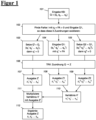
- step 111 the output Z i without the contribution of color i is multiplied component-wise by the ratio V i (110). This produces the desired result 112, which is the estimate of the target color values for the entire color group input combination KB.
- the color group of the input combination is reduced by removing color i, provided that an output is assigned to this smaller color group, and then color i is added by estimation, so that the original color group is complete again.
- this reduction can also be performed multiple times, so that after n steps at the latest, one arrives at the empty color group, the unprinted substrate, for which an assignment is easily determined. From there, If necessary, you can add each individual color step by step until you have the complete color group, as Figure 2 shows.
- color data 201 from the source color space with n colors that are to be transformed and represent the input.
- a color group is searched for for which target color data 203 is present in the transformation rule. This color group is a subset of the color data 201 and is to be gradually supplemented to form the complete set, while at the same time the target color data 203 is also supplemented to form the complete output. If the current color group is already complete in step 204, the output 205 is finished. Otherwise, one of the missing colors i is selected in step 206.
- Both selected data sets, the color group with component of i and the color group without component of i, are color data of the n colors of the source color space.
- the ratios of the m values of the color data set Z1 (108) to the m values of the color data set Z2 (210) are calculated component by component.
- These ratios V i are applied component by component to the current output in step 212 as an estimated effect of color i, and color i is added to the current color group (213). This is repeated if necessary until the color group is complete and the result of transformation 205 is available.
- Figure 3 illustrates the well-known occurrence of more than 4-color overprints, although the individual objects do not use more than 4 colors, in addition to the description on page 7.
- Shown is a stylized packaging design 201 with an image area 202, which is constructed in 4 colors in CMYK and a logo area 203 with a spot color.
- the enlarged view 204 of the design shows that the contours of the CMYK image and the spot color rectangle do not overlap, but only abut each other. Thus, there are no 5-color areas in the design.
- overprinting 205 in print production, which is used as described to avoid registration-related flashes, enlarges one of the contours and thereby creates overprinting areas 206 of the spot color with CMYK, where five colors now appear simultaneously.
- rasterization with antialiasing can also mix 207 raster points from portions of their respective areas, creating an additional 5-color pixel 208 with CMYK and spot color components.
Landscapes
- Engineering & Computer Science (AREA)
- Multimedia (AREA)
- Signal Processing (AREA)
- Textile Engineering (AREA)
- Facsimile Image Signal Circuits (AREA)
- Image Processing (AREA)
Applications Claiming Priority (1)
| Application Number | Priority Date | Filing Date | Title |
|---|---|---|---|
| EP22020391 | 2022-08-15 |
Publications (2)
| Publication Number | Publication Date |
|---|---|
| EP4325829A1 EP4325829A1 (de) | 2024-02-21 |
| EP4325829B1 true EP4325829B1 (de) | 2025-04-02 |
Family
ID=82939792
Family Applications (1)
| Application Number | Title | Priority Date | Filing Date |
|---|---|---|---|
| EP23191426.8A Active EP4325829B1 (de) | 2022-08-15 | 2023-08-14 | Verfahren zur durchführung von transformationen von farbdaten |
Country Status (3)
| Country | Link |
|---|---|
| US (1) | US11962738B2 (enExample) |
| EP (1) | EP4325829B1 (enExample) |
| JP (1) | JP2024026055A (enExample) |
Families Citing this family (2)
| Publication number | Priority date | Publication date | Assignee | Title |
|---|---|---|---|---|
| EP4325831B1 (de) * | 2022-08-15 | 2025-04-02 | GMG GmbH & Co. KG | Verfahren zur durchführung von transformationen von farbdaten mit transformationsvorschrift |
| EP4325830A1 (de) * | 2022-08-15 | 2024-02-21 | GMG GmbH & Co. KG | Verfahren zur durchführung von farbraumtransformationen mit transformationstabellen |
Family Cites Families (13)
| Publication number | Priority date | Publication date | Assignee | Title |
|---|---|---|---|---|
| AU7973891A (en) * | 1990-06-01 | 1991-12-31 | Cymbolic Sciences International Ltd. | Real time transformation between colour spaces |
| US5734800A (en) * | 1994-11-29 | 1998-03-31 | Pantone, Inc. | Six-color process system |
| US5892891A (en) | 1996-11-20 | 1999-04-06 | Xerox Corporation | System for printing color images with extra colorants in addition to primary colorants |
| JP4154116B2 (ja) * | 2000-09-28 | 2008-09-24 | 富士通株式会社 | 色変換テーブル作成方法および色変換テーブル作成装置並びに色変換テーブル作成プログラムを記録したコンピュータ読取可能な記録媒体 |
| DE50109949D1 (de) * | 2001-04-05 | 2006-07-06 | Gretag Macbeth Ag | Verfahren zur Erzeugung einer Farbpalette |
| JP4164346B2 (ja) * | 2002-11-27 | 2008-10-15 | キヤノン株式会社 | 色分解テーブル作成方法、画像処理装置および印刷装置 |
| US7408673B1 (en) * | 2003-08-21 | 2008-08-05 | Adobe Systems Incorporated | Mixed color groups |
| DE102004003300B4 (de) | 2004-01-22 | 2014-03-06 | Heidelberger Druckmaschinen Ag | Verfahren zur Herstellung eines Prüfdrucks für einen Druckprozess mit mehr als vier Druckfarben |
| US20090310154A1 (en) * | 2006-05-30 | 2009-12-17 | Hewlett-Parkard Development Company, L.P. | Chromatic Component Replacement |
| US8395815B2 (en) | 2009-07-09 | 2013-03-12 | Xerox Corporation | System and method for modeling higher dimension color response |
| EP2381230B1 (de) * | 2010-04-23 | 2018-06-13 | GMG GmbH & Co. KG | Verfahren zur Erstellung von Überdruckvorhersagen |
| JP6292206B2 (ja) * | 2015-10-21 | 2018-03-14 | コニカミノルタ株式会社 | プロファイル生成装置及びプロファイル生成プログラム並びにカラーマッチング方法 |
| JP7524681B2 (ja) * | 2020-08-31 | 2024-07-30 | 株式会社リコー | 画像処理装置、画像処理方法およびプログラム |
-
2023
- 2023-08-14 JP JP2023132146A patent/JP2024026055A/ja active Pending
- 2023-08-14 EP EP23191426.8A patent/EP4325829B1/de active Active
- 2023-08-15 US US18/234,080 patent/US11962738B2/en active Active
Also Published As
| Publication number | Publication date |
|---|---|
| EP4325829A1 (de) | 2024-02-21 |
| US11962738B2 (en) | 2024-04-16 |
| US20240056542A1 (en) | 2024-02-15 |
| JP2024026055A (ja) | 2024-02-28 |
Similar Documents
| Publication | Publication Date | Title |
|---|---|---|
| DE3750101T2 (de) | Elektronische Graphiksysteme. | |
| DE69515071T2 (de) | Farbdruckerabgleich mit verbesserter Farbabbildungslinearität | |
| DE69806153T2 (de) | Anordnung und verfahren zur hochgenauen kolorimetrischen charakterisierung von anzeigevorrichtungen | |
| DE10252575A1 (de) | Bestimmung von Bezugspunkten für einen Aufbau einer Erster-Farbraum-Zu-Zweiter-Farbraum-Nachschlag- tabelle | |
| EP2506559B1 (de) | Verfahren zur Graubalancekorrektur eines Druckprozesses | |
| EP2362633B1 (de) | Verfahren zur Bestimmung von Charakterisierungsdaten eines Druckprozesses | |
| DE10359322B4 (de) | Verfahren und Vorrichtung zur Korrektur von nicht angepassten Druckdaten anhand eines farbmetrisch vermessenen Referenzbogens | |
| EP4325829B1 (de) | Verfahren zur durchführung von transformationen von farbdaten | |
| DE3919726A1 (de) | Verfahren und anordnung zur erzeugung von farbbild-reproduktionen | |
| EP1237355B1 (de) | Verfahren zur Bestimmung eines Farbprofils für das Drucken mit mehr als drei bunten Druckfarben | |
| DE102004003300B4 (de) | Verfahren zur Herstellung eines Prüfdrucks für einen Druckprozess mit mehr als vier Druckfarben | |
| EP0528094B1 (de) | Verfahren und Vorrichtung zur Ermittlung von Rasterprozentwerten | |
| EP2491708B1 (de) | Verfahren zur erstellung einer optimierten druckerkalibrierung | |
| DE69319857T2 (de) | Verfahren und Gerät zur Verbesserung von Vollfarbbildern mit Verwendung von Verfahrensschwärze und Druckerschwärze | |
| DE102008031735A1 (de) | Graubalancekorrektur eines Druckverfahrens | |
| DE10205476A1 (de) | Verfahren zur Druckprozesstransformation des Farbdrucks für Schwarzweiß-Bilder | |
| EP2966850B1 (de) | Verfahren zur berechnung von ersatzfarben für sonderfarben | |
| DE10150837B4 (de) | Verfahren zur Bestimmung bzw. Umrechnung von Farbprofilen | |
| EP4094944B1 (de) | Verfahren zur bestimmung eines übereinstimmungsfaktors hinsichtlich der farblichen übereinstimmung eines erstellten druckerzeugnisses mit vorgegebenen sollwerten für farben | |
| EP4325831B1 (de) | Verfahren zur durchführung von transformationen von farbdaten mit transformationsvorschrift | |
| EP1985107B1 (de) | Verfahren zur transformation von farbwerten | |
| EP4325830A1 (de) | Verfahren zur durchführung von farbraumtransformationen mit transformationstabellen | |
| DE60003373T2 (de) | Verfahren und Vorrichtung zur Kalibrierung einer Druckvorrichtung | |
| DE69526276T2 (de) | Farbdrucksystem | |
| DE102015204956B4 (de) | Verfahren zur Berechnung von Multicolor-Profilen |
Legal Events
| Date | Code | Title | Description |
|---|---|---|---|
| PUAI | Public reference made under article 153(3) epc to a published international application that has entered the european phase |
Free format text: ORIGINAL CODE: 0009012 |
|
| STAA | Information on the status of an ep patent application or granted ep patent |
Free format text: STATUS: THE APPLICATION HAS BEEN PUBLISHED |
|
| AK | Designated contracting states |
Kind code of ref document: A1 Designated state(s): AL AT BE BG CH CY CZ DE DK EE ES FI FR GB GR HR HU IE IS IT LI LT LU LV MC ME MK MT NL NO PL PT RO RS SE SI SK SM TR |
|
| STAA | Information on the status of an ep patent application or granted ep patent |
Free format text: STATUS: REQUEST FOR EXAMINATION WAS MADE |
|
| 17P | Request for examination filed |
Effective date: 20240621 |
|
| RBV | Designated contracting states (corrected) |
Designated state(s): AL AT BE BG CH CY CZ DE DK EE ES FI FR GB GR HR HU IE IS IT LI LT LU LV MC ME MK MT NL NO PL PT RO RS SE SI SK SM TR |
|
| GRAP | Despatch of communication of intention to grant a patent |
Free format text: ORIGINAL CODE: EPIDOSNIGR1 |
|
| STAA | Information on the status of an ep patent application or granted ep patent |
Free format text: STATUS: GRANT OF PATENT IS INTENDED |
|
| INTG | Intention to grant announced |
Effective date: 20241105 |
|
| GRAS | Grant fee paid |
Free format text: ORIGINAL CODE: EPIDOSNIGR3 |
|
| GRAA | (expected) grant |
Free format text: ORIGINAL CODE: 0009210 |
|
| STAA | Information on the status of an ep patent application or granted ep patent |
Free format text: STATUS: THE PATENT HAS BEEN GRANTED |
|
| AK | Designated contracting states |
Kind code of ref document: B1 Designated state(s): AL AT BE BG CH CY CZ DE DK EE ES FI FR GB GR HR HU IE IS IT LI LT LU LV MC ME MK MT NL NO PL PT RO RS SE SI SK SM TR |
|
| REG | Reference to a national code |
Ref country code: GB Ref legal event code: FG4D Free format text: NOT ENGLISH |
|
| REG | Reference to a national code |
Ref country code: CH Ref legal event code: EP |
|
| REG | Reference to a national code |
Ref country code: IE Ref legal event code: FG4D Free format text: LANGUAGE OF EP DOCUMENT: GERMAN |
|
| REG | Reference to a national code |
Ref country code: DE Ref legal event code: R096 Ref document number: 502023000769 Country of ref document: DE |
|
| REG | Reference to a national code |
Ref country code: NL Ref legal event code: MP Effective date: 20250402 |
|
| PG25 | Lapsed in a contracting state [announced via postgrant information from national office to epo] |
Ref country code: NL Free format text: LAPSE BECAUSE OF FAILURE TO SUBMIT A TRANSLATION OF THE DESCRIPTION OR TO PAY THE FEE WITHIN THE PRESCRIBED TIME-LIMIT Effective date: 20250402 |
|
| PG25 | Lapsed in a contracting state [announced via postgrant information from national office to epo] |
Ref country code: FI Free format text: LAPSE BECAUSE OF FAILURE TO SUBMIT A TRANSLATION OF THE DESCRIPTION OR TO PAY THE FEE WITHIN THE PRESCRIBED TIME-LIMIT Effective date: 20250402 Ref country code: ES Free format text: LAPSE BECAUSE OF FAILURE TO SUBMIT A TRANSLATION OF THE DESCRIPTION OR TO PAY THE FEE WITHIN THE PRESCRIBED TIME-LIMIT Effective date: 20250402 Ref country code: PT Free format text: LAPSE BECAUSE OF FAILURE TO SUBMIT A TRANSLATION OF THE DESCRIPTION OR TO PAY THE FEE WITHIN THE PRESCRIBED TIME-LIMIT Effective date: 20250804 |
|
| PGFP | Annual fee paid to national office [announced via postgrant information from national office to epo] |
Ref country code: DE Payment date: 20250723 Year of fee payment: 3 |
|
| REG | Reference to a national code |
Ref country code: LT Ref legal event code: MG9D |
|
| PG25 | Lapsed in a contracting state [announced via postgrant information from national office to epo] |
Ref country code: GR Free format text: LAPSE BECAUSE OF FAILURE TO SUBMIT A TRANSLATION OF THE DESCRIPTION OR TO PAY THE FEE WITHIN THE PRESCRIBED TIME-LIMIT Effective date: 20250703 Ref country code: NO Free format text: LAPSE BECAUSE OF FAILURE TO SUBMIT A TRANSLATION OF THE DESCRIPTION OR TO PAY THE FEE WITHIN THE PRESCRIBED TIME-LIMIT Effective date: 20250702 |
|
| PG25 | Lapsed in a contracting state [announced via postgrant information from national office to epo] |
Ref country code: PL Free format text: LAPSE BECAUSE OF FAILURE TO SUBMIT A TRANSLATION OF THE DESCRIPTION OR TO PAY THE FEE WITHIN THE PRESCRIBED TIME-LIMIT Effective date: 20250402 |
|
| PG25 | Lapsed in a contracting state [announced via postgrant information from national office to epo] |
Ref country code: BG Free format text: LAPSE BECAUSE OF FAILURE TO SUBMIT A TRANSLATION OF THE DESCRIPTION OR TO PAY THE FEE WITHIN THE PRESCRIBED TIME-LIMIT Effective date: 20250402 |
|
| PG25 | Lapsed in a contracting state [announced via postgrant information from national office to epo] |
Ref country code: HR Free format text: LAPSE BECAUSE OF FAILURE TO SUBMIT A TRANSLATION OF THE DESCRIPTION OR TO PAY THE FEE WITHIN THE PRESCRIBED TIME-LIMIT Effective date: 20250402 |
|
| PGFP | Annual fee paid to national office [announced via postgrant information from national office to epo] |
Ref country code: AT Payment date: 20251020 Year of fee payment: 3 |
|
| PG25 | Lapsed in a contracting state [announced via postgrant information from national office to epo] |
Ref country code: RS Free format text: LAPSE BECAUSE OF FAILURE TO SUBMIT A TRANSLATION OF THE DESCRIPTION OR TO PAY THE FEE WITHIN THE PRESCRIBED TIME-LIMIT Effective date: 20250702 |
|
| PG25 | Lapsed in a contracting state [announced via postgrant information from national office to epo] |
Ref country code: IS Free format text: LAPSE BECAUSE OF FAILURE TO SUBMIT A TRANSLATION OF THE DESCRIPTION OR TO PAY THE FEE WITHIN THE PRESCRIBED TIME-LIMIT Effective date: 20250802 |
|
| PG25 | Lapsed in a contracting state [announced via postgrant information from national office to epo] |
Ref country code: LV Free format text: LAPSE BECAUSE OF FAILURE TO SUBMIT A TRANSLATION OF THE DESCRIPTION OR TO PAY THE FEE WITHIN THE PRESCRIBED TIME-LIMIT Effective date: 20250402 |