EP4314834B1 - Diagnose von morbus alzheimer durch nachweis von autoantikörpern gegen das y-box-bindende protein-1 (yb-1) - Google Patents
Diagnose von morbus alzheimer durch nachweis von autoantikörpern gegen das y-box-bindende protein-1 (yb-1) Download PDFInfo
- Publication number
- EP4314834B1 EP4314834B1 EP22714878.0A EP22714878A EP4314834B1 EP 4314834 B1 EP4314834 B1 EP 4314834B1 EP 22714878 A EP22714878 A EP 22714878A EP 4314834 B1 EP4314834 B1 EP 4314834B1
- Authority
- EP
- European Patent Office
- Prior art keywords
- peptide
- antibody
- antibodies
- sample
- immunoassay
- Prior art date
- Legal status (The legal status is an assumption and is not a legal conclusion. Google has not performed a legal analysis and makes no representation as to the accuracy of the status listed.)
- Active
Links
Images

Classifications
-
- G—PHYSICS
- G01—MEASURING; TESTING
- G01N—INVESTIGATING OR ANALYSING MATERIALS BY DETERMINING THEIR CHEMICAL OR PHYSICAL PROPERTIES
- G01N33/00—Investigating or analysing materials by specific methods not covered by groups G01N1/00 - G01N31/00
- G01N33/48—Biological material, e.g. blood, urine; Haemocytometers
- G01N33/50—Chemical analysis of biological material, e.g. blood, urine; Testing involving biospecific ligand binding methods; Immunological testing
- G01N33/68—Chemical analysis of biological material, e.g. blood, urine; Testing involving biospecific ligand binding methods; Immunological testing involving proteins, peptides or amino acids
- G01N33/6854—Immunoglobulins
-
- G—PHYSICS
- G01—MEASURING; TESTING
- G01N—INVESTIGATING OR ANALYSING MATERIALS BY DETERMINING THEIR CHEMICAL OR PHYSICAL PROPERTIES
- G01N33/00—Investigating or analysing materials by specific methods not covered by groups G01N1/00 - G01N31/00
- G01N33/48—Biological material, e.g. blood, urine; Haemocytometers
- G01N33/50—Chemical analysis of biological material, e.g. blood, urine; Testing involving biospecific ligand binding methods; Immunological testing
- G01N33/53—Immunoassay; Biospecific binding assay; Materials therefor
- G01N33/543—Immunoassay; Biospecific binding assay; Materials therefor with an insoluble carrier for immobilising immunochemicals
-
- G—PHYSICS
- G01—MEASURING; TESTING
- G01N—INVESTIGATING OR ANALYSING MATERIALS BY DETERMINING THEIR CHEMICAL OR PHYSICAL PROPERTIES
- G01N33/00—Investigating or analysing materials by specific methods not covered by groups G01N1/00 - G01N31/00
- G01N33/48—Biological material, e.g. blood, urine; Haemocytometers
- G01N33/50—Chemical analysis of biological material, e.g. blood, urine; Testing involving biospecific ligand binding methods; Immunological testing
- G01N33/68—Chemical analysis of biological material, e.g. blood, urine; Testing involving biospecific ligand binding methods; Immunological testing involving proteins, peptides or amino acids
- G01N33/6893—Chemical analysis of biological material, e.g. blood, urine; Testing involving biospecific ligand binding methods; Immunological testing involving proteins, peptides or amino acids related to diseases not provided for elsewhere
- G01N33/6896—Neurological disorders, e.g. Alzheimer's disease
-
- G—PHYSICS
- G01—MEASURING; TESTING
- G01N—INVESTIGATING OR ANALYSING MATERIALS BY DETERMINING THEIR CHEMICAL OR PHYSICAL PROPERTIES
- G01N2333/00—Assays involving biological materials from specific organisms or of a specific nature
- G01N2333/435—Assays involving biological materials from specific organisms or of a specific nature from animals; from humans
- G01N2333/46—Assays involving biological materials from specific organisms or of a specific nature from animals; from humans from vertebrates
- G01N2333/47—Assays involving proteins of known structure or function as defined in the subgroups
- G01N2333/4701—Details
- G01N2333/4703—Regulators; Modulating activity
-
- G—PHYSICS
- G01—MEASURING; TESTING
- G01N—INVESTIGATING OR ANALYSING MATERIALS BY DETERMINING THEIR CHEMICAL OR PHYSICAL PROPERTIES
- G01N2470/00—Immunochemical assays or immunoassays characterised by the reaction format or reaction type
- G01N2470/04—Sandwich assay format
-
- G—PHYSICS
- G01—MEASURING; TESTING
- G01N—INVESTIGATING OR ANALYSING MATERIALS BY DETERMINING THEIR CHEMICAL OR PHYSICAL PROPERTIES
- G01N2800/00—Detection or diagnosis of diseases
- G01N2800/28—Neurological disorders
- G01N2800/2814—Dementia; Cognitive disorders
- G01N2800/2821—Alzheimer
Definitions
- the present invention is in the field of medicine, in particular to the field diagnostics of Alzheimer's Disease (AD). Furthermore, it relates to methods, means and kits for diagnosis of Alzheimer's Disease in samples of patients.
- AD Alzheimer's Disease
- AD Alzheimer's disease
- a ⁇ amyloid- ⁇ (A ⁇ ) in plaques
- tau proteins in neurofibrillary tangles
- neurovascular damage and neuroinflammation.
- the disease course is heterogeneous at the individual level, and there are very few blood-based biomarkers that can predict clinical outcomes.
- Diagnosis of AD is usually based on the person's medical history, history from relatives, and behavioral observations. Imaging techniques and blood-based biomarkers may be used to exclude other diseases. The diagnosis can only be confirmed with very high accuracy post-mortem when brain material is available and can be examined histologically.
- Y box binding protein 1 (also known as Y-box transcription factor or nuclease-sensitive element-binding protein 1) is a member of the family of DNA- and RNA-binding proteins with a cold shock domain. YB-1 participates in a wide variety of DNA/RNA-dependent events, including DNA reparation, pre-mRNA splicing, mRNA packaging, and regulation of mRNA stability and translation. At the cellular level, multiple activities of YB-1 are manifested with involvement in cell proliferation and differentiation, stress response, and malignant cell transformation ( Lyabin et al., Wiley Interdiscip Rev RNA (2014) 5(1):95-110 ).
- WO 2017/207616 A1 WO 2017/207616 A1
- WO 2006/067792 A2 discloses a method for diagnosing AD by determining the level of antibodies against aldolase.
- Noori et al (Neurobiology of disease, 2020 ) discusses transcriptomics in neuroinflammation.
- the present inventors for the first time found that endogenous antibodies against YB-1 (anti-YB-1 auto-antibodies) are associated with Alzheimer's Disease (AD) making them a biomarker for this disease.
- AD Alzheimer's Disease
- the data presented herein demonstrate that auto-antibodies directed against YB-1 provide an advantageous tool for the diagnosis of AD.
- the present invention relates to a method for the diagnosis of Alzheimer's Disease (AD) in a subject, comprising the steps of
- the antibodies against YB-1 may specifically bind to a peptide having a sequence according to SEQ ID NO:2.
- the anti-YB-1 auto-antibodies can advantageously be detected by using peptide immunoassays comprising detecting the binding of the auto-antibodies to a peptide having an epitope in the sequence of SEQ ID NO:2.
- the samples in which the anti-YB-1 auto-antibodies are detected are typically blood samples, i.e. whole blood, serum or plasma samples, preferably the sample is plasma or serum.
- the samples may also be cerebrospinal fluid samples (liquor cerebrospinalis; herein in short "liquor”).
- the method of the invention may be an immunoassay and comprise the steps of
- the peptide is a peptide consisting of the sequence of SEQ ID NO:2. More in particular, the peptide may comprise 10 to 19, preferably 12 to 19, consecutive residues of SEQ ID NO:2, wherein the peptide is between 10 and 30, preferably 12 to 24, amino residues in length.
- the present invention also pertains to the in vitro use of Y-box binding protein 1 (YB-1) or an antigenic peptide fragment thereof for the diagnosis of AD. Further, the invention relates to a kit for diagnosing AD, said kit comprising YB-1 or an antigenic peptide thereof.
- the antigenic peptide may comprise at least 10 to 19, preferably 12 to 19, consecutive residues of SEQ ID NO:2, and wherein the peptide is between 10 and 30, preferably 12 to 24, amino residues in length.
- the present invention is based on the surprising finding of the inventors that in samples of patients with AD increased levels of anti-YB-1 antibodies can be found as compared to subjects without AD ("healthy subjects” or "control subjects”). In other words the inventors have found that patients with AD have higher levels of antibodies against Y-box binding protein-1 (YB-1) in the blood (e.g. determined in serum or plasma) whereas in control groups anti-YB-1 auto-antibodies can be detected at much lower levels.
- YB-1 Y-box binding protein-1
- the present invention is based on the finding that levels of the anti-YB-1 autoimmune-antibodies in subjects have diagnostic properties.
- the antibodies to be detected in connection with the present invention are therefore autoantibodies, i.e. those produced by immune system of the subject to be diagnosed.
- the invention relates to a method for the diagnosis of Alzheimer's Disease (AD) in a subject, comprising the steps of
- the "YB-1" may be present in its natural cellular environment and can be used together with the material associated with YB-1 in its natural state as well as in isolated form with respect to its primary, secondary and tertiary structures.
- the YB-1 is well known to those skilled in the art.
- the protein or its immunogenic fragment is preferably used in isolated form, i.e. essentially free of other proteins, lipids, carbohydrates or other substances naturally associated with YB-1. "Essentially free of” means that the protein or its immunogenic fragment is at least 75%, preferably at least 85%, more preferably at least 95% and especially preferably at least 99% free of other proteins, lipids, carbohydrates or other substances naturally associated with YB-1.
- the naturally occurring protein as well as all modifications, mutants or derivatives of the YB-1 can be used.
- a YB-1 produced by means of recombinant techniques which includes amino acid modifications, such as inversions, deletions, insertions, additions etc. can be used according to the invention provided that this part of the essential function of the YB-1 is present, namely the capability of binding antibodies.
- the YB-1 being used may also comprise exceptional amino acids and/or modifications of such as alkylation, oxidation, thiol-modification, denaturation, oligomerization and the like.
- the YB-1 can also be synthesized by chemical means.
- peptide or "polypeptide” of a YB-1 used in the present invention comprises also molecules differing from the original sequence by deletion(s), insertion(s), substitution(s) and/or other modifications well known in the prior art and/or comprising a fragment of the original amino acid molecule, with the YB-1 still exhibiting the properties mentioned above.
- a peptide has preferably at least a length of 57 amino acid residues but may also be shorter, e.g. at least 12, 15, 20 or 25 amino acid residues in length.
- allele variants and modifications are well known to those skilled in the art and have been described in the standard textbooks of molecular biology, e.g.
- YB-1 The amino acid sequence of YB-1 is known. Database entries exist in several well known Databases. When referring to the amino acid sequence of YB-1 any amino acid sequence known is meant, particularly those disclosed in common databases, preferably of human origin. This protein in humans is encoded by the YBX1 gene (Entrez Gene ID: 4904). One preferred sequence of YB-1 are given herein, i.e. SEQ ID NO:1 for full-length YB-1.
- the YB-1 may be glycosylated in vivo.
- all of the above illustrated modifications of the YB-1 will be referred to as "functionally analogous peptides or proteins” or “immunogenic peptides” or “antigenic peptides” in brief.
- the antibodies to be detected or determined according to the present invention are directed against YB-1. This means that the antibodies specifically bind YB-1. Specific binding of an antibody normally occurs via binding of a binding site of the antigen.
- the antibodies of the present invention are those specifically binding to YB-1 or immunogenic fragments thereof. This binding may occur via recognition of sequence or structural epitopes.
- the skilled person is aware of methods of how determining specific epitopes, e.g. fragments of the antigen YB-1, which are recognized and bound by the antibodies to be determined. Fragments of YB-1 binding to the autoantibodies are called immunogenic or antigenic fragments.
- An example herein is the peptide of SEQ ID NO:2.
- anti-YB-1 antibodies are understood as any immunoglobulin specifically recognizing/binding to YB-1.
- the antibody to be detected binds any of YB-1, preferably to a sequence comprising or consisting of SEQ ID NO:1 or SEQ ID NO:2.
- the anti-YB-1 antibody may an IgA-antibody, IgM-antibody and IgG-antibody, e.g. IgG1, IgG2, IgG3 and IgG4.
- control levels as disclosed herein refer to control levels of YB-1 antibodies. It will be readily understood by the skilled person that the control levels from subjects having the desired disease or response as defined in the methods and to which the determined levels are compared to, are not necessarily determined in parallel but may be represented by previously determined levels. Nevertheless, control levels may be determined in parallel. The skilled person with the disclosure of the present invention and his knowledge is able to determine such levels, as outlined herein. Hence, the control levels of the present invention may be previously defined thresholds or cut-off values. Preferred thresholds are disclosed herein. Furthermore, it will be acknowledged by the skilled person that control levels are, like the levels to be determined in the subject to be diagnosed, determined in samples of the subjects not having AD, i.e. in this context healthy subjects. Preferably, the sample is the same kind of sample as the sample of the person to be diagnosed or to be treated, e.g. when the sample of the latter is serum, the control levels are preferably derived from serum samples of the control subjects.
- the levels of YB-1 antibodies in samples of the patient to be diagnosed are compared with the control groups as defined herein. However, in certain aspects the levels are compared to fixed values, i.e. thresholds under or over which a certain diagnosis, or prognosis of response is given.
- unit-standards may be applied (e.g. see WO 2017/207616 A1 ).
- Such standard for the YB-1 antibody can e.g. be derived from a serum sample from a systemic sclerosis patient. Systemic sclerosis patients are known to have high levels of autoimmune antibodies in general. However, it will be acknowledged by the skilled person that also other samples may be taken to set a different standard, e.g. samples of healthy subjects. Nevertheless, the principle of generating a standard (units) is the same in any case and are exemplified herein using serum samples of systemic sclerosis patients.
- “Equal” level in context with the present invention means that the levels differ by not more than ⁇ 10 %, preferably by not more than ⁇ 5 %, more preferably by not more than ⁇ 2 %.
- “decreased” or “increased” level in the context of the present invention mean that the levels differ by more than 10 %, preferably by more than 15 %, preferably more than 20 %.
- the sample of the subject to be diagnosed in which the level of anti-YB-1 antibodies is to be determined is preferably a bodily fluid such as whole blood, liquor or lymph or fractions of blood such as serum or plasma.
- a bodily fluid such as whole blood, liquor or lymph or fractions of blood such as serum or plasma.
- the sample is plasma or serum or liquor.
- the sample may need to be homogenized, or extracted with a solvent prior to use in the present invention in order to obtain a liquid sample.
- a liquid sample hereby may be a solution or suspension.
- Liquid samples may be subjected to one or more pre-treatments prior to use in the present invention. Such pre-treatments include, but are not limited to dilution, filtration, centrifugation, concentration, sedimentation, precipitation, and dialysis. Pre-treatments may also include the addition of chemical or biochemical substances to the solution, such as acids, bases, buffers, salts, solvents, reactive dyes, detergents, emulsifiers, chelators.
- “Plasma” in the context of the present invention is the virtually cell-free supernatant of blood containing anticoagulant obtained after centrifugation.
- anticoagulants include calcium ion binding compounds such as EDTA or citrate and thrombin inhibitors such as heparinates or hirudin.
- Cell-free plasma can be obtained by centrifugation of the anticoagulated blood (e.g. citrated, EDTA or heparinized blood) for at least 15 minutes at 2000 to 3000 g.
- “Serum” is the liquid fraction of whole blood that is collected after the blood is allowed to clot. When coagulated blood (clotted blood) is centrifuged serum can be obtained as supernatant. It does not contain fibrinogen, although some clotting factors remain.
- Liquor is cerebrospinal fluid that can be obtained by lumbar puncture.
- the anti-YB-1 antibody is preferably detected in an immunoassay.
- Suitable immunoassays may be selected from the group of immunoprecipitation, enzyme immunoassay (EIA)), enzyme-linked immunosorbentassays (ELISA), radioimmunoassay (RIA), fluorescent immunoassay, a chemiluminescent assay, an agglutination assay, nephelometric assay, turbidimetric assay, a Western Blot, a competitive immunoassay, a noncompetitive immunoassay, a homogeneous immunoassay a heterogeneous immunoassay, a bioassay and a reporter assay such as a luciferase assay or luminex.
- the immunoassay is an enzyme linked immunosorbent assay (ELISA).
- Luminex assays are also preferred herein.
- the immunoassays can be homogenous or heterogeneous assays, competitive and noncompetitive assays.
- the assay may be in the form of a sandwich assay, which is a noncompetitive immunoassay, wherein the anti-YB-1 antibody (i.e. the "analyte") to be detected and/or quantified is allowed to bind to an immobilized YB-1 protein or immunogenic peptide fragment thereof and to a secondary antibody.
- the YB-1 or fragment thereof i.e. a peptide
- the secondary antibody is an antibody which is labeled, e.g. with a dye, with a radioisotope, or a reactive or catalytically active moiety such as a peroxidase, e.g. horseradish peroxidase.
- the amount of labeled antibody bound to the analyte is then measured by an appropriate method.
- the general composition and procedures involved with "sandwich assays" are well-established and known to the skilled person ( The Immunoassay Handbook, Ed. David Wild, Elsevier LTD, Oxford; 3rd ed.
- Sandwich immunoassays can for example be designed as one-step assays or as two-step assays.
- the detectable label may for example be based on fluorescence or chemiluminescence.
- the labelling system comprises rare earth cryptates or rare earth chelates in combination with a fluorescence dye or chemiluminescence dye, in particular a dye of the cyanine type.
- fluorescence based assays comprise the use of dyes, which may for instance be selected from the group comprising FAM (5-or 6-carboxyfluorescein), VIC, NED, Fluorescein, Fluoresceinisothiocyanate (FITC), IRD-700/800, Cyanine dyes, such as CY3, CY5, CY3.5, CY5.5, Cy7, Xanthen, 6-Carboxy-2',4',7',4,7-hexachlorofluorescein (HEX), TET, 6-Carboxy-4',5'-dichloro-2',7'-dimethodyfluorescein (JOE), N,N,N',N'-Tetramethyl-6-carboxyrhodamine (TAMRA), 6-Carboxy-X-rhodamine (ROX), 5-Carboxyrhodamine-6G (R6G5), 6-carboxyrhodamine-6G (RG6), Rhodamine
- chemiluminescence based assays comprise the use of dyes, based on the physical principles described for chemiluminescent materials in Kirk-Othmer, Encyclopedia of chemical technology, 4th ed., executive editor, J. I. Kroschwitz; editor, M. Howe-Grant, John Wiley & Sons, 1993, vol.15, p. 518-562 , including citations on pages 551-562.
- Preferred chemiluminescent dyes are acridiniumesters.
- the "sensitivity” of an assay relates to the proportion of actual positives which are correctly identified as such, i.e. the ability to identify positive results (true positives positive results / number of positives). Hence, the lower the concentrations of the analyte that can be detected with an assay, the more sensitive the immunoassay is.
- the "specificity” of an assay relates to the proportion of negatives which are correctly identified as such, i.e. the ability to identify negative results (true negatives / negative results).
- the "specificity” is defined as the ability of an individual antigen binding site to react with only one antigenic epitope.
- the binding behaviour of an antibody can also be characterized in terms of its "affinity” and its "avidity”.
- the "affinity” of an antibody is a measure for the strength of the reaction between a single antigenic epitope and a single antigen binding site.
- the “avidity” of an antibody is a measure for the overall strength of binding between an antigen with many epitopes and multivalent antibodies.
- immunogenic peptide or "antigenic peptide” as used herein is a portion of a YB-1 protein that is recognized (i.e., specifically bound) by the anti-YB-1 antibody such as the peptide according to SEQ ID NO:2.
- immunogenic peptides generally comprise at least 5 amino acid residues, more preferably at least 10, and still more preferably at least 20 amino acid residues of YB-1. However, they may also comprise at least 30, 40, 50, 60, 70, 80, 90, 100, 110, 120, 130, 140 or 150 amino acid residues.
- YB-1 can be produced by expression in cells, preferably eukaryotic cells or in cell free, preferably eukaryotic cell free systems. Polypeptide and peptide fragments of YB-1 can also be produced synthetically or by enzymatic digestions. Hence, in the assays and methods of the invention YB-1 may be present in its natural cellular environment and can be used together with the material associated with the protein in its natural state as well as in isolated form. Suitable expression systems include prokaryotic cells (e.g. E. coli) or eukaryotic cells (e.g. mammalian cells such as Chinese hamster ovary (CHO) cells) overexpressing the human YB-1.
- prokaryotic cells e.g. E. coli
- eukaryotic cells e.g. mammalian cells such as Chinese hamster ovary (CHO) cells
- Cell extracts or purified protein can be used to detect anti-YB-1 antibodies.
- the isolated protein should account for at least 0.5%, preferably at least 5% more preferably at least 25%, and particular preferred at least 50%.
- the protein is preferably used in isolated form, i.e. essentially free of other proteins, lipids, carbohydrates or other substances naturally associated with the YB-1. "Essentially free of” means that the protein is at least 75%, preferably at least 85%, more preferably at least 95% and especially preferably at least 99% free of other proteins, lipids, carbohydrates or other substances naturally associated with the protein.
- the method comprises the steps of
- the antigenic peptide may advantageously be a peptide according to the sequence of SEQ ID NO:2 (e.g. consisting of SEQ ID NO:2 or comprising at least 10 to 19 consecutive residues of SEQ ID NO:2, wherein the peptide is between 10 and 30 amino residues in length).
- the peptide comprises 10 to 19, preferably 12 to 19, consecutive residues of SEQ ID NO:2, wherein the peptide is between 10 and 30, preferably 12 to 24, amino residues in length.
- the method comprises the steps of
- the method of the invention may comprise the steps of
- the present invention also relates to a method for determining the level of anti-YB-1 auto-antibodies in a sample from a subject, comprising the step of
- This method for determining the level of anti-YB-1 auto-antibodies in a sample from a subject may further comprise the comparison of the anti-YB-1 auto-antibody level in the sample of the subject with a pre-determined threshold level determined on the basis of the comparison of such levels in healthy subjects and in patients suffering from Alzheimer's Disease.
- the full-length YB-1 (e.g. see WO 2017/207616 A1 ) or the antigenic peptide fragment (such as the preferred peptide based on or derived from SEQ ID NO:2 mentioned herein above) thereof may preferably be immobilized on a surface.
- the YB-1 or the antigenic peptide fragment thereof is immobilized directly on a surface.
- "Direct" immobilization in context with the present invention relates to an immobilization without using tags fused to the YB-1, e.g. without YB-1 being fused to a GST-Tag.
- a direct immobilization to the surface means that the protein/peptide is not fused to a tag.
- the YB-1 is immobilized directly on a surface or stabilized by a buffer covering the surface, the buffer comprising Calcium chloride, further preferred the YB-1 is immobilized directly on a surface and stabilized by a buffer covering the surface, the buffer comprising Calcium chloride.
- the Calcium chloride concentration of the buffer may vary, however it shall stabilize the protein to allow proper binding of antibodies to the YB-1.
- the Calcium chloride concentration is from 0.1 mM to 10 mM, further preferred from 0.5 to 5 mM, particularly preferred 1 mM.
- the calcium chloride may in a preferred aspect be added to any buffer of the methods of the present invention that come into contact with the YB-1 protein, e.g. also washing and/or detection buffers.
- the complex may for example be detected using a secondary antibody against the Fc portion of the anti-YB-1 antibody.
- the secondary antibody may be an anti-IgG antibody.
- the anti-YB-1 antibody to be detected may be an IgG-antibody and the secondary antibody is an anti-IgG antibody, particularly preferred the subject is a human and the second antibody is an anti-human-IgG antibody.
- the secondary antibody is an anti-human-total IgG antibody. Nevertheless, in some aspects it may be preferred that the subtypes are differentially detected.
- the subject is a human and
- the secondary antibody may for example be labeled with a detectable marker, e.g. a peroxidase.
- the invention also relates to the use of YB-1 or an antigenic peptide fragment thereof, preferably as set out herein above (e.g. the antigenic peptide comprises at least 10 to 19, preferably 12 to 19, consecutive residues of SEQ ID NO:2, and wherein the peptide is between 10 and 30, preferably 12 to 24, amino residues in length), for the diagnosis of Alzheimer's Disease.
- the antigenic peptide as such may be used for detection of anti-YB-1 antibodies in a sample of a subject to be diagnosed for AD.
- the levels of the anti-YB-1 antibodies may be analyzed in a number of fashions well known to a person skilled in the art. For example, each assay result obtained may be compared to a "normal" (control) value, or a value indicating a particular disease or outcome. A particular diagnosis/prognosis may depend upon the comparison of each assay result to such a value, which may be referred to as a diagnostic or prognostic "threshold".
- assays for one or more diagnostic or prognostic indicators are correlated to a condition or disease by merely the presence or absence of the indicator(s) in the assay. For example, an assay can be designed so that a positive signal only occurs above a particular threshold concentration of interest, and below which concentration the assay provides no signal above background.
- the area under the ROC curve is a measure of the probability that the perceived measurement will allow correct identification of a condition.
- ROC curves can be used even when test results do not necessarily give an accurate number.
- a threshold is selected to provide a ROC curve area of greater than about 0.5, more preferably greater than about 0.7, still more preferably greater than about 0.8, even more preferably greater than about 0.85, and most preferably greater than about 0.9.
- the term "about” in this context refers to +/- 5% of a given measurement.
- the horizontal axis of the ROC curve represents (1-specificity), which increases with the rate of false positives.
- the vertical axis of the curve represents sensitivity, which increases with the rate of true positives.
- the value of (1-specificity) may be determined, and a corresponding sensitivity may be obtained.
- the area under the ROC curve is a measure of the probability that the measured marker level will allow correct identification of a disease or condition. Thus, the area under the ROC curve can be used to determine the effectiveness of the test.
- a positive likelihood ratio, negative likelihood ratio, odds ratio, or hazard ratio may be used as a measure of a test's ability to predict risk or diagnose a disease.
- a value of 1 indicates that a positive result is equally likely among subjects in both the "diseased" and "control" groups; a value greater than 1 indicates that a positive result is more likely in the diseased group; and a value less than 1 indicates that a positive result is more likely in the control group.
- a value of 1 indicates that a negative result is equally likely among subjects in both the "diseased" and "control" groups; a value greater than 1 indicates that a negative result is more likely in the test group; and a value less than 1 indicates that a negative result is more likely in the control group.
- a value of 1 indicates that a positive result is equally likely among subjects in both the "diseased" and “control” groups; a value greater than 1 indicates that a positive result is more likely in the diseased group; and a value less than 1 indicates that a positive result is more likely in the control group.
- a value of 1 indicates that the relative risk of an endpoint (e.g., death) is equal in both the "diseased" and “control” groups; a value greater than 1 indicates that the risk is greater in the diseased group; and a value less than 1 indicates that the risk is greater in the control group.
- associating a diagnostic or prognostic indicator, with a diagnosis or with a prognostic risk of a future clinical outcome is a statistical analysis.
- a marker level of higher than X may signal that a patient is more likely to suffer from AD than patients with a level lower than or equal to X, as determined by a level of statistical significance.
- a change in marker concentration from baseline levels may be reflective of patient prognosis, and the degree of change in marker level may be related to the severity of adverse events.
- Statistical significance is often determined by comparing two or more populations, and determining a confidence interval and/or a p value.
- Preferred confidence intervals of the invention are 90%, 95%, 97.5%, 98%, 99%, 99.5%, 99.9% and 99.99%, while preferred p values are 0.1, 0.05, 0.025, 0.02, 0.01, 0.005, 0.001, and 0.0001.
- Suitable threshold levels can be determined by grouping a reference population of patients according to their level of YB-1-antibodies into certain quantiles, e.g. quartiles, quintiles or even according to suitable percentiles. Kaplan-Meier estimators may be used for the assessment of a patient.
- the invention also pertains to a research and/or diagnostic kit for the diagnosis of Alzheimer's Disease, wherein the kit comprises YB-1 or an antigenic peptide fragment thereof.
- the kit may further comprise an antibody directed to the Fc portion of the anti-YB-1 antibody to be detected, i.e. an anti-human IgG antibody.
- kits can comprise a carrier, package or container that is compartmentalized to receive one or more containers such as vials, tubes, and the like, each of the container(s) comprising one of the separate elements to be used in the method.
- the kit of the invention will typically comprise the container described above and one or more other containers comprising materials desirable from a commercial and user standpoint, including buffers, diluents, filters, needles, syringes, and package inserts with instructions for use.
- a label can be provided on the container to indicate that the composition is used for a specific therapeutic or non-therapeutic application, and can also indicate directions for either in vivo or in vitro use, such as those described herein. Directions and or other information can also be included on an insert which is included with the kit.
- Said kit typically comprises the YB-1 protein or an antigenic peptide thereof (as defined herein above) and means to detect antibodies binding to said YB-1 or antigenic peptide thereof.
- the kit is preferably designed to detect autoimmune antibodies in samples of subject and hence comprises means to detect such antibodies, particularly antibodies binding to said YB-1 or peptide thereof.
- Such means are outlined herein above, e.g. for immunoassays, and applying likewise to the kit.
- the aspects set out for the immunoassays, proteins and methods apply also to the kit of the invention.
- the kits of the present invention are meant for the detection of autoimmune antibodies in samples, e.g. blood samples, like serum or plasma. Hence, in one aspect they comprise means for the preparation of blood, e.g.
- kits of the present invention may comprise one or more standard compositions having a defined concentration of YB-1 antibodies, preferably of the kind to be detected in the method.
- YB-1 autoantibody levels in serum samples were measured using two different sandwich ELISA kits (CellTrend GmbH Luckenwalde, Germany).
- sandwich ELISA kits CellTrend GmbH Luckenwalde, Germany.
- the microtiter 96-well polystyrene plates were directly coated with a peptide according to SEQ ID NO:2 ("peptide 4+5" a.k.a. "peptide 45").
- the microtiter 96-well polystyrene plates were directly coated with a peptide according to SEQ ID NO:3 ("peptide 49").
- YB-1-autoantibodies are not commercially available; a serum sample from a patient with a systemic sclerosis is used for the standard curve. A 1:200 dilution of the serum sample is defined as 40 units/ml YB-1-antibodies. To set a standard for the concentrations of the autoimmune antibodies, a standard curve was generated.
- a serum sample of systemic sclerosis serum sample was diluted (a) 1: 200 for standard point 40 units/ml, (b) 1: 400 for standard point 20 units/ml, (c) 1: 800 for standard point 10 units/ml, (d) 1: 1600 for standard point 5 units/ml, (e) 1: 3200 for standard point 2.5 units/ml and (f) 1: 6400 for standard point 1.25 units/ml. Then the optical density was determined using the kit and method of above. Each standard point was performed in duplicates.
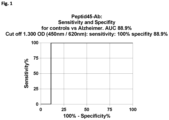
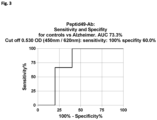
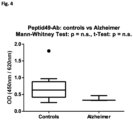
- YB-1 antibody levels in serum samples from 9 healthy donors (“Control") and 5 patients with Alzheimer's Disease were measured using the kits and method of example 1 (YB-1-AB-ELISAs). The levels were determined in OD (optical density).
- Figures 2 and 4 show the anti-YB-1 antibody levels as determined in serum samples of healthy donors compared to AD patients for the two peptide ELISAs.
Landscapes
- Health & Medical Sciences (AREA)
- Life Sciences & Earth Sciences (AREA)
- Engineering & Computer Science (AREA)
- Immunology (AREA)
- Biomedical Technology (AREA)
- Hematology (AREA)
- Chemical & Material Sciences (AREA)
- Urology & Nephrology (AREA)
- Molecular Biology (AREA)
- Analytical Chemistry (AREA)
- Biochemistry (AREA)
- Microbiology (AREA)
- Biotechnology (AREA)
- Pathology (AREA)
- General Physics & Mathematics (AREA)
- Food Science & Technology (AREA)
- Medicinal Chemistry (AREA)
- Physics & Mathematics (AREA)
- General Health & Medical Sciences (AREA)
- Cell Biology (AREA)
- Proteomics, Peptides & Aminoacids (AREA)
- Neurology (AREA)
- Neurosurgery (AREA)
- Peptides Or Proteins (AREA)
Claims (15)
- Verfahren zur Diagnose von Alzheimer Krankheit (AD) in einem Individuum, umfassend die Schritte:(i) Bestimmen des Spiegels von Antikörpern gegen Y-Box-bindendes Protein-1 (YB-1) in einer Probe von einem Individuum, für das eine Diagnose zu stellen ist,(ii) Vergleichen des bestimmten Spiegels in der Probe mit einem Kontrollspiegel von YB-1-Antikörpern, die von Individuen ohne AD stammen;wobei ein erhöhter Spiegel in der Probe des Individuums, für das eine Diagnose zu stellen ist, im Vergleich zu dem Kontrollspiegel ein Hinweis auf AD bei dem Individuum ist, für das eine Diagnose zu stellen ist.
- Verfahren nach Anspruch 1, wobei die Antikörper gegen YB-1 spezifisch an ein Peptid mit der Sequenz gemäß SEQ ID NO:2 binden.
- Verfahren nach Anspruch 1 oder 2, wobei ein Spiegel von anti-YB-1-Antikörpern in der Probe des Individuums, für das eine Diagnose zu stellen ist, von mehr als das 1,2-Fache im Vergleich zum Kontrollspiegel ein Hinweis auf AD bei dem Individuum ist, für das eine Diagnose zu stellen ist.
- Verfahren nach einem der Ansprüche 1 bis 3, wobei die anti-YB-1-Antikörper in einem Immunoassay nachgewiesen werden.
- Verfahren nach Anspruch 4, wobei der Immunoassay ausgewählt ist aus der Gruppe von Immunpräzipitation, Enzym-Immunoassay (EIA), Radio-Immunoassay (RIA), Enzyme-linked Immunosorbent Assay (ELISA), Fluoreszenz-Immunoassay, einem Chemilumineszenz-Assay, einem Agglutinations-Assay, Nephelometrie-Assay, Turbidimetrie-Assay, einem Western Blot, einem kompetitiven Immunoassay, einem nicht-kompetitiven Immunoassay, einem homogenen Immunoassay, einem heterogenen Immunoassay, einem Bioassay und einem Reporter-Assay wie einem Luciferase-Assay oder Luminex.
- Verfahren nach einem der vorangehenden Ansprüche, wobei die Probe Plasma oder Serum ist.
- Verfahren nach einem der vorangehenden Ansprüche, umfassend die Schritte:(a) Inkontaktbringen der Probe, von der vermutet wird, einen YB-1-Antikörper zu umfassen, mit YB-1 oder einem antigenen Peptidfragment davon,(b) Nachweisen der Bindung der Antikörper an YB-1 oder das antigene Peptidfragment davon.
- Verfahren nach Anspruch 7, wobei das Peptid ein Peptid ist, das aus der Sequenz von SEQ ID NO:2 besteht.
- Verfahren nach Anspruch 7, wobei das Peptid 10 bis 19, bevorzugt 12 bis 19, aufeinanderfolgende Reste von SEQ ID NO:2 umfasst, wobei das Peptid eine Länge zwischen 10 und 30, bevorzugt 12 bis 24, Aminoreste aufweist.
- Verfahren nach den Ansprüchen 7 bis 9, wobei das Peptid auf einer Oberfläche immobilisiert ist.
- Verfahren nach einem der Ansprüche 7 bis 10, wobei die Bindung unter Verwendung eines sekundären Antikörpers gegen den Fc-Teil des anti-YB-1-Antikörpers nachgewiesen wird.
- Verfahren nach Anspruch 11, wobei der anti-YB-1-Antikörper ein IgG-Antikörper und der sekundäre Antikörper ein anti-IgG-Antikörper ist.
- Verfahren nach Anspruch 11 oder 12, wobei der sekundäre Antikörper mit einem nachweisbaren Marker markiert ist.
- In vitro-Verwendung von Y-Box-bindendem Protein-1 (YB-1) oder eines antigenen Peptidfragments davon für die Diagnose von AD.
- Verwendung nach Anspruch 14, wobei das antigene Peptid mindestens 10 bis 19, bevorzugt 12 bis 19, aufeinanderfolgende Reste von SEQ ID NO:2 umfasst, und wobei das Peptid eine Länge zwischen 10 und 30, bevorzugt 12 bis 24, Aminoreste aufweist.
Applications Claiming Priority (2)
| Application Number | Priority Date | Filing Date | Title |
|---|---|---|---|
| EP21164708 | 2021-03-24 | ||
| PCT/EP2022/057501 WO2022200355A1 (en) | 2021-03-24 | 2022-03-22 | Diagnosis of alzheimer's disease by detecting auto-antibodies against y-box binding protein-1 (yb-1) |
Publications (3)
| Publication Number | Publication Date |
|---|---|
| EP4314834A1 EP4314834A1 (de) | 2024-02-07 |
| EP4314834B1 true EP4314834B1 (de) | 2025-02-26 |
| EP4314834C0 EP4314834C0 (de) | 2025-02-26 |
Family
ID=75223072
Family Applications (1)
| Application Number | Title | Priority Date | Filing Date |
|---|---|---|---|
| EP22714878.0A Active EP4314834B1 (de) | 2021-03-24 | 2022-03-22 | Diagnose von morbus alzheimer durch nachweis von autoantikörpern gegen das y-box-bindende protein-1 (yb-1) |
Country Status (3)
| Country | Link |
|---|---|
| US (1) | US20250283892A1 (de) |
| EP (1) | EP4314834B1 (de) |
| WO (1) | WO2022200355A1 (de) |
Family Cites Families (5)
| Publication number | Priority date | Publication date | Assignee | Title |
|---|---|---|---|---|
| DE102004060385A1 (de) * | 2004-12-14 | 2006-07-06 | Rwth Aachen | Verfahren zur Bestimmung entzündlicher Vorgänge und pharmazeutische Zusammensetzungen zur Behandlung derselben |
| WO2006067792A2 (en) * | 2004-12-22 | 2006-06-29 | Yeda Research And Development Co. Ltd. At The Weizmann Institute Of Science | Aldolase autoantigens useful in diagnosis and treatment of alzheimer's disease |
| RU2561050C2 (ru) | 2013-08-28 | 2015-08-20 | Федеральное государственное бюджетное учреждение науки Институт биофизики клетки Российской академии наук (ИБК РАН) | Применение белка yb-1 и его фрагментов для изготовления лекарственных средств при лечении болезни альцгеймера |
| WO2017207616A1 (en) | 2016-05-31 | 2017-12-07 | Celltrend Gmbh | Diagnosis of cancer by detecting auto-antibodies against y box binding protein (yb-1) |
| JP2023538975A (ja) * | 2020-08-24 | 2023-09-12 | マラバイオ システムズ,インク. | 母体自己抗体を減少させる方法 |
-
2022
- 2022-03-22 WO PCT/EP2022/057501 patent/WO2022200355A1/en not_active Ceased
- 2022-03-22 US US18/551,454 patent/US20250283892A1/en active Pending
- 2022-03-22 EP EP22714878.0A patent/EP4314834B1/de active Active
Also Published As
| Publication number | Publication date |
|---|---|
| EP4314834A1 (de) | 2024-02-07 |
| WO2022200355A1 (en) | 2022-09-29 |
| EP4314834C0 (de) | 2025-02-26 |
| US20250283892A1 (en) | 2025-09-11 |
Similar Documents
| Publication | Publication Date | Title |
|---|---|---|
| Bizzaro et al. | Prevalence and clinical correlation of anti-phospholipid–binding protein antibodies in anticardiolipin-negative patients with systemic lupus erythematosus and women with unexplained recurrent miscarriages | |
| EP3077825A1 (de) | Verfahren zur selektiven bestimmung des plazentalen wachstumsfaktors 2 | |
| EP3306316A1 (de) | Rep-protein als proteinantigen zur verwendung in diagnostischen tests | |
| US20170122945A1 (en) | Immunoassay and antibodies for the detection of chromogranin a | |
| US9372189B2 (en) | Biomarker for lymphocytic infundibuloneurohypophysitis, and use applications thereof | |
| US20250283892A1 (en) | Diagnosis of alzheimer's disease by detecting auto-antibodies against y-box binding protein-1 (yb-1) | |
| JP6606552B2 (ja) | 特異的に精製された抗プレセプシン抗体 | |
| JP6312302B2 (ja) | 脳梗塞の診断マーカー | |
| US20210311048A1 (en) | Anti-CXC chemokine receptor antibodies and C-X-C chemokines for the diagnosis of autoimmune disease and graft-versus-host disease | |
| JP4685369B2 (ja) | 関節リウマチ診断用試薬 | |
| WO2017207616A9 (en) | Diagnosis of cancer by detecting auto-antibodies against y box binding protein (yb-1) | |
| Akimoto et al. | Relationship between clinical features and binding domains of anti-prothrombin autoantibodies in patients with systemic lupus erythematosus and antiphospholipid syndrome | |
| JP6499342B2 (ja) | 脳梗塞の診断マーカー | |
| EP3213075B1 (de) | Diagnose einer autoimmunerkrankung unter verwendung von gegen c5a-rezeptor gerichteten antikörpern | |
| WO2016005369A1 (en) | Par2 antibodies for diagnosis of graft intolerance of a liver transplant | |
| JP6618107B2 (ja) | リンパ球性漏斗下垂体後葉炎検査試薬及びその用途 | |
| US10739346B2 (en) | Diagnosis of cancer by detecting auto-antibodies against EGF-receptor | |
| EP3304087B1 (de) | Diagnose von chronischem erschöpfungssyndrome mittels gegen einen beta-adrenergen rezeptor gerichteten detektions-antikörpern | |
| EP4014045B1 (de) | Krebsdiagnose mit auto-antikörpern gegen pd1 und pd-l1 | |
| EP3102946B1 (de) | Diagnose von krebs durch detektion von auto-antikörpern gegen den vaskulären endothelialen wachstumsfaktor (vegf) | |
| EP3298408B1 (de) | Verfahren zur diagnose von aps mittels bestimmung von anti-par1-antikörpern | |
| JP5750646B2 (ja) | Scca2濃度測定によるアレルギー疾患の検査方法 | |
| JP2025541243A (ja) | フォン・ヴィレブランド因子a3ドメインを標的とする単一ドメイン抗体 |
Legal Events
| Date | Code | Title | Description |
|---|---|---|---|
| STAA | Information on the status of an ep patent application or granted ep patent |
Free format text: STATUS: UNKNOWN |
|
| STAA | Information on the status of an ep patent application or granted ep patent |
Free format text: STATUS: THE INTERNATIONAL PUBLICATION HAS BEEN MADE |
|
| PUAI | Public reference made under article 153(3) epc to a published international application that has entered the european phase |
Free format text: ORIGINAL CODE: 0009012 |
|
| STAA | Information on the status of an ep patent application or granted ep patent |
Free format text: STATUS: REQUEST FOR EXAMINATION WAS MADE |
|
| 17P | Request for examination filed |
Effective date: 20231023 |
|
| AK | Designated contracting states |
Kind code of ref document: A1 Designated state(s): AL AT BE BG CH CY CZ DE DK EE ES FI FR GB GR HR HU IE IS IT LI LT LU LV MC MK MT NL NO PL PT RO RS SE SI SK SM TR |
|
| DAV | Request for validation of the european patent (deleted) | ||
| DAX | Request for extension of the european patent (deleted) | ||
| GRAP | Despatch of communication of intention to grant a patent |
Free format text: ORIGINAL CODE: EPIDOSNIGR1 |
|
| STAA | Information on the status of an ep patent application or granted ep patent |
Free format text: STATUS: GRANT OF PATENT IS INTENDED |
|
| INTG | Intention to grant announced |
Effective date: 20240918 |
|
| GRAS | Grant fee paid |
Free format text: ORIGINAL CODE: EPIDOSNIGR3 |
|
| GRAA | (expected) grant |
Free format text: ORIGINAL CODE: 0009210 |
|
| STAA | Information on the status of an ep patent application or granted ep patent |
Free format text: STATUS: THE PATENT HAS BEEN GRANTED |
|
| AK | Designated contracting states |
Kind code of ref document: B1 Designated state(s): AL AT BE BG CH CY CZ DE DK EE ES FI FR GB GR HR HU IE IS IT LI LT LU LV MC MK MT NL NO PL PT RO RS SE SI SK SM TR |
|
| REG | Reference to a national code |
Ref country code: GB Ref legal event code: FG4D |
|
| REG | Reference to a national code |
Ref country code: CH Ref legal event code: EP |
|
| REG | Reference to a national code |
Ref country code: DE Ref legal event code: R096 Ref document number: 602022011152 Country of ref document: DE |
|
| REG | Reference to a national code |
Ref country code: IE Ref legal event code: FG4D |
|
| U01 | Request for unitary effect filed |
Effective date: 20250319 |
|
| U07 | Unitary effect registered |
Designated state(s): AT BE BG DE DK EE FI FR IT LT LU LV MT NL PT RO SE SI Effective date: 20250325 |
|
| PGFP | Annual fee paid to national office [announced via postgrant information from national office to epo] |
Ref country code: AT Payment date: 20250417 Year of fee payment: 4 |
|
| U20 | Renewal fee for the european patent with unitary effect paid |
Year of fee payment: 4 Effective date: 20250404 |
|
| PG25 | Lapsed in a contracting state [announced via postgrant information from national office to epo] |
Ref country code: RS Free format text: LAPSE BECAUSE OF FAILURE TO SUBMIT A TRANSLATION OF THE DESCRIPTION OR TO PAY THE FEE WITHIN THE PRESCRIBED TIME-LIMIT Effective date: 20250526 |
|
| PG25 | Lapsed in a contracting state [announced via postgrant information from national office to epo] |
Ref country code: PL Free format text: LAPSE BECAUSE OF FAILURE TO SUBMIT A TRANSLATION OF THE DESCRIPTION OR TO PAY THE FEE WITHIN THE PRESCRIBED TIME-LIMIT Effective date: 20250226 |
|
| PG25 | Lapsed in a contracting state [announced via postgrant information from national office to epo] |
Ref country code: ES Free format text: LAPSE BECAUSE OF FAILURE TO SUBMIT A TRANSLATION OF THE DESCRIPTION OR TO PAY THE FEE WITHIN THE PRESCRIBED TIME-LIMIT Effective date: 20250226 |
|
| PG25 | Lapsed in a contracting state [announced via postgrant information from national office to epo] |
Ref country code: NO Free format text: LAPSE BECAUSE OF FAILURE TO SUBMIT A TRANSLATION OF THE DESCRIPTION OR TO PAY THE FEE WITHIN THE PRESCRIBED TIME-LIMIT Effective date: 20250526 Ref country code: IS Free format text: LAPSE BECAUSE OF FAILURE TO SUBMIT A TRANSLATION OF THE DESCRIPTION OR TO PAY THE FEE WITHIN THE PRESCRIBED TIME-LIMIT Effective date: 20250626 |
|
| PG25 | Lapsed in a contracting state [announced via postgrant information from national office to epo] |
Ref country code: HR Free format text: LAPSE BECAUSE OF FAILURE TO SUBMIT A TRANSLATION OF THE DESCRIPTION OR TO PAY THE FEE WITHIN THE PRESCRIBED TIME-LIMIT Effective date: 20250226 |
|
| PG25 | Lapsed in a contracting state [announced via postgrant information from national office to epo] |
Ref country code: GR Free format text: LAPSE BECAUSE OF FAILURE TO SUBMIT A TRANSLATION OF THE DESCRIPTION OR TO PAY THE FEE WITHIN THE PRESCRIBED TIME-LIMIT Effective date: 20250527 |
|
| PGFP | Annual fee paid to national office [announced via postgrant information from national office to epo] |
Ref country code: CH Payment date: 20250401 Year of fee payment: 4 |
|
| PG25 | Lapsed in a contracting state [announced via postgrant information from national office to epo] |
Ref country code: SM Free format text: LAPSE BECAUSE OF FAILURE TO SUBMIT A TRANSLATION OF THE DESCRIPTION OR TO PAY THE FEE WITHIN THE PRESCRIBED TIME-LIMIT Effective date: 20250226 |
|
| PG25 | Lapsed in a contracting state [announced via postgrant information from national office to epo] |
Ref country code: CZ Free format text: LAPSE BECAUSE OF FAILURE TO SUBMIT A TRANSLATION OF THE DESCRIPTION OR TO PAY THE FEE WITHIN THE PRESCRIBED TIME-LIMIT Effective date: 20250226 |
|
| PG25 | Lapsed in a contracting state [announced via postgrant information from national office to epo] |
Ref country code: SK Free format text: LAPSE BECAUSE OF FAILURE TO SUBMIT A TRANSLATION OF THE DESCRIPTION OR TO PAY THE FEE WITHIN THE PRESCRIBED TIME-LIMIT Effective date: 20250226 |
|
| PG25 | Lapsed in a contracting state [announced via postgrant information from national office to epo] |
Ref country code: MC Free format text: LAPSE BECAUSE OF FAILURE TO SUBMIT A TRANSLATION OF THE DESCRIPTION OR TO PAY THE FEE WITHIN THE PRESCRIBED TIME-LIMIT Effective date: 20250226 |
|
| PLBE | No opposition filed within time limit |
Free format text: ORIGINAL CODE: 0009261 |
|
| STAA | Information on the status of an ep patent application or granted ep patent |
Free format text: STATUS: NO OPPOSITION FILED WITHIN TIME LIMIT |
|
| REG | Reference to a national code |
Ref country code: CH Ref legal event code: L10 Free format text: ST27 STATUS EVENT CODE: U-0-0-L10-L00 (AS PROVIDED BY THE NATIONAL OFFICE) Effective date: 20260107 |
|
| PG25 | Lapsed in a contracting state [announced via postgrant information from national office to epo] |
Ref country code: IE Free format text: LAPSE BECAUSE OF NON-PAYMENT OF DUE FEES Effective date: 20250322 |
|
| 26N | No opposition filed |
Effective date: 20251127 |
|
| REG | Reference to a national code |
Ref country code: CH Ref legal event code: U11 Free format text: ST27 STATUS EVENT CODE: U-0-0-U10-U11 (AS PROVIDED BY THE NATIONAL OFFICE) Effective date: 20260401 |
|
| PGFP | Annual fee paid to national office [announced via postgrant information from national office to epo] |
Ref country code: GB Payment date: 20260311 Year of fee payment: 5 |
|
| U20 | Renewal fee for the european patent with unitary effect paid |
Year of fee payment: 5 Effective date: 20260330 |