EP4306589A2 - Polyurethanzusammensetzung zur erzeugung von bodenbelagsmustern - Google Patents
Polyurethanzusammensetzung zur erzeugung von bodenbelagsmustern Download PDFInfo
- Publication number
- EP4306589A2 EP4306589A2 EP23207446.8A EP23207446A EP4306589A2 EP 4306589 A2 EP4306589 A2 EP 4306589A2 EP 23207446 A EP23207446 A EP 23207446A EP 4306589 A2 EP4306589 A2 EP 4306589A2
- Authority
- EP
- European Patent Office
- Prior art keywords
- polyurethane composition
- weight
- mpa
- mixed
- mixed polyurethane
- Prior art date
- Legal status (The legal status is an assumption and is not a legal conclusion. Google has not performed a legal analysis and makes no representation as to the accuracy of the status listed.)
- Pending
Links
Images



Classifications
-
- C—CHEMISTRY; METALLURGY
- C08—ORGANIC MACROMOLECULAR COMPOUNDS; THEIR PREPARATION OR CHEMICAL WORKING-UP; COMPOSITIONS BASED THEREON
- C08G—MACROMOLECULAR COMPOUNDS OBTAINED OTHERWISE THAN BY REACTIONS ONLY INVOLVING UNSATURATED CARBON-TO-CARBON BONDS
- C08G18/00—Polymeric products of isocyanates or isothiocyanates
- C08G18/06—Polymeric products of isocyanates or isothiocyanates with compounds having active hydrogen
- C08G18/28—Polymeric products of isocyanates or isothiocyanates with compounds having active hydrogen characterised by the compounds used containing active hydrogen
- C08G18/30—Low-molecular-weight compounds
- C08G18/36—Hydroxylated esters of higher fatty acids
-
- B—PERFORMING OPERATIONS; TRANSPORTING
- B05—SPRAYING OR ATOMISING IN GENERAL; APPLYING FLUENT MATERIALS TO SURFACES, IN GENERAL
- B05D—PROCESSES FOR APPLYING FLUENT MATERIALS TO SURFACES, IN GENERAL
- B05D3/00—Pretreatment of surfaces to which liquids or other fluent materials are to be applied; After-treatment of applied coatings, e.g. intermediate treating of an applied coating preparatory to subsequent applications of liquids or other fluent materials
- B05D3/007—After-treatment
-
- B—PERFORMING OPERATIONS; TRANSPORTING
- B05—SPRAYING OR ATOMISING IN GENERAL; APPLYING FLUENT MATERIALS TO SURFACES, IN GENERAL
- B05D—PROCESSES FOR APPLYING FLUENT MATERIALS TO SURFACES, IN GENERAL
- B05D3/00—Pretreatment of surfaces to which liquids or other fluent materials are to be applied; After-treatment of applied coatings, e.g. intermediate treating of an applied coating preparatory to subsequent applications of liquids or other fluent materials
- B05D3/12—Pretreatment of surfaces to which liquids or other fluent materials are to be applied; After-treatment of applied coatings, e.g. intermediate treating of an applied coating preparatory to subsequent applications of liquids or other fluent materials by mechanical means
-
- B—PERFORMING OPERATIONS; TRANSPORTING
- B05—SPRAYING OR ATOMISING IN GENERAL; APPLYING FLUENT MATERIALS TO SURFACES, IN GENERAL
- B05D—PROCESSES FOR APPLYING FLUENT MATERIALS TO SURFACES, IN GENERAL
- B05D5/00—Processes for applying liquids or other fluent materials to surfaces to obtain special surface effects, finishes or structures
- B05D5/06—Processes for applying liquids or other fluent materials to surfaces to obtain special surface effects, finishes or structures to obtain multicolour or other optical effects
- B05D5/061—Special surface effect
-
- C—CHEMISTRY; METALLURGY
- C08—ORGANIC MACROMOLECULAR COMPOUNDS; THEIR PREPARATION OR CHEMICAL WORKING-UP; COMPOSITIONS BASED THEREON
- C08G—MACROMOLECULAR COMPOUNDS OBTAINED OTHERWISE THAN BY REACTIONS ONLY INVOLVING UNSATURATED CARBON-TO-CARBON BONDS
- C08G18/00—Polymeric products of isocyanates or isothiocyanates
- C08G18/06—Polymeric products of isocyanates or isothiocyanates with compounds having active hydrogen
- C08G18/28—Polymeric products of isocyanates or isothiocyanates with compounds having active hydrogen characterised by the compounds used containing active hydrogen
- C08G18/65—Low-molecular-weight compounds having active hydrogen with high-molecular-weight compounds having active hydrogen
-
- C—CHEMISTRY; METALLURGY
- C08—ORGANIC MACROMOLECULAR COMPOUNDS; THEIR PREPARATION OR CHEMICAL WORKING-UP; COMPOSITIONS BASED THEREON
- C08G—MACROMOLECULAR COMPOUNDS OBTAINED OTHERWISE THAN BY REACTIONS ONLY INVOLVING UNSATURATED CARBON-TO-CARBON BONDS
- C08G18/00—Polymeric products of isocyanates or isothiocyanates
- C08G18/06—Polymeric products of isocyanates or isothiocyanates with compounds having active hydrogen
- C08G18/70—Polymeric products of isocyanates or isothiocyanates with compounds having active hydrogen characterised by the isocyanates or isothiocyanates used
- C08G18/72—Polyisocyanates or polyisothiocyanates
- C08G18/74—Polyisocyanates or polyisothiocyanates cyclic
- C08G18/76—Polyisocyanates or polyisothiocyanates cyclic aromatic
- C08G18/7657—Polyisocyanates or polyisothiocyanates cyclic aromatic containing two or more aromatic rings
-
- C—CHEMISTRY; METALLURGY
- C08—ORGANIC MACROMOLECULAR COMPOUNDS; THEIR PREPARATION OR CHEMICAL WORKING-UP; COMPOSITIONS BASED THEREON
- C08K—Use of inorganic or non-macromolecular organic substances as compounding ingredients
- C08K3/00—Use of inorganic substances as compounding ingredients
- C08K3/01—Use of inorganic substances as compounding ingredients characterized by their specific function
- C08K3/013—Fillers, pigments or reinforcing additives
-
- E—FIXED CONSTRUCTIONS
- E04—BUILDING
- E04F—FINISHING WORK ON BUILDINGS, e.g. STAIRS, FLOORS
- E04F15/00—Flooring
- E04F15/12—Flooring or floor layers made of masses in situ, e.g. seamless magnesite floors, terrazzo gypsum floors
-
- B—PERFORMING OPERATIONS; TRANSPORTING
- B05—SPRAYING OR ATOMISING IN GENERAL; APPLYING FLUENT MATERIALS TO SURFACES, IN GENERAL
- B05D—PROCESSES FOR APPLYING FLUENT MATERIALS TO SURFACES, IN GENERAL
- B05D2503/00—Polyurethanes
-
- B—PERFORMING OPERATIONS; TRANSPORTING
- B05—SPRAYING OR ATOMISING IN GENERAL; APPLYING FLUENT MATERIALS TO SURFACES, IN GENERAL
- B05D—PROCESSES FOR APPLYING FLUENT MATERIALS TO SURFACES, IN GENERAL
- B05D2601/00—Inorganic fillers
- B05D2601/02—Inorganic fillers used for pigmentation effect, e.g. metallic effect
-
- B—PERFORMING OPERATIONS; TRANSPORTING
- B44—DECORATIVE ARTS
- B44C—PRODUCING DECORATIVE EFFECTS; MOSAICS; TARSIA WORK; PAPERHANGING
- B44C5/00—Processes for producing special ornamental bodies
- B44C5/04—Ornamental plaques, e.g. decorative panels, decorative veneers
-
- B—PERFORMING OPERATIONS; TRANSPORTING
- B44—DECORATIVE ARTS
- B44D—PAINTING OR ARTISTIC DRAWING, NOT OTHERWISE PROVIDED FOR; PRESERVING PAINTINGS; SURFACE TREATMENT TO OBTAIN SPECIAL ARTISTIC SURFACE EFFECTS OR FINISHES
- B44D5/00—Surface treatment to obtain special artistic surface effects or finishes
- B44D5/10—Mechanical treatment
-
- C—CHEMISTRY; METALLURGY
- C08—ORGANIC MACROMOLECULAR COMPOUNDS; THEIR PREPARATION OR CHEMICAL WORKING-UP; COMPOSITIONS BASED THEREON
- C08K—Use of inorganic or non-macromolecular organic substances as compounding ingredients
- C08K2201/00—Specific properties of additives
- C08K2201/002—Physical properties
- C08K2201/005—Additives being defined by their particle size in general
Definitions
- the present invention relates to a polyurethane composition, and more particularly to a method of applying the polyurethane composition on a surface for creating decorative floorings or flooring materials.
- Construction industry is facing the issue of providing flooring surfaces that have specific functional characteristics, in combination with decorative effects that appeal to the eyes.
- Recent trend in the industry is to use polymeric material as an alternative to natural flooring materials. This material is manufactured to appear like natural materials such as wood and natural stone, yet it is made up of synthetic materials. Such floorings are relatively cheaper to install and maintenance cost is very low.
- One such attempt to create patterns or textured flooring surfaces involves the use of two different 2K-PU compositions.
- the first 2K-PU composition contains a first color
- the second 2K-PU composition contains a second color.
- both the first and the second 2K-PU compositions are very lightly and very inhomogeneously mixed and are then applied to the surface thereby creating the desired patterns.
- this method fails to provide realistic decorative effect/pattern.
- the present invention is made in view to overcome the problems described above, and one of the objects of the present invention is to provide a polyurethane composition comprising a polyol component (A), a hardener component (B) and a metallic pigment (MP) selected from the group consisting of metallic effect pigments (MPM) and pearlescent pigments (MPP).
- Another object of the present invention is to create concrete-like and wood-like patterns on cured polyurethane composition that look like real concrete and wood respectively.
- the present invention provides a polyurethane composition
- a polyurethane composition comprising a polyol component (A) comprising at least one polyol, and a hardener component (B) comprising at least one polyisocyanate, whereby the polyurethane composition further comprises at least one metallic pigment (MP) selected from the group consisting of metallic effect pigments (MPM) and pearlescent pigments (MPP).
- MPM metallic effect pigments
- MPP pearlescent pigments
- the polyol component (A) comprises the at least one metallic pigment (MP) selected from the group consisting of metallic effect pigments (MPM) and pearlescent pigments (MPP).
- MPM metallic effect pigments
- MPP pearlescent pigments
- the present invention also provides a method for applying a mixed polyurethane composition, preferably as a flooring material.
- the method comprises the steps of providing a space where the polyurethane composition is applied, mixing components (A) and (B) of the polyurethane composition to obtain a mixed polyurethane composition, applying the mixed polyurethane composition on a desired location and in a desired shape within the space provided, creating a pattern on the surface of the applied mixed polyurethane composition by contacting the applied mixed polyurethane composition with an object and allowing the applied mixed polyurethane composition cure.
- the method for applying the mixed polyurethane composition is preferably used to create floors and/or ship decks.
- the present invention also relates to the use of metallic pigments (MP) selected from the group consisting of metallic effect pigments (MPM) and pearlescent pigments (MPP) in a mixed polyurethane composition comprising a polyol component (A) comprising at least one polyol, and a hardener component (B) comprising at least one polyisocyanate, to create concrete-like or wood-like appearing patterns on the surface of the mixed polyurethane composition upon, before curing of the polyurethane composition, creating a pattern on the surface of the applied mixed polyurethane composition by contacting the applied mixed polyurethane composition with an object.
- MP metallic pigments
- MPP pearlescent pigments
- polyurethane composition of the invention is preferably used as a flooring material and a casting material.
- the average molecular weight is understood to mean the number average molecular weight, as determined using conventional methods, preferably by gel permeation-chromatography (GPC) using polystyrene as standard, styrenedivinylbenzene gel with porosity of 100 Angstrom, 1000 Angstrom and 10000 Angstrom as the column and tetrahydrofurane as a solvent, at 35°C.
- GPC gel permeation-chromatography
- curing means that the composition becomes harder or sets-in as a result of a chemical change/reaction.
- Multi component composition refers to a curable composition in the present document, the components are present in two or more different components stored in separate containers and are storage stable in each case for itself. Only shortly before or during the application of the composition, the two or more components are mixed together, whereupon the mixed composition cures, the curing in some cases only runs through the action of moisture or is completed.
- filler is meant to comprise any material, matter, component and/or composition added to thicken the coated or casted composition, support its structure and simply increase the volume of the composition and/or to lower the cost. Fillers are usually comprised of cheap and inert materials, such as one or more of talc, calcium carbonate, kaolin, lime, baryte, clay, etc.
- additive(s) is meant to comprise a component, agent, composition and the like usually added in smaller amounts (e.g. less than 5%, 1%, 0.1 %, or 0.01 % of the total composition) and yet give a very significant effect on the product.
- Additives can comprise one or more of catalysts, adhesion promoters, UV stabilizers, biocides to fight microbial and/or plant growth or agents to impart anti-freeze properties.
- composition and/or coating composition comprises one or more additives.
- the viscosity of the polyurethane compositions is measured at 23°C using a Brookfield DV-E viscometer at 100 rpm using spindle #6 for viscosities below 9500 mPa.s and spindle #7 for viscosities of 9500 mPa.s and above.
- concrete-like and “beton-like” can be used interchangeably, and are meant to describe a concrete like texture, pattern or appearance.
- concrete as used herein has a broad definition, mimicking its use in industry. It can refer to an adequately wetted concrete mixture, an insufficiently wetted concrete mixture, or a dry mix, and includes cementitious mixtures that themselves may include aggregate, gravel, fly ash, ground slag, silica fume, fibers and/or sand.
- cementitious mixtures that themselves may include aggregate, gravel, fly ash, ground slag, silica fume, fibers and/or sand.
- concrete as used herein includes all types of cementitious material to which water has been or is to be added, including mortar, pervious concrete, flowable fill, ready-mixed concrete and bedding mix.
- particle size as used herein preferably refers to the average particle size.
- average particle size here refers to the D 50 value of the cumulative volume distribution curve in which 50% by volume of the particles have a diameter which is smaller than the value.
- the average particle size or the D 50 value is preferably determined by laser diffractometry in the present invention.
- the present invention relates in a first aspect to a polyurethane composition
- a polyurethane composition comprising:
- the composition used according to the invention comprises a polyol component (A) and a hardener component (B), i.e. the composition comprises two or more individual components. These components are stored separately in order to avoid spontaneous reaction.
- the components may be assembled together as a package. Prior to use, the components are combined with each other. When the components are mixed together, curing reactions begin so that the composition is to be processed within the open time after mixing the components.
- the composition preferably consists of two components.
- one or more additional components may be included for specific purposes. For instance, an additional component comprising non-metallic pigment (NoP) for coloring purposes.
- NoP non-metallic pigment
- Systems comprising organic binder components including a polyol component and a polyisocyanate hardener component suitable for flooring applications is known to the skilled person and commercially available, for instance products of Sika für AG.
- An example for a commercially available combination of a binder component comprising polyol and an isocyanate hardener component are Sikafloor ® products from Sika für AG, for example Sikafloor 3000, Sikafloor 327 and Sikafloor 330.
- ratios referring to ingredients in different components relate to suitable or correct proportions of each component according to operating instructions, i.e. to the mixing ratios to be used for mixing the components and, in use to the mixture of the components prepared.
- the polyol component (A) comprises one or more polyols.
- one or more additives may be added to polyol component (A).
- Polyol component (A) is preferably a liquid component.
- the polyol component (A) may be viscous but is generally pourable.
- polystyrene resins examples include polyoxyalkylenepolyols, also referred to as "polyetherpolyols", polyesterpolyols, polycarbonatepolyols, poly(meth)acrylate polyols, polyhydrocarbon-polyols, polyhydroxy-functional acrylonitrile/butadiene copolymers and mixtures thereof, in particular diols thereof, and mixtures thereof.
- polyetherpolyols are polyoxyethylenepolyols, polyoxypropylenepolyols and polyoxybutylenepolyols, in particular polyoxyethylenediols, polyoxypropylenediols, polyoxybutylenediols, polyoxyethylenetriols and polyoxypropylenetriols.
- polyetherpolyols are so-called ethylene oxide-terminated ("EO-endcapped", ethylene oxide-end-capped) polyoxypropylenepolyols, styrene-acrylonitrile-grafted polyetherpolyols, e.g. Lupranol ® from BASF Polyurethanes GmbH, Germany.
- EO-endcapped ethylene oxide-terminated polyoxypropylenepolyols
- styrene-acrylonitrile-grafted polyetherpolyols e.g. Lupranol ® from BASF Polyurethanes GmbH, Germany.
- Particularly preferred polyols to be used in the present invention are polyhydroxy-functional fats and oils, for example natural fats and oils, such as castor oil, or polyols obtained by chemical modification of natural fats and oils, so-called oleochemical polyols.
- Castor oil is particularly preferred as natural oil and castor oil is particularly preferred as basis for polyols obtained by chemical modification of natural fats and oils.
- Examples of chemically modified natural fats and oils are polyols obtained from epoxypolyesters or epoxypolyethers obtained, for example, by epoxidation of unsaturated oils, by subsequent ring opening with carboxylic acids or alcohols, polyols obtained by hydroformylation and hydrogenation of unsaturated oils, or polyols which are obtained from natural fats and oils by degradation processes, such as alcoholysis or ozonolysis, and subsequent chemical linkage, for example by trans esterification or dimerization, of the degradation products thus obtained or derivatives thereof.
- Suitable degradation products of natural fats and oils are in particular fatty acids and fatty alcohols and fatty acid esters, in particular the methyl esters (FAME), which can be derivatized, for example, by hydroformylation and hydrogenation to give hydroxy-fatty acid esters.
- FAME methyl esters
- the polyols mentioned above usually have a relatively high molecular weight, for instance, an average molecular weight of from 250 to 30000 g/mol, in particular from 1000 to 30000 g/mol, and/or an average OH functionality in the range from 1.6 to 3.
- suitable polyols are low molecular weight di- or polyhydric alcohols, e.g., with a molecular weight of less than 250 g/mol.
- suitable polyols are low molecular weight di- or polyhydric alcohols, e.g., with a molecular weight of less than 250 g/mol.
- suitable polyols are low molecular weight di- or polyhydric alcohols, e.g., with a molecular weight of less than 250 g/mol.
- suitable polyols are low molecular weight di- or polyhydric alcohols, e.g., with a molecular weight of less than 250 g/mol.
- suitable polyols are low molecular weight di- or polyhydric alcohols, e.g., with a molecular weight of less than 250 g/mol.
- suitable polyols are low molecular weight di- or polyhydric alcohols, e.g., with a molecular weight of
- low molecular weight di- or polyhydric alcohols may be used as the polyol, the use of the polyols mentioned above having a high molecular weight is preferred.
- at least one high molecular weight polyol and at least one low molecular weight di- or polyhydric alcohol are used in combination.
- a low molecular weight polyol is considered to have a molecular weight of less than 250 g/mol, whereas a high molecular weight polyol is considered to have an average molecular weight of 250 g/mol or more.
- the polyol component (A) comprises at least one low molecular weight polyol, preferably in combination with at least one high molecular weight polyol, in particular castor oil.
- Particularly preferred is a combination of one or more polyhydroxy-functional fats and oils, such natural fats and oils, or polyols obtained by chemical modification of natural fats and oils, in particular castor oil and polyols obtained by chemical modification of castor oil, and one, two or more low molecular weight di- or polyhydric alcohols.
- the one or more polyols having a high molecular weight are usually used in higher amounts than the at least one low molecular weight di- or polyhydric alcohol.
- the amount of the one or more polyols having a high molecular weight is between 90 - 99.5 weight-%, based on the total weight of all the polyols of the polyol component (A).
- the amount of the at least one low molecular weight di- or polyhydric alcohol is between 0.5 - 90 weight-%, based on the total weight of all the polyols of the polyol component (A).
- the amount of the sum of (the one or more polyols having a high molecular weight) and (the at least one low molecular weight di- or polyhydric alcohol) is between 50 - 98 weight-%, preferably between 50 - 90 weight-%, more preferably between 50 - 80 weight-%, most preferably between 55 - 70 weight-%, based on the total weight of the polyol component (A).
- the polyol component (A) further comprises inorganic and organic fillers, preferably selected from the list consisting of ground or precipitated calcium carbonates which are optionally coated with fatty acids in particular stearates, barite (heavy spar), talc, quartz powders, quartz sand, dolomites, wollastonites, kaolins, calcinated kaolins, molecular sieves and silicic acids including highly-dispersed silicic acids from pyrolysis processes.
- inorganic and organic fillers preferably selected from the list consisting of ground or precipitated calcium carbonates which are optionally coated with fatty acids in particular stearates, barite (heavy spar), talc, quartz powders, quartz sand, dolomites, wollastonites, kaolins, calcinated kaolins, molecular sieves and silicic acids including highly-dispersed silicic acids from pyrolysis processes.
- the particle size of the inorganic and organic fillers is 0.01-0.5 mm, more preferably 0.1-0.3 mm.
- the polyurethane composition contains less than 5 weight-%, preferably less than 2 weight-%, preferably less than 1 weight-%, preferably less than 0.5 weight-%, of components with a particle size of bigger than 2 mm, preferably bigger than 1 mm, more preferably more than 0.5 mm, based on total weight of the polyurethane composition.
- the amount of the inorganic and organic fillers is between 20 - 50 weight-%, preferably between 30 - 45 weight-%, based on the total weight of the polyol component (A).
- the polyol component (A) is essentially free of water.
- the amount of water is less than 0.5 weight-%, preferably less than 0.1 weight-%, more preferably less than 0.05 weight-%, based on the total weight of the polyol component (A).
- the polyol component (A) may contain further additives.
- additives are commonly used, if desired, and typically known to the persons skilled in the art.
- further additives are plasticizers, stabilizers against heat light and UV radiation, flame retardants and biocides.
- the hardener component (B) comprises one or more polyisocyanates.
- Hardener component (B) is preferably a liquid component.
- the hardener component (B) may be viscous but is generally pourable.
- Such polyisocyanates are commercially available and widely used as hardener for polyols.
- suitable polyisocyanates are hexamethylene diisocyanate (HDI), HDI trimers such as Desmodur ® N 3600, toluene diisocyanate (TDI), isophorone diisocyanate (IPDI) such as Vestamat ® T 1890, methylene diphenyl diisocyanate and derivatives of these polyisocyanates, wherein HDI and its derivatives, and methylene diphenyl diisocyanate and its derivatives are preferred.
- HDI hexamethylene diisocyanate
- HDI trimers such as Desmodur ® N 3600
- TDI toluene diisocyanate
- IPDI isophorone diisocyanate
- Vestamat ® T 1890 methylene diphenyl diisocyanate and derivatives of these polyisocyanates, wherein HDI and its derivatives, and
- MDI methylene diphenyl diisocyanate
- MDI is a useful compound, e.g. as a starting material for polyurethane production, and produced worldwide in millions of tons annually. A plurality of different product grades of MDI is available. "Methylene diphenyl diisocyanate" as this term is used in the present invention, include, depending on its grade, monomeric and polymeric methylene diphenyl diisocyanate.
- MDI is available in the form of three different isomers, namely 4,4'-methylene diphenyl diisocyanate (4,4'-MDI), 2,4'-methylene diphenyl diisocyanate (2,4'-MDI), and 2,2'-methylene diphenyl diisocyanate (2,2'-MDI).
- 4,4'-MDI 4,4'-methylene diphenyl diisocyanate
- 2,4'-methylene diphenyl diisocyanate 2,4'-methylene diphenyl diisocyanate
- 2,2'-methylene diphenyl diisocyanate 2,2'-methylene diphenyl diisocyanate
- Polymeric MDI is the raw product of MDI synthesis containing MDI isomers and oligomeric species.
- Monomeric MDI is obtained from polymeric MDI by purification.
- Monomeric MDI refers to "pure" MDI including products of a single MDI isomer or of isomer mixtures of two or three MDI isomers.
- the isomeric ratio can vary in wide ranges.
- 4,4'-MDI is a colorless to yellowish solid having a melting point of 39.5°C.
- Commercial monomeric MDI is often a mixture of 4,4'-MDI, 2,4'-MDI and typically very low levels of 2,2'-MDI.
- Polymeric MDI includes oligomeric species. Usually MDI isomers are also included in polymeric MDI. Thus, polymeric MDI may contain a single MDI isomer or isomer mixtures of two or three MDI isomers, the balance being oligomeric species. Polymeric MDI tends to have isocyanate functionalities of higher than 2. The isomeric ratio as well as the amount of oligomeric species can vary in wide ranges in these products. For instance, polymeric MDI may typically contain about 30 to 80 weight-% of MDI isomers, the balance being said oligomeric species.
- the MDI isomers are often a mixture of 4,4'-MDI, 2,4'-MDI and very low levels of 2,2'-MDI.
- Polymeric MDI is typically a brown or dark amber liquid at room temperature (23°C).
- the oligomeric species are oligomers usually having a NCO functionality of 3 or higher.
- the oligomeric species are a result of the synthesis process and can be represented by the following formula wherein n is 1 to 4 and higher.
- the amount of the homologues decreases with increasing chain length.
- the total content of homologues with n higher than 4 is generally not very high.
- polymeric MDI grades is available with varying characteristics as to the number, type and content of isomers and oligomeric species, isomeric ratio, and weight distribution of the oligomeric homologues. These characteristics depend on type and conditions of synthesis and purification procedures. Moreover, the characteristics can be adjusted, e.g., by mixing different MDI grades according to the needs of the customer.
- the hardener component (B) comprising at least one polyisocyanate may optionally comprise one or more further additives, e.g. solvents, in relatively small amounts, e.g. up to 20 or up to 10 weight-% of the additives all together, preferably up to 5 weight-% and more preferably up to 2 weight-% based on the total weight of the hardener component (B).
- suitable solvents include but are not limited to esters, ketones, hydrocarbons and chlorinated hydrocarbons.
- the hardener component (B) comprising an isocyanate hardener essentially consists of MDI, i.e. monomeric MDI and/or polymeric MDI, e.g. with an amount of other additives of less than 2 weight-%. Since the MDI products are technical products, they may, of course, include low quantities of impurities.
- the ratio by weight of component (A) : component (B) is 5:1 to 2:1, more preferably 4:1 to 3:1.
- the reaction of the one or more polyols and of the one or more polyisocyanates results in cured organic binder, which is a polyurethane.
- the molar ratio between free NCO-groups and NCO-reactive groups, preferably OH-groups, in the composition of the invention before mixing is between 0.8 - 1.2, preferably 0.9 - 1.1.
- the application temperature is e.g. from about 8 to 40°C, preferably from about 10 to 30°C.
- the polyurethane composition of the present invention further comprises at least one metallic pigment (MP).
- Metallic pigments (MP) are the pigments that consists of metals and alloys.
- the metallic pigments used in the context of this invention are selected from the group consisting of metallic effect pigments (MPM) and pearlescent pigments (MPP). Most preferred, the metallic pigments used in the context of this invention are pearlescent pigments (MPP).
- the metallic effect pigments (MPM) and pearlescent pigments (MPP) are the type of special effect pigments.
- the special effect pigments are recognized as class of compounds that manipulate light to create a visual effects.
- the polyol component (A) comprises at least one metallic pigment (MP) selected from the group consisting of metallic effect pigments (MPM) and pearlescent pigments (MPP).
- MP metallic effect pigments
- MPP pearlescent pigments
- the metallic effect pigments may consist of metals or alloys which are selected from the group consisting of aluminum, copper, zinc, tin, brass, iron, titanium, chromium, nickel, steel, silver and alloys and mixtures thereof.
- the metallic effect pigments (MPM) used in the present invention are of nonferrous metals, preferably aluminum and copper, or alloys, preferably brass, most preferably aluminum.
- preferred metallic effect pigments are aluminum flake and copper bronze flake.
- metallic effect pigments available commercially include “Chromal I”, “Stapa ® Metallic”, “Hydrolux”, “Aloxal” and “Hydroian ® “ from Eckart GMbH; and “Paliocrom ® “ from BASF, Ludwigshafen, Germany.
- metallic effect pigments are flake shaped aluminium pigment “Chromal I” and an aluminum pigment paste "STAPA ® METALLIC 501".
- the primary purpose of using metallic effect pigments in the polyurethane composition of the present invention is to produce optically attractive effects (light-dark or color flop).
- Pearlescent pigments are the type of metallic pigments that generally consists of platelets with high refractive index (at least in some regions in pigments with a layer structure) and high transparency.
- pearlescent effect pigments can be defined as transparent effect pigments which produce pearlescent or iridescent effects, and are based on platelets of low refractive index materials coated with a high refractive index material.
- Pearlescent pigments (MPP) used in the industry are generally of layered pigment structures, especially of coated mica particles.
- the mica is coated with metal oxides.
- the mica surface is coated with a titanium dioxide (TiO 2 ) layer of defined thickness.
- TiO 2 titanium dioxide
- variations in the layer thickness produce a range of interference colors. For example, lowering of the titanium dioxide content or additional coating with Fe 2 O 3 or Cr 2 O 3 (if necessary without a TiO 2 layer) results in imparting further interesting color effects to pearlescent pigments (MPP).
- pearlescent pigments available commercially include “MagnaPearl”, “Chroma ® “ and “Colibri ® “, from BASF Chemie GmBH, “P1420
- Particularly preferred pearlescent pigments (MPP) are “MagnaPearl 1000", “MagnaPearl 2000” and “P1420
- the amount of pearlescent pigments (MPP) is 0.15 - 7 weight-%, preferably 0.2 - 6 weight-%, more preferably 0.2 - 3, more preferably 0.3 - 2.5, most preferably 0.5 - 2 weight-%, based on total weight of the polyurethane composition.
- the particle size of the pearlescent pigments (MPP) is from 2 - 300 ⁇ m, preferably 5 - 150 ⁇ m, most preferably 30 - 75 ⁇ m.
- the level of metallic pigments present in the polyurethane composition of the present invention can vary dependent upon the other composition components, the desired color, and/or the end use of the polyurethane composition.
- Non-metallic Pigments NoP
- the polyurethane composition of the present invention may contain non-metallic pigments (NoP) apart from the metallic pigments (MP).
- NoP non-metallic pigments
- MP metallic pigments
- Non-metallic pigments (NoP) are well known classes of chemicals that are used to color or modify the hue of a substrate.
- the non-metallic pigments are used to impart color characteristics to the polyurethane composition of the invention. Typically, these pigments alter appearance by selective absorption and /or by scattering of light.
- non-metallic pigments examples include inorganic pigments, such as carbon black, iron oxides, manganese oxides, titanium dioxide, lead chromate and cadmium sulfide, and organic pigments such as those from the series of metal-free or metal-containing phthalocyanies, polycyclic dyes consisting of at least three rings and containing keto groups, such as the anthraquinoid and indigoid dyes, quinacridones, phthaloperinones, naphthaloperinones, phthalobenzimidazoles, naphthoylene-benzimidazoles, quinophth alones, naphthophthalones, metal-free and metal-containing monoazo, disazo and polyazo dyes, azomethine, polymethine, diarylmethane and triarylmethane dyes, azine, oxazine, thiazine and thiazole dyes.
- inorganic pigments such as carbon black, iron oxides,
- white pigment available commercially include “Bayertitan” from Bayer; “Finntitan” from Kemira Oy, Vuorikemia; “Hombitan” from Sachtleben; “Kronos” from Kronos Titan; “Tibras” from Titanio do Brasil; “Tiofine” from TDF Tiofine BY; “Tiona” from SCM Chern.; “Tioxide” from Tioxide Group; “Tipaque” from Ishihara S.K.; “Tipure” from Du Pont; “Titafrance” from Thann et Mulhouse; and “Tronox” from Kerr McGee.
- black pigments examples include “Bayferrox 318 M” from Lanxess; and “Deanox” from Deanshanger Oxide Works. Other manufacturers include S.I.L.O., Columbian Chemical Company, and Miles. Particularly, preferred black pigment is “Bayferrox 318 M”.
- the polyurethane composition of the invention further comprises non-metallic pigments (NoP), preferably, the amount of non-metallic pigments (NoP) is:
- Dispersing additives are stabilizing substances that are adsorbed onto the pigment surface via pigment-affinic groups (i.e. anchor groups with a high affinity for the pigment surface) and establish repulsive forces between individual pigment particles. Therefore, the main purpose of dispersing additives is to prevent particles flocculating by various mechanisms (electrostatic effects, steric effects).
- Dispersing additives along with the wetting agents result in a fine and homogeneous distribution of solid particles in liquid media and ensure the long-term stability of such systems. These additives aid in stabilizing pigments (inorganic, organic and also effect pigments) and fillers. Good adsorption of the additive to the pigment surface is necessary for efficient stabilization. Further, dispersing additives can also solve flooding and floating problems.
- the polyurethane composition contains less than 5 weight-%, preferably less than 2 weight-%, preferably less than 1 weight-%, preferably less than 0.5 weight-%, preferably less than 0.2 weight-%, most preferably less than 0.1 weight-%, of a dispersing additive, based on total weight of the polyurethane composition.
- Dispersing agents examples include "Anti-Terra, Disperbyk-161” from Byk; Disperbyk-164" from Byk “Borchigen ND” from Borchers; “SerAdFA 601” from Servo; “Solsperse” from ICI; “Surfynol” from Air Products; Tamol and Triton from Rohm&Haas; and “Texaphor” from Henkel.
- Particularly, preferred dispersing additive is “Disperbyk-164".
- Rheology additives are used to improve the flow properties of the polyurethane composition of the present invention.
- the composition contains 0.1 - 4 weight-%, preferably 0.5 - 3 weight-%, preferably 1 - 2 weight-%, of a rheology additive, based on total weight of the polyurethane composition.
- Hydrogenated castor oils, pyrogenic silica, and modified montmorillonite clays are preferred.
- rheology additives examples include "Acrysol RM-4" from Rohm & Haas; “Aerosil 200” from Degussa; “Arbothix” from J. RETTENMAIER & SOHNE GmbH; “BYK 7410ET” from BYK-Chemie GmbH ; “Bentone,Thixatrol from NL Industries, Inc.; “Talen 7200-20” from Kyoeisha; and “Tixogel” from Siidchemie. Particularly, preferred rheology additive is “BYK 7410ET”.
- polyurethane composition of the invention may comprise one or more optional components selected from the group consisting of fillers, organic co-solvents, catalysts, flame retardants, biocides, stabilizers (against heat, light and UV radiation) and adhesion promoters.
- fillers may be used to serve multiple functions based on the type of filler used. Fillers may thicken the composition, support its structure, increase volume and also enhance the technical properties of the composition.
- the viscosity of the polyurethane composition 1 min - 90 min, preferably 2 min - 60 min, more preferably 5 min - 20 min, most preferably 5 min - 10 min after mixing is 2'500 - 20'000 mPa.s, preferably 3'000 - 15'000 mPa.s, more preferably 3'000-10'000 mPa.s, more preferably 3'000 - 9'500 mPa.s, most preferably 3'000 - 8'000 mPa.s, whereby the viscosity is measured at 23°C using a Brookfield DV-E viscometer at 100 rpm using spindle #6 for viscosities below 9500 mPa.s and spindle #7 for viscosities of 9500 mPa.s and above.
- the polyurethane composition of the invention is a multicomponent composition i.e. the composition comprises two or more individual components). More preferably, the polyurethane composition of the invention is a two-component composition.
- the components are stored separately in order to avoid spontaneous reaction.
- the components may be assembled together as a package. For use, the components are combined with each other. When the components are mixed together the curing reactions begin. Therefore, the mixed composition is to be processed within the open time after mixing the components.
- the composition is processed within two hours, preferably one hour, from mixing the components.
- the polyurethane composition of the invention is a two-component composition (i.e. the composition is provided in the form of two-component storage package comprising a first component and a second component).
- the first component comprises the polyol component (A) and all other additives including the metallic pigment
- the second component contains the hardener component (B) including a suspension aid (if required).
- the first component and the second components are stored separately and combined to form a mixed polyurethane composition of the invention. Mixing of the first component and the second component is performed just before use, i.e. before application to a substrate.
- the metallic pigment can be present in either of the first component and the second component.
- the metallic pigment is present in the first component containing the polyol component A.
- the other additives used in the first component are selected from the group consisting of fillers, rheology additives, dispersing additives, wetting agents, thixotropic agents, molecular sieve, catalysts, and other additional materials known to the persons skilled in the art.
- the mixed polyurethane composition is prepared by combining the polyol component (A), the hardener component (B) and other additives, it will be necessary to apply the composition to a substrate within a reasonable time, preferably within two hours, more preferably within an hour, to prevent the composition from curing before application and creation of the pattern.
- the polyurethane composition of the invention is provided in the form of a multicomponent storage package.
- the polyol component (A), the hardener component (B) and the non-metallic pigment (NoP) are provided in separate storage components, preferably three separate storage components.
- the polyurethane composition of the invention is provided in the form of a kit containing different components. Further, these different components are combined to obtain the mixed polyurethane composition of the invention.
- the metallic pigment is present with storage component containing the polyol component (A).
- Providing an additional component comprising non-metallic pigment (NoP) has the advantage to have more flexibility to create the final colour of the final cured product without having to adjust the composition of the other components.
- the polyurethane composition of the invention is used to create concrete-like and wood-like patterns on cured polyurethane compositions that look like real concrete and wood respectively.
- a further aspect of the present invention therefore relates to a method for applying a mixed polyurethane composition as described in detail above, preferably as a flooring material, wherein the method comprises the steps of:
- the polyol component (A) and the hardener component (B) are mixed with each other to prepare the mixed polyurethane composition. Thereafter, the mixed polyurethane composition is applied on a desired location and in a desired shape to create a flooring surface.
- the space provided to apply the mixed polyurethane composition of the invention can be made of any convenient material selected from the group consisting of concrete, glass, gypsum board, metal, plastic, rubber, wood, and combinations thereof.
- the space provided to apply the mixed polyurethane composition of the invention is made up from concrete or metal.
- the pattern on the surface of the applied mixed polyurethane composition can be created by contacting the applied mixed polyurethane composition with an object selected from the group consisting of rake, comb, trowel, spatula, blade, roller, spray and other related instruments.
- the object is selected from the group consisting of rake, comb, trowel and spatula.
- the object is a trowel or spatula, preferably a trowel.
- the object is a rake or comb.
- the pattern is created on the surface of the applied mixed polyurethane composition before the applied mixed polyurethane composition gets fully cured, preferably within one hour form the application of the mixed polyurethane composition.
- the pattern created on the surface of the applied mixed polyurethane composition is selected from the group consisting of wood-like pattern and concrete-like pattern, preferably a wood-like pattern.
- another mixed and uncured polyurethane composition is not mixed with and/or added to the mixed polyurethane composition of step b) before applying the mixed polyurethane composition of step b) on desired location and in a desired shape within the space provided in step c).
- step e) preferably, another mixed and uncured polyurethane composition is not brought in contact with the applied mixed polyurethane composition of step c) before the applied mixed polyurethane composition of step c) has cured in step e).
- step d) preferably, another mixed and uncured polyurethane composition is not brought in contact with the applied mixed polyurethane composition of step c) before creating a pattern on the surface of the applied mixed polyurethane composition by contacting the applied mixed polyurethane composition with an object in step d)
- the object is inserted into the applied mixed polyurethane composition, preferably more than 20% of the thickness, preferably more than 40% of the thickness, preferably more than 60% of the thickness, more preferably more than 80%, most preferably more than 90% of the thickness of the applied mixed polyurethane composition. This is especially preferred if the creation of a wood-like pattern is intended.
- the object is preferably a rake or comb.
- the object is moved, preferably continuously, from one side of the applied mixed polyurethane composition, preferably in a unidirectional manner, to another to obtain a drawing line.
- the application temperature is e.g. from about 8 to 40°C, more preferably from about 10 to 30°C.
- the surface of the applied mixed polyurethane composition settles to a flat or substantially flat state, while the metallic pigments (i.e. metallic effect pigments or pearlescent pigments) remain in the non-uniformly dispersed pattern created by the dragging action.
- the surface then cures (dries) over time on reaction of the polyol component (A) with the hardener component (B).
- the applied mixed polyurethane composition is cured at a temperature of 15°C or more.
- the viscosity of the applied mixed polyurethane composition during the creation of the pattern in step d) is 2'500 - 20'000 mPa.s, preferably 3'000 - 15'000 mPa.s, more preferably 3'000 - 10'000 mPa.s, more preferably 3'000 - 9'500 mPa.s, most preferably 3'000 - 8'000 mPa.s, whereby the viscosity is measured at 23°C using a Brookfield DV-E viscometer at 100 rpm using spindle #6 for viscosities below 9500 mPa.s and spindle #7 for viscosities of 9500 mPa.s and above.
- the viscosity of the applied mixed polyurethane composition during the creation of the pattern in step d) remains for 1 min - 90 min, preferably 2 min - 60 min, more preferably 5 min - 20 min, most preferably 5 min - 10 min, in the viscosity range mentioned before.
- the thickness of the cured polyurethane composition in step e) is 0.5 - 30 mm, preferably 1 - 20 mm, preferably 2-10 mm.
- the thickness of the cured polyurethane composition in step e) is 5 - 15 mm, more preferably 5-10 mm. This is especially preferred if the creation of ship decks is intended.
- the thickness of the cured polyurethane composition in step e) is 2 - 5 mm, more preferably 2-3 mm. This is especially preferred if the creation of floors is intended.
- inventive polyurethane composition of the invention and the method for applying the mixed polyurethane composition of the invention can also be used to create sports floors, domestic floors, retail shops and offices, factory and showroom floors, swimming pools, shower and bathroom floors, and a wide range of architectural decorative purposes.
- the method for applying a mixed polyurethane composition preferably contains a step f) wherein the surface of the cured polyurethane composition of step e) is mechanically treated, preferably grinded, preferably 5 - 50 %, more preferably 10 - 20 %, of the thickness of the cured polyurethane composition is thereby removed.
- this method is used to create floors and/or ship decks, especially ship decks.
- the mixed polyurethane composition of the invention is applied on a carrier, e.g. metal, wood and plastic, in order to obtain a pre-manufactured article that can be applied to a substrate in order to imitate wood or concrete.
- a carrier e.g. metal, wood and plastic
- the mixed polyurethane composition of the invention is applied/casted in a form/mold and allowed to cure. Thereafter, the demolding of the cured mixed polyurethane composition is performed, to obtain a pre-manufactured article.
- the pre-manufactured article thus obtained can be applied to a substrate in order to imitate wood or concrete.
- the substrate on which the pre-manufactured article is applied can be made of any convenient material selected from the group consisting of concrete, glass, gypsum board, metal, plastic, rubber, wood, and combinations thereof.
- the substrate on which the pre-manufactured article is applied is made up from concrete.
- the polyurethane composition of the invention is preferably used as a flooring material. More preferably, as flooring tiles or floor boards.
- the polyurethane composition of the invention is preferably used as a casting material.
- the wood effect is more distinct in case the thickness of the cured polyurethane composition in step e) is 5 - 15 mm compared to thicknesses below 5 mm.
- This type of cured polyurethane composition i.e. with thickness 5-15 mm
- Another aspect of the present invention relates to use of metallic pigments (MP) selected from the group consisting of metallic effect pigments (MPM) and pearlescent pigments (MPP) in a mixed polyurethane composition
- MP metallic pigments
- MPM metallic effect pigments
- MPP pearlescent pigments
- the concrete-like or wood-like patterns on the surface of the mixed polyurethane composition of the invention are created by touching the surface of applied (or casted) mixed polyurethane composition with the object. Touching the surface of applied mixed polyurethane composition with the object causes disordering of the surface and creation of the pattern.
- the object has a surface contacting the surface of the applied or casted mixed polyurethane composition.
- the pattern is created when the object is touched, more preferably tapped, on the surface of the applied or casted mixed polyurethane composition.
- the object is contacted with the mixed polyurethane composition before the mixed polyurethane compositions is cured. More preferably, within one hour of applying/casting the mixed polyurethane composition.
- the concrete-like pattern on the surface of the mixed polyurethane composition of the invention is created by tapping the surface of the mixed polyurethane composition with the object. Tapping the surface of mixed polyurethane composition with the object causes disordering of the surface and creation of the pattern.
- the object is inserted into the applied mixed polyurethane composition to less than 20% of the thickness, preferably less than 10% of the thickness, most preferably not inserted into the applied mixed polyurethane composition.
- the object used to create the concrete-like pattern on the surface of the mixed polyurethane composition is flat and allows tapping.
- the object has a surface area of more than 20 cm 2 , preferably more than 40 cm 2 and preferably less 1000 cm 2 , more preferably less than 600 cm 2 .
- the object is a trowel.
- the object is inserted into the applied mixed polyurethane composition, preferably more than 20% of the thickness, preferably more than 40% of the thickness, preferably more than 60% of the thickness, more preferably more than 80%, most preferably more than 90%, of the thickness of the applied mixed polyurethane composition.
- the object is moved, preferably continuously, from one side of the applied mixed polyurethane composition to another, preferably in a unidirectional manner, to obtain a drawing line.
- the drawing line consists of a set of drawing lines created by the teeth of the comb/rake.
- the object is moved continuously, preferably in a slightly irregular and slightly wavy manner, from one side of the applied mixed polyurethane composition to another to obtain a first drawing line, set of drawing lines respectively.
- the length of said drawing line, set of drawing lines respectively, obtained is more than 0,5 meter, more than 1 meter, more than 2 meters, more preferably more than 5 meters. Further, the length of said drawing line, set of drawing lines respectively, is preferably between 1 - 20 meters, between 2 - 10 meters, more preferably between 2-5 meters.
- the object is moved from one end of the applied mixed polyurethane composition to another end to obtain a first drawing line, set of drawing lines respectively.
- a second drawing line, set of drawing lines respectively is created in the same way predominantly parallel to the first drawing line, set of drawing lines respectively, and so on.
- the starting point of the following drawing line can be either end of the applied mixed polyurethane composition.
- the expression "predominantly parallel to the drawing line” is understood in a way that the distance between the previous drawing line and the following drawing line is less than 5 cm, less than 4 cm, less than 3 cm, preferably less than 2 cm.
- the distance between the closest drawing lines of the previous and the following set of drawing lines is less than 5 cm, less than 4 cm, less than 3 cm, preferably less than 2 cm.
- the before mentioned distance is less than 3 times, preferably less than 2 times, the average distance of the teeth of the comb/rake to each other.
- the distance between the previous and the following drawing lines, previous and the following set of drawing lines respectively, is preferably such that they do not overlap with more than 50% of their width, preferably not overlap with more than 20% of their width, most preferably they do not overlap with their width.
- the object is rake or comb.
- sanding is performed on the surface of the applied/casted mixed polyurethane composition.
- sanding is performed by using a sand paper like material, or more preferably a sand paper with a corn size of preferably 40, preferably 24 and more preferably 16.
- sanding is performed to create even surfaces, if the viscosity of the casted composition is very high.
- Sanding is particularly required if the top/upper surface of the applied/casted mixed polyurethane composition gets damaged after curing, for e.g. due to UV or mechanical stress.
- sanding is performed in creating ship decks.
- an additional layer of a topcoat composition is applied on the patterned surface of the mixed polyurethane composition.
- a two component polyurethane composition preferably water based, preferably UV-stable, preferably transparent, preferably with a thickness of 10 - 100 ⁇ m.
- topcoat composition is Sikafloor-304 W available from Sika.
- Raw materials used for preparing the polyurethane composition of the invention are: Raw materials used Description Supplier SR3000 N (Sikafloor 3000) 2K PU resin, aliphatic Sika SR 327 (Sikafloor 327) 2K PU resin, aromatic Sika GM700 2K PU resin, aromatic Sika SR330 2K PU resin, aromatic Sika Chromal 1 Flake shaped aluminium pigment Eckart STAPA metallic 501 Aluminium pigment paste - non leafing Eckart MagnaPearl 1000 Pearlescent pigments BASF MagnaPearl 2000 Pearlescent pigments BASF MagnaPearl 4000 Pearlescent pigments BASF P1420
- a commercially available two component polyurethane composition SR3000N (available from Sika) is used to produce the mixed polyurethane composition of the invention.
- the polyol component (A) of the two component polyurethane composition SR3000N is manually stirred for a short time, then the polyol component (A) is mixed with the metallic effect pigment (papaya pigment). Further, dispersing additives, rheology additive and other additives are added to the polyol component A in suitable proportions to obtain a mixture.
- the hardener component (B) of the two component polyurethane composition SR3000N is added to the mixture containing the polyol component (A), metallic effect pigment and other additives.
- the resulting mixture is provided in a forced action mixer and stirred with a stirring speed of about 300 to 400 rpm to obtain the mixed polyurethane composition in homogenous form.
- Example PU Resin type Metallic Pigment Non Metallic Pigment Rheology additive Other Example 1 SR3000N 5 weight-% Chromal I (Particle size less than 71 ⁇ m) - - - - Example 2 SR3000N 5 weight-% STAPA metallic 501 (D 90 particle size 40-50 ⁇ m) - - - - - Example 3 SR3000N 2 weight-% MagnaPearl 1000, particle size 8-48 microns, rating ++ 1 weight-% Blue NoP - - - Example 4 SR3000N 2 weight-% MagnaPearl 2000, particle size 5-25 microns, rating + 1 weight-% Blue NoP - - - Example 5 SR3000N 2 weight-% MagnaPearl 4000, particle size 15-150 microns, rating + 1 weight-% Blue NoP - - - -
- the polyurethane composition of the invention has the following composition:
- the mixed polyurethane composition of example 1 is prepared by using the general method for preparation of the mixed polyurethane composition as described above.
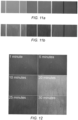
- FIG. 1a The actual photographic image of wood-effect created by the mixed polyurethane composition of example 1 is shown in Fig 1a .
- the polyurethane composition of the invention has the following composition.
- the mixed polyurethane composition of example 2 is prepared by using the general method for preparation of the mixed polyurethane composition as described above.
- Wood-effect can be created by using the metallic pigments of varying particles sizes, however some sizes give better results than others.
- the polyurethane composition of example 3, example 4 and example 5 were prepared by using the two component polyurethane composition SR3000N, 2 weight-% of MagnaPearl and 1 weight-% blue NoP.
- the polyurethane composition of example 3, example 4 and example 5 differs only in the size of the metallic pigment.
- the mixed polyurethane composition of example 3, example 4 and example 5 contains MagnaPearl 1000 (particle size 8 - 48 microns, rating++), MagnaPearl 2000 (particle size 5 - 25 microns, rating+) and MagnaPearl 4000 (particle size 15 - 150 microns, rating+) respectively. "+" indicates good results, "++" indicates even better results.
- the photographic images depicted in Fig. 2 showcase wood-effect created by using the mixed polyurethane composition of example 3 (i.e. with MagnaPearl 1000) and the mixed polyurethane composition of example 4 (i.e. with MagnaPearl 2000). Further, it has been observed that the mixed polyurethane composition of example 3 (i.e. with MagnaPearl 1000) gives best results.
- the particle size of MagnaPearl 1000 is higher than MagnaPearl 2000 but lower than MagnaPearl 4000.
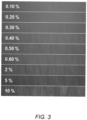
- Wood-effect can be created by using the metallic pigments with varying concentration, however some concentrations give better results than others.
- the viscosity of the mixed composition was between 3000 - 8000 mPa.s when drawing the pattern, except in the cases of example 13 (i.e. 10 weight-% papaya pigment) and example 14 (i.e. 10 weight-% papaya pigment). In these cases, the viscosity became higher than 8000 mPa.s making the casting (less flow) and drawing of pattern more difficult. Especially in the case of example 14, the final result was not even/plain any more.
- the flow values were measured using a flow-plate on which 1 mL of the mixed polyurethane composition is placed. After completion of the curing, the length of the flow strip is measured with a ruler.
- hardness samples were cured overnight at 20°C and subsequently, 5 hours at 80°C.
- the hardness was measured according to a procedure described in ASTM D2240, Test Method for Rubber Property -Durometer Hardness.
- Viscosity was measured with a Brookfield DV-E viscometer using spindle 6.
- the non-metallic pigments are preferably added to the mixed polyurethane compositions of the invention.
- the effect of these non-metallic pigments, on wood-effect i.e. wood-effect created by using the mixed polyurethane composition containing non-metallic pigments was studied.
- the mixed polyurethane compositions of example 15, example 16 and example 17 were prepared by using the two component polyurethane composition SR3000N and 1.1 weight-% of MPP (Magnapearl 1000). The difference amongst example 15, example 16 and example 17 lies in the amount of black NoP used.
- the mixed polyurethane composition of example 15 was prepared without using black NoP, whereas the polyurethane composition of example 16 and example 17 contains 0.1 weight-% and 0.2 weight-% of black NoP respectively, based on total weight of the mixed polyurethane composition.
- the mixed polyurethane compositions of example 18, 19 and 20 were prepared by using the two component polyurethane composition SR3000N and 2 weight-% of MPM (Grey). The difference amongst the mixed polyurethane compositions of example 18, 19 and 20 lies in the amount of white NoP.
- the mixed polyurethane composition of example 18 was prepared without using white NoP.
- the mixed polyurethane composition of example 19 and 20 contains 1.1 weight-% and 2.2 weight-% of white NoP, based on total weight of the mixed polyurethane composition.
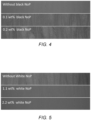
- FIG. 5 The photographic images of wood-effect created by using the mixed polyurethane composition of example 18 (i.e. without white NoP), example 19 (i.e. with 1.1 weight-% of white NoP) and example 20 (i.e. with 2.2 weight-% of white NoP) are depicted in Fig. 5 . It has been observed that wood-effect is visible in the surface created by using the mixed polyurethane composition of example 18 (i.e. without white NoP). But, in case of surfaces created by the mixed polyurethane compositions of example 19 (i.e. with 1.1 weight-% of white NoP) and example 20 (i.e. with 2.2 weight-% of white NoP) the wood-effect is not visible. Hence, it can be inferred that the white NoP masks wood-effect.
- the dispersing additives are preferably added to the mixed polyurethane compositions of the invention to enhance stabilization.
- the presence of the dispersing additives in the mixed polyurethane composition of the invention also affects the viscosity of the mixed polyurethane composition. Presence or absence of dispersing additive in the mixed polyurethane composition has significant impact on wood-effect.
- the mixed polyurethane compositions of example 21 and example 12 were considered.
- the mixed polyurethane compositions of example 21 and example 12 contains the two component polyurethane composition SR3000N and 2 weight-% of papaya pigment. Further, the mixed polyurethane composition of example 21 additionally contains 1 weight-% of flow dispersing additive, based on total weight of mixed composition. Therefore, the difference between the mixed polyurethane composition of example 21 and example 12 lies in use of dispersive additive.
- dispersive additive in the mixed polyurethane composition of example 21 gives rise to a viscosity less than 2500 mPa.s, when making a pattern after five minutes of mixing.
- the viscosity of the mixed polyurethane composition of example 12 i.e. without dispersing additive is between the ranges of 3000-8000 mPa.s, when making a pattern after five minutes of mixing.
- the rheology additives are preferably added to the mixed polyurethane compositions of the invention to improve flow properties.
- the presence of the rheology additives in the mixed polyurethane composition of the invention affects the viscosity of the mixed polyurethane composition. Presence or absence of rheology additive in the mixed polyurethane composition has significant effect on wood-effect.
- the mixed polyurethane composition of example 22, example 23 and example 24 were prepared by using the two component polyurethane composition SR3000N, 2 weight-% of metallic pigments (papaya) and rheology additive, based on total mixed composition.
- the mixed polyurethane composition of example 22, example 23 and example 24 contains 1 weight-% of rheology additive Arbothix, 3 weight-% of rheology additive BYK 7410ET and 1 weight-% of rheology additive BYK 7410ET respectively, based on total mixed composition.
- the measured viscosity values of the mixed polyurethane composition of example 12, example 22, example 23 and example 24 were as follows: Substrate composition Description Viscosity (5 minutes after mixing in mPa.s) Example 12 SR3000N + 2% papaya (reference, without thickner or rheology additive) 4120 Example 22 SR3000N + 2% papaya + 1% Arbothix 6400 Example 23 SR3000N + 2% papaya + 3% BYK 7410ET 11880 Example 24 SR3000N + 2% papaya + 1% BYK 7410ET 5280
- Viscosity is measured at 20°C using a Brookfield DV-E viscometer at 100 rpm using spindle #7
- the metallic pigment is added to the polyol component. Therefore, it is of utmost importance to study the storage stability of polyol component containing the metallic pigment. To study the storage stability the polyurethane composition of example 12 was considered.
- the metallic pigment is added to the polyol component (A) of the polyurethane composition of example 12 and the mixture thus produced was stored at room temperature. Further, the viscosity behavior of the mixture (i.e. polyol component A and papaya pigment) with respect to time was studied, the results of which are provided in Table below: Time (in days) Temperatur e (in ⁇ C) Viscosity (in mPa.s) of the polyol component (before mixing with hardener component) spindle # 0 22 10840 7 1 21 11360 7 7 22 10560 7 14 22.5 10160 7 21 22 10680 7 28 21 11440 7
- the hardener component (B) After measuring the viscosity values of the polyol component at different intervals of time, the hardener component (B) is added, mixed and samples were immediately casted. After five minutes of casting wood-effect is created. During the process, the viscosity of the casted composition is between 3000 - 8000 mPa.s .
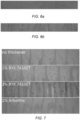
- FIG. 8 The photographic images of wood-effect created by using the mixed polyurethane composition of example 12 after 0, 28 and 49 days of storage is depicted the Fig. 8 .
- wood-effect is created by inserting the object into the applied mixed polyurethane composition, preferably more than 20% of the thickness, preferably more than 40% of the thickness, preferably more than 60% of the thickness, more preferably more than 80%, most preferably more than 90%, of the thickness of the applied mixed polyurethane composition.
- Tests were conducted to study the effect of sanding and/or topcoat on the wood effect created on the surface of the mixed polyurethane composition.
- wood boards were made with nine different colors.
- Each wood board contains a two component polyurethane composition (GM700) and 0.75 - 1 weight-% of one of the nine different non-metallic pigments (NoP).
- GM700 two component polyurethane composition
- NoP non-metallic pigments
- first wood board sample For each color two different types of samples were prepared a first wood board sample and a second wood board sample.
- the overall composition of the first wood board sample and the second wood board sample are as provided below:
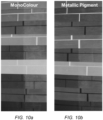
- the photographic images of the first wood board sample (i.e. Monocolor or without metallic pigment) and the second woodboard sample (i.e. with the metallic pigment Magnapearl 1000) are depicted in the Fig. 10a and Fig. 10b respectively.
- the metallic pigment Magnapearl 1000 was added to the polyol component (A) of the two component polyurethane resin (GM700). Subsequently the hardener component (B) of the two component polyurethane resin (GM700) is added and mixed to obtain a mixed polyurethane composition.
- the mixed polyurethane composition is poured on the surface (a A-4-size foil) and intended pattern is drawn on it by using a spatula. During the "drawing" the viscosity of the casted composition was between 3000 - 8000 mPa.s.
- the surface was cured for 1 day and lines were made using a milling cutter to create a floor board pattern. The milled lines were filled to the rim with the mixed polyurethane composition (or another polyurethane product) and cured for 1 day. After that, the whole surface is grinded to create a wood-effect.
- the viscosity of the mixed polyurethane composition plays pivotal role in the creation of realistic wood-like effect/pattern.
- a mixed polyurethane composition of example 25 was taken and its viscosity is measured at different intervals of time.
- the mixed polyurethane composition of example 25 was prepared by using a two component polyurethane composition GM700 and 2 weight-% of metallic pigment (papaya) based on total mixed composition.
- the viscosity of the mixed polyurethane composition at room temperature was measured at the times indicated in the Table provided below: Time (in min) Viscosity (in MPa.s) 1 1600 5 2100 10 2800 20 5000 25 7000 30 9600
- the samples of the mixed polyurethane composition of example 25 were poured on the surface (an A4-size foil). Immediately after casting, a spatula was used to draw the intended pattern. The sample of thickness 8 mm was cured for 1 day.
- FIG. 14 The photographic image of the concrete-like effect created by using the mixed polyurethane compositions of the invention is depicted in Fig. 14 .
Landscapes
- Chemical & Material Sciences (AREA)
- Polymers & Plastics (AREA)
- Health & Medical Sciences (AREA)
- Chemical Kinetics & Catalysis (AREA)
- Medicinal Chemistry (AREA)
- Engineering & Computer Science (AREA)
- Organic Chemistry (AREA)
- Architecture (AREA)
- Mechanical Engineering (AREA)
- Civil Engineering (AREA)
- Structural Engineering (AREA)
- Paints Or Removers (AREA)
- Compositions Of Macromolecular Compounds (AREA)
- Polyurethanes Or Polyureas (AREA)
Applications Claiming Priority (3)
| Application Number | Priority Date | Filing Date | Title |
|---|---|---|---|
| EP16205032 | 2016-12-19 | ||
| PCT/EP2017/083612 WO2018114991A1 (en) | 2016-12-19 | 2017-12-19 | Polyurethane composition for creating flooring patterns |
| EP17825496.7A EP3555165B1 (de) | 2016-12-19 | 2017-12-19 | Polyurethanzusammensetzung zur erzeugung von bodenbelagsmustern |
Related Parent Applications (2)
| Application Number | Title | Priority Date | Filing Date |
|---|---|---|---|
| EP17825496.7A Division EP3555165B1 (de) | 2016-12-19 | 2017-12-19 | Polyurethanzusammensetzung zur erzeugung von bodenbelagsmustern |
| EP17825496.7A Division-Into EP3555165B1 (de) | 2016-12-19 | 2017-12-19 | Polyurethanzusammensetzung zur erzeugung von bodenbelagsmustern |
Publications (2)
| Publication Number | Publication Date |
|---|---|
| EP4306589A2 true EP4306589A2 (de) | 2024-01-17 |
| EP4306589A3 EP4306589A3 (de) | 2024-01-31 |
Family
ID=57838131
Family Applications (2)
| Application Number | Title | Priority Date | Filing Date |
|---|---|---|---|
| EP23207446.8A Pending EP4306589A3 (de) | 2016-12-19 | 2017-12-19 | Polyurethanzusammensetzung zur erzeugung von bodenbelagsmustern |
| EP17825496.7A Active EP3555165B1 (de) | 2016-12-19 | 2017-12-19 | Polyurethanzusammensetzung zur erzeugung von bodenbelagsmustern |
Family Applications After (1)
| Application Number | Title | Priority Date | Filing Date |
|---|---|---|---|
| EP17825496.7A Active EP3555165B1 (de) | 2016-12-19 | 2017-12-19 | Polyurethanzusammensetzung zur erzeugung von bodenbelagsmustern |
Country Status (3)
| Country | Link |
|---|---|
| EP (2) | EP4306589A3 (de) |
| ES (1) | ES2974835T3 (de) |
| WO (1) | WO2018114991A1 (de) |
Families Citing this family (1)
| Publication number | Priority date | Publication date | Assignee | Title |
|---|---|---|---|---|
| DE102024110017A1 (de) | 2024-04-10 | 2025-10-16 | Brillux Gmbh & Co. Kg | Kit of parts zur Herstellung einer Wand- und Bodenbeschichtung |
Family Cites Families (2)
| Publication number | Priority date | Publication date | Assignee | Title |
|---|---|---|---|---|
| WO2002004207A1 (en) * | 2000-07-11 | 2002-01-17 | Pergo Ab | A process for the manufacturing of an improved decorative laminate and a decorative laminate obtained by the process |
| NZ553549A (en) * | 2004-09-03 | 2009-07-31 | Heidi Marie Eckert | Epoxy resin based coating to provide substrates with a decorative non-uniformly distributed special effect pigment |
-
2017
- 2017-12-19 EP EP23207446.8A patent/EP4306589A3/de active Pending
- 2017-12-19 EP EP17825496.7A patent/EP3555165B1/de active Active
- 2017-12-19 ES ES17825496T patent/ES2974835T3/es active Active
- 2017-12-19 WO PCT/EP2017/083612 patent/WO2018114991A1/en not_active Ceased
Also Published As
| Publication number | Publication date |
|---|---|
| EP3555165A1 (de) | 2019-10-23 |
| WO2018114991A1 (en) | 2018-06-28 |
| EP3555165C0 (de) | 2024-01-03 |
| EP3555165B1 (de) | 2024-01-03 |
| ES2974835T3 (es) | 2024-07-01 |
| EP4306589A3 (de) | 2024-01-31 |
Similar Documents
| Publication | Publication Date | Title |
|---|---|---|
| DE60222285T2 (de) | Niedrigviscose kratzresistente beschichtungen mit strukturgebenden und inorganischen füllstoffen | |
| JP4953355B2 (ja) | 水性塗料組成物 | |
| CN101705045B (zh) | 具有仿丝绒效果的卷材涂料及其制备方法 | |
| US12234317B2 (en) | Polyurethane composition for the manufacture of floors, especially for marine applications | |
| CN104927620B (zh) | 一种实木板材用防开裂紫外光固化涂装体系 | |
| CN115010403A (zh) | 一种水性聚氨酯浮动彩砂自流平砂浆及其制备工艺 | |
| EP3555165B1 (de) | Polyurethanzusammensetzung zur erzeugung von bodenbelagsmustern | |
| CN117701139B (zh) | 一种无溶剂聚氨酯浮动彩砂自流平地坪材料及制备方法 | |
| CN102775834A (zh) | 聚氨酯高光腻子涂料及其制备方法 | |
| EP3147303A1 (de) | Produkt mit fester oberfläche bestehend aus aliphatischem isocyanat und verfahren zu dessen herstellung | |
| EP0798349A2 (de) | Mittel zum Aufbringen eines Schutzüberzugs auf harte Oberflächen, um sie gegen Witterungseinflüsse und mechanische Beanspruchungen sowie gegen Einwirkung von Chemikalien zu schützen, Verfahren zu ihrer Herstellung und ihre Verwendung | |
| CN1974696A (zh) | 一种用多彩涂料色片制成的砂壁状涂料 | |
| KR101581636B1 (ko) | 비금속광물 착색용 조성물 및 이를 이용한 착색된 비금속 광물의 제조방법 | |
| KR102531206B1 (ko) | 줄눈재용 폴리우레아 수지 조성물 | |
| CN104109412B (zh) | 一种耐磨透明性好的环保pu哑光清面漆 | |
| CN104497848A (zh) | 一种高强度双组分蓖麻油聚氨酯防水涂料 | |
| DE1938727A1 (de) | Keramischer Stein und Verfahren zu seiner Herstellung | |
| WO2004014815A1 (de) | Lösemittelfreies verfahren zur hydrophoben farbbeschichtung von glasgranulat, das produkt hieraus und seine verwendung | |
| KR100975355B1 (ko) | 도막형 바닥재용 친환경 컬러 코팅제 | |
| EP4464751B1 (de) | Reaktive 2k-beschichtungszusammensetzung | |
| CN110183951A (zh) | 一种水性丙烯酸聚氨酯面漆及其制备方法 | |
| EP3819718A1 (de) | Farbige beschichtung für uhrenkomponenten | |
| KR20060079552A (ko) | 이액형 상온 경화형 폴리우레탄 조성물 | |
| EP1918336A1 (de) | Beschichtungszusammensetzung enthaltend Edelsteinpartikel | |
| EP3981841B1 (de) | Bodenbelag enthaltend uv-nachweisbare grundierung |
Legal Events
| Date | Code | Title | Description |
|---|---|---|---|
| PUAI | Public reference made under article 153(3) epc to a published international application that has entered the european phase |
Free format text: ORIGINAL CODE: 0009012 |
|
| STAA | Information on the status of an ep patent application or granted ep patent |
Free format text: STATUS: THE APPLICATION HAS BEEN PUBLISHED |
|
| REG | Reference to a national code |
Ref country code: DE Ref legal event code: R079 Free format text: PREVIOUS MAIN CLASS: C08K0003013000 Ipc: C08G0018650000 |
|
| PUAL | Search report despatched |
Free format text: ORIGINAL CODE: 0009013 |
|
| AC | Divisional application: reference to earlier application |
Ref document number: 3555165 Country of ref document: EP Kind code of ref document: P |
|
| AK | Designated contracting states |
Kind code of ref document: A2 Designated state(s): AL AT BE BG CH CY CZ DE DK EE ES FI FR GB GR HR HU IE IS IT LI LT LU LV MC MK MT NL NO PL PT RO RS SE SI SK SM TR |
|
| AK | Designated contracting states |
Kind code of ref document: A3 Designated state(s): AL AT BE BG CH CY CZ DE DK EE ES FI FR GB GR HR HU IE IS IT LI LT LU LV MC MK MT NL NO PL PT RO RS SE SI SK SM TR |
|
| RIC1 | Information provided on ipc code assigned before grant |
Ipc: C08K 3/013 20180101ALI20231222BHEP Ipc: B05D 5/06 20060101ALI20231222BHEP Ipc: E04F 15/12 20060101ALI20231222BHEP Ipc: B44C 5/04 20060101ALI20231222BHEP Ipc: C08K 3/00 20180101ALI20231222BHEP Ipc: C08G 18/36 20060101ALI20231222BHEP Ipc: C08G 18/76 20060101ALI20231222BHEP Ipc: C08G 18/65 20060101AFI20231222BHEP |
|
| STAA | Information on the status of an ep patent application or granted ep patent |
Free format text: STATUS: REQUEST FOR EXAMINATION WAS MADE |
|
| 17P | Request for examination filed |
Effective date: 20240731 |
|
| RBV | Designated contracting states (corrected) |
Designated state(s): AL AT BE BG CH CY CZ DE DK EE ES FI FR GB GR HR HU IE IS IT LI LT LU LV MC MK MT NL NO PL PT RO RS SE SI SK SM TR |
|
| STAA | Information on the status of an ep patent application or granted ep patent |
Free format text: STATUS: EXAMINATION IS IN PROGRESS |
|
| 17Q | First examination report despatched |
Effective date: 20250508 |