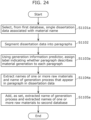
EP4296933A1 - Vorbereitungsprozessausgabevorrichtung, vorbereitungsprozessausgabeverfahren und programm - Google Patents
Vorbereitungsprozessausgabevorrichtung, vorbereitungsprozessausgabeverfahren und programm Download PDFInfo
- Publication number
- EP4296933A1 EP4296933A1 EP22756263.4A EP22756263A EP4296933A1 EP 4296933 A1 EP4296933 A1 EP 4296933A1 EP 22756263 A EP22756263 A EP 22756263A EP 4296933 A1 EP4296933 A1 EP 4296933A1
- Authority
- EP
- European Patent Office
- Prior art keywords
- generation
- information
- sintering
- probability
- types
- Prior art date
- Legal status (The legal status is an assumption and is not a legal conclusion. Google has not performed a legal analysis and makes no representation as to the accuracy of the status listed.)
- Withdrawn
Links
Images



















Classifications
-
- G—PHYSICS
- G16—INFORMATION AND COMMUNICATION TECHNOLOGY [ICT] SPECIALLY ADAPTED FOR SPECIFIC APPLICATION FIELDS
- G16C—COMPUTATIONAL CHEMISTRY; CHEMOINFORMATICS; COMPUTATIONAL MATERIALS SCIENCE
- G16C60/00—Computational materials science, i.e. ICT specially adapted for investigating the physical or chemical properties of materials or phenomena associated with their design, synthesis, processing, characterisation or utilisation
-
- G—PHYSICS
- G06—COMPUTING OR CALCULATING; COUNTING
- G06F—ELECTRIC DIGITAL DATA PROCESSING
- G06F16/00—Information retrieval; Database structures therefor; File system structures therefor
- G06F16/90—Details of database functions independent of the retrieved data types
- G06F16/904—Browsing; Visualisation therefor
-
- G—PHYSICS
- G06—COMPUTING OR CALCULATING; COUNTING
- G06Q—INFORMATION AND COMMUNICATION TECHNOLOGY [ICT] SPECIALLY ADAPTED FOR ADMINISTRATIVE, COMMERCIAL, FINANCIAL, MANAGERIAL OR SUPERVISORY PURPOSES; SYSTEMS OR METHODS SPECIALLY ADAPTED FOR ADMINISTRATIVE, COMMERCIAL, FINANCIAL, MANAGERIAL OR SUPERVISORY PURPOSES, NOT OTHERWISE PROVIDED FOR
- G06Q10/00—Administration; Management
- G06Q10/04—Forecasting or optimisation specially adapted for administrative or management purposes, e.g. linear programming or "cutting stock problem"
-
- G—PHYSICS
- G06—COMPUTING OR CALCULATING; COUNTING
- G06Q—INFORMATION AND COMMUNICATION TECHNOLOGY [ICT] SPECIALLY ADAPTED FOR ADMINISTRATIVE, COMMERCIAL, FINANCIAL, MANAGERIAL OR SUPERVISORY PURPOSES; SYSTEMS OR METHODS SPECIALLY ADAPTED FOR ADMINISTRATIVE, COMMERCIAL, FINANCIAL, MANAGERIAL OR SUPERVISORY PURPOSES, NOT OTHERWISE PROVIDED FOR
- G06Q50/00—Information and communication technology [ICT] specially adapted for implementation of business processes of specific business sectors, e.g. utilities or tourism
- G06Q50/04—Manufacturing
-
- G—PHYSICS
- G16—INFORMATION AND COMMUNICATION TECHNOLOGY [ICT] SPECIALLY ADAPTED FOR SPECIFIC APPLICATION FIELDS
- G16C—COMPUTATIONAL CHEMISTRY; CHEMOINFORMATICS; COMPUTATIONAL MATERIALS SCIENCE
- G16C20/00—Chemoinformatics, i.e. ICT specially adapted for the handling of physicochemical or structural data of chemical particles, elements, compounds or mixtures
- G16C20/70—Machine learning, data mining or chemometrics
-
- Y—GENERAL TAGGING OF NEW TECHNOLOGICAL DEVELOPMENTS; GENERAL TAGGING OF CROSS-SECTIONAL TECHNOLOGIES SPANNING OVER SEVERAL SECTIONS OF THE IPC; TECHNICAL SUBJECTS COVERED BY FORMER USPC CROSS-REFERENCE ART COLLECTIONS [XRACs] AND DIGESTS
- Y02—TECHNOLOGIES OR APPLICATIONS FOR MITIGATION OR ADAPTATION AGAINST CLIMATE CHANGE
- Y02P—CLIMATE CHANGE MITIGATION TECHNOLOGIES IN THE PRODUCTION OR PROCESSING OF GOODS
- Y02P10/00—Technologies related to metal processing
- Y02P10/25—Process efficiency
Definitions
- the present disclosure relates to, for instance, a generation process output device that outputs information about a generation process for a material.
- a synthesis process is a process for generating a target material through synthesis and is also referred to as a generation process.
- the present disclosure is to solve the above problem and provides, for instance, a generation process output device capable of more appropriately supporting the search of a generation process for a target material.
- a generation process output device includes: a first information obtainer that obtains first information about a target material; a deriver that derives, for each of one or more types of generation processes, a generation parameter based on a database regarding materials, the generation parameter indicating a degree that the generation process is required for generating the target material specified by the first information; and an outputter that outputs one or more generation parameters that have been derived, where each of the one or more generation parameters is the generation parameter.
- a search for a synthesis process by a calculator is performed by analyzing the relationship of material names, experimental procedures, and experimental conditions stored in a known database, and studies are in progress focusing on the material development of an organic material (also referred to as an organic compound).
- an organic material also referred to as an organic compound.
- a generation process output device includes: a first information obtainer that obtains first information about a target material; a deriver that derives, for each of one or more types of generation processes, a generation parameter based on a database regarding materials, where the generation parameter indicates a degree that the generation process is required for generating the target material specified by the first information; and an outputter that outputs one or more generation parameters that have been derived, where each of the one or more generation parameters is the generation parameter.
- the outputter may output the generation parameter indicating the degree as at least one of a generation probability or a ranking.
- the generation probability may be a probability that a generation process of a type corresponding to the generation probability is required for the generation of the target material.
- the ranking may be achieved by arranging the one or more types of generation processes in order of the degree.
- material generation is, for example, material synthesis
- material synthesis is, for example, material sintering.
- the one or more types of generation processes may be, for example, one or more types of sintering methods, or may include, for instance, ultrasonic processing.
- the generation parameter of each type of a generation process for a target material is output.
- the user can easily grasp, for each type of the generation process, the necessity of the generation process for the generation of the target material, i.e., a possibility that the target material is generated using the generation process.
- the user can firstly grasp, for each generation process type, the possibility that the target material is generated, and then select a generation process.
- the user can easily select a generation process. If the user is a researcher with good knowledge and experience, they can make the use of their knowledges and experiences to select a generation process more accurately.
- the user can find out, among those generation processes, a generation process of a type that is most required for the generation of a target material. It can be also said that the generation process of such a type is a generation process of a type that is most likely to generate the target material. The user can then determine that the target material can be generated using that generation process. As a result, the search of a generation process for a target material by the user can be more appropriately supported.
- the deriver may input a descriptor related to the target material to a predictor to derive the generation parameter of each of the one or more types of generation processes for the target material.
- the predictor is trained using the database to output, in response to the input of a descriptor related to a material, the generation parameter of each of the one or more types of generation processes for the material.
- the predictor is, for example, a neural network.
- the predictor may be trained using the database to output, in response to the input of a descriptor indicating a composition, the generation parameter of each of the one or more types of generation processes for a material having the composition.
- the deriver may input a descriptor indicating the composition of the target material to the predictor to derive the generation parameter of each of the one or more types of generation processes for the target material.
- the predictor may be trained using the database to output, in response to the input of a descriptor indicating one or more raw materials for generating a material, the generation parameter of each of the one or more types of generation processes for the material.
- the deriver may input a descriptor indicating one or more raw materials for generating the target material to the predictor, to derive the generation parameter of each of the one or more types of generation processes for the target material.
- the generation parameter of each of one or more types of generation processes for an unknown target material can be derived by using a trained predictor.
- the outputter may generate a first image indicating the one or more generation parameters, and output the first image to a display to output the one or more generation parameters.
- a first image i.e., a process-related image
- the user can determine that a target material can be generated using the generation process of a type corresponding to the largest generation parameter. If the user does not own a generation device capable of implementing the generation process of the type corresponding to the largest generation parameter, the user can check the generation parameter of a type corresponding to a generation process implementable by a generation device owned by the user. The user can determine to attempt the generation of the target material even with the generation process of a type corresponding to the smallest generation parameter if the generation parameter indicates the generation probability of, for example, at least 30%.
- the generation process output device may further include: a second information obtainer that obtains second information of each of one or more known materials related to the target material from a database regarding materials.
- the outputter may generate the first image so as to additionally indicate the second information of each of the one or more known materials.
- the second information obtainer may further obtain, from the database, the area of part of literature that describes a generation process for generating the known material indicated in the selected single second information item.
- the outputter may further generate, as a second image, an image indicating the description in the area of the part of the literature, to output the image to the display.
- the following is displayed for each of one or more known materials related to a target material: second information indicating the known material; and the area of part of literature that describes the generation process of the known material.
- second information indicating the known material
- the area of part of literature that describes the generation process of the known material.
- the outputter may generate the first image indicating the generation parameter of each of the M types of generation processes and not indicating generation parameters of the other remaining generation processes among the N types of generation processes.
- a generation probability indicated by the generation parameter of one type of generation process among plural types of generation processes is the only generation probability indicating at least a threshold 80%, for example, only the generation probability of that one type of generation process is displayed and the generation probabilities of the other remaining generation processes are not displayed.
- a predetermined condition is that a generation probability is at least a threshold 80%. Accordingly, the user can easily find the most probable generation process for a target material.
- the sum of two highest generation probabilities among the generation probabilities of three or more generation processes is at least a threshold 90%, for example, only the two highest generation probabilities are displayed and the other remaining generation probabilities are not displayed.
- the two highest generation probabilities are two generation probabilities higher than any other generation probabilities.
- a predetermined condition is that the sum of two highest generation probabilities is at least a threshold 90%. Accordingly, a generation parameter such as a generation probability that has no chance of generating a target material can be omitted from the first image, and unnecessary provision of information for the user can be inhibited.
- the second information obtainer may obtain the second information indicating the composition formula and attribute of the known material.
- the outputter may further generate (i) a map presenting the relationship of composition formulae indicated in the second information items of the one or more known materials, (ii) a map presenting the relationship between a composition formula and an attribute indicated in the second information of each of the one or more known materials, or (iii) a map presenting the relationship of attributes indicated in the second information items of the one or more known materials, to output the map to the display, where each of the composition formulae is the composition formula, each of the attributes is the attribute, and each of the second information items is the second information.
- the user can easily find out desired second information from these second information items since the second information items are displayed on a map.
- the user can easily select the desired second information and easily view a second image (i.e., a reference image) corresponding to the selected second information.
- the attribute of the known material indicated in the second information may be at least one of the following: the crystal structure of the known material; a process condition in a generation process for generating the known material; a property value indicating the property degree of the known material; literature information for identifying literature that describes the known material; and an application of the known material.
- the process condition is a condition used for a generation process and is, for example, a temperature, a time, or the like.
- the outputter may further: specify the type of a generation process implementable by a generation device owned by a user; and assign mutually different weights to (i) a degree indicated by the generation parameter of the generation process of the specified type, and (ii) degrees indicated by the other remaining generation parameters among the generation parameters of the one or more types of generation processes, to generate the first image indicating the generation parameter of each of the one or more types of generation processes that have been updated.
- the second information obtainer may further obtain estimated information regarding the estimation of a generation device that can implement one or more of the other remaining generation processes excluding the generation process of the specified type among the one or more types of generation processes.
- the outputter may further output an image indicating the estimated information to the display.
- the second information of each of the one or more known materials may include an estimated required time which is a time required for generating the known material.
- the outputter may arrange the second information of each of the one or more known materials in an order according to the estimated required time indicated in the second information, and generate the first image indicating one or more second information items arranged in the order, where each of the one or more second information items is the second information.
- the estimated required time of each of one or more known materials is displayed, and the user can therefore predict a time required for the generation of a target material based on the estimated required times. Moreover, since the estimated required times are arranged in order and displayed, the user can easily grasp the largest value, the smallest value, or the dispersion of the estimated required time and more appropriately predict the time required for the generation of the target material. If the second information of each of one or more known materials also indicates a generation process for generating the known material, the user can easily determine which generation process can reduce the time required for the generation of the target material.
- the user can determine to use a generation process corresponding to the second largest generation parameter for the generation of the target material. In other words, the user can select a generation process for the target material in consideration of a time required for the generation of the target material.
- Embodiments 1 through 5 Prior to describing Embodiments 1 through 5 in detail, the configuration of generation process search system 10 commonly used in Embodiments 1 through 5 will be described.
- Embodiments 1 through 5 particularly describe a sintering method in a generation process.
- an inorganic material also referred to as an inorganic compound
- the search of a generation process still very much depends on knowledges and experiences of researchers conducting the search.
- the selection of a sintering method included in a generation process is one of important factors in experimental conditions.
- a sintering method in general, is a method of sintering a raw material at high temperature to change the nature of the raw material, and various types of sintering methods are known.
- An optimal sintering method greatly depends on the combination of types and composition ratio of elements included in the inorganic material.
- a sintering method is also referred to as a burning method.
- material sintering is lower than material synthesis, and material synthesis is lower than material generation. Sintering may be therefore also referred to as generation or synthesis.
- PTL 1 discloses a synthesis route design system that includes: a means for applying reaction rules stored in a reaction knowledge base to predict a route for generating a target molecule from compounds purchasable from the market (i.e., a synthesis route); a means for estimating, for each of predicted synthesis routes, a variable expense index serving as the rough indication of a cost required for manufacturing a target molecule from starting materials; and a means for presenting estimated variable expense indices in ascending order to the user.
- the user can easily determine a synthesis route that is economically and industrially feasible among a large number of predicted synthesis routes.
- the system disclosed in PTL 1 i.e., a system that supports the search of a synthesis route, does not have any function to display a sintering method with which a target material that is a target molecule is very likely to be synthesized. It is therefore difficult, in the synthesis of the target material, for the user to firstly grasp the synthesis possibility of each sintering method and then set experimental conditions.
- Each of Embodiments 1 through 5 describes generation process search system 10 that enables the user to easily grasp the synthesis possibility of each sintering method.
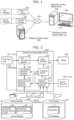
- FIG. 1 is a diagram illustrating one example of the configuration of generation process search system 10 according to each of Embodiments 1 through 5.
- Generation process search system 10 includes generation process display device 100, display 108, input unit 110, database creation device 200, first storage 301, and second storage 302.
- generation process display device 100, database creation device 200, first storage 301, and second storage 302 are mutually connected via network 401 such as the Internet.
- Generation process display device 100 is configured as, for example, a computer such as a personal computer or a server, and displays, on display 108, information about a generation process which is a process for generating a target material.
- a generation process which is a process for generating a target material.
- the generation of a material is performed by synthesizing the material. Accordingly, material generation is also referred to as material synthesis.
- a generation process is therefore also referred to as a synthesis process. More specifically, the generation or synthesis of the material involves material sintering. Therefore, a generation process or synthesis process according to each of Embodiments 1 through 5 means a material sintering method.
- Display 108 displays an image indicating information about the aforementioned generation process, i.e., the aforementioned synthesis process, in accordance with a signal output from generation process display device 100.
- Such display 108 is, for example, a liquid crystal display, a plasma display, or an organic electroluminescent (EL) display, but is not limited to these examples.
- Input unit 110 configured as, for example, a keyboard, a touch sensor, a touch pad, or a mouse receives an input operation from the user of generation process display device 100, and outputs a signal in accordance with the input operation to generation process display device 100.
- display 108 and input unit 110 are configured separately, but may be configured integrally like a touch panel.
- generation process display device 100 neither includes display 108 nor input unit 110, but may include them.
- Database creation device 200 is configured as, for example, a computer such as a personal computer or a server, and creates a second database to be used by generation process display device 100.
- Database creation device 200 reads a first database stored in first storage 301 from first storage 301 via network 401, and creates the second database using the first database.
- Database creation device 200 stores the created second database into second storage 302 via network 401.
- First storage 301 is a recording medium for storing a first database.
- the first database includes a plurality of thesis data items each indicating the content of a dissertation about material synthesis.
- Second storage 302 is a recording medium for storing a second database.
- the first database and the second database are each a database regarding materials. The details of the second database will be described later.
- These recording media are each any one of, for example, a hard disk drive, random access memory (RAM), read only memory (ROM), and a semiconductor memory. Such a recording medium may be either volatile or non-volatile.
- first storage 301 and second storage 302 are disposed outside database creation device 200, but may be included in database creation device 200.
- First storage 301 and second storage 302 may be directly connected to database creation device 200 without network 401 therebetween.
- the first database and the second database are stored in mutually different recording media, but may be stored in the same recording medium.
- a pair of the first database and the second database may be regarded as a single database.
- FIG. 2 is a block diagram illustrating one example of the functional configuration of generation process display device 100 according to each of Embodiments 1 through 5.
- the generation process display device 100 uses a first database stored in first storage 301 and a second database stored in second storage 302.
- the first database includes a plurality of thesis data items 1.
- Each of the plurality of thesis data items 1 is associated with the composition formula of a primary material (i.e., a known material) to be synthesized which is indicated in thesis data item 1.
- the second database includes a plurality of first synthesis information items 2a and a plurality of second synthesis information items 2b.
- Each of the plurality of first synthesis information items 2a indicates, in association with each other, (i) the composition formula of a known material, which is associated with thesis data 1, and (ii) the type name of the sintering method of the known material.
- Each of the plurality of second synthesis information items 2b indicates, in association with each other, (i) the composition formula of a known material, which is associated with thesis data 1, and (ii) an attribute of the known material indicated in that thesis data 1.
- the attribute of the known material may be literature information of thesis data 1 that indicates the known material, or the location of a paragraph which describes synthesis of the known material in dissertation data 1.
- the attribute of the known material may be the crystal structure, sintering temperature, property value, or application of the known material.
- the attribute of the known material may include part or all of the items listed above.
- Literature information is information for identifying thesis data 1 and is, for example, part or all of the title, date of issue, year of publication, and name of author of thesis data 1.
- the location of a paragraph is, for example, the paragraph number, title, or item number of the paragraph in dissertation data 1.
- the second database according to each of Embodiments 1 through 5 thus indicates, for each of a plurality of materials, the composition formula, sintering method, and attribute of the material in association with each other. With this, the obtainment of second information and the derivation of a generation probability can be appropriately performed, as will be described later.
- the data format of the second database i.e., the data format of first synthesis information 2a and the data format of second synthesis information 2b may be, for example, a table format or a JavaScript Object Notation (JSON) format.
- JSON JavaScript Object Notation
- Generation process display device 100 is a device that displays information about a material generation process, and displays, in response to the input of a target composition formula by the user, the generation probability of each type of a sintering method for the target composition formula.
- a target composition formula is the composition formula of a material targeted for synthesis (i.e., a target material).
- the generation probability of each type of a sintering method for a target material or a target composition formula is a probability that indicates, for each of predetermined plural types of sintering methods, that the target material having the target composition formula is sintered using the sintering method.
- a generation probability is expressed, for example, in percentage. The higher the generation probability of a sintering method for a target material or a target composition formula is, the higher the possibility that the target material is sintered using the sintering method is.
- Generation process display device 100 is connected to display 108 as well as first input unit 101 and second input unit 109 included in input unit 110.
- Generation process display device 100 includes first information obtainer 102, composition descriptor generator 103, sintering trainer 104, probability deriver 105, second information obtainer 106, and image generator 107.
- generation process display device 100 includes none of first input unit 101, second input unit 109, and display 108, but may include at least one of them.
- First input unit 101 is a functional element included in input unit 110 and receives an input operation from the user to output, to first information obtainer 102, a composition formula in accordance with the input operation, i.e., a signal indicating the target composition formula of a target material to be displayed, for example.
- First information obtainer 102 receives a signal from first input unit 101. In other words, first information obtainer 102 obtains first information which is a signal indicating a target composition formula. First information obtainer 102 outputs the first information to composition descriptor generator 103 and image generator 107.
- Composition descriptor generator 103 Composition descriptor generator 103
- Composition descriptor generator 103 obtains first information from first information obtainer 102 and generates a composition descriptor corresponding to a target composition formula indicated in the first information.
- a composition descriptor is, for example, a vector uniquely indicating a composition formula. Specifically, when a composition formula is composed of one or more element types among element types of seventy-two types, a composition descriptor corresponding to the composition formula is a seventy-two-dimensional vector.
- a composition formula is CaMnO 3
- a composition descriptor corresponding to the composition formula "CaMnO 3 " is indicated by a three-dimensional vector composed of a combination of one or more element types among element types of three types, and is expressed by [1,1,3].
- composition descriptor [1,1,3] may be normalized so that the vector sum of the composition descriptor is 1 and may be expressed by [0.2,0.2,0.6].
- a composition descriptor is the weighted average, the largest value, or the smallest value of a known parameter unique to each element.
- a known parameter unique to each element indicates a known number group, such as an atomic volume, a covalent radius, or a density, that each element has, and is obtainable without any physical calculation.
- the weighted average of the parameter is calculated based on the number of atoms composing a material.
- Composition descriptor generator 103 outputs the composition descriptor to probability deriver 105 and second information obtainer 106.
- Sintering trainer 104 conducts training about the relationship between a composition formula and a sintering method with reference to a second database in second storage 302, to create a sintering predictor that indicates the relationship.
- Sintering trainer 104 uses, as training data, a plurality of first synthesis information items 2a included in the second database. Each of the plurality of first synthesis information items 2a indicates, in association with each other, a composition formula and the type name of the sintering method of the known material having the composition formula.
- Sintering trainer 104 outputs the composition formula indicated in first synthesis information 2a to composition descriptor generator 103, and obtains a composition descriptor corresponding to the composition formula from composition descriptor generator 103.
- Sintering trainer 104 then, for each of the plurality of first synthesis information items 2a, conducts training that uses, as training data, the composition descriptor corresponding to the composition formula indicated in first synthesis information 2a and the type name of the sintering method indicated in first synthesis information 2a.
- Sintering trainer 104 thus creates a sintering predictor that outputs the generation probability of each of plural types of sintering methods in response to the input of a composition descriptor.
- the generation probability of each of the plural types of sintering methods is a probability indicating a possibility that a material having the composition formula corresponding to the input composition descriptor is sintered, i.e., synthesized, using the sintering method.
- sintering training 104 Upon obtaining, from probability deriver 105, the composition descriptor corresponding to the target composition formula, sintering training 104 inputs the composition descriptor to the sintering predictor to obtain the generation probability of each of the plural types of sintering methods for the target composition formula. Sintering trainer 104 then outputs the generation probabilities to probability deriver 105.
- sintering trainer 104 may conduct retraining of the sintering predictor based on the difference between first synthesis information items 2a after the update and first synthesis information items 2a before the update.
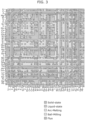
- FIG. 3 is a diagram illustrating one example of the result of predicting a sintering method by the sintering predictor of sintering trainer 104.
- the map illustrated in FIG. 3 is a two-dimensional map having a vertical axis and a horizontal axis.
- Li, B, C, O, F, Na, Mg, Al, Si, P, S, Cl, K, Ca, Sc, Ti, V, Cr, Mn, Fe, Co, Ni, Cu, Zn, Ga, Ge, As, Se, Br, Rb, Sr, Y, Zr, Nb, Mo, Ru, Rh, Pd, Ag, Cd, In, Sn, Sb, Te, I, Cs, Ba, La, Ce, Pr, Nd, Sm, Eu, Gd, Tb, Dy, Ho, Er, Tm, Yb, Lu, Hf, Ta, W, Re, Ir, Pt, Au, Hg, Tl, Pb, and Bi are adopted as element types.
- the element types listed above are arranged along the vertical axis in the stated order so that the intersection of the vertical axis and the horizontal axis (i.e., the lower left edge in FIG. 3 ) is an end point.
- the element types listed above are arranged along the horizontal axis in the stated order so that the intersection is a start point.
- Sintering trainer 104 conducts training of the sintering predictor, using a plurality of first synthesis information items 2a obtained from second storage 302 and a plurality of composition descriptors obtained from composition descriptor generator 103.
- Sintering method types according to each of Embodiments 1 through 5 are five types of Ball-Milling, Solid-State, Liquid-State, Flux, and Arc-Melting.
- the sintering predictor of sintering trainer 104 outputs the generation probability of each of the five types of sintering methods in response to the input of a composition descriptor corresponding to the composition formula of a material.
- the two-dimensional map in FIG. 3 indicates, in association with each other, (i) a composition formula corresponding to a composition descriptor input to the sintering predictor, and (ii) the type of a sintering method corresponding to the highest generation probability among the generation probabilities of the five types of sintering methods, which are output from the sintering predictor for the composition formula.
- the composition formula is a composition formula formed by combining one element type on the vertical axis and one element type on the horizontal axis with the ratio of 1:1.
- the two-dimensional map indicates the following: when one of combined element types is Li, and the other of the combined element types is C, Ti, Rb, Y, Zr, Mo, Ru, Ce, Gd, Er, Tm, or Tl, a sintering method with the highest generation probability is Arc-Melting; when one of combined element types is Li, and the other of the combined element types is F, Rh, Nd, Ta, Re, Ir, or Pt, a sintering method with the highest generation probability is Solid-State; when one of combined element types is Li, and the other of the combined element types is Cl, Br, Tb, Ho, Lu, W, or Au, a sintering method with the highest generation probability is Liquid-State; and when one of combined element types is Li, and the other of the combined element types is Na or Ba, a sintering method with the highest generation probability is Flux.
- the two-dimensional map indicates that when one of combined element types is Rb and the other of the combined element types is any one of the listed element types, a sintering method with the highest generation probability is Arc-Melting.
- the element types to be trained and the types of the sintering method are merely examples and the present disclosure is not limited to such examples.
- the arrangement order of the element types is one example, and the element types may be arranged, placing emphasis on easy association between the vertical axis and the horizontal axis or on the viewability of the two-dimensional map.
- Probability deriver 105 obtains, from composition descriptor generator 103, a composition descriptor corresponding to a target composition formula, and derives, as a generation probability, a possibility that a target material having the target composition formula is generated using each of the five sintering methods.
- the sintering predictor of sintering trainer 104 is used in the derivation of the generation probability.
- probability deriver 105 derives, for each of one or more types of sintering methods, a possibility that a target material having the target composition formula indicated in first information is sintered using the sintering method.
- the possibility is derived based on a second database in second storage 302.
- probability deriver 105 inputs the composition descriptor obtained from composition descriptor generator 103 to the sintering predictor of sintering trainer 104. Probability deriver 105 then obtains, from the sintering predictor, the generation probability of each of the five types of sintering methods output from the sintering predictor. Probability deriver 105 outputs the generation probability of each of the five types of sintering methods to second information obtainer 106 and image generator 107.
- composition descriptor generator 103 When a target composition formula is BiCuSO, for example, composition descriptor generator 103 generates a composition descriptor which is a vector indicating BiCuSO. Probability deriver 105 obtains the composition descriptor from composition descriptor generator 103, and inputs the composition descriptor to the trained sintering predictor of sintering trainer 104 to derive the generation probability of each sintering method type for BiCuSO.
- probability deriver 105 thus derives a generation probability based on combination and composition ratio of element types included in a target composition formula indicated in first information. With this, the reliability of a generation probability to be derived can be enhanced.
- probability deriver 105 inputs a composition descriptor indicating the composition formula of a target material to a sintering predictor to derive the generation probability of each of one or more types of sintering methods for the target material.
- the predictor has been trained using a second database to output, in response to the input of a composition descriptor indicating a composition formula, the generation probability of each of one or more types of sintering methods for a material having the composition formula. With this, even though the composition formula of a target material is not indicated in the second database, the generation probability of each of one or more types of sintering methods for an unknown target material can be derived by using a trained sintering predictor.
- Second information obtainer 106 obtains the composition descriptor of a target composition formula from composition descriptor generator 103, and obtains the generation probability of each of the five types of sintering methods from probability deriver 105. Subsequently, based on the obtained composition descriptor and the obtained generation probability of each of the five types of sintering methods, second information obtainer 106 obtains one or more second information items necessary for image generation from a second database in second storage 302. Second information obtainer 106 then outputs the one or more second information items to image generator 107. With this, an image indicating the one or more second information items (i.e., a process-related image to be described later) is generated and then displayed by image generator 107.
- image generator 107 an image indicating the one or more second information items (i.e., a process-related image to be described later) is generated and then displayed by image generator 107.
- the second information indicates, for example, (i) the composition formula of a known material which is related to a target composition formula input by the user and whose sintering method has been predicted as being same as the sintering method of the target composition formula, (ii) literature information associated with that composition formula, and (iii) an attribute such as the location of a paragraph of the literature information. That the sintering method of a target composition formula is same as the sintering method of a known material means that the type of a sintering method corresponding to the highest generation probability is same between a target material and the known material.
- the second information is not limited to the above example.
- the second information may indicate attributes such as a crystal structure, a sintering temperature, a property value, and an application corresponding to the composition formula of the known material.
- second information obtainer 106 obtains first synthesis information 2a and second synthesis information 2b indicating the composition formula of the known material related to the target composition formula to obtain the second information.
- the sintering method indicated in the obtained second information is regarded as an attribute of the known material.
- second information obtainer 106 obtains, from the first database, a paragraph of thesis data 1 corresponding to the selected second information item, and outputs the paragraph to image generator 107.
- second information obtainer 106 thus obtains, for each of one or more known materials related to a target composition formula indicated in first information, second information indicating the composition formula and attribute of the known material.
- the second information is obtained from a second database in second storage 302.
- the attribute of the known material indicated in the second information is at least one of the following: the crystal structure of the known material; a sintering temperature for sintering the known material; a property value indicating the property degree of the known material; literature information for identifying literature that describes the known material; and an application of the known material.
- the literature is dissertation data 1 in a first database in first storage 301.
- the attribute may be the location of a paragraph, in the literature, that describes at least one of the known material or the sintering method of the known material.
- second information obtainer 106 obtains, from the first database, the area of part of literature that describes the sintering method of the known material having the composition formula indicated in the selected second information item.
- the area of the part of the literature is a sentence, a phrase, or a paragraph that includes the description of the sintering method. In each of Embodiments 1 through 5, the area of the part is a paragraph, but may be a sentence or a phrase.
- a process-related image is also referred to as a first image.
- Image generator 107 obtains a target composition formula from first information obtainer 102 and generates an image indicating the target composition formula. In addition, image generator 107 generates an image indicating generation probabilities obtained from probability deriver 105. In other words, image generator 107 generates an image indicating the generation probability of each of the five types of sintering methods corresponding to the composition descriptor of the target composition formula. Image generator 107 also obtains one or more second information items from second information obtainer 106 and generates an image indicating these second information items. Although the second information item according to each of Embodiments 1 through 5 indicates a composition formula, a crystal structure, a sintering temperature, a property value, literature information, and an application, the second information is not limited to indicate them. Each of the generated images is, for example, included in a process-related image and displayed on display 108.
- Image generator 107 thus generates, as a process-related image indicating information regarding a generation process, an image indicating the second information items of one or more known materials and the generation probability of each of one or more types of sintering methods, and displays the image on display 108.
- image generator 107 when the area of part of literature is obtained by second information obtainer 106, image generator 107 generates, as a reference image, an image indicating the description in the area of the part of the literature, and displays the image on display 108.
- a reference image is also referred to as a second image.
- the area of the part of the literature is, for example, a paragraph, as described above.
- Display 108 obtains a signal from image generator 107 and displays an image in accordance with the obtained signal. In other words, display 108 displays a process-related image and a reference image as described above.
- Second input unit 109 Second input unit 109
- Second input unit 109 is a functional element included in input unit 110.
- Second input unit 109 receives an input operation from the user to, for example, select any one of one or more second information items in a process-related image displayed on display 108.
- Second input unit 109 then outputs a signal for identifying the selected second information item to second information obtainer 106.
- Second information obtainer 106 identifies, based on the signal, the second information item selected by the user among the one or more second information items, and obtains a paragraph in dissertation data 1 that describes a sintering method corresponding to the selected second information item.
- FIG. 4 is a block diagram illustrating one example of the functional configuration of database creation device 200 according to each of Embodiments 1 through 5.
- Database creation device 200 analyzes information in each of thesis data items 1 from a first database collected in advance, and creates a second database including first synthesis information 2a that indicates a composition formula and a sintering method corresponding to the composition formula in association with each other.
- the second database includes also second synthesis information 2b described above.
- Information in the created second database is obtained by second information obtainer 106 in generation process display device 100 and used by sintering trainer 104.
- database creation device 200 specifies a paragraph, among all of paragraphs in thesis data 1, that describes synthesis of a material corresponding to a composition formula associated with thesis data 1 in advance. Materials described in thesis data 1 are known materials. Database creation device 200 then obtains a name that is the type name of a sintering method described in the specified paragraph, and associates the name of the sintering method with the composition formula associated with thesis data 1 to generate first synthesis information 2a and add first synthesis information 2a to the second database.
- Database creation device 200 uses a pre-trained synthesis predictor to specify a paragraph describing information about material synthesis. Moreover, database creation device 200 analyzes thesis data 1 to extract information to be used by image generator 107. For example, database creation device 200 detects a paragraph describing a sintering method in thesis data 1, and extracts the detected paragraph.
- Such database creation device 200 includes thesis obtainer 202, text segmenter 203, segment descriptor generator 204, label provider 205, synthesis information trainer 206, label obtainer 207, and information extractor 208.
- Dissertation obtainer 202 Dissertation obtainer 202
- Dissertation obtainer 202 obtains thesis data 1 from a first database in storage 301 and outputs thesis data 1 to text segmenter 203.
- Text segmenter 203 extracts the text information of thesis data 1 obtained from thesis obtainer 202 and segments the text information into areas. Each of the areas is, for example, a paragraph. In other words, text segmenter 203 segments the text information into paragraphs to obtain the text information. In each of Embodiments 1 through 5, ScienceParse for example is used for the extraction of the text information from thesis data 1, but the present disclosure is not limited to this example. Text segmenter 203 then outputs each of the obtained paragraphs to label obtainer 207, segment descriptor generator 204, and label provider 205.
- Segment descriptor generator 204 generates a segment descriptor for each of the paragraphs obtained from text segmenter 203, and outputs the segment descriptor to synthesis information trainer 206.
- a segment descriptor is, for example, a vector uniquely indicating what is described in a paragraph.
- Label provider 205 provides a label for a paragraph obtained from text segmenter 203, in accordance with an input operation by the user of database creation device 200. This label indicates whether information about material synthesis is included in the paragraph. Label provider 205 then outputs the label provided for the paragraph to synthesis information trainer 206 and label obtainer 207.
- Synthesis information trainer 206 obtains a segment descriptor corresponding to each of paragraphs from segment descriptor generator 204, and obtains a label provided for each of the paragraphs from label provider 205. Synthesis information trainer 206 then conducts, for each of the paragraphs, training regarding the relationship between the segment descriptor corresponding to the paragraph and the label provided for the paragraph, to create a synthesis predictor that indicates the relationship. For example, clustering is used for such a prediction means. Clustering is a kind of training without a teacher in machine learning and is a method of grouping data based on similarity between data items in the data. Examples of the method include k-means, random forest, and neural network, but the method is not limited to these examples. In response to the input of a segment descriptor, the synthesis predictor outputs a label indicating whether a paragraph corresponding to the segment descriptor includes information about material synthesis.
- synthesis information trainer 206 obtains a segment descriptor from segment descriptor generator 204 without obtaining a label from label provider 205. Upon obtaining the segment descriptor, synthesis information trainer 206 inputs the segment descriptor to the synthesis predictor to obtain a label corresponding to the segment descriptor from the synthesis predictor. Synthesis information trainer 206 outputs the label obtained from the synthesis predictor to label obtainer 207.
- Label obtainer 207 obtains a paragraph from text segmenter 203 and obtains a label corresponding to the paragraph from label provider 205 or synthesis information trainer 206. Before a synthesis predictor is created, that is, before the synthesis predictor is trained, label obtainer 207 obtains the label from label provider 205. After a synthesis predictor is created, that is, after the synthesis predictor is trained, label obtainer 207 obtains the label from synthesis information trainer 206. Label obtainer 207 assigns, to the paragraph obtained from text segmenter 203, the label that is obtained from label provider 205 or synthesis information trainer 206 and corresponds to the paragraph. Label obtainer 207 then outputs, to information extractor 208, the paragraph assigned with the label.
- Information extractor 208 obtains a paragraph assigned with a label from label obtainer 207. Information extractor 208 then extracts information about material synthesis from the paragraph assigned with the label indicating that the information is included.
- the information is related to a material generation process, and indicates, for example, at least one of the name of a sintering method, a composition formula, a sintering temperature, a crystal structure, and a property value.
- information extractor 208 searches a character string indicating the name of a sintering method in the paragraph to extract information indicating the name of a sintering method from the paragraph.
- information extractor 208 searches the unit of a sintering temperature and a numerical value placed before the unit in the paragraph, to extract information indicating the sintering temperature from the paragraph.
- information extractor 208 searches a character string indicating a crystal structure in the paragraph to extract information indicating the crystal structure from the paragraph.
- information extractor 208 searches the unit of a property value and a numerical value placed before the unit in the paragraph, to extract information indicating the property value from the paragraph.
- Information extractor 208 associates the sintering method indicated in the extracted information with the composition formula associated in advance with thesis data 1 obtained by thesis obtainer 202, to generate first synthesis information 2a indicating the composition formula and the sintering method of a known material in association with each other.
- Information extractor 208 also associates an attribute of the known material, which is other than a sintering method, with the composition formula associated with thesis data 1 obtained by thesis obtainer 202, to generate second synthesis information 2b indicating the composition formula and the attribute of the known material in association with each other.
- This attribute may include literature information about dissertation data 1 obtained by thesis obtainer 202 and the location of a paragraph from which the information indicating the sintering method has been extracted.
- the attribute may also include, for instance, a sintering temperature, a crystal structure, and a property value indicated in the information extracted by information extractor 208.
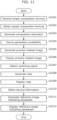
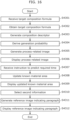
- FIG. 5 is a flowchart illustrating one example of the overall flow of processing performed by generation process search system 10 according to each of Embodiments 1 through 5.
- Database creation device 200 creates a second database that includes: first synthesis information 2a indicating composition formula and sintering method of a known material in association with each other; and second synthesis information 2b.
- Generation process display device 100 conducts training that uses first synthesis information 2a, to create a sintering predictor that predicts a sintering method from a composition formula.
- a sintering predictor that predicts a sintering method from a composition formula.
- a fully connected NeuralNetwork is used for the model of the sintering predictor.
- Generation process display device 100 derives, using the sintering predictor, the generation probability of each type of a sintering method for a target composition formula. In other words, generation process display device 100 predicts a sintering method for sintering a target material having a target composition formula.
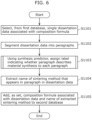
- FIG. 6 is a flowchart illustrating one example of the overall flow of processing performed by database creation device 200 according to each of Embodiments 1 through 5, i.e., a flowchart illustrating the detailed flow of the process in step S1100.
- a procedure for creating a second database in the entire database creation device 200 will be described using the flowchart in FIG. 6 .
- Dissertation obtainer 202 obtains single thesis data 1 to be processed, from a first database including thesis data items 1 that have already been published, and outputs that thesis data 1 to text segmenter 203. In other words, thesis data 1 associated with a composition formula in advance is selected.
- Text segmenter 203 segments thesis data 1 obtained from thesis obtainer 202 into paragraphs to obtain thesis data 1. Text segmenter 203 outputs each of the obtained paragraphs to label obtainer 207, segment descriptor generator 204, and label provider 205.
- segment descriptor generator 204 Upon obtaining a paragraph from text segmenter 203, segment descriptor generator 204 generates a segment descriptor corresponding to the paragraph.
- synthesis information trainer 206 inputs the segment descriptor to the synthesis predictor to obtain a label indicating whether information about material synthesis is included in the paragraph corresponding to the segment descriptor.
- Synthesis information trainer 206 then outputs the label to label obtainer 207.
- label provider 205 outputs the label to label obtainer 207 in accordance with an input operation by the user of database creation device 200.
- Label obtainer 207 obtains the label output from synthesis information trainer 206 or label provider 205, i.e., the label indicating whether the paragraph describes material synthesis, and assigns the obtained label to the paragraph. Label obtainer 207 then outputs the paragraph assigned with the label to information extractor 208.
- Information extractor 208 extracts information indicating, for instance, the name of a sintering method from the paragraph that describes material synthesis, i.e., the paragraph that includes information about material synthesis, among the paragraphs obtained from label obtainer 207. Names of sintering methods are registered in advance in information extractor 208. In step S1104, information extractor 208 determines whether the name of a registered sintering method is present in the paragraph that describes material synthesis. When it is determined that the name of the registered sintering method is present in the paragraph, information extractor 208 extracts the name of that sintering method.
- information extractor 208 extracts the names of all of the sintering methods. It should be noted that the information extracted by information extractor 208 indicates not only the name of a sintering method, but also an attribute, which excludes a sintering method, regarding the composition formula associated with thesis data 1 obtained in step S1101.
- the attribute is, for example, literature information of that thesis data 1, the location of a paragraph that describes the name of the sintering method, or the crystal structure, sintering temperature, property value, or application of the composition formula described in the paragraph.
- Information extractor 208 also associates the name of the sintering method extracted in step S1104 with the composition formula associated with thesis data 1 that includes the paragraph describing the name of the sintering method, and adds the name and the composition formula to the second database.
- first synthesis information 2a is generated and added to the second database.
- Information extractor 208 also associates, with the composition formula associated with thesis data 1, an attribute, other than a sintering method, that is extracted in step S1104, and adds the attribute and the composition formula to the second database.
- second synthesis information 2b is generated and added to the second database.
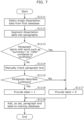
- FIG. 7 is a flowchart illustrating one example of the flow of pre-processing for training in synthesis information trainer 206 according to each of Embodiments 1 through 5.
- FIG. 7 illustrates the flow of pre-processing for training in synthesis information trainer 206, that is, some of sub-processes included in the process in step S1103 in FIG. 6 .
- Segment descriptor generator 204 converts, to a vector, the character string of characters included in a paragraph obtained from text segmenter 203, using, for example, Wor2Vec, to generate a segment descriptor expressed as the vector.
- Synthesis information trainer 206 then inputs the vector, i.e., the segment descriptor, to a trained synthesis predictor to obtain a label indicating whether the paragraph corresponding to the segment descriptor describes material synthesis.
- the Word2Vec model is specialized in material dissertations published by Synthesis Project. Although Word2Vec is used for conversion from a paragraph character string to a vector in each of Embodiments 1 through 5, the present disclosure is not limited to this and a different model may be used.
- Machine learning is used for the training of a synthesis predictor conducted by synthesis information trainer 206.
- a class classification based on stochastic gradient descent is used for models of the machine learning.
- a training database is used for the training of the synthesis predictor.
- the training database includes each of paragraphs of 100 thesis data items 1, and each of the paragraphs is provided with a label indicating whether the paragraph describes material synthesis.
- the flowchart illustrated in FIG. 7 is a flowchart for manually creating such a training database.
- Dissertation obtainer 202 obtains single thesis data 1 from a first database and outputs that thesis data 1 to text segmenter 203. In other words, thesis data 1 is selected.
- part of thesis data 1 included in the first database is used, but the present disclosure is not limited to this and thesis data included in a database other than the first database may be used.
- 100 dissertation data items 1 are randomly selected from the first database for training in synthesis information trainer 206, and the processes in the flowchart in FIG. 7 are repeatedly performed for each of 100 thesis data items 1.
- Text segmenter 203 segments thesis data 1 obtained from thesis obtainer 202 into paragraphs to obtain thesis data 1. Text segmenter 203 outputs each of the obtained paragraphs to label obtainer 207, segment descriptor generator 204, and label provider 205.
- label provider 205 Upon obtaining a paragraph from text segmenter 203, label provider 205 performs mechanical pre-screening on the paragraph.
- the paragraph starts with a word unrelated to material synthesis such as "summary” or "refer” (Yes in step S1113), for example, label provider 205 performs the process in S1118 after the process in step S1117.
- label provider 205 performs the process in step S1114.
- step S1114 whether the paragraph determined as not starting with a word unrelated to material synthesis includes information about material synthesis is checked manually.
- label provider 205 receives an input operation from the user of database creation device 200, and determines, in accordance with the input operation, whether the paragraph includes information about material synthesis.
- label provider 205 When the paragraph includes information about material synthesis (Yes in step S1114), label provider 205 performs the process in step S1116, and when the paragraph does not include such information (No in step S1114), performs the process in step S1117.
- Synthesis information trainer 206 adds, to the training database, the label provided by label provider 205 and the segment descriptor of the paragraph corresponding to that label.
- the label and the segment descriptor of the paragraph are associated with each other to be added to the training database.
- database creation device 200 Before training is conducted by synthesis information trainer 206, database creation device 200 generates first synthesis information 2a and second synthesis information 2b while creating a training database as described above and also conducting training by synthesis information trainer 206 with the use of the training database. After training is conducted by synthesis information trainer 206, i.e., after a synthesis predictor is created, database creation device 200 instead of label provider 205 provides a label for each of paragraphs using the synthesis predictor, and generates first synthesis information 2a and second synthesis information 2b.
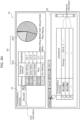
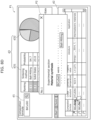
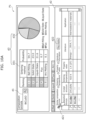
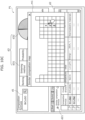
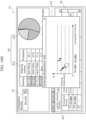
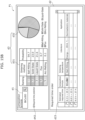
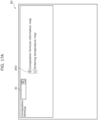
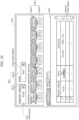
- FIG. 8A through FIG. 8E are each a diagram illustrating one example of a display by generation process display device 100 according to Embodiment 1.
- FIG. 8A is a diagram illustrating one example of a process-related image according to Embodiment 1.
- image generator 107 generates process-related image P1 and displays process-related image P1 on display 108.
- This process-related image P1 includes target composition area d1, known material area d2, and generation probability area d3.
- a target composition formula indicated in first information obtained by first information obtainer 102 is displayed in target composition area d1.
- One or more second information items obtained by second information obtainer 106 are displayed in known material area d2.
- the generation probability of each of five types of sintering methods for sintering a target material having the target composition formula is displayed in generation probability area d3.
- the composition formula of the target material input by the user and the generation probability of each of the types of the sintering methods related to the composition formula are displayed in process-related image P1.
- a target composition formula "BiCuSO" input by the user is displayed as one example in target composition area d1.
- the present disclosure is not limited to this example.
- BiCuSO and Ag 3 Si are each a composition formula presenting a matrix which is compositional elements that occupy most of the portion in the volume of an alloy, the present disclosure is not limited to this example.
- the target composition formula may be a real composition formula including a dopant type as in Bi 0.9 Mg 0.1 CuSO.
- a real composition formula is also referred to as the composition formula of a real composition.
- generation probability area d3 the generation probability of each type of a sintering method related to the target composition formula "BiCuSO" is displayed in table d31 and pie graph d32.
- Sintering method types according to each of Embodiments 1 through 5 are five types of Ball-Milling, Solid-State, Liquid-State, Flux, and Arc-Melting, but the sintering method types according to the present disclosure are not limited to these types.
- the sintering method types to be displayed are based on first synthesis information 2a.
- a sub area with a tab is displayed for each type of the sintering method in known material area d2.
- second information of each of one or more known materials which are related to a target material and are sintered using the sintering method of a type corresponding to the sub area, is displayed.
- the second information indicates the composition formula and attributes of the known material, and the attributes are a sintering method and literature information in the example in FIG. 8A .
- Image generator 107 thus generates process-related image P1 indicating, for each type of a sintering method, second information of each of one or more known materials generated using the sintering method.
- This enables the user to easily find out, in process-related image P1, second information items of one or more known materials sintered using the sintering method whose generation probability for a target material is the highest. In other words, even when a plurality of second information items are displayed, the user can easily find out second information that is useful regarding the sintering of the target material among the plurality of second information items.
- the sintering method type "Ball-Milling” is the type of a sintering method, among the five sintering methods, that corresponds to the highest generation probability among five generation probabilities derived for the target composition formula "BiCuSO".
- image generator 107 specifies the sintering method type corresponding to the highest generation probability among the five generation probabilities derived for the target composition formula, and displays first a sub area with the tab indicating the specified sintering method type.
- image generator 107 may arrange five tabs in the descending order of the generation probabilities. This enables the user to visually easily grasp sintering methods related to a target material.
- each of the one or more known materials related to the target material is a material similar to the target material and close to the target material in terms of a distance between vectors.
- each of the one or more known materials related to the target material is a material having a composition descriptor similar to the composition descriptor of the target material.
- the composition formulae of one or more known materials, each having a distance of at most a threshold between the composition descriptor of the known material and the composition descriptor of the target material are displayed in known material area d2 in the ascending order of the distance.
- the composition formulae of a predetermined number of known materials may be displayed in known material area d2 in the ascending order of the distance.
- Image generator 107 thus arranges second information of each of one or more known materials in an order according to the composition formula indicated in the second information, and generates process-related image P1 indicating one or more second information items arranged in the order.
- second information indicating the composition formula of a known material that is closer or more similar to the composition formula of a target material is arranged with higher priority. This enables the user to easily find out desired second information from those second information items.
- composition formula "BiCuSeO" and the composition formula "BiCuTeO”, which are related to the target composition formula "BiCuSO", of known materials whose generation probabilities using the Ball-Milling are high are displayed as examples.
- element types Se and Te different from the element types of the target composition formula are displayed with emphasis in bold.
- composition formula of a known material related to a target composition formula is a real composition formula including a dopant type
- the composition formula may be displayed as the composition formula of a mother substance in known material area d2 for viewability.
- the composition formula of a mother substance is a composition formula, such as BiCuSeO, which does not include any dopant type.
- the composition formula of a real composition may be displayed in addition to the composition formula of a mother substance, or only the composition formula of a real composition may be displayed.
- the composition formula of a real composition is a composition formula, such as Bi 1-x Mg x CuSeO, Bi 1-x Ca x CuSeO, Bi 1-x Sr x CuSeO, or Bi 1-x Ba x CuSeO, which includes a dopant type.
- the dopant type is Mg, Ca, Sr, or Ba
- each of the composition formulae is a composition formula that includes the dopant type whose ratio is in the range of 0 ⁇ x ⁇ 0.15.
- the attribute of a known material displayed in known material area d2 includes, for example, literature information of dissertation data 1 that is the source of the composition formula of the known material.
- the literature information that is the source of the composition formula is obtained from second synthesis information 2b in the second database.
- the literature information may be obtained from a different database via network 401 such as the Internet.
- Second synthesis information 2b indicates literature information, which is an attribute, in association with a single composition formula, but may indicate literature information in association with a plurality of composition formulae. In this case, second synthesis information 2b may indicate a primary composition formula among the plurality of composition formulae.
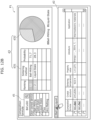
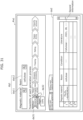
- FIG. 8B is a diagram illustrating another example of process-related image P1 according to Embodiment 1.
- process-related image P1 illustrated in FIG. 8B the composition formula of a target material input by the user and the generation probability of a sintering method related to the composition formula are displayed, as in process-related image P1 illustrated in FIG. 8A .
- target composition formula "BiRbSO” input by the user is displayed, as one example, in target composition area d1.
- generation probability area d3 the generation probability of the sintering method related to the target composition formula "BiRbSO” is displayed in table d31 and pie chart d32.
- a target composition formula is "BiRbSO”
- only one type of sintering method Arc-Melting among the five sintering methods is displayed in generation probability area d3.
- only the generation probability "85.0%” of the sintering method Arc-Melting among the generation probabilities of the five sintering methods is displayed in generation probability area d3.
- image generator 107 when any one of the generation probabilities of the five sintering methods indicates, for example, at least 80%, image generator 107 includes, in generation probability area d3, only the generation probability indicating at least 80% and the name of a sintering method corresponding to the generation probability. Image generator 107 thus neither includes, in generation probability area d3, the other four generation probabilities other than the generation probability indicating at least 80% nor the names of the sintering methods corresponding to the four generation probabilities. It should be understood that the generation probability 80% is one example of a threshold and the threshold may be higher or lower than 80%.
- Such a generation probability is based on the result of training in sintering trainer 104 as described with reference to FIG. 3 .
- the following is trained by sintering trainer 104: when one element type included in a target composition formula composed of two element types is Rb, a sintering method whose generation probability is the highest among the five sintering methods is Arc-Melting whatever the other element type of the two element types may be.
- composition formulae are each the composition formula of a material that contains Rb that is most likely to be sintered using the sintering method Arc-Melting.
- the attribute is literature information that is the source of the composition formula of the known material.
- image generator 107 When a predetermined condition is satisfied, image generator 107 according to the present embodiment thus generates process-related image P1 indicating the generation probability of each of M types of sintering methods and not indicating the generation probabilities of the other remaining sintering methods among N types of sintering methods.
- N is an integer of 3 or greater and M is a predetermined integer of at least 1 and less than N.
- the M types of sintering methods are one type of sintering method, and is specifically Arc-Melting.
- a threshold e.g. 90%
- image generator 107 generates process-related image P1 indicating the two highest generation probabilities and the names of the sintering methods corresponding to the two highest generation probabilities and not indicating the other remaining three generation probabilities and the names of the sintering methods corresponding to the three generation probabilities.
- the generation probability of one type of sintering method among a plurality of sintering methods is at least a threshold 80%, for example, only the generation probability of that one type of sintering method is displayed and the generation probabilities of the other remaining sintering methods are not displayed. Accordingly, the user can easily find a sintering method that is the most probable method for a target material.
- the sum of, for example, two highest generation probabilities among the generation probabilities of three or more types of sintering methods is at least a threshold 90%, only the two highest generation probabilities are displayed and the other remaining generation probabilities are not displayed. Accordingly, a generation probability having no chance of sintering a target material can be omitted from process-related image P1, and unnecessary provision of information for the user can be inhibited.
- Image generator 107 may display only the element type Rb with more emphasis than the other element types in the composition formula of each of one or more known materials displayed in known material area d2. Since it has been clarified, through training, that the generation probability of the sintering method Arc-Melting is the highest when it comes to a material having a composition formula including Rb, image generator 107 displays the element type Rb with emphasis. For example, when any one of the generation probabilities of the five sintering methods indicates at least a threshold, for example, image generator 107 specifies the type of a sintering method corresponding to the generation probability indicating at least the threshold. In the above example, the threshold is 80%. Image generator 107 may emphasize only an element type, in the composition formula of a known material, that is different from element types in a target composition formula.
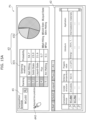
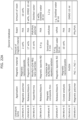
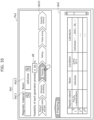
- FIG. 8C is a diagram illustrating another example of process-related image P1 according to Embodiment 1.
- known material area d2 in process-related image P1 illustrated in FIG. 8C not only literature information illustrated in FIG. 8A , but also a crystal structure, a sintering method, a property value, and an application corresponding to the composition formula of a known material are displayed as attributes of the known material.
- Known material area d2 displayed in FIG. 8C is one example and the present disclosure is not limited to this. Second information displayed in known material area d2 may be customized by the user.
- Image generator 107 may arrange second information of each of one or more known materials in an order corresponding to an attribute indicated in the second information, and generate process-related image P1 indicating one or more second information items arranged in the order.
- the attribute is the sintering temperature of a known material, for example, second information indicating a higher sintering temperature is arranged with higher priority. This enables the user to easily find out desired second information from those second information items.
- FIG. 8D is a diagram illustrating an example of a reference image according to Embodiment 1.
- process-related image P1 illustrated in FIG. 8C is displayed, for example, the user performs an input operation to second input unit 109 to select second information indicating the composition formula "BiCuSeO" in known material area d2.
- second input unit 109 outputs a signal in accordance with the input operation, to second information obtainer 106.
- Second information obtainer 106 obtains the signal from second input unit 109 and specifies "BiCuSeO" which is the composition formula in the second information identified by the signal.
- Second information obtainer 106 also searches second synthesis information 2b indicating the specified composition formula "BiCuSeO" and specifies literature information and the location of a paragraph that are indicated as attributes in second synthesis information 2b. Second information obtainer 106 searches also, in a first database in first storage 301, thesis data 1 including the specified literature information, extracts the paragraph at the specified location from that thesis data 1, and outputs the paragraph to image generator 107. Image generator 107 superimposes, on process-related image P1, reference image P2 indicating the paragraph obtained from second information obtainer 106 to display reference image P2 on display 108.
- FIG. 8D illustrates an example of the display of reference image P2 indicating a paragraph that describes a generation process in dissertation data 1 corresponding to the composition formula "BiCuSeO" when the composition formula "BiCuSeO" is selected by the user.
- Image generator 107 may emphasize more, than other character strings, the character string of the composition formula "BiCuSeO” and the character string of the sintering method "Ball-Milling" in the paragraph. For example, image generator 107 obtains the composition formula "BiCuSeO" specified by second information obtainer 106 from second information obtainer 106 and searches, in the paragraph, the character string of the composition formula "BiCuSeO".
- Image generator 107 also searches, in the paragraph, the character string of the sintering method "Ball-Milling" corresponding to the sub area indicating the composition formula "BiCuSeO". Image generator 107 then emphasizes the searched character strings of the composition formula "BiCuSeO" and the sintering method "Ball-Milling".
- Image generator 107 thus generates reference image P2 in which a word indicating a sintering method presented as an attribute in selected second information is emphasized more than the other remaining words in the area of part of literature such as thesis data 1. Since a word indicating a sintering method is thus displayed with emphasis, the user can easily find out the word indicating a sintering method in the area of part of thesis data 1. In addition, the user can search the vicinity of the word and easily find out a description regarding the sintering method.
- the user can check, at a glance, a generation process described in thesis data 1 that describes a sintering method whose generation probability was predicted as the highest regarding a selected composition formula "BiCuSeO".
- a paragraph indicated in reference image P2 is a paragraph of thesis data 1 that describes a sintering method whose generation probability was predicted as the highest, it is possible to display, to the user, a generation process that is very likely to achieve a target material.
- it is no longer necessary for the user themselves to read or search to search a part describing a generation process in the description of thesis data 1 it is possible to achieve efficiency in a work per se required for the search of a generation process.
- FIG. 8E is a diagram illustrating another example of reference image P2 according to Embodiment 1.
- process-related image P1 illustrated in FIG. 8C is displayed, for example, the user performs an input operation to second input unit 109 to select a plurality of composition formulae in known material area d2.
- second input unit 109 outputs, to second information obtainer 106, a signal in accordance with the input operation.
- Second information obtainer 106 obtains the signal from second input unit 109, and specifies the plurality of composition formulae selected by the user and indicated by the signal.
- second image obtainer 106 For each of the specified composition formulae, second image obtainer 106 also searches second synthesis information 2b indicating the composition formula, and specifies literature information and the location of a paragraph that are indicated as attributes in second synthesis information 2b. For each of the plurality of composition formulae selected by the user, second information obtainer 106 also searches, in a first database in first storage 301, thesis data 1 including the specified literature information, extracts the paragraph at the specified location in that thesis data 1, and outputs the paragraph to image generator 107. Second information obtainer 106 performs the output of the paragraph to image generator 107 for each of the composition formulae selected by the user.
- image generator 107 generates reference image P2 indicating each of the paragraphs obtained from second information obtainer 106 in the form of a list or a tab, and superimposes reference image P2 on process-related image P1 to display reference image P2 on display 108.
- FIG. 8E illustrates an example of the display of reference image P2 indicating, in the form of a tab, a paragraph corresponding to each of three composition formulae when the three composition formulae are selected by the user.
- the display in the form of a tab is one example and the paragraph may be displayed in other form or paragraphs may be displayed in the form of a list. This enables easy comparison between generation processes. For example, a plurality of paragraphs in dissertation data 1 that describes a sintering method whose generation probability was predicted as the highest are selected and the selected paragraphs are displayed in the form of a list.
- FIG. 9 is a flowchart illustrating one example of the overall flow of processing performed by generation process display device 100 according to Embodiment 1 of the present disclosure. In other words, FIG. 9 is a flowchart illustrating the detailed flow of processes in step S1300 in FIG. 5 .
- First input unit 101 receives, through an input operation by the user, a target composition formula to be displayed, and outputs the target composition formula to first information obtainer 102.
- First information obtainer 102 obtains the target composition formula from first input unit 101, and outputs the target composition formula to composition descriptor generator 103.
- Composition descriptor generator 103 generates a composition descriptor corresponding to the target composition formula obtained from first information obtainer 102, and outputs the composition descriptor to probability deriver 105 and second information obtainer 106.
- Sintering trainer 104 inputs the composition descriptor obtained from composition descriptor generator 103 via probability deriver 105 to a trained sintering predictor, to obtain the generation probability of each type of a sintering method corresponding to the composition descriptor, and outputs the generation probability to probability deriver 105.
- sintering trainer 104 may conduct retraining of the sintering predictor based on the difference between the second database after the update and the second database before the update.
- Probability deriver 105 then obtains the generation probability of each type of the sintering method from sintering trainer 104 to derive the generation probability of each type of a sintering method for a target composition formula.
- Probability deriver 105 outputs the derived generation probability to image generator 107.
- Image generator 107 generates process-related image P1 indicating the target composition formula input by the user and obtained from first information obtainer 102.
- This process-related image P1 includes the generation probability, which is obtained from probability deriver 105, of each type of the sintering method for the target composition formula.
- This process-related image P1 also includes second information of each of one or more known materials related to a target material.
- the second information indicates, for example, the composition formula and attribute of the known material.
- the attribute is, for instance, a crystal structure, a sintering temperature, a sintering method, a property value, literature information, the location of a paragraph, or an application.
- Image generator 107 displays process-related image P1 generated in step S1305 on display 108.
- Second information obtainer 106 selects second information in accordance with an input operation to second input unit 109 by the user from among one or more second information items included in process-related image P1.
- second information obtainer 106 Based on the composition formula indicated in the selected second information, second information obtainer 106 obtains, from the first database, a paragraph corresponding to the composition formula, and outputs the paragraph to image generator 107. Upon obtaining the paragraph from second information obtainer 106, image generator 107 generates reference image P2 indicating the paragraph.
- Image generator 107 displays the generated reference image P2 on display 108.
- generation process display device 100 includes: first information obtainer 102 that obtains first information indicating the composition formula of a target material; second information obtainer 106 that obtains, from a database regarding materials, second information of each of one or more known materials related to the composition formula indicated in the first information, where the second information indicates the composition formula and attribute of the known material; probability deriver 105 that based on the database, derives, for each of one or more types of sintering methods, a possibility that the target material having the composition formula indicated in the first information is sintered using the sintering method, where the possibility is derived as a generation probability; image generator 107 that generates, as process-related image P1 indicating information regarding a generation process, an image indicating second information items of the one or more known materials and the generation probability of each of the one or more types of sintering methods, and displays process-related image P1 on display 108.
- second information obtainer 106 obtains, from the database, the area of part of literature that describes the sintering method of the known material having the composition formula indicated in the selected second information item.
- Image generator 107 generates, as reference image P2, an image indicating the description in the area of the part of the literature, and displays reference image P2 on display 108.
- the database is, for example, at least one of a first database in first storage 301 or a second database in second storage 302.
- the literature is, for example, dissertation data 1.
- the generation probability of each type of a sintering method related to a target material is displayed.
- a possibility that the target material is generated through sintering is displayed as a generation probability for each type of the sintering method used for the sintering.
- the composition formula and attribute of the known material as well as the area of part of literature that describes the sintering method of the known material are displayed. This enables, in the generation of the target material, the user to firstly grasp the generation possibility of each type of the sintering method, subsequently select a sintering method, and also set experimental conditions.
- the user can determine that a target material can be sintered using a sintering method of a type corresponding to the highest generation probability.
- a sintering device that can implement the sintering method of the type corresponding to the highest generation probability
- the user can check a generation probability corresponding to a sintering method implementable by a sintering device owned by the user.
- the user can attempt to burn a target material even with the use of a sintering method of a type corresponding to the lowest generation probability if the generation probability is, for example, at least 50%.
- composition formula and attribute of each of one or more known materials related to the target material each having a composition formula similar to the composition formula of the target material, as the composition formula and attribute of each of the one or more known materials related to the target material, for example.
- the attribute may be related to sintering, synthesis, or generation of the known material. This enables the user to easily grasp what kind of sintering is performed on a known material similar to a target material. Accordingly, it is possible to more appropriately support the search of a generation process for a target material.
- FIG. 10A through 10E are each a diagram illustrating one example of a display by generation process display device 100 according to Embodiment 2.
- image generator 107 As illustrated in FIG. 10A or FIG. 10B , image generator 107 according to the present embodiment generates process-related image P1 resulting from including, into process-related image P1 illustrated in FIG. 8C according to Embodiment 1, also map display button d22, and radio button d21 for each of similar composition formula, sintering temperature, property value, and literature information.
- FIG. 10A is a diagram illustrating one example of process-related image P1 when radio button d21 for similar composition formula is selected.
- the display order of the one or more composition formulae may be switched so that the composition formulae are arranged in the descending order of the similarity.
- the similarity indicates a higher value as the aforementioned distance between the vector of the composition descriptor of a target composition formula and the vector of the composition descriptor of a similar composition formula gets shorter.
- FIG. 10B is a diagram illustrating one example of process-related image P1 when map display button d22 is also selected after radio button d21 for similar composition formula is selected in FIG. 10A .
- FIG. 10C is a diagram illustrating one example of a map displayed after map display button d22 in FIG. 10B is selected.
- image generator 107 displays similar composition map m1 superimposed on process-related image P1.
- Similar composition map m1 indicates the relationship between the composition formula of each of one or more known materials and a target composition formula.
- Similar composition map m1 is, for example, the periodic table of elements.
- similar composition map m1 shows, on the periodic table of elements, an element, which is not included in the target composition formula, in the composition formula of each of one or more known materials related to a target material. This makes it easier for the user to visually understand the relationship between a target composition formula and a similar composition formula.
- second information obtainer 106 obtains, from the first database, a paragraph corresponding to a composition formula including the selected element, and outputs the paragraph to image generator 107.
- image generator 107 Upon obtaining the paragraph from second information obtainer 106, image generator 107 generates and displays reference image P2 indicating the paragraph.
- FIG. 10D is a diagram illustrating one example of a map displayed after radio button d21 for sintering temperature is selected and map display button d22 is selected.
- Image generator 107 displays sintering temperature map m2 superimposed on process-related image P1.
- Sintering temperature map m2 indicates the relationship of sintering temperatures of one or more known materials related to a target material.
- Sintering temperature map m2 is, for example, a two-dimensional map with the horizontal axis indicating a plurality of composition formulae and the vertical axis indicating a sintering temperature. Along the horizontal axis, the composition formulae of the one or more known materials are arranged in order, for example, with higher priority given to a composition formula closer to a target composition formula.
- a dot corresponding to each of the one or more known materials is placed at a position corresponding to the composition formula and sintering temperature of the known material on sintering temperature map m2. This makes it easier for the user to visually understand the relationship between a sintering temperature and a similar composition formula. In other words, when the user predicts the range of a sintering temperature that is very likely to achieve a target material, it is easy to find a known material whose sintering temperature is in the predicted sintering temperature range.
- second information obtainer 106 obtains a paragraph corresponding to the selected composition formula or dot from the first database. Second information obtainer 106 then outputs the paragraph to image generator 107. Upon obtaining the paragraph from second information obtainer 106, image generator 107 generates and displays reference image P2 indicating the paragraph.
- FIG. 10E is a diagram illustrating one example of a map displayed after radio button d21 for literature information is selected and map display button d22 is selected.
- Image generator 107 displays literature map m3 superimposed on process-related image P1.
- Literature map m3 indicates the relationship of thesis data items 1 corresponding to a plurality of known materials.
- the horizontal axis of literature map m3 indicates the publication year of thesis data 1
- the vertical axis of literature map m3 indicates the name of the author of thesis data 1.
- the publication year and the author's name of thesis data 1 are presented as literature information in second information. For example, the user may be aware of a researcher who has been studying a known material for many years.
- second information obtainer 106 identifies thesis data 1 corresponding to the selected dot in the first database. Second information obtainer 106 then outputs a paragraph of the specified thesis data 1 that includes the description of a sintering method to image generator 107. Upon obtaining the paragraph from second information obtainer 106, image generator 107 generates and displays reference image P2 indicating the paragraph.
- Image generator 107 thus generates, for example, similar composition map m1 as a map presenting the relationship of composition formulae indicated in second information items of one or more known materials, to display the map on display 108.
- Image generator 107 also generates, for example, sintering temperature map m2 as a map presenting the relationship between a composition formula and an attribute that are indicated in second information of each of the one or more known materials, to display the map on display 108.
- FIG. 11 is a flowchart illustrating one example of the overall flow of processing performed by generation process display device 100 according to Embodiment 2 of the present disclosure. Since processes from steps S2301 to S2306 included in the flowchart are same as the processes from steps S1301 to S1306 in FIG. 9 , description thereof is omitted. Likewise, since processes from steps S2310 to S2312 are same as the processes from steps S1307 to S1309 in FIG. 9 , description thereof is omitted.
- Second information obtainer 106 obtains a switching signal from second input unit 109 in response to an input operation by the user. Second information obtainer 106 then outputs, to image generator 107, information corresponding to the obtained switching signal among the second information items of the one or more known materials presented in known material area d2.
- a switching signal indicates radio button d21 and map display button d22 selected by the user.
- the information corresponding to the switching signal is, for example, a composition formula, a sintering temperature, or literature information in the second information of each of the one or more known materials.
- Image generator 107 generates a map indicating the information that corresponds to the switching signal obtained from second information obtainer 106 and that is included in the second information of each of the one or more known materials.
- Image generator 107 displays the map generated in step S2308 on display 108.
- the second information selected in step S2310 may be second information presented in known material area d2 or second information corresponding to an indicated object such as a dot on a map.
- FIG. 12A and FIG. 12B are each a diagram illustrating one example of a display by generation process display device 100 according to Embodiment 3.
- image generator 107 displays process-related image P1 resulting from including, into process-related image P1 in FIG. 8C according to Embodiment 1, method selection buttons d41 corresponding to five types of sintering methods.
- method selection buttons d41 corresponding to the five types of sintering methods that are Ball-Milling, Solid-State, Liquid-State, Flux, and Arc-Melting are displayed.
- These method selection buttons d41 are buttons for notifying generation process display device 100 that a sintering method implementable by a sintering device owned by the user of generation process display device 100 is a sintering method corresponding to method selection button d41.
- a sintering device owned by the user is also referred to as a user-owned device.
- the user selects one or more method selection buttons d41 through an input operation to second input unit 109 by the user.
- second information obtainer 106 obtains, from second input unit 109, a signal in accordance with the input operation, and specifies the selected one or more method selection buttons d41 based on the signal.
- second information obtainer 106 specifies sintering methods corresponding to the one or more selected method selection buttons d41, and notifies image generator 107 of the specified sintering methods.
- image generator 107 updates the generation probability of each of the five types of sintering methods in accordance with the notified one or more types of sintering methods.
- image generator 107 updates each of the generation probabilities in generation probability area d3 in process-related image P1. In other words, image generator 107 updates the generation probability of each of Ball-Milling and Liquid-State, and removes the generation probability of each of Solid-State, Flux, and Arc-Melting that are the other sintering methods.
- image generator 107 multiplies the generation probability of each of Solid-State, Flux, and Arc-Melting with a weight "0" to update these generation probabilities to "0" and removes Solid-State, Flux, and Arc-Melting from generation probability area d3.
- Image generator 107 also updates the generation probabilities of Ball-Milling and Liquid-State while maintaining the ratio between these generation probabilities so that the sum of the generation probabilities is 100.
- the generation probability of Ball-Milling is a and the generation probability of Liquid-State is b
- image generator 107 updates generation probability a by a ⁇ ⁇ 100 / (a + b) ⁇ .
- image generator 107 multiplies generation probability a with a weight "100 / (a + b)" to update generation probability a.
- image generator 107 updates generation probability b by b ⁇ ⁇ 100 / (a + b) ⁇ .
- image generator 107 multiplies generation probability b with the weight "100 / (a + b)" to update generation probability b.
- the generation probability of each of Ball-Milling and Liquid-State thus updated is displayed in generation probability area d3 in process-related image P1.
- image generator 107 may update information indicated in known material area d2. For example, method selection button d41 for each of Ball-Milling and Liquid-State is selected, as described above. In this case, image generator 107 may keep only second information regarding each of Ball-Milling and Liquid-State among the second information items of one or more known materials indicated in known material area d2, and remove the remaining second information items from known material area d2.
- FIG. 13 is a flowchart illustrating one example of the overall flow of processing performed by generation process display device 100 according to Embodiment 3 of the present disclosure. Since processes from steps S3301 to S3306 included in this flowchart are same as the processes from S1301 to S1306 in FIG. 9 , description thereof is omitted. Likewise, since processes from steps S3311 to S3313 are same as the processes from steps S1307 to S1309 in FIG. 9 , description thereof is omitted.
- Second information obtainer 106 specifies one or more types of sintering methods implementable by a user-owned device based on a signal obtained from second input unit 109. Second information obtainer 106 also notifies image generator 107 of the one or more types of sintering methods implementable by the user-owned device.
- Image generator 107 updates the generation probability of each of five types of sintering methods based on the one or more types of sintering methods that are implementable by the user-owned device and notified by second information obtainer 106.
- Image generator 107 recreates process-related image P1 based on the updated generation probabilities.
- the updated generation probabilities of the one or more types of sintering methods implementable by the user-owned device are indicated and the generation probabilities of the other sintering methods are not indicated.
- information indicated in known material area d2 may be also updated.
- image generator 107 may keep only second information items indicating the one or more types of sintering methods implementable by the user-owned device and remove the remaining second information items.
- Second information indicates, for example, a composition formula, a crystal structure, a sintering temperature, a sintering method, a property value, literature information, an application, etc.
- Image generator 107 displays the recreated process-related image P1 on display 108.
- Image generator 107 thus specifies the types of sintering methods implementable by a sintering device owned by the user and assigns different weights between the generation probabilities of the sintering methods of the specified types and the generation probabilities of the other remaining sintering methods among the generation probabilities of one or more types of sintering methods, to update the generation probability of each of the one or more types of sintering methods indicated in process-related image P1.
- This can increase the generation probabilities of sintering methods implementable by a sintering device owned by the user and decrease the generation probabilities of sintering methods implementable only by a sintering device not owned by the user.
- a weight greater than 1 is assigned to the generation probabilities of sintering methods implementable by a sintering device owned by the user, while a weight of 0 is assigned to the generation probabilities of the other remaining sintering methods.
- FIG. 14 is a diagram illustrating another example of process-related image P1 after method selection buttons d41 in FIG. 12A are selected.
- method selection button d41 for each of Ball-Milling and Liquid-State is selected, as in the above example.
- image generator 107 displays estimation request buttons d33 for replacing known material area d2 with estimation request area d5 in process-related image P1, without updating the generation probability of each of the five types of sintering methods, as illustrated in FIG. 14 .
- This estimation request button d33 is associated with a sintering method in table d31 that is not implementable by a user-owned device.
- second input unit 109 When estimation request button d33 is selected through an input operation to second input unit 109 by the user, second input unit 109 outputs a signal indicating the selected estimation request button d33 to second information obtainer 106.
- second information obtainer 106 specifies, based on the signal, a sintering method associated with the selected estimation request button d33, and obtains estimation request data related to an estimation request regarding a sintering device that can implement the sintering method.
- Estimation request data may be stored in first storage 301, second storage 302, the internal memory of generation process display device 100, or a server or a storage connected to network 401. Second information obtainer 106 then outputs the estimation request data to image generator 107.
- image generator 107 Upon obtaining the estimation request data from second information obtainer 106, image generator 107 replaces known material area d2 in process-related image P1 with estimation request area d5 presenting the estimation request data. Image generator 107 then displays process-related image P1 including estimation request area d5 on display 108.
- estimation request button d33 is displayed for a sintering method corresponding to method selection button d41 that has not been selected.
- estimation request button d33 is selected, estimation request data for requesting the estimation of a sintering device that can implement a sintering method associated with the selected estimation request button d33 is displayed in estimation request area d5 that is an estimation request window.
- Second information obtainer 106 thus obtains estimated information regarding the estimation of a sintering device that can implement any one of the other remaining sintering methods excluding one or more sintering methods of the types specified in step S3307 among the one or more types of sintering methods.
- Image generator 107 displays an image indicating the estimated information on display 108.
- Estimated information is, for example, estimation request data as described above, and an image indicating the estimated information is displayed in estimation request area d5 in process-related image P1. This enables the user to easily request, based on displayed estimated information, the estimation of a sintering device not owned by the user.
- FIG. 15A and 15B are each a diagram illustrating one example of a display by generation process display device 100 according to Embodiment 4.
- image generator 107 displays process-related image P1 resulting from including required time prediction button d42 into process-related image P1 in FIG. 8C according to Embodiment 1.
- image generator 107 updates known material area d2 so that estimated required time d23 of each of one or more known materials is included in known material area d2, as illustrated in FIG. 15B .
- Estimated required time d23 is, for example, a time estimated as being required for material sintering, synthesis, or generation.
- second information obtainer 106 obtains second information from first synthesis information 2a and second synthesis information 2b of each of one or more known materials related to a target material.
- the second information indicates, for instance, a composition formula, a sintering method, literature information, and an application, excluding an estimated required time.
- Second information obtainer 106 then outputs the second information obtained for each of the one or more known materials to image generator 107.
- Image generator 107 generates process-related image P1 that includes required time prediction button d42 and known material area d2 indicating the second information obtained for each of the one or more known materials, and displays the generated process-related image P1 on display 108.
- second information obtainer 106 obtains, from second input unit 109, a signal in accordance with the input operation, and based on the signal, determines that required time prediction button d42 is selected. Consequently, second information obtainer 106 obtains information indicating an estimated required time from second synthesis information 2b of each of the one or more known materials related to the target material, and outputs the information to image generator 107.
- image generator 107 Upon obtaining the information indicating the estimated required time of each of the one or more known materials from second information obtainer 106, image generator 107 updates known material area d2 in process-related image P1, as illustrated in FIG. 15B .
- known material area d2 as illustrated in FIG. 15A which indicates, for each type of the sintering method, attributes such as the composition formula and crystal structure of each of the one or more known materials, is updated to known material area d2 as illustrated in FIG. 15B .
- the estimated required time of each of the one or more known materials is presented as part of the attributes of the known material.
- the composition formula and attributes of each of the one or more known materials are not classified for each type of the sintering method, and are presented in the ascending order of the estimated required time of the known material.
- the attributes of the known material are, for instance, the estimated required time, sintering method, literature information, and application of the known material.
- the composition formula and attributes of the known material are arranged in an order starting from a known material with the shortest estimated required time.
- a set for each of the one or more known materials may be arranged in the ascending order of the estimated required time of the known material.
- second information obtainer 106 when required time prediction button d42 is selected, second information obtainer 106 obtains information indicating an estimated required time, but second information obtainer 106 may obtain the information indicating an estimated required time in advance. In this case, second information obtainer 106 obtains the information indicating an estimated required time and outputs the information to image generator 107 before required time prediction button d42 is selected, i.e., when process-related image P1 in FIG. 15A is displayed.
- image generator 107 updates known material area d2, as illustrated in FIG. 15B , based on the information indicating an estimated required time, which was obtained in advance.
- Image generator 107 displays process-related image P1 including the updated known material area d2 on display 108.
- FIG. 16 is a flowchart illustrating one example of the overall flow of processing performed by generation process display device 100 according to Embodiment 4 of the present disclosure. Since processes from steps S4301 to S4306 included in this flowchart are same as the processes from step S1301 to S1306 in FIG. 9 , description thereof is omitted. Likewise, since processes from steps S4310 to S4312 are same as the processes from steps S1307 to S1309 in FIG. 9 , description thereof is omitted.
- second information obtainer 106 determines that required time prediction button d42 is selected. In other words, second information obtainer 106 receives an instruction to predict a required time. As a result, second information obtainer 106 obtains, from second synthesis information 2b in second storage 302, information indicating an estimated required time associated with the composition formula of each of the one or more known materials related to the target material, and outputs the information to image generator 107.
- Image generator 107 updates known material area d2 in process-related image P1 based on the information indicating the estimated required time obtained from second information obtainer 106. Accordingly, the updated known material area d2 presents the estimated required time of each of the one or more known materials in association with the composition formula of the known material.
- Image generator 107 displays process-related image P1 that includes the updated known material area d2 on display 108.
- attributes indicated in second information of each of one or more known materials thus includes an estimated required time that is a time required for sintering the known material.
- Image generator 107 arranges the second information of each of the one or more known materials in an order according to the estimated required time indicated in the second information, and generates process-related image P1 indicating one or more second information items arranged in the order. Since the estimated required time of each of the one or more known materials is thus displayed, the user can predict a time required for sintering a target material based on these estimated required times.
- the user can easily grasp the largest value, the smallest value, or the dispersion of the estimated required time, thereby more appropriately predicting the time required for sintering a target material. If the attributes of each of the one or more known materials include a sintering method, the user can easily determine which sintering method can reduce the time required for sintering a target material.
- the user when the user attempts to use, for the sintering of the target material, a sintering method with the highest generation probability among the sintering methods presented in process-related image P1, and the estimated required time of the sintering method is long, the user can determine to use a sintering method with the second highest generation probability for the sintering of the target material. In other words, the user can select a sintering method for a target material with consideration given to a time required for sintering.
- FIG. 17A , FIG. 17B , and FIG. 17C are each a diagram illustrating one example of a display by generation process display device 100 according to Embodiment 5.
- image generator 107 generates initial image P0 that includes a plurality of map selection buttons d43 for selecting the type of a map.
- Initial image P0 includes, for example, target composition area d1 that is empty for receiving the input of a target composition formula, map selection button d43 for selecting a composition formula information map, and map selection button d43 for selecting a sintering temperature map.
- First information obtainer 102 obtains, as first information, a signal indicating the target composition formula in accordance with the input operation, and obtains also a map selection signal indicating the type of a map corresponding to map selection button d43 selected in response to the input operation.
- the map selection signal indicates, for example, a composition formula information map as a map type.
- image generator 107 obtains, from first information obtainer 102, the first information and the map selection signal indicating a composition formula information map, and generates process-related image P1 illustrated in FIG. 17B to display process-related image P1 on display 108.
- This process-related image P1 illustrated in FIG. 17B includes composition formula information map m11 instead of known material area d2.
- the vertical axis of composition formula information map m11 indicates a compositional difference
- the horizontal axis of composition formula information map m11 indicates a composition formula.
- the compositional difference is the difference between a composition descriptor corresponding to a target composition formula and a composition descriptor corresponding to the composition formula of a known material, and is the distance between the vectors of these composition descriptors.
- the composition formulae of one or more known materials related to a target material are arranged along the horizontal axis of composition formula information map m11 in accordance with the result of principal component analysis. On composition formula information map m11, a dot corresponding to each of the one or more known materials related to the target material is arranged at a location corresponding to the compositional difference and composition formula of the known material.
- image generator 107 displays process-related image P1 so as to include sintering temperature map m12 instead of known material area d2, as illustrated in FIG. 17C .
- the vertical axis of sintering temperature map m12 indicates a sintering temperature and the horizontal axis of sintering temperature map m12 indicates a compositional difference.
- On sintering temperature map m12 a dot corresponding to each of the one or more known materials related to the target material is arranged at a location corresponding to the sintering temperature and compositional difference of the known material.
- Second information obtainer 106 obtains, from second input unit 109, a signal in accordance with the input operation, and specifies the selected dot based on the signal. Second information obtainer 106 also obtains, from the first database, a paragraph that describes, for instance, the sintering method of the composition formula of the known material corresponding to the specified dot. Second information obtainer 106 then outputs the paragraph to image generator 107. Upon obtaining the paragraph from second information obtainer 106, image generator 107 generates reference image P2 indicating the paragraph, to include reference image P2 in process-related image P1. Image generator 107 displays process-related image P1 including that reference image P2 on display 108.
- FIG. 18 is a flowchart illustrating one example of the overall flow of processing performed by generation process display device 100 according to Embodiment 5 of the present disclosure. Since processes from steps S5302 to S5304 included in this flowchart are same as the processes from steps S1302 to S1304 in FIG. 9 , description thereof is omitted. Likewise, processes from steps S5306 to S5309 are same as the processes in steps S1306 to S1309 in FIG. 9 , description thereof is omitted.
- first input unit 101 After an input operation by the user, first input unit 101 outputs the following to first information obtainer 102: first information which is a signal indicating a target composition formula to be displayed; and a map selection signal indicating a map type. First information obtainer 102 outputs the first information and the map selection signal to image generator 107.
- Image generator 107 generates a map based on second information of each of one or more known materials related to a target material and the map selection signal obtained from first information obtainer 102. In other words, image generator 107 arranges the second information in a display format according to the map type indicated by the map selection signal, to generate a map.
- the map is, for example, composition formula information map m11 or sintering temperature map m12 described above. Image generator 107 then generates process-related image P1 including the map.
- Second information selected in step S5307 is equivalent to a dot corresponding to the composition formula of a known material on the map described above.
- image generator 107 thus generates composition formula information map m11 presenting the relationship of composition formulae indicated in the second information items of one or more known materials or sintering temperature map m12 presenting the relationship between a composition formula and attributes indicated in the second information of each of the one or more known materials, to display the map on display 108.
- composition formula information map m11 presenting the relationship of composition formulae indicated in the second information items of one or more known materials
- sintering temperature map m12 presenting the relationship between a composition formula and attributes indicated in the second information of each of the one or more known materials
- generation process display device 100 displays, for instance, process-related image P1 and reference image P2 on display 108, but may output information included in these images without displaying the images.
- generation process display device 100 may be also referred to as a generation process output device.
- the generation process output device outputs information regarding a generation process for a material, and includes: first information obtainer 102 that obtains first information indicating the composition formula of a target material; second information obtainer 106 that obtains, from a database regarding materials, second information of each of one or more known materials related to the composition formula indicated in the first information, where the second information indicates the composition formula and attribute of the known material; probability deriver 105 that, based on the database, derives, for each of one or more types of sintering methods, a possibility that the target material having the composition formula indicated in the first information is sintered using the sintering method, where the possibility is derived as a generation probability; and an outputter that outputs, as information regarding the generation process, the second information of each of the one or more known materials and the generation probability of each of the one or more types of sintering methods.
- second information obtainer 106 obtains, from the database, the area of part of literature that describes the sintering method of the known material having the composition formula indicated in the selected second information item.
- the outputter outputs information indicating the description in the area of the part of the literature.
- the outputter is, for example, a functional element included in image generator 107.
- Such a generation process output device cannot display, for instance, information regarding a generation process directly on display 108, but is capable of causing other device connected to network 401 to display an image indicating such information by outputting the information to, for example, network 401.
- the same advantageous effects as produced by generation process display device 100 described above can be produced.
- Second information obtainer 106 in the generation process output device need not obtain the aforementioned area of part of literature from a database.
- the outputter need not output information indicating the description in the area of the part of the literature. Even in such a case, the same advantageous effects as produced by generation process display device 100 described above can be produced for information regarding a generation process and excluding information indicated in reference image P2.
- probability deriver 105 inputs the composition descriptor of a target composition formula to a sintering predictor to derive the generation probability of each of five types of sintering methods for a target material.
- Probability deriver 105 uses a single sintering predictor, but may use a plurality of sintering predictors. For example, each of five sintering predictors outputs the generation probability of one type of sintering method associated in advance with the sintering predictor. In this case, probability deriver 105 inputs the composition descriptor of the target composition formula to each of the five sintering predictors to derive the generation probability of each of the five types of the sintering methods for the target material.
- a sintering predictor outputs the generation probability of each of five sintering methods in response to the input of the composition descriptor of a target composition formula composed of element types of at most 72 or 86 types. Nevertheless, the sintering predictor may output a generation probability in response to the input of the composition descriptor of a composition formula composed of two types of element types.
- probability deriver 105 inputs, for each pair of two element types included in a target composition formula, a composition descriptor corresponding to the pair to derive the generation probability of each of the five sintering methods for the pair.
- Probability deriver 105 then calculates the generation probability of the sintering method for the target composition formula using the generation probability of the sintering method derived for each pair.
- a target composition formula is "BiCuSO”
- pairs each composed of two types of element types included in the target composition formula are "BiCu”, “BiS”, “BiO”, “CuS”, “CuO”, and "SO”.
- Probability deriver 105 inputs, for each of these pairs, a composition descriptor corresponding to the pair to the sintering predictor to derive the generation probability of each of the five sintering methods for the pair.
- Probability deriver 105 then derives the generation probability of a predetermined sintering method for the target composition formula "BiCuSO", using the generation probability of the predetermined sintering method for "BiCu”, the generation probability of the predetermined sintering method for "BiS”, the generation probability of the predetermined sintering method for "BiO”, the generation probability of the predetermined sintering method for "CuS”, the generation probability of the predetermined sintering method for "CuO", and the generation probability of the predetermined sintering method for "SO”.
- the average or weighted addition of the generation probabilities derived for the pairs may be used in the calculation of the generation probability of the predetermined sintering method for the target composition formula.
- the generation probability of each of the five types of sintering methods are derived and displayed, but the number of the sintering method types is not limited to five, and may be at least one and less than five, or may be six or more.
- the sintering method types are not limited to Ball-Milling, Solid-State, Liquid-State, Flux, and Arc-Melting, and may be any other type.
- the names of the sintering methods such as Ball-Milling, Solid-State, Liquid-State, Flux, and Arc-Melting are examples, and the names of the sintering methods according to the present disclosure are not limited to these names.
- Ball-Milling may be Ball-Mill.
- a first database according to each of the above embodiments includes a plurality of thesis data items 1 as literatures, but each of the literatures is not limited to thesis data 1 indicating a thesis and may be a magazine, a book, or data indicating an experiment report.
- first synthesis information 2a and second synthesis information 2b are separate from each other, but may be integrated into one.
- the attributes indicated in second synthesis information 2b include the location of a paragraph in thesis data 1, but may include the paragraph per se.
- second information obtainer 106 can obtain the paragraph from second synthesis information 2b without using thesis data 1 in the first database.
- second information items of a plurality of known materials are displayed, but the number of the second information items may be one.
- generation process display device 100 is a generation process display device or a generation process output device as described below.
- a generation process display device is a generation process display device that displays information regarding a material generation process, and includes: a first information obtainer that obtains first information indicating the composition formula of a target material; a second information obtainer that obtains, from a database regarding materials, second information of each of one or more known materials related to the composition formula indicated in the first information, where the second information indicates the composition formula and attribute of the known material; a probability deriver that based on the database, derives, for each of one or more types of sintering methods, a possibility that the target material having the composition formula indicated in the first information is sintered using the sintering method, where the possibility is derived as a generation probability; and an image generator that generates a first image indicating the second information of each of the one or more known materials and the generation probability of each of the one or more types of sintering methods to display the first image on a display.
- the second information obtainer When one of the second information items of the one or more known materials indicated in the first image is selected, the second information obtainer also obtains, from the database, the area of part of literature that describes the sintering method of the known material having the composition formula indicated in the selected second information item, and the image generator also generates, as a second image, an image indicating the description in the area of the part of the literature to display the second image on the display.
- the first image is also referred to as a process-related image and the second image is also referred to as a reference image.
- the generation probability of each type of a sintering method for a target material is displayed.
- a possibility that the target material is generated through sintering is displayed as the generation probability of each type of a sintering method used for the sintering.
- the composition formula and attribute of the known material as well as the area of part of literature that describes the sintering method of the known material are displayed. This enables, in the generation of the target material, the user to firstly grasp the generation possibility of each type of the sintering method, subsequently select a sintering method, and also set experimental conditions.
- the user can easily select a sintering method and set experimental conditions. If the user is a researcher with good knowledge and experience, they make the use of their knowledges and experiences to select a more accurate sintering method and set experimental conditions.
- a first image i.e., a process-related image
- the user can determine that a target material can be sintered using the sintering method of a type corresponding to the highest generation probability.
- the user can check a generation probability corresponding to a sintering method implementable by a sintering device owned by the user.
- the user can determine to attempt the sintering of the target material even with the use of the sintering method of a type corresponding to the lowest generation probability if the generation probability is, for example, at least 30%.
- the attribute may be related to sintering, synthesis, or generation of the known material. This enables the user to easily grasp what kind of sintering is performed on a known material similar to the target material. Accordingly, it is possible to more appropriately support the search of a generation process for the target material.
- material sintering is lower than material synthesis and material synthesis is lower than material generation. Sintering may be therefore also referred to as synthesis or generation.
- the probability deriver may derive the generation probability based on the combination or composition ratio of element types included in the composition formula indicated in the first information.
- the database may indicate, for each of a plurality of materials, the composition formula, sintering method, and attribute of the material in association with each other.
- the probability deriver may input a descriptor indicating the composition descriptor of the target material to a sintering predictor to derive the generation probability of each of the one or more types of sintering methods for the target material, where the sintering predictor is trained using the database to output, in response to the input of a descriptor indicating a composition formula, the generation probability of each of the one or more types of sintering methods for a material having the composition formula.
- the sintering predictor is, for example, a neural network.
- the generation probability of each of one or more types of sintering methods for an unknown target material can be derived by using a trained sintering predictor.
- the image generator may generate the first image indicating the generation probability of each of the M types of sintering methods and not indicating the generation probabilities of the other remaining sintering methods among the N types of sintering methods.
- the M types of sintering methods may be, for example, one type of sintering method.
- the generation probability of one type of sintering method among a plurality of sintering methods is at least a threshold 80%, for example, only the generation probability of that one type of sintering method is displayed and the generation probabilities of the other remaining sintering methods are not displayed. Accordingly, the user can easily find a sintering method that is the most probable method for a target material.
- the sum of, for example, two highest generation probabilities among the generation probabilities of three or more types of sintering methods is at least a threshold 90%, only the two highest generation probabilities are displayed and the other remaining generation probabilities are not displayed.
- the two highest generation probabilities are two generation probabilities higher than any other generation probability. Accordingly, a generation probability having no chance of sintering a target material can be omitted from a first image, and unnecessary provision of information for the user can be inhibited.
- Each of the one or more types of sintering methods may be a different one of Ball-Milling, Solid-State, Liquid-State, Flux, and Arc-Melting.
- Ball-Milling Solid-State, Liquid-State, Flux, and Arc-Melting are examples, and the names of the sintering methods according to the present disclosure are not limited to these names.
- Ball-Milling may be Ball-Mill.
- the area of the part of the literature may be a sentence, a phrase, or a paragraph that includes the description of the sintering method.
- the image generator may generate the second image in which a word indicating a sintering method presented as the attribute in the selected second information may be emphasized more than the other remaining words in the area of the part of the literature.
- the image generator may generate, for each type of the sintering method, the first image indicating the second information of each of the one or more known materials generated using the sintering method.
- the image generator may also generate (i) a map presenting the relationship of composition formulae indicated in second information items of the one or more known materials or (ii) a map presenting the relationship between a composition formula and an attribute that are indicated in the second information of each of the one or more known materials, to display the map on the display.
- the user can easily find out desired second information from these second information items since the second information items are displayed on the map.
- the user can easily select the desired second information item and easily view a second image (i.e., a reference image) corresponding to the selected second information item.
- the attribute of the known material indicated in the second information may be at least one of the following: the crystal structure of the known material; a sintering temperature for sintering the known material; a property value indicating the property degree of the known material; literature information for identifying literature that describes the known material; and an application of the known material.
- the image generator may arrange the second information of each of the one or more known materials in an order according to the composition formula or the attribute indicated in the second information, and generate the first image indicating one or more second information items arranged in the order.
- a plurality of second information items are arranged, for example, in a composition formula order that is an order according to a composition formula indicated in each of the plurality of second information items or in an attribute order that is an order according to an attribute indicated in each of the plurality of second information items.
- the composition formula order second information indicating the composition formula of a known material that is closer or more similar to the composition formula of a target material is arranged with higher priority, for example.
- the attribute is the sintering temperature of a known material
- second information indicating a higher sintering temperature is arranged with higher priority in the attribute order. This enables the user to easily find out desired second information from those second information items.
- the image generator may further: specify the type of a sintering method implementable by a sintering device owned by the user; and assign mutually different weights between (i) the generation probability of the sintering method of the specified type, and (ii) the generation probabilities of the other remaining sintering methods among the generation probabilities of the one or more types of sintering methods, to update the generation probability, which is indicated in the first image, of each of the one or more sintering methods.
- the second information obtainer may also obtain estimated information regarding the estimation of a sintering device that can perform sintering using one or more of the other remaining sintering methods excluding the sintering method of the specified type among the one or more types of sintering methods.
- the image generator may also display an image indicating the estimated information on the display.
- the attribute indicated in the second information of each of the one or more known materials may include an estimated required time which is a time required for sintering the known material.
- the image generator may arrange the second information of each of the one or more known materials in an order according to the estimated required time indicated in the second information, and generate the first image indicating one or more second information items arranged in the order.
- the user can predict a time required for sintering a target material, based on the estimated required times. Since the estimated required times are arranged in order and displayed, the user can easily grasp the largest value, the smallest value, or the dispersion of the estimated required time, thereby more appropriately predicting the time required for sintering a target material. If the attribute of each of the one or more known materials includes a sintering method, the user can easily determine which sintering method can reduce the time required for sintering a target material.
- the user when the user attempts to use, for the sintering of a target material, a sintering method with the highest generation probability presented in the first image and the estimated required time of that sintering method is long, the user can determine to use a sintering method with the second highest generation probability for the sintering of the target material. In other words, the user can select a sintering method for the target material with consideration given to a time required for sintering.
- a generation process output device outputs information regarding a generation process for a material and includes: a first information obtainer that obtains first information indicating the composition formula of a target material; a second information obtainer that obtains, from a database regarding materials, second information of each of one or more known materials related to the composition formula indicated in the first information, where the second information indicates the composition formula and attribute of the known material; a probability deriver that based on the database, derives, for each of one or more types of sintering methods, a possibility that the target material having the composition formula indicated in the first information is sintered using the sintering method, where the possibility is derived as a generation probability; and an outputter that outputs, as the information regarding the generation process, the second information of each of the one or more known materials and the generation probability of each of the one or more types of sintering methods.
- the second information obtainer obtains, from the database, also the area of part of literature that describes the sintering method of the known material having the composition formula indicated in the selected second information item, and the outputter outputs also information indicating the description in the area of the part of the literature.
- the generation process output device cannot display, for instance, information regarding a generation process directly on a display, but is capable of outputting the information to, for example, a network to cause other device connected to the network to display an image indicating the information.
- the same advantageous effects as produced by the generation process display device described above can be produced.
- the generation process output device outputs information regarding a generation process of a material, and includes: a first information obtainer that obtains first information indicating the composition formula of a target material; a second information obtainer that obtains, from a database regarding materials, second information of each of one or more known materials related to the composition formula indicated in the first information, where the second information indicates the composition formula and attribute of the known material; a probability deriver that based on the database, derives, for each of one or more types of sintering methods, a possibility that the target material having the composition formula indicated in the first information is sintered using the sintering method, where the possibility is derived as a generation probability; and an outputter that outputs, as the information regarding the generation process, the second information of each of the one or more known materials and the generation probability of each of the one or more types of sintering methods.
- the generation process output device cannot display, for instance, information regarding a generation process directly on a display, but is capable of outputting the information to, for example, a network to cause other device connected to the network to display an image indicating the information.
- the same advantageous effects as produced by the generation process display device described above can be produced for the information regarding a generation process.
- An organic-inorganic mixed material produces special effects by achieving both desired effects of an organic material and desired effects of an inorganic material. For the generation of an organic-inorganic material that produces such effects, it is necessary to select an appropriate generation process.
- generation parameters each indicating a degree that each of plural types of generation processes is required for a target material generation that uses a plurality of raw materials, are derived.
- the target material is also referred to as a complex material or a mixed material.
- a single raw material may be used instead of a plurality of raw materials.
- the generation probabilities of sintering methods are derived. In the present embodiment, however, generation processes are not limited to sintering methods. In the present embodiment, generation probabilities are used as one example of generation parameters, as in each of Embodiments 1 through 5, but the generation parameters may be a ranking indicated in, for example, FIG. 8A . Such ranking relatively indicates a degree that each of plural types of generation processes is required.
- first information indicates the composition formula of a target material
- second information indicates: the composition formula of a known material related to the target material; and an attribute associated with the composition formula.
- first information indicates the names of one or more raw materials for generating a target material.
- the names are information for identifying raw materials and may be, for example, the composition formulae of the raw materials. It can be also said that the first information indicates one or more raw materials by the names of the one or more raw materials.
- the second information indicates: the names of one or more raw materials for generating a known material which are related to one or more raw materials of the target material (hereinafter also referred to as related raw materials); and attributes associated with the one or more related raw materials. It can be also said that the second information indicates one or more related raw materials by the names of the one or more related raw materials.
- FIG. 19 is a diagram illustrating one example of the configuration of generation process search system 10a according to the present embodiment.
- Generation process search system 10a includes generation process display device 100a, display 108, input unit 109, database creation device 200a, first storage 301, and second storage 302a.
- Generation process display device 100a, database creation device 200a, first storage 301, and second storage 302a, for example, are connected to each other via network 401 such as the Internet.
- Generation process display device 100a is configured as a computer such as a personal computer or a server and displays, on display 108, information regarding a generation process that is a process for generating a target material.
- Generation process display device 100a displays an image indicating the information regarding the generation process on display 108, but may output the information without displaying the image.
- generation process display device 100a may be referred to as a generation process output device.
- the image is also referred to as a first image or a process-related image.
- Display 108 displays an image indicating the information regarding the generation process in accordance with a signal output from generation process display device 100a.
- Input unit 110 receives an input operation from the user of generation process display device 100a, and outputs a signal in accordance with the input operation, to generation process display device 100a.
- display 108 and input unit 110 are configured separately, but may be configured integrally like a touch panel.
- generation process display device 100a neither includes display 108 nor input unit 110, but may include them.
- Database creation device 200a is configured as a computer such as a personal computer or a server, and creates a second database used by generation process display device 100a.
- Database creation device 200a reads a first database stored in first storage 301 from first storage 301 via network 401, and creates the second database using the first database.
- Database creation device 200a stores the created second database into second storage 302a via network 401.
- First storage 301 is a recording medium for storing a first database, as in each of Embodiments 1 through 5.
- Second storage 302a is a recording medium for storing a second database.
- the first database and the second database are each a database regarding materials. The details of the second database will be described later.
- These recording media are each any one of, for example, a hard disk drive, RAM, ROM, or a semiconductor memory. Such recording media may be either volatile or non-volatile.
- first storage 301 and second storage 302a are disposed outside database creation device 200a, but may be included in database creation device 200a.
- First storage 301 and second storage 302a may be directly connected to database creation device 200a without network 401 therebetween.
- the first database and the second database are stored in mutually different recording media, but may be stored in the same recording medium.
- a pair of the first database and the second database may be regarded as a single database.
- FIG. 20 is a block diagram illustrating one example of the functional configuration of generation process display device 100a according to the present embodiment.
- the first database includes a plurality of thesis data items 1.
- Each of the plurality of thesis data items 1 is associated with the material name of a primary material (i.e., a known material) described in thesis data item 1.
- the material name may be the composition formula of a known material. Alternatively, the material name may be the names or composition formulae of one or more raw materials for generating a known material.
- the second database includes a plurality of first generation information items 2c and a plurality of second generation information items 2d.
- Each of the plurality of first generation information items 2c indicates, in association with each other, (i) the names of one or more raw materials for generating the known material whose material name is associated with thesis data item 1, and (ii) the name of a generation process for generating the known material from the one or more raw materials.
- First generation information 2c may indicate the names of a plurality of generation processes.
- Each of second generation information items 2d indicates, in association with each other, (i) the names of one or more raw materials for generating the known material of a material name associated with thesis data item 1, and (ii) the attribute of the known material described in thesis data item 1.
- the attribute of the known material may be literature information of thesis data item 1 that indicates a generation process for generating the known material from the one or more raw materials or the location of a paragraph that describes the generation of the known material in that thesis data item 1.
- the attribute of the known material may be the crystal structure, property value, application, or process condition of the known material.
- a process condition is a condition used for the generation process of a known material and is, for instance, a temperature or a time.
- the attribute of the known material may include all or part of the items listed above.
- the second database according to the present embodiment indicates, for each of a plurality of known materials, the names, generation processes, and attributes of one or more raw materials for generating the known material, in association with each other. With this, it is possible to appropriately perform both the obtainment of second information and the derivation of a generation probability, as will be described later.
- Generation process display device 100a displays information regarding a material generation process.
- generation process display device 100a displays the generation probability of each type of a generation process for a target material generated using the one or more raw materials.
- the generation probability of each type of the generation process for the target material is a degree that each of predetermined types of generation processes is required for the generation of the target material.
- the generation probability is expressed, for example, in percentage. The higher the generation probability of a generation process for a target material is, the greater the degree that the generation process is required for the generation of the target material is.
- Generation process display device 100a is connected to display 108, and first input unit 101 and second input unit 109 included in input unit 110.
- Generation process display device 100a includes first information obtainer 102, descriptor generator 103a, generation trainer 104a, probability deriver 105, second information obtainer 106, and image generator 107.
- generation process display device 100a includes none of first input unit 101, second input unit 109, and display 108, but may include at least one of them.
- First input unit 101 is a functional element included in input unit 110. Upon receiving an input operation from the user, first input unit 101 outputs, to first information obtainer 102, a signal that indicates the names of one or more raw materials and is in accordance with the input operation, for example.
- First information obtainer 102 receives a signal from first input unit 101. In other words, first information obtainer 102 obtains first information that is a signal indicating the names of one or more raw materials. First information obtainer 102 outputs the first information to descriptor generator 103a and image generator 107.
- Descriptor generator 103a obtains first information from first information obtainer 102, and generates a descriptor corresponding to each of the names of one or more raw materials indicated in the first information.
- the descriptor is, for example, a vector uniquely indicating a raw material.
- the descriptor may be same as a descriptor generated by composition descriptor generator 103 according to each of Embodiments 1 through 5.
- descriptor generator 103a may generate the descriptor of the organic molecular material as described below.
- descriptor generator 103a obtains first information from first information obtainer 102 and generates a descriptor corresponding to the organic molecular material indicated in the first information.
- the descriptor is, for example, a vector uniquely indicating an organic molecular material.
- descriptor generator 103a uses, as a descriptor, a parameter indicating the number of hetero atoms or the number of amid bonds in the organic molecular material, i.e., a parameter calculated using, for instance, the component elements and structure of the organic molecular material.
- SMILES simplified molecular input line entry system
- PVA polyvinyl alcohol
- Descriptor generator 103a subsequently quantifies this character string to generate a numerical vector composed by arranging numerical values such as the number of hetero atoms
- a public program such as RDkit or mordred is used for the generation of the numerical vector.
- the descriptor of the organic molecular material may be generated as One Hot Vector.
- the number of candidates for the organic molecular material is only two, i.e., polyvinyl alcohol and cellulose, a vector [0, 1] is generated as the descriptor of the polyvinyl alcohol and a vector [1, 0] may be generated as the descriptor of the cellulose.
- Descriptor generator 103a outputs these descriptors to probability deriver 105 and second information obtainer 106.
- Generation trainer 104a conducts training about the relationship between one or more raw materials and generation processes with reference to a second database in second storage 302a to create a generation predictor indicating the relationship.
- Generation trainer 104a uses, as training data, a plurality of first generation information items 2c included in the second database, for example.
- Each of the plurality of first generation information items 2c indicates, in association with each other, the names of one or more raw materials and the name of a generation process for generating a known material from the one or more raw materials.
- Generation trainer 104a outputs the names of the one or more raw materials indicated in first generation information 2c to descriptor generator 103a, and obtains, from descriptor generator 103a, a descriptor corresponding to each of the names of the one or more raw materials.
- Generation trainer 104a then conducts, for each of the plurality of first generation information items 2c, training that uses, as training data, one or more descriptors corresponding to the names of the one or more raw materials indicated in first generation information 2c and the name of the generation process indicated in first generation information 2c. With this, generation trainer 104a creates a generation predictor that outputs, in response to the input of the descriptors of one or more raw materials, the generation probability of each of plural types of generation processes for generating a material from the one or more raw materials. The generation probability of each of the plural types of generation processes indicates a degree that the generation process is required for a target material generation that uses one or more raw materials corresponding to the one or more descriptors that have been input.
- the plural types of generation processes are, for example, seven types of generation processes, and include agitation, mixing, ultrasonic processing, freezing, melting, freeze drying, and impurity removal.
- the plural types of generation processes are not limited to these examples.
- generation trainer 104a Upon obtaining, from probability deriver 105, one or more descriptors corresponding to one or more raw materials for generating a target material, generation trainer 104a inputs the one or more descriptors to a generation predictor to obtain, from the generation predictor, the generation probability of each of the plural types of generation processes for the target material. Generation trainer 104a then outputs these generation probabilities to probability deriver 105.
- generation trainer 104a may conduct retraining of the generation predictor based on the difference between first generation information items 2c after the update and first generation information items 2c before the update.
- Probability deriver 105 obtains, from descriptor generator 103a, one or more descriptors corresponding to one or more raw materials for generating a target material, and derives, as a generation probability, a degree that each of plural types of generation processes is required for the generation of the target material.
- the generation predictor of generation trainer 104a is used for the derivation of the generation probability.
- probability deriver 105 derives, for each of the plural types of generation processes, a degree that the generation process is required for the target material generation that uses one or more raw materials indicated in first information. Probability deriver 105 derives the degree as a generation probability.
- probability deriver 105 inputs one or more descriptors obtained from descriptor generator 103a to the generation predictor of generation trainer 104a. Probability deriver 105 then obtains, from the generation predictor, the generation probability of each of the plural types of generation processes output from the generation predictor. Probability deriver 105 outputs the generation probability of each of the plural types of generation processes to second information obtainer 106 and image generator 107.
- Second information obtainer 106 obtains the descriptor of each of one or more raw materials for generating a target material from descriptor generator 103a. Subsequently, based on the obtained one or more descriptors, second information obtainer 106 obtains, from a second database in second storage 302a, one or more second information items necessary for image generation. Second information obtainer 106 then outputs the one or more second information items to image generator 107. With this, an image (i.e., a process-related image) indicating the one or more second information items is generated and then displayed by image generator 107.
- image i.e., a process-related image
- Second information obtained by second information obtainer 106 indicates the names of one or more related raw materials related to one or more raw materials indicated in first information and the attributes of a known material generated from the one or more related raw materials.
- the attributes are, for instance, literature information and the location of a paragraph.
- second information obtainer 106 obtains first generation information item 2c and second generation information item 2d indicating one or more related raw materials, among a plurality of first generation information items 2c and a plurality of second generation information items 2d included in the second database, to obtain the second information.
- a generation process indicated in first generation information 2c in the obtained second information may be regarded as an attribute of the known material.
- second information obtainer 106 may obtain, from the first database, a paragraph of thesis data 1 which corresponds to the selected second information item, and output the paragraph to image generator 107.
- Image generator 107 obtains first information from first information obtainer 102 and generates an image indicating the first information. In addition, image generator 107 generates an image indicating generation probabilities obtained from probability deriver 105. In other words, image generator 107 generates an image indicating the generation probability of each of seven types of generation processes for generating a target material from one or more raw materials indicated in the first information. Image generator 107 also obtains one or more second information items from second information obtainer 106 and generates an image indicating these second information items. Each of the generated images is, for example, included in a process-related image and displayed on display 108.
- Image generator 107 thus generates, as a process-related image indicating information regarding a generation process, an image indicating one or more second information items and the generation probability of each of plural types of generation processes, and displays the image on display 108.
- image generator 107 may generate, as a reference image, an image indicating the description in the area of the part of the literature and display the image on display 108, as described above.
- a reference image is also referred to as a second image.
- the area of the part of the literature is, for example, a paragraph, as described above. It can be also said that this image generator 107 is an outputter that outputs information regarding a generation process.
- FIG. 21 is a block diagram illustrating one example of the functional configuration of database creation device 200a according to the present embodiment.
- Database creation device 200a analyzes information in each of thesis data items 1 from a first database collected in advance, and creates a second database including first generation information 2c that indicates, in association with each other, (i) the names of one or more raw materials and (ii) a generation process corresponding to the one or more raw materials.
- the second database includes also second generation information 2d as described above. Information in the created second database is obtained by second information obtainer 106 and used by generation trainer 104a in generation process display device 100a.
- database creation device 200a specifies, for thesis data 1 associated with a material name in advance, a paragraph, among all of the paragraphs of thesis data 1, which describes information regarding the generation of a known material corresponding to the material name, which uses one or more raw materials.
- Database creation device 200a then obtains the name of a generation process and the names of the one or more raw materials in the specified paragraph, and associates the name of the generation process and the names of the one or more raw materials to generate first generation information 2c and add first generation information 2c to the second database.
- database creation device 200a may generate first generation information 2c using the names of the one or more raw materials associated with thesis data item 1.
- database creation device 200a obtains the name of the generation process in the specified paragraph, and associates the name of the generation process with the names of the one or more raw materials associated with thesis data 1 to generate first generation information 2c.
- database creation device 200a uses a generation information predictor that has been trained in advance.
- Database creation device 200a also analyses thesis data 1 to extract information to be used by image generator 107. For example, database creation device 200a detects and extracts a paragraph that describes a generation process from thesis data 1.
- Such database creation device 200a includes thesis obtainer 202, text segmenter 203, segment descriptor generator 204, label provider 205, generation information trainer 206a, label obtainer 207, and information extractor 208.
- Dissertation obtainer 202, text segmenter 203, and segment descriptor generator 204 perform the same processing as that described in each of Embodiments 1 through 5.
- Label provider 205 provides a label for a paragraph obtained from text segmenter 203, in response to an input operation by the user of database creation device 200a.
- the label indicates whether or not information regarding the generation of a material is included in the paragraph. In the generation of the material, the material is generated from one or more raw materials.
- Label provider 205 then outputs the label provided for the paragraph to generation information trainer 206a and label obtainer 207.
- Generation information trainer 206a obtains, from segment descriptor generator 204, a segment descriptor corresponding to each of a plurality of paragraphs, and obtains a label provided for each of the plurality of paragraphs from label provider 205. Generation information trainer 206a then conducts training regarding the relationship between the segment descriptor corresponding to each of the plurality of paragraphs and the label provided for the paragraph, to create a generation information predictor that indicates the relationship. Clustering, for example, is used for such a prediction means, as in each of Embodiments 1 through 5. The generation information predictor outputs, in response to the input of a segment descriptor, a label indicating whether information regarding material generation is included in the paragraph corresponding to the segment descriptor.
- generation information trainer 206a obtains a segment descriptor from segment descriptor generator 204 without obtaining a label from label provider 205. Upon obtaining the segment descriptor, generation information trainer 206a inputs the segment descriptor to the generation information predictor to obtain a label corresponding to the segment descriptor from the generation information predictor. Generation information trainer 206a outputs the label obtained from the generation information predictor to label obtainer 207.
- Label obtainer 207 obtains a paragraph from text segmenter 203 and obtains a label corresponding to the paragraph from label provider 205 or generation information trainer 206a. Before a generation information predictor is created, i.e., before the generation information predictor is trained, label obtainer 207 obtains the label from label provider 205. After a generation information predictor is created, i.e., after the generation information predictor is trained, label obtainer 207 obtains the label from generation information trainer 206a. Label obtainer 207 assigns, to a paragraph obtained from text segmenter 203, a label corresponding to the paragraph and obtained from label provider 205 or generation information trainer 206a. Label obtainer 207 then outputs the paragraph assigned with the label to information extractor 208.
- Information extractor 208 obtains, from label obtainer 207, a paragraph assigned with a label indicating that information regarding material generation is included. Information extractor 208 then extracts the information from the paragraph assigned with the label.
- the information is related to a material generation process and indicates at least one of the name of a generation process, the names of one or more raw materials, the composition formulae, crystal structures, property values, or process conditions of one or more raw materials, for example.
- information extractor 208 searches a character string indicating the name of a generation process in the paragraph to extract the name of the generation process from the paragraph.
- Information extractor 208 also searches a character string indicating the name of a raw material in the paragraph to extract the name of the raw material from the paragraph.
- Information extractor 208 also searches the unit of a temperature used in a generation process as well as a numerical value placed before that unit in the paragraph, to extract a process condition indicating the temperature from the paragraph. Information extractor 208 also searches a character string indicating a crystal structure in the paragraph to extract information indicating the crystal structure from the paragraph. Information extractor 208 also searches the unit of a property value as well as a numerical value placed before that unit in the paragraph, to extract information indicating the property value from the paragraph.
- Information extractor 208 associates the extracted generation process name with the extracted one or more raw material names. With this, information extractor 208 generates first generation information 2c indicating, in association with each other, one or more raw materials and a generation process for generating a known material. Information extractor 208 also associates attributes of the known material that exclude a generation process with the names of the one or more raw materials. With this, information extractor 208 generates second generation information 2d indicating, in association with each other, one or more raw materials and attributes of a known material.
- FIG. 22A and FIG. 22B are each a diagram illustrating one example of information indicated in a second database.
- a plurality of first generation information items 2c and a plurality of second generation information items 2d are indicated together in the form of a table.
- the second database illustrated in FIG. 22A indicates the names of a magnetic material and the names of a resin as the names of two raw materials.
- the names of a magnetic material are, for instance, "magnetic nanocomposite" and "Fe 3 O 4 ".
- a number indicating a composition ratio in a composition formula may be indicated as a subscript or a normal character that is not a subscript.
- the names of a resin are, for instance, "PVA” and "cellulose”.
- the second database illustrated in FIG. 22B indicates, as attributes of a known material, a material application and a literature name that is the name of thesis data 1.
- the second database also indicates, as attributes of a known material, the names of generation processes such as ultrasonic processing, freeze drying, and an impurity removal, and the names of process conditions such as a resin mixing temperature, a resin mixing time, the agitation speed of a magnetic material, and a melting time.
- FIG. 23 is a flowchart illustrating one example of the overall flow of processing performed by generation process search system 10a according to the present embodiment.
- Database creation device 200a creates a second database including: first generation information item 2c indicating the names of one or more raw materials and the name of a generation process in association with each other; and second generation information item 2d.
- Generation process display device 100a conducts training that uses first generation information 2c to create a generation predictor that predicts a generation process from the names of one or more raw materials.
- a fully-connected NeuralNetwork for example, is used for the model of the generation predictor.
- generation process display device 100a uses the generation predictor to derives the generation probability of each type of a generation process for generating a target material from one or more raw materials. In other words, generation process display device 100a predicts, for each of plural types of generation processes, a generation probability indicating a degree that the generation process is required for the target material generation that uses the one or more raw materials.
- FIG. 24 is a flowchart illustrating one example of the overall flow of processing performed by database creation device 200a according to the present embodiment. In other words, FIG. 24 is a flowchart illustrating the detailed flow of processes in step S1100a in FIG. 23 .
- the material name of a magnetic resin material which is a composite material composed of a magnetic material (magnetic powders to be specific) and a resin is associated with each of a plurality of thesis data items 1 stored in first storage 301.
- Dissertation data 1 is associated with a material name by manually checking the material name of a material mainly discussed in that thesis data 1 to associate the material name with thesis data 1.
- the method of associating a material name with thesis data 1, however, is not limited to this, and a material name may be checked automatically.
- a magnetic resin material may be referred to as a magnetic resin mixed material, a magnetic powder resin material, or a magnetic powder resin mixed material.
- Dissertation obtainer 202 obtains single thesis data 1 to be processed from a first database including a plurality of thesis data items 1 that have already been published, and outputs obtained thesis data 1 to text segmenter 203. In other words, thesis data 1 associated with a material name in advance is selected.
- Text segmenter 203 segments thesis data 1 obtained from thesis obtainer 202 into paragraphs to obtain thesis data 1. Text segmenter 203 outputs each of the obtained paragraphs to label obtainer 207, segment descriptor generator 204, and label provider 205.
- segment descriptor generator 204 Upon obtaining a paragraph from text segmenter 203, segment descriptor generator 204 generates a segment descriptor corresponding to the paragraph.
- generation information trainer 206a inputs the segment descriptor to the generation information predictor to obtain a label indicating whether information regarding the generation of a material corresponding to the material name is included in the paragraph corresponding to the segment descriptor.
- Generation information trainer 206a then outputs the label to label obtainer 207.
- label provider 205 Before the creation of a generation information predictor, label provider 205 outputs the label to label obtainer 207 in response to an input operation by the user of database creation device 200a.
- Label obtainer 207 obtains the label output from generation information trainer 206a or label provider 205, i.e., the label indicating whether the paragraph describes material generation, and assigns the obtained label to the paragraph. Label obtainer 207 then outputs the paragraph assigned with the label to information extractor 208.
- Information extractor 208 extracts information indicating, for instance, the names of one or more raw materials and the name of a generation process from a paragraph that describes material generation, i.e., a paragraph that includes information regarding material generation among the paragraphs obtained from label obtainer 207.
- a plurality of names of raw materials and a plurality of names of generation processes, for instance, are registered in advance in information extractor 208.
- information extractor 208 determines whether the name of a registered generation process is present in the paragraph that describes material generation. When determining that the name of the registered generation process is present, information extractor 208 extracts the name of the generation process.
- information extractor 208 extracts the names of all of the generation processes. Information extractor 208 extracts also the names of one or more raw materials as well as the names of the generation processes.
- a known material is a magnetic resin material
- the names of one or more raw materials to be used for the generation of the known material includes both the name of a magnetic material and the name of a resin.
- Information extracted by information extractor 208 includes not only the name of a generation process and the names of one or more raw materials, but also the attributes of a known material that are included in thesis data 1 obtained in step S1101a.
- the attributes are, for example, the literature information of thesis data 1, the location of a paragraph that describes the name of the generation process, or the crystal structure, process condition, property value, application, etc. of the known material described in the paragraph.
- Information extractor 208 also associates the name of the generation process with the names of one or more raw materials, both of which are extracted in step S1104a, to add these names to a second database.
- first generation information 2c is generated and added to the second database.
- Information extractor 208 also associates attributes other than the generation process extracted in step S1104a with the names of one or more raw materials to add the attributes and the names to the second database.
- second generation information 2d is generated and added to the second database.
- FIG. 25 is a diagram illustrating one example of a process-related image according to the present embodiment.
- image generator 107 generates process-related image Pa1 and outputs process-related image Pa1 to display 108.
- This process-related image Pa1 includes raw material area da1, known material area da2, and generation possibility area da3.
- raw material area da1 the names of one or more raw materials for generating a target material, which are indicated in first information obtained by first information obtainer 102, are displayed.
- raw material area da1 includes first raw material area da11 and second raw material area da12. The name of a magnetic material that is a raw material is displayed in first raw material area da11, and the name of a resin that is a raw material is displayed in second raw material area da12.
- one or more second information items obtained by second information obtainer 106 are displayed.
- generation possibility area da3 a generation probability derived by probability deriver 105, i.e., the generation probability of each of plural types of generation processes for generating a target material using one or more raw materials is displayed.
- the names of one or more raw materials for generating a target material, which are input by the user, and the generation probability of each type of a generation process for generating the target material are displayed in process-related image Pa1.
- the name “Fe 3 O 4 " of a magnetic material and the name “PVA” of a resin are displayed as examples in first raw material area da11 and second raw material area da12 in raw material area da1. These names are input by the user.
- a magnetic material is used as magnetic powders. From raw materials of these names, a composite material of magnetic powders and a resin is generated as a target material.
- the name of a raw material may be a composition formula such as "Fe 3 O 4 ", a registered trademark such as "LAPONITE”, or a chemical product name such as "magnetite”.
- the name of a raw material may be an abbreviation such as "PVA” (or “PVAL” or “PVOH”), an abbreviated name such as "POVAL”, or a chemical product name such as "polyvinyl alcohol”.
- generation probability area da3 the generation probability of each type of a generation process for generating, from the magnetic material "Fe 3 O 4 " and the resin "PVA", a composite material that is a target material is displayed.
- the generation probability is one example of the generation parameter described above, and indicates a degree that the generation process is required for the generation of the target material. Accordingly, a generation probability or a generation parameter may be also referred to as a generation possibility that is a possibility that the generation is performed or feasibility that the generation is feasible.
- Generation possibility area da3 includes objects da31 each indicating the name of a different one of plural types of generation processes, and probability boxes da32 for displaying the generation probabilities of the generation processes whose names are indicated by objects da31.
- the types of the generation processes according to the present embodiment are seven types that are resin material agitation, mixing of magnetic material and resin, ultrasonic processing, freezing, melting, freeze drying, and impurity removal, but the present disclosure is not limited to these.
- the types of generation processes to be displayed are based on first generation information 2c. For example, in probability box da32 corresponding to object da31 indicating ultrasonic processing in generation possibility area da3, a probability "60%" indicating a probability that ultrasonic processing is required for the generation of a composite material is displayed as a generation probability.
- These objects da31 are displayed in a manner selectable by the user.
- the user can select any one of objects da31 through an input operation to input unit 110.
- the user can select a desired object da31, i.e., a desired generation process.
- a sub area with a tab related to the generation process selected by the user is displayed as one example in known material area da2.
- Known material area da2 includes, for example, two sub areas each with a tab.
- Information about one or more related raw materials used for the generation of a known material on which the generation process selected by the user is performed is displayed as second information in one of the two sub areas.
- Information about one or more related raw materials used for the generation of a known material on which the generation process selected by the user is not performed is displayed as second information in the other of the two sub areas.
- the second information indicates, for example, the names of two related raw materials and the literature information of thesis data 1 that describes a known material generation process that uses these related raw materials.
- a single second information item or a plurality of second information items may be displayed in a sub area.
- information regarding the generation of each of one or more known materials is displayed as second information in a sub area.
- Image generator 107 thus generates, for each type of a generation process, process-related image Pa1 indicating second information regarding each of one or more known materials generated by performing the generation process. This enables the user to easily find out, in process-related image Pa1, second information of each of the one or more known materials generated using the same generation process as the generation process required for a target material generation that uses two raw materials, for example.
- image generator 107 according to the present embodiment generates, for each type of a generation process, second information regarding each of one or more known materials generated without performing the generation process. This enables the user to easily find out, in process-related image Pa1, second information of each of the one or more known materials generated without using a generation process that is not required for the target material generation that uses two raw materials, for example.
- a sub area with the tab "with ultrasonic processing” is firstly displayed out of two tabs for ultrasonic processing that is a generation process type.
- the tab "with ultrasonic processing” is a tab related to a generation that uses the generation process "ultrasonic processing” selected by the user among the seven types of generation processes.
- image generator 107 outputs, to display 108, first, the sub area with the tab related to the generation that uses the generation process selected by the user.
- the generation probability of the generation process "ultrasonic processing" selected by the user is 60%.
- image generator 107 may display, first, the sub area with the tab related to the generation that uses the generation process "ultrasonic processing" selected by the user.
- image generator 107 may display, first, a sub area with a tab related to a generation that does not use the generation process "ultrasonic processing” selected by the user. In other words, the sub area with the tab "without ultrasonic processing" may be displayed first.
- Image generator 107 may display, side by side on display 108, also the sub area with the tab related to the generation that uses the generation process selected by the user and the sub area with the tab related to the generation that does not use the generation process selected by the user. This enables the user to visually easily grasp known information regarding a generation that uses a selected generation process and a generation that does not use the selected generation process.
- a combination of one or more related raw materials is also referred to as a related raw material combination, and a combination of one or more raw materials indicated in first information is hereinafter also referred to as a raw material combination.
- a related raw material combination is a set of materials similar to materials in a raw material combination, and is a combination of one or more materials close to the materials in the raw material combination in terms of distance between vectors.
- a related raw material combination is a set of materials each having a descriptor close to the descriptor of the raw material combination.
- a line including the names of one or more related raw materials indicated in each of the plurality of second information items are displayed in a predetermined order in known material area da2.
- the line includes, for instance, the name "Fe 3 O 4 " of a magnetic material and the name "PVA (+DMSO)" of a resin.
- the predetermined order is the ascending order of the aforementioned distance between vectors.
- the vector of a related raw material combination of the magnetic material "Fe 3 O 4 " and the resin "PVA (+DMSO)" is the closest to the vector of a raw material combination of the magnetic material "Fe 3 O 4 " and the resin "PVA".
- a composite vector obtained from the vector of the magnetic material "Fe 3 O 4 " and the vector of the resin "PVA (+DMSO)" is the closest to a composite vector obtained from the vector of the magnetic material "Fe 3 O 4 " and the vector of the resin "PVA” whose names are indicated in first information. Accordingly, the lines including, for instance, the name “Fe 3 O 4 " of a magnetic material and the name “PVA (+DMSO)" of a resin are displayed at the top. The order of such line including the names of one or more related raw materials may be, for example, determined by second information obtainer 106 and notified to image generator 107.
- the second information of a related raw material combination having a distance between vectors that is at most a threshold is displayed in known material area da2.
- the second information of each of a predetermined number of related raw material combinations may be displayed in the ascending order of the aforementioned distance between vectors.
- Image generator 107 thus arranges second information of each of one or more related raw material combinations in an order according to the vectors or descriptors of the one or more related raw material combinations, and generates process-related image Pa1 indicating one or more second information items arranged in the order.
- second information indicating a related raw material combination same as or similar to a raw material combination for generating a target material is arranged with higher priority. This enables the user to easily find out desired second information from those second information items.
- two related raw materials displayed in known material area da2 are same as two raw materials for generating a target material, respectively.
- the magnetic material "Fe 3 O 4 " and the resin "PVA (+DMSO)" that are two related raw materials are same as the magnetic material "Fe 3 O 4 " and the resin "PVA” that are two raw materials indicated in first information.
- the generation process "ultrasonic processing" selected by the user is used for a known material generation that uses the two related raw materials.
- a part of the name of a related raw material indicated in second information which is different from the name of a raw material indicated in first information, may be displayed with more emphasis than a part of the name of the related raw material indicated in the second information, which is same as the name of the raw material indicated in the first information.
- the different part may be emphasized, for example, in bold.
- "DMSO” indicated as the solvent of the resin "PVA” is emphasized in bold.
- the attribute of a known material in the second information displayed in known material area da2 includes, for example, literature information of thesis data 1 that is the source of the known material.
- the literature information is obtained from second generation information 2d in a second database.
- the literature information may be obtained from a different database via network 401 such as the Internet.
- FIG. 26 is a diagram illustrating another example of process-related image Pa1 according to the present embodiment.
- the generation probability of each of the seven types of generation processes is displayed in process-related image Pa1 illustrated in FIG. 25 .
- process-related image Pa1 in FIG. 26 only the generation probability of the generation process of the type selected by the user among the seven types of generation processes is displayed.
- probability box da32 is not displayed for each of seven objects da31 indicating the names of the generation processes, and only probability box da32 corresponding to object da31 selected by the user is displayed.
- the generation probability of the generation process whose name is indicated in object da31 selected by the user is displayed. For example, the generation probability "60%" of the generation process "ultrasonic processing" is displayed in probability box da32.
- FIG. 27 is a flowchart illustrating one example of the overall flow of processing performed by generation process display device 100a according to Embodiment 6. In other words, FIG. 27 is a flowchart illustrating the detailed flow of processes in step S1300a in FIG. 23 .
- First input unit 101 receives, through a user's input operation, names of one or more raw materials to be displayed, and outputs the names to first information obtainer 102.
- First information obtainer 102 obtains the names of the one or more raw materials from first input unit 101 and outputs the names to descriptor generator 103a.
- Descriptor generator 103a generates a descriptor corresponding to each of the names of the one or more raw materials obtained from first information obtainer 102, and outputs the descriptor to probability deriver 105 and second information obtainer 106.
- Generation trainer 104a inputs, to a trained generation predictor, one or more descriptors obtained from descriptor generator 103a via probability deriver 105, to obtain the generation probability of each of types of generation processes corresponding to the one or more descriptors. Generation trainer 104a then outputs the generation probability to probability deriver 105. When the second database is updated, generation trainer 104a may conduct retraining of the generation predictor based on the difference between the second database after the update and the second database before the update. Probability deriver 105 then obtains the generation probability of each of the types of the generation processes from generation trainer 104a to derive the generation probability of each of types of generation processes for generating a target material using one or more raw materials. Probability deriver 105 outputs the derived generation probability to image generator 107.
- Image generator 107 generates process-related image Pa1 indicating the names of the one or more raw materials that are input by the user and obtained from first information obtainer 102.
- This process-related image Pa1 indicates seven types of generation processes and the generation probability of each of the seven types of generation processes, which is obtained from probability deriver 105.
- This process-related image Pa1 also includes second information of each of one or more related raw material combinations related to a raw material combination, which is obtained from second information obtainer 106.
- the second information indicates, for example, the names of one or more related raw materials included in the related raw material combination and the attributes of a known material generated from the one or more related raw materials.
- the attributes are, for instance, literature information and the location of a paragraph.
- Image generator 107 displays process-related image Pa1 generated in step S1305a on display 108.
- first information obtainer 102 selects the generation process of a type according to an input operation to first input unit 101 by the user among the seven types of generation processes presented in process-related image Pa1. First information obtainer 102 then notifies image generator 107 of the selected generation process.
- Image generator 107 displays, in known material area da2 in process-related image Pa1, one or more second information items related to the notified generation process, i.e., the generation process selected by the user.
- Each of the one or more second information items indicates (i) the names of one or more related raw materials for generating a known material using the generation process, and (ii) the attributes of the known material.
- each of the one or more second information items indicates (i) the names of one or more related raw materials for generating a known material without using the generation process, and (ii) the attributes of the known material.
- a function of each of plural types of organic inorganic mixed materials varies depending not only on raw materials including an organic material and an inorganic material, but also on the generation processes of the raw materials. Accordingly, it is necessary to appropriately select a generation process depending on a function to be achieved.
- a magnetic resin material which is one example of an organic inorganic mixed material
- synthesis is performed through ultrasonic processing in many cases.
- the necessity of each of generation processes such as resin material agitation and repetition of freezing and melting differs depending on a magnetic material and a resin to be used as raw materials, as well as the function of the magnetic resin material.
- first information indicates not only one or more raw materials for generating a target material, but also a function of the target material.
- descriptor generator 103a generates a function descriptor for a function indicated in the first information.
- Probability deriver 105 then derives the generation probability of each type of a generation process for generating, from the one or more raw materials, the target material having the function. In other words, probability deriver 105 obtains the descriptor of each of the one or more raw materials and the function descriptor from descriptor generator 103a, and outputs these descriptors to generation trainer 104a.
- Generation trainer 104a inputs these descriptors to a generation predictor to obtain the generation probability of each of types of generation processes corresponding to these descriptors, and outputs these generation probabilities to probability deriver 105.
- Probability deriver 105 obtains these generation probabilities from generation trainer 104a to derive the generation probabilities.
- a function descriptor is not input to the generation predictor, the generation probability of each of types of generation processes for generating at least one of a target material having an optional function or a target material not having any function is derived.
- first generation information 2c indicates, in association with the names of one or more raw materials, not only the name of a generation process but also the name of the function of a known material generated from the one or more raw materials.
- the generation process is a process for generating, from the one or more raw materials, a known material having the function.
- the generation predictor of generation trainer 104a is created through training that uses such first generation information 2c.
- Information extractor 208 in database creation device 200a according to the present variation extracts also the name of the function of the known material from a paragraph of thesis data 1 to generate first generation information 2c described above.
- information extractor 208 extracts not only the names of one or more raw materials used for the generation of a known material, the name of a generation process, and the attributes of the known material, but also the name of the function of the known material.
- each of thesis data items 1 in the first database may be assigned not only with a material name as described above, but also with the name of the function of a known material.
- information extractor 208 generates first generation information 2c that indicates the name of the function assigned to thesis data 1 in association with the names of one or more raw materials.
- the function of a known material may be indicated in the second database as an attribute of the known material.
- a function descriptor generated by descriptor generator 103a may be described as the aforementioned One Hot Vector.
- a function is indicated in information not appropriate for presenting variables (also referred to as category information), such as variables indicating temperatures or times, which are physically continuous.
- Functions of a magnetic resin material include, for example, absorption and conductivity.
- the vector [0,0] whose number of dimensions is "2" is prepared for each of absorption and conductivity.
- the descriptor of the function "absorption" is presented as the vector [1,0] and the descriptor of the function "conductivity" is presented as the vector [0,1].
- an element flag corresponding to a target indicated by a descriptor i.e., a function
- the value of the corresponding element is changed from 0 to 1.
- the number of function candidates is four, the number of dimensions is 4, and when the number of function candidates is 6, the number of dimensions is 6.
- the number of dimensions (stated differently, the length) of a vector is thus set in accordance with the number of function candidates.
- FIG. 28 is a diagram illustrating one example of process-related image Pa1 according to the present variation.
- check boxes d6 for selecting any one of functions are displayed.
- the user performs an input operation to first input unit 101 to input the name "Fe 3 O 4 " of a magnetic material and the name "PVA" of a resin to raw material area da1 in process-related image Pa1, for example.
- the user performs an input operation to first input unit 101 also to select object da31 indicating "ultrasonic processing” as a generation process.
- object da31 indicating "ultrasonic processing” as a generation process.
- the generation probability "60%" of the generation process "ultrasonic processing” is displayed in probability box da32, as illustrated in FIG. 26 .
- the user performs an input operation to first input unit 101 to select, for example, a single function among a plurality of functions.
- the user inputs a check mark to any one of check boxes d6 associated with the plurality of functions.
- the function associated with check box d6 to which the check mark is input is selected.
- Each of the plurality of functions is a function of a target material and is, for example, absorption, conductivity, or heat resistance.
- Absorption is a function of a target material (i.e., a magnetic resin material) to absorb a chemical substance or medicine.
- Conductivity is a function of a target material to transmit electricity.
- Heat resistance is a function of a target material to be tolerant against high temperatures. In the example illustrated in FIG.
- probability deriver 105 updates the generation probability of each of the seven types of generation processes based on the first information. For example, probability deriver 105 updates the generation probability of the generation process "ultrasonic processing" from “60%” to "90%”. The generation probability thus updated is displayed in probability box da32, as illustrated in FIG. 28 .
- the generation probability of the generation process can be narrowed down to a probability that the generation process is required for the generation of the target material having the function selected by the user.
- the generation probability of the generation process is updated from "60%" to "90%".
- a probability that ultrasonic processing is required increases compared with the generation of a composite material that is not limited by a function.
- the composite material is a target material and is more specifically a magnetic resin material. In this way, it is possible to easily and precisely understand even a generation probability that depends on the function of a target material. With this, material development can be supported more optimally.
- the generation probability of a generation process is displayed as a probability that the generation process is required for the generation of a target material having the plurality of functions that have been selected.
- FIG. 29 is a diagram illustrating another example of process-related image Pa1 according to the present variation.
- the selection of a function is performed through an input in check box d6, but may be performed through a selection from options displayed by pull down d61, as illustrated in FIG. 29 .
- Pull down d61 is also referred to as a pull-down menu, a pull-down list, or a drop down.
- the options are items presenting the names of functions.
- the function of a target material is selected using pull down d61 in the example illustrated in FIG. 29 , the user may directly input the name of the function of a target material.
- first information may indicate not only one or more raw materials for generating a target material and the function of the target material, but also an application of the target material.
- descriptor generator 103a generates a descriptor for the application indicated in the first information.
- the One Hot Vector mentioned above may be used for the generation of the descriptor.
- probability deriver 105 derives the generation probability of each type of a generation process for generating, from the one or more raw materials, the target material having the function and the application.
- probability deriver 105 obtains the descriptor of each of the one or more raw materials and the descriptors of the function and the application from descriptor generator 103a, and outputs these descriptors to generation trainer 104a.
- Generation trainer 104a inputs these descriptors to a generation predictor to obtain the generation probability of each of types of generation processes corresponding to these descriptors and output the generation probabilities to probability deriver 105.
- Probability deriver 105 obtains the generation probabilities to derive the generation probabilities. When an application descriptor is not input to the generation predictor, the generation probability of each of types of generation processes for generating at least one of a target material having any one of applications or a target material having no application is derived.
- first generation information 2c indicates the following in association with each other: the names of one or more raw materials; the names of function and application of a known material generated from the one or more raw materials; and the name of a generation process for generating, from the one or more raw materials, the known material having the function and the application.
- the generation predictor of generation trainer 104a is created through training that uses such first generation information 2c.
- Information extractor 208 in database creation device 200a according to the present variation extracts also the names of the function and application of the known material from a paragraph of thesis data 1 to generate first generation information 2c described above.
- information extractor 208 extracts not only the names of one or more raw materials used for the generation of a known material, the name of a generation process, and the attributes of the known material, but also the names of the function and application of the known material.
- each of dissertation data items 1 in a first database may be associated not only with a material name as described above but also with the names of the function and application of a known material.
- information extractor 208 generates first generation information 2c that indicates, in association with one or more raw materials, the names of the function and application associated with thesis data item 1.
- the function and application of a known material may be indicated in the second database as attributes of the known material.
- FIG. 30 is a diagram illustrating another example of process-related image Pa1 according to the present variation.
- check boxes d7 for selecting any one of a plurality of applications are also displayed.
- the user performs an input operation to first input unit 101 to select, for example, an application among the plurality of applications.
- the user inputs a check mark to any one of check boxes d7 associated with the plurality of applications.
- the application associated with check box d7 to which the check mark is input is selected.
- Each of the plurality of applications is an application of a target material and is, for example, a different one of an absorbent, a biomaterial, and a device material.
- An absorbent is an application used for the absorption of, for instance, a chemical substance or medicine.
- a biomaterial is an application used for, for instance, an implant to a living body of a human, for instance.
- a device material is an application used for incorporation into a machine.
- the user performs an input operation to first input unit 101 to input the name "Fe 3 O 4 " of a magnetic material and the name "PVA” of a resin to raw material area da1 in process-related image Pa1, for example.
- the user performs an input operation to first input unit 101 to also select object da31 indicating "ultrasonic processing” as a generation process.
- object da31 indicating "ultrasonic processing” as a generation process.
- the generation probability "60%" of the generation process "ultrasonic processing” is displayed in probability box da32, as illustrated in FIG. 26 .
- the user performs an input operation to first input unit 101 to select, for example, the function "absorption” among a plurality of functions and also select, for example, the application "absorbent" among a plurality of applications.
- first information indicates not only the names of two raw materials firstly input by the user but also the names of the selected function and application.
- probability deriver 105 updates the generation probability of each of the seven types of generation processes based on the first information. For example, probability deriver 105 updates the generation probability of the generation process "ultrasonic processing" from "60%" to "90%". The generation probability thus updated is displayed in probability box da32, as illustrated in FIG. 30 .
- the generation probability of the generation process can be narrowed down to a probability that the generation process is required for the generation of the target material having the function and application selected by the user.
- the generation probability of the generation process “ultrasonic processing” is updated from “60%" to "90%".
- a function and an application are selected in the example illustrated in FIG. 30 , only one of a function and an application may be selected.
- a target material generated using a generation process can be narrowed down to a target material having the application selected by the user. Accordingly, the generation probability of the generation process can be narrowed down to a probability that the generation process is required for the generation of the target material having the application selected by the user.
- second information obtainer 106 obtains, from a second database in second storage 302a, second information indicating, as a related raw material, a raw material having a name same as or similar to the name of the single raw material indicated in first information.
- second information obtainer 106 obtains second information indicating, as a related raw material, a raw material having the distance of at most a threshold between the vector of that raw material and the vector of the single raw material indicated in the first information.
- second information which indicates a resin having the distance of at most a threshold between the vector of that resin and the vector of the single raw material indicated in the first information.
- the second information may indicate not only a resin that is the related raw material, but also a magnetic material.
- the magnetic material is any magnetic material that is not to be limited by first information.
- FIG. 31 and FIG. 32 are each a diagram illustrating one example of process-related image Pa1 according to the present variation.
- generation process display device 100a obtains first information indicating the name "cellulose” of the raw material, and derives the generation probability of each of the seven types of generation processes based on the first information. Subsequently, when object da31 indicating the generation process "resin material agitation", which is one of the seven types of generation processes, is selected by the user, generation process display device 100a displays the generation probability "10%" of the generation process "resin material agitation” in probability box da32.
- generation process display device 100a obtains first information indicating the name "PVA” of the raw material, and derives the generation probability of each of the seven types of generation processes based on the first information. Subsequently, when object da31 indicating the generation process "resin material agitation", which is one of the seven types of generation processes, is selected by the user, generation process display device 100a displays the generation probability "90%" of the generation process "resin material agitation” in probability box da32.
- second information indicating a related raw material having a name same as or similar to the name "cellulose", which is input by the user, of a raw material that is a resin is displayed.
- second information indicating the name "cellulose" of a related raw material that is a resin is displayed.
- the second information indicates the name "Fe 3 O 4 (+BzMe 3 NOH)" of a magnetic material and attributes of a known material generated using the magnetic material and the resin.
- the attributes include literature information of thesis data 1 that describes the generation of the known material and a condition (i.e., a process condition) used for the generation process "resin material agitation" selected by the user.
- second information indicating the names "PVA (+DMSO)", “PVA”, and “PVA (+distilled water)” of a related raw material that is a resin is displayed.
- the second information indicating the name “PVA (+DMSO)" of a related raw material indicates not only the name “PVA (+DMSO)” but also the name “Fe 3 O 4 (+BzMe 3 NOH)” of a magnetic material and attributes of a known material generated using the magnetic material and the resin.
- second information indicating the name "PVA” of a related raw material indicates not only the name “PVA” but also the name “nano-magnetite” of a magnetic material and attributes of a known material generated using the magnetic material and the resin.
- Second information indicating the name "PVA (+distilled water)" of a related raw material indicates not only the name “PVA (+distilled water)” but also the name “LAPONITE-RD” of a magnetic material and attributes of a known material generated using the magnetic material and the resin.
- the attributes include literature information of thesis data 1 that describes the generation of the known material and a process condition used for the generation process "resin material agitation” selected by the user. In generating a known material from the magnetic material “Fe 3 O 4 (+BzMe 3 NOH)" and the resin "PVA (+DMSO)", agitation of six hours at 80 degrees Celsius is indicated as a process condition for the generation process "resin material agitation".
- a generation process such as repetition of freezing and melting
- the number of days required for the generation is displayed as a process condition in the present variation.
- the user can guess, to some extent, a generation process implementable in a user's situation based on the process condition before starting an experiment of generating a target material, thereby achieving significant efficiency in the search of a generation process.
- Equipment used in the generation process may be displayed as a process condition.
- a required generation process differs depending on a raw material to be used, and required equipment also differs depending on a required generation process. With such equipment being displayed, it is possible for the user to easily determine that the target material can be generated using the generation process if the user owns the equipment.
- function and application of a target material may be input, as in Variation 1.
- a generation process required for the generation of one magnetic resin material may differ from a generation process required for the generation of the other magnetic resin material, and necessary equipment also differs depending on a required generation process.
- necessary equipment since necessary equipment is displayed, it is possible for the user to easily determine, even in the case described above, that a magnetic resin material can be generated using the generation process if the user owns that equipment.
- FIG. 33 is a diagram illustrating another example of process-related image Pa1 according to the present variation.
- Process conditions are displayed as numerical values in the example in FIG. 32 , but may be displayed as map ma, as illustrated in FIG. 33 .
- image generator 107 may generate map ma presenting the relationship of attributes of each of one or more known materials indicated in second information, and output map ma to display 108.
- a known material is a composite material (i.e., a magnetic resin material) generated from a magnetic material and a resin that are each a related raw material.
- a composite material i.e., a magnetic resin material
- resin material agitation is selected as a generation process.
- map ma which indicates the relationship between (i) an agitation time and an agitation speed used as process conditions of the generation process and (ii) the number of dissertation data items 1 each of which describes an agitation time and an agitation speed
- the horizontal axis of map ma indicates an agitation speed
- the vertical axis of map ma indicates an agitation time.
- a color or the density of the color according to the number of thesis data items 1 each of which describes an agitation speed and an agitation time is shown at a location specified by an agitation speed on the horizontal axis and an agitation time on the vertical axis. For example, a darker black color is shown as the number of dissertation data items 1 increases, and a lighter black color is shown as the number decreases.
- the name of a resin is input and the name of a magnetic material is not input in raw material area da1 in the examples in FIG. 31 through FIG. 33 , the name of a magnetic material may be input and the name of a resin need not be input. Even in such a case, the same advantageous effects as those described above can be produced.
- Embodiment 6 and Variations 1 and 2 thereof the generation probabilities of all of generation processes or the generation probability of the generation process selected by the user are displayed. In the present variation, however, only a generation process corresponding to the generation probability of at least a threshold among all of generation processes is displayed.
- FIG. 34 is a diagram illustrating one example of process-related image Pa1 according to the present variation.
- Image generator 107 displays, on display 108, process-related image Pa1 indicating only a generation process corresponding to the generation probability of, for example, at least the threshold "50%" among seven types of generation processes. For example, image generator 107 does not display object da31 indicating the generation process "resin material agitation” and displays only object da31 of each of the other six types of generation processes among the seven types of generation processes.
- the user does not input the name of a raw material that is a magnetic material to first raw material area da11, and inputs the name "cellulose" of a raw material that is a resin to second raw material area da12, as in the example illustrated in FIG. 31 .
- the generation probability of the generation process "resin material agitation” is 10% and is not more than the threshold "50%". Accordingly, object da31 indicating the generation process "resin material agitation" is not displayed.
- FIG. 35 is a diagram illustrating another example of process-related image Pa1 according to the present variation.
- the threshold "50%" is predetermined.
- a threshold can be discretionarily set by the user.
- image generator 107 displays, on display 108, process-related image Pa1 including threshold box d8 in which a threshold is input.
- the user performs an input operation to input unit 110 to input a threshold in threshold box d8.
- the user may input a condition such as "at least a threshold” or "less than a threshold” in threshold box d8. With this, only a generation process that satisfies the threshold condition input by the user is included in process-related image Pa1 and then displayed.
- a generation probability is not displayed for each of displayed generation processes in the examples in FIG. 34 and FIG. 35 , the generation probability of each of the displayed generation processes may be displayed, as in the example illustrated in FIG. 25 .
- Embodiment 6 and Variations 1 through 3 thereof are described above, the present disclosure is not limited to these embodiment and variations. Various variations obtained by applying various modifications conceived by persons skilled in the art to Embodiment 6 and Variations 1 through 3 thereof may be also included in the present disclosure so long as they do not depart from the spirit of the present disclosure. Moreover, Embodiment 6 and Variations 1 through 3 thereof may be combined with any one of Embodiments 1 through 5.
- the names of two raw materials are input in raw material area da1, for example, but the names of three or more raw materials may be input.
- Raw materials are not limited to a magnetic material and a resin and may be any other materials.
- the generation probability of each of a plurality of generation processes is derived, but the generation probability of a single generation process may be derived.
- generation process display devices 100 and 100a are each a generation process output device as described below.
- the generation process output device includes: first information obtainer 102 that obtains first information about a target material; a deriver that derives, for each of one or more types of generation processes, a generation parameter based on a database regarding materials, where the generation parameter indicates a degree that the generation process is required for generating the target material specified by the first information; and an outputter that outputs one or more generation parameters that have been derived, where each of the one or more generation parameters is the generation parameter.
- the outputter is, for example, image generator 107 that generates and outputs, for example, an image including generation parameters.
- the first information may directly indicate a target material by the composition of the target material or indirectly indicate a target material by one or more raw materials used for the generation of the target material.
- the outputter may output the generation parameter indicating the degree as at least one of a generation probability or a ranking.
- the generation probability may be a probability that a generation process of a type corresponding to the generation probability is required for the generation of the target material.
- the ranking may be achieved by arranging the one or more types of generation processes in order of the degree.
- the generation parameter is a generation probability
- the deriver described above is, for example, probability deriver 105 that derives a generation probability.
- the ranking is a ranking illustrated in, for example, FIG. 8A .
- the database is, for example, a second database according to each of Embodiments 1 through 6.
- the generation parameter of each type of a generation process for a target material is output.
- the user can easily grasp, for each type of the generation process, the necessity of the generation process for the generation of the target material, i.e., a possibility that the target material is generated using the generation process.
- the user can firstly grasp, for each generation process type, the possibility that the target material is generated, and then select a generation process.
- the user can easily select a generation process. If the user is a researcher with good knowledge and experience, they can make the use of their knowledges and experiences to select a generation process more accurately.
- the user can find out, from those generation processes, a generation process of a type that is most required for the generation of a target material. It can be also said that the generation process of such a type is a generation process of a type that is most likely to generate the target material. Thus, the user can determine that the target material can be generated using that generation process. As a result, the search of a generation process for a target material by the user can be more appropriately supported.
- the deriver inputs a descriptor related to the target material to a predictor to derive the generation parameter of each of the one or more types of generation processes for the target material.
- the predictor is trained using the database to output, in response to the input of a descriptor related to a material, the generation parameter of each of the one or more types of generation processes for the material.
- the predictor is, for example, the sintering predictor or generation predictor described above, and a specific example of the predictor is, for instance, a neural network.
- the predictor is trained using the database to output, in response to the input of a descriptor indicating a composition, the generation parameter of each of the one or more types of generation processes for a material having the composition.
- the deriver inputs a descriptor indicating the composition of the target material to the predictor to derive the generation parameter of each of the one or more types of generation processes for the target material.
- the generation probability of each of plural types of sintering methods is derived as the generation parameter of each of plural types of generation processes, as in each of Embodiments 1 through 5.
- the predictor is trained using the database to output, in response to the input of a descriptor indicating one or more raw materials for generating a material, the generation parameter of each of the one or more types of generation processes for the material.
- the deriver inputs a descriptor indicating one or more raw materials for generating the target material to the predictor, to derive the generation parameter of each of the one or more types of generation processes for the target material.
- the generation probability of each of plural types of generation processes is derived as a generation parameter, as in Embodiment 6.
- the generation parameter of each of one or more types of generation processes for an unknown target material can be derived by using a trained predictor.
- the outputter generates a first image indicating the one or more generation parameters, and outputs the first image to a display to output the one or more generation parameters.
- the outputter in this case is equivalent to image generator 107.
- the first image is, for example, process-related image P1 or Pa1 described above.
- a first image indicating generation parameters is displayed on display 108, and the user can therefore easily grasp the generation parameters by viewing the first image.
- the generation parameter of each of plural types of generation processes is indicated in the first image, for example, the user can determine that a target material can be generated using the generation process of a type corresponding to the largest generation parameter. If the user does not own a generation device capable of implementing the generation process of the type corresponding to the largest generation parameter, the user can check the generation parameter of a type corresponding to a generation process implementable by a generation device owned by the user. The user can determine to attempt the generation of the target material even with the generation process of a type corresponding to the smallest generation parameter if the generation parameter indicates the generation probability of, for example, at least 30%.
- the generation process output device may include second information obtainer 106 that obtains second information of each of one or more known materials related to the target material from a database regarding materials.
- the outputter may generate the first image so as to additionally indicate the second information of each of the one or more known materials.
- second information obtainer 106 may further obtain, from the database, an area of part of literature that describes a generation process for generating the known material indicated in the selected single second information item.
- the outputter may further generate, as a second image, an image indicating the description in the area of the part of the literature, to output the image to display 108.
- the following is displayed for each of one or more known materials related to a target material: second information indicating the known material; and the area of part of literature that describes the generation process of the known material.
- second information indicating the known material
- the area of part of literature that describes the generation process of the known material.
- the outputter When the generation parameter of each of N types of generation processes is derived by the deriver and the generation parameter of each of M types of generation processes satisfies a predetermined condition, where N is an integer of 3 or greater, M is a predetermined integer of at least 1 and less than N, and the M types of generation processes each have a greater degree than other remaining generation processes among the N types of generation processes, the outputter generates the first image indicating the generation parameter of each of the M types of generation processes and not indicating generation parameters of the other remaining generation processes among the N types of generation processes.
- a generation probability indicated by the generation parameter of one type of generation process among plural types of generation processes is the only generation probability indicating at least a threshold 80%, for example, only the generation probability of that one type of generation process is displayed and the generation probabilities of the other remaining generation processes are not displayed.
- a predetermined condition is that a generation probability is at least a threshold 80%. Accordingly, the user can easily find the most probable generation process for a target material.
- the sum of two highest generation probabilities among the generation probabilities of three or more generation processes is at least a threshold 90%, for example, only the two highest generation probabilities are displayed and the other remaining generation probabilities are not displayed.
- the two highest generation probabilities are two generation probabilities higher than any other generation probabilities.
- a predetermined condition is that the sum of two highest generation probabilities is at least a threshold 90%. Accordingly, a generation parameter such as a generation probability that has no chance of generating a target material can be omitted from the first image, and unnecessary provision of information for the user can be inhibited.
- Second information obtainer 106 obtains the second information indicating the composition formula and attribute of the known material.
- the outputter further generates (i) a map presenting the relationship of composition formulae indicated in the second information items of the one or more known materials, (ii) a map presenting the relationship between a composition formula and an attribute that are indicated in the second information of each of the one or more known materials, or (iii) a map presenting the relationship of attributes indicated in the second information items of the one or more known materials, to output the map to display 108, where each of the composition formulae is the composition formula, each of the attributes is the attribute, and each of the second information items is the second information.
- the map (iii) is map ma presented in FIG. 33 .
- the user can easily find out desired second information from those second information items since the second information items are displayed on a map.
- the user can easily select the desired second information and easily view a second image (i.e., a reference image) corresponding to the selected second information.
- the attribute of the known material indicated in the second information is at least one of the following: the crystal structure of the known material; a process condition in a generation process for generating the known material; a property value indicating the property degree of the known material; literature information for identifying literature that describes the known material; and an application of the known material.
- the process condition is a condition used for a generation process and is, for example, a temperature, a time, or the like.
- the outputter further: specifies the type of a generation process implementable by a generation device owned by a user; and assigns mutually different weights to (i) a degree indicated by the generation parameter of the generation process of the specified type, and (ii) degrees indicated by the other remaining generation parameters among the generation parameters of the one or more types of generation processes, to generate the first image indicating the generation parameter of each of the one or more types of generation processes that have been updated
- Second information obtainer 106 further obtains estimated information regarding the estimation of a generation device that can implement one or more of the other remaining generation processes excluding the generation process of the specified type among the one or more types of generation processes.
- the outputter further outputs an image indicating the estimated information to display 108.
- the second information of each of the one or more known materials includes an estimated required time which is a time required for generating the known material.
- the outputter arranges the second information of each of the one or more known materials in an order according to the estimated required time indicated in the second information, and generates the first image indicating one or more second information items arranged in the order, where each of the one or more second information items is the second information.
- the estimated required time of each of one or more known materials is displayed, and the user can therefore predict a time required for the generation of a target material based on the estimated required times. Moreover, since the estimated required times are arranged in order and displayed, the user can easily grasp the largest value, the smallest value, or the dispersion of the estimated required time and more appropriately predict the time required for the generation of the target material. If the second information of each of one or more known materials also indicates a generation process for generating the known material, the user can easily determine which generation process can reduce the time required for the generation of the target material.
- the user can determine to use a generation process corresponding to the second largest generation parameter for the generation of the target material. In other words, the user can select a generation process for the target material in consideration of a time required for the generation of the target material.
- each of elements may be configured by dedicated hardware or realized by executing a software program suitable for the element.
- Each of elements may be realized by a program executor such as a central processing unit (CPU) or a processor reading and executing a software program recorded on a recording medium such as a hard disk or a semiconductor memory.
- a software program for implementing the generation process display device and the database creation device according to each of the above embodiments causes a computer to execute each of the steps in the flowcharts illustrated in FIGs. 5 to 7 , FIG. 9 , FIG. 11 , FIG. 13 , FIG. 16 , and FIG. 18 .
- each of elements may be configured by dedicated hardware or realized by executing a software program suitable for the element.
- Each of elements may be realized by a program executor such as a central processing unit (CPU) or a processor reading and executing a software program recorded on a recording medium such as a hard disk or a semiconductor memory.
- a software program for implementing the generation process display device and the database creation device according to each of the above embodiments causes a computer to execute each of the steps in the flowcharts illustrated in FIGs. 5 to 7 , FIG. 9 , FIG. 11 , FIG. 13 , FIG. 16 , FIG. 18 , FIG. 23 , FIG. 24 , and FIG. 27 .
- the present disclosure may be a computer program or a digital signal recorded on a computer-readable recording medium, e.g., a flexible disk, a hard disk, a compact disc (CD)-ROM, DVD, DVD-ROM, DVD-RAM, Blu-ray (registered trademark) Disc, a semiconductor memory, etc.
- a computer-readable recording medium e.g., a flexible disk, a hard disk, a compact disc (CD)-ROM, DVD, DVD-ROM, DVD-RAM, Blu-ray (registered trademark) Disc, a semiconductor memory, etc.
- the present disclosure may be a digital signal recorded on any one of these recording media.
- the present disclosure may transmit a computer program or a digital signal via, for instance, a telecommunication line, a wireless or wired communication line, a network as represented by the Internet, or data broadcasting.
- a program or a digital signal may be recorded on a recording medium and transferred, or may be transferred via a network or the like, so that the present disclosure is implemented by a separate and different computer system.
- the present disclosure produces an advantageous effect of, for example, appropriately supporting the search of a generation process for a material by the user, and can be used in computer devices or systems for displaying information regarding the generation process.
Landscapes
- Engineering & Computer Science (AREA)
- Theoretical Computer Science (AREA)
- Business, Economics & Management (AREA)
- Databases & Information Systems (AREA)
- Computing Systems (AREA)
- Physics & Mathematics (AREA)
- General Physics & Mathematics (AREA)
- Economics (AREA)
- Human Resources & Organizations (AREA)
- Strategic Management (AREA)
- General Engineering & Computer Science (AREA)
- Bioinformatics & Computational Biology (AREA)
- Bioinformatics & Cheminformatics (AREA)
- Life Sciences & Earth Sciences (AREA)
- Data Mining & Analysis (AREA)
- Marketing (AREA)
- General Business, Economics & Management (AREA)
- Tourism & Hospitality (AREA)
- Primary Health Care (AREA)
- Manufacturing & Machinery (AREA)
- Health & Medical Sciences (AREA)
- General Health & Medical Sciences (AREA)
- Quality & Reliability (AREA)
- Operations Research (AREA)
- Entrepreneurship & Innovation (AREA)
- Game Theory and Decision Science (AREA)
- Development Economics (AREA)
- Management, Administration, Business Operations System, And Electronic Commerce (AREA)
- Information Retrieval, Db Structures And Fs Structures Therefor (AREA)
Applications Claiming Priority (2)
| Application Number | Priority Date | Filing Date | Title |
|---|---|---|---|
| JP2021026720 | 2021-02-22 | ||
| PCT/JP2022/006381 WO2022176945A1 (ja) | 2021-02-22 | 2022-02-17 | 生成プロセス出力装置、生成プロセス出力方法、及びプログラム |
Publications (2)
| Publication Number | Publication Date |
|---|---|
| EP4296933A1 true EP4296933A1 (de) | 2023-12-27 |
| EP4296933A4 EP4296933A4 (de) | 2024-08-21 |
Family
ID=82932277
Family Applications (1)
| Application Number | Title | Priority Date | Filing Date |
|---|---|---|---|
| EP22756263.4A Withdrawn EP4296933A4 (de) | 2021-02-22 | 2022-02-17 | Vorbereitungsprozessausgabevorrichtung, vorbereitungsprozessausgabeverfahren und programm |
Country Status (5)
| Country | Link |
|---|---|
| US (1) | US12494271B2 (de) |
| EP (1) | EP4296933A4 (de) |
| JP (1) | JPWO2022176945A1 (de) |
| CN (1) | CN116868220A (de) |
| WO (1) | WO2022176945A1 (de) |
Families Citing this family (4)
| Publication number | Priority date | Publication date | Assignee | Title |
|---|---|---|---|---|
| US12587274B2 (en) | 2023-03-28 | 2026-03-24 | Quantum Generative Materials Llc | Satellite optimization management system based on natural language input and artificial intelligence |
| US12368503B2 (en) | 2023-12-27 | 2025-07-22 | Quantum Generative Materials Llc | Intent-based satellite transmit management based on preexisting historical location and machine learning |
| CN120595752B (zh) * | 2025-08-06 | 2025-10-24 | 河北冀衡化学股份有限公司 | 生产设备的控制方法、系统、设备及可读存储介质 |
| CN121029834A (zh) * | 2025-10-31 | 2025-11-28 | 香港科技大学(广州) | 用于原子级加工的工艺数据推送方法、装置、存储介质及设备 |
Family Cites Families (15)
| Publication number | Priority date | Publication date | Assignee | Title |
|---|---|---|---|---|
| JPH1153425A (ja) | 1997-08-05 | 1999-02-26 | Sumitomo Chem Co Ltd | 合成ルート設計システム及び合成ルート設計プログラムを記録した機械読み取り可能な記録媒体 |
| JP2002163553A (ja) * | 2000-11-28 | 2002-06-07 | Toray Ind Inc | 化合物商品案内システム、その案内方法、ならびに化合物商品の商取引システムおよびその商取引方法 |
| JP2005157424A (ja) * | 2003-11-20 | 2005-06-16 | Sumitomo Chemical Co Ltd | 有機化合物情報の処理システム、処理方法および処理プログラム |
| JP4909869B2 (ja) * | 2007-10-17 | 2012-04-04 | 住友林業株式会社 | 部材割付システム |
| JP5099511B2 (ja) * | 2008-06-25 | 2012-12-19 | 国立大学法人山口大学 | 合成経路評価システムとその方法とそのプログラム |
| CN112272764A (zh) * | 2018-01-30 | 2021-01-26 | 斯坦福国际研究院 | 化学合成路线和方法的计算生成 |
| JP2019179319A (ja) * | 2018-03-30 | 2019-10-17 | 富士通株式会社 | 予測モデル作成装置、予測モデル作成方法および予測モデル作成プログラム |
| US11735292B2 (en) * | 2018-08-07 | 2023-08-22 | International Business Machines Corporation | Intelligent personalized chemical synthesis planning |
| CN112189211B (zh) * | 2018-08-08 | 2024-08-27 | 松下知识产权经营株式会社 | 材料描述符生成方法、生成装置及生成程序、预测模型构建方法、构建装置及构建程序 |
| JP7139801B2 (ja) * | 2018-09-04 | 2022-09-21 | 横浜ゴム株式会社 | 物性データ予測方法及び物性データ予測装置 |
| JP6624533B1 (ja) * | 2018-11-08 | 2019-12-25 | ジャパンモード株式会社 | 材料物性推定プログラム、材料生成機構推定プログラム |
| JP2020185573A (ja) * | 2019-05-10 | 2020-11-19 | オーエム金属工業株式会社 | 自動材料選択装置及び自動材料選択プログラム |
| JP7180791B2 (ja) * | 2019-12-16 | 2022-11-30 | 日本電信電話株式会社 | 材料開発支援装置、材料開発支援方法、および材料開発支援プログラム |
| US11610652B2 (en) * | 2020-05-06 | 2023-03-21 | Toyota Research Institute, Inc. | Autonomous inorganic material synthesis machine |
| US20220359045A1 (en) * | 2021-05-07 | 2022-11-10 | International Business Machines Corporation | Prediction of enzymatically catalyzed chemical reactions |
-
2022
- 2022-02-17 EP EP22756263.4A patent/EP4296933A4/de not_active Withdrawn
- 2022-02-17 JP JP2023500920A patent/JPWO2022176945A1/ja active Pending
- 2022-02-17 WO PCT/JP2022/006381 patent/WO2022176945A1/ja not_active Ceased
- 2022-02-17 CN CN202280015567.9A patent/CN116868220A/zh active Pending
-
2023
- 2023-08-15 US US18/234,113 patent/US12494271B2/en active Active
Also Published As
| Publication number | Publication date |
|---|---|
| US20230386617A1 (en) | 2023-11-30 |
| EP4296933A4 (de) | 2024-08-21 |
| WO2022176945A1 (ja) | 2022-08-25 |
| US12494271B2 (en) | 2025-12-09 |
| CN116868220A (zh) | 2023-10-10 |
| JPWO2022176945A1 (de) | 2022-08-25 |
Similar Documents
| Publication | Publication Date | Title |
|---|---|---|
| EP4296933A1 (de) | Vorbereitungsprozessausgabevorrichtung, vorbereitungsprozessausgabeverfahren und programm | |
| Xie et al. | DeepVF: a deep learning-based hybrid framework for identifying virulence factors using the stacking strategy | |
| Lomize et al. | OPM: orientations of proteins in membranes database | |
| Riley | Three pitfalls to avoid in machine learning | |
| De Neuter et al. | On the feasibility of mining CD8+ T cell receptor patterns underlying immunogenic peptide recognition | |
| Ferrè et al. | DiANNA 1.1: an extension of the DiANNA web server for ternary cysteine classification | |
| Seiler et al. | ConsensusCluster: a software tool for unsupervised cluster discovery in numerical data | |
| Mramor et al. | Visualization-based cancer microarray data classification analysis | |
| Savojardo et al. | BETAWARE: a machine-learning tool to detect and predict transmembrane beta-barrel proteins in prokaryotes | |
| Savojardo et al. | TPpred2: improving the prediction of mitochondrial targeting peptide cleavage sites by exploiting sequence motifs | |
| Liu et al. | iRNA5hmC: the first predictor to identify RNA 5-hydroxymethylcytosine modifications using machine learning | |
| US10949607B2 (en) | Automated document filtration with normalized annotation for document searching and access | |
| Zhang et al. | Machine learning formation enthalpies of intermetallics | |
| Wang et al. | Utilizing feature selection techniques for AI-driven tumor subtype classification: enhancing precision in cancer diagnostics | |
| Lin et al. | EPInformer: a scalable deep learning framework for gene expression prediction by integrating promoter-enhancer sequences with multimodal epigenomic data | |
| Marceau | Atomic-scale analysis of light alloys using atom probe tomography | |
| Geffers et al. | Web-based digital gene expression atlases for the mouse | |
| JP2026002901A (ja) | 情報処理装置、情報処理方法、及びプログラム | |
| CN115803775A (zh) | 判断支持装置、信息处理装置和训练方法 | |
| CN104303132B (zh) | 多感官情感表达 | |
| Gardini et al. | Spathial: an R package for the evolutionary analysis of biological data | |
| Hu et al. | Analyzing networks with VisANT | |
| US20230421653A1 (en) | Information processing apparatus, information processing method, and program | |
| WO2023008449A1 (ja) | 情報表示方法、情報表示装置およびプログラム | |
| Appel et al. | The initial oxidation of HfNiSn Half-Heusler alloy by oxygen and water vapor |
Legal Events
| Date | Code | Title | Description |
|---|---|---|---|
| STAA | Information on the status of an ep patent application or granted ep patent |
Free format text: STATUS: THE INTERNATIONAL PUBLICATION HAS BEEN MADE |
|
| PUAI | Public reference made under article 153(3) epc to a published international application that has entered the european phase |
Free format text: ORIGINAL CODE: 0009012 |
|
| STAA | Information on the status of an ep patent application or granted ep patent |
Free format text: STATUS: REQUEST FOR EXAMINATION WAS MADE |
|
| 17P | Request for examination filed |
Effective date: 20230821 |
|
| AK | Designated contracting states |
Kind code of ref document: A1 Designated state(s): AL AT BE BG CH CY CZ DE DK EE ES FI FR GB GR HR HU IE IS IT LI LT LU LV MC MK MT NL NO PL PT RO RS SE SI SK SM TR |
|
| DAV | Request for validation of the european patent (deleted) | ||
| DAX | Request for extension of the european patent (deleted) | ||
| REG | Reference to a national code |
Ref country code: DE Ref legal event code: R079 Free format text: PREVIOUS MAIN CLASS: G06Q0050040000 Ipc: G06F0016904000 |
|
| A4 | Supplementary search report drawn up and despatched |
Effective date: 20240718 |
|
| RIC1 | Information provided on ipc code assigned before grant |
Ipc: G16C 20/70 20190101ALN20240712BHEP Ipc: G16C 60/00 20190101ALI20240712BHEP Ipc: G06Q 10/04 20230101ALI20240712BHEP Ipc: G06Q 50/04 20120101ALI20240712BHEP Ipc: G06F 16/904 20190101AFI20240712BHEP |
|
| RIC1 | Information provided on ipc code assigned before grant |
Ipc: G16C 20/70 20190101ALN20240926BHEP Ipc: G16C 60/00 20190101ALI20240926BHEP Ipc: G06Q 10/04 20230101ALI20240926BHEP Ipc: G06Q 50/04 20120101ALI20240926BHEP Ipc: G06F 16/904 20190101AFI20240926BHEP |
|
| RIC1 | Information provided on ipc code assigned before grant |
Ipc: G16C 20/70 20190101ALN20241001BHEP Ipc: G16C 60/00 20190101ALI20241001BHEP Ipc: G06Q 10/04 20230101ALI20241001BHEP Ipc: G06Q 50/04 20120101ALI20241001BHEP Ipc: G06F 16/904 20190101AFI20241001BHEP |
|
| STAA | Information on the status of an ep patent application or granted ep patent |
Free format text: STATUS: THE APPLICATION IS DEEMED TO BE WITHDRAWN |
|
| 18D | Application deemed to be withdrawn |
Effective date: 20250411 |