EP4294980B1 - Verfolgung und kontrolle der leistung des kreppverfahrens - Google Patents
Verfolgung und kontrolle der leistung des kreppverfahrens Download PDFInfo
- Publication number
- EP4294980B1 EP4294980B1 EP22707302.0A EP22707302A EP4294980B1 EP 4294980 B1 EP4294980 B1 EP 4294980B1 EP 22707302 A EP22707302 A EP 22707302A EP 4294980 B1 EP4294980 B1 EP 4294980B1
- Authority
- EP
- European Patent Office
- Prior art keywords
- vibration
- score
- data
- vibration data
- creping
- Prior art date
- Legal status (The legal status is an assumption and is not a legal conclusion. Google has not performed a legal analysis and makes no representation as to the accuracy of the status listed.)
- Active
Links
Images




Classifications
-
- D—TEXTILES; PAPER
- D21—PAPER-MAKING; PRODUCTION OF CELLULOSE
- D21G—CALENDERS; ACCESSORIES FOR PAPER-MAKING MACHINES
- D21G3/00—Doctors
- D21G3/04—Doctors for drying cylinders
-
- G—PHYSICS
- G05—CONTROLLING; REGULATING
- G05B—CONTROL OR REGULATING SYSTEMS IN GENERAL; FUNCTIONAL ELEMENTS OF SUCH SYSTEMS; MONITORING OR TESTING ARRANGEMENTS FOR SUCH SYSTEMS OR ELEMENTS
- G05B19/00—Program-control systems
- G05B19/02—Program-control systems electric
- G05B19/418—Total factory control, i.e. centrally controlling a plurality of machines, e.g. direct or distributed numerical control [DNC], flexible manufacturing systems [FMS], integrated manufacturing systems [IMS] or computer integrated manufacturing [CIM]
- G05B19/41875—Total factory control, i.e. centrally controlling a plurality of machines, e.g. direct or distributed numerical control [DNC], flexible manufacturing systems [FMS], integrated manufacturing systems [IMS] or computer integrated manufacturing [CIM] characterised by quality surveillance of production
-
- D—TEXTILES; PAPER
- D21—PAPER-MAKING; PRODUCTION OF CELLULOSE
- D21G—CALENDERS; ACCESSORIES FOR PAPER-MAKING MACHINES
- D21G9/00—Other accessories for paper-making machines
- D21G9/0009—Paper-making control systems
- D21G9/0036—Paper-making control systems controlling the press or drying section
-
- D—TEXTILES; PAPER
- D21—PAPER-MAKING; PRODUCTION OF CELLULOSE
- D21G—CALENDERS; ACCESSORIES FOR PAPER-MAKING MACHINES
- D21G9/00—Other accessories for paper-making machines
- D21G9/0009—Paper-making control systems
- D21G9/0054—Paper-making control systems details of algorithms or programs
-
- G—PHYSICS
- G05—CONTROLLING; REGULATING
- G05B—CONTROL OR REGULATING SYSTEMS IN GENERAL; FUNCTIONAL ELEMENTS OF SUCH SYSTEMS; MONITORING OR TESTING ARRANGEMENTS FOR SUCH SYSTEMS OR ELEMENTS
- G05B2219/00—Program-control systems
- G05B2219/30—Nc systems
- G05B2219/32—Operator till task planning
- G05B2219/32368—Quality control
Definitions
- This invention relates to creping and more particularly, to tracking creping performance.
- a paper sheet is dried on a heated drying cylinder, termed a Yankee or Yankee dryer.
- Creping is the process of impacting the sheet into a hard blade (called a doctor blade or creping blade), thus compressing the sheet in the machine direction, creating a folded sheet structure. Creping breaks a large number of fiber-to-fiber bonds in the sheet, imparting the qualities of bulk, stretch, absorbency, and softness which are characteristic of tissue.
- creping doctor blades wear, they must be replaced with new ones.
- the process of changing blades represents a significant source of tissue machine downtime, or lost production, as creped products cannot be produced when the blade is being changed.
- Excessive vibration on the creping doctor blade can originate through mechanical and operational or process conditions.
- mechanical vibration sources include press rolls, pumps, felts, Yankee cylinder bearings, insufficient stiffness of the doctor blade holder etc., as well as dryer roundness deformation caused by thermal non-uniformities. Once a mechanical vibration source is identified, maintenance intervention to correct the problem often requires shutting down the equipment resulting in production loss.
- operational practices or process conditions that can influence vibration may include cleaning machine clothing, changing machine clothing vacuum or shower settings, changing the drying temperature, changing hood temperatures, using a steam shower, changing a transfer roll pressure, changing an edge spray, changing the doctor blade type and edge bevel, engaging a cleaning blade, changing the cleaning or creping blades, sheet moisture levels, coating chemistry, machine speed, basis weight, furnish, and loading pressure, can be attended to without interrupting production.
- examples herein can reduce the complexity of data generated by one or more sensors in a creping process.
- the reduction in complexity of creping data can facilitate maintenance of various portions of a creping machine and can further facilitate efficient operation and a higher quality end product of the creping process.
- One example of such a method comprises measuring process data, assigning a score to the process data, and generating an index score comprising the process data.
- the process data can comprise vibration data and measuring the process data can include measuring vibration of a creping blade using one or more vibration sensors. Assigning the score to the process data can then include assigning a score to the vibration data, wherein the generated index score comprises at least the assigned score of the vibration data. Further, the method can include determining an average vibration value of the creping blade wherein the average vibration value is used in assigning the score to the vibration data.
- assigning a score to the vibration data comprises comparing the vibration data to previous vibration data.
- the method can further comprise outputting the signal to a display.
- the previous vibration data can be associated with at least one previously used creping blade.
- the method can also include reducing the previous vibration data to a single value per creping blade and can further include comparing the standard deviation of the vibration data to a standard deviation of previous vibration data, wherein the single value is the standard deviation of the previous vibration data.
- reducing the previous vibration data to the single value per creping blade includes generating fitted vibration data by fitting a function to the vibration data.
- the method can also include generating a detrended function by calculating a difference between measured vibration data and the fitted vibration data and can further include calculating a standard deviation of the detrended function.
- the method includes assigning the score to the vibration data can include comparing the vibration data to a threshold.
- the method can also include assigning the score to the at least one vibration value using a difference between the vibration data and the threshold with a larger difference between the vibration data and the threshold corresponding to a worse score.
- the score can also be associated with a color with the color corresponding to the difference between the vibration data and the threshold.
- the generated index score can comprise the assigned score to the vibration data and at least one other score.
- the method includes weighting the score assigned to the vibration data with the score assigned to the vibration data being weighted based on operator input.
- the method can also include comparing the index score to a threshold and outputting a signal if the index score is above or below the threshold. Additionally, the method can include determining a length of time until a creping blade should be changed using the score assigned to the vibration data.
- the method comprises evaluating a length of time until the creping blade should be changed using the generated index score.
- the method can also include evaluating a performance of a Yankee dryer using the index score.
- the method can further include using the index score to prevent damage to the Yankee dryer. Additionally, the method can include using the index score to determine the performance of the creping process.
- the generated index score comprises measurements from one or more other sensors selected from a group consisting of a vibration sensor, a temperature sensor, a tachometer, a pressure sensor, a flow sensor, a moisture sensor and any combination thereof.
- the method can include comparing a measurement of the one or more other sensors to a threshold and outputting a signal when the measurement is above or below the threshold.
- the invention is directed to a system comprising a memory configured to store process data, wherein the process data includes vibration data.
- the system further includes one or more sensors configured to measure the process data, wherein measuring process data includes measuring vibration data of a creping blade using one or more vibration sensors.
- the system also includes one or more processors configured to assign a score to the process data, including assigning a vibration score for the vibration data; and generate an index score based on the score for the process data and the vibration score for the vibration data.
- the invention is directed to a non-transitory computer-readable storage medium having stored thereon instructions that, when executed, cause one or more processors of a computing device to measure process data, wherein the process data includes vibration data, and wherein measuring process data includes measuring vibration data of a creping blade using one or more vibration sensors.
- the instructions further cause the one or more processors to assign a score to the process data, including assigning a vibration score for the vibration data; and generate an index score based on the score for the process data and the vibration score for the vibration data.
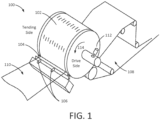
- FIG. 1 is a perspective view of an example assembly 100 for creping sheets of material in a paper making process.
- the assembly 100 includes a Yankee dryer 102, with a drive side and a tending side, a creping blade 104, vibration sensors 106, an un-creped sheet 108, a creped sheet 110, and a tachometer 112.
- the un-creped sheet 108 with a first moisture content can adhere to a coating on the Yankee dryer 102.
- the Yankee dryer 102 can then dry the sheet to a second moisture content, lower than the first, using heat (e.g., steam heat) from the Yankee dryer 102 as the Yankee dryer rotates about its longitudinal axis.
- heat e.g., steam heat
- the un-creped sheet 108 with a first moisture content can be dried by gas fired hoods that impinge hot air on the sheet surface which is not adhered to the Yankee dryer 102. Further, the Yankee dryer and the gas fired hood(s) can dry the sheet simultaneously.
- the sheet, having a lower moisture than the un-creped sheet can then be removed from the Yankee dryer 102 by a creping blade 104.
- Creping blade 104 can ride above the surface of the Yankee dryer 102 in a coating which coats the Yankee dryer 102. For example, creping blade 104 can be pressed against the surface of the Yankee dryer 102 into a coating which is sprayed onto the Yankee dryer 102. In some examples, creping blade 104 rides along the surface of the Yankee dryer 102. Creping blade 104 can also extend along the entire width of the Yankee dryer 102, from a tending side to a drive side. Further, creping blade 104 can compress the sheet in the direction of rotation of the machine (shown by arrow 114), thereby creating a folded sheet structure of the creped sheet 110. In some examples, more than one creping blade 104 is used in the process of creping.
- one or more blades can be used as a cleaning blade to remove excess coating from the surface of the Yankee dryer 102 and to prepare the dryer for additional coating application.
- a cleaning blade By creping the sheet, a large number of fiber-to-fiber bonds in the sheet are broken, imparting the qualities of bulk, stretch, absorbency, and softness which are characteristic of tissue.
- vibration sensors 106 are used and can be any type of sensor which can detect vibration.
- vibration sensors 106 are accelerometers and in some examples, accelerometers are piezoelectric accelerometers.
- vibration sensors 106 can be used to measure the vibrations of creping blade 104 during a creping process.
- vibration sensors 106 can detect differences in vibration frequencies and amplitudes of the creping blade between the tending side (e.g., front side) and the drive side (e.g., back side) of the Yankee dryer as the creping blade rides above the surface of the Yankee dryer 102 (e.g., in a coating).
- tachometer 112 can measure the speed at which the Yankee dryer 102 rotates (e.g., rotations per minute).
- pressure sensors are used which can detect things such as the Yankee steam pressure and felt uhle box pressure (e.g., vacuum).
- sensors are used which measure an amount, type, and rate of coating sprayed onto the Yankee dryer 102.
- an amount and/or rate of adhesive coating sprayed onto the Yankee dryer 102 can be measured by a sensor, an amount and/or rate of release coating sprayed onto the Yankee dryer 102 can be measured by a different sensor, and a processor and/or another sensor can measure the ratio of the amount and/or rate of adhesive coating to release coating sprayed onto the Yankee dryer 102.
- Other sensors such as acoustical sensors, chemical sensors, electrical sensors, moisture sensors, flow sensors, position sensors, motion sensors, speed sensors, optical sensors, and other sensors which can measure various aspects of the assembly which can crepe sheets are contemplated.
- FIG. 2 is a cross-sectional view of an example creping blade assembly 200 performing a creping process according to an aspect of the present invention.
- the creping blade assembly 200 includes a creping blade 204 with one or more vibration sensors 206.
- the creping blade 204 and one or more vibration sensors 206 are attached to a blade holder 212.
- the creping blade 204 can ride above the surface of a Yankee dryer 202 in a coating 214 located on the surface of the Yankee dryer 202.
- the creping blade 204 can ride along the surface of a Yankee dryer 202 and in some examples, the creping blade 204 can ride above the coating 214 located on the surface of the Yankee dryer 202.
- FIG. 2 also includes an un-creped sheet of material 208 located on the surface of the Yankee dryer 202 and a creped sheet of material 210.
- the creping blade assembly 200 performs a creping operation on the un-creped sheet of material 208.
- the coating 214 of the surface of the Yankee dryer 202 can cause the un-creped sheet of material 208 to adhere to the Yankee dryer 202 as the Yankee dryer 202 removes moisture from the un-creped sheet of material 208 using heat.
- the creping blade 204 can then be used to remove the sheet of material 208 from the surface of the Yankee dryer 202 and cause the sheet of material to fold, thereby creating a creped sheet of material 210.
- the creping blade 204 can vibrate against the surface of the Yankee dryer 202 which can cause various unwanted results.
- excessive vibration of the creping blade 204 can cause holes to appear in the creped sheet of material 210, the coating 214 on the surface of the Yankee dryer to become uneven, and further can cause damage to the Yankee dryer surface itself (e.g., under the coating).
- excessive vibration can be considered chattering as the creping blade 204 can chatter against the Yankee dryer 202.
- Measuring the vibration of the creping blade 204 can help prevent excessive vibration as when excess vibration is detected, corrective action can be taken to remedy any issues which cause the excessive vibration.
- an early warning system can detect and address excessive vibration (e.g., chatter) of the creping blade.
- the creping blade 204 can become dull and require changing. In some examples, it is necessary to change the creping blade 204 before it is dull as the blade can have imperfections or other issues which can affect the creping process and the quality of the creped sheet of material 210. The time between when a creping blade is first used and when it is dull or requires changing can be considered the blade service life. Many different ways can be used to monitor when a creping blade 204 is required to be changed. In some examples, vibration sensors 206 can measure vibration data for creping blade 204 and send the vibration data to a processor.
- the processor can use the vibration data and compare the vibration data to a threshold, with the threshold indicative of a point at which the creping blade requires changing.
- visual measurements e.g., inspection
- a processor can predict when a creping blade 204 requires changing.
- the processor can use different methods to predict the necessity of changing the creping blade 204 including using historical data such as previous blade service life and/or current data such as from vibration sensors 206.
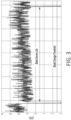
- FIG. 3 is a graph of example vibration data taken by a vibration sensor associated with a creping blade over time.
- the vibration data of FIG. 3 is in the form of root mean square acceleration, or gRMS.
- vibration data can comprise gRMS measurements.
- Vibration data can be used to determine a creping blade's service life which can be further used in a variety of applications as is described further herein.
- the vibration data of FIG. 3 includes many different points over the life of a creping blade with a majority of points being taken while the creping blade is operating. When the creping blade is in operation, the vibration data can be higher than if the creping blade is not in operation. However, the vibration data also includes multiple points in time at which the value is at or near zero.
- the creping blade is in the process of being replaced.
- the time between points at which the vibration value is at or near zero can be considered the creping blade's service life.
- a processor can receive vibration data similar to the vibration data in FIG. 3 and can determine that the time between the last value of vibration data where it is at or near zero (e.g., start point), and the first time at which the vibration data is at or near zero (e.g., stop point) corresponds with the creping blade's service life.
- the processor can receive vibration data similar to the vibration data in FIG.
- the threshold at which the vibration data is considered to be at or near zero can be a creping blade change threshold.
- the threshold can have any value but is preferably outside an operating range of vibration data associated with a creping blade.
- vibration sensors can measure vibration of the creping blade and produce vibration data continuously, while in some examples, vibration sensors can measure vibration of the creping blade and produce vibration data at discrete points in time. Using the vibration data to determine a service life of a creping blade can be advantageous over other methods as vibration data as it does not require a distributed control system (DCS) or electronic pressure transducers, both of which can be costly or unavailable to older systems.
- DCS distributed control system
- a sensor can measure a loading pressure of the creping blade and a processor can compare the loading pressure to a threshold to determine if the creping blade has been removed (e.g., replaced) and the time between removals.
- the sensor measuring the loading pressure can create loading data similar to the shape of vibration data of FIG. 3 , and determine that if the loading pressure moves from high to low, a creping blade is being changed, while if the loading pressure moves from low to high, a creping blade is being put back into operation.
- a sensor can measure the status of the creping blade loading and report a signal to a processor indicating if blade loading is enabled or disabled.
- the processor can measure a time between the disabled signals to determine the life of a creping blade.
- an operator operating the creping assembly can track the changing of creping blades in a logbook and determine the time between changes of the creping blades. Still further examples of determining the life of a creping blade are contemplated.
- vibration data can include many discrete points of data, each measured at a specific time, for a single creping blade. Vibration data can be taken at any interval, but in some examples vibration data is taken at a rate of 60 measurements per hour or one measurement per minute. In some examples, a creping blade can have a service life as short as 2 hours in operation and in some examples, a creping blade can have a service life exceeding 24 hours. It can be beneficial to track the vibration data of each creping blade used over time and perform data analysis on the total vibration data of all the blades used over a period of time. For example, tracking the vibration data of multiple creping blades and trending the data can help predict the service life of future creping blades.
- the amount of vibration data generated by many creping blades can be difficult to analyze and perform calculations on.
- a large amount of processing resources and memory resources e.g., data storage
- FIG. 4 is a graph of example average vibration data of a series of creping blades.
- the vibration data of a single creping blade (e.g., as in FIG. 3 ) has been reduced by taking an average of the vibration data while the creping blade was in operation.
- a single data point e.g., average
- overall analysis of the data can be made with fewer processing resources and memory resources. Additionally, it can be easier for an operator or processor to draw conclusions from the data. For example, in FIG. 4 , approximately 990 data points represent the average vibration data of approximately 990 creping blades.
- the vibration data in FIG. 4 was not reduced to an average vibration value per creping blade, the number of data points would be greater than 260,000, requiring significantly more processing and memory resources.
- trendline 416 uses the first approximately 200 creping blade data points and is extrapolated to approximately 700 blade data points.
- Trendline 416 indicates that the average vibration data is increasing over time as more creping blades are used.
- an operator can use the trendline 416 to diagnose issues with the creping blades or creping assembly. For example, some issues can include excessive vibration, excessive wear, incorrect installation of creping blades, creping blade stick out, incorrect edge bevel or other issues.
- the trendline 416 can also be updated over time as the average vibration of each creping blade is determined. Further, an alarm and/or threshold level 418 of average vibration can be set.
- an operator can use the alarm and/or threshold level 418 of average vibration to determine when a maintenance operation is required.
- the alarm and/or threshold level of average vibration can be updated over time.
- the alarm and/or threshold level 418 can be used with trendline 416 to determine when a maintenance operation is required. For example, trendline 416, which is extrapolated, can cross the alarm and/or threshold level 418 of average vibration.
- An operator can be alerted and can take corrective action (e.g., maintenance) to prevent the average vibration of a future creping blade from being too high, which could cause damage.
- the operator can use the crossing of the trendline 416 and the alarm and/or threshold level 418 to determine when maintenance or changes to the creping process are required. This can be advantageous as an operator can plan when the creping process needs to be shut down and it can also aid an operator in decision making regarding various scheduling of processes.
- reducing the vibration data of each blade to a single value is done by calculating and/or determining the single value.
- the single value can represent a maximum, minimum, mode, rate of change, standard deviation, detrended standard deviation, and blade service life duration. Further techniques for reducing vibration data and/or other data associated with a paper making process are contemplated, and any combination of techniques can be used to reduce the amount of data.
- a descriptive performance variable can be created.
- the descriptive performance variable can be a variable with a value which describes a series of values such as measurement data.
- vibration data of a creping blade is reduced to a detrended standard deviation of the vibration data.
- vibration data is collected from one or more vibration sensors for a period of time such as the blade service life.
- a function can be fit to the vibration data and a trendline can be created.
- the function is a linear function while in some examples, the function is a nonlinear function.
- the trendline can be considered fitted vibration data.
- a difference between the fitted function and the measured vibration data can be calculated which can result in data generally centered about 0.
- the standard deviation of the data generally centered about 0 can be taken and the result can be considered a detrended standard deviation of the vibration data.
- the vibration data is reduced to the single value of a detrended standard deviation.
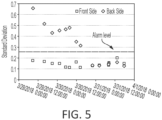
- the process of reducing the vibration data of a creping blade to a detrended standard deviation can be repeated for a series of creping blades. This can result in a single detrended standard deviation value per blade. In some examples, the process can result in a single detrended standard deviation value per a side of a blade. For example, in FIG. 5 , a detrended standard deviation of a front side of a creping blade and a back side of the creping blade can be determined. This can be advantageous over using a single detrended standard deviation of the entire creping blade as it can be more accurate.
- the detrended standard deviation values for the front and back of multiple creping blades over the life of the creping blades can be charted.
- an alarm level can be set which can cause an alarm to be set off and/or cause a signal to be output when a detrended standard deviation value exceeds a threshold.
- the alarm and/or the signal can be output to a display such that an operator can be notified.
- the alarm level for the detrended standard deviation data can indicate at a higher level that something is wrong.
- a traditional alarm can indicate that a creping blade is an issue due to high vibration measurements while an alarm level can indicate that a creping blade is not the issue, but rather another part of the creping process is wrong as a new creping blade still caused the detrended standard deviation of the vibration data to exceed the alarm level.
- each data point represents the detrended standard deviation of the vibration data associated with the front or back of a single creping blade. While the front side data is below an alarm level for all the creping blades, the back side data is above the alarm level for multiple creping blades until a point at which it is below the alarm level. This can indicate that something other than changing the creping blade was used to correct the creping process.
- the alarm level can be used for secondary alarming.
- the secondary alarming can have a higher sensitivity to the operating state of the creping process and can be used to capture any defects in the process early and with a higher frequency than traditional alarming on vibration data itself.
- vibration data comprises vibration frequency.
- vibration data can be collected at various vibration frequencies.
- the vibration data can be separated into frequency bands with each frequency band representing possible issues with the creping process which can be diagnosed by an operator. For example, vibration data which is in the frequency band of 0 to 5 kilohertz can indicate that the creping blade holder has an issue and/or the Yankee dryer is out of round. Further, vibration data which is in the frequency band of 15 to 20 kilohertz can indicate that no major issues are present and that the creping process is operating in an acceptable condition.
- the vibration frequency data from creping blades can be reduced. In some examples, the vibration frequency data from creping blades can be reduced on a per blade basis in a similar manner as vibration data is reduced to a single value as described elsewhere herein.
- sensors can be used to measure various parts of the creping assembly in the creping process.
- Sensors can include tachometers, pressure sensors, temperature sensors, moisture sensors, flow sensors, Yankee coating film thickness sensors, Yankee coating film modulus sensors, and other sensors with each sensor capable of providing data of the operation of the creping assembly to a processor.
- Some examples of such sensors are described in U.S. Patent No. 8,691,323 and U.S. Patent No. 9,388,530 .
- the amount of data generated by the sensors can be large and complex as many different sensors can be used in various parts of the creping process and/or for a single part of the creping process. To reduce the amount and complexity of the data, a score can be assigned to the data generated from a sensor.
- a score can be used to determine how various parts of the creping process are performing.
- the assigning of a score to the data generated from a sensor can be done in a variety of ways and can further be based on a variety of factors.
- the assigning of a score to the data generated from a sensor can be based on previous sensor data, statistical manipulation of the sensor data such as an average and/or standard deviation, and/or any combination of factors.
- a score can be assigned to the data generated from multiple sensors. In some examples, a score can be generated from the data generated from multiple sensors. The score can have a range of values. In some examples, the score can have a range between 0 and 100 with 100 representing an ideal score and 0 representing the least ideal (e.g., worst) score.
- a pressure sensor can measure the steam pressure of the Yankee dryer in pounds per square inch (PSI) and a first measurement in PSI can be assigned a first score and a second measurement in PSI can be assigned a second score. In such an example, the second score can be closer to the ideal score of 100 than the first score and an operator can more easily interpret that the second measurement is better than the first measurement.
- PSI pounds per square inch
- each score can correlate directly with the value of the sensor measurement, however in some examples, each score is not directly correlated with the value of the sensor measurement.
- the difference between a first value and a second value can be the same difference as between a first score and a second score, but in some examples, the difference is not the same.
- the assigned score can indicate that the measurement data is outside of an acceptable range.
- Process data can include data from a creping machine and/or data from product produced by the creping machine (e.g., creped paper).
- process data can include vibration data of a creping blade, Yankee steam pressure, and quality data of creped paper.
- process data is associated with a machine such as a creping machine and the process data can be considered machine process data.
- the machine process data is process data that is associated with a corresponding machine.
- the process data can be recorded such as in non-volatile computer-readable memory.
- the recorded process data can be used by one or more processors (e.g., to generate indices) as is described elsewhere herein.
- FIG. 6A includes process data, which can include any sensor measurement values over time, is assigned a single score of 67.
- process data which can include any sensor measurement values over time
- an average of the process data is determined along with a standard deviation of the process data.
- the standard deviation of the process data is added to the average to generate an upper value while the standard deviation of the process data is subtracted from the average to generate a lower value.
- the range between the upper and lower values of the process data can represent the variability of the process data.
- the upper and lower values are used with control lines (CL) in that the scores at which the upper and lower values intersect with the control lines represent the scores assigned to the upper and lower process data values.
- CL control lines
- the average of the process data is 12.5 while the standard deviation is 1.5.
- the standard deviation added to the average is 14 (e.g., upper value) and the standard deviation subtracted from the average is 11 (e.g., lower value).
- the intersect of the upper value with the control lines is approximately 35 and thus the score assigned to the upper value is 35.
- the intersect of the lower value with the control lines is approximately 100 and thus the score assigned to the lower value is 100.
- multiple process data values can correspond to the same score as control lines are on either side of a central value.
- the central value can be an ideal average value of the process data.
- the control lines on either side of the central value can be determined by using multiples of a standard deviation of ideal process data.
- the central value of the process data is approximately 10.8 while a standard deviation of ideal process data is approximately 1.
- the standard deviation is then added to the central value once to determine the 1S point of the upper control line, twice to determine the 2S point of the upper control line, and a third time to determine the 3S point of the upper control line. A liner fit between the points can be determined and thus the upper control line is determined.
- the standard deviation is subtracted from the central value once to determine the -1S point, twice to determine the -2S point, and a third time to determine the -3S point of the lower control line. A linear fit between the points can be determined and thus the lower control line is determined.
- an overall score can be assigned to the process data.
- Score Overall is the overall assigned score
- PR ⁇ is the average of the process data
- ⁇ is the standard deviation of the process data
- Score(x) means the assigned score as a function of x.
- the overall score of 67 is determined by taking the average of the upper score, 35, and the lower score, 100, assigned to the standard deviation added to the average process data, 14, and the standard deviation subtracted from the average process data, 11, respectively.
- the process of assigning an overall score to a series of values can be advantageous over assigning a score to each individual process data value as a single value may not be representative of the actual condition of a measured device.
- the process of assigning an overall score in contrast, can account for the variability of the measured data relative to a centerline.
- the process can be further advantageous over taking a simple average of the process data as a simple average cannot take into account the variability of the process data.
- a higher overall score of the process data can indicate that the process data, the sensor measurement, and the assembly the sensor is measuring are in a better condition than compared to a lower score.
- colors can be associated with ranges of assigned scores and in some examples, red is associated with an overall score range between 0 and 33, yellow is associated with an overall score range between 34 and 66, and green is associated with an overall score range between 67 and 100. Other ranges and colors are contemplated.
- a lower score corresponds with worse operating conditions (e.g., excessive vibration).
- process data such as vibration data
- only adding or only subtracting one or more standard deviations from the average are of interest.
- vibration data higher than the average vibration data plus one standard deviation of the vibration data is associated with an overall score less than 100, all vibration data below the average plus one standard deviation has a score of 100.
- this is because a lower value of vibration data is classified as a good operating state.
- only one of the standard deviations of the process data added to the average of the process data or the standard deviation of the process data subtracted from the average of the process data is of concern.
- control line only one control line can be used to assign a score to such process data.
- the standard deviation of the vibration data added to the average of the vibration data is approximately 12, which intersects the control line at a score of approximately 80. If more than one process data value is used in assigning a score to the process data, then the overall score can use the method for an overall score as previously disclosed herein.
- the process of assigning a score to process data can be repeated in order to assign scores to process data from multiple sensors.
- an index can be generated which comprises the multiple scores assigned to the process data from multiple sensors.
- a processor, operator, non-computer readable storage medium having instructions stored thereon, and/or other computing devices can be used to generate the index.
- process data from one sensor can be given an individual score while in some examples, process data from multiple sensors can be given an individual score.
- process data from multiple sensors are combined into an index.
- the index can comprise a name of the process data which represents the type of process data.
- the index can further comprise a unit of measurement associated with the process data.
- the index can also comprise of a color associated with each of the individual scores as previously discussed herein.
- the index of FIG. 7 comprises process data representative of the Yankee pressure (e.g., Yankee dryer pressure) which has a unit of PSI and an individual score of 65.70 which correlates with a yellow color indicator.
- the index of FIG. 7 comprises process data representative of the uhle box vacuum which has a unit of PSI and an individual score of 100.00 which correlates with a green color indicator.
- the index can comprise scores associated with any sensors on a creping machine and the index can be customized such that scores associated with any sensor can be added or removed at any time.
- the index can comprise scores associated with sensors and/or tests performed on the product produced by the creping machine in addition to or in lieu of scores associated with sensors on the creping machine.
- One such example of an index is a Yankee protection index.
- the Yankee protection index is named as such because the types of process data incorporated into the Yankee protection index can have an effect on the surface of the Yankee dryer.
- the sources of the process data include back side gRMS vibration data, front side gRMS vibration data, Yankee steam pressure data, felt uhle box pressure (e.g., vacuum) data, adhesive coating add-on data, release coating add-on data, and data of the ratio of adhesive coating vs. the release coating.
- Other sources of process data can be incorporated into the Yankee protection index and the sources of process data is not limited to those listed. Additionally, in some examples not all the sources of process data listed are included in the Yankee protection index.
- a blade performance index which has sources of process data including blade life (e.g., determined by vibration data as described elsewhere herein), vibration data, blade loading pressure, and edge wear rate.
- the blade performance index can be associated with the performance of the creping blade or other blades such as a doctor blade.
- a creping efficiency index can be an index of process data which is associated with how efficiently a Yankee coating is producing desired end quality properties in the finished product (e.g., tissue sheet).
- the creping efficiency index can include process data from various sources including a stretch to crepe ratio, which is defined by the machine direction (MD) stretch in the finished sheet divided by the crepe ratio with the crepe ratio defined by a reel speed subtracted from a Yankee speed, with the difference being divided by the reel speed.
- MD machine direction
- the creping efficiency index can also include process data from sources such as an amount of Yankee adhesive coating, an amount of Yankee release coating, a ratio of the Yankee adhesive coating to the Yankee release coating, a crepe count in the sheet (e.g., crepe structures per inch), and vibration data.
- Another example of an index can be a product quality index which is associated with the quality of the final product produced by the creping process (e.g., tissue quality).
- the product quality index can comprise sources of process data which include sheet moisture data, sheet softness, sheet bulk, sheet stretch in both the MD and the cross direction (CD), and sheet moisture after the Yankee dryer (e.g., creping moisture).
- the various sources of process data used in the product quality index are associated with the finished product of the creping process (e.g., final creped sheet).
- the process data associated with the product quality is considered product quality data.
- indices are contemplated such as a felt health index, an energy usage index, and a wet end performance index. Such indices can include process data from various sources such as sensors and the process data included in each index can be changed at any time.
- the index comprises at least a score associated with vibration data.
- the index includes scores from disparate sources which do not influence each other (e.g., two different creping machines).
- the index includes scores from sources which do influence each other.
- the index includes scores from sources which have a correlation with each other. For example, in FIG. 7 , the score of the overall vibration of the front of a creping blade and the score of the overall vibration of the back of the creping blade can be correlated with each other and included in the index. By including scores from sources which can be correlated with each other, an index can be made which includes the most relevant factors to a specific process within the overall creping process.
- the index can also reduce the time necessary to troubleshoot aspects of the creping process as scores from sources correlated with each other can indicate which aspect(s) of the creping process require corrective action.
- different indices can reflect changes in each other and in some examples, can interact with one another.
- a poor blade performance index can indicate a risk for the Yankee protection index.
- the Yankee protection index can decrease if the blade performance index decreases.
- the performance of one index can be indicative of the performance of another index and each of the indices can include and give weight to the performance of the other index.
- an overall score can be assigned to an index.
- the overall score can include the scores from the difference sources within the index.
- the overall score can be a simple sum of the individual scores.
- the overall score can be a weighted sum of the individual scores.
- an overall score of 77.54 is calculated from a weighted sum of the individual scores assigned to the various sources of process data.
- the individual scores can be weighted in any way and can be modified at any time.
- the weight of some individual scores is higher than other weights of individual scores.
- the weight of an individual score can be based on the relative importance that the individual score has to the overall index.
- the weight of an individual score can be user-defined and/or based on the variable sensitivity of the individual score. For example, in FIG. 7 , the score associated with the overall vibration of the front of a creping blade has a weight of 36% while the score associated with the Yankee pressure has a weight of 13%. Thus, the overall score of the index will reflect this weighting and the overall score of the index will depend more on the overall vibration of the front of the creping blade than the Yankee pressure. In the example of FIG. 7 , the overall vibration of the front of the creping blade is more important to the creping process than the Yankee pressure and so the weight of the overall vibration of the front of the creping blade is higher than the weight of the Yankee pressure measurement.
- an overall score for each individual score is determined by multiplying the individual score with the weight given to the individual score.
- the overall score for each individual score can be added together to generate an overall score of the index.
- the overall score for an index can be considered an index score.
- the overall index score of 77.54 is a sum of: various chemistry add-on process data scores multiplied by a weight of 38% (e.g., 0.38), overall vibration of the front and back of a creping process data scores multiplied by a weight of 36% (e.g., 0.36), and Yankee pressure and uhle box vacuum process data scores multiplied by a weight of 13% (e.g., 0.13).
- the index score comprises at least a score of vibration data, with the vibration data associated with one or more vibration sensors sensing the vibration of a creping blade.
- a weighted index score can be advantageous because it can provide an easy to understand overall indication of the performance of a process involving multiple sensors.
- the index score can include colors to help quickly understand how well the overall process, which includes multiple sources of data, is performing. For example, in FIG. 7 , the score of 77.54 is green indicating acceptable performance (e.g., score of 67-100) while a score of 34 to 66 could be yellow indicating a possible issue and a score of 0 to 33 could be red indicating a possible failure.
- the individual scores of the process data can be compared to a threshold, while in some examples, the index score can be compared to a threshold.
- a threshold can be a single value, a series of values, and/or a range of values. The threshold can be defined at any time and can change at any time, however, in some examples, the threshold is a user-defined value which remains constant over time.
- a signal is output and/or an alarm is triggered. In some examples, the value only has to be the same as the threshold value for a signal to be output and/or an alarm to be triggered. The signal and/or alarm can be output on a display such that an operator can be notified that the value has exceeded the threshold value.
- the alarm can indicate in any manner that the value has passed the threshold value.
- the alarm can be a visual alarm, an audible alarm, or a combination thereof.
- the alarm is displayed on a display.
- an alarm can be triggered if any one of the scores passes a threshold score (e.g., 34) and additionally or alternatively, an alarm can be triggered if the index score passes a threshold score. It can be advantageous to alarm on the index score rather than to alarm on an individual score because the index score can allow an operator to determine which system of the creping assembly requires attention rather than which individual sensor requires attention. In some examples, alarming on the index score allows an operator to isolate an issue to a specific system of the creping assembly.
- individual scores of process data can have larger changes within a period of time, alarming more frequently than an index score.
- the individual score alarms do not affect the overall creping process and alarming on the individual scores would be unnecessarily frequent.
- alarming on the overall score rather than on individual scores can be a better indication that corrective action needs to be taken.
- the index score can also be compared to other index scores such as historical index scores, index scores from other creping assemblies, and ideal index scores. Further, an index score can be trended over time to determine how the index of various measurement sources changes overtime. This can provide insight as to when maintenance or other corrective actions should be scheduled.
- an index score can be used with assemblies, machines, and/or other processes. Further, in some examples, multiple index scores can be combined to form an overall index with an overall index score.
- a papermaking assembly can include a creping assembly with an index and index score as well as other assemblies and/or machines with other indices and index scores.
- the different indices and index scores can be combined together in any way to form a single, overall index with an overall index score representative of the entire papermaking assembly. This can be advantageous as the overall index and index score can allow an operator to monitor an entire papermaking assembly easily due to the reduction of process data. Additionally, in some examples, the overall index score can be easily compared to overall index scores from other machines and/or assemblies, to averages of other overall index scores, and/or to a standardized overall score.
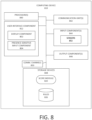
- FIG. 8 is a block diagram illustrating an example computing device configured to determine a characteristic of received user input and output a corresponding set of subelements associated with an application on the computing device, in accordance with one or more aspects of the invention.
- Computing device 810 of FIG. 8 is described below.
- FIG. 8 illustrates only one particular example of computing device 810, and many other examples of computing device 810 may be used in other instances and may include a subset of the components included in example computing device 810 or may include additional components not shown in FIG. 8 .
- computing device 810 includes user interface device (UID) 812, one or more processors 840, one or more communication units 842, one or more input components 844, one or more output components 846, and one or more storage components 848.
- UID 812 includes display component 802 and presence-sensitive input component 804.
- Storage components 848 of computing device 810 include score module 820, and rules data store 826.
- One or more processors 840 may implement functionality and/or execute instructions associated with computing device 810 to generate an index score for a creping blade.
- processors 840 include application processors, display controllers, auxiliary processors, one or more sensor hubs, and any other hardware configure to function as a processor, a processing unit, or a processing device.
- Module 820 may be operable by processors 840 to perform various actions, operations, or functions of computing device 810.
- processors 840 of computing device 810 may retrieve and execute instructions stored by storage components 848 that cause processors 840 to perform the operations described with respect to module 820.
- the instructions when executed by processors 840, may cause computing device 810 to generate an index score for a creping blade.
- Score module 820 may perform operations for generating an index score based on received data points from sensors 852.
- One or more storage components 848 within computing device 810 may store information for processing during operation of computing device 810 (e.g., computing device 810 may store data accessed by module 820 during execution at computing device 810).
- storage component 848 is a temporary memory, meaning that a primary purpose of storage component 848 is not long-term storage.
- Storage components 848 on computing device 810 may be configured for short-term storage of information as volatile memory and therefore not retain stored contents if powered off. Examples of volatile memories include random access memories (RAM), dynamic random access memories (DRAM), static random access memories (SRAM), and other forms of volatile memories known in the art.
- Storage components 848 also include one or more computer-readable storage media.
- Storage components 848 in some examples include one or more non-transitory computer-readable storage mediums.
- Storage components 848 may be configured to store larger amounts of information than typically stored by volatile memory.
- Storage components 848 may further be configured for long-term storage of information as non-volatile memory space and retain information after power on/off cycles. Examples of non-volatile memories include magnetic hard discs, optical discs, floppy discs, flash memories, or forms of electrically programmable memories (EPROM) or electrically erasable and programmable (EEPROM) memories.
- Storage components 848 may store program instructions and/or information (e.g., data) associated with module 820 and rules data store 826.
- Storage components 848 may include a memory configured to store data or other information associated with module 820 and rules data store 826.
- Communication channels 850 may interconnect each of the components 812, 840, 842, 844, 846, and 848 for inter-component communications (physically, communicatively, and/or operatively).
- communication channels 850 may include a system bus, a network connection, an inter-process communication data structure, or any other method for communicating data.
- One or more communication units 842 of computing device 810 may communicate with external devices via one or more wired and/or wireless networks by transmitting and/or receiving network signals on one or more networks.
- Examples of communication units 842 include a network interface card (e.g., such as an Ethernet card), an optical transceiver, a radio frequency transceiver, a GPS receiver, or any other type of device that can send and/or receive information.
- Other examples of communication units 842 may include short wave radios, cellular data radios, wireless network radios, as well as universal serial bus (USB) controllers.
- USB universal serial bus
- One or more input components 844 of computing device 810 may receive input. Examples of input are tactile, audio, and video input.
- Input components 844 of computing device 810 includes a presence-sensitive input device (e.g., a touch sensitive screen, a PSD), mouse, keyboard, voice responsive system, camera, microphone or any other type of device for detecting input from a human or machine.
- a presence-sensitive input device e.g., a touch sensitive screen, a PSD
- mouse e.g., keyboard, voice responsive system, camera, microphone or any other type of device for detecting input from a human or machine.
- input components 844 may include one or more sensor components 852 one or more location sensors (GPS components, Wi-Fi components, cellular components), one or more temperature sensors, one or more movement sensors (e.g., accelerometers, gyros), one or more pressure sensors (e.g., barometer), one or more ambient light sensors, and one or more other sensors (e.g., infrared proximity sensor, hygrometer sensor, and the like).
- the one or more sensor components 852 can be vibration sensors which can detect vibration and/or acceleration of one or more creping blades.
- the one or more sensor components 852 can be tachometers for measuring rotational speed of components (e.g., Yankee dryer), pressure sensors for measuring steam pressure of the Yankee dryer, chemical sensors which can measure an amount and/or rate of adhesive coating spayed onto the Yankee dryer, and/or moisture sensors which can measure the moisture content of a sheet through various steps of the creping process.
- Other sensors can include acoustical sensors, chemical sensors, electrical sensors, flow sensors, position sensors, motion sensors, speed sensors, and optical sensors.
- One or more output components 846 of computing device 810 may generate output in a selected modality. Examples of modalities may include a tactile notification, audible notification, visual notification, machine generated voice notification, or other modalities.
- Output components 846 of computing device 810 includes a presence-sensitive display, a sound card, a video graphics adapter card, a speaker, a cathode ray tube (CRT) monitor, a liquid crystal display (LCD), a light emitting diode (LED) display, an organic LED (OLED) display, a virtual/augmented/extended reality (VR/AR/XR) system, a three-dimensional display, or any other type of device for generating output to a human or machine in a selected modality.
- a presence-sensitive display includes a presence-sensitive display, a sound card, a video graphics adapter card, a speaker, a cathode ray tube (CRT) monitor, a liquid crystal display (LCD), a light emitting diode (LED) display
- UID 812 of computing device 810 may include display component 802 and presence-sensitive input component 804.
- Display component 802 may be a screen, such as any of the displays or systems described with respect to output components 846, at which information (e.g., a visual indication) is displayed by UID 812 while presence-sensitive input component 804 may detect an object at and/or near display component 802.
- UID 812 may also represent an external component that shares a data path with computing device 810 for transmitting and/or receiving input and output.
- UID 812 represents a built-in component of computing device 810 located within and physically connected to the external packaging of computing device 810 (e.g., a screen on a mobile phone).
- UID 812 represents an external component of computing device 810 located outside and physically separated from the packaging or housing of computing device 810 (e.g., a monitor, a projector, etc. that shares a wired and/or wireless data path with computing device 810).
- UID 812 of computing device 810 may detect two-dimensional and/or three-dimensional gestures as input from a user of computing device 810. For instance, a sensor of UID 812 may detect a user's movement (e.g., moving a hand, an arm, a pen, a stylus, a tactile object, etc.) within a threshold distance of the sensor of UID 812. UID 812 may determine a two or three-dimensional vector representation of the movement and correlate the vector representation to a gesture input (e.g., a hand-wave, a pinch, a clap, a pen stroke, etc.) that has multiple dimensions.
- a gesture input e.g., a hand-wave, a pinch, a clap, a pen stroke, etc.
- UID 812 can detect a multi-dimension gesture without requiring the user to gesture at or near a screen or surface at which UID 812 outputs information for display. Instead, UID 812 can detect a multi-dimensional gesture performed at or near a sensor which may or may not be located near the screen or surface at which UID 812 outputs information for display.
- the one or more sensors 852 can measure process data which can be electronically transmitted to the score module 820 of the computing device 810.
- the score module 820 can assign a score to the process data and can further generate an index score comprising the process data.
- the process data comprises product quality data with the product quality data associated with a finished product of the creping process.
- the process data comprises vibration data and the one or more sensors 852 are vibration sensors which measure vibration data of a creping blade.
- the score module 820 can assign a score to the vibration data with the index score comprising at least the assigned score of the vibration data.
- the one or more processors 840 can determine an average vibration value of a creping blade and the score module 820 can assign a score to the vibration data using the average vibration value. In some examples, the one or more processors 840 calculate a standard deviation of vibration data of the creping blade and the score module 820 assigns a score to the vibration data using the standard deviation of the vibration data. In some such examples, the standard deviation is compared to a threshold and if the standard deviation exceeds the threshold, the computing device can output a signal indicating as such. In further examples, the signal is output to a display.
- the scoring module 820 can compare the vibration data to previous vibration data and assign a score to the vibration data based on the comparison.
- the previous vibration data can be associated with at least one previously used creping blade with the previous vibration data, in some examples, being reduced to a single value per creping blade.
- the one or more processors 840 can compare the standard deviation of the vibration data to a standard deviation of previous vibration data with the single with the single value being the standard deviation of the previous vibration data.
- one or more processors 840 determine the single value by generating fitted vibration data by fitting a function to the vibration data, generating a detrended function by calculating a difference between the measured vibration data and the fitted vibration data, and calculating a standard deviation of the detrended function. In some examples, the one or more processors 840 determine a start point and a stop point of the at least one previously used creping blade where the start point corresponds to a start of use of the at least one previously used creping blade and the stop point corresponds to an end of use of the at least one previously used creping blade.
- the vibration data comprises vibration data at one or more frequencies.
- the computing device 810 can diagnose one or more issues with a Yankee dryer based at least in part on the vibration data. Issues of a Yankee dryer can include excess vibration of creping blades, scratching of the Yankee dryer surface, coating deficiencies, steam pressure variations, and other incorrect operations of portions of the Yankee dryer system.
- the score module 820 can assign a score to the least one vibration value by comparing the vibration data to a threshold. In some such examples, the score module 820 assigns the score to the at least one vibration value using a difference between the vibration data and the threshold. In further examples, a larger difference between the vibration data and the threshold correspond to a worse score. In some examples, the score module 820 associates a color with the score of the vibration data which can correspond to the difference between the vibration data and the threshold.
- the index score comprises the score assigned to the vibration data (e.g., by score module 820) and at least one other score, which can be associated with a paper making process.
- the score module 820 associates and can assign the at least one other score with creping blade chatter.
- the score module 820 assigns a score to data from sensors such as: vibration of a back side of a creping blade, vibration of a front side of a creping blade, a steam pressure of a Yankee dryer, a uhle box pressure (e.g., vacuum) of the felt, properties of an adhesive coating on a Yankee dryer, properties of a release coating on a Yankee dryer, a ratio of the properties of the adhesive coating and the release coating, and any combinations thereof.
- the one or more processors 840 in conjunction with the score module 820 weight any assigned scores (e.g., a score assigned to vibration data) and sum them together provide an index score. In some such examples, an operator can input the weighting into the computing device 810.
- the one or more processors 840 in conjunction with the score module 820 can compare the index score to a threshold and output a signal if the index score is above or below the threshold.
- the one or more processors 840 can determine a length of time until a creping blade should be changed using the score assigned to the vibration data by the score module 820, and/or by using the index score. In some examples, the one or more processors 840 evaluates a performance of a Yankee dryer using the index score. In some examples, the index score is used to prevent damage to the Yankee dryer and/or to determine the performance of the creping process. Further, in some examples, the index score comprises measurements from one or more other sensors which can be selected from a group consisting of a vibration sensor, a temperature sensor, a tachometer, a pressure sensor, a flow sensors, a moisture sensor, and any combination thereof.
- the sensors 852 are vibration sensors which can be located on the front side of a creping blade and/or on a back side of a creping blade.
- the creping blade is a doctor blade while in some examples, the creping blade is a cleaning doctor blade.
- the index score is associated with a first paper making machine and is compared to a second index score by the one or more processors 840 with the second index score associated with a second paper making machine.
- the one or more processors 840 and/or the score module compare the index score to a value with the value being an average index score of one or more paper making machines.
- one or more vibration sensors generate the vibration data which comprises a series of side-to-side variation measurements over time for the creping blade during a papermaking process.
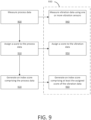
- FIG. 9 is a flow chart illustrating an example mode of operation.
- the techniques of FIG. 9 may be performed by one or more processors of a computing device, such as computing device 810 illustrated in FIG. 8 .
- a computing device such as computing device 810 illustrated in FIG. 8 .
- the techniques of FIG. 9 are described within the context of computing device 810 of FIG. 8 , although computing devices having configurations different than that of computing device 810 may perform the techniques of FIG. 9 .
- the one or more sensors 852 measure process data.
- the score module 820 alone or in combination with the one or more processors 840 assign a score to the process data.
- the score module 820 alone or in combination with the one or more processors 840 generates an index score comprising the process data.
- Element 930 illustrates one example of the method outlined in steps 900, 910, and 920.
- measuring process data 900 comprises measuring vibration data using one or more vibration sensors 940.
- assigning a score to the process data 910 comprises assigning a score to the vibration data 950.
- generating an index score comprising the process data 920 comprises generating an index score comprising at least the assigned score of the vibration data 960.
- Computer-readable media may include computer-readable storage media, which corresponds to a tangible medium such as data storage media, or communication media including any medium that facilitates transfer of a computer program from one place to another, e.g., according to a communication protocol.
- Computer-readable media generally may correspond to (1) tangible computer-readable storage media which is non-transitory or (2) a communication medium such as a signal or carrier wave.
- Data storage media may be any available media that can be accessed by one or more computers or one or more processors to retrieve instructions, code and/or data structures for implementation of the techniques according to the invention.
- a computer program product may include a computer-readable medium.
- such computer-readable storage media can comprise RAM, ROM, EEPROM, CD-ROM or other optical disk storage, magnetic disk storage, or other magnetic storage devices, flash memory, or any other medium that can be used to store desired program code in the form of instructions or data structures and that can be accessed by a computer.
- any connection is properly termed a computer-readable medium.
- a computer-readable medium For example, if instructions are transmitted from a website, server, or other remote source using a coaxial cable, fiber optic cable, twisted pair, digital subscriber line (DSL), or wireless technologies such as infrared, radio, and microwave, then the coaxial cable, fiber optic cable, twisted pair, DSL, or wireless technologies such as infrared, radio, and microwave are included in the definition of medium.
- DSL digital subscriber line
- Disk and disc includes compact disc (CD), laser disc, optical disc, digital versatile disc (DVD), floppy disk and Blu-ray disc, where disks usually reproduce data magnetically, while discs reproduce data optically with lasers. Combinations of the above should also be included within the scope of computer-readable media.
- processors such as one or more digital signal processors (DSPs), general purpose microprocessors, application specific integrated circuits (ASICs), field programmable logic arrays (FPGAs), or other equivalent integrated or discrete logic circuitry.
- DSPs digital signal processors
- ASICs application specific integrated circuits
- FPGAs field programmable logic arrays
- processors may refer to any of the foregoing structure or any other structure suitable for implementation of the techniques described herein.
- the functionality described herein may be provided within dedicated hardware and/or software modules configured for encoding and decoding, or incorporated in a combined codec. Also, the techniques could be fully implemented in one or more circuits or logic elements.
- the techniques of this invention may be implemented in a wide variety of devices or apparatuses, including a wireless handset, an integrated circuit (IC) or a set of ICs (e.g., a chip set).
- IC integrated circuit
- a set of ICs e.g., a chip set.
- Various components, modules, or units are described to emphasize functional aspects of devices configured to perform the disclosed techniques, but do not necessarily require realization by different hardware units. Rather, as described above, various units may be combined in a codec hardware unit or provided by a collection of interoperative hardware units, including one or more processors as described above, in conjunction with suitable software and/or firmware.
Landscapes
- Engineering & Computer Science (AREA)
- General Engineering & Computer Science (AREA)
- Manufacturing & Machinery (AREA)
- Quality & Reliability (AREA)
- Physics & Mathematics (AREA)
- General Physics & Mathematics (AREA)
- Automation & Control Theory (AREA)
- Software Systems (AREA)
- Paper (AREA)
- Measurement Of Mechanical Vibrations Or Ultrasonic Waves (AREA)
- Testing Of Devices, Machine Parts, Or Other Structures Thereof (AREA)
- Testing Of Balance (AREA)
Claims (19)
- Verfahren zum Verfolgen von Daten, die einem Kreppprozess zugeordnet sind, das Verfahren umfassend:Messen von Prozessdaten, wobei die Prozessdaten Schwingungsdaten umfassen, und wobei das Messen von Prozessdaten das Messen von Schwingungsdaten einer Kreppklinge unter Verwendung eines oder mehrerer Schwingungssensoren (106) einschließt;Zuweisen einer Bewertung für die Prozessdaten, das das Zuweisen einer Schwingungsbewertung für die Schwingungsdaten einschließt; undErzeugen einer Indexbewertung basierend auf der Bewertung für die Prozessdaten und die Schwingungsbewertung für die Schwingungsdaten; und optional wobei die Prozessdaten ferner Produktqualitätsdaten umfassen.
- Verfahren nach Anspruch 1, ferner umfassend:Bestimmen eines durchschnittlichen Schwingungswerts der Kreppklinge (204), wobei das Zuweisen der Bewertung zu den Schwingungsdaten das Bestimmen der Bewertung mindestens teilweise basierend auf dem durchschnittlichen Schwingungswert der Kreppklinge (204) umfasst; undBerechnen einer Standardabweichung der Schwingungsdaten der Kreppklinge (204), wobei das Zuweisen der Bewertung zu den Schwingungsdaten das Bestimmen der Bewertung mindestens teilweise basierend auf der Standardabweichung der Schwingungsdaten der Kreppklinge (204) umfasst; und optional ferner umfassend:Vergleichen der Standardabweichung mit einer Schwelle; undAusgeben eines Signals, wenn die Standardabweichung der Schwingungsdaten die Schwelle überschreitet.
- Verfahren nach Anspruch 2, wobei das Ausgeben des Signals das Ausgeben des Signals an eine Anzeige umfasst, wenn die Standardabweichung der Schwingungsdaten die Schwelle überschreitet; und optional wobei das Zuweisen der Schwingungsbewertung zu den Schwingungsdaten das Vergleichen der Schwingungsdaten mit vorherigen Schwingungsdaten umfasst, wobei die vorherigen Schwingungsdaten mindestens einer zuvor verwendeten Kreppklinge (204) zugeordnet sind.
- Verfahren nach Anspruch 3, ferner umfassend ein Reduzieren der vorherigen Schwingungsdaten auf einen einzelnen Wert pro Kreppklinge (204); und optional ferner umfassend das Vergleichen der Standardabweichung der Schwingungsdaten mit einer Standardabweichung von vorherigen Schwingungsdaten, wobei der einzelne Wert die Standardabweichung der vorherigen Schwingungsdaten ist.
- Verfahren nach Anspruch 4, wobei das Reduzieren der vorherigen Schwingungsdaten auf den einzelnen Wert pro Kreppklinge umfasst:Erzeugen von angepassten Schwingungsdaten durch ein Anpassen einer Funktion an die Schwingungsdaten;Erzeugen einer trendbereinigten Funktion durch das Berechnen einer Differenz zwischen den gemessenen Schwingungsdaten und den angepassten Schwingungsdaten; undBerechnen einer Standardabweichung der trendbereinigten Funktion; und optional ferner umfassend das Bestimmen eines Startpunkts und eines Stopppunkts der mindestens einen zuvor verwendeten Kreppklinge (204), wobei der Startpunkt einem Start des Verwendens der mindestens einen zuvor verwendeten Kreppklinge (204) entspricht und der Stopppunkt einem Ende des Verwendens der mindestens einen zuvor verwendeten Kreppklinge (204) entspricht.
- Verfahren nach einem oder mehreren der Ansprüche 1 bis 5, wobei die Schwingungsdaten Schwingungsdaten bei einer oder mehreren Frequenzen umfassen; und optional ferner umfassend ein Diagnostizieren eines oder mehrerer Probleme mit einem Yankee-Trockner (102), mindestens teilweise basierend auf den Schwingungsdaten.
- Verfahren nach einem oder mehreren der Ansprüche 1 bis 6, wobei das Zuweisen der Schwingungsbewertung zu den Schwingungsdaten ferner umfasst:Vergleichen der Schwingungsdaten mit einer Schwelle; undZuweisen der Bewertung zu dem mindestens einen Schwingungswert unter Verwendung einer Differenz zwischen den Schwingungsdaten und der Schwelle,wobei, wenn die Schwingungsdaten die Schwelle überschreiten, eine größere Differenz zwischen den Schwingungsdaten und der Schwelle einer schlechteren Schwingungsbewertung entspricht; und optional wobei die Schwingungsbewertung für die Schwingungsdaten einer Farbe zugeordnet ist, wobei die Farbe der Differenz zwischen den Schwingungsdaten und der Schwelle entspricht.
- Verfahren nach einem oder mehreren der Ansprüche 1 bis 7, wobei die Indexbewertung eine Kombination aus der Schwingungsbewertung für die Schwingungsdaten und mindestens einer weiteren Bewertung für mindestens einen anderen Abschnitt der Prozessdaten umfasst; und optional ferner umfassend das Zuordnen der mindestens einen weiteren Bewertung mit einem oder mehreren von einem Papierherstellungsprozess und einem Rattern der Kreppklinge (204).
- Verfahren nach Anspruch 8, wobei die mindestens eine andere Bewertung eine Bewertung für Daten ist, die eines oder mehrere beschreiben von:Schwingung einer Rückseite einer Kreppklinge (204),Schwingung einer Vorderseite einer Kreppklinge (204),einem Dampfdruck eines Yankee-Trockners (102),einem Uhle-Box-Druck des Yankee-Trockners (102),Eigenschaften einer Klebebeschichtung auf einem Yankee-Trockner (102),Eigenschaften einer Trennbeschichtung auf einem Yankee-Trockner (102) undeinem Verhältnis der Eigenschaften der Klebebeschichtung und der Trennbeschichtung; und optional wobei das Erzeugen der Indexbewertung umfasstZuweisen einer jeweiligen Gewichtung zu jeder der Schwingungsbewertungen und zu der mindestens einen anderen Bewertung; undBestimmen einer Summe aus der gewichteten Schwingungsbewertung und der mindestens einen anderen gewichteten Bewertung.
- Verfahren nach Anspruch 9, ferner umfassend:
Bestimmen, wobei das Gewicht, das den Schwingungsdaten zugewiesen ist, basierend auf Bedienereingaben; und optional ferner umfassend:Vergleichen der Indexbewertung mit einer Schwelle; undAusgeben eines Signals, das angibt, ob die Indexbewertung über der Schwelle oder unter der Schwelle liegt. - Verfahren nach einem oder mehreren der Ansprüche 1 bis 10, ferner umfassend:Bestimmen einer Zeitspanne bis eine Kreppklinge (204) ausgewechselt werden sollte, unter Verwendung eines oder mehrerer der Schwingungsbewertung, die den Schwingungsdaten zugewiesen ist, und der Indexbewertung; und optional ferner umfassend das Bestimmen einer Beurteilung einer Leistung eines Yankee-Trockners (102) unter Verwendung der Indexbewertung; undDurchführen einer Aktion basierend auf der Beurteilung.
- Verfahren nach einem oder mehreren der Ansprüche 1 bis 11, wobei die Aktion eines oder mehrere umfasst von:
unter Verwendung der Indexbewertung, um Schäden an dem Yankee-Trockner (102) zu verhindern, Bestimmen der Leistung des Kreppprozesses; und optional wobei sich der eine oder die mehreren Schwingungssensoren (106) auf einer oder mehreren von einer Vorderseite einer Kreppklinge (204) und einer Rückseite einer Kreppklinge (204) befinden. - Verfahren nach einem oder mehreren der Ansprüche 1 bis 12, wobei die Indexbewertung ferner Messungen von einem oder mehreren anderen Sensoren umfasst, der eine oder die mehreren anderen Sensoren umfassend eines oder mehrere von:einem zusätzlichen Schwingungssensor (106),einem Temperatursensor,einem Drehzahlmesser,einem Drucksensor,einem Durchflusssensor undeinem Feuchtigkeitssensor; und optional ferner umfassend:Vergleichen einer Messung des einen oder der mehreren anderen Sensoren mit einer Schwelle; undAusgeben eines Signals, das angibt, ob der Messwert über oder unter der Schwelle liegt.
- Verfahren nach einem oder mehreren der Ansprüche 1 bis 13, wobei die Kreppklinge (204) ein Rakel umfasst; und optional wobei die Indexbewertung einer ersten Papierherstellungsmaschine zugeordnet ist, und wobei das Verfahren ferner umfasst:
Vergleichen der Indexbewertung mit einer zweiten Indexbewertung, wobei die zweite Indexbewertung einer zweiten Papierherstellungsmaschine zugeordnet ist. - Verfahren nach einem oder mehreren der Ansprüche 1 bis 14, ferner umfassend das Vergleichen der Indexbewertung mit einer durchschnittlichen Indexbewertung einer oder mehrerer Papierherstellungsmaschinen; und optional wobei der eine oder die mehreren Schwingungssensoren (106) die Schwingungsdaten erzeugen, die Schwingungsdaten umfassend eine Reihe von Messungen von Seite-zu-Seite-Abweichungen im Laufe der Zeit für die Kreppklinge (204) während eines Papierherstellungsprozesses.
- System, umfassend:einen Speicher, der konfiguriert ist, um Prozessdaten zu speichern, wobei die Prozessdaten Schwingungsdaten einschließen;einen oder mehrere Schwingungssensoren (106), die konfiguriert sind, um Prozessdaten zu messen, wobei das Messen der Prozessdaten das Messen von Schwingungsdaten einer Kreppklinge unter Verwendung eines oder mehrerer Schwingungssensoren (106) umfasst; undeinen oder mehrere Prozessoren (840), die konfiguriert sind zum:Zuweisen einer Bewertung zu den Prozessdaten, das das Zuweisen einer Schwingungsbewertung für die Schwingungsdaten einschließt; undErzeugen einer Indexbewertung basierend auf der Bewertung für die Prozessdaten und der Schwingungsbewertung für die Schwingungsdaten; und optional wobei der eine oder die mehreren Prozessoren ferner konfiguriert sind, um das Verfahren nach einem oder mehreren der Ansprüche 2 bis 15 durchzuführen.
- Nichtflüchtiges computerlesbares Speichermedium, auf dem Anweisungen gespeichert sind, die, wenn sie durch das System nach Anspruch 16 ausgeführt werden, den einen oder die mehreren Prozessoren (840) einer Computervorrichtung veranlassen zum:Messen von Prozessdaten, wobei die Prozessdaten Schwingungsdaten umfassen, und wobei das Messen von Prozessdaten das Messen von Schwingungsdaten einer Kreppklinge unter Verwendung eines oder mehrerer Schwingungssensoren (106) umfasst;Zuweisen einer Bewertung zu den Prozessdaten, das das Zuweisen einer Schwingungsbewertung für die Schwingungsdaten einschließt; undErzeugen einer Indexbewertung basierend auf der Bewertung für die Prozessdaten und der Schwingungsbewertung für die Schwingungsdaten.
- Nichtflüchtiges computerlesbares Speichermedium nach Anspruch 17, wobei die Anweisungen bei Ausführung ferner den einen oder die mehreren Prozessoren (840) veranlassen, das Verfahren nach einem oder mehreren der Ansprüche 2 bis 15 durchzuführen.
- Verwendung des Systems nach Anspruch 16, um Daten zu verfolgen, die einem Kreppprozess zugeordnet sind.
Applications Claiming Priority (2)
| Application Number | Priority Date | Filing Date | Title |
|---|---|---|---|
| US202163149727P | 2021-02-16 | 2021-02-16 | |
| PCT/US2022/016474 WO2022177909A1 (en) | 2021-02-16 | 2022-02-15 | Creping process performance tracking and control |
Publications (3)
| Publication Number | Publication Date |
|---|---|
| EP4294980A1 EP4294980A1 (de) | 2023-12-27 |
| EP4294980B1 true EP4294980B1 (de) | 2025-02-26 |
| EP4294980C0 EP4294980C0 (de) | 2025-02-26 |
Family
ID=80623759
Family Applications (1)
| Application Number | Title | Priority Date | Filing Date |
|---|---|---|---|
| EP22707302.0A Active EP4294980B1 (de) | 2021-02-16 | 2022-02-15 | Verfolgung und kontrolle der leistung des kreppverfahrens |
Country Status (9)
| Country | Link |
|---|---|
| US (2) | US12111644B2 (de) |
| EP (1) | EP4294980B1 (de) |
| JP (1) | JP2024511702A (de) |
| CN (2) | CN121556290A (de) |
| CA (1) | CA3208357A1 (de) |
| CL (1) | CL2023002419A1 (de) |
| CO (1) | CO2023011978A2 (de) |
| MX (1) | MX2023009599A (de) |
| WO (1) | WO2022177909A1 (de) |
Families Citing this family (3)
| Publication number | Priority date | Publication date | Assignee | Title |
|---|---|---|---|---|
| JP2022185815A (ja) * | 2021-06-03 | 2022-12-15 | 大王製紙株式会社 | ティシューペーパー及びティシューペーパーの製造方法 |
| CN116415126A (zh) * | 2021-12-23 | 2023-07-11 | 斯凯孚公司 | 用于造纸机的刮刀的异常检测的方法、装置和计算设备 |
| SE2330593A1 (en) * | 2023-12-21 | 2025-06-22 | Valmet Oy | Method and controller for detecting vibrations in creping blades |
Family Cites Families (82)
| Publication number | Priority date | Publication date | Assignee | Title |
|---|---|---|---|---|
| US1924154A (en) | 1932-05-09 | 1933-08-29 | Sonbert Machine Company | Paper machine and process of making paper |
| US3061944A (en) | 1959-04-15 | 1962-11-06 | Kimberly Clark Co | Papermaking machine |
| GB1577664A (en) | 1977-05-10 | 1980-10-29 | Mitsubishi Corp | Process for preparing paper from lauan pulp |
| US4320582A (en) | 1979-03-09 | 1982-03-23 | United States Steel Corporation | Yankee Dryer and method of fabrication |
| JPS569493A (en) | 1979-07-04 | 1981-01-30 | Katayama Chemical Works Co | Pulp or paper producing apparatus |
| GB8605152D0 (en) | 1986-03-03 | 1986-04-09 | Hughes Ltd Stewart | Digital tachometer |
| FI82094C (fi) | 1989-02-16 | 1997-09-09 | Valmet Corp | Anvaendning av en legering av ett metallpulver och en karbid eller nitrid innefattande belaeggningskomposition foer en i en pappersmaskin anvaendbar yankeecylinder |
| SE468123B (sv) | 1991-01-25 | 1992-11-09 | Roode Berglund | Saett foer styrning av vidhaeftning/slaeppning av en med schaber fraan en yankee-cylinder avtagen pappersbana jaemte en anordning foer beroeringsfri maetning av banspaenningen i en pappersbana saerskilt foer tillaempning av saettet. |
| US5187219A (en) | 1991-08-22 | 1993-02-16 | Nalco Chemical Company | Water soluble polyols in combination with glyoxlated acrylamide/diallyldimethyl ammonium chloride polymers as Yankee dryer adhesive compositions |
| US5179150A (en) | 1991-10-07 | 1993-01-12 | Nalco Chemical Company | Polyvinyl alcohols in combination with glyoxlated-vinyl amide polymers as yankee dryer adhesive compositions |
| US5278620A (en) | 1992-07-08 | 1994-01-11 | Xerox Corporation | Cleaning blade equipped with a vibration sensor |
| JPH0718597A (ja) * | 1993-06-28 | 1995-01-20 | Aikawa Iron Works Co Ltd | クレーピングドクター装置及びクレーピングドクター装置のブレード角度の制御方法 |
| US5879279A (en) | 1996-09-05 | 1999-03-09 | U.S. Centrifuge | Centrifugal separator apparatus having a vibration sensor |
| US6139686A (en) | 1997-06-06 | 2000-10-31 | The Procter & Gamble Company | Process and apparatus for making foreshortened cellulsic structure |
| JP3117936B2 (ja) * | 1997-06-25 | 2000-12-18 | 株式会社ドクター製作所 | 異物付着検出機能付きドクター装置 |
| US6275781B1 (en) | 1997-07-29 | 2001-08-14 | Skf Condition Monitoring, Inc. | Vibration data processor and processing method |
| EP1032731B1 (de) | 1997-11-17 | 2004-05-19 | Metso Paper, Inc. | Verfahren zur erkennung von verunreinigung und / oder beschädigung einer oberfläche beim durchlauf in einen papierkalender |
| US6260004B1 (en) | 1997-12-31 | 2001-07-10 | Innovation Management Group, Inc. | Method and apparatus for diagnosing a pump system |
| US6280573B1 (en) | 1998-08-12 | 2001-08-28 | Kimberly-Clark Worldwide, Inc. | Leakage control system for treatment of moving webs |
| WO2000072989A1 (fr) | 1999-05-27 | 2000-12-07 | Kawasaki Steel Corporation | Procede et dispositif permettant de deceler le broutage d'un laminoir a froid |
| US6203962B1 (en) | 1999-06-24 | 2001-03-20 | Konica Corporation | Electrophotographic image forming method, electrophotographic image forming apparatus, and processing cartridge and electrophotographic photoreceptor used therein |
| GB0016561D0 (en) | 2000-07-05 | 2000-08-23 | Rolls Royce Plc | Health monitoring |
| FI115145B (fi) | 2000-09-12 | 2005-03-15 | Metso Paper Inc | Menetelmä ja laite kalanteritelan puhdistamiseksi |
| WO2002020901A1 (en) | 2000-09-06 | 2002-03-14 | Metso Paper, Inc. | Method and equipment for cleaning and maintaining rolls |
| FI115237B (fi) | 2001-04-11 | 2005-03-31 | Metso Paper Inc | Menetelmä paperikoneen kaavinlaitteiston toiminnan seuraamiseksi sekä menetelmän toteuttava paperikoneen kaavinlaitteisto |
| FI111413B (fi) | 2001-11-12 | 2003-07-15 | Metso Paper Inc | Laite kaavinterän kuluman mittaamiseksi sekä menetelmä kaavinterän kulumisen mittauksessa |
| US6813941B2 (en) | 2001-12-20 | 2004-11-09 | Kimberly-Clark Worldwide, Inc. | Method to measure tension in a moving web and to control properties of the web |
| FI112878B (fi) | 2002-07-04 | 2004-01-30 | Metso Paper Inc | Menetelmä ja sovitelma päällystysaseman teräpalkin värähtelyjen vaimentamiseksi |
| FI116030B (fi) | 2002-11-06 | 2005-09-15 | Kemira Oyj | Paperi- ja kartonkikoneiden termofiilisten mikrobien biofilminmuodostuksen esto |
| US7027953B2 (en) | 2002-12-30 | 2006-04-11 | Rsl Electronics Ltd. | Method and system for diagnostics and prognostics of a mechanical system |
| US7166192B2 (en) | 2003-05-23 | 2007-01-23 | Hercules Incorporated | Method for controlling pitch and stickies deposition |
| WO2005031502A2 (en) | 2003-09-22 | 2005-04-07 | Kim Hyeung-Yun | Methods for monitoring structural health conditions |
| JP4491644B2 (ja) | 2003-12-26 | 2010-06-30 | オー・ジー株式会社 | スピーカ防水振動板 |
| US7203431B2 (en) | 2003-12-26 | 2007-04-10 | Ricoh Company, Ltd. | Abnormality determining method, abnormality determining apparatus, and image forming apparatus |
| US7640139B2 (en) | 2004-10-18 | 2009-12-29 | Nsk Ltd. | Abnormality diagnosing system for mechanical equipment |
| US7392715B2 (en) | 2004-10-29 | 2008-07-01 | Stowe Woodward Ag | Wireless sensors in roll covers |
| US7457550B2 (en) | 2005-01-18 | 2008-11-25 | Ricoh Company, Limited | Abnormality determining apparatus, image forming apparatus, copying machine, and information obtaining method |
| US20060281191A1 (en) | 2005-06-09 | 2006-12-14 | Prasad Duggirala | Method for monitoring organic deposits in papermaking |
| US20120073775A1 (en) | 2005-06-09 | 2012-03-29 | Prasad Duggirala | Method for monitoring organic deposits in papermaking |
| US7545971B2 (en) | 2005-08-22 | 2009-06-09 | Honeywell International Inc. | Method and apparatus for measuring the crepe of a moving sheet |
| DE102005052858A1 (de) | 2005-11-07 | 2007-05-10 | Voith Patent Gmbh | Reinigungssystem |
| US7309036B2 (en) | 2005-12-05 | 2007-12-18 | Gl&V Management Hungary Kft | Refining member clash control method |
| US8691323B2 (en) | 2006-03-06 | 2014-04-08 | Nalco Company | Method and apparatus for monitoring and controlling the application of performance enhancing materials to creping cylinders |
| US7850823B2 (en) | 2006-03-06 | 2010-12-14 | Georgia-Pacific Consumer Products Lp | Method of controlling adhesive build-up on a yankee dryer |
| US7691236B2 (en) | 2006-07-26 | 2010-04-06 | The Procter + Gamble Company | Creping blade with a highly smooth bevel surface |
| NO334362B1 (no) | 2006-10-20 | 2014-02-17 | Aker Subsea As | System og fremgangsmåte for tilstandsovervåking av undersjøisk utstyr |
| JP2009063750A (ja) | 2007-09-05 | 2009-03-26 | Ricoh Co Ltd | クリーニング装置、プロセスカートリッジ、及び画像形成装置 |
| JP5113620B2 (ja) | 2008-01-30 | 2013-01-09 | 株式会社リコー | 画像形成装置 |
| FI120458B (fi) | 2008-06-27 | 2009-10-30 | Metso Paper Inc | Rainanmuodostuskoneen terä |
| US9388530B2 (en) | 2008-10-07 | 2016-07-12 | Nalco Company | Method and apparatus for monitoring and controlling the application of performance enhancing materials to creping cylindersto improve process |
| JP2010217512A (ja) | 2009-03-17 | 2010-09-30 | Ricoh Co Ltd | 画像形成装置及びプロセスカートリッジ |
| US8160467B2 (en) | 2009-04-28 | 2012-04-17 | Xerox Corporation | Apparatus and method for print apparatus rotational assembly cleaning blade adjustment |
| SE533701C2 (sv) | 2009-07-03 | 2010-12-07 | Anders Karlstroem | Förfarande för att minimera skillnaden mellan temperaturprofiler i raffinörer med två malzoner |
| WO2012055897A1 (de) | 2010-10-29 | 2012-05-03 | Emtec Electronic Gmbh | Verfahren und vorrichtung zur erkennung von stickyablagerungen bei der papierproduktion |
| US9562861B2 (en) | 2011-04-05 | 2017-02-07 | Nalco Company | Method of monitoring macrostickies in a recycling and paper or tissue making process involving recycled pulp |
| US8781982B1 (en) | 2011-09-23 | 2014-07-15 | Lockheed Martin Corporation | System and method for estimating remaining useful life |
| US9404895B2 (en) * | 2011-10-20 | 2016-08-02 | Nalco Company | Method for early warning chatter detection and asset protection management |
| CN202401341U (zh) | 2012-01-06 | 2012-08-29 | 金红叶纸业集团有限公司 | 造纸设备 |
| CN103194927B (zh) | 2012-01-06 | 2015-05-06 | 金红叶纸业集团有限公司 | 造纸设备及造纸方法 |
| CN104246064B (zh) | 2012-04-16 | 2016-09-14 | 斯托拉恩索公司 | 在回用纤维工艺中自动地测定粘性物的方法 |
| ES2856212T3 (es) | 2013-04-26 | 2021-09-27 | Kadant Inc | Porta-rasquetas con mitigación de vibraciones |
| ES2834981T3 (es) | 2013-04-26 | 2021-06-21 | Kadant Inc | Sistemas para la medición de vibraciones y carga de la cuchilla rascadora |
| CN103266529B (zh) * | 2013-05-13 | 2015-04-08 | 金红叶纸业集团有限公司 | 起皱刮刀均匀线压力调节方法 |
| MX375449B (es) | 2013-11-06 | 2025-03-06 | Kadant Inc | Sistemas sujetadores de cuchilla raspadora. |
| EP2883999B1 (de) | 2013-12-11 | 2016-04-20 | Garcia Xabier Echeverria | Rakelvorrichtung für eine Papiermaschine |
| JP2016057492A (ja) | 2014-09-10 | 2016-04-21 | 富士ゼロックス株式会社 | 清掃装置、画像形成装置 |
| US9534970B1 (en) | 2015-06-10 | 2017-01-03 | International Paper Company | Monitoring oscillating components |
| US9873981B2 (en) | 2015-07-16 | 2018-01-23 | Gpcp Ip Holdings Llc | Doctor control systems for papermaking machines and related methods |
| US20170308802A1 (en) | 2016-04-21 | 2017-10-26 | Arundo Analytics, Inc. | Systems and methods for failure prediction in industrial environments |
| JP6789141B2 (ja) * | 2017-01-31 | 2020-11-25 | 大王製紙株式会社 | 衛生薄葉紙の評価方法 |
| US10618137B2 (en) | 2017-03-24 | 2020-04-14 | National Cheng Kung University | Automated constructing method of cloud manufacturing service and cloud manufacturing system |
| WO2019084144A1 (en) * | 2017-10-24 | 2019-05-02 | Ecolab Usa Inc. | DETECTION DETECTION IN A PAPER MAKING SYSTEM BY VIBRATION ANALYSIS |
| US20190152011A1 (en) * | 2017-11-21 | 2019-05-23 | General Electric Company | Predictive cutting tool failure determination |
| CN112203955B (zh) | 2017-12-22 | 2023-12-19 | 弹性钢接头公司 | 用于监测输送机系统的装置和方法 |
| CN110273320B (zh) * | 2018-03-14 | 2022-11-29 | 金红叶纸业(南通)有限公司 | 造纸起皱系统及其起皱方法 |
| US11066917B2 (en) | 2018-05-10 | 2021-07-20 | Baker Hughes Holdings Llc | Earth-boring tool rate of penetration and wear prediction system and related methods |
| CA3114429C (en) * | 2018-09-28 | 2024-05-21 | Msa Technology, Llc | Determination of sensor operational status via sensor interrogation |
| EP3864475B1 (de) | 2018-10-12 | 2024-01-03 | Tata Consultancy Services Limited | Verfahren und system zur überwachung des werkzeugverschleisses zur schätzung der restnutzungsdauer eines werkzeugs bei der bearbeitung |
| JP6959278B2 (ja) * | 2019-02-27 | 2021-11-02 | ファナック株式会社 | びびり振動判定装置、機械学習装置及びシステム |
| WO2020183730A1 (ja) * | 2019-03-14 | 2020-09-17 | オムロン株式会社 | 監視システム、情報処理装置、及び情報処理方法 |
| US11344987B2 (en) * | 2019-09-04 | 2022-05-31 | Tsinghua Shenzhen International Graduate School | Method for monitoring chatter in machining process |
| US11941521B2 (en) * | 2020-09-11 | 2024-03-26 | Acoem France | Vibrating machine automated diagnosis with supervised learning |
-
2022
- 2022-02-15 US US17/672,027 patent/US12111644B2/en active Active
- 2022-02-15 JP JP2023549658A patent/JP2024511702A/ja active Pending
- 2022-02-15 MX MX2023009599A patent/MX2023009599A/es unknown
- 2022-02-15 WO PCT/US2022/016474 patent/WO2022177909A1/en not_active Ceased
- 2022-02-15 EP EP22707302.0A patent/EP4294980B1/de active Active
- 2022-02-15 CA CA3208357A patent/CA3208357A1/en active Pending
- 2022-02-15 CN CN202512008892.0A patent/CN121556290A/zh active Pending
- 2022-02-15 CN CN202280018264.2A patent/CN116917570B/zh active Active
-
2023
- 2023-08-16 CL CL2023002419A patent/CL2023002419A1/es unknown
- 2023-09-08 CO CONC2023/0011978A patent/CO2023011978A2/es unknown
-
2024
- 2024-08-30 US US18/821,665 patent/US20250044776A1/en active Pending
Also Published As
| Publication number | Publication date |
|---|---|
| WO2022177909A1 (en) | 2022-08-25 |
| MX2023009599A (es) | 2023-10-12 |
| US20250044776A1 (en) | 2025-02-06 |
| CA3208357A1 (en) | 2022-08-25 |
| CN116917570B (zh) | 2026-01-09 |
| US20220260979A1 (en) | 2022-08-18 |
| EP4294980A1 (de) | 2023-12-27 |
| US12111644B2 (en) | 2024-10-08 |
| CL2023002419A1 (es) | 2024-01-05 |
| BR112023016410A2 (pt) | 2023-11-21 |
| EP4294980C0 (de) | 2025-02-26 |
| CN121556290A (zh) | 2026-02-24 |
| JP2024511702A (ja) | 2024-03-15 |
| CN116917570A (zh) | 2023-10-20 |
| CO2023011978A2 (es) | 2023-09-29 |
Similar Documents
| Publication | Publication Date | Title |
|---|---|---|
| US20250044776A1 (en) | Creping process performance tracking and control | |
| TWI422460B (zh) | Tool nose detection method for cutting machine tool | |
| CN104884926B (zh) | 轴承装置振动分析方法、轴承装置振动分析装置和滚动轴承状态监视装置 | |
| EP2769017B1 (de) | Verfahren zur rattererkennung mit frühwarnung und anlagenschutzverwaltung | |
| US10247599B2 (en) | Rotating machine abnormality detection device and method and rotating machine | |
| CA3055191C (en) | Methods and apparatus to analyze recordings in leak detection | |
| US8831233B2 (en) | Monitoring apparatus and method | |
| EP2944822B1 (de) | Rotationsabrissdetektion durch radiometrische messung des subsynchronen bandspektrums | |
| CN103688144A (zh) | 用于分析旋转机器零件的状态的方法和系统 | |
| KR102433483B1 (ko) | 진동 센서를 통한 설비 예지 보전 시스템 | |
| TW202244474A (zh) | 振動診斷裝置 | |
| Ünal et al. | A review: sensors used in tool wear monitoring and prediction | |
| JP7646325B2 (ja) | 過渡速度動作中の振動傾向を決定することによるロータ異常の検出 | |
| JP2002323371A (ja) | 音響診断装置及び音響診断方法 | |
| BR112023016410B1 (pt) | Método de rastreamento de dados, sistema, e, mídia de armazenamento não transitório legível por computador | |
| CN114935357A (zh) | 一种基于熵值计算的设备健康监测系统 | |
| KR102193381B1 (ko) | 기계 학습을 이용한 팬의 운전 건전성 평가 시스템 및 방법 | |
| JP2006153760A (ja) | 周期運動体の状態監視方法、監視装置、監視システム、コンピュータプログラム及び記録媒体 | |
| TWM674952U (zh) | 設備檢查監控系統 | |
| US20220171358A1 (en) | Multi-point measurement system and method thereof | |
| CN121088580A (zh) | 故障的识别方法及装置、存储介质、电子设备 | |
| CN115308102A (zh) | 纸张透气度测量方法以及纸张透气度测量系统 | |
| Răzvan Bogdan et al. | VIBROMECHANICAL DIAGNOSTICS OF MINE HOIST MACHINES | |
| TWM560015U (zh) | 異音偵測系統 |
Legal Events
| Date | Code | Title | Description |
|---|---|---|---|
| STAA | Information on the status of an ep patent application or granted ep patent |
Free format text: STATUS: UNKNOWN |
|
| STAA | Information on the status of an ep patent application or granted ep patent |
Free format text: STATUS: THE INTERNATIONAL PUBLICATION HAS BEEN MADE |
|
| PUAI | Public reference made under article 153(3) epc to a published international application that has entered the european phase |
Free format text: ORIGINAL CODE: 0009012 |
|
| STAA | Information on the status of an ep patent application or granted ep patent |
Free format text: STATUS: REQUEST FOR EXAMINATION WAS MADE |
|
| 17P | Request for examination filed |
Effective date: 20230830 |
|
| AK | Designated contracting states |
Kind code of ref document: A1 Designated state(s): AL AT BE BG CH CY CZ DE DK EE ES FI FR GB GR HR HU IE IS IT LI LT LU LV MC MK MT NL NO PL PT RO RS SE SI SK SM TR |
|
| DAV | Request for validation of the european patent (deleted) | ||
| DAX | Request for extension of the european patent (deleted) | ||
| GRAP | Despatch of communication of intention to grant a patent |
Free format text: ORIGINAL CODE: EPIDOSNIGR1 |
|
| STAA | Information on the status of an ep patent application or granted ep patent |
Free format text: STATUS: GRANT OF PATENT IS INTENDED |
|
| INTG | Intention to grant announced |
Effective date: 20241007 |
|
| GRAS | Grant fee paid |
Free format text: ORIGINAL CODE: EPIDOSNIGR3 |
|
| GRAA | (expected) grant |
Free format text: ORIGINAL CODE: 0009210 |
|
| STAA | Information on the status of an ep patent application or granted ep patent |
Free format text: STATUS: THE PATENT HAS BEEN GRANTED |
|
| AK | Designated contracting states |
Kind code of ref document: B1 Designated state(s): AL AT BE BG CH CY CZ DE DK EE ES FI FR GB GR HR HU IE IS IT LI LT LU LV MC MK MT NL NO PL PT RO RS SE SI SK SM TR |
|
| REG | Reference to a national code |
Ref country code: GB Ref legal event code: FG4D |
|
| REG | Reference to a national code |
Ref country code: CH Ref legal event code: EP |
|
| REG | Reference to a national code |
Ref country code: DE Ref legal event code: R096 Ref document number: 602022011122 Country of ref document: DE |
|
| REG | Reference to a national code |
Ref country code: IE Ref legal event code: FG4D |
|
| U01 | Request for unitary effect filed |
Effective date: 20250318 |
|
| U07 | Unitary effect registered |
Designated state(s): AT BE BG DE DK EE FI FR IT LT LU LV MT NL PT RO SE SI Effective date: 20250325 |
|
| PG25 | Lapsed in a contracting state [announced via postgrant information from national office to epo] |
Ref country code: RS Free format text: LAPSE BECAUSE OF FAILURE TO SUBMIT A TRANSLATION OF THE DESCRIPTION OR TO PAY THE FEE WITHIN THE PRESCRIBED TIME-LIMIT Effective date: 20250526 |
|
| PG25 | Lapsed in a contracting state [announced via postgrant information from national office to epo] |
Ref country code: PL Free format text: LAPSE BECAUSE OF FAILURE TO SUBMIT A TRANSLATION OF THE DESCRIPTION OR TO PAY THE FEE WITHIN THE PRESCRIBED TIME-LIMIT Effective date: 20250226 |
|
| PG25 | Lapsed in a contracting state [announced via postgrant information from national office to epo] |
Ref country code: ES Free format text: LAPSE BECAUSE OF FAILURE TO SUBMIT A TRANSLATION OF THE DESCRIPTION OR TO PAY THE FEE WITHIN THE PRESCRIBED TIME-LIMIT Effective date: 20250226 |
|
| PG25 | Lapsed in a contracting state [announced via postgrant information from national office to epo] |
Ref country code: NO Free format text: LAPSE BECAUSE OF FAILURE TO SUBMIT A TRANSLATION OF THE DESCRIPTION OR TO PAY THE FEE WITHIN THE PRESCRIBED TIME-LIMIT Effective date: 20250526 Ref country code: IS Free format text: LAPSE BECAUSE OF FAILURE TO SUBMIT A TRANSLATION OF THE DESCRIPTION OR TO PAY THE FEE WITHIN THE PRESCRIBED TIME-LIMIT Effective date: 20250626 |
|
| PG25 | Lapsed in a contracting state [announced via postgrant information from national office to epo] |
Ref country code: HR Free format text: LAPSE BECAUSE OF FAILURE TO SUBMIT A TRANSLATION OF THE DESCRIPTION OR TO PAY THE FEE WITHIN THE PRESCRIBED TIME-LIMIT Effective date: 20250226 |
|
| PG25 | Lapsed in a contracting state [announced via postgrant information from national office to epo] |
Ref country code: GR Free format text: LAPSE BECAUSE OF FAILURE TO SUBMIT A TRANSLATION OF THE DESCRIPTION OR TO PAY THE FEE WITHIN THE PRESCRIBED TIME-LIMIT Effective date: 20250527 |
|
| PG25 | Lapsed in a contracting state [announced via postgrant information from national office to epo] |
Ref country code: SM Free format text: LAPSE BECAUSE OF FAILURE TO SUBMIT A TRANSLATION OF THE DESCRIPTION OR TO PAY THE FEE WITHIN THE PRESCRIBED TIME-LIMIT Effective date: 20250226 |
|
| PG25 | Lapsed in a contracting state [announced via postgrant information from national office to epo] |
Ref country code: CZ Free format text: LAPSE BECAUSE OF FAILURE TO SUBMIT A TRANSLATION OF THE DESCRIPTION OR TO PAY THE FEE WITHIN THE PRESCRIBED TIME-LIMIT Effective date: 20250226 |
|
| PG25 | Lapsed in a contracting state [announced via postgrant information from national office to epo] |
Ref country code: SK Free format text: LAPSE BECAUSE OF FAILURE TO SUBMIT A TRANSLATION OF THE DESCRIPTION OR TO PAY THE FEE WITHIN THE PRESCRIBED TIME-LIMIT Effective date: 20250226 |
|
| PLBE | No opposition filed within time limit |
Free format text: ORIGINAL CODE: 0009261 |
|
| STAA | Information on the status of an ep patent application or granted ep patent |
Free format text: STATUS: NO OPPOSITION FILED WITHIN TIME LIMIT |
|
| 26N | No opposition filed |
Effective date: 20251127 |
|
| U20 | Renewal fee for the european patent with unitary effect paid |
Year of fee payment: 5 Effective date: 20260106 |