EP4289538B1 - Rotationsschneidwerkzeug mit scheibenförmigem schneidkörper und wendeschneidplatte dafür - Google Patents
Rotationsschneidwerkzeug mit scheibenförmigem schneidkörper und wendeschneidplatte dafür Download PDFInfo
- Publication number
- EP4289538B1 EP4289538B1 EP23193269.0A EP23193269A EP4289538B1 EP 4289538 B1 EP4289538 B1 EP 4289538B1 EP 23193269 A EP23193269 A EP 23193269A EP 4289538 B1 EP4289538 B1 EP 4289538B1
- Authority
- EP
- European Patent Office
- Prior art keywords
- insert
- cutting
- cutting insert
- present
- imaginary
- Prior art date
- Legal status (The legal status is an assumption and is not a legal conclusion. Google has not performed a legal analysis and makes no representation as to the accuracy of the status listed.)
- Active
Links
Images


Classifications
-
- B—PERFORMING OPERATIONS; TRANSPORTING
- B23—MACHINE TOOLS; METAL-WORKING NOT OTHERWISE PROVIDED FOR
- B23C—MILLING
- B23C5/00—Milling-cutters
- B23C5/02—Milling-cutters characterised by the shape of the cutter
- B23C5/08—Disc-type cutters
-
- B—PERFORMING OPERATIONS; TRANSPORTING
- B23—MACHINE TOOLS; METAL-WORKING NOT OTHERWISE PROVIDED FOR
- B23C—MILLING
- B23C5/00—Milling-cutters
- B23C5/16—Milling-cutters characterised by physical features other than shape
- B23C5/20—Milling-cutters characterised by physical features other than shape with removable cutter bits or teeth or cutting inserts
- B23C5/202—Plate-like cutting inserts with special form
-
- B—PERFORMING OPERATIONS; TRANSPORTING
- B23—MACHINE TOOLS; METAL-WORKING NOT OTHERWISE PROVIDED FOR
- B23C—MILLING
- B23C5/00—Milling-cutters
- B23C5/16—Milling-cutters characterised by physical features other than shape
- B23C5/20—Milling-cutters characterised by physical features other than shape with removable cutter bits or teeth or cutting inserts
- B23C5/202—Plate-like cutting inserts with special form
- B23C5/205—Plate-like cutting inserts with special form characterised by chip-breakers of special form
-
- B—PERFORMING OPERATIONS; TRANSPORTING
- B23—MACHINE TOOLS; METAL-WORKING NOT OTHERWISE PROVIDED FOR
- B23C—MILLING
- B23C5/00—Milling-cutters
- B23C5/16—Milling-cutters characterised by physical features other than shape
- B23C5/20—Milling-cutters characterised by physical features other than shape with removable cutter bits or teeth or cutting inserts
- B23C5/22—Securing arrangements for bits or teeth or cutting inserts
- B23C5/2204—Securing arrangements for bits or teeth or cutting inserts with cutting inserts clamped against the walls of the recess in the cutter body by a clamping member acting upon the wall of a hole in the insert
- B23C5/2208—Securing arrangements for bits or teeth or cutting inserts with cutting inserts clamped against the walls of the recess in the cutter body by a clamping member acting upon the wall of a hole in the insert for plate-like cutting inserts
- B23C5/2213—Securing arrangements for bits or teeth or cutting inserts with cutting inserts clamped against the walls of the recess in the cutter body by a clamping member acting upon the wall of a hole in the insert for plate-like cutting inserts having a special shape
-
- B—PERFORMING OPERATIONS; TRANSPORTING
- B23—MACHINE TOOLS; METAL-WORKING NOT OTHERWISE PROVIDED FOR
- B23C—MILLING
- B23C2200/00—Details of milling cutting inserts
- B23C2200/04—Overall shape
- B23C2200/0472—Trapezium
-
- B—PERFORMING OPERATIONS; TRANSPORTING
- B23—MACHINE TOOLS; METAL-WORKING NOT OTHERWISE PROVIDED FOR
- B23C—MILLING
- B23C2200/00—Details of milling cutting inserts
- B23C2200/12—Side or flank surfaces
- B23C2200/121—Side or flank surfaces with projections
-
- B—PERFORMING OPERATIONS; TRANSPORTING
- B23—MACHINE TOOLS; METAL-WORKING NOT OTHERWISE PROVIDED FOR
- B23C—MILLING
- B23C2200/00—Details of milling cutting inserts
- B23C2200/16—Supporting or bottom surfaces
- B23C2200/161—Supporting or bottom surfaces with projections
-
- B—PERFORMING OPERATIONS; TRANSPORTING
- B23—MACHINE TOOLS; METAL-WORKING NOT OTHERWISE PROVIDED FOR
- B23C—MILLING
- B23C2210/00—Details of milling cutters
- B23C2210/16—Fixation of inserts or cutting bits in the tool
- B23C2210/168—Seats for cutting inserts, supports for replacable cutting bits
-
- B—PERFORMING OPERATIONS; TRANSPORTING
- B23—MACHINE TOOLS; METAL-WORKING NOT OTHERWISE PROVIDED FOR
- B23C—MILLING
- B23C2210/00—Details of milling cutters
- B23C2210/28—Arrangement of teeth
- B23C2210/285—Cutting edges arranged at different diameters
Definitions
- the present invention relates to a rotary cutting tool having a disk-shaped cutting body and an indexable cutting insert therefor, for use in metal cutting processes in general, and for slotting operations in particular.
- Such an indexable cutting insert is known from JP 2015-196203 A .
- disk-shaped cutting bodies having a plurality of insert receiving pockets and a plurality of cutting inserts removably retained therein.
- WO 2010/083541 A1 discloses a slotting cutter having a disk-shaped cutting body with a plurality of identical insert receiving pockets and an equal number of identical non-indexable cutting inserts removably retained therein.
- JP 2015-196203 A discloses a slotting cutter having a disk-shaped cutting body with a plurality of non-identical insert receiving pockets and an equal number of identical indexable cutting inserts removably retained therein.
- an indexable cutting insert comprising:
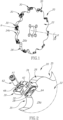
- the present invention relates to a cutting tool 20 comprising a disk-shaped cutting body 22 having an axis of rotation R defining a direction of rotation DR about the axis of rotation R, two opposing first and second body end surfaces 24a, 24b and a body peripheral surface 26 extending therebetween.
- a median plane M perpendicular to the axis of rotation R intersects the body peripheral surface 26, and first and second planes P1, P2 are equidistantly offset from opposite first and second sides S1, S2 of the median plane M, respectively.
- neither of the first and second planes P1, P2 may intersect the cutting body 22.
- first and second planes P1, P2 may be annular shaped, thus ensuring that neither of the first and second planes P1, P2 intersect a raised central portion of the cutting body 22.
- a plurality of identical insert receiving pockets 28 are circumferentially spaced about the body peripheral surface 26 and an equal number of identical indexable cutting inserts 30 are removably retained therein.
- the body peripheral surface 26 may have a total of N insert receiving pockets 28 and exhibit N -fold rotational symmetry about the axis of rotation R.
- the cutting tool 20 may exhibit N /2-fold rotational symmetry about the axis of rotation R.
- N is an even number.
- the cutting inserts 30 may be manufactured by a suitably hard material, preferably by form pressing and sintering a cemented carbide, such as tungsten carbide, and the cutting body 22 may be manufactured from a less hard material.
- each insert receiving pocket 28 opens out to the first and second body end surfaces 24a, 24b, and has a seat surface 32 and a back wall 34 shown in this embodiment as being transverse to the seat surface 32.
- each insert receiving pocket 28 may open out to a chip gullet 35, and each chip gullet 35 may be located rotationally forward of its respective insert receiving pocket 28, thus aiding chip evacuation.
- each insert receiving pocket's back wall 34 may be perpendicular to the median plane M.
- each insert receiving pocket's back wall 34 may face in the direction of rotation DR.
- each insert receiving pocket's seat surface 32 may have a floor surface 36 and first and second lateral support surfaces 38a, 38b transverse thereto, and the first and second lateral support surfaces 38a, 38b may be located on the first and second sides S1, S2 of the median plane M, respectively.
- the floor surface 36 and the first and second lateral support surfaces 38a, 38b of each seat surface 32 may be contiguous with their respective chip gullet 35.
- the floor surface 36 and the first and second lateral support surfaces 38a, 38b may be formed in a central recess 40 of the seat surface 32, and the first and second lateral support surfaces 38a, 38b may face towards each other.
- first and second lateral support surfaces 38a, 38b may extend parallel to the median plane M.
- the plurality of identical seat surfaces 32 can be simply and cost-effectively manufactured.
- each seat surface 32 may include a planar raised shoulder surface 41 partially surrounding the central recess 40.
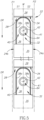
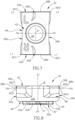
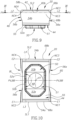
- each cutting insert 30 has opposing upper and lower surfaces 42, 44 and an insert peripheral surface 46 therebetween and an insert axis A1 extending therethrough.
- a through bore 48 coaxial with the insert axis A1 may intersect the upper and lower surfaces 42, 44.
- each cutting insert 30 may not exhibit rotational symmetry about its insert axis A1.
- the lower surface 44 has a bearing surface 50 and first and second lower abutment surfaces 52a, 52b transverse thereto.
- first and second lower abutment surfaces 52a, 52b may be spaced apart.
- first and second lower abutment surfaces 52a, 52b may be planar.
- the bearing surface 50 and the first and second lower abutment surfaces 52a, 52b may be formed on a central boss 51 protruding from the lower surface 44.
- the bearing surface 50 may comprise at least two coplanar bearing sub-surfaces 53a, 53b.
- the lower surface 44 may include a planar bottom surface 55 surrounding the central boss 51.
- the first and second lower abutment surfaces 52a, 52b form an obtuse first tilt angle ⁇ 1 .
- the first tilt angle ⁇ 1 may be greater than 170 degrees and less than 180 degrees, and with 178 degrees shown in the illustrated example of Fig. 10 .
- the first tilt angle ⁇ 1 may be an internal angle.
- the insert peripheral surface 46 has opposing first and second insert end surfaces 54a, 54b spaced apart by opposing first and second insert side surfaces 56a, 56b, with first and second cutting edges 58a, 58b formed at the intersection of the upper surface 42 and the first and second insert end surfaces 54a, 54b, respectively.
- the first cutting edge 58a may be interrupted by a first chip dividing notch 60a
- the second cutting edge 58b may be interrupted by a second chip dividing notch 60b.
- first and second insert end surfaces 54a, 54b may converge towards the first insert side surface 56a, and the first and second lower abutment surfaces 52a, 52b may face in the same direction as the second insert side surface 56b.
- each cutting insert 30 may exhibit mirror symmetry about a vertical plane PV containing its insert axis A1 and intersecting its first and second insert side surfaces 56a, 56b.
- each cutting insert's lower surface 44 is in contact with the seat surface 32 of its respective insert receiving pocket 28, and circumferentially adjacent cutting inserts 30 have a different one of their first and second insert end surfaces 54a, 54b in contact with the back wall 34 of their respective insert receiving pocket 28.
- a clamping screw 62 may extend through the through bore 48 and threadingly engage a screw bore 64 in the seat surface 32.
- the screw bore 64 may be formed in the floor surface 36.
- the screw bore 64 may have a screw axis A2 contained in the median plane M.
- each cutting insert 30 may be non-coaxial with the screw axis A2 of its respective insert receiving pocket 28, and thus each through bore 48 may be eccentrically positioned in relation to its respective screw bore 64.
- each insert's bearing surface 50 may be in contact with the floor surface 36 of its respective insert receiving pocket 28.
- the bottom surface 55 may be spaced apart from the raised shoulder surface 41 by a gap G.
- the median plane M may intersect the first and second cutting edges 58a, 58b of each cutting insert 30.
- each cutting insert's vertical plane PV may be non-perpendicular to the median plane M, albeit with a deviation of 1 degree therefrom.
- the first plane P1 only intersects the first cutting edge 58a of every circumferentially alternate cutting insert 30 at a first intersection point I1 and none of the second cutting edges 58b
- the second plane P2 only intersects the second cutting edge 58b of every circumferentially alternate cutting insert 30 at a second intersection point I2 and none of the first cutting edges 58a.
- first and second cutting edges 58a, 58b intersecting the first and second planes P1, P2 , respectively, may be operative and associated with first and second insert end surfaces 54a, 54b, respectively, not in contact with the back wall 34.
- each cutting insert 30 may be indexed in its respective insert receiving pocket 28, such that the unworn first and second cutting edges 58a, 58b become operative.
- each cutting insert 30 may be relocated to another insert receiving pocket 28, such that the unworn first and second cutting edges 58a, 58b become operative, although the operator must ensure that the first plane P1 only intersects the first cutting edge 58a of every circumferentially alternate cutting insert 30 and none of the second cutting edges 58b, and the second plane P2 only intersects the second cutting edge 58b of every circumferentially alternate cutting insert 30 and none of the first cutting edges 58a.
- the first chip dividing notches 60a associated with the operative first cutting edges 58a may be located on one side of the median plane M, and the second chip dividing notches 60b associated with the operative second cutting edges 58b may be located on the opposite side of the median plane M.
- first and second chip dividing notches 60a, 60b provide the operator with a useful visual indictor, when indexing and replacing the cutting inserts 30.
- each first cutting edge 58a may have first and second end points NE1 , NE2 located on opposite sides of the median plane M, and each second cutting edge 58b may have third and fourth end points NE3, NE4 located on opposite sides of the median plane M.
- the first end point NE1 of each operative first cutting edge 58a may be contained in the first plane P1 and thus coincident with its associated first intersection point I1
- the third end point NE3 of each operative second cutting edge 58b may be contained in the second plane P2 and thus coincident with its associated second intersection point I2
- the lateral distance between the first and second planes P1, P2 may define a maximum tool cutting width W MAX of the cutting tool 20.
- each operative first cutting edge 58a may be located a first cutting width W1 from the first plane P1
- the fourth end point NE4 of each operative second cutting edge 58b may be located a second cutting width W2 from the second plane P2 .
- the first cutting width W1 may be at least nine tenths of the maximum tool cutting width W MAX , i.e. W1 ⁇ W MAX *9/10
- the second cutting distance W2 may be at least nine tenths of the maximum tool cutting width W MAX i.e. W2 ⁇ W MAX *9/10.
- the first cutting distance W1 may be equal to the second cutting distance W2 .
- each operative first cutting edge 58a may have an inclined first end portion 66a extending from its first end point NE1 and forming an acute first end angle ⁇ 1 of less than 60 degrees with median plane M
- each operative second cutting edge 58b may have an inclined second end portion 66b extending from its third end point NE3 and forming an acute second end angle ⁇ 2 of less than 60 degrees with median plane M.
- the first and second end angles ⁇ 1, ⁇ 2 may be equal.
- the inclined first end portion 66a of each operative first cutting edge 58a may laterally overlap the second cutting width W2, and the inclined second end portion 66b of each operative second cutting edge 58b may laterally overlap the first cutting width W1.
- the operative first and second cutting edges 58a, 58b may be considered 'fully effective', enabling the cutting tool 20 to perform cutting operations at suitably and advantageously high feed rates.
- the first lower abutment surface 52a of each cutting insert 30 having its first cutting edge 58a operative may be in contact with one of the first and second lateral support surfaces 38a, 38b located on one of the first and second sides S1, S2 of the median plane M
- the second lower abutment surface 52b of each cutting insert 30 having its second cutting edge 58b operative may be in contact with one of the first and second lateral support surfaces 38a, 38b located on the other one of the first and second sides S1, S2 of the median plane M .
- the second lower abutment surface 52b of each cutting insert 30 having its first cutting edge 58a operative may not be in contact with any of the first and second lateral support surfaces 38a, 38b
- the first lower abutment surface 52a of each cutting insert 30 having its second cutting edge 58b operative may not be in contact with any of the first and second lateral support surfaces 38a, 38b.
- each insert's lower surface 44 is in contact with the seat surface 32 of its respective insert receiving pocket 28.
- each cutting insert 30 is retained its respective insert receiving pocket 28 with a high level of stability.
- the first lower abutment surface 52a of each cutting insert 30 having its first cutting edge 58a operative may be in contact with the second lateral support surface 38b
- the second lower abutment surface 52b of each cutting insert 30 having its second cutting edge 58b operative may be in contact with the first lateral support surface 38a
- first lower abutment surface 52a of each cutting insert 30 having its first cutting edge 58a operative may be entirely located further from the first intersection point I1 than the second lower abutment surface 52b
- second lower abutment surface 52b of each cutting insert 30 having its second cutting edge 58b operative may be entirely located further from the second intersection point I2 than the first lower abutment surface 52a.
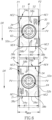
- the first and second lateral sides SL1, SL2 may be equal in length, and the imaginary acute trapezoid T may be an isosceles trapezoid.
- the horizontal plane PH may be located closer to the upper surface 42 than to the lower surface 44, and as shown in Fig. 11 , no portion of the cutting insert 30 below the horizontal plane PH may extend outside the imaginary acute trapezoid T.
- first and second lateral sides SL1, SL2 may be bisected by first and second lateral bisectors BL1, BL2, and the first and second lateral bisectors BL1, BL2 may form an obtuse second tilt angle ⁇ 2 .
- the second tilt angle ⁇ 2 may be equal to the first tilt angle ⁇ 1 .
- the first and second end points NE1, NE2 of the first cutting edge 58a define an imaginary first straight line L1
- the third and fourth end points NE3, NE4 of the second cutting edge 58b define an imaginary second line L2.
- the imaginary first straight line L1 may be parallel to one of the first and second lateral sides SL1, SL2, and the imaginary second straight line L2 may be parallel to one of the first and second lateral sides SL1, SL2.
- the imaginary first straight line L1 is parallel to the first lateral side SL1
- the imaginary second straight line L2 is parallel to the second lateral side SL2.
- the first and second lower abutment surfaces 52a, 52b are located inside the imaginary acute trapezoid T.
- first and second lower abutment surfaces 52a, 52b may be entirely located inside the imaginary acute trapezoid T and not intersect the insert peripheral surface 46.
- imaginary third and fourth straight lines L3, L4 extending parallel to the first and second lower abutment surfaces 52a, 52b, respectively, may be perpendicular to the first and second lateral sides SL1, SL2, respectively.
- first and second insert end surfaces 54a, 54b may include first and second end abutment surfaces 68a, 68b.
- the horizontal plane PH may intersect the first and second end abutment surfaces 68a, 68b.
- circumferentially adjacent cutting inserts 30 may have a different one of their first and second end abutment surfaces 68a, 68b in contact with the back wall 34 of their respective insert receiving pocket 28, and also such that each insert's horizontal plane PH intersects the back wall 34 of its respective insert receiving pocket 28.
- first and second end abutment surfaces 68a, 68b may be planar.
- a first end plane E1 defined by the first end abutment surface 68a may contain the first lateral side SL1
- a second end plane E2 defined by the second end abutment surface 68b may contain the second lateral side SL2.
- the second end abutment surface 68b may be located on one side of the first end plane E1 and no portion of the cutting insert 30 may extend to the other side thereof, and the first end abutment surface 68a may be located on one side of the second end plane E2 and no portion of the cutting insert 30 may extend to the other side thereof.
- the first and third peripheral corner points NC1, NC3 define the end points of a short base BS of the acute trapezoid T
- the second and fourth peripheral corner points NC2, NC4 define the end points of a long base BL of the acute trapezoid T.
- the first and second lower abutment surfaces 52a, 52b may face towards the long base BL.
- the first and second lower abutment surfaces 52a, 52b may be entirely located on opposite sides of a base bisector BB bisecting at least one of the short and long bases BS, BL.
- the vertical plane PV may contain the base bisector BB.
- the imaginary first straight line L1 may be parallel to the second lateral side SL2
- the imaginary second straight line L2 may be parallel to the first lateral side SL1
- the imaginary first and second straight lines L1 , L2 associated with the operative first and second cutting edges 58a, 58b, respectively, may be perpendicular to the median plane M.
Landscapes
- Engineering & Computer Science (AREA)
- Mechanical Engineering (AREA)
- Milling Processes (AREA)
- Cutting Tools, Boring Holders, And Turrets (AREA)
- Knives (AREA)
Claims (8)
- Indexierbarer Schneideinsatz (30), aufweisend:eine obere und eine untere Fläche (42, 44), die einander gegenüberliegen, und eine Einsatzumfangsfläche (46) dazwischen und eine sich durch diese erstreckende Einsatzachse (A1),wobei die untere Fläche (44) eine Auflagefläche (50) und eine erste und zweite untere Anschlagfläche (52a, 52b) aufweist, die quer dazu angeordnet sind, undwobei die Einsatzumfangsfläche (46) eine erste und zweite Einsatzstirnfläche (54a, 54b) aufweist, die einander gegenüberliegen und durch eine erste und zweite Einsatzseitenfläche (56a, 56b), die einander gegenüberliegen, voneinander beabstandet sind, wobei eine erste und zweite Schneidkante (58a, 58b) jeweils am Schnittpunkt der oberen Fläche (42) und der ersten bzw. zweiten Einsatzstirnfläche (54a, 54b) ausgebildet sind,dadurch gekennzeichnet, dass:
in einem Querschnitt, der in einer horizontalen Ebene (PH) senkrecht zur Einsatzachse (A1) vorgenommen ist und die Einsatzumfangsfläche (46) schneidet:ein erster und zweiter Umfangseckpunkt (NC1, NC2), die am Schnittpunkt der ersten Einsatzstirnfläche (54a) und der ersten bzw. zweiten Einsatzseitenfläche (56a, 56b) ausgebildet sind, die Endpunkte einer ersten lateralen Seite (SL1) eines gedachten spitzen Trapezes (T) definieren,ein dritter und vierter Umfangseckpunkt (NC3, NC4), die am Schnittpunkt der zweiten Einsatzstirnfläche (54b) und der ersten bzw. zweiten Einsatzseitenfläche (56a, 56b) ausgebildet sind, die Endpunkte einer zweiten lateralen Seite (SL2) des gedachten spitzen Trapezes (T) definieren, undder erste und der dritte Umfangseckpunkt (NC1, NC3) die Endpunkte einer kurzen Basis (BS) des spitzen Trapezes (T) und der zweite und der vierte Umfangseckpunkt (NC2, NC4) die Endpunkte einer langen Basis (BL) des spitzen Trapezes (T) definieren.und in einer Ansicht des Schneideinsatzes (30) von unten:
die erste und zweite untere Anschlagfläche (52a, 52b) einen stumpfen ersten Neigungswinkel (α1) bilden und innerhalb des gedachten spitzen Trapezes (T) liegen. - Schneideinsatz (30) nach Anspruch 1, wobei:die horizontale Ebene (PH) näher an der oberen Fläche (42) als an der unteren Fläche (44) angeordnet ist, undsich kein Teil des Schneideinsatzes (30) unterhalb der horizontalen Ebene (PH) außerhalb des gedachten spitzen Trapezes (T) erstreckt.
- Schneideinsatz (30) nach Anspruch 1 oder 2, wobei in der Ansicht von unten:
die erste und die zweite untere Anschlagfläche (52a, 52b) der langen Basis (BL) zugewandt sind. - Schneideinsatz (30) nach einem der vorstehenden Ansprüche, wobei in der Ansicht von unten:
eine gedachte dritte und vierte Gerade (L3, L4), die sich parallel zu der ersten bzw. zweiten unteren Anschlagfläche (52a, 52b) erstrecken, jeweils senkrecht zu der ersten bzw. zweiten lateralen Seite (SL1, SL2) angeordnet sind. - Schneideinsatz (30) nach einem der vorstehenden Ansprüche, wobei:die erste und die zweite laterale Seite (SL1, SL2) durch eine erste und eine zweite Seitenhalbierende (BL1, BL2) halbiert werden,die erste und die zweite Seitenhalbierende (BL1, BL2) einen stumpfen zweiten Neigungswinkel (α2) bilden, undder zweite Neigungswinkel (α2) gleich dem ersten Neigungswinkel (α1) ist.
- Schneideinsatz (30) nach einem der vorstehenden Ansprüche, der eine Spiegelsymmetrie um eine vertikale Ebene (PV) aufweist, die die Einsatzachse (A1) enthält und die erste und zweite Einsatzseitenfläche (56a, 56b) schneidet.
- Schneideinsatz (30) nach einem der vorstehenden Ansprüche, wobei:
die Auflagefläche (50) und die erste und zweite untere Anschlagfläche (52a, 52b) an einem zentralen Vorsprung (51) ausgebildet sind, der aus der unteren Fläche (44) herausragt. - Schneideinsatz (30) nach einem der vorstehenden Ansprüche, wobei die der erste Neigungswinkel (α1) ein Innenwinkel ist.
Applications Claiming Priority (3)
| Application Number | Priority Date | Filing Date | Title |
|---|---|---|---|
| US15/815,836 US10525537B2 (en) | 2017-11-17 | 2017-11-17 | Rotary cutting tool having disk-shaped cutting body and indexable cutting insert therefor |
| PCT/IL2018/051116 WO2019097504A1 (en) | 2017-11-17 | 2018-10-18 | Rotary cutting tool having disk-shaped cutting body and indexable cutting insert therefor |
| EP18797166.8A EP3710190B1 (de) | 2017-11-17 | 2018-10-18 | Rotationsschneidwerkzeug mit scheibenförmigem schneidkörper |
Related Parent Applications (2)
| Application Number | Title | Priority Date | Filing Date |
|---|---|---|---|
| EP18797166.8A Division EP3710190B1 (de) | 2017-11-17 | 2018-10-18 | Rotationsschneidwerkzeug mit scheibenförmigem schneidkörper |
| EP18797166.8A Division-Into EP3710190B1 (de) | 2017-11-17 | 2018-10-18 | Rotationsschneidwerkzeug mit scheibenförmigem schneidkörper |
Publications (4)
| Publication Number | Publication Date |
|---|---|
| EP4289538A2 EP4289538A2 (de) | 2023-12-13 |
| EP4289538A3 EP4289538A3 (de) | 2024-02-28 |
| EP4289538C0 EP4289538C0 (de) | 2025-05-14 |
| EP4289538B1 true EP4289538B1 (de) | 2025-05-14 |
Family
ID=64109982
Family Applications (2)
| Application Number | Title | Priority Date | Filing Date |
|---|---|---|---|
| EP23193269.0A Active EP4289538B1 (de) | 2017-11-17 | 2018-10-18 | Rotationsschneidwerkzeug mit scheibenförmigem schneidkörper und wendeschneidplatte dafür |
| EP18797166.8A Active EP3710190B1 (de) | 2017-11-17 | 2018-10-18 | Rotationsschneidwerkzeug mit scheibenförmigem schneidkörper |
Family Applications After (1)
| Application Number | Title | Priority Date | Filing Date |
|---|---|---|---|
| EP18797166.8A Active EP3710190B1 (de) | 2017-11-17 | 2018-10-18 | Rotationsschneidwerkzeug mit scheibenförmigem schneidkörper |
Country Status (11)
| Country | Link |
|---|---|
| US (1) | US10525537B2 (de) |
| EP (2) | EP4289538B1 (de) |
| JP (1) | JP7210572B2 (de) |
| KR (1) | KR102520529B1 (de) |
| CN (1) | CN111315517B (de) |
| BR (1) | BR112020009213A2 (de) |
| CA (1) | CA3079675A1 (de) |
| IL (1) | IL274242B2 (de) |
| PL (2) | PL3710190T3 (de) |
| TW (1) | TWI768117B (de) |
| WO (1) | WO2019097504A1 (de) |
Family Cites Families (22)
| Publication number | Priority date | Publication date | Assignee | Title |
|---|---|---|---|---|
| JPS59132723U (ja) * | 1983-02-24 | 1984-09-05 | 兼房刃物工業株式会社 | チツプソ− |
| US4690024A (en) * | 1985-02-28 | 1987-09-01 | Black & Decker Inc. | Saw blade and tip therefor |
| JPH0760525A (ja) * | 1993-08-28 | 1995-03-07 | Retsu Gomi | フライスカッター |
| SE511567C2 (sv) * | 1997-04-18 | 1999-10-18 | Sandvik Ab | Skär för skivfräsar, samt skivfräs innefattande sådana skär |
| IL129297A (en) * | 1998-07-13 | 2002-12-01 | Iscar Ltd | Tangential cutting insert |
| IL140104A (en) * | 2000-12-05 | 2006-06-11 | Amir Satran | Rotary cutting tool |
| IL165621A (en) * | 2004-12-07 | 2008-06-05 | Iscar Ltd | Cutting tool and cutting insert therefor |
| DE102006034673A1 (de) | 2006-07-24 | 2008-01-31 | Walter Ag | Kurbelwellenfräser |
| DE102007011395A1 (de) | 2007-03-07 | 2008-09-11 | Linsinger-Maschinenbau Gmbh | Scheibenfräserwerkzeug und Schneidelement |
| EP2401106A1 (de) | 2009-01-22 | 2012-01-04 | Linsinger Maschinenbau GmbH | Scheibenfräserwerkzeug und schneidelement |
| EP2450138B1 (de) | 2010-11-03 | 2013-10-16 | Seco Tools Ab | Schneideinsatz mit genuteter Oberfläche zur Definition mehrerer Auflageflächen |
| KR101978525B1 (ko) * | 2010-11-03 | 2019-05-14 | 쎄코 툴스 에이비 | 다수의 유형의 절삭 인서트들을 유지하기 위한 공구홀더 및 그러한 공구홀더를 포함하는 절삭 공구 |
| JP5556957B2 (ja) * | 2011-04-26 | 2014-07-23 | 株式会社タンガロイ | 切削インサートおよび切削工具 |
| IL214782A (en) * | 2011-08-22 | 2016-02-29 | Iscar Ltd | Cutting insert and milling tool |
| US9033621B2 (en) * | 2011-09-19 | 2015-05-19 | Iscar, Ltd. | Cutting insert, cutting body and clamping mechanism of a cutting tool assembly for chip removal |
| KR101318583B1 (ko) * | 2011-12-06 | 2013-10-15 | 한국야금 주식회사 | 슬롯 밀링용 인서트 |
| JP5825420B2 (ja) * | 2012-02-20 | 2015-12-02 | 株式会社タンガロイ | 切削インサートおよび刃先交換式切削工具 |
| JP6127343B2 (ja) * | 2013-03-26 | 2017-05-17 | 住友電工ハードメタル株式会社 | ミーリングカッタ用切削インサート |
| JP2015196203A (ja) | 2014-03-31 | 2015-11-09 | 三菱マテリアル株式会社 | 刃先交換式メタルソー |
| TWI494182B (zh) * | 2014-07-28 | 2015-08-01 | 張新添 | Discarded structure of discarded blades |
| KR102252055B1 (ko) * | 2014-12-05 | 2021-05-17 | 대구텍 유한책임회사 | 회전 절삭 공구 및 그 절삭 인서트 |
| CN106180894B (zh) * | 2016-08-25 | 2018-09-14 | 唐山冶金锯片有限公司 | 一种双面刃锯齿刀块、机卡式圆锯片及双面刃锯齿刀块换位方法 |
-
2017
- 2017-11-17 US US15/815,836 patent/US10525537B2/en active Active
-
2018
- 2018-09-10 TW TW107131657A patent/TWI768117B/zh not_active IP Right Cessation
- 2018-10-18 CN CN201880072209.5A patent/CN111315517B/zh active Active
- 2018-10-18 EP EP23193269.0A patent/EP4289538B1/de active Active
- 2018-10-18 PL PL18797166.8T patent/PL3710190T3/pl unknown
- 2018-10-18 PL PL23193269.0T patent/PL4289538T3/pl unknown
- 2018-10-18 JP JP2020522965A patent/JP7210572B2/ja active Active
- 2018-10-18 IL IL274242A patent/IL274242B2/en unknown
- 2018-10-18 CA CA3079675A patent/CA3079675A1/en active Pending
- 2018-10-18 KR KR1020207017223A patent/KR102520529B1/ko active Active
- 2018-10-18 EP EP18797166.8A patent/EP3710190B1/de active Active
- 2018-10-18 WO PCT/IL2018/051116 patent/WO2019097504A1/en not_active Ceased
- 2018-10-18 BR BR112020009213-4A patent/BR112020009213A2/pt not_active Application Discontinuation
Also Published As
| Publication number | Publication date |
|---|---|
| JP7210572B2 (ja) | 2023-01-23 |
| EP4289538A3 (de) | 2024-02-28 |
| US10525537B2 (en) | 2020-01-07 |
| IL274242B2 (en) | 2023-11-01 |
| CN111315517A (zh) | 2020-06-19 |
| KR102520529B1 (ko) | 2023-04-12 |
| PL4289538T3 (pl) | 2025-09-08 |
| IL274242B1 (en) | 2023-07-01 |
| WO2019097504A1 (en) | 2019-05-23 |
| PL3710190T3 (pl) | 2024-10-28 |
| EP3710190A1 (de) | 2020-09-23 |
| BR112020009213A2 (pt) | 2020-10-20 |
| CA3079675A1 (en) | 2019-05-23 |
| EP4289538A2 (de) | 2023-12-13 |
| EP3710190C0 (de) | 2024-07-03 |
| TWI768117B (zh) | 2022-06-21 |
| EP4289538C0 (de) | 2025-05-14 |
| KR20200085866A (ko) | 2020-07-15 |
| RU2020112868A (ru) | 2021-12-17 |
| EP3710190B1 (de) | 2024-07-03 |
| JP2021503376A (ja) | 2021-02-12 |
| CN111315517B (zh) | 2023-12-08 |
| IL274242A (en) | 2020-06-30 |
| US20190151963A1 (en) | 2019-05-23 |
| RU2020112868A3 (de) | 2022-01-19 |
| TW201922388A (zh) | 2019-06-16 |
Similar Documents
| Publication | Publication Date | Title |
|---|---|---|
| US9120156B2 (en) | Rhombus-shaped indexable cutting insert and cutting tool | |
| EP2956263B1 (de) | Einseitiger, quadratischer, indizierbarer schneideeinsatz und schneidwerkzeug | |
| US8708613B2 (en) | Left-handed and right-handed cutting tool | |
| TWI737885B (zh) | 具有兩個夾持孔的可轉位單側式切削刀塊及切削刀具 | |
| WO2019106651A1 (en) | Slitting cutter and tool key in combination therewith | |
| EP4072762B1 (de) | Schneideinsatz, der zwei obere schneidkanten und einen unteren zentralen vorsprung mit vier anschlagwänden aufweist, die ein imaginäres viereck definieren, und rotierendes schneidwerkzeug | |
| JP5988010B2 (ja) | 切削インサート、工具ボデーおよび切削工具 | |
| EP4289538B1 (de) | Rotationsschneidwerkzeug mit scheibenförmigem schneidkörper und wendeschneidplatte dafür | |
| RU2776248C2 (ru) | Вращающийся режущий инструмент, имеющий дискообразный режущий корпус, и индексируемая режущая вставка для него | |
| CA1161628A (en) | Milling cutter | |
| US20190299305A1 (en) | Cutting tool and cutting insert having complementary engagement features for eccentric mounting | |
| CA3137796A1 (en) | Cutting insert having lower anti-slip recess, insert holder and cutting tool |
Legal Events
| Date | Code | Title | Description |
|---|---|---|---|
| PUAI | Public reference made under article 153(3) epc to a published international application that has entered the european phase |
Free format text: ORIGINAL CODE: 0009012 |
|
| STAA | Information on the status of an ep patent application or granted ep patent |
Free format text: STATUS: REQUEST FOR EXAMINATION WAS MADE |
|
| 17P | Request for examination filed |
Effective date: 20230915 |
|
| AC | Divisional application: reference to earlier application |
Ref document number: 3710190 Country of ref document: EP Kind code of ref document: P |
|
| AK | Designated contracting states |
Kind code of ref document: A2 Designated state(s): AL AT BE BG CH CY CZ DE DK EE ES FI FR GB GR HR HU IE IS IT LI LT LU LV MC MK MT NL NO PL PT RO RS SE SI SK SM TR |
|
| REG | Reference to a national code |
Ref legal event code: R079 Free format text: PREVIOUS MAIN CLASS: B23C0005200000 Ref country code: DE Ref document number: 602018082052 Country of ref document: DE Ipc: B23C0005080000 |
|
| PUAL | Search report despatched |
Free format text: ORIGINAL CODE: 0009013 |
|
| AK | Designated contracting states |
Kind code of ref document: A3 Designated state(s): AL AT BE BG CH CY CZ DE DK EE ES FI FR GB GR HR HU IE IS IT LI LT LU LV MC MK MT NL NO PL PT RO RS SE SI SK SM TR |
|
| RIC1 | Information provided on ipc code assigned before grant |
Ipc: B23C 5/22 20060101ALI20240124BHEP Ipc: B23C 5/20 20060101ALI20240124BHEP Ipc: B23C 5/08 20060101AFI20240124BHEP |
|
| RIC1 | Information provided on ipc code assigned before grant |
Ipc: B23C 5/22 20060101ALI20241031BHEP Ipc: B23C 5/20 20060101ALI20241031BHEP Ipc: B23C 5/08 20060101AFI20241031BHEP |
|
| GRAP | Despatch of communication of intention to grant a patent |
Free format text: ORIGINAL CODE: EPIDOSNIGR1 |
|
| STAA | Information on the status of an ep patent application or granted ep patent |
Free format text: STATUS: GRANT OF PATENT IS INTENDED |
|
| INTG | Intention to grant announced |
Effective date: 20241216 |
|
| GRAS | Grant fee paid |
Free format text: ORIGINAL CODE: EPIDOSNIGR3 |
|
| GRAA | (expected) grant |
Free format text: ORIGINAL CODE: 0009210 |
|
| STAA | Information on the status of an ep patent application or granted ep patent |
Free format text: STATUS: THE PATENT HAS BEEN GRANTED |
|
| AC | Divisional application: reference to earlier application |
Ref document number: 3710190 Country of ref document: EP Kind code of ref document: P |
|
| AK | Designated contracting states |
Kind code of ref document: B1 Designated state(s): AL AT BE BG CH CY CZ DE DK EE ES FI FR GB GR HR HU IE IS IT LI LT LU LV MC MK MT NL NO PL PT RO RS SE SI SK SM TR |
|
| REG | Reference to a national code |
Ref country code: GB Ref legal event code: FG4D |
|
| REG | Reference to a national code |
Ref country code: CH Ref legal event code: EP |
|
| REG | Reference to a national code |
Ref country code: DE Ref legal event code: R096 Ref document number: 602018082052 Country of ref document: DE |
|
| REG | Reference to a national code |
Ref country code: IE Ref legal event code: FG4D |
|
| U01 | Request for unitary effect filed |
Effective date: 20250519 |
|
| U07 | Unitary effect registered |
Designated state(s): AT BE BG DE DK EE FI FR IT LT LU LV MT NL PT RO SE SI Effective date: 20250523 |
|
| PG25 | Lapsed in a contracting state [announced via postgrant information from national office to epo] |
Ref country code: ES Free format text: LAPSE BECAUSE OF FAILURE TO SUBMIT A TRANSLATION OF THE DESCRIPTION OR TO PAY THE FEE WITHIN THE PRESCRIBED TIME-LIMIT Effective date: 20250514 |
|
| PG25 | Lapsed in a contracting state [announced via postgrant information from national office to epo] |
Ref country code: NO Free format text: LAPSE BECAUSE OF FAILURE TO SUBMIT A TRANSLATION OF THE DESCRIPTION OR TO PAY THE FEE WITHIN THE PRESCRIBED TIME-LIMIT Effective date: 20250814 Ref country code: GR Free format text: LAPSE BECAUSE OF FAILURE TO SUBMIT A TRANSLATION OF THE DESCRIPTION OR TO PAY THE FEE WITHIN THE PRESCRIBED TIME-LIMIT Effective date: 20250815 |
|
| PG25 | Lapsed in a contracting state [announced via postgrant information from national office to epo] |
Ref country code: HR Free format text: LAPSE BECAUSE OF FAILURE TO SUBMIT A TRANSLATION OF THE DESCRIPTION OR TO PAY THE FEE WITHIN THE PRESCRIBED TIME-LIMIT Effective date: 20250514 |
|
| PG25 | Lapsed in a contracting state [announced via postgrant information from national office to epo] |
Ref country code: RS Free format text: LAPSE BECAUSE OF FAILURE TO SUBMIT A TRANSLATION OF THE DESCRIPTION OR TO PAY THE FEE WITHIN THE PRESCRIBED TIME-LIMIT Effective date: 20250814 |
|
| U20 | Renewal fee for the european patent with unitary effect paid |
Year of fee payment: 8 Effective date: 20250912 |
|
| PG25 | Lapsed in a contracting state [announced via postgrant information from national office to epo] |
Ref country code: IS Free format text: LAPSE BECAUSE OF FAILURE TO SUBMIT A TRANSLATION OF THE DESCRIPTION OR TO PAY THE FEE WITHIN THE PRESCRIBED TIME-LIMIT Effective date: 20250914 |
|
| PG25 | Lapsed in a contracting state [announced via postgrant information from national office to epo] |
Ref country code: SM Free format text: LAPSE BECAUSE OF FAILURE TO SUBMIT A TRANSLATION OF THE DESCRIPTION OR TO PAY THE FEE WITHIN THE PRESCRIBED TIME-LIMIT Effective date: 20250514 |
|
| PG25 | Lapsed in a contracting state [announced via postgrant information from national office to epo] |
Ref country code: CZ Free format text: LAPSE BECAUSE OF FAILURE TO SUBMIT A TRANSLATION OF THE DESCRIPTION OR TO PAY THE FEE WITHIN THE PRESCRIBED TIME-LIMIT Effective date: 20250514 |
|
| PG25 | Lapsed in a contracting state [announced via postgrant information from national office to epo] |
Ref country code: SK Free format text: LAPSE BECAUSE OF FAILURE TO SUBMIT A TRANSLATION OF THE DESCRIPTION OR TO PAY THE FEE WITHIN THE PRESCRIBED TIME-LIMIT Effective date: 20250514 |