EP4286997B1 - Tastatur und elektronische vorrichtung - Google Patents
Tastatur und elektronische vorrichtung Download PDFInfo
- Publication number
- EP4286997B1 EP4286997B1 EP22847925.9A EP22847925A EP4286997B1 EP 4286997 B1 EP4286997 B1 EP 4286997B1 EP 22847925 A EP22847925 A EP 22847925A EP 4286997 B1 EP4286997 B1 EP 4286997B1
- Authority
- EP
- European Patent Office
- Prior art keywords
- metal frame
- keyboard
- inner metal
- component
- circuit board
- Prior art date
- Legal status (The legal status is an assumption and is not a legal conclusion. Google has not performed a legal analysis and makes no representation as to the accuracy of the status listed.)
- Active
Links
Images




Classifications
-
- G—PHYSICS
- G06—COMPUTING OR CALCULATING; COUNTING
- G06F—ELECTRIC DIGITAL DATA PROCESSING
- G06F1/00—Details not covered by groups G06F3/00 - G06F13/00 and G06F21/00
- G06F1/16—Constructional details or arrangements
- G06F1/1613—Constructional details or arrangements for portable computers
- G06F1/1633—Constructional details or arrangements of portable computers not specific to the type of enclosures covered by groups G06F1/1615 - G06F1/1626
- G06F1/1662—Details related to the integrated keyboard
-
- G—PHYSICS
- G06—COMPUTING OR CALCULATING; COUNTING
- G06F—ELECTRIC DIGITAL DATA PROCESSING
- G06F1/00—Details not covered by groups G06F3/00 - G06F13/00 and G06F21/00
- G06F1/16—Constructional details or arrangements
- G06F1/1613—Constructional details or arrangements for portable computers
- G06F1/1633—Constructional details or arrangements of portable computers not specific to the type of enclosures covered by groups G06F1/1615 - G06F1/1626
- G06F1/1662—Details related to the integrated keyboard
- G06F1/1669—Detachable keyboards
-
- G—PHYSICS
- G06—COMPUTING OR CALCULATING; COUNTING
- G06F—ELECTRIC DIGITAL DATA PROCESSING
- G06F3/00—Input arrangements for transferring data to be processed into a form capable of being handled by the computer; Output arrangements for transferring data from processing unit to output unit, e.g. interface arrangements
- G06F3/01—Input arrangements or combined input and output arrangements for interaction between user and computer
- G06F3/02—Input arrangements using manually operated switches, e.g. using keyboards or dials
- G06F3/0202—Constructional details or processes of manufacture of the input device
-
- H—ELECTRICITY
- H01—ELECTRIC ELEMENTS
- H01H—ELECTRIC SWITCHES; RELAYS; SELECTORS; EMERGENCY PROTECTIVE DEVICES
- H01H13/00—Switches having rectilinearly-movable operating part or parts adapted for pushing or pulling in one direction only, e.g. push-button switch
- H01H13/70—Switches having rectilinearly-movable operating part or parts adapted for pushing or pulling in one direction only, e.g. push-button switch having a plurality of operating members associated with different sets of contacts, e.g. keyboard
- H01H13/86—Switches having rectilinearly-movable operating part or parts adapted for pushing or pulling in one direction only, e.g. push-button switch having a plurality of operating members associated with different sets of contacts, e.g. keyboard characterised by the casing, e.g. sealed casings or casings reducible in size
-
- H—ELECTRICITY
- H01—ELECTRIC ELEMENTS
- H01H—ELECTRIC SWITCHES; RELAYS; SELECTORS; EMERGENCY PROTECTIVE DEVICES
- H01H2209/00—Layers
- H01H2209/01—Increasing rigidity; Anti-creep
-
- H—ELECTRICITY
- H01—ELECTRIC ELEMENTS
- H01H—ELECTRIC SWITCHES; RELAYS; SELECTORS; EMERGENCY PROTECTIVE DEVICES
- H01H2219/00—Legends
- H01H2219/054—Optical elements
- H01H2219/062—Light conductor
-
- H—ELECTRICITY
- H01—ELECTRIC ELEMENTS
- H01H—ELECTRIC SWITCHES; RELAYS; SELECTORS; EMERGENCY PROTECTIVE DEVICES
- H01H2223/00—Casings
- H01H2223/008—Casings metallic
-
- H—ELECTRICITY
- H01—ELECTRIC ELEMENTS
- H01H—ELECTRIC SWITCHES; RELAYS; SELECTORS; EMERGENCY PROTECTIVE DEVICES
- H01H2227/00—Dimensions; Characteristics
- H01H2227/032—Operating force
-
- H—ELECTRICITY
- H01—ELECTRIC ELEMENTS
- H01H—ELECTRIC SWITCHES; RELAYS; SELECTORS; EMERGENCY PROTECTIVE DEVICES
- H01H2227/00—Dimensions; Characteristics
- H01H2227/036—Minimise height
-
- H—ELECTRICITY
- H01—ELECTRIC ELEMENTS
- H01H—ELECTRIC SWITCHES; RELAYS; SELECTORS; EMERGENCY PROTECTIVE DEVICES
- H01H2229/00—Manufacturing
- H01H2229/024—Packing between substrate and membrane
- H01H2229/028—Adhesive
Definitions
- Embodiments of this application relate to the field of terminal technologies, and in particular, to a keyboard and an electronic device.
- a user With explosive growth of electronic devices such as a portable laptop computer, a smartphone, and a tablet computer (portable equipment, PAD), the electronic devices have become important tools of daily work and entertainment.
- a user usually operates an electronic device by using a keyboard, to quickly perform an input or an output.
- the user has a stronger requirement for portability of the keyboard, but an overall thickness of the keyboard affects the portability of the keyboard.
- the keyboard In a use process of the keyboard, the keyboard needs to withstand an impact stress exerted by the user in a tapping process. To reduce a possibility that the keyboard sinks due to insufficient rigidity of the keyboard when the keyboard suffers from the impact stress in the use process, a strength enhancement mechanical part is disposed at the bottom of the keyboard, to improve a deformation resistance capability of the keyboard by using the strength enhancement mechanical part.
- the strength enhancement mechanical part added at the bottom increases the overall thickness of the keyboard. Consequently, the portability of the keyboard becomes poorer.
- CN 110 908 444 A discloses a keyboard comprising an outer metal frame, an inner metal frame connected to the outer metal frame, a key hole penetrating through the outer metal frame and the inner metal frame and a keyboard assembly detachably connected to the inner metal frame and comprising a key extending through the keyhole.
- the keyboard assembly further comprises a circuit board film arranged on a bottom plate, wherein the bottom plate is connected to the inner metal frame by screw connection.
- CN 111 506 202 A discloses a keyboard comprising a keyboard assembly, a keyboard frame and a plurality of connecting pieces, wherein the keyboard assembly is provided with a bottom plate, a circuit board arranged on the bottom plate and a plurality of key groups arranged on the circuit board.
- US 2015/270077 A1 discloses a keyboard comprising an upper part formed from a rubber mat having keys, a lower part connected to the upper part in a sealed manner, a circuit board placed between the upper part and the lower part, a retainer plate lying on the lower part and bushings connecting the circuit board to the retainer plate.
- TW 201 314 723 A discloses a keyboard frame comprising an outer frame and inner metal frame connected to the outer frame and having a mounting hole for mounting the metal frame to a laptop computer.
- the present invention provides a keyboard and an electronic device according to the enclosed independent claims.
- Advantageous features of the present invention are defined in the corresponding subclaims.
- parts of the description and drawings referring to embodiments, which are not covered by the claims, are not presented as embodiments of the invention but as examples useful for understanding the invention.
- a first aspect of the claimed invention provides a keyboard for an electronic device.
- the keyboard includes at least the following:
- the inner metal frame with a strength enhancement function is disposed between the outer metal frame and the keyboard assembly.
- the inner metal frame and the outer metal frame are connected, and the keyboard assembly and the inner metal frame are connected.
- Strength enhancement is performed on the keyboard by using the disposed inner metal frame, to improve a deformation resistance capability of the keyboard, and reduce a possibility that the keyboard deforms and sinks when the keyboard suffers from an impact stress in a use process. Therefore, a metal baseplate and a plastic frame of a current keyboard can be canceled, to help reduce an overall thickness of the keyboard while it is ensured that rigidity of the keyboard meets a requirement, and improve portability of the keyboard.
- the keyboard assembly is detachably connected to the inner metal frame.
- the keyboard assembly further includes a circuit board unit.
- the key is disposed on the circuit board unit
- the circuit board unit is disposed on a side that is of the inner metal frame and that faces away from the outer metal frame, and the circuit board unit is detachably connected to the inner metal frame.
- the keyboard further includes an adaptation piece, and in a possible implementation, the circuit board unit is detachably connected to the inner metal frame by using the adaptation piece.
- the adaptation piece includes a first component and a second component, the first component is disposed on the inner metal frame, and the first component and the second component are fastened to connect the circuit board unit and the inner metal frame.
- the first component is threaded with the second component.
- the first component is a nut
- the inner metal frame includes a mounting hole
- the first component is inserted into the mounting hole
- the second component includes a bolt and a cap portion connected to the bolt
- the bolt is threaded with the first component
- the cap portion abuts against the circuit board unit to apply, to the circuit board unit, a pressure stress toward the inner metal frame.
- the circuit board unit includes a circuit board, a metal sheet, and a backlight module
- the circuit board is disposed on a side that is of the metal sheet and that faces the inner metal frame
- the backlight module is disposed on a side that is of the metal sheet and that faces away from the inner metal frame
- the circuit board includes a first avoidance hole
- the metal sheet includes a second avoidance hole
- the backlight module includes a third avoidance hole
- the first component is inserted into the first avoidance hole and the second avoidance hole
- the cap portion is accommodated in the third avoidance hole and abuts against a surface that is of the metal sheet and that faces away from the circuit board.
- the inner metal frame includes a transverse spacer and a longitudinal spacer, the transverse spacer and the longitudinal spacer are alternately disposed around the key avoidance hole, and the first component is disposed in an intersection region of the transverse spacer and the longitudinal spacer.
- the outer metal frame and the inner metal frame are detachably connected.
- the outer metal frame includes an outer surface and an inner surface, and the inner metal frame is stuck to the inner surface.
- the keyboard frame assembly further includes a first adhesive member disposed within the annular accommodation cavity, the key avoidance hole is located within a region limited by the annular accommodation cavity, and the first adhesive member connects the outer metal frame and the inner metal frame.
- the inner metal frame includes a transverse spacer and a longitudinal spacer, and the transverse spacer and the longitudinal spacer are alternately disposed around the key avoidance hole;
- a second aspect of the embodiments of this application provides an electronic device, including the keyboard according to the foregoing embodiment.
- the electronic device 1 may be a mobile terminal such as a desktop computer, a laptop computer (laptop), a tablet computer (Table), an ultra-mobile personal computer (ultra-mobile personal computer, UMPC), a handheld computer, a walkie-talkie, a netbook, a POS machine, or a personal digital assistant (personal digital assistant, PDA), a fixed terminal, or a foldable device.
- a mobile terminal such as a desktop computer, a laptop computer (laptop), a tablet computer (Table), an ultra-mobile personal computer (ultra-mobile personal computer, UMPC), a handheld computer, a walkie-talkie, a netbook, a POS machine, or a personal digital assistant (personal digital assistant, PDA), a fixed terminal, or a foldable device.
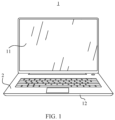
- FIG. 1 schematically shows a three-dimensional structure of an electronic device 1 according to an embodiment.
- the electronic device 1 may include a display 11 and a host body 12.
- the display 11 may be rotatably connected to the host body 12.
- the display 11 and the host body 12 may be connected by using a rotating shaft; or the display 11 and the host body 12 may be rotatably connected by using a hinge structure.
- the display 11 and the host body 12 may be mutually independent devices.
- the display 11 and the host body 12 are detachable. When being used, the display 11 is placed on the host body 12, and after the use, the display 11 and the host body 12 may be separated from each other.
- the display 11 is electrically connected to the host body 12.
- the display 11 may be electrically connected to the host body 12 by using a contact, or the display 11 is electrically connected to the host body 12 by using a flexible circuit board (Flexible Printed Circuit, FPC), or the display 11 is electrically connected to the host body 12 by using a wire.
- the display 11 may be wirelessly connected to the host body 12 by using a wireless signal.
- the electronic device 1 may further include a keyboard 2.
- the keyboard 2 may be disposed on the host body 12.
- the keyboard 2 is electrically connected to a control unit in the host body 12.
- the keyboard 2 serves as an input device of the electronic device 1.
- the keyboard 2 may be used to enter a character or an operation instruction by using a key, and may further control a cursor to move.
- the keyboard includes an outer metal frame, a plastic frame, a keyboard assembly, and a metal baseplate.
- the plastic frame is formed on the outer metal frame of the keyboard by using an injection molding process.
- the keyboard assembly is disposed between the outer metal frame and the metal baseplate. Both the keyboard assembly and the metal baseplate are attached to the plastic frame.
- the plastic frame carries the keyboard assembly and metal baseplate.
- a solder column protrudes from the plastic frame. The solder column penetrates through mounting holes of the keyboard assembly and the metal baseplate.
- the metal baseplate may serve as a strength enhancement structure, to improve overall rigidity of the keyboard, so as to resolve a problem that the outer metal frame sinks due to insufficient rigidity when the outer metal frame is pressed.
- the plastic frame and the metal baseplate lead to a large overall thickness of the keyboard. Consequently, portability of the keyboard is poor.
- an embodiment of this application provides a keyboard 2.
- An inner metal frame 42 is disposed between a keyboard assembly 3 and an outer metal frame 41, and the inner metal frame 42 carries the keyboard assembly 3.
- the inner metal frame 42 has a strength enhancement function, to improve overall rigidity of the keyboard 2. Therefore, a plastic frame and a metal baseplate in the keyboard can be canceled, to effectively reduce an overall thickness of the keyboard 2, reduce a weight of the keyboard 2, and help improve portability of the keyboard 2.
- FIG. 2 schematically shows a structure of a keyboard according to an embodiment of this application.
- a keyboard 2 in this embodiment of this application includes a keyboard assembly 3 and a keyboard frame assembly 4.
- the keyboard assembly 3 is connected to the keyboard frame assembly 4.
- the keyboard frame assembly 4 is configured to carry the keyboard assembly 3, or provide protection for the keyboard assembly 3 on an outer side of the keyboard assembly 3.
- the keyboard assembly 3 in this embodiment of this application includes a circuit board unit 31 and a plurality of keys 32 disposed on the circuit board unit 31.
- the circuit board unit 31 and the keys 32 are stacked in a thickness direction Z of the keyboard 2.
- the circuit board unit 31 may provide support for each key 32.
- the keys 32 include a numeric key, a function key (for example, a Delete key or an Insert key), and a letter key.
- the keys 32 may be classified into a single-unit key and a multi-unit key based on sizes of the keys.
- the single-unit key is a square key 32 on the keyboard 2, for example, a key 32 corresponding to each letter or each number.
- the multi-unit key is a key 32 other than the single-unit key, for example, a Space key, an Enter key, or a Shift key.
- the circuit board unit 31 includes a circuit board 311, a metal sheet 312, and a backlight module 313.
- the circuit board 311, the metal sheet 312, and the backlight module 313 are stacked in the thickness direction Z of the keyboard 2.
- the circuit board 311 is located on a side that is of the metal sheet 312 and on which the key 32 is disposed, and the backlight module 313 is located on a side that is of the metal sheet 312 and that faces away from the key 32.
- the metal sheet 312 can effectively improve a deformation resistance capability of the circuit board unit 31, to reduce a possibility that the circuit board 311 is broken when being bent or pulled.
- the circuit board 311 may be a flexible circuit board.
- a material of the metal sheet 312 may be steel, aluminum, or an aluminum alloy.
- the metal sheet 312 may be a steel sheet.
- a thickness of the metal sheet 312 is 0.3 millimeter to 0.4 millimeter.
- the key 32 includes a scissor leg assembly 321 and a keycap 322.
- the scissor leg assembly 321 is separately rotatably connected to the keycap 322 and the metal sheet 312.
- the scissor leg assembly 321 is disposed below the keycap 322.
- the scissor leg assembly 321 is configured to provide good support for the keycap 322, so that a pressure stress exerted on the keycap 322 can be balanced, and a user can press the keycap 322 at any location on the keycap 322 by exerting fixed pressure, to reduce a possibility that the keycap 322 withstands uneven pressure or a key is stuck.
- one or more scissor leg assemblies 321 may be disposed below one keycap 322.
- the scissor leg assembly 321 includes an outer scissor leg 321a and an inner scissor leg 321b.
- the outer scissor leg 321a and the inner scissor leg 321b intersect with each other and are rotatably connected. Respective lower ends of the outer scissor leg 321a and the inner scissor leg 321b are rotatably connected to the metal sheet 312. Respective upper ends of the outer scissor leg 321a and the inner scissor leg 321b are rotatably connected to the keycap 322.
- the outer scissor leg 321a and the inner scissor leg 321b each
- the backlight module 313 may be configured to provide backlight for the key 32, so that in an environment with dark light, the user can clearly observe a corresponding key 32, to reduce a possibility that the key 32 is wrongly operated, and improve input accuracy and input efficiency.
- the backlight module 313 includes a light guide board (not shown in the figure) and a light-emitting unit (not shown in the figure).
- the light guide board has light guiding and light uniformization functions.
- the backlight module 313 may display the backlight by using the light guide board, to illuminate the key 32 in a corresponding region.
- the light emitting unit is configured to emit light into the light guide board.
- the light emitting unit may be disposed at a location near an edge of the light guide board. After being lit, the light emitting unit emits light into the light guide board. After the light is uniformized by the light guide board, a region of the 32 keys is illuminated.
- the light emitting unit may be an LED lamp.
- the circuit board unit 31 and the key 32 of the keyboard assembly 3 may be assembled to form a whole, and then are assembled with the keyboard frame assembly 4 to form the keyboard 2.
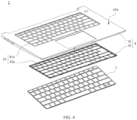
- FIG. 4 schematically shows a partial exploded structure of a keyboard 2 according to the claimed invention.
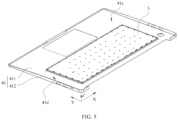
- FIG. 5 schematically shows a rear-side structure of a keyboard 2 according to the claimed invention.
- the keyboard frame assembly 4 includes an outer metal frame 41, an inner metal frame 42, and a key avoidance hole 43.
- the inner metal frame 42 is connected to the outer metal frame 41.
- the key avoidance hole 43 penetrates through the outer metal frame 41 and the inner metal frame 42.
- the keyboard assembly 3 is connected to the inner metal frame 42.
- the inner metal frame 42 is located between the outer metal frame 41 and the keyboard assembly 3.
- the inner metal frame 42 is configured to carry the keyboard assembly 3.
- the key 32 is disposed in correspondence with the key avoidance hole 43, so that the key 32 is exposed from the key avoidance hole 43, and the user taps the key 32 to execute an input instruction.
- the outer metal frame 41 may be of an integral structure, to help improve rigidity and a deformation resistance capability of the outer metal frame 41 while it is ensured that the outer metal frame 41 is lightweighted.
- the outer metal frame 41 may be processed and manufactured in a processing manner such as stamping, die casting, or model casting.
- a material of the outer metal frame 41 may be aluminum, an aluminum alloy, or steel.
- the outer metal frame 41 is provided with a first opening 41a used to avoid the key 32.
- the key avoidance hole 43 includes the first opening 41a.
- the outer metal frame 41 includes an outer surface 41b and an inner surface 41c that are opposite to each other. The first opening 41a penetrates through the outer surface 41b and the inner surface 41c.
- the outer surface 41b of the outer metal frame 41 is a surface that is of the outer metal frame 41 and that faces the user when the user uses the keyboard 2.
- the inner surface 41c of the outer metal frame 41 is a surface that is of the outer metal frame 41 and that faces an inside of the keyboard 2 when the user uses the keyboard 2. In this case, the user cannot easily observe the inner surface 41c of the outer metal frame 41 from an outside of the keyboard 2.
- the inner metal frame 42 is disposed on an inner side of the outer metal frame 41.
- the inner metal frame 42 may be connected to the inner surface 41c of the outer metal frame 41.
- the inner metal frame 42 may perform strength enhancement on the outer metal frame 41, to help reduce a possibility that the outer metal frame 41 sinks under pressure.
- the inner metal frame 42 may be of an integral structure, to help improve rigidity and a deformation resistance capability of the inner metal frame 42 while it is ensured that the inner metal frame 42 is lightweighted.
- the inner metal frame 42 may be processed and manufactured in a processing manner such as stamping, die casting, or model casting.
- the inner metal frame 42 may be formed by stamping a flat plate.
- a material of the inner metal frame 42 may be aluminum, an aluminum alloy, or steel.
- the inner metal frame 42 is provided with a second opening 42a used to avoid the key 32.
- the key avoidance hole 43 includes the second opening 42a.
- the first opening 41a and the second opening 42a are aligned and communicate to form the key
- FIG. 6 schematically shows a partial exploded structure of a keyboard according to an embodiment of this application.
- the outer metal frame 41 includes a first board 411 and a first side plate 412.
- the first board 411 and the first side plate 412 intersect to form an accommodation concave part 41d.
- the first opening 41a is disposed on the first board 411.
- a heat dissipation hole may be disposed on the first side plate 412.
- the inner metal frame 42 is located in the accommodation concave part 41d. In the thickness direction Z of the keyboard 2, the inner metal frame 42 and the first board 411 are stacked and connected to the first board 411.
- the keyboard assembly 3 is connected to the inner metal frame 42, so that the inner metal frame 42 can carry the keyboard assembly 3.
- the keyboard assembly 3 is suspended below the inner metal frame 42.
- the keyboard assembly 3 applies, to the inner metal frame 42, a tensile stress that is away from the outer metal frame 41, and the inner metal frame 42 applies, to the outer metal frame 41, a tensile stress that faces away from the inner surface 41c of the outer metal frame 41.
- the inner metal frame 42 and the outer metal frame 41 are combined with each other, and the inner metal frame 42 has high rigidity and has a strength enhancement function. Therefore, when an external force is exerted on the keyboard assembly 3, the keyboard assembly 3 does not easily deform or sink, and the keyboard assembly 3 does not easily pull the inner metal frame 42 and the outer metal frame 41 to deform or sink.
- the inner metal frame 42 with the strength enhancement function is disposed between the outer metal frame 41 and the keyboard assembly 3.
- the inner metal frame 42 is connected to the outer metal frame 41, and the keyboard assembly 3 is connected to the inner metal frame 42.
- Strength enhancement is performed on the keyboard 2 by using the disposed inner metal frame 42, to improve a deformation resistance capability of the keyboard 2, and reduce a possibility that the keyboard 2 deforms and sinks when the keyboard 2 suffers from an impact stress in a use process. Therefore, a metal baseplate and a plastic frame of a current keyboard can be canceled, to help reduce an overall thickness of the keyboard 2 while it is ensured that rigidity of the keyboard 2 meets a requirement, and improve portability of the keyboard 2.
- a solder column protrudes from the plastic frame.
- An end portion that is of the solder column and that penetrates through the metal baseplate deforms through hot melting or pressing, and is clamped on a bottom surface of the metal baseplate, to connect the keyboard assembly, the metal baseplate, and the plastic frame.
- the keyboard assembly and the plastic frame can be separated only after the end portion of the solder column is cut off. Consequently, the plastic frame cannot be reused.
- the plastic frame and the outer metal frame are both scrapped.
- the keyboard assembly 3 is detachably connected to the inner metal frame 42, so that the keyboard assembly 3 can be removed from the inner metal frame 42 when the keyboard assembly 3 needs to be repaired.
- the keyboard assembly 3 is reinstalled on the inner metal frame 42, so that the inner metal frame 42 and the outer metal frame 41 can be reused, thereby reducing maintenance difficulty and maintenance costs.
- the keyboard assembly 3 and the inner metal frame 42 may be stuck by using an adhesive member.
- the keyboard assembly 3 and the inner metal frame 42 may be snap-fitted by using a snap-fit.
- the keyboard assembly 3 and the inner metal frame 42 may be fastened by using a fastener.
- the fastener may be a screw.
- the keyboard assembly 3 includes the circuit board unit 31.
- the key 32 is disposed on the circuit board unit 31.
- the circuit board unit 31 provides support for the key 32.
- the circuit board unit 31 is disposed on a side that is of the inner metal frame 42 and that faces away from the outer metal frame 41.
- the circuit board unit 31 is detachably connected to the inner metal frame 42.
- the circuit board unit 31 is of a plate-like structure and has high rigidity. Therefore, the circuit board unit 31 is connected to the inner metal frame 42, to effectively ensure stability and reliability of a connection between the circuit board unit 31 and the inner metal frame 42, and reduce a possibility that the keyboard assembly 3 and the inner metal frame 42 are loosened or separated due to frequent tapping.
- the circuit board unit 31 includes the circuit board 311, the metal sheet 312, and the backlight module 313.
- the circuit board 311 is disposed on a side that is of the metal sheet 312 and that faces the inner metal frame 42.
- the circuit board 311 may be a printed circuit board (Printed Circuit Board, PCB) or a flexible circuit board.
- the backlight module 313 is disposed on a side that is of the metal sheet 312 and that faces away from the inner metal frame 42.
- the circuit board 311 has signal collection and signal processing functions. When the key 32 is tapped, a corresponding region of the circuit board 311 is triggered to execute a corresponding input instruction.
- the metal sheet 312 of the circuit board unit 31 is detachably connected to the inner metal frame 42. Light of the backlight module 313 may penetrate through the metal sheet 312 and the circuit board 311 and illuminate the key 32.
- the keyboard 2 further includes an adaptation piece 5.
- the circuit board unit 31 is detachably connected to the inner metal frame 42 by using the adaptation piece 5.
- a part of the adaptation piece 5 is connected to the circuit board unit 31, and the other part is connected to the inner metal frame 42, so that the circuit board unit 31 is pressed against a surface that is of the inner metal frame 42 and that faces the circuit board unit 31.
- the adaptation piece 5 may be removed to separate the keyboard assembly 3 and the inner metal frame 42.
- the adaptation piece 5 includes a first component 51 and a second component 52.
- the first component 51 and the second component 52 are independently disposed. After the first component 51 and the second component 52 are separately processed and manufactured, the first component 51 and the second component 52 may be connected to each other to form the adaptation piece 5.
- the first component 51 is disposed on the inner metal frame 42.
- the first component 51 may be detachably connected to the inner metal frame 42. After the inner metal frame 42 and the outer metal frame 41 are assembled, the first component 51 is connected to the inner metal frame 42. Alternatively, the first component 51 is connected to the inner metal frame 42 in advance, and then the inner metal frame 42 with the first component 51 is connected to the outer metal frame 41.
- the first component 51 may be directly built into or soldered onto the inner metal frame 42 to form an integral structure with the inner metal frame 42.
- the first component 51 is built into or soldered onto the inner metal frame 42, and then the inner metal frame 42 is connected to the outer metal frame 41. Therefore, in a process of connecting the inner metal frame 42 and the outer metal frame 41, the first component 51 is not easily separated from the inner metal frame 42 and lost.
- the keyboard assembly 3 and the inner metal frame 42 are connected by using the second component 52 and the first component 51.
- the first component 51 and the second component 52 are fastened to connect the circuit board unit 31 and the inner metal frame 42.
- the first component 51 and the second component 52 that are separately designed are used for the adaptation piece 5, so that the first component 51 is positioned and mounted on the inner metal frame 42 in advance, and then the keyboard assembly 3 is fastened by using the second component 52. Therefore, the second component 52 may be directly aligned with the first component 51 to perform a connection operation, and the second component 52 does not need to be repositioned with respect to the inner metal frame 42.
- the first component 51 is threaded with the second component 52.
- One of the first component 51 and the second component 52 has an external thread, and the other has an internal thread.
- the threads may guide the second component 52 to be aligned with the first component 51, to reduce difficulty in positioning the first component 51 and the second component 52 in alignment with each other, and help improve connection convenience and connection efficiency.
- the first component 51 and the second component 52 are easily self-locked, and have good anti-loosening performance and connection stability, to reduce a probability that a gap occurs between the keyboard assembly 3 and the inner metal frame 42 after the first component 51 and the second component 52 are mutually loosened after long-term use, and the keyboard assembly 3 becomes loose, affecting stability and comfort of tapping the key 32 by the user.
- the first component 51 is a nut.
- the inner metal frame 42 includes a mounting hole.
- the first component 51 is inserted into the mounting hole.
- the first component 51 may be partially located in the mounting hole, and partially located outside the mounting hole, or may be integrally located in the mounting hole.
- the first component 51 is pressed into the mounting hole of the inner metal frame 42 in an extrusion manner. Referring to FIG. 9 and FIG.
- a tooth portion 511 may be disposed on a peripheral surface of the first component 51, so that after the first component 51 is pressed into the mounting hole, the tooth portion 511 of the first component 51 may be built into a hole wall of the mounting hole, to improve a bonding force and connection stability between the first component 51 and the inner metal frame 42, reduce a possibility that the first component 51 easily drops from the inner metal frame 42, and further reduce a possibility that the first component 51 rotates in the mounting hole when the first component 51 withstands torque.
- a plurality of tooth portions 511 are evenly distributed in an annular shape around the first component 51.
- the second component 52 includes a bolt 521 and a cap portion 522 connected to the bolt 521. The bolt 521 is threaded with the first component 51.
- the bolt 521 has an external thread
- the first component 51 has an internal threaded hole that matches the external thread.
- the cap portion 522 of the second component 52 abuts against the circuit board unit 31, to apply, to the circuit board unit 31, a pressure stress toward the inner metal frame 42.
- the cap portion 522 of the second component 52 may carry the keyboard assembly 3, and also limit the keyboard assembly 3, to reduce a possibility that the keyboard assembly 3 moves away from the inner metal frame 42.
- the circuit board unit 31 includes the circuit board 311, the metal sheet 312, and the backlight module 313.
- the circuit board 311 includes a first avoidance hole 311a.
- the metal sheet 312 includes a second avoidance hole 312a.
- the backlight module 313 includes a third avoidance hole 313a.
- the first avoidance hole 311a, the second avoidance hole 312a, and the third avoidance hole 313a are aligned, and communicate with each other.
- the first component 51 is inserted into the first avoidance hole 311a and the second avoidance hole 312a, so that the circuit board unit 31 may be positioned by using the first component 51, to quickly and accurately adjust relative locations of the circuit board unit 31 and the inner metal frame 42.
- the cap portion 522 of the second component 52 is accommodated in the third avoidance hole 313a and abuts against a surface that is of the metal sheet 312 and that faces away from the circuit board 311.
- the metal sheet 312 has high rigidity. Therefore, when the second component 52 abuts against the metal sheet 312, and a large pressure stress may be applied to the metal sheet 312, to improve connection stability between the circuit board unit 31 and the inner metal frame 42.
- the second component 52 and the metal sheet 312 each are of a metal material. Therefore, after the cap portion 522 of the second component 52 abuts against the metal sheet 312, the cap portion 522 is not easily rotated and loosened relative to the metal sheet 312.
- the cap portion 522 of the second component 52 is accommodated in the third avoidance hole 313a. Space of the third avoidance hole 313a may be used, to help reduce the overall thickness of the keyboard 2.
- the backlight module 313 may be avoided, to reduce a possibility that a structure of the backlight module 313 is damaged because the cap portion 522 of the second component 52 abuts against the backlight module 313.
- the cap portion 522 of the second component 52 is integrally located in the third avoidance hole 313a.
- a top surface that is of the cap portion 522 of the second component 52 and that faces away from the inner metal frame 42 is flush with an edge of the third avoidance hole 313a formed in the backlight module 313, or a top surface that is of the cap portion 522 of the second component 52 and that faces away from the inner metal frame 42 is lower than an edge of the third avoidance hole 313a formed in the backlight module 313, to reduce a possibility that the cap portion 522 of the second component 52 collides with or scratches an adjacent mechanical part.
- the inner metal frame 42 includes a transverse spacer 421 and a longitudinal spacer 422 that are connected to each other.
- the entire keyboard 2 has a length and a width.
- the transverse spacer 421 extends in a length direction X of the keyboard 2.
- the longitudinal spacer 422 extends in a width direction Y of the keyboard 2.
- the transverse spacer 421 and the longitudinal spacer 422 are alternately disposed around the key avoidance hole 43.
- two longitudinal spacers 422 are disposed on a left side and a right side of each key avoidance hole 43, and two transverse spacers 421 are disposed on an upper side and a lower side.
- a plurality of transverse spacers 421 and a plurality of longitudinal spacers 422 are classified to form a plurality of second openings 42a.
- the first component 51 is disposed in an intersection region of the transverse spacer 421 and the longitudinal spacer 422.
- the intersection region of the transverse spacer 421 and the longitudinal spacer 422 has a large area, and therefore, has high rigidity.
- an acting force is transmitted to the inner metal frame 42 through the first component 51.
- the intersection region of the transverse spacer 421 and the longitudinal spacer 422 has high rigidity, and has a strong deformation resistance capability. Therefore, under a pulling action of the first component 51, the intersection region of the transverse spacer 421 and the longitudinal spacer 422 does not easily deform or sink, to ensure that the keyboard 2 can still remain structurally stable when withstanding impact.
- the transverse spacer 421 and the longitudinal spacer 422 are disposed on the second board 423.
- the outer metal frame 41 and the inner metal frame 42 are detachably connected.
- the outer metal frame 41 and the inner metal frame 42 each are independently processed and manufactured, and then are assembled.
- the outer metal frame 41 or the inner metal frame 42 is repaired subsequently, the outer metal frame 41 and the inner metal frame 42 are separated.
- the outer metal frame 41 and the inner metal frame 42 are recombined, so that both the outer metal frame 41 and the inner metal frame 42 can be reused, to reduce maintenance difficulty and maintenance costs.
- the outer metal frame 41 includes an outer surface 41b and an inner surface 41c that are opposite in a thickness direction of the outer metal frame 41.
- the inner metal frame 42 is stuck to the inner surface 41c.
- a predetermined location of the outer metal frame 41 or a predetermined location of the inner metal frame 42 is coated with glue or an adhesive tape in advance, and then the inner metal frame 42 and the outer metal frame 41 are stuck and fastened.
- a connection structure may not need to be additionally disposed on the outer metal frame 41 or the inner metal frame 42 to connect and fasten the outer metal frame 41 and the inner metal frame 42, to reduce structural complexity of the outer metal frame 41 or the inner metal frame 42, and reduce processing difficulty of the outer metal frame 41 or the inner metal frame 42.
- a quantity of parts used for the keyboard 2 is reduced, to help reduce an assembly process and assembly difficulty of the keyboard 2.
- a glue coating thickness or a thickness of the adhesive tape is precisely controlled, to help further reduce the overall thickness of the keyboard 2.
- the keyboard frame assembly 4 further includes a first adhesive member 6 disposed in the annular accommodation cavity.
- the first adhesive member 6 is an adhesive tape or cured glue.
- the key avoidance hole 43 is located in a region limited by the annular accommodation cavity.
- the first adhesive member 6 connects the outer metal frame 41 and the inner metal frame 42. Before the outer metal frame 41 and the inner metal frame 42 are assembled, the predetermined location of the outer metal frame 41 or the predetermined location of the inner metal frame 42 is coated with the glue or the adhesive tape in advance, and then the outer metal frame 41 and the inner metal frame 42 are stuck together.
- the glue or the adhesive tape is located in the annular accommodation cavity.
- the annular accommodation cavity may limit the glue or the adhesive tape, to reduce a possibility that the glue spills from space between the outer metal frame 41 and the inner metal frame 42 or that the adhesive tape is misaligned.
- the annular accommodation cavity is a continuously extending cavity.
- An annular groove 42b is disposed in an edge region of the inner metal frame 42, so that after the outer metal frame 41 and the inner metal frame 42 are combined, the annular groove 42b and the inner surface 41c of the outer metal frame 41 form the annular accommodation cavity.
- the second opening 42a of the inner metal frame 42 is located in a region limited by the annular groove 42b.
- the inner metal frame 42 includes the second board 423, a second side plate 424, and a flange 425.
- the second side plate 424 and the second board 423 intersect.
- the flange 425 and the second side plate 424 are connected.
- the second board 423 includes the transverse spacer 421, the longitudinal spacer 422, and the second opening 42a formed through division of the transverse spacer 421 and the longitudinal spacer 422.
- the annular groove 42b is disposed on a surface that is of the flange 425 and that faces the outer metal frame 41.
- the keyboard frame assembly 4 further includes a second adhesive member 7 disposed in the first chamber.
- the second adhesive member 7 is an adhesive tape or cured glue.
- the second adhesive member 7 connects the outer metal frame 41 and the inner metal frame 42.
- the predetermined location of the outer metal frame 41 or the predetermined location of the inner metal frame 42 is coated with the glue or the adhesive tape in advance, and then the outer metal frame 41 and the inner metal frame 42 are stuck together.
- the glue or the adhesive tape is located in the first chamber.
- the first chamber may limit the glue or the adhesive tape, to reduce the possibility that the glue spills from space between the outer metal frame 41 and the inner metal frame 42 or that the adhesive tape is misaligned.
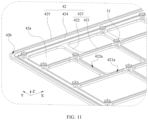
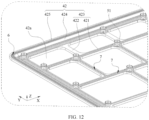
- FIG. 11 and FIG. 12 each schematically show a partial structure of a keyboard 2 according to an embodiment of this application.
- a first concave part 421a is disposed on the transverse spacer 421 of the inner metal frame 42, so that after the outer metal frame 41 and the inner metal frame 42 are combined, the first concave part 421a and the inner surface 41c of the outer metal frame 41 form the first chamber.
- first concave part 421a is coated with glue or an adhesive tape in advance.
- the first adhesive member 6 and the second adhesive member 7 jointly connect the outer metal frame 41 and the inner metal frame 42, to help further improve connection strength of the outer metal frame 41 and the inner metal frame 42.
- the keyboard frame assembly 4 further includes a second adhesive member 7 disposed in the second chamber.
- the predetermined location of the outer metal frame 41 or the predetermined location of the inner metal frame 42 is coated with the glue or the adhesive tape in advance, and then the outer metal frame 41 and the inner metal frame 42 are stuck together.
- the glue or the adhesive tape is located in the second chamber.
- the second chamber may limit the glue or the adhesive tape, to reduce the possibility that the glue spills from space between the outer metal frame 41 and the inner metal frame 42 or that the adhesive tape is misaligned. For example, referring to FIG.
- a second concave part 422a is disposed on the longitudinal spacer 422 of the inner metal frame 42, so that after the outer metal frame 41 and the inner metal frame 42 are combined, the second concave part 422a and the inner surface 41c of the outer metal frame 41 form the second chamber.
- an inside of the second concave part 422a is coated with glue or an adhesive tape in advance.
- the keyboard frame assembly 4 further includes a second adhesive member 7 disposed in the first chamber and the second chamber.
- the first chamber and the second chamber may communicate.
- the first component 51 may be disposed at an intersection of the first chamber and the second chamber, and an end surface that is of the first component 51 and that faces the outer metal frame 41 is exposed from the inner metal frame 42, so that glue or an adhesive tape can connect the first component 51 and the outer metal frame 41.
- a part that is of the outer metal frame 41 and that corresponds to the first component 51 may exert an opposite acting force on the first component 51, to further reduce a possibility that the first component 51 and the inner metal frame 42 move away from the outer metal frame 41.
- An embodiment of this application provides a method for manufacturing a keyboard 2, including:
- the keyboard 2 in the foregoing embodiment may be manufactured.
- mount shall be understood in a broad sense, for example, may be a fixed connection, may be an indirect connection by using an intermediate medium, or may be a connection between insides of two elements or an interaction relationship between two elements.
- connect shall be understood in a broad sense, for example, may be a fixed connection, may be an indirect connection by using an intermediate medium, or may be a connection between insides of two elements or an interaction relationship between two elements.
- a process, a method, a system, a product, or a device that includes a series of steps or units is not necessarily limited to those steps or units that are clearly listed, but may include other steps or units that are not clearly listed or are inherent to the process, method, product, or device.
- a plurality of in this specification indicates two or more.
- the term “and/or” in this specification describes only an association relationship between associated objects and represents that three relationships can exist. For example, “A and/or B” can represent the following three cases: Only A exists, both A and B exist, and only B exists.
- the character “/” in this specification usually indicates an "or” relationship between the associated objects. In a formula, the character "/" indicates that the associated objects are in a "division" relationship.
- sequence numbers of the foregoing processes do not mean execution sequences.
- the execution sequences of the processes should be determined based on functions and internal logic of the processes, and should not be construed as any limitation on the implementation processes of the embodiments of this application.
Landscapes
- Engineering & Computer Science (AREA)
- Theoretical Computer Science (AREA)
- General Engineering & Computer Science (AREA)
- Computer Hardware Design (AREA)
- Human Computer Interaction (AREA)
- Physics & Mathematics (AREA)
- General Physics & Mathematics (AREA)
- Input From Keyboards Or The Like (AREA)
Claims (11)
- Eine Tastatur (2) für ein elektronisches Gerät (1), wobei die Tastatur (2) mindestens Folgendes umfasst:eine Tastaturbaugruppe (3), bestehend aus einer Leiterplatteneinheit (31) und einer Taste (32); undeine Tastaturrahmenbaugruppe (4), bestehend aus einem äußeren Metallrahmen (41), einem inneren Metallrahmen (42) und einem Tastenfreiloch (43), wobei der innere Metallrahmen (42) mit dem äußeren Metallrahmen (41) verbunden ist, das Tastenfreiloch (43) durch den äußeren Metallrahmen (41) und den inneren Metallrahmen (42) hindurchgeht, die Tastaturbaugruppe (3) mit dem inneren Metallrahmen (42) verbunden ist, der innere Metallrahmen (42) zwischen dem äußeren Metallrahmen (41) und der Tastaturbaugruppe (3) angeordnet ist, der innere Metallrahmen (42) dazu konfiguriert ist, die Tastaturbaugruppe (3) zu tragen, und die Taste (32) entsprechend dem Tastenfreiloch (43) angeordnet ist, sodass die Taste (32) aus dem Tastenfreiloch (43) herausragt und dadurch für einen Benutzer zugänglich ist; undwobei die Tastaturbaugruppe (3) lösbar mit dem inneren Metallrahmen (42) verbunden ist;wobei die Tastatur ferner ein Anpassungsstück (5) umfasst, das Anpassungsstück (5) besteht aus einer ersten Komponente (51) und einer zweiten Komponente (52), die erste Komponente ist am inneren Metallrahmen (42) angeordnet, und die erste Komponente (51) und die zweite Komponente (52) sind befestigt, um die Leiterplatteneinheit (31) und den inneren Metallrahmen (42) zu verbinden;wobei die Leiterplatteneinheit (31) eine Leiterplatte (311), ein Metallblech (312) und ein Hintergrundbeleuchtungsmodul (313) umfasst, die Leiterplatte (311) ist auf einer Seite des Metallblechs (312) angeordnet, die dem inneren Metallrahmen (42) zugewandt ist, das Hintergrundbeleuchtungsmodul (313) ist auf einer Seite des Metallblechs (312) angeordnet, die vom inneren Metallrahmen (42) abgewandt ist, die Leiterplatte (311) umfasst ein erstes Freiloch (311a), das Metallblech (312) umfasst ein zweites Freiloch (312a), das Hintergrundbeleuchtungsmodul (313) umfasst ein drittes Freiloch (313a), die erste Komponente (51) ist in das erste Freiloch (311a) und das zweite Freiloch (312a) eingesetzt, und ein Kappenabschnitt (522) der zweiten Komponente (52) ist im dritten Freiloch (313a) untergebracht und liegt an einer Oberfläche des Metallblechs (312) an, die von der Leiterplatte (311) abgewandt ist.
- Die Tastatur gemäß Anspruch 1, wobei die Taste (32) auf der Leiterplatteneinheit (31) angeordnet ist, die Leiterplatteneinheit (31) auf einer Seite des inneren Metallrahmens (42) angeordnet ist, die vom äußeren Metallrahmen (41) abgewandt ist, und die Leiterplatteneinheit (31) lösbar mit dem inneren Metallrahmen (42) verbunden ist.
- Die Tastatur gemäß Anspruch 2, wobei die Leiterplatteneinheit (31) lösbar mit dem inneren Metallrahmen (42) unter Verwendung des Anpassungsstücks (5) verbunden ist.
- Die Tastatur gemäß einem der Ansprüche 1 bis 3, wobei die erste Komponente (51) mit der zweiten Komponente (52) verschraubt ist.
- Die Tastatur gemäß einem der Ansprüche 1 bis 4, wobei die erste Komponente (51) eine Mutter ist, der innere Metallrahmen (42) ein Montageloch umfasst, die erste Komponente (51) in das Montageloch eingesetzt ist, die zweite Komponente (51) einen Bolzen (521) und den mit dem Bolzen (521) verbundenen Kappenteil (522) umfasst, der Bolzen (521) mit der ersten Komponente (51) verschraubt ist und der Kappenteil (522) gegen die Leiterplatteneinheit (31) drückt, um auf die Leiterplatteneinheit (31) eine Druckspannung in Richtung des inneren Metallrahmens (42) auszuüben.
- Die Tastatur gemäß einem der Ansprüche 1 bis 5, wobei der innere Metallrahmen (42) einen Querspacer (421) und einen Längsspacer (422) umfasst, der Querspacer (421) und der Längsspacer (422) abwechselnd um das Tastenvermeidungloch (43) angeordnet sind, und die erste Komponente (51) in einem Schnittbereich des Querspacers (421) und des Längsspacers (422) angeordnet ist.
- Die Tastatur gemäß einem der Ansprüche 1 bis 6, wobei der äußere Metallrahmen (41) und der innere Metallrahmen (42) lösbar verbunden sind.
- Die Tastatur gemäß Anspruch 7, wobei der äußere Metallrahmen (41) eine Außenfläche (41b) und eine Innenfläche (41c) umfasst, und der innere Metallrahmen (42) an der Innenfläche (41c) haftet.
- Die Tastatur gemäß Anspruch 8, wobei sich zwischen dem inneren Metallrahmen (42) und der Innenfläche ein ringförmiger Aufnahmeraum befindet, die Tastaturrahmenbaugruppe (4) ferner ein erstes Klebeelement (6) umfasst, das innerhalb des ringförmigen Aufnahmeraums angeordnet ist, das Tastenvermeidungloch (43) sich innerhalb eines durch den ringförmigen Aufnahmeraum begrenzten Bereichs befindet und das erste Klebeelement (6) den äußeren Metallrahmen (41) und den inneren Metallrahmen (42) verbindet.
- Die Tastatur gemäß Anspruch 9, wobei der innere Metallrahmen (42) einen Querspacer (421) und einen Längsspacer (422) umfasst, und der Querspacer (421) und der Längsspacer (422) abwechselnd um das Tastenvermeidungloch (43) angeordnet sind;es befindet sich eine erste Kammer zwischen dem Querspacer (421) und der Innenfläche (41c), und die Tastaturrahmenbaugruppe (4) umfasst ferner ein zweites Klebeelement (7), das in der ersten Kammer angeordnet ist; oderes befindet sich eine zweite Kammer zwischen dem Längsspacer (422) und der Innenfläche (41c), und die Tastaturrahmenbaugruppe (4) umfasst ferner ein zweites Klebeelement (7), das in der zweiten Kammer angeordnet ist; oderEs gibt eine erste Kammer zwischen dem Querspacer (421) und der inneren Oberfläche (41c), es gibt eine zweite Kammer zwischen dem Längsspace (422) und der inneren Oberfläche (41c), und die Tastaturrahmenbaugruppe (4) umfasst ferner ein zweites Klebeelement (7), das in der ersten Kammer und der zweiten Kammer angeordnet ist; undDas zweite Klebeelement (7) verbindet den äußeren Metallrahmen (41) und den inneren Metallrahmen (42).
- Ein elektronisches Gerät (1), umfassend die Tastatur gemäß einem der Ansprüche 1 bis 10.
Applications Claiming Priority (2)
| Application Number | Priority Date | Filing Date | Title |
|---|---|---|---|
| CN202110867785.2A CN113778234A (zh) | 2021-07-29 | 2021-07-29 | 键盘以及电子设备 |
| PCT/CN2022/090796 WO2023005310A1 (zh) | 2021-07-29 | 2022-04-29 | 键盘以及电子设备 |
Publications (3)
| Publication Number | Publication Date |
|---|---|
| EP4286997A1 EP4286997A1 (de) | 2023-12-06 |
| EP4286997A4 EP4286997A4 (de) | 2024-07-24 |
| EP4286997B1 true EP4286997B1 (de) | 2025-06-18 |
Family
ID=78836506
Family Applications (1)
| Application Number | Title | Priority Date | Filing Date |
|---|---|---|---|
| EP22847925.9A Active EP4286997B1 (de) | 2021-07-29 | 2022-04-29 | Tastatur und elektronische vorrichtung |
Country Status (4)
| Country | Link |
|---|---|
| US (1) | US12189868B2 (de) |
| EP (1) | EP4286997B1 (de) |
| CN (1) | CN113778234A (de) |
| WO (1) | WO2023005310A1 (de) |
Families Citing this family (3)
| Publication number | Priority date | Publication date | Assignee | Title |
|---|---|---|---|---|
| CN113778234A (zh) * | 2021-07-29 | 2021-12-10 | 荣耀终端有限公司 | 键盘以及电子设备 |
| US20240028083A1 (en) * | 2022-07-19 | 2024-01-25 | Hewlett-Packard Development Company, L.P. | Brackets for mounting electronic components |
| CN119088170A (zh) * | 2023-06-06 | 2024-12-06 | 荣耀终端有限公司 | 电子设备以及键盘组件 |
Family Cites Families (19)
| Publication number | Priority date | Publication date | Assignee | Title |
|---|---|---|---|---|
| KR100614645B1 (ko) | 2004-06-03 | 2006-08-22 | 삼성전자주식회사 | 파워-온 리셋회로 |
| TWI266582B (en) * | 2004-07-06 | 2006-11-11 | Lg Electronics Inc | Hinge frame for portable computer and structure for mounting the same |
| JP5083078B2 (ja) | 2008-07-11 | 2012-11-28 | ソニー株式会社 | キーボード及びキーボードの製造方法 |
| CN201438292U (zh) * | 2009-05-19 | 2010-04-14 | 精元电脑股份有限公司 | 超薄键盘装置 |
| TWI436395B (zh) * | 2011-09-30 | 2014-05-01 | Acer Inc | Keyboard frame with better structural strength |
| DE202012104777U1 (de) * | 2012-12-07 | 2014-03-11 | Prehkeytec Gmbh | Gummimatten-Tastatur, insbesondere Silikonmatten-Tastatur |
| CN205140831U (zh) * | 2015-07-20 | 2016-04-06 | 杨立涛 | 一种按键及键盘 |
| TWI620220B (zh) * | 2016-03-25 | 2018-04-01 | 致伸科技股份有限公司 | 鍵盤以及應用該鍵盤的筆記型電腦 |
| TWI584325B (zh) | 2016-08-19 | 2017-05-21 | 致伸科技股份有限公司 | 鍵盤裝置及其剪刀式連接元件 |
| JP6412626B1 (ja) | 2017-06-20 | 2018-10-24 | レノボ・シンガポール・プライベート・リミテッド | キーボード装置及び電子機器 |
| CN110908444B (zh) * | 2019-12-04 | 2022-11-22 | 联想(北京)有限公司 | 一种输入设备 |
| JP6846547B1 (ja) * | 2020-01-09 | 2021-03-24 | レノボ・シンガポール・プライベート・リミテッド | 電子機器 |
| CN111506202B (zh) * | 2020-04-17 | 2023-09-12 | 光宝科技(常州)有限公司 | 键盘和键盘组装方法 |
| CN111403211B (zh) | 2020-05-06 | 2022-03-11 | 光宝科技(常州)有限公司 | 键盘框架及键盘 |
| CN111739752B (zh) * | 2020-05-27 | 2023-05-23 | 淮安达方电子有限公司 | 键盘及其按键与调整机构 |
| CN212723808U (zh) | 2020-08-31 | 2021-03-16 | 重庆广道精密电子有限公司 | 一种笔记本电脑键盘框架 |
| CN114840055B (zh) * | 2021-01-30 | 2024-09-24 | 华为技术有限公司 | 键盘及电子设备 |
| CN113778234A (zh) | 2021-07-29 | 2021-12-10 | 荣耀终端有限公司 | 键盘以及电子设备 |
| JP2023161363A (ja) * | 2022-04-25 | 2023-11-07 | レノボ・シンガポール・プライベート・リミテッド | キーボード装置及び電子機器 |
-
2021
- 2021-07-29 CN CN202110867785.2A patent/CN113778234A/zh active Pending
-
2022
- 2022-04-29 EP EP22847925.9A patent/EP4286997B1/de active Active
- 2022-04-29 WO PCT/CN2022/090796 patent/WO2023005310A1/zh not_active Ceased
- 2022-04-29 US US18/282,633 patent/US12189868B2/en active Active
Also Published As
| Publication number | Publication date |
|---|---|
| US12189868B2 (en) | 2025-01-07 |
| EP4286997A1 (de) | 2023-12-06 |
| CN113778234A (zh) | 2021-12-10 |
| WO2023005310A1 (zh) | 2023-02-02 |
| US20240176426A1 (en) | 2024-05-30 |
| EP4286997A4 (de) | 2024-07-24 |
Similar Documents
| Publication | Publication Date | Title |
|---|---|---|
| EP4286997B1 (de) | Tastatur und elektronische vorrichtung | |
| TWI689957B (zh) | 鍵盤裝置 | |
| US11079816B1 (en) | System and method for vapor chamber directional heat dissipation for a piezoelectric keyboard assembly | |
| US20160196936A1 (en) | Case keyboard with thin film switches | |
| US20120163028A1 (en) | Multi-segmented light guide for an input device | |
| US20200051761A1 (en) | Illuminated keyboard | |
| US20130149168A1 (en) | Mounting apparatus for fan | |
| JP2017076213A (ja) | 入力装置、電子機器、入力装置の製造方法 | |
| TW202038270A (zh) | 鍵盤 | |
| EP2584433A2 (de) | Tastatur-Modul und Verfahren zu dessen Herstellung | |
| US8302521B2 (en) | Die with a punch module | |
| US11776774B2 (en) | Keyboard | |
| US20120189401A1 (en) | Fastening structure | |
| US10650986B2 (en) | Keyboard | |
| US20190228932A1 (en) | Luminous membrane keyboard | |
| CN114023587B (zh) | 一种带导光膜的夹层片式发光键芯模组 | |
| US9941077B2 (en) | Computer thin film switch keyboard | |
| CN210670724U (zh) | 模块化印制电路板散热结构 | |
| US20050073826A1 (en) | Light guide plate with multiple visible regions | |
| US11126272B2 (en) | Sinkable keyboard device | |
| US20230141940A1 (en) | Straight-through three-in-one light-emitting key core module | |
| US11966073B2 (en) | Reflective four-in-one light-emitting key core module | |
| US11599203B2 (en) | Backlight module | |
| US20100236765A1 (en) | Fan assembly and heat dissipation device having the same | |
| TW202234442A (zh) | 按鍵 |
Legal Events
| Date | Code | Title | Description |
|---|---|---|---|
| STAA | Information on the status of an ep patent application or granted ep patent |
Free format text: STATUS: THE INTERNATIONAL PUBLICATION HAS BEEN MADE |
|
| PUAI | Public reference made under article 153(3) epc to a published international application that has entered the european phase |
Free format text: ORIGINAL CODE: 0009012 |
|
| STAA | Information on the status of an ep patent application or granted ep patent |
Free format text: STATUS: REQUEST FOR EXAMINATION WAS MADE |
|
| 17P | Request for examination filed |
Effective date: 20230829 |
|
| AK | Designated contracting states |
Kind code of ref document: A1 Designated state(s): AL AT BE BG CH CY CZ DE DK EE ES FI FR GB GR HR HU IE IS IT LI LT LU LV MC MK MT NL NO PL PT RO RS SE SI SK SM TR |
|
| A4 | Supplementary search report drawn up and despatched |
Effective date: 20240624 |
|
| RIC1 | Information provided on ipc code assigned before grant |
Ipc: H01H 13/86 20060101ALI20240618BHEP Ipc: G06F 1/16 20060101ALI20240618BHEP Ipc: G06F 3/02 20060101AFI20240618BHEP |
|
| DAV | Request for validation of the european patent (deleted) | ||
| DAX | Request for extension of the european patent (deleted) | ||
| GRAP | Despatch of communication of intention to grant a patent |
Free format text: ORIGINAL CODE: EPIDOSNIGR1 |
|
| STAA | Information on the status of an ep patent application or granted ep patent |
Free format text: STATUS: GRANT OF PATENT IS INTENDED |
|
| INTG | Intention to grant announced |
Effective date: 20250115 |
|
| GRAS | Grant fee paid |
Free format text: ORIGINAL CODE: EPIDOSNIGR3 |
|
| GRAA | (expected) grant |
Free format text: ORIGINAL CODE: 0009210 |
|
| STAA | Information on the status of an ep patent application or granted ep patent |
Free format text: STATUS: THE PATENT HAS BEEN GRANTED |
|
| AK | Designated contracting states |
Kind code of ref document: B1 Designated state(s): AL AT BE BG CH CY CZ DE DK EE ES FI FR GB GR HR HU IE IS IT LI LT LU LV MC MK MT NL NO PL PT RO RS SE SI SK SM TR |
|
| REG | Reference to a national code |
Ref country code: GB Ref legal event code: FG4D |
|
| REG | Reference to a national code |
Ref country code: CH Ref legal event code: EP |
|
| REG | Reference to a national code |
Ref country code: DE Ref legal event code: R096 Ref document number: 602022016229 Country of ref document: DE |
|
| REG | Reference to a national code |
Ref country code: CH Ref legal event code: EP |
|
| REG | Reference to a national code |
Ref country code: IE Ref legal event code: FG4D |
|
| REG | Reference to a national code |
Ref country code: NL Ref legal event code: FP |
|
| PG25 | Lapsed in a contracting state [announced via postgrant information from national office to epo] |
Ref country code: FI Free format text: LAPSE BECAUSE OF FAILURE TO SUBMIT A TRANSLATION OF THE DESCRIPTION OR TO PAY THE FEE WITHIN THE PRESCRIBED TIME-LIMIT Effective date: 20250618 |
|
| REG | Reference to a national code |
Ref country code: LT Ref legal event code: MG9D |
|
| PG25 | Lapsed in a contracting state [announced via postgrant information from national office to epo] |
Ref country code: GR Free format text: LAPSE BECAUSE OF FAILURE TO SUBMIT A TRANSLATION OF THE DESCRIPTION OR TO PAY THE FEE WITHIN THE PRESCRIBED TIME-LIMIT Effective date: 20250919 Ref country code: NO Free format text: LAPSE BECAUSE OF FAILURE TO SUBMIT A TRANSLATION OF THE DESCRIPTION OR TO PAY THE FEE WITHIN THE PRESCRIBED TIME-LIMIT Effective date: 20250918 |
|
| PG25 | Lapsed in a contracting state [announced via postgrant information from national office to epo] |
Ref country code: BG Free format text: LAPSE BECAUSE OF FAILURE TO SUBMIT A TRANSLATION OF THE DESCRIPTION OR TO PAY THE FEE WITHIN THE PRESCRIBED TIME-LIMIT Effective date: 20250618 |
|
| PG25 | Lapsed in a contracting state [announced via postgrant information from national office to epo] |
Ref country code: HR Free format text: LAPSE BECAUSE OF FAILURE TO SUBMIT A TRANSLATION OF THE DESCRIPTION OR TO PAY THE FEE WITHIN THE PRESCRIBED TIME-LIMIT Effective date: 20250618 |
|
| PG25 | Lapsed in a contracting state [announced via postgrant information from national office to epo] |
Ref country code: RS Free format text: LAPSE BECAUSE OF FAILURE TO SUBMIT A TRANSLATION OF THE DESCRIPTION OR TO PAY THE FEE WITHIN THE PRESCRIBED TIME-LIMIT Effective date: 20250918 |
|
| PG25 | Lapsed in a contracting state [announced via postgrant information from national office to epo] |
Ref country code: LV Free format text: LAPSE BECAUSE OF FAILURE TO SUBMIT A TRANSLATION OF THE DESCRIPTION OR TO PAY THE FEE WITHIN THE PRESCRIBED TIME-LIMIT Effective date: 20250618 |
|
| PG25 | Lapsed in a contracting state [announced via postgrant information from national office to epo] |
Ref country code: PT Free format text: LAPSE BECAUSE OF FAILURE TO SUBMIT A TRANSLATION OF THE DESCRIPTION OR TO PAY THE FEE WITHIN THE PRESCRIBED TIME-LIMIT Effective date: 20251020 |
|
| REG | Reference to a national code |
Ref country code: AT Ref legal event code: MK05 Ref document number: 1804801 Country of ref document: AT Kind code of ref document: T Effective date: 20250618 |
|
| PG25 | Lapsed in a contracting state [announced via postgrant information from national office to epo] |
Ref country code: IS Free format text: LAPSE BECAUSE OF FAILURE TO SUBMIT A TRANSLATION OF THE DESCRIPTION OR TO PAY THE FEE WITHIN THE PRESCRIBED TIME-LIMIT Effective date: 20251018 |
|
| PG25 | Lapsed in a contracting state [announced via postgrant information from national office to epo] |
Ref country code: SM Free format text: LAPSE BECAUSE OF FAILURE TO SUBMIT A TRANSLATION OF THE DESCRIPTION OR TO PAY THE FEE WITHIN THE PRESCRIBED TIME-LIMIT Effective date: 20250618 Ref country code: AT Free format text: LAPSE BECAUSE OF FAILURE TO SUBMIT A TRANSLATION OF THE DESCRIPTION OR TO PAY THE FEE WITHIN THE PRESCRIBED TIME-LIMIT Effective date: 20250618 |
|
| PG25 | Lapsed in a contracting state [announced via postgrant information from national office to epo] |
Ref country code: CZ Free format text: LAPSE BECAUSE OF FAILURE TO SUBMIT A TRANSLATION OF THE DESCRIPTION OR TO PAY THE FEE WITHIN THE PRESCRIBED TIME-LIMIT Effective date: 20250618 |
|
| PG25 | Lapsed in a contracting state [announced via postgrant information from national office to epo] |
Ref country code: PL Free format text: LAPSE BECAUSE OF FAILURE TO SUBMIT A TRANSLATION OF THE DESCRIPTION OR TO PAY THE FEE WITHIN THE PRESCRIBED TIME-LIMIT Effective date: 20250618 |
|
| PG25 | Lapsed in a contracting state [announced via postgrant information from national office to epo] |
Ref country code: EE Free format text: LAPSE BECAUSE OF FAILURE TO SUBMIT A TRANSLATION OF THE DESCRIPTION OR TO PAY THE FEE WITHIN THE PRESCRIBED TIME-LIMIT Effective date: 20250618 |
|
| PG25 | Lapsed in a contracting state [announced via postgrant information from national office to epo] |
Ref country code: SK Free format text: LAPSE BECAUSE OF FAILURE TO SUBMIT A TRANSLATION OF THE DESCRIPTION OR TO PAY THE FEE WITHIN THE PRESCRIBED TIME-LIMIT Effective date: 20250618 |
|
| PG25 | Lapsed in a contracting state [announced via postgrant information from national office to epo] |
Ref country code: ES Free format text: LAPSE BECAUSE OF FAILURE TO SUBMIT A TRANSLATION OF THE DESCRIPTION OR TO PAY THE FEE WITHIN THE PRESCRIBED TIME-LIMIT Effective date: 20250618 |