EP4286451B1 - Polycarbonat und verfahren zur herstellung davon - Google Patents
Polycarbonat und verfahren zur herstellung davon Download PDFInfo
- Publication number
- EP4286451B1 EP4286451B1 EP22746113.4A EP22746113A EP4286451B1 EP 4286451 B1 EP4286451 B1 EP 4286451B1 EP 22746113 A EP22746113 A EP 22746113A EP 4286451 B1 EP4286451 B1 EP 4286451B1
- Authority
- EP
- European Patent Office
- Prior art keywords
- substituted
- unsubstituted
- polycarbonate
- chemical formula
- same
- Prior art date
- Legal status (The legal status is an assumption and is not a legal conclusion. Google has not performed a legal analysis and makes no representation as to the accuracy of the status listed.)
- Active
Links
Classifications
-
- C—CHEMISTRY; METALLURGY
- C08—ORGANIC MACROMOLECULAR COMPOUNDS; THEIR PREPARATION OR CHEMICAL WORKING-UP; COMPOSITIONS BASED THEREON
- C08G—MACROMOLECULAR COMPOUNDS OBTAINED OTHERWISE THAN BY REACTIONS ONLY INVOLVING UNSATURATED CARBON-TO-CARBON BONDS
- C08G64/00—Macromolecular compounds obtained by reactions forming a carbonic ester link in the main chain of the macromolecule
- C08G64/16—Aliphatic-aromatic or araliphatic polycarbonates
- C08G64/1608—Aliphatic-aromatic or araliphatic polycarbonates saturated
- C08G64/1625—Aliphatic-aromatic or araliphatic polycarbonates saturated containing atoms other than carbon, hydrogen or oxygen
- C08G64/1641—Aliphatic-aromatic or araliphatic polycarbonates saturated containing atoms other than carbon, hydrogen or oxygen containing nitrogen
-
- C—CHEMISTRY; METALLURGY
- C08—ORGANIC MACROMOLECULAR COMPOUNDS; THEIR PREPARATION OR CHEMICAL WORKING-UP; COMPOSITIONS BASED THEREON
- C08G—MACROMOLECULAR COMPOUNDS OBTAINED OTHERWISE THAN BY REACTIONS ONLY INVOLVING UNSATURATED CARBON-TO-CARBON BONDS
- C08G64/00—Macromolecular compounds obtained by reactions forming a carbonic ester link in the main chain of the macromolecule
- C08G64/20—General preparatory processes
- C08G64/30—General preparatory processes using carbonates
- C08G64/305—General preparatory processes using carbonates and alcohols
-
- C—CHEMISTRY; METALLURGY
- C08—ORGANIC MACROMOLECULAR COMPOUNDS; THEIR PREPARATION OR CHEMICAL WORKING-UP; COMPOSITIONS BASED THEREON
- C08G—MACROMOLECULAR COMPOUNDS OBTAINED OTHERWISE THAN BY REACTIONS ONLY INVOLVING UNSATURATED CARBON-TO-CARBON BONDS
- C08G64/00—Macromolecular compounds obtained by reactions forming a carbonic ester link in the main chain of the macromolecule
- C08G64/20—General preparatory processes
- C08G64/30—General preparatory processes using carbonates
- C08G64/307—General preparatory processes using carbonates and phenols
-
- C—CHEMISTRY; METALLURGY
- C08—ORGANIC MACROMOLECULAR COMPOUNDS; THEIR PREPARATION OR CHEMICAL WORKING-UP; COMPOSITIONS BASED THEREON
- C08L—COMPOSITIONS OF MACROMOLECULAR COMPOUNDS
- C08L69/00—Compositions of polycarbonates; Compositions of derivatives of polycarbonates
-
- C—CHEMISTRY; METALLURGY
- C08—ORGANIC MACROMOLECULAR COMPOUNDS; THEIR PREPARATION OR CHEMICAL WORKING-UP; COMPOSITIONS BASED THEREON
- C08G—MACROMOLECULAR COMPOUNDS OBTAINED OTHERWISE THAN BY REACTIONS ONLY INVOLVING UNSATURATED CARBON-TO-CARBON BONDS
- C08G2261/00—Macromolecular compounds obtained by reactions forming a carbon-to-carbon link in the main chain of the macromolecule
- C08G2261/30—Monomer units or repeat units incorporating structural elements in the main chain
- C08G2261/32—Monomer units or repeat units incorporating structural elements in the main chain incorporating heteroaromatic structural elements in the main chain
- C08G2261/322—Monomer units or repeat units incorporating structural elements in the main chain incorporating heteroaromatic structural elements in the main chain non-condensed
- C08G2261/3221—Monomer units or repeat units incorporating structural elements in the main chain incorporating heteroaromatic structural elements in the main chain non-condensed containing one or more nitrogen atoms as the only heteroatom, e.g. pyrrole, pyridine or triazole
-
- C—CHEMISTRY; METALLURGY
- C08—ORGANIC MACROMOLECULAR COMPOUNDS; THEIR PREPARATION OR CHEMICAL WORKING-UP; COMPOSITIONS BASED THEREON
- C08G—MACROMOLECULAR COMPOUNDS OBTAINED OTHERWISE THAN BY REACTIONS ONLY INVOLVING UNSATURATED CARBON-TO-CARBON BONDS
- C08G2261/00—Macromolecular compounds obtained by reactions forming a carbon-to-carbon link in the main chain of the macromolecule
- C08G2261/50—Physical properties
- C08G2261/59—Stability
- C08G2261/592—Stability against heat
Definitions
- the present invention relates to a polycarbonate and a preparation method thereof. More specifically, the present invention relates to a polycarbonate having high hardness and/or heat resistance, and a preparation method thereof.
- a polycarbonate resin is a polymer material, which has been used in various fields such as exterior materials of electrical and electronic products, automobile parts, construction materials, and optical parts.
- Polycarbonate is a material extracted from bisphenol A petroleum and has a problem in that in order to increase the hardness, additional processes such as hard coating and costs are required, and the durability is reduced.
- US 8,372,943 B2 discloses isosorbide-based bisphenol polymer structural units and methods of making the same. These structural units may be polymerized with one or more other types of structural units to form polymers, such as polycarbonates.
- An exemplary embodiment of the present invention has been made in an effort to provide a polycarbonate having a novel structure, and a preparation method thereof.
- Another exemplary embodiment of the present invention has been made in an effort to provide a composition including a polycarbonate having a novel structure, and a molded article prepared from the composition.
- An exemplary embodiment of the present invention provides a polycarbonate including a unit represented by the following Chemical Formula 1a or 1b and a unit represented by the following Chemical Formula 1c.
- An exemplary embodiment of the present invention provides a method for preparing the polycarbonate according to the above-described exemplary embodiment, the method including: polymerizing a composition including a compound of the following Chemical Formula 12a or 12b, a compound of the following Chemical Formula 12c, and a carbonate precursor.
- Another exemplary embodiment of the present invention provides a composition including the polycarbonate according to the above-described exemplary embodiment.
- Still another exemplary embodiment of the present invention provides a molded article prepared from a composition including the polycarbonate according to the above-described exemplary embodiment.
- the polycarbonate according to some exemplary embodiments of the present invention has a high hardness.
- the polycarbonate according to some exemplary embodiments of the present invention has excellent heat resistance.
- the polycarbonate can be utilized in a wide range of fields such as lenses, glass, optical parts and vehicle parts that require excellent mechanical strength or heat resistance.
- a cycloalkylene may be a monocyclic or polycyclic cycloalkylene.
- the cycloalkylene may be a cycloalkylene having 3 to 20 carbon atoms; a monocyclic or polycyclic cycloalkylene having 6 to 18 carbon atoms; or a monocyclic or polycyclic cycloalkylene having 6 to 12 carbon atoms.
- the cycloalkylene may be a divalent group derived from an alicyclic hydrocarbon such as cyclopentylene, cyclohexylene, or cycloheptylene as the monocyclic cycloalkylene, and may be adamantane-diyl, norbonane-diyl, and the like as the polycyclic cycloalkylene.
- the cycloalkylene is not limited thereto.
- the cycloalkylene may be unsubstituted or substituted one or more with an alkyl group having 1 to 10 carbon atoms, an alkoxy having 1 to 10 carbon atoms, or a halogen.
- cycloalkyl is a monovalent group rather than a divalent group.
- a heterocycloalkylene may be a monocyclic or polycyclic heterocycloalkylene group including O, S, Se or N as a heteroatom.
- the heterocycloalkylene may be a heterocycloalkylene having 1 to 20 carbon atoms; a monocylic or polycyclic heterocycloalkylene having 2 to 18 carbon atoms; or a monocyclic or polycyclic heterocycloalkylene having 2 to 12 carbon atoms. More specifically, examples of the heterocycloalkylene include dioxanylene, dithianylene, and the like.
- heterocycloakylene is a monovalent group rather than a divalent group.
- a straight-chained or branched alkylene may be a straight-chained or branched alkylene as a divalent group derived from an aliphatic hydrocarbon having 1 to 10, or 1 to 5 carbon atoms.
- alkylene examples include methylene, ethylene, propylene, n-propylene, isopropylene, butylene, n-butylene, isobutylene, tert-butylene, sec-butylene, 1-methyl-butylene, 1-ethyl-butylene, pentylene, n-pentylene, isopentylene, neopentylene, tert-pentylene, hexylene, n-hexylene, 1-methylpentylene, 2-methylpentylene, 4-methyl-2-pentylene, 3,3-dimethylbutylene, 2-ethylbutylene, heptylene, n-heptylene, 1-methylhexylene, octylene, n-octylene, tert-octylene, 1-methylheptylene, 2-ethylhexylene, 2-propylpentylene, n-nonylene, 2,2-
- straight-chained or branched alkylene may be applied, except that a straight-chained or branched alkyl is a monovalent group rather than a divalent group.
- the alkyl includes a straight-chained alkyl, a branched alkyl and a cycloalkyl, unless otherwise limited.
- an arylene may be a monocyclic or polycyclic arylene, and the number of carbon atoms thereof is not particularly limited, but is preferably 6 to 30, and may be 6 to 20.
- Specific examples of the monocyclic arylene include phenylene, biphenylylene, terphenylylene, and the like, but are not limited thereto.
- the arylene is a polycyclic arylene, the number of carbon atoms thereof is not particularly limited, but is preferably 10 to 30, and may be 10 to 20.
- polycyclic arylene examples include naphthylene, anthracenylene, phenanthrenylene, triphenylenylene, pyrenylene, phenalenylene, perylenylene, chrysenylene, fluorenylene, and the like, but are not limited thereto.
- aryl is a monovalent group rather than a divalent group.
- a heteroarylene includes one or more atoms other than carbon, that is, one or more heteroatoms, and specifically, the heteroatom includes one or more atoms selected from the group consisting of O, N, Se, S, and the like.
- the number of carbon atoms of the heteroarylene is not particularly limited, but is preferably 1 to 30, and may be 1 to 20.
- the heteroarylene may be monocyclic or polycyclic.
- heteroarylene examples include a thiophene group, a furan group, a pyrrole group, an imidazole group, a thiazole group, an oxazole group, an oxadiazole group, a pyridine group, a bipyridine group, a pyrimidine group, a triazine group, a triazole group, an acridine group, a pyridazine group, a pyrazine group, a quinoline group, a quinazoline group, a quinoxaline group, a phthalazine group, a pyridopyrimidine group, a pyridopyrazine group, a pyrazinopyrazine group, an isoquinoline group, an indole group, a carbazole group, and the like, but are not limited thereto.
- heteroarylene is a monovalent group rather than a divalent group.
- a divalent aliphatic hydrocarbon group means the above-described straight-chained or branched alkylene, cycloalkylene, heterocycloalkylene, and the like.
- an alkoxy may be an alkoxy group having 1 to 10, or 1 to 5 carbon atoms.
- Specific examples of the alkoxy group include methoxy, ethoxy, n-propoxy, isopropoxy, n-butoxy, isobutoxy, tert-butoxy, sec-butoxy, 1-methyl-butoxy, 1-ethyl-butoxy, pentoxy, or the like, but are not limited thereto.
- a halogen is a fluoro, chloro, bromo, or iodo group.
- haloalkyl means that some or all of an alkyl has been substituted with a halogen group.
- isosorbide is not particularly limited to stereochemistry, and may include an isomer of isosorbide.
- substitution means that a hydrogen atom bonded to a carbon atom of a compound is changed into another substituent, and a position to be substituted is not limited as long as the position is a position at which the hydrogen atom is substituted, that is, a position at which the substituent may be substituted, and when two or more are substituted, the two or more substituents may be the same as or different from each other.
- substituted or unsubstituted means being substituted with one or more substituents selected from the group consisting of a halogen; nitro (NO 2 ); nitrile (CN); haloalkyl; COOR; alkyl; cycloalkyl; heterocycloalkyl; alkoxy; aryl; and heteroaryl, being substituted with a substituent to which two or more substituents among the exemplified substituents are linked, or having no substituent.
- R is alkyl, cycloalkyl, heterocycloalkyl, alkoxy, aryl or heteroaryl.
- * means a binding site to another structure.
- An exemplary embodiment of the present invention provides a polycarbonate including a unit represented by the following Chemical Formula 1a or 1b and a unit represented by the following Chemical Formula 1c.
- Chemical Formula 1c is not particularly limited to stereochemistry.
- Chemical Formula 1a or 1b is a monomer mainly used for polyimide, and is one of the monomers of the representative heat-resistant polymer.
- Chemical Formula 1a or 1b are known to have excellent mechanical properties, good dimensional stability, excellent wear resistance, chemical resistance, and flame retardancy. Hardness characteristics are excellent due to a structural feature in which the hetero ring of Chemical Formula 1c is linked, and when a compound derived from a unit represented by Chemical Formula 1a or 1b and a unit represented by Chemical Formula 1c is used, the heat resistance and strength of a polycarbonate may be improved.
- the unit represented by Chemical Formula 1c has characteristics in which the hardness of the polycarbonate becomes excellent due to the hetero ring.
- the unit represented by Chemical Formula 1c is a unit derived from an eco-friendly material isosorbide, a polycarbonate including the unit represented by Chemical Formula 1c has an advantage of being eco-friendly.
- the polycarbonate includes the unit represented by Chemical Formula 1a or 1b in an amount of 30 wt% or more, preferably 50 wt% or more, and more preferably 70 wt%, based on the total weight of the polycarbonate.
- the polycarbonate may include the unit represented by Chemical Formula 1a or 1b in an amount of 99 wt% or less, for example, 95 wt% or less, or 90 wt% or less.
- the polycarbonate includes the unit represented by Chemical Formula 1c in an amount of 30 wt% or more, preferably 50 wt% or more, and more preferably 70 wt%, based on the total weight of the polycarbonate.
- the polycarbonate may include the unit represented by Chemical Formula 1c in an amount of 99 wt% or less, for example, 95 wt% or less, or 90 wt% or less.
- the polycarbonate includes the unit represented by Chemical Formula 1a or 1b in an amount of 30 wt% to 70 wt% based on the total weight of the polycarbonate, and includes the unit represented by Chemical Formula 1c in an amount of 30 wt% to 70 wt% based on the total weight of the polycarbonate.
- the contents of the structures included in the polycarbonate may be calculated by a typical method from the results after gel permeation chromatography (GPC) and melt index (MI) analysis using PS standard for the polycarbonate, and the specific measurement method is as described in the following examples.
- GPC gel permeation chromatography
- MI melt index
- X1 of Chemical Formula 1a may be selected from the following structural formulae.
- Z1 is a single bond; a substituted or unsubstituted straight-chained or branched alkylene having 1 to 30 carbon atoms; O or CO.
- Z1 is a single bond; a substituted or unsubstituted straight-chained or branched alkylene having 1 to 20 carbon atoms; O or CO.
- Z1 is a single bond; a substituted or unsubstituted straight-chained or branched alkylene having 1 to 10 carbon atoms; O or CO.
- Z1 is a single bond; a substituted or unsubstituted straight-chained or branched alkylene having 1 to 5 carbon atoms; O or CO.
- Z1 is a substituted or unsubstituted branched alkylene, the number of carbon atoms thereof is 2 or higher.
- Z1 is a single bond; a substituted or unsubstituted straight-chained alkylene having 1 to 30 carbon atoms; O or CO.
- Z1 is a single bond; a substituted or unsubstituted straight-chained alkylene having 1 to 20 carbon atoms; O or CO.
- Z1 is a single bond; a substituted or unsubstituted straight-chained alkylene having 1 to 10 carbon atoms; O or CO.
- Z1 is a single bond; a substituted or unsubstituted straight-chained alkylene having 1 to 5 carbon atoms; O or CO.
- Z1 is a single bond; a substituted or unsubstituted methylene; O or CO.
- Z1 is a single bond; a methylene substituted with a methyl group; a methylene substituted with a trifluoromethyl group; O or CO.
- Z1 is a single bond.
- Z1 is -C(CH 3 ) 2 -.
- Z1 is -C(CF 3 ) 2 -.
- Z1 is O.
- Z1 is CO.
- R11 to R15 are each hydrogen or a C1 to C6 alkyl.
- R11 to R15 are each hydrogen or methyl.
- X2 of Chemical Formula 1b may be selected from the following structural formulae.
- R16 and R17 are each hydrogen, alkyl, aryl or heteroaryl, and when t is an integer from 0 to 3, u is an integer from 0 to 9, and when t is 2 or higher, R16's are the same as or different from each other, and when u is 2 or higher, R17's are the same as or different from each other.
- R16 and R17 are each hydrogen or a C1 to C6 alkyl.
- R16 and R17 are each hydrogen or methyl.
- L1 and L2 of Chemical Formula 1a are the same as or different from each other, and are each a single bond, a straight-chained or branched alkylene, cycloalkylene, arylene, a straight-chained or branched alkylene-cycloalkylene, cycloalkylene-a straight-chained or branched alkylene, a straight-chained or branched alkylenecycloalkylene-a straight-chained or branched alkylene, a straight-chained or branched alkylene-arylene, arylene-a straight-chained or branched alkylene, or a straight-chained or branched alkylene-arylene-a straight-chained or branched alkylene, and here, the straight-chained or branched alkylene, cycloalkylene and arylene are each unsubstituted or substituted with alkoxy, COOR
- L1 and L2 of Chemical Formula 1a are the same as or different from each other, and are each a single bond, a straight-chained or branched alkylene, cycloalkylene, arylene, a straight-chained or branched alkylenecycloalkylene, cycloalkylene-a straight-chained or branched alkylene, a straight-chained or branched alkylenecycloalkylene-a straight-chained or branched alkylene, a straight-chained or branched alkylene-arylene, arylene-a straight-chained or branched alkylene, or a straight-chained or branched alkylene-arylene-a straight-chained or branched alkylene, and here, the straight-chained or branched alkylene, cycloalkylene and arylene are each unsubstituted or substituted with alkoxy, COOR,
- the branched alkylene may be a C2 to C6.
- L1 and L2 of Chemical Formula 1a are the same as or different from each other, and are each a single bond, methylene, ethylene, a straight-chained or branched propylene, a straight-chained or branched butylene, cyclohexylene, phenylene, methylene-cyclohexylene, cyclohexylene-methylene, methylene-cyclohexylene-methylene, phenylene-methylene, methylene-phenylene, or methylene-phenylene-methylene, and these are each unsubstituted or substituted with alkoxy, COOR, alkyl or aryl.
- L1 and L2 of Chemical Formula 1a are the same as or different from each other, and are each a single bond, methylene, ethylene, propylene, butylene, cyclohexylene, phenylene, methylene-cyclohexylene, cyclohexylene-methylene, methylene-cyclohexylene-methylene, phenylene-methylene, methylene-phenylene, or methylene-phenylene-methylene, and these are each unsubstituted or substituted with alkoxy, COOR, alkyl or aryl.
- L1 and L2 of Chemical Formula 1a are the same as or different from each other, and are each a single bond, methylene, ethylene, propylene or butylene, these are unsubstituted or substituted with a C1 to C5 alkyl, a C1 to C6 alkoxy, COOR or phenyl, and R is hydrogen or a C1 to C6 alkyl.
- L1 and L2 of Chemical Formula 1a are the same as or different from each other, and are each cyclohexylene, methylene-cyclohexylene, cyclohexylene-methylene, or methylene-cyclohexylene-methylene.
- L1 and L2 of Chemical Formula 1a are the same as or different from each other, and are each phenylene, phenylene-methylene, methylene-phenylene, or methylene-phenylene-methylene, these are each unsubstituted or substituted with a C1 to C6 alkoxy, COOR or a C1 to C6 alkyl, and R is hydrogen or a C1 to C6 alkyl.
- L1 and L2 of Chemical Formula 1a are methylene; an ethylene which is unsubstituted or substituted with a methyl group, a phenyl group or COOR; or a propylene which is unsubstituted or substituted with a methyl group, and R is a methyl group.
- L3 and L4 of Chemical Formula 1b are the same as or different from each other, and are each a single bond, a straight-chained or branched alkylene, cycloalkylene, arylene, a straight-chained or branched alkylene-cycloalkylene, cycloalkylene-a straight-chained or branched alkylene, a straight-chained or branched alkylene-cycloalkylene-a straight-chained or branched alkylene, a straight-chained or branched alkylene-arylene, arylene-a straight-chained or branched alkylene, or a straight-chained or branched alkylene-arylene-a straight-chained or branched alkylene, and here, the straight-chained or branched alkylene, cycloalkylene and arylene are each unsubstituted or substituted with alkoxy, CO
- L3 and L4 of Chemical Formula 1b are the same as or different from each other, and are each a single bond, a straight-chained or branched alkylene, cycloalkylene, arylene, a straight-chained or branched alkylene-cycloalkylene, cycloalkylene-a straight-chained or branched alkylene, a straight-chained or branched alkylene-cycloalkylene-a straight-chained or branched alkylene, a straight-chained or branched alkylene-arylene, arylene-a straight-chained or branched alkylene, or a straight-chained or branched alkylene-arylene-a straight-chained or branched alkylene, and here, the straight-chained or branched alkylene, cycloalkylene and arylene are each unsubstituted or substituted with alkoxy, CO
- L3 and L4 of Chemical Formula 1b are the same as or different from each other, and are each a single bond, methylene, ethylene, a straight-chained or branched propylene, a straight-chained or branched butylene, cyclohexylene, phenylene, methylene-cyclohexylene, cyclohexylene-methylene, methylene-cyclohexylene-methylene, phenylene-methylene, methylene-phenylene, or methylene-phenylene-methylene, and these are each unsubstituted or substituted with alkoxy, COOR, alkyl or aryl.
- L3 and L4 of Chemical Formula 1b are the same as or different from each other, and are each a single bond, methylene, ethylene, propylene, butylene, cyclohexylene, phenylene, methylene-cyclohexylene, cyclohexylene-methylene, methylene-cyclohexylene-methylene, phenylene-methylene, methylene-phenylene, or methylene-phenylene-methylene, and these are each unsubstituted or substituted with alkoxy, COOR, alkyl or aryl.
- L4 of Chemical Formula 1b is a single bond, methylene, ethylene, a straight-chained or branched propylene, a straight-chained or branched butylene, cyclohexylene, methylene-cyclohexylene, cyclohexylene-methylene, or phenylene.
- L4 of Chemical Formula 1b is a single bond, methylene, ethylene, propylene, butylene, cyclohexylene, methylene-cyclohexylene, cyclohexylene-methylene, or phenylene.
- L3 of Chemical Formula 1b is a single bond or phenylene.
- L5 and L6 of Chemical Formula 1c are the same as or different from each other, and are each a single bond or a straight-chained or branched alkylene.
- L5 and L6 of Chemical Formula 1c are the same as or different from each other, and are each a single bond or a straight-chained or branched C1 to C6 alkylene.
- L5 and L6 of Chemical Formula 1c are the same as or different from each other, and are each a single bond, methylene, ethylene, propylene or butylene.
- the weight average molecular weight (Mw) of the polycarbonate according to an exemplary embodiment of the invention may be appropriately adjusted according to the purpose and use, and the weight average molecular weight of the polycarbonate may be 40,000 g/mol or more, or 45,000 g/mol or more, or 48,000 g/mol or more and 80,000 g/mol or less, or 55,000 g/mol or less, or 50,000 g/mol or less, considering that it is possible to exhibit improved weather resistance while maintaining excellent characteristics of the polycarbonate itself, such as transparency and impact strength.
- the weight average molecular weight of the polycarbonate is 40,000 g/mol to 80,000 g/mol.
- the weight average molecular weight may be preferably 50,000 g/mol to 75,000 g/mol, and more preferably 51,000 g/mol to 74,000 g/mol.
- the weight average molecular weights (Mws) of the polycarbonate and the oligomer used in the preparation thereof may be measured by gel permeation chromatograph (GPC) using a polystyrene (PS) standard using Agilent 1200 series.
- GPC gel permeation chromatograph
- PS polystyrene
- the weight average molecular weights may be measured using an Agilent 1200 series device using a Polymer Laboratories PLgel MIX-B 300 mm length column, and in this case, the measurement temperature is 160°C, the used solvent is 1,2,4-trichlorobenzene, and the flow rate is 1 mL/min.
- the sample of the polycarbonate or oligomer is each prepared at a concentration of 10 mg/10 mL, and then fed in an amount of 200 pL, and the Mw value is induced using a calibration curve formed using a polystyrene standard.
- a polystyrene standard nine types of polystyrene standard products with a molecular weight (g/mol) of 2,000 / 10,000 / 30,000 / 70,000 / 200,000 / 700,000 / 2,000,000 / 4,000,000 / 10,000,000 are used.
- a melt index (MI) measured in accordance with ASTM D1238 (conditions of 300°C and 1.2 kg) of the above polycarbonate can be appropriately adjusted according to the purpose and use, and may be 5 g/10 min or more, 7 g/10 min or more, 10 g/10 min or more, or 21 g/10 min or more, and 35 g/10 min or less, 34 g/10 min or less, 30 g/10 min or less, 28 g/10 min or less, or 26 g/10 min or less, in consideration of improved hardness.
- the melt index may be 21 g/10 min or more and 26 g/10 min or less.
- the Izod room temperature impact strength of the polycarbonate measured at 23°C in accordance with ASTM D256 (0.32 cm (1/8 inch), Notched Izod) may be 200 J/m or more, or 210 J/m or more, or 2 20 J/m or more, or 300 J/m or more, or 330 J/m or more, and 500 J/m or less, or 400 J/m or less, or 370 J/m or less, or 360 J/m or less.
- the Izod room temperature impact strength may be 330 J/m or more and 360 J/m or less.
- the pencil hardness of the polycarbonate may represent high hardness in F or HB when measured at an angle of 45 degrees under a load of 50 g in accordance with ASTM D3363.
- the polycarbonate further includes a unit of the following Chemical Formula 2.
- the polycarbonate may include the unit represented by Chemical Formula 2 in an amount of 70 wt% or less, for example, 50 wt% or less, and 10 wt% or more, based on the total weight of the polycarbonate.
- the polycarbonate includes the unit represented by Chemical Formula 2 in an amount more than 70 wt%, the fluidity is improved, but the molecular weight is not increased to a desired value due to a decrease in degree of polymerization, and when the unit is included in an amount less than 10 wt%, the reactivity rapidly deteriorates.
- Chemical Formula 2 may be represented by one of the following Chemical Formulae 3 to 6.
- Y1 and Y2 are each a substituted or unsubstituted divalent aliphatic hydrocarbon group having 1 to 30 carbon atoms, a substituted or unsubstituted divalent isosorbide group, a substituted or unsubstituted arylene having 6 to 30 carbon atoms, or a substituted or unsubstituted heteroarylene having 1 to 30 carbon atoms.
- Y1 and Y2 are each a substituted or unsubstituted divalent aliphatic hydrocarbon group having 1 to 20 carbon atoms, a substituted or unsubstituted divalent isosorbide group, a substituted or unsubstituted arylene having 6 to 20 carbon atoms, or a substituted or unsubstituted heteroarylene having 1 to 20 carbon atoms.
- Y1 and Y2 are a divalent isosorbide group.
- Y3 and Y4 are each a substituted or unsubstituted straight-chained or branched alkylene having 1 to 30 carbon atoms, a substituted or unsubstituted cycloalkylene having 3 to 30 carbon atoms, O, S, SO, SO 2 or CO.
- Y3 and Y4 are each a substituted or unsubstituted straight-chained or branched alkylene having 1 to 20 carbon atoms, a substituted or unsubstituted cycloalkylene having 3 to 20 carbon atoms, O, S, SO, SO 2 or CO.
- R1 to R4 are the same as or different from each other, and are each hydrogen, a halogen, a substituted or unsubstituted alkyl having 1 to 20 carbon atoms, or a substituted or unsubstituted alkoxy having 1 to 20 carbon atoms.
- e+f 2.
- the polycarbonate may have a hydroxy group or a phenyl end group.
- Another exemplary embodiment of the present invention provides a method for preparing a polycarbonate including a unit represented by the above-described Chemical Formula 1a or 1b; and a unit represented by Chemical Formula 1c, the method including; polymerizing a composition including a compound of the following Chemical Formula 12a or 12b, a compound of the following Chemical Formula 12c and a carbonate precursor.
- the compound represented by Chemical Formula 12c is not particularly limited to stereochemistry.
- the compound represented by Chemical Formula 12c is an eco-friendly compound.
- the compound of Chemical Formula 12a or 12b may be represented by the following structures.
- the compound of Chemical Formula 12c may be obtained by mixing 1 equivalent of isosorbide with 2.5 equivalents of a hydroxyalkyl halide, heating the resulting mixture under basic conditions, and then performing extraction in methylene chloride and water, followed by recrystallization, but a method of preparing the compound of Chemical Formula 12c is not limited thereto.
- the carbonate precursor may be represented by the following Chemical Formula 13.
- R5 and R6 are the same as or different from each other, and are each independently a substituted or unsubstituted straight-chained or branched alkyl, a substituted or unsubstituted cycloalkyl, a substituted or unsubstituted aryl, or a substituted or unsubstituted heteroaryl.
- the carbonate precursor serves to link the compound of Chemical Formula 12a or 12b, the compound of Chemical Formula 12c and an additional comonomer, if necessary.
- Specific examples thereof include phosgene, triphosgene, diphosgene, bromophosgene, dimethyl carbonate, diethyl carbonate, dibutyl carbonate, dicylcohexyl carbonate, diphenyl carbonate, ditolyl carbonate, bis(chlorophenyl) carbonate, m-cresyl carbonate, dinaphthyl carbonate, bis(diphenyl) carbonate, bishaloformate, or the like, and any one of them or a mixture of two or more thereof may be used.
- the unit of the above-described Chemical Formula 1a or 1b may be formed by polymerizing the compound of Chemical Formula 12a or 12b with the carbonate precursor of Chemical Formula 13.
- the unit of the above-described Chemical Formula 1c may be formed by polymerizing the compound of Chemical Formula 12c with the carbonate precursor of Chemical Formula 13.
- the compound of Chemical Formula 12a or 12b may be used in an amount of 10 parts by mole to 90 parts by mole, for example, 30 parts by mole to 80 parts by mole, based on the total 100 parts by mole of a diol compound included in the composition including the compound of Chemical Formula 12a or 12b, the compound of Chemical Formula 12c and the carbonate precursor.
- the compound of Chemical Formula 12c may be used in an amount of 30 parts by mole to 100 parts by mole, for example, 40 parts by mole to 90 parts by mole, based on the total 100 parts by mole of a diol compound included in the composition including the compound of Chemical Formula 12a or 12b, the compound of Chemical Formula 12c and the carbonate precursor.
- the carbonate precursor of Chemical Formula 13 may be used in an amount of 0.80 to 1.2 equivalents based on a diol compound included in the composition including the compound of Chemical Formula 12a or 12b, the compound of Chemical Formula 12c and the carbonate precursor.
- the diol compound includes all compounds including two hydroxy groups in the composition.
- the composition used in the polymerization step may further include a compound of the following Chemical Formula 21.
- the compound of Chemical Formula 21 may be formed as the unit of the above-described Chemical Formula 2 by polymerization.
- the compound of Chemical Formula 21 may be used in an amount of 10 parts by mole to 90 parts by mole, 30 parts by mole to 80 parts by mole, for example, 40 parts by mole to 70 parts by mole, based on 100 parts by mole of the carbonate precursor of Chemical Formula 13.
- Chemical Formula 21 may be represented by the following Chemical Formula 31, 41, 51 or 61.
- composition including the polycarbonate may include one or more selected from the group consisting of a heat stabilizer, an antioxidant, a UV absorber and a polymerization catalyst.
- examples of the heat stabilizer include phosphorous acid, phosphoric acid, phosphonous acid, phosphonic acid, esters thereof, and the like, and specifically, it is possible to use triphenylphosphite, tris(nonylphenyl)phosphite, tris(2,4-di-tert-butylphenyl)phosphite, tridecylphosphite, trioctylphosphite, trioctadecylphosphite, didecylmonophenylphosphite, dioctylmonophenylphosphite, diisopropylmonophenylphosphite, monobutyldiphenylphosphite, monodecyldiphenylphosphite, monooctyldiphenylphosphite, bis(2,6-di-tert-butyl-4-methylphenyl)penta
- the antioxidant it is possible to use pentaerythritol tetrakis(3-mercaptopropionate), pentaerythritol tetrakis(3-laurylthiopropionate), glycerol-3-stearyl thiopropionate, triethylene glycol-bis[3-(3-tert-butyl-5-methyl-4-hydroxyphenyl)propionate], 1,6-hexanediol-bis[3-(3,5-di-tert-butyl-4-hydroxyphenyl)propionate], pentaerythritol-tetrakis[3-(3,5-di-tert-butyl-4-hydroxyphenyl)propionate], octadecyl-3-(3,5-di-tert-butyl-4-hydroxyphenyl)propionate, 1,3,5-trimethyl-2,4,6-tris(3,5-d
- UV absorber it is possible to use 2-(2'-hydroxy-5'-tert-octylphenyl)benzotriazole, 2-(3-tert-butyl-5-methyl-2-hydroxyphenyl)-5-chlorobenzotriazole, 2-(5-methyl-2-hydroxyphenyl)benzotriazole, 2-[2-hydroxy-3,5-bis( ⁇ , ⁇ -dimethylbenzyl)phenyl]-2H-benzotriazole, 2,2'-methylenebis(4-cumyl-6-benzotriazolephenyl), 2,2'-p-phenylenebis(1,3-benzoxazin-4-one) or a combination of two or more thereof.
- examples of the polymerization catalyst include a catalyst typically used in an esterification reaction or ester exchange reaction, such as a hydroxide of an alkali metal such as lithium hydroxide, sodium hydroxide, and potassium hydroxide, or an alkaline earth metal such as magnesium hydroxide, calcium hydroxide, and strontium hydroxide, a hydroxide of boron or aluminum, an alkoxide of an alkali metal salt, an alkaline earth metal salt, a quaternary ammonium salt, an alkali metal or an alkaline earth metal, an organic acid salt of an alkali metal or an alkaline earth metal, a zinc compound, a boron compound, a silicon compound, a germanium compound, an organic tin compound, a lead compound, an antimony compound, a manganese compound, a titanium compound, and a zirconium compound. Further, cesium carbonate may be used.
- the polymerization catalysts may be used either alone or in a combination of two or more.
- the content thereof is not particularly limited, and a content applied in the art can be appropriately applied.
- Still another exemplary embodiment of the present invention provides a molded article prepared from a composition including the polycarbonate according to the above-described exemplary embodiments.
- the polycarbonate including the unit represented by Chemical Formula 1a or 1b and the unit represented by Chemical Formula 1c has excellent hardness or heat resistance
- the molded article according to the present invention has a wider range of applications than molded articles prepared from a polycarbonate used in the related art.
- the polycarbonate further includes a repeating unit represented by Chemical Formula 2
- the range of applications may be further expanded because desired physical properties can be implemented by adjusting the weight ratio of the units represented by Chemical Formulae 1a, 1b, 1c and 2.
- composition or molded article may further include one or more selected from the group consisting of an antioxidant, a plasticizer, an anti-static agent, a nucleating agent, a flame retardant, a lubricant, an impact modifier, a fluorescent brightener, a UV absorber, a pigment and a dye, if necessary, in addition to the aforementioned polycarbonate.
- a method of preparing the molded article it is possible to include mixing the aforementioned polycarbonate and other additives well using a mixer, preparing the resulting mixture as a pellet by extrusion molding the mixture using an extruder, drying the pellet, and then injecting the pellet using an injection molder.
- the internal pressure of the reactor was reduced from atmospheric pressure to 13.3 kPa (100 Torr), the reaction temperature was increased to 230°C for 80 minutes and maintained at the temperature for 40 minutes, and then phenol generated was removed while reducing the internal pressure to 3.7 kPa (28 Torr) for 20 minutes while increasing the reaction temperature to 250°C for 20 minutes.
- the temperature of the reactor was increased to 260°C for 10 minutes, and the pressure in the reactor was allowed to reach 133.3 Pa (1 Torr) or less in order to remove phenol additionally generated. After the reactor reached a predetermined stirring torque, the reaction was terminated, and a copolymer was prepared by taking produced reactants.
- the prepared polycarbonate was found to have a weight average molecular weight of 60,100 g/mol.
- a polycarbonate was prepared in the same manner as in Example 1, except that Monomer 2 was used instead of Monomer 1 in Example 1. As a result of GPC analysis using a PS standard, the prepared polycarbonate was found to have a weight average molecular weight of 52,300 g/mol.
- a polycarbonate was prepared in the same manner as in Example 1, except that Monomer 3 was used instead of Monomer 1 in Example 1. As a result of GPC analysis using a PS standard, the prepared polycarbonate was found to have a weight average molecular weight of 51,500 g/mol.
- a polycarbonate was prepared in the same manner as in Example 1, except that Monomer 4 was used instead of Monomer 1 in Example 1. As a result of GPC analysis using a PS standard, the prepared polycarbonate was found to have a weight average molecular weight of 54,300 g/mol.
- a polycarbonate was prepared in the same manner as in Example 1, except that Monomer 5 was used instead of Monomer 1 in Example 1. As a result of GPC analysis using a PS standard, the prepared polycarbonate was found to have a weight average molecular weight of 50,500 g/mol.
- a polycarbonate was prepared in the same manner as in Example 1, except that Monomer 6 was used instead of Monomer 1 in Example 1. As a result of GPC analysis using a PS standard, the prepared polycarbonate was found to have a weight average molecular weight of 72,000 g/mol.
- a polycarbonate was prepared in the same manner as in Example 1, except that Monomer 7 was used instead of Monomer 1 in Example 1. As a result of GPC analysis using a PS standard, the prepared polycarbonate was found to have a weight average molecular weight of 69,600 g/mol.
- a polycarbonate was prepared in the same manner as in Example 1, except that Monomer 8 was used instead of Monomer 1 in Example 1. As a result of GPC analysis using a PS standard, the prepared polycarbonate was found to have a weight average molecular weight of 73,500 g/mol.
- a polycarbonate was prepared in the same manner as in Example 1, except that Monomer 1 was used alone instead of Monomer 1 and isosorbide (ISB) in Example 1. While polymerization occurred, the viscosity increased from the initial stage and a brown-colored polymerized product was obtained. As a result of GPC analysis using a PS standard, the prepared polycarbonate was found to have a weight average molecular weight of 5,100 g/mol.
- a polycarbonate was prepared in the same manner as in Example 1, except that isosorbide (ISB) was used alone instead of Monomer 1 and isosorbide (ISB) in Example 1. While polymerization occurred, a brown-coloring phenomenon was shown and a phenomenon in which the degree of polymerization was reduced to a very low level was shown. As a result of GPC analysis using a PS standard, the prepared polycarbonate was found to have a weight average molecular weight of 4,600 g/mol.
- Comparative Examples 1 and 2 had a weight average molecular weight of 10,000 g/mol or less, meaning that extrusion and injection could not be properly performed because polymerization was not properly performed, so that the melt index, pencil hardness and Izod room temperature impact strength could not be measured.
- the polycarbonate according to the present invention had excellent mechanical properties by including the unit represented by Chemical Formula 1a or 1b, and had excellent hardness by further including the unit represented by Chemical Formula 1c.
Landscapes
- Chemical & Material Sciences (AREA)
- Health & Medical Sciences (AREA)
- Chemical Kinetics & Catalysis (AREA)
- Medicinal Chemistry (AREA)
- Polymers & Plastics (AREA)
- Organic Chemistry (AREA)
- Polyesters Or Polycarbonates (AREA)
Claims (13)
- Polycarbonat, umfassend eine Einheit, die durch die folgende chemische Formel 1a oder 1b dargestellt ist; und eine Einheit, die durch die folgende chemische Formel 1c dargestellt ist:


 X1 eines ist, das aus einem substituierten oder unsubstituierten aliphatischen Ring und einem substituierten oder unsubstituierten aromatischen Ring oder einer vierwertigen Gruppe, in der zwei oder mehr von ihnen durch eine Einfachbindung verknüpft sind; einem substituierten oder unsubstituierten geradkettigen oder verzweigten Alkylen; O oder CO ausgewählt ist,X2 eines ist, das aus einem substituierten oder unsubstituierten aliphatischen Ring und einem substituierten oder unsubstituierten aromatischen Ring oder einer dreiwertigen Gruppe, in der zwei oder mehr von ihnen durch eine Einfachbindung verknüpft sind; einem substituierten oder unsubstituierten geradkettigen oder verzweigten Alkylen; O oder CO ausgewählt ist,L1 bis L6 gleich oder verschieden voneinander sind und jeweils eines sind, das aus einer Einfachbindung, einem substituierten oder unsubstituierten geradkettigen oder verzweigten Alkylen, einem substituierten oder unsubstituierten Cycloalkylen und einem substituierten oder unsubstituierten Arylen oder einer zweiwertigen Gruppe, in der zwei oder mehr von ihnen durch eine Einfachbindung verknüpft sind, ausgewählt ist,eine Vielzahl von Einheiten der chemischen Formeln 1a, 1b und 1c, die in dem Polycarbonat enthalten sind, jeweils gleich oder verschieden voneinander sind, und* eine Stelle bedeutet, die mit der Hauptkette des Polycarbonats verknüpft ist.
 - Polycarbonat nach Anspruch 1, wobei das Polycarbonat die Einheit, die durch die chemische Formel 1a oder 1b dargestellt ist, in einer Menge von 30 Gew.-% bis 70 Gew.-%, bezogen auf ein Gesamtgewicht des Polycarbonats, umfasst und die Einheit, die durch die chemische Formel 1c dargestellt ist, in einer Menge von 30 Gew.-% bis 70 Gew.-%, bezogen auf das Gesamtgewicht des Polycarbonats, umfasst.
- Polycarbonat nach Anspruch 1, wobei das Polycarbonat ein gewichtsmittleres Molekulargewicht von 40.000 g/mol bis 80.000 g/mol aufweist, wobei das gewichtsmittlere Molekulargewicht durch GPC-Analyse unter Verwendung eines PS-Standards gemessen wird.
- Polycarbonat nach Anspruch 1, wobei X1 aus den folgenden Strukturformeln ausgewählt ist:

 R11 bis R15 jeweils Wasserstoff, Alkyl, Aryl oder Heteroaryl sind,o eine ganze Zahl von 0 bis 2 ist,p eine ganze Zahl von 0 bis 8 ist,s eine ganze Zahl von 0 bis 4 ist,q und r jeweils eine ganze Zahl von 0 bis 3 sind, undwenn o 2 ist, die R11 gleich oder verschieden voneinander sind,wenn p 2 oder höher ist, die R12 gleich oder verschieden voneinander sind,wenn s 2 oder höher ist, die R13 gleich oder verschieden voneinander sind,wenn q 2 oder höher ist, die R15 gleich oder verschieden voneinander sind,wenn r 2 oder höher ist, die R14 gleich oder verschieden voneinander sind, undZ1 eine Einfachbindung; ein substituiertes oder unsubstituiertes geradkettiges oder verzweigtes Alkylen; O oder CO ist.
 - Polycarbonat nach Anspruch 1, wobei X2 aus den folgenden Strukturformeln ausgewählt ist:

R16 und R17 jeweils Wasserstoff, Alkyl, Aryl oder Heteroaryl sind,t eine ganze Zahl von 0 bis 3 ist,u eine ganze Zahl von 0 bis 9 ist,wenn t 2 oder höher ist, die R16 gleich oder verschieden voneinander sind, undwenn u 2 oder höher ist, die R17 gleich oder verschieden voneinander sind. - Polycarbonat nach Anspruch 1, wobei das Polycarbonat ferner eine Einheit der folgenden chemischen Formel 2 umfasst:
 W1 und W3 gleich oder verschieden voneinander sind und jeweils eine substituierte oder unsubstituierte zweiwertige aliphatische Kohlenwasserstoffgruppe, eine substituierte oder unsubstituierte zweiwertige Isosorbidgruppe, ein substituiertes oder unsubstituiertes Alkylen, ein substituiertes oder unsubstituiertes Cycloalkylen, ein substituiertes oder unsubstituiertes Arylen oder ein substituiertes oder unsubstituiertes Heteroarylen sind,W2 eine substituierte oder unsubstituierte zweiwertige aliphatische Kohlenwasserstoffgruppe, eine substituierte oder unsubstituierte zweiwertige Isosorbidgruppe, ein substituiertes oder unsubstituiertes Alkylen, ein substituiertes oder unsubstituiertes Cycloalkylen, ein substituiertes oder unsubstituiertes Arylen, ein substituiertes oder unsubstituiertes Heteroarylen, O, S, SO, SO2 oder CO ist,k eine ganze Zahl von 0 bis 5 ist,
1 0 oder 1 ist, vorausgesetzt, dass, wenn W2 direkt an W3 gebunden ist, O, S, SO, SO2 oder CO ist, 1 1 ist, und wenn k 2 oder höher ist, die W2 gleich oder verschieden voneinander sind,eine Vielzahl von Einheiten der chemischen Formel 2, die in dem Polycarbonat enthalten sind, gleich oder verschieden voneinander sind, und* eine Stelle bedeutet, die mit der Hauptkette des Polycarbonats verknüpft ist. - Polycarbonat nach Anspruch 6, wobei die chemische Formel 2 durch eine der folgenden chemischen Formeln 3 bis 6 dargestellt ist:


 Y1 und Y2 jeweils eine substituierte oder unsubstituierte zweiwertige aliphatische Kohlenwasserstoffgruppe, eine substituierte oder unsubstituierte zweiwertige Isosorbidgruppe, ein substituiertes oder unsubstituiertes Arylen oder ein substituiertes oder unsubstituiertes Heteroarylen sind,Y3 und Y4 jeweils ein substituiertes oder unsubstituiertes geradkettiges oder verzweigtes Alkylen, ein substituiertes oder unsubstituiertes Cycloalkylen, O, S, SO, SO2 oder CO sind,R1 bis R4 gleich oder verschieden voneinander sind und jeweils Wasserstoff, ein Halogen, ein substituiertes oder unsubstituiertes Alkyl oder ein substituiertes oder unsubstituiertes Alkoxy sind,a und b jeweils eine ganze Zahl von 0 bis 4 sind,c, d, e und f jeweils eine ganze Zahl von 1 bis 4 sind, undg, h, i und j jeweils eine ganze Zahl von 0 bis 4 sind,eine Vielzahl von Einheiten der chemischen Formeln 3 bis 6, die in dem Polycarbonat enthalten sind, gleich oder verschieden voneinander sind, und* eine Stelle bedeutet, die mit der Hauptkette des Polycarbonats verknüpft ist.
 - Verfahren zur Herstellung des Polycarbonats nach Anspruch 1, wobei das Verfahren umfasst:Polymerisieren einer Zusammensetzung, umfassend eine Verbindung der folgenden chemischen Formel 12a oder 12b, eine Verbindung der folgenden chemischen Formel 12c und einen Carbonatvorläufer:


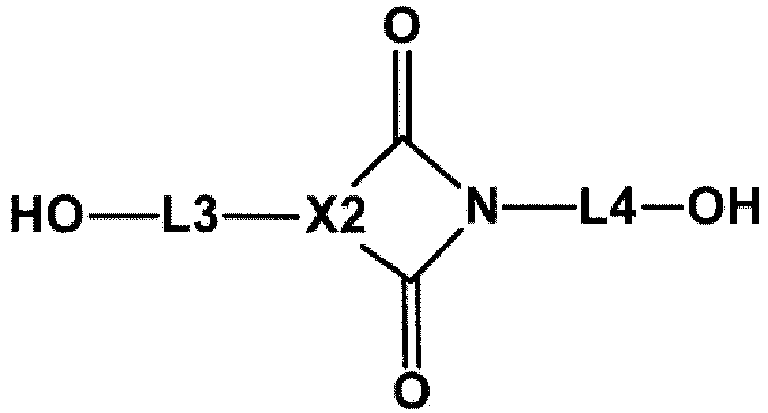
 wobei in den chemischen Formeln 12a, 12b und 12c,
X1 eines ist, das aus einem substituierten oder unsubstituierten aliphatischen Ring und einem substituierten oder unsubstituierten aromatischen Ring oder einer vierwertigen Gruppe, in der zwei oder mehr von ihnen durch eine Einfachbindung verknüpft sind; einem substituierten oder unsubstituierten geradkettigen oder verzweigten Alkylen; O oder CO ausgewählt ist,X2 eines ist, das aus einem substituierten oder unsubstituierten aliphatischen Ring und einem substituierten oder unsubstituierten aromatischen Ring oder einer dreiwertigen Gruppe, in der zwei oder mehr von ihnen durch eine Einfachbindung verknüpft sind; einem substituierten oder unsubstituierten geradkettigen oder verzweigten Alkylen; O oder CO ausgewählt ist,
L1 bis L6 gleich oder verschieden voneinander sind und jeweils eines sind, das aus einer Einfachbindung, einem substituierten oder unsubstituierten geradkettigen oder verzweigten Alkylen, einem substituierten oder unsubstituierten Cycloalkylen und einem substituierten oder unsubstituierten Arylen oder einer zweiwertigen Gruppe, in der zwei oder mehr von ihnen durch eine Einfachbindung verknüpft sind, ausgewählt ist. - Verfahren nach Anspruch 8, wobei der Carbonatvorläufer durch die folgende chemische Formel 13 dargestellt ist:
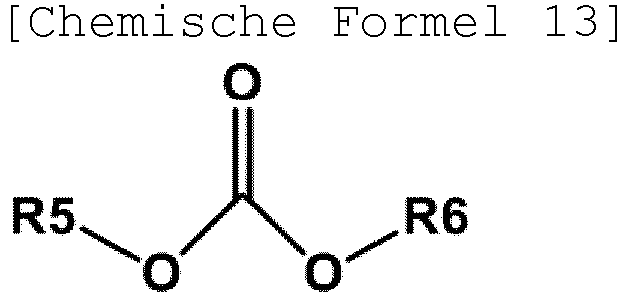
R5 und R6 gleich oder verschieden voneinander sind und jeweils unabhängig ein substituiertes oder unsubstituiertes geradkettiges oder verzweigtes Alkyl, ein substituiertes oder unsubstituiertes Cycloalkyl, ein substituiertes oder unsubstituiertes Aryl oder ein substituiertes oder unsubstituiertes Heteroaryl sind. - Verfahren nach Anspruch 8, wobei die Zusammensetzung ferner eine Verbindung der folgenden chemischen Formel 21 umfasst:
 W1 und W3 gleich oder verschieden voneinander sind und jeweils eine substituierte oder unsubstituierte zweiwertige aliphatische Kohlenwasserstoffgruppe, eine substituierte oder unsubstituierte zweiwertige Isosorbidgruppe, ein substituiertes oder unsubstituiertes Alkylen, ein substituiertes oder unsubstituiertes Cycloalkylen, ein substituiertes oder unsubstituiertes Arylen oder ein substituiertes oder unsubstituiertes Heteroarylen sind,W2 eine substituierte oder unsubstituierte zweiwertige aliphatische Kohlenwasserstoffgruppe, eine substituierte oder unsubstituierte zweiwertige Isosorbidgruppe, ein substituiertes oder unsubstituiertes Alkylen, ein substituiertes oder unsubstituiertes Cycloalkylen, ein substituiertes oder unsubstituiertes Arylen, ein substituiertes oder unsubstituiertes Heteroarylen, O, S, SO, SO2 oder CO ist, undk eine ganze Zahl von 0 bis 5 ist,
1 0 oder 1 ist, vorausgesetzt, dass, wenn W2 direkt an W3 gebunden ist, O, S, SO, SO2 oder CO ist, 1 1 ist, und wenn k 2 oder höher ist, die W2 gleich oder verschieden voneinander sind. - Verfahren nach Anspruch 10, wobei die chemische Formel 21 durch die folgende chemische Formel 31, 41, 51 oder 61 dargestellt ist:
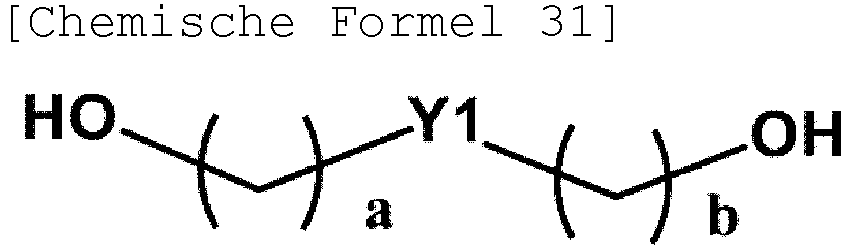


 Y1 und Y2 jeweils eine substituierte oder unsubstituierte zweiwertige aliphatische Kohlenwasserstoffgruppe, eine substituierte oder unsubstituierte zweiwertige Isosorbidgruppe, ein substituiertes oder unsubstituiertes Arylen oder ein substituiertes oder unsubstituiertes Heteroarylen sind,Y3 und Y4 jeweils ein substituiertes oder unsubstituiertes geradkettiges oder verzweigtes Alkylen, ein substituiertes oder unsubstituiertes Cycloalkylen, O, S, SO, SO2 oder CO sind, undR1 bis R4 gleich oder verschieden voneinander sind und jeweils Wasserstoff, ein Halogen, ein substituiertes oder unsubstituiertes Alkyl oder ein substituiertes oder unsubstituiertes Alkoxy sind,a und b jeweils eine ganze Zahl von 0 bis 4 sind,c, d, e und f jeweils eine ganze Zahl von 1 bis 4 sind, undg, h, i und j jeweils eine ganze Zahl von 0 bis 4 sind.
 - Zusammensetzung, umfassend das Polycarbonat nach einem der Ansprüche 1 bis 7.
- Formkörper, hergestellt aus einer Zusammensetzung, umfassend das Polycarbonat nach einem der Ansprüche 1 bis 7.
Applications Claiming Priority (2)
| Application Number | Priority Date | Filing Date | Title |
|---|---|---|---|
| KR1020210014001A KR102875404B1 (ko) | 2021-02-01 | 2021-02-01 | 폴리카보네이트 및 이의 제조방법 |
| PCT/KR2022/000529 WO2022164084A1 (ko) | 2021-02-01 | 2022-01-12 | 폴리카보네이트 및 이의 제조방법 |
Publications (3)
| Publication Number | Publication Date |
|---|---|
| EP4286451A1 EP4286451A1 (de) | 2023-12-06 |
| EP4286451A4 EP4286451A4 (de) | 2024-02-21 |
| EP4286451B1 true EP4286451B1 (de) | 2025-04-23 |
Family
ID=82653667
Family Applications (1)
| Application Number | Title | Priority Date | Filing Date |
|---|---|---|---|
| EP22746113.4A Active EP4286451B1 (de) | 2021-02-01 | 2022-01-12 | Polycarbonat und verfahren zur herstellung davon |
Country Status (7)
| Country | Link |
|---|---|
| US (1) | US20240117114A1 (de) |
| EP (1) | EP4286451B1 (de) |
| JP (1) | JP7554940B2 (de) |
| KR (1) | KR102875404B1 (de) |
| CN (1) | CN116635451A (de) |
| TW (1) | TWI809658B (de) |
| WO (1) | WO2022164084A1 (de) |
Families Citing this family (2)
| Publication number | Priority date | Publication date | Assignee | Title |
|---|---|---|---|---|
| JP2024024769A (ja) * | 2022-08-10 | 2024-02-26 | 帝人株式会社 | ポリカーボネート樹脂およびそれからなる成形品 |
| WO2026026973A1 (zh) * | 2024-08-01 | 2026-02-05 | 苏州百递博远生物科技有限公司 | 聚碳酸酯核酸复合物及其应用 |
Family Cites Families (18)
| Publication number | Priority date | Publication date | Assignee | Title |
|---|---|---|---|---|
| US4393190A (en) * | 1981-09-21 | 1983-07-12 | General Electric Company | Carbonate copolymers prepared from imide reactants |
| DE19704506A1 (de) * | 1997-02-06 | 1998-08-13 | Basf Ag | Chiral nematische Polyester |
| DE19749123A1 (de) * | 1997-11-06 | 1999-05-12 | Basf Ag | Cholesterische Oligomere mit vernetzbaren Endgruppen |
| US6096853A (en) * | 1998-12-21 | 2000-08-01 | General Electric Company | Synthesis of phenolic monomers containing imide or diimide moieties and high heat carbonate polymers prepared therefrom |
| US6608163B2 (en) * | 2001-01-17 | 2003-08-19 | General Electric Company | Polycarbonate copolymers having improved hydrolytic stability |
| KR100561337B1 (ko) | 2002-05-29 | 2006-03-16 | 주식회사 엘지화학 | 고분자량의 폴리카보네이트 수지의 제조방법 |
| US7081511B2 (en) * | 2004-04-05 | 2006-07-25 | Az Electronic Materials Usa Corp. | Process for making polyesters |
| US20050288405A1 (en) * | 2004-06-29 | 2005-12-29 | General Electric Company | Copolymers containing diimide moieties and blends thereof |
| US7858728B2 (en) * | 2007-10-19 | 2010-12-28 | Sabic Innovative Plastics Ip B.V. | Polycarbonate resins method of manufacture, and articles formed therefrom |
| US8273849B2 (en) * | 2009-12-30 | 2012-09-25 | Sabic Innovative Plastics Ip B.V. | Isosorbide-based polycarbonates, method of making, and articles formed therefrom |
| US8372943B2 (en) * | 2010-12-10 | 2013-02-12 | Sabic Innovative Plastics Ip B.V. | Isosorbide—containing polycarbonates and their preparation |
| DE202015009117U1 (de) * | 2014-06-20 | 2016-10-24 | Google Inc. | Integration von Online-Navigationsdaten mit gecachten Navigationsdaten während der aktiven Navigation |
| KR20170028831A (ko) * | 2015-09-04 | 2017-03-14 | 주식회사 엘지화학 | 코폴리카보네이트 및 이의 제조방법 |
| WO2017057521A1 (ja) * | 2015-09-29 | 2017-04-06 | 三菱化学株式会社 | ポリカーボネート樹脂組成物、およびその成形体 |
| CN105801830B (zh) * | 2016-05-03 | 2018-01-19 | 中国航空工业集团公司北京航空材料研究院 | 一种耐高温聚碳酸酯及其制备方法 |
| KR102308714B1 (ko) * | 2018-09-14 | 2021-10-01 | 주식회사 엘지화학 | 디올 화합물, 폴리카보네이트 및 이의 제조방법 |
| KR102199925B1 (ko) * | 2019-06-03 | 2021-01-11 | 주식회사 삼양사 | 언하이드로헥시톨의 에테르 디올 유래 폴리카보네이트 디올 및 그 제조방법, 및 그로부터 제조된 폴리우레탄 및 이를 포함하는 접착제 |
| KR102622819B1 (ko) | 2019-07-29 | 2024-01-08 | 에스케이텔레콤 주식회사 | 차량 통신 지원 장치 및 방법 |
-
2021
- 2021-02-01 KR KR1020210014001A patent/KR102875404B1/ko active Active
-
2022
- 2022-01-12 JP JP2023539200A patent/JP7554940B2/ja active Active
- 2022-01-12 WO PCT/KR2022/000529 patent/WO2022164084A1/ko not_active Ceased
- 2022-01-12 CN CN202280008493.6A patent/CN116635451A/zh active Pending
- 2022-01-12 EP EP22746113.4A patent/EP4286451B1/de active Active
- 2022-01-12 US US18/273,523 patent/US20240117114A1/en active Pending
- 2022-01-14 TW TW111101619A patent/TWI809658B/zh active
Also Published As
| Publication number | Publication date |
|---|---|
| US20240117114A1 (en) | 2024-04-11 |
| TW202235483A (zh) | 2022-09-16 |
| CN116635451A (zh) | 2023-08-22 |
| EP4286451A1 (de) | 2023-12-06 |
| JP7554940B2 (ja) | 2024-09-20 |
| TWI809658B (zh) | 2023-07-21 |
| JP2024501310A (ja) | 2024-01-11 |
| EP4286451A4 (de) | 2024-02-21 |
| WO2022164084A1 (ko) | 2022-08-04 |
| KR20220110957A (ko) | 2022-08-09 |
| KR102875404B1 (ko) | 2025-10-22 |
Similar Documents
| Publication | Publication Date | Title |
|---|---|---|
| KR101803960B1 (ko) | 코폴리카보네이트 수지 조성물 및 이를 포함하는 물품 | |
| EP4286451B1 (de) | Polycarbonat und verfahren zur herstellung davon | |
| KR101637399B1 (ko) | 폴리오르가노실록산 화합물 및 이를 포함하는 코폴리카보네이트 수지 | |
| KR102855167B1 (ko) | 폴리카보네이트 및 이의 제조방법 | |
| EP3406650B1 (de) | Copolycarbonat und harzzusammensetzung damit | |
| JP7688711B2 (ja) | ポリカーボネートおよびその製造方法 | |
| JP7607134B2 (ja) | ポリカーボネートおよびその製造方法 | |
| EP3381980B1 (de) | Polycarbonatharzzusammensetzung | |
| KR102907312B1 (ko) | 폴리카보네이트 및 이로부터 형성된 성형품 | |
| KR102865742B1 (ko) | 폴리카보네이트 및 이의 제조방법 | |
| KR102913369B1 (ko) | 폴리카보네이트 및 이로부터 형성된 성형품 | |
| KR101709829B1 (ko) | 폴리오르가노실록산, 제조방법 및 이를 포함하는 코폴리카보네이트 수지 | |
| KR20220115343A (ko) | 폴리카보네이트 및 이의 제조방법 | |
| KR101566837B1 (ko) | 폴리오르가노실록산 화합물의 제조방법 및 이를 포함하는 코폴리카보네이트 수지 |
Legal Events
| Date | Code | Title | Description |
|---|---|---|---|
| STAA | Information on the status of an ep patent application or granted ep patent |
Free format text: STATUS: THE INTERNATIONAL PUBLICATION HAS BEEN MADE |
|
| PUAI | Public reference made under article 153(3) epc to a published international application that has entered the european phase |
Free format text: ORIGINAL CODE: 0009012 |
|
| STAA | Information on the status of an ep patent application or granted ep patent |
Free format text: STATUS: REQUEST FOR EXAMINATION WAS MADE |
|
| 17P | Request for examination filed |
Effective date: 20230622 |
|
| AK | Designated contracting states |
Kind code of ref document: A1 Designated state(s): AL AT BE BG CH CY CZ DE DK EE ES FI FR GB GR HR HU IE IS IT LI LT LU LV MC MK MT NL NO PL PT RO RS SE SI SK SM TR |
|
| A4 | Supplementary search report drawn up and despatched |
Effective date: 20240123 |
|
| RIC1 | Information provided on ipc code assigned before grant |
Ipc: C08L 69/00 20060101ALI20240118BHEP Ipc: C08G 64/30 20060101ALI20240118BHEP Ipc: C08G 64/16 20060101AFI20240118BHEP |
|
| DAV | Request for validation of the european patent (deleted) | ||
| DAX | Request for extension of the european patent (deleted) | ||
| GRAP | Despatch of communication of intention to grant a patent |
Free format text: ORIGINAL CODE: EPIDOSNIGR1 |
|
| STAA | Information on the status of an ep patent application or granted ep patent |
Free format text: STATUS: GRANT OF PATENT IS INTENDED |
|
| INTG | Intention to grant announced |
Effective date: 20250204 |
|
| GRAS | Grant fee paid |
Free format text: ORIGINAL CODE: EPIDOSNIGR3 |
|
| GRAA | (expected) grant |
Free format text: ORIGINAL CODE: 0009210 |
|
| STAA | Information on the status of an ep patent application or granted ep patent |
Free format text: STATUS: THE PATENT HAS BEEN GRANTED |
|
| AK | Designated contracting states |
Kind code of ref document: B1 Designated state(s): AL AT BE BG CH CY CZ DE DK EE ES FI FR GB GR HR HU IE IS IT LI LT LU LV MC MK MT NL NO PL PT RO RS SE SI SK SM TR |
|
| REG | Reference to a national code |
Ref country code: GB Ref legal event code: FG4D |
|
| REG | Reference to a national code |
Ref country code: CH Ref legal event code: EP |
|
| REG | Reference to a national code |
Ref country code: DE Ref legal event code: R096 Ref document number: 602022013649 Country of ref document: DE |
|
| REG | Reference to a national code |
Ref country code: IE Ref legal event code: FG4D |
|
| REG | Reference to a national code |
Ref country code: NL Ref legal event code: MP Effective date: 20250423 |
|
| PG25 | Lapsed in a contracting state [announced via postgrant information from national office to epo] |
Ref country code: NL Free format text: LAPSE BECAUSE OF FAILURE TO SUBMIT A TRANSLATION OF THE DESCRIPTION OR TO PAY THE FEE WITHIN THE PRESCRIBED TIME-LIMIT Effective date: 20250423 |
|
| REG | Reference to a national code |
Ref country code: AT Ref legal event code: MK05 Ref document number: 1787733 Country of ref document: AT Kind code of ref document: T Effective date: 20250423 |
|
| PG25 | Lapsed in a contracting state [announced via postgrant information from national office to epo] |
Ref country code: ES Free format text: LAPSE BECAUSE OF FAILURE TO SUBMIT A TRANSLATION OF THE DESCRIPTION OR TO PAY THE FEE WITHIN THE PRESCRIBED TIME-LIMIT Effective date: 20250423 Ref country code: FI Free format text: LAPSE BECAUSE OF FAILURE TO SUBMIT A TRANSLATION OF THE DESCRIPTION OR TO PAY THE FEE WITHIN THE PRESCRIBED TIME-LIMIT Effective date: 20250423 Ref country code: PT Free format text: LAPSE BECAUSE OF FAILURE TO SUBMIT A TRANSLATION OF THE DESCRIPTION OR TO PAY THE FEE WITHIN THE PRESCRIBED TIME-LIMIT Effective date: 20250825 |
|
| REG | Reference to a national code |
Ref country code: LT Ref legal event code: MG9D |
|
| PG25 | Lapsed in a contracting state [announced via postgrant information from national office to epo] |
Ref country code: NO Free format text: LAPSE BECAUSE OF FAILURE TO SUBMIT A TRANSLATION OF THE DESCRIPTION OR TO PAY THE FEE WITHIN THE PRESCRIBED TIME-LIMIT Effective date: 20250723 Ref country code: GR Free format text: LAPSE BECAUSE OF FAILURE TO SUBMIT A TRANSLATION OF THE DESCRIPTION OR TO PAY THE FEE WITHIN THE PRESCRIBED TIME-LIMIT Effective date: 20250724 |
|
| PG25 | Lapsed in a contracting state [announced via postgrant information from national office to epo] |
Ref country code: PL Free format text: LAPSE BECAUSE OF FAILURE TO SUBMIT A TRANSLATION OF THE DESCRIPTION OR TO PAY THE FEE WITHIN THE PRESCRIBED TIME-LIMIT Effective date: 20250423 |
|
| PG25 | Lapsed in a contracting state [announced via postgrant information from national office to epo] |
Ref country code: BG Free format text: LAPSE BECAUSE OF FAILURE TO SUBMIT A TRANSLATION OF THE DESCRIPTION OR TO PAY THE FEE WITHIN THE PRESCRIBED TIME-LIMIT Effective date: 20250423 |
|
| PG25 | Lapsed in a contracting state [announced via postgrant information from national office to epo] |
Ref country code: HR Free format text: LAPSE BECAUSE OF FAILURE TO SUBMIT A TRANSLATION OF THE DESCRIPTION OR TO PAY THE FEE WITHIN THE PRESCRIBED TIME-LIMIT Effective date: 20250423 |
|
| PG25 | Lapsed in a contracting state [announced via postgrant information from national office to epo] |
Ref country code: AT Free format text: LAPSE BECAUSE OF FAILURE TO SUBMIT A TRANSLATION OF THE DESCRIPTION OR TO PAY THE FEE WITHIN THE PRESCRIBED TIME-LIMIT Effective date: 20250423 |
|
| PG25 | Lapsed in a contracting state [announced via postgrant information from national office to epo] |
Ref country code: RS Free format text: LAPSE BECAUSE OF FAILURE TO SUBMIT A TRANSLATION OF THE DESCRIPTION OR TO PAY THE FEE WITHIN THE PRESCRIBED TIME-LIMIT Effective date: 20250723 |
|
| PG25 | Lapsed in a contracting state [announced via postgrant information from national office to epo] |
Ref country code: IS Free format text: LAPSE BECAUSE OF FAILURE TO SUBMIT A TRANSLATION OF THE DESCRIPTION OR TO PAY THE FEE WITHIN THE PRESCRIBED TIME-LIMIT Effective date: 20250823 |
|
| PG25 | Lapsed in a contracting state [announced via postgrant information from national office to epo] |
Ref country code: LV Free format text: LAPSE BECAUSE OF FAILURE TO SUBMIT A TRANSLATION OF THE DESCRIPTION OR TO PAY THE FEE WITHIN THE PRESCRIBED TIME-LIMIT Effective date: 20250423 |
|
| PGFP | Annual fee paid to national office [announced via postgrant information from national office to epo] |
Ref country code: GB Payment date: 20251222 Year of fee payment: 5 |
|
| PG25 | Lapsed in a contracting state [announced via postgrant information from national office to epo] |
Ref country code: DK Free format text: LAPSE BECAUSE OF FAILURE TO SUBMIT A TRANSLATION OF THE DESCRIPTION OR TO PAY THE FEE WITHIN THE PRESCRIBED TIME-LIMIT Effective date: 20250423 Ref country code: SM Free format text: LAPSE BECAUSE OF FAILURE TO SUBMIT A TRANSLATION OF THE DESCRIPTION OR TO PAY THE FEE WITHIN THE PRESCRIBED TIME-LIMIT Effective date: 20250423 |
|
| PGFP | Annual fee paid to national office [announced via postgrant information from national office to epo] |
Ref country code: FR Payment date: 20251223 Year of fee payment: 5 |
|
| PG25 | Lapsed in a contracting state [announced via postgrant information from national office to epo] |
Ref country code: CZ Free format text: LAPSE BECAUSE OF FAILURE TO SUBMIT A TRANSLATION OF THE DESCRIPTION OR TO PAY THE FEE WITHIN THE PRESCRIBED TIME-LIMIT Effective date: 20250423 |
|
| PG25 | Lapsed in a contracting state [announced via postgrant information from national office to epo] |
Ref country code: EE Free format text: LAPSE BECAUSE OF FAILURE TO SUBMIT A TRANSLATION OF THE DESCRIPTION OR TO PAY THE FEE WITHIN THE PRESCRIBED TIME-LIMIT Effective date: 20250423 |
|
| REG | Reference to a national code |
Ref country code: DE Ref legal event code: R097 Ref document number: 602022013649 Country of ref document: DE |
|
| PG25 | Lapsed in a contracting state [announced via postgrant information from national office to epo] |
Ref country code: SK Free format text: LAPSE BECAUSE OF FAILURE TO SUBMIT A TRANSLATION OF THE DESCRIPTION OR TO PAY THE FEE WITHIN THE PRESCRIBED TIME-LIMIT Effective date: 20250423 |
|
| PG25 | Lapsed in a contracting state [announced via postgrant information from national office to epo] |
Ref country code: IT Free format text: LAPSE BECAUSE OF FAILURE TO SUBMIT A TRANSLATION OF THE DESCRIPTION OR TO PAY THE FEE WITHIN THE PRESCRIBED TIME-LIMIT Effective date: 20250423 |
|
| PLBE | No opposition filed within time limit |
Free format text: ORIGINAL CODE: 0009261 |
|
| STAA | Information on the status of an ep patent application or granted ep patent |
Free format text: STATUS: NO OPPOSITION FILED WITHIN TIME LIMIT |
|
| REG | Reference to a national code |
Ref country code: CH Ref legal event code: L10 Free format text: ST27 STATUS EVENT CODE: U-0-0-L10-L00 (AS PROVIDED BY THE NATIONAL OFFICE) Effective date: 20260304 |
|
| PG25 | Lapsed in a contracting state [announced via postgrant information from national office to epo] |
Ref country code: RO Free format text: LAPSE BECAUSE OF FAILURE TO SUBMIT A TRANSLATION OF THE DESCRIPTION OR TO PAY THE FEE WITHIN THE PRESCRIBED TIME-LIMIT Effective date: 20250423 |
|
| 26N | No opposition filed |
Effective date: 20260126 |
|
| PGFP | Annual fee paid to national office [announced via postgrant information from national office to epo] |
Ref country code: DE Payment date: 20251222 Year of fee payment: 5 |