EP4274956B1 - Gasdosierventil zur dosierten abgabe von gasförmigem kraftstoff - Google Patents
Gasdosierventil zur dosierten abgabe von gasförmigem kraftstoff Download PDFInfo
- Publication number
- EP4274956B1 EP4274956B1 EP21839397.3A EP21839397A EP4274956B1 EP 4274956 B1 EP4274956 B1 EP 4274956B1 EP 21839397 A EP21839397 A EP 21839397A EP 4274956 B1 EP4274956 B1 EP 4274956B1
- Authority
- EP
- European Patent Office
- Prior art keywords
- gas
- valve element
- sleeve
- metering valve
- opening
- Prior art date
- Legal status (The legal status is an assumption and is not a legal conclusion. Google has not performed a legal analysis and makes no representation as to the accuracy of the status listed.)
- Active
Links
Images

Classifications
-
- F—MECHANICAL ENGINEERING; LIGHTING; HEATING; WEAPONS; BLASTING
- F02—COMBUSTION ENGINES; HOT-GAS OR COMBUSTION-PRODUCT ENGINE PLANTS
- F02M—SUPPLYING COMBUSTION ENGINES IN GENERAL WITH COMBUSTIBLE MIXTURES OR CONSTITUENTS THEREOF
- F02M21/00—Apparatus for supplying engines with non-liquid fuels, e.g. gaseous fuels stored in liquid form
- F02M21/02—Apparatus for supplying engines with non-liquid fuels, e.g. gaseous fuels stored in liquid form for gaseous fuels
- F02M21/0218—Details on the gaseous fuel supply system, e.g. tanks, valves, pipes, pumps, rails, injectors or mixers
- F02M21/0248—Injectors
- F02M21/0251—Details of actuators therefor
- F02M21/0254—Electric actuators, e.g. solenoid or piezoelectric
-
- F—MECHANICAL ENGINEERING; LIGHTING; HEATING; WEAPONS; BLASTING
- F02—COMBUSTION ENGINES; HOT-GAS OR COMBUSTION-PRODUCT ENGINE PLANTS
- F02M—SUPPLYING COMBUSTION ENGINES IN GENERAL WITH COMBUSTIBLE MIXTURES OR CONSTITUENTS THEREOF
- F02M21/00—Apparatus for supplying engines with non-liquid fuels, e.g. gaseous fuels stored in liquid form
- F02M21/02—Apparatus for supplying engines with non-liquid fuels, e.g. gaseous fuels stored in liquid form for gaseous fuels
- F02M21/0203—Apparatus for supplying engines with non-liquid fuels, e.g. gaseous fuels stored in liquid form for gaseous fuels characterised by the type of gaseous fuel
- F02M21/0206—Non-hydrocarbon fuels, e.g. hydrogen, ammonia or carbon monoxide
-
- F—MECHANICAL ENGINEERING; LIGHTING; HEATING; WEAPONS; BLASTING
- F02—COMBUSTION ENGINES; HOT-GAS OR COMBUSTION-PRODUCT ENGINE PLANTS
- F02M—SUPPLYING COMBUSTION ENGINES IN GENERAL WITH COMBUSTIBLE MIXTURES OR CONSTITUENTS THEREOF
- F02M21/00—Apparatus for supplying engines with non-liquid fuels, e.g. gaseous fuels stored in liquid form
- F02M21/02—Apparatus for supplying engines with non-liquid fuels, e.g. gaseous fuels stored in liquid form for gaseous fuels
- F02M21/0218—Details on the gaseous fuel supply system, e.g. tanks, valves, pipes, pumps, rails, injectors or mixers
- F02M21/0248—Injectors
- F02M21/0257—Details of the valve closing elements, e.g. valve seats, stems or arrangement of flow passages
- F02M21/026—Lift valves, i.e. stem operated valves
- F02M21/0269—Outwardly opening valves, e.g. poppet valves
-
- F—MECHANICAL ENGINEERING; LIGHTING; HEATING; WEAPONS; BLASTING
- F02—COMBUSTION ENGINES; HOT-GAS OR COMBUSTION-PRODUCT ENGINE PLANTS
- F02M—SUPPLYING COMBUSTION ENGINES IN GENERAL WITH COMBUSTIBLE MIXTURES OR CONSTITUENTS THEREOF
- F02M51/00—Fuel-injection apparatus characterised by being operated electrically
- F02M51/06—Injectors peculiar thereto with means directly operating the valve needle
- F02M51/061—Injectors peculiar thereto with means directly operating the valve needle using electromagnetic operating means
- F02M51/0625—Injectors peculiar thereto with means directly operating the valve needle using electromagnetic operating means characterised by arrangement of mobile armatures
- F02M51/0664—Injectors peculiar thereto with means directly operating the valve needle using electromagnetic operating means characterised by arrangement of mobile armatures having a cylindrically or partly cylindrically shaped armature, e.g. entering the winding; having a plate-shaped or undulated armature entering the winding
- F02M51/0667—Injectors peculiar thereto with means directly operating the valve needle using electromagnetic operating means characterised by arrangement of mobile armatures having a cylindrically or partly cylindrically shaped armature, e.g. entering the winding; having a plate-shaped or undulated armature entering the winding the armature acting as a valve or having a short valve body attached thereto
-
- F—MECHANICAL ENGINEERING; LIGHTING; HEATING; WEAPONS; BLASTING
- F02—COMBUSTION ENGINES; HOT-GAS OR COMBUSTION-PRODUCT ENGINE PLANTS
- F02M—SUPPLYING COMBUSTION ENGINES IN GENERAL WITH COMBUSTIBLE MIXTURES OR CONSTITUENTS THEREOF
- F02M51/00—Fuel-injection apparatus characterised by being operated electrically
- F02M51/06—Injectors peculiar thereto with means directly operating the valve needle
- F02M51/061—Injectors peculiar thereto with means directly operating the valve needle using electromagnetic operating means
- F02M51/0625—Injectors peculiar thereto with means directly operating the valve needle using electromagnetic operating means characterised by arrangement of mobile armatures
- F02M51/0664—Injectors peculiar thereto with means directly operating the valve needle using electromagnetic operating means characterised by arrangement of mobile armatures having a cylindrically or partly cylindrically shaped armature, e.g. entering the winding; having a plate-shaped or undulated armature entering the winding
- F02M51/0671—Injectors peculiar thereto with means directly operating the valve needle using electromagnetic operating means characterised by arrangement of mobile armatures having a cylindrically or partly cylindrically shaped armature, e.g. entering the winding; having a plate-shaped or undulated armature entering the winding the armature having an elongated valve body attached thereto
- F02M51/0682—Injectors peculiar thereto with means directly operating the valve needle using electromagnetic operating means characterised by arrangement of mobile armatures having a cylindrically or partly cylindrically shaped armature, e.g. entering the winding; having a plate-shaped or undulated armature entering the winding the armature having an elongated valve body attached thereto the body being hollow and its interior communicating with the fuel flow
-
- F—MECHANICAL ENGINEERING; LIGHTING; HEATING; WEAPONS; BLASTING
- F02—COMBUSTION ENGINES; HOT-GAS OR COMBUSTION-PRODUCT ENGINE PLANTS
- F02M—SUPPLYING COMBUSTION ENGINES IN GENERAL WITH COMBUSTIBLE MIXTURES OR CONSTITUENTS THEREOF
- F02M2200/00—Details of fuel-injection apparatus, not otherwise provided for
- F02M2200/02—Fuel-injection apparatus having means for reducing wear
-
- F—MECHANICAL ENGINEERING; LIGHTING; HEATING; WEAPONS; BLASTING
- F02—COMBUSTION ENGINES; HOT-GAS OR COMBUSTION-PRODUCT ENGINE PLANTS
- F02M—SUPPLYING COMBUSTION ENGINES IN GENERAL WITH COMBUSTIBLE MIXTURES OR CONSTITUENTS THEREOF
- F02M2200/00—Details of fuel-injection apparatus, not otherwise provided for
- F02M2200/70—Linkage between actuator and actuated element, e.g. between piezoelectric actuator and needle valve or pump plunger
- F02M2200/701—Linkage between actuator and actuated element, e.g. between piezoelectric actuator and needle valve or pump plunger mechanical
-
- Y—GENERAL TAGGING OF NEW TECHNOLOGICAL DEVELOPMENTS; GENERAL TAGGING OF CROSS-SECTIONAL TECHNOLOGIES SPANNING OVER SEVERAL SECTIONS OF THE IPC; TECHNICAL SUBJECTS COVERED BY FORMER USPC CROSS-REFERENCE ART COLLECTIONS [XRACs] AND DIGESTS
- Y02—TECHNOLOGIES OR APPLICATIONS FOR MITIGATION OR ADAPTATION AGAINST CLIMATE CHANGE
- Y02T—CLIMATE CHANGE MITIGATION TECHNOLOGIES RELATED TO TRANSPORTATION
- Y02T10/00—Road transport of goods or passengers
- Y02T10/10—Internal combustion engine [ICE] based vehicles
- Y02T10/30—Use of alternative fuels, e.g. biofuels
Definitions
- the invention relates to a gas metering valve as used for the metered release of gaseous fuel, in particular for introducing gaseous fuel into a combustion chamber of an internal combustion engine
- Gas metering valves are known from the state of the art in which gaseous fuel can be metered and released at short intervals directly into the combustion chamber of an internal combustion engine or into the intake tract of an internal combustion engine.
- Various gaseous fuels can be metered, in particular hydrogen.
- the metered release of hydrogen places special demands on the metering valve because, on the one hand, hydrogen is chemically very reactive, which requires correspondingly resistant materials.
- hydrogen diffuses through very small gaps due to the small H2 molecules and is therefore difficult to seal completely.
- a purely metallic seal is therefore usually not sufficient to completely seal hydrogen, so the use of elastic materials for sealing is necessary, i.e. elastomers such as plastics or rubber.
- US 10 036 352 B2 discloses a previously published gas metering valve for the metered release of gaseous fuel.
- Both valve elements are controlled by a single electromagnet that acts on the first valve element, with the first valve element taking the second valve element with it as it opens. Since the two valve elements should be as far apart as possible, a coupler element that transmits the movement is present between the first valve element and the second valve element, for example in the form of a coupler sleeve. All moving components are guided within the housing, but it must be noted that the gaseous fuel has no lubricating properties and the guide gaps of the valve elements must therefore be relatively large so that the components in the housing do not jam or wear excessively.
- the gas metering valve according to the invention has the advantage that the valve elements are guided exactly within the gas space without causing increased wear between the housing and the valve elements or the coupler sleeve and at the same time the assembly of the gas metering valve is not impaired.
- the gas metering valve has a housing in which a gas chamber with an inlet opening and an outlet opening is formed.
- a valve element is arranged in the gas chamber so that it can move longitudinally, which opens and closes the inlet opening through its longitudinal movement, the valve element being movable by an electrical actuator.
- a nozzle needle is arranged in the gas chamber, which interacts with a nozzle seat to open and close the outlet opening, a coupler sleeve being arranged between the valve element and the nozzle needle, which transfers the movement of the valve element to the nozzle needle.
- the coupler sleeve is received in a receiving opening of the valve element without any play.
- valve element which interacts with the electric actuator, is passed on to the nozzle needle via the coupler sleeve. Since the coupler sleeve is held in the receiving opening without any play, the valve element and the coupler sleeve stabilize each other, preventing the two components from becoming misaligned within the housing. Despite this, the gas metering valve is easy to assemble, since both components can be manufactured separately and are only plugged together and thus firmly connected during assembly.
- the gas flow is guided from the inlet opening to the outlet opening through the coupler sleeve.
- the coupler sleeve is advantageously designed as a hollow cylinder and the receiving opening on the valve element is designed as a blind bore.
- the outer diameter of the section of the coupler sleeve that is arranged within the receiving opening is 1 to 10 ⁇ m larger than the inner diameter of the receiving opening when unassembled in order to form a firm connection over the service life of the metering valve.
- the coupler sleeve has a first sleeve section and a second sleeve section, the first sleeve section being made of a ferromagnetic material and being received in the receiving opening of the valve element, while the second sleeve section is made of a non-ferromagnetic material, both sleeve sections being firmly connected to one another. Since the first valve element serves as a magnet armature when the electrical actuator is designed as an electromagnet, a ferromagnetic coupler sleeve amplifies the effect of the electromagnet on the magnet armature, i.e. the first valve element.
- the entire coupler sleeve is made of ferromagnetic material, the magnetic field is scattered too strongly, so that the effective magnetic force on the valve element is reduced. Since only the sleeve section that is arranged inside the valve element is ferromagnetic, this results in an amplification of the magnetic force without generating a stray field, which directs the magnetic field into undesirable areas of the housing.
- the two sleeve sections are made of metallic materials and the firm connection is realized by a welded joint, so that both sleeve sections are firmly and permanently connected to each other.
- the coupler sleeve is guided laterally in the gas chamber on two guide sections that are axially spaced apart from one another. Since there is a fixed connection with the valve element, the valve element can also be guided through the coupler sleeve if a sufficiently large gap is formed between the outer wall of the valve element and the housing or the wall of the gas chamber. This eliminates friction and thus excessive wear between the valve element and the wall of the gas chamber.
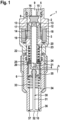
- FIG. 1 a gas metering valve according to the invention is shown in longitudinal section.
- the gas metering valve has a housing 1 which comprises a holding body 2, a magnet body 3, a nozzle body 4 and a connecting body 5, which are clamped against each other in a gas-tight manner by means of a clamping nut 6 and further clamping elements not shown in the drawing.
- a connection (not shown in the drawing) via which the gaseous fuel is guided into a gas chamber 8 which is formed in the holding body 2, the magnet body 3 and the nozzle body 4.
- the gas chamber 8 has an inlet opening 9 and an outlet opening 10, the inlet opening 9 in the drawing of the Figure 1 at the upper end of the gas metering valve, while the outlet opening 10 is shown at the lower end.
- a valve element 12 is arranged in the gas chamber 8 so as to be longitudinally displaceable.
- the valve element 12 has a sealing surface 16 with which the valve element 12 interacts with a valve seat 15 to open and close the inlet opening 9, an elastomer being applied to the sealing surface 16 in order to seal the inlet opening 9 gas-tight against the gas chamber 8.
- Several oblique bores 13 are formed in the valve element 12, through which gaseous fuel can be fed into a receiving opening 14 which is designed as a blind bore.
- the valve element 12 is guided in a first guide section 17 in the gas chamber 8, wherein the first guide section 17 comprises, for example, a hardened sleeve which reduces the friction between the valve element 12 and the wall of the gas chamber 8.
- the coupler sleeve 20 has several openings 21 at its outlet end through which the gaseous fuel can exit and flow further in the direction of the outlet opening 10.
- the outer diameter of the coupler sleeve 20 is dimensioned such that it is accommodated in the receiving opening 14 without play, so that a firm connection is formed between the valve element 12 and the coupler sleeve 20.
- the coupler sleeve 20 is surrounded by a coupler spring 22, which is supported at one end on a support ring 23 which is fastened to the coupler sleeve 20 or is formed integrally therewith, and which is supported at the other end on a spring support ring 25 which is supported on the nozzle body 4 via a support element 26, so that a force is exerted on the coupler sleeve 20 and thus also on the valve element 12 in the direction of the inlet opening 9 via the prestressed coupler spring 22.
- An electromagnet 18 is used to move the valve element 12, which is arranged in the magnet body 3 and surrounds the valve element 12.
- the holding body 2 has a thin turn 19, i.e. a tapered section in the holding body 2, so that the magnetic force on the valve element 12 is optimized.
- the coupler sleeve 20 is guided in a second guide section 24 within the housing, so that the combination of valve element 12 and coupler sleeve 20 is guided over the first guide section 17 and the second guide section 24. This ensures a low-friction movement of the valve element 12 and coupler sleeve 20.
- a nozzle needle 30 is also arranged so as to be longitudinally displaceable, which comprises a shaft 31 and a valve plate 32.
- a sealing surface 36 is formed on the valve plate 32, with which the valve plate 32 can be connected to a Nozzle seat 37 to open and close the outlet opening 10.
- the nozzle needle 30 is surrounded by a nozzle spring 33, which is supported at one end on a shoulder 34 in the gas chamber 8 and at the other end on a spring plate 35, which is firmly connected to the nozzle needle 30. This results in a longitudinal force on the nozzle needle 31 in the direction of the inlet opening 9 via the pre-tensioned nozzle spring 33.
- the coupler sleeve 20 and the nozzle needle 30 are spaced apart from one another, ie a distance h is formed between the outlet-side end of the coupler sleeve 20 and the end face of the nozzle needle 30. This distance serves to compensate for thermal expansions that are unavoidable during operation of the gas dosing valve.
- the gas metering valve works as follows: By energizing the electromagnet 18, the valve element 12 is pulled away from the valve seat 15 so that the inlet opening 9 is opened and gaseous fuel flows into the gas chamber 8. The gaseous fuel reaches the receiving opening 14 via the transverse bores 13 and thus into the coupler sleeve 20, from where the gaseous fuel flows further in the direction of the outlet opening 10. The movement of the valve element 12 also moves the coupler sleeve 20 in the direction of the outlet opening 10 until it comes into contact with the nozzle needle 30.
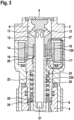
- FIG. 2 A further embodiment of the gas metering valve according to the invention is shown in an enlarged view of the coupler sleeve 20.
- the coupler sleeve 20 here comprises a first sleeve section 120 and a second section 220, wherein the first sleeve section 120 is arranged within the receiving opening 14.
- the first sleeve section 120 is made of a ferromagnetic material
- the second sleeve section 220 is made of a non-magnetic material. Both sleeve sections 120, 220 are firmly connected to one another via a welded connection 28.
- the first sleeve section is ferromagnetic and firmly connected to the valve element 12, a stronger magnetic force is exerted on the valve element 12, thus enabling a faster movement of the valve element 12. If the entire coupler sleeve 22 were made of a ferromagnetic material, the magnetic field of the electromagnet 18 would be scattered, thus reducing the effective magnetic force on the valve element 12.
- FIG 3 shows a further embodiment of the gas metering valve according to the invention.
- the combination of valve element 12 and coupler sleeve 20 is no longer guided via a first guide section on the valve element 12, but rather via a first guide section 17' of a coupler sleeve, so that the entire guidance of the combination of valve element 12 and coupler sleeve 20 takes place via the coupler sleeve 20.
- the two guide sections 17' and 24 on the coupler sleeve ensure guidance of the valve element 12, which has correspondingly large gaps between its outside and the wall of the gas space, so that contact and thus wear between the valve element 12 and the wall of the gas space 8 does not occur.
- Figure 3 on the right side the magnetic field lines 27 of the electromagnet 18 and their approximate course within the gas dosing valve.
Landscapes
- Engineering & Computer Science (AREA)
- Chemical & Material Sciences (AREA)
- General Engineering & Computer Science (AREA)
- Combustion & Propulsion (AREA)
- Mechanical Engineering (AREA)
- Chemical Kinetics & Catalysis (AREA)
- General Chemical & Material Sciences (AREA)
- Oil, Petroleum & Natural Gas (AREA)
- Electromagnetism (AREA)
- Physics & Mathematics (AREA)
- Analytical Chemistry (AREA)
- Magnetically Actuated Valves (AREA)
- Fuel-Injection Apparatus (AREA)
- Measuring Volume Flow (AREA)
- Lift Valve (AREA)
Description
- Die Erfindung betrifft ein Gasdosierventil, wie es zur dosierten Abgabe von gasförmigem Kraftstoff Verwendung findet, insbesondere zur Einbringung von gasförmigem Kraftstoff in einen Brennraum einer Brennkraftmaschine
- Aus dem Stand der Technik sind Gasdosierventile bekannt, bei denen gasförmiger Brennstoff dosiert und in kurzen Zeitabständen direkt in einen Brennraum einer Brennkraftmaschine oder auch in einen Ansaugtrakt einer Brennkraftmaschine abgegeben werden kann. Dabei können verschiedene gasförmige Brennstoffe dosiert werden, insbesondere auch Wasserstoff. Die dosierte Abgabe von Wasserstoff stellt besondere Anforderungen an das Dosierventil, da Wasserstoff zum einen chemisch sehr reaktiv ist, was entsprechend widerstandsfähige Materialien erfordert. Zum anderen diffundiert Wasserstoff aufgrund der kleinen H2-Moleküle auch durch sehr kleine Spalte und lässt sich entsprechend nur schwer völlig abdichten. Eine rein metallische Dichtung ist daher meistens nicht ausreichend, um Wasserstoff komplett abzudichten, so dass die Verwendung von elastischen Materialien zur Abdichtung notwendig ist, also Elastomere, wie Kunststoffe oder Gummi.
- Gasdosierventile, die den Wasserstoff direkt in einen Brennraum einer Brennkraftmaschine abgeben, sind an ihrem brennraumseitigen Ende den hohen Temperaturen im Brennraum ausgesetzt und müssen entsprechend hitzebeständig sein. Die Verwendung eines Elastomers an einem brennraumseitigen Ventilsitz scheidet deshalb aus, da Elastomere solchen Temperaturen nicht dauerhaft standhalten können. Zur Lösung dieses Problems ist aus der
DE 10 2020 201 973 A1 ein Gasdosierventil bekannt, das zwei Ventilelemente aufweist, wobei das erste Ventilelement eine Einlassöffnung des Dosierventils steuert, während das zweite Ventilelement die brennraumseitige Auslassöffnung öffnet und schließt. Nur das erste Ventilelement, das weit vom Brennraum entfernt ist, ist mit einer Elastomerdichtung ausgestattet, um eine völlige Abdichtung des Wasserstoffs zu gewährleisten, während der Brennraum nahe dem Dichtsitz als metallische Dichtung ausgebildet ist. Bei geschlossenem Gasdosierventil ist so eine völlige Abdichtung gewährleistet, während die eigentliche Eindosierung, d.h. das kurzeitige Öffnen und Schließen des Dosierventils, auch über das zweite Ventilelement mit der metallischen Dichtung erfolgen kann. -
US 10 036 352 B2 - Beide Ventilelemente werden dabei von einem einzigen Elektromagneten gesteuert, der auf das erste Ventilelement wirkt, wobei das erste Ventilelement bei seiner Öffnungsbewegung das zweite Ventilelement mitnimmt. Da ein möglichst großer Abstand der beiden Ventilelemente erreicht werden soll, ist zwischen dem ersten Ventilelement und dem zweiten Ventilelement ein die Bewegung übertragendes Kopplerelement vorhanden, beispielsweise in Form einer Kopplerhülse. Alle beweglichen Bauteile sind innerhalb des Gehäuses geführt, wobei jedoch beachtet werden muss, dass der gasförmige Brennstoff keinerlei Schmiereigenschaften hat und die Führungsspalte der Ventilelemente deshalb relativ groß ausgebildet sein müssen, damit die Bauteile im Gehäuse nicht klemmen oder übermäßig verschleißen. Daher besteht die Gefahr, dass ein möglicher Schiefstand des ersten Ventilelements, das auch als Magnetanker dient, auf die übrigen Bauteile übertragen wird, insbesondere auf die Kopplerhülse, so dass es an bestimmten Stellen zwischen dem ersten Ventilelement oder der Kopplerhülse einerseits und dem Gehäuse andererseits zu erhöhtem Verschleiß kommt.
- Das erfindungsgemäße Gasdosierventil weist demgegenüber den Vorteil auf, dass die Ventilelemente exakt innerhalb des Gasraums geführt sind, ohne dass es zu einem erhöhten Verschleiß zwischen dem Gehäuse und den Ventilelementen bzw. der Kopplerhülse kommt und gleichzeitig die Montierbarkeit des Gasdosierventils nicht beeinträchtigt ist. Dazu weist das Gasdosierventil ein Gehäuse auf, in dem ein Gasraum mit einer Einlassöffnung und einer Auslassöffnung ausgebildet ist. Im Gasraum ist ein Ventilelement längsbeweglich angeordnet, das durch seine Längsbewegung die Einlassöffnung öffnet und schließt, wobei das Ventilelement durch einen elektrischen Aktor bewegbar ist. Im Gasraum ist darüber hinaus eine Düsennadel angeordnet, die mit einem Düsensitz zum Öffnen und Schließen der Auslassöffnung zusammenwirkt, wobei zwischen dem Ventilelement und der Düsennadel eine Kopplerhülse angeordnet ist, die die Bewegung des Ventilelements auf die Düsennadel überträgt. Dabei ist die Kopplerhülse in einer Aufnahmeöffnung des Ventilelements spielfrei aufgenommen.
- Die Bewegung des Ventilelements, das mit dem elektrischen Aktor zusammenwirkt, wird über die Kopplerhülse auf die Düsennadel weitergegeben. Da die Kopplerhülse in der Aufnahmeöffnung spielfrei aufgenommen ist, stabilisieren sich das Ventilelement und die Kopplerhülse gegenseitig, so dass eine Desachsierung der beiden Bauteile innerhalb des Gehäuses verhindert wird. Trotzdem lässt sich das Gasdosierventil gut montieren, da beide Bauteile separat gefertigt werden können und erst bei der Montage zusammengesteckt und damit fest verbunden werden.
- In einer vorteilhaften Ausgestaltung der Erfindung wird der Gasstrom von der Einlassöffnung zur Auslassöffnung durch die Kopplerhülse geführt. Dadurch ergeben sich große konstruktive Freiheiten bei der Führung der Kopplerhülse und damit bei der Optimierung der Kraftübertragung vom Ventilelement auf die Düsennadel. Dabei ist die Kopplerhülse in vorteilhafter Weise als Hohlzylinder ausgebildet und die Aufnahmeöffnung am Ventilelement als Sackbohrung ausgebildet. Um eine feste Verbindung der beiden Bauteile zu ermöglichen, ist der Außendurchmesser des Abschnitts der Kopplerhülse, der innerhalb der Aufnahmeöffnung angeordnet ist, im unmontierten Zustand 1 bis 10 µm größer als der Innendurchmesser der Aufnahmeöffnung, um eine feste Verbindung über die Lebenszeit des Dosierventils zu bilden.
- In einer weiteren vorteilhaften Ausgestaltung weist die Kopplerhülse einen ersten Hülsenabschnitt und einen zweiten Hülsenabschnitt auf, wobei der erste Hülsenabschnitt aus einem ferromagnetischen Werkstoff gefertigt ist und in der Aufnahmeöffnung des Ventilelements aufgenommen ist, während der zweite Hülsenabschnitt aus einem nicht ferromagnetischen Material gefertigt ist, wobei beide Hülsenabschnitte fest miteinander verbunden sind. Da das erste Ventilelement als Magnetanker dient, wenn der elektrische Aktor als Elektromagnet ausgebildet ist, verstärkt eine ferromagnetische Kopplerhülse die Wirkung des Elektromagneten auf den Magnetanker, also das erste Ventilelement. Ist jedoch die gesamte Kopplerhülse aus ferromagnetischem Material gefertigt, so wird das Magnetfeld zu stark gestreut, so dass die effektive magnetische Kraft auf das Ventilelement gemindert wird. Da nur der Hülsenabschnitt ferromagnetisch ist, der innerhalb des Ventilelements angeordnet ist, ergibt sich damit eine Verstärkung der Magnetkraft, ohne dass ein Streufeld erzeugt wird, was das Magnetfeld in unerwünschte Bereiche des Gehäuses lenkt.
- In vorteilhafter Weise sind dabei die beiden Hülsenabschnitte aus metallischen Werkstoffen gefertigt und die feste Verbindung ist durch eine Schweißverbindung realisiert, so dass beide Hülsenabschnitte fest und dauerhaft miteinander verbunden sind.
- In einer weiteren vorteilhaften Ausgestaltung ist die Kopplerhülse seitlich im Gasraum an zwei axial voneinander beabstandeten Führungsabschnitten geführt. Da eine feste Verbindung mit dem Ventilelement besteht, kann so auch das Ventilelement durch die Kopplerhülse geführt werden, wenn ein entsprechend großer Spalt zwischen der Außenwand des Ventilelements und dem Gehäuse bzw. der Wand des Gasraums ausgebildet ist. Damit wird Reibung und damit übermäßiger Verschleiß zwischen dem Ventilelement und der Wand des Gasraums ausgeschlossen.
- In der Zeichnung sind verschiedene Ausführungsbeispiele des erfindungsgemäßen Gasdosierventils dargestellt. Es zeigt:
- Figur 1
- im Längsschnitt ein erstes Ausführungsbeispiel eines erfindungsgemäßen Gasdosierventils,
- Figur 2
- eine vergrößerte Darstellung der
Figur 1 im Bereich der Kopplerhülse und - Figur 3
- ein weiteres Ausführungsbeispiel des erfindungsgemäßen Gasdosierventils in der gleichen Darstellung wie
Figur 2 . - In
Figur 1 ist ein erfindungsgemäßes Gasdosierventil im Längsschnitt dargestellt. Das Gasdosierventil weist ein Gehäuse 1 auf, das einen Haltekörper 2, einen Magnetkörper 3, einen Düsenkörper 4 und einen Anschlusskörper 5 umfasst, die mittels einer Spannmutter 6 und weiterer, in der Zeichnung nicht dargestellter Spannelemente gasdicht gegeneinander verspannt sind. Im Anschlusskörper 5 ist ein in der Zeichnung nicht dargestellter Anschluss vorhanden, über den der gasförmige Brennstoff in einen Gasraum 8 geleitet wird, der im Haltekörper 2, dem Magnetkörper 3 und dem Düsenkörper 4 ausgebildet ist. Dabei weist der Gasraum 8 eine Einlassöffnung 9 und eine Auslassöffnung 10 auf, wobei die Einlassöffnung 9 in der Zeichnung derFigur 1 am oberen Ende des Gasdosierventils ausgebildet ist, während die Auslassöffnung 10 am unteren Ende gezeigt ist. Im Gasraum 8 ist ein Ventilelement 12 längsverschiebbar angeordnet. Das Ventilelement 12 weist dabei eine Dichtfläche 16 auf, mit der das Ventilelement 12 mit einem Ventilsitz 15 zum Öffnen und Schließen der Einlassöffnung 9 zusammenwirkt, wobei auf der Dichtfläche 16 ein Elastomer aufgebracht ist, um die Einlassöffnung 9 gasdicht gegenüber dem Gasraum 8 zu verschließen. Im Ventilelement 12 sind mehrere Schrägbohrungen 13 ausgebildet, über die gasförmiger Brennstoff in eine Aufnahmeöffnung 14 einströmen kann, die als Sackbohrung ausgebildet ist. Das Ventilelement 12 wird in einem ersten Führungsabschnitt 17 im Gasraum 8 geführt, wobei der erste Führungsabschnitt 17 dabei beispielsweise eine gehärtete Hülse umfasst, die die Reibung zwischen dem Ventilelement 12 und der Wand des Gasraums 8 mindert. - In der Aufnahmeöffnung 14 ist eine Kopplerhülse 20 aufgenommen, die als Hohlzylinder ausgebildet ist. Die Kopplerhülse 20 weist an ihrem auslassseitigen Ende mehrere Öffnungen 21 auf, über die der gasförmige Brennstoff austreten und weiter in Richtung der Auslassöffnung 10 strömen kann. Der Außendurchmesser der Kopplerhülse 20 ist dabei so bemessen, dass er spielfrei in der Aufnahmeöffnung 14 aufgenommen ist, so dass eine feste Verbindung zwischen Ventilelement 12 und Kopplerhülse 20 gebildet wird. Die Kopplerhülse 20 ist von einer Kopplerfeder 22 umgeben, die sich mit einem Ende an einem Stützring 23 abstützt, der an der Kopplerhülse 20 befestigt ist oder einstückig mit dieser ausgebildet ist, und die sich mit dem anderen Ende an einem Federstützring 25 abstützt, der sich über ein Stützelement 26 am Düsenkörper 4 abstützt, so dass über die vorgespannte Kopplerfeder 22 eine Kraft in Richtung der Einlassöffnung 9 auf die Kopplerhülse 20 und damit auch auf das Ventilelement 12 ausgeübt wird.
- Zur Bewegung des Ventilelements 12 dient ein Elektromagnet 18, der im Magnetkörper 3 angeordnet ist und das Ventilelement 12 umgibt. Um das Magnetfeld des Elektromagneten 18 optimal zu formen, weist der Haltekörper 2 dazu eine Dünndrehung 19 auf, d.h. einen verjüngten Abschnitt im Haltekörper 2, so dass die Magnetkraft auf das Ventilelement 12 optimiert wird. Die Kopplerhülse 20 ist einem zweiten Führungsabschnitt 24 innerhalb des Gehäuses geführt, so dass der Verbund aus Ventilelement 12 und Kopplerhülse 20 über den ersten Führungsabschnitt 17 und den zweiten Führungsabschnitt 24 geführt wird. Damit ist eine reibungsarme Bewegung von Ventilelement 12 und Kopplerhülse 20 gewährleistet.
- Im Düsenkörper 4 ist eine Düsennadel 30 ebenfalls längsverschiebbar angeordnet, die einen Schaft 31 und einen Ventilteller 32 umfasst. Am Ventilteller 32 ist eine Dichtfläche 36 ausgebildet, mit der der Ventilteller 32 mit einem Düsensitz 37 zum Öffnen und Schließen der Auslassöffnung 10 zusammenwirkt. Die Düsennadel 30 ist dabei von einer Düsenfeder 33 umgeben, die sich mit einem Ende an einem Absatz 34 im Gasraum 8 abstützt und mit dem anderen Ende an einem Federteller 35, der fest mit der Düsennadel 30 verbunden ist. Dadurch ergibt sich über die vorgespannte Düsenfeder 33 eine Längskraft auf die Düsennadel 31 in Richtung der Einlassöffnung 9. Im geschlossenen Zustand des Gasdosierventils, bei dem das Ventilelement 12 am Ventilsitz 15 aufsitzt und die Düsennadel 31 am Düsensitz 37, sind die Kopplerhülse 20 und die Düsennadel 30 voneinander beabstandet, d.h. dass zwischen dem auslassseitigen Ende der Kopplerhülse 20 und der Stirnfläche der Düsennadel 30 ein Abstand h gebildet ist. Dieser Abstand dient dem Ausgleich von thermischen Ausdehnungen, wie sie beim Betrieb des Gasdosierventils unvermeidlich sind.
- Die Funktionsweise des Gasdosierventils ist wie folgt: Durch Bestromung des Elektromagneten 18 wird das Ventilelement 12 vom Ventilsitz 15 weggezogen, so dass die Einlassöffnung 9 freigegeben wird und gasförmiger Brennstoff in den Gasraum 8 einströmt. Über die Querbohrungen 13 gelangt der gasförmige Brennstoff in die Aufnahmeöffnung 14 und damit in die Kopplerhülse 20, von wo der gasförmige Brennstoff weiter in Richtung der Auslassöffnung 10 strömt. Durch die Bewegung des Ventilelements 12 wird auch die Kopplerhülse 20 in Richtung der Auslassöffnung 10 bewegt, bis sie an der Düsennadel 30 zur Anlage kommt. Durch die weitere Bewegung der Kopplerhülse 20 bzw. des Ventilelements 12 wird die Düsennadel 30 nach außen gedrückt, so dass ein Strömungsquerschnitt an der Auslassöffnung 10 aufgesteuert wird, durch den der gasförmige Brennstoff ausströmen kann. Zur Beendigung der Gasdosierung wird der Elektromagnet 18 ausgeschaltet, so dass die Kopplerfeder 22 und die Düsenfeder 33 die Kopplerhülse 20 und damit das Ventilelement 12 bzw. die Düsennadel 30 zurück in ihre Ausgangsstellung drücken.
- In
Figur 2 ist ein weiteres Ausführungsbeispiel des erfindungsgemäßen Gasdosierventils in einer vergrößerten Darstellung der Kopplerhülse 20 gezeigt. Die Kopplerhülse 20 umfasst hier einen ersten Hülsenabschnitt 120 und einen zweiten Abschnitt 220, wobei der erste Hülsenabschnitt 120 innerhalb der Aufnahmeöffnung 14 angeordnet ist. Der erste Hülsenabschnitt 120 ist aus einem ferromagnetischen Werkstoff gefertigt, während der zweite Hülsenabschnitt 220 aus einem amagnetischen Werkstoff gefertigt ist. Beide Hülsenabschnitte 120, 220 sind dabei fest miteinander über eine Schweißverbindung 28 verbunden. Da der erste Hülsenabschnitt ferromagnetisch ist und fest mit dem Ventilelement 12 verbunden, ergibt sich eine stärkere Magnetkraft auf das Ventilelement 12 und damit wird eine raschere Bewegung des Ventilelements 12 ermöglicht. Wäre die gesamte Kopplerhülse 22 aus einem ferromagnetischen Material, so würde das Magnetfeld des Elektromagneten 18 gestreut und damit die effektive Magnetkraft auf das Ventilelement 12 gemindert. -
Figur 3 zeigt ein weiteres Ausführungsbeispiel des erfindungsgemäßen Gasdosierventils. Dabei wird der Verbund aus Ventilelement 12 und Kopplerhülse 20 nicht mehr über einen ersten Führungsabschnitt am Ventilelement 12 geführt, sondern über einen ersten Führungsabschnitt 17' einer Kopplerhülse, so dass die gesamte Führung des Verbundes aus Ventilelement 12 und Kopplerhülse 20 über die Kopplerhülse 20 geschieht. Die beiden Führungsabschnitte 17' und 24 an der Kopplerhülse sorgen für eine Führung des Ventilelements 12, das entsprechend große Spalte zwischen seiner Außenseite und der Wand des Gasraums aufweist, so dass eine Berührung und damit ein Verschleiß zwischen dem Ventilelement 12 und der Wand des Gasraums 8 nicht stattfindet. Zur Illustration des Magnetfeldes, das über die Dünndrehung 19 und den magnetischen ersten Hülsenabschnitt 120 geführt ist, zeigtFigur 3 auf der rechten Seite die Magnetfeldlinien 27 des Elektromagneten 18 und ihr ungefährer Verlauf innerhalb des Gasdosierventils.
Claims (9)
- Gasdosierventil zur dosierten Abgabe von gasförmigem Kraftstoff, mit einem Gehäuse (1), in dem ein Gasraum (8) mit einer Einlassöffnung (9) und einer Auslassöffnung (10) ausgebildet ist, wobei im Gasraum (8) ein Ventilelement (12) längsbeweglich angeordnet ist, das durch seine Längsbewegung die Einlassöffnung (9) öffnet und schließt, wobei das Ventilelement (12) eine Dichtfläche (16) aufweist, mit der das Ventilelement (12) mit einem Ventilsitz (15) zusammenwirkt, wobei auf der Dichtfläche (16) ein Elastomer aufgebracht ist, um die Einlassöffnung (9) gasdicht gegenüber dem Gasraum (8) zu verschließen, und wobei das Ventilelement (12) durch einen elektrischen Aktor (18) bewegbar ist, und mit einer im Gasraum (8) angeordneten Düsennadel (30), die mit einem Düsensitz (37) zum Öffnen und Schließen der Auslassöffnung (10) zusammenwirkt, wobei zwischen dem Ventilelement (12) und der Düsennadel (30) eine Kopplerhülse (20) angeordnet ist, die die Längsbewegung des Ventilelements (12) auf die Düsennadel (30) überträgt,
dadurch gekennzeichnet,
dass die Kopplerhülse (20) in einer Aufnahmeöffnung (14) des Ventilelements (12) spielfrei aufgenommen ist. - Gasdosierventil nach Anspruch 1, dadurch gekennzeichnet, dass der Gasstrom von der Einlassöffnung (9) zur Auslassöffnung (10) durch die Kopplerhülse (20) geführt ist.
- Gasdosierventil nach Anspruch 1 oder 2, dadurch gekennzeichnet, dass die Kopplerhülse (20) als Hohlzylinder ausgebildet ist und die Aufnahmeöffnung (14) im Ventilelement (12) eine Sackbohrung ist.
- Gasdosierventil nach Anspruch 3, dadurch gekennzeichnet, dass der Innendurchmesser der Aufnahmeöffnung (14) im unmontierten Zustand 1 bis 10 µm kleiner ist als der Außendurchmesser des Abschnitts der Kopplerhülse (20), der innerhalb der Aufnahmeöffnung (14) angeordnet ist.
- Gasdosierventil nach einem der Ansprüche 1 bis 4, dadurch gekennzeichnet, dass die Kopplerhülse (20) einen ersten Hülsenabschnitt (120) und einen zweiten Hülsenabschnitt (220) umfasst, wobei der erste Hülsenabschnitt (120) aus einem ferromagnetischen Werkstoff gefertigt ist und in der Aufnahmeöffnung (14) des Ventilelements (20) aufgenommen ist, und der zweite Hülsenabschnitt (220) aus einem nicht ferromagnetischen Material gefertigt ist, wobei beide Hülsenabschnitte (120; 220) fest miteinander verbunden sind.
- Gasdosierventil nach Anspruch 5, dadurch gekennzeichnet, dass die beiden Hülsenabschnitte (120; 220) aus metallischen Werkstoffen gefertigt sind und miteinander verschweißt sind.
- Gasdosierventil nach einem der Ansprüche 1 bis 6, dadurch gekennzeichnet, dass die Kopplerhülse (20) seitlich im Gasraum (8) an wenigstens zwei axial voneinander beabstandeten Führungsabschnitten (17'; 24) geführt ist.
- Gasdosierventil nach Anspruch 7, dadurch gekennzeichnet, dass das Ventilelement (12) seitlich ein so großes Führungsspiel aufweist, dass es ausschließlich durch die Kopplerhülse (20) in radialer Richtung geführt ist.
- Gasdosierventil nach einem der Ansprüche 1 bis 8, dadurch gekennzeichnet, dass der elektrische Aktor ein Elektromagnet (18) ist und das Ventilelement (12) als Tauchanker ausgebildet ist.
Applications Claiming Priority (2)
| Application Number | Priority Date | Filing Date | Title |
|---|---|---|---|
| DE102021200180.7A DE102021200180A1 (de) | 2021-01-11 | 2021-01-11 | Gasdosierventil zur dosierten Abgabe von gasförmigem Kraftstoff |
| PCT/EP2021/085473 WO2022148610A1 (de) | 2021-01-11 | 2021-12-13 | Gasdosierventil zur dosierten abgabe von gasförmigem kraftstoff |
Publications (2)
| Publication Number | Publication Date |
|---|---|
| EP4274956A1 EP4274956A1 (de) | 2023-11-15 |
| EP4274956B1 true EP4274956B1 (de) | 2024-12-04 |
Family
ID=79282958
Family Applications (1)
| Application Number | Title | Priority Date | Filing Date |
|---|---|---|---|
| EP21839397.3A Active EP4274956B1 (de) | 2021-01-11 | 2021-12-13 | Gasdosierventil zur dosierten abgabe von gasförmigem kraftstoff |
Country Status (5)
| Country | Link |
|---|---|
| EP (1) | EP4274956B1 (de) |
| JP (1) | JP7625705B2 (de) |
| CN (1) | CN116964314A (de) |
| DE (1) | DE102021200180A1 (de) |
| WO (1) | WO2022148610A1 (de) |
Families Citing this family (3)
| Publication number | Priority date | Publication date | Assignee | Title |
|---|---|---|---|---|
| DE102024101441B4 (de) * | 2024-01-18 | 2025-11-13 | Schaeffler Technologies AG & Co. KG | Gasinjektor für eine Brennkraftmaschine |
| WO2025193417A1 (en) * | 2024-03-11 | 2025-09-18 | Cummins Inc. | Fuel injector for gaseous fuel and modular valve assemblies for the same |
| CN118705091B (zh) * | 2024-06-13 | 2025-09-12 | 一汽解放汽车有限公司 | 一种气体喷射器 |
Family Cites Families (11)
| Publication number | Priority date | Publication date | Assignee | Title |
|---|---|---|---|---|
| JP3830625B2 (ja) * | 1997-08-07 | 2006-10-04 | 株式会社日本自動車部品総合研究所 | 燃料噴射装置 |
| JP5482836B2 (ja) * | 2011-09-20 | 2014-05-07 | 株式会社デンソー | 燃料噴射弁及び燃料噴射弁の製造方法 |
| DE102013205624B4 (de) * | 2013-03-28 | 2015-07-09 | Continental Automotive Gmbh | Ventil zum Einblasen von gasförmigen Kraftstoffen für eine Brennstoffmaschine |
| DE102015217673A1 (de) * | 2015-09-15 | 2017-03-16 | Continental Automotive Gmbh | Einspritzvorrichtung zur Zumessung eines Fluids und Kraftfahrzeug mit einer derartigen Einspritzvorrichtung |
| DE102015219380A1 (de) * | 2015-10-07 | 2017-04-13 | Robert Bosch Gmbh | Brennstoffeinspritzventil zum Einspritzen eines gasförmigen und/oder flüssigen Brennstoffs |
| EP3153701B1 (de) * | 2015-10-09 | 2018-12-26 | Continental Automotive GmbH | Flüssigkeitsinjektor, verbrennungsmotor und verfahren zum betreiben eines verbrennungsmotors |
| DE102017212725A1 (de) * | 2017-07-25 | 2019-01-31 | Robert Bosch Gmbh | Proportionalventil zum Steuern eines gasförmigen Mediums |
| DE102017220798A1 (de) * | 2017-11-21 | 2019-05-23 | Robert Bosch Gmbh | Dosierventil und Strahlpumpeneinheit zum Steuern eines gasförmigen Mediums |
| DE102018217723A1 (de) * | 2018-10-17 | 2020-04-23 | Robert Bosch Gmbh | Kraftstoffinjektor, Verfahren zum Betreiben eines Kraftstoffinjektors |
| DE102020201973A1 (de) | 2020-01-31 | 2021-08-05 | Robert Bosch Gesellschaft mit beschränkter Haftung | Gasdosierventil für Brennkraftmaschinen |
| CN111502880A (zh) * | 2020-03-17 | 2020-08-07 | 成都威特电喷有限责任公司 | 一种防止动态泄漏的电控高压燃油喷射装置 |
-
2021
- 2021-01-11 DE DE102021200180.7A patent/DE102021200180A1/de active Pending
- 2021-12-13 WO PCT/EP2021/085473 patent/WO2022148610A1/de not_active Ceased
- 2021-12-13 CN CN202180095536.4A patent/CN116964314A/zh active Pending
- 2021-12-13 JP JP2023541097A patent/JP7625705B2/ja active Active
- 2021-12-13 EP EP21839397.3A patent/EP4274956B1/de active Active
Also Published As
| Publication number | Publication date |
|---|---|
| DE102021200180A1 (de) | 2022-07-14 |
| EP4274956A1 (de) | 2023-11-15 |
| JP7625705B2 (ja) | 2025-02-03 |
| JP2024502138A (ja) | 2024-01-17 |
| WO2022148610A1 (de) | 2022-07-14 |
| CN116964314A (zh) | 2023-10-27 |
Similar Documents
| Publication | Publication Date | Title |
|---|---|---|
| EP4274956B1 (de) | Gasdosierventil zur dosierten abgabe von gasförmigem kraftstoff | |
| EP3655641B1 (de) | Injektor zum einspritzen von kraftstoff | |
| EP1778968B1 (de) | Vorrichtung zum einspritzen von kraftstoff in den brennraum einer brennkraftmaschine | |
| EP3535486B1 (de) | Brennstoffeinspritzventil zum einspritzen eines gasförmigen und/oder flüssigen brennstoffs | |
| EP4150201B1 (de) | Gasdosierventil für brennkraftmaschinen | |
| EP1745210B1 (de) | Düsenbaugruppe und einspritzventil | |
| DE102006017006A1 (de) | Treibstoff-Einspritzventilvorrichtung | |
| DE102014217441A1 (de) | Elektromagnetisch betätigbares Proportionalventil | |
| DE19727074B4 (de) | Kraftstoffeinspritzventil für Zylindereinspritzung | |
| EP2458194B1 (de) | Kraftstoffeinspritzventil für Brennkraftmaschinen | |
| EP1760305B1 (de) | Kraftstoffeinspritzventil | |
| EP4396487B1 (de) | Magnetventil sowie wasserstofftanksystem mit magnetventil | |
| WO2020187673A1 (de) | Ventilvorrichtung | |
| WO2024120859A1 (de) | Gasventil | |
| WO2005095787A1 (de) | Servoventil und einspritzventil | |
| DE102021204437A1 (de) | Gasdosierventil | |
| EP1601869A1 (de) | Ventil mit federelement für einen kraftstoffinjektor | |
| DE102024101441B4 (de) | Gasinjektor für eine Brennkraftmaschine | |
| EP3359805B1 (de) | Fluid-einspritzvorrichtung für brennkraftmaschinen | |
| DE102005023179B3 (de) | Einspritzventil mit einem erhöhten Druck im Ablaufraum | |
| EP3784900B1 (de) | Kraftstoffinjektor | |
| DE102007004872A1 (de) | Ventil zum Steuern von Fluiden, insbesondere Brennstoffeinspritzventil | |
| DE102016225939A1 (de) | Elektromagnetisch betätigbares Ventil und Verfahren zur Herstellung einer Ventilnadel für ein elektromagnetisch betätigbares Ventil | |
| EP4271915A1 (de) | Gasdosierventil für gasförmigen Brennstoff | |
| WO2022199947A1 (de) | Einspritzdüse, kraftstoffinjektor mit einspritzdüse |
Legal Events
| Date | Code | Title | Description |
|---|---|---|---|
| STAA | Information on the status of an ep patent application or granted ep patent |
Free format text: STATUS: UNKNOWN |
|
| STAA | Information on the status of an ep patent application or granted ep patent |
Free format text: STATUS: THE INTERNATIONAL PUBLICATION HAS BEEN MADE |
|
| PUAI | Public reference made under article 153(3) epc to a published international application that has entered the european phase |
Free format text: ORIGINAL CODE: 0009012 |
|
| STAA | Information on the status of an ep patent application or granted ep patent |
Free format text: STATUS: REQUEST FOR EXAMINATION WAS MADE |
|
| 17P | Request for examination filed |
Effective date: 20230811 |
|
| AK | Designated contracting states |
Kind code of ref document: A1 Designated state(s): AL AT BE BG CH CY CZ DE DK EE ES FI FR GB GR HR HU IE IS IT LI LT LU LV MC MK MT NL NO PL PT RO RS SE SI SK SM TR |
|
| DAV | Request for validation of the european patent (deleted) | ||
| DAX | Request for extension of the european patent (deleted) | ||
| GRAP | Despatch of communication of intention to grant a patent |
Free format text: ORIGINAL CODE: EPIDOSNIGR1 |
|
| STAA | Information on the status of an ep patent application or granted ep patent |
Free format text: STATUS: GRANT OF PATENT IS INTENDED |
|
| INTG | Intention to grant announced |
Effective date: 20240913 |
|
| GRAS | Grant fee paid |
Free format text: ORIGINAL CODE: EPIDOSNIGR3 |
|
| GRAA | (expected) grant |
Free format text: ORIGINAL CODE: 0009210 |
|
| STAA | Information on the status of an ep patent application or granted ep patent |
Free format text: STATUS: THE PATENT HAS BEEN GRANTED |
|
| AK | Designated contracting states |
Kind code of ref document: B1 Designated state(s): AL AT BE BG CH CY CZ DE DK EE ES FI FR GB GR HR HU IE IS IT LI LT LU LV MC MK MT NL NO PL PT RO RS SE SI SK SM TR |
|
| REG | Reference to a national code |
Ref country code: CH Ref legal event code: EP |
|
| REG | Reference to a national code |
Ref country code: DE Ref legal event code: R096 Ref document number: 502021006048 Country of ref document: DE |
|
| REG | Reference to a national code |
Ref country code: IE Ref legal event code: FG4D Free format text: LANGUAGE OF EP DOCUMENT: GERMAN |
|
| REG | Reference to a national code |
Ref country code: LT Ref legal event code: MG9D |
|
| REG | Reference to a national code |
Ref country code: NL Ref legal event code: MP Effective date: 20241204 |
|
| PG25 | Lapsed in a contracting state [announced via postgrant information from national office to epo] |
Ref country code: HR Free format text: LAPSE BECAUSE OF FAILURE TO SUBMIT A TRANSLATION OF THE DESCRIPTION OR TO PAY THE FEE WITHIN THE PRESCRIBED TIME-LIMIT Effective date: 20241204 |
|
| PG25 | Lapsed in a contracting state [announced via postgrant information from national office to epo] |
Ref country code: FI Free format text: LAPSE BECAUSE OF FAILURE TO SUBMIT A TRANSLATION OF THE DESCRIPTION OR TO PAY THE FEE WITHIN THE PRESCRIBED TIME-LIMIT Effective date: 20241204 |
|
| PG25 | Lapsed in a contracting state [announced via postgrant information from national office to epo] |
Ref country code: BG Free format text: LAPSE BECAUSE OF FAILURE TO SUBMIT A TRANSLATION OF THE DESCRIPTION OR TO PAY THE FEE WITHIN THE PRESCRIBED TIME-LIMIT Effective date: 20241204 |
|
| PG25 | Lapsed in a contracting state [announced via postgrant information from national office to epo] |
Ref country code: ES Free format text: LAPSE BECAUSE OF FAILURE TO SUBMIT A TRANSLATION OF THE DESCRIPTION OR TO PAY THE FEE WITHIN THE PRESCRIBED TIME-LIMIT Effective date: 20241204 |
|
| PG25 | Lapsed in a contracting state [announced via postgrant information from national office to epo] |
Ref country code: NO Free format text: LAPSE BECAUSE OF FAILURE TO SUBMIT A TRANSLATION OF THE DESCRIPTION OR TO PAY THE FEE WITHIN THE PRESCRIBED TIME-LIMIT Effective date: 20250304 |
|
| PG25 | Lapsed in a contracting state [announced via postgrant information from national office to epo] |
Ref country code: GR Free format text: LAPSE BECAUSE OF FAILURE TO SUBMIT A TRANSLATION OF THE DESCRIPTION OR TO PAY THE FEE WITHIN THE PRESCRIBED TIME-LIMIT Effective date: 20250305 Ref country code: LV Free format text: LAPSE BECAUSE OF FAILURE TO SUBMIT A TRANSLATION OF THE DESCRIPTION OR TO PAY THE FEE WITHIN THE PRESCRIBED TIME-LIMIT Effective date: 20241204 |
|
| PG25 | Lapsed in a contracting state [announced via postgrant information from national office to epo] |
Ref country code: RS Free format text: LAPSE BECAUSE OF FAILURE TO SUBMIT A TRANSLATION OF THE DESCRIPTION OR TO PAY THE FEE WITHIN THE PRESCRIBED TIME-LIMIT Effective date: 20250304 |
|
| PG25 | Lapsed in a contracting state [announced via postgrant information from national office to epo] |
Ref country code: NL Free format text: LAPSE BECAUSE OF FAILURE TO SUBMIT A TRANSLATION OF THE DESCRIPTION OR TO PAY THE FEE WITHIN THE PRESCRIBED TIME-LIMIT Effective date: 20241204 |
|
| PG25 | Lapsed in a contracting state [announced via postgrant information from national office to epo] |
Ref country code: SM Free format text: LAPSE BECAUSE OF FAILURE TO SUBMIT A TRANSLATION OF THE DESCRIPTION OR TO PAY THE FEE WITHIN THE PRESCRIBED TIME-LIMIT Effective date: 20241204 |
|
| PG25 | Lapsed in a contracting state [announced via postgrant information from national office to epo] |
Ref country code: PL Free format text: LAPSE BECAUSE OF FAILURE TO SUBMIT A TRANSLATION OF THE DESCRIPTION OR TO PAY THE FEE WITHIN THE PRESCRIBED TIME-LIMIT Effective date: 20241204 |
|
| PG25 | Lapsed in a contracting state [announced via postgrant information from national office to epo] |
Ref country code: IS Free format text: LAPSE BECAUSE OF FAILURE TO SUBMIT A TRANSLATION OF THE DESCRIPTION OR TO PAY THE FEE WITHIN THE PRESCRIBED TIME-LIMIT Effective date: 20250404 |
|
| PG25 | Lapsed in a contracting state [announced via postgrant information from national office to epo] |
Ref country code: PT Free format text: LAPSE BECAUSE OF FAILURE TO SUBMIT A TRANSLATION OF THE DESCRIPTION OR TO PAY THE FEE WITHIN THE PRESCRIBED TIME-LIMIT Effective date: 20250404 |
|
| PG25 | Lapsed in a contracting state [announced via postgrant information from national office to epo] |
Ref country code: EE Free format text: LAPSE BECAUSE OF FAILURE TO SUBMIT A TRANSLATION OF THE DESCRIPTION OR TO PAY THE FEE WITHIN THE PRESCRIBED TIME-LIMIT Effective date: 20241204 |
|
| PG25 | Lapsed in a contracting state [announced via postgrant information from national office to epo] |
Ref country code: RO Free format text: LAPSE BECAUSE OF FAILURE TO SUBMIT A TRANSLATION OF THE DESCRIPTION OR TO PAY THE FEE WITHIN THE PRESCRIBED TIME-LIMIT Effective date: 20241204 |
|
| PG25 | Lapsed in a contracting state [announced via postgrant information from national office to epo] |
Ref country code: SK Free format text: LAPSE BECAUSE OF FAILURE TO SUBMIT A TRANSLATION OF THE DESCRIPTION OR TO PAY THE FEE WITHIN THE PRESCRIBED TIME-LIMIT Effective date: 20241204 |
|
| PG25 | Lapsed in a contracting state [announced via postgrant information from national office to epo] |
Ref country code: CZ Free format text: LAPSE BECAUSE OF FAILURE TO SUBMIT A TRANSLATION OF THE DESCRIPTION OR TO PAY THE FEE WITHIN THE PRESCRIBED TIME-LIMIT Effective date: 20241204 |
|
| PG25 | Lapsed in a contracting state [announced via postgrant information from national office to epo] |
Ref country code: IT Free format text: LAPSE BECAUSE OF FAILURE TO SUBMIT A TRANSLATION OF THE DESCRIPTION OR TO PAY THE FEE WITHIN THE PRESCRIBED TIME-LIMIT Effective date: 20241204 |
|
| REG | Reference to a national code |
Ref country code: CH Ref legal event code: PL |
|
| PG25 | Lapsed in a contracting state [announced via postgrant information from national office to epo] |
Ref country code: LU Free format text: LAPSE BECAUSE OF NON-PAYMENT OF DUE FEES Effective date: 20241213 |
|
| REG | Reference to a national code |
Ref country code: DE Ref legal event code: R097 Ref document number: 502021006048 Country of ref document: DE |
|
| PG25 | Lapsed in a contracting state [announced via postgrant information from national office to epo] |
Ref country code: SE Free format text: LAPSE BECAUSE OF FAILURE TO SUBMIT A TRANSLATION OF THE DESCRIPTION OR TO PAY THE FEE WITHIN THE PRESCRIBED TIME-LIMIT Effective date: 20241204 |
|
| PG25 | Lapsed in a contracting state [announced via postgrant information from national office to epo] |
Ref country code: MC Free format text: LAPSE BECAUSE OF FAILURE TO SUBMIT A TRANSLATION OF THE DESCRIPTION OR TO PAY THE FEE WITHIN THE PRESCRIBED TIME-LIMIT Effective date: 20241204 |
|
| REG | Reference to a national code |
Ref country code: BE Ref legal event code: MM Effective date: 20241231 |
|
| PG25 | Lapsed in a contracting state [announced via postgrant information from national office to epo] |
Ref country code: DK Free format text: LAPSE BECAUSE OF FAILURE TO SUBMIT A TRANSLATION OF THE DESCRIPTION OR TO PAY THE FEE WITHIN THE PRESCRIBED TIME-LIMIT Effective date: 20241204 |
|
| PLBE | No opposition filed within time limit |
Free format text: ORIGINAL CODE: 0009261 |
|
| STAA | Information on the status of an ep patent application or granted ep patent |
Free format text: STATUS: NO OPPOSITION FILED WITHIN TIME LIMIT |
|
| PG25 | Lapsed in a contracting state [announced via postgrant information from national office to epo] |
Ref country code: BE Free format text: LAPSE BECAUSE OF NON-PAYMENT OF DUE FEES Effective date: 20241231 |
|
| PG25 | Lapsed in a contracting state [announced via postgrant information from national office to epo] |
Ref country code: CH Free format text: LAPSE BECAUSE OF NON-PAYMENT OF DUE FEES Effective date: 20241231 |
|
| PG25 | Lapsed in a contracting state [announced via postgrant information from national office to epo] |
Ref country code: IE Free format text: LAPSE BECAUSE OF NON-PAYMENT OF DUE FEES Effective date: 20241213 |
|
| 26N | No opposition filed |
Effective date: 20250905 |
|
| PGFP | Annual fee paid to national office [announced via postgrant information from national office to epo] |
Ref country code: AT Payment date: 20260113 Year of fee payment: 5 |
|
| PGFP | Annual fee paid to national office [announced via postgrant information from national office to epo] |
Ref country code: FR Payment date: 20251217 Year of fee payment: 5 |
|
| PGFP | Annual fee paid to national office [announced via postgrant information from national office to epo] |
Ref country code: DE Payment date: 20260223 Year of fee payment: 5 |