EP4274746B1 - Pneumatique comprenant une couche de frettage a trame hydrophobe et a sommet d'épaisseur réduite - Google Patents
Pneumatique comprenant une couche de frettage a trame hydrophobe et a sommet d'épaisseur réduite Download PDFInfo
- Publication number
- EP4274746B1 EP4274746B1 EP22706067.0A EP22706067A EP4274746B1 EP 4274746 B1 EP4274746 B1 EP 4274746B1 EP 22706067 A EP22706067 A EP 22706067A EP 4274746 B1 EP4274746 B1 EP 4274746B1
- Authority
- EP
- European Patent Office
- Prior art keywords
- monofilaments
- reinforcement
- textile
- radially
- fibres
- Prior art date
- Legal status (The legal status is an assumption and is not a legal conclusion. Google has not performed a legal analysis and makes no representation as to the accuracy of the status listed.)
- Active
Links
Images



Classifications
-
- B—PERFORMING OPERATIONS; TRANSPORTING
- B60—VEHICLES IN GENERAL
- B60C—VEHICLE TYRES; TYRE INFLATION; TYRE CHANGING; CONNECTING VALVES TO INFLATABLE ELASTIC BODIES IN GENERAL; DEVICES OR ARRANGEMENTS RELATED TO TYRES
- B60C9/00—Reinforcements or ply arrangement of pneumatic tyres
- B60C9/0007—Reinforcements made of metallic elements, e.g. cords, yarns, filaments or fibres made from metal
-
- B—PERFORMING OPERATIONS; TRANSPORTING
- B60—VEHICLES IN GENERAL
- B60C—VEHICLE TYRES; TYRE INFLATION; TYRE CHANGING; CONNECTING VALVES TO INFLATABLE ELASTIC BODIES IN GENERAL; DEVICES OR ARRANGEMENTS RELATED TO TYRES
- B60C9/00—Reinforcements or ply arrangement of pneumatic tyres
- B60C9/0042—Reinforcements made of synthetic materials
-
- B—PERFORMING OPERATIONS; TRANSPORTING
- B60—VEHICLES IN GENERAL
- B60C—VEHICLE TYRES; TYRE INFLATION; TYRE CHANGING; CONNECTING VALVES TO INFLATABLE ELASTIC BODIES IN GENERAL; DEVICES OR ARRANGEMENTS RELATED TO TYRES
- B60C9/00—Reinforcements or ply arrangement of pneumatic tyres
- B60C9/0064—Reinforcements comprising monofilaments
-
- B—PERFORMING OPERATIONS; TRANSPORTING
- B60—VEHICLES IN GENERAL
- B60C—VEHICLE TYRES; TYRE INFLATION; TYRE CHANGING; CONNECTING VALVES TO INFLATABLE ELASTIC BODIES IN GENERAL; DEVICES OR ARRANGEMENTS RELATED TO TYRES
- B60C9/00—Reinforcements or ply arrangement of pneumatic tyres
- B60C9/18—Structure or arrangement of belts or breakers, crown-reinforcing or cushioning layers
- B60C9/1807—Structure or arrangement of belts or breakers, crown-reinforcing or cushioning layers comprising fabric reinforcements
-
- B—PERFORMING OPERATIONS; TRANSPORTING
- B60—VEHICLES IN GENERAL
- B60C—VEHICLE TYRES; TYRE INFLATION; TYRE CHANGING; CONNECTING VALVES TO INFLATABLE ELASTIC BODIES IN GENERAL; DEVICES OR ARRANGEMENTS RELATED TO TYRES
- B60C9/00—Reinforcements or ply arrangement of pneumatic tyres
- B60C9/18—Structure or arrangement of belts or breakers, crown-reinforcing or cushioning layers
- B60C9/1821—Structure or arrangement of belts or breakers, crown-reinforcing or cushioning layers comprising discrete fibres or filaments
-
- B—PERFORMING OPERATIONS; TRANSPORTING
- B60—VEHICLES IN GENERAL
- B60C—VEHICLE TYRES; TYRE INFLATION; TYRE CHANGING; CONNECTING VALVES TO INFLATABLE ELASTIC BODIES IN GENERAL; DEVICES OR ARRANGEMENTS RELATED TO TYRES
- B60C9/00—Reinforcements or ply arrangement of pneumatic tyres
- B60C9/18—Structure or arrangement of belts or breakers, crown-reinforcing or cushioning layers
- B60C9/20—Structure or arrangement of belts or breakers, crown-reinforcing or cushioning layers built-up from rubberised plies each having all cords arranged substantially parallel
-
- B—PERFORMING OPERATIONS; TRANSPORTING
- B60—VEHICLES IN GENERAL
- B60C—VEHICLE TYRES; TYRE INFLATION; TYRE CHANGING; CONNECTING VALVES TO INFLATABLE ELASTIC BODIES IN GENERAL; DEVICES OR ARRANGEMENTS RELATED TO TYRES
- B60C9/00—Reinforcements or ply arrangement of pneumatic tyres
- B60C9/18—Structure or arrangement of belts or breakers, crown-reinforcing or cushioning layers
- B60C9/20—Structure or arrangement of belts or breakers, crown-reinforcing or cushioning layers built-up from rubberised plies each having all cords arranged substantially parallel
- B60C9/22—Structure or arrangement of belts or breakers, crown-reinforcing or cushioning layers built-up from rubberised plies each having all cords arranged substantially parallel the plies being arranged with all cords disposed along the circumference of the tyre
-
- B—PERFORMING OPERATIONS; TRANSPORTING
- B60—VEHICLES IN GENERAL
- B60C—VEHICLE TYRES; TYRE INFLATION; TYRE CHANGING; CONNECTING VALVES TO INFLATABLE ELASTIC BODIES IN GENERAL; DEVICES OR ARRANGEMENTS RELATED TO TYRES
- B60C9/00—Reinforcements or ply arrangement of pneumatic tyres
- B60C2009/0035—Reinforcements made of organic materials, e.g. rayon, cotton or silk
-
- B—PERFORMING OPERATIONS; TRANSPORTING
- B60—VEHICLES IN GENERAL
- B60C—VEHICLE TYRES; TYRE INFLATION; TYRE CHANGING; CONNECTING VALVES TO INFLATABLE ELASTIC BODIES IN GENERAL; DEVICES OR ARRANGEMENTS RELATED TO TYRES
- B60C9/00—Reinforcements or ply arrangement of pneumatic tyres
- B60C9/18—Structure or arrangement of belts or breakers, crown-reinforcing or cushioning layers
- B60C9/20—Structure or arrangement of belts or breakers, crown-reinforcing or cushioning layers built-up from rubberised plies each having all cords arranged substantially parallel
- B60C9/22—Structure or arrangement of belts or breakers, crown-reinforcing or cushioning layers built-up from rubberised plies each having all cords arranged substantially parallel the plies being arranged with all cords disposed along the circumference of the tyre
- B60C2009/2214—Structure or arrangement of belts or breakers, crown-reinforcing or cushioning layers built-up from rubberised plies each having all cords arranged substantially parallel the plies being arranged with all cords disposed along the circumference of the tyre characterised by the materials of the zero degree ply cords
-
- B—PERFORMING OPERATIONS; TRANSPORTING
- B60—VEHICLES IN GENERAL
- B60C—VEHICLE TYRES; TYRE INFLATION; TYRE CHANGING; CONNECTING VALVES TO INFLATABLE ELASTIC BODIES IN GENERAL; DEVICES OR ARRANGEMENTS RELATED TO TYRES
- B60C11/00—Tyre tread bands; Tread patterns; Anti-skid inserts
- B60C11/03—Tread patterns
- B60C2011/0337—Tread patterns characterised by particular design features of the pattern
- B60C2011/0339—Grooves
- B60C2011/0341—Circumferential grooves
Definitions
- the present invention relates to a pneumatic tire.
- pneumatic tire is meant a bandage intended to form a cavity by cooperating with a support element, for example a rim, this cavity being capable of being pressurized to a pressure higher than atmospheric pressure.
- a pneumatic tire according to the invention has a structure of substantially toroidal shape of revolution around a main axis of the pneumatic tire.
- the state of the art discloses passenger vehicle tires comprising a crown comprising a tread and a crown reinforcement.
- the crown reinforcement conventionally comprises a hoop reinforcement and a working reinforcement.
- the hoop reinforcement is arranged radially outside the working reinforcement and radially inside the tread.
- the working reinforcement comprises a radially inner working layer and a radially outer working layer arranged radially outside the radially inner working layer.
- Each radially inner and outer working layer is axially delimited by two axial edges of said working layer and comprises metallic working wire reinforcement elements extending axially from one axial edge to the other axial edge of said working layer substantially parallel to each other.
- the hoop reinforcement is axially delimited by two axial edges and comprises a strip wound in a helix over several circumferential turns so as to extend axially between the axial edges of the hoop reinforcement.
- the strip comprises several textile hoop reinforcement wire elements substantially parallel to each other extending in a main hoop direction.
- the aim of the invention is to obtain a tire presenting a better compromise between the vibration disturbance generated by the oxidation pockets and the mass of the tire, and consequently, its rolling resistance.
- the inventors behind the invention had to demonstrate the mechanism leading to the formation of oxidation pockets.
- the inventors observed that the very aggressive conditions encountered when the tire is rolling on stony roads are such that the stones covering the road form indenters that attack the tread of the tire and even perforate it and reach the crown reinforcement.
- the corrosive agents in particular water and salt, penetrate the crown reinforcement initially via the hoop reinforcement.
- the corrosive agents were, in a second step, conducted into the hoop reinforcement not by the textile hoop wire reinforcement elements but by the weft wire elements connecting the textile hoop wire reinforcement elements to each other.
- weft wire elements which comprise an assembly comprising cotton monofilaments.
- the use of cotton was, until the discovery of the inventors, guided solely by the relatively low cost of cotton and by the fact that such weft wire elements were only useful during the hoop reinforcement manufacturing process described below and had no effect on the formation of oxidation pockets.
- weft filamentary elements are substantially parallel to each other in a main weft direction that is non-collinear with the main hooping direction.
- the main weft direction and the main hooping direction are substantially perpendicular.
- Such weft filamentary elements are used during the method of manufacturing the strip during which, during a step of manufacturing a wide-width fabric, the textile hooping filamentary reinforcement elements are arranged substantially parallel to each other and are connected together by one or more weft filamentary elements, each weft filamentary element extending over the entire width of the wide-width fabric.
- the textile hooping filamentary reinforcement elements and the weft filamentary elements are coated with one or more layers of one or more adhesive compositions, and then the wide-width fabric previously obtained is heat-treated so as to obtain a glued wide-width fabric. Then, during a subsequent calendering step, the glued wide-width fabric is immersed in a elastomeric matrix so as to obtain a calendered wide-width fabric. Then, during a cutting step, the calendered wide-width fabric is cut so as to obtain several narrow-width strips in which the textile hooping wire reinforcement elements extend in a direction substantially parallel to the direction of the greatest length of the strip.
- weft wire elements the only function of the weft wire elements was to hold the textile hoop wire reinforcement elements in relation to each other during the various stages of gluing, calendering and cutting.
- the inventors therefore proposed to eliminate the conduction means formed by the cotton weft filamentary elements and, in accordance with the invention, identified that the weft filamentary element(s) comprising as few monofilaments and fibers as possible that conduct corrosive agents made it possible to limit the formation of oxidation pockets.
- the invention teaches the use of monofilaments and/or organic and/or inorganic synthetic fibers which, due to their very nature, do not conduct water or very little and do not conduct corrosive agents or very little, and in any case, much less than cotton.
- the monofilaments and/or organic and/or inorganic synthetic fibers have a relatively low moisture uptake rate.
- the or at least one of the weft thread element(s) has a moisture uptake rate typically strictly less than 5.0%, preferably less than or equal to 3.0% and even more preferably less than or equal to 2.0%.
- the moisture regain rate is measured in accordance with ASTM D 885/D 885MA of January 2010 (paragraph 10) and is defined as the ratio of the mass of water contained in the weft filament element to the dry mass of the weft filament element, expressed as a percentage and is equal to [(W - M)/M] x 100 where W is the mass, in grams, of the weft filament element subjected to a temperature of 23°C ⁇ 2°C under 50% ⁇ 10% relative humidity for 48H according to ISO23529:2016, and M is the mass, in grams, of the weft filament element after oven drying.
- the textile hoop wire reinforcement elements are connected to each other by one or more weft wire element(s).
- the weft wire element(s) are interlaced with the textile hoop wire reinforcement elements in contact with the textile hoop wire reinforcement elements so as to maintain each textile hoop wire reinforcement element at a given distance from the textile hoop wire reinforcement elements which are adjacent to it.
- the interlacing of the textile hoop wire reinforcement elements and the weft wire element(s) defines a weave.
- a well-known weave is the taffeta weave also called plain weave.
- Textile monofilaments and fibres are usually classified into two main categories, natural monofilaments and fibres and man-made monofilaments and fibres.
- Natural monofilaments and fibres include monofilaments and fibres of plant origin (including cotton), animal origin and mineral origin.
- Man-made monofilaments and fibres include artificial monofilaments and fibres and synthetic monofilaments and fibres.
- Artificial monofilaments and fibres are made from natural raw materials and include viscose made from wood cellulose.
- Synthetic monofilaments and fibres include organic polymeric monofilaments and fibres (e.g. polyesters and polyamides) and inorganic polymeric monofilaments and fibres (e.g. glass and carbon).
- Each hoop wire reinforcement element is textile insofar as it comprises, for at least 50% of its mass, one or more textile monofilaments and/or one or more textile fibers and preferably consists of one or more textile monofilaments and/or one or more textile fibers.
- a monofilament is a single continuous filamentary element of very great length, generally obtained by spinning a melt.
- a fiber is a single filamentary element of short length. Several fibers are spun together to obtain a continuous thread.
- the assembly comprises synthetic polymeric fibers alone or in combination with synthetic polymeric monofilaments, the assembly comprises one or more continuous thread(s), each continuous thread being formed by a spun yarn (or assembly) of these synthetic polymeric fibers.
- the invention proposes to take advantage of the weft wire element(s) that are little or not at all conductive of corrosive agents to reduce the thickness of the material(s) separating the bottom of the deepest cutout of the axially central part of the tread and the textile hoop wire reinforcement elements of the axially central part of the tread. This thickness is represented by the distance average radial distance E1.
- the determination of the mean radial distance E1 is made on the axially central part of the crown by measuring, between the surfaces, several radial distances axially distributed over the width of the axially central part of the crown. For example, a distance will be measured every centimeter in the axial direction starting from an end plane axially delimiting the axially central part of the crown.
- the measured radial distance is considered negative in order to take into account the greater probability of the effect of corrosive agents.
- the measured radial distance is considered to be positive.
- radial distance between two surfaces we mean the straight distance between a point of one of the surfaces and its projected onto the other of the surfaces according to the radial direction of the tire.
- the axially central portion of the tread is the axial portion of the tread of the axially central portion of the crown. These axially central portions of the crown and the tread are delimited axially by the same first and second end planes, each first and second end plane being perpendicular to the axial direction of the tire and passing through first and second points located axially at an axial distance from the median plane of the tire equal to 25% of the width of the tread surface.
- the tread surface is determined on a tire mounted on a measuring rim and inflated to the nominal pressure (250 kPa or 290 kPa depending on whether it is a standard or reinforced tire) within the meaning of the ETRTO ("European Tyre and Rim Technical Organization") standard manual, 2020.
- the axial width of the tread surface is simply measured.
- the axial limit of the tread surface passes through the point for which the angle between the tangent to the tread surface and a straight line parallel to the axial direction passing through this point is equal to 30°.
- the radially outermost point is retained.
- the tire according to the invention is for a vehicle selected from passenger vehicles, light commercial vehicles and camper vans and even more preferably the tire according to the invention is for a passenger vehicle.
- a passenger vehicle tire is a passenger car or passenger car tire as defined in the ETRTO Standard Manual, 2020.
- Such a tire has a section in a meridian cutting plane characterized by a section height H and a nominal section width SW within the meaning of the ETRTO Standard Manual, 2020.
- the passenger vehicle tires to which the invention will advantageously be applied are such that the H/S ratio, expressed as a percentage, is at most equal to 90, preferably at most equal to 80 and more preferably at most equal to 70 and is at least equal to 20, preferably at least equal to 30, and the nominal section width SW is at least equal to 115 mm, preferably at least equal to 155 mm and more preferably at least equal to 175 mm and at most equal to 385 mm, preferably at most equal to 315 mm, plus preferably at most equal to 285 mm.
- the H/S ratio expressed as a percentage
- the hook diameter D defining the diameter of the rim on which the tire is mounted, is at least equal to 12 inches, preferably at least equal to 16 inches and at most equal to 24 inches, preferably at most equal to 21 inches.
- the nominal section width SW, the nominal aspect ratio H/S and the hook diameter D are those of the dimension marking on the sidewall of the tire and comply with the ETRTO 2020 standard manual.
- a light commercial vehicle or motorhome tyre is as defined in the ETRTO Standard Handbook in sections 10 to 12 of the Commercial Vehicle Tyre Part.
- the depth of a cut is, on a new tire, the maximum radial distance between the bottom of the cut and its projection on the ground when the tire is rolling.
- the maximum value of the depths of the cuts is called the tread height.
- the deepest cut in the axially central part of the tread is also the deepest cut in the tread and therefore defines the tread height.
- a cutout is either a groove or an incision and forms a space opening onto the running surface.
- An incision or groove has, on the rolling surface, two main characteristic dimensions: a width and a curvilinear length such that the curvilinear length is at least twice the width.
- An incision or groove is therefore delimited by at least two main lateral faces determining its curvilinear length and connected by a bottom face, the two main lateral faces being distant from each other by a non-zero distance, called the width of the cutout.
- the width of a cutout is, on a new tyre, the maximum distance between the two main lateral faces measured, in the case where the cutout does not include a chamfer, at a radial dimension coincident with the rolling surface, and in the case where the cutout includes a chamfer, at the radial dimension that is the most radially outermost of the cutout and radially innermost of the chamfer.
- the width is measured substantially perpendicular to the main lateral faces.
- the axial width of a cutout is measured along the axial direction of the tire, for example in a meridian cutting plane of the tire.
- An incision is such that the distance between the main lateral faces is suitable to allow at least partial contact of the main lateral faces delimiting said incision when passing through the contact area, in particular when the tire is new and under normal driving conditions, including in particular the fact that the tire is at nominal load and at pressure nominal.
- a groove is such that the distance between the main lateral faces is such that these main lateral faces cannot come into contact with each other under normal driving conditions, including in particular the fact that the tire is at nominal load and nominal pressure.
- a cutout can be transverse or circumferential.
- a transverse cut is such that the cut extends in a mean direction forming an angle strictly greater than 30°, preferably greater than or equal to 45° with the circumferential direction of the tire.
- the mean direction is the shortest curve joining the two ends of the cut and parallel to the rolling surface.
- a transverse cut may be continuous, i.e. not interrupted by a tread block or another cut such that the two main lateral faces determining its length are uninterrupted over the length of the transverse cut.
- a transverse cut may also be discontinuous, i.e. interrupted by one or more tread blocks and/or one or more cuts such that the two main lateral faces determining its length are interrupted by one or more tread blocks and/or one or more cuts.
- a circumferential cut is such that the cut extends in a mean direction forming an angle of less than or equal to 30°, preferably less than or equal to 10° with the circumferential direction of the tire.
- the mean direction is the shortest curve joining the two ends of the cut and parallel to the running surface. In the case of a continuous circumferential cut, the two ends coincide with each other and are joined by a curve making a complete turn of the tire.
- a circumferential cut may be continuous, that is to say not interrupted by a tread block or another cut so that the two main lateral faces determining its length are uninterrupted over the entirety of a turn of the tire.
- a circumferential cut may also be discontinuous, i.e. interrupted by one or more tread blocks and/or one or more cuts such that the two main lateral faces determining its length are interrupted by one or more tread blocks and/or one or more cuts over the entire circumference of the tire.
- the lateral faces are called axially inner faces and axially outer face, the axially inner face being arranged, at a given azimuth, axially inside the axially outer face relative to the median plane.
- Each circumferential cutout includes axially inner and outer axial ends. Whether in the case of a circumferential cutout without a chamfer or provided with a chamfer, each axially inner and outer end is located respectively on each axially inner or outer edge.
- the side faces are called the leading face and the trailing face, the leading face being the one whose edge, for a given circumferential line, enters the contact area before the edge of the trailing face.
- the or each circumferential cutout is provided with chamfers.
- a chamfer of a circumferential cutout may be a straight chamfer or a rounded chamfer.
- a straight chamfer is formed by a flat face inclined relative to the axially inner and outer face that it extends to the axially inner or outer edge axially delimiting the circumferential cutout.
- a rounded chamfer is formed by a curved face tangentially connecting to the axially inner or outer face that it extends.
- a chamfer of a circumferential cutout is characterized by a height and a width equal respectively to the radial distance and the axial distance between the common point between the axially inner or outer face extended by the chamfer and the axially inner or outer edge axially delimiting the circumferential cutout.
- each transverse cutout is provided with chamfers.
- each transverse cutout being delimited radially by leading and trailing faces circumferentially delimiting said transverse cutout and connected to each other by a bottom face radially inwardly delimiting said transverse cutout.
- a chamfer of a transverse cutout may be a straight chamfer or a rounded chamfer.
- a straight chamfer is formed by a flat face inclined relative to the leading or trailing face that it extends to the leading or trailing edge circumferentially delimiting the transverse cutout.
- a rounded chamfer is formed by a curved face tangentially connecting to the leading or trailing face that it extends.
- a chamfer of a transverse cut is characterized by a height and a width equal respectively to the radial distance and to the distance in a direction perpendicular to the leading or trailing faces between the common point between the leading or trailing face extended by the chamfer and the leading or trailing edge circumferentially delimiting the transverse cut.
- the tire according to the invention has a substantially toric shape around an axis of revolution substantially coincident with the axis of rotation of the tire.
- This axis of revolution defines three directions conventionally used by those skilled in the art: an axial direction, a circumferential direction and a radial direction.
- Axial direction means the direction substantially parallel to the axis of revolution of the tire or mounted assembly, i.e. the axis of rotation of the tire or mounted assembly.
- Circumferential direction means the direction which is substantially perpendicular to both the axial direction and a radius of the tyre or mounted assembly (in other words, tangent to a circle whose centre is on the axis of rotation of the tyre or mounted assembly).
- Radial direction means the direction along a radius of the tire or mounted assembly, i.e. any direction intersecting the axis of rotation of the tire or mounted assembly and substantially perpendicular to that axis.
- median plane of the tire we mean the plane perpendicular to the axis of rotation of the tire which is located at mid-axial distance of the two beads and passes through the axial center of the crown.
- equatorial circumferential plane of the tyre is meant, in a meridian section plane, the plane passing through the equator of the tyre, perpendicular to the median plane and to the radial direction.
- the equator of the tyre is, in a meridian section plane (plane perpendicular to the circumferential direction and parallel to the radial and axial directions) the axis parallel to the axis of rotation of the tyre and located equidistant between the radially outermost point of the tread intended to be in contact with the ground and the radially innermost point of the tyre intended to be in contact with a support, for example a rim.
- meridian plane is meant a plane parallel to and containing the axis of rotation of the tire or mounted assembly and perpendicular to the circumferential direction.
- radially inner, respectively radially outer is meant closer to the axis of rotation of the tire, respectively further away from the axis of rotation of the tire.
- axially inner, respectively axially outer is meant closer to the median plane of the tire, respectively further away from the median plane of the tire.
- each bead is meant the portion of the tire intended to allow the tire to be attached to a mounting support, for example a wheel comprising a rim.
- a mounting support for example a wheel comprising a rim.
- each bead is in particular intended to be in contact with a hook on the rim allowing it to be attached.
- carcass or working layer is meant a layer comprising continuous wire reinforcement elements from one edge to the other of the carcass or working layer.
- a carcass or working layer may be turned up in the tire so as to form a thickness twice that of said carcass or working layer. work.
- Two different carcass or working layers comprise discontinuous wire reinforcement elements from one layer to the other.
- Two superimposed carcass or working layers form a thickness equal to the sum of the thicknesses of the two carcass or working layers.
- any interval of values denoted by the expression "between a and b" represents the domain of values from greater than a to less than b (i.e., excluding the limits a and b), while any interval of values denoted by the expression “from a to b” signifies the domain of values from a to b (i.e., including the strict limits a and b).
- the characteristics of the textile hoop wire reinforcement elements as well as the weft wire element(s) can be determined by extracting these elements from the tire, for example according to a process conforming to standard ASTM D885/D885M - 10a - paragraph 6.4.
- the geometric characteristics of the tire are carried out on an unloaded and uninflated tire or on a section of the tire in a meridian plane when possible.
- At least 50%, preferably at least 75% and even more preferably 100% of the mass of the or each weft thread element is constituted by textile monofilaments and/or textile fibers chosen from organic polymeric synthetic monofilaments and fibers, inorganic polymeric synthetic monofilaments and fibers and assemblies of these monofilaments and fibers.
- the or each weft thread element when 100% of the mass of the or each weft thread element is constituted by textile monofilaments and/or textile fibres selected from organic polymeric synthetic monofilaments and fibres, inorganic polymeric synthetic monofilaments and fibres and assemblies of these monofilaments and fibres, the or each weft thread element is constituted by textile monofilaments and/or textile fibres selected from organic polymeric synthetic monofilaments and fibres, inorganic polymeric synthetic monofilaments and fibres and assemblies of these monofilaments and fibres.
- the or each weft thread element is free of natural monofilament, natural fibres, artificial monofilament and artificial fibres.
- the proportion of the mass of the monofilaments and fibers considered is determined by measuring the mass of the weft filament element and then separating the monofilaments and fibers considered and measuring their mass. The ratio of the two masses is equal to the desired mass proportion.
- At least 50%, preferably at least 75% and even more preferably 100% of the cumulative length of the weft filament element(s) comprises several textile monofilaments and/or textile fibers selected from organic polymeric synthetic monofilaments and fibers, inorganic polymeric synthetic textile monofilaments and fibers and assemblies of these monofilaments and fibers.
- the proportion of cumulative length of the weft wire element(s) considered is determined on a representative portion of the tire and if necessary on the entire tire by measuring the cumulative length of the weft wire element(s) and by measuring the cumulative length of the weft wire element(s) considered.
- the ratio of the two cumulative lengths is equal to the proportion of cumulative length sought.
- E1 ⁇ 1.80 mm preferably E1 ⁇ 1.50 mm, more preferably E1 ⁇ 1.40 mm and even more preferably E1 ⁇ 1.20 mm.
- the presence of a non-zero thickness of material(s) makes it possible to protect the textile hoop wire reinforcement elements from too many attacks and from too much penetration of corrosive agents into the crown reinforcement.
- the or at least one of the weft thread element(s) comprises several monofilaments and/or organic polymeric synthetic textile fibers. Such monofilaments and fibers are particularly inexpensive.
- At least 50%, preferably at least 75% and even more preferably 100% of the mass of the or each weft thread element is constituted by textile monofilaments and/or textile fibers chosen from monofilaments and organic polymeric synthetic fibers.
- 100% of the mass of the or each weft thread element is constituted by textile monofilaments and/or textile fibers chosen from monofilaments and organic polymeric synthetic fibers
- the or each weft thread element is constituted by textile monofilaments and/or textile fibers chosen among monofilaments and organic polymeric synthetic fibres.
- the or each weft yarn element is free of natural monofilament, natural fibres, artificial monofilament and artificial fibres.
- the mass proportion is determined as described above.
- At least 50%, preferably at least 75% and even more preferably 100% of the cumulative length of the weft wire element(s) comprises several monofilaments and/or organic polymeric synthetic fibers.
- the proportion of cumulative length is determined as described above.
- the monofilaments and organic polymeric synthetic fibers are chosen from polyester monofilaments and fibers, polyamide monofilaments and fibers, polyketone monofilaments and fibers, polyurethane monofilaments and fibers, acrylic monofilaments and fibers, polyolefin monofilaments and fibers, polyetheretherketone monofilaments and fibers and assemblies of these monofilaments and fibers, preferably from polyester monofilaments and fibers, polyamide monofilaments and fibers and assemblies of these monofilaments and fibers and more preferably the monofilaments and organic synthetic fibers are polyester monofilaments and fibers.
- PET poly(ethylene terephthalate), PEN (poly(ethylene naphthalate) and PEF (polyethylene 2,5-furandicarboxylate) and more particularly PET will be preferentially chosen.
- polyamides aliphatic polyamides and aromatic polyamides will be preferentially chosen, and more particularly aliphatic polyamides.
- these modes of realization propose to also take advantage of the weft wire element(s) that are little or not at all conductive of corrosive agents to reduce not only the thickness of the material(s) separating the bottom of the deepest cutout of the axially central part of the tread and the textile hoop wire reinforcement elements of the axially central part of the tread but also to reduce the thickness of the material(s) separating the textile hoop wire reinforcement elements of the axially central part of the tread and the metallic working wire reinforcement elements of the radially outermost working layer and therefore radially closest to the textile hoop wire reinforcement elements of the axially central part of the tread.
- This thickness is represented by the average radial distance E2.
- the determination of the mean radial distance E2 is done like the determination of the mean radial distance E1 mutatis mutandis.
- E2 ⁇ 0.05 mm In a first variant, E2 ⁇ 0.05 mm, preferably E2 ⁇ 0.10 mm.
- the presence of a non-zero thickness of material(s) makes it possible to avoid direct contact between the textile hoop wire reinforcement elements and the metal working wire reinforcement elements and therefore excessive propagation of corrosive agents from the hoop reinforcement to the working reinforcement. Such a non-zero thickness also makes it possible to ensure mechanical decoupling of the working reinforcement and the hoop reinforcement.
- a second variant E2 ⁇ 0.05 mm.
- At least one of the textile hoop wire reinforcement elements is, in certain conceivable but non-limiting embodiments, in contact with at least one of the metal working wire reinforcement elements of the radially outermost working layer.
- bringing the textile hoop wire reinforcement elements into contact with at least one of the metal working wire reinforcement elements only results in limited propagation of the corrosive agents in the working reinforcement thanks to the weft wire reinforcement element(s) of the invention.
- the relatively low value of E1 and optionally the relatively low value of E2 make it possible, if desired, to reduce the mean radial distance H and therefore to lighten the tire. In other embodiments, it will be possible, by reducing E1 and optionally by reducing E2, to maintain a relatively high value of H by increasing the tread height, in particular to increase the number of kilometers that the tire is likely to travel.
- the hoop reinforcement is axially delimited by two axial edges of the hoop reinforcement and comprises a strip wound in a helix over several circumferential turns so as to extend axially between the axial edges of the hoop reinforcement.
- the strip is wound in a helix over several circumferential turns such that, in the axially central portion of the apex, two adjacent circumferential turns of the strip do not overlap axially and radially with each other.
- the strip since the strip has two longitudinal axial edges, in the axially central portion of the apex, the adjacent longitudinal axial edges of the two adjacent circumferential turns are axially contiguous without forming an axial and radial overlap or are axially distant from each other without forming an axial and radial overlap between the two circumferential turns.
- forming a double thickness in the hoop reinforcement is avoided.
- the compromise between high-speed endurance and the mass of the tire is thus improved by more closely hooping the parts most sensitive to high speed, in particular the parts axially external to the axially central part, and by less closely hooping the parts least sensitive to high speed, in particular the axially central part.
- two adjacent circumferential turns form an axial and radial overlap between them.
- the strip comprises several textile hoop wire reinforcement elements substantially parallel to each other and embedded in a polymer matrix, preferably an elastomeric matrix.
- each textile hoop wire reinforcement element extends in a main hoop direction forming, with the circumferential direction of the tire, an angle, in absolute value, less than or equal to 10°, preferably less than or equal to 7° and more preferably less than or equal to 5°.
- the textile hooping wire reinforcement elements are connected to each other by several weft wire elements substantially parallel to each other in a main weft direction non-collinear with the main hooping direction, the weft wire elements being discontinuous with each other.
- the main weft direction forms an angle greater than or equal to 45°, preferably greater than or equal to 75° with the main hooping direction.
- a strip is manufactured which, once wound in a helix around the working reinforcement, forms the hoop reinforcement.
- the textile hoop wire reinforcement elements are arranged substantially parallel to each other. Then, the textile hoop wire reinforcement elements are separated into a first and a second sheet of textile hoop wire reinforcement elements.
- the textile hooping wire reinforcement elements are connected together by one or more weft wire elements, each weft wire element extending over the entire width of the wide fabric.
- the weft wire elements are alternately interlaced with the textile hooping wire reinforcement elements of the first layer of warp wire elements and the second layer of warp wire elements.
- the textile hoop wire reinforcement elements and the weft wire elements are coated with one or more layers of one or more adhesive compositions, then the previously obtained wide-width fabric is heat-treated so as to obtain a glued wide-width fabric.
- the glued wide-width fabric is embedded in an elastomeric matrix so as to obtain a calendered wide-width fabric.
- the calendered wide-width fabric is cut so as to obtain several narrow-width strips in which the textile hooping wire reinforcement elements extend in a direction substantially parallel to the direction of the greatest length of the strip.
- ruffled weft wire element is meant a wire element comprising monofilaments, fibers or threads coming out of the circumscribed circle of a theoretical wire element corresponding to the weft wire element from which the monofilaments, fibers or threads coming out of the circumscribed circle have been removed.
- ruffled weft wire element is meant that the weft wire element is neither smooth nor textured as described in the application WO2015016791 .
- a loom with a shuttle may be used. not specifically requiring ruffled weft wire elements.
- each textile hoop wire reinforcement element comprises one or more organic synthetic monofilament(s), preferably an assembly comprising several organic synthetic monofilaments.
- the textile hoop wire elements are non-conductive of corrosive agents and the propagation of these corrosive agents along the textile hoop wire elements arranged near or in contact with the aggressions is avoided as much as possible.
- the organic polymeric synthetic monofilaments are chosen from polyester monofilaments, aliphatic polyamide monofilaments, aromatic polyamide monofilaments, polyketone monofilaments and assemblies of these monofilaments, preferably from polyester monofilaments, aliphatic polyamide monofilaments, aromatic polyamide monofilaments and assemblies of these monofilaments and even more preferably from polyester monofilaments, aliphatic polyamide monofilaments and assemblies of aliphatic polyamide monofilaments and aromatic polyamide monofilaments.
- PET poly(ethylene terephthalate), PEN (poly(ethylene naphthalate) and PEF (polyethylene 2,5-furandicarboxylate) and more particularly PET will be preferentially chosen.
- aliphatic polyamides aliphatic polyamides 6 or 6.6 will be preferentially chosen.
- aromatic polyamides poly(metaphenylene isophthalamides) and poly(paraphenylene terephthalamides) will be preferentially chosen.
- the or each working layer is axially delimited by two axial edges of the or each working layer and comprises metallic working wire reinforcement elements extending axially from one axial edge to the other axial edge of the or each working layer substantially parallel to each other.
- each metallic working wire reinforcement element extends in a main direction forming, with the circumferential direction of the tire, an angle, in absolute value, strictly greater than 10°, preferably ranging from 15° to 50° and more preferably ranging from 20° to 35°.
- the working reinforcement comprises a radially inner working layer and a radially outer working layer arranged radially to the outside of the radially inner working layer.
- the main direction in which each working wire reinforcement element of the radially outermost working layer extends inner and the main direction in which each working wire reinforcement element of the radially outermost working layer extends form, with the circumferential direction of the tire, angles of opposite orientations. The angles may have identical or different absolute values.
- the working reinforcement comprises a single working layer.
- the radially outermost working layer is therefore the single working layer.
- the presence of a single working layer makes it possible in particular to lighten the tire, therefore to reduce the energy dissipated by hysteresis of the crown and therefore to reduce the rolling resistance of the tire.
- the working reinforcement is, with the exception of the working layer, devoid of any layer reinforced by wire reinforcement elements.
- the wire reinforcement elements of such reinforced layers excluded from the working reinforcement of the tire comprise the metal wire reinforcement elements and the textile wire reinforcement elements.
- the working reinforcement is constituted by the single working layer.
- each metal working wire reinforcement element of the or each working layer is constituted by a metal monofilament.
- the tire comprising two beads, two sidewalls each connecting each bead to the crown and a carcass reinforcement anchored in each bead, the carcass reinforcement extending radially in each sidewall and axially in the crown radially internal to the crown reinforcement.
- the carcass reinforcement comprises a single carcass layer.
- the carcass reinforcement is, with the exception of the single carcass layer, devoid of any layer reinforced by wire reinforcement elements.
- the wire reinforcement elements of such reinforced layers excluded from the carcass reinforcement of the tire comprise the metal wire reinforcement elements and the textile wire reinforcement elements.
- the carcass reinforcement is constituted by the single carcass layer.
- the carcass reinforcement comprises two carcass layers. In this second configuration, preferably, the main directions of the carcass wire reinforcement elements of the two carcass layers are substantially parallel to each other.
- the carcass reinforcement comprising at least one carcass layer, the or each carcass layer is delimited axially by two edges axial of the or each carcass layer and comprises textile carcass wire reinforcement elements extending axially from one axial edge to the other axial edge of the or each carcass layer.
- each carcass wire reinforcement element extends in a main direction of each carcass wire reinforcement element forming, with the circumferential direction of the tire, a substantially constant angle between each axial edge of the or each carcass layer and in absolute value, greater than or equal to 60°, preferably ranging from 80° to 90°.
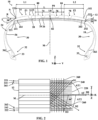
- the figures show a reference X, Y, Z corresponding to the usual axial (Y), radial (Z) and circumferential (X) directions of a tire.
- the tire 10 has a substantially toric shape around an axis of revolution substantially parallel to the axial direction Y.
- the tire 10 is intended for a passenger vehicle and has dimensions 225/45 R17. In the various figures, the tire 10 is shown in new condition, that is to say not having yet been driven.
- the tire 10 comprises a crown 12 comprising a tread 14 carrying a tread surface 15 intended to come into contact with a ground when the tire 10 is rolling.
- the tread surface 15 is delimited axially by first and second axial ends 151, 152 passing through each point N arranged on either side of the median plane M and for which the angle between the tangent T to the tread surface 15 and a straight line R parallel to the axial direction Y passing through this point is equal to 30°.
- the tread surface 15 has an axial width L measured as the axial distance from the first axial end 151 to the second axial end 152.
- the crown 12 comprises an axially central portion P0 as well as two axially lateral portions P1 and P2 arranged axially on either side of the axially central portion P0 relative to the median plane M.
- the axially central portion P0 extends axially over an axial width L0 equal to 50% of the axial width L of the rolling surface 15.
- Each first and second axially lateral portion P1, P2 has an axial width L1, L2 equal to 25% of the axial width L of the rolling surface 15.
- the axially central portion P0 is axially centered on the median plane M.
- the tread 14 comprises cutouts comprising main circumferential cutouts 72, 74, 76, 78, secondary circumferential cutouts 80, 82, 84 as well as transverse cutouts 90, 92, 94, 96, 98.
- the main circumferential cutouts 72, 74, 76, 78 are circumferential grooves.
- each main circumferential cutout 72, 74, 76, 78 comprises two side faces Fr1, Fr2 as well as a bottom face Frd.
- Each main circumferential cutout 72, 74, 76, 78 has a depth He ranging from 4.00 mm to the tread height Hs, preferably ranging from 5.00 mm to the tread height Hs and more preferably ranging from 5.50 mm to the tread height Hs. Each depth is greater than or equal to 50% of the tread height Hs.
- Hs 6.50 mm
- each main circumferential cutout 72, 78 has a depth equal to 6.00 mm.
- each main circumferential cutout 74, 76 is the deepest cutout of the tire 10 and in particular of the axially central part P0.
- the crown 12 also comprises a crown reinforcement 16 extending in the crown 12 in the circumferential direction X.
- the tire 10 also comprises a sealing layer 18 to an inflation gas being intended to delimit an internal cavity closed with a mounting support of the tire 10 once the tire 10 is mounted on the mounting support, for example a rim.
- the top frame 16 comprises a working frame 20 and a hoop frame 22.
- the working reinforcement 20 comprises two working layers 24, 26.
- the radially outer working layer 26 is arranged radially outside the radially inner working layer 24.
- the radially outer working layer 26 is thus the radially outermost working layer of the working reinforcement 20.
- the hoop frame 22 comprises at least one hoop layer and here comprises a hoop layer 28.
- the crown reinforcement 16 is radially surmounted by the tread 14.
- the hoop reinforcement 22, here the hoop layer 28, is arranged radially outside the working reinforcement 20 and radially inside the tread 14.
- the hoop reinforcement 22 is therefore radially interposed between the working reinforcement 20 and the tread 14.
- the tire 10 comprises two sidewalls 30 extending the crown 12 radially inwards.
- the tire 10 further comprises two beads 32 radially inwards to the sidewalls 30.
- Each sidewall 30 connects each bead 32 to the crown 12.
- the tire 10 comprises a carcass reinforcement 34 anchored in each bead 32, in this case is wrapped around two bead wires 33.
- the carcass reinforcement 34 extends radially in each sidewall 30 and axially in the crown 12 radially inside the crown reinforcement 16.
- the crown reinforcement 16 is arranged radially between the tread 14 and the carcass reinforcement 34.
- the carcass reinforcement 34 comprises at least one carcass layer and here comprises a single carcass layer 36. In this case, the carcass reinforcement 34 is made up of the single carcass layer 36.
- each working layer 24, 26, hooping layer 28 and carcass layer 36 comprises a polymer matrix, here an elastomeric matrix in which one or more wire reinforcement elements of the corresponding layer are embedded.
- the interfaces between two adjacent layers different layers are represented by dotted lines.
- the hooping reinforcement 22, here the hooping layer 28, is delimited axially by two axial edges 221, 222 of the hooping reinforcement 22.
- the hooping reinforcement 22 comprises a strip 40 wound in a helix over several circumferential turns Ci so as to extend axially between the axial edges 221, 222 of the hooping reinforcement 22.
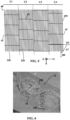
- the strip 40 comprises several textile hooping wire reinforcement elements 220 substantially parallel to each other and embedded in the elastomeric matrix of the hooping layer 28 described above so that the textile hooping wire reinforcement elements 220 are wound in a helix radially around the working reinforcement 20.
- the strip 40 is wound in a helix over several circumferential turns Ci so that, in the axially central portion P0 of the apex 12, two adjacent circumferential turns Ci of the strip 40 do not overlap axially and radially with each other.
- Each textile hoop wire reinforcement element 220 extends along a main hoop direction D0 forming, with the circumferential direction X of the tire 10, an angle AF, in absolute value, less than or equal to 10°, preferably less than or equal to 7° and more preferably less than or equal to 5°.
- AF in absolute value
- the strip 40 comprises a density of 120 textile hoop wire reinforcement elements per decimeter of strip 40, this density being measured perpendicular to the direction D0.
- the textile hooping wire reinforcement elements 220 are connected to each other by several weft wire elements 42 substantially parallel to each other along a main weft direction DT that is non-collinear with the main hooping direction D0.
- the weft wire elements 42 are discontinuous with each other.
- the main weft direction DT forms an angle AT greater than or equal to 45°, preferably greater than or equal to 75° with the main hooping direction D0 and here substantially equal to 90°.
- the radially inner working layer 24 is axially delimited by two axial edges 241, 242.
- the radially inner working layer 24 comprises metallic working wire reinforcement elements 240 extending axially from the axial edge 241 to the other axial edge 242, each substantially parallel to the other in a main direction D1.
- the radially outer working layer 26 is axially delimited by two axial edges 261, 262.
- the radially outer working layer 26 comprises metallic working wire reinforcement elements 260 extending axially from the axial edge 261 to the other axial edge 262, each substantially parallel to the other in a main direction D2.
- each main direction D1 along which each working wire reinforcement element 240 of the radially inner working layer 24 extends and the main direction D2 along which each working wire reinforcement element 260 of the radially outer working layer 26 extends form, with the circumferential direction X of the tire 10, angles AT1 and AT2 respectively of opposite orientations.
- Each main direction D1, D2 forms, with the circumferential direction X of the tire 10, an angle AT1, AT2 respectively, in absolute value, strictly greater than 10°, preferably ranging from 15° to 50° and more preferably ranging from 20° to 35°.
- the carcass layer 36 is delimited axially by two axial edges 361, 362.
- each hoop wire reinforcement element 220 comprises one or more organic synthetic monofilament(s), preferably comprises an assembly comprising several synthetic monofilaments organic.
- the organic polymeric synthetic monofilaments are chosen from polyester monofilaments, aliphatic polyamide monofilaments, aromatic polyamide monofilaments, polyketone monofilaments and assemblies of these monofilaments, preferably from polyester monofilaments, aliphatic polyamide monofilaments, aromatic polyamide monofilaments and assemblies of these monofilaments and even more preferably from polyester monofilaments, aliphatic polyamide monofilaments and assemblies of aliphatic polyamide monofilaments and aromatic polyamide monofilaments.
- each hoop wire reinforcement element 220 conventionally comprises two multifilament strands, each multifilament strand being made up of a yarn of aliphatic polyamide monofilaments, here nylon with a count equal to 94 tex, these two multifilament strands being individually helical at 320 turns per meter in one direction and then helical together at 320 turns per meter in the opposite direction. These two multifilament strands are helical wound around each other.
- each weft yarn element 42 comprises several textile monofilaments and/or several textile fibers chosen from organic polymeric synthetic monofilaments and fibers, inorganic polymeric synthetic monofilaments and fibers and assemblies of these monofilaments and fibers. More precisely, at least 50%, preferably at least 75% and here 100% of the mass of each weft yarn element 42 is constituted by the textile monofilaments and/or textile fibers chosen from organic polymeric synthetic monofilaments and fibers, inorganic polymeric synthetic monofilaments and fibers and assemblies of these monofilaments and fibers.
- At least 50%, preferably at least 75% and here 100% of the cumulative length of the weft thread elements 42 comprises several textile monofilaments and/or textile fibers chosen from organic polymeric synthetic monofilaments and fibers, inorganic polymeric synthetic textile monofilaments and fibers and assemblies of these monofilaments and fibers.
- At least one of the weft filamentary elements 42 comprises several monofilaments and/or organic polymeric synthetic textile fibers. More precisely, at least 50%, preferably at least 75% and here 100% of the mass of each weft filamentary element 42 is constituted by the textile monofilaments and/or textile fibers chosen from monofilaments and organic polymeric synthetic fibers. In addition, at least 50%, preferably at least 75% and here 100% of the cumulative length of the weft filamentary elements 42 comprises several monofilaments and/or organic polymeric synthetic fibers.
- the organic polymeric synthetic monofilaments and fibers are selected from polyester monofilaments and fibers, polyamide monofilaments and fibers, polyketone monofilaments and fibers, polyurethane monofilaments and fibers, acrylic monofilaments and fibers, polyolefin monofilaments and fibers, polyetheretherketone monofilaments and fibers and assemblies of these monofilaments and fibers, preferably from polyester monofilaments and fibers, polyamide monofilaments and fibers and assemblies of these monofilaments and fibers and here, the organic synthetic monofilaments and fibers are polyester monofilaments and fibers.
- each weft wire element 42 comprises, here is made up of, two strands each comprising a core and a layer covering the core, the core comprising several polyester monofilaments and the layer comprising several polyester fibers.
- the sum of the counts of the strands of each weft wire element 42 is equal to 22 tex.
- the count of each strand of weft wire element 42 ranges from 1 to 20 tex and preferably from 10 to 15 tex. Here, it is 11 tex.
- the two strands are wound in a helix around each other at a twist of 1100 turns per meter, then each weft wire element 42 has a twist equal to 1100 turns per meter.
- the moisture uptake rate of each weft wire element 42 is equal to 1.8%.
- the density of the weft wire elements 42 ranges from 3.0 to 8.0 weft wire elements per dm of length of the strip 40, preferably from 3.0 to 6.0 weft wire elements per dm of length of the strip 40 and more preferably from 3.0 to 5.5 weft wire elements per dm of length of the strip 40.
- the density of the weft wire elements 42 is equal to 5.0 weft wire elements per dm of length of the strip 40.
- Each wire mesh reinforcement element 240, 260 comprises an assembly of two steel monofilaments wound in a helix at a pitch of 14 mm, each steel monofilament having a diameter equal to 0.30 mm.
- the circle circumscribed to this assembly has been shown, the diameter of which is equal to the diameter of each metal working wire reinforcement element 240, 260.
- each metal working wire reinforcement element 240, 260 is made up of a steel monofilament having a diameter equal to 0.30 mm. More generally, the steel monofilaments have diameters ranging from 0.25 mm to 0.32 mm.
- an assembly of six steel monofilaments having a diameter equal to 0.23 mm and comprising an inner layer of two monofilaments wound together in a helix at a pitch of 12.5 mm in a first direction, for example the Z direction, and an outer layer of four monofilaments wound together in a helix around the inner layer at a pitch of 12.5 mm in a second direction opposite to the first direction, for example the S direction, may be used.
- Each 360 carcass wire reinforcement element conventionally comprises two multifilament strands, each multifilament strand being made up of a polyester monofilament yarn, here PET, these two multifilament strands being individually helical at 240 turns per meter in one direction and then helical together at 240 turns per meter in the opposite direction.
- Each of these multifilament strands has a count equal to 220 tex. In other variants, counts equal to 144 tex and twists equal to 420 turns per meter or counts equal to 334 tex and twists equal to 270 turns per meter may be used.
- the average radial distance E1 between the surface 100 and the radially outer surface 102 is such that E1 ⁇ 2.00 mm.
- E1 ⁇ 0.20 mm, preferably E1 ⁇ 0.50 mm and more preferably E1 ⁇ 1.00 mm. In this case E1 1.50 mm.
- the working reinforcement 20 of the tire 10 according to the second embodiment comprises a single working layer 26, which is therefore the radially outermost working layer of the working reinforcement 20.
- Tires comprising a single working layer and a carcass layer as described above and their manufacturing processes are known in particular from EP3489035 , FR2797213 and of FR1413102 .
- two adjacent circumferential turns Ci of strip 40 form a radial and axial overlap between them.
- the textile hoop wire reinforcement elements are represented in the form of a white circle when they belong to a given circumferential turn Ci and in the form of a circle filled with small dots when they belong to the circumferential turn Ci+1 adjacent to the circumferential turn Ci.
- the radially outer surface 102 is, in accordance with the invention, the surface passing through the radially outermost points of the radially outermost textile hoop wire reinforcement elements 220 among the textile hoop wire reinforcement elements 220.
- the radially outermost textile hoop wire reinforcement elements 220 among the textile hoop wire reinforcement elements 220 are the textile hoop wire reinforcement elements 220 of each circumferential turn radially covering the textile hoop wire reinforcement elements 220 of the adjacent circumferential turn.
- the radially inner surface 104 is, in accordance with the invention, the surface passing through the radially innermost points of the radially innermost textile hoop wire reinforcement elements 220 among the textile hoop wire reinforcement elements 220.
- the radially innermost textile hoop wire reinforcement elements 220 among the textile hoop wire reinforcement elements 220 are, on the one hand, the textile hoop wire reinforcement elements 220 of each circumferential turn being radially covered by the textile hoop wire reinforcement elements 220 of the adjacent circumferential turn and, on the other hand, the textile hoop wire reinforcement elements 220 of each circumferential turn not covered by other textile hoop wire reinforcement elements 220.
- the tire 10 according to the fourth embodiment is such that the strip 40 is wound in a helix over several circumferential turns Ci so that, in the axially central portion P0 of the crown 12, two adjacent circumferential turns Ci of the strip 40 do not overlap axially and radially with each other.
- the tire 10 according to the fourth embodiment is such that the strip 40 is wound in a helix over several circumferential turns Ci so that, in the axially central portion P0 of the crown 12, two adjacent circumferential turns Ci of the strip 40 do not overlap axially and radially with each other.
- the adjacent longitudinal axial edges of the two adjacent circumferential turns are axially distant from each other without forming an axial and radial overlap between the two circumferential turns.
- the control tire T0 comprises a hoop reinforcement in which the textile weft wire reinforcement elements are not connected to each other by any weft wire element.
- the hoop reinforcement of the control tire T0 is devoid of any weft wire element.
- E2 0.11 mm.
- the T1 witness tire comprises a hoop reinforcement in which the textile weft wire reinforcement elements are connected to each other weft wire elements comprising cotton fibers.
- E2 0.30 mm.
- Each tire tested was inflated to a pressure equal to 80% of its nominal inflation pressure on a passenger vehicle on which it is intended and suitable for mounting.
- This vehicle was driven on a circuit comprising a portion of tarmac road and a portion of road covered with crushed stones so as to present sharp edges and ends capable of damaging the tread of the tire tested.
- the vehicle completed several laps of this circuit so as to allow the tread to be damaged by the crushed stones, whether when passing over the portion of road covered with crushed stones or when passing over the portion of tarmac road in the event that crushed stones had become stuck in the tread.
- the circuit also included a wet portion comprising a saltwater tank allowing the entry of corrosive agents in the attacks caused by the stones. After sufficient driving, for example several thousand kilometers, the tread and the hoop reinforcement are removed from each tested tire and the radially outermost working layer of the working reinforcement is analyzed.
- the number Np of aggressions present on the radially outermost working layer of the working reinforcement is first counted.
- the surface area of each oxidation pocket is measured.
- the total surface area St of all the oxidation pockets of the radially outermost working layer of the working reinforcement is deduced.
- control tires T0, T1 The various characteristics of the control tires T0, T1 as well as the results of the aggressive rolling test described above were collected in Table 1 below.
- the number of attacks Np is given on a base of 100 relative to the control tire T1.
- An Np number greater than 100 means that the radially outermost working layer of the tested tire exhibits more attacks than the control tire T1.
- the total surface area St is given on a base of 100 relative to the control tyre T1.
- a total surface area St greater than 100 means that the radially outermost working layer of the test tyre has a total surface area of oxidation pockets greater than that of the control tyre T1.
- This first comparative test shows that the presence of cotton weft wire elements in the control tire T1 causes a significant increase in the total surface area St of oxidation pockets compared to the control tire T0 in which no weft wire elements are present in the hoop reinforcement.
- Control tires T2, T3 and a tire 10 were compared according to the first embodiment described above.
- the control tire T3 comprises hooping wire reinforcement elements identical to those of the tire 10 according to the first embodiment.
- each hooping wire reinforcement element comprises two multifilament strands, each multifilament strand being made up of a yarn of aliphatic polyamide monofilaments, here nylon with a count equal to 140 tex, these two multifilament strands being individually helical at 250 turns per meter in one direction and then helical together at 250 turns per meter in the opposite direction.
- E1 1.50 mm.
- E1 2.30 mm.
- weft filamentary elements comprise cotton fibers for the control tires T2 and T3 while the weft filamentary elements of the tire 10 according to the first embodiment are as described above.
- Control tyres T2, T3 and 10 were compared according to the first embodiment in the aggressive rolling test described above.
- the tyre masses and rolling resistance were also measured in accordance with Annex 6 of Regulation 117 of the United Nations Economic Commission for Europe.
- the tire 10 according to the first embodiment has a total surface area St of oxidation pockets which is not significantly greater than the total surface area St of oxidation pockets of the control tire T2 and in any case, the increase in the total surface area St of oxidation pockets is not commensurate with the weight reduction of the tire and not commensurate with the gain in rolling resistance.
Landscapes
- Engineering & Computer Science (AREA)
- Mechanical Engineering (AREA)
- Tires In General (AREA)
Applications Claiming Priority (2)
| Application Number | Priority Date | Filing Date | Title |
|---|---|---|---|
| FR2100144A FR3118605B1 (fr) | 2021-01-07 | 2021-01-07 | Pneumatique comprenant une couche de frettage à trame hydrophobe et à sommet d’épaisseur réduite |
| PCT/FR2022/050002 WO2022148921A1 (fr) | 2021-01-07 | 2022-01-03 | Pneumatique comprenant une couche de frettage a trame hydrophobe et a sommet d'épaisseur réduite |
Publications (2)
| Publication Number | Publication Date |
|---|---|
| EP4274746A1 EP4274746A1 (fr) | 2023-11-15 |
| EP4274746B1 true EP4274746B1 (fr) | 2024-08-14 |
Family
ID=75539460
Family Applications (1)
| Application Number | Title | Priority Date | Filing Date |
|---|---|---|---|
| EP22706067.0A Active EP4274746B1 (fr) | 2021-01-07 | 2022-01-03 | Pneumatique comprenant une couche de frettage a trame hydrophobe et a sommet d'épaisseur réduite |
Country Status (7)
| Country | Link |
|---|---|
| EP (1) | EP4274746B1 (https=) |
| JP (1) | JP2024503639A (https=) |
| KR (1) | KR20230129060A (https=) |
| CN (1) | CN116710293A (https=) |
| CA (1) | CA3203673A1 (https=) |
| FR (1) | FR3118605B1 (https=) |
| WO (1) | WO2022148921A1 (https=) |
Families Citing this family (4)
| Publication number | Priority date | Publication date | Assignee | Title |
|---|---|---|---|---|
| WO2022224610A1 (ja) | 2021-04-22 | 2022-10-27 | 住友ゴム工業株式会社 | 空気入りタイヤ |
| FR3161387A1 (fr) * | 2024-04-18 | 2025-10-24 | Compagnie Generale Des Etablissements Michelin | Pneumatique comprenant un sous-creux réduit et une bande de roulement silencieuse |
| FR3165689A1 (fr) | 2024-08-26 | 2026-02-27 | Compagnie Generale Des Etablissements Michelin | Pneumatique à performances durables améliorées |
| FR3165690A1 (fr) | 2024-08-26 | 2026-02-27 | Compagnie Generale Des Etablissements Michelin | Pneumatique à performances durables maximisées |
Family Cites Families (23)
| Publication number | Priority date | Publication date | Assignee | Title |
|---|---|---|---|---|
| NL131398C (https=) | 1964-05-14 | Michelin & Cie | ||
| JP2874965B2 (ja) * | 1990-06-19 | 1999-03-24 | 株式会社ブリヂストン | 高速走行に適した空気入りラジアルタイヤ |
| JPH05319021A (ja) * | 1992-05-20 | 1993-12-03 | Bridgestone Corp | 空気入りラジアルタイヤ |
| FR2797213B1 (fr) | 1999-08-02 | 2002-08-30 | Michelin Soc Tech | Procede de fabrication d'un pneumatique avec preconformation d'une nappe de carcasse radiale pour rendre obliques les cables de la partie centrale |
| JP2004277933A (ja) * | 2003-03-17 | 2004-10-07 | Toray Ind Inc | タイヤコード簾織物およびそれからなるタイヤ |
| US7252129B2 (en) * | 2005-02-22 | 2007-08-07 | Milliken & Company | Tire with cap ply layer |
| JP2007283896A (ja) * | 2006-04-17 | 2007-11-01 | Bridgestone Corp | 空気入りタイヤ |
| JP5206346B2 (ja) * | 2008-11-17 | 2013-06-12 | 横浜ゴム株式会社 | 空気入りラジアルタイヤのベルトカバー用すだれ織物 |
| JP5549242B2 (ja) * | 2010-01-29 | 2014-07-16 | 横浜ゴム株式会社 | 空気入りラジアルタイヤ |
| JP6024081B2 (ja) * | 2011-08-26 | 2016-11-09 | 横浜ゴム株式会社 | 空気入りラジアルタイヤ及びその製造方法 |
| JP6174921B2 (ja) * | 2013-06-19 | 2017-08-02 | 住友ゴム工業株式会社 | タイヤ |
| FR3008996B1 (fr) * | 2013-07-29 | 2016-01-01 | Michelin & Cie | Produit renforce a faible epaisseur et pneumatique comprenant ce produit |
| US10315464B2 (en) | 2013-07-30 | 2019-06-11 | Kordsa Global Endustrivel Iplik Ve Kord Bezi Sanayi Ve Ticaret Anonim Sirketi | Cap ply reinforcement strip in pneumatic tire |
| JP6203597B2 (ja) * | 2013-10-21 | 2017-09-27 | 株式会社ブリヂストン | 空気入りタイヤ |
| FR3032147B1 (fr) * | 2015-02-03 | 2017-02-17 | Michelin & Cie | Pneu radial ayant une structure de ceinture amelioree |
| FR3042738B1 (fr) * | 2015-10-27 | 2017-11-24 | Michelin & Cie | Pneumatique a couches de travail comprenant des monofilaments et a bande de roulement rainuree |
| FR3048638B1 (fr) * | 2016-03-11 | 2018-03-30 | Compagnie Generale Des Etablissements Michelin | Pneu radial ayant une structure de ceinture amelioree |
| FR3069486A1 (fr) * | 2017-07-28 | 2019-02-01 | Compagnie Generale Des Etablissements Michelin | Bandage a structure de ceinture amelioree |
| FR3074097A3 (fr) | 2017-11-27 | 2019-05-31 | Compagnie Generale Des Etablissements Michelin | Armature de renforcement de pneumatique |
| WO2020096535A1 (en) * | 2018-11-06 | 2020-05-14 | Kordsa Teknik Tekstil A.S. | Cord fabric for tire reinforcement |
| FR3094272A1 (fr) * | 2019-03-28 | 2020-10-02 | Compagnie Generale Des Etablissements Michelin | Pneumatique à couches de travail comprenant une architecture et une sculpture optimisées |
| FR3094672B1 (fr) * | 2019-04-05 | 2021-03-12 | Michelin & Cie | Pneumatique ayant des architectures sommet et bourrelet optimisées |
| KR102182544B1 (ko) * | 2019-11-29 | 2020-11-24 | 한국타이어앤테크놀로지 주식회사 | 직물 스트립을 포함하는 타이어 |
-
2021
- 2021-01-07 FR FR2100144A patent/FR3118605B1/fr active Active
-
2022
- 2022-01-03 EP EP22706067.0A patent/EP4274746B1/fr active Active
- 2022-01-03 JP JP2023541274A patent/JP2024503639A/ja active Pending
- 2022-01-03 CN CN202280009147.XA patent/CN116710293A/zh active Pending
- 2022-01-03 WO PCT/FR2022/050002 patent/WO2022148921A1/fr not_active Ceased
- 2022-01-03 CA CA3203673A patent/CA3203673A1/en active Pending
- 2022-01-03 KR KR1020237022626A patent/KR20230129060A/ko active Pending
Also Published As
| Publication number | Publication date |
|---|---|
| FR3118605A1 (fr) | 2022-07-08 |
| CN116710293A (zh) | 2023-09-05 |
| CA3203673A1 (en) | 2022-07-14 |
| FR3118605B1 (fr) | 2022-12-30 |
| EP4274746A1 (fr) | 2023-11-15 |
| KR20230129060A (ko) | 2023-09-05 |
| WO2022148921A1 (fr) | 2022-07-14 |
| JP2024503639A (ja) | 2024-01-26 |
Similar Documents
| Publication | Publication Date | Title |
|---|---|---|
| EP4274746B1 (fr) | Pneumatique comprenant une couche de frettage a trame hydrophobe et a sommet d'épaisseur réduite | |
| EP3568289B1 (fr) | Assemblage comprenant une structure élastique et une structure porteuse | |
| EP3568291B1 (fr) | Assemblage pour pneumatique comprenant une structure rompable et une structure porteuse, pneumatique et procédé de fabrication dudit pneu | |
| EP3568290B1 (fr) | Assemblage comprenant un tissu partiellement rompable et une structure porteuse | |
| EP3390115B1 (fr) | Assemblage pour pneumatique comprenant des tissu(s) ou tricot(s) comprenant des éléments filaires pré-encollés | |
| EP3390114B1 (fr) | Ensemble pour pneumatique comprenant des tissu(s) ou tricot(s) imprégnés et un moyen de maintien sacrificiel | |
| FR3106528A1 (fr) | Pneumatique pour motocyclette | |
| FR3103732A1 (fr) | Assemblage comprenant une structure porteuse adaptable | |
| EP4274744A1 (fr) | Pneumatique comprenant une couche de frettage à trame hydrophobe et à épaisseur de découplage réduite | |
| EP4045298B1 (fr) | Assemblage comprenant un tissu à âme fusible et une structure porteuse | |
| EP3877199B1 (fr) | Procede de fabrication d'un pneumatique | |
| EP3996903B1 (fr) | Assemblage comprenant un tissu déformable plastiquement et une structure porteuse | |
| EP3996904B1 (fr) | Assemblage comprenant un tissu partiellement rompable et une structure porteuse | |
| EP4377101B1 (fr) | Pneumatique pour motocylcette a haute vitesse limite | |
| CA3156181A1 (fr) | Assemblage comprenant une structure porteuse adaptable | |
| WO2024200361A1 (fr) | Armatures de carcasse de pneumatique pour avion | |
| FR3112311A1 (fr) | Pneumatique pour véhicule de tourisme | |
| WO2022069821A1 (fr) | Procédé de fabrication d'une couche de produit auto-obturant optimisée |
Legal Events
| Date | Code | Title | Description |
|---|---|---|---|
| STAA | Information on the status of an ep patent application or granted ep patent |
Free format text: STATUS: UNKNOWN |
|
| STAA | Information on the status of an ep patent application or granted ep patent |
Free format text: STATUS: THE INTERNATIONAL PUBLICATION HAS BEEN MADE |
|
| PUAI | Public reference made under article 153(3) epc to a published international application that has entered the european phase |
Free format text: ORIGINAL CODE: 0009012 |
|
| STAA | Information on the status of an ep patent application or granted ep patent |
Free format text: STATUS: REQUEST FOR EXAMINATION WAS MADE |
|
| 17P | Request for examination filed |
Effective date: 20230807 |
|
| AK | Designated contracting states |
Kind code of ref document: A1 Designated state(s): AL AT BE BG CH CY CZ DE DK EE ES FI FR GB GR HR HU IE IS IT LI LT LU LV MC MK MT NL NO PL PT RO RS SE SI SK SM TR |
|
| DAV | Request for validation of the european patent (deleted) | ||
| DAX | Request for extension of the european patent (deleted) | ||
| GRAP | Despatch of communication of intention to grant a patent |
Free format text: ORIGINAL CODE: EPIDOSNIGR1 |
|
| STAA | Information on the status of an ep patent application or granted ep patent |
Free format text: STATUS: GRANT OF PATENT IS INTENDED |
|
| INTG | Intention to grant announced |
Effective date: 20240507 |
|
| GRAS | Grant fee paid |
Free format text: ORIGINAL CODE: EPIDOSNIGR3 |
|
| GRAA | (expected) grant |
Free format text: ORIGINAL CODE: 0009210 |
|
| STAA | Information on the status of an ep patent application or granted ep patent |
Free format text: STATUS: THE PATENT HAS BEEN GRANTED |
|
| AK | Designated contracting states |
Kind code of ref document: B1 Designated state(s): AL AT BE BG CH CY CZ DE DK EE ES FI FR GB GR HR HU IE IS IT LI LT LU LV MC MK MT NL NO PL PT RO RS SE SI SK SM TR |
|
| REG | Reference to a national code |
Ref country code: GB Ref legal event code: FG4D Free format text: NOT ENGLISH |
|
| REG | Reference to a national code |
Ref country code: CH Ref legal event code: EP |
|
| REG | Reference to a national code |
Ref country code: DE Ref legal event code: R096 Ref document number: 602022005353 Country of ref document: DE |
|
| REG | Reference to a national code |
Ref country code: IE Ref legal event code: FG4D Free format text: LANGUAGE OF EP DOCUMENT: FRENCH |
|
| REG | Reference to a national code |
Ref country code: LT Ref legal event code: MG9D |
|
| REG | Reference to a national code |
Ref country code: NL Ref legal event code: MP Effective date: 20240814 |
|
| PG25 | Lapsed in a contracting state [announced via postgrant information from national office to epo] |
Ref country code: NO Free format text: LAPSE BECAUSE OF FAILURE TO SUBMIT A TRANSLATION OF THE DESCRIPTION OR TO PAY THE FEE WITHIN THE PRESCRIBED TIME-LIMIT Effective date: 20241114 |
|
| REG | Reference to a national code |
Ref country code: AT Ref legal event code: MK05 Ref document number: 1712970 Country of ref document: AT Kind code of ref document: T Effective date: 20240814 |
|
| PG25 | Lapsed in a contracting state [announced via postgrant information from national office to epo] |
Ref country code: NL Free format text: LAPSE BECAUSE OF FAILURE TO SUBMIT A TRANSLATION OF THE DESCRIPTION OR TO PAY THE FEE WITHIN THE PRESCRIBED TIME-LIMIT Effective date: 20240814 Ref country code: PL Free format text: LAPSE BECAUSE OF FAILURE TO SUBMIT A TRANSLATION OF THE DESCRIPTION OR TO PAY THE FEE WITHIN THE PRESCRIBED TIME-LIMIT Effective date: 20240814 Ref country code: FI Free format text: LAPSE BECAUSE OF FAILURE TO SUBMIT A TRANSLATION OF THE DESCRIPTION OR TO PAY THE FEE WITHIN THE PRESCRIBED TIME-LIMIT Effective date: 20240814 Ref country code: PT Free format text: LAPSE BECAUSE OF FAILURE TO SUBMIT A TRANSLATION OF THE DESCRIPTION OR TO PAY THE FEE WITHIN THE PRESCRIBED TIME-LIMIT Effective date: 20241216 Ref country code: GR Free format text: LAPSE BECAUSE OF FAILURE TO SUBMIT A TRANSLATION OF THE DESCRIPTION OR TO PAY THE FEE WITHIN THE PRESCRIBED TIME-LIMIT Effective date: 20241115 |
|
| PG25 | Lapsed in a contracting state [announced via postgrant information from national office to epo] |
Ref country code: BG Free format text: LAPSE BECAUSE OF FAILURE TO SUBMIT A TRANSLATION OF THE DESCRIPTION OR TO PAY THE FEE WITHIN THE PRESCRIBED TIME-LIMIT Effective date: 20240814 |
|
| PG25 | Lapsed in a contracting state [announced via postgrant information from national office to epo] |
Ref country code: LV Free format text: LAPSE BECAUSE OF FAILURE TO SUBMIT A TRANSLATION OF THE DESCRIPTION OR TO PAY THE FEE WITHIN THE PRESCRIBED TIME-LIMIT Effective date: 20240814 |
|
| PG25 | Lapsed in a contracting state [announced via postgrant information from national office to epo] |
Ref country code: AT Free format text: LAPSE BECAUSE OF FAILURE TO SUBMIT A TRANSLATION OF THE DESCRIPTION OR TO PAY THE FEE WITHIN THE PRESCRIBED TIME-LIMIT Effective date: 20240814 Ref country code: IS Free format text: LAPSE BECAUSE OF FAILURE TO SUBMIT A TRANSLATION OF THE DESCRIPTION OR TO PAY THE FEE WITHIN THE PRESCRIBED TIME-LIMIT Effective date: 20241214 |
|
| PG25 | Lapsed in a contracting state [announced via postgrant information from national office to epo] |
Ref country code: HR Free format text: LAPSE BECAUSE OF FAILURE TO SUBMIT A TRANSLATION OF THE DESCRIPTION OR TO PAY THE FEE WITHIN THE PRESCRIBED TIME-LIMIT Effective date: 20240814 |
|
| PG25 | Lapsed in a contracting state [announced via postgrant information from national office to epo] |
Ref country code: RS Free format text: LAPSE BECAUSE OF FAILURE TO SUBMIT A TRANSLATION OF THE DESCRIPTION OR TO PAY THE FEE WITHIN THE PRESCRIBED TIME-LIMIT Effective date: 20241114 Ref country code: ES Free format text: LAPSE BECAUSE OF FAILURE TO SUBMIT A TRANSLATION OF THE DESCRIPTION OR TO PAY THE FEE WITHIN THE PRESCRIBED TIME-LIMIT Effective date: 20240814 |
|
| PG25 | Lapsed in a contracting state [announced via postgrant information from national office to epo] |
Ref country code: RS Free format text: LAPSE BECAUSE OF FAILURE TO SUBMIT A TRANSLATION OF THE DESCRIPTION OR TO PAY THE FEE WITHIN THE PRESCRIBED TIME-LIMIT Effective date: 20241114 Ref country code: PT Free format text: LAPSE BECAUSE OF FAILURE TO SUBMIT A TRANSLATION OF THE DESCRIPTION OR TO PAY THE FEE WITHIN THE PRESCRIBED TIME-LIMIT Effective date: 20241216 Ref country code: PL Free format text: LAPSE BECAUSE OF FAILURE TO SUBMIT A TRANSLATION OF THE DESCRIPTION OR TO PAY THE FEE WITHIN THE PRESCRIBED TIME-LIMIT Effective date: 20240814 Ref country code: NO Free format text: LAPSE BECAUSE OF FAILURE TO SUBMIT A TRANSLATION OF THE DESCRIPTION OR TO PAY THE FEE WITHIN THE PRESCRIBED TIME-LIMIT Effective date: 20241114 Ref country code: NL Free format text: LAPSE BECAUSE OF FAILURE TO SUBMIT A TRANSLATION OF THE DESCRIPTION OR TO PAY THE FEE WITHIN THE PRESCRIBED TIME-LIMIT Effective date: 20240814 Ref country code: LV Free format text: LAPSE BECAUSE OF FAILURE TO SUBMIT A TRANSLATION OF THE DESCRIPTION OR TO PAY THE FEE WITHIN THE PRESCRIBED TIME-LIMIT Effective date: 20240814 Ref country code: IS Free format text: LAPSE BECAUSE OF FAILURE TO SUBMIT A TRANSLATION OF THE DESCRIPTION OR TO PAY THE FEE WITHIN THE PRESCRIBED TIME-LIMIT Effective date: 20241214 Ref country code: HR Free format text: LAPSE BECAUSE OF FAILURE TO SUBMIT A TRANSLATION OF THE DESCRIPTION OR TO PAY THE FEE WITHIN THE PRESCRIBED TIME-LIMIT Effective date: 20240814 Ref country code: GR Free format text: LAPSE BECAUSE OF FAILURE TO SUBMIT A TRANSLATION OF THE DESCRIPTION OR TO PAY THE FEE WITHIN THE PRESCRIBED TIME-LIMIT Effective date: 20241115 Ref country code: FI Free format text: LAPSE BECAUSE OF FAILURE TO SUBMIT A TRANSLATION OF THE DESCRIPTION OR TO PAY THE FEE WITHIN THE PRESCRIBED TIME-LIMIT Effective date: 20240814 Ref country code: ES Free format text: LAPSE BECAUSE OF FAILURE TO SUBMIT A TRANSLATION OF THE DESCRIPTION OR TO PAY THE FEE WITHIN THE PRESCRIBED TIME-LIMIT Effective date: 20240814 Ref country code: BG Free format text: LAPSE BECAUSE OF FAILURE TO SUBMIT A TRANSLATION OF THE DESCRIPTION OR TO PAY THE FEE WITHIN THE PRESCRIBED TIME-LIMIT Effective date: 20240814 Ref country code: AT Free format text: LAPSE BECAUSE OF FAILURE TO SUBMIT A TRANSLATION OF THE DESCRIPTION OR TO PAY THE FEE WITHIN THE PRESCRIBED TIME-LIMIT Effective date: 20240814 |
|
| PG25 | Lapsed in a contracting state [announced via postgrant information from national office to epo] |
Ref country code: DK Free format text: LAPSE BECAUSE OF FAILURE TO SUBMIT A TRANSLATION OF THE DESCRIPTION OR TO PAY THE FEE WITHIN THE PRESCRIBED TIME-LIMIT Effective date: 20240814 Ref country code: SM Free format text: LAPSE BECAUSE OF FAILURE TO SUBMIT A TRANSLATION OF THE DESCRIPTION OR TO PAY THE FEE WITHIN THE PRESCRIBED TIME-LIMIT Effective date: 20240814 Ref country code: RO Free format text: LAPSE BECAUSE OF FAILURE TO SUBMIT A TRANSLATION OF THE DESCRIPTION OR TO PAY THE FEE WITHIN THE PRESCRIBED TIME-LIMIT Effective date: 20240814 |
|
| PG25 | Lapsed in a contracting state [announced via postgrant information from national office to epo] |
Ref country code: EE Free format text: LAPSE BECAUSE OF FAILURE TO SUBMIT A TRANSLATION OF THE DESCRIPTION OR TO PAY THE FEE WITHIN THE PRESCRIBED TIME-LIMIT Effective date: 20240814 |
|
| PG25 | Lapsed in a contracting state [announced via postgrant information from national office to epo] |
Ref country code: CZ Free format text: LAPSE BECAUSE OF FAILURE TO SUBMIT A TRANSLATION OF THE DESCRIPTION OR TO PAY THE FEE WITHIN THE PRESCRIBED TIME-LIMIT Effective date: 20240814 |
|
| PG25 | Lapsed in a contracting state [announced via postgrant information from national office to epo] |
Ref country code: SK Free format text: LAPSE BECAUSE OF FAILURE TO SUBMIT A TRANSLATION OF THE DESCRIPTION OR TO PAY THE FEE WITHIN THE PRESCRIBED TIME-LIMIT Effective date: 20240814 Ref country code: IT Free format text: LAPSE BECAUSE OF FAILURE TO SUBMIT A TRANSLATION OF THE DESCRIPTION OR TO PAY THE FEE WITHIN THE PRESCRIBED TIME-LIMIT Effective date: 20240814 |
|
| REG | Reference to a national code |
Ref country code: DE Ref legal event code: R097 Ref document number: 602022005353 Country of ref document: DE |
|
| PLBE | No opposition filed within time limit |
Free format text: ORIGINAL CODE: 0009261 |
|
| STAA | Information on the status of an ep patent application or granted ep patent |
Free format text: STATUS: NO OPPOSITION FILED WITHIN TIME LIMIT |
|
| 26N | No opposition filed |
Effective date: 20250515 |
|
| REG | Reference to a national code |
Ref country code: CH Ref legal event code: PL |
|
| PG25 | Lapsed in a contracting state [announced via postgrant information from national office to epo] |
Ref country code: SE Free format text: LAPSE BECAUSE OF FAILURE TO SUBMIT A TRANSLATION OF THE DESCRIPTION OR TO PAY THE FEE WITHIN THE PRESCRIBED TIME-LIMIT Effective date: 20240814 |
|
| PG25 | Lapsed in a contracting state [announced via postgrant information from national office to epo] |
Ref country code: LU Free format text: LAPSE BECAUSE OF NON-PAYMENT OF DUE FEES Effective date: 20250103 Ref country code: MC Free format text: LAPSE BECAUSE OF FAILURE TO SUBMIT A TRANSLATION OF THE DESCRIPTION OR TO PAY THE FEE WITHIN THE PRESCRIBED TIME-LIMIT Effective date: 20240814 |
|
| PG25 | Lapsed in a contracting state [announced via postgrant information from national office to epo] |
Ref country code: BE Free format text: LAPSE BECAUSE OF NON-PAYMENT OF DUE FEES Effective date: 20250131 |
|
| PG25 | Lapsed in a contracting state [announced via postgrant information from national office to epo] |
Ref country code: CH Free format text: LAPSE BECAUSE OF NON-PAYMENT OF DUE FEES Effective date: 20250131 |
|
| REG | Reference to a national code |
Ref country code: BE Ref legal event code: MM Effective date: 20250131 |
|
| PG25 | Lapsed in a contracting state [announced via postgrant information from national office to epo] |
Ref country code: IE Free format text: LAPSE BECAUSE OF NON-PAYMENT OF DUE FEES Effective date: 20250103 |
|
| PGFP | Annual fee paid to national office [announced via postgrant information from national office to epo] |
Ref country code: DE Payment date: 20260121 Year of fee payment: 5 |
|
| PGFP | Annual fee paid to national office [announced via postgrant information from national office to epo] |
Ref country code: FR Payment date: 20260123 Year of fee payment: 5 |