EP4274333B1 - Ressourcenbestimmungsverfahren, -vorrichtung und -vorrichtung sowie speichermedium, chip und programmprodukt - Google Patents
Ressourcenbestimmungsverfahren, -vorrichtung und -vorrichtung sowie speichermedium, chip und programmprodukt Download PDFInfo
- Publication number
- EP4274333B1 EP4274333B1 EP21912428.6A EP21912428A EP4274333B1 EP 4274333 B1 EP4274333 B1 EP 4274333B1 EP 21912428 A EP21912428 A EP 21912428A EP 4274333 B1 EP4274333 B1 EP 4274333B1
- Authority
- EP
- European Patent Office
- Prior art keywords
- resource set
- terminal
- resource
- resources
- value
- Prior art date
- Legal status (The legal status is an assumption and is not a legal conclusion. Google has not performed a legal analysis and makes no representation as to the accuracy of the status listed.)
- Active
Links
Images






Classifications
-
- H—ELECTRICITY
- H04—ELECTRIC COMMUNICATION TECHNIQUE
- H04W—WIRELESS COMMUNICATION NETWORKS
- H04W72/00—Local resource management
- H04W72/02—Selection of wireless resources by user or terminal
-
- H—ELECTRICITY
- H04—ELECTRIC COMMUNICATION TECHNIQUE
- H04W—WIRELESS COMMUNICATION NETWORKS
- H04W72/00—Local resource management
- H04W72/04—Wireless resource allocation
- H04W72/044—Wireless resource allocation based on the type of the allocated resource
- H04W72/0453—Resources in frequency domain, e.g. a carrier in FDMA
-
- H—ELECTRICITY
- H04—ELECTRIC COMMUNICATION TECHNIQUE
- H04W—WIRELESS COMMUNICATION NETWORKS
- H04W72/00—Local resource management
- H04W72/40—Resource management for direct mode communication, e.g. D2D or sidelink
Definitions
- Embodiments of the present disclosure relate to, but are not limited to, Sidelink (SL) communication, and particularly to methods, devices and apparatuses for resource determination, a storage medium, a chip, and a program product.
- SL Sidelink
- V2X communication is a communication between a vehicle and anything outside of the vehicle.
- the V2X communication includes Vehicle to Vehicle (V2V) communication, Vehicle to Pedestrian (V2P) communication, Vehicle to Infrastructure (V2I) communication, and Vehicle to Network (V2N) communication.
- V2V Vehicle to Vehicle
- V2P Vehicle to Pedestrian
- V2I Vehicle to Infrastructure
- V2N Vehicle to Network
- D2D Device to Device (D2D) communication technology is a communication mode in which two peer-to-peer user nodes directly communicate with each other.
- FRAUNHOFER HHI ET AL "Resource Allocation Enhancements for Mode 2",3GPP DRAFT; R1-2008757, 3RD GENERATION PARTNERSHIP PROJECT (3GPP), MOBILE COMPETENCE CENTRE ; 650, ROUTE DES LUCIOLES ; F-06921 SOPHIA-ANTIPOLIS CEDEX ; FRANCE,vol. RAN WG1, no. e-Meeting; 20201026 - 20201113 23 October 2020, XP051945369 discloses resource allocation enhancements for sidelink mode 2.
- the embodiments of the disclosure provide methods, apparatuses and devices for resource determination, a storage medium, a chip, and a program product.
- the first terminal since the first terminal receives the indication information indicating the reference resource set, the first terminal determines the candidate resource set based on the reference resource set, and resources used for sending sidelink data are determined based on the candidate resource set. In this way, when selecting the resources used for sending the sidelink data, the first terminal can determine the resources used for sending the sidelink data based on the indicated reference resource set, so that the reliability of the sidelink data transmission can be improved.
- the first terminal or the second terminal in the present disclosure may be called as Terminal, User Equipment (UE), Mobile Station (MS), Mobile Terminal (MT), and the like.
- the terminal device herein can specifically be a mobile phone, a Pad, a computer with wireless transceiver function, a palmtop computer, a desktop computer, a personal digital assistant, a portable media player, a smart speaker, a navigation device, a smart watch, a smart glasses, a smart necklace and other wearable devices, a pedometer, a digital TV, a Virtual Reality (VR) terminal device, a Augmented Reality (AR) terminal device, a wireless terminal in industrial control, a wireless terminal in self driving, a wireless terminal in remote medical surgery, a wireless terminal in smart grid, a wireless terminal in transportation safety, a wireless terminal in smart city, a wireless terminal in smart home, and vehicles, on-board devices, on-board modules, wireless modem, handheld or Customer Premise Equipment (CPE) in vehicle networking systems.
- the first terminal or the second terminal may also be an intelligent
- the network device in the embodiments of the present disclosure may include a Wireless-Fidelity (Wi-Fi) access point, an evolved base station or a next generation communication base station, such as a 5G gNB or small station, a micro station or a transmission reception point (TRP), and the network device may also include a relay station, an access point, etc.
- Wi-Fi Wireless-Fidelity
- 5G gNB next generation communication base station
- TRP transmission reception point
- the network device may also include a relay station, an access point, etc.
- the method for resource determination in the embodiments of the present disclosure can be applied to the current Long Term Evolution (LTE) system or the LTE Advanced (LTE-A) system, and can also be applied to the 5G network currently being formulated or other networks in the future, which is not specifically limited in the embodiments of the present disclosure.
- the terminals in the communication system may correspond to different names in different networks and it will be understood by those skilled in the art that the names do not define the device itself.
- the method for resource determination can be applied to the V2X system or the D2D system.
- the V2X system may include a New Radio (NR) V2X system.
- NR New Radio
- terminals can communicate with each other in two ways. In one of the ways, the terminals communicate with each other through Uu interface.
- the communication between terminals requires forwarding of the nodes such as base stations.
- the terminals can perform sidelink communication, i.e., the terminals can perform direct communication without the forwarding of the base stations.
- the link directly connecting terminals is called a as sidelink link.
- the sidelink communication can be divided into sidelink communication within network coverage, sidelink communication partly within network coverage, and sidelink communication outside network coverage.
- the broadcast transmission mode can be supported, and in NR-V2X, the unicast and the multicast transmission modes can be introduced.
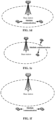
- FIG. 1a is a schematic diagram of a unicast transmission mode between terminals according to an embodiment of the present disclosure.
- the receiving end has one terminal, for example, the first terminal and the second terminal can communicate with each other in a single direction.
- FIG. 1b is a schematic diagram of a multicast transmission mode between terminals according to an embodiment of the present disclosure.
- the receiving end has all terminals in a communication group or all terminals within a certain transmission distance.
- a first terminal can send sidelink data to a second terminal, a third terminal and a fourth terminal that are all in a communication group.
- FIG. 1c is a schematic diagram of a broadcast transmission mode between terminals according to an embodiment of the present disclosure.
- the receiving end has any one of terminals around a terminal at the sending end.
- a first terminal is a terminal at the sending end, and other terminals around the first terminal, i.e., the second terminal to the sixth terminal are all terminals at the receiving end.
- FIG. 1d is a schematic diagram of all terminals performing sidelink communication being located within network coverage according to an embodiment of the present disclosure. As shown in FIG. 1d , in the sidelink communication within network coverage, all terminals within the coverage of the same base station can perform sidelink communication based on the same sidelink configuration by receiving configuration information from the base station.
- within network coverage in the embodiments of the present disclosure can be within coverage corresponding to a network device.
- FIG. 1e is a schematic diagram of a part of terminals performing sidelink communication being located within network coverage according to an embodiment of the present disclosure.
- the terminals within the network coverage can receive the configuration information from the base station and perform sidelink communication according to the configuration from the base station.
- the terminals outside the network coverage cannot receive the configuration information from the base station.
- the terminal outside the network coverage determines sidelink configuration information based on pre-configuration information and information carried in Physical Sidelink Broadcast Channel (PSBCH) sent by the terminal within the network coverage, thereby performing the sidelink communication.
- PSBCH Physical Sidelink Broadcast Channel
- FIG. 1f is a schematic diagram of all terminals performing sidelink communication being located outside network coverage according to an embodiment of the present disclosure. As shown in FIG. 1f , in the sidelink communication outside the network coverage, all terminals can determine sidelink configuration according to pre-configuration information to perform the sidelink communication.
- a D2D-based sidelink transmission technology has a manner for receiving and sending communication data through base stations different from that in traditional cellular system.
- D2D communication has higher spectrum efficiency and lower transmission delay.
- the V2X system adopts a way of D2D direct communication, and defines two resource selection modes in 3GPP: the first resource selection mode and the second resource selection mode.
- transmission resources of a terminal may be allocated by a base station, and the terminal may send sidelink data on a sidelink link according to the resources allocated by the base station.
- the base station can allocate resources for single transmission or resources for semi-static transmission for the terminal.
- the network may allocate transmission resources for sidelink transmission for the terminal.
- a physical layer of the terminal can exclude resources unsuitable for the sidelink transmission from the resource selection window according to a channel listening result; determine the candidate resource set based on the resources unsuitable for the sidelink transmission, and report the candidate resource set to a Media Access Control (MAC) layer of the terminal.
- the MAC layer may then select resources from the reported candidate resource set to transmit sidelink data.
- MAC Media Access Control
- the terminal can randomly select the transmission resources in the pre-configured resource pool or the resource pool configured by the network. For example, the transmission resources can be selected according to the listening result.
- the following three problems will exist when the resources used for sending the sidelink data are determined through the second resource selection mode.
- FIG. 2a is a schematic diagram of positions of terminals performing sidelink communication according to an embodiment of the present disclosure.
- a first terminal and a second terminal can detect each other's transmissions, and a second terminal and a third terminal can detect each other's transmissions. If the first terminal selects resources used for sending sidelink data according to listening and sends sidelink data by using the resources. However, the first terminal and the third terminal are far away from each other and cannot detect each other's transmissions. In this case, the first terminal and the third terminal may select the same or overlapping transmission resources, and the transmission of the sidelink data from the third terminal may cause interference to the transmission of the sidelink data of the first terminal.
- the terminal selects the transmission resources through listening, in the listening window, if the terminal sends sidelink data on a certain slot, due to the limitation of half-duplex, the terminal cannot receive data sent by other terminals on the slot and has no listening result. Therefore, when the terminal performs resource exclusion, all the resources corresponding to the slot in the selection window will be excluded to avoid interference from other terminals. Therefore, due to the limitation of half duplex, the terminal excludes many resources that do not need to be excluded.
- FIG. 2b is another schematic diagram of positions of terminals performing sidelink communication according to an embodiment of the present disclosure.
- the first terminal and the second terminal can detect each other's transmissions
- the first terminal and the third terminal can detect each other's transmissions
- the third terminal and the fourth terminal can detect each other's transmissions.
- the first terminal and the third terminal are both configured to send the sidelink data
- the second terminal and the fourth terminal are both used configured to receive the sidelink data.
- the second terminal is far away from the third terminal and the fourth terminal is far away from the first terminal, in this case, even if the first terminal and the second terminal use the same time-frequency resources, the reception of their respective target receiving terminals will not be affected.
- the signal received power for listening each other during the listening process may be very high, so both the first terminal and the second terminal will choose orthogonal time-frequency resources, which may eventually lead to the decline of resource utilization efficiency.
- the embodiments of the present disclosure provide a method for resource determination.
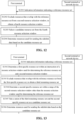
- FIG. 3 is a flowchart of a method for resource determination according to an embodiment of the present disclosure. As shown in FIG. 3 , the method includes operations S301 to S303.
- a first terminal receives indication information indicating a reference resource set.
- the first terminal may receive indication information sent by the second terminal. In other embodiments, the first terminal may receive indication information sent by the network device.
- the indication information may be called as reference resource set indication information.
- the indication information may be high-layer information or physical layer information in a sidelink communication system.
- the high-layer information described in any of the embodiments of the present disclosure may include MAC layer information.
- the indication information may be separate information or may be carried in other information sent by the second terminal or the network device to the first terminal.
- the reference resource set may be used for assisting the first terminal in resource selection.
- the reference resource set may include: a resource set suitable for use of the first terminal or a resource set unsuitable for the use of the first terminal. In other embodiments, the reference resource set may include: a resource set suitable for the use of the first terminal or a resource set unsuitable for the use of the first terminal in resources that have been instructed to be reserved through Sidelink Control Information (SCI). In still other embodiments, the reference resource set may include: a resource set suitable for the use of the first terminal or a resource set unsuitable for the use of the first terminal in the resources that have been pre-selected but not yet been instructed to be reserved through the SCI. In still other embodiments, the reference resource set may include: a resource set that has been used by the first terminal and that has experienced a resource collision or has a limitation of the half duplex.
- SCI Sidelink Control Information
- the indication information may include or indicate at least one of time domain information of the reference resource set or frequency domain information of the reference resource set. Therefore, the first terminal may determine a reference resource set within a range of at least one of the time domain information or the frequency domain information based on at least one of the time domain information or the frequency domain information.
- the reference resource set indicated by the indication information may be at least one of: a resource set that is continuous or discontinuous in the time domain, or a resource set that is continuous or discontinuous in the frequency domain.
- the reference resource set indicated by the indication information may be a resource set that is continuous in both the time domain and the frequency domain.
- the reference resource set indicated by the indication information may be a resource set that is discontinuous in at least one of the time domain and the frequency domain.
- the first terminal determines a candidate resource set based on the reference resource set.
- the candidate resource set may be selected from the reference resource set.
- the candidate resource set is included in the reference resource set, i.e. the operation that the candidate resource set is determined based on the reference resource set may include: the candidate resource set is selected from the reference resource set.
- the candidate resource set may be partly selected from the reference resource set. In this case, the candidate resource set partially overlaps with the reference resource set.
- the determined candidate resource set may not be selected from the reference resource set. In this case, an intersection of the reference resource set and the candidate resource set is an empty set.
- the candidate resource set may be a subset of the reference resource set. In other implementations, the reference resource set partially overlaps with the candidate resource set. In still other implementations, the reference resource set may be a subset of the candidate resource set.
- the first terminal determines resources used for sending sidelink data based on the candidate resource set.
- the sidelink data may include at least one of sidelink control information or sidelink data information.
- the sidelink control information can be the SCI.
- At least one of the sidelink control information or the sidelink data information may be information sent by the first terminal to the second terminal or the network device.
- the resources used for sending the sidelink data may be selected from the candidate resource set.
- the resources used for sending the sidelink data are included in the candidate resource set, i.e. the operation that the resources used for sending the sidelink data are determined based on the candidate resource set may include: the resources used for sending the sidelink data are selected from the candidate resource set.
- the resources used for sending the sidelink data may be partially selected from the candidate resource set. In this case, the resources used for sending the sidelink data partially overlap with the candidate resource set.
- the determined resources used for sending the sidelink data may not be selected from the reference resource set. In this case, the intersection of the candidate resource set and the resources used for sending the sidelink data is an empty set.
- the resources used for sending the sidelink data may be a subset of the candidate resource set.
- the reference resource set partially overlap with the resources used for sending the sidelink data.
- the candidate resource set may be a subset of the resources used for sending the sidelink data.
- the first terminal since the first terminal receives the indication information indicating the reference resource set, the first terminal determines the candidate resource set based on the reference resource set, and resources used for sending sidelink data are determined based on the candidate resource set. In this way, when selecting the resources used for sending the sidelink data, the first terminal can determine the resources used for sending the sidelink data based on the indicated reference resource set, so that the reliability of the sidelink data transmission can be improved.
- the second terminal or the network device may indicate, to the first terminal, a reference resource set capable of avoiding interference from the sidelink data sent by the third terminal.
- a reference resource set capable of avoiding interference from the sidelink data sent by the third terminal.
- a resource pool used for determining the reference resource set is identical to a resource pool used for determining the candidate resource set.
- the resource pool may be a resource set that is continuous or discontinuous in the time domain and/or frequency domain.
- a length in time domain of the resource pool may be greater than or equal to a length in time domain of an union between the reference resource set and the candidate resource set, and/or a length in frequency domain of the resource pool may be greater than or equal to a length in frequency domain of the union between the reference resource set and the candidate resource set.
- the operation that the first terminal receives the indication information includes: the first terminal receives the indication information sent by the second terminal or the network device.
- the method may further include: the first terminal sends first high-layer information or first physical layer information to the second terminal or the network device.
- the first high-layer information or the first physical layer information indicates at least one of: a size in frequency domain of resources included in the reference resource set, or configuration information of the resource pool used for determining the reference resource set..
- the second terminal or the network device may receive the first high-layer information or the first physical layer information sent by the first terminal, therefore, the second terminal or network device may determine at least one of the size in frequency domain of resources included in the reference resource set, or the configuration information of the resource pool used for determining the reference resource set based on the first high-layer information or the first physical layer information, thereby determining the reference resource set.
- the resources included in the reference resource set may be all the resources included in the reference resource set.
- the first terminal may send the first high-layer information or the first physical layer information to the second terminal or network device, such that the second terminal or network device may determine an indicated reference resource set based on the first high-layer information or the first physical layer information.
- a physical layer of the first terminal receives the indication information sent by the second terminal or network device.
- the physical layer of the first terminal determines the candidate resource set based on the reference resource set.
- the method further includes: the physical layer reports the candidate resource set to the MAC layer of the first terminal; and the MAC layer determines the resources used for sending the sidelink data based on the candidate resource set.
- the indication information may be physical layer information, so that the physical layer of the first terminal may determine the reference resource set based on the received physical layer information.
- the method further includes: the physical layer of the first terminal determines a first resource set, and uploads the first resource set to the MAC layer of the first terminal; the MAC layer determines the candidate resource set based on the reference resource set and the first resource set; and the MAC layer determines the resources used for sending the sidelink data based on the candidate resource set.
- the indication information may be physical layer information.
- the physical layer of the first terminal can receive the indication information sent by the second terminal or the network device, and report the indication information to the MAC layer of the first terminal.
- the physical layer may determine a first resource set based on the reference resource set indicated by the indication information, and report the first resource set to the MAC layer, so that the MAC layer of the first terminal may receive the indication information, and determine the candidate resource set based on the reference resource set indicated by the indication information and the first resource set reported by the physical layer.
- the indication information may also be MAC layer information.
- the MAC layer of the first terminal may receive the indication information sent by the second terminal or the network device, so that the MAC layer of the first terminal may determine the reference resource set based on the reference resource set indicated by the indication information and the first resource set reported by the physical layer.
- the reference resource set may include resources suitable for the first terminal to send the sidelink data.
- resources included in the reference resource set and resources included in the candidate resource set have a same size in frequency domain. Since the reference resource set includes resources suitable for the first terminal to send the sidelink data, the first terminal can preferentially select resources used for sending the sidelink data from the reference resource set, thereby improving the reliability of the sidelink data transmission.
- the reference resource set includes resources unsuitable for the first terminal to send the sidelink data.
- a size in frequency domain of the resources included in the reference resource set is one or more sub-channels; and resources included in the reference resource set and resources included in the candidate resource set have a same or different size in frequency domain.
- the embodiments corresponding to FIG. 4 to FIG. 9 illustrate the method for resource determination of the embodiments of the present disclosure by taking the reference resource set including resources suitable for the first terminal to send the sidelink data as an example.
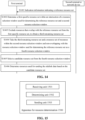
- FIG. 4 is a flowchart of another method for resource determination according to an embodiment of the present disclosure. As shown in FIG. 4 , the method includes operations S401 to S404.
- the second terminal or the network device sends the indication information to the first terminal, and the first terminal receives the indication information sent by the second terminal or the network device.
- the indication information indicates a reference resource set.
- the first terminal determines a first resource set.
- the first terminal may determine the first resource set based on the second resource selection mode.
- the first resource set may be a resource set selected by the first terminal from a pre-configured resource pool or a resource pool configured by the network.
- the first terminal determines a candidate resource set based on an intersection of the first resource set and the reference resource set.
- the candidate resource set is determined based on the intersection of the first resource set determined by the first terminal and the reference resource set.
- the candidate resource set may be a common subset between the first resource set and the reference resource set.
- the embodiments corresponding to FIG. 4 may conform to a case where the physical layer of the first terminal determines the candidate resource set based on the reference resource set.
- the physical layer of the first terminal may determine the first resource set
- the physical layer of the first terminal may determine the candidate resource set based on the first resource set and the reference resource set, and upload the candidate resource set to the MAC layer.
- the embodiments corresponding to FIG. 4 can also conform to a case where the physical layer of the first terminal determines a first resource set and uploads the first resource set to the MAC layer of the first terminal, and the MAC layer determines the candidate resource set based on the reference resource set and the first resource set.
- the operation that the first terminal receives the indication information includes: the first terminal receives the indication information sent by the second terminal or a network device.
- the number of resources included in the reference resource set may be greater than or equal to a product of the first value M' total and the second value Y1.
- the number of resources included in the reference resource set may be determined by the second terminal or network device.
- the first value M' total is the total number of resources in the resource selection window used by the second terminal or network device to determine the reference resource set.
- the second value Y1 is greater than 0 and less than or equal to 1.
- the second value Y1 is determined by one of: a fixed setting, a network configuration, or a pre-configuration; by an indication of the first terminal, from one or more target values through second high-layer information or second physical layer information.
- the one or more target values are determined by a fixed setting, a network configuration or a pre-configuration.
- the first terminal may send information used for feeding back the indication information to the second terminal or the network device, and indicate the second value Y1 through the information used for feeding back the indication information.
- the second value Y1 may be 0.3, 0.5, 0.8, or 1.
- values set by the fixed setting in any embodiment of the present disclosure may be values defined in the standard.
- the resource selection window used for determining the reference resource set is identical to the resource selection window used for determining the first resource set.
- a resource set in a resource selection window used for determining the reference resource set may be a subset of a resource set in a resource pool used for determining the reference resource set.
- the length in time domain and/or length in frequency domain of the resource selection window used for determining the reference resource set may be less than or equal to the length time domain and/or length in frequency domain of the resource pool used for determining the reference resource set.
- the first terminal may send third high-layer information or third physical layer information to the second terminal or network device.
- the third high-layer information or the third physical layer information indicates a time starting position of the resource selection window used for determining the reference resource set. Therefore, the second terminal or network device may receive the third high-layer information or the third physical layer information sent by the first terminal, and may determine the time starting position of the resource selection window used for determining the reference resource set based on the third high-layer information or the third physical layer information, thereby determining the reference resource set.
- the first value M' total may be identical to the initial number M total of resources in an available resource set of the resource pool used by the first terminal.
- the resource selection window used for determining the reference resource set is determined by the second terminal or the network device based on at least one of: a time at which trigger information sent by the first terminal is received, or specific information included in the trigger information.
- the specific information included in the trigger information may include information for determining a resource selection window of the reference resource set. For example, information of position in time-frequency used for determining a resource selection window of the reference resource set, etc.
- the second terminal or network device can receive the trigger information sent by the first terminal.
- the resource selection window used for determining the reference resource set is determined based on a received time at which trigger information sent by the first terminal is received, or specific information included in the trigger information.
- the trigger information can be physical layer information or high-layer information.
- the first value M' total differs from the initial number M total of resources in the available resource set of the resource pool used by the first terminal.
- any two of the first high-layer information /first physical layer information, the second high-layer information/second physical layer information, the third high-layer information/third physical layer information, or the trigger information may be the same message or different messages.
- the different messages can be signaling separating from each other, or can be carried in different signaling, or can be carried in the same signaling.
- the method may further include: in a case where the intersection of the first resource set and the reference resource set is greater than or equal to a first threshold, the intersection of the first resource set and the reference resource set is taken as the candidate resource set.
- the method further includes: in a case where the intersection of the first resource set and the reference resource set is less than the first threshold, a first Reference Signal Received Power (RSRP) threshold used for determining the first resource set is raised to a second RSRP threshold; a second resource set AA is determined based on the second RSRP threshold; and in a case where an intersection of the second resource set AA and the reference resource set is greater than or equal to the first threshold, the intersection of the second resource set AA and the reference resource set is taken as the candidate resource set.
- the RSRP in any embodiment of the present disclosure may include Sidelink Reference Signal Received Power (S-RSRP).
- the operation that the first threshold is raised to a second RSRP threshold may include: the first RSRP threshold is raised by 3dB to obtain the second RSRP threshold.
- the second RSRP threshold is raised by 3dB until the intersection of the resource set determined based on the obtained RSRP threshold and the reference resource set is greater than or equal to the first threshold, and the intersection is taken as the candidate resource set.
- the first terminal determines resources used for sending the sidelink data based on the candidate resource set.
- resources included in the reference resource set, resources included in the candidate resource set, and resources included in the first resource set have a same size in frequency domain.
- the first resource set is a set determined by the first terminal that is suitable for the first terminal to send sidelink data
- the reference resource set includes resources determined by the second terminal or the network device that is suitable for the first terminal to send the sidelink data, so that the candidate resource set is determined based on the intersection of the first resource set and the reference resource set, which can not only satisfies the requirements for the first terminal to send the sidelink data, but also satisfies the requirements for the second terminal or network device to receive the sidelink data, thereby improving the transmission reliability of the sidelink data.
- a method for selecting resources from a specific resource selection window by using a second resource selection mode in an embodiment of the present disclosure is described below.
- the first terminal may determine the selected resource set by determining an eighth resource set and a ninth resource set; and taking an intersection of the eighth resource set and the ninth resource set as the selected resource set.
- the eighth resource set is determined based on a third target slot at which data is transmitted within a listening window and no listening is performed, and the ninth resource set is determined based on a detected Physical Sidelink Control Channel (PSCCH).
- the first terminal can determine the slot in the specific resource selection window based on the third target slot and the value set of the resource reservation period field configured by the resource pool used by the first terminal.
- the operation that the eighth resource set is determined may include: in a case where the data is sent at the third target slot in the listening window and no listening is performed at the third target slot, resources corresponding to the third target slot are excluded from a specific resource selection window to obtain the eighth resource set.
- the operation that the resources corresponding to the third target slot are excluded from the target resource selection window may include: in the specific resource selection window, a fourth target slot corresponding to the third target slot is determined based on a resource reservation period; and all resources in the fourth target slot are determined.
- the resources in the fourth target slot may include all the frequency resources in the fourth target slot.
- the operation that a ninth resource set is determined may include: in a case where the intersection of the fifth remaining resources and the eighth resource set is less than the product of the available resource set and the sixth value, the first RSRP threshold is raised to a second RSRP threshold; in a case where the RSRP of the PSCCH or the RSRP of the PSSCH scheduled by the PSCCH is greater than the second RSRP threshold and the periodic resource reservation is activated for the reserved resource in the target resource selection window or in the resource pool used by the first terminal, the reserved resource is excluded from the target resource selection window to obtain sixth remaining resources; and in a case where an intersection of the sixth remaining resources and the eighth resource set is greater than or equal to a product of the available resource set and the sixth value, the sixth remaining resources are taken as the ninth resource set.
- the sixth value can have a value between 0.2 and 1.
- the sixth value can be determined from the value set ⁇ 0.2, 0.35, 0.5, 1 ⁇ .
- the first terminal may determine the value from the value set based on the priority for sending the sidelink data.
- a value of the first RSRP threshold can be determined based on at least one of the priority carried in the PSCCH detected by the first terminal or the priority for the first terminal to send the sidelink data.
- the method further includes: in a case where the intersection of the fifth remaining resources and the eighth resource set is less than the product of the available resource set and the sixth value, the first RSRP threshold is raised to a second RSRP threshold; in a case where the RSRP of the PSCCH or the RSRP of the PSSCH scheduled by the PSCCH is greater than the second RSRP threshold and the periodic resource reservation is activated for the reserved resource in the specific resource selection window or in the resource pool used by the first terminal, the reserved resource is excluded from the specific resource selection window to obtain sixth remaining resources; and in a case where an intersection of the sixth remaining resources and the eighth resource set is greater than or equal to a product of the available resource set and the sixth value, the sixth remaining resources are taken as the ninth resource set.
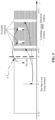
- FIG. 5 is a schematic diagram of determining a selected resource set according to an embodiment of the present disclosure.
- the first terminal triggers a resource selection or a resource reselection in slot n, and the specific resource selection window starts from n+T1 and ends at n+T2.
- the values of T proc,1 can be 3 slots, 5 slots, 9 slots and 17 slots respectively.
- T2 is greater than or equal to T2 min and T2 is less than or equal to a residual delay budget of service.
- a value set of T2 min may include slots selected from the set ⁇ 1 ⁇ 2 ⁇ , 5 ⁇ 2 ⁇ , 10 ⁇ 2 ⁇ , 20 ⁇ 2 ⁇ ⁇ . In a case where the values of the subcarrier spacing are 15kHz, 30kHz, 60kHz and 120kHz respectively, the values of ⁇ may be 0, 1, 2, 3, respectively.
- the first terminal may determine, according to the priority for the first terminal to send the sidelink data, T2 min from the value set ⁇ 1 ⁇ 2 ⁇ , 5 ⁇ 2 ⁇ , 10 ⁇ 2 ⁇ , 20 ⁇ 2 ⁇ ⁇ . [n+T1, n+T2] is called the specific resource selection window.
- the first terminal can perform resource listening between n-T0 to n-T proc,0 , and the value of T0 is 100 or 1100 milliseconds.
- the values of the subcarrier spacing are 15kHz, 30kHz, 60kHz and 120kHz, respectively, the values of T proc,0 can be 1 slot, 1 slot, 2 slots and 4 slots respectively.
- [n-T0 to n-T proc,0 ] is called a listening window or a resource listening window.
- the physical layer of the first terminal may exclude, according to the channel listening result, resources unsuitable for sidelink transmission from a specific resource selection window.
- the first terminal takes all available resources belonging to the resource pool used by the first terminal in the specific resource selection window as a target resource set.
- Any resource in the target resource set can be recorded as R (x,y), where x indicates a position in frequency domain of the resource and y indicates a position in time domain of the resource.
- the initial number of resources in the target resource set can be M total .
- one resource may have one or more slots in the time domain and one or more sub-channels in the frequency domain.
- a sub-channel includes multiple PRBs.
- one resource may have multiple slots in the time domain.
- the terminal determines whether the slot a+q ⁇ Prx1g overlaps with the resource R (x,y+j ⁇ Ptx1g). If so, the resource R (x,y) is excluded from the resource set A. Where j may have a value selected forn 0, 1, 2, 3... C-1, and C may be determined based on a random counter value generated by the first terminal.
- the Ptxlg is a number of logical slots converted from the resource reservation period Prx of the first terminal. Prx is one of the resource reservation periods allowed by the resource pool. If Prx is less than Tscal and n minus a is less than or equal to Prxlg, Q can be rounded up by Tscal divided by Prx, otherwise Q is equal to 1. Tscal is a value in millisecond converted from T2.
- the terminal detects the first sidelink control information transmitted in the PSCCH on a resource E (v, m) (v is the position in frequency domain of the resource) in the slot m within the listening window, the S-RSRP of the PSCCH or the S-RSRP of the PSSCH scheduled by the PSCCH (i.e. the S-RSRP of the corresponding PSSCH transmitted in the same slot as the PSCCH) is measured. If the measured S-RSRP is greater than the first S-RSRP threshold and periodic resource reservation is activated in the resource pool used by the first terminal, the first terminal may assume that the first sidelink control information received in m+q ⁇ Prx1g have the same content as that received in slot m.
- q can have a value selected from 1, 2, 3... Q.
- Prx is less than Tscal and n minus m is less than or equal to Prxlg
- Q can be rounded up by Tscal divided by Prx, otherwise Q is equal to 1.
- Tscal is a value in millisecond converted from T2.
- the Prxlg is a number of logical slots converted from the resource reservation period Prx.
- the resource reservation period Prx may be the resource reservation period indicated by the Resource reservation period in the first sidelink control information transmitted in the PSCCH detected by the first terminal.
- the first terminal may determine whether the resources indicated by the Time resource assignment domain and the Frequency resource assignment domain of the Q pieces of the first sidelink control information supposedly received overlap with the resource R (x,y+j ⁇ Ptx1g). If so, the corresponding resource R (x,y) is excluded from the set A.
- the first terminal may determine whether the resources indicated by the Time resource assignment (Time resource assignment) and the Frequency resource assignment (Frequency resource assignment) fields of the Q first sidelink control information supposedly received overlap with the resource R (x, y).
- j may have a value selected forn 0, 1, 2, 3... C-1, and C may be determined based on a random counter value generated by the first terminal.
- the Ptxlg is a number of logical slots converted from the Ptx, and the Ptx is a resource reservation period determined by the first terminal performing resource selection.
- the first S-RSRP threshold may be determined by the priority P1 carried in the PSCCH detected by the first terminal and the priority P2 of the sidelink data to be sent by the terminal.
- the configuration of the resource pool used by the terminal may include an S-RSRP threshold list.
- the S-RSRP threshold list contains S-RSRP thresholds corresponding to all priority combinations.
- the configuration of resource pool can be network configuration or pre-configuration.
- the first S-RSRP threshold value is raised by 3dB to obtain the second S-RSRP threshold value, and then the two cases above are performed again, i.e., the resources that should be excluded from the target resource set are determined again according to the slot that is not being listened in the listening window and the position in time domain and frequency domain when the PSCCH is detected, until the remaining resources in the target resource set after the resource exclusion are greater than or equal to M total ⁇ X%.
- the possible values of X are ⁇ 20, 35, 50 ⁇ .
- the configuration of the resource pool used by the first terminal may include correspondences between the priority and the possible values of X.
- the first terminal determines the value of X according to the priority of the sidelink data to be sent and the correspondences.
- the X% described above may be the sixth value in the embodiments of the present disclosure.
- the physical layer of the first terminal may take the remaining resources in the target resource set as the selected resource set A.
- the embodiments of the present disclosure relates to multiple cases where resources are selected from the resource selection window.
- the physical layer of the first terminal needs to determine a first resource set, and the first resource set is selected from the target resource selection window.
- the first terminal may select the candidate resource set from the first resource selection window.
- the first terminal may select the candidate resource set from the third resource selection window.
- the first terminal may select the candidate resource set from the fourth resource selection window.
- the selection of resources from any of the above-mentioned resource selection windows may be performed by the physical layer of the first terminal.
- the selection can be performed in a manner of the second resource selection mode.
- the selected resource set may be the first resource set.
- the selected resource set may be a candidate resource set.
- the selected resource set may be a candidate resource set.
- the selected resource set may be a candidate resource set.
- any resource selection window in the embodiments of the present disclosure may include resources or resource sets within the selection window.
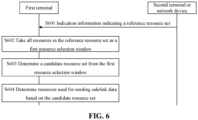
- FIG. 6 is a flowchart of yet another method for resource determination according to an embodiment of the present disclosure. As shown in FIG. 6 , the method includes operations S601 to S604.
- the second terminal or the network device sends indication information indicating a reference resource set to the first terminal, and the first terminal receives the indication information sent by the second terminal or the network device.
- the indication information is located in a slot r, a slot at which a first one of resources in the reference resource set is located is not before a first one of slots after a specific interval following after slot r.
- the specific interval is determined based on a duration for the first terminal to decode the indication information and respond based on the indication information, and the specific interval is determined by a fixed setting, a network configuration, or a pre-configuration.
- the specific interval may include an interval for decoding the indication information.
- the specific interval may include an n interval for decoding the indication information and responding based on the indication information.
- the specific interval may include a sum of an interval for decoding the indication information and responding based on the indication information and an interval determined based on a subcarrier spacing. The interval determined based on the subcarrier spacing may be T proc,1 as described above.
- the first terminal takes all resources in the reference resource set as a first resource selection window.
- the time-frequency resources occupied by all resources in the reference resource set are identical to the time-frequency resources occupied by the first resource selection window.
- the first terminal determines a candidate resource set from the first resource selection window.
- the first terminal may determine, by adopting the second resource selection mode, the candidate resource set from the first resource selection window.
- the number of resources in the candidate resource set finally determined by the first terminal may be equal to the number of resources in the reference resource set.
- the number of resources in the candidate resource set may be the number of all resources in the candidate resource set, and the number of resources in the reference resource set may be the number of all resources in the reference resource.
- the first terminal determines, based on the candidate resource set, resources used for sending sidelink data.
- the first terminal determines the candidate resource set from the reference resource set indicated by the second terminal or the network device, and then determines the resources used for sending the sidelink data based on the candidate resource set. Therefore, the first terminal can select the resources used for sending the sidelink data from the indicated reference resource set, thereby improving the reliability for the second terminal or the network device to receive the sidelink data.
- the first terminal may determine the candidate resource set based on the reference resource set, a resource selection window W used for determining the reference resource set, and a second resource selection window [n+T1, n+T2].
- the second resource selection window is located between the first target slot and the second target slot.
- a slot value of the first target slot n+T1 is a sum of a slot value triggering a resource selection or a resource reselection and a second slot value.
- the second slot value is greater than or equal to 0 and less than or equal to the third slot value T proc,1 .
- the third slot value is determined based on the subcarrier spacing.
- a slot value of the second target slot n+T2 is a sum of the slot value triggering the resource selection or the resource reselection and the fourth slot value.
- the fourth slot value is greater than or equal to the fifth slot value and less than or equal to the residual delay budget of service;.
- the fifth slot value is determined by the first terminal from a second value set based on a priority for sending the sidelink data.
- the fourth slot value may be the above T2, and the fifth time slot value may be the above T2 min .
- FIG. 7 is a schematic diagram of a listening window and a selection window according to an embodiment of the present disclosure.
- the first terminal triggers the resource selection or the resource reselection at slot n.
- the time domain of the listening window is between n-T0 and n-T proc,0 , and the first terminal can perform resource listening between n-T0 to n-T proc,0 .
- the second resource selection window may be resources between [n+T1, n+T2].
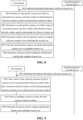
- FIG. 8 is a flowchart of still another method for resource determination according to an embodiment of the present disclosure. As shown in FIG. 8 , the method includes operations S801 to S806.
- the second terminal or the network device sends indication information indicating a reference resource set SC to the first terminal, and the first terminal receives the indication information sent by the second terminal or the network device.
- the first terminal determines a first specific resource set within an intersection of a resource selection window for determining the reference resource set and a second resource selection window.
- the first terminal determines an intersection of the first specific resource set and the reference resource set as a third specific resource set.
- the first terminal takes a union of the second specific resource set and the third specific resource set as the candidate resource set.
- the first terminal may determine a union of the second specific resource set and the third specific resource set as the candidate resource set.
- the first terminal determines resources used for sending the sidelink data based on the candidate resource set.
- the candidate resource set is determined based on a union of the third resource set A1, the fourth resource set (A2 ⁇ SC) and the fifth resource set A3.
- the candidate resource set may be a union of the third resource set A1, and the fourth resource set (A2 ⁇ SC) and the fifth resource set A3.
- the third resource set may be a resource set in a resource selection window between the first target slot and a slot corresponding to the first slot value r+ ⁇ +T proc,1 .
- r is a slot at which the information indicating the SC is located
- ⁇ indicates a duration for the terminal to decode the information indicating the SC and respond based on the information
- the value of ⁇ is defined by standard, configured by network or pre-configured.
- the fourth resource set may be an intersection of the sixth resource set A2 and the reference resource set.
- the sixth resource set is a resource set in a resource selection window between the slot corresponding to the first slot value r+ ⁇ +T proc,1 and a slot corresponding to a first smaller value.
- the first smaller value is a smaller value between the value of the second target slot n+T2 and a sum of the first slot value r+ ⁇ +T proc,1 and a duration of the resource selection window used for determining the reference resource set.
- the fifth resource set is a resource set in a resource selection window between a slot corresponding to the first smaller value and the second target slot.
- the first slot value is determined based on a value of a slot at which the first terminal receives the indication information.
- the duration of the resource selection window used for determining the reference resource set is determined based on one of: a fixed setting, a network configuration, or a pre-configuration; or by an indication of the first terminal within a specific range.
- a value of the fixed setting may be 96ms.
- the candidate resource set may be A1 ⁇ (A2 ⁇ reference resource set) UA3.
- A1 is a resource set determined by taking [the first target slot n+T1, the slot r+ ⁇ +T proc,1 corresponding to the first slot value] as a resource selection window.
- A2 is a resource set determined by taking [the slot r+ ⁇ +T proc,1 corresponding to the first slot value, min (r+ ⁇ +T proc,1 +C, second target slot n+T2)] as the resource selection window.
- A3 is a resource set determined by taking [min (r+ ⁇ +T proc,1 +C, n+T2), n+T2] as the resource selection window.
- n is a time at which the first terminal triggers the resource selection or the resource reselection.
- C may be a duration for the second terminal or network device to determine the resource selection window of the SC, and a value of C may be defined by standard, network configuration, pre-configuration, or by an indication of the first terminal within a specific range. For example, C may be fixed to 96ms. In case where min (r+ ⁇ +T proc,1 +C, n+T2) is n+T2, A3 is an empty set.
- FIG. 9 is a flowchart of a method for resource determination method according to another embodiment of the present disclosure. As shown in FIG. 9 , the method includes operations S901 to S904.
- the second terminal or the network device sends indication information indicating a reference resource set SC to the first terminal, and the first terminal receives the indication information sent by the second terminal or the network device.
- the first terminal takes a union of the reference resource set and a resource set in a second resource selection window other than a resource selection window used for determining the reference resource set as a third resource selection window.
- the first terminal excludes resources in the second resource selection window [n+T1, n+T2] that overlap with the resource selection window W for determining the reference resource set, to obtain a remaining resource, and takes the union of the remaining resource and the reference resource set as the third resource selection window.
- the first terminal selects the candidate resource set from the third resource selection window.
- a manner for selecting the candidate resource from the third resource selection window can be: the candidate resource is selected from the third resource selection window by adopting the second resource selection mode.
- the description of the second resource selection mode is described in the above-mentioned embodiments and will not be described herein.
- the first terminal determines resources used for sending sidelink data based on the candidate resource set.
- the third resource selection window may be determined based on a union of the third resource set A1, the sixth resource set A2 and the fifth resource set A3.
- the third resource selection window may be a union of the third resource set A1, the sixth resource set A2 and the fifth resource set A3.
- the third resource set A1 can be a resource set in a resource selection window between the first target slot and the slot corresponding to the first slot value r+ ⁇ +T proc,1 .
- the sixth resource set A2 may be a resource set in a resource selection window between the slot corresponding to the first time slot value r+ ⁇ +T proc,1 and a slot corresponding to the first smaller value.
- the first smaller value is a smaller value between the value of the second target slot n+T2 and a sum of the first slot value r+ ⁇ +T proc,1 and a duration of the resource selection window used for determining the reference resource set.
- the fifth resource set is a resource set in a resource selection window between a slot corresponding to the first smaller value and the second target slot.
- the first slot value is determined based on a value of a slot at which the first terminal receives the indication information.
- the first terminal may determine the third resource selection window as ⁇ all resources within a range of [n+T1, r+ ⁇ +T proc,1 ] ⁇ U ⁇ resources located within [r+ ⁇ +T proc,1 , min (r+ ⁇ +T proc,1 +C, n+T2)] ⁇ U ⁇ all resources within a range of [min (r+ ⁇ +T proc,1 +C, n+T2), n+T2] ⁇ .
- the embodiments corresponding to FIG. 10 to FIG. 14 explain the method for resource determination of the embodiments of the present disclosure by taking a case where the reference resource set includes resources unsuitable for the first terminal to send the sidelink data as an example.
- FIG. 10 is a flowchart of a method for resource determination according to yet another embodiment of the present disclosure. As shown in FIG. 10 , the method includes operations S1001 to S1005.
- the second terminal or the network device sends indication information indicating a reference resource set SC to the first terminal, and the first terminal receives the indication information sent by the second terminal or the network device.
- the first terminal determines a first resource set.
- the first terminal excludes resources that overlap with the reference resource set from the first resource set to obtain a first remaining resource set.
- the first terminal determines a candidate resource set based on the first remaining resource set.
- the candidate resource set may be determined based on the first remaining resource set.
- the first remaining resource set is obtained by excluding resources that overlap with the reference resource set from a first resource set determined by the first terminal.
- the embodiments corresponding to FIG. 10 may conform to a case where the physical layer of the first terminal determines the candidate resource set based on the reference resource set. For example, the physical layer of the first terminal determines a first resource set, the physical layer of the first terminal excludes resources that overlap with the reference resource set from the first resource set to obtain the first remaining resource set, and the physical layer of the first terminal determines the candidate resource set based on the first remaining resource set.
- the embodiments corresponding to FIG. 10 can also conform to a case where the physical layer of the first terminal determines a first resource set and uploads the first resource set to the MAC layer of the first terminal, and the MAC layer determines the candidate resource set based on the reference resource set and the first resource set. For example, the MAC layer of the first terminal excludes the resources that overlap with the reference resource set from the first resource set to obtain a first remaining resource set; and determines the candidate resource set based on the first remaining resource set.
- the first terminal may take the first remaining resource set as the candidate resource set.
- the operation that the candidate resource set is determined based on the first remaining resource may include: in a case where a number of resources in the first remaining resource set is greater than or equal to a second threshold M total ⁇ Y3, the first remaining resource set is taken as the candidate resource set.
- the second threshold value M total ⁇ Y3 is a product of an initial number of resources M total in an available resource set of a resource pool used by the first terminal and a fourth value Y3.
- the fourth value Y3 is determined by a fixed setting, a network configuration, or a pre-configuration. In some embodiments, in a case where a number of resources in the first remaining resource set is less than the second threshold M total ⁇ Y3, the first resource set is taken as the candidate resource set.
- resources used for sending sidelink data are determined based on the candidate resource set.
- FIG. 11 is a flowchart of a method for resource determination according to still another embodiment of the present disclosure. As shown in FIG. 11 , the method includes operations S1101 to S1105.
- the second terminal or the network device sends indication information indicating a reference resource set SC to the first terminal, and the first terminal receives the indication information sent by the second terminal or the network device.
- the first terminal determines a first resource set.
- the first terminal excludes resources that overlap with the reference resource set from a first resource set to obtain a first remaining resource set.
- a first RSRP threshold used for determining the first resource set is raised by 3dB, and operations S1102, S1103, and S1104 are performed again.
- the third threshold value M total ⁇ Y4 is a product of an initial number M total of resources in an available resource set of a resource pool used by the first terminal and a fifth value Y4.
- the fifth value Y4 is determined by one of: a fixed setting, a network configuration, or a pre-configuration.
- the embodiments corresponding to FIG. 11 may conform to a case where the physical layer of the first terminal determine the first resource set; excludes resources that overlap with the reference resource set from the first resource set to obtain a first remaining resource set; and takes the first remaining resource set as the candidate resource set in a case where the first remaining resource set is greater than or equal to a third threshold.
- the embodiments corresponding to FIG. 11 may conform to a case where the physical layer of the first terminal determine the first resource set; excludes resources that overlap with the reference resource set from the first resource set to obtain a first remaining resource set; and takes the first remaining resource set as the candidate resource set in a case where the first remaining resource set is greater than or equal to a third threshold.
- the 11 can also conform to a case where the physical layer of the first terminal determines the first resource set and uploads the first resource set to the MAC layer of the first terminal; the MAC layer excludes resources that overlap with the reference resource set from the first resource set to obtain a first remaining resource set; and the MAC layer takes the first remaining resource set as the candidate resource set in a case where the first remaining resource set is greater than or equal to a third threshold.
- the MAC layer determines the resources used for sending the sidelink data based on the candidate resource set.
- the first terminal determines resources used for sending the sidelink data based on the candidate resource set.
- resources included in the reference resource set and resources included in the first resource set have a same or different size in frequency domain.
- the first terminal receives indication information indicating a reference resource set sent by the second terminal or the network device.
- the first terminal excludes resources that overlap with the reference resource set from the second resource selection window, to obtain the fourth resource selection window.
- the second resource selection window is located between a first target slot and a second target slot.
- a value of the first target slot n+T1 is a sum of a value of a slot to trigger resource selection or resource reselection and a second slot value, where the second slot value is greater than or equal to 0 and less than or equal to a third slot value T proc,1 , and the third slot value is determined based on a subcarrier spacing.
- a value of the second target slot n+T2 is a sum of a value of a slot to trigger the resource selection or the resource reselection and a fourth slot value, where the fourth slot value is greater than or equal to a fifth slot value and less than or equal to a remaining delay budget value of a service, and the fifth slot value is determined by the first terminal from a second value set based on a priority for sending the sidelink data.
- the first terminal selects the candidate resource set from the fourth resource selection window.
- the first terminal may select the candidate resource set from the fourth resource selection window according to the second resource selection mode.
- the first terminal determines resources used for sending the sidelink data based on the candidate resource set.
- FIG. 13 is a flowchart of yet another method for resource determination method according to another embodiment of the present disclosure. As shown in FIG. 13 , the method includes operations S1301 to S1306.
- the second terminal or the network device sends indication information indicating a reference resource set to the first terminal, and the first terminal receives the indication information sent by the second terminal or the network device.
- the first terminal determines a first specific resource set within an intersection of the resource selection window used for determining the reference resource set and the second resource selection window.
- the first terminal excludes resources that overlap with the reference resource set from the first specific resource set, to obtain a third remaining resource set.
- the first terminal determines a second specific resource set within a range of the second resource selection window other than the resource selection window used for determining the reference resource set.
- the first terminal takes a union of the third remaining resource set and the second specific resource set as the candidate resource set.
- the first terminal determines resources used for sending the sidelink data based on the candidate resource set.
- the candidate resource set is determined based on a union of a third resource set A1, a seventh resource set and a fifth resource set A3.
- the candidate resource set may be the union of the third resource set A1, the seventh resource set and the fifth resource set A3.
- the third resource set is a resource set in a resource selection window between the first target slot and a slot corresponding to a first slot value r+ ⁇ +T proc,1 .
- the seventh resource set is a resource set of resources within the sixth resource set A2 vand non-overlapping with the reference resource set, where the sixth resource set A2 is a resource set in a resource selection window between the slot corresponding to the first slot value r+ ⁇ +T proc,1 and a slot corresponding to a first smaller value, where the first smaller value is a smaller value between the value of the second target slot n+T2 and a sum of the first slot value r+ ⁇ +T proc,1 and a duration of the resource selection window used for determining the reference resource set.
- the fifth resource set is a resource set in a resource selection window between a slot corresponding to the first smaller value and the second target slot.
- a value of the first target slot n+T1 is a sum of a value of a slot to trigger resource selection or resource reselection and a second slot value, where the second slot value is greater than or equal to 0 and less than or equal to a third slot value T proc,1 , and the third slot value is determined based on a subcarrier spacing.
- a value of the second target slot n+T2 is a sum of a value of a slot to trigger the resource selection or the resource reselection and a fourth slot value, where the fourth slot value is greater than or equal to a fifth slot value and less than or equal to a remaining delay budget value of a service, and the fifth slot value is determined by the first terminal from a second value set based on a priority for sending the sidelink data.
- the first slot value is determined based on a value of a slot at which the first terminal receives the indication information.
- the candidate resource set may be A1 ⁇ (resources in A2 that do not overlap completely with resources in the candidate resource set SC) U A3.
- A1 is a resource set determined by taking [n+T1, r+ ⁇ +T proc,1 ] as the resource selection window.
- A2 is a resource set determined by taking [r+ ⁇ +T proc,1 , min (r+ ⁇ +T proc,1 +C, n+T2)] as the resource selection window.
- A3 a resource set determined by taking [min (r+ ⁇ +T proc,1 +C, n+T2), n+T2] as the resource selection window.
- n is a time at which the first terminal triggers the resource selection or the resource reselection.
- C may be a duration for the second terminal or network device to determine the resource selection window of the SC, and a value of C may be defined by standard, network configuration, pre-configuration, or by an indication of the first terminal within a specific range. For example, C may be fixed to 96ms.
- FIG. 14 is a flowchart of still another method for resource determination according to another embodiment of the present disclosure. As shown in FIG. 14 , the method includes operations 1401 to 1406.
- the second terminal or the network device sends indication information indicating a reference resource set to the first terminal, and the first terminal receives the indication information sent by the second terminal or the network device.
- the first terminal determines a first specific resource set within an intersection of a resource selection window used for determining the reference resource set and the second resource selection window.
- the first terminal excludes resources that overlap with the reference resource set from the first specific resource set, to obtain a third remaining resource set.
- the first terminal takes the third remaining resource set and a resource set of resources within the second resource selection window and non-overlapping with the resource selection window used for determining the reference resource set as the fourth resource selection window.
- the fourth resource selection window may be determined based on a union of the third resource set A1, the seventh resource set and the fifth resource set A3.
- the fourth resource selection window may be a union of the third resource set A1, the seventh resource set and the fifth resource set A3.
- the third resource set is a resource set in a resource selection window between the first target slot and a slot corresponding to a first slot value r+ ⁇ +T proc,1 .
- the seventh resource set is a resource set of resources within the sixth resource set A2 and non-overlapping with the reference resource set, where the sixth resource set is a resource set in a resource selection window between the slot corresponding to the first slot value r+ ⁇ +T proc,1 and a slot corresponding to a first smaller value, where the first smaller value is a smaller value between the value of the second target slot n+T2 and a sum of the first slot value r+ ⁇ +T proc,1 and a duration of the resource selection window used for determining the reference resource set.
- the fifth resource set is a resource set in a resource selection window between a slot corresponding to the first smaller value and the second target slot.
- a value of the first target slot n+T1 is a sum of a value of a slot to trigger resource selection or resource reselection and a second slot value, where the second slot value is greater than or equal to 0 and less than or equal to a third slot value T proc,1 , and the third slot value is determined based on a subcarrier spacing.
- a value of the second target slot n+T2 is a sum of a value of a slot to trigger the resource selection or the resource reselection and a fourth slot value, where the fourth slot value is greater than or equal to a fifth slot value and less than or equal to a remaining delay budget value of a service, and the fifth slot value is determined by the first terminal from a second value set based on a priority for sending the sidelink data.
- the first slot value is determined based on a value of a slot at which the first terminal receives the indication information.
- the first terminal determines a resource selection window as ⁇ all resources in a range of [n+T1, r+ ⁇ +T proc,1 ] ⁇ U ⁇ resources in the range of [r+ ⁇ +T proc,1 min (r+ ⁇ +T proc,1 +C, n+T2)] that do not overlap with resources in SC ⁇ all resources in a range of ⁇ [min (r+ ⁇ +T proc,1 +C, n+T2] ⁇ .
- the first terminal may determine the candidate resource set according to the second resource selection mode.
- the first terminal selects the candidate resource set from the fourth resource selection window.
- the first terminal determines resources used for sending the sidelink data based on the candidate resource set.
- the resource pool used for determining the reference resource set, the resource pool used for determining the candidate resource set, and the resource pool used for determining the first resource set are identical.
- a number of sub-channels included in each resource in the first resource set, a number of sub-channels included in each resource in the reference resource set, and a number of sub-channels included in each resource in the candidate resource set are identical.
- the first terminal may determine the candidate set by using any of the above methods.
- the determination of the candidate resource set may be performed by the physical layer of the first terminal.
- the physical layer of the first terminal may upload the determined candidate resource set to the MAC layer of the first terminal.
- the determination of the candidate resource set may be performed by the MAC layer of the first terminal.
- the MAC layer of the first terminal may perform the operation of determining the resources used for sending the sidelink data.
- the first terminal receives the indication information indicating the reference resource set.
- the first terminal may determine the candidate resource set based on the reference resource set.
- the first terminal may randomly select the resources used for sending the sidelink data from the candidate resource set.
- the first terminal receives the indication information indicating the reference resource set.
- the first terminal may determine the candidate resource set based on the reference resource set.
- the candidate resource set has a set of Q resources or multiple sets of Q resources and an interval between any two of the set of Q resources or any set of the multiple sets of Q resources is greater than or equal to a specific slot value Z and less than or equal to 32
- the set of Q resources or the any set of the multiple sets of Q resources is taken as the resources used for sending the sidelink data.
- Q is a number of resources determined by the first terminal to send one or more Transport Blocks (TBs).
- the specific slot value is a sum of a first interval and a second interval.
- the first interval includes an interval between an end of a last one of Orthogonal Frequency Division Multiplexing (OFDM) symbols used by the first terminal to send a PSSCH and a first one of symbols of a Physical Sidelink Feedback Channel (PSFCH) corresponding to the PSSCH.
- the second interval includes an interval for receiving the PSFCH, preparing for retransmission of data, and transmit-receive conversion.
- the first interval may be determined by the minimum interval sl-MinTimeGapPSFCH between the PSSCH configured in the resource pool and the PSFCH associated therewith and the configuration period sl-PSFCH-Period of the PSFCH in the resource pool.
- the first terminal receives the indication information indicating the reference resource set.
- the first terminal may determine the candidate resource set based on the reference resource set.
- the first terminal can randomly select resources from a first resource set based on the candidate resource set to obtain the resources used for sending the sidelink data.
- the resources used for sending the sidelink data includes: Q resources used for sending one or more TBs.
- At least R of the Q resources belong to the candidate resource set. R is a value obtained by upward rounding or downward rounding of a product of Q and a fifth value Y5, where the fifth value Y5 is greater than 0 and less than or equal to 1, and the fifth value Y5 is determined by a fixed setting, a network configuration, or a pre-configuration.
- the first terminal receives the indication information indicating the reference resource set.
- the first terminal may determine a candidate resource set based on the reference resource set.
- the first terminal can randomly select resources from a first resource set based on the candidate resource set to obtain the resources used for sending the sidelink data.
- the resources used for sending the sidelink data includes: Q resources used for sending one or more TBs.
- the resource used for initial transmission among the Q resources belongs to the candidate resource set.
- the embodiments of the disclosure provide a method for a terminal to select resources according to the reference resource set.
- the first terminal may determine the reference resource set according to the indication information indicating the reference resource set sent by the second terminal or the network device; the physical layer of the first terminal can then determine the candidate resource set to be reported to the MAC according to the SC, where the candidate resource set can be the intersection of the resource set determined by the first terminal according to the second resource selection mode and the reference resource set, or the resources in the resource set determined by the first terminal according to the second resource selection mode that does not overlap with the resource in the reference resource set, or a resource set, determined according to the second resource selection mode, in the resource selection window determined according to the reference resource set; and finally the first terminal physical layer reports the determined candidate resource set to the MAC layer of the first terminal to enable the MAC layer to select resources from the determined candidate resource set.
- the first terminal determines the reference resource set according to the indication information indicating the reference resource set sent by the second terminal or the network device; then the MAC layer of the first terminal directly determines the candidate resource set according to the reference resource set and the first resource set reported by the physical layer of the first terminal according to the second resource selection mode; and finally, the MAC layer of the first terminal selects resources within the candidate resource set.
- the second terminal or the network device can be prevented from selecting resources unsuitable for receiving at the receiving end, thereby effectively improving the overall performance of the sidelink communication.
- a manner that one terminal (second terminal or network equipment) sends the reference resource set to another terminal (first terminal) can assist the first terminal in resource selection.
- the second terminal or the network device may determines the reference resource set according to the resource interception result performed by or available resource set obtained by the indication of the base station or the like. or detected SCI sidelink link control information.
- the reference resource set can be a resource set suitable for the first terminal.
- the resource set may be a resource set unsuitable for the first terminal to use, and the first terminal avoids selecting the resources in the resource set when selecting resources, thereby avoiding problems such as hiding terminals, half duplex restrictions, exposing terminals and the like.
- a terminal undertaking the functions of the second terminal or network device is called a resource coordination terminal.
- the second terminal or the network device does not need to listen when selecting the candidate resource set, thereby reducing the power consumption of the second terminal or the network device.
- the terminal selects the resource in combination with the reference resource set sent by other terminals during the resource selection process, thereby improving the transmission reliability.
- embodiments of the present disclosure provide a device for resource determination. All units and all modules included in the device for resource determination can be implemented by a processor in apparatus for resource determination. Of course, all units and all modules can also be implemented by specific logic circuits.
- FIG. 15 is a schematic structural diagram of an apparatus for resource determination according to an embodiment of the present disclosure.
- the apparatus for resource determination 1500 includes a receiving unit 1501, a determining unit 1502 and a sending unit 1503.
- the receiving unit 1501 is configured for the first terminal to receive indication information indicating a reference resource set.
- the determining unit 1502 is configured to determine a candidate resource set based on the reference resource set; and determine resources used for sending sidelink data based on the candidate resource set.
- a resource pool used for determining the reference resource set is identical to a resource pool used for determining the candidate resource set.
- the receiving unit 1501 is further configured for the first terminal to receive the indication information sent by the second terminal or the network device.
- the apparatus for resource determination 1500 further includes a sending unit 1503 configured to send first high-layer information or first physical layer information to the second terminal or the network device.
- the first high-layer information or the first physical layer information indicates at least one of: a size in frequency domain of resources included in the reference resource set, or configuration information of the resource pool used for determining the reference resource set.
- the determining unit 1502 is further configured for the physical layer of the first terminal to receive the indication information.
- the physical layer of the first terminal determines a candidate resource set based on the reference resource set.
- the physical layer reports the candidate resource set to the MAC layer of the first terminal.
- the MAC layer determines the resources used for sending the sidelink data based on the candidate resource set.
- the determining unit 1502 is further configured for the physical layer of the first terminal to determine a first resource set and upload the first resource set to the MAC layer of the first terminal.
- the MAC layer determines the candidate resource set based on the reference resource set and the first resource set.
- the MAC layer determines the resource used for sending the sidelink data based on the candidate resource set.
- the candidate resource set is determined based on an intersection of the first resource set determined by the first terminal and the reference resource set.
- the receiving unit 1501 is further configured for the first terminal to receive the indication information sent by the second terminal or the network device.
- a number of resources included in the reference resource set is greater than or equal to a product of a first value and a second value, the first value being a total number of resources in a resource selection window used by the second terminal to determine the reference resource set.
- the second value being greater than 0 and less than or equal to 1, and the second value being determined by a fixed setting, a network configuration, or a pre-configuration; or by an indication of the first terminal, from one or more target values through second high-layer information or second physical layer information, where the one or more target values are determined by a fixed setting, a network configuration or a pre-configuration.
- the sending unit 1503 is further configured for the first terminal to send third high-layer information or third physical layer information to the second terminal.
- the third high-layer information or the third physical layer information indicates a time starting position of the resource selection window used for determining the reference resource set.
- the resource selection window used for determining the reference resource set is determined by the second terminal based on at least one of: a time at which trigger information sent by the first terminal is received, or specific information included in the trigger information.
- the determining unit 1502 is further configured to take the intersection of the first resource set and the reference resource set as the candidate resource set.
- the first threshold is a product of an initial number of resources in an available resource set of a resource pool used by the first terminal and a third value, the third value is greater than 0 and less than or equal to 1, and the third value is determined by the first terminal from a first value set based on a priority for sending the sidelink data.
- a first Reference Signal Received Power (RSRP) threshold used for determining the first resource set is raised to a second RSRP threshold.
- a second resource set is determined based on the second RSRP threshold. In a case where an intersection of the second resource set and the reference resource set is greater than or equal to the first threshold, the intersection of the second resource set and the reference resource set is taken as the candidate resource set.
- resources included in the reference resource set, resources included in the candidate resource set, and resources included in the first resource set have a same size in frequency domain.
- the determining unit 1502 is further configured to take all resources in the reference resource set as a first resource selection window, and select the candidate resource set from the first resource selection window.
- a slot corresponding to a first one of the resources in the reference resource set is not before a first one of slots after a specific interval following a slot corresponding to a first slot value.
- the first slot value is determined based on a value of a slot at which the first terminal receives the indication information.
- the specific interval is determined based on a duration for the first terminal to decode the indication information and respond based on the indication information, and the specific interval is determined by a fixed setting, a network configuration, or a pre-configuration.
- the determining unit 1502 is further configured to determine the candidate resource set based on the reference resource set, a resource selection window used for determining the reference resource set, and a second resource selection window.
- the second resource selection window is located between a first target slot and a second target slot.
- a value of the first target slot is a sum of a value of a slot to trigger resource selection or resource reselection and a second slot value, where the second slot value is greater than or equal to 0 and less than or equal to a third slot value, and the third slot value is determined based on a subcarrier spacing.
- a value of the second target slot is a sum of a value of a slot to trigger the resource selection or the resource reselection and a fourth slot value, where the fourth slot value is greater than or equal to a fifth slot value and less than or equal to a remaining delay budget value of a service, and the fifth slot value is determined by the first terminal from a second value set based on a priority for sending the sidelink data.
- the determining unit 1502 is further configured to determine a first specific resource within the intersection of the resource selection window for determining the reference resource set and the second resource selection window; determine a first specific resource set within a range of an intersection of the resource selection window used for determining the reference resource set and the second resource selection window; determine a second specific resource set within a range of the second resource selection window other than the resource selection window used for determining the reference resource set; determine a union of the first specific resource set and the reference resource set as a third specific resource set; and take the second specific resource set and the third specific resource set as the candidate resource set.
- the candidate resource set is determined based on a union of a third resource set, a fourth resource set, and a fifth resource set.
- the third resource set is a resource set in a resource selection window between the first target slot and a slot corresponding to a first slot value.
- the fourth resource set is an intersection of a sixth resource set and the reference resource set.
- the sixth resource set is a resource set in a resource selection window between the slot corresponding to the first slot value and a slot corresponding to a first smaller value, where the first smaller value is a smaller value between the value of the second target slot and a sum of the first slot value and a duration of the resource selection window used for determining the reference resource set.
- the fifth resource set is a resource set in a resource selection window between a slot corresponding to the first smaller value and the second target slot.
- the first slot value is determined based on a value of a slot at which the first terminal receives the indication information.
- the determining unit 1502 is further configured to take a union of the reference resource set and a resource set in the second resource selection window other than the resource selection window used for determining the reference resource set as a third resource selection window; and select the candidate resource set from the third resource selection window.
- the third resource selection window is determined based on a union of a third resource set, a sixth resource set, and a fifth resource set.
- the third resource set is a resource set in a resource selection window between the first target slot and a slot corresponding to a first slot value.
- the sixth resource set is a resource set in a resource selection window between the slot corresponding to the first slot value and a slot corresponding to a first smaller value, where the first smaller value is a smaller value between the value of the second target slot and a sum of the first slot value and a duration of the resource selection window used for determining the reference resource set.
- the fifth resource set is a resource set in a resource selection window between a slot corresponding to the first smaller value and the second target slot.
- the first slot value is determined based on a value of a slot at which the first terminal receives the indication information.
- the candidate resource set is determined based on a first remaining resource set.
- the first remaining resource set is obtained by excluding resources that overlap with the reference resource set from a first resource set determined by the first terminal.
- the determining unit 1502 is further configured to take the first remaining resource set as the candidate resource set in a case where a number of resources in the first remaining resource set is greater than or equal to a second threshold.
- the second threshold is a product of an initial number of resources in an available resource set of a resource pool used by the first terminal and a fourth value, and the fourth value is determined by a fixed setting, a network configuration, or a pre-configuration.
- the determining unit 1502 is further configured to take the first resource set as the candidate resource set in a case where a number of resources in the first remaining resource set is less than the second threshold.
- the determining unit 1502 is further configured to determine a first resource set; exclude resources that overlap with the reference resource set from the first resource set, to obtain a first remaining resource set; in a case where the first remaining resource set is greater than or equal to a third threshold, take the first remaining resource set as the candidate resource set.
- the third threshold value is a product of an initial number of resources in an available resource set of a resource pool used by the first terminal and a fifth value, and the fifth value is determined by a fixed setting, a network configuration, or a pre-configuration.
- the determining unit 1502 is further configured to raise a first RSRP threshold used for determining the first resource set to a second RSRP threshold in a case where the first remaining resource set is less than the third threshold; determine a second resource set based on the second RSRP threshold; exclude resources that overlap with the reference resource set from the second resource set, to obtain a second remaining resource set; and in a case where the second remaining resource set is greater than or equal to the third threshold, take the second remaining resource set as the candidate resource set.
- a size in frequency domain of resources included in the reference resource set is different from a size in frequency domain of resources included in the first resource set.
- the determining unit 1502 is further configured to determine a fourth resource selection window based on the reference resource set.
- the determining unit 1502 is further configured to select the candidate resource set from the fourth resource selection window.
- the determining unit 1502 is further configured to exclude resources that overlap with the reference resource set from the second resource selection window, to obtain the fourth resource selection window.
- the second resource selection window is located between a first target slot and a second target slot.
- a value of the first target slot is a sum of a value of a slot to trigger resource selection or resource reselection and a second slot value, where the second slot value is greater than or equal to 0 and less than or equal to a third slot value, and the third slot value is determined based on a subcarrier spacing.
- a value of the second target slot is a sum of a value of a slot to trigger the resource selection or the resource reselection and a fourth slot value, where the fourth slot value is greater than or equal to a fifth slot value and less than or equal to a remaining delay budget value of a service, and the fifth slot value is determined by the first terminal from a second value set based on a priority for sending the sidelink data.
- the determining unit 1502 is further configured to determine a first specific resource set within an intersection of the resource selection window used for determining the reference resource set and the second resource selection window; exclude resources that overlap with the reference resource set from the first specific resource set, to obtain a third remaining resource set; determine a second specific resource set within a range of the second resource selection window other than the resource selection window used for determining the reference resource set; and take a union of the third remaining resource set and the second specific resource set as the candidate resource set.
- the candidate resource set is determined based on a union of a third resource set, a seventh resource set, and a fifth resource set.
- the third resource set is a resource set in a resource selection window between the first target slot and a slot corresponding to a first slot value.
- the seventh resource set is a resource set of resources within the sixth resource set and non-overlapping with the reference resource set, where the sixth resource set is a resource set in a resource selection window between the slot corresponding to the first slot value and a slot corresponding to a first smaller value, where the first smaller value is a smaller value between the value of the second target slot and a sum of the first slot value and a duration of the resource selection window used for determining the reference resource set.
- the fifth resource set is a resource set in a resource selection window between a slot corresponding to the first smaller value and the second target slot.
- a value of the first target slot is a sum of a value of a slot to trigger resource selection or resource reselection and a second slot value, where the second slot value is greater than or equal to 0 and less than or equal to a third slot value, and the third slot value is determined based on a subcarrier spacing;
- a value of the second target slot is a sum of a value of a slot to trigger the resource selection or the resource reselection and a fourth slot value, where the fourth slot value is greater than or equal to a fifth slot value and less than or equal to a remaining delay budget value of a service, and the fifth slot value is determined by the first terminal from a second value set based on a priority for sending the sidelink data.
- the first slot value is determined based on a value of a slot at which the first terminal receives the indication information.
- the determining unit 1502 is further configured to determine a first specific resource set within an intersection of a resource selection window used for determining the reference resource set and the second resource selection window; exclude resources that overlap with the reference resource set from the first specific resource set, to obtain a third remaining resource set; and take the third remaining resource set and a resource set of resources within the second resource selection window and non-overlapping with the resource selection window used for determining the reference resource set as the fourth resource selection window.
- the fourth resource selection window is determined based on a union of a third resource set, a seventh resource set, and a fifth resource set.
- the third resource set is a resource set in a resource selection window between the first target slot and a slot corresponding to a first slot value.
- the seventh resource set is a resource set of resources within the sixth resource set and non-overlapping with the reference resource set, where the sixth resource set is a resource set in a resource selection window between the slot corresponding to the first slot value and a slot corresponding to a first smaller value, where the first smaller value is a smaller value between the value of the second target slot and a sum of the first slot value and a duration of the resource selection window used for determining the reference resource set.
- the fifth resource set is a resource set in a resource selection window between a slot corresponding to the first smaller value and the second target slot.
- a value of the first target slot is a sum of a value of a slot to trigger resource selection or resource reselection and a second slot value, where the second slot value is greater than or equal to 0 and less than or equal to a third slot value, and the third slot value is determined based on a subcarrier spacing.
- a value of the second target slot is a sum of a value of a slot to trigger the resource selection or the resource reselection and a fourth slot value, where the fourth slot value is greater than or equal to a fifth slot value and less than or equal to a remaining delay budget value of a service, and the fifth slot value is determined by the first terminal from a second value set based on a priority for sending the sidelink data.
- the first slot value is determined based on a value of a slot at which the first terminal receives the indication information.
- the duration of the resource selection window used for determining the reference resource set is determined based on a fixed setting, a network configuration, or a pre-configuration; or by an indication of the first terminal within a specific range.
- the reference resource set includes resources suitable for the first terminal to send the sidelink data.
- a size in frequency domain of resources included in the reference resource set is identical to a size in frequency domain of resources included in the candidate resource set.
- the reference resource set includes resources that are not suitable for the first terminal to send the sidelink data.
- a size in frequency domain of resources included in the reference resource set is one or more sub-channels.
- the size in frequency domain of resources included in the reference resource set is different from a size in frequency domain of resources included in the candidate resource set.
- a resource pool used for determining the reference resource set, a resource pool used for determining the candidate resource set, and a resource pool used for determining the first resource set are identical.
- a number of sub-channels included in each resource in the first resource set, a number of sub-channels included in each resource in the reference resource set, and a number of sub-channels included in each resource in the candidate resource set are identical.
- the determining unit 1502 is further configured to determine an eighth resource set and a ninth resource set.
- the determining unit 1502 is further configured to take an intersection of the eighth resource set and the ninth resource set as the first resource set.
- the eighth resource set is determined based on a third target slot at which data is transmitted within a listening window and no listening is performed, and the ninth resource set is determined based on a detected PSCCH.
- the determining unit 1502 is further configured to, in a case where the data is sent at the third target slot in the listening window and no listening is performed at the third target slot, exclude resources corresponding to the third target slot from a target resource selection window to obtain the eighth resource set.
- the determining unit 1502 is further configured to determine, in the target resource selection window, a fourth target slot corresponding to the third target slot based on a resource reservation period; and exclude all resources in the fourth target slot.
- the determining unit 1502 is further configured to measuring a RSRP of the PSCCH or a RSRP of a PSSCH scheduled by the PSCCH in a case where a PSCCH is detected in the listening window; in a case where the RSRP of the PSCCH or the RSRP of the PSSCH scheduled by the PSCCH is greater than a first RSRP threshold and a periodic resource reservation is activated for a reserved resource in the target resource selection window or in a resource pool used by the first terminal, exclude the reserved resource from the target resource selection window to obtain fifth remaining resources; and in a case where an intersection of the fifth remaining resources and the eighth resource set is greater than or equal to a product of an available resource set of the resource pool used by the first terminal and a sixth value, take the fifth remaining resources as the ninth resource set.
- the determining unit 1502 is further configured to, in a case where the intersection of the fifth remaining resources and the eighth resource set is less than the product of the available resource set and the sixth value, raise the first RSRP threshold to a second RSRP threshold; in a case where the RSRP of the PSCCH or the RSRP of the PSSCH scheduled by the PSCCH is greater than the second RSRP threshold and the periodic resource reservation is activated for the reserved resource in the target resource selection window or in the resource pool used by the first terminal, exclude the reserved resource from the target resource selection window to obtain sixth remaining resources; and in a case where an intersection of the sixth remaining resources and the eighth resource set is greater than or equal to a product of the available resource set and the sixth value, take the sixth remaining resources as the ninth resource set.
- the determining unit 1502 is further configured to randomly select the resources used for sending the sidelink data from the candidate resource set.
- the determining unit 1502 is further configured to, in a case where the candidate resource set has a set of Q resources or multiple sets of Q resources and an interval between any two of the set of Q resources or any set of the multiple sets of Q resources is greater than or equal to a specific slot value and less than or equal to 32, take the set of Q resources or the any set of the multiple sets of Q resources as the resources used for sending the sidelink data.
- Q is a number of resources determined by the first terminal to send one or more Transport Blocks (TBs).
- the specific slot value is a sum of a first interval and a second interval.
- the first interval includes an interval between an end of a last one of Orthogonal Frequency Division Multiplexing (OFDM) symbols used by the first terminal to send a PSSCH and a first one of symbols of a Physical Sidelink Feedback Channel (PSFCH) corresponding to the PSSCH.
- the second interval includes an interval for receiving the PSFCH, preparing for retransmission of data, and transmit-receive conversion.
- OFDM Orthogonal Frequency Division Multiplexing
- the determining unit 1502 is further configured to randomly select resources from a first resource set based on the candidate resource set to obtain the resources used for sending the sidelink data.
- the resources used for sending the sidelink data includes: Q resources used for sending one or more TBs.
- At least R of the Q resources belong to the candidate resource set. R is a value obtained by upward rounding or downward rounding of a product of Q and a fifth value, where the fifth value is greater than 0 and less than or equal to 1, and the fifth value is determined by a fixed setting, a network configuration, or a pre-configuration.
- the determining unit 1502 is further configured to randomly select resources from a first resource set based on the candidate resource set to obtain the resources used for sending the sidelink data.
- the resources used for sending the sidelink data includes: Q resources used for sending one or more TBs.
- a resource used for initial transmission among the Q resources belongs to the candidate resource set.
- FIG. 16 is a schematic structural diagram of another apparatus for resource determination according to an embodiment of the present disclosure.
- the apparatus for resource determination 1600 includes: a sending unit 1601 configured for a second terminal to send indication information indicating a reference resource set to the first terminal.
- the reference resource set is used for the first terminal to determine a candidate resource set based on the reference resource set, and determine resources used for sending sidelink data based on the candidate resource set.
- the apparatus for resource determination 1600 may further include a determining unit 1602 for the second terminal to determine a reference resource set and determine indication information based on the reference resource set.
- the apparatus for resource determination 1600 further includes a receiving unit 1603 configured to receive the first high-layer information or the first physical layer information sent by the first terminal.
- the first high-layer information or the first physical layer information indicates at least one of: a size in frequency domain of resources included in the reference resource set, or configuration information of the resource pool used for determining the reference resource set.
- the receiving unit 1603 is further configured to receive third high-layer information or third physical layer information sent by the first terminal.
- the third high-layer information or the third physical layer information indicates a time starting position of the resource selection window used for determining the reference resource set.
- the receiving unit 1603 is further configured to receive trigger information sent by the first terminal; and determine the resource selection window used for determining the reference resource set based on at least one of: a time at which trigger information sent by the first terminal is received, or specific information included in the trigger information.
- the method for resource determination in sidelink communication is implemented in the form of a software function unit and sold or used as an independent product, it can be stored in a computer readable storage medium.
- the technical solution of the present disclosure in essence or in the form of a software product, which is stored in a storage medium, includes several instructions for making a first terminal device/the second terminal device to perform all or part of the steps of the method according to each embodiment of the present disclosure.
- the aforementioned storage media include: U disk, mobile hard disk, read-only memory (ROM), random access memory (RAM), disk or optical disk and other media that can store program code.
- embodiments of the present disclosure are not limited to any particular combination of hardware and software.
- FIG. 17 is a schematic diagram of a hardware entity of a device for resource determination according to an embodiment of the present disclosure.
- the hardware entity of the device for resource determination 1700 includes a processor 1701 and a memory 1702.
- the memory 1702 stores computer programs executable on the processor 1701. The operations in the method performed by the first terminal or the second terminal of any of the above embodiments are implemented when the processor 1701 executes the programs.
- the apparatus for resource determination in the embodiments of the present disclosure may be a first terminal or a second terminal in any of the above embodiments.
- Embodiments of the present disclosure provide a computer storage medium having stored thereon one or more programs that, where the one or more programs executable by one or more processors to implement operations of the method in any of the above embodiments.
- FIG. 18 is a schematic structural diagram of a chip according to an embodiment of the present disclosure.
- the chip 1800 shown in FIG. 18 includes a processor 1801 configured to invoke and run computer programs from a memory to cause a device on which the chip is mounted to implement operations of the method performed by the first terminal/second terminal in embodiments of the present disclosure.
- the chip 1800 may also include a memory 1802.
- the processor 1801 may invoke and run computer programs from the memory 1802 to implement the operations of the method performed by the first terminal/second terminal in embodiments of the present disclosure.
- the memory 1802 may be a separate device independent of or integrated into the processor 1801.
- the chip 1800 may also include an input interface 1803.
- the processor 1801 may control the input interface 1803 to communicate with other devices or chips and in particular may obtain information or data sent by other devices or chips.
- the chip 1800 may also include an output interface 1804.
- the processor 1801 may control the output interface 1804 to communicate with other devices or chips and in particular may output information or data to other devices or chips.
- the chip can be applied to the first terminal/second terminal in the embodiments of the present disclosure, and the chip can realize the corresponding process realized by the first terminal/second terminal in each method of the embodiments of the disclosure.
- the chips referred to in embodiments of the present disclosure may also be called as system-on-chip or system-on-chip or the like.
- Embodiments of the disclosure provide a computer program product.
- the computer program product includes a computer storage medium for storing computer program codes.
- the computer program codes include instructions executable by at least one processor, the operations of the method performed by the first terminal/second terminal of the method described above can be implemented when the instructions are executed by the at least one processor.
- the computer program product may be applied to the first terminal/second terminal in the embodiments of the present disclosure, and the computer program instructions cause the computer to execute the corresponding flow performed by the first terminal/second terminal in the various methods of the embodiments of the present disclosure, which will not be repeated herein for the sake of brevity.
- the processor of the embodiment of the present disclosure may be an integrated circuit chip with signal processing capability.
- each step of the above method embodiment can be completed by the instruction in the form of integrated logic circuit of hardware or software in the processor.
- the above processors can be general purpose processors, digital signal processors (DSPS), application specific integrated circuits (ASICs), field programmable gate arrays (FPGAs) or other programmable logic devices, discrete gate or transistor logic devices, and discrete hardware components.
- the disclosed methods, steps and logic block diagrams in the embodiments of the present disclosure can be implemented or executed.
- the general-purpose processor may be a microprocessor or the processor may be any conventional processor or the like.
- the steps of the method disclosed in connection with the embodiment of the present disclosure can be directly embodied in the execution completion of the hardware decoding processor, or by the combination of the hardware and software modules in the decoding processor.
- the software module can be located in random memory, flash memory, read-only memory, programmable read-only memory or electrically erasable programmable memory, register and other mature storage media in the art.
- the storage medium is located in the memory, and the processor reads the information in the memory and completes the steps of the above method in combination with its hardware.
- the memory in the embodiments of the present disclosure may be volatile memory or non-volatile memory, or may include both volatile and non-volatile memory.
- the nonvolatile memory can be read-only memory (ROM), programmable ROM (PROM), erasable Prom (EPROM), electrically erasable EPROM (EEPROM) or flash memory.
- Volatile memory can be random access memory (RAM), which is used as an external cache.
- RAM random access memory
- RAM random access memory
- SRAM static RAM
- DRAM dynamic RAM
- SDRAM synchronous DRAM
- DDR SDRAM double data rate SDRAM
- ESDRAM enhanced SDRAM
- SLDRAM synchlink DRAM
- DR RAM direct Rambus RAM
- indication information any high-layer information, MAC layer information, physical layer information and trigger information in the embodiments of the present disclosure can be respectively indication signaling, high-layer signaling, MAC layer signaling, physical layer signaling and trigger signaling.
- the first terminal/second terminal performs any operation in the embodiments of the present disclosure, which may be performed by the processor of the first terminal/second terminal.
- embodiments of the present disclosure are not limited to the sequence in which the first terminal/second terminal performs the following steps.
- the manner in which the data is processed in different embodiments may be the same method or different methods.
- any operation in the embodiments of the present disclosure can be independently performed by the first terminal/the second terminal, that is, when the first terminal/the second terminal performs any operation in the following embodiments, it cannot depend on the execution of other steps.
- the disclosed first terminal device/ second device and methods can be realized in other ways.
- the embodiment of the device described above is only schematic.
- the division of the unit is only a logical function division, and there can be another division method in actual implementation, for example, multiple units or components can be combined or integrated into another system, or some features can be ignored or not implemented.
- the mutual coupling or direct coupling or communication connection illustrated or discussed can be indirect coupling or communication connection through some interfaces, devices or units, and can be electric, mechanical or other forms. It will be appreciated by those of ordinary skill in the art that all or a portion of the operations of the above-described method embodiments may be implemented by means of hardware associated with program instructions.
- the above-described program may be stored in a computer-readable storage medium.
- the program when executed, performs the operations of the above-described method embodiments.
- the storage medium includes a removable storage device, a Read Only Memory (ROM), a magnetic disk, or an optical disk and other media that can store program codes.
- ROM Read Only Memory
- the methods disclosed in the method embodiments provided in this disclosure can be arbitrarily combined without conflict to obtain new method embodiments.
- the features disclosed in the product embodiments provided in this disclosure can be arbitrarily combined without conflict to obtain new product embodiments.
- the features disclosed in the method or first terminal/second terminal embodiments provided in this disclosure can be arbitrarily combined without conflict to obtain new method embodiments or first terminal/second terminal embodiments.
- the integrated unit described above may be stored in a computer-readable storage medium if implemented as a software functional module and sold or used as an independent product.
- the technical solution of the embodiments of the present disclosure in essence or in part contributing to the related art, may be embodied in the form of a software product, which is stored in a storage medium, includes instructions for causing a video coding apparatus to perform all or part of the methods described in the various embodiments of the present disclosure.
- the aforementioned storage media include: U disk, mobile hard disk, read-only memory (ROM), random access memory (RAM), disk or optical disk and other media that can store program code.
- the embodiments of the disclosure provide methods, devices and apparatus for resource determination, a storage medium, a chip and a program product.
- the first terminal can determine resources used for sending the sidelink data based on the indicated reference resource set when selecting the resource used for sending the sidelink data, thereby improving the reliability of the sidelink data transmission.
Landscapes
- Engineering & Computer Science (AREA)
- Computer Networks & Wireless Communication (AREA)
- Signal Processing (AREA)
- Mobile Radio Communication Systems (AREA)
Claims (14)
- Verfahren zur Ressourcenbestimmung, dadurch gekennzeichnet, dass es Folgendes umfasst:Senden erster Informationen der oberen Schichten oder erster Informationen der physikalischen Schicht durch ein erstes Endgerät an ein zweites Endgerät, wobei die ersten Informationen der oberen Schichten oder die ersten Informationen der physikalischen Schicht mindestens eines von Folgenden umfassen: eine Größe von Ressourcen in der Frequenzdomäne, die in einem Referenzressourcensatz beinhaltet sind, oder Konfigurationsinformationen eines Ressourcenpools, der zum Bestimmen des Referenzressourcensatzes verwendet wird;Empfangen (S301) von Anzeigeinformationen durch das erste Endgerät, die von dem zweiten Endgerät gesendet werden, wobei die Anzeigeinformationen den Referenzressourcensatz anzeigen;Bestimmen (S302) eines Kandidatenressourcensatzes durch das erste Endgerät basierend auf dem Referenzressourcensatz; undBestimmen (S303) von Ressourcen, die zum Senden von Sidelink-Daten durch das erste Endgerät verwendet werden, durch das erste Endgerät basierend auf dem Kandidatenressourcensatz;wobei der Ressourcenpool, der zum Bestimmen des Referenzressourcensatzes verwendet wird, identisch ist mit einem Ressourcenpool, der zum Bestimmen des Kandidatenressourcensatzes verwendet wird.
- Verfahren nach Anspruch 1, wobei eine physikalische Schicht des ersten Endgeräts die Anzeigeinformationen empfängt;die physikalische Schicht des ersten Endgeräts den Kandidatenressourcensatz basierend auf dem Referenzressourcensatz bestimmt; unddas Verfahren ferner Folgendes umfasst: Melden des Kandidatenressourcensatzes durch die physikalische Schicht an eine Medienzugriffssteuerungsschicht, MAC-Schicht, des ersten Endgeräts; undBestimmen der Ressourcen, die zum Senden der Sidelink-Daten verwendet werden, durch die MAC-Schicht basierend auf dem Kandidatenressourcensatz.
- Verfahren nach Anspruch 1, ferner umfassend:Bestimmen eines ersten Ressourcensatzes durch eine physikalische Schicht des ersten Endgeräts und Hochladen des ersten Ressourcensatzes durch die physikalische Schicht auf eine MAC-Schicht des ersten Endgeräts;Bestimmen des Kandidatenressourcensatzes durch die MAC-Schicht basierend auf dem Referenzressourcensatz und dem ersten Ressourcensatz; undBestimmen der Ressourcen, die zum Senden der Sidelink-Daten verwendet werden, durch die MAC-Schicht basierend auf dem Kandidatenressourcensatz.
- Verfahren nach einem der Ansprüche 1 bis 3, wobei der Kandidatenressourcensatz basierend auf einer Schnittmenge eines ersten Ressourcensatzes, der durch das erste Endgerät bestimmt wird, und des Referenzressourcensatzes bestimmt wird, wobei der Referenzressourcensatz Ressourcen beinhaltet, die für das erste Endgerät zum Senden der Sidelink-Daten geeignet sind,
wobei das Bestimmen (S303) der Ressourcen, die zum Senden der Sidelink-Daten verwendet werden, durch das erste Endgerät basierend auf dem Kandidatenressourcensatz Folgendes umfasst:Auswählen der Ressourcen, die zum Senden der Sidelink-Daten verwendet werden, nach dem Zufallsprinzip aus dem Kandidatenressourcensatz. - Verfahren nach Anspruch 4, wobeieine Anzahl von Ressourcen, die in dem Referenzressourcensatz beinhaltet ist, größer oder gleich einem Produkt eines ersten Wertes und eines zweiten Wertes ist, wobei der erste Wert eine Gesamtanzahl von Ressourcen in einem Ressourcenauswahlfenster ist, das von dem zweiten Endgerät verwendet wird, um den Referenzressourcensatz zu bestimmen,der zweite Wert größer als 0 und kleiner oder gleich 1 ist und der zweite Wert durch eine feste Einstellung, eine Netzwerkkonfiguration oder eine Vorkonfiguration oder durch eine Anzeige des ersten Endgeräts aus einem oder mehreren Zielwerten über zweite Informationen der oberen Schichten oder zweite Informationen der physikalischen Schicht bestimmt wird, wobei der eine oder die mehreren Zielwerte durch eine feste Einstellung, eine Netzwerkkonfiguration oder eine Vorkonfiguration bestimmt werden.
- Verfahren nach Anspruch 5, ferner umfassend:Senden dritter Informationen der oberen Schichten oder dritter Informationen der physikalischen Schicht durch das erste Endgerät an das zweite Endgerät, wobei die dritten Informationen der oberen Schichten oder die dritten Informationen der physikalischen Schicht eine zeitliche Startposition des Ressourcenauswahlfensters anzeigen, das zum Bestimmen des Referenzressourcensatzes verwendet wird,wobei das zum Bestimmen des Referenzressourcensatzes verwendete Ressourcenauswahlfenster durch das zweite Endgerät basierend auf mindestens einem von Folgenden bestimmt wird: einer Zeit, zu der Auslöseinformationen empfangen werden, die von dem ersten Endgerät gesendet werden, oder spezifischen Informationen, die in den Auslöseinformationen beinhaltet sind.
- Verfahren nach einem der Ansprüche 1 bis 3, wobei der Kandidatenressourcensatz basierend auf einem ersten verbleibenden Ressourcensatz bestimmt wird,wobei der erste verbleibende Ressourcensatz durch Ausschließen von Ressourcen, die sich mit dem Referenzressourcensatz überlappen, aus einem ersten Ressourcensatz erhalten wird, der durch das erste Endgerät bestimmt wird,wobei das Verfahren ferner Folgendes umfasst:falls eine Anzahl von Ressourcen in dem ersten verbleibenden Ressourcensatz größer oder gleich einem zweiten Schwellenwert ist, Nehmen des ersten verbleibenden Ressourcensatzes als den Kandidatenressourcensatz,wobei der zweite Schwellenwert ein Produkt einer anfänglichen Anzahl von Ressourcen in einem verfügbaren Ressourcensatz eines Ressourcenpools, der durch das erste Endgerät verwendet wird, und eines vierten Wertes ist, undder vierte Wert durch eine feste Einstellung, eine Netzwerkkonfiguration oder eine Vorkonfiguration bestimmt wird.
- Verfahren nach einem der Ansprüche 1 bis 3, wobei das Bestimmen (S302) des Kandidatenressourcensatzes durch das erste Endgerät basierend auf dem Referenzressourcensatz Folgendes umfasst:Bestimmen eines ersten Ressourcensatzes;Ausschließen von Ressourcen, die sich mit dem Referenzressourcensatz überlappen, aus dem ersten Ressourcensatz, um einen ersten verbleibenden Ressourcensatz zu erhalten;falls eine Anzahl von Ressourcen in dem ersten verbleibenden Ressourcensatz größer oder gleich einem dritten Schwellenwert ist, Nehmen des ersten verbleibenden Ressourcensatzes als den Kandidatenressourcensatz,wobei der dritte Schwellenwert ein Produkt einer anfänglichen Anzahl von Ressourcen in einem verfügbaren Ressourcensatz eines Ressourcenpools, der durch das erste Endgerät verwendet wird, und eines fünften Wertes ist,der fünfte Wert durch eine feste Einstellung, eine Netzwerkkonfiguration oder eine Vorkonfiguration bestimmt wird.wobei das Verfahren ferner Folgendes umfasst:falls die Anzahl von Ressourcen in dem ersten verbleibenden Ressourcensatz kleiner als der dritte Schwellenwert ist, Erhöhen des ersten RSRP-Schwellenwerts, der zum Bestimmen des ersten Ressourcensatzes verwendet wird, auf einen zweiten RSRP-Schwellenwert;Bestimmen eines zweiten Ressourcensatzes basierend auf dem zweiten RSRP-Schwellenwert;Ausschließen von Ressourcen, die sich mit dem Referenzressourcensatz überlappen, aus dem zweiten Ressourcensatz, um einen zweiten verbleibenden Ressourcensatz zu erhalten; undfalls eine Anzahl von Ressourcen in dem zweiten verbleibenden Ressourcensatz größer oder gleich dem dritten Schwellenwert ist, Nehmen des zweiten verbleibenden Ressourcensatzes als den Kandidatenressourcensatz.
- Verfahren nach Anspruch 7 oder 8, wobei sich eine Größe von Ressourcen in der Frequenzdomäne, die in dem Referenzressourcensatz beinhaltet sind, von einer Größe von Ressourcen in der Frequenzdomäne, die in dem ersten Ressourcensatz beinhaltet sind, unterscheidet,wobei der Referenzressourcensatz Ressourcen umfasst, die für das erste Endgerät zum Senden der Sidelink-Daten nicht geeignet sind,wobei eine Größe von Ressourcen in der Frequenzdomäne, die in dem Referenzressourcensatz beinhaltet sind, einen oder mehrere Subkanäle beträgt; undwobei sich eine Größe von Ressourcen in der Frequenzdomäne, die in dem Referenzressourcensatz beinhaltet sind, von einer Größe von Ressourcen in der Frequenzdomäne, die in dem Kandidatenressourcensatz beinhaltet sind, unterscheidet.
- Verfahren nach einem der Ansprüche 3, 7 und 8, wobei der zum Bestimmen des Referenzressourcensatzes verwendete Ressourcenpool, der zum Bestimmen des Kandidatenressourcensatzes verwendete Ressourcenpool und ein zum Bestimmen des ersten Ressourcensatzes verwendeter Ressourcenpool identisch sind,wobei eine Anzahl von Subkanälen, die in jeder Ressource in dem ersten Ressourcensatz beinhaltet ist, eine Anzahl von Subkanälen, die in jeder Ressource in dem Referenzressourcensatz beinhaltet ist, und eine Anzahl von Subkanälen, die in jeder Ressource in dem Kandidatenressourcensatz beinhaltet ist, identisch sind,wobei das Verfahren ferner umfasst:Bestimmen eines achten Ressourcensatzes und eines neunten Ressourcensatzes;Nehmen einer Schnittmenge des achten Ressourcensatzes und des neunten Ressourcensatzes als den ersten Ressourcensatz,wobei der achte Ressourcensatz basierend auf einem dritten Zielschlitz bestimmt wird, an dem Daten innerhalb eines Horchfensters übertragen werden und kein Horchen durchgeführt wird, und der neunte Ressourcensatz basierend auf einem erkannten Physical Sidelink Control Channel, PSCCH, bestimmt wird,wobei das Bestimmen des achten Ressourcensatzes Folgendes umfasst:falls die Daten an dem dritten Zielschlitz in dem Horchfenster gesendet werden und kein Horchen an dem dritten Zielschlitz durchgeführt wird, Ausschließen von Ressourcen, die dem dritten Zielschlitz entsprechen, aus einem Zielressourcenauswahlfenster, um den achten Ressourcenschlitz zu erhalten,wobei das Ausschließen der Ressourcen, die dem dritten Zielschlitz entsprechen, aus dem Zielressourcenauswahlfenster Folgendes umfasst:Bestimmen eines vierten Zielschlitzes in dem Zielressourcenauswahlfenster, der dem dritten Zielschlitz entspricht, basierend auf einer Ressourcenreservierungsperiode; undAusschließen aller Ressourcen in dem vierten Zielschlitz.
- Verfahren nach Anspruch 10, wobei das Bestimmen des neunten Ressourcensatzes Folgendes umfasst:falls ein PSCCH in dem Horchfenster erkannt wird, Messen einer RSRP des PSCCH oder einer RSRP eines durch den PSCCH disponierten Physical Sidelink Shared Channel, PSSCH;falls die RSRP des PSCCH oder die RSRP des durch den PSCCH disponierten PSSCH größer als ein erster RSRP-Schwellenwert ist und eine periodische Ressourcenreservierung für eine reservierte Ressource in dem Zielressourcenauswahlfenster oder in einem von dem ersten Endgerät verwendeten Ressourcenpool aktiviert ist, Ausschließen der reservierten Ressource aus dem Zielressourcenauswahlfenster, um fünfte verbleibende Ressourcen zu erhalten; undfalls eine Schnittmenge der fünften verbleibenden Ressourcen und des achten Ressourcensatzes größer oder gleich einem Produkt eines verfügbaren Ressourcensatzes des von dem ersten Endgerät verwendeten Ressourcenpools und eines sechsten Wertes ist, Nehmen der fünfen verbleibenden Ressourcen als den neunten Ressourcensatz,wobei das Verfahren ferner Folgendes umfasst:falls die Schnittmenge der fünften verbleibenden Ressourcen und des achten Ressourcensatzes kleiner als das Produkt des verfügbaren Ressourcensatzes und des sechsten Wertes ist, Erhöhen des ersten RSRP-Schwellenwerts auf einen zweiten RSRP-Schwellenwert;falls die RSRP des PSCCH oder die RSRP des durch den PSCCH disponierten PSSCH größer als einer zweiter RSRP-Schwellenwert ist und die periodische Ressourcenreservierung für die reservierte Ressource in dem Zielressourcenauswahlfenster oder in einem von dem ersten Endgerät verwendeten Ressourcenpool aktiviert ist, Ausschließen der reservierten Ressource aus dem Zielressourcenauswahlfenster, um sechste verbleibende Ressourcen zu erhalten; undfalls eine Schnittmenge der sechsten verbleibenden Ressourcen und des achten Ressourcensatzes größer oder gleich einem Produkt des verfügbaren Ressourcensatzes und des sechsten Wertes ist, Nehmen der sechsten verbleibenden Ressourcen als den neunten Ressourcensatz.
- Verfahren zur Ressourcenbestimmung, dadurch gekennzeichnet, dass es Folgendes umfasst:Empfangen erster Informationen der oberen Schichten oder erster Informationen der physikalischen Schicht, die von einem ersten Endgerät gesendet werden, durch ein zweites Endgerät, wobei die ersten Informationen der oberen Schichten oder die ersten Informationen der physikalischen Schicht mindestens eines von Folgenden umfassen: eine Größe von Ressourcen in der Frequenzdomäne, die in einem Referenzressourcensatz beinhaltet sind, oder Konfigurationsinformationen eines Ressourcenpools, der zum Bestimmen des Referenzressourcensatzes verwendet wird; undSenden (S401) von Anzeigeinformationen durch das zweite Endgerät an das erste Endgerät, wobei die Anzeigeinformationen den Referenzressourcensatz anzeigen, wobei der Referenzressourcensatz durch das erste Endgerät verwendet wird, um basierend auf dem Referenzressourcensatz einen Kandidatenressourcensatz zu bestimmen und basierend auf dem Kandidatenressourcensatz Ressourcen zu bestimmen, die zum Senden von Sidelink-Daten verwendet werden.
- Verfahren nach Anspruch 12, ferner umfassend:Empfangen dritter Informationen der oberen Schichten oder dritter Informationen der physikalischen Schicht, die von dem ersten Endgerät gesendet werden, durch das zweite Endgerät, wobei die dritten Informationen der oberen Schichten oder die dritten Informationen der physikalischen Schicht eine zeitliche Startposition des Ressourcenauswahlfensters anzeigen, das zum Bestimmen des Referenzressourcensatzes verwendet wird; oderEmpfangen von Auslöseinformationen, die vom ersten Endgerät gesendet werden, durch das zweite Endgerät; und Bestimmen des zum Bestimmen des Referenzressourcensatzes verwendeten Ressourcenauswahlfenster basierend auf mindestens einem von Folgenden: einer Zeit, zu der Auslöseinformationen empfangen werden, die von dem ersten Endgerät gesendet werden, oder spezifischen Informationen, die in den Auslöseinformationen beinhaltet sind.
- Vorrichtung zur Ressourcenbestimmung (1700), umfassend:einen Prozessor (1701) undeinen Speicher (1702), der ein Computerprogramm speichert, das von dem Prozessor (1701) ausgeführt werden kann;wobei der Prozessor (1701) dazu ausgelegt ist, das Programm auszuführen, um das Verfahren nach einem der Ansprüche 1 bis 11 oder das Verfahren nach Anspruch 12 oder 13 durchzuführen.
Applications Claiming Priority (1)
| Application Number | Priority Date | Filing Date | Title |
|---|---|---|---|
| PCT/CN2021/070185 WO2022141645A1 (zh) | 2021-01-04 | 2021-01-04 | 资源确定方法、装置、设备、存储介质、芯片及程序产品 |
Publications (3)
| Publication Number | Publication Date |
|---|---|
| EP4274333A1 EP4274333A1 (de) | 2023-11-08 |
| EP4274333A4 EP4274333A4 (de) | 2024-02-28 |
| EP4274333B1 true EP4274333B1 (de) | 2025-04-02 |
Family
ID=82258865
Family Applications (1)
| Application Number | Title | Priority Date | Filing Date |
|---|---|---|---|
| EP21912428.6A Active EP4274333B1 (de) | 2021-01-04 | 2021-01-04 | Ressourcenbestimmungsverfahren, -vorrichtung und -vorrichtung sowie speichermedium, chip und programmprodukt |
Country Status (4)
| Country | Link |
|---|---|
| US (1) | US12581518B2 (de) |
| EP (1) | EP4274333B1 (de) |
| CN (1) | CN116686360A (de) |
| WO (1) | WO2022141645A1 (de) |
Families Citing this family (6)
| Publication number | Priority date | Publication date | Assignee | Title |
|---|---|---|---|---|
| US12279144B2 (en) * | 2021-01-19 | 2025-04-15 | Mediatek Singapore Pte. Ltd. | Resource allocation enhancements for sidelink communications |
| US12446103B2 (en) * | 2021-11-22 | 2025-10-14 | Electronics And Telecommunications Research Institute | Method and apparatus for sidelink discontinuous reception (DRX) communication in wireless systems |
| KR20230113187A (ko) * | 2022-01-21 | 2023-07-28 | 한국전자통신연구원 | 빔 기반 사이드링크 통신을 위한 자원 선택 방법 및 장치 및 이를 이용한 사이드링크 통신 |
| US12193044B2 (en) * | 2022-02-25 | 2025-01-07 | Toyota Motor Engineering & Manufacturing North America, Inc. | Resource selection for 5G NR V2X communications |
| CN119054258A (zh) * | 2022-08-11 | 2024-11-29 | Oppo广东移动通信有限公司 | 通信方法及通信装置 |
| CN120614701A (zh) * | 2024-03-06 | 2025-09-09 | 中国移动通信有限公司研究院 | 传输方法、设备及存储介质 |
Family Cites Families (10)
| Publication number | Priority date | Publication date | Assignee | Title |
|---|---|---|---|---|
| US10251158B2 (en) * | 2017-03-24 | 2019-04-02 | Qualcomm, Incorporated | Low latency enhancements to CV2X autonomous resource selection and re-selection procedure for vehicle-to-vehicle communications |
| RU2747701C1 (ru) * | 2017-09-15 | 2021-05-13 | Гуандун Оппо Мобайл Телекоммьюникейшнс Корп., Лтд. | Способ и устройство для выбора ресурсов |
| CN109565793B (zh) * | 2017-10-31 | 2020-09-11 | Oppo广东移动通信有限公司 | 一种终端选择资源的方法及装置、计算机存储介质 |
| CN111148240B (zh) | 2018-11-02 | 2022-04-12 | 华为技术有限公司 | 资源配置方法及装置 |
| CN111836371B (zh) * | 2019-04-18 | 2023-11-03 | 中信科智联科技有限公司 | 资源选择方法、装置及终端 |
| CN112804032B (zh) * | 2019-11-14 | 2022-07-05 | 上海朗帛通信技术有限公司 | 一种被用于无线通信的节点中的方法和装置 |
| CN114946237B (zh) * | 2020-04-24 | 2025-10-03 | 华为技术有限公司 | 资源选择方法及通信装置 |
| CN116097833B (zh) * | 2020-08-06 | 2025-08-19 | 富士通株式会社 | 信息发送方法,资源确定方法以及装置 |
| US12402162B2 (en) * | 2020-10-15 | 2025-08-26 | Apple Inc. | Utilization of inter-UE coordination message |
| CN116097889B (zh) * | 2020-12-31 | 2025-02-07 | 华为技术有限公司 | 一种通信方法及装置 |
-
2021
- 2021-01-04 EP EP21912428.6A patent/EP4274333B1/de active Active
- 2021-01-04 WO PCT/CN2021/070185 patent/WO2022141645A1/zh not_active Ceased
- 2021-01-04 CN CN202180089225.7A patent/CN116686360A/zh active Pending
-
2023
- 2023-06-29 US US18/343,958 patent/US12581518B2/en active Active
Non-Patent Citations (1)
| Title |
|---|
| FRAUNHOFER HHI ET AL: "Resource Allocation Enhancements for Mode 2", vol. RAN WG1, no. e-Meeting; 20201026 - 20201113, 23 October 2020 (2020-10-23), XP051945369, Retrieved from the Internet <URL:https://ftp.3gpp.org/tsg_ran/WG1_RL1/TSGR1_103-e/Docs/R1-2008757.zip R1-2008757_SL_RA_M2enh.docx> [retrieved on 20201023] * |
Also Published As
| Publication number | Publication date |
|---|---|
| WO2022141645A9 (zh) | 2023-07-13 |
| EP4274333A1 (de) | 2023-11-08 |
| US20230345510A1 (en) | 2023-10-26 |
| EP4274333A4 (de) | 2024-02-28 |
| US12581518B2 (en) | 2026-03-17 |
| CN116686360A (zh) | 2023-09-01 |
| WO2022141645A1 (zh) | 2022-07-07 |
Similar Documents
| Publication | Publication Date | Title |
|---|---|---|
| EP4274333B1 (de) | Ressourcenbestimmungsverfahren, -vorrichtung und -vorrichtung sowie speichermedium, chip und programmprodukt | |
| JP7783185B2 (ja) | V2xシステムで端末の間の協力を通じるリソース割り当て方法及び装置 | |
| TWI571153B (zh) | 用於一無線通訊系統之基地台及裝置對裝置使用者裝置 | |
| CN102638767B (zh) | 一种集群业务传输方法及装置 | |
| CN112204908A (zh) | Harq反馈的处理方法及装置、存储介质 | |
| CN115136682A (zh) | 用于在无线通信系统中发送和接收广播信息的方法和装置 | |
| US9585167B2 (en) | Device to device user equipment and base station | |
| CN113950030B (zh) | 一种信息发送的方法及装置 | |
| KR20210145562A (ko) | V2x 시스템에서 단말 간 협력을 통한 자원 할당 방법 및 장치 | |
| JP7668346B2 (ja) | リソースセットの伝送方法及び端末 | |
| WO2024093972A1 (zh) | 通信方法和装置 | |
| US12593313B2 (en) | Wireless communication method and terminal device | |
| CN115669093B (zh) | 节能的方法及设备 | |
| KR20230074494A (ko) | 통신 방법, 장치 및 기기 | |
| WO2022061776A1 (zh) | 确定资源集合的方法和终端设备 | |
| KR102940189B1 (ko) | 데이터 송신 방법, 단말 장치 및 네트워크 장치 | |
| CN118945837A (zh) | 无线通信方法、第一终端设备及第二终端设备 | |
| WO2022134076A1 (zh) | 无线通信的方法和终端设备 | |
| US12526774B2 (en) | Sidelink resource indication information determination method, first terminal device, and second terminal device | |
| CN118382143A (zh) | 一种通信方法、网络设备和终端设备 | |
| CN117242837A (zh) | 无线通信方法、第一设备和第二设备 | |
| WO2024061069A1 (zh) | 侧行链路通信的方法及装置 | |
| WO2024051682A1 (zh) | 资源确定的方法和装置 | |
| WO2024051726A1 (zh) | 资源确定方法和装置 | |
| WO2024031233A1 (zh) | 通信方法及终端设备 |
Legal Events
| Date | Code | Title | Description |
|---|---|---|---|
| STAA | Information on the status of an ep patent application or granted ep patent |
Free format text: STATUS: THE INTERNATIONAL PUBLICATION HAS BEEN MADE |
|
| PUAI | Public reference made under article 153(3) epc to a published international application that has entered the european phase |
Free format text: ORIGINAL CODE: 0009012 |
|
| STAA | Information on the status of an ep patent application or granted ep patent |
Free format text: STATUS: REQUEST FOR EXAMINATION WAS MADE |
|
| 17P | Request for examination filed |
Effective date: 20230803 |
|
| AK | Designated contracting states |
Kind code of ref document: A1 Designated state(s): AL AT BE BG CH CY CZ DE DK EE ES FI FR GB GR HR HU IE IS IT LI LT LU LV MC MK MT NL NO PL PT RO RS SE SI SK SM TR |
|
| A4 | Supplementary search report drawn up and despatched |
Effective date: 20240129 |
|
| RIC1 | Information provided on ipc code assigned before grant |
Ipc: H04W 72/02 20090101ALI20240123BHEP Ipc: H04W 72/04 20230101AFI20240123BHEP |
|
| DAV | Request for validation of the european patent (deleted) | ||
| DAX | Request for extension of the european patent (deleted) | ||
| GRAP | Despatch of communication of intention to grant a patent |
Free format text: ORIGINAL CODE: EPIDOSNIGR1 |
|
| STAA | Information on the status of an ep patent application or granted ep patent |
Free format text: STATUS: GRANT OF PATENT IS INTENDED |
|
| INTG | Intention to grant announced |
Effective date: 20241209 |
|
| GRAS | Grant fee paid |
Free format text: ORIGINAL CODE: EPIDOSNIGR3 |
|
| GRAA | (expected) grant |
Free format text: ORIGINAL CODE: 0009210 |
|
| STAA | Information on the status of an ep patent application or granted ep patent |
Free format text: STATUS: THE PATENT HAS BEEN GRANTED |
|
| AK | Designated contracting states |
Kind code of ref document: B1 Designated state(s): AL AT BE BG CH CY CZ DE DK EE ES FI FR GB GR HR HU IE IS IT LI LT LU LV MC MK MT NL NO PL PT RO RS SE SI SK SM TR |
|
| REG | Reference to a national code |
Ref country code: GB Ref legal event code: FG4D |
|
| REG | Reference to a national code |
Ref country code: CH Ref legal event code: EP |
|
| REG | Reference to a national code |
Ref country code: IE Ref legal event code: FG4D |
|
| REG | Reference to a national code |
Ref country code: DE Ref legal event code: R096 Ref document number: 602021028700 Country of ref document: DE |
|
| REG | Reference to a national code |
Ref country code: NL Ref legal event code: MP Effective date: 20250402 |
|
| PG25 | Lapsed in a contracting state [announced via postgrant information from national office to epo] |
Ref country code: NL Free format text: LAPSE BECAUSE OF FAILURE TO SUBMIT A TRANSLATION OF THE DESCRIPTION OR TO PAY THE FEE WITHIN THE PRESCRIBED TIME-LIMIT Effective date: 20250402 |
|
| REG | Reference to a national code |
Ref country code: AT Ref legal event code: MK05 Ref document number: 1782547 Country of ref document: AT Kind code of ref document: T Effective date: 20250402 |
|
| P01 | Opt-out of the competence of the unified patent court (upc) registered |
Free format text: CASE NUMBER: UPC_APP_5280_4274333/2025 Effective date: 20250829 |
|
| PG25 | Lapsed in a contracting state [announced via postgrant information from national office to epo] |
Ref country code: PT Free format text: LAPSE BECAUSE OF FAILURE TO SUBMIT A TRANSLATION OF THE DESCRIPTION OR TO PAY THE FEE WITHIN THE PRESCRIBED TIME-LIMIT Effective date: 20250804 Ref country code: FI Free format text: LAPSE BECAUSE OF FAILURE TO SUBMIT A TRANSLATION OF THE DESCRIPTION OR TO PAY THE FEE WITHIN THE PRESCRIBED TIME-LIMIT Effective date: 20250402 Ref country code: ES Free format text: LAPSE BECAUSE OF FAILURE TO SUBMIT A TRANSLATION OF THE DESCRIPTION OR TO PAY THE FEE WITHIN THE PRESCRIBED TIME-LIMIT Effective date: 20250402 |
|
| REG | Reference to a national code |
Ref country code: LT Ref legal event code: MG9D |
|
| PG25 | Lapsed in a contracting state [announced via postgrant information from national office to epo] |
Ref country code: GR Free format text: LAPSE BECAUSE OF FAILURE TO SUBMIT A TRANSLATION OF THE DESCRIPTION OR TO PAY THE FEE WITHIN THE PRESCRIBED TIME-LIMIT Effective date: 20250703 Ref country code: NO Free format text: LAPSE BECAUSE OF FAILURE TO SUBMIT A TRANSLATION OF THE DESCRIPTION OR TO PAY THE FEE WITHIN THE PRESCRIBED TIME-LIMIT Effective date: 20250702 |
|
| PG25 | Lapsed in a contracting state [announced via postgrant information from national office to epo] |
Ref country code: PL Free format text: LAPSE BECAUSE OF FAILURE TO SUBMIT A TRANSLATION OF THE DESCRIPTION OR TO PAY THE FEE WITHIN THE PRESCRIBED TIME-LIMIT Effective date: 20250402 |
|
| PG25 | Lapsed in a contracting state [announced via postgrant information from national office to epo] |
Ref country code: BG Free format text: LAPSE BECAUSE OF FAILURE TO SUBMIT A TRANSLATION OF THE DESCRIPTION OR TO PAY THE FEE WITHIN THE PRESCRIBED TIME-LIMIT Effective date: 20250402 |
|
| PG25 | Lapsed in a contracting state [announced via postgrant information from national office to epo] |
Ref country code: HR Free format text: LAPSE BECAUSE OF FAILURE TO SUBMIT A TRANSLATION OF THE DESCRIPTION OR TO PAY THE FEE WITHIN THE PRESCRIBED TIME-LIMIT Effective date: 20250402 |
|
| PG25 | Lapsed in a contracting state [announced via postgrant information from national office to epo] |
Ref country code: AT Free format text: LAPSE BECAUSE OF FAILURE TO SUBMIT A TRANSLATION OF THE DESCRIPTION OR TO PAY THE FEE WITHIN THE PRESCRIBED TIME-LIMIT Effective date: 20250402 |
|
| PG25 | Lapsed in a contracting state [announced via postgrant information from national office to epo] |
Ref country code: RS Free format text: LAPSE BECAUSE OF FAILURE TO SUBMIT A TRANSLATION OF THE DESCRIPTION OR TO PAY THE FEE WITHIN THE PRESCRIBED TIME-LIMIT Effective date: 20250702 |
|
| PG25 | Lapsed in a contracting state [announced via postgrant information from national office to epo] |
Ref country code: IS Free format text: LAPSE BECAUSE OF FAILURE TO SUBMIT A TRANSLATION OF THE DESCRIPTION OR TO PAY THE FEE WITHIN THE PRESCRIBED TIME-LIMIT Effective date: 20250802 |
|
| PG25 | Lapsed in a contracting state [announced via postgrant information from national office to epo] |
Ref country code: LV Free format text: LAPSE BECAUSE OF FAILURE TO SUBMIT A TRANSLATION OF THE DESCRIPTION OR TO PAY THE FEE WITHIN THE PRESCRIBED TIME-LIMIT Effective date: 20250402 |
|
| REG | Reference to a national code |
Ref country code: DE Ref legal event code: R097 Ref document number: 602021028700 Country of ref document: DE |
|
| PG25 | Lapsed in a contracting state [announced via postgrant information from national office to epo] |
Ref country code: DK Free format text: LAPSE BECAUSE OF FAILURE TO SUBMIT A TRANSLATION OF THE DESCRIPTION OR TO PAY THE FEE WITHIN THE PRESCRIBED TIME-LIMIT Effective date: 20250402 Ref country code: SM Free format text: LAPSE BECAUSE OF FAILURE TO SUBMIT A TRANSLATION OF THE DESCRIPTION OR TO PAY THE FEE WITHIN THE PRESCRIBED TIME-LIMIT Effective date: 20250402 |
|
| PG25 | Lapsed in a contracting state [announced via postgrant information from national office to epo] |
Ref country code: CZ Free format text: LAPSE BECAUSE OF FAILURE TO SUBMIT A TRANSLATION OF THE DESCRIPTION OR TO PAY THE FEE WITHIN THE PRESCRIBED TIME-LIMIT Effective date: 20250402 |
|
| PG25 | Lapsed in a contracting state [announced via postgrant information from national office to epo] |
Ref country code: EE Free format text: LAPSE BECAUSE OF FAILURE TO SUBMIT A TRANSLATION OF THE DESCRIPTION OR TO PAY THE FEE WITHIN THE PRESCRIBED TIME-LIMIT Effective date: 20250402 |
|
| PG25 | Lapsed in a contracting state [announced via postgrant information from national office to epo] |
Ref country code: SK Free format text: LAPSE BECAUSE OF FAILURE TO SUBMIT A TRANSLATION OF THE DESCRIPTION OR TO PAY THE FEE WITHIN THE PRESCRIBED TIME-LIMIT Effective date: 20250402 |
|
| PG25 | Lapsed in a contracting state [announced via postgrant information from national office to epo] |
Ref country code: IT Free format text: LAPSE BECAUSE OF FAILURE TO SUBMIT A TRANSLATION OF THE DESCRIPTION OR TO PAY THE FEE WITHIN THE PRESCRIBED TIME-LIMIT Effective date: 20250402 |
|
| PLBE | No opposition filed within time limit |
Free format text: ORIGINAL CODE: 0009261 |
|
| STAA | Information on the status of an ep patent application or granted ep patent |
Free format text: STATUS: NO OPPOSITION FILED WITHIN TIME LIMIT |
|
| REG | Reference to a national code |
Ref country code: CH Ref legal event code: L10 Free format text: ST27 STATUS EVENT CODE: U-0-0-L10-L00 (AS PROVIDED BY THE NATIONAL OFFICE) Effective date: 20260211 |
|
| 26N | No opposition filed |
Effective date: 20260105 |
|
| PGFP | Annual fee paid to national office [announced via postgrant information from national office to epo] |
Ref country code: GB Payment date: 20260123 Year of fee payment: 6 |
|
| PGFP | Annual fee paid to national office [announced via postgrant information from national office to epo] |
Ref country code: DE Payment date: 20260126 Year of fee payment: 6 |
|
| PGFP | Annual fee paid to national office [announced via postgrant information from national office to epo] |
Ref country code: FR Payment date: 20260129 Year of fee payment: 6 |