EP4265739A1 - Combinaison de gènes pour la hiérarchisation des tumeurs humaines, et son utilisation - Google Patents
Combinaison de gènes pour la hiérarchisation des tumeurs humaines, et son utilisation Download PDFInfo
- Publication number
- EP4265739A1 EP4265739A1 EP22762537.3A EP22762537A EP4265739A1 EP 4265739 A1 EP4265739 A1 EP 4265739A1 EP 22762537 A EP22762537 A EP 22762537A EP 4265739 A1 EP4265739 A1 EP 4265739A1
- Authority
- EP
- European Patent Office
- Prior art keywords
- gene
- tumor
- cancer
- chr6
- krtap10
- Prior art date
- Legal status (The legal status is an assumption and is not a legal conclusion. Google has not performed a legal analysis and makes no representation as to the accuracy of the status listed.)
- Pending
Links
Images



Classifications
-
- C—CHEMISTRY; METALLURGY
- C12—BIOCHEMISTRY; BEER; SPIRITS; WINE; VINEGAR; MICROBIOLOGY; ENZYMOLOGY; MUTATION OR GENETIC ENGINEERING
- C12Q—MEASURING OR TESTING PROCESSES INVOLVING ENZYMES, NUCLEIC ACIDS OR MICROORGANISMS; COMPOSITIONS OR TEST PAPERS THEREFOR; PROCESSES OF PREPARING SUCH COMPOSITIONS; CONDITION-RESPONSIVE CONTROL IN MICROBIOLOGICAL OR ENZYMOLOGICAL PROCESSES
- C12Q1/00—Measuring or testing processes involving enzymes, nucleic acids or microorganisms; Compositions therefor; Processes of preparing such compositions
- C12Q1/68—Measuring or testing processes involving enzymes, nucleic acids or microorganisms; Compositions therefor; Processes of preparing such compositions involving nucleic acids
- C12Q1/6876—Nucleic acid products used in the analysis of nucleic acids, e.g. primers or probes
- C12Q1/6883—Nucleic acid products used in the analysis of nucleic acids, e.g. primers or probes for diseases caused by alterations of genetic material
- C12Q1/6886—Nucleic acid products used in the analysis of nucleic acids, e.g. primers or probes for diseases caused by alterations of genetic material for cancer
-
- C—CHEMISTRY; METALLURGY
- C12—BIOCHEMISTRY; BEER; SPIRITS; WINE; VINEGAR; MICROBIOLOGY; ENZYMOLOGY; MUTATION OR GENETIC ENGINEERING
- C12Q—MEASURING OR TESTING PROCESSES INVOLVING ENZYMES, NUCLEIC ACIDS OR MICROORGANISMS; COMPOSITIONS OR TEST PAPERS THEREFOR; PROCESSES OF PREPARING SUCH COMPOSITIONS; CONDITION-RESPONSIVE CONTROL IN MICROBIOLOGICAL OR ENZYMOLOGICAL PROCESSES
- C12Q2600/00—Oligonucleotides characterized by their use
- C12Q2600/112—Disease subtyping, staging or classification
-
- C—CHEMISTRY; METALLURGY
- C12—BIOCHEMISTRY; BEER; SPIRITS; WINE; VINEGAR; MICROBIOLOGY; ENZYMOLOGY; MUTATION OR GENETIC ENGINEERING
- C12Q—MEASURING OR TESTING PROCESSES INVOLVING ENZYMES, NUCLEIC ACIDS OR MICROORGANISMS; COMPOSITIONS OR TEST PAPERS THEREFOR; PROCESSES OF PREPARING SUCH COMPOSITIONS; CONDITION-RESPONSIVE CONTROL IN MICROBIOLOGICAL OR ENZYMOLOGICAL PROCESSES
- C12Q2600/00—Oligonucleotides characterized by their use
- C12Q2600/118—Prognosis of disease development
-
- C—CHEMISTRY; METALLURGY
- C12—BIOCHEMISTRY; BEER; SPIRITS; WINE; VINEGAR; MICROBIOLOGY; ENZYMOLOGY; MUTATION OR GENETIC ENGINEERING
- C12Q—MEASURING OR TESTING PROCESSES INVOLVING ENZYMES, NUCLEIC ACIDS OR MICROORGANISMS; COMPOSITIONS OR TEST PAPERS THEREFOR; PROCESSES OF PREPARING SUCH COMPOSITIONS; CONDITION-RESPONSIVE CONTROL IN MICROBIOLOGICAL OR ENZYMOLOGICAL PROCESSES
- C12Q2600/00—Oligonucleotides characterized by their use
- C12Q2600/156—Polymorphic or mutational markers
Definitions
- the present invention relates to the field of tumor grade detection, in particular to a gene combination for human tumor grading, and a use thereof.
- Renal cancer is a common malignant tumor of urinary system. In recent years, the incidence of renal cancer has increased year by year, accounting for 2% - 3% of adult malignant tumors, and increasing at a rate of about 2.5% per year. Renal cancer lacks typical clinical features in the early stage. Renal cancer with clinical symptoms is often in advanced stage.
- the treatment of renal cancer is a comprehensive treatment based on surgery. In the treatment, it is often necessary to grade the malignant degree of renal cancer tissue to help doctors judge the progress and prognosis of the disease, and formulate further treatment plans. Fuhrman nuclear grading is the most widely used grading system for malignant degree of renal cancer at present.
- the Fuhrman nuclear grading system was proposed in 1982.
- the malignant degree and risk of the tumor were graded and evaluated through the Fuhrman grading system.
- renal cancer is divided into four levels: G1 (well-differentiated), G2 (moderately well-differentiated), G3 (moderately differentiated), and G4 (poorly differentiated or undifferentiated).
- G1 well-differentiated
- G2 moderately well-differentiated
- G3 moderately differentiated
- G4 poorly differentiated or undifferentiated
- the Fuhrman grading system is a pure pathological image classification system, which has the following defects: 1.
- G2 pathological images and G3 pathological images have a small degree of discrimination, and it is difficult to classify the two.
- the above defects are likely to lead to inaccurate grading of the malignant degree of the disease, errors in the judgment of disease progress and prognosis, and affect the diagnosis and treatment of the disease.
- next-generation sequencing technology With the maturity and promotion of the next-generation sequencing technology, the method of using gene detection for diagnosing diseases has attracted widespread attention. For example, through whole exome sequencing, the mutation and copy number variation of marker genes are detected for diagnosing tumors or judging tumor progression.
- This method overcomes the shortcomings of subjectivity and difficulty in traditional tumor grading, and is of great significance for early diagnosis, treatment and prognosis of tumors.
- the existing gene combinations and methods based on the next-generation sequencing technology and used for grading the malignancy of renal cancer lack external validation, the malignancy grading is unreliable, and cannot be applied clinically. Therefore, it is urgent to find a new tumor malignancy and risk grading system based on specific gene detection.
- the technical problem to be solved by present invention is to provide a gene combination for grading renal cancer and use thereof, which can grade the malignancy of renal cancer and can be used for prognostic prediction of renal cancer patients.
- the present invention uses whole exome sequencing technology to screen the specially screened and grouped renal cancer patient data of the Peking University First Hospital, and finally obtain the gene combination, which is used for grading the malignant degree of renal cancer and predicting the prognosis, providing clinicians and patients with more accurate information on the malignant degree of renal cancer and disease prediction.
- the present invention provides a gene combination for human tumor grading, the gene combination consists of a gene set A and a gene fragment set B; the gene set A comprises at least one selected from ASAH1, ASXL1, BCOR, BRAF, CALML6, CCDC136, CIDEC, COX18, CSF1R, CYP3A5, DEK, DNMT3A, EGR1, FAM71E2, FGFR1, FKBP7, FLT1, FLT3, FLT4, GLIS1, IDH2, IFITM3, IMMT, KDR, KIT, KMT2A, KNOP1, KRT76, KRT9, KRTAP10-10, KRTAP10-8, MAF, MECOM, MFRP, MLLT3, MNS1, MRTFA, MTOR, MYH11, NF1, NUP214, PDGFRA, PDGFRB, PML, PRB2, PROSER3, RAF1, RARA, RBM15, RET, REXO1, RPN1, RUNX
- the detailed genes included in the gene fragment set B are as follows: Table 1 Gene Fragment Set B position of gene fragment genes available for detection chr2:179479501-179610249 at least one of TTN, MIR548N and LOC100506866 chr2:207989501-208000249 KLF7 chr2:219719501-219840249 at least one of WNT6, CDK5R2 and WNT10A chr2:3679501-3700249 COLEC11 chr3:126249501-126270249 at least one of C3orf22 and CHST13 chr3:129319501-129330249 PLXND 1 chr3:138659501-138770249 at least one of FOXL2, PRR23B, PRR23C, C3orf72 and PRR23A chr3:183999501-184020249 at least one of PSMD2 and ECE2 chr4:1189501-1230249 at least one of CT
- the gene set A comprises at least one selected from ASAH1, CCDC136, FAM71E2, IFITM3, KRT9, PRB2, PROSER3, TCEAL5, U2AF2, USP35, WDR44 and ZNF700.
- the gene fragment set B comprises at least one selected from chr2:179479501-179610249, chr2:207989501-208000249, chr2:21971-19840249, chr3:126249501-126270249, chr3:129319501-129330249, chr3:138659501-138770249, chr3:183999501-184020249, chr5:150899501-150940249, chr7: 100539501-100560249 and chr13: 114519501-114530249.
- the present invention provides use of the gene combination above in the manufacture of products for human tumor grade detection.
- the tumor is a tumor of the urinary system or pan-cancer.
- the tumor of the urinary system is malignant tumor of the urinary system.
- the tumor of the urinary system is renal cancer.
- the pan-cancer is a cancer type in TCGA pan-cancer data.
- the tumor grading refers to the judgment of tumor malignancy and the prediction of tumor prognosis.
- the tumor grading is divided into a high-risk group and a low-risk group.
- the product comprises primers, probes, reagents, kits, gene chips or detection systems for detecting the genotypes of the genes in the gene combination.
- the product is used for detecting exon and related intron regions of genes in gene set A and gene fragment set B.
- the present invention provides the method for grading the above tumors comprises the following steps:
- the gene mutation comprises base substitution mutation, deletion mutation, insertion mutation and/or fusion mutation
- the gene copy number variation comprises gene copy number increase and/or gene copy number decrease.
- step S1 by comparing the sequencing data of the tumor tissue and the normal tissue, it is used for evaluating the gene mutation and copy number variation of the genes contained in the gene set A, while evaluating the copy number variation of the gene fragment set B.
- step S2 if at least one gene in gene set A has gene mutation or copy number variation, or at least one fragment in gene fragment set B has copy number increase, the tumor is graded as the high-risk group; on the contrary, there is no gene mutation or copy number variation in gene set A, and no gene copy number increase in any fragment in gene fragment set B, and the tumor is graded as the low-risk group.
- any gene fragments are selected from the gene combination for combination to form a new gene combination, and the same tumor grading method is used for grading tumor malignancy and predicting tumor prognosis, so as to guide clinical diagnosis and treatment.
- the inventor mainly used the high throughput database of renal cancer exome sequencing of Peking University First Hospital to screen, and confirmed a gene combination (panel) for human tumor grading, which comprises gene set A and gene fragment set B;
- the gene set A comprises at least one selected from ASAH1, ASXL1, BCOR, BRAF, CALML6, CCDC136, CIDEC, COX18, CSF1R, CYP3A5, DEK, DNMT3A, EGR1, FAM71E2, FGFR1, FKBP7, FLT1, FLT3, FLT4, GLIS1, IDH2, IFITM3, IMMT, KDR, KIT, KMT2A, KNOP1, KRT76, KRT9, KRTAP10-10, KRTAP10-8, MAF, MECOM, MFRP, MLLT3, MNS1, MRTFA, MTOR, MYH11, NF1, NUP214, PDGFRA, PDGFRB, PML, PRB2, PROSER3, RAF1, RARA, RBM15, RET, REXO1, RPN1, RUNX1T1, SCYL1, SLC16A6, SRC, STAG2, TCEAL5, TET2, TMEM82, TP53, TRIM26, U2AF
- the detailed genes included in the gene fragment set B are as follows: Table 1 Gene Fragment Set B position of gene fragment genes available for detection chr2:179479501-179610249 at least one of TTN, MIR548N and LOC100506866 chr2:207989501-208000249 KLF7 chr2:219719501-219840249 at least one of WNT6, CDK5R2 and WNT10A chr2:3679501-3700249 COLEC11 chr3:126249501-126270249 at least one of C3orf22 and CHST13 chr3:129319501-129330249 PLXND 1 chr3:138659501-138770249 at least one of FOXL2, PRR23B, PRR23C, C3orf72 and PRR23A chr3:183999501-184020249 at least one of PSMD2 and ECE2 chr4:1189501-1230249 at least one of CT
- Example 2 A method for grading the malignancy degree and predicting the prognosis of human renal cancer
- This example provides a method for grading detection of human tumor, comprising using the gene combination (panel) in Example 1 to perform human renal cancer malignancy grading and prognosis predication, and the specific steps are as follows:
- Example 2 in the present invention, the genes in the gene combination (panel) of Example 1 are allowed to be picked and recombined to form a new gene combination.
- the evaluation criterion is that, if at least one gene selected from gene set A has gene mutation or copy number variation, the renal cancer patient is graded as a high-risk group; for the gene fragment selected from gene fragment set B, if at least one of the gene fragments in the region increased copy number, indicating that the renal cancer patient is graded as a high-risk group.
- the renal cancer patient is graded as the low-risk group.
- Example 4 A method for grading and predicting the prognosis of human pan-cancer
- This example provides a method for grading and detecting human tumor, including, using the gene combination (panel) in Example 1 to grade and predict the prognosis of human pan-cancer, and the specific steps are as follows:
- Example 4 in the present invention, the genes in the gene combination (panel) of Example 1 are allowed to be picked and recombined to form a new gene combination.
- the evaluation criterion is that, if at least one gene selected from gene set A has gene mutation or copy number variation, the pan-cancer patient is graded as a high-risk group; for the gene fragment selected from gene fragment set B, if at least one of the gene fragments in the region increased copy number, indicating that, the pan-cancer patient is graded as a high-risk group.
- Experiment Example 1 The feasibility verification of gene combination and detection method for human tumor grading in evaluating the malignant grade and prognosis prediction of human renal clear cell carcinoma
- TCGA Pan-cancer Atlas
- TCGA Pan-cancer Atlas
- renal clear cell carcinoma database is a globally recognized renal cancer database, which can be used for testing the feasibility and reliability of the invention for evaluating the malignant degree grading and prognosis prediction of renal cancer.
- TCGA Pan-cancer Atlas renal clear cell carcinoma data has 512 patient data, of which 354 patients have complete gene mutation and copy number variation data, which is applicable to the application conditions of the present invention.
- Example 2 all genes of gene set A and all fragments of gene fragment set B in Example 1 are selected for implementation in this experimental example.
- the actual genes used for detection in gene fragment set B are shown in Table 2.
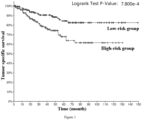
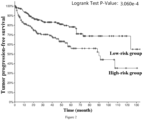
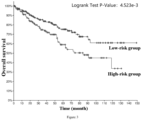
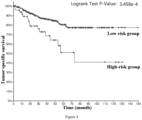
- the above 354 patients were classified into high-risk group and low-risk group. The high-risk group accounted for 46.6% and the low-risk group accounted for 53.4%.
- the present invention allows to select any gene fragments from the gene combination (panel) and combine to form a new gene combination, and use the same judgment criteria to grade the malignancy of renal cell carcinoma and predict the prognosis of the tumor.
- gene set A1 is selected from gene set A of gene combination (panel)
- gene fragment set B 1 is selected from gene fragment set B to form gene combination 1 (panel 1), which is used for malignant grade and prognosis prediction of renal cell carcinoma, and feasibility analysis is performed using TCGA (Pan-cancer Atlas) renal clear cell carcinoma database.
- TCGA Pan-cancer Atlas
- the judgment criteria are: if there is a gene mutation or copy number variation of at least one gene in gene set A1, or there is an increase in the copy number of at least one region in gene fragment set B 1, it indicates that the renal cancer patients are graded as a high-risk group with a worse tumor prognosis; conversely, if there is no gene mutation or copy number variation in gene set A1, and there is no gene copy number increase in gene fragment set B1, the patients with this type of renal cell carcinoma are graded as a the low-risk group with a good tumor prognosis.
- gene combination 1 panel 1 is optimized on the basis of gene combination (panel), which has higher accuracy (higher specificity).
- the above-mentioned 354 patients were graded by the gene combination 1 (panel 1) into malignant degree, and successfully divided into high-risk group and low-risk group, of which the high-risk group accounted for 14.4% and the low-risk group accounted for 85.6%.
- TCGA Pan-cancer Atlas pan-cancer database is a globally recognized pan-cancer database, which can be used to test the feasibility and credibility of the invention for evaluating the grade of malignancy and prognosis prediction of pan-cancer.
- TCGA Pan-cancer Atlas pan-cancer data has 10967 pan-cancer data, of which 9896 have complete gene mutation and copy number variation data, which is applicable to the application conditions of the invention.
- Example 4 According to the method described in Example 4, all genes in gene set A and all fragments in gene fragment set B in Example 1 were selected for implementation in this experiment. The genes actually used for detection in gene fragment set B are the same as those in Table 2 in Example 1. The above 9896 patients were divided into high-risk group and low-risk group according to the grade of malignancy. The high-risk group accounted for 77.0%, and the low-risk group accounted for 23.0%.
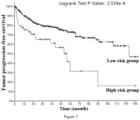
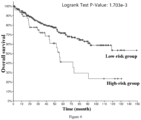
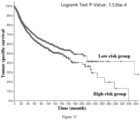
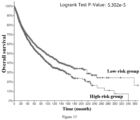
- the low-risk group has significantly better tumor-specific survival (Log-rank p value ⁇ 1.000e-10), tumor progression-free survival (Log-rank p value ⁇ 1.000e-10), tumor disease-free survival (Log-rank p value ⁇ 1.000e-10) and total survival (Log-rank p value ⁇ 1.000e-10). Therefore, it is accurate and reliable to use the gene combination of the invention for grading the malignancy and predicting the prognosis of pan-cancer patients.
- the present invention allows to select any gene fragments from the gene combination (panel) for combination to form a new gene combination, and use the same judgment criteria for grading the pan-cancer malignancy and predicting tumor prognosis.
- the gene combination 1 (panel 1) in Experiment Example 2 is selected and used grading the pan-cancer malignancy and predicting pan-cancer prognosis, and the feasibility analysis is performed using TCGA (Pan-cancer Atlas) pan-cancer database.
- the judgment criteria are: If at least one gene in gene set A1 has gene mutation or copy number variation, or at least one fragment in gene fragment set B1 has copy number increase, it indicates that the pan-cancer patients are at high-risk and have a worse tumor prognosis; conversely, if there is no gene mutation or copy number variation in gene set A1, and no gene copy number increase in any fragment in gene fragment set B1, then this type of pan-carcinoma patient is a low-risk group with good tumor prognosis. It should be specially noted that in this experimental example, gene combination 1(panel 1) is optimized on the basis of gene combination (panel), which has significantly lower implementation cost due to fewer detection sites.
- gene combination 1 (panel 1) graded the malignant degree of 9896 patients in the above-mentioned pan-cancer database, and successfully divided them into high-risk group and low-risk group, of which the high-risk group accounted for 26.8% and the low-risk group accounted for 73.2%.
Landscapes
- Chemical & Material Sciences (AREA)
- Life Sciences & Earth Sciences (AREA)
- Health & Medical Sciences (AREA)
- Organic Chemistry (AREA)
- Proteomics, Peptides & Aminoacids (AREA)
- Engineering & Computer Science (AREA)
- Immunology (AREA)
- Pathology (AREA)
- Analytical Chemistry (AREA)
- Zoology (AREA)
- Genetics & Genomics (AREA)
- Wood Science & Technology (AREA)
- Physics & Mathematics (AREA)
- Biotechnology (AREA)
- Microbiology (AREA)
- Molecular Biology (AREA)
- Hospice & Palliative Care (AREA)
- Biophysics (AREA)
- Oncology (AREA)
- Biochemistry (AREA)
- Bioinformatics & Cheminformatics (AREA)
- General Engineering & Computer Science (AREA)
- General Health & Medical Sciences (AREA)
- Measuring Or Testing Involving Enzymes Or Micro-Organisms (AREA)
- Investigating Or Analysing Biological Materials (AREA)
Priority Applications (1)
| Application Number | Priority Date | Filing Date | Title |
|---|---|---|---|
| MA71433A MA71433A (fr) | 2021-03-02 | 2022-03-02 | Combinaison de gènes pour la hiérarchisation des tumeurs humaines, et son utilisation |
Applications Claiming Priority (4)
| Application Number | Priority Date | Filing Date | Title |
|---|---|---|---|
| CN202110232095 | 2021-03-02 | ||
| CN202110332750.9A CN113025716A (zh) | 2021-03-02 | 2021-03-26 | 一种用于人肿瘤分级的基因组合及其用途 |
| CN202110762353.5A CN113355422B (zh) | 2021-03-02 | 2021-07-06 | 一种用于人肿瘤分级的基因组合及其用途 |
| PCT/CN2022/078709 WO2022184073A1 (fr) | 2021-03-02 | 2022-03-02 | Combinaison de gènes pour la hiérarchisation des tumeurs humaines, et son utilisation |
Publications (2)
| Publication Number | Publication Date |
|---|---|
| EP4265739A1 true EP4265739A1 (fr) | 2023-10-25 |
| EP4265739A4 EP4265739A4 (fr) | 2025-05-21 |
Family
ID=76452638
Family Applications (1)
| Application Number | Title | Priority Date | Filing Date |
|---|---|---|---|
| EP22762537.3A Pending EP4265739A4 (fr) | 2021-03-02 | 2022-03-02 | Combinaison de gènes pour la hiérarchisation des tumeurs humaines, et son utilisation |
Country Status (6)
| Country | Link |
|---|---|
| US (1) | US20240084392A1 (fr) |
| EP (1) | EP4265739A4 (fr) |
| JP (1) | JP7667865B2 (fr) |
| CN (2) | CN113025716A (fr) |
| MA (1) | MA71433A (fr) |
| WO (1) | WO2022184073A1 (fr) |
Families Citing this family (8)
| Publication number | Priority date | Publication date | Assignee | Title |
|---|---|---|---|---|
| CN113025716A (zh) * | 2021-03-02 | 2021-06-25 | 北京大学第一医院 | 一种用于人肿瘤分级的基因组合及其用途 |
| CN113604571A (zh) * | 2021-09-02 | 2021-11-05 | 北京大学第一医院 | 一种用于人肿瘤分级的基因组合及其用途 |
| CN114854861A (zh) * | 2022-05-20 | 2022-08-05 | 北京大学第一医院 | 基因组合制备人肿瘤同源重组缺陷、肿瘤突变负荷和微卫星不稳定性分级检测产品的用途 |
| CN115976218A (zh) * | 2023-01-19 | 2023-04-18 | 北京大学第一医院 | 一种基因组合在制备用于人肿瘤治疗反应状态分级检测的产品中的用途 |
| CN116203241B (zh) * | 2023-03-20 | 2023-08-22 | 江西省肿瘤医院(江西省第二人民医院、江西省癌症中心) | Trim26蛋白的检测试剂在制备诊断和预后结肠癌的产品中的用途 |
| CN118460716B (zh) * | 2024-05-20 | 2024-11-01 | 南京迪安医学检验所有限公司 | 一种肺癌诊断标志物及其应用 |
| CN118675616B (zh) * | 2024-06-11 | 2025-07-15 | 深圳湾实验室 | 一种单细胞测序数据分析方法、设备、介质和程序产品 |
| CN119132388B (zh) * | 2024-08-21 | 2025-08-15 | 河南省肿瘤医院 | 基于低深度全基因组测序检测肿瘤分子分型的方法、装置及应用 |
Family Cites Families (20)
| Publication number | Priority date | Publication date | Assignee | Title |
|---|---|---|---|---|
| CA2505416A1 (fr) | 2002-11-21 | 2004-06-10 | Wyeth | Methodes de diagnostic de rcc et autres tumeurs solides |
| EP1777523A1 (fr) | 2005-10-19 | 2007-04-25 | INSERM (Institut National de la Santé et de la Recherche Médicale) | Méthode pour pronostiquer la progression d'un cancer et les résultats du patient et les moyens pour performer la méthode |
| BRPI0817031A2 (pt) * | 2007-09-07 | 2017-05-23 | Univ Bruxelles | kit de diagnóstico e método para prognóstico de cancro em sujeitos mamíferos |
| WO2009030770A2 (fr) * | 2007-09-07 | 2009-03-12 | Universite Libre De Bruxelles | Procédés et outils de diagnostic de cancer chez des patients er- |
| WO2010056931A1 (fr) * | 2008-11-14 | 2010-05-20 | Intelligent Oncotherapeutics, Inc. | Procédés d'identification d'un phénotype de tumeur et traitement |
| CN102308212A (zh) * | 2008-12-04 | 2012-01-04 | 加利福尼亚大学董事会 | 用于确定前列腺癌诊断和预后的材料和方法 |
| US9551034B2 (en) | 2010-01-11 | 2017-01-24 | Genomic Health, Inc. | Method to use gene expression to determine likelihood of clinical outcome of renal cancer |
| KR20130043104A (ko) | 2010-04-06 | 2013-04-29 | 카리스 라이프 사이언스 룩셈부르크 홀딩스 | 질병용 순환 생물학적 지표들 |
| WO2013095793A1 (fr) * | 2011-12-22 | 2013-06-27 | Aveo Pharmaceuticals, Inc. | Identification de biomarqueurs multigéniques |
| CA2892490A1 (fr) * | 2012-11-26 | 2014-05-30 | Caris Science, Inc. | Compositions de biomarqueur et procedes |
| WO2017203008A1 (fr) * | 2016-05-25 | 2017-11-30 | Curevac Ag | Nouveaux biomarqueurs |
| WO2018062862A1 (fr) | 2016-09-28 | 2018-04-05 | 가톨릭대학교 산학협력단 | Marqueurs spécifiques au sexe pour diagnostiquer un pronostic et déterminer une stratégie de traitement pour des patients atteints d'un cancer rénal |
| KR20190030833A (ko) * | 2017-09-15 | 2019-03-25 | 가톨릭대학교 산학협력단 | 신장암 환자의 예후 진단 및 치료 전략 결정용 연령 특이적 마커 |
| KR20190067570A (ko) * | 2017-12-07 | 2019-06-17 | 가톨릭대학교 산학협력단 | 신장암 환자의 예후 진단 및 치료 전략 결정용 병리등급 특이적 마커 |
| WO2019152788A1 (fr) * | 2018-02-02 | 2019-08-08 | Morgan And Mendel Genomics, Inc. | Prédicteur génomique robuste de métastase du cancer du sein et du poumon |
| KR102084658B1 (ko) * | 2018-06-27 | 2020-03-05 | 가톨릭대학교 산학협력단 | 신장암 환자의 예후 진단 및 치료 전략 결정용 전이 특이적 마커 |
| US12497662B2 (en) * | 2019-04-16 | 2025-12-16 | Grail, Inc. | Systems and methods for tumor fraction estimation from small variants |
| CA3140066A1 (fr) * | 2019-05-20 | 2020-11-26 | Foundation Medicine, Inc. | Systemes et procedes d'evaluation d'une fraction tumorale |
| CN110499364A (zh) * | 2019-07-30 | 2019-11-26 | 北京凯昂医学诊断技术有限公司 | 一种用于检测扩展型遗传病全外显子的探针组及其试剂盒和应用 |
| CN113025716A (zh) * | 2021-03-02 | 2021-06-25 | 北京大学第一医院 | 一种用于人肿瘤分级的基因组合及其用途 |
-
2021
- 2021-03-26 CN CN202110332750.9A patent/CN113025716A/zh active Pending
- 2021-07-06 CN CN202110762353.5A patent/CN113355422B/zh active Active
-
2022
- 2022-03-02 JP JP2023544465A patent/JP7667865B2/ja active Active
- 2022-03-02 WO PCT/CN2022/078709 patent/WO2022184073A1/fr not_active Ceased
- 2022-03-02 EP EP22762537.3A patent/EP4265739A4/fr active Pending
- 2022-03-02 MA MA71433A patent/MA71433A/fr unknown
- 2022-03-02 US US18/273,213 patent/US20240084392A1/en active Pending
Also Published As
| Publication number | Publication date |
|---|---|
| WO2022184073A1 (fr) | 2022-09-09 |
| US20240084392A1 (en) | 2024-03-14 |
| JP2024510542A (ja) | 2024-03-08 |
| JP7667865B2 (ja) | 2025-04-23 |
| MA71433A (fr) | 2025-04-30 |
| CN113355422A (zh) | 2021-09-07 |
| CN113025716A (zh) | 2021-06-25 |
| CN113355422B (zh) | 2022-11-22 |
| EP4265739A4 (fr) | 2025-05-21 |
Similar Documents
| Publication | Publication Date | Title |
|---|---|---|
| US20240084392A1 (en) | Gene combination for human tumor grading, and use thereof | |
| Manne et al. | Keynote review: Recent advances in biomarkers for cancer diagnosis and treatment | |
| US20060265138A1 (en) | Expression profiling of tumours | |
| US20160130656A1 (en) | Methods for evaluating lung cancer status | |
| JP2011524162A (ja) | 乳癌の予後を予測するための遺伝子発現プロフィール | |
| WO2007035690A2 (fr) | Methodes de diagnostic du cancer du pancreas | |
| KR102068310B1 (ko) | 간암 재발 예측용 dna 메틸화 마커 및 이의 용도 | |
| WO2017008165A1 (fr) | Méthode de classification et traitement de cancers de l'endomètre | |
| WO2023030422A1 (fr) | Combinaison génique pour la hiérarchisation des tumeurs humaines et son utilisation | |
| CN115141887A (zh) | 基于分泌细胞富集特征的结肠癌预后及辅助化疗获益的评分模型、构建方法及应用 | |
| EP4512909A1 (fr) | Utilisation d'une combinaison de gènes dans la préparation de produits de détection de déficience de recombinaison homologue de tumeurs humaines, de charge de mutation tumorale et de classification d'instabilité des microsatellites | |
| Wu et al. | Comprehensive analysis of the molecular mechanism for gastric cancer based on competitive endogenous RNA network | |
| Zhang et al. | An approach for differential diagnosis of breast tumors by CTDNA methylation sequencing | |
| WO2024152790A1 (fr) | Utilisation d'un panel de gènes pour préparer un produit utilisé pour la détection de la classification des états de réponse au traitement des tumeurs humaines | |
| US20240327927A1 (en) | Active surveillance and risk stratification for prostate cancer | |
| Du et al. | Cell-free DNA methylation profile potential in the diagnosis of lung squamous cell carcinoma | |
| EP4277999A1 (fr) | Procédés d'évaluation d'un carcinome à cellules squameuses buccal à un stade précoce | |
| CN115637292B (zh) | 预测肺腺癌患者小细胞转化风险的模型及其建立方法 | |
| CN120564851B (zh) | 一种ptc风险分层评估模型及应用 | |
| ES2381729B1 (es) | Test predictor de supervivencia global de adenocarcinoma de pulmón | |
| Kim et al. | 102P Prognostic significance of BRCA mutations and tumor microenvironment profiling in high-grade serous ovarian carcinoma | |
| Ye et al. | Patient-derived ovarian cancer organoids as platforms for predicting platinum resistance and screening tumor stem cell inhibitors | |
| Fang et al. | Identification of a ubiquitin related gene signature for predicting prognosis and immune infiltration in breast cancer based on single cell and bulk RNA sequencing analysis | |
| Yue et al. | Ferroptosis-related gene signature predicts clinical metastasis of clear cell renal cell carcinoma based on single-cell RNA-seq | |
| Li et al. | Identification of aberrantly methylated differentially expressed genes in papillary thyroid carcinoma using integrated bioinformatic analysis |
Legal Events
| Date | Code | Title | Description |
|---|---|---|---|
| STAA | Information on the status of an ep patent application or granted ep patent |
Free format text: STATUS: THE INTERNATIONAL PUBLICATION HAS BEEN MADE |
|
| PUAI | Public reference made under article 153(3) epc to a published international application that has entered the european phase |
Free format text: ORIGINAL CODE: 0009012 |
|
| STAA | Information on the status of an ep patent application or granted ep patent |
Free format text: STATUS: REQUEST FOR EXAMINATION WAS MADE |
|
| 17P | Request for examination filed |
Effective date: 20230721 |
|
| AK | Designated contracting states |
Kind code of ref document: A1 Designated state(s): AL AT BE BG CH CY CZ DE DK EE ES FI FR GB GR HR HU IE IS IT LI LT LU LV MC MK MT NL NO PL PT RO RS SE SI SK SM TR |
|
| A4 | Supplementary search report drawn up and despatched |
Effective date: 20250423 |
|
| RIC1 | Information provided on ipc code assigned before grant |
Ipc: C12Q 1/6886 20180101AFI20250415BHEP |