EP4263753B1 - Brandhindernde copolymere und formmassen - Google Patents
Brandhindernde copolymere und formmassen Download PDFInfo
- Publication number
- EP4263753B1 EP4263753B1 EP21840442.4A EP21840442A EP4263753B1 EP 4263753 B1 EP4263753 B1 EP 4263753B1 EP 21840442 A EP21840442 A EP 21840442A EP 4263753 B1 EP4263753 B1 EP 4263753B1
- Authority
- EP
- European Patent Office
- Prior art keywords
- fire
- retardant
- copolymer
- styrene
- molding material
- Prior art date
- Legal status (The legal status is an assumption and is not a legal conclusion. Google has not performed a legal analysis and makes no representation as to the accuracy of the status listed.)
- Active
Links
Images

Classifications
-
- C—CHEMISTRY; METALLURGY
- C09—DYES; PAINTS; POLISHES; NATURAL RESINS; ADHESIVES; COMPOSITIONS NOT OTHERWISE PROVIDED FOR; APPLICATIONS OF MATERIALS NOT OTHERWISE PROVIDED FOR
- C09K—MATERIALS FOR MISCELLANEOUS APPLICATIONS, NOT PROVIDED FOR ELSEWHERE
- C09K21/00—Fireproofing materials
- C09K21/14—Macromolecular materials
-
- C—CHEMISTRY; METALLURGY
- C08—ORGANIC MACROMOLECULAR COMPOUNDS; THEIR PREPARATION OR CHEMICAL WORKING-UP; COMPOSITIONS BASED THEREON
- C08F—MACROMOLECULAR COMPOUNDS OBTAINED BY REACTIONS ONLY INVOLVING CARBON-TO-CARBON UNSATURATED BONDS
- C08F2/00—Processes of polymerisation
- C08F2/12—Polymerisation in non-solvents
- C08F2/16—Aqueous medium
- C08F2/18—Suspension polymerisation
-
- C—CHEMISTRY; METALLURGY
- C08—ORGANIC MACROMOLECULAR COMPOUNDS; THEIR PREPARATION OR CHEMICAL WORKING-UP; COMPOSITIONS BASED THEREON
- C08F—MACROMOLECULAR COMPOUNDS OBTAINED BY REACTIONS ONLY INVOLVING CARBON-TO-CARBON UNSATURATED BONDS
- C08F212/00—Copolymers of compounds having one or more unsaturated aliphatic radicals, each having only one carbon-to-carbon double bond, and at least one being terminated by an aromatic carbocyclic ring
- C08F212/02—Monomers containing only one unsaturated aliphatic radical
- C08F212/04—Monomers containing only one unsaturated aliphatic radical containing one ring
- C08F212/06—Hydrocarbons
- C08F212/08—Styrene
-
- C—CHEMISTRY; METALLURGY
- C08—ORGANIC MACROMOLECULAR COMPOUNDS; THEIR PREPARATION OR CHEMICAL WORKING-UP; COMPOSITIONS BASED THEREON
- C08F—MACROMOLECULAR COMPOUNDS OBTAINED BY REACTIONS ONLY INVOLVING CARBON-TO-CARBON UNSATURATED BONDS
- C08F230/00—Copolymers of compounds having one or more unsaturated aliphatic radicals, each having only one carbon-to-carbon double bond, and containing phosphorus, selenium, tellurium or a metal
- C08F230/02—Copolymers of compounds having one or more unsaturated aliphatic radicals, each having only one carbon-to-carbon double bond, and containing phosphorus, selenium, tellurium or a metal containing phosphorus
-
- C—CHEMISTRY; METALLURGY
- C08—ORGANIC MACROMOLECULAR COMPOUNDS; THEIR PREPARATION OR CHEMICAL WORKING-UP; COMPOSITIONS BASED THEREON
- C08G—MACROMOLECULAR COMPOUNDS OBTAINED OTHERWISE THAN BY REACTIONS ONLY INVOLVING UNSATURATED CARBON-TO-CARBON BONDS
- C08G75/00—Macromolecular compounds obtained by reactions forming a linkage containing sulfur with or without nitrogen, oxygen, or carbon in the main chain of the macromolecule
- C08G75/02—Polythioethers
- C08G75/04—Polythioethers from mercapto compounds or metallic derivatives thereof
- C08G75/045—Polythioethers from mercapto compounds or metallic derivatives thereof from mercapto compounds and unsaturated compounds
-
- C—CHEMISTRY; METALLURGY
- C08—ORGANIC MACROMOLECULAR COMPOUNDS; THEIR PREPARATION OR CHEMICAL WORKING-UP; COMPOSITIONS BASED THEREON
- C08J—WORKING-UP; GENERAL PROCESSES OF COMPOUNDING; AFTER-TREATMENT NOT COVERED BY SUBCLASSES C08B, C08C, C08F, C08G or C08H
- C08J9/00—Working-up of macromolecular substances to porous or cellular articles or materials; After-treatment thereof
- C08J9/0014—Use of organic additives
- C08J9/0038—Use of organic additives containing phosphorus
-
- C—CHEMISTRY; METALLURGY
- C08—ORGANIC MACROMOLECULAR COMPOUNDS; THEIR PREPARATION OR CHEMICAL WORKING-UP; COMPOSITIONS BASED THEREON
- C08J—WORKING-UP; GENERAL PROCESSES OF COMPOUNDING; AFTER-TREATMENT NOT COVERED BY SUBCLASSES C08B, C08C, C08F, C08G or C08H
- C08J9/00—Working-up of macromolecular substances to porous or cellular articles or materials; After-treatment thereof
- C08J9/16—Making expandable particles
-
- C—CHEMISTRY; METALLURGY
- C08—ORGANIC MACROMOLECULAR COMPOUNDS; THEIR PREPARATION OR CHEMICAL WORKING-UP; COMPOSITIONS BASED THEREON
- C08K—Use of inorganic or non-macromolecular organic substances as compounding ingredients
- C08K3/00—Use of inorganic substances as compounding ingredients
- C08K3/02—Elements
- C08K3/06—Sulfur
-
- C—CHEMISTRY; METALLURGY
- C08—ORGANIC MACROMOLECULAR COMPOUNDS; THEIR PREPARATION OR CHEMICAL WORKING-UP; COMPOSITIONS BASED THEREON
- C08L—COMPOSITIONS OF MACROMOLECULAR COMPOUNDS
- C08L25/00—Compositions of, homopolymers or copolymers of compounds having one or more unsaturated aliphatic radicals, each having only one carbon-to-carbon double bond, and at least one being terminated by an aromatic carbocyclic ring; Compositions of derivatives of such polymers
- C08L25/02—Homopolymers or copolymers of hydrocarbons
- C08L25/04—Homopolymers or copolymers of styrene
- C08L25/06—Polystyrene
-
- C—CHEMISTRY; METALLURGY
- C08—ORGANIC MACROMOLECULAR COMPOUNDS; THEIR PREPARATION OR CHEMICAL WORKING-UP; COMPOSITIONS BASED THEREON
- C08L—COMPOSITIONS OF MACROMOLECULAR COMPOUNDS
- C08L25/00—Compositions of, homopolymers or copolymers of compounds having one or more unsaturated aliphatic radicals, each having only one carbon-to-carbon double bond, and at least one being terminated by an aromatic carbocyclic ring; Compositions of derivatives of such polymers
- C08L25/02—Homopolymers or copolymers of hydrocarbons
- C08L25/04—Homopolymers or copolymers of styrene
- C08L25/08—Copolymers of styrene
-
- C—CHEMISTRY; METALLURGY
- C08—ORGANIC MACROMOLECULAR COMPOUNDS; THEIR PREPARATION OR CHEMICAL WORKING-UP; COMPOSITIONS BASED THEREON
- C08L—COMPOSITIONS OF MACROMOLECULAR COMPOUNDS
- C08L25/00—Compositions of, homopolymers or copolymers of compounds having one or more unsaturated aliphatic radicals, each having only one carbon-to-carbon double bond, and at least one being terminated by an aromatic carbocyclic ring; Compositions of derivatives of such polymers
- C08L25/18—Homopolymers or copolymers of aromatic monomers containing elements other than carbon and hydrogen
-
- C—CHEMISTRY; METALLURGY
- C08—ORGANIC MACROMOLECULAR COMPOUNDS; THEIR PREPARATION OR CHEMICAL WORKING-UP; COMPOSITIONS BASED THEREON
- C08L—COMPOSITIONS OF MACROMOLECULAR COMPOUNDS
- C08L81/00—Compositions of macromolecular compounds obtained by reactions forming in the main chain of the macromolecule a linkage containing sulfur with or without nitrogen, oxygen or carbon only; Compositions of polysulfones; Compositions of derivatives of such polymers
- C08L81/02—Polythioethers; Polythioether-ethers
-
- C—CHEMISTRY; METALLURGY
- C08—ORGANIC MACROMOLECULAR COMPOUNDS; THEIR PREPARATION OR CHEMICAL WORKING-UP; COMPOSITIONS BASED THEREON
- C08J—WORKING-UP; GENERAL PROCESSES OF COMPOUNDING; AFTER-TREATMENT NOT COVERED BY SUBCLASSES C08B, C08C, C08F, C08G or C08H
- C08J2325/00—Characterised by the use of homopolymers or copolymers of compounds having one or more unsaturated aliphatic radicals, each having only one carbon-to-carbon double bond, and at least one being terminated by an aromatic carbocyclic ring; Derivatives of such polymers
- C08J2325/02—Homopolymers or copolymers of hydrocarbons
- C08J2325/04—Homopolymers or copolymers of styrene
- C08J2325/06—Polystyrene
-
- C—CHEMISTRY; METALLURGY
- C08—ORGANIC MACROMOLECULAR COMPOUNDS; THEIR PREPARATION OR CHEMICAL WORKING-UP; COMPOSITIONS BASED THEREON
- C08J—WORKING-UP; GENERAL PROCESSES OF COMPOUNDING; AFTER-TREATMENT NOT COVERED BY SUBCLASSES C08B, C08C, C08F, C08G or C08H
- C08J2325/00—Characterised by the use of homopolymers or copolymers of compounds having one or more unsaturated aliphatic radicals, each having only one carbon-to-carbon double bond, and at least one being terminated by an aromatic carbocyclic ring; Derivatives of such polymers
- C08J2325/18—Homopolymers or copolymers of aromatic monomers containing elements other than carbon and hydrogen
-
- C—CHEMISTRY; METALLURGY
- C08—ORGANIC MACROMOLECULAR COMPOUNDS; THEIR PREPARATION OR CHEMICAL WORKING-UP; COMPOSITIONS BASED THEREON
- C08J—WORKING-UP; GENERAL PROCESSES OF COMPOUNDING; AFTER-TREATMENT NOT COVERED BY SUBCLASSES C08B, C08C, C08F, C08G or C08H
- C08J2343/00—Characterised by the use of homopolymers or copolymers of compounds having one or more unsaturated aliphatic radicals, each having only one carbon-to-carbon double bond, and containing boron, silicon, phosphorus, selenium, tellurium or a metal; Derivatives of such polymers
- C08J2343/02—Homopolymers or copolymers of monomers containing phosphorus
-
- C—CHEMISTRY; METALLURGY
- C08—ORGANIC MACROMOLECULAR COMPOUNDS; THEIR PREPARATION OR CHEMICAL WORKING-UP; COMPOSITIONS BASED THEREON
- C08J—WORKING-UP; GENERAL PROCESSES OF COMPOUNDING; AFTER-TREATMENT NOT COVERED BY SUBCLASSES C08B, C08C, C08F, C08G or C08H
- C08J2381/00—Characterised by the use of macromolecular compounds obtained by reactions forming in the main chain of the macromolecule a linkage containing sulfur with or without nitrogen, oxygen, or carbon only; Polysulfones; Derivatives of such polymers
- C08J2381/02—Polythioethers; Polythioether-ethers
-
- C—CHEMISTRY; METALLURGY
- C08—ORGANIC MACROMOLECULAR COMPOUNDS; THEIR PREPARATION OR CHEMICAL WORKING-UP; COMPOSITIONS BASED THEREON
- C08L—COMPOSITIONS OF MACROMOLECULAR COMPOUNDS
- C08L2201/00—Properties
- C08L2201/02—Flame or fire retardant/resistant
-
- C—CHEMISTRY; METALLURGY
- C08—ORGANIC MACROMOLECULAR COMPOUNDS; THEIR PREPARATION OR CHEMICAL WORKING-UP; COMPOSITIONS BASED THEREON
- C08L—COMPOSITIONS OF MACROMOLECULAR COMPOUNDS
- C08L2203/00—Applications
- C08L2203/20—Applications use in electrical or conductive gadgets
-
- C—CHEMISTRY; METALLURGY
- C08—ORGANIC MACROMOLECULAR COMPOUNDS; THEIR PREPARATION OR CHEMICAL WORKING-UP; COMPOSITIONS BASED THEREON
- C08L—COMPOSITIONS OF MACROMOLECULAR COMPOUNDS
- C08L2203/00—Applications
- C08L2203/30—Applications used for thermoforming
-
- C—CHEMISTRY; METALLURGY
- C08—ORGANIC MACROMOLECULAR COMPOUNDS; THEIR PREPARATION OR CHEMICAL WORKING-UP; COMPOSITIONS BASED THEREON
- C08L—COMPOSITIONS OF MACROMOLECULAR COMPOUNDS
- C08L35/00—Compositions of homopolymers or copolymers of compounds having one or more unsaturated aliphatic radicals, each having only one carbon-to-carbon double bond, and at least one being terminated by a carboxyl radical, and containing at least one other carboxyl radical in the molecule, or of salts, anhydrides, esters, amides, imides or nitriles thereof; Compositions of derivatives of such polymers
- C08L35/06—Copolymers with vinyl aromatic monomers
-
- C—CHEMISTRY; METALLURGY
- C08—ORGANIC MACROMOLECULAR COMPOUNDS; THEIR PREPARATION OR CHEMICAL WORKING-UP; COMPOSITIONS BASED THEREON
- C08L—COMPOSITIONS OF MACROMOLECULAR COMPOUNDS
- C08L41/00—Compositions of homopolymers or copolymers of compounds having one or more unsaturated aliphatic radicals, each having only one carbon-to-carbon double bond, and at least one being terminated by a bond to sulfur or by a heterocyclic ring containing sulfur; Compositions of derivatives of such polymers
Definitions
- the present invention relates to fire-retardant copolymers and molding materials and/or compositions based on styrene with reactively bound sulfur and a low sulfur content. Phosphorus compounds are also covalently bound in these copolymers and molding compositions.
- the copolymers and molding compositions are characterized by being essentially colorless, odorless and also free of migrating flame retardant additives. In addition, they are free of potentially carcinogenic antimony trioxide (ATO).
- ATO antimony trioxide
- the copolymers and molding compositions according to the invention exhibit very pronounced intrinsic flame retardancy and can therefore be used in the transport/automotive sector, in the construction industry and in the electrical and electronics industry.
- styrene homopolymers and copolymers with flame retardant additives is important for a wide range of applications, for example for polystyrene particle foams made from expandable polystyrene (EPS) or polystyrene extrusion foam boards (XPS) for insulating buildings as well as for injection-molded parts made from HIPS, ABS, ASA, etc. for use as parts and components for consumer goods in the electrical and electronics sector.
- EPS expandable polystyrene
- XPS polystyrene extrusion foam boards
- Polymers made up of styrene monomers have a total production volume of around 10% by weight of the total global plastics production and thus belong to the fourth largest group of the twenty plastics produced worldwide.
- Homopolystyrene (PS) is mainly used as packaging material in food packaging and in disposable consumer goods. It is also used as particle foam or extruded foam in packaging and in thermal insulation.
- Polystyrene as such is highly flammable in the event of a fire and has no flame-retardant properties. In fact, pure polystyrene bodies burn completely under most fire conditions and have no flame-retardant properties. In addition, in the event of a fire, there is a strong formation of soot and smoke gases.
- the polymer can only be made flame-retardant by adding suitable flame-retardant additives. Due to the large surface area, intumescent and crust-forming flame-retardant systems are typically not sufficiently effective when used as foam.
- gas-phase active flame retardants such as brominated flame retardant additives with suitable synergists (e.g.
- halogenated flame retardants are typically persistent in the environment and release corrosive gases such as hydrogen chloride or hydrogen bromide in the event of a fire. If these flame retardants are also low molecular weight, they are mobile in the plastic and tend to migrate out of it and accumulate in the environment and in living organisms.
- styrene can be copolymerized with a wide variety of comonomers. Depending on the comonomers used, the products are then the copolymers poly(acrylonitrile-butadiene-styrene) (ABS), poly(styrene-butadiene-styrene) (SBS), poly(styrene-acrylonitrile) (SAN), poly(acrylonitrile-styrene-acrylate) (ASA), poly(styrene-butadiene) rubber (SBR), high-impact polystyrene (HIPS), polystyrene acrylates such as polystyrene methyl acrylate (SMA) and polystyrene methyl methacrylate (SMMA), methyl acrylate-butadiene-styrene copolymer (MBS), methyl methacrylate-acrylonitrile-butad
- ABS acrylonitrile-butadiene-st
- Elemental sulfur as an additive flame retardant in homopolystyrene is also used in the WO 2011/095540 A2 described, which, however, only achieves its effectiveness in combination with a phosphorus-containing flame retardant.
- sulfur in the form of a flame retardant additive mixed into polystyrene foams is almost ineffective in terms of flame protection.
- elemental sulfur in the final product always leads to a typically pronounced yellow coloration, which is undesirable in many applications. Elemental sulfur also leads to more or less pronounced sulfur odors in the polymer processing process and in the final product.
- thermosets In the WO 2017/004186 A1 The flame-retardant effect of high-sulfur thermosets is described for the first time. These can be used as an additive in polyurethane foams and also as a thermoset material. However, these sulfur copolymers have a high sulfur content of at least 40% by weight. Due to the high sulfur content and the associated unpleasant odor that high-sulfur materials typically emit due to their at least partially sulfidic structure, the use of these thermosets in many plastics applications is severely restricted.
- duromeric materials cannot be used in the typical applications for foamed polystyrene, since their foamability is either completely impossible or at least very limited.
- the functionality in the WO 2017/004186 A1 The material described is based on the formation of a stable crust and on intumescence (foaming and bonding). In the case of materials such as foamed polymers, which are characterized by a very large surface area in relation to the mass, such mechanisms in flame retardancy do not offer sufficient protection to pass standardized fire tests. Test results regarding the fire behaviour of these polymers are also missing in the WO 2017/004186 A1 .
- the WO 2011/095540 A2 describes fire-retardant molding compounds and processes for their production and their use.
- the object of the present invention is therefore to generate copolymers and/or molded materials, for example as semi-finished products or as a component of cladding, insulating materials, which have a flame-retardant or fire-retardant property in combination with covalently bound, organic-phosphorus-containing comonomers and a low content of covalently bound sulfur, without the mandatory addition of further flame-retardant additives in order to achieve a sufficient fire-retardant effect.
- the copolymers according to the invention exhibit no leaching, no odor, no inherent color and at the same time very good intrinsic flame-retardant properties. They are also free of - potentially - carcinogenic antimony trioxide and can be produced cost-effectively using commercially available starting materials.
- thermoplastic copolymers and/or molding compounds By copolymerizing styrene and its derivatives with additional phosphorus-containing monomers in the presence of small amounts of sulfur, new thermoplastic copolymers and/or molding compounds were found. In addition to the covalently bound phosphorus, these copolymers and/or molding materials or compounds also have an extremely small amount of bound sulfur while simultaneously having intrinsic flame-retardant properties.
- repeat units are randomly distributed from the monomers used.
- the square brackets nevertheless indicate a repeating sequence of the repeat units in question in accordance with the usual polymer chain representation according to the state of the art.
- copolymers formed according to formulas (6) to (15) and (17) to (24) according to the invention and/or molding compositions formed from them are flame-retardant and/or self-extinguishing and essentially colorless and/or odorless.
- essentially colorless is understood to mean the absence of visible coloring.
- Odourless in relation to copolymers and moulding compounds can mean the olfactory perception of sulphidic compounds of less than 50 ⁇ g/m 3 air, or less than 5 ⁇ g/m 3 air (for example hydrogen sulphide, dimethyl sulphide, methyl mercaptan), or less than 0.5 ⁇ g/m 3 (for example Thiophenol, thiocresol, diphenyl sulfide, propyl mercaptan, ethyl mercaptan, crotyl mercaptan, amyl mercaptan, benzyl mercaptan, amyl mercaptan, allyl mercaptan) air, whereby the sulfidic compounds have a different odor threshold depending on their chemical structure and can be perceived differently by each individual.
- sulphidic compounds of less than 50 ⁇ g/m 3 air, or less than 5 ⁇ g/m 3 air (for example hydrogen sulphide, dimethyl
- the intrinsically flame-retardant copolymers are characterized by the fact that the phosphorus or sulfur-containing groups are covalently bonded to the copolymer and cannot migrate from it.
- a copolymer formed according to the invention from formulae (6) to (15) and (17) to (24) can form an individual component of a molding compound or can be a co-component of a molding compound.
- the term molding compound is understood to mean workpieces containing copolymers which form a molding material for the production of molded bodies or semi-finished or finished parts.
- the molding compound is processed into semi-finished or finished parts by applying mechanical force and/or increasing the temperature ⁇ 250°C using a processing method such as extrusion, pressing, transfer molding or injection molding in tools and subsequent cooling.
- a semi-finished product is considered to be a prefabricated raw material or material or semi-finished product of the simplest form, which can generally consist of a single material or a single compound such as a single copolymer according to the invention, but does not have to consist of just a single material or a single compound such as a single copolymer according to the invention. It is thus possible for at least one copolymer according to the invention to form a workpiece or semi-finished product together with at least one further copolymer and/or another polymer and/or another material such as metal (e.g. aluminum and/or iron) and/or plastic (e.g. polyurethane and/or polycarbonate) and/or ceramics (e.g.
- metal e.g. aluminum and/or iron
- plastic e.g. polyurethane and/or polycarbonate
- ceramics e.g.
- the molding compound or material can consist of a copolymer according to the invention and/or at least one further polymer and/or an additional copolymer according to the invention.
- the molding compound, the molding material or the molded body can also contain a copolymer according to the invention and/or a further polymer and/or an additional copolymer according to the invention and/or a other material such as metal (e.g. aluminum and/or iron) or plastic (e.g. polyurethane and/or polycarbonate) or ceramic (kaolin and/or silicates and/or clay materials) together for a semi-finished product.
- metal e.g. aluminum and/or iron
- plastic e.g. polyurethane and/or polycarbonate
- ceramic kaolin and/or silicates and/or clay materials
- Semi-finished products include simple profiles, construction profiles, rods, pipes and plates. Molding materials that have already been given an individual shape in a preparatory production step but are still intended for further production steps are further processed in a second step, for example by forming in the next step, either into a finished part or initially into another semi-finished or finished product.
- the semi-finished products are transformed into finished components, finished building elements (e.g. construction profiles, bricks or insulation materials) or finished building blocks.
- finished building elements e.g. construction profiles, bricks or insulation materials
- the copolymers formed according to the invention from formulas (6) to (15) and (17) to (24) can be individual components or co-components of a molding compound or molding material that are used as semi-finished products, for example in the construction industry as insulating materials.
- the molding compound or molding material can therefore contain an individual copolymer or other polymers and/or copolymers and/or additives and/or additives whose properties are based on the desired use, such as in house or plant construction or in automobile construction.
- the molding materials or compounds also contain other additives such as flame retardants such as melamine, melamine polyphosphate, melamine cyanurate, metal oxides, metal hydroxides, cyclotriphosphazenes, phosphates, phosphinates, phosphine oxides, hyphosphosphites or expandable graphite.
- flame retardants such as melamine, melamine polyphosphate, melamine cyanurate, metal oxides, metal hydroxides, cyclotriphosphazenes, phosphates, phosphinates, phosphine oxides, hyphosphosphites or expandable graphite.
- Suitable additives would be, for example, additional halogen-free flame retardants such as Aflammit PCO 900, Exolit OP 930, Exolit OP 1312, DOPO, HCA-HQ, Cyagard RF-1241, 20 Cyagard RF-1243, Fyrol PMP, Phoslite B85AX, Melapur 200, Melapur MC and Budit 669.
- additional halogen-free flame retardants such as Aflammit PCO 900, Exolit OP 930, Exolit OP 1312, DOPO, HCA-HQ, Cyagard RF-1241, 20 Cyagard RF-1243, Fyrol PMP, Phoslite B85AX, Melapur 200, Melapur MC and Budit 669.
- the fire-retardant and/or self-extinguishing copolymers or the molding compounds or molding materials or semi-finished products have an optionally odor-neutral and/or color-neutral design.
- a copolymer or a molding material formed from a molding compound has at least a flame-retardant or fire-retardant effect when it comes into contact with a flame, or, depending on the substituents, is self-extinguishing.
- the copolymers and/or molding compounds according to the invention are free from antimony trioxide and can be obtained free from halogen-containing components.
- compounds comprising copolymers with a random monomer distribution of the formula (6) to (15) and (17) to (24) were found with a statistical monomer distribution of monomer units with the mass fraction ⁇ with ⁇ (Sty), ⁇ (P) and ⁇ (3) in which ⁇ (3) and ⁇ (P) correspond to the mass fraction of the sulfur-containing and potentially phosphorus-containing repeat unit.
- the copolymers according to the invention are already flame-retardant and/or self-extinguishing as individual compounds or as components of molding materials or compounds.
- Flame-retardant means that after an initial ignition, a copolymer or a molding material or compound comprising copolymers has shorter afterburning times compared to homostyrene.
- Self-extinguishing means that an ignited copolymer or a molding material or compound extinguishes within five seconds after a burner flame is removed from the copolymer or the molding material or compound.
- These molding compounds can be obtained by physical mixing (blending) with other polymers and copolymers in any desired ratio.
- copolymers and molding materials or compositions according to the invention do not have any halogen-containing substituents and are therefore halogen-free, which means that they are environmentally friendly during production, use, disposal and in the event of fire.
- fire-retardant moulding materials or compounds for extrusion (or for pressing, casting or foaming) which comprise at least one fire-retardant copolymer with a sulphur content of less than 5%.
- thermoplastic properties of the copolymers and/or molding compounds Due to the thermoplastic properties of the copolymers and/or molding compounds, a wide variety of applications can be served by means of a wide variety of shapes. Since foam bodies can also be produced as molding materials from the copolymers and/or molding compounds, these can be used, for example, as thermal insulation materials.
- the foams produced from the fire-retardant copolymers preferably have a density in the range from 5 to 200 kg/m 3 , particularly preferably in the range from 10 to 100 kg/m 3 and are preferably present in the foams to an extent of more than 80%, particularly preferably from 95 to 100%.
- the polymer matrix of the fire-retardant copolymers, copolymer foams or molding materials preferably consists of thermoplastic (co)polymers or polymer mixtures, in particular styrene (co)polymers.
- the fire-retardant and expandable styrene (co)polymers (EPS) and styrene (co)polymer extrusion foams (XPS) according to the invention can be processed by mixing a blowing agent in the form of a low-boiling organic solvent such as n-hexane or pentane into the polymer melt and then extruding and granulating under pressure to form expandable granules (EPS) or by extrusion and relaxation using appropriately shaped nozzles to form foam sheets (XPS) or foam strands.
- EPS expandable granule
- XPS foam sheets
- Expandable styrene (co)polymers are understood to mean styrene (co)polymers containing blowing agents.
- the EPS particle size is preferably in the range of 0.2 - 2 mm.
- Styrene (co)polymer particle foams are obtainable by pre-foaming and sintering the corresponding expandable styrene (co)polymers (EPS).
- the styrene (co)polymer particle foams preferably have 2 to 15 cells per millimeter.
- a further polymer, in particular a styrene polymer can be mixed into the copolymers according to the invention or the molding compositions according to the invention containing copolymers, e.g. B.
- GPPS crystal-clear polystyrene
- HIPS impact-modified polystyrene
- SBS acrylonitrile-butadiene-styrene polymers
- SBS poly(styrene-butadiene-styrene)
- SAN poly(styrene-butadiene) rubber
- SBR poly(acrylonitrile-styrene-acrylic ester)
- ASA polystyrene acrylates such as polystyrene methyl acrylate (SMA) and polystyrene methyl methacrylate (SMMA), methyl acrylate-butadiene-styrene copolymer (MBS), methyl methacrylate-acrylonitrile-butadiene-styrene polymers (MABS), st
- a further polymer is also understood to mean a copolymer of styrene and/or phosphorus-containing comonomers, for example copolymers of styrene with at least one of the monomers of the formulae (25) to (38).
- the molding compounds described are essentially colorless and/or odorless.
- RAL 1013 pearl white RAL 9001 cream white
- RAL 9003 signal white
- RAL 9010 pure white RAL 9016 traffic white.
- Odorless can be understood as the olfactory perception of sulfidic compounds of less than 50 ⁇ g/m 3 air, preferably less than 5 ⁇ g/m 3 air (for example hydrogen sulfide, dimethyl sulfide, methyl mercaptan), particularly preferably less than 0.5 ⁇ g/m 3 air (for example thiophenol, thiocresol, diphenyl sulfide, propyl mercaptan, ethyl mercaptan, crotyl mercaptan, amyl mercaptan, benzyl mercaptan, amyl mercaptan, allyl mercaptan), whereby the sulfidic compounds have a different odor threshold depending on their chemical structure and can typically be perceived personally individually.
- air for example hydrogen sulfide, dimethyl sulfide, methyl mercaptan
- 0.5 ⁇ g/m 3 air for example thiophenol,
- the styrene (co)polymers according to the invention can be mixed with another polymer as a thermoplastic polymer such as homopolystyrene (PS), polyamides (PA), polyolefins such as polypropylene (PP) or polyethylene (PE), polyacrylates such as polymethyl methacrylate (PMMA), polycarbonate (PC), polyesters such as polyethylene terephthalate (PET) or polybutylene terephthalate (PBT), polyether sulfones (PES), polyether ketones or polyether sulfides (PES), if appropriate using compatibilizers.
- a thermoplastic polymer such as homopolystyrene (PS), polyamides (PA), polyolefins such as polypropylene (PP) or polyethylene (PE), polyacrylates such as polymethyl methacrylate (PMMA), polycarbonate (PC), polyesters such as polyethylene terephthalate (PET) or polybutylene terephthalate (PBT
- mixtures with other polymers in the stated quantity ranges are also possible with, for example, hydrophobically modified or functionalized polymers or oligomers, rubbers such as polyacrylates or polydienes such as styrene-butadiene block copolymers or biodegradable, aliphatic or aliphatic/aromatic copolyesters.
- hydrophobically modified or functionalized polymers or oligomers rubbers such as polyacrylates or polydienes such as styrene-butadiene block copolymers or biodegradable, aliphatic or aliphatic/aromatic copolyesters.
- Suitable compatibilizers include styrene copolymers modified with maleic anhydride, polymers containing epoxy groups or organosilanes.
- Polymer recyclates of the above-mentioned thermoplastic polymers in particular styrene (co)polymers and expandable styrene (co)polymers (EPS), can also be added to the styrene copolymers in the manufacturing process in amounts of up to 50% by weight, in particular in amounts of 1 to 20% by weight, without the flame-retardant or self-extinguishing properties of the copolymers and/or molding compounds being significantly changed.
- mixtures of SMA and SAN or SAN and SPMI are preferably used.
- the proportion is selected according to the desired heat resistance.
- the acrylonitrile content in SAN is preferably 25 to 33% by weight.
- the methacrylate content in SMA is preferably 25 to 30% by weight.
- the styrene (co)polymers or molding materials can contain auxiliaries and additives, for example flame retardants, fillers, nucleating agents, UV stabilizers, chain transfer agents, blowing agents, plasticizers, antioxidants, soluble and insoluble inorganic and/or organic dyes and pigments, e.g. infrared (IR) absorbers such as carbon black, graphite or aluminum powder.
- auxiliaries and additives for example flame retardants, fillers, nucleating agents, UV stabilizers, chain transfer agents, blowing agents, plasticizers, antioxidants, soluble and insoluble inorganic and/or organic dyes and pigments, e.g. infrared (IR) absorbers such as carbon black, graphite or aluminum powder.
- IR infrared
- a dispersing agent such as organosilanes, polymers containing epoxy groups or styrene polymers grafted with maleic anhydride.
- Preferred plasticizers are mineral oils and phthalates, which can be used in amounts of 0.05 to 10 wt.% based on the styrene (co)polymer.
- the amount of IR absorbers used depends on their type and effect.
- the styrene (co)polymer particle foams preferably contain 0.5 to 5% by weight, particularly preferably 1 to 4% by weight, of IR absorbers.
- Graphite, carbon black or aluminum with an average particle size in the range of 1 to 50 ⁇ m are preferably used as IR absorbers.
- the graphite preferably used has an average particle size of 1 to 50 ⁇ m, in particular 2.5 ⁇ m to 12 ⁇ m, a bulk density of 100 to 500 kg/m 3 and a specific surface area of 5 to 20 m 2 /g. Natural graphite or ground synthetic graphite can be used.
- the graphite particles are preferably contained in the styrene (co)polymer in amounts of 0.05 to 8 wt.%, in particular 0.1 to 5 wt.%.
- EPS expandable styrene
- molding materials can be produced using different processes.
- Athermanous particles and a non-ionic surfactant are mixed with a melt of the styrene (co)polymer or molding material, preferably in an extruder. At the same time, the blowing agent is added to the melt.
- Athermanous particles are understood to be particles that are impermeable to infrared radiation (heat radiation).
- the athermanous particles can also be incorporated into a melt of styrene (co)polymer or molding material containing a blowing agent, whereby sieved edge fractions of a bead spectrum of polystyrene beads containing a blowing agent produced during suspension polymerization are advantageously used.
- the styrene (co)polymer melts or molding material polymer melts containing blowing agents and the athermanous particles are pressed out and crushed into granules containing a blowing agent. Since the athermanous particles can have a strong nucleating effect, they should be cooled quickly after being pressed out under pressure in order to avoid foaming. It is therefore advantageous to carry out underwater granulation under pressure in a closed system.
- blowing agent to the styrene (co)polymers or molding materials containing the athermanous particles in a separate process step.
- the granules are then impregnated with the blowing agent, preferably in an aqueous suspension.
- the finely divided, athermanous particles and the non-ionic surfactant can be added directly to a styrene (co)polymer melt or molding material melt.
- the athermanous particles can also be added to the melt in the form of a concentrate in polystyrene.
- styrene (co)polymer granules are preferred. and athermanous particles are fed together into an extruder, the styrene (co)polymer is melted there and mixed with the athermanous particles.
- the expandable styrene (co)polymers are particularly preferably produced by polymerizing styrene and optionally the copolymerizable monomers of the copolymers according to the invention in aqueous suspension and impregnating them with a blowing agent, the polymerization being carried out in the presence of 0.1 to 5% by weight of graphite particles based on the styrene (co)polymer and a nonionic surfactant.
- Suitable nonionic surfactants are, for example, maleic anhydride copolymers (MA), e.g.
- PIBSA polyisobutylene succinic anhydride
- the molecular weights of the nonionic surfactant are preferably in the range from 500 to 3000 g/mol. They are usually used in amounts ranging from 0.01 to 2 wt.% based on the styrene (co)polymer.
- the expandable styrene (co)polymers or molding materials containing athermanous particles can be processed into styrene (co)polymer foams with densities of 5 - 200 kg/m 3 , preferably from 7 to 100 kg/m 3 and in particular from 10 - 80 kg/m 3 .
- the expandable particles are pre-foamed. This is usually done by heating the particles with steam in so-called pre-foamers.
- the pre-foamed particles are then welded to form molded bodies.
- the pre-foamed particles are placed in molds that are not gas-tight and exposed to steam. After cooling, the molded parts can be removed.
- the foams produced from the expandable copolymers or molding materials according to the invention are characterized by excellent thermal insulation. This effect is particularly evident at low densities.
- the foams or molded materials can be used for thermal insulation of buildings and parts of buildings, for thermal insulation of machines and household appliances and as packaging materials.
- the copolymer melt containing blowing agent is generally conveyed through the nozzle plate at a temperature in the range of 140 to 300 °C, preferably in the range of 160 to 240 °C. Cooling down to the glass transition temperature is not necessary.
- the nozzle plate is heated to at least the temperature of the blowing agent-containing copolymer melt.
- the temperature of the nozzle plate is preferably in the range of 20 to 100 °C above the temperature of the blowing agent-containing copolymer melt. This prevents polymer deposits in the nozzles and ensures trouble-free granulation.
- the diameter (D) of the nozzle bores at the nozzle outlet should be in the range of 0.2 to 1.5 mm, preferably in the range of 0.3 to 1.2 mm, particularly preferably in the range of 0.3 to 0.8 mm 10. This allows granulate sizes below 2 mm, particularly in the range of 0.4 to 1.4 mm, to be specifically adjusted even after strand expansion.
- copolymers and/or molding compositions according to the invention by suspension polymerization.
- suspension polymerization styrene, phosphorus-containing comonomer and sulfur are preferably used as monomers.
- up to 50% of its weight can be replaced by other, ethylenically unsaturated monomers.
- the usual auxiliaries such as peroxide initiators, suspension stabilizers, blowing agents, chain transfer agents, expansion aids, nucleating agents and plasticizers can be added.
- Blowing agents are added in amounts of 3 to 10% by weight, based on the monomer(s). They can be added to the suspension before, during or after polymerization.
- Suitable blowing agents are aliphatic hydrocarbons with 4 to 6 carbon atoms. It is advantageous to use inorganic Pickering dispersants such as magnesium pyrophosphate or calcium phosphate as suspension stabilizers.
- Suspension polymerization produces pearl-shaped, essentially round particles with an average diameter in the range of 0.2 to 2 mm.
- the finished, expandable copolymer beads and granules can be coated with the usual and known coating agents such as metal stearates, glycerol esters and finely divided silicates, antistatic agents or anti-sticking agents.
- the EPS granulate can be coated with glycerol monostearate (GMS, typically 0.25 wt.%), glycerol tristearate (typically 0.25 wt.%), finely divided silica (Aerosil R972, typically 0.12 wt.%) and zinc stearate (typically 0.15 wt.%) as well as antistatic agent.
- GMS glycerol monostearate
- glycerol tristearate typically 0.25 wt.%
- finely divided silica (Aerosil R972, typically 0.12 wt.%)
- zinc stearate typically 0.15 wt.%
- the expandable copolymer particles can be processed into polystyrene foams with densities of 8 to 200 kg/m 3 , preferably 10 to 100 kg/m 3 .
- the expandable particles are pre-foamed. This is usually done by heating the particles with steam in so-called pre-foamers.
- the particles pre-foamed in this way are then welded to form molded bodies or semi-finished products or molded bodies.
- the pre-foamed particles are placed in molds that do not close gas-tight and are exposed to steam. After cooling, the molded parts can be removed.
- 2-Hydroxyethyl methacrylate (929 mg, 7.12 mmol), distilled triethylamine (741 mg, 7.32 mmol) and copper(I) chloride (11.38 mg, 0.11 mmol) were mixed in approximately 10 ml of peroxide-free diethyl ether, deoxygenated and cooled in an ice bath.
- Diphenyl chlorophosphate (1860 mg, 7.12 mmol) dissolved in 4 ml of diethyl ether was added dropwise. The mixture was stirred for one hour in an ice bath and for 48 h at room temperature, then filtered and the solvent evaporated.
- 2-Hydroxyethyl acrylate (826 mg, 7.12 mmol), distilled triethylamine (741 mg, 7.32 mmol) and copper(I) chloride (11.38 mg, 0.11 mmol) were mixed in approximately 10 ml of peroxide-free diethyl ether, deoxygenated and cooled in an ice bath.
- Diphenyl chlorophosphate (1860 mg, 7.12 mmol) dissolved in 4 ml of diethyl ether was added dropwise. The mixture was stirred for one hour in an ice bath and for 48 h at room temperature, then filtered and the solvent evaporated.
- Hydroxybutyl methacrylate (2:1 isomer mixture) (1125 mg, 7.12 mmol), distilled triethylamine (741 mg, 7.32 mmol) and copper(I) chloride (11.38 mg, 0.11 mmol) were mixed in approximately 10 ml of peroxide-free diethyl ether, deoxygenated and cooled in an ice bath.
- Diphenyl chlorophosphate (1860 mg, 7.12 mmol) dissolved in 4 ml of diethyl ether was added dropwise. The mixture was stirred for one hour in an ice bath and for 48 h at room temperature, then filtered and the solvent evaporated.
- 2-Hydroxyethyl methacrylate (2.0 g, 15.5 mmol) was stirred together with triethylamine (1.7 g, 16.5 mmol) and copper(I) chloride (0.06 g) in diethyl ether (20 ml) for 1 hour at 0 °C under inert gas before diphenylphosphinic chloride (3.7 g, 15.8 mmol) dissolved in diethyl ether (5 ml) was added dropwise. After stirring for 24 hours at 20 °C, the triethylammonium chloride was removed and the solvent was distilled off.
- styrene (99%, Acros Organics / stabilizer removed), sulfur (>99%, Alfa Aesar), divinylbenzene (Merck KGaA, contains 25 - 50% ethylstyrene), methacrylic acid allyl ester (98%, Sigma Aldrich, stab. with 50-185 ppm MEHQ), vinylphosphonic acid (97%, Sigma Aldrich), diphenyl(4-vinylphenyl)phosphine (97%, Sigma Aldrich) and the synthesized monomers of formulas (25) to (38) were used.
- Copolymer (6) Poly(styrene-ran-diethyl-2-methacryloyloxy-ethylphosphate-ran-sulfur) Example (6a)
- Compound (6a) has particularly good flame retardant properties. This is due to the fact that, in addition to the phosphorus-containing monomer unit, there is a high molecular weight.
- Copolymer (7) Poly(styrene-ran-diphenyl-2-methacryloyloxy-ethylphosphate-ran-sulfur)
- Compound (7a) exhibits particularly good flame retardant properties. This is due to the fact that, in addition to the phosphorus-containing monomer unit, a high molecular weight is present.
- Copolymer (8) Poly(styrene- an -diphenyl-2-acryloyloxy-ethylphosphate- an -sulfur)
- Compound (8a) exhibits particularly good flame retardant properties. This is due to the fact that, in addition to the phosphorus-containing monomer unit, a high molecular weight is present.
- Copolymer (9) Poly(styrenerane - diphenyl-methacryloyloxy-n-butylphosphaterane- ran- sulfur)
- Copolymer (10) Poly(styrenerane - diphenyl-4-acryloyloxy- butylphosphaterane -sulfur)
- Copolymer (11) Poly(styrene-ran-diphenyl-2-methacryloyloxy-ethylphosphinate-ran-sulfur)
- Copolymer (16) Poly(styrene-ran-allyl-methacrylate-ran-sulfur) (not according to the invention)
- ⁇ [AMA] corresponds to the mass fraction of the methacrylic acid allyl ester and Rv consists of vinyl or a covalent bond to another polymer of the formula (1).
- Copolymer (17) Poly(styrene-ran-diethyl-4-methacryloyloxy-butylphosphate-ran-sulfur)
- Copolymer (18) Poly(styrene-ran-2-methacryloyloxy-methylphosphonate-ran-sulfur)
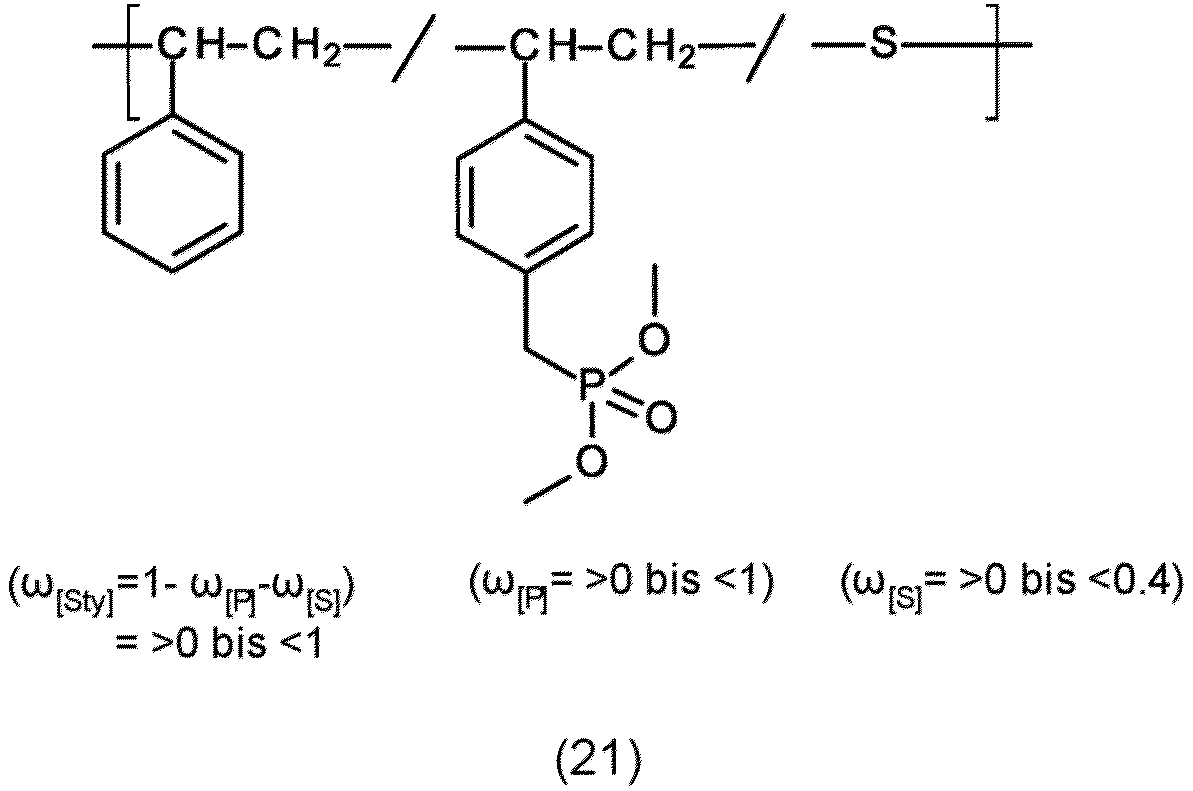
- Copolymer (21) Poly(styrene-ran-dimethyl [(4-ethenylphenyl)methyl]phosphonate-ran-sulfur)
- Copolymer (22) Poly(styrene-ran-dibutyl[(4-ethenylphenyl)methyl]phosphonate-ran-sulfur)
- Copolymer (23) Poly(styrene-ran-vinylphosphonic acid-ran-sulfur)
- Copolymer (24) Poly(styrene-ran-diphenyl(4-vinylphenyl)phosphine-ran-sulfur)
- Polymers and additives used for the production of fire-retardant molding materials or compounds polymer / aggregate type and manufacturer abbreviation polystyrene Polystyrene 158K, BASF SE, Ludwigshafen, Germany PS 2,4,8,10-Tetraoxa-3,9-diphosphaspiro [5.5] undecane-3,9-dimethyl-3,9-dioxide Aflammit PCO 900, Thor GmbH, Speyer, Germany P1 Hexakisphenoxycyclotriphosphazene aber GmbH, Düsseldorf, Germany P2
- EB14 First, 20 g (11a) were dissolved in dichloromethane. The solution was then filled into a 20 cm x 10 cm aluminum mold and dried at room temperature (RT) for 24 h. The dried copolymer was removed from the aluminum mold and foamed with steam in a 5-hole stainless steel mold for 20 min. The foamed test specimen was dried for 24 h at 50 °C until the mass was constant. The resulting test specimens have a density of approx. 70 kg/m 3 .
- EB15 First, 20 g of (2c) were dissolved in dichloromethane. The solution was then filled into a 20 cm x 10 cm aluminum mold and incubated at room temperature (RT) for Dried for 24 hours. The dried copolymer was removed from the aluminum mold and foamed with steam in a perforated stainless steel mold for 20 minutes. The foamed test specimen was dried for 24 hours at 50 °C until the mass was constant. The resulting test specimens have a density of approx. 70 kg/m 3 .
- EB16 First, 20 g (4c) were dissolved in dichloromethane. The solution was then filled into a 20 cm x 10 cm aluminum mold and dried at room temperature (RT) for 24 hours. The dried copolymer was removed from the aluminum mold and foamed with steam in a perforated stainless steel mold for 20 minutes. The foamed test specimen was dried for 24 hours at 50 °C until it reached constant mass. The resulting test specimens have a density of approx. 70 kg/m 3 .
- EB17 First, 20 g (8b) were dissolved in dichloromethane. The solution was then filled into a 20 cm x 10 cm aluminum mold and dried at room temperature (RT) for 24 h. The dried copolymer was removed from the aluminum mold and foamed with steam in a perforated stainless steel mold for 20 min. The foamed test specimen was dried for 24 h at 50 °C until it reached constant mass. The resulting test specimens have a density of approx. 70 kg/m 3 .
- a 5 cm x 10 cm x 1 cm strip of the foam body is held for a few seconds in a 2 cm high propane gas flame with an energy of approx. 50 kW. As soon as the sample ignites, but after a maximum of 5 s, it is pulled out of the flame and the flammability and self-extinguishing of the sample are recorded.
- Flame retardant means that after an initial ignition, the copolymer bodies or molding compounds have shorter afterburning times compared to homopolystyrene.
- test specimen made of copolymers or moulding compounds ignited by the flame of the burner extinguishes within 5 s after the burner flame has been removed from the test specimen.
- a 20 cm x 10 cm x 1 cm sample is exposed to flame for 15 s using a burner with an energy of approx. 50 kW, which has a flame height of 2 cm, at a vertical distance of 1 cm from the bottom of the sample.
- the afterburn time, flame height as well as self-extinguishing and burning dripping behavior of the sample are noted.
- the elemental composition of the copolymers was measured using a vario MICRO cube (Elementar Analysesysteme GmbH, Langenselbold). The calibration of the measurement method was carried out using sulfanilamide.
- the measurement of the molecular weight and molecular weight distribution of the samples was carried out using a GPC analysis system from Shimadzu (Kyoto, Japan) consisting of a degasser (DGU-20A 3R ), two pumps (LC-20AD), an autosampler (SIL-20A HT ), a column oven (CTO-20A, 30°C), a diode array detector (SPD-M20A, 30°C), a refractive index detector (RID-20A, 30°C), a control unit (CBM-20A) and a column set (PSS Polymer Standard Services GmbH, Mainz - one guard column SDV 50x8 mm, 5 ⁇ m, two separation columns SDV 300x8 mm, 5 ⁇ m, 1000 ⁇ , one separation column SDV 300x8 mm, 5 ⁇ m, 100,000 ⁇ ). Calibration was carried out with polystyrene standards.
- melt viscosity was measured using the MeltFloW basic plus (Karg Industrietechnik, Krailing) according to ISO 1133.
- the foam bodies were tested and classified according to the following criteria: 0 >10 agglomerates and phase separations per foam body; + >0 - ⁇ 10 agglomerates and phase separations per foam body; ++ No agglomerates and phase separations per foam body.
- Fire test results Screening test according to DIN 4102-2 (B2): Example composition proportion of (co)polymer (phr 1 ) proportion P1 or P2 (phr 1 ) Self-extinguishing (yes/no) VB1 PS 100 - no VB2 PS + P1 100 2.50 no VB3 PS + P2 100 4.75 no EB8 (6a) 100 - Yes EB9 (7a) 100 - Yes EB10 (8a) 100 - Yes EB11 (9a) 100 - Yes EB12 (10a) 100 - Yes EB13 (14a) 100 - Yes EB14 (11a) 100 - Yes 1 parts per hundred rubber Small burner test according to DIN 4102-2 (B2): Example composition proportion of (co)polymer (phr 1 ) proportion P1 or P2 (phr 1 ) flame height (cm) afterburn time (s) VB1 PS 100 - > 15 31 VB2 PS + P1 100 2.50 > 15 35 VB3 PS + P2 100
Landscapes
- Chemical & Material Sciences (AREA)
- Organic Chemistry (AREA)
- Health & Medical Sciences (AREA)
- Chemical Kinetics & Catalysis (AREA)
- Medicinal Chemistry (AREA)
- Polymers & Plastics (AREA)
- Engineering & Computer Science (AREA)
- Materials Engineering (AREA)
- Compositions Of Macromolecular Compounds (AREA)
- Addition Polymer Or Copolymer, Post-Treatments, Or Chemical Modifications (AREA)
Description
- Die vorliegende Erfindung betrifft brandhindernde Copolymere und Formstoffe und/oder -massen auf Styrolbasis mit reaktiv gebundenem Schwefel bei niedrigem Schwefelgehalt. In diesen Copolymeren und Formmassen sind auch Phosphorverbindungen kovalent angebunden. Die Copolymere und Formmassen zeichnen sich dadurch aus, dass sie im Wesentlichen farblos, geruchsfrei und auch frei von migrierenden Flammschutzadditiven sind. Zudem sind sie frei von potentiell cancerogenem Antimontrioxid (ATO). Die erfindungsgemäßen Copolymere und Formmassen zeigen eine sehr gut ausgeprägte intrinsische Flammwidrigkeit und können dadurch sowohl im Bereich Transport / Automotive, in der Bau- und in der Elektro- und Elektronikindustrie verwendet werden.
- Die Ausrüstung von Styrolhomo- und -copolymeren mit Flammschutzadditiven ist für eine Vielzahl von Anwendungen von Bedeutung, beispielsweise für Polystyrol-Partikelschaumstoffe aus expandierbarem Polystyrol (EPS) oder Polystyrol-Extrusionsschaumstoffplatten (XPS) zum Isolieren von Gebäuden sowie für spritzgegossene Teile aus HIPS, ABS, ASA etc. zur Verwendung als Bauteile und Komponenten für Konsumgüter im Elektro- und Elektronikbereich.
- Polymere, welche aus Styrolmonomeren aufgebaut sind, weisen eine Gesamtproduktionsmenge von ca. 10 Gew.% bezogen auf die gesamte weltweite Kunststoffproduktion auf und gehören somit zur viertgrößten Gruppe der weltweit zwanzig produzierten Kunststoffe. Homopolystyrol (PS) wird überwiegend als Verpackungsmaterial in Lebensmittelverpackungen und in Einweg-Gebrauchsartikeln verwendet. Zudem findet es als Partikelschaumstoff bzw. extrudierter Schaumstoff in Verpackungen und in der Wärmedämmung seine Anwendung.
- Polystyrol als solches ist im Brandfall leicht entzündlich und weist keine flammhemmenden Eigenschaften auf. Tatsächlich brennen reine Polystyrolkörper unter den meisten Brandbedingungen komplett ab und besitzen keine flammhemmenden Eigenschaften. Zudem kommt es im Brandfall zu starker Ruß- und Rauchgasbildung. Nur durch Zusätze von geeigneten Flammschutzadditiven lässt sich eine flammhemmende Eigenschaft des Polymers erreichen. Aufgrund der großen Oberfläche sind in der Anwendung als Schaumstoff intumeszente und krustenbildende Flammschutzsysteme typischerweise nicht ausreichend wirksam. Dazu muss, wie in der
WO 2006/082233 A1 beschrieben, auf gasphasenaktive Flammschutzmittel wie z. B. bromierte Flammschutzadditive mit hierzu passenden Synergisten (z. B. die thermischen Radikalbildner Dicumylperoxid, Di-tert-butylperoxid oder Dicumyl) zurückgegriffen werden. Halogenhaltige Flammschutzmittel sind dabei typischerweise persistent in der Umwelt und setzten im Brandfall korrosive Gase wie Chlor- oder Bromwasserstoff frei. Sind diese Flammschutzmittel auch noch niedermolekular, so sind diese beweglich im Kunststoff und neigen dazu, aus diesem zu migrieren und sich in der Umwelt und in Lebewesen anzureichern. - In der
WO 2007/058736 A1 ist beschrieben, dass aufgrund seiner persistenten, bioakkumulativen und toxischen Eigenschaften, das in der Vergangenheit in Polystyrolschaumstoffen eingesetzte Hexabromcyclododekan, durch ein polymeres und polybromiertes Flammschutzmittel ersetzt werden kann. Eine weitere Alternative zu den bisher beschriebenen, flammgeschützten Polystyrolpolymeren ist das Blenden von Polystyrol mit anderen, weniger brennbaren Polymeren. So ist beispielsweise in derWO 2013/028344 A1 beschrieben, dass Polystyrol mit einem halogenierten Polyphenylenether (PPE) geblendet werden kann, um den notwendigen Flammschutz zu erhalten. - Um die mechanischen Eigenschaften von Styrolpolymeren einstellen zu können, kann Styrol mit unterschiedlichsten Comonomeren copolymerisiert werden. Die Produkte sind dann entsprechend der eingesetzten Comonomeren die Copolymere Poly(Acrylnitril-Butadien-Styrol) (ABS), Poly(Styrol-Butadien-Styrol) (SBS), Poly(Styrol-Acrylnitril) (SAN), Poly(Acrylnitril-Styrol-Acrylat) (ASA), Poly(StyrolButadien)kautschuk (SBR), High-Impact Polystyrol (HIPS), Polystyrolacrylate wie Polystyrolmethylacrylat (SMA) und Polystyrolmethylmethacrylat (SMMA), Methylacrylat-Butadien-Styrol-Copolymer (MBS), Methylmethacrylat-Acrylnitril-Butadien-Styrol-Polymerisate (MABS), Styrol-N-Phenyl-Maleinsäureimid-Copolymere (SPMI) und weitere.
- In der Literatur werden schwefelhaltige Flammschutzadditive mit hohem Schwefelgehalt (> 30%) beschrieben, die als Flammschutzsynergisten für phosphorhaltige Flammschutzmittel in Polystyrolschaumstoffen eingesetzt werden. Dies ist beispielsweise in den Druckschriften
WO 2011/121001 A1 oderWO 2012/089667 A1 der Fall. Diese hochschwefelhaltigen Verbindungen zeichnen sich aber typischerweise durch einen intensiven Geruch und durch eine kräftige, gelbe bis rotbraune Farbe aus, welches den Einsatz in vielen, insbesondere ungefärbten Kunststoffanwendungen einschränkt bzw. unmöglich macht. Weiterhin erreichen die beschriebenen Flammschutzadditive keinen ausreichenden Flammschutzeffekt in Polystyrol-Schaumstoffen, wenn diese allein und ohne weitere Flammschutzmittel eingesetzt werden. Auch wird in den Veröffentlichungen lediglich der Einsatz als Zusatzstoff (Additiv) beschrieben, die Brennbarkeit der reinen Materialien wird nicht erwähnt. - Elementarer Schwefel als additiver Flammschutzmittelzusatzstoff in Homopolystyrol wird ebenfalls in der
WO 2011/095540 A2 beschrieben, welcher seine Wirksamkeit allerdings nur in Kombination mit einem phosphorhaltigen Flammschutzmittel erreicht. Einzeln bleibt der Schwefel in Form eines beigemischten Flammschutzadditivs in Polystyrolschaumstoffen in Hinblick auf den Flammschutz nahezu wirkungslos. Weiterhin führt der Zusatz von elementarem Schwefel im finalen Produkt immer zu einer typischerweise stark ausgeprägten Gelbfärbung, welche in vielen Anwendungen unerwünscht ist. Ebenfalls führt der elementare Schwefel im Prozess der Polymerverarbeitung und im Endprodukt dazu, dass mehr oder weniger ausgeprägte Schwefelgerüche entstehen. - In der
WO 2017/004186 A1 ist erstmalig die flammhemmende Wirkung von hochschwefelhaltigen Duromeren beschrieben. Diese sollen zum einen als Additiv in Polyurethanschäumen, zum anderen auch als duromerer Werkstoff eingesetzt werden können. Diese Schwefelcopolymere weisen jedoch einen hohen Schwefelgehalt von mindestens 40 Gew.% auf. Aufgrund des hohen Schwefelgehalts und des damit einhergehenden unangenehmen Geruchs, den hochschwefelhaltige Materialien aufgrund ihrer zumindest teilweise sulfidischen Struktur typischerweise absondern, ist die Verwendung dieser Duromere in vielen Kunststoffanwendungen stark eingeschränkt. - Desweiteren können duromere Werkstoffe in den typischen Anwendungen für geschäumtes Polystyrol nicht eingesetzt werden, da deren Aufschäumbarkeit entweder gänzlich unmöglich oder zumindest sehr stark eingeschränkt ist. Die Funktionsweise in der
WO 2017/004186 A1 beschriebenen Materials basiert auf der Ausbildung einer stabilen Kruste sowie auf Intumeszenz (Aufschäumen und Verkleben). Bei Materialien wie geschäumten Polymeren, welche sich durch eine sehr große Oberfläche im Verhältnis zur Masse auszeichnen, bieten solche Mechanismen im Flammschutz keinen ausreichenden Schutz, um normierte Brandprüfungen zu bestehen. Testergebnisse bezüglich des Brandverhaltens dieser Polymere fehlen so auch in derWO 2017/004186 A1 . - Ferner beschreibt die Veröffentlichung von Ahmed Aziz et al.: "Copolymerisation of elemental sulfur with styrene", in Journal of Applied Polymer Science, Bd. 29, Nr.4, vom 01. April 1984, Seiten 1225-1239 die Herstellung von Copolymeren ausgehend von den Monomeren Styrol und Schwefel, wobei der Massenanteil von Schwefel bei unter 40% liegt.
- Auch ist in der
EP 0509304 A1 in den Ausführungsbeispielen die Herstellung von Copolymeren ausgehend von phosphat- und triazinhaltigen Monomeren beschrieben, in denen jedoch kein Schwefel enthalten ist. - Die
WO 2011/095540 A2 beschreibt brandhindernde Formmassen und Verfahren zu deren Herstellung und deren Verwendung. - Schließlich sind in der
WO 2011/121485 A1 schwefelhaltige Copolymere beschrieben, die im Gegensatz zu den vorliegenden Copolymeren aus anderen Monomereinheiten aufgebaut sind und andere Teilstrukturen umfassen, die nachveröffentlicht worden sind. - Aufgabe der hier vorliegenden Erfindung ist es daher Copolymere und/oder Formstoffe beispielsweise als Halbzeuge oder als Bestandteil von Verkleidungen, Dämmstoffe zu generieren, die eine flammhemmende oder brandhindernde Eigenschaft in Kombination mit kovalent gebunden, organisch-phosphorhaltigen Comonomeren und einem geringen Gehalt an kovalent gebundenem Schwefel aufweisen, ohne dass weitere Flammschutzadditive zwingend zugemischt werden müssen, um einen ausreichenden brandhemmenden Effekt zu erreichen.
- Diese Aufgabe wird erfindungsgemäß durch die Merkmale der unabhängigen Ansprüche 1 und 5 gelöst.
- Die erfindungsgemäßen Copolymere weisen durch die kovalente Anbindung der flammschutzaktiven Gruppen keinerlei Auswaschung, keinen Geruch, keine Eigenfarbe und gleichzeitig sehr gute intrinsische Flammschutzeigenschaften auf. Sie sind weiterhin frei von - potentiell - krebserregendem Antimontrioxid und mittels kommerziell erhältlicher Ausgangsmaterialien kostengünstig herzustellen.
- Durch die Copolymerisation von Styrol und seinen Derivaten mit zusätzlichen phosphorhaltigen Monomeren wurden in Gegenwart von geringen Mengen an Schwefel neuartige, thermoplastische Copolymere und/oder Formmassen gefunden. Diese Copolymere und/oder Formstoffe oder -massen weisen neben dem kovalent gebundenen Phosphor zusätzlich noch einen äußerst geringen Anteil an gebundenem Schwefel bei gleichzeitig intrinsisch-flammhemmenden Eigenschaften auf.
- Bei der Darstellung der vorliegenden Copolymeren ist von einer zufälligen Verteilung der Wiederholungseinheiten aus den verwendeten Monomeren auszugehen. Die bei einer normalen Polymerkette angegebene Anzahl von Wiederholungseinheiten "n" ist in diesem Fall nur bedingt anwendbar, da die Monomereinheiten innerhalb der Polymerkette nicht einer regelmäßigen Abfolge wiederholt folgen. Aus diesem Grund wurde auf die Angabe einer Wiederholungseinheit "n" in den nachfolgenden Formeln 1 - 24 verzichtet. Im vorliegenden Fall wäre es deshalb auch möglich in den nachfolgenden Formeln Wiederholungseinheiten zu definieren, die im Bereich von n = 2 -100.000 liegen können. Mit den eckigen Klammern ist dennoch eine wiederholende Abfolge der in Frage kommenden Wiederholungseinheiten entsprechend der üblichen Polymerkettendarstellung nach dem Stand der Technik angedeutet. Es könnte daher die Angabe "n" an den eckigen Klammern in den nachfolgenden Formeln (1) bis (24) angegeben werden, auf die jedoch aus den vorher genannten Gründen verzichtet wurde. Die Darstellung der Copolymerzusammensetzung aus unterschiedlichen Monomeren mit " / " ist entsprechend der Empfehlung nach IUPAC gewählt.
- Die erfindungsgemäß nach Formel (6) bis (15) und (17) bis (24) gebildeten Copolymere und/oder aus ihnen gebildete Formmassen sind flammhemmend und/oder selbstverlöschend und im Wesentlichen farb- und/oder geruchlos. Unter im Wesentlichen farblos ist dabei im Sinne der Anmeldung die Abwesenheit von sichtbaren Einfärbungen zu verstehen. Diese entsprechen den wahrgenommenen RAL-Farbtypen, beispielhaft aber nicht abschließend aufgezählt, RAL 1013 Perlweiß, 10 RAL 9001 Cremeweiß, RAL 9003 Signalweiß, RAL 9010 Reinweiß und/oder RAL 9016 Verkehrsweiß.
- Unter geruchlos in Bezug auf die Copolymere und Formmassen kann die olfaktorische Wahrnehmung von sulfidischen Verbindungen von weniger als 50 µg/m3 Luft, beziehungsweise weniger als 5 µg/m3 Luft (beispielsweise Schwefelwasserstoff, Dimethylsulfid, Methylmercaptan), oder auch weniger als 0,5 µg/m3 (beispielsweise Thiophenol, Thiokresol, Diphenylsulfid, Propylmercaptan, Ethylmercaptan, Crotylmercaptan, Amylmercaptan, Benzylmercaptan, Amylmercaptan, Allylmercaptan) Luft verstanden werden, wobei die sulfidischen Verbindungen in Abhängigkeit ihrer chemischen Struktur eine unterschiedliche Geruchsschwelle aufweisen und individuell unterschiedlich wahrgenommen werden können.
- Weiterhin zeichnen sich die intrinsisch flammgehemmten Copolymere dadurch aus, dass die phosphor- oder schwefelhaltigen Gruppen kovalent an das Copolymer angebunden sind und nicht aus diesem migrieren können.
- Ein erfindungsgemäß aus den Formeln (6) bis (15) und (17) bis (24) gebildetes Copolymer kann einen Einzelbestandteil einer Formmasse bilden oder Mitbestandteil einer Formmasse sein. Definitionsgemäß sollen unter dem Begriff Formmasse copolymerhaltige Werkstücke verstanden werden, die einen Formstoff für die Herstellung von Formkörpern bzw. Halbzeugen oder Fertigteilen bilden. Durch mechanische Krafteinwirkung und/oder erhöhte Temperatur ≤ 250°C wird durch eine Verarbeitungsmethode wie Extrudieren, Pressen, Spritzpressen oder Spritzgießen in Werkzeugen und nachfolgender Abkühlung die Formmasse zu Halbzeugen oder Fertigteilen verarbeitet.
- Als Halbzeug wird im Rahmen der Anmeldung ein vorgefertigtes Rohmaterial oder Werkstoff oder Halbfabrikat der einfachsten Form angesehen, das in der Regel aus einem einzelnen Material oder einer einzelnen Verbindung wie einem einzelnen erfindungsgemäßen Copolymer bestehen kann, aber nicht nur aus einem einzelnen Material oder einer einzelnen Verbindung wie einem einzelnen erfindungsgemäßen Copolymer bestehen muss. So ist es möglich, dass zumindest ein erfindungsgemäßes Copolymer mit mindestens einem weiteren Copolymer und/oder einem weiteren Polymer und/oder einem anderen Werkstoff wie beispielsweise Metall (Bsp. Aluminium und/oder Eisen) und/oder Kunststoff (Bsp. Polyurethan und/oder Polycarbonat) und/oder Keramiken (Bsp. Kaolin und/oder Silikate und/oder Tonmaterialien) und/oder Prepregs, BMC oder SMC zusammen ein Werkstück oder Halbzeug bildet. D.h. die Formmasse oder der -stoff kann aus einem erfindungsgemäßen Copolymer und/oder zumindest einem weiteren Polymer und/oder aus einem zusätzlichen erfindungsgemäßen Copolymer bestehen. Die Formmasse, der Formstoff oder der Formkörper kann auch ein erfindungsgemäßes Copolymer und/oder ein weiteres Polymer und/oder ein zusätzliches erfindungsgemäßes Copolymer und/oder einen anderen Werkstoff wie beispielsweise Metall (Bsp. Aluminium und/oder Eisen) oder Kunststoff (Bsp. Polyurethan und/oder Polycarbonat) oder Keramik (Kaolin und/oder Silikate und/oder Tonmaterialien) zusammen für ein Halbzeug umfassen. Es dabei auch möglich, dass die Formmasse, der Formstoff oder der Formkörper den Werkstoff oder das Werkstück als Beschichtung teilweise oder vollumfänglich umgibt oder der Werkstoff oder das Werkstück in die Formmasse, den Formstoff oder den Formkörper eingebettet ist.
- Als Halbzeuge werden beispielsweise einfache Profile Konstruktionsprofile, Stangen, Rohre und Platten bezeichnet. Formstoffe, die bereits in einem vorbereitenden Fertigungsschritt eine individuelle Form erhalten haben, aber noch für weitere Fertigungsschritte vorgesehen sind, werden in einem zweiten Schritt beispielsweise durch Umformung im nächsten Schritt entweder zu einem Fertigteil oder zunächst zu einem weiteren Halbzeug oder -fabrikat weiterverarbeitet.
- So entstehen aus den Halbzeugen Fertig-Bauteile, Fertig-Bauelemente (z. B. Konstruktionsprofile, Ziegel oder Dämmstoffe) oder Fertig-Bausteine.
- Die Material- und Oberflächenqualitäten sind oft für bestimmte Einsatzzwecke und Fertigungsverfahren optimiert. Beispielhaft, aber nicht abschließend benannt, können die Copolymere, die erfindungsgemäß aus den Formeln (6) bis (15) und (17) bis (24) gebildet werden, Einzelbestandteil oder Mitbestandteil einer Formmasse oder eines Formstoffes sein, die als Halbzeuge Verwendung beispielweise in der Bauindustrie als Dämmstoffe Verwendung finden. Die Formmasse oder der Formstoff kann insofern ein einzelnes Copolymer oder auch weitere Polymere und/oder Copolymere und/oder Zuschläge und/oder Additive enthalten, die sich in ihrer Eigenschaft an der gewünschten Verwendung wie beispielsweise im Haus- oder Anlagenbau oder im Automobilbau orientieren. So ist es möglich, dass die Formstoffe oder -massen zusätzlich weitere Zuschläge wie Flammschutzmittel wie Melamin, Melaminpolyphosphat, Melamincyanurat, Metalloxide, Metallhydroxide, Cyclotriphosphazene, Phosphate, Phosphinate, Phosphinoxide, Hyphosphosphite oder Blähgraphit enthalten. Geeignete Zuschläge wären beispielsweise zusätzliche halogenfreie Flammschutzmittel wie Aflammit PCO 900, Exolit OP 930, Exolit OP 1312, DOPO, HCA-HQ, Cyagard RF-1241, 20 Cyagard RF-1243, Fyrol PMP, Phoslite B85AX, Melapur 200, Melapur MC und Budit 669 erhältlich.
- Auch sind in diesem Zusammenhang als Zuschläge Verbindungen wie 2,4,8,10-Tetraoxa-3,9-diphosphaspiro [5.5] undecane-3,9-dimethyl-3,9-dioxide (0,1 - 10 Gew.%) oder Hexakisphenoxycyclotriphosphazen (0,5 - 20 Gew.%) zu nennen.
- Im Rahmen der vorliegenden Erfindung weisen die brandhindernden und/oder selbstverlöschenden Copolymere oder die Formmassen oder Formstoffe bzw. Halbzeug eine optional geruchsneutrale und/oder farbneutrale Ausgestaltung auf.
- Ein Copolymer oder ein aus einer Formmasse gebildeter Formstoff wirkt bei Kontakt mit einer Flamme zumindest flammhemmend bzw. brandhindernd oder auch in Abhängigkeit von den Substituenten selbstverlöschend. Die erfindungsgemäßen Copolymere und/oder Formmassen sind frei von Antimontrioxid und können frei von halogenhaltigen Bestandteilen erhalten werden.
- Es wurden Copolymere oder Formstoffe umfassende Verbindungen mit einer zufälligen Monomerverteilung der Formel (6) bis (15) und (17) bis (24) gefunden mit einer statistischen Monomerverteilung von Monomereinheiten mit dem Massenanteil ω mit ω(Sty), ω(S). Die Summe der Massenanteile ω(Sty) und ω(3) beträgt 1.
- Ferner wurden erfrindungsgemäß Copolymere umfassende Verbindungen mit einer zufälligen Monomerverteilung der Formel (6) bis (15) und (17) bis (24) gefunden mit einer statistischen Monomerverteilung von Monomereinheiten mit dem Massenanteil ω mit ω(Sty), ω(P) und ω(3) bei denen ω(3) und ω(P) dem Massenanteil der schwefelhaltigen und potenziell, phosphorhaltigen Repetiereinheit entspricht. Die Summe der Massenanteile in einem Copolymeren mit den Formeln (6) bis (24) sind jeweils Monomereinheiten mit den Massenanteilen ω mit ω(Sty), ω(P) und ω(3) = 1.
- Für nachfolgenden Verbindungen der Formeln (6) gilt das vorhergehend bereits genannte. Bei den hier dargestellten Strukturformeln der Copolymere wurde auch auf die Angabe des Indizes "n" an der eckigen Klammer aus den zuvor beschriebenen Gründen verzichtet. Im vorliegenden Fall wäre es deshalb auch möglich in den nachfolgenden Formeln Wiederholungseinheiten zu definieren, die im Bereich von n = 3 bis 100.000 liegen können, wobei durch die zufällige Monomerverteilung eine Angabe von "n" in den Wiederholungseinheiten in den Formeln (6) bis (24) verzichtet wurde.




- Die erfindungsgemäßen Copolymere sind als Einzelverbindung oder als Bestandteil von Formstoffen oder -massen bereits flammhemmend und/oder selbstverlöschend. Unter flammhemmend ist zu verstehen, dass nach einer initialen Entzündung ein Copolymer oder ein copolymerumfassender Formstoff oder Formmasse im Vergleich zu Homostyrol kürzere Nachbrennzeiten aufweist. Selbstverlöschend bedeutet, dass ein entzündetes Copolymer oder ein Formstoff oder eine Formmasse innerhalb von fünf Sekunden erlischt, nachdem eine Brennerflamme vom Copolymer oder dem Formstoff oder der Formmasse entfernt wird. Diese Formmassen können durch physikalische Abmischung (Blending) mit anderen Polymeren und Copolymeren in beliebigen Mengenverhältnissen erhalten werden.
- Die erfindungsgemäßen Copolymere und Formstoffe oder -massen weisen keine halogenhaltigen Substituenten auf und sind insofern halogenfrei, was eine Umweltverträglichkeit sowohl bei der Herstellung, der Verwendung und auch bei der Entsorgung sowie im Brandfall bedeutet.
- Ferner wurden brandhindernde Formstoffe oder -massen für die Extrusion (oder zum Pressen, Gießen oder Schäumen) gefunden, die zumindest ein brandhinderndes Copolymer mit einem Schwefelanteil von weniger als 5 % aufweisen.
- Bedingt durch die thermoplastischen Eigenschaften der Copolymere und/oder Formmassen kann durch unterschiedlichste Formgebung eine Vielzahl von Anwendungen bedient werden. Da auch Schaumkörper als Formstoff aus den Copolymeren und/oder Formmassen hergestellt werden können, können diese ihren Einsatz beispielhaft als Wärmeisolationsmaterialien finden.
- Die aus den brandhindernden Copolymeren hergestellten Schaumstoffe weisen bevorzugt eine Dichte im Bereich von 5 bis 200 kg/m3, besonders bevorzugt im Bereich von 10 bis 100 kg/m3 auf und sind bevorzugt zu mehr als 80%, besonders bevorzugt von 95 bis 100% in den Schaumstoffen vorhanden.
- Bevorzugt besteht die Polymermatrix der brandhindernden Copolymere, Copolymerschaumstoffe oder Formstoffe aus thermoplastischen (Co)Polymeren oder Polymermischungen, insbesondere Styrol(co)polymeren. Die erfindungsgemäßen, brandhindernden und expandierbaren Styrol(co)polymere (EPS) und Styrol(co)polymerextrusionschaumstoffe (XPS) können durch Einmischen eines Treibmittels in Form eines niedrig siedenden organischen Lösungsmittels wie beispielsweise n-Hexan oder Pentan in die Polymerschmelze und anschließender Extrusion und Granulierung unter Druck zu expandierbaren Granulaten (EPS) oder durch Extrusion und Entspannung unter Verwendung entsprechend geformter Düsen zu Schaumstoffplatten (XPS) oder Schaumstoffsträngen verarbeitet werden.
- Unter expandierbaren Styrol(co)polymerisaten (EPS) werden treibmittelhaltige Styrol(co)polymerisate verstanden. Die EPS-Partikelgröße liegt bevorzugt im Bereich von 0,2 - 2 mm. Styrol(co)polymer-Partikelschaumstoffe sind durch Vorschäumen und Versintern der entsprechenden, expandierbaren Styrol(co)polymeren (EPS) erhältlich. Die Styrol(co)polymer-Partikelschaumstoffe weisen bevorzugt 2 bis 15 Zellen pro Millimeter auf. Den erfindungsgemäßen Copolymeren oder den erfindungsgemäßen copolymerenthaltenden Formmassen können noch ein weiteres Polymer, insbesondere ein Styrolpolymer beigemischt werden, z. B. Homopolystyrol, glasklares Polystyrol (GPPS), Schlagzähpolystyrol (HIPS), Styrol-Methylstyrolcopolymere, Acrylnitril-Butadien-Styrolpolymerisate (ABS), Poly(Styrol-Butadien-Styrol) (SBS), Styrol-Acrylnitril-Polymer (SAN), Poly(Styrolbutadien)kautschuk (SBR), Poly-(Acrylnitril-Styrol-Acrylester) (ASA), Polystyrolacrylate wie Polystyrolmethylacrylat (SMA) und Polystyrolmethylmethacrylat (SMMA), Methylacrylat-Butadien-Styrol-Copolymer (MBS), Methylmethacrylat-Acrylnitril-Butadien-Styrol-Polymerisate (MABS), Styrol-N-Phenylmaleinsäureimid-Copolymere (SPMI) oder Mischungen davon oder Mischungen der genannten Styrol(co)polymere mit Polyolefinen wie Polyethylen oder Polypropylen und Polyphenylenether (PPE).
- Weiterhin ist unter einem weiteren Polymer auch ein Copolymer aus Styrol und/oder phosphorhaltigen Co-Monomeren zu verstehen, beispielsweise Copolymere aus Styrol mit mindestens einem der Monomere der Forme (25) bis (38).
- Die beschriebenen Formmassen sind im Wesentlichen farb- und/oder geruchlos.
- Unter "im Wesentlichen farblos" ist dabei im Sinne der Anmeldung die Abwesenheit von sichtbaren Einfärbungen zu verstehen. Diese entsprechen den wahrgenommenen RAL-Farbtypen, beispielhaft aber nicht abschließend aufgezählt, RAL 1013 Perlweiß, RAL 9001 Cremeweiß, RAL 9003 Signalweiß, RAL 9010 Reinweiß und/oder RAL 9016 Verkehrsweiß.
- Unter geruchlos kann die olfaktorische Wahrnehmung von sulfidischen Verbindungen von weniger als 50 µg/m3 Luft, bevorzugt weniger als 5 µg/m3 Luft (beispielsweise Schwefelwasserstoff, Dimethylsulfid, Methylmercaptan), besonders bevorzugt weniger als 0,5 µg/m3 (beispielsweise Thiophenol, Thiokresol, Diphenylsulfid, Propylmercaptan, Ethylmercaptan, Crotylmercaptan, Amylmercaptan, Benzylmercaptan, Amylmercaptan, Allylmercaptan) Luft verstanden werden, wobei die sulfidischen Verbindungen in Abhängigkeit ihrer chemischen Struktur eine unterschiedliche Geruchsschwelle aufweisen und typischerweise persönlich individuell wahrgenommen werden können.
- Die erfindungsgemäßen Styrol(co)polymere können zur Verbesserung der mechanischen Eigenschaften oder der Temperaturbeständigkeit gegebenenfalls unter Verwendung von Verträglichkeitsvermittlern mit einem weiteren Polymer als thermoplastisches Polymer wie Homopolystyrol (PS), Polyamiden (PA), Polyolefinen wie Polypropylen (PP) oder Polyethylen (PE), Polyacrylaten wie Polymethylmethacrylat (PMMA), Polycarbonat (PC), Polyestern wie Polyethylenterephthalat (PET) oder Polybutylenterephthalat (PBT), Polyethersulfonen (PES), Polyetherketonen oder Polyethersulfiden (PES) versetzt werden. Des Weiteren sind Mischungen mit weiteren Polymeren in den genannten Mengenbereichen auch mit z. B. hydrophob modifizierten oder funktionalisierten Polymeren oder Oligomeren, Kautschuken wie Polyacrylaten oder Polydienen wie z.B. Styrol-Butadien-Blockcopolymeren oder biologisch abbaubaren, aliphatischen oder aliphatisch/aromatischen Copolyestern möglich.
- Als Verträglichkeitsvermittler eignen sich z. B. mit Maleinsäureanhydrid-modifizierte Styrolcopolymere, epoxidgruppenhaltige Polymere oder Organosilane.
- Den Styrolcopolymeren können im Herstellungsverfahren auch Polymerrezyklate der genannten thermoplastischen Polymere, insbesondere Styrol(co)polymere und expandierbare Styrol(co)polymere (EPS) in Mengen von maximal 50 Gew.%, insbesondere in Mengen von 1 bis 20 Gew.% zugemischt werden, ohne dass die flammhemmenden oder selbstverlöschenden Eigenschaften der Copolymere und/oder Formmassen wesentlich verändert werden.
- Für hochtemperaturbeständige Copolymere und/oder Formstoffe und/oder Schaumstoffe werden bevorzugt Mischungen aus SMA und SAN bzw. SAN und SPMI eingesetzt. Der Anteil wird entsprechend der gewünschten Wärmeformbeständigkeit gewählt. Der Acrylnitrilgehalt in SAN beträgt bevorzugt 25 bis 33 Gew.%. Der Methacrylat-Anteil in SMA beträgt bevorzugt 25 bis 30 Gew.%.
- Die Styrol(co)polymerisate oder Formstoffe können Hilfsmittel und Zuschläge enthalten, beispielsweise Flammschutzmittel, Füllstoffe, Keimbildner, UV-Stabilisatoren, Kettenüberträger, Treibmittel, Weichmacher, Antioxidantien, lösliche und unlösliche anorganische und/oder organische Farbstoffe und Pigmente, z. B. Infrarot (IR)-Absorberwie Ruß, Graphit oder Aluminiumpulver. In der Regel werden die Farbstoffe und Pigmente in Mengen im Bereich von 0,01 bis 30 Gew.%, bevorzugt im Bereich von 1 bis 5 Gew.% zugesetzt. Zur homogenen und mikrodispersen Verteilung der Pigmente in dem Styrolcopolymer kann es insbesondere bei polaren Pigmenten zweckmäßig sein, ein Dispergierhilfsmittel wie z. B. Organosilane, epoxygruppenhaltige Polymere oder mit Maleinsäureanhydrid gepfropfte Styrolpolymere einzusetzen. Bevorzugte Weichmacher sind Mineralöle und Phthalate, die in Mengen von 0,05 bis 10 Gew.% bezogen auf das Styrol(co)polymerisat eingesetzt werden können.
- Die Menge der eingesetzten IR-Absorber richtet sich nach deren Art und Wirkung. Die Styrol(co)polymer-Partikelschaumstoffe enthalten bevorzugt 0,5 bis 5 Gew.%, besonders bevorzugt 1 bis 4 Gew.% IR-Absorber. Bevorzugt werden als IR-Absorber Graphit, Ruß oder Aluminium mit einer mittleren Teilchengröße im Bereich von 1 bis 50 µm verwendet.
- Der bevorzugt eingesetzte Graphit hat eine mittlere Partikelgröße von 1 bis 50 µm, insbesondere von 2,5 µm bis 12 µm, ein Schüttgewicht von 100 bis 500 kg/m3 und eine spezifische Oberfläche von 5 bis 20 m2/g. Es kann Naturgraphit oder gemahlener, synthetischer Graphit eingesetzt werden. Die Graphitpartikel sind im Styrol(co)polymerisat vorzugsweise in Mengen von 0,05 bis 8 Gew.%, insbesondere von 0,1 bis 5 Gew.% enthalten.
- Die Herstellung der besonders bevorzugten, expandierbaren Styrol(co)polymerisate (EPS) oder Formstoffe kann nach unterschiedlichen Verfahren erfolgen.
- Bei einer Ausführungsform vermischt man athermane Partikel und ein nichtionisches Tensid mit einer Schmelze des Styrol(co)polymerisats oder Formstoffs, vorzugsweise in einem Extruder. Dabei wird gleichzeitig das Treibmittel in die Schmelze zudosiert. Unter athermanen Partikeln versteht man hierbei Partikel, welche für infrarote Strahlung (Wärmestrahlung) undurchlässig sind.
- Man kann die athermanen Partikel auch in eine Schmelze von treibmittelhaltigem Styrol(co)polymerisat oder Formstoff einarbeiten, wobei zweckmäßigerweise ausgesiebte Randfraktionen eines Perlspektrums von bei einer Suspensionspolymerisation entstandenen, treibmittelhaltigen Polystyrolperlen eingesetzt werden. Die Treibmittel und die athermanen Partikel enthaltende Styrol(co)polymerschmelzen oder Formstoffpolymerschmelzen werden ausgepresst und zu treibmittelhaltigem Granulat zerkleinert. Da die athermanen Partikel stark nukleierend wirken können, sollte nach dem Auspressen unter Druck rasch abgekühlt werden, um ein Aufschäumen zu vermeiden. Man führt daher zweckmäßigerweise eine Unterwassergranulierung unter Druck in einem geschlossenen System durch.
- Es ist auch möglich, den die athermanen Partikel enthaltenen Styrol(co)polymerisaten oder Formstoffen ein Treibmittel in einem gesonderten Verfahrensschritt zuzusetzen. Hierbei werden die Granulate dann vorzugsweise in wässriger Suspension mit dem Treibmittel imprägniert.
- In allen drei Fällen kann man die feinteiligen, athermanen Partikel und das nichtionische Tensid direkt einer Styrol(co)polymerschmelze oder Formstoffschmelze zusetzen. Man kann die athermanen Partikel aber auch in Form eines Konzentrats in Polystyrol der Schmelze zusetzen. Bevorzugt werden aber Styrol(co)polymer-Granulat und athermane Partikel zusammen in einen Extruder eingegeben, das Styrol(co)polymer dort aufgeschmolzen und mit den athermanen Partikeln vermischt.
- Besonders bevorzugt werden die expandierbaren Styrol(co)polymerisate (EPS) durch Polymerisation von Styrol und gegebenenfalls den copolymerisierbaren Monomeren der erfindungsgemäßen Copolymere in wässriger Suspension und Imprägnierung mit einem Treibmittel hergestellt, wobei die Polymerisation in Gegenwart von 0,1 bis 5 Gew.% Graphitpartikeln bezogen auf das Styrol(co)polymer und einem nichtionischen Tensid durchgeführt wird. Als nichtionisches Tensid eignen sich beispielsweise Maleinsäureanhydrid-Copolymere (MSA) z. B. aus Maleinsäureanhydrid und C(20)- bis C(24)-Olefin, Polyisobutylen-Bernsteinsäureanhydrid (PIBSA) oder deren Umsetzungsprodukte mit Hydroxy-Polyethylenglycolester, Diethylaminoethanol oder Aminen wie Tridecylamin, Octylamin oder Polyetheramin, Tetraethylenpentamin oder Mischungen davon. Die Molekulargewichte des nichtionischen Tensids liegen bevorzugt im Bereich von 500 bis 3000 g/mol. Sie werden in der Regel in Mengen im Bereich von 0,01 bis 2 Gew.% bezogen auf das Styrol(co)polymer eingesetzt.
- Die expandierbaren, athermanen Partikel enthaltenden Styrol(co)polymerisate oder Formstoffe können zu Styrol(co)polymerschaumstoffen mit Dichten von 5 - 200 kg/m3, bevorzugt von 7 bis 100 kg/m3 und insbesondere von 10 - 80 kg/m3, verarbeitet werden.
- Hierzu werden die expandierbaren Partikel vorgeschäumt. Dies geschieht zumeist durch Erwärmung der Partikel mit Wasserdampf in sogenannten Vorschäumern. Die so vorgeschäumten Partikel werden danach zu Formkörpern verschweißt. Hierzu werden die vorgeschäumten Partikel in nicht gasdicht schließende Formen gebracht und mit Wasserdampf beaufschlagt. Nach Abkühlen können die Formteile entnommen werden.
- Die aus den erfindungsgemäßen, expandierbaren Copolymerisaten oder Formstoffen hergestellten Schaumstoffe zeichnen sich durch eine hervorragende Wärmeisolierung aus. Dieser Effekt zeigt sich besonders deutlich bei niedrigen Dichten.
- Die Schaumstoffe oder Formstoffe können zur Wärmedämmung von Gebäuden und Gebäudeteilen, zur thermischen Isolierung von Maschinen und Haushaltsgeräten sowie als Verpackungsmaterialien verwendet werden.
- Zur Herstellung der expandierbaren Copolymerisate kann das Treibmittel in die Polymerschmelze eingemischt werden. Ein mögliches Verfahren umfasst die Stufen a) Schmelzerzeugung, b) Mischen, c) Kühlen, d) Fördern und e) Granulieren. Jede dieser Stufen kann durch die in der Kunststoffverarbeitung bekannten Apparate oder Apparatekombinationen ausgeführt werden. Zur Einmischung eignen sich statische oder dynamische Mischer, beispielsweise Extruder. Die Polymerschmelze kann direkt aus einem Polymerisationsreaktor entnommen werden oder direkt in dem Mischextruder oder einem separaten Aufschmelzextruder durch Aufschmelzen von Polymergranulaten erzeugt werden. Die Kühlung der Schmelze kann in den Mischaggregaten oder in separaten Kühlern erfolgen. Für die Granulierung kommen beispielsweise die druckbeaufschlagte Unterwassergranulierung, Granulierung mit rotierenden Messern und Kühlung durch Sprühvernebelung von Temperierflüssigkeiten oder Zerstäubungsgranulation in Betracht. Zur Durchführung des Verfahrens geeignete Apparateanordnungen sind z. B.:
- a) Polymerisationsreaktor - statischer Mischer/Kühler- Granulator
- b) Polymerisationsreaktor - Extruder- Granulator
- c) Extruder - statischer Mischer - Granulator
- d) Extruder - Granulator
- Die treibmittelhaltige Copolymerschmelze wird in der Regel mit einer Temperatur im Bereich von 140 bis 300 °C, bevorzugt im Bereich von 160 bis 240 °C durch die Düsenplatte gefördert. Eine Abkühlung bis in den Bereich der Glasübergangstemperatur ist nicht notwendig.
- Die Düsenplatte wird mindestens auf die Temperatur der treibmittelhaltigen Copolymerschmelze beheizt. Bevorzugt liegt die Temperatur der Düsenplatte im Bereich von 20 bis 100 °C über der Temperatur der treibmittelhaltigen Copolymerschmelze. Dadurch werden Polymerablagerungen in den Düsen verhindert und eine störungsfreie Granulierung gewährleistet.
- Um marktfähige Granulatgrößen zu erhalten, sollte der Durchmesser (D) der Düsenbohrungen am Düsenaustritt im Bereich von 0,2 bis 1,5 mm, bevorzugt im Bereich von 0,3 bis 1,2 mm, besonders bevorzugt im Bereich von 0,3 bis 0,8 mm 10 liegen. Damit lassen sich auch nach Strangaufweitung Granulatgrößen unter 2 mm, insbesondere im Bereich 0,4 bis 1,4 mm gezielt einstellen.
- Besonders bevorzugt wird ein Verfahren zur Herstellung von brandhindernden, expandierbaren Copolymeren (EPS), welches die folgenden Schritte umfasst:
- a) Einmischen eines organischen Treibmittels in die Polymerschmelze der erfindungsgemäßen Copolymere und/oder Abmischungen daraus mittels statischer oder dynamischer Mischer bei einer Temperatur von mindestens 150°C,
- b) Kühlen der Treibmittel-Copolymerschmelze auf einen Temperaturbereich von 120 bis 200 °C
- c) Austrag durch eine Düsenplatte mit Bohrungen, deren Durchmesser am 20 Düsenaustritt höchstens 1,5 mm beträgt und
- d) Granulieren der treibmittelhaltigen Schmelze direkt hinter der Düsenplatte unter Wasser bei einem Druck im Bereich von 1 bis 20 bar.
- Es ist auch möglich, die erfindungsgemäßen Copolymere und/oder Formmassen durch Suspensionspolymerisation herzustellen. Bei der Suspensionspolymerisation werden als Monomere bevorzugt Styrol, phosphorhaltiges Comonemer und Schwefel eingesetzt. Es kann jedoch bis zu 50 % seines Gewichts durch andere, ethylenisch ungesättigte Monomere ersetzt sein.
- Bei der Suspensionspolymerisation können die üblichen Hilfsmittel wie z. B. Peroxidinitiatoren, Suspensionsstabilisatoren, Treibmittel, Kettenüberträger, Expandierhilfsmittel, Keimbildner und Weichmacher zugesetzt werden. Treibmittel werden in Mengen von 3 bis 10 Gew.%, bezogen auf das bzw. die Monomer/e zugesetzt. Man kann sie vor, während oder nach der Polymerisation der Suspension zusetzen. Geeignete Treibmittel sind aliphatische Kohlenwasserstoffe mit 4 bis 6 Kohlenstoffatomen. Es ist vorteilhaft, als Suspensionsstabilisatoren anorganische Pickering-Dispergatoren wie z. B. Magnesiumpyrophosphat oder Calciumphosphat einzusetzen.
- Bei der Suspensionspolymerisation entstehen perlförmige, im Wesentlichen runde Teilchen mit einem mittleren Durchmesser im Bereich von 0,2 bis 2 mm. Zur Verbesserung der Verarbeitbarkeit können die fertigen, expandierbaren Copolymerperlen und -granulate mit den üblichen und bekannten Beschichtungsmitteln wie beispielsweise Metallstearaten, Glycerinestern und feinteiligen Silikaten, Antistatika oder Antiverklebungsmittel beschichten werden.
- Das EPS-Granulat kann mit Glycerinmonostearat (GMS, typischerweise 0,25 Gew.%), Glycerintristearat (typischerweise 0,25 Gew.%), feinteiliger Kieselsäure (Aerosil R972, typischerweise 0,12 Gew.%) und Zink-Stearat (typischerweise 0,15 Gew.%) sowie Antistatikum beschichtet werden.
- Die expandierbaren Copolymerteilchen können zu Polystyrolschaumstoffen mit Dichten von 8 bis 200 kg/m3, bevorzugt von 10 bis 100 kg/m3 verarbeitet werden. Hierzu werden die expandierbaren Partikel vorgeschäumt. Dies geschieht zumeist durch Erwärmen der Partikel mit Wasserdampf in sogenannten Vorschäumern. Die so vorgeschäumten Partikel werden danach zu Formkörpern bzw. Halbzeugen oder Formkörpern verschweißt. Hierzu werden die vorgeschäumten Partikel in nicht gasdicht schließende Formen gebracht und mit Wasserdampf beaufschlagt. Nach Abkühlen können die Formteile entnommen werden.
-

- Synthetisiert nach M. Dutkiewicz et al., Polymer Degradation and Stability 2018, 148, Seiten 10 - 18.
-

- 1H-NMR (500 MHz, CDCl3): 1,30 ppm (6 Protonen, -P-O-CH2-CH3), 1,93 (3 Protonen, -CH3 Acrylat), 4,10 (4 Protonen, -P-O-CH2-CH3), 4,26 und 4,35 (je 2 Protonen, -O-CH2-CH2-O-), 5,59 und 6,14 (je 1 Proton, CH2=C-);
-

- 2-Hydroxyethyl-Methacrylat (929 mg, 7,12 mmol), destilliertes Triethylamin (741 mg, 7,32 mmol) und Kupfer(I)chlorid (11,38 mg, 0,11 mmol) wurden in ca. 10 ml peroxidfreiem Diethylether gemischt, sauerstofffrei gemacht und in einem Eisbad abgekühlt. Diphenylchlorphosphat (1860 mg, 7,12 mmol) gelöst in 4 ml Diethylether wurde tropfenweise hinzugegeben. Die Mischung wurde für eine Stunde im Eisbad und 48 h bei Raumtemperatur gerührt, anschließend filtriert und das Lösungsmittel evaporiert.
- 1H-NMR (500 MHz, CDCl3): 1,91 ppm (3 Protonen, -CH3 Acrylat), 4,38 und 4,48 (je 2 Protonen, -O-CH2-CH2-O-), 5,56 und 6,11 (je 1 Proton, CH2=C-), 7,22 und 7,33 (10 Protonen, Aromaten)
-

- 2-Hydroxyethyl-Acrylat (826 mg, 7,12 mmol), destilliertes Triethylamin (741 mg, 7,32 mmol) und Kupfer(I)chlorid (11,38 mg, 0,11 mmol) wurden in ca. 10 ml peroxidfreiem Diethylether gemischt, sauerstofffrei gemacht und in einem Eisbad abgekühlt. Diphenylchlorphosphat (1860 mg, 7,12 mmol) gelöst in 4 ml Diethylether wurde tropfenweise hinzugegeben. Die Mischung wurde für eine Stunde im Eisbad und 48 h bei Raumtemperatur gerührt, anschließend filtriert und das Lösungsmittel evaporiert.
- 1H-NMR (500 MHz, CDCl3): 4,38 und 4,48 (je 2 Protonen (-O-CH2-CH2-O-), 5,85, 6,08 und 6,41 (je 1 Proton, CH2=CH-), 7,23 und 7,34 (6 und 4 Protonen, Aromaten)
-

- Hydroxybutyl-Methacrylat (2:1 Isomerengemisch) (1125 mg, 7,12 mmol), destilliertes Triethylamin (741 mg, 7,32 mmol) und Kupfer(I)chlorid (11,38 mg, 0,11 mmol) wurden in ca. 10 ml peroxidfreiem Diethylether gemischt, sauerstofffrei gemacht und in einem Eisbad abgekühlt. Diphenylchlorphosphat (1860 mg, 7,12 mmol) gelöst in 4 ml Diethylether wurde tropfenweise hinzugegeben. Die Mischung wurde für eine Stunde im Eisbad und 48 h bei Raumtemperatur gerührt, anschließend filtriert und das Lösungsmittel evaporiert.
- 1H-NMR (500 MHz, CDCl3), δ (ppm): 0.92/0.96 (t, 6H, CH3); 1.69/1.77 (q, 4H, CH2); 1.90 (s, 6H, CH3); 4.24/4.34 (m, 2H, -O-CH2-); 4.80 (d, 2H, CH2); 5.06 (q, 2H, CH); 5.52 (s, 1H, CH vinyl trans zu Carbonyl); 6.10 (s, 1H, CH vinyl cis zu Carbonyl); 7.20/7.32 (Aromaten-H).
-

- 4-Hydroxybutyl -Acrylat (1025 mg, 7,12 mmol), destilliertes Triethylamin (741 mg, 7,32 mmol) und Kupfer(I)chlorid (11,38 mg, 0,11 mmol) wurden in ca. 10 ml peroxidfreiem Diethylether gemischt, sauerstofffrei gemacht und in einem Eisbad abgekühlt. Diphenylchlorphosphat (1860 mg, 7,12 mmol) gelöst in 4 ml Diethylether wurde tropfenweise hinzugegeben. Die Mischung wurde für eine Stunde im Eisbad und 48 h bei Raumtemperatur gerührt, anschließend filtriert und das Lösungsmittel evaporiert.
- 1H-NMR (500 MHz, CDCl3): 1,76 ppm (4 Protonen, -O-CH2-(CH2)2-CH2-O-), 4,16 und 4,30 (je 2 Protonen, -O-CH2-(CH2)2-CH2-O-), 5,83, 6,11 und 6,36 (je 1 Proton, CH2=CH-), 7,22 und 7,33 (6+4 Protonen, Aromaten)
-

- Kalium-tert.-Butanolat (4,4 g, 39,3 mmol) wurden in THF (40 ml, trocken) bei 0 °C unter Inertgas suspendiert, bevor Diethylphosphonat (5,4 g, 39,3 mmol) gelöst in THF (20 ml) zugetropft wurde. Die Mischung wurde für 30 min gerührt, ehe sie bei 0 °C in eine Lösung von Chlormethylstyrol (3,0 g, 19,7 mmol), TBHQ (2-tert.-Butylhydrochinon) und TBAI (Tetrabutylammoniumiodid) in THF (20 ml) getropft wurde. Nach 18 Stunden bei 20 °C unter Inertgas wurden die Feststoffe abgetrennt und das Lösungsmittel abdestilliert.
- 1H NMR (CDCl3, 500 MHz) δ (ppm): 1.21 (t, 6H, CH2-CH3), 3.16 (d, 2H, CH2-P), 4.02 (m, 4H, P-O-CH2), 5.22/ 5.73 (d, 2H, CH=CH2); 6.68 (dd, 1H, CH=CH2); 7.24 - 7.34 (m, 4H aromatic).
- IR (cm-1): 3025 (Ar-H), 2850-2953 (alkyl-H), 1600 (CH2=CH-Ar); 1512 (C-C, Ar); 1250 (P=O), 1027 (P-O-C); 957 (C=C), 854 (Ar-H).
-

- 2-Hydroxyethylmethacrylat (2,0 g, 15,5 mmol) wurde zusammen mit Triethylamin (1,7 g, 16,5 mmol) und Kupfer(I)-chlorid (0,06 g) in Diethylether (20 ml) für 1 Stunde bei 0 °C unter Inertgas gerührt, bevor Diphenylphosphinsäurechlorid (3,7 g, 15,8 mmol) gelöst in Diethylether (5 ml) zugetropft wurde. Nach 24 Stunden Rühren bei 20 °C wurde das Triethylammoniumchlorid entfernt und das Lösungsmittel abdestilliert.
- 1H NMR (CDCl3, 500 MHz) δ (ppm): 1.92 (s, 3H, α-CH3), 4.25 (t, 2H, CH2-O-P), 4.40 (t, 2H, O-CH2-CH2-), 5.58/ 6.05 (s, 2H, C=CH2), 7.42 - 7.78 (m, 10Harom).
-

- Kalium-tert.-Butanolat (5,0 g, 44,1 mmol) wurden in THF (40 ml, trocken) bei 0 °C unter Inertgas suspendiert, bevor Dimethylphosphonat (4,9 g, 44,1 mmol) gelöst in THF (20 ml) zugetropft wurde. Die Mischung wurde für 30 min gerührt, ehe sie bei 0 °C in eine Lösung von Chlormethylstyrol (3,4 g, 22,1 mmol), TBHQ (2-tert.-Butylhydrochinon) und TBAI (Tetrabutylammoniumiodid) in THF (20 ml) getropft wurde. Nach 18 Stunden bei 20 °C unter Inertgas wurden die Feststoffe abgetrennt und das Lösungsmittel abdestilliert.
- 1H NMR (CDCl3, 500 MHz) δ (ppm): 3.15 (d, 2H, CH2-P), 3.65 (d, 6H, P-O-CH3), 5.22/ 5.72 (d, 2H, CH=CH2); 6.66 (dd, 1H, CH=CH2); 7.22 - 7.34 (m, 4H arom.).
- IR (cm-1): 3020 (Ar-H), 2850-2953 (alkyl-H), 1600 (CH2=CH-Ar); 1512 (C-C, Ar); 1250 (P=O), 1027 (P-O-C); 957 (C=C), 854 (Ar-H).
-
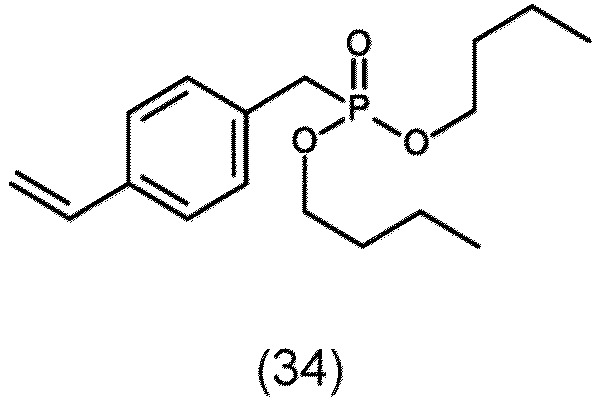
- Kalium-tert.-Butanolat (5,0 g, 44,1 mmol) wurden in THF (40 ml, trocken) bei 0 °C unter Inertgas suspendiert, bevor Dibutylphosphonat (8,6 g, 44,1 mmol) gelöst in THF (20 ml) zugetropft wurde. Die Mischung wurde für 30 min gerührt, ehe sie bei 0 °C in eine Lösung von Chlormethylstyrol (3,4 g, 22,1 mmol), TBHQ (2-tert.-Butylhydrochinon) und TBAI (Tetrabutylammoniumiodid) in THF (20 ml) getropft wurde. Nach 18 Stunden bei 20 °C unter Inertgas wurden die Feststoffe abgetrennt und das Lösungsmittel abdestilliert.
- 1H NMR (CDCl3, 500 MHz) δ (ppm): 0.89 (t, 6H, CH3), 1.34 (sextet, 4H, CH2-CH3), 1.56 (quintet, 4H, CH2-CH2-CH3), 3.16 (d, 2H, CH2-P), 3.93 (m, 4H, P-O-CH2), 5.22/ 5.74 (d, 2H, CH=CH2); 6.70 (dd, 1H, CH=CH2); 7.24 - 7.34 (m, 4H arom.).
- IR (cm-1): 3025 (Ar-H), 2850-2953 (alkyl-H), 1600 (CH2=CH-Ar); 1512 (C-C, Ar); 1250 (P=O), 1027 (P-O-C); 957 (C=C), 854 (Ar-H).
-
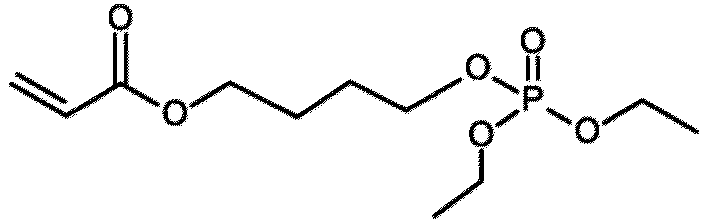

- 4-Hydroxybutylacrylat (5,3 g, 37 mmol) wurde zusammen mit Triethylamin (3,8 g, 38 mmol) und Kupfer(I)-chlorid (0,1 g) in Diethylether (30 ml) für 1 Stunde bei 0 °C unter Inertgas gerührt, bevor Diethylchlorphosphat (6,5 g, 38 mmol) gelöst in Diethylether (10 ml) zugetropft wurde. Nach 24 Stunden Rühren bei 20 °C wurde das Triethylammoniumchlorid entfernt und das Lösungsmittel abdestilliert.
- 1H-NMR (500 MHz, CDC!3), δ(ppm): 1.33 (t, 6H, CH3); 1.78 (q, 4H, CH2); 4.09/4.18 (m, 8H, -O-CH2-); 5.82/6.10/6.37 (3H, CH2=CH-)
-

- Zu einer Lösung auf 2-Hydroxyethylmethacrylat (3,0 g, 23,0 mmol), Triethylamin (2,5 g, 25 mmol) und 4-(Dimethylamino)-pyridin (60 mg, 0,5 mmol) in Dichlormethan (10 mL) wurde bei 0 °C unter Inertgas Tosylchlorid (4,3 g, 22,6 mmol), gelöst in Dichlormethan (15 mL) unter Rühren zugetropft. Nach 6 Stunden wurde bei 20 °C Dimethylphosphonat (5,0 g, 45,8 mmol), gelöst in Dichlormethan (20 mL) zugetropft und für 18 Stunden gerührt. Die Feststoffe wurden abgetrennt und die flüchtigen Bestandteile entfernt.
- 1H NMR (CDCl3, 500 MHz) δ (ppm): 1.94 (s, 3H, α-CH3), 3.12 (t, 2H, CH2-P), 3.7-4.30 (s, 6H, P-O-CH3), 5.58/6.05 (s, 2H, CH=CH2).
- IR (cm-1): 2961 (alkyl-H), 1717 (C=O), 1634 (C=C), 1456 (C-H), 1362 (C-P), 1262 (P=O), 1173 (C-O), 1043 (P-O-C), 977 (C-H).
-


- Zu einer Lösung auf 2-Hydroxyethylmethacrylat (2,7 g, 20,5 mmol), Triethylamin (2,1 g, 21 mmol) und 4-(Dimethylamino)-pyridin (60 mg, 0,5 mmol) in Dichlormethan (10 mL) wurde bei 0 °C unter Inertgas Tosylchlorid (3,8 g, 20,1 mmol), gelöst in Dichlormethan (15 mL) unter Rühren zugetropft. Nach 6 Stunden wurde bei 20 °C Diethylphosphonat (5,6 g, 40,7 mmol), gelöst in Dichlormethan (20 mL) zugetropft und für 18 Stunden gerührt. Die Feststoffe wurden abgetrennt und die flüchtigen Bestandteile entfernt.
- 1H NMR (CDCl3, 500 MHz) δ (ppm): 1.34 (t, 6H, CH2-CH3), 1.94 (s, 3H, α-CH3), 3.19 (t, 2H, CH2-P), 4.12 (q, 4H, P-O-CH2), 5.55/ 6.02 (s, 2H, CH=CH2).
- IR (cm-1): 2956 (alkyl-H), 1717 (C=O), 1634 (C=C), 1456 (C-H), 1362 (C-P), 1261 (P=O), 1173 (C-O), 1043 (P-O-C), 977 (C-H).
-

- Zu einer Lösung auf 2-Hydroxyethylmethacrylat (2,1 g, 16,4 mmol), Triethylamin (1,7 g, 17 mmol) und 4-(Dimethylamino)-pyridin (40 mg, 0,3 mmol) in Dichlormethan (10 mL) wurde bei 0 °C unter Inertgas Tosylchlorid (3,2 g, 16,6 mmol), gelöst in Dichlormethan (15 mL) unter Rühren zugetropft. Nach 6 Stunden wurde bei 20 °C Dibutylphosphonat (6,4 g, 33,0 mmol), gelöst in Dichlormethan (20 mL) zugetropft und für 18 Stunden gerührt. Die Feststoffe wurden abgetrennt und die flüchtigen Bestandteile entfernt.
- 1H NMR (CDCl3, 500 MHz) δ (ppm): 0.93 (t, 6H, CH3), 1.39 (sextet, 4H, CH2-CH3), 1.64 (quintet, 4H, CH2-CH2-CH3), 1.95 (s, 3H, α-CH3), 3.09 (m, 2H, CH2-P), 4.05 (m, 4H, PO-CH2), 5.56/ 6.10 (s, 2H, CH=CH2).
- IR (cm-1): 2982 (alkyl-H), 1734 (C=O), 1639 (C=C), 1456 (C-H), 1362 (C-P), 1258 (P=O), 1173 (C-O), 1017 (P-O-C), 977 (C-H).
- Für die durchgeführten Synthesen der Copolymere wurden Styrol (99%, Acros Organics / Stabilisator entfernt), Schwefel (>99%, Alfa Aesar), Divinylbenzol (Merck KGaA, enthält 25 - 50% Ethylstyrol), Metharcylsäureallylester (98%, Sigma Aldrich, stab. mit 50-185 ppm MEHQ), Vinylphosphonsäure (97%, Sigma Aldrich), Diphenyl(4-vinylphenyl)phosphine (97%, Sigma Aldrich) und die synthetisierten Monomere der Formeln (25) bis (38) verwendet.
- Bezüglich der nachfolgenden Copolymerstrukturen 6a) bis (24a) gelten die Aussagen hinsichtlich der Angabe der Wiederholungseinheiten zu den Formeln (6) bis Formel (24) analog. Wegen der zufälligen Verteilung der Monomereinheiten innerhalb des Copolymers wurde auf die Angabe des "n" als Wiederholungseinheit verzichtet.
-

- Schwefel (310 mg, 1 Gew.%), Styrol (30,98 g, 98 Gew.%) und Monomer (26) (320 mg, 1 Gew.%) wurden miteinander gemischt und durch drei Gefrierentgasungszyklen sauerstofffrei gemacht. Die Mischung wurde für 72 h auf 130 °C erhitzt. Nach Lösen in THF wurde das Produkt durch Fällung in Methanol isoliert.
- EA: C 90.9 %, H 8.4 %, S 0.2 %;
- TGA: Td5%: 405 °C
- DCS: Tg: 90,3 °C
- GPC (UV Detektor): Mn 32 kDa; Mw 62 kDa.
- Verbindung (6a) weist besonders gute flammhemmende Eigenschaften auf. Dies ist darauf zurückzuführen, dass neben der phosphorhaltigen Monomereinheit ein hohes Molekulargewicht vorhanden ist.
-

- Verbindung (7a) weist besonders gute flammhemmende Eigenschaften auf. Dies ist darauf zurückzuführen, dass neben der phosphorhaltigen Monomereinheit ein hohes Molekulargewicht vorhanden ist.
- Schwefel (1,5 g, 1 Gew.%), Styrol (147 g, 98 Gew.%) und Monomer (27) (1,5 g, 1 Gew.%) wurden miteinander gemischt und durch drei Gefrierentgasungszyklen sauerstofffrei gemacht. Die Mischungen wurden für 72 Std. auf 130 °C erhitzt. Nach Lösen in THF wurde das Produkt durch Fällen in Methanol isoliert.
- TGA: Td5% (°C) = 325;
- DSC: Tg (°C) = 96,7;
- GPC (UV Detektor): Mw (kDa) = 46; Mn (kDa) = 10.
-

- Schwefel (1,5 g, 1 Gew.%), Styrol (147 g, 98 Gew.%) und Monomer (28) (1,5 g, 1 Gew.%) wurden miteinander gemischt und durch drei Gefrierentgasungszyklen sauerstofffrei gemacht. Die Mischungen wurden für 72 Std. auf 130 °C erhitzt. Nach Lösen in THF wurde das Produkt durch Fällen in Methanol isoliert.
- TGA: Td5% (°C) = 325;
- DSC: Tg (°C) = 94,2;
- GPC (UV Detektor): Mw (kDa) = 46; Mn (kDa) = 11,8.
- Verbindung (8a) weist besonders gute flammhemmende Eigenschaften auf. Dies ist darauf zurückzuführen, dass neben der phosphorhaltigen Monomereinheit ein hohes Molekulargewicht vorhanden ist.
-

- Schwefel (1,6 g, 1 Gew.%), Styrol (138,4 g, 94 Gew.%) und Monomer (28) (10,0 g, 5 Gew.%) wurden miteinander gemischt und durch drei Gefrierentgasungszyklen sauerstofffrei gemacht. Die Mischungen wurden für 72 Stunden auf 130 °C erhitzt. Nach Lösen in THF wurde das Produkt durch Fällen in Methanol isoliert.
- TGA: Td5% (°C) = 350;
- DSC: Tg (°C) = 96,8;
- GPC (UV Detektor): Mw (kDa) =49,5; Mn (kDa) =7,3
-

- Schwefel (1,5 g, 1 Gew.%), Styrol (147 g, 98 Gew.%) und Monomer (29) (1,5 g, 1 Gew.%) wurden miteinander gemischt und durch drei Gefrierentgasungszyklen sauerstofffrei gemacht. Die Mischungen wurden für 72 Std. auf 130 °C erhitzt. Nach Lösen in THF wurde das Produkt durch Fällen in Methanol isoliert.
- TGA: Td5% (°C) = 290;
- DSC: Tg (°C) = 83,4;
- GPC: Mw (kDa) = 40; Mn (kDa) = 13,3.
-

- Schwefel (1,5 g, 1 Gew.%), Styrol (147 g, 98 Gew.%) und Monomer (30) (1,5 g, 1 Gew.%) wurden miteinander gemischt und durch drei Gefrierentgasungszyklen sauerstofffrei gemacht. Die Mischungen wurden für 72 Std. auf 130 °C erhitzt. Nach Lösen in THF wurde das Produkt durch Fällen in Methanol isoliert.
- TGA: Td5% (°C) = 325;
- DSC: Tg (°C) = 93,5;
- GPC (UV Detektor): Mw (kDa) = 51; Mn (kDa) = 12,1.
-

- Schwefel (0,1 g, 1 Gew.%), Styrol (9,8 g, 98 Gew.%) und Monomer (32) (0,1 g, 1 Gew.%) wurden miteinander gemischt und durch drei Gefrierentgasungszyklen sauerstofffrei gemacht. Die Mischungen wurden für 72 Stunden auf 130 °C erhitzt. Nach Lösen in THF wurde das Produkt durch Fällen in Methanol isoliert.
- GPC (UV Detektor): Mw (kDa) =34,0; Mn (kDa) =3,3
- Copolymer (14): Poly(styrene-ran-diethyl p-vinylbenzylphosphonate-ran-sulfur)
-

- Schwefel (0,1 g, 1 Gew.%), Styrol (9,8 g, 98 Gew.%) und Monomer (31) (0,1 g, 1 Gew.%;) wurden miteinander gemischt und durch drei Gefrierentgasungszyklen sauerstofffrei gemacht. Die Mischungen wurden für 72 Std. auf 130 °C erhitzt. Nach Lösen in THF wurde das Produkt durch Fällen in Methanol isoliert.
GPC (UV Detektor): Mw (kDa) =14,6; Mn (kDa) =2,5 -

- Schwefel (0,01 g, 1 Gew.%), Styrol (0,98 g, 98 Gew.%) Methacrylsäureallylester (0,01 g, 1 Gew.%) und Azodiisobutyronitril (AIBN, 0,07 g) wurden miteinander gemischt und durch drei Gefrierentgasungszyklen sauerstofffrei gemacht. Die Mischung wurde für 4 Stunden auf 80 °C erhitzt. Nach Lösen in THF wurde das Produkt durch Fällen in Methanol isoliert.
GPC (UV Detektor): Mw (kDa) =22; Mn (kDa) =6 -

- Schwefel (0,01 g, 1 Gew.%), Styrol (0,98 g, 98 Gew.%) und Monomer (35) (0,01 g, 1 Gew.%) wurden miteinander gemischt und durch drei Gefrierentgasungszyklen sauerstofffrei gemacht. Die Mischungen wurden für 72 Stunden auf 130 °C erhitzt. Nach Lösen in THF wurde das Produkt durch Fällen in Methanol isoliert.
- TGA: Td5% (°C) = 325;
- DSC: Tg (°C) = 97,9;
- GPC (UV Detektor): Mw (kDa) =25,8; Mn (kDa) =5,3
-

- Schwefel (0,01 g, 1 Gew.%), Styrol (0,98 g, 98 Gew.%) , Monomer (36) (0,01 g, 1 Gew.%) und Azodiisobutyronitril (AIBN, 70 mg, 5 mol% auf Styrol) wurden miteinander gemischt und durch drei Gefrierentgasungszyklen sauerstofffrei gemacht. Die Mischung wurde für 40 Stunden auf 80 °C erhitzt. Nach Lösen in THF wurde das Produkt durch Fällen in Methanol isoliert.
- GPC (UV Detektor): Mw (kDa) =16,2; Mn (kDa) =3,9;
- IR (P=O, 1247 cm-1): nachweisbar
-

- Schwefel (0,01 g, 1 Gew.%), Styrol (0,98 g, 98 Gew.%), Monomer (37) (0,01 g, 1 Gew.%) und Azodiisobutyronitril (AIBN, 70 mg, 5 mol% auf Styrol) wurden miteinander gemischt und durch drei Gefrierentgasungszyklen sauerstofffrei gemacht.
- Die Mischung wurde für 40 Stunden auf 80 °C erhitzt. Nach Lösen in THF wurde das Produkt durch Fällen in Methanol isoliert.
- GPC (UV Detektor): Mw (kDa) =8,7; Mn (kDa) =2,9;
- IR (P=O, 1247 cm-1): nachweisbar
-

- Schwefel (0,01 g, 1 Gew.%), Styrol (0,98 g, 98 Gew.%), Monomer (38) (0,01 g, 1 Gew.%) und Azodiisobutyronitril (AIBN, 70 mg, 5 mol% auf Styrol) wurden miteinander gemischt und durch drei Gefrierentgasungszyklen sauerstofffrei gemacht. Die Mischung wurde für 40 Stunden auf 80 °C erhitzt. Nach Lösen in THF wurde das Produkt durch Fällen in Methanol isoliert.
GPC (UV Detektor): Mw (kDa) =13,8; Mn (kDa) =3,6; -

- Schwefel (0,01 g, 1 Gew.%), Styrol (0,98 g, 98 Gew.%) , Monomer (33) (0,01 g, 1 Gew.%) und Azodiisobutyronitril (AIBN, 70 mg, 5 mol% auf Styrol) wurden miteinander gemischt und durch drei Gefrierentgasungszyklen sauerstofffrei gemacht. Die Mischung wurde für 40 Stunden auf 80 °C erhitzt. Nach Lösen in THF wurde das Produkt durch Fällen in Methanol isoliert.
- GPC (UV Detektor): Mw (kDa) =6,0; Mn (kDa) =3,6
- IR (P=O, 1247 cm-1): nachweisbar
-

- Schwefel (0,01 g, 1 Gew.%), Styrol (0,98 g, 98 Gew.%), Monomer (34) (0,01 g, 1 Gew.%) und Azodiisobutyronitril (AIBN, 15,6 mg, 5 mol% auf Styrol) wurden miteinander gemischt und durch drei Gefrierentgasungszyklen sauerstofffrei gemacht. Die Mischung wurde für 40 Stunden auf 80 °C erhitzt. Nach Lösen in THF wurde das Produkt durch Fällen in Methanol isoliert.
- GPC (UV Detektor): Mw (kDa) =15,0; Mn (kDa) =3,0
- IR (P=O, 1247 cm-1): nachweisbar
-

- Schwefel (0,2 g, 1 Gew.%), Styrol (19,6 g, 98 Gew.%), Vinylphosphonsäure (0,2 g, 1 Gew.%) und Azodiisobutyronitril (AIBN, 1,3 g, 5 mol% auf Styrol) wurden miteinander gemischt und durch drei Gefrierentgasungszyklen sauerstofffrei gemacht. Die Mischung wurde für 15 Stunden auf 80 °C erhitzt. Nach Lösen in THF wurde das Produkt durch Fällen in Methanol isoliert.
GPC (UV Detektor): Mw (kDa) =28,7; Mn (kDa) =7,7 -

- Schwefel (0,2 g, 1 Gew.%), Styrol (19,6 g, 98 Gew.%) Diphenylphosphinostyrol (0,2 g, 1 Gew.%) und Azodiisobutyronitril (AIBN, 1,3 g, 5 mol% auf Styrol) wurden miteinander gemischt und durch drei Gefrierentgasungszyklen sauerstofffrei gemacht. Die Mischung wurde für 15 Stunden auf 80 °C erhitzt. Nach Lösen in THF wurde das Produkt durch Fällen in Methanol isoliert.
GPC (UV Detektor): Mw (kDa) =17,9; Mn (kDa) =6,9 - Verwendete Polymere und Zuschlagsstoffe für die Herstellung der brandhindernden Formstoffe oder -massen:
Polymer / Zuschlagsstoff Typ und Hersteller Kürzel Polystyrol Polystyrol 158K, BASF SE, Ludwigshafen, Deutschland PS 2,4,8,10-Tetraoxa-3,9-diphosphaspiro [5.5] undecane-3,9-dimethyl-3,9-dioxide Aflammit PCO 900, Thor GmbH, Speyer, Deutschland P1 Hexakisphenoxycyclotriphosphazene aber GmbH, Karlsruhe, Deutschland P2 - Zunächst wurden 20 g PS in Dichlormethan gelöst. Anschließend wurde die Lösung in eine 20 cm x 10 cm Aluminiumform gefüllt und bei Raumtemperatur (RT) für 24 h getrocknet. Das getrocknete Polymer wurde aus der Aluminiumform gelöst und in einer Lochedelstahlform für 20 min mit Wasserdampf aufgeschäumt. Der geschäumte Prüfkörper wurde für 24 h bei 50 °C bis zur Massekonstanz getrocknet. Die daraus entstandenen Prüfkörper weisen eine Dichte von ca. 70 kg/m3 auf.
- Zunächst wurden 20 g PS und 0,5 g P1 in Dichlormethan gelöst. Anschließend wurde die Lösung in eine 20 cm x 10 cm Aluminiumform gefüllt und bei Raumtemperatur (RT) für 24 h getrocknet. Der getrocknete Compound wurde aus der Aluminiumform gelöst und in einer Lochedelstahlform für 20 min mit Wasserdampf aufgeschäumt. Der geschäumte Prüfkörper wurde für 24 h bei 50 °C bis zur Massekonstanz getrocknet. Die daraus entstandenen Prüfkörper weisen eine Dichte von ca. 70 kg/m3 auf.
- Zunächst wurden 20 g PS und 0,95 g P2 in Dichlormethan gelöst. Anschließend wurde die Lösung in eine 20 cm x 10 cm Aluminiumform gefüllt und bei Raumtemperatur (RT) für 24 h getrocknet. Der getrocknete Compound wurde aus der Aluminiumform gelöst und in einer Lochedelstahlform für 20 min mit Wasserdampf aufgeschäumt. Der geschäumte Prüfkörper wurde für 24 h bei 50 °C bis zur Massekonstanz getrocknet. Die daraus entstandenen Prüfkörper weisen eine Dichte von ca. 70 kg/m3 auf.
- Zunächst wurden 20 g (2a) in Dichlormethan gelöst. Anschließend wurde die Lösung in eine 20 cm x 10 cm Aluminiumform gefüllt und bei Raumtemperatur (RT) für 24 h getrocknet. Das getrocknete Copolymer wurde aus der Aluminiumform gelöst und in einer Lochedelstahlform für 20 min mit Wasserdampf aufgeschäumt. Der geschäumte Prüfkörper wurde für 24 h bei 50 °C bis zur Massekonstanz getrocknet. Die daraus entstandenen Prüfkörper weisen eine Dichte von ca. 70 kg/m3 auf.
- Zunächst wurden 20 g (2a) und 0,95 g P2 in Dichlormethan gelöst. Anschließend wurde die Lösung in eine 20 cm x 10 cm Aluminiumform gefüllt und bei Raumtemperatur (RT) für 24 h getrocknet. Der getrocknete Compound wurde aus der Aluminiumform gelöst und in einer Lochedelstahlform für 20 min mit Wasserdampf aufgeschäumt. Der geschäumte Prüfkörper wurde für 24 h bei 50 °C bis zur Massekonstanz getrocknet. Die daraus entstandenen Prüfkörper weisen eine Dichte von ca. 70 kg/m3 auf.
- Zunächst wurden 20 g (2b) in Dichlormethan gelöst. Anschließend wurde die Lösung in eine 20 cm x 10 cm Aluminiumform gefüllt und bei Raumtemperatur (RT) für 24 h getrocknet. Das getrocknete Copolymer wurde aus der Aluminiumform gelöst und in einer Lochedelstahlform für 20 min mit Wasserdampf aufgeschäumt. Der geschäumte Prüfkörper wurde für 24 h bei 50 °C bis zur Massekonstanz getrocknet. Die daraus entstandenen Prüfkörper weisen eine Dichte von ca. 70 kg/m3 auf.
- Zunächst wurden 20 g (2b) und 0,5 g P1 in Dichlormethan gelöst. Anschließend wurde die Lösung in eine 20 cm x 10 cm Aluminiumform gefüllt und bei Raumtemperatur (RT) für 24 h getrocknet. Der getrocknete Compound wurde aus der Aluminiumform gelöst und in einer Lochedelstahlform für 20 min mit Wasserdampf aufgeschäumt. Der geschäumte Prüfkörper wurde für 24 h bei 50 °C bis zur Massekonstanz getrocknet. Die daraus entstandenen Prüfkörper weisen eine Dichte von ca. 70 kg/m3 auf.
- Zunächst wurden 20 g (3a) in Dichlormethan gelöst. Anschließend wurde die Lösung in eine 20 cm x 10 cm Aluminiumform gefüllt und bei Raumtemperatur (RT) für 24 h getrocknet. Das getrocknete Copolymer wurde aus der Aluminiumform gelöst und in einer Lochedelstahlform für 20 min mit Wasserdampf aufgeschäumt. Der geschäumte Prüfkörper wurde für 24 h bei 50 °C bis zur Massekonstanz getrocknet. Die daraus entstandenen Prüfkörper weisen eine Dichte von ca. 70 kg/m3 auf.
- Zunächst wurden 20 g (4a) in Dichlormethan gelöst. Anschließend wurde die Lösung in eine 20 cm x 10 cm Aluminiumform gefüllt und bei Raumtemperatur (RT) für 24 h getrocknet. Das getrocknete Copolymer wurde aus der Aluminiumform gelöst und in einer Lochedelstahlform für 20 min mit Wasserdampf aufgeschäumt. Der geschäumte Prüfkörper wurde für 24 h bei 50 °C bis zur Massekonstanz getrocknet. Die daraus entstandenen Prüfkörper weisen eine Dichte von ca. 70 kg/m3 auf.
- Zunächst wurden 20 g (4b) in Dichlormethan gelöst. Anschließend wurde die Lösung in eine 20 cm x 10 cm Aluminiumform gefüllt und bei Raumtemperatur (RT) für 24 h getrocknet. Das getrocknete Copolymer wurde aus der Aluminiumform gelöst und in einer Lochedelstahlform für 20 min mit Wasserdampf aufgeschäumt. Der geschäumte Prüfkörper wurde für 24 h bei 50 °C bis zur Massekonstanz getrocknet. Die daraus entstandenen Prüfkörper weisen eine Dichte von ca. 70 kg/m3 auf.
- Zunächst wurden 20 g (6a) in Dichlormethan gelöst. Anschließend wurde die Lösung in eine 20 cm x 10 cm Aluminiumform gefüllt und bei Raumtemperatur (RT) für 24 h getrocknet. Das getrocknete Copolymer wurde aus der Aluminiumform gelöst und in einer Lochedelstahlform für 20 min mit Wasserdampf aufgeschäumt. Der geschäumte Prüfkörper wurde für 24 h bei 50 °C bis zur Massekonstanz getrocknet. Die daraus entstandenen Prüfkörper weisen eine Dichte von ca. 70 kg/m3 auf.
- Zunächst wurden 20 g (7a) in Dichlormethan gelöst. Anschließend wurde die Lösung in eine 20 cm x 10 cm Aluminiumform gefüllt und bei Raumtemperatur (RT) für 24 h getrocknet. Das getrocknete Copolymer wurde aus der Aluminiumform gelöst und in einer Lochedelstahlform für 20 min mit Wasserdampf aufgeschäumt. Der geschäumte Prüfkörper wurde für 24 h bei 50 °C bis zur Massekonstanz getrocknet. Die daraus entstandenen Prüfkörper weisen eine Dichte von ca. 70 kg/m3 auf.
- Zunächst wurden 20 g (8a) in Dichlormethan gelöst. Anschließend wurde die Lösung in eine 20 cm x 10 cm Aluminiumform gefüllt und bei Raumtemperatur (RT) für 24 h getrocknet. Das getrocknete Copolymer wurde aus der Aluminiumform gelöst und in einer Lochedelstahlform für 20 min mit Wasserdampf aufgeschäumt. Der geschäumte Prüfkörper wurde für 24 h bei 50 °C bis zur Massekonstanz getrocknet. Die daraus entstandenen Prüfkörper weisen eine Dichte von ca. 70 kg/m3 auf.
- Zunächst wurden 20 g (9a) in Dichlormethan gelöst. Anschließend wurde die Lösung in eine 20 cm x 10 cm Aluminiumform gefüllt und bei Raumtemperatur (RT) für 24 h getrocknet. Das getrocknete Copolymer wurde aus der Aluminiumform gelöst und in einer Lochedelstahlform für 20 min mit Wasserdampf aufgeschäumt. Der geschäumte Prüfkörper wurde für 24 h bei 50 °C bis zur Massekonstanz getrocknet. Die daraus entstandenen Prüfkörper weisen eine Dichte von ca. 70 kg/m3 auf.
- Zunächst wurden 20 g (10a) in Dichlormethan gelöst. Anschließend wurde die Lösung in eine 20 cm x 10 cm Aluminiumform gefüllt und bei Raumtemperatur (RT) für 24 h getrocknet. Das getrocknete Copolymer wurde aus der Aluminiumform gelöst und in einer Lochedelstahlform für 20 min mit Wasserdampf aufgeschäumt. Der geschäumte Prüfkörper wurde für 24 h bei 50 °C bis zur Massekonstanz getrocknet. Die daraus entstandenen Prüfkörper weisen eine Dichte von ca. 70 kg/m3 auf.
- Zunächst wurden 20 g (14a) in Dichlormethan gelöst. Anschließend wurde die Lösung in eine 20 cm x 10 cm Aluminiumform gefüllt und bei Raumtemperatur (RT) für 24 h getrocknet. Das getrocknete Copolymer wurde aus der Aluminiumform gelöst und in einer Lochedelstahlform für 20 min mit Wasserdampf aufgeschäumt. Der geschäumte Prüfkörper wurde für 24 h bei 50 °C bis zur Massekonstanz getrocknet. Die daraus entstandenen Prüfkörper weisen eine Dichte von ca. 70 kg/m3 auf.
- EB14: Zunächst wurden 20 g (11a) in Dichlormethan gelöst. Anschließend wurde die Lösung in eine 20 cm x 10 cm Aluminiumform gefüllt und bei Raumtemperatur (RT) für 24 h getrocknet. Das getrocknete Copolymer wurde aus der Aluminiumform gelöst und in 5 einer Lochedelstahlform für 20 min mit Wasserdampf aufgeschäumt. Der geschäumte Prüfkörper wurde für 24 h bei 50 °C bis zur Massekonstanz getrocknet. Die daraus entstandenen Prüfkörper weisen eine Dichte von ca. 70 kg/m3 auf.
- EB15: Zunächst wurden 20 g (2c) in Dichlormethan gelöst. Anschließend wurde die Lösung in eine 20 cm x 10 cm Aluminiumform gefüllt und bei Raumtemperatur (RT) für 24 h getrocknet. Das getrocknete Copolymer wurde aus der Aluminiumform gelöst und in einer Lochedelstahlform für 20 min mit Wasserdampf aufgeschäumt. Der geschäumte Prüfkörper wurde für 24 h bei 50 °C bis zur Massekonstanz getrocknet. Die daraus entstandenen Prüfkörper weisen eine Dichte von ca. 70 kg/m3 auf.
- EB16: Zunächst wurden 20 g (4c) in Dichlormethan gelöst. Anschließend wurde die Lösung in eine 20 cm x 10 cm Aluminiumform gefüllt und bei Raumtemperatur (RT) für 24 h getrocknet. Das getrocknete Copolymer wurde aus der Aluminiumform gelöst und in einer Lochedelstahlform für 20 min mit Wasserdampf aufgeschäumt. Der geschäumte Prüfkörper wurde für 24 h bei 50 °C bis zur Massekonstanz getrocknet. Die daraus entstandenen Prüfkörper weisen eine Dichte von ca. 70 kg/m3 auf.
- EB17: Zunächst wurden 20 g (8b) in Dichlormethan gelöst. Anschließend wurde die Lösung in eine 20 cm x 10 cm Aluminiumform gefüllt und bei Raumtemperatur (RT) für 24 h getrocknet. Das getrocknete Copolymer wurde aus der Aluminiumform gelöst und in einer Lochedelstahlform für 20 min mit Wasserdampf aufgeschäumt. Der geschäumte Prüfkörper wurde für 24 h bei 50 °C bis zur Massekonstanz getrocknet. Die daraus entstandenen Prüfkörper weisen eine Dichte von ca. 70 kg/m3 auf.
- Ein 5 cm x 10 cm x 1 cm Streifen des Schaumkörpers wird für wenige Sekunden in eine 2 cm hohe Propangasflamme mit einer Energie von ca. 50 kW gehalten. Sobald sich die Probe entzündet, jedoch maximal nach 5 s, wird diese aus der Flamme gezogen und die Entzündbarkeit sowie Selbstverlöschung der Probe protokolliert.
- Unter Flammhemmend ist zu verstehen, dass nach einer initialen Entzündung die Copolymerkörper oder Formmassen im Vergleich zu Homopolystyrol kürzere Nachbrennzeiten aufweisen.
- Unter Selbstverlöschung wird im Screeningtest das folgende Verhalten verstanden: Der durch die Flamme des Brenners entzündete Probenkörper aus Copolymeren oder Formmassen bestehend erlischt innerhalb von 5 s nachdem die Brennerflamme vom Probekörper entfernt wurde.
- Eine 20 cm x 10 cm x 1 cm Probe wird mit einem Brenner mit einer Energie von ca. 50 kW, der eine Flammenhöhe von 2 cm aufweist, mit einem senkrechten Abstand von 1 cm zur Unterseite der Probe für 15 s beflammt. Die Nachbrennzeit, Flammenhöhe sowie Selbstverlöschung und brennendes Abtropfverhalten der Probe werden notiert.
- Die Messung der elementaren Zusammensetzung der Copolymere wurde mit einem vario MICRO cube (Elementar Analysesysteme GmbH, Langenselbold) gemessen. Die Kalibrierung der Messmethode wurde mit Sulfanilamid durchgeführt.
- Die Messung des Molekulargewichtes und der Molekulargewichtsverteilung der Proben wurden mit einem GPC-Analysesystem von Shimadzu (Kyoto, Japan) bestehend aus einem Degasser (DGU-20A3R), zwei Pumpen (LC-20AD), einem Autosampler (SIL-20AHT), einem Säulenofen (CTO-20A, 30°C), einem Diodenarraydetektor (SPD-M20A, 30°C), einem Brechungsindexdetektor (RID-20A, 30°C), einer Steuerungseinheit (CBM-20A) und einem Säulenset (PSS Polymer Standard Services GmbH, Mainz - eine Vorsäule SDV 50x8 mm, 5 µm, zwei Trennsäulen SDV 300x8 mm, 5 µm, 1000 Å, eine Trennsäule SDV 300x8 mm, 5 µm, 100.000 Å), gemessen. Die Kalibrierung wurde mit Polystyrol-Standards durchgeführt.
- Die Messung der Schmelzeviskosität wurde mit dem MeltFloW basic plus (Karg Industrietechnik, Krailing) nach ISO 1133 durchgeführt.
- Bei der Beurteilung der Schaumqualität wurden verschiedene Aspekte berücksichtigt:
(a) Zelligkeit der Polymerschäume (Größe und Gleichmäßigkeit der Zellen). Hierbei wurden die Schaumkörper auf folgende Kriterien geprüft und klassifiziert:-- Große Zellen (> 5 mm) stark unregelmäßig; - Große Zellen (> 5 mm) unregelmäßig; 0 Mittelgroße Zellen (5 mm - 1 mm) unregelmäßig; + Kleine Zellen (< 1 mm) unregelmäßig; ++ kleine Zellen (< 1 mm) regelmäßig.
(b) Phasenseparation & Bildung von Agglomeraten. Hierbei wurden die Schaumkörper auf folgende Kriterien geprüft und klassifiziert:0 >10 Agglomerate und Phasenseparationen pro Schaumkörper; + >0 - <10 Agglomerate und Phasenseparationen pro Schaumkörper; ++ Keine Agglomerate und Phasenseparationen pro Schaumkörper. - "Die Beurteilung der Qualität der Schaumkörper, die elementare Zusammensetzung, die Molekulargewichte und -verteilungen sowie die thermischen Kenndaten der synthetisierten Copolymere sind in den nachfolgenden Tabellen 1, 2 und 3 dargestellt. Die Brandprüfergebnisse nach DIN 4102-2 (B2) sind in den Tabelle 4 (Screeningtest) und 5 (Kleinbrennerprüfung) zusammengestellt.
Tabelle 1: Beurteilung Qualität Schaumkörper Probe (a) Zelligkeit (b) Phasenseparation & Agglomerate (6a) ++ ++ (7a) ++ ++ (8a) ++ ++ (9a) ++ + (10a) ++ + (14a) ++ ++ Tabelle 2: Elementare Zusammensetzung der synthetisierten Copolymere: Probe C (%)1 H (%)1 S (%)1 N (%)1 (6a) 90,9 8,40 0,20 0,00 1 prozentuale elementare Zusammensetzung mittels Elementaranalyse bestimmt, Tabelle 3: Molekulargewichte und -verteilungen, thermische Kenndaten und Viskosität der Copolymere: Probe Mn1 (kDa) Mw1 (kDa) Ð 1 Td5% 2 (°C) Tg3 (°C) (6a) 32 62 1,94 405 90 (7a) 10 46 4,60 325 96,7 (8a) 11,8 46 3,90 325 94,2 (9a) 13,3 40 3,08 290 83,4 (10a) 12,1 51 4,21 325 93,5 1 mittlere Molekulargewichte und deren Molekulargewichtsverteilung mittels GPC bestimmt,
2 Zersetzungstemperatur bei 5% Masseverlust mittels TGA bestimmt,
3 Onset der Glasübergangstemperatur mittels DSC bestimmt.Tabelle 4: Brandprüfergebnisse:Screeningtest nach DIN 4102-2 (B2): Beispiel Zusammensetzung Anteil (Co)Polymer (phr1) Anteil P1 bzw. P2 (phr1) Selbstverlöschend (ja/nein) VB1 PS 100 - nein VB2 PS + P1 100 2,50 nein VB3 PS + P2 100 4,75 nein EB8 (6a) 100 - ja EB9 (7a) 100 - ja EB10 (8a) 100 - ja EB11 (9a) 100 - ja EB12 (10a) 100 - ja EB13 (14a) 100 - ja EB14 (11a) 100 - ja 1 parts per hundred rubber Tabelle 5: Kleinbrennerprüfung nach DIN 4102-2 (B2): Beispiel Zusammensetzung Anteil (Co)Polymer (phr1) Anteil P1 bzw. P2 (phr1) Flammenhöhe (cm) Nachbrennzeit (s) VB1 PS 100 - > 15 31 VB2 PS + P1 100 2,50 > 15 35 VB3 PS + P2 100 4,75 > 15 22 EB8 (6a) 100 - 11 13 EB10 (8a) 100 - 8 5 EB17 (8b) 100 - 9 3 EB12 (10a) 100 - 6 0 1 parts per hundred rubber
Claims (15)
- Brandhinderndes Copolymer, mit einer statistischen Monomerverteilung von Monomereinheiten mit dem Massenanteil ω mit ω(Sty), ω(P) und ω(S) bei denen ω(S) und ω(P) dem Massenanteil der schwefelhaltigen und phosphorhaltigen Repetiereinheit entsprechen und die Summe der Massenanteile ω(Sty), ω(P) und ω(S) = 1 ist, ausgewählt aus der Gruppe der Formeln (6) bis (15) und (17) bis (24), umfassend


- Brandhinderndes Copolymer nach Anspruch 1,
dadurch gekennzeichnet, dass das Copolymer farb- und/oder geruchlos ist, wobei sich die Farblosigkeit mit einem Vergleich zu den Farben nach RAL 1013 Perlweiß, RAL 9001 Cremeweiß, RAL 9003 Signalweiß, RAL 9010 Reinweiß und/oder RAL 9016 Verkehrsweiß bestimmt und/oder die Geruchslosigkeit in der Wahrnehmungsgrenze von sulfidischen Verbindungen im Bereich von weniger als 50 µg/m3 Luft liegt. - Brandhinderndes Copolymer nach einem der Ansprüche 1 oder 2,
dadurch gekennzeichnet, dass das Copolymer nach einer initialen Entzündung im Vergleich zu Homopolystyrol kürzere Nachbrennzeiten aufweist oder innerhalb von 5s nach der Entzündung erlischt. - Brandhinderndes Copolymer nach einem der Ansprüche 1 bis 3,
das weitere phosphorhaltige Zuschläge enthält. - Brandhindernder Formstoff, umfassend zumindest ein brandhinderndes Copolymer, mit einer statistischen Monomerverteilung von Monomereinheiten mit dem Massenanteil ω mit ω(Sty), ω(P) und ω(S) bei denen ω(S) und ω(P) dem Massenanteil der schwefelhaltigen und phosphorhaltigen Repetiereinheit entsprechen und die Summe der Massenanteile ω(Sty), ω(P) und ω(S) = 1 ist, ausgewählt aus der Gruppe von Verbindungen der Formeln (6) bis (15) und (17) bis (24), umfassend


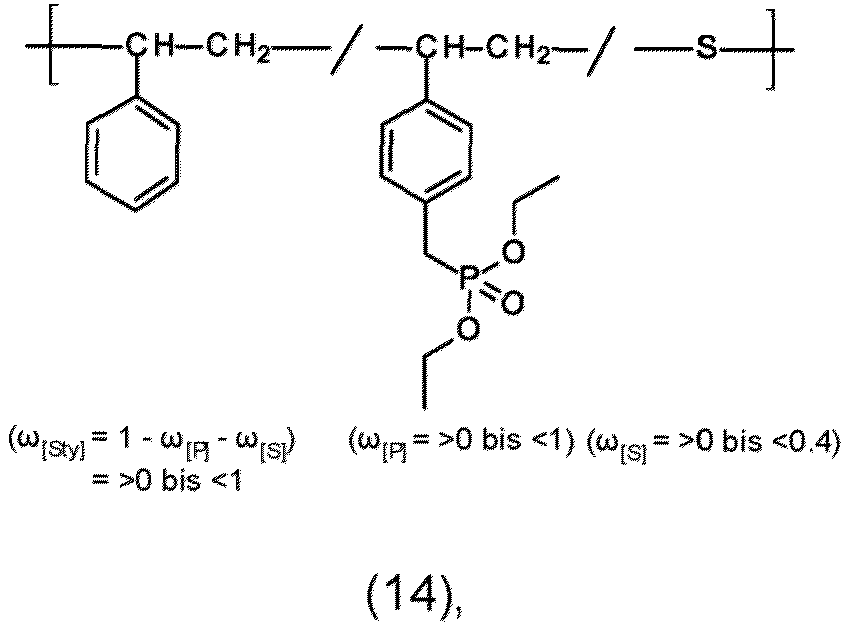


- Brandhindernder Formstoff nach Anspruch 5, wobei der brandhindernde Formstoff einen Werkstoff aus Metall oder Kunststoff oder Prepregs oder Keramik umfasst.
- Brandhindernder Formstoff nach Anspruch 5 oder 6, wobei der Copolymeranteil mehr als 10 Gew.% des Formstoffs beträgt.
- Brandhindernder Formstoff nach einem der Ansprüche 5 bis 7, wobei der Formstoff als weiteres Polymer homopolymere Polystyrole (PS) oder expandierbare Styrolpolymere (EPS) oder Extrusionsschaumstoffplatten (XPS) umfasst.
- Brandhindernder Formstoff nach einem der Ansprüche 5 bis 8, wobei der Formstoff nach einer initialen Entzündung im Vergleich zu Homopolystyrol kürzere Nachbrennzeiten aufweist und insofern flammhemmend ist oder der Formstoff innerhalb von 5s nach der Entzündung erlischt und damit selbstverlöschend ist.
- Brandhindernder Formstoff nach einem der Ansprüche 5 bis 9, wobei der Formstoff farb- und/oder geruchlos ist und sich die Farblosigkeit mit einem Vergleich zu den Farben nach RAL 1013 Perlweiß, RAL 9001 Cremeweiß, RAL 9003 Signalweiß, RAL 9010 Reinweiß und/oder RAL 9016 Verkehrsweiß bestimmt und/oder die Geruchslosigkeit in der Wahrnehmungsgrenze von sulfidischen Verbindungen im Bereich von weniger als 50 µg/m3 Luft liegt.
- Brandhindernder Formstoff nach einem der Ansprüche 5 bis 10, wobei die Formmasse als Werkstoff mindestens einen IR-Absorber, insbesondere Graphit, Ruß oder Aluminium mit einer mittleren Teilchengröße im Bereich von 1 bis 50 µm enthält.
- Verfahren zur Herstellung von brandhindernden Formstoffen nach einem der Ansprüche 5 bis 11 umfassend die Schrittea. Einmischen eines organischen Treibmittels in eine Polymerschmelze umfassend mindestens ein brandhinderndes Copolymer mit oder ohne weitere phosphorhaltige Zuschläge mittels statischer und/oder dynamischer Mischer bei einer Temperatur von mindestens 150 °C,b. Kühlen der treibmittelhaltigen Polymerschmelze auf eine Temperatur von mindestens 120°C,c. Austrag durch eine Düsenplatte mit Bohrungen, deren Durchmesser am Düsenaustritt höchstens 1,5 mm beträgt undd. Granulieren der treibmittelhaltigen Schmelze direkt hinter der Düsenplatte unter Wasser bei einem Druck im Bereich von 1 bis 20 bar.
- Verfahren zur Herstellung von brandhindernden Formstoffen nach einem der Ansprüche 5 bis 11, umfassend die Schritte:a. Polymerisation,b. Zugabe eines organischen Treibmittels vor, während und/oder nach der Polymerisation undc. Abtrennen der expandierbaren, treibmittelhaltigen Copolymere durch Sieben.
- Verfahren zur Herstellung von brandhindernden Copolymeren oder Formstoffen nach Anspruch 13, wobei die Formstoffe mittels einer Suspensionspolymerisation erhalten werden.
- Verwendung von brandhindernden Copolymeren oder Formstoffen nach einem der Ansprüche 1 bis 11 als Einzel- oder Co-Bestandteil von Dämm- oder Isoliermaterial für Gebäude oder als Bauteil und Komponente im Elektro- und Elektronikbereich.
Applications Claiming Priority (2)
| Application Number | Priority Date | Filing Date | Title |
|---|---|---|---|
| DE2020101078 | 2020-12-17 | ||
| PCT/DE2021/101017 WO2022128001A1 (de) | 2020-12-17 | 2021-12-17 | Brandhindernde copolymere und formmassen |
Publications (3)
| Publication Number | Publication Date |
|---|---|
| EP4263753A1 EP4263753A1 (de) | 2023-10-25 |
| EP4263753C0 EP4263753C0 (de) | 2024-10-09 |
| EP4263753B1 true EP4263753B1 (de) | 2024-10-09 |
Family
ID=74553547
Family Applications (1)
| Application Number | Title | Priority Date | Filing Date |
|---|---|---|---|
| EP21840442.4A Active EP4263753B1 (de) | 2020-12-17 | 2021-12-17 | Brandhindernde copolymere und formmassen |
Country Status (4)
| Country | Link |
|---|---|
| US (1) | US20240084120A1 (de) |
| EP (1) | EP4263753B1 (de) |
| DE (1) | DE112021006475A5 (de) |
| WO (1) | WO2022128001A1 (de) |
Families Citing this family (1)
| Publication number | Priority date | Publication date | Assignee | Title |
|---|---|---|---|---|
| CN119930927A (zh) * | 2025-01-23 | 2025-05-06 | 海南大学 | 一种多功能型高分子阻燃剂及其制备方法 |
Citations (1)
| Publication number | Priority date | Publication date | Assignee | Title |
|---|---|---|---|---|
| EP0509304B1 (de) * | 1991-04-09 | 1995-08-23 | Bayer Ag | Phosphorhaltige Pfropfpolymerisate |
Family Cites Families (13)
| Publication number | Priority date | Publication date | Assignee | Title |
|---|---|---|---|---|
| FR1502687A (fr) * | 1966-06-28 | 1967-11-24 | Aquitaine Petrole | Nouvelle composition plastique au soufre |
| US5811470A (en) * | 1996-05-06 | 1998-09-22 | Albemarle Corporation | Flame retardant styrenic polymers |
| DE102005005494A1 (de) | 2005-02-04 | 2006-08-10 | Basf Ag | Flammgeschützte, expandierbare Styrolpolymer (EPS)-Granulate mit Flammschutzsynergist in der Beschichtung |
| CN101305022B (zh) | 2005-11-12 | 2012-06-20 | 陶氏环球技术有限责任公司 | 溴化丁二烯/乙烯基芳族共聚物、该共聚物与乙烯基芳族聚合物的掺合物和由该掺合物形成的聚合物泡沫 |
| EP2531552A2 (de) | 2010-02-05 | 2012-12-12 | Basf Se | Halogenfreie, phosphorhaltige flammgeschützte polymerschaumstoffe |
| WO2011121485A1 (en) | 2010-03-30 | 2011-10-06 | Koninklijke Philips Electronics N.V. | Network and method for assigning network addresses |
| RU2012146394A (ru) | 2010-04-01 | 2014-05-10 | Басф Се | Огнезащитное средство |
| HUE026076T2 (en) | 2010-12-27 | 2016-05-30 | Basf Se | Anti-combustion system |
| WO2017004186A1 (en) | 2015-06-30 | 2017-01-05 | The Arizona Board Of Regents On Behalf Of The University Of Arizona | Methods of utilizing elemental sulfur for flame retardant polymers and additives |
| US8889770B2 (en) | 2011-08-25 | 2014-11-18 | Chemtura Corporation | Brominated flame retardant, antimony oxide free polymer formulations |
| EP2957579B1 (de) * | 2013-02-18 | 2019-10-02 | Kuraray Co., Ltd. | Copolymer und formkörper |
| US9540568B1 (en) * | 2015-07-27 | 2017-01-10 | International Business Machines Corporation | Flame-retardant copolymers |
| DE102019135325A1 (de) * | 2019-12-19 | 2021-06-24 | Hochschule Hamm-Lippstadt, Körperschaft des öffentlichen Rechts | Flammgeschützte Copolymere und Formmassen |
-
2021
- 2021-12-17 EP EP21840442.4A patent/EP4263753B1/de active Active
- 2021-12-17 DE DE112021006475.4T patent/DE112021006475A5/de active Pending
- 2021-12-17 WO PCT/DE2021/101017 patent/WO2022128001A1/de not_active Ceased
-
2022
- 2022-06-23 US US18/257,912 patent/US20240084120A1/en active Pending
Patent Citations (1)
| Publication number | Priority date | Publication date | Assignee | Title |
|---|---|---|---|---|
| EP0509304B1 (de) * | 1991-04-09 | 1995-08-23 | Bayer Ag | Phosphorhaltige Pfropfpolymerisate |
Also Published As
| Publication number | Publication date |
|---|---|
| DE112021006475A5 (de) | 2023-12-07 |
| US20240084120A1 (en) | 2024-03-14 |
| WO2022128001A1 (de) | 2022-06-23 |
| EP4263753C0 (de) | 2024-10-09 |
| EP4263753A1 (de) | 2023-10-25 |
Similar Documents
| Publication | Publication Date | Title |
|---|---|---|
| EP2480598B1 (de) | Flammgeschützte expandierbare styrol-polymerisate | |
| EP2513251B1 (de) | Flammschutzmittel | |
| EP1791896B8 (de) | Halogenfreie, flammgeschützte polymerschaumstoffe | |
| EP2478044B1 (de) | Halogenfreie, flammgeschützte polymerschaumstoffe, enthaltend mindestens eine oligophosphorverbindung | |
| DE102009059781A1 (de) | Flammgeschützte Polymerschaumstoffe | |
| EP2658905B1 (de) | Flammschutzsystem | |
| AT511395B1 (de) | Flammgeschützte expandierbare polymerisate | |
| EP2609144A1 (de) | Flammgeschützte, wärmedämmende polymerisate und verfahren zu deren herstellung | |
| EP2699634A1 (de) | Flammgeschützte expandierbare polymerisate | |
| EP4077481B1 (de) | Flammgeschützte copolymere und formmassen | |
| EP2531552A2 (de) | Halogenfreie, phosphorhaltige flammgeschützte polymerschaumstoffe | |
| WO2022128001A1 (de) | Brandhindernde copolymere und formmassen | |
| EP2574614B1 (de) | Flammgeschützte Polymerschaumstoffe mit halogenfreien, phosphorhaltigen Flammschutzmitteln auf Zuckerbasis | |
| AT508507B1 (de) | Flammgeschützte expandierbare polymerisate | |
| EP2531557A1 (de) | Flammschutzmittel | |
| AT508303A1 (de) | Flammgeschützte expandierbare polymerisate | |
| EP2376562A2 (de) | Weisses expandierbares polystyrol mit verbesserter wärmeleitfähigkeit | |
| AT509959B1 (de) | Flammgeschützte expandierbare polymerisate | |
| EP4298146A1 (de) | Reaktive flammschutzzusammensetzung | |
| EP2692786A1 (de) | Flammgeschützter und wärmeformbeständiger Extrusionsschaumstoff aus Styrolcopolymeren |
Legal Events
| Date | Code | Title | Description |
|---|---|---|---|
| STAA | Information on the status of an ep patent application or granted ep patent |
Free format text: STATUS: UNKNOWN |
|
| STAA | Information on the status of an ep patent application or granted ep patent |
Free format text: STATUS: THE INTERNATIONAL PUBLICATION HAS BEEN MADE |
|
| PUAI | Public reference made under article 153(3) epc to a published international application that has entered the european phase |
Free format text: ORIGINAL CODE: 0009012 |
|
| STAA | Information on the status of an ep patent application or granted ep patent |
Free format text: STATUS: REQUEST FOR EXAMINATION WAS MADE |
|
| 17P | Request for examination filed |
Effective date: 20230613 |
|
| AK | Designated contracting states |
Kind code of ref document: A1 Designated state(s): AL AT BE BG CH CY CZ DE DK EE ES FI FR GB GR HR HU IE IS IT LI LT LU LV MC MK MT NL NO PL PT RO RS SE SI SK SM TR |
|
| DAV | Request for validation of the european patent (deleted) | ||
| DAX | Request for extension of the european patent (deleted) | ||
| GRAP | Despatch of communication of intention to grant a patent |
Free format text: ORIGINAL CODE: EPIDOSNIGR1 |
|
| STAA | Information on the status of an ep patent application or granted ep patent |
Free format text: STATUS: GRANT OF PATENT IS INTENDED |
|
| RAP3 | Party data changed (applicant data changed or rights of an application transferred) |
Owner name: UNIVERSITAET SIEGEN, KOERPERSCHAFT DES OEFFENTLICHEN RECHTS Owner name: HOCHSCHULE HAMM-LIPPSTADT, KOERPERSCHAFT DES OEFFENTLICHEN RECHTS |
|
| INTG | Intention to grant announced |
Effective date: 20240503 |
|
| GRAS | Grant fee paid |
Free format text: ORIGINAL CODE: EPIDOSNIGR3 |
|
| GRAA | (expected) grant |
Free format text: ORIGINAL CODE: 0009210 |
|
| STAA | Information on the status of an ep patent application or granted ep patent |
Free format text: STATUS: THE PATENT HAS BEEN GRANTED |
|
| AK | Designated contracting states |
Kind code of ref document: B1 Designated state(s): AL AT BE BG CH CY CZ DE DK EE ES FI FR GB GR HR HU IE IS IT LI LT LU LV MC MK MT NL NO PL PT RO RS SE SI SK SM TR |
|
| REG | Reference to a national code |
Ref country code: CH Ref legal event code: EP |
|
| REG | Reference to a national code |
Ref country code: DE Ref legal event code: R096 Ref document number: 502021005474 Country of ref document: DE |
|
| REG | Reference to a national code |
Ref country code: IE Ref legal event code: FG4D Free format text: LANGUAGE OF EP DOCUMENT: GERMAN |
|
| U01 | Request for unitary effect filed |
Effective date: 20241031 |
|
| U07 | Unitary effect registered |
Designated state(s): AT BE BG DE DK EE FI FR IT LT LU LV MT NL PT RO SE SI Effective date: 20241121 |
|
| U20 | Renewal fee for the european patent with unitary effect paid |
Year of fee payment: 4 Effective date: 20250128 |
|
| PG25 | Lapsed in a contracting state [announced via postgrant information from national office to epo] |
Ref country code: HR Free format text: LAPSE BECAUSE OF FAILURE TO SUBMIT A TRANSLATION OF THE DESCRIPTION OR TO PAY THE FEE WITHIN THE PRESCRIBED TIME-LIMIT Effective date: 20241009 Ref country code: IS Free format text: LAPSE BECAUSE OF FAILURE TO SUBMIT A TRANSLATION OF THE DESCRIPTION OR TO PAY THE FEE WITHIN THE PRESCRIBED TIME-LIMIT Effective date: 20250209 |
|
| PG25 | Lapsed in a contracting state [announced via postgrant information from national office to epo] |
Ref country code: ES Free format text: LAPSE BECAUSE OF FAILURE TO SUBMIT A TRANSLATION OF THE DESCRIPTION OR TO PAY THE FEE WITHIN THE PRESCRIBED TIME-LIMIT Effective date: 20241009 |
|
| PG25 | Lapsed in a contracting state [announced via postgrant information from national office to epo] |
Ref country code: NO Free format text: LAPSE BECAUSE OF FAILURE TO SUBMIT A TRANSLATION OF THE DESCRIPTION OR TO PAY THE FEE WITHIN THE PRESCRIBED TIME-LIMIT Effective date: 20250109 |
|
| PG25 | Lapsed in a contracting state [announced via postgrant information from national office to epo] |
Ref country code: GR Free format text: LAPSE BECAUSE OF FAILURE TO SUBMIT A TRANSLATION OF THE DESCRIPTION OR TO PAY THE FEE WITHIN THE PRESCRIBED TIME-LIMIT Effective date: 20250110 |
|
| PG25 | Lapsed in a contracting state [announced via postgrant information from national office to epo] |
Ref country code: PL Free format text: LAPSE BECAUSE OF FAILURE TO SUBMIT A TRANSLATION OF THE DESCRIPTION OR TO PAY THE FEE WITHIN THE PRESCRIBED TIME-LIMIT Effective date: 20241009 |
|
| PG25 | Lapsed in a contracting state [announced via postgrant information from national office to epo] |
Ref country code: RS Free format text: LAPSE BECAUSE OF FAILURE TO SUBMIT A TRANSLATION OF THE DESCRIPTION OR TO PAY THE FEE WITHIN THE PRESCRIBED TIME-LIMIT Effective date: 20250109 |
|
| PG25 | Lapsed in a contracting state [announced via postgrant information from national office to epo] |
Ref country code: SM Free format text: LAPSE BECAUSE OF FAILURE TO SUBMIT A TRANSLATION OF THE DESCRIPTION OR TO PAY THE FEE WITHIN THE PRESCRIBED TIME-LIMIT Effective date: 20241009 |
|
| PG25 | Lapsed in a contracting state [announced via postgrant information from national office to epo] |
Ref country code: MC Free format text: LAPSE BECAUSE OF FAILURE TO SUBMIT A TRANSLATION OF THE DESCRIPTION OR TO PAY THE FEE WITHIN THE PRESCRIBED TIME-LIMIT Effective date: 20241009 |
|
| PG25 | Lapsed in a contracting state [announced via postgrant information from national office to epo] |
Ref country code: SK Free format text: LAPSE BECAUSE OF FAILURE TO SUBMIT A TRANSLATION OF THE DESCRIPTION OR TO PAY THE FEE WITHIN THE PRESCRIBED TIME-LIMIT Effective date: 20241009 |
|
| PG25 | Lapsed in a contracting state [announced via postgrant information from national office to epo] |
Ref country code: CZ Free format text: LAPSE BECAUSE OF FAILURE TO SUBMIT A TRANSLATION OF THE DESCRIPTION OR TO PAY THE FEE WITHIN THE PRESCRIBED TIME-LIMIT Effective date: 20241009 |
|
| PLBE | No opposition filed within time limit |
Free format text: ORIGINAL CODE: 0009261 |
|
| STAA | Information on the status of an ep patent application or granted ep patent |
Free format text: STATUS: NO OPPOSITION FILED WITHIN TIME LIMIT |
|
| 26N | No opposition filed |
Effective date: 20250710 |
|
| PG25 | Lapsed in a contracting state [announced via postgrant information from national office to epo] |
Ref country code: IE Free format text: LAPSE BECAUSE OF NON-PAYMENT OF DUE FEES Effective date: 20241217 |
|
| REG | Reference to a national code |
Ref country code: CH Ref legal event code: U11 Free format text: ST27 STATUS EVENT CODE: U-0-0-U10-U11 (AS PROVIDED BY THE NATIONAL OFFICE) Effective date: 20260101 |
|
| PGFP | Annual fee paid to national office [announced via postgrant information from national office to epo] |
Ref country code: GB Payment date: 20251219 Year of fee payment: 5 |
|
| U20 | Renewal fee for the european patent with unitary effect paid |
Year of fee payment: 5 Effective date: 20251230 |
|
| PGFP | Annual fee paid to national office [announced via postgrant information from national office to epo] |
Ref country code: CH Payment date: 20260101 Year of fee payment: 5 |