EP4262904B1 - Stents für die anwendung in der interventionellen behandlung von gefässerkrankungen und der gefässchirurgie - Google Patents
Stents für die anwendung in der interventionellen behandlung von gefässerkrankungen und der gefässchirurgie Download PDFInfo
- Publication number
- EP4262904B1 EP4262904B1 EP21839106.8A EP21839106A EP4262904B1 EP 4262904 B1 EP4262904 B1 EP 4262904B1 EP 21839106 A EP21839106 A EP 21839106A EP 4262904 B1 EP4262904 B1 EP 4262904B1
- Authority
- EP
- European Patent Office
- Prior art keywords
- metallic material
- content
- struts
- tungsten
- stent
- Prior art date
- Legal status (The legal status is an assumption and is not a legal conclusion. Google has not performed a legal analysis and makes no representation as to the accuracy of the status listed.)
- Active
Links
Images
Classifications
-
- A—HUMAN NECESSITIES
- A61—MEDICAL OR VETERINARY SCIENCE; HYGIENE
- A61F—FILTERS IMPLANTABLE INTO BLOOD VESSELS; PROSTHESES; DEVICES PROVIDING PATENCY TO, OR PREVENTING COLLAPSING OF, TUBULAR STRUCTURES OF THE BODY, e.g. STENTS; ORTHOPAEDIC, NURSING OR CONTRACEPTIVE DEVICES; FOMENTATION; TREATMENT OR PROTECTION OF EYES OR EARS; BANDAGES, DRESSINGS OR ABSORBENT PADS; FIRST-AID KITS
- A61F2/00—Filters implantable into blood vessels; Prostheses, i.e. artificial substitutes or replacements for parts of the body; Appliances for connecting them with the body; Devices providing patency to, or preventing collapsing of, tubular structures of the body, e.g. stents
- A61F2/82—Devices providing patency to, or preventing collapsing of, tubular structures of the body, e.g. stents
- A61F2/86—Stents in a form characterised by the wire-like elements; Stents in the form characterised by a net-like or mesh-like structure
- A61F2/90—Stents in a form characterised by the wire-like elements; Stents in the form characterised by a net-like or mesh-like structure characterised by a net-like or mesh-like structure
- A61F2/91—Stents in a form characterised by the wire-like elements; Stents in the form characterised by a net-like or mesh-like structure characterised by a net-like or mesh-like structure made from perforated sheets or tubes, e.g. perforated by laser cuts or etched holes
-
- A—HUMAN NECESSITIES
- A61—MEDICAL OR VETERINARY SCIENCE; HYGIENE
- A61L—METHODS OR APPARATUS FOR STERILISING MATERIALS OR OBJECTS IN GENERAL; DISINFECTION, STERILISATION OR DEODORISATION OF AIR; CHEMICAL ASPECTS OF BANDAGES, DRESSINGS, ABSORBENT PADS OR SURGICAL ARTICLES; MATERIALS FOR BANDAGES, DRESSINGS, ABSORBENT PADS OR SURGICAL ARTICLES
- A61L31/00—Materials for other surgical articles, e.g. stents, stent-grafts, shunts, surgical drapes, guide wires, materials for adhesion prevention, occluding devices, surgical gloves, tissue fixation devices
- A61L31/02—Inorganic materials
- A61L31/022—Metals or alloys
-
- A—HUMAN NECESSITIES
- A61—MEDICAL OR VETERINARY SCIENCE; HYGIENE
- A61L—METHODS OR APPARATUS FOR STERILISING MATERIALS OR OBJECTS IN GENERAL; DISINFECTION, STERILISATION OR DEODORISATION OF AIR; CHEMICAL ASPECTS OF BANDAGES, DRESSINGS, ABSORBENT PADS OR SURGICAL ARTICLES; MATERIALS FOR BANDAGES, DRESSINGS, ABSORBENT PADS OR SURGICAL ARTICLES
- A61L31/00—Materials for other surgical articles, e.g. stents, stent-grafts, shunts, surgical drapes, guide wires, materials for adhesion prevention, occluding devices, surgical gloves, tissue fixation devices
- A61L31/08—Materials for coatings
- A61L31/082—Inorganic materials
- A61L31/088—Other specific inorganic materials not covered by A61L31/084 or A61L31/086
-
- A—HUMAN NECESSITIES
- A61—MEDICAL OR VETERINARY SCIENCE; HYGIENE
- A61L—METHODS OR APPARATUS FOR STERILISING MATERIALS OR OBJECTS IN GENERAL; DISINFECTION, STERILISATION OR DEODORISATION OF AIR; CHEMICAL ASPECTS OF BANDAGES, DRESSINGS, ABSORBENT PADS OR SURGICAL ARTICLES; MATERIALS FOR BANDAGES, DRESSINGS, ABSORBENT PADS OR SURGICAL ARTICLES
- A61L31/00—Materials for other surgical articles, e.g. stents, stent-grafts, shunts, surgical drapes, guide wires, materials for adhesion prevention, occluding devices, surgical gloves, tissue fixation devices
- A61L31/14—Materials characterised by their function or physical properties, e.g. injectable or lubricating compositions, shape-memory materials, surface modified materials
-
- A—HUMAN NECESSITIES
- A61—MEDICAL OR VETERINARY SCIENCE; HYGIENE
- A61L—METHODS OR APPARATUS FOR STERILISING MATERIALS OR OBJECTS IN GENERAL; DISINFECTION, STERILISATION OR DEODORISATION OF AIR; CHEMICAL ASPECTS OF BANDAGES, DRESSINGS, ABSORBENT PADS OR SURGICAL ARTICLES; MATERIALS FOR BANDAGES, DRESSINGS, ABSORBENT PADS OR SURGICAL ARTICLES
- A61L31/00—Materials for other surgical articles, e.g. stents, stent-grafts, shunts, surgical drapes, guide wires, materials for adhesion prevention, occluding devices, surgical gloves, tissue fixation devices
- A61L31/14—Materials characterised by their function or physical properties, e.g. injectable or lubricating compositions, shape-memory materials, surface modified materials
- A61L31/148—Materials at least partially resorbable by the body
Definitions
- the invention relates to stents for use in the interventional treatment of vascular diseases and vascular surgery.
- Implantable stents are used in cardiology to treat coronary vascular occlusions and in the interventional treatment of vascular diseases and vascular surgery, for example to treat peripheral stenoses, aneurysms, aortic dissections or accident-related vascular lesions.
- this has significantly reduced mortality due to acute myocardial infarction.
- the mechanical integrity of a stent must be guaranteed until the vessel has remodeled. This period depends on the application, the type and severity of the lesion and the patient's condition. After this functional lifespan, however, it is advantageous if the stent disappears from the vessel again in order to prevent late-onset complications. such as restenosis or thrombosis.
- a bioresorbable endoluminal prosthesis for insertion into a body lumen, comprising a stent substrate made of a first metallic material having a lower electrical potential than a standard reference electrode.
- the stent substrate is coated with a biodegradable polymer having dispersed therein a second metallic material, the second metallic material having a higher electrical potential than the standard reference electrode.
- the second metallic material is present in the polymer coating in a concentration sufficient to cause galvanic corrosion of the first metallic material such that the stent substrate is bioresorbed over time.
- a material is referred to as bioresorbable if it is degradable in the body and the degradation products are either excreted directly from the body or are used in the course of regular metabolic processes or are converted into forms that can be used by the body.
- An implant or part of an implant made of a bioresorbable material loses its original shape over time after implantation. During degradation, the concentrations of the elements contained in the material in the body can exceed normal values. After the material has been completely degraded at the site of implantation, these concentrations return to normal values.
- the solution according to the invention consists of a stent formed with two bioresorbable metallic materials.
- the stent according to the invention is formed with a tubular support structure made of interconnected struts made of a first bioresorbable metallic material.
- a coating made of a second metallic bioresorbable material is formed on the surface of the struts.
- the second metallic material has a lower dissolution rate during bioresorption under physiological conditions in the implanted state and a more positive electrode potential than the first metallic material. If a first and a second metallic material have a negative electrode potential compared to a common reference electrode (e.g. standard hydrogen or calomel electrode) , the absolute value of the electrode potential of the second metallic material is therefore smaller than the absolute value of the electrode potential of the first metallic material.
- the electrode potential of the second metallic material should preferably be +150 mV higher than the electrode potential of the first metallic material under physiological conditions in order to achieve the greatest possible galvanic effect.
- the sum of the volume of the second metallic material is smaller than the volume of the first metallic material with which the stent struts are formed.
- the first metallic material is tungsten, molybdenum or a base alloy of one of these two metals. At least one metal contained in a molybdenum-based alloy is selected from W, Re, Nb, Ta and Mn or at least one metal contained in a tungsten-based alloy is selected from Mo, Re, Nb, Ta and Mn.
- a molybdenum-based alloy consists of at least 50 at-% Mo and a tungsten-based alloy consists of at least 50 at-% tungsten.
- These metallic materials have very high strength and rigidity, which allows the formation of thin stent struts.
- the materials are also characterized by consistent removal across the entire surface through corrosion or bioresorption. Since the alloying elements W, Ta and Nb are miscible with Mo in any ratio, one or more of these elements can be part of a molybdenum-based alloy in any proportion greater than 0 at-% and less than 50 at-%. The same applies to the alloying elements Mo, Ta and Nb in a tungsten-based alloy.
- a Mo-based alloy can contain rhenium with more than 0 at-% and a maximum of 42 at-% and manganese with more than 0 at-% and a maximum of 36 at-%.
- a W-base alloy may contain rhenium with more than 0 at-% and a maximum of 37 at-% and manganese with more than 0 at-% and a maximum of 20 at-%.
- a second metallic material is pure rhenium, or an alloy of rhenium with molybdenum or tungsten.
- a base alloy of rhenium, molybdenum or tungsten can be used as a second metallic material, which can contain more than 0 at-% and a maximum of 14 at-% molybdenum. or a base alloy of rhenium with tungsten can be used which contains more than 0 at-% and a maximum of 20 at-% tungsten.
- the metal contained in a molybdenum or tungsten-based alloy is rhenium.
- An alloy of molybdenum and rhenium can also be used as the second metallic material which contains more than 0 at-% and a maximum of 42 at-% rhenium, or an alloy of tungsten and rhenium, whereby this alloy contains more than 0 at-% and a maximum of 37 at-% rhenium. If the first metallic material is an alloy with rhenium, the second metallic material contains a larger proportion of rhenium and has a more positive electrode potential than the first metallic material. If the first metallic material is tungsten or a tungsten-based alloy without rhenium, the second metallic material can also be pure molybdenum.
- the second metallic material can be applied to the first metallic material using various coating methods.
- coating methods include chemical vapor deposition (PVD) methods, such as atomic layer deposition, or physical vapor deposition (CVD) methods, such as magnetron sputtering or ion beam sputtering.
- PVD chemical vapor deposition
- CVD physical vapor deposition
- the first metallic material should be completely and fully covered by the second metallic material in order to prevent rapid corrosion of the first metallic material during the functional period and to ensure the mechanical integrity of the stent.
- the thickness of the coating formed with the second metallic material should be selected in the range 1 nm to 1000 nm, preferably 1 nm - 50 nm.
- the coating with the second metallic material is applied in such a way that the layer thickness is uneven across the stent surface.
- the thickness of the coating should be formed taking into account the dissolution rate of the metallic materials as a result of bioresorption and electrochemical corrosion as well as the time required for the vessel wall to recover. Part of the coating may already have broken down by the time the vessel wall in question has reached a sufficiently healthy state, as long as the mechanical integrity of the Stents are not endangered. For example, the health status and age of a patient before the operation, the type of vessel containing the implanted stent and the type and severity of the lesion can be taken into account for the required thickness of the coating with the second material.
- the coating can be applied either to the electropolished surface of the first metallic material or after imprinting a separate surface structure onto the respective surface areas of the first metallic material. This primarily affects the surface areas of the struts of the stent that are arranged or aligned in the direction of the vessel wall. These can be provided with a surface structure that is formed with elevations and depressions.
- the surface area of the struts can be increased by a factor of 1.1 to 10 with the surface structuring compared to an electropolished surface of the struts.
- the surface structuring can advantageously be periodic and/or formed with grooves, depressions, valleys as depressions and/or elevations with rings and/or mountains.
- the surface structuring can be achieved by locally defined material removal, preferably in the area of the surface of the struts of the stents that face the vessel wall, using laser radiation or photolithographic techniques. It can also be formed by all-round defined etching of a stent structure or a tube used as a semi-finished product made of the first metallic material, e.g. with hydrogen peroxide.
- the stent By constructing the stent from two bioresorbable metallic materials, a resorption behavior favorable for interventional cardiology or vascular surgery under physiological conditions and the time until complete dissolution of the metallic materials can be adjusted.
- the dissolution of the implanted stent according to the invention in the vessel is characterized by three time periods with different dissolution rates.
- the duration of the time periods can be regulated in particular via the thickness of the coating, so that the dissolution behavior of the stent can be easily adapted to the respective application.
- the dissolution rate is low because only the slowly degradable second metallic material is exposed and resorbed.
- the mechanical properties of the stent are therefore constant because they are primarily determined by the first metallic material, which is protected from degradation during this period.
- the second time period begins when the first metallic material has been partially exposed by the degradation of the second metallic material.
- the partial exposure can be promoted by an uneven thickness of the coating on the surface of the struts with the second metallic material. If both metallic materials are exposed at the same time, galvanic corrosion occurs during this time period due to the different electrode potentials and the first metallic material is locally degraded at an accelerated rate in surface areas exposed by the second metallic material, while the second metallic material is locally protected from further corrosion.
- the degradation of the first metallic material is accelerated by the surface roughness/structuring, taking into account the particularly uniform degradation of molybdenum and tungsten over an entire exposed area.
- the dissolution rate is lower than in the second time period because the influence of galvanic corrosion due to advanced dissolution or fragmentation of the coating made of the second metallic material is weakened.
- the surface roughness/structuring continues to have a positive effect on the dissolution rate due to the larger surface area.
- the dissolution rate is significantly higher than in the first time period because the dissolution rate of the first metallic material is generally higher than that of the second metallic material.
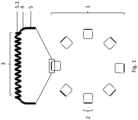
- Figure 1 a sectional plan view of an example of a stent according to the invention with an enlarged partial view.
- Figure 1 is a sectional top view in a plane that is aligned perpendicular to the central longitudinal axis of the stent 1.
- the stent 1 is formed with struts 2 that are connected to one another at certain points (not shown). There are free spaces between the struts 2, as is the case with conventional stents 1.
- the surface area of the struts 2 facing the vessel wall has been provided with a surface structure 3 which has been formed with grooves as depressions and rings as elevations.
- the grooves and rings have been formed in a periodically repeating manner.
- a coating 5.1 which is formed with the second metallic material 5, is formed.
- the dimensions of all elements of the stent 1 can be selected according to the information in the general part of the description.
- FIG. 1 shows a schematic sectional view of an example of a stent 1 consisting of several struts 2, which are connected to one another at certain points in a manner not shown, wherein the connection points are arranged in planes which are at a distance from the plane of the section shown.
- the first metallic material 4 from which the struts 2 are made is pure molybdenum.
- This structure is created by using common drawing processes to obtain a molybdenum tube with a diameter of 3 mm and a wall thickness of 50 ⁇ m. The wall thickness determines the strut thickness (radial extension) of the subsequent stent structure.
- a stent structure with a length of 30 mm is then produced from this tube using a laser cutting process, with the strut width (tangential extension) of the struts connected to one another at certain points being 250 ⁇ m.
- the structure formed with the struts 2 is then cleaned and deburred using an electropolishing process.
- a surface structuring 3 with grooves as depressions along the length of the struts 2 with an average structure height of 5 ⁇ m is created on the surface of the struts 2 facing the vessel wall, thus increasing the total surface area by a factor of 2.5.
- a defect-free coating 5.1 made of pure rhenium as the second metallic material 5 with an average layer thickness of 20 nm is then applied using the atomic layer deposition process.
- the coating 5.1 completely encloses the core of the struts 2, which consist of the first metallic material 4. Rhenium has a dissolution rate of 50 nm per year.
- the thickness of the coating 5.1 is selected such that it ensures the mechanical integrity of the stent 1 for the necessary functional life of 4 months by protecting the molybdenum from corrosion.
- the thickness of the coating 5.1 varies slightly, especially in the surface-structured area 3 of the struts 2.
- the rhenium has dissolved locally in several places on the struts 2, so that the molybdenum underneath is exposed. This occurs primarily in the surface-structured area 3, since areas of the coating 5.1 of varying thickness have been formed here.
- the formation of local galvanic elements accelerates the corrosion of the exposed molybdenum, while the surrounding rhenium is protected from further corrosion. Due to the locally limited effect of the galvanic elements, further local galvanic elements form over time across the entire surface of the stent structure.
- the increased surface area in the structured area 3 further accelerates the dissolution and resorption of the stent 1.
- the local corrosion also weakens the integrity of the stent 1. This ultimately leads to a break in the stent structure, which in turn leads to an increase in the surface area and thus an increased dissolution of the molybdenum.
- the dissolution rate of molybdenum is 25 ⁇ m per year. The duration of the complete degradation of this stent 1 is approximately one year.
- the example describes a peripheral stent for leg arteries.
- a tube made of a molybdenum alloy with 25 at.% tungsten with a diameter of 5 mm and a wall thickness of 70 ⁇ m is produced using standard drawing processes.
- the wall thickness determines the strut thickness (radial extension) of the subsequent stent structure.
- a stent structure with a length of 50 mm is then produced from this tube using a laser cutting process, with the strut width (tangential extension) of the struts 2 connected to one another at points being 60 ⁇ m.
- the surface of the struts 2 is then cleaned and deburred using an electropolishing process.
- the total surface is then increased by a factor of 1.5 by roughening using etching with hydrogen peroxide.
- a defect-free coating 5.1 made of pure rhenium 5 with an average layer thickness of 5 nm is then applied using the atomic layer deposition process.
- the coating 5.1 completely encloses the core of the struts 2.
- Rhenium as the second metallic material 5 has an annual dissolution rate of 50 nm.
- the thickness of the coating 5.1 is selected so that the mechanical integrity of the stent is guaranteed for a period of at least one month, as the coating 5.1 protects the molybdenum-tungsten alloy as the first metallic material 4 from corrosion.
- FIG. 1 shows a schematic sectional view of an example of a stent 1 consisting of several struts 2 which are connected to one another at certain points in a manner not shown, with the connection points being arranged in planes which are at a distance from the plane of the section shown.
- the first metallic material 4 from which the struts 2 are made is pure tungsten.
- This structure is produced by using common drawing processes to obtain a tungsten tube with a diameter of 3 mm and a wall thickness of 50 ⁇ m. The wall thickness determines the strut thickness (radial extent) of the later stent structure.
- a stent structure with a length of 30 mm is then produced from this tube using a laser cutting process, with the strut width (tangential extent) of the struts 2 connected to one another at certain points being 50 ⁇ m.
- the structure formed with the struts 2 is then cleaned and deburred using an electropolishing process.
- a surface structuring 3 with defined periodic depressions along the length of the struts 2 with an average structure height of 2 ⁇ m is created on the surface of the struts 2 facing the vessel wall, thus increasing the total surface by a factor of 1.5.
- a coating 5.1 made of a second metallic material 5, a rhenium alloy with 15 at-% tungsten, with an average layer thickness of 600 nm is then applied using the magnetron sputtering process with a rotating substrate.
- the coating 5.1 completely encloses the core of the struts 2, which consist of the first metallic material 4.
- the rhenium-tungsten alloy has a dissolution rate of 3000 nm per year.
- the thickness of the coating 5.1 is selected such that it ensures the mechanical integrity of the stent 1 for the necessary functional period of 2 months by protecting the tungsten from corrosion.
- the thickness of the coating 5.1 varies, in particular due to the production by means of magnetron sputtering and in the surface-structured area 3 of the struts 2.
- the rhenium-tungsten alloy has dissolved locally at several points on the struts 2, so that the tungsten underneath is exposed. This occurs primarily in the surface-structured area 3, since areas of the coating 5.1 of varying thickness have been formed here.
- the formation of local galvanic elements accelerates the corrosion of the exposed tungsten, while the surrounding rhenium-tungsten alloy is protected from further corrosion. Due to the locally limited effect of the galvanic elements, further local galvanic elements nevertheless form over time across the entire surface of the stent structure.
- the increased surface area in the structured area 3 further accelerates the dissolution and resorption of the stent 1.
- the local corrosion also weakens the integrity of the stent 1. This ultimately leads to a break in the stent structure, which in turn leads to an increase in the surface area and thus an increased dissolution of the tungsten.
- the dissolution rate of tungsten is 40 ⁇ m per year.
- the duration of the complete degradation of this stent 1 is approximately 6 months.
Landscapes
- Health & Medical Sciences (AREA)
- Public Health (AREA)
- Heart & Thoracic Surgery (AREA)
- Vascular Medicine (AREA)
- Life Sciences & Earth Sciences (AREA)
- Animal Behavior & Ethology (AREA)
- General Health & Medical Sciences (AREA)
- Veterinary Medicine (AREA)
- Surgery (AREA)
- Epidemiology (AREA)
- Chemical & Material Sciences (AREA)
- Inorganic Chemistry (AREA)
- Engineering & Computer Science (AREA)
- Biomedical Technology (AREA)
- Physics & Mathematics (AREA)
- Optics & Photonics (AREA)
- Cardiology (AREA)
- Oral & Maxillofacial Surgery (AREA)
- Transplantation (AREA)
- Materials For Medical Uses (AREA)
- Media Introduction/Drainage Providing Device (AREA)
- Prostheses (AREA)
Applications Claiming Priority (2)
| Application Number | Priority Date | Filing Date | Title |
|---|---|---|---|
| DE102020216158.5A DE102020216158B4 (de) | 2020-12-17 | 2020-12-17 | Stents für die Anwendung in der interventionellen Behandlung von Gefäßerkrankungen und der Gefäßchirurgie |
| PCT/EP2021/085591 WO2022128979A1 (de) | 2020-12-17 | 2021-12-14 | STENTS FÜR DIE ANWENDUNG IN DER INTERVENTIONELLEN BEHANDLUNG VON GEFÄßERKRANKUNGEN UND DER GEFÄßCHIRURGIE |
Publications (2)
| Publication Number | Publication Date |
|---|---|
| EP4262904A1 EP4262904A1 (de) | 2023-10-25 |
| EP4262904B1 true EP4262904B1 (de) | 2024-11-20 |
Family
ID=79269718
Family Applications (1)
| Application Number | Title | Priority Date | Filing Date |
|---|---|---|---|
| EP21839106.8A Active EP4262904B1 (de) | 2020-12-17 | 2021-12-14 | Stents für die anwendung in der interventionellen behandlung von gefässerkrankungen und der gefässchirurgie |
Country Status (7)
| Country | Link |
|---|---|
| US (1) | US20240050247A1 (https=) |
| EP (1) | EP4262904B1 (https=) |
| JP (1) | JP2023553698A (https=) |
| KR (1) | KR20230121874A (https=) |
| CN (1) | CN116761643A (https=) |
| DE (1) | DE102020216158B4 (https=) |
| WO (1) | WO2022128979A1 (https=) |
Family Cites Families (6)
| Publication number | Priority date | Publication date | Assignee | Title |
|---|---|---|---|---|
| US20040049261A1 (en) | 2002-09-09 | 2004-03-11 | Yixin Xu | Medical devices |
| CN101257860B (zh) * | 2005-04-05 | 2015-10-21 | 万能医药公司 | 可降解的植入式医疗装置 |
| US7651527B2 (en) * | 2006-12-15 | 2010-01-26 | Medtronic Vascular, Inc. | Bioresorbable stent |
| ZA200904416B (en) * | 2007-01-30 | 2010-08-25 | Hemoteq Ag | Biodegradable vascular support |
| US8507101B2 (en) * | 2009-12-10 | 2013-08-13 | Biotronik Vi Patent Ag | Biocorrodible implant having a corrosion-inhibiting coating |
| JP2016105749A (ja) * | 2013-04-05 | 2016-06-16 | テルモ株式会社 | ガルバニック腐食ステント |
-
2020
- 2020-12-17 DE DE102020216158.5A patent/DE102020216158B4/de active Active
-
2021
- 2021-12-14 KR KR1020237024456A patent/KR20230121874A/ko active Pending
- 2021-12-14 EP EP21839106.8A patent/EP4262904B1/de active Active
- 2021-12-14 CN CN202180092358.XA patent/CN116761643A/zh active Pending
- 2021-12-14 JP JP2023536870A patent/JP2023553698A/ja active Pending
- 2021-12-14 US US18/267,810 patent/US20240050247A1/en active Pending
- 2021-12-14 WO PCT/EP2021/085591 patent/WO2022128979A1/de not_active Ceased
Also Published As
| Publication number | Publication date |
|---|---|
| US20240050247A1 (en) | 2024-02-15 |
| DE102020216158B4 (de) | 2024-08-22 |
| WO2022128979A1 (de) | 2022-06-23 |
| JP2023553698A (ja) | 2023-12-25 |
| EP4262904A1 (de) | 2023-10-25 |
| CN116761643A (zh) | 2023-09-15 |
| KR20230121874A (ko) | 2023-08-21 |
| DE102020216158A1 (de) | 2022-06-23 |
Similar Documents
| Publication | Publication Date | Title |
|---|---|---|
| DE69029114T2 (de) | Einrichtung und Verfahren zur endovaskulären Abstützung | |
| DE60220319T2 (de) | Sich auflösender stent | |
| DE69736343T2 (de) | Vaskuläre und endoluminale Stents | |
| DE69839141T2 (de) | Mehschichtiger Stent aus Metall | |
| EP1270023B2 (de) | In vivo abbaubare metallische Gefäßstütze | |
| DE10145714B4 (de) | Stent | |
| EP1419793B1 (de) | Endoprothese mit einer Trägerstruktur aus einer Magnesiumlegierung | |
| DE69507187T2 (de) | Intravaskuläre Prothese mit antithrombogenischer Beschichtung | |
| DE60220649T2 (de) | Stent aus einer Röntgenopakeslegierung | |
| DE69835248T2 (de) | Herstellungsverfahren für einen Stent für Angioplastie | |
| DE19856983A1 (de) | Implantierbare, bioresorbierbare Gefäßwandstütze, insbesondere Koronarstent | |
| EP0966979A2 (de) | Implantierbare, bioresorbierbare Gefässwandstütze, insbesondere Koronarstent | |
| DE102008038367A1 (de) | Stent und Verfahren und Vorrichtung zur Herstellung des Stents | |
| DE19916086A1 (de) | Implantierbare Prothese, insbesondere Gefäßprothese (Stent) | |
| EP1984033B1 (de) | Verfahren zur umhüllung eines stents | |
| EP3930777B1 (de) | Intravaskuläres funktionselement, system mit einem funktionselement und verfahren | |
| EP1886651A1 (de) | Stent mit einer Struktur aus einem biokorrodierbaren metallischen Werkstoff | |
| EP4262904B1 (de) | Stents für die anwendung in der interventionellen behandlung von gefässerkrankungen und der gefässchirurgie | |
| DE102008044221A1 (de) | Stent mit einer Struktur aus einem biokorrodierbaren Werkstoff und einem gesteuerten Korrosionsverhalten | |
| EP3952798B1 (de) | Stent | |
| EP3643337B1 (de) | Stent zur implantierung in einen hohlraum eines menschlichen oder tierischen körpers sowie verfahren zur herstellung eines röntgenopaken schichtaufbaus auf einem stent | |
| EP2914309A1 (de) | Bioresorbierbarer stent aus einem verbundmaterial | |
| WO2023006537A1 (de) | Implantat, insbesondere stent, und herstellungsverfahren | |
| EP1389135A1 (de) | Medizinische vorrichtung | |
| EP3708129A1 (de) | Implantat |
Legal Events
| Date | Code | Title | Description |
|---|---|---|---|
| STAA | Information on the status of an ep patent application or granted ep patent |
Free format text: STATUS: UNKNOWN |
|
| STAA | Information on the status of an ep patent application or granted ep patent |
Free format text: STATUS: THE INTERNATIONAL PUBLICATION HAS BEEN MADE |
|
| PUAI | Public reference made under article 153(3) epc to a published international application that has entered the european phase |
Free format text: ORIGINAL CODE: 0009012 |
|
| STAA | Information on the status of an ep patent application or granted ep patent |
Free format text: STATUS: REQUEST FOR EXAMINATION WAS MADE |
|
| 17P | Request for examination filed |
Effective date: 20230717 |
|
| AK | Designated contracting states |
Kind code of ref document: A1 Designated state(s): AL AT BE BG CH CY CZ DE DK EE ES FI FR GB GR HR HU IE IS IT LI LT LU LV MC MK MT NL NO PL PT RO RS SE SI SK SM TR |
|
| DAV | Request for validation of the european patent (deleted) | ||
| DAX | Request for extension of the european patent (deleted) | ||
| GRAP | Despatch of communication of intention to grant a patent |
Free format text: ORIGINAL CODE: EPIDOSNIGR1 |
|
| STAA | Information on the status of an ep patent application or granted ep patent |
Free format text: STATUS: GRANT OF PATENT IS INTENDED |
|
| INTG | Intention to grant announced |
Effective date: 20240701 |
|
| GRAS | Grant fee paid |
Free format text: ORIGINAL CODE: EPIDOSNIGR3 |
|
| GRAA | (expected) grant |
Free format text: ORIGINAL CODE: 0009210 |
|
| STAA | Information on the status of an ep patent application or granted ep patent |
Free format text: STATUS: THE PATENT HAS BEEN GRANTED |
|
| AK | Designated contracting states |
Kind code of ref document: B1 Designated state(s): AL AT BE BG CH CY CZ DE DK EE ES FI FR GB GR HR HU IE IS IT LI LT LU LV MC MK MT NL NO PL PT RO RS SE SI SK SM TR |
|
| REG | Reference to a national code |
Ref country code: GB Ref legal event code: FG4D Free format text: NOT ENGLISH |
|
| REG | Reference to a national code |
Ref country code: CH Ref legal event code: EP |
|
| REG | Reference to a national code |
Ref country code: DE Ref legal event code: R096 Ref document number: 502021005905 Country of ref document: DE |
|
| REG | Reference to a national code |
Ref country code: IE Ref legal event code: FG4D Free format text: LANGUAGE OF EP DOCUMENT: GERMAN |
|
| REG | Reference to a national code |
Ref country code: LT Ref legal event code: MG9D |
|
| REG | Reference to a national code |
Ref country code: NL Ref legal event code: MP Effective date: 20241120 |
|
| PG25 | Lapsed in a contracting state [announced via postgrant information from national office to epo] |
Ref country code: IS Free format text: LAPSE BECAUSE OF FAILURE TO SUBMIT A TRANSLATION OF THE DESCRIPTION OR TO PAY THE FEE WITHIN THE PRESCRIBED TIME-LIMIT Effective date: 20250320 Ref country code: PT Free format text: LAPSE BECAUSE OF FAILURE TO SUBMIT A TRANSLATION OF THE DESCRIPTION OR TO PAY THE FEE WITHIN THE PRESCRIBED TIME-LIMIT Effective date: 20250320 Ref country code: HR Free format text: LAPSE BECAUSE OF FAILURE TO SUBMIT A TRANSLATION OF THE DESCRIPTION OR TO PAY THE FEE WITHIN THE PRESCRIBED TIME-LIMIT Effective date: 20241120 |
|
| PG25 | Lapsed in a contracting state [announced via postgrant information from national office to epo] |
Ref country code: FI Free format text: LAPSE BECAUSE OF FAILURE TO SUBMIT A TRANSLATION OF THE DESCRIPTION OR TO PAY THE FEE WITHIN THE PRESCRIBED TIME-LIMIT Effective date: 20241120 Ref country code: NL Free format text: LAPSE BECAUSE OF FAILURE TO SUBMIT A TRANSLATION OF THE DESCRIPTION OR TO PAY THE FEE WITHIN THE PRESCRIBED TIME-LIMIT Effective date: 20241120 |
|
| PG25 | Lapsed in a contracting state [announced via postgrant information from national office to epo] |
Ref country code: BG Free format text: LAPSE BECAUSE OF FAILURE TO SUBMIT A TRANSLATION OF THE DESCRIPTION OR TO PAY THE FEE WITHIN THE PRESCRIBED TIME-LIMIT Effective date: 20241120 |
|
| PG25 | Lapsed in a contracting state [announced via postgrant information from national office to epo] |
Ref country code: ES Free format text: LAPSE BECAUSE OF FAILURE TO SUBMIT A TRANSLATION OF THE DESCRIPTION OR TO PAY THE FEE WITHIN THE PRESCRIBED TIME-LIMIT Effective date: 20241120 |
|
| PG25 | Lapsed in a contracting state [announced via postgrant information from national office to epo] |
Ref country code: NO Free format text: LAPSE BECAUSE OF FAILURE TO SUBMIT A TRANSLATION OF THE DESCRIPTION OR TO PAY THE FEE WITHIN THE PRESCRIBED TIME-LIMIT Effective date: 20250220 |
|
| PG25 | Lapsed in a contracting state [announced via postgrant information from national office to epo] |
Ref country code: GR Free format text: LAPSE BECAUSE OF FAILURE TO SUBMIT A TRANSLATION OF THE DESCRIPTION OR TO PAY THE FEE WITHIN THE PRESCRIBED TIME-LIMIT Effective date: 20250221 Ref country code: LV Free format text: LAPSE BECAUSE OF FAILURE TO SUBMIT A TRANSLATION OF THE DESCRIPTION OR TO PAY THE FEE WITHIN THE PRESCRIBED TIME-LIMIT Effective date: 20241120 |
|
| PGFP | Annual fee paid to national office [announced via postgrant information from national office to epo] |
Ref country code: CH Payment date: 20250203 Year of fee payment: 4 |
|
| PG25 | Lapsed in a contracting state [announced via postgrant information from national office to epo] |
Ref country code: PL Free format text: LAPSE BECAUSE OF FAILURE TO SUBMIT A TRANSLATION OF THE DESCRIPTION OR TO PAY THE FEE WITHIN THE PRESCRIBED TIME-LIMIT Effective date: 20241120 |
|
| PG25 | Lapsed in a contracting state [announced via postgrant information from national office to epo] |
Ref country code: IT Free format text: LAPSE BECAUSE OF NON-PAYMENT OF DUE FEES Effective date: 20241214 |
|
| PG25 | Lapsed in a contracting state [announced via postgrant information from national office to epo] |
Ref country code: RS Free format text: LAPSE BECAUSE OF FAILURE TO SUBMIT A TRANSLATION OF THE DESCRIPTION OR TO PAY THE FEE WITHIN THE PRESCRIBED TIME-LIMIT Effective date: 20250220 |
|
| PG25 | Lapsed in a contracting state [announced via postgrant information from national office to epo] |
Ref country code: SM Free format text: LAPSE BECAUSE OF FAILURE TO SUBMIT A TRANSLATION OF THE DESCRIPTION OR TO PAY THE FEE WITHIN THE PRESCRIBED TIME-LIMIT Effective date: 20241120 |
|
| PG25 | Lapsed in a contracting state [announced via postgrant information from national office to epo] |
Ref country code: DK Free format text: LAPSE BECAUSE OF FAILURE TO SUBMIT A TRANSLATION OF THE DESCRIPTION OR TO PAY THE FEE WITHIN THE PRESCRIBED TIME-LIMIT Effective date: 20241120 |
|
| PG25 | Lapsed in a contracting state [announced via postgrant information from national office to epo] |
Ref country code: EE Free format text: LAPSE BECAUSE OF FAILURE TO SUBMIT A TRANSLATION OF THE DESCRIPTION OR TO PAY THE FEE WITHIN THE PRESCRIBED TIME-LIMIT Effective date: 20241120 |
|
| PG25 | Lapsed in a contracting state [announced via postgrant information from national office to epo] |
Ref country code: RO Free format text: LAPSE BECAUSE OF FAILURE TO SUBMIT A TRANSLATION OF THE DESCRIPTION OR TO PAY THE FEE WITHIN THE PRESCRIBED TIME-LIMIT Effective date: 20241120 |
|
| PG25 | Lapsed in a contracting state [announced via postgrant information from national office to epo] |
Ref country code: SK Free format text: LAPSE BECAUSE OF FAILURE TO SUBMIT A TRANSLATION OF THE DESCRIPTION OR TO PAY THE FEE WITHIN THE PRESCRIBED TIME-LIMIT Effective date: 20241120 |
|
| PG25 | Lapsed in a contracting state [announced via postgrant information from national office to epo] |
Ref country code: CZ Free format text: LAPSE BECAUSE OF FAILURE TO SUBMIT A TRANSLATION OF THE DESCRIPTION OR TO PAY THE FEE WITHIN THE PRESCRIBED TIME-LIMIT Effective date: 20241120 |
|
| PG25 | Lapsed in a contracting state [announced via postgrant information from national office to epo] |
Ref country code: LU Free format text: LAPSE BECAUSE OF NON-PAYMENT OF DUE FEES Effective date: 20241214 |
|
| REG | Reference to a national code |
Ref country code: DE Ref legal event code: R097 Ref document number: 502021005905 Country of ref document: DE |
|
| PG25 | Lapsed in a contracting state [announced via postgrant information from national office to epo] |
Ref country code: SE Free format text: LAPSE BECAUSE OF FAILURE TO SUBMIT A TRANSLATION OF THE DESCRIPTION OR TO PAY THE FEE WITHIN THE PRESCRIBED TIME-LIMIT Effective date: 20241120 |
|
| PG25 | Lapsed in a contracting state [announced via postgrant information from national office to epo] |
Ref country code: MC Free format text: LAPSE BECAUSE OF FAILURE TO SUBMIT A TRANSLATION OF THE DESCRIPTION OR TO PAY THE FEE WITHIN THE PRESCRIBED TIME-LIMIT Effective date: 20241120 |
|
| PLBE | No opposition filed within time limit |
Free format text: ORIGINAL CODE: 0009261 |
|
| STAA | Information on the status of an ep patent application or granted ep patent |
Free format text: STATUS: NO OPPOSITION FILED WITHIN TIME LIMIT |
|
| REG | Reference to a national code |
Ref country code: BE Ref legal event code: MM Effective date: 20241231 |
|
| PG25 | Lapsed in a contracting state [announced via postgrant information from national office to epo] |
Ref country code: BE Free format text: LAPSE BECAUSE OF NON-PAYMENT OF DUE FEES Effective date: 20241231 |
|
| 26N | No opposition filed |
Effective date: 20250821 |
|
| PG25 | Lapsed in a contracting state [announced via postgrant information from national office to epo] |
Ref country code: IE Free format text: LAPSE BECAUSE OF NON-PAYMENT OF DUE FEES Effective date: 20241214 |
|
| REG | Reference to a national code |
Ref country code: CH Ref legal event code: U11 Free format text: ST27 STATUS EVENT CODE: U-0-0-U10-U11 (AS PROVIDED BY THE NATIONAL OFFICE) Effective date: 20260101 |
|
| PGFP | Annual fee paid to national office [announced via postgrant information from national office to epo] |
Ref country code: GB Payment date: 20251218 Year of fee payment: 5 |
|
| PGFP | Annual fee paid to national office [announced via postgrant information from national office to epo] |
Ref country code: AT Payment date: 20260113 Year of fee payment: 5 |
|
| PG25 | Lapsed in a contracting state [announced via postgrant information from national office to epo] |
Ref country code: IT Free format text: LAPSE BECAUSE OF NON-PAYMENT OF DUE FEES Effective date: 20241214 |
|
| PGRI | Patent reinstated in contracting state [announced from national office to epo] |
Ref country code: IT Effective date: 20241231 |
|
| PGFP | Annual fee paid to national office [announced via postgrant information from national office to epo] |
Ref country code: FR Payment date: 20251218 Year of fee payment: 5 |
|
| PGFP | Annual fee paid to national office [announced via postgrant information from national office to epo] |
Ref country code: DE Payment date: 20251222 Year of fee payment: 5 |
|
| PGFP | Annual fee paid to national office [announced via postgrant information from national office to epo] |
Ref country code: IT Payment date: 20251231 Year of fee payment: 5 |