EP4253116B1 - Steuerungsverfahren für hybridfahrzeug und fahrzeugsteuerungseinheit - Google Patents
Steuerungsverfahren für hybridfahrzeug und fahrzeugsteuerungseinheit Download PDFInfo
- Publication number
- EP4253116B1 EP4253116B1 EP21928630.9A EP21928630A EP4253116B1 EP 4253116 B1 EP4253116 B1 EP 4253116B1 EP 21928630 A EP21928630 A EP 21928630A EP 4253116 B1 EP4253116 B1 EP 4253116B1
- Authority
- EP
- European Patent Office
- Prior art keywords
- engine
- power
- hybrid vehicle
- power battery
- driving motor
- Prior art date
- Legal status (The legal status is an assumption and is not a legal conclusion. Google has not performed a legal analysis and makes no representation as to the accuracy of the status listed.)
- Active
Links
Images



Classifications
-
- B—PERFORMING OPERATIONS; TRANSPORTING
- B60—VEHICLES IN GENERAL
- B60W—CONJOINT CONTROL OF VEHICLE SUB-UNITS OF DIFFERENT TYPE OR DIFFERENT FUNCTION; CONTROL SYSTEMS SPECIALLY ADAPTED FOR HYBRID VEHICLES; ROAD VEHICLE DRIVE CONTROL SYSTEMS FOR PURPOSES NOT RELATED TO THE CONTROL OF A PARTICULAR SUB-UNIT
- B60W20/00—Control systems specially adapted for hybrid vehicles
- B60W20/10—Controlling the power contribution of each of the prime movers to meet required power demand
- B60W20/13—Controlling the power contribution of each of the prime movers to meet required power demand in order to stay within battery power input or output limits; in order to prevent overcharging or battery depletion
-
- B—PERFORMING OPERATIONS; TRANSPORTING
- B60—VEHICLES IN GENERAL
- B60L—PROPULSION OF ELECTRICALLY-PROPELLED VEHICLES; SUPPLYING ELECTRIC POWER FOR AUXILIARY EQUIPMENT OF ELECTRICALLY-PROPELLED VEHICLES; ELECTRODYNAMIC BRAKE SYSTEMS FOR VEHICLES IN GENERAL; MAGNETIC SUSPENSION OR LEVITATION FOR VEHICLES; MONITORING OPERATING VARIABLES OF ELECTRICALLY-PROPELLED VEHICLES; ELECTRIC SAFETY DEVICES FOR ELECTRICALLY-PROPELLED VEHICLES
- B60L15/00—Methods, circuits, or devices for controlling the traction-motor speed of electrically-propelled vehicles
- B60L15/20—Methods, circuits, or devices for controlling the traction-motor speed of electrically-propelled vehicles for control of the vehicle or its driving motor to achieve a desired performance, e.g. speed, torque, programmed variation of speed
- B60L15/2045—Methods, circuits, or devices for controlling the traction-motor speed of electrically-propelled vehicles for control of the vehicle or its driving motor to achieve a desired performance, e.g. speed, torque, programmed variation of speed for optimising the use of energy
-
- B—PERFORMING OPERATIONS; TRANSPORTING
- B60—VEHICLES IN GENERAL
- B60K—ARRANGEMENT OR MOUNTING OF PROPULSION UNITS OR OF TRANSMISSIONS IN VEHICLES; ARRANGEMENT OR MOUNTING OF PLURAL DIVERSE PRIME-MOVERS IN VEHICLES; AUXILIARY DRIVES FOR VEHICLES; INSTRUMENTATION OR DASHBOARDS FOR VEHICLES; ARRANGEMENTS IN CONNECTION WITH COOLING, AIR INTAKE, GAS EXHAUST OR FUEL SUPPLY OF PROPULSION UNITS IN VEHICLES
- B60K6/00—Arrangement or mounting of plural diverse prime-movers for mutual or common propulsion, e.g. hybrid propulsion systems comprising electric motors and internal combustion engines
- B60K6/20—Arrangement or mounting of plural diverse prime-movers for mutual or common propulsion, e.g. hybrid propulsion systems comprising electric motors and internal combustion engines the prime-movers consisting of electric motors and internal combustion engines, e.g. HEVs
- B60K6/42—Arrangement or mounting of plural diverse prime-movers for mutual or common propulsion, e.g. hybrid propulsion systems comprising electric motors and internal combustion engines the prime-movers consisting of electric motors and internal combustion engines, e.g. HEVs characterised by the architecture of the hybrid electric vehicle
- B60K6/44—Series-parallel type
- B60K6/442—Series-parallel switching type
-
- B—PERFORMING OPERATIONS; TRANSPORTING
- B60—VEHICLES IN GENERAL
- B60L—PROPULSION OF ELECTRICALLY-PROPELLED VEHICLES; SUPPLYING ELECTRIC POWER FOR AUXILIARY EQUIPMENT OF ELECTRICALLY-PROPELLED VEHICLES; ELECTRODYNAMIC BRAKE SYSTEMS FOR VEHICLES IN GENERAL; MAGNETIC SUSPENSION OR LEVITATION FOR VEHICLES; MONITORING OPERATING VARIABLES OF ELECTRICALLY-PROPELLED VEHICLES; ELECTRIC SAFETY DEVICES FOR ELECTRICALLY-PROPELLED VEHICLES
- B60L50/00—Electric propulsion with power supplied within the vehicle
- B60L50/50—Electric propulsion with power supplied within the vehicle using propulsion power supplied by batteries or fuel cells
- B60L50/60—Electric propulsion with power supplied within the vehicle using propulsion power supplied by batteries or fuel cells using power supplied by batteries
- B60L50/61—Electric propulsion with power supplied within the vehicle using propulsion power supplied by batteries or fuel cells using power supplied by batteries by batteries charged by engine-driven generators, e.g. series hybrid electric vehicles
- B60L50/62—Electric propulsion with power supplied within the vehicle using propulsion power supplied by batteries or fuel cells using power supplied by batteries by batteries charged by engine-driven generators, e.g. series hybrid electric vehicles charged by low-power generators primarily intended to support the batteries, e.g. range extenders
-
- B—PERFORMING OPERATIONS; TRANSPORTING
- B60—VEHICLES IN GENERAL
- B60L—PROPULSION OF ELECTRICALLY-PROPELLED VEHICLES; SUPPLYING ELECTRIC POWER FOR AUXILIARY EQUIPMENT OF ELECTRICALLY-PROPELLED VEHICLES; ELECTRODYNAMIC BRAKE SYSTEMS FOR VEHICLES IN GENERAL; MAGNETIC SUSPENSION OR LEVITATION FOR VEHICLES; MONITORING OPERATING VARIABLES OF ELECTRICALLY-PROPELLED VEHICLES; ELECTRIC SAFETY DEVICES FOR ELECTRICALLY-PROPELLED VEHICLES
- B60L58/00—Methods or circuit arrangements for monitoring or controlling batteries or fuel cells, specially adapted for electric vehicles
- B60L58/10—Methods or circuit arrangements for monitoring or controlling batteries or fuel cells, specially adapted for electric vehicles for monitoring or controlling batteries
- B60L58/12—Methods or circuit arrangements for monitoring or controlling batteries or fuel cells, specially adapted for electric vehicles for monitoring or controlling batteries responding to state of charge [SoC]
-
- B—PERFORMING OPERATIONS; TRANSPORTING
- B60—VEHICLES IN GENERAL
- B60W—CONJOINT CONTROL OF VEHICLE SUB-UNITS OF DIFFERENT TYPE OR DIFFERENT FUNCTION; CONTROL SYSTEMS SPECIALLY ADAPTED FOR HYBRID VEHICLES; ROAD VEHICLE DRIVE CONTROL SYSTEMS FOR PURPOSES NOT RELATED TO THE CONTROL OF A PARTICULAR SUB-UNIT
- B60W10/00—Conjoint control of vehicle sub-units of different type or different function
- B60W10/02—Conjoint control of vehicle sub-units of different type or different function including control of driveline clutches
-
- B—PERFORMING OPERATIONS; TRANSPORTING
- B60—VEHICLES IN GENERAL
- B60W—CONJOINT CONTROL OF VEHICLE SUB-UNITS OF DIFFERENT TYPE OR DIFFERENT FUNCTION; CONTROL SYSTEMS SPECIALLY ADAPTED FOR HYBRID VEHICLES; ROAD VEHICLE DRIVE CONTROL SYSTEMS FOR PURPOSES NOT RELATED TO THE CONTROL OF A PARTICULAR SUB-UNIT
- B60W10/00—Conjoint control of vehicle sub-units of different type or different function
- B60W10/04—Conjoint control of vehicle sub-units of different type or different function including control of propulsion units
- B60W10/06—Conjoint control of vehicle sub-units of different type or different function including control of propulsion units including control of combustion engines
-
- B—PERFORMING OPERATIONS; TRANSPORTING
- B60—VEHICLES IN GENERAL
- B60W—CONJOINT CONTROL OF VEHICLE SUB-UNITS OF DIFFERENT TYPE OR DIFFERENT FUNCTION; CONTROL SYSTEMS SPECIALLY ADAPTED FOR HYBRID VEHICLES; ROAD VEHICLE DRIVE CONTROL SYSTEMS FOR PURPOSES NOT RELATED TO THE CONTROL OF A PARTICULAR SUB-UNIT
- B60W10/00—Conjoint control of vehicle sub-units of different type or different function
- B60W10/04—Conjoint control of vehicle sub-units of different type or different function including control of propulsion units
- B60W10/08—Conjoint control of vehicle sub-units of different type or different function including control of propulsion units including control of electric propulsion units, e.g. motors or generators
-
- B—PERFORMING OPERATIONS; TRANSPORTING
- B60—VEHICLES IN GENERAL
- B60W—CONJOINT CONTROL OF VEHICLE SUB-UNITS OF DIFFERENT TYPE OR DIFFERENT FUNCTION; CONTROL SYSTEMS SPECIALLY ADAPTED FOR HYBRID VEHICLES; ROAD VEHICLE DRIVE CONTROL SYSTEMS FOR PURPOSES NOT RELATED TO THE CONTROL OF A PARTICULAR SUB-UNIT
- B60W10/00—Conjoint control of vehicle sub-units of different type or different function
- B60W10/24—Conjoint control of vehicle sub-units of different type or different function including control of energy storage means
- B60W10/26—Conjoint control of vehicle sub-units of different type or different function including control of energy storage means for electrical energy, e.g. batteries or capacitors
-
- B—PERFORMING OPERATIONS; TRANSPORTING
- B60—VEHICLES IN GENERAL
- B60W—CONJOINT CONTROL OF VEHICLE SUB-UNITS OF DIFFERENT TYPE OR DIFFERENT FUNCTION; CONTROL SYSTEMS SPECIALLY ADAPTED FOR HYBRID VEHICLES; ROAD VEHICLE DRIVE CONTROL SYSTEMS FOR PURPOSES NOT RELATED TO THE CONTROL OF A PARTICULAR SUB-UNIT
- B60W20/00—Control systems specially adapted for hybrid vehicles
- B60W20/10—Controlling the power contribution of each of the prime movers to meet required power demand
- B60W20/11—Controlling the power contribution of each of the prime movers to meet required power demand using model predictive control [MPC] strategies, i.e. control methods based on models predicting performance
-
- B—PERFORMING OPERATIONS; TRANSPORTING
- B60—VEHICLES IN GENERAL
- B60W—CONJOINT CONTROL OF VEHICLE SUB-UNITS OF DIFFERENT TYPE OR DIFFERENT FUNCTION; CONTROL SYSTEMS SPECIALLY ADAPTED FOR HYBRID VEHICLES; ROAD VEHICLE DRIVE CONTROL SYSTEMS FOR PURPOSES NOT RELATED TO THE CONTROL OF A PARTICULAR SUB-UNIT
- B60W20/00—Control systems specially adapted for hybrid vehicles
- B60W20/10—Controlling the power contribution of each of the prime movers to meet required power demand
- B60W20/12—Controlling the power contribution of each of the prime movers to meet required power demand using control strategies taking into account route information
-
- B—PERFORMING OPERATIONS; TRANSPORTING
- B60—VEHICLES IN GENERAL
- B60W—CONJOINT CONTROL OF VEHICLE SUB-UNITS OF DIFFERENT TYPE OR DIFFERENT FUNCTION; CONTROL SYSTEMS SPECIALLY ADAPTED FOR HYBRID VEHICLES; ROAD VEHICLE DRIVE CONTROL SYSTEMS FOR PURPOSES NOT RELATED TO THE CONTROL OF A PARTICULAR SUB-UNIT
- B60W20/00—Control systems specially adapted for hybrid vehicles
- B60W20/10—Controlling the power contribution of each of the prime movers to meet required power demand
- B60W20/15—Control strategies specially adapted for achieving a particular effect
-
- B—PERFORMING OPERATIONS; TRANSPORTING
- B60—VEHICLES IN GENERAL
- B60W—CONJOINT CONTROL OF VEHICLE SUB-UNITS OF DIFFERENT TYPE OR DIFFERENT FUNCTION; CONTROL SYSTEMS SPECIALLY ADAPTED FOR HYBRID VEHICLES; ROAD VEHICLE DRIVE CONTROL SYSTEMS FOR PURPOSES NOT RELATED TO THE CONTROL OF A PARTICULAR SUB-UNIT
- B60W20/00—Control systems specially adapted for hybrid vehicles
- B60W20/20—Control strategies involving selection of hybrid configuration, e.g. selection between series or parallel configuration
-
- B—PERFORMING OPERATIONS; TRANSPORTING
- B60—VEHICLES IN GENERAL
- B60W—CONJOINT CONTROL OF VEHICLE SUB-UNITS OF DIFFERENT TYPE OR DIFFERENT FUNCTION; CONTROL SYSTEMS SPECIALLY ADAPTED FOR HYBRID VEHICLES; ROAD VEHICLE DRIVE CONTROL SYSTEMS FOR PURPOSES NOT RELATED TO THE CONTROL OF A PARTICULAR SUB-UNIT
- B60W30/00—Purposes of road vehicle drive control systems not related to the control of a particular sub-unit, e.g. of systems using conjoint control of vehicle sub-units
- B60W30/18—Propelling the vehicle
- B60W30/188—Controlling power parameters of the driveline, e.g. determining the required power
- B60W30/1882—Controlling power parameters of the driveline, e.g. determining the required power characterised by the working point of the engine, e.g. by using engine output chart
-
- B—PERFORMING OPERATIONS; TRANSPORTING
- B60—VEHICLES IN GENERAL
- B60L—PROPULSION OF ELECTRICALLY-PROPELLED VEHICLES; SUPPLYING ELECTRIC POWER FOR AUXILIARY EQUIPMENT OF ELECTRICALLY-PROPELLED VEHICLES; ELECTRODYNAMIC BRAKE SYSTEMS FOR VEHICLES IN GENERAL; MAGNETIC SUSPENSION OR LEVITATION FOR VEHICLES; MONITORING OPERATING VARIABLES OF ELECTRICALLY-PROPELLED VEHICLES; ELECTRIC SAFETY DEVICES FOR ELECTRICALLY-PROPELLED VEHICLES
- B60L2240/00—Control parameters of input or output; Target parameters
- B60L2240/40—Drive Train control parameters
- B60L2240/42—Drive Train control parameters related to electric machines
- B60L2240/423—Torque
-
- B—PERFORMING OPERATIONS; TRANSPORTING
- B60—VEHICLES IN GENERAL
- B60L—PROPULSION OF ELECTRICALLY-PROPELLED VEHICLES; SUPPLYING ELECTRIC POWER FOR AUXILIARY EQUIPMENT OF ELECTRICALLY-PROPELLED VEHICLES; ELECTRODYNAMIC BRAKE SYSTEMS FOR VEHICLES IN GENERAL; MAGNETIC SUSPENSION OR LEVITATION FOR VEHICLES; MONITORING OPERATING VARIABLES OF ELECTRICALLY-PROPELLED VEHICLES; ELECTRIC SAFETY DEVICES FOR ELECTRICALLY-PROPELLED VEHICLES
- B60L2240/00—Control parameters of input or output; Target parameters
- B60L2240/40—Drive Train control parameters
- B60L2240/44—Drive Train control parameters related to combustion engines
- B60L2240/443—Torque
-
- B—PERFORMING OPERATIONS; TRANSPORTING
- B60—VEHICLES IN GENERAL
- B60L—PROPULSION OF ELECTRICALLY-PROPELLED VEHICLES; SUPPLYING ELECTRIC POWER FOR AUXILIARY EQUIPMENT OF ELECTRICALLY-PROPELLED VEHICLES; ELECTRODYNAMIC BRAKE SYSTEMS FOR VEHICLES IN GENERAL; MAGNETIC SUSPENSION OR LEVITATION FOR VEHICLES; MONITORING OPERATING VARIABLES OF ELECTRICALLY-PROPELLED VEHICLES; ELECTRIC SAFETY DEVICES FOR ELECTRICALLY-PROPELLED VEHICLES
- B60L2260/00—Operating Modes
- B60L2260/20—Drive modes; Transition between modes
- B60L2260/26—Transition between different drive modes
-
- B—PERFORMING OPERATIONS; TRANSPORTING
- B60—VEHICLES IN GENERAL
- B60L—PROPULSION OF ELECTRICALLY-PROPELLED VEHICLES; SUPPLYING ELECTRIC POWER FOR AUXILIARY EQUIPMENT OF ELECTRICALLY-PROPELLED VEHICLES; ELECTRODYNAMIC BRAKE SYSTEMS FOR VEHICLES IN GENERAL; MAGNETIC SUSPENSION OR LEVITATION FOR VEHICLES; MONITORING OPERATING VARIABLES OF ELECTRICALLY-PROPELLED VEHICLES; ELECTRIC SAFETY DEVICES FOR ELECTRICALLY-PROPELLED VEHICLES
- B60L2270/00—Problem solutions or means not otherwise provided for
- B60L2270/10—Emission reduction
- B60L2270/12—Emission reduction of exhaust
-
- B—PERFORMING OPERATIONS; TRANSPORTING
- B60—VEHICLES IN GENERAL
- B60W—CONJOINT CONTROL OF VEHICLE SUB-UNITS OF DIFFERENT TYPE OR DIFFERENT FUNCTION; CONTROL SYSTEMS SPECIALLY ADAPTED FOR HYBRID VEHICLES; ROAD VEHICLE DRIVE CONTROL SYSTEMS FOR PURPOSES NOT RELATED TO THE CONTROL OF A PARTICULAR SUB-UNIT
- B60W2510/00—Input parameters relating to a particular sub-units
- B60W2510/24—Energy storage means
- B60W2510/242—Energy storage means for electrical energy
- B60W2510/244—Charge state
-
- B—PERFORMING OPERATIONS; TRANSPORTING
- B60—VEHICLES IN GENERAL
- B60W—CONJOINT CONTROL OF VEHICLE SUB-UNITS OF DIFFERENT TYPE OR DIFFERENT FUNCTION; CONTROL SYSTEMS SPECIALLY ADAPTED FOR HYBRID VEHICLES; ROAD VEHICLE DRIVE CONTROL SYSTEMS FOR PURPOSES NOT RELATED TO THE CONTROL OF A PARTICULAR SUB-UNIT
- B60W2520/00—Input parameters relating to overall vehicle dynamics
- B60W2520/10—Longitudinal speed
-
- B—PERFORMING OPERATIONS; TRANSPORTING
- B60—VEHICLES IN GENERAL
- B60W—CONJOINT CONTROL OF VEHICLE SUB-UNITS OF DIFFERENT TYPE OR DIFFERENT FUNCTION; CONTROL SYSTEMS SPECIALLY ADAPTED FOR HYBRID VEHICLES; ROAD VEHICLE DRIVE CONTROL SYSTEMS FOR PURPOSES NOT RELATED TO THE CONTROL OF A PARTICULAR SUB-UNIT
- B60W2520/00—Input parameters relating to overall vehicle dynamics
- B60W2520/30—Wheel torque
-
- B—PERFORMING OPERATIONS; TRANSPORTING
- B60—VEHICLES IN GENERAL
- B60W—CONJOINT CONTROL OF VEHICLE SUB-UNITS OF DIFFERENT TYPE OR DIFFERENT FUNCTION; CONTROL SYSTEMS SPECIALLY ADAPTED FOR HYBRID VEHICLES; ROAD VEHICLE DRIVE CONTROL SYSTEMS FOR PURPOSES NOT RELATED TO THE CONTROL OF A PARTICULAR SUB-UNIT
- B60W2710/00—Output or target parameters relating to a particular sub-units
- B60W2710/06—Combustion engines, Gas turbines
- B60W2710/0666—Engine torque
-
- B—PERFORMING OPERATIONS; TRANSPORTING
- B60—VEHICLES IN GENERAL
- B60W—CONJOINT CONTROL OF VEHICLE SUB-UNITS OF DIFFERENT TYPE OR DIFFERENT FUNCTION; CONTROL SYSTEMS SPECIALLY ADAPTED FOR HYBRID VEHICLES; ROAD VEHICLE DRIVE CONTROL SYSTEMS FOR PURPOSES NOT RELATED TO THE CONTROL OF A PARTICULAR SUB-UNIT
- B60W2710/00—Output or target parameters relating to a particular sub-units
- B60W2710/08—Electric propulsion units
-
- B—PERFORMING OPERATIONS; TRANSPORTING
- B60—VEHICLES IN GENERAL
- B60W—CONJOINT CONTROL OF VEHICLE SUB-UNITS OF DIFFERENT TYPE OR DIFFERENT FUNCTION; CONTROL SYSTEMS SPECIALLY ADAPTED FOR HYBRID VEHICLES; ROAD VEHICLE DRIVE CONTROL SYSTEMS FOR PURPOSES NOT RELATED TO THE CONTROL OF A PARTICULAR SUB-UNIT
- B60W2710/00—Output or target parameters relating to a particular sub-units
- B60W2710/24—Energy storage means
- B60W2710/242—Energy storage means for electrical energy
- B60W2710/244—Charge state
-
- B—PERFORMING OPERATIONS; TRANSPORTING
- B60—VEHICLES IN GENERAL
- B60W—CONJOINT CONTROL OF VEHICLE SUB-UNITS OF DIFFERENT TYPE OR DIFFERENT FUNCTION; CONTROL SYSTEMS SPECIALLY ADAPTED FOR HYBRID VEHICLES; ROAD VEHICLE DRIVE CONTROL SYSTEMS FOR PURPOSES NOT RELATED TO THE CONTROL OF A PARTICULAR SUB-UNIT
- B60W2710/00—Output or target parameters relating to a particular sub-units
- B60W2710/24—Energy storage means
- B60W2710/242—Energy storage means for electrical energy
- B60W2710/248—Current for loading or unloading
-
- B—PERFORMING OPERATIONS; TRANSPORTING
- B60—VEHICLES IN GENERAL
- B60W—CONJOINT CONTROL OF VEHICLE SUB-UNITS OF DIFFERENT TYPE OR DIFFERENT FUNCTION; CONTROL SYSTEMS SPECIALLY ADAPTED FOR HYBRID VEHICLES; ROAD VEHICLE DRIVE CONTROL SYSTEMS FOR PURPOSES NOT RELATED TO THE CONTROL OF A PARTICULAR SUB-UNIT
- B60W2720/00—Output or target parameters relating to overall vehicle dynamics
- B60W2720/10—Longitudinal speed
-
- B—PERFORMING OPERATIONS; TRANSPORTING
- B60—VEHICLES IN GENERAL
- B60W—CONJOINT CONTROL OF VEHICLE SUB-UNITS OF DIFFERENT TYPE OR DIFFERENT FUNCTION; CONTROL SYSTEMS SPECIALLY ADAPTED FOR HYBRID VEHICLES; ROAD VEHICLE DRIVE CONTROL SYSTEMS FOR PURPOSES NOT RELATED TO THE CONTROL OF A PARTICULAR SUB-UNIT
- B60W2720/00—Output or target parameters relating to overall vehicle dynamics
- B60W2720/30—Wheel torque
-
- B—PERFORMING OPERATIONS; TRANSPORTING
- B60—VEHICLES IN GENERAL
- B60Y—INDEXING SCHEME RELATING TO ASPECTS CROSS-CUTTING VEHICLE TECHNOLOGY
- B60Y2200/00—Type of vehicle
- B60Y2200/90—Vehicles comprising electric prime movers
- B60Y2200/92—Hybrid vehicles
-
- Y—GENERAL TAGGING OF NEW TECHNOLOGICAL DEVELOPMENTS; GENERAL TAGGING OF CROSS-SECTIONAL TECHNOLOGIES SPANNING OVER SEVERAL SECTIONS OF THE IPC; TECHNICAL SUBJECTS COVERED BY FORMER USPC CROSS-REFERENCE ART COLLECTIONS [XRACs] AND DIGESTS
- Y02—TECHNOLOGIES OR APPLICATIONS FOR MITIGATION OR ADAPTATION AGAINST CLIMATE CHANGE
- Y02T—CLIMATE CHANGE MITIGATION TECHNOLOGIES RELATED TO TRANSPORTATION
- Y02T10/00—Road transport of goods or passengers
- Y02T10/60—Other road transportation technologies with climate change mitigation effect
- Y02T10/62—Hybrid vehicles
-
- Y—GENERAL TAGGING OF NEW TECHNOLOGICAL DEVELOPMENTS; GENERAL TAGGING OF CROSS-SECTIONAL TECHNOLOGIES SPANNING OVER SEVERAL SECTIONS OF THE IPC; TECHNICAL SUBJECTS COVERED BY FORMER USPC CROSS-REFERENCE ART COLLECTIONS [XRACs] AND DIGESTS
- Y02—TECHNOLOGIES OR APPLICATIONS FOR MITIGATION OR ADAPTATION AGAINST CLIMATE CHANGE
- Y02T—CLIMATE CHANGE MITIGATION TECHNOLOGIES RELATED TO TRANSPORTATION
- Y02T10/00—Road transport of goods or passengers
- Y02T10/60—Other road transportation technologies with climate change mitigation effect
- Y02T10/70—Energy storage systems for electromobility, e.g. batteries
-
- Y—GENERAL TAGGING OF NEW TECHNOLOGICAL DEVELOPMENTS; GENERAL TAGGING OF CROSS-SECTIONAL TECHNOLOGIES SPANNING OVER SEVERAL SECTIONS OF THE IPC; TECHNICAL SUBJECTS COVERED BY FORMER USPC CROSS-REFERENCE ART COLLECTIONS [XRACs] AND DIGESTS
- Y02—TECHNOLOGIES OR APPLICATIONS FOR MITIGATION OR ADAPTATION AGAINST CLIMATE CHANGE
- Y02T—CLIMATE CHANGE MITIGATION TECHNOLOGIES RELATED TO TRANSPORTATION
- Y02T10/00—Road transport of goods or passengers
- Y02T10/80—Technologies aiming to reduce greenhouse gasses emissions common to all road transportation technologies
- Y02T10/92—Energy efficient charging or discharging systems for batteries, ultracapacitors, supercapacitors or double-layer capacitors specially adapted for vehicles
Definitions
- EP 2 902 287 A1 relates to a drive control method including acquiring an operation parameter of the vehicle and performing a drive control of the vehicle based on the operation parameter and an operation mode of the vehicle.
- US 2020/324754 A1 relates to a vehicle including an engine, a motor operating with electrical energy of a battery, an engine clutch for switching between an operation mode including an EV mode for transferring power generated by the motor to wheels and an HEV mode for transferring power generated by the engine and the motor to the wheels, and a controller.
- EP 3 309 031 A1 relates to a mode transition control device for a hybrid vehicle, which prevents a second power generation system from overheating while traveling in a series HEV mode.
- EP 3 309 032 A1 relates to an energy management control device for a hybrid vehicle.
- a control method for a hybrid vehicle, a computer-readable storage medium and a vehicle controller are provided as set out in the claims.
- the present invention is intended to solve one of the technical problems in related art at least to some extent.
- a first object of the present invention is to provide a control method for a hybrid vehicle, which enables the hybrid vehicle to operate with a low energy consumption in an operation mode of minimum equivalent fuel consumption according to the traveling parameters, thereby effectively improving the economy of the hybrid vehicle, and meeting the user's expectation during use.
- a second object of the present invention is to provide a computer-readable storage medium.
- a third object of the present invention is to provide a vehicle controller.
- an embodiment according to a first aspect of the present invention provides a control method for a hybrid vehicle.
- the hybrid vehicle includes an engine, a driving motor, an electric generator, and a power battery.
- the engine is configured to selectively output power to a wheel end.
- the driving motor is configured to output power to the wheel end.
- the electric generator is connected to the engine and driven by the engine to generate electricity.
- the power battery is configured to supply electricity to the driving motor and be charged with an alternating current outputted by the electric generator or the driving motor, where the capacity of the power battery is greater than or equal to a first preset capacity.
- the control method includes the following steps: acquiring a traveling parameter of the hybrid vehicle, controlling the engine, the driving motor and the electric generator according to the traveling parameter, to enable the engine to operate in an economic zone by charging and discharging control of the power battery; and comparing the equivalent fuel consumptions when the hybrid vehicle is in a series mode, a parallel mode, and an EV mode, to select an operation mode of minimum equivalent fuel consumption as a current operation mode of the hybrid vehicle.
- a traveling parameter of the hybrid vehicle is acquired; the engine, the driving motor, and the electric generator are controlled according to the traveling parameter, to enable the engine to always operate in an economic zone when it is in an operating state, by charging and discharging control of the power battery; and the equivalent fuel consumptions when the hybrid vehicle is in the series mode, the parallel mode, and the EV mode are compared, to select an operation mode of minimum equivalent fuel consumption as a current operation mode of the hybrid vehicle.
- the hybrid vehicle is allowed to operate with a low energy consumption in an operation mode of minimum equivalent fuel consumption according to the traveling parameter, thereby effectively improving the economy of the hybrid vehicle, and meeting the user's expectation during use.
- an embodiment according to a second aspect of the present invention provides a computer-readable storage medium storing a control program for the hybrid vehicle, when executed by a processor, implementing the control method for a hybrid vehicle as described above.
- an embodiment according to a third aspect of the present invention provides a vehicle controller, which includes: a memory, a processor, and a control program for a hybrid vehicle stored in the memory and executable on the processor.
- a control program for a hybrid vehicle stored in the memory and executable on the processor.
- 1000 hybrid vehicle 100 hybrid system, 10 engine, 20 driving motor, 30 electric generator, 40 power battery, 50 controller, 60 dual electronic controller module, 61 first inverter, 62 second inverter, 63 DC/DC, 70 transmission, 80 host reduction gear, C1 clutch, 2000 vehicle controller, 2100 memory, 2200 processor.
- the controller 50 is configured to acquire a traveling parameter of a hybrid vehicle 1000; control the engine 10, the driving motor 20 and the electric generator 30 according to the traveling parameter, to enable the engine 10 to operate in an economic zone by charging and discharging control of the power battery 40; and compare equivalent fuel consumptions when the hybrid vehicle 1000 is in a series mode, a parallel mode, and an EV modes, to select an operation mode of minimum equivalent fuel consumption as a current operation mode of the hybrid vehicle 1000.
- the engine 10 can be an Atkinson cycle engine 10, and a clutch C1 is provided between the engine 10 and the wheel end.
- the controller 50 controls the connection and disconnection of the engine 10 with and from the wheel end by controlling the disengagement and engagement of the clutch C1, so that the engine 10 can selectively output power to the wheel end.
- direct driving by the engine 10 is realized, that is, the engine 10 directly outputs power to the wheel end.
- the controller 50 controls the clutch C1 to disengage, the engine 10 is disconnected from the wheel end, and the engine 10 will out directly output power to the wheel end.
- the controller 50 controls the clutch C1 to engage, the engine 10 is connected to the wheel end, and the engine 10 directly outputs power to the wheel end, to realize the direct driving by the engine 10.
- the driving motor 20 can be a hair-pin motor, in which rectangular coils are used for the stator winding, to improve the slot fullness of the stator slot, reduce the motor volume, and greatly improve the power density of the motor.
- the driving motor 20 is directly connected with the wheel end through a gear, and the controller 50 outputs power to the wheel end by controlling the driving motor 20 to operate.
- the driving motor 20 is arranged in parallel to the electric generator 30. Compared with other arrangements where for example, the driving motor 20 and the electric generator 30 are arranged coaxially, the parallel arrangement in this embodiment has a low design requirement for the motor, so that the large-power electric generator 30 can be easily arranged, and the cost is low.
- the electric generator 30 can be a hair-pin motor, the electric generator 30 is connected between the clutch C1 and the engine 10, and the electric generator 30 is directly connected with the engine 10 through a gear.
- the controller 50 controls the engine 10 to operate, which in turn drives the electric generator 30 to generate electricity.
- the generated electricity can be controlled by the controller 50 to charge the power battery 40 or power the driving motor 20.
- the hybrid system 100 further includes a transmission 70 and a host reduction gear 80.
- the transmission 70 further includes gears Z1, Z2, Z3, and Z4.
- a central shaft of the gear Z1 is connected to one end of the clutch C1, the gear Z1 is engaged with the gear Z2, the gear Z2 is engaged with the gear Z3, and a central shaft of the gear Z3 is connected to the driving motor 20.
- a central shaft of the gear Z2 is connected to a central shaft of the gear Z4, and the gear Z4 is engaged with a host reduction gear of the host reduction gear 80.
- the transmission 70 can also have other structures, which is not limited herein.
- the power battery 40 can be a blade battery.
- the power battery 40 is respectively electrically connected to the driving motor 20 and the electric generator 30, and the power battery 40 is controlled by the controller 50 to power the driving motor 20, or be charged with an alternating current outputted by the electric generator 30 or the driving motor 20. That is, the power battery 40 can be charged by the electric generator 30 or the driving motor 20.
- the capacity of the power battery 40 is larger than or equal to a first preset capacity.
- the first preset capacity is 5 kWh to 25 kWh.
- the power battery 40 Due to the large capacity of the power battery 40, the power battery 40 has a good buffering effect by using the charging and discharging of the power battery 40, whereby the operation efficiency of the engine 10 can be adjusted, and the engine 10 can always operate in an economic zone when it is in an operating state. Otherwise, the operating efficiency of the engine 10 is low, and it will be in a non-operating state.
- the engine 10 operating in an economic zone means that the engine 10 always operates in the high-efficiency state. In this embodiment, the engine 10 operates in a state with a fuel efficiency of 38% or higher.
- the large capacity of the power battery 40 enables the hybrid system 100 to run in the EV mode for a long time, and the operating time of the engine 10 becomes shorter, thus reducing the fuel consumption.
- the controller 50 controls the engine 10, the driving motor 20 and the electric generator 30 according to the traveling parameter, to enable the engine 10 to operate in an economic zone by charging and discharging control of the power battery 40; and compares equivalent fuel consumptions when the hybrid vehicle 1000 is in the series mode, the parallel mode, and the EV mode, to select an operation mode of minimum equivalent fuel consumption as a current operation mode of the hybrid vehicle 1000.
- the equivalent fuel consumptions are compared based on a situation where the engine 10 operates in the economic zone, for example, the engine 10 operates in an economic zone of 25 kW.
- the traveling parameter such as the required wheel torque
- the fuel consumption in the parallel mode may be lower than the fuel consumption in the series mode, and also lower than the fuel consumption in the EV mode.
- the controller 50 enables the hybrid vehicle 1000 to operate in an operating mode with minimum equivalent fuel consumption while the power demand and Noise, Vibration, Harshness (NVH) are met.
- NDH Noise, Vibration, Harshness
- the series mode means that the power output between the engine 10 and the wheel end is cut off (that is, the clutch C1 is in a disengaged state), and the engine 10 drives the electric generator 30 to generate electricity and provide it to the driving motor 20.
- the engine 10 also charges excess energy to the power battery 40 by the electric generator 30.
- the parallel mode means the power coupling between the engine 10 and the wheel end (that is, the clutch C1 is in an engaged state). In some cases, the engine 10 also charges excess energy to the power battery 40 by the driving motor 20.
- the EV mode means that neither engine 10 nor electric generator 30 operates, and the power battery 40 supplies power to the driving motor 20.
- the engine 10 is enabled to always operate in the economic zone under all operating conditions, and the equivalent fuel consumption of the hybrid vehicle 1000 is minimum, thereby effectively improving the economy of the hybrid vehicle 1000.
- the hybrid vehicle 1000 is ensured to operate in an energy-saving mode.
- the engine 10 when the hybrid vehicle 1000 is in the series mode, the engine 10 charges the power battery 40 by the electric generator 30.
- the engine 10 charges the power battery 40 by the driving motor 20.
- the engine 10 charges the power battery 40 by different motors in the series mode and parallel mode, to optimize the loss and reduce the energy consumption of the vehicle.
- the controller 50 when the engine 10 operates in the economic zone, the controller 50 is further configured to control the engine 10 to operate on an optimum economic line, when SOC of the power battery 40 is greater than or equal to a first preset value; or control the engine 10 to operate on the optimum economic line when SOC of the power battery 40 is less than the first preset value and the output power of the engine 10 is greater than or equal to a required wheel power.
- the first preset value inversely correlates with the first preset capacity.
- the controller 50 controls the engine 10 to operate on the optimum economic line.
- the hybrid vehicle 1000 can be enabled to operate on the optimum economic line.
- the engine 10 has at least one economic line in the economic zone, and one of these economic lines is an optimum economic line.
- the fuel consumption of the engine 10 corresponding to the optimum economic line is minimum.
- the fuel consumption of the hybrid vehicle 1000 is caused to reach a minimum value by controlling the engine 10 to operate on the optimum economic line.
- the first preset value inversely correlates with the first preset capacity.
- the first preset value can be obtained by a look-up table method according to the first preset capacity, and the first preset value may be different in different modes.
- the first preset value may be 17% in the series mode, and the first preset value may be 25% in the parallel mode.
- the capacity of the power battery 40 is greater than or equal to the first preset capacity.
- the power battery 40 is a large-capacity battery, and the first preset value can be set to be extremely low. Even if SOC of the power battery 40 is low, the engine 10 also can operate on the optimum economic line.
- the setting of the capacity of the power battery 40 to be greater than or equal to the first preset capacity allows the engine 10 of the hybrid vehicle 1000 to operate on the optimum economic line for a longer time.
- the controller 50 when the hybrid vehicle 1000 is in the parallel mode, is further configured to determine a required wheel torque.
- the required wheel torque is less than the output torque when the engine 10 operates on the economic line
- the engine 10 is controlled to operate on the economic line to respond to the required wheel torque
- the engine 10 is controlled to drive the driving motor 20 to generate electricity, so as to charge excess energy outputted by the engine 10 to the power battery 40 by the driving motor 20.
- the required wheel torque is greater than the output torque when the engine 10 operates on the economic line, the engine 10 is controlled to operate on the economic line, and the power battery 40 is controlled to power the driving motor 20, so both the power battery 40 and the engine 10 respond to the required wheel torque.
- the process occurs in the parallel mode of the hybrid vehicle 1000.
- the large-capacity power battery 40 can be used to supplement the torque or take in excess torque, that is, the power battery 40 plays a buffering role, so that the engine 10 can operate in the high-efficiency economic zone for a longer time, and the equivalent fuel consumption of the hybrid vehicle 1000 in the parallel mode is minimum, thus making the hybrid vehicle 1000 more economical.
- the engine 10 is controlled to operate on the economic line, to meet the power demand.
- the controller 50 controls the engine 10 to drive the driving motor 20 generate electricity and the electric generator 30 to be idle, so that excess energy outputted by the engine 10 is charged to the power battery 40 by the driving motor 20.
- the hybrid vehicle 1000 enters a parallel electricity generation mode in the parallel mode. That is, the parallel mode includes the parallel electricity generation mode.
- the parallel electricity generation is to generate electricity by the driving motor 20.
- the power of the driving motor 20 is larger, so the power supplementing rate is higher; and the loss when the electric generator 30 is idle is less than the loss when the driving motor 20 is idle, so the energy saving effect is better.
- the driving motor 20 is used for electricity generation in the mode, thereby further improving the economy of the vehicle. Moreover, excess energy outputted by the engine 10 is charged to the power battery 40, so the power in the power battery 40 increase accordingly, and the vehicle can operate in the EV mode for a longer time, with a better economy.
- the engine 10 If the required wheel torque is greater than the output torque when the engine 10 operates on the economic line, the engine 10 is controlled to operate on the economic line, and the power battery 40 is controlled to power the driving motor 20. At this time, both the power battery 40 and the engine 10 provide the required wheel torque, to meet the power demand; and the hybrid vehicle 1000 enters a parallel assisting mode in the parallel mode.
- the power battery 40 plays a buffering role, such that the operating area of the engine 10 is in an economic zone (that is, on the economic line) on the efficiency curve diagram, and the engine 10 is ensured to always operate in the economic zone.
- the hybrid vehicle 1000 has high economy.
- the capacity of the power battery 40 is greater than or equal to the first preset capacity.
- the large-capacity power battery 40 can play a buffering role to supplement the torque or take in excess torque when the engine 10 operates.
- the controller 50 when the hybrid vehicle 1000 is in the series mode, is further configured to determine a required wheel power according to the required wheel torque and speed of the vehicle; control the engine 10 to operate on an economic line, so as to drive the electric generator 30 to generate electricity according to a output torque when the engine 10 operates on the economic line and output power to the wheel end by the driving motor 20; charge excess power to the power battery 40 by the electric generator 30 when the electricity generation power of the electric generator 30 is greater than the required wheel power; and control the power battery 40 to power the driving motor 20, so both the engine 10 and the power battery 40 respond to the required wheel power, when the electricity generation power of the electric generator 30 is less than the required wheel power.
- the process occurs in the series mode of the hybrid vehicle 1000.
- the large-capacity power battery 40 can be used to supplement the power or take in excess power, that is, the power battery 40 plays a buffering role, so that the engine 10 can operate in the high-efficiency economic zone for a longer time, thus making the hybrid vehicle 1000 more economical.
- the controller 50 can control the clutch C1 to disengage, to cut off the power output between the engine 10 and the wheel end; and the engine 10 drives the electric generator 30 to generate electricity and the power is outputted by the driving motor 20 to the wheel end, to allow the hybrid vehicle 1000 to enter the series mode.
- the controller 50 controls the engine 10 to operate on the economic line, acquires a required wheel torque and speed of the hybrid vehicle 1000, acquires a required wheel power according to the required wheel torque and speed of the hybrid vehicle 1000 (specifically by a method in related art, which is not limited herein), and compares the required wheel power with the electricity generation power of the electric generator 30.
- the electricity generation power of the electric generator 30 is a power outputted when the electric generator 30 is driven to generate electricity by the torque outputted by the engine 10 operating on the economic line. Excess power is charged to the power battery 40 by the electric generator 30 if the electricity generation power of the electric generator 30 is greater than the required wheel power.
- the power battery 40 is controlled to power the driving motor 20, so both the engine 10 and the power battery 40 provides the required wheel power, if the electricity generation power of the electric generator 30 is less than or equal to the required wheel power.
- the power battery 40 plays a buffering role, such that the operating area of the engine 10 is in an economic zone (that is, on the economic line) on the efficiency curve diagram, and the engine 10 is ensured to always operate in the economic zone.
- the hybrid vehicle 1000 has high economy.
- the capacity of the power battery 40 is greater than the first preset capacity.
- the large-capacity power battery 40 can play a buffering role to supplement the power or take in excess power when the engine 10 operates.
- the controller 50 is further configured to determine, when the speed of the hybrid vehicle 1000 is greater than or equal to a preset vehicle speed threshold, a first wheel torque threshold entering the parallel mode and a second wheel torque threshold exiting the parallel mode of the hybrid vehicle 1000 according to SOC of the power battery 40 and the speed of the hybrid vehicle 1000, and control the hybrid vehicle 1000 to enter the parallel mode when the required wheel torque is greater than or equal to the first wheel torque threshold and less than or equal to the second wheel torque threshold; control the engine 10 to operate on the economic line, and control the power battery 40 to power the driving motor 20, so both the engine 10 and the power battery 40 respond to the required wheel torque, when the required wheel torque is greater than the output torque when the engine 10 operates on the economic line; control the engine 10 to operate on the economic line to respond to the required wheel torque, and control the engine 10 to drive the driving motor 20 to generate electricity, so as to charge excess energy outputted by the engine 10 to the power battery 40 by the driving motor 20, if the required wheel torque is less than the output torque when the engine
- the operating mode of the hybrid vehicle 1000 can be determined according to the required wheel torque of the hybrid vehicle 1000, SOC of the power battery 40, and speed of the hybrid vehicle 1000, to ensure that the hybrid vehicle 1000 operates in a mode with minimum equivalent fuel consumption, and achieve the purpose of energy saving.
- the controller 50 acquires the speed of the hybrid vehicle 1000 and compares it with a preset vehicle speed threshold (e.g. 65 Km/h).
- a preset vehicle speed threshold e.g. 65 Km/h.
- the controller 50 can determine a first wheel torque threshold T1 entering the parallel mode and a second wheel torque threshold T2 exiting the parallel mode of the hybrid vehicle 1000 by a look-up table method according to SOC of the power battery 40 and speed of the hybrid vehicle 1000. Then, the controller 50 acquires a required wheel torque of the hybrid vehicle 1000, and compares it with the first wheel torque threshold T1 and the second wheel torque threshold T2.
- the controller 50 controls the clutch C1 to engage, to cause power coupling between the engine 10 and the wheel end, so as to allow the hybrid vehicle 1000 to enter the parallel mode.
- the controller 50 control the engine 10 to operate on the economic line, and control the power battery 40 to power the driving motor 20. Both the engine 10 and the power battery 40 provide the required wheel torque.
- the hybrid vehicle 1000 enters the parallel assisting mode in the parallel mode. If the required wheel torque is less than the output torque when the engine 10 operates on the economic line, the controller 50 controls the engine 10 to operate on the economic line, so as to provide the required wheel torque; and control the engine 10 to drive the driving motor 20 to generate electricity, so as to charge excess energy outputted by the engine 10 to the power battery 40 by the driving motor 20.
- the hybrid vehicle 1000 enters the parallel electricity generation mode in the parallel mode. If the required wheel torque is equal to the output torque when the engine 10 operates on the economic line, the controller 50 controls the engine 10 to operate on the economic line, so as to provide the required wheel torque independently. At this time, the hybrid vehicle 1000 enters the parallel direct-driving mode in the parallel mode.
- the hybrid vehicle 1000 is controlled to enter the parallel mode according to the required wheel torque of the hybrid vehicle 1000, SOC of the power battery 40, and speed of the hybrid vehicle 1000, and different modes in the parallel mode are used, such that the engine 10 always operates in the economic zone, thereby achieving the object of energy saving, and ensuring the high economy of the hybrid vehicle 1000. Moreover, the hybrid vehicle 1000 can operate in the parallel direct-driving mode.
- the hybrid vehicle 1000 can operates in the parallel direct-driving mode, to effectively avoid the loss above, thereby improving the economy of the hybrid vehicle 1000. It can be understood that in this embodiment, at the current required wheel torque, the current SOC and the current vehicle speed, more energy can be saved when the hybrid vehicle 1000 operates in the parallel mode than in the series mode and the EV mode.
- the first wheel torque threshold T1 and the second wheel torque threshold T2 can be acquired by a look-up table method according to SOC of the power battery 40, as shown in Table 1: Table 1 SOC of power battery 40 First wheel torque threshold Second wheel torque threshold SOC ⁇ SOC1 T11 T21 SOC1 ⁇ SOC ⁇ SOC2 T12 T22 SOC2 ⁇ SOC T13 T23
- SOC1 and SOC2 are preset values and SOC1 ⁇ SOC2; T11 ⁇ T12 ⁇ T13, T21 ⁇ T22 ⁇ T23.
- the vehicle speed where the engine 10 is involved in the operation inversely correlates with SOC of the power battery 40. That is to say, in the parallel mode, the vehicle speed where the engine 10 is involved in the operation varies with varying SOC of the power battery 40, so as to reduce the duration of the parallel mode as much as possible, and allow the power battery 40 to discharge to power the driving motor 20 as much as possible. That is, electricity is used as much as possible, and the vehicle operates in the EV mode as much as possible.
- SOC1 and SOC2 are preset values, and SOC1 ⁇ SOC2, V3 ⁇ V2 ⁇ V1.
- the hybrid vehicle 1000 enters the EV mode, that is, the solely electric mode. It is to be understood that in this embodiment, at the current required wheel torque, current SOC and current vehicle speed, more energy is saved when the hybrid vehicle 1000 operates in the EV mode. Therefore, the operating mode of the vehicle is switched from the parallel mode to the EV mode.
- the controller 50 is further configured to, when the required wheel torque is greater than the second wheel torque threshold T2, control the hybrid vehicle 1000 to enter the series mode; determine a required wheel power according to the required wheel torque and the vehicle speed; control the engine 10 to operate at a preset power at an optimum economic point, so as to drive the electric generator 30 to generate electricity according to the preset power when the engine 10 operates at the optimum economic point and output power to the wheel end by the driving motor 20; charge excess power to the power battery 40 by the electric generator 30 when the electricity generation power of the electric generator 30 is greater than the required wheel power; and control the engine 10 to increase the output power, and control the engine 10 to operate on the economic line of the engine 10, so as to respond to the required wheel power, when the electricity generation power of the electric generator 30 is less than the required wheel power.
- the hybrid vehicle 1000 is controlled to enter the series mode according to the required wheel torque of the hybrid vehicle 1000, SOC of the power battery 40, and speed of the hybrid vehicle 1000, and different modes in the series mode are used, such that the engine 10 always operates in the economic zone, thereby achieving the object of energy saving, and ensuring the high economy of the hybrid vehicle 1000.
- the operating mode of the vehicle is switched from the parallel mode to the series mode, and the engines 10 always operates on the economic line, and particularly, is switched from the economic line in the parallel mode to the economic line in the series mode.
- the controller 50 controls the engine 10 to increase the output power and control the engine 10 to operate on the economic line of the engine 10 to provide the required wheel power, if the electricity generation power of the electric generator 30 is less than the required wheel power.
- the engine 10 when the electricity generation power of the electric generator 30 is less than the required wheel power and the current SOC of the power battery 40 is less than the second preset value, the engine 10 will increase the output power while the driving demand is met, and some energy will be transferred to the power battery 40 to supplement the power in the power battery 40.
- SOC1 and SOC2 are preset values, and SOC1 ⁇ SOC2, T31 ⁇ T32 ⁇ T33.
- the controller 50 is further configured to, when the hybrid vehicle 1000 operates in the series mode, control the engine 10 to operate on a first economic line if SOC of the power battery 40 is in a first preset interval; and control the engine 10 to operate on a second economic line if SOC of the power battery 40 is in a second preset interval.
- An upper limit of the second preset interval is less than or equal to a lower limit of the first preset interval.
- the first economic line is the optimum economic line of the series mode. At the same rotational speed, the output torque when the engine 10 operates on the second economic line is greater than or equal to the output torque when the engine 10 operates on the first economic line.
- the controller 50 is further configured to, when the hybrid vehicle 1000 operates in the parallel mode, control the engine 10 to operate on a third economic line if SOC of the power battery 40 is in a third preset interval; control the engine 10 to operate on a fourth economic line if SOC of the power battery 40 is in a fourth preset interval; and control the engine 10 to operate on a fifth economic line if SOC of the power battery 40 is in a fifth preset interval.
- An upper limit of the fifth preset interval is less than or equal to a lower limit of the fourth preset interval, and an upper limit of the fourth preset interval is less than or equal to a lower limit of the third preset interval.
- the third economic line is the optimum economic line in the parallel mode.
- the fifth economic line basically coincide with an external characteristic line of the engine 10, and the fourth economic line is located between the fifth economic line and the third economic line.
- the third preset interval may be such that SOC of the power battery 40 is greater than or equal to 25%
- the fourth preset interval may be such that SOC of the power battery 40 is greater than 15% and less than 25%
- the fifth preset interval may be such that SOC of the power battery 40 is less than or equal to 15%. That is to say, the optimum operating mode of the engine 10 is always operation on the economic lines, and not operation in an economic area between economic lines.
- the economic zone in the present invention may be two economic lines in the series mode or three economic lines in the parallel mode in the economic zone, as described above.
- the present invention is not limited thereto, and the description is merely exemplary here.
- the economic line on which the engine 10 operates is movable. Therefore, when the hybrid vehicle 1000 operates at a low SOC of the power battery 40, power reservation of the power battery 40 is achieved by adjusting the economic line on which the engine 10 operates, and improving the fraction of the engine 10 involved in the driving and the output torque.
- the economic lines of the engine 10 in the parallel mode and the series mode are different, to achieve a low comprehensive fuel consumption of the hybrid vehicle 1000.
- a series mode and a parallel mode are set for the hybrid vehicle 1000 according to the embodiment of the present invention, to achieve the high-efficiency operation of the engine 10 in the whole range from low- to medium- and high-speed operating conditions.
- the engine 10 is determined to operate in the parallel mode or the series mode according to the traveling parameter.
- the timing at which the engine 10 enters the series mode is determined according to the traveling parameter. Therefore, the probability of the engine 10 operating on the optimum economic line is increased, and the engine 10 always operates in the economic zone, to achieve energy saving.
- the controller 50 is further configured to determine SOC of the power battery 40; and control the hybrid vehicle 1000 to operate in the series mode or the parallel mode and the engine 10 to operate in the economic zone, according to SOC of the power battery 40, the vehicle speed, the required wheel torque, when SOC of the power battery 40 is less than a third preset value.
- the hybrid vehicle 1000 when SOC of the power battery 40 is less than a third preset value (for example, 25%), the hybrid vehicle 1000 is controlled to enter the series mode or the parallel mode according to SOC of the power battery 40, the vehicle speed and the required wheel torque, and the engine 10 is controlled to operate in the economic zone when the hybrid vehicle 1000 operates in the series mode or the parallel mode, thereby avoiding the fast power drop in the case of electricity-deficient operating conditions when the hybrid vehicle 1000 operates in the EV mode, and ensuring power reservation of the power battery 40.
- a third preset value for example, 25%
- the controller 50 can be configured to control the hybrid vehicle 1000 according to a control logic shown in FIG. 6a and FIG. 6b , which specifically includes the following steps:
- a corresponding control policy is schematically shown in FIG. 7 .
- SOC of the power battery 40 when SOC of the power battery 40 is high (for example, SOC is ⁇ 70%), the vehicle travels solely relying on electricity in most time, that is, the fraction of operating zone in the EV mode is higher than that of the operating zone in the series mode.
- direct driving by the engine 10 dominates, and the engine 10 operates on the optimum economic line.
- the driving motor 20 assists to meet the wheel demand, that is, the vehicle enters the parallel assisting mode. Only in the case of large power demand, the vehicle enters the series electricity-generation mode to meet the wheel demand.
- the operating zone in the EV mode decreases, and the operating zone in the series mode increases.
- the assisting torque of the driving motor 20 decreases, to slow down the descending rate of SOC of the power battery 40, and achieve power reservation of the power battery 40.
- the parallel mode when the speed at which the engine 10 is involved in the operation is higher relative to SOC of the power battery 40, the involving speed is smaller and closer to the preset vehicle speed threshold.
- SOC of the power battery 40 is extremely low (for example, SOC is ⁇ 18%)
- the vehicle does not travel solely relying on electricity any more, and series driving is employed at a low speed.
- the engine 10 will drive the electric generator 30 to generate some more electricity that is supplemented to the power battery 40.
- the zone of direct driving by the engine 10 at a high speed decreases. After the engine 10 enters direct drying, some more electricity will be generated and supplemented to the power battery 40.
- the series driving includes series power following (when SOC of the power battery 40 is low) and series constant power (when SOC of the power battery 40 is high) according to different SOC of the power battery 40.
- series power following the operating point of the engine 10 follows the economic line of the engine 10; and when SOC of the power battery 40 is extremely low, the output power of the engine 10 will respond to the required wheel power, and charge the power battery 40 as well.
- series constant power the engine 10 will operate at a high-efficiency economic point (for example, 25 kW). If the required wheel torque cannot be met solely by driving by the engine 10, the power battery 40 outputs some energy, and the driving motor 20 is driven by both the power battery 40 and the engine 10. It can be understood that 25 KW is an exemplary economic point in this embodiment.
- the parallel mode is mainly employed, that is, direct driving by the engine 10 dominates.
- the economy is good, and the energy consumption is low.
- the electrically equivalent fuel consumption in the EV mode alone is tested to be about 1.5 times the fuel consumption of the engine 10 operating in the economic zone;
- the NVH performance is good.
- the rotational speed of the engine 10 in the parallel mode is about 2500 rpm, and the rotational speed of the engine 10 is greater than 3000 rpm if the series electricity-generation mode is employed.
- the power reservation is good.
- the power battery 40 does not discharge to the outside, and SOC of the power battery 40 basically does not drop.
- the power battery 40 will discharge to the outside, and SOC of the power battery 40 drops quickly.
- the power battery 40 has large capacity, high discharge power, and long solely electricity-relaying traveling range, leading to a good NVH performance of the vehicle traveling solely relying on electricity for a long time.
- the engine 10 and the driving motor 20 operates in a high efficiency interval, resulting in a low energy consumption of the vehicle.
- the EV mode is mainly adopted.
- the economy is good.
- the efficiency of the driving motor 20 is high.
- the series electricity-generation mode is employed, the operation of the engine 10 in a low-efficiency zone cannot be avoided, and the electricity generation efficiency of the engine 10 is low.
- the NVH performance is good in the EV mode. For example, there is no start noise of the engine 10 in this mode, and the quietness is good. If the series mode is used, the engine 10 will rotate at a speed of 1400 rpm-1600 rpm, and the experience is slightly worse.
- the series mode is mainly adopted, in which the power performance is good.
- the engine 10 has powerful electricity generation power, to meet the driver's demand for acceleration and overtaking.
- the power reservation performance is good.
- the parallel assisting mode because the engine 10 is directly connected to the wheel end and the driving demand cannot be met when the engine 10 operates in the economic zone, the power battery 40 needs to supplement a large power, so the power reservation performance becomes worse.
- the hybrid vehicle 1000 mainly operates in the EV mode and series mode at a medium or low speed, and the hybrid vehicle 1000 is mainly directly driven by the engine 10 at a high speed.
- the engine 10 operates on the economic line, to ensure the fuel economy.
- the power battery 40 is in an extremely low SOC state
- the engine 10 operates on the second economic line, to improve the power reservation.
- the engine 10 operates on the economic line at a high SOC; and as SOC decreases, the economic line on which the engine 10 operates shifts gradually toward the external characteristic line, to improve the power reservation. Therefore, the energy consumption, power and NVH performances of the hybrid vehicle 1000 can well meet the needs of users.
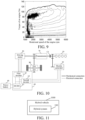
- the core underlying the control in the present invention is that driving by electricity dominates, and the high-efficiency operating area of the driving motor 20 almost covers the entire range of rotational speed and torque, as shown in FIG. 8a and FIG. 8b ; and direct driving by the engine 10 is supplementary, and the engine 10 always operates on the optimum economic line, as shown in FIG. 9 , thereby improving the fuel economy of the vehicle.
- the faction of the driving motor 20 in an area where the efficiency exceeds 90% is tested to 90.7% or more, and the driving by the motor is in the high-efficiency area for a long time.
- the engine 10 operates in a high-efficiency range of 38% or more for 70% of the time.
- the capacity of the power battery 40 is not less than 5 kWh, the faction of traveling in the EV mode can be ensured even in a non-full power state while the engine 10 is maintained to operate in a high-efficiency range.
- the output power is greater than the vehicle's demand, the battery can take in excess energy, so that the vehicle can largely operates in the electrically driven mode.
- the hybrid system 100 further includes a dual electronic controller module 60.
- the dual electronic controller module 60 is respectively connected to the driving motor 20 and the electric generator 30, and the dual electronic controller module 60 powers the driving motor 20 by an AC current outputted by the electric generator 30.
- the power battery 40 is connected to the dual electronic controller module 60, and the power battery 40 powers the driving motor 20 by the dual electronic controller module 60, or is charged by the dual electronic controller module 60 with an AC current outputted by the electric generator 30 or the driving motor 20.
- the maximum operating power of the electric generator 30 is greater than or equal to the first preset power, and the maximum operating power of the engine 10 is greater than or equal to the second preset power.
- the second preset power is greater than or equal to the first preset power, and a difference between the second preset power and the first preset power is less than 5%-10% of the second preset power.
- the capacity of the power battery 40 is greater than or equal to the first preset capacity.
- the first preset capacity is 5 kWh to 25 kWh.
- the first preset power can be set to 70 kW, and the second preset power can be set to 81 kW
- the power battery 40 has a large capacity, so that the hybrid vehicle 1000 operates in the EV mode in 80% of the operating time; and the large capacity of the power battery 40 allows for the balance of the operation of the engine 10 by charging and discharging, so that the engine 10 can always operate in high efficiency when it is in an operating state, for driving or electricity generation (referring to the foregoing description for details).
- the electric generator 30 is large, and the corresponding electricity generation power is larger, so that rapid power supplementation can be achieved.
- the time for increasing SOC of the power battery 40 from 20% to 25% is about 5 min. That is, it takes about 1 min to generate electricity in situ.
- the engine 10 is the energy source
- the electric generator 30 is the pipeline for energy flow
- the battery is the reservoir.
- the source, the pipeline, and the reservoir suffer no bottleneck for energy flow. That is, the parameters of the engine 10, and the electric generator 30, and the battery can be coordinated to realize the efficient and reasonable utilization of energy.
- the dual electronic controller module 60 includes a first inverter 61, a second inverter 62 and a DC/DC 63.
- An AC terminal of the first inverter 61 is connected to the driving motor 20, a DC terminal of the first inverter 61 is respectively connected to a DC terminal of the second inverter 62 and a first DC terminal of the DC/DC 63, an AC terminal of the second inverter 62 is connected to the electric generator 30, and a second DC terminal of the DC/DC 63 is connected to the power battery 40.
- an AC current outputted by the electric generator 30 is converted into a DC current by the second inverter 62, and the DC current is converted by the first inverter 61 into an AC current, which is then supplied to the driving motor 20; and at the same time, a DC current outputted by the power battery 40 is converted by the DC/DC 63, and then the DC current is converted by the first inverter 61 into an AC current, which is then supplied to the driving motor 20, so that the driving motor 20 can operate for driving work.
- an AC current outputted by the electric generator 30 is converted into a DC current by the second inverter 62, and the DC current is converted by the first inverter 61 into an AC current, which is then supplied to the driving motor 20, so that the driving motor 20 can operate for driving work.
- the DC current is converted by the DC/DC 63 and then charged to the power battery 40.
- the electric generator 30 when power coupling is enabled between the engine 10 and the wheel end, the electric generator 30 is idle, and the power battery 40 powers the driving motor 20, the hybrid system 100 enters the parallel assisting mode.
- a DC current outputted by the power battery 40 is converted by the DC/DC 63, and then the DC current is converted by the first inverter 61 into an AC current, which is then supplied to the driving motor 20, so that the driving motor 20 can operate for driving work.
- the engine 10 outputs power to the wheel end so as to participate in the driving work.
- the hybrid system 100 allows the hybrid vehicle 1000 to be mainly driven by electricity, supplemented by driving by fuel.
- the vehicle is preferentially driven in a high-efficiency mode, and the mode is switched according to the power performance of the vehicle and power reservation performance of the battery, so that the energy consumption, power performance, and NVH of the hybrid vehicle 1000 can well meet the user's demand.
- FIG. 11 is a schematic structural view of a hybrid vehicle 1000 according to an embodiment of the present invention. As shown in FIG. 11 , the hybrid vehicle 1000 includes the hybrid system 100 above.
- FIG. 12 is a flow chart of a control method for the hybrid vehicle 1000 according to an embodiment of the present invention.
- the hybrid vehicle 1000 includes an engine 10, a driving motor 20, an electric generator 30, and a power battery 40.
- the engine 10 is configured to selectively output power to a wheel end.
- the driving motor 20 is configured to output power to the wheel end.
- the electric generator 30 is connected to the engine 10 and driven by the engine 10 to generate electricity.
- the power battery 40 is configured to supply electricity to the driving motor 20 and be charged with an alternating current outputted by the electric generator 30 or the driving motor 20, where the capacity of the power battery 40 is greater than or equal to a first preset capacity.
- Step S202 The engine 10, the driving motor 20 and the electric generator 30 are controlled according to the traveling parameter, and the engine 10 is controlled to operate in an economic zone by the charging and discharging control of the power battery 40.
- Step S203 Equivalent fuel consumptions when the hybrid vehicle 1000 operates in the series mode, parallel mode and EV mode are compared, to select an operating mode of minimum equivalent fuel consumption as a current operation mode of the hybrid vehicle 1000.
- the traveling parameter includes at least one of the required wheel torque, SOC of the power battery 40, and vehicle speed of the hybrid vehicle 1000.
- the step of controlling the engine 10, the driving motor 20 and the electric generator 30 according to the traveling parameter when the hybrid vehicle 1000 is in the parallel mode includes: determining the required wheel torque; controlling the engine 10 to operate on the economic line to respond to the required wheel torque when the required wheel torque is less than the output torque when the engine 10 operates on the economic line, and controlling the engine 10 to drive the driving motor 20 to generate electricity, so as to charge excess energy outputted by the engine 10 to the power battery 40 by the driving motor 20; and controlling the engine 10 to operate on the economic line, when the required wheel torque is greater than the output torque when the engine 10 operates on the economic line, and controlling the power battery 40 to power the driving motor 20, so both the power battery 40 and the engine 10 respond to the required wheel torque.
- the step of controlling the engine 10, the driving motor 20 and the electric generator 30 according to the traveling parameter when the hybrid vehicle 1000 is in the series mode includes: determining a required wheel power according to the required wheel torque and the vehicle speed; controlling the engine 10 to operate on an economic line, so as to drive the electric generator 30 to generate electricity according to an output torque when the engine 10 operates on the economic line and output power to the wheel end by the driving motor 20; charging excess power to the power battery 40 by the electric generator 30 when the electricity generation power of the electric generator 30 is greater than the required wheel power; and controlling the power battery 40 to power the driving motor 20, so both the engine 10 and the power battery 40 respond to the required wheel power, when the electricity generation power of the electric generator 30 is less than the required wheel power.
- the step of controlling the engine 10, the driving motor 20 and the electric generator 30 according to the traveling parameter includes: determining a first wheel torque threshold entering the parallel mode and a second wheel torque threshold exiting the parallel mode of the hybrid vehicle 1000 according to SOC of the power battery 40 and the speed of the hybrid vehicle 1000 when the speed of the hybrid vehicle 1000 is greater than or equal to a preset vehicle speed threshold, and controlling the hybrid vehicle 1000 to enter the parallel mode when the required wheel torque is greater than or equal to the first wheel torque threshold and less than or equal to the second wheel torque threshold; control the engine 10 to operate on the economic line, and control the power battery 40 to power the driving motor 20, so both the engine 10 and the power battery 40 respond to the required wheel torque, when the required wheel torque is greater than the output torque when the engine 10 operates on the economic line; controlling the engine 10 to operate on the economic line to respond to the required wheel torque, and controlling the engine 10 to drive the driving motor 20 to generate electricity, so as to charge excess energy outputted by the engine 10 to the power battery 40 by the driving motor 20,
- the step of controlling the engine 10, the driving motor 20 and the electric generator 30 according to the traveling parameter further includes: controlling the hybrid vehicle 1000 to enter the series mode, when the required wheel torque is greater than the second wheel torque threshold; determining a required wheel power according to the required wheel torque and the vehicle speed; controlling the engine 10 to operate at a preset power at an optimum economic point, so as to drive the electric generator 30 to generate electricity according to the preset power when the engine 10 operates at the optimum economic point, and outputting power to the wheel end by the driving motor 20; charging excess power to the power battery 40 by the electric generator 30 when the electricity generation power of the electric generator 30 is greater than the required wheel power; and controlling the engine 10 to increase the output power, and controlling the engine 10 to operate on the economic line of the engine 10, so as to respond to the required wheel power, when the electricity generation power of the electric generator 30 is less than the required wheel power.
- the step of controlling the engine 10, the driving motor 20 and the electric generator 30 according to the traveling parameter further includes: determining a third wheel torque threshold entering the series mode of the hybrid vehicle 1000 according to SOC of the power battery 40 and the vehicle speed, when the speed of the hybrid vehicle 1000 is less than a preset vehicle speed threshold, and controlling the hybrid vehicle 1000 to enter the series mode when the required wheel torque is greater than or equal to the third wheel torque threshold; determining a required wheel power according to the required wheel torque and the vehicle speed; controlling the engine 10 to operate at a preset power at an optimum economic point, so as to drive the electric generator 30 to generate electricity according to the preset power when the engine 10 operates at the optimum economic point, and outputting power to the wheel end by the driving motor 20; charging excess power to the power battery 40 by the electric generator 30 when the electricity generation power of the electric generator 30 is greater than the required wheel power; and controlling the engine 10 to increase the output power, and controlling the engine 10 to operate on the economic line of the engine 10, so as to respond to the required wheel torque
- the step of controlling the engine 10, the driving motor 20 and the electric generator 30 according to the traveling parameter further includes: determining whether the current SOC of the power battery 40 is less than a second preset value when the electricity generation power of the electric generator 30 is less than the required wheel power, and controlling the engine 10 to further increase the output power if yes, so as to control the output power of the engine 10 to respond to the required wheel power, and charge the power battery 40 by the electric generator 30.
- the step of controlling the engine 10, the driving motor 20 and the electric generator 30 according to the traveling parameter further includes: controlling the engine 10 to stop operation and controlling the power battery 40 to power the driving motor 20, so as to respond to the required wheel torque by the power battery 40, when the required wheel torque is less than the third wheel torque threshold.
- the engine 10 when the hybrid vehicle 1000 operates in the series mode, the engine 10 is controlled to operate on a first economic line if SOC of the power battery 40 is in a first preset interval; and the engine 10 is controlled to operate on a second economic line if SOC of the power battery 40 is in a second preset interval.
- An upper limit of the second preset interval is less than or equal to a lower limit of the first preset interval.
- the output torque when the engine 10 operates on the second economic line is greater than or equal to the output torque when the engine 10 operates on the first economic line.
- the engine 10 when the hybrid vehicle 1000 operates in the parallel mode, the engine 10 is controlled to operate on a third economic line if SOC of the power battery 40 is in a third preset interval; the engine 10 is controlled to operate on a fourth economic line if SOC of the power battery 40 is in a fourth preset interval; and the engine 10 is controlled to operate on a fifth economic line if SOC of the power battery 40 is in a fifth preset interval.
- An upper limit of the fifth preset interval is less than or equal to a lower limit of the fourth preset interval, and an upper limit of the fourth preset interval is less than or equal to a lower limit of the third preset interval.
- the third economic line is the optimum economic line in the parallel mode.
- the fifth economic line basically coincide with an external characteristic line of the engine 10, and the fourth economic line is located between the fifth economic line and the third economic line.
- the hybrid vehicle 1000 when the hybrid vehicle 1000 operates in the EV mode, the hybrid vehicle 1000 is controlled to operate in the series mode or the parallel mode and the engine 10 is controlled to operate in the economic zone according to SOC of the power battery 40, the vehicle speed and the required wheel torque if SOC of the power battery 40 is less than the third preset value.
- control method for the hybrid vehicle 1000 according to the present invention can be made reference to the description of the hybrid system 100 according to the present invention, and details will not be given here again.
- a traveling parameter of the hybrid vehicle 1000 is acquired; the engine 10, the driving motor 20, and the electric generator 30 are controlled according to the traveling parameter, to enable the engine 10 to operate in an economic zone, by charging and discharging control of the power battery 40; and the equivalent fuel consumptions when the hybrid vehicle 1000 is in the series mode, parallel mode, and EV mode are compared, to select an operation mode of minimum equivalent fuel consumption as a current operation mode of the hybrid vehicle 1000.
- the hybrid vehicle 1000 is allowed to operate with a low energy consumption in an operation mode of minimum equivalent fuel consumption according to the traveling parameter, thereby effectively improving the economy of the hybrid vehicle 1000, and meeting the user's expectation during use.
- a computer-readable storage medium is further provided, on which a control program for the hybrid vehicle 1000 is stored.
- the control program for the hybrid vehicle 1000 is executed by the processor 2200, the control method for the hybrid vehicle 1000 is implemented.
- the computer-readable storage medium enables, by the control method for the hybrid vehicle 1000 as described above, the hybrid vehicle 1000 to operate with a low energy consumption in an operation mode of minimum equivalent fuel consumption according to the traveling parameter, thereby effectively improving the economy of the hybrid vehicle 1000, and meeting the user's expectation during use.
- FIG. 13 is a schematic structural view of a vehicle controller 2000 according to an embodiment of the present invention.
- the vehicle controller 2000 includes a memory 2100, a processor 2200, and a control program for the hybrid vehicle 1000 stored on the memory 2100 and running on the processor 2200.
- the control program for the hybrid vehicle 1000 is implemented by the processor 2200, the control method for the hybrid vehicle 1000 is implemented.
- the vehicle controller 2000 enables, by the control method for the hybrid vehicle 1000 as described above, the hybrid vehicle 1000 to operate with a low energy consumption in an operation mode of minimum equivalent fuel consumption according to the traveling parameter, thereby effectively improving the economy of the hybrid vehicle 1000, and meeting the user's expectation during use.
- a "computer-readable medium” may be any apparatus that can include, store, communicate, propagate, or transmit the program for use by the instruction execution system, apparatus, or device or in combination with the instruction execution system, apparatus, or device.
- the computer-readable medium includes the following: an electrical connection (electronic device) having one or more wires, a portable computer diskette (magnetic apparatus), a random access memory (RAM) 2100, a read-only memory (ROM) 2100, an erasable programmable read-only memory 2100 (EPROM or flash memory 2100), an optical fiber apparatus, and a portable compact disk read-only memory (CD-ROM) 2100.
- the computer-readable medium can even be paper or other suitable media on which the program can be printed, because the program can be obtained electronically by, for example, optically scanning the paper or other media, then editing, interpreting, or processing in other suitable ways if necessary, and then stored in a computer memory 2100.
- steps or methods can be implemented by software or firmware that is stored in a memory 2100 and executed by a proper instruction execution system.
- implementation may be performed by any one of the following technologies well known in the art or a combination thereof: a discrete logic circuit including a logic gate circuit for implementing a logic function of a data signal, a dedicated integrated circuit including a proper combined logic gate circuit, a programmable gate array (PGA), a field programmable gate array (FPGA), and the like.
- first and second are used merely for the purpose of description, and shall not be construed as indicating or implying relative importance or implying a quantity of indicated technical features. Therefore, the features defined by “first”, and “second” may explicitly or implicitly include at least one of the features. In the descriptions of the present invention, unless explicitly specified, “multiple” means at least two, for example, two or three.
- a connection may be a fixed connection, a detachable connection, or an integral connection; or the connection may be a mechanical connection or an electrical connection; or the connection may be a direct connection, an indirect connection through an intermediary, or internal communication between two elements or mutual action relationship between two elements, unless otherwise specified explicitly.
- the specific meanings of the above terms in the present disclosure can be understood according to specific situations.
Landscapes
- Engineering & Computer Science (AREA)
- Transportation (AREA)
- Mechanical Engineering (AREA)
- Chemical & Material Sciences (AREA)
- Combustion & Propulsion (AREA)
- Automation & Control Theory (AREA)
- Power Engineering (AREA)
- Sustainable Development (AREA)
- Sustainable Energy (AREA)
- Life Sciences & Earth Sciences (AREA)
- Electric Propulsion And Braking For Vehicles (AREA)
- Hybrid Electric Vehicles (AREA)
- Control Of Vehicle Engines Or Engines For Specific Uses (AREA)
Claims (15)
- Steuerungsverfahren für ein Hybridfahrzeug (100), wobei das Hybridfahrzeug einen Motor bzw. Verbrennungsmotor (10), einen Antriebsmotor (20), einen elektrischen Generator (30) und eine Leistungsbatterie (40) umfasst, wobei der Motor konfiguriert ist, um selektiv Leistung an ein Radende abzugeben, wobei der Antriebsmotor konfiguriert ist, um Leistung an das Radende abzugeben, der elektrische Generator mit dem Motor verbunden ist und von dem Motor angetrieben wird, um Elektrizität zu erzeugen, die Leistungsbatterie dazu konfiguriert ist, Elektrizität an den Antriebsmotor zu liefern und mit einem Wechselstrom geladen zu werden, der von dem elektrischen Generator oder dem Antriebsmotor ausgegeben wird, und die Kapazität der Leistungsbatterie größer oder gleich einer ersten voreingestellten Kapazität ist, wobei das Steuerungsverfahren umfasst:Erfassen (S201) eines Fahrparameters des Hybridfahrzeugs;Steuern (S202) des Motors, des Antriebsmotors und des elektrischen Generators in Abhängigkeit von den Fahrparametern, um den Motor in die Lage zu versetzen, in einer wirtschaftlichen Zone zu arbeiten, durch Steuerung des Ladens und Entladens der Leistungsbatterie; gekennzeichnet durchVergleichen (S203) der äquivalenten Kraftstoffverbräuche, wenn sich das Hybridfahrzeug in einem Serienmodus, einem Parallelmodus und einem EV-Modus befindet, um einen Betriebsmodus mit minimalem äquivalentem Kraftstoffverbrauch als einen aktuellen Betriebsmodus des Hybridfahrzeugs auszuwählen;wobei, wenn der Motor (10) in der wirtschaftlichen Zone arbeitet, der Motor so gesteuert wird, dass er auf einer optimalen wirtschaftlichen Linie arbeitet, wenn der SOC der Leistungsbatterie größer oder gleich einem ersten voreingestellten Wert ist, oder der Motor so gesteuert wird, dass er auf der optimalen wirtschaftlichen Linie arbeitet, wenn der SOC der Leistungsbatterie kleiner als der erste voreingestellte Wert ist und die Ausgangsleistung des Motors größer oder gleich einer erforderlichen Radleistung ist, wobei der erste voreingestellte Wert umgekehrt mit der ersten voreingestellten Kapazität korreliert.
- Steuerungsverfahren für ein Hybridfahrzeug gemäß Anspruch 1, wobei, wenn sich das Hybridfahrzeug in dem Serienmodus befindet, der Motor (10) die Leistungsbatterie (40) durch den elektrischen Generator (30) auflädt, und wenn sich das Hybridfahrzeug in dem Parallelmodus befindet, der Motor (10) die Leistungsbatterie durch den Antriebsmotor (20) auflädt.
- Steuerungsverfahren für ein Hybridfahrzeug gemäß Anspruch 1 oder 2, wobei der Fahrparameter mindestens eines der folgenden Elemente umfasst: das erforderliche Raddrehmoment, den SOC der Leistungsbatterie und die Fahrzeuggeschwindigkeit des Hybridfahrzeugs.
- Steuerungsverfahren für ein Hybridfahrzeug gemäß Anspruch 3,
wobei der Schritt der Steuerung des Motors, des Antriebsmotors und des elektrischen Generators in Abhängigkeit von den Fahrparametern, wenn sich das Hybridfahrzeug in dem Parallelmodus befindet, umfasst:Bestimmung des erforderlichen Raddrehmoments;Steuern des Motors (10), um auf der ökonomischen Linie zu arbeiten, um auf das erforderliche Raddrehmoment zu reagieren, wenn das erforderliche Raddrehmoment geringer ist als das Ausgangsdrehmoment, wenn der Motor auf der ökonomischen Linie arbeitet, und Steuern des Motors, um den Antriebsmotor (20) anzutreiben, um Elektrizität zu erzeugen, um überschüssige Energie, die von dem Motor ausgegeben wird, durch den Antriebsmotor in die Leistungsbatterie (40) zu laden; undSteuerung des Motors (10), um auf der ökonomischen Linie zu arbeiten, wenn das erforderliche Raddrehmoment größer ist als das Ausgangsdrehmoment, wenn der Motor auf der ökonomischen Linie arbeitet, und Steuerung der Leistungsbatterie (40), um den Antriebsmotor (20) zu versorgen, so dass sowohl die Leistungsbatterie als auch der Motor auf das erforderliche Raddrehmoment reagieren; oderwobei der Schritt der Steuerung des Motors, des Antriebsmotors und des elektrischen Generators in Abhängigkeit von den Fahrparametern, wenn sich das Hybridfahrzeug in dem Serienmodus befindet, umfasst:Ermittlung der erforderlichen Radleistung in Abhängigkeit von dem erforderlichen Raddrehmoment und der Fahrzeuggeschwindigkeit;Steuerung des Motors (10) für den Betrieb auf der ökonomischen Linie, um den elektrischen Generator anzutreiben, um Elektrizität entsprechend dem Ausgangsdrehmoment zu erzeugen, wenn der Motor auf der ökonomischen Linie arbeitet, und um Leistung an das Radende durch den Antriebsmotor abzugeben;Laden von Überschussstrom in die Leistungsbatterie (40) durch den elektrischen Generator (30), wenn die Stromerzeugungsleistung des elektrischen Generators größer ist als die erforderliche Radleistung; undSteuerung der Leistungsbatterie zur Versorgung des Antriebsmotors (20), so dass sowohl der Motor als auch die Leistungsbatterie auf die erforderliche Radleistung reagieren, wenn die Stromerzeugungsleistung des elektrischen Generators geringer ist als die erforderliche Radleistung. - Steuerungsverfahren für ein Hybridfahrzeug gemäß Anspruch 3, wobei der Schritt der Steuerung des Motors, des Antriebsmotors und des elektrischen Generators gemäß dem Fahrparameter umfasst:Bestimmen eines ersten Raddrehmomentschwellenwerts, der in den Parallelmodus eintritt, und eines zweiten Raddrehmomentschwellenwerts, der den Parallelmodus des Hybridfahrzeugs verlässt, gemäß dem SOC der Energiebatterie und der Geschwindigkeit des Hybridfahrzeugs, wenn die Geschwindigkeit des Hybridfahrzeugs größer oder gleich einem voreingestellten Fahrzeuggeschwindigkeitsschwellenwert ist, und Steuern des Hybridfahrzeugs, um in den Parallelmodus einzutreten, wenn das erforderliche Raddrehmoment größer oder gleich dem ersten Raddrehmomentschwellenwert und kleiner oder gleich dem zweiten Raddrehmomentschwellenwert ist;Steuerung des Motors (10), um auf der ökonomischen Linie zu arbeiten, und Steuerung der Leistungsbatterie, um den Antriebsmotor (20) zu versorgen, so dass sowohl der Motor als auch die Leistungsbatterie auf das erforderliche Raddrehmoment reagieren, wenn das erforderliche Raddrehmoment größer ist als das Ausgangsdrehmoment, wenn der Motor auf der ökonomischen Linie arbeitet;Steuern des Motors (10), um auf der ökonomischen Linie zu arbeiten, um auf das erforderliche Raddrehmoment zu reagieren, und Steuern des Motors, um den Antriebsmotor anzutreiben, um Elektrizität zu erzeugen, um überschüssige Energie, die von dem Motor ausgegeben wird, durch den Antriebsmotor (20) in die Leistungsbatterie (40) zu laden, wenn das erforderliche Raddrehmoment geringer ist als das Ausgangsdrehmoment, wenn der Motor auf der ökonomischen Linie arbeitet; undSteuerung des Motors (10) für den Betrieb auf der ökonomischen Linie, um unabhängig auf das erforderliche Raddrehmoment zu reagieren, wenn das erforderliche Raddrehmoment gleich dem Ausgangsdrehmoment ist, wenn der Motor auf der ökonomischen Linie arbeitet.
- Steuerungsverfahren für ein Hybridfahrzeug gemäß Anspruch 5, wobei der erste Raddrehmomentschwellenwert und der zweite Raddrehmomentschwellenwert positiv mit dem SOC der Leistungsbatterie korrelieren; oder
wobei beim Betrieb des Hybridfahrzeugs in der Parallelbetriebsart die Fahrzeuggeschwindigkeit, bei der der Motor in den Betrieb einbezogen ist, umgekehrt mit dem SOC der Leistungsbatterie korreliert. - Steuerungsverfahren für ein Hybridfahrzeug gemäß Anspruch 5, wobei der Schritt der Steuerung des Motors, des Antriebsmotors und des elektrischen Generators gemäß den Fahrparametern ferner umfasst:
Steuerung des Motors (10), um den Betrieb zu stoppen, und Steuerung der Leistungsbatterie, um den Antriebsmotor (20) mit Energie zu versorgen, um auf das erforderliche Raddrehmoment durch die Leistungsbatterie (40) zu reagieren, wenn das erforderliche Raddrehmoment unter dem ersten Raddrehmomentschwellenwert liegt. - Steuerungsverfahren für ein Hybridfahrzeug gemäß Anspruch 5, wobei der Schritt der Steuerung des Motors, des Antriebsmotors und des elektrischen Generators gemäß dem Fahrparameter ferner umfasst:Steuerung des Hybridfahrzeugs (1000) zum Eintritt in den Serienmodus, wenn das erforderliche Raddrehmoment größer ist als der zweite Raddrehmomentschwellenwert;Ermittlung der erforderlichen Radleistung in Abhängigkeit von dem erforderlichen Raddrehmoment und der Fahrzeuggeschwindigkeit;Steuern des Motors (10), um mit einer voreingestellten Leistung an einem optimalen wirtschaftlichen Punkt zu arbeiten, um den elektrischen Generator anzutreiben, um Elektrizität gemäß der voreingestellten Leistung zu erzeugen, wenn der Motor an dem optimalen wirtschaftlichen Punkt arbeitet, und Ausgeben von Leistung an das Radende durch den Antrieb smotor (20);Laden von Überschussstrom in die Leistungsbatterie (40) durch den elektrischen Generator, wenn die Stromerzeugungsleistung des elektrischen Generators größer ist als die erforderliche Radleistung; undSteuerung des Motors, um die Ausgangsleistung zu erhöhen, und Steuerung des Motors, um auf der wirtschaftlichen Linie des Motors zu arbeiten, um auf die erforderliche Radleistung zu reagieren, wenn die Stromerzeugungsleistung des elektrischen Generators geringer ist als die erforderliche Radleistung.
- Steuerungsverfahren für ein Hybridfahrzeug gemäß Anspruch 5, wobei der Schritt der Steuerung des Motors, des Antriebsmotors und des elektrischen Generators gemäß dem Fahrparameter ferner umfasst:Bestimmen einer dritten Raddrehmomentschwelle, die in den Serienmodus des Hybridfahrzeugs eintritt, entsprechend dem SOC der Energiebatterie und der Fahrzeuggeschwindigkeit, wenn die Geschwindigkeit des Hybridfahrzeugs kleiner als eine voreingestellte Fahrzeuggeschwindigkeitsschwelle ist, und Steuern des Hybridfahrzeugs, um in den Serienmodus einzutreten, wenn das erforderliche Raddrehmoment größer oder gleich der dritten Raddrehmomentschwelle ist;Ermittlung der erforderlichen Radleistung in Abhängigkeit von dem erforderlichen Raddrehmoment und der Fahrzeuggeschwindigkeit;Steuern des Motors (10), um mit einer voreingestellten Leistung an einem optimalen wirtschaftlichen Punkt zu arbeiten, um so den elektrischen Generator (30) anzutreiben, um Elektrizität entsprechend der voreingestellten Leistung zu erzeugen, wenn der Motor an dem optimalen wirtschaftlichen Punkt arbeitet, und Ausgeben von Leistung an das Radende durch den Antriebsmotor (20);Laden von Überschussstrom in die Leistungsbatterie (40) durch den elektrischen Generator (30), wenn die Stromerzeugungsleistung des elektrischen Generators größer ist als die erforderliche Radleistung; undSteuerung des Motors, um die Ausgangsleistung zu erhöhen, und Steuerung des Motors, um auf der wirtschaftlichen Linie des Motors zu arbeiten, um auf die erforderliche Radleistung zu reagieren, wenn die Stromerzeugungsleistung des elektrischen Generators (30) geringer ist als die erforderliche Radleistung.
- Steuerungsverfahren für ein Hybridfahrzeug gemäß Anspruch 8 oder 9, wobei der Schritt der Steuerung des Motors, des Antriebsmotors und des elektrischen Generators gemäß dem Fahrparameter ferner umfasst:
Bestimmen, ob der aktuelle SOC der Leistungsbatterie (40) kleiner als ein zweiter voreingestellter Wert ist, wenn die Elektrizitätserzeugungsleistung des elektrischen Generators (30) kleiner als die erforderliche Radleistung ist, und Steuern des Motors, um die Ausgangsleistung ferner zu erhöhen, falls ja, um die Ausgangsleistung des Motors (10) zu steuern, um auf die erforderliche Radleistung zu reagieren, und die Leistungsbatterie durch den elektrischen Generator (30) zu laden. - Steuerungsverfahren für ein Hybridfahrzeug gemäß Anspruch 9,
wobei der Schritt der Steuerung des Motors, des Antriebsmotors und des elektrischen Generators in Abhängigkeit von den Fahrparametern ferner umfasst:
Steuerung des Motors (10), um den Betrieb zu stoppen, und Steuerung der Leistungsbatterie (40), um den Antriebsmotor (20) mit Energie zu versorgen, um auf das erforderliche Raddrehmoment durch die Leistungsbatterie zu reagieren, wenn das erforderliche Raddrehmoment unter dem dritten Raddrehmomentschwellenwert liegt; und/oder wobei der Schwellenwert für das dritte Raddrehmoment positiv mit dem SOC der Energiebatterie (40) korreliert. - Steuerungsverfahren für ein Hybridfahrzeug gemäß Anspruch 3,wobei, wenn das Hybridfahrzeug in dem Serienmodus arbeitet,der Motor (10) so gesteuert wird, dass er auf einer ersten wirtschaftlichen Linie arbeitet, wenn der SOC der Leistungsbatterie in einem ersten voreingestellten Intervall liegt; undder Motor so gesteuert wird, dass er auf einer zweiten ökonomischen Linie arbeitet, wenn der SOC der Energiebatterie in einem zweiten voreingestellten Intervall liegt, wobei eine obere Grenze des zweiten voreingestellten Intervalls kleiner als oder gleich einer unteren Grenze des ersten voreingestellten Intervalls ist; die erste ökonomische Linie die optimale ökonomische Linie des Serienmodus ist; und bei der gleichen Drehzahl das Ausgangsdrehmoment, wenn der Motor auf der zweiten ökonomischen Linie arbeitet, größer als oder gleich dem Ausgangsdrehmoment ist, wenn der Motor auf der ersten ökonomischen Linie arbeitet; und/oderwobei, wenn das Hybridfahrzeug in dem Parallelmodus arbeitet,der Motor (10) so gesteuert wird, dass er auf einer dritten wirtschaftlichen Linie arbeitet, wenn der SOC der Leistungsbatterie (40) in einem dritten voreingestellten Intervall liegt;der Motor (10) so gesteuert wird, dass er auf einer vierten ökonomischen Linie arbeitet, wenn der SOC der Energiebatterie in einem vierten voreingestellten Intervall liegt; undder Motor (10) so gesteuert wird, dass er auf einer fünften ökonomischen Linie arbeitet, wenn der SOC der Energiebatterie in einem fünften voreingestellten Intervall liegt, wobei eine obere Grenze des fünften voreingestellten Intervalls kleiner oder gleich einer unteren Grenze des vierten voreingestellten Intervalls ist und eine obere Grenze des vierten voreingestellten Intervalls kleiner oder gleich einer unteren Grenze des dritten voreingestellten Intervalls ist; die dritte ökonomische Linie die optimale ökonomische Linie in dem Parallelmodus ist; und die fünfte ökonomische Linie im Wesentlichen mit einer äußeren charakteristischen Linie des Motors übereinstimmt und die vierte ökonomische Linie zwischen der fünften ökonomischen Linie und der dritten ökonomischen Linie angeordnet ist.
- Steuerungsverfahren für ein Hybridfahrzeug gemäß Anspruch 3, wobei das Hybridfahrzeug in dem EV-Modus betrieben wird,
das Hybridfahrzeug (1000) so gesteuert wird, dass es im Serienmodus oder im Parallelmodus arbeitet, und der Motor so gesteuert wird, dass er in dem wirtschaftlichen Bereich arbeitet, je nach dem SOC der Leistungsbatterie (40), der Fahrzeuggeschwindigkeit und dem erforderlichen Raddrehmoment, wenn der SOC der Leistungsbatterie unter einem dritten voreingestellten Wert liegt. - Computerlesbares Speichermedium, das ein Steuerprogramm für ein Hybridfahrzeug speichert, wobei, wenn das Steuerprogramm für ein Hybridfahrzeug von einem Prozessor ausgeführt wird, das Steuerverfahren für ein Hybridfahrzeug gemäß einem der Ansprüche 1 bis 13 implementiert wird.
- Fahrzeugsteuergerät (2000), umfassend: einen Speicher (2100), einen Prozessor (2200) und ein Steuerprogramm für ein Hybridfahrzeug, das in dem Speicher gespeichert und auf dem Prozessor ausführbar ist, wobei, wenn das Steuerprogramm für ein Hybridfahrzeug durch den Prozessor ausgeführt wird, das Steuerverfahren für ein Hybridfahrzeug gemäß einem der Ansprüche 1 bis 13 implementiert wird.
Applications Claiming Priority (2)
| Application Number | Priority Date | Filing Date | Title |
|---|---|---|---|
| CN202110228793.2A CN112590528B (zh) | 2021-03-02 | 2021-03-02 | 混合动力系统、混合动力车辆及其控制方法、整车控制器 |
| PCT/CN2021/083380 WO2022183549A1 (zh) | 2021-03-02 | 2021-03-26 | 混合动力车辆的控制方法和整车控制器 |
Publications (3)
| Publication Number | Publication Date |
|---|---|
| EP4253116A1 EP4253116A1 (de) | 2023-10-04 |
| EP4253116A4 EP4253116A4 (de) | 2024-06-05 |
| EP4253116B1 true EP4253116B1 (de) | 2025-03-12 |
Family
ID=75207671
Family Applications (1)
| Application Number | Title | Priority Date | Filing Date |
|---|---|---|---|
| EP21928630.9A Active EP4253116B1 (de) | 2021-03-02 | 2021-03-26 | Steuerungsverfahren für hybridfahrzeug und fahrzeugsteuerungseinheit |
Country Status (10)
| Country | Link |
|---|---|
| US (1) | US12485873B2 (de) |
| EP (1) | EP4253116B1 (de) |
| JP (1) | JP7614370B2 (de) |
| KR (1) | KR20230111252A (de) |
| CN (1) | CN112590528B (de) |
| AU (2) | AU2021430962B2 (de) |
| ES (1) | ES3020907T3 (de) |
| HU (1) | HUE071072T2 (de) |
| PL (1) | PL4253116T3 (de) |
| WO (1) | WO2022183549A1 (de) |
Families Citing this family (29)
| Publication number | Priority date | Publication date | Assignee | Title |
|---|---|---|---|---|
| CN113147720B (zh) * | 2021-05-08 | 2022-08-26 | 湖南三一路面机械有限公司 | 混合动力设备、混合动力系统、混合动力系统的控制方法 |
| CN113320522B (zh) * | 2021-06-30 | 2022-03-25 | 中国第一汽车股份有限公司 | 一种混合动力车辆工作模式切换方法及混合动力车辆 |
| CN113386732B (zh) * | 2021-06-30 | 2023-03-17 | 中国第一汽车股份有限公司 | 一种非插电混动车辆工作模式的切换方法 |
| CN115723736B (zh) * | 2021-08-31 | 2024-09-10 | 比亚迪股份有限公司 | 混合动力车辆及其功率分配方法和装置、整车控制器 |
| CN114684137B (zh) * | 2022-02-14 | 2024-03-22 | 东风柳州汽车有限公司 | 串联模式下的发电点选择方法、装置、设备及存储介质 |
| CN114394083B (zh) * | 2022-03-01 | 2024-08-30 | 重庆金康动力新能源有限公司 | 混合动力汽车扭矩分配方法和系统 |
| CN114673207A (zh) * | 2022-04-06 | 2022-06-28 | 杭齿传动(安徽)有限公司 | 一种混合传动泥浆泵齿轮箱系统及其控制方法 |
| CN114559929B (zh) * | 2022-04-18 | 2025-08-01 | 中国第一汽车股份有限公司 | 基于外部介入扭矩的车辆控制方法以及装置 |
| CN114715122B (zh) * | 2022-04-25 | 2023-08-08 | 合众新能源汽车股份有限公司 | 增程器的控制方法、装置、电子设备和存储介质 |
| CN115257349B (zh) * | 2022-08-01 | 2024-11-05 | 麦格纳动力总成(江西)有限公司 | 一种混合动力驱动系统、控制方法及汽车 |
| CN116215488B (zh) * | 2023-02-03 | 2025-06-27 | 赛力斯汽车有限公司 | 增程式电动汽车的驱动控制方法、电子设备及存储介质 |
| CN116353618A (zh) * | 2023-03-08 | 2023-06-30 | 中国第一汽车股份有限公司 | 车辆驾驶信息提示方法、装置、存储介质及电子装置 |
| CN116331186B (zh) * | 2023-03-10 | 2025-08-19 | 重庆长安汽车股份有限公司 | 一种混动车辆的最优经济工作点的确定方法、装置、车辆、介质及设备 |
| CN116215499B (zh) * | 2023-03-10 | 2025-08-19 | 重庆长安汽车股份有限公司 | 混动车辆的目标驱动模式判定方法、装置、车辆、介质及设备 |
| CN116215498B (zh) * | 2023-03-10 | 2025-08-05 | 重庆长安汽车股份有限公司 | 混动车辆的驱动模式切换时机判定方法、驱动模式控制方法、装置、车辆、介质及设备 |
| CN116394917B (zh) * | 2023-03-31 | 2025-07-29 | 重庆长安汽车股份有限公司 | 一种混动车辆的串并联驱动模式切换控制方法、装置、车辆、设备及介质 |
| CN116653911B (zh) * | 2023-05-29 | 2024-02-13 | 广州汽车集团股份有限公司 | 混动系统控制方法、装置、计算机可读介质及电子设备 |
| TWI862042B (zh) * | 2023-07-27 | 2024-11-11 | 亞福儲能股份有限公司 | 複合動力系統 |
| CN117400904B (zh) * | 2023-11-06 | 2025-03-07 | 东风商用车有限公司 | 基于虚拟双电池的运行模式确定方法、装置及存储介质 |
| KR20250113725A (ko) * | 2024-01-19 | 2025-07-28 | 현대자동차주식회사 | 차량 제어 장치 및 그 방법 |
| CN117681856B (zh) * | 2024-02-04 | 2024-05-07 | 西南交通大学 | 一种基于整车扭矩需求及电量状态的能量管理控制方法 |
| CN117841972B (zh) * | 2024-02-19 | 2024-07-30 | 重庆赛力斯凤凰智创科技有限公司 | 使用增程器提升动力性的控制方法、系统、设备及介质 |
| CN117944655B (zh) * | 2024-03-06 | 2024-09-03 | 重庆赛力斯凤凰智创科技有限公司 | 车辆扭矩确定方法、装置、电子设备及存储介质 |
| CN118597091B (zh) * | 2024-05-27 | 2025-10-31 | 比亚迪股份有限公司 | 新能源车辆能量智能管理方法、系统及相关设备 |
| CN118722569A (zh) * | 2024-06-26 | 2024-10-01 | 中国第一汽车股份有限公司 | 混动车辆串联四驱的控制方法、控制装置及车辆 |
| US20260028014A1 (en) * | 2024-07-25 | 2026-01-29 | Caterpillar Inc. | Control system for a hybrid vehicle |
| CN119037390B (zh) * | 2024-08-23 | 2025-06-06 | 广州汽车集团股份有限公司 | 车辆工作模式控制方法、装置、控制器、车辆及存储介质 |
| CN119239562A (zh) * | 2024-10-21 | 2025-01-03 | 一汽解放汽车有限公司 | 一种增程器控制方法、装置、设备及介质 |
| CN120308089B (zh) * | 2025-05-15 | 2025-11-07 | 江苏致控驱动技术有限公司 | 一种增程器发电系统及控制方法 |
Family Cites Families (26)
| Publication number | Priority date | Publication date | Assignee | Title |
|---|---|---|---|---|
| JP3401181B2 (ja) * | 1998-02-17 | 2003-04-28 | トヨタ自動車株式会社 | ハイブリッド車の駆動制御装置 |
| US8284038B2 (en) * | 2009-08-11 | 2012-10-09 | Ford Global Technologies, Llc | System and method for indicating a vehicle driving mode |
| FR2953772B1 (fr) * | 2009-12-15 | 2012-01-06 | Continental Automotive France | Procede de pilotage d'un dispositif de motorisation de vehicule hybride, et dispositif associe |
| JP5767238B2 (ja) | 2010-11-04 | 2015-08-19 | トヨタ自動車株式会社 | 車両用ハイブリッド駆動装置 |
| EP2815942B1 (de) * | 2012-02-15 | 2017-11-01 | Toyota Jidosha Kabushiki Kaisha | Steuervorrichtung und steuersystem |
| JP6070934B2 (ja) | 2012-12-21 | 2017-02-01 | 三菱自動車工業株式会社 | ハイブリッド車の走行モード切換制御装置 |
| CN103350696B (zh) * | 2013-07-11 | 2016-04-27 | 北京交通大学 | 一种控制混合动力汽车扭矩输出的装置及方法 |
| CN104276031B (zh) * | 2014-01-30 | 2016-01-13 | 比亚迪股份有限公司 | 车辆及其驱动控制方法 |
| JP6172008B2 (ja) * | 2014-03-24 | 2017-08-02 | トヨタ自動車株式会社 | ハイブリッド車両 |
| JP2015202807A (ja) * | 2014-04-15 | 2015-11-16 | トヨタ自動車株式会社 | 車両制御装置 |
| CN104442345B (zh) * | 2014-11-11 | 2017-02-01 | 奇瑞汽车股份有限公司 | 混联式混合动力汽车动力总成系统及其功率分配控制方法 |
| EP3309031B1 (de) * | 2015-06-09 | 2020-07-29 | Nissan Motor Co., Ltd. | Modusübergangsteuerungsvorrichtung für hybridfahrzeug |
| WO2016199247A1 (ja) * | 2015-06-10 | 2016-12-15 | 日産自動車株式会社 | ハイブリッド車両のエネルギ管理制御装置 |
| JP2018154230A (ja) * | 2017-03-17 | 2018-10-04 | 株式会社豊田中央研究所 | ハイブリッド車両の制御システム |
| CN108656924B (zh) * | 2017-03-31 | 2020-11-06 | 比亚迪股份有限公司 | 混合动力汽车的动力系统和发电控制方法及混合动力汽车 |
| CN108656929B (zh) * | 2017-03-31 | 2020-04-24 | 比亚迪股份有限公司 | 混合动力汽车的动力系统和发电控制方法及混合动力汽车 |
| CN108973977A (zh) | 2017-06-02 | 2018-12-11 | 天津市松正电动汽车技术股份有限公司 | 一种混合动力汽车能量输出管理方法 |
| CN109606348B (zh) | 2019-01-14 | 2020-03-31 | 吉林大学 | 一种插电式行星混联汽车能量管理控制方法 |
| CN110040004B (zh) | 2019-04-01 | 2020-10-02 | 一汽-大众汽车有限公司 | 一种增程式纯电动汽车的功率跟随控制方法和系统 |
| KR102570749B1 (ko) * | 2019-04-11 | 2023-08-28 | 현대자동차주식회사 | 차량 및 차량의 제어방법 |
| CN109910868B (zh) | 2019-04-24 | 2021-08-24 | 重庆长安新能源汽车科技有限公司 | 一种用于混合动力车辆串联模式的能量管理方法及装置 |
| CN110239512B (zh) | 2019-05-10 | 2021-01-05 | 浙江吉利控股集团有限公司 | 一种混合动力车辆的能量管理方法及系统 |
| CN111942367A (zh) | 2019-05-17 | 2020-11-17 | 上汽通用汽车有限公司 | 混合动力车辆的动力系统的扭矩分配的方法 |
| CN110304042B (zh) | 2019-05-20 | 2022-01-11 | 北京理工大学 | 基于规则的四驱phev转矩分配控制方法 |
| CN111907511A (zh) * | 2020-07-30 | 2020-11-10 | 舍弗勒技术股份两合公司 | 混合动力系统用功率控制方法及混合动力系统 |
| CN112193232B (zh) | 2020-09-23 | 2021-10-12 | 江苏大学 | 一种混合动力汽车自适应能量管理系统及方法 |
-
2021
- 2021-03-02 CN CN202110228793.2A patent/CN112590528B/zh active Active
- 2021-03-26 KR KR1020237022315A patent/KR20230111252A/ko active Pending
- 2021-03-26 EP EP21928630.9A patent/EP4253116B1/de active Active
- 2021-03-26 ES ES21928630T patent/ES3020907T3/es active Active
- 2021-03-26 PL PL21928630.9T patent/PL4253116T3/pl unknown
- 2021-03-26 HU HUE21928630A patent/HUE071072T2/hu unknown
- 2021-03-26 AU AU2021430962A patent/AU2021430962B2/en active Active
- 2021-03-26 JP JP2023540637A patent/JP7614370B2/ja active Active
- 2021-03-26 WO PCT/CN2021/083380 patent/WO2022183549A1/zh not_active Ceased
-
2023
- 2023-06-30 US US18/216,695 patent/US12485873B2/en active Active
-
2025
- 2025-11-12 AU AU2025267354A patent/AU2025267354A1/en active Pending
Also Published As
| Publication number | Publication date |
|---|---|
| JP2024507050A (ja) | 2024-02-16 |
| KR20230111252A (ko) | 2023-07-25 |
| WO2022183549A1 (zh) | 2022-09-09 |
| US12485873B2 (en) | 2025-12-02 |
| JP7614370B2 (ja) | 2025-01-15 |
| CN112590528A (zh) | 2021-04-02 |
| CN112590528B (zh) | 2021-06-18 |
| EP4253116A1 (de) | 2023-10-04 |
| EP4253116A4 (de) | 2024-06-05 |
| ES3020907T3 (en) | 2025-05-23 |
| AU2021430962A1 (en) | 2023-08-31 |
| AU2021430962B2 (en) | 2025-08-14 |
| HUE071072T2 (hu) | 2025-07-28 |
| US20230339451A1 (en) | 2023-10-26 |
| AU2025267354A1 (en) | 2025-12-04 |
| PL4253116T3 (pl) | 2025-07-14 |
Similar Documents
| Publication | Publication Date | Title |
|---|---|---|
| EP4253116B1 (de) | Steuerungsverfahren für hybridfahrzeug und fahrzeugsteuerungseinheit | |
| US10017174B2 (en) | Control system and control method of hybrid electric vehicle | |
| EP2558329B1 (de) | Stromversorgungssystem und mit dem stromversorgungssystem ausgestattetes fahrzeug | |
| US9487090B2 (en) | Dual energy storage system for micro hybrid vehicles | |
| CN113844249B (zh) | 混合动力系统、混合动力车辆及其控制方法、整车控制器 | |
| US10396647B2 (en) | Converter controlling device for hybrid vehicle and converter controlling method for hybrid vehicle | |
| CN113829864B (zh) | 混合动力系统、混合动力车辆及其控制方法、整车控制器 | |
| EP2752344A1 (de) | Steuerungsvorrichtung für ein hybridfahrzeug | |
| CN203713586U (zh) | 电动客车增程器的集成控制系统 | |
| WO2010050040A1 (ja) | 電動車両の電源システムおよびその制御方法 | |
| CN106143481A (zh) | 混合动力汽车的控制方法和装置 | |
| CN106143467B (zh) | 混合动力汽车的控制方法和装置 | |
| CN106143483B (zh) | 混合动力汽车的控制方法和装置 | |
| CN111169458A (zh) | 一种混合动力汽车的功率分配方法、装置及系统 | |
| JP2021020657A (ja) | 車両の制御装置 | |
| CN115782853A (zh) | 一种增程式车辆的控制方法和控制系统 | |
| CN113135104B (zh) | 电动车辆的充电方法 | |
| CN113859048B (zh) | 一种车辆发电控制方法、控制系统及车辆 | |
| KR101786128B1 (ko) | 듀얼모드를 구비하는 저전압직류변환장치 | |
| JP2010125956A (ja) | 電動車両の制御システム | |
| US10351123B2 (en) | Method for controlling hybrid vehicle | |
| KR102572840B1 (ko) | 하이브리드 차량의 엔진 및 모터의 출력 토크를 분배하는 제어 시스템 및 그 동작 방법 | |
| US20250263063A1 (en) | System and method for power allocation to high-voltage thermal loads from multiple energy sources in a hybrid powertrain during cold conditions | |
| CN119840817A (zh) | 一种增程式电动船舶动力系统的控制方法 |
Legal Events
| Date | Code | Title | Description |
|---|---|---|---|
| STAA | Information on the status of an ep patent application or granted ep patent |
Free format text: STATUS: THE INTERNATIONAL PUBLICATION HAS BEEN MADE |
|
| PUAI | Public reference made under article 153(3) epc to a published international application that has entered the european phase |
Free format text: ORIGINAL CODE: 0009012 |
|
| STAA | Information on the status of an ep patent application or granted ep patent |
Free format text: STATUS: REQUEST FOR EXAMINATION WAS MADE |
|
| 17P | Request for examination filed |
Effective date: 20230628 |
|
| AK | Designated contracting states |
Kind code of ref document: A1 Designated state(s): AL AT BE BG CH CY CZ DE DK EE ES FI FR GB GR HR HU IE IS IT LI LT LU LV MC MK MT NL NO PL PT RO RS SE SI SK SM TR |
|
| A4 | Supplementary search report drawn up and despatched |
Effective date: 20240503 |
|
| DAV | Request for validation of the european patent (deleted) | ||
| DAX | Request for extension of the european patent (deleted) | ||
| RIC1 | Information provided on ipc code assigned before grant |
Ipc: B60W 10/26 20060101ALI20240427BHEP Ipc: B60W 10/08 20060101ALI20240427BHEP Ipc: B60W 10/06 20060101ALI20240427BHEP Ipc: B60W 20/20 20160101ALI20240427BHEP Ipc: B60W 20/15 20160101ALI20240427BHEP Ipc: B60L 50/62 20190101ALI20240427BHEP Ipc: B60K 6/442 20071001AFI20240427BHEP |
|
| GRAP | Despatch of communication of intention to grant a patent |
Free format text: ORIGINAL CODE: EPIDOSNIGR1 |
|
| STAA | Information on the status of an ep patent application or granted ep patent |
Free format text: STATUS: GRANT OF PATENT IS INTENDED |
|
| INTG | Intention to grant announced |
Effective date: 20241009 |
|
| GRAS | Grant fee paid |
Free format text: ORIGINAL CODE: EPIDOSNIGR3 |
|
| GRAA | (expected) grant |
Free format text: ORIGINAL CODE: 0009210 |
|
| STAA | Information on the status of an ep patent application or granted ep patent |
Free format text: STATUS: THE PATENT HAS BEEN GRANTED |
|
| AK | Designated contracting states |
Kind code of ref document: B1 Designated state(s): AL AT BE BG CH CY CZ DE DK EE ES FI FR GB GR HR HU IE IS IT LI LT LU LV MC MK MT NL NO PL PT RO RS SE SI SK SM TR |
|
| REG | Reference to a national code |
Ref country code: GB Ref legal event code: FG4D |
|
| REG | Reference to a national code |
Ref country code: CH Ref legal event code: EP |
|
| REG | Reference to a national code |
Ref country code: DE Ref legal event code: R096 Ref document number: 602021027667 Country of ref document: DE |
|
| REG | Reference to a national code |
Ref country code: NL Ref legal event code: FP Ref country code: IE Ref legal event code: FG4D |
|
| PGFP | Annual fee paid to national office [announced via postgrant information from national office to epo] |
Ref country code: DE Payment date: 20250319 Year of fee payment: 5 |
|
| PGFP | Annual fee paid to national office [announced via postgrant information from national office to epo] |
Ref country code: NL Payment date: 20250319 Year of fee payment: 5 |
|
| P01 | Opt-out of the competence of the unified patent court (upc) registered |
Free format text: CASE NUMBER: APP_13452/2025 Effective date: 20250319 |
|
| PGFP | Annual fee paid to national office [announced via postgrant information from national office to epo] |
Ref country code: AT Payment date: 20250417 Year of fee payment: 5 |
|
| REG | Reference to a national code |
Ref country code: ES Ref legal event code: FG2A Ref document number: 3020907 Country of ref document: ES Kind code of ref document: T3 Effective date: 20250523 |
|
| PG25 | Lapsed in a contracting state [announced via postgrant information from national office to epo] |
Ref country code: RS Free format text: LAPSE BECAUSE OF FAILURE TO SUBMIT A TRANSLATION OF THE DESCRIPTION OR TO PAY THE FEE WITHIN THE PRESCRIBED TIME-LIMIT Effective date: 20250612 |
|
| PG25 | Lapsed in a contracting state [announced via postgrant information from national office to epo] |
Ref country code: FI Free format text: LAPSE BECAUSE OF FAILURE TO SUBMIT A TRANSLATION OF THE DESCRIPTION OR TO PAY THE FEE WITHIN THE PRESCRIBED TIME-LIMIT Effective date: 20250312 |
|
| PGFP | Annual fee paid to national office [announced via postgrant information from national office to epo] |
Ref country code: PL Payment date: 20250506 Year of fee payment: 5 |
|
| PGFP | Annual fee paid to national office [announced via postgrant information from national office to epo] |
Ref country code: GB Payment date: 20250423 Year of fee payment: 5 Ref country code: ES Payment date: 20250429 Year of fee payment: 5 |
|
| REG | Reference to a national code |
Ref country code: LT Ref legal event code: MG9D |
|
| PG25 | Lapsed in a contracting state [announced via postgrant information from national office to epo] |
Ref country code: NO Free format text: LAPSE BECAUSE OF FAILURE TO SUBMIT A TRANSLATION OF THE DESCRIPTION OR TO PAY THE FEE WITHIN THE PRESCRIBED TIME-LIMIT Effective date: 20250612 |
|
| PGFP | Annual fee paid to national office [announced via postgrant information from national office to epo] |
Ref country code: HU Payment date: 20250320 Year of fee payment: 5 |
|
| PG25 | Lapsed in a contracting state [announced via postgrant information from national office to epo] |
Ref country code: HR Free format text: LAPSE BECAUSE OF FAILURE TO SUBMIT A TRANSLATION OF THE DESCRIPTION OR TO PAY THE FEE WITHIN THE PRESCRIBED TIME-LIMIT Effective date: 20250312 |
|
| PG25 | Lapsed in a contracting state [announced via postgrant information from national office to epo] |
Ref country code: LV Free format text: LAPSE BECAUSE OF FAILURE TO SUBMIT A TRANSLATION OF THE DESCRIPTION OR TO PAY THE FEE WITHIN THE PRESCRIBED TIME-LIMIT Effective date: 20250312 |
|
| PGFP | Annual fee paid to national office [announced via postgrant information from national office to epo] |
Ref country code: FR Payment date: 20250506 Year of fee payment: 5 |
|
| PG25 | Lapsed in a contracting state [announced via postgrant information from national office to epo] |
Ref country code: GR Free format text: LAPSE BECAUSE OF FAILURE TO SUBMIT A TRANSLATION OF THE DESCRIPTION OR TO PAY THE FEE WITHIN THE PRESCRIBED TIME-LIMIT Effective date: 20250613 Ref country code: BG Free format text: LAPSE BECAUSE OF FAILURE TO SUBMIT A TRANSLATION OF THE DESCRIPTION OR TO PAY THE FEE WITHIN THE PRESCRIBED TIME-LIMIT Effective date: 20250312 |
|
| REG | Reference to a national code |
Ref country code: HU Ref legal event code: AG4A Ref document number: E071072 Country of ref document: HU |
|
| REG | Reference to a national code |
Ref country code: AT Ref legal event code: MK05 Ref document number: 1774744 Country of ref document: AT Kind code of ref document: T Effective date: 20250312 |
|
| PG25 | Lapsed in a contracting state [announced via postgrant information from national office to epo] |
Ref country code: SE Free format text: LAPSE BECAUSE OF FAILURE TO SUBMIT A TRANSLATION OF THE DESCRIPTION OR TO PAY THE FEE WITHIN THE PRESCRIBED TIME-LIMIT Effective date: 20250312 |
|
| PG25 | Lapsed in a contracting state [announced via postgrant information from national office to epo] |
Ref country code: SM Free format text: LAPSE BECAUSE OF FAILURE TO SUBMIT A TRANSLATION OF THE DESCRIPTION OR TO PAY THE FEE WITHIN THE PRESCRIBED TIME-LIMIT Effective date: 20250312 |
|
| PG25 | Lapsed in a contracting state [announced via postgrant information from national office to epo] |
Ref country code: PT Free format text: LAPSE BECAUSE OF FAILURE TO SUBMIT A TRANSLATION OF THE DESCRIPTION OR TO PAY THE FEE WITHIN THE PRESCRIBED TIME-LIMIT Effective date: 20250714 |
|
| PGFP | Annual fee paid to national office [announced via postgrant information from national office to epo] |
Ref country code: IT Payment date: 20250627 Year of fee payment: 5 |
|
| PG25 | Lapsed in a contracting state [announced via postgrant information from national office to epo] |
Ref country code: AT Free format text: LAPSE BECAUSE OF FAILURE TO SUBMIT A TRANSLATION OF THE DESCRIPTION OR TO PAY THE FEE WITHIN THE PRESCRIBED TIME-LIMIT Effective date: 20250312 |
|
| PG25 | Lapsed in a contracting state [announced via postgrant information from national office to epo] |
Ref country code: EE Free format text: LAPSE BECAUSE OF FAILURE TO SUBMIT A TRANSLATION OF THE DESCRIPTION OR TO PAY THE FEE WITHIN THE PRESCRIBED TIME-LIMIT Effective date: 20250312 Ref country code: CZ Free format text: LAPSE BECAUSE OF FAILURE TO SUBMIT A TRANSLATION OF THE DESCRIPTION OR TO PAY THE FEE WITHIN THE PRESCRIBED TIME-LIMIT Effective date: 20250312 |
|
| REG | Reference to a national code |
Ref country code: CH Ref legal event code: H13 Free format text: ST27 STATUS EVENT CODE: U-0-0-H10-H13 (AS PROVIDED BY THE NATIONAL OFFICE) Effective date: 20251023 |
|
| PG25 | Lapsed in a contracting state [announced via postgrant information from national office to epo] |
Ref country code: RO Free format text: LAPSE BECAUSE OF FAILURE TO SUBMIT A TRANSLATION OF THE DESCRIPTION OR TO PAY THE FEE WITHIN THE PRESCRIBED TIME-LIMIT Effective date: 20250312 |
|
| PG25 | Lapsed in a contracting state [announced via postgrant information from national office to epo] |
Ref country code: SK Free format text: LAPSE BECAUSE OF FAILURE TO SUBMIT A TRANSLATION OF THE DESCRIPTION OR TO PAY THE FEE WITHIN THE PRESCRIBED TIME-LIMIT Effective date: 20250312 |
|
| PG25 | Lapsed in a contracting state [announced via postgrant information from national office to epo] |
Ref country code: IS Free format text: LAPSE BECAUSE OF FAILURE TO SUBMIT A TRANSLATION OF THE DESCRIPTION OR TO PAY THE FEE WITHIN THE PRESCRIBED TIME-LIMIT Effective date: 20250712 |
|
| PG25 | Lapsed in a contracting state [announced via postgrant information from national office to epo] |
Ref country code: LU Free format text: LAPSE BECAUSE OF NON-PAYMENT OF DUE FEES Effective date: 20250326 |
|
| REG | Reference to a national code |
Ref country code: BE Ref legal event code: MM Effective date: 20250331 |
|
| REG | Reference to a national code |
Ref country code: DE Ref legal event code: R097 Ref document number: 602021027667 Country of ref document: DE |
|
| PG25 | Lapsed in a contracting state [announced via postgrant information from national office to epo] |
Ref country code: MC Free format text: LAPSE BECAUSE OF FAILURE TO SUBMIT A TRANSLATION OF THE DESCRIPTION OR TO PAY THE FEE WITHIN THE PRESCRIBED TIME-LIMIT Effective date: 20250312 |
|
| PG25 | Lapsed in a contracting state [announced via postgrant information from national office to epo] |
Ref country code: DK Free format text: LAPSE BECAUSE OF FAILURE TO SUBMIT A TRANSLATION OF THE DESCRIPTION OR TO PAY THE FEE WITHIN THE PRESCRIBED TIME-LIMIT Effective date: 20250312 |
|
| PG25 | Lapsed in a contracting state [announced via postgrant information from national office to epo] |
Ref country code: BE Free format text: LAPSE BECAUSE OF NON-PAYMENT OF DUE FEES Effective date: 20250331 |
|
| PLBE | No opposition filed within time limit |
Free format text: ORIGINAL CODE: 0009261 |
|
| STAA | Information on the status of an ep patent application or granted ep patent |
Free format text: STATUS: NO OPPOSITION FILED WITHIN TIME LIMIT |
|
| PG25 | Lapsed in a contracting state [announced via postgrant information from national office to epo] |
Ref country code: CH Free format text: LAPSE BECAUSE OF NON-PAYMENT OF DUE FEES Effective date: 20250331 |
|
| PG25 | Lapsed in a contracting state [announced via postgrant information from national office to epo] |
Ref country code: IE Free format text: LAPSE BECAUSE OF NON-PAYMENT OF DUE FEES Effective date: 20250326 |
|
| REG | Reference to a national code |
Ref country code: CH Ref legal event code: L10 Free format text: ST27 STATUS EVENT CODE: U-0-0-L10-L00 (AS PROVIDED BY THE NATIONAL OFFICE) Effective date: 20260121 |