EP4249261A1 - Aktive energieemissionsvorrichtung - Google Patents
Aktive energieemissionsvorrichtung Download PDFInfo
- Publication number
- EP4249261A1 EP4249261A1 EP21909758.1A EP21909758A EP4249261A1 EP 4249261 A1 EP4249261 A1 EP 4249261A1 EP 21909758 A EP21909758 A EP 21909758A EP 4249261 A1 EP4249261 A1 EP 4249261A1
- Authority
- EP
- European Patent Office
- Prior art keywords
- inert gas
- housing
- active energy
- energy irradiation
- flow path
- Prior art date
- Legal status (The legal status is an assumption and is not a legal conclusion. Google has not performed a legal analysis and makes no representation as to the accuracy of the status listed.)
- Pending
Links
Images







Classifications
-
- B—PERFORMING OPERATIONS; TRANSPORTING
- B01—PHYSICAL OR CHEMICAL PROCESSES OR APPARATUS IN GENERAL
- B01J—CHEMICAL OR PHYSICAL PROCESSES, e.g. CATALYSIS OR COLLOID CHEMISTRY; THEIR RELEVANT APPARATUS
- B01J19/00—Chemical, physical or physico-chemical processes in general; Their relevant apparatus
- B01J19/08—Processes employing the direct application of electric or wave energy, or particle radiation; Apparatus therefor
- B01J19/12—Processes employing the direct application of electric or wave energy, or particle radiation; Apparatus therefor employing electromagnetic waves
-
- B—PERFORMING OPERATIONS; TRANSPORTING
- B41—PRINTING; LINING MACHINES; TYPEWRITERS; STAMPS
- B41J—TYPEWRITERS; SELECTIVE PRINTING MECHANISMS, i.e. MECHANISMS PRINTING OTHERWISE THAN FROM A FORME; CORRECTION OF TYPOGRAPHICAL ERRORS
- B41J11/00—Devices or arrangements of selective printing mechanisms, e.g. ink-jet printers or thermal printers, for supporting or handling copy material in sheet or web form
- B41J11/0015—Devices or arrangements of selective printing mechanisms, e.g. ink-jet printers or thermal printers, for supporting or handling copy material in sheet or web form for treating before, during or after printing or for uniform coating or laminating the copy material before or after printing
- B41J11/002—Curing or drying the ink on the copy materials, e.g. by heating or irradiating
- B41J11/0021—Curing or drying the ink on the copy materials, e.g. by heating or irradiating using irradiation
- B41J11/00214—Curing or drying the ink on the copy materials, e.g. by heating or irradiating using irradiation using UV radiation
-
- B—PERFORMING OPERATIONS; TRANSPORTING
- B41—PRINTING; LINING MACHINES; TYPEWRITERS; STAMPS
- B41F—PRINTING MACHINES OR PRESSES
- B41F23/00—Devices for treating the surfaces of sheets, webs, or other articles in connection with printing
- B41F23/04—Devices for treating the surfaces of sheets, webs, or other articles in connection with printing by heat drying, by cooling, by applying powders
-
- B—PERFORMING OPERATIONS; TRANSPORTING
- B41—PRINTING; LINING MACHINES; TYPEWRITERS; STAMPS
- B41F—PRINTING MACHINES OR PRESSES
- B41F23/00—Devices for treating the surfaces of sheets, webs, or other articles in connection with printing
- B41F23/04—Devices for treating the surfaces of sheets, webs, or other articles in connection with printing by heat drying, by cooling, by applying powders
- B41F23/0403—Drying webs
- B41F23/0406—Drying webs by radiation
- B41F23/0409—Ultraviolet dryers
-
- B—PERFORMING OPERATIONS; TRANSPORTING
- B41—PRINTING; LINING MACHINES; TYPEWRITERS; STAMPS
- B41J—TYPEWRITERS; SELECTIVE PRINTING MECHANISMS, i.e. MECHANISMS PRINTING OTHERWISE THAN FROM A FORME; CORRECTION OF TYPOGRAPHICAL ERRORS
- B41J11/00—Devices or arrangements of selective printing mechanisms, e.g. ink-jet printers or thermal printers, for supporting or handling copy material in sheet or web form
- B41J11/0015—Devices or arrangements of selective printing mechanisms, e.g. ink-jet printers or thermal printers, for supporting or handling copy material in sheet or web form for treating before, during or after printing or for uniform coating or laminating the copy material before or after printing
- B41J11/002—Curing or drying the ink on the copy materials, e.g. by heating or irradiating
- B41J11/0021—Curing or drying the ink on the copy materials, e.g. by heating or irradiating using irradiation
- B41J11/00218—Constructional details of the irradiation means, e.g. radiation source attached to reciprocating print head assembly or shutter means provided on the radiation source
-
- B—PERFORMING OPERATIONS; TRANSPORTING
- B41—PRINTING; LINING MACHINES; TYPEWRITERS; STAMPS
- B41J—TYPEWRITERS; SELECTIVE PRINTING MECHANISMS, i.e. MECHANISMS PRINTING OTHERWISE THAN FROM A FORME; CORRECTION OF TYPOGRAPHICAL ERRORS
- B41J2/00—Typewriters or selective printing mechanisms characterised by the printing or marking process for which they are designed
- B41J2/005—Typewriters or selective printing mechanisms characterised by the printing or marking process for which they are designed characterised by bringing liquid or particles selectively into contact with a printing material
- B41J2/01—Ink jet
-
- B—PERFORMING OPERATIONS; TRANSPORTING
- B41—PRINTING; LINING MACHINES; TYPEWRITERS; STAMPS
- B41J—TYPEWRITERS; SELECTIVE PRINTING MECHANISMS, i.e. MECHANISMS PRINTING OTHERWISE THAN FROM A FORME; CORRECTION OF TYPOGRAPHICAL ERRORS
- B41J29/00—Details of, or accessories for, typewriters or selective printing mechanisms not otherwise provided for
- B41J29/377—Cooling or ventilating arrangements
Definitions
- the present disclosure relates to an active energy irradiation device.
- Patent Literature 1 describes an inkjet recording device including a light irradiation device that performs irradiation with light, and an inert gas supply device that creates a low-oxygen concentration atmosphere in the vicinity of the light irradiation device.
- the light irradiation device has a suction hole, and an inert gas discharge device separate from the light irradiation device suctions an inert gas through the suction hole, and discharges the inert gas to the outside.
- Patent Literature 1 Japanese Unexamined Patent Publication No. 2010-280170
- the active energy irradiation device as described above is likely to increase in the size of the device due to the configuration for recovering the inert gas, which is a concern.
- An object of the present disclosure is to provide an active energy irradiation device capable of recovering an inert gas while suppressing an increase in the size of the device.
- an active energy irradiation device including: a plurality of active energy irradiation units arranged at least along a predetermined direction; a housing that houses the active energy irradiation units; an exhaust unit that is provided in the housing, and that discharges air to an outside of the housing; and an inert gas suction unit that suctions an inert gas outside the housing, and that allows the inert gas to flow into the housing.
- An air flow path allowing the air to flow through, and an inert gas flow path allowing the inert gas, which is allowed to flow in by the inert gas suction unit, to flow through are provided inside the housing.
- the air flow path and the inert gas flow path merge with each other.
- the exhaust unit exhausts the inert gas together with the air.
- the inert gas outside the housing can be recovered (namely, suctioned and exhausted from the exhaust unit to the outside) using the flow of air inside the housing.
- the need for a separate configuration for recovering the inert gas can be suppressed. Therefore, the inert gas can be recovered while suppressing an increase in the size of the device.
- the active energy irradiation device may further include an air-cooled heatsink housed inside the housing and thermally connected to the active energy irradiation units, and the air flow path and the inert gas flow path may pass through the heatsink.
- the heatsink can radiate heat using not only the air but also the inert gas.
- the active energy irradiation device may further include a duct provided between the heatsink and the exhaust unit inside the housing, and allowing the air, which has passed through the heatsink, to flow through to the exhaust unit, and end portion on a heatsink side of the duct may be inserted into grooves formed in heat radiation fins of the heatsink.
- the duct enables the air to efficiently flow through from the heatsink to the exhaust unit.
- the end portion of the duct is inserted into the grooves of the heat radiation fins, the need for a seal member such as a packing at a connection between the duct and the heat radiation fins can be eliminated.
- the inert gas suction unit may be a structure attached to the housing.
- the inert gas suction unit can be attached to the housing as one unit.
- the inert gas suction unit may include a suction port that suctions the inert gas, and a recovery flow path allowing the inert gas to flow through from the suction port into the housing.
- the inert gas suction unit the inert gas is suctioned from the suction port, and the recovery flow path enables the inert gas to flow through into the housing.
- the active energy irradiation device may further include an inert gas supply unit that supplies the inert gas to the outside of the housing, and the suction port may be provided at an end portion of the inert gas suction unit on a side away from the inert gas supply unit.
- the inert gas suction unit can suction the inert gas at a position spaced apart from the inert gas supply unit. Compared to a case where the inert gas is suctioned at a position close to the inert gas supply unit, for example, the flow speed of the inert gas can be lowered, and the inert gas can be efficiently suctioned.
- the recovery flow path may allow the inert gas to flow through to a side toward the inert gas supply unit.
- the recovery flow path enables the inert gas to flow through and turn. The direct entry of ink mist and the like, which are contained in the inert gas, into the housing can be suppressed by the turning.
- the recovery flow path may include a filter that captures at least ink mist contained in the inert gas. In this case, the entry of ink mist and the like, which are contained in the inert gas, into the housing can be suppressed by the filter.
- the recovery flow path may include a shielding plate that shields at least ink mist contained in the inert gas.
- the shielding plate that shields at least ink mist contained in the inert gas.
- the recovery flow path may include an ink trap that accumulates ink formed by a liquefaction of ink mist contained in the inert gas.
- the ink formed by the liquefaction of ink mist can be accumulated in the recovery flow path.
- the inert gas suction unit may be detachably attached to the housing. Accordingly, the replacement and maintenance of the inert gas suction unit can be easily performed.
- the active energy irradiation units may perform irradiation with an ultraviolet ray or an electron beam. Accordingly, the active energy irradiation device can be used as a device that performs irradiation with an ultraviolet ray or an electron beam.
- the active energy irradiation device capable of recovering the inert gas while suppressing an increase in the size of the device.
- an active energy irradiation system 100 is, for example, a system that is installed in an ultraviolet (UV) printer, and includes a plurality of active energy irradiation devices 1.
- the active energy irradiation devices 1 are, for example, high-output air-cooled LED light sources for printing applications.
- the active energy irradiation devices 1 irradiate an irradiation target with light (ultraviolet rays, active energy rays) to dry ink on the irradiation target. Examples of the irradiation target include a printed matter to which a photocurable ink is adhered.
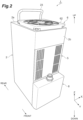
- the active energy irradiation devices 1 have a rectangular parallelepiped outer shape.
- the active energy irradiation devices 1 are arranged to be in contact with each other in a predetermined direction.
- the plurality of active energy irradiation devices 1 arranged in the predetermined direction are fixed and held by a fixing plate 11.
- the active energy irradiation device 1 includes a housing 2, a plurality of LED substrates 3, a heatsink 4, an intake unit 5, an exhaust unit 6, a duct 7, an inert gas supply unit 8, and an inert gas suction unit 9.
- the predetermined direction in which the plurality of active energy irradiation devices 1 are arranged is defined as an "X direction", a direction perpendicular to the X direction, which is a light emission direction of the active energy irradiation devices 1, is defined as a "Z direction”, and a direction orthogonal to the X direction and the Z direction is defined as a "Y direction”.
- a side of the active energy irradiation device 1 from which light is emitted is defined as a "lower side", and the opposite side is defined as an "upper side”.
- One side in the Y direction is defined as a "front side”
- the other side in the Y direction is defined as a "rear side".
- the housing 2 has a rectangular shape that is elongated in the Z direction.
- the housing 2 is made of metal.
- the housing 2 houses the LED substrates 3, the heatsink 4, and the duct 7.
- the housing 2 is configured by assembling a front casing 21 and a rear casing 22 to each other.
- a grip portion 23 for grasping the housing 2 is provided on an upper wall 2a of the housing 2.
- a driver substrate 12 with the Y direction as a thickness direction is disposed on the rear side inside the housing 2.
- the driver substrate 12 is an electrical driving circuit substrate for driving the active energy irradiation device 1.
- a driver substrate heatsink 13 that cools transistors and the like of the driver substrate 12 is disposed on the driver substrate 12.
- the driver substrate heatsink 13 is thermally connected to the transistors and the like of the driver substrate 12.
- the LED substrate 3 includes a substrate 31 having a rectangular plate shape and constituting a predetermined circuit (refer to FIG. 8 ), and LED elements (active energy irradiation units) 32 that are light-emitting elements arranged at predetermined pitches in the X direction and the Y direction on the substrate 31.
- the LED elements 32 emit light (ultraviolet rays) downward.
- the LED substrates 3 are disposed at a lower end portion inside the housing 2 with the Z direction as a thickness direction of the substrates 31.
- the LED substrates 3 are arranged along the X direction. Accordingly, several to several hundred LED elements 32 are arranged at least in the X direction inside the housing 2.
- the irradiation target moving in the Y direction is irradiated with light emitted from each of the LED elements 32 on the LED substrates 3 through a light irradiation window 24 made of a glass plate and provided on a lower wall 2b of the housing 2.
- the heatsink 4 is a heat radiation member thermally connected to the LED elements 32 on the LED substrates 3.
- the heatsink 4 is an air-cooled heatsink that radiates heat through heat exchange with air. Air constitutes a heat transfer medium (coolant) for cooling the LED elements 32.
- the heatsink 4 includes a base plate 41, heat radiation fins 42, a heat pipe 43, and a partition plate (partition member) 44.
- the base plate 41 has a rectangular plate shape.
- the plurality of LED substrates 3 are provided on a lower surface of the base plate 41.
- the lower surface of the base plate 41 is in contact with the substrates 31 of the LED substrates 3.
- the heat radiation fins 42 have a flat plate shape with the Y direction as a thickness direction.
- the heat radiation fins 42 are erected on an upper surface (surface) of the base plate 41.
- the heat radiation fins 42 are arranged to be stacked with gaps therebetween in the Y direction (first direction).
- the heat pipe 43 is provided to be embedded in a plurality of the heat radiation fins 42.
- the heat pipe 43 is thermally connected to the plurality of heat radiation fins 42.
- the partition plate 44 is provided to intersect the plurality of heat radiation fins 42.
- the partition plate 44 has a flat plate shape with the X direction as a thickness direction.
- the partition plate 44 partitions the plurality of heat radiation fins 42 in the X direction (second direction).
- a pair of the partition plates 44 are provided spaced from each other in the X direction on the plurality of heat radiation fins 42.
- the pair of partition plates 44 partition the plurality of heat radiation fins 42 into a pair of outer portions 42x located outside in the X direction and an inner portion 42y located between the pair of outer portions.
- the partition plates 44 partition the plurality of heat radiation fins 42 such that more air passes through in the X direction between the plurality of heat radiation fins 42 on the lower side (base plate 41 side) than on the upper side (side opposite to the base plate 41 side).
- the partition plates 44 are brazed and fixed to the plurality of heat radiation fins 42.
- the heatsink 4 is attached to the housing 2 through a bracket 25 and a support frame 26 (refer to FIG. 7 ).
- the intake unit 5 introduces air from outside the housing 2 into the housing 2.
- the intake unit 5 introduces the air into a buffer space BF to be described later inside the housing 2.
- the intake unit 5 is provided on a portion toward an upper side of the center of a wall portion 2c on the front side of the housing 2.
- the intake unit 5 includes an intake filter (filter unit) 51, a filter holding portion 52, and intake ports 53.
- the intake filter 51 captures foreign matter (dust and the like) contained in the air introduced into the housing 2.
- the intake filter 51 is made of, for example, urethane or the like.
- the intake filter 51 has a rectangular plate-shaped outer shape.
- the intake filter 51 extends over the portion toward the upper side of the center of the wall portion 2c when viewed from the front.
- the filter holding portion 52 houses and holds the intake filter 51.
- the filter holding portion 52 includes an outer plate 52x having a rectangular plate shape with the Y direction as a thickness direction.
- a front surface of the outer plate 52x is located on the same plane as a front surface of the wall portion 2c of the housing 2.
- the filter holding portion 52 is detachably attached to the duct 7 and the support frame 27 provided on the duct 7.
- the intake ports 53 are through-holes that are open along the Y direction (direction intersecting a direction from the heatsink 4 toward the exhaust unit 6), and that communicate with the inside of the housing 2.
- the intake ports 53 are arranged in proximity to each other in regions at both end portions in the X direction of the outer plate 52x.
- the intake ports 53 are through-holes having an elongated hole shape with the Z direction as a longitudinal direction. Air suctioned from the intake ports 53 is introduced into the buffer space BF inside the housing 2 through the intake filter 51 (refer to FIG. 8 ).
- the exhaust unit 6 discharges the air from inside the housing 2 to the outside of the housing 2.
- the exhaust unit 6 is provided on an upper end portion of the housing 2.
- the exhaust unit 6 includes a fan 61.
- an axial fan is used as the fan 61.
- the fan 61 delivers the air, which is suctioned from the lower side along the Z direction, to the upper side under pressure along the Z direction.
- the fan 61 is fixed to an upper end portion inside the housing 2.
- An exhaust filter 62 made of, for example, urethane or the like is attached to the upper wall 2a of the housing 2 located on a discharge side of the fan 61.
- the exhaust filter 62 is illustrated only in the FIG. 2 for the sake of convenience, and the illustration in the other drawings is omitted.
- an external pipe for outdoor exhaust (not illustrated) is connected to the discharge side of the fan 61 of the exhaust unit 6.
- the duct 7 is provided between the heatsink 4 and the exhaust unit 6 inside the housing 2.
- the duct 7 allows the air, which has passed through the heatsink 4, to flow through to the exhaust unit 6.
- the duct 7 allows an inert gas, which has passed through the heatsink 4, to flow through to the exhaust unit 6.
- the duct 7 has a rectangular pipe shape.
- the duct 7 includes a linear portion 71 extending in the Z direction with a constant cross-sectional area, and an enlarged portion 72 provided on a downstream side of the linear portion 71 and extending in the Z direction such that the cross-sectional area increases as the enlarged portion 72 extends downstream.
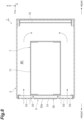
- the buffer space BF (refer to FIG. 8 ) that is a space into which air is introduced from outside by the intake unit 5 is provided on one side and the other side in the X direction of the duct 7 inside the housing 2.
- the buffer space BF is a space defined by inner surfaces of the housing 2 and outer surfaces of the linear portion 71 and the enlarged portion 72 of the duct 7.
- Lower end portions of the duct 7 are inserted and fixed to grooves 47 formed in the heat radiation fins 42 of the heatsink 4.
- An upper end portion of the duct 7 is fixed to a suction side of the fan 61.
- the duct 7 is attached to the housing 2 through the support frame 27.
- the inert gas supply unit 8 supplies inert gas to the outside of the housing 2.
- the inert gas include nitrogen.
- the inert gas supply unit 8 forms a region, which is dominated by the inert gas (region with low oxygen concentration), in a region including an irradiation region of light from the plurality of LED elements 32, by supplying the inert gas.
- the inert gas supply unit 8 is attached to a lower end portion of the wall portion 2c on the front side of the housing 2.
- the inert gas supply unit 8 includes a purge housing 81 having a rectangular box shape; a socket 82 provided on an upper end surface of the purge housing 81; and a spray port 83 provided at a lower end portion of the purge housing 81.
- the inert gas is introduced from the socket 82 into the purge housing 81, and the inert gas is sprayed from the spray port 83.
- the inert gas suction unit 9 suctions the inert gas outside the housing 2, and causes the inert gas to flow into the housing 2.
- the inert gas suction unit 9 is a structure attached to the housing 2.
- the inert gas suction unit 9 is detachably attached to a rear side of the lower wall 2b of the housing 2 by fasteners such as screws.
- the inert gas suction unit 9 includes a suction unit housing 91 having a rectangular box shape; a suction port 92 provided in a lower surface of the suction unit housing 91; and a recovery flow path 93 provided inside the suction unit housing 91 (refer to FIG. 7 ).
- the inert gas is suctioned into the suction unit housing 91 through the suction port 92, and the inert gas is allowed to flow through into the housing 2 by the recovery flow path 93.
- outside air is introduced into the buffer space BF inside the housing 2 by the intake unit 5.
- the air introduced into the buffer space BF flows downward along the Z direction, and then passes through the heatsink 4 and flows into the duct 7.
- the heatsink 4 the air flows downward along the Z direction between the plurality of heat radiation fins 42 of each of the pair of outer portions 42x, and then flows to pass through between the partition plates 44 and the base plate 41 and to turn upward, and merges at the inner portion 42y. Then, the air flows upward along the Z direction between the plurality of heat radiation fins 42 of the inner portion 42y, and flows into the duct 7.
- the air introduced into the buffer space BF flows downward along the Z direction, and then passes through the driver substrate heatsink 13.
- the air that has passed through the driver substrate heatsink 13 merges with the flow in the inner portion 42y of the heatsink 4 through a lower rear space inside the housing 2, flows upward along the Z direction between the plurality of heat radiation fins 42 of the inner portion 42y, and flows into the duct 7.
- the air that has flowed into the duct 7 flows upward along the Z direction, and is discharged to the outside of the housing 2 through the fan 61.
- the inert gas sprayed from the inert gas supply unit 8 is suctioned by the inert gas suction unit 9, and flows into the housing 2.
- the inert gas that has flowed into the housing 2 merges with the flow in the inner portion 42y of the heatsink 4 through the lower rear space inside the housing 2, flows upward along the Z direction between the plurality of heat radiation fins 42 of the inner portion 42y, together with the air, and flows into the duct 7.
- the inert gas that has flowed into the duct 7 flows upward along the Z direction, together with the air, and is discharged to the outside of the housing 2 through the fan 61, together with the air.
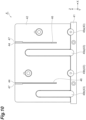
- the heat pipe 43 of the heatsink 4 is bent in a U shape and extends when viewed in the X direction.
- the heat pipe 43 linearly extends in the Z direction when viewed in the Y direction.
- the heat pipe 43 includes a pair of first heat pipes 48a and 48b provided spaced apart from each other in the X direction, and a pair of second heat pipes 49a and 49b provided spaced apart from each other in the X direction between the pair of first heat pipes 48a and 48b.
- the second heat pipes 49a and 49b are longer than the first heat pipes 48a and 48b.
- the heat pipes 43 adjacent to each other differ by 180° in the direction of the U shape (direction of an opening side of the U shape).
- the first heat pipe 48a and the second heat pipe 49b that are not adjacent to each other linearly extend rearward along the Y direction so as to be in contact with the base plate 41, and then extend to be bent upward and forward, and linearly extend forward along the Y direction.
- the first heat pipe 48b and the second heat pipe 49a that are not adjacent to each other linearly extend forward along the Y direction so as to be in contact with the base plate 41, and then extend to be bent upward and rearward, and linearly extend rearward along the Y direction.
- a linearly extending portion of the heat pipe 43 is brazed and fixed to the plurality of heat radiation fins 42.
- the partition plates 44 are provided such that upper end surfaces of the partition plates 44 are located on the same plane as upper end surfaces of the heat radiation fins 42.
- the partition plates 44 extend such that lower ends of the partition plates 44 are located between the center of the heat radiation fins 42 and the base plate 41 in the Z direction. Namely, as described above, the lower ends of the partition plates 44 are spaced apart from the base plate 41.
- the partition plates 44 extend to intersect all the heat radiation fins 42 in the Y direction.
- the partition plates 44 are interposed in slits 46 formed in the plurality of heat radiation fins 42.
- the slits 46 are open on the side opposite to the base plate 41 side, and are open in the Y direction.
- a thickness of the partition plates 44 is less than or equal to a width in the X direction of the slits 46.
- the slits 46 are each provided between the first heat pipe 48a and the second heat pipe 49a adjacent to each other and between the first heat pipe 48b and the second heat pipe 49b adjacent to each other in the X direction.
- the partition plates 44 are each provided between the first heat pipe 48a and the second heat pipe 49a adjacent to each other and between the first heat pipe 48b and the second heat pipe 49b adjacent to each other.
- the lower end portions of the duct 7 are inserted into the grooves 47 formed in the heat radiation fins 42 of the heatsink 4.
- a pair of side walls facing each other in the X direction protrude downward.
- the grooves 47 are open upward and are open in the Y direction.
- the grooves 47 are provided to continue with the slits 46 at upper end portions of the plurality of heat radiation fins 42.
- a thickness of the lower end portion of the duct 7 is less than or equal to a width in the X direction of the groove 47.
- the lower end portions of the duct 7 are press-fitted into the grooves 47 through a heat conductive grease (heat conductive material). Accordingly, the lower end portions of the duct 7 are fixed to the plurality of heat radiation fins 42 while being thermally connected thereto, and are in overlapping contact with outer sides in the X direction of the partition plates 44. As a result, the inner portion 42y of the plurality of heat radiation fins 42 partitioned off by the partition plates 44 communicates with the inside of the duct 7 in an airtight manner.
- the heat conductive grease is not particularly limited, and various greases can be used.
- the buffer space BF illustrated in FIG. 8 is formed inside the housing 2.
- the buffer space BF forms a flow path allowing the air to flow from the upper side into the gaps between the plurality of heat radiation fins 42 in the pair of outer portions 42x of the heatsink 4.
- an air flow path allowing the air to flow through from the intake unit 5 to the exhaust unit 6, and an inert gas flow path allowing the inert gas to flow through from the inert gas suction unit 9 to the exhaust unit 6 are provided inside the housing 2.
- the air flow path includes a flow path passing through the buffer space BF, the heatsink 4, and the duct 7 in order from the intake unit 5, and reaching the exhaust unit 6.
- the air flow path includes a flow path passing through the buffer space BF, the driver substrate heatsink 13, the lower rear space inside the housing 2, the heatsink 4, and the duct 7 in order from the intake unit 5, and reaching the exhaust unit 6.
- the inert gas flow path includes a flow path passing through the lower rear space inside the housing 2, the heatsink 4, and the duct 7 in order from the inert gas suction unit 9, and reaching the exhaust unit 6. Namely, the air flow path and the inert gas flow path merge with each other.
- the exhaust unit 6 exhausts the inert gas with the air.
- the inert gas suction unit 9 is disposed on a downstream side of the LED substrates 3 in a movement direction of the irradiation target.
- the inert gas suction unit 9 includes the suction port 92 that suctions the inert gas, and the recovery flow path 93 allowing the inert gas to flow through from the suction port 92 into the housing 2.
- the suction port 92 is provided at an end portion of the suction unit housing 91 of the inert gas suction unit 9 on a side away from the inert gas supply unit 8 (rear side). A plurality of the suction ports 92 are provided.
- the suction ports 92 are through-holes having an elongated hole shape that is elongated in the Y direction.
- the suction ports 92 are arranged in the X direction.
- the recovery flow path 93 allows the inert gas to flow through to a side toward the inert gas supply unit 8 (front side).
- the recovery flow path 93 introduces the inert gas, which has flowed through to the front side, into the housing 2 through an introduction port 98.
- the recovery flow path 93 is formed by an internal space of the suction unit housing 91.
- the recovery flow path 93 includes a filter 94, a shielding plate 95, and an ink trap 96.
- the filter 94 captures at least ink mist contained in the inert gas.
- the filter 94 is disposed in the course of the recovery flow path 93 (inside the suction unit housing 91).
- the filter 94 is not particularly limited, and a known filter can be used.
- the shielding plate 95 shields at least ink mist contained in the inert gas.
- the shielding plate 95 is a flat plate-shaped member with the Y direction as a thickness direction.
- the shielding plate 95 has a surface intersecting a flow-through direction of the recovery flow path 93.
- the shielding plate 95 is erected inside the suction unit housing 91. In the illustrated example, the shielding plate 95 is provided on an upstream side of the filter 94 in the recovery flow path 93.
- the ink trap 96 accumulates ink W formed by the liquefaction of ink mist contained in the inert gas.
- the ink trap 96 is a portion having a function of blocking a certain amount of the ink W.
- ink mist collects, liquefies, and accumulates.
- the ink trap 96 is provided on a downstream side of the shielding plate 95 in the recovery flow path 93. Namely, in the ink trap 96, the accumulated ink W is blocked by the shielding plate 95.
- the ink trap 96 is defined by inner surfaces of the shielding plate 95 and the suction unit housing 91.
- the ink trap 96 is provided below the filter 94 in the recovery flow path 93.
- the ink trap 96 can store the ink W formed by the liquefaction of ink mist accumulated in the filter 94.
- the inert gas supplied from the inert gas supply unit 8 and flowing rearward is suctioned into the inert gas suction unit 9 through the suction ports 92.
- the inert gas suctioned from the suction ports 92 is allowed to flow and turn forward by the recovery flow path 93, and is introduced into the housing 2 through the introduction port 98. Then, the inert gas introduced into the housing 2 merges with the air flowing through inside the housing 2, and flows to the heatsink 4.
- the air flow path is formed by the intake unit 5, the buffer space BF, the heatsink 4 (gaps between the heat radiation fins 42), the duct 7, the driver substrate heatsink 13, the lower rear space inside the housing 2, and the exhaust unit 6.
- the inert gas flow path is formed by the inert gas suction unit 9, the lower rear space inside the housing 2, the heatsink 4, the duct 7, and the exhaust unit 6.
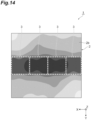
- FIG. 14 is a view illustrating a thermal camera image of a periphery of the LED substrates 3 in the active energy irradiation device 1.
- FIG. 14 is an image of the lower wall 2b of the housing 2 when viewed from below.
- the temperature profile of the plurality of LED substrates 3 (plurality of LED elements 32 (refer to FIG. 3 )) can be made uniform through cooling.
- the temperature distribution of the plurality of LED substrates 3 can be made uniform with a temperature gradient within 2°C.
- the inert gas outside the housing 2 can be recovered (namely, suctioned and exhausted from the exhaust unit 6 to the outside) using the flow of air inside the housing 2.
- the need for a separate configuration for recovering the inert gas can be suppressed. Therefore, the inert gas can be recovered while suppressing an increase in the size of the device.
- the inert gas supplied from the inert gas supply unit 8 can be efficiently recovered before spreading out.
- the active energy irradiation device 1 includes the heatsink 4 housed inside the housing 2, and the air flow path and the inert gas flow path pass through the heatsink 4.
- the heatsink 4 can radiate heat using not only the air but also the inert gas.
- the active energy irradiation device 1 includes the duct 7 allowing the air and the inert gas, which have passed through the heatsink 4, to flow through to the exhaust unit 6.
- the end portions on the heatsink 4 side of the duct 7 are inserted into the grooves 47 formed in the heat radiation fins 42 of the heatsink 4.
- the duct 7 enables the air and the inert gas to efficiently flow through from the heatsink 4 to the exhaust unit 6.
- the end portions of the duct 7 are inserted into the grooves 47 of the heat radiation fins 42, the need for a seal member such as a packing at a connection between the duct 7 and the heat radiation fins 42 can be eliminated.
- the inert gas suction unit 9 is a structure attached to the housing 2.
- the inert gas suction unit 9 can be attached to the housing 2 as one unit.
- the inert gas suction unit 9 includes the suction ports 92 that suction the inert gas, and the recovery flow path 93 allowing the inert gas to flow through from the suction ports 92 into the housing 2.
- the inert gas suction unit 9 the inert gas is suctioned from the suction ports 92, and the recovery flow path 93 enables the inert gas to flow through into the housing 2.
- the active energy irradiation device 1 includes the inert gas supply unit 8 that supplies the inert gas to the outside of the housing 2.
- the suction ports 92 are provided at the end portion of the inert gas suction unit 9 on the side away from the inert gas supply unit 8.
- the inert gas suction unit 9 can suction the inert gas at a position spaced apart from the inert gas supply unit 8.
- the flow speed of the inert gas can be lowered, and the inert gas can be reliably suctioned.
- the recovery flow path 93 allows the inert gas to flow through to the side toward the inert gas supply unit 8.
- the recovery flow path 93 enables the inert gas to flow through and turn, and the direct entry of foreign matter such as ink mist (hereinafter, referred to as "ink mist and the like"), which is contained in the inert gas, into the housing 2 can be suppressed by the turning.
- the recovery flow path 93 includes the filter 94 that captures at least ink mist contained in the inert gas. In this case, the entry of ink mist and the like, which are contained in the inert gas, into the housing 2 can be suppressed by the filter 94.
- the recovery flow path 93 includes the shielding plate 95 that shields at least ink mist contained in the inert gas. In this case, the entry of ink mist and the like, which are contained in the inert gas, into the housing 2 can be suppressed by the shielding plate 95.
- the recovery flow path 93 includes the ink trap 96 that accumulates the ink W formed by the liquefaction of ink mist contained in the inert gas. In this case, the ink W can be accumulated in the recovery flow path 93.
- the inert gas suction unit 9 is detachably attached to the housing 2. Accordingly, the replacement and maintenance of the inert gas suction unit 9 can be easily performed. For example, the removal of the ink W accumulated in the ink trap 96 can be easily performed.
- the LED elements 32 perform irradiation with ultraviolet rays. Accordingly, the active energy irradiation device 1 can be used as a device that performs irradiation with ultraviolet rays.
- FIG. 15 is a cross-sectional view of an inert gas suction unit 209 according to a modification example.
- the inert gas suction unit 209 is different from the inert gas suction unit 9 described above (refer to FIG. 13 ) in that the recovery flow path 93 includes a shielding plate 295 and an ink trap 296.
- the shielding plate 295 shields at least ink mist contained in the inert gas.
- the shielding plate 295 is erected inside the suction unit housing 91.
- the shielding plate 295 is a flat plate-shaped member with the Y direction as a thickness direction.
- the shielding plate 295 has a surface intersecting the flow-through direction of the recovery flow path 93.
- the shielding plate 295 includes shielding plates 295a extending to protrude downward from the inner surface of the suction unit housing 91, and shielding plates 295b extending to protrude upward from the inner surface of the suction unit housing 91.
- the shielding plates 295a and the shielding plates 295b are disposed in the recovery flow path 93 so as to be alternately arranged in the Y direction.
- the ink trap 296 accumulates the ink W formed by the liquefaction of ink mist contained in the inert gas.
- the ink trap 296 is a portion having a function of blocking a certain amount of the ink W.
- the ink trap 296 is defined by inner surfaces of the shielding plates 295b and the suction unit housing 91.
- the inert gas suctioned from the suction ports 92 is allowed to flow forward by the recovery flow path 93, and is introduced into the housing 2 through the introduction port 98.
- the inert gas flows between the shielding plates 295a and the shielding plates 295b in a meandering manner, and ink mist in the inert gas comes into contact with the shielding plate 295, and accumulates in the ink trap 296 at a lower portion of the shielding plate 295 as the ink W.
- One mode of the present disclosure is not limited to the embodiment.
- the lower ends of the partition plates 44 of the heatsink 4 are spaced apart from the base plate 41; however, the configuration is not limited as long as the configuration allows more air to pass through in the X direction between the plurality of heat radiation fins 42 on the base plate 41 side than on the side opposite to the base plate 41 side, and the configuration may be as follows.
- a ventilation portion for example, a hole, a mesh portion, or the like
- the ventilation portion can be used as a space through which the air passes.
- the configuration can be specifically realized in which more air passes through in the X direction between the plurality of heat radiation fins 42 on the base plate 41 side than on the side opposite to the base plate 41 side.
- the partition plate 44 may include a mesh portion, and the base plate 41 side of the mesh portion may have a larger opening ratio than that of the side opposite to the base plate 41 in the mesh portion.
- the mesh portion can be used as a space through which the air passes
- the base plate 41 side of the mesh portion can be used as a space through which more air passes.
- the configuration can be specifically realized in which more air passes through in the X direction between the plurality of heat radiation fins 42 on the base plate 41 side than on the side opposite to the base plate 41 side.
- the heatsink 4 includes the partition plates 44, but is not limited to including the partition plates 44, and may include other various partition members as long as the partition members can partition the heatsink 4.
- the LED elements 32 as active energy irradiation units perform irradiation with ultraviolet rays; however, the active energy irradiation units may perform irradiation with electron beams.
- the active energy irradiation device can be used as a device that performs irradiation with electron beams.
- the heatsink 4 is used to radiate heat from the LED elements 32, and the LED element 32 is a heat-generating unit; however, the heat-generating unit from which the heatsink 4 has to radiate heat is not limited to the LED element 32, and may be other heat-generating units.
- the lower end portions of the duct 7 are inserted into the grooves 47 of the heat radiation fins 42 of the heatsink 4; however, the object to be inserted into the grooves 47 is not limited to the duct 7, and may be other members. In this case, the other members can be engaged with the heat radiation fins 42 using the grooves 47.
- the duct 7 has a rectangular pipe shape; however, the shape of the duct 7 is not particularly limited, and may have, for example, other polygonal pipe shapes.
- the exhaust unit 6 includes the fan 61; however, the configuration of the exhaust unit 6 is not particularly limited.
- the exhaust unit 6 may include a pipe for discharging the air and the inert gas to the outdoors, without including the fan 61.
- the air and the inert gas may be delivered under pressure by a blower or the like at a connection destination on a downstream side of the pipe.
- an air presence region exists around the linear portion 71 and the enlarged portion 72 of the duct 7; however, the air presence region may exist around only one of the linear portion 71 and the enlarged portion 72, or the air presence region may exist around only a part of the linear portion 71 or a part of the enlarged portion 72.
- the inert gas suction unit 9 is detachably attached to the housing 2 by fasteners such as screws; however, the configuration for detachable attachment is not particularly limited, and a known configuration can be used.
- the inert gas suction unit 9 may be detachably attached to the housing 2 by sliding the inert gas suction unit 9 with respect to the housing 2.
Landscapes
- Health & Medical Sciences (AREA)
- General Health & Medical Sciences (AREA)
- Toxicology (AREA)
- Engineering & Computer Science (AREA)
- Mechanical Engineering (AREA)
- Chemical & Material Sciences (AREA)
- Electromagnetism (AREA)
- Physics & Mathematics (AREA)
- Organic Chemistry (AREA)
- Chemical Kinetics & Catalysis (AREA)
- Cooling Or The Like Of Electrical Apparatus (AREA)
- Ink Jet (AREA)
- Physical Or Chemical Processes And Apparatus (AREA)
Applications Claiming Priority (2)
| Application Number | Priority Date | Filing Date | Title |
|---|---|---|---|
| JP2020215355A JP7734486B2 (ja) | 2020-12-24 | 2020-12-24 | 活性エネルギ照射装置 |
| PCT/JP2021/020056 WO2022137597A1 (ja) | 2020-12-24 | 2021-05-26 | 活性エネルギ照射装置 |
Publications (2)
| Publication Number | Publication Date |
|---|---|
| EP4249261A1 true EP4249261A1 (de) | 2023-09-27 |
| EP4249261A4 EP4249261A4 (de) | 2024-10-30 |
Family
ID=82158024
Family Applications (1)
| Application Number | Title | Priority Date | Filing Date |
|---|---|---|---|
| EP21909758.1A Pending EP4249261A4 (de) | 2020-12-24 | 2021-05-26 | Aktive energieemissionsvorrichtung |
Country Status (5)
| Country | Link |
|---|---|
| US (1) | US20240066893A1 (de) |
| EP (1) | EP4249261A4 (de) |
| JP (1) | JP7734486B2 (de) |
| IL (1) | IL303863A (de) |
| WO (1) | WO2022137597A1 (de) |
Family Cites Families (16)
| Publication number | Priority date | Publication date | Assignee | Title |
|---|---|---|---|---|
| JP2000009900A (ja) | 1998-06-26 | 2000-01-14 | Toyo Ink Mfg Co Ltd | 電子線照射装置および電子線照射方法 |
| DE19916474A1 (de) * | 1999-04-13 | 2000-10-26 | Ist Metz Gmbh | Bestrahlungsgerät |
| US6550905B1 (en) * | 2001-11-19 | 2003-04-22 | Dotrix N.V. | Radiation curable inkjet ink relatively free of photoinitiator and method and apparatus of curing the ink |
| JP4878295B2 (ja) | 2007-01-26 | 2012-02-15 | 浜松ホトニクス株式会社 | 光源装置 |
| JP4893389B2 (ja) | 2007-03-13 | 2012-03-07 | セイコーエプソン株式会社 | 記録装置および液体噴射装置 |
| JP2010280170A (ja) | 2009-06-05 | 2010-12-16 | Ricoh Co Ltd | インクジェット記録装置 |
| JP5392117B2 (ja) | 2010-01-28 | 2014-01-22 | トヨタ紡織株式会社 | オイルセパレータ |
| US8851715B2 (en) * | 2012-01-13 | 2014-10-07 | Phoseon Technology, Inc. | Lamp ventilation system |
| JP2014210430A (ja) | 2013-04-04 | 2014-11-13 | 株式会社東通研 | 紫外線照射装置 |
| JP6349098B2 (ja) | 2014-02-06 | 2018-06-27 | パナソニック デバイスSunx株式会社 | 紫外線照射ヘッド及び紫外線照射装置 |
| JP6460674B2 (ja) | 2014-08-01 | 2019-01-30 | キヤノン株式会社 | プリント装置 |
| JP6126644B2 (ja) * | 2015-05-29 | 2017-05-10 | Hoya Candeo Optronics株式会社 | 光照射装置 |
| JP6602627B2 (ja) | 2015-09-29 | 2019-11-06 | 株式会社Screenホールディングス | インクジェット印刷装置およびインクジェット印刷方法 |
| CH714677A2 (de) * | 2018-02-23 | 2019-08-30 | Hapa Ag | Aushärtekammer für Druckerzeugnisse. |
| WO2020067158A1 (ja) * | 2018-09-27 | 2020-04-02 | 京セラ株式会社 | 光照射装置および印刷装置 |
| JP7474128B2 (ja) * | 2019-08-26 | 2024-04-24 | 浜松ホトニクス株式会社 | 活性エネルギ照射ユニット及び活性エネルギ照射装置 |
-
2020
- 2020-12-24 JP JP2020215355A patent/JP7734486B2/ja active Active
-
2021
- 2021-05-26 WO PCT/JP2021/020056 patent/WO2022137597A1/ja not_active Ceased
- 2021-05-26 EP EP21909758.1A patent/EP4249261A4/de active Pending
- 2021-05-26 US US18/268,442 patent/US20240066893A1/en active Pending
- 2021-05-26 IL IL303863A patent/IL303863A/en unknown
Also Published As
| Publication number | Publication date |
|---|---|
| IL303863A (en) | 2023-08-01 |
| EP4249261A4 (de) | 2024-10-30 |
| JP7734486B2 (ja) | 2025-09-05 |
| US20240066893A1 (en) | 2024-02-29 |
| JP2022101021A (ja) | 2022-07-06 |
| WO2022137597A1 (ja) | 2022-06-30 |
Similar Documents
| Publication | Publication Date | Title |
|---|---|---|
| KR101848318B1 (ko) | 광조사 장치 | |
| EP3192588B1 (de) | Lichtbestrahlungsvorrichtung | |
| TWI627072B (zh) | Light irradiation device | |
| US11204160B2 (en) | Light source device | |
| JP7313555B2 (ja) | 光照射装置 | |
| KR20210103545A (ko) | 광조사 장치 및 인쇄 장치 | |
| US12338987B2 (en) | Heatsink, active energy irradiation device, and active energy irradiation system | |
| EP4249261A1 (de) | Aktive energieemissionsvorrichtung | |
| US12409667B2 (en) | Active energy irradiation device and active energy irradiation system | |
| EP4249110A1 (de) | Aktivenergie-strahlungseinrichtung | |
| CN117136337A (zh) | 光照射装置 | |
| JP2019153375A (ja) | 光源装置 | |
| EP4249111A1 (de) | Aktivenergiebestrahlungsvorrichtung und aktivenergiebestrahlungssystem | |
| CN117836142A (zh) | 活性能量照射装置及喷墨打印机 | |
| JP7638817B2 (ja) | 電子機器アセンブリ |
Legal Events
| Date | Code | Title | Description |
|---|---|---|---|
| STAA | Information on the status of an ep patent application or granted ep patent |
Free format text: STATUS: THE INTERNATIONAL PUBLICATION HAS BEEN MADE |
|
| PUAI | Public reference made under article 153(3) epc to a published international application that has entered the european phase |
Free format text: ORIGINAL CODE: 0009012 |
|
| STAA | Information on the status of an ep patent application or granted ep patent |
Free format text: STATUS: REQUEST FOR EXAMINATION WAS MADE |
|
| 17P | Request for examination filed |
Effective date: 20230620 |
|
| AK | Designated contracting states |
Kind code of ref document: A1 Designated state(s): AL AT BE BG CH CY CZ DE DK EE ES FI FR GB GR HR HU IE IS IT LI LT LU LV MC MK MT NL NO PL PT RO RS SE SI SK SM TR |
|
| DAV | Request for validation of the european patent (deleted) | ||
| DAX | Request for extension of the european patent (deleted) | ||
| REG | Reference to a national code |
Ref country code: DE Ref legal event code: R079 Free format text: PREVIOUS MAIN CLASS: B41J0002010000 Ipc: B41J0029377000 |
|
| A4 | Supplementary search report drawn up and despatched |
Effective date: 20241002 |
|
| RIC1 | Information provided on ipc code assigned before grant |
Ipc: B41F 23/04 20060101ALI20240926BHEP Ipc: B41J 11/00 20060101ALI20240926BHEP Ipc: B41J 29/377 20060101AFI20240926BHEP |