EP4235840A1 - Metall-enthaltendes anodenmaterial sowie elektrochemische primärzellen enthaltend das anodenmaterial und verwendung der verbindungen - Google Patents
Metall-enthaltendes anodenmaterial sowie elektrochemische primärzellen enthaltend das anodenmaterial und verwendung der verbindungen Download PDFInfo
- Publication number
- EP4235840A1 EP4235840A1 EP22158298.4A EP22158298A EP4235840A1 EP 4235840 A1 EP4235840 A1 EP 4235840A1 EP 22158298 A EP22158298 A EP 22158298A EP 4235840 A1 EP4235840 A1 EP 4235840A1
- Authority
- EP
- European Patent Office
- Prior art keywords
- silicon
- anode material
- alkylene
- metal
- cathode
- Prior art date
- Legal status (The legal status is an assumption and is not a legal conclusion. Google has not performed a legal analysis and makes no representation as to the accuracy of the status listed.)
- Ceased
Links
Images

Classifications
-
- H—ELECTRICITY
- H01—ELECTRIC ELEMENTS
- H01M—PROCESSES OR MEANS, e.g. BATTERIES, FOR THE DIRECT CONVERSION OF CHEMICAL ENERGY INTO ELECTRICAL ENERGY
- H01M12/00—Hybrid cells; Manufacture thereof
- H01M12/04—Hybrid cells; Manufacture thereof composed of a half-cell of the fuel-cell type and of a half-cell of the primary-cell type
- H01M12/06—Hybrid cells; Manufacture thereof composed of a half-cell of the fuel-cell type and of a half-cell of the primary-cell type with one metallic and one gaseous electrode
-
- H—ELECTRICITY
- H01—ELECTRIC ELEMENTS
- H01M—PROCESSES OR MEANS, e.g. BATTERIES, FOR THE DIRECT CONVERSION OF CHEMICAL ENERGY INTO ELECTRICAL ENERGY
- H01M4/00—Electrodes
- H01M4/02—Electrodes composed of, or comprising, active material
- H01M4/06—Electrodes for primary cells
-
- H—ELECTRICITY
- H01—ELECTRIC ELEMENTS
- H01M—PROCESSES OR MEANS, e.g. BATTERIES, FOR THE DIRECT CONVERSION OF CHEMICAL ENERGY INTO ELECTRICAL ENERGY
- H01M4/00—Electrodes
- H01M4/02—Electrodes composed of, or comprising, active material
- H01M4/24—Electrodes for alkaline accumulators
-
- H—ELECTRICITY
- H01—ELECTRIC ELEMENTS
- H01M—PROCESSES OR MEANS, e.g. BATTERIES, FOR THE DIRECT CONVERSION OF CHEMICAL ENERGY INTO ELECTRICAL ENERGY
- H01M4/00—Electrodes
- H01M4/02—Electrodes composed of, or comprising, active material
- H01M4/36—Selection of substances as active materials, active masses, active liquids
- H01M4/38—Selection of substances as active materials, active masses, active liquids of elements or alloys
- H01M4/386—Silicon or alloys based on silicon
-
- H—ELECTRICITY
- H01—ELECTRIC ELEMENTS
- H01M—PROCESSES OR MEANS, e.g. BATTERIES, FOR THE DIRECT CONVERSION OF CHEMICAL ENERGY INTO ELECTRICAL ENERGY
- H01M4/00—Electrodes
- H01M4/02—Electrodes composed of, or comprising, active material
- H01M4/36—Selection of substances as active materials, active masses, active liquids
- H01M4/48—Selection of substances as active materials, active masses, active liquids of inorganic oxides or hydroxides
- H01M4/50—Selection of substances as active materials, active masses, active liquids of inorganic oxides or hydroxides of manganese
-
- H—ELECTRICITY
- H01—ELECTRIC ELEMENTS
- H01M—PROCESSES OR MEANS, e.g. BATTERIES, FOR THE DIRECT CONVERSION OF CHEMICAL ENERGY INTO ELECTRICAL ENERGY
- H01M4/00—Electrodes
- H01M4/02—Electrodes composed of, or comprising, active material
- H01M4/62—Selection of inactive substances as ingredients for active masses, e.g. binders, fillers
- H01M4/624—Electric conductive fillers
- H01M4/625—Carbon or graphite
-
- H—ELECTRICITY
- H01—ELECTRIC ELEMENTS
- H01M—PROCESSES OR MEANS, e.g. BATTERIES, FOR THE DIRECT CONVERSION OF CHEMICAL ENERGY INTO ELECTRICAL ENERGY
- H01M4/00—Electrodes
- H01M4/86—Inert electrodes with catalytic activity, e.g. for fuel cells
- H01M4/90—Selection of catalytic material
- H01M4/9016—Oxides, hydroxides or oxygenated metallic salts
-
- H—ELECTRICITY
- H01—ELECTRIC ELEMENTS
- H01M—PROCESSES OR MEANS, e.g. BATTERIES, FOR THE DIRECT CONVERSION OF CHEMICAL ENERGY INTO ELECTRICAL ENERGY
- H01M6/00—Primary cells; Manufacture thereof
- H01M6/04—Cells with aqueous electrolyte
- H01M6/045—Cells with aqueous electrolyte characterised by aqueous electrolyte
-
- H—ELECTRICITY
- H01—ELECTRIC ELEMENTS
- H01M—PROCESSES OR MEANS, e.g. BATTERIES, FOR THE DIRECT CONVERSION OF CHEMICAL ENERGY INTO ELECTRICAL ENERGY
- H01M6/00—Primary cells; Manufacture thereof
- H01M6/14—Cells with non-aqueous electrolyte
Definitions
- the invention relates to a metal-containing anode material, in particular for use in primary electrochemical cells with alkaline electrolytes, the metal-containing anode material comprising silicon, potassium, zinc, aluminum, iron and/or an alloy comprising one or more of the aforementioned metals as the metal. and the surface of the metal-containing anode material at least partially comprises organofunctional silicon-containing compounds.
- Silicon-containing compounds are organofunctional silanes and organofunctional siloxane oligomers with which the surfaces can be provided or equipped.
- the object of the invention was to provide an anode material and/or an additive for electrochemical primary cells or electrolytes which is suitable for stabilizing the surface of the anode material against corrosive influences, at least for a certain time, to the point of inhibiting corrosion.
- One object was therefore to provide passivation of the anode surface by active and/or passive inhibition.
- organofunctional silicon-containing compounds preferably interact via polar interactions with the surface of the anode material and the anode surface and preferably passivate them against corrosion.
- the objects are also achieved through the use of organofunctional silicon-containing compounds, preferably silanes, silanols and/or siloxane oligomers and mixtures of these, as an additive in electrolyte solutions, particularly in electrolyte solutions that are suitable for electrochemical primary cells.
- Organofunctional silanes, organofunctional silanols and/or organofunctional siloxane oligomers are particularly suitable as additives in electrolyte solutions
- the invention relates to a metal-containing anode material, in particular for use in primary electrochemical cells with alkaline electrolytes, the metal-containing anode material comprising as metal silicon, potassium, zinc, aluminum, iron and/or as metal alloy comprising one or more containing the aforementioned metals, and the surface of the metal-containing anode material at least partially has organofunctional silicon-containing compounds.
- the subject of the invention is an anode material which as metal (hereinafter abbreviated: Me) comprises silicon (Si), potassium (K), zinc (Zn), aluminum (Al), iron (Fe) and/or an alloy comprising one or more of the aforementioned metals and optionally lithium (Li), in particular comprising an alloy of silicon, potassium, zinc, aluminum and/or iron and optionally lithium in each case.
- Me metal
- Si silicon
- K potassium
- Zn zinc
- Al aluminum
- Fe iron
- Li lithium
- the surface of the anode material has metal-oxygen-silicon structures, which are also referred to below as Me-O-Si structure, the silicon structure, here Si structure, being part of an organofunctional silicon-containing connection can be or is.
- a component of an organofunctional silicon-containing compound is in particular a compound which can be derived from an organofunctional silane by hydrolysis and/or condensation and is optionally covalently bonded to surfaces of the anode material or to a solid phase gel on a surface of an anode material via oxygen.
- the surface of the anode material in particular an anode made from it, has metal-oxygen-silicon structures, such as Me-O-Si structures, at least partially up to the complete covering of the surface, the silicon structures each being independent Constituents of organofunctional silicon-containing compounds are.
- the surface can be dynamically at least partially solvated with organofunctional silicon-containing compounds.
- the subject matter of the invention is an anode material whose surface at least partially has a solid phase gel, the gel comprising metal-oxygen structures, in particular the gel comprising water and hydroxy-functional structures of siloxanes, in particular siloxane oligomers, zinc hydroxide, aluminum hydroxide and/or or iron hydroxide structures, the metal-oxygen structures being at least partially formed as metal-oxygen-silicon structures, e.g. Me-O-Si structure, the silicon structures, such as Si structures, in the respective Structure are part of an organofunctional silicon-containing compound or are derived from an organofunctional silicon-containing compound. Silicon is a semi-metal and is therefore also considered a metal according to the invention.
- the surface of the anode material in particular the surface of an anode produced from the anode material, has at least partially to completely metal-oxygen-silicon structures on the surface, which comprise at least one structure of the formula I, in particular of the formula Ia and/or a solid phase gel, in particular with structures of the formula Ib, in each case with Me being a metal comprising silicon, potassium, zinc, aluminum, iron and/or as a metal alloy which can comprise one or more of the aforementioned metals and optionally lithium.
- Me represents metal atoms in the surface of the anode material and Me in the formula Ib represents a metal atom bonded to or surrounded by oxygen atoms, n as an index may be greater than 1.
- formula Ib is a siloxane oligomer where Me is silicon, where R is an organofunctional silicon compound or a component of an organofunctional silicon compound, such as preferably of formulas IIa, IIa*, IIa**, IIa** *, IIb and/or hydrolyzates and/or condensates of these.
- the surfaces in the metal-containing anode material, in particular the anode material in the form of an anode, with organofunctional silicon-containing compounds are represented as R.
- formula Ia single metal atoms are shown in a surface connected through oxygen atoms to the organofunctional silicon compounds and shown as -OR.
- a solid phase gel is indicated in formula Ib, which represents, for example, a siloxane oligomer in the area of the surface of the anode material, in particular in the form of an anode, which is connected via oxygen atoms to organofunctional silicon compounds, represented as -OR.
- Both -OR in formula Ia and in formula Ib can passivate the surface of the metal-containing anode material and thus delay corrosion.
- the silicon-containing compounds of the anode material or in an electrolyte solution include compounds of the general formulas IIa, IIa*, IIa**, IIa*** and/or IIb and optionally mixtures containing these compounds or silanols, siloxanols, siloxanes of that.
- Forme II preferably comprises the formulas IIa, IIa*, IIa**, IIa*** and/or IIb, where IIb comprises siloxane oligomers, such as organosiloxanes with chain-like, cyclic, crosslinked and/or spatially crosslinked structures and/or formula II comprises at least a silane structural element of the formula IIa, IIa*, IIa** and/or IIa***, or with R in formula I comprising formula IIa, IIa*, IIa**, IIa*** and/or IIb or mixtures thereof -SiY(OR 1 ) c (OR 2 ) d (IIa) -SiY(O - ) c (OR 2 ) d (IIa*) with c equal
- the invention also relates to a metal-containing anode material in which the metal comprises silicon and optionally lithium and/or an alloy comprising at least silicon.
- the anode material is preferably present as a three-dimensional shaped body with an outer surface and inner surface, the shaped body comprising silicon particles in particular, and the shaped body having organofunctional silicon-containing compounds on at least part of its outer and inner surface.
- Silicon-containing compounds are preferably selected from organofunctional silanes or siloxanes derived from organofunctional silane(s), mixtures of organofunctional silanes, mixtures of organofunctional silanes and functional siloxanes and/or a mixture of organofunctional siloxane oligomers, with which the anode material is preferably provided, equipped or can be equipped.
- the outer and/or inner surface preferably has the silicon-containing compound from 5 to 100%, preferably from 10 to 50% of the surface. The surface can be determined using the methods known to the person skilled in the art, such as, for example, by means of BET determination.
- the invention also relates to an anode material comprising silicon particles and optionally carbon and silicon-containing particles and optionally particles of at least one allotropic carbon modification, the silicon particles each independently containing iron, zinc, aluminum, carbon, calcium, potassium, optionally titanium , optionally oxygen, optionally copper of greater than or equal to 0.01 mg/kg.
- the anode material is preferably present as a three-dimensional shaped body in the form of an essentially flat plate.
- the plate has a front side and a rear side opposite the front side, with the front and rear side forming the plate with a side surface running around between the front and rear side.
- front, back and side surfaces form the surface of the anode, and in particular the surface of the metal-containing anode material at least partially comprising organofunctional silicon-containing compounds.
- the plate can be formed from particles of metal-containing particulate powders, which in particular form a structure.
- the structure of the particles in a shaped body can, for example, but not exclusively, be obtained by sintering powders, shaped bodies, green or white compacts.
- the particles are preferably bonded to one another in the structure.
- the silicon particles can be bonded to one another by means of the silicon of the silicon particles by means of a partial and/or complete melting of the particles.
- the silicon particles which are cohesively bonded to one another are i) fused and/or ii) sintered and/or iii) pressed together, or b) the cohesive bond at the contact points of the silicon particles is formed by silicon material of the silicon particles by the silicon particles being i) fused together and/or ii) sintered and/or iii) pressed.
- Particles of metal-containing particulate powders preferably comprise particle sizes from 1 nm to 30,000 nm, preference is given to mixtures of fractions of particle sizes comprising particle sizes from 10 nm to 1000 nm and 1000 nm to 30,000 nm.
- the invention also provides an electrochemical primary cell with an anode comprising an anode material according to the invention, the primary cell also comprising a cathode and a separator, the separator separating anode and cathode, the primary cell containing an electrolyte solution and the cathode comprising a composition containing carbon material and an oxygen storage material that stores oxygen as an oxygen-containing compound.
- the cathode can be an air cathode.
- the electrochemical primary cell is particularly preferably an electrochemical silicon cathode primary cell or a silicon air cathode primary cell, which is particularly preferably present as a silicon button cell, for example a hearing aid battery, or as a silicon battery stack.
- silicon battery packs are found in multi-cell vehicle batteries.
- the composition of the cathode preferably comprises, as the acid-storing material, a) at least one manganese oxide, in particular manganese dioxide, as a component of the cathode material, with the cathode material in particular being present as the cathode in a hermetically sealed battery housing, or b) the cathode being an air cathode and the composition of the cathode being Component of the cathode material comprises a manganese oxide, in particular manganese oxide and/or manganese dioxide, platinum, platinum-based, silver individually or together as a catalyst.
- the invention also relates to the use of silanes, silanols and/or siloxane oligomers, in particular their use as additives in electrolyte solutions, these comprising 3-glycidyloxypropylalkoxysilane, 3-glycidyloxyethylalkoxysilane, 3-glycidyloxymethylalkoxysilane, 3-(2,3-dihydroxyprop-1- oxy)propylalkoxysilane, 3-(2,3-dihydroxyprop-1-oxy)ethylalkoxysilane, 3-(2,3-dihydroxyprop-1-oxy)methylalkoxysilane each having independently alkoxy selected from methoxy, ethoxy and propropoxy, hydrolyzates of the foregoing silanes and/or oligomeric condensates of the aforementioned silanes, or mixtures of two of the aforementioned compounds as an electrolyte component and/or for the production of metal-containing anode material, which at least
- the anode material in particular in the form of a silicon anode, has a shaped body which has a density of 0.1 g/cm 3 to 2.3 g/cm 3 . More preferably, the molding has a density of 0.5 g/cm 3 to 2.1 g/cm 3 , preferably 0.5 to 1.8 g/cm 3 , more preferably 1.3 to 1.8 g / cm3 .
- Preferred organofunctional silicon compounds include alkyltrialkoxysilanes, dialkyldialkoxysilanes, (polyalkylene oxide)alkylsilanes, glycidylalkyltrialkoxysilanes, glycidylalkyl(alkyl)dialkoxysilanes, and their hydrolysis and optional condensation products alkylsiloxanes, dialkylsiloxanes, (polyalkylene oxide)alkylsiloxanes, glycidylalkylsiloxanes, glycidylalkyl(alkyl)siloxanes.
- the respective alkyl groups can be linear, branched and/or cyclic and can contain 1 to 24 carbon atoms, preferably 1 to 10 carbon atoms, particularly preferably 1 to 8 carbon atoms. Methyl, ethyl, propyl, butyl, pentyl, hexy, heptyl, octyl and the respective isomers known to those skilled in the art are particularly preferred.
- the alkoxy groups are preferably selected from methoxy, ethoxy, propoxy and butoxy. Furthermore, all hydroxy-functional silanes of the aforementioned silanes are included, which can be obtained by hydrolysis of the respective alkoxysilanes.
- the silanes and/or siloxanes can preferably be covalently bonded as a Me-O-Si compound by means of one or two Si-O bonds in the alkaline electrolyte to the Me-O-, in particular Si-O-functionalized surface.
- the silanes and/or siloxanes preferably have two alkyl groups. It can be preferred if the silanes are functionalized with groups that cause either a significant steric hindrance of the hydroxide ions, so that they can not penetrate unhindered to the surface of the silicon anode or the functional groups include (polyalkylene oxide) alkyl groups that can flexibly cover the surface of the silicon anode and thus inhibit corrosion for a certain period of time.
- the electrolyte solution is an aqueous, alkaline composition comprising polyalkylene oxide, or a mixture of polyalkylene oxides.
- the alkylenes are selected from divalent alkylenes which contain 1 to 6 carbon atoms, and the divalent alkylenes are preferably selected from methylene, ethylene, n-propylene, isopropylene and butylene.
- Preferred compounds having polyalkylene oxide groups, in particular comprising polyalkylene oxide groups can preferably have a molecular weight of 200 g/mol to 35,000 g/mol, preferably 200 to 1500 g/mol. It is further preferred if the average molecular weight is from 200 g/mol to 1500 g/mol.
- An anode material according to the invention can advantageously be provided with a film or a coating comprising polyalkylene oxide.
- the anode material in particular a silicon as metal-containing anode material, preferably anode material of silicon particles, has a content of iron, zinc, potassium, aluminum, carbon, calcium, optionally titanium, optionally oxygen, optionally copper of in each case greater than or equal to 0, 01 mg/kg, an iron content of greater than or equal to 0.02 mg/kg being particularly preferred.
- the invention further relates to an anode material comprising silicon particles and optionally carbon and silicon-containing particles and optionally particles of at least one allotropic carbon modification, the silicon particles, in particular the silicon anode, having an iron content of greater than or equal to 0.02 mg/kg.
- Particles containing carbon and silicon and having at least one allotropic carbon modification can include carbon black, spherical nanoparticles comprising graphite, graphite, graphene and polycyclic carbon. These particles preferably have a diameter of greater than or equal to 1 nm, in particular from 10 nm to 300 nm.
- the particles containing carbon and silicon preferably comprise silicon carbide and/or the particles comprise at least one allotropic carbon modification including diamond, polycyclic carbon modifications, graphite, fullerene, graphene.
- Diamond can come from a wire saw recycling process.
- zinc, potassium, aluminum or iron can also have corresponding particles as anode material, which can have a content of silicon, carbon, calcium, optionally titanium, optionally oxygen, optionally copper of greater than or equal to 0.01 mg/kg.
- a particularly preferred alternative or additional metal-containing anode material may comprise Siridion® Black.
- the anode material can comprise silicon-containing particles with a carbon content, in particular with a carbon content of 1 to less than 10% by weight in the total content of the silicon-containing particles.
- Preferred anode materials may include mixtures of non-carbon containing silicon particles and carbon containing silicon particles.
- the silicon particles mentioned according to the invention can also be present as mixtures comprising defined fractions of silicon particles of different composition in terms of quality.
- the silicon particles can include primary particles, amorphous silicon particles, monocrystalline or polycrystalline silicon particles.
- Primary particles are particles that are formed in a thermal process for the production of silicon particles and then agglomerate and thereby form aggregates and/or agglomerates.
- the primary particles usually have a diameter of 1 to 1000 nm, while the aggregates and/or agglomerates can have at least one dimension of 150 to 20 microns.
- a preferred particle size distribution of amorphous silicon particles can be from 1 nm to 700 nm, in particular from 10 nm to 500 nm, and the mono- to polycrystalline a particle size distribution from 500 nm to 20 micrometers, in particular from 700 nm to 20 micrometers.
- the mono- to polycrystalline silicon particles are bimodal with silicon particles in the range from 800 nm to 9 micrometers and from 13 to 20 micrometers.
- the silicon particles or other particles with polymerizable monomers can be present in a composition that is shaped and polymerized and optionally subsequently sintered or pyrolyzed.
- the silicon in the anode material in particular the silicon particles, preferably amorphous and/or polycrystalline silicon particles, of the anode material comprises dopants, the dopants being selected from elements of main group 13, in particular comprising boron, indium, aluminum and/or gallium, and from elements of main group 15, in particular comprising phosphorus, arsenic and/or antimony and elements of the iron group, boron, aluminum, phosphorus and/or iron being particularly preferred.
- the elements of the 13th main group (new nomenclature: group 13 of the periodic table) are electron acceptors of the new nomenclature.
- Elements of main group 15 (new nomenclature: group 15 of the periodic table) are used as electron donors.
- the silicon in particular the silicon particles of the anode material, comprises dopants, the dopants being greater than or equal to 1 element of main group 15 per 10 6 silicon atoms and/or greater than or equal to 1 element of main group 13 per 10 6 silicon -Atoms are present, in particular greater than or equal to 1 element of main group 15 per 10 4 silicon atoms and/or greater than or equal to 1 element of main group 13 per 10 4 silicon atoms, determined by means of ICP-MS analysis known to those skilled in the art (Inductive Plasma Discharge -Mass spectroscopy, which is described in detail on Wikipedia: https://de.wikipedia.org/wiki/Massenspektrometrie_mit_induktiv_kupplungem_Plasma).
- the analysis can also be carried out by GD-MS (GDMS/GD-MS glow discharge mass spectroscopy with secondary electron multiplier (SEM) and/or Faraday detector according to source: https://assets.thermofisher.com/TFS-Assets /CMD/brochures/BR-30066-GD-MS-ELEMENT-GD-PLUS-BR30066-EN.pdf).
- SEM secondary electron multiplier
- the Farady detector preferably for measuring trace concentrations in the % range.
- the silicon, in particular the amorphous and/or polycrystalline silicon particles, of the anode material comprises dopants, the dopants being greater than or equal to 10 2 atoms (approx. 100 ppm by weight, depending on the atomic weight of the dopant) of the 15th Main group for 10 6 silicon atoms and/or greater than or equal to 10 2 atoms of main group 13 for 10 6 silicon atoms.
- the silicon, in particular the amorphous and/or polycrystalline silicon particles, of the anode material comprises dopants, the dopants being greater than or equal to 10 3 atoms of main group 15 per 10 6 silicon atoms greater than or equal to 2*10 3 atoms of the 13th main group to 10 6 silicon atoms.
- the above contents Dopants in the silicon of the anode material can be distributed inhomogeneously in the silicon, and the contents can be present integrally over the total amount of silicon in the anode material on average.
- a test quantity of 1 g test quantity is measured using GD-MS or ICPMS, with certain deviations being able to be determined between the two methods; an average value is preferably determined.
- the silicon, in particular the amorphous silicon particles, of the anode material comprises dopants, the dopants locally being greater than or equal to 10 4 atoms of main group 15 to 10 6 silicon atoms and/or greater than or equal to 10 4 atoms of main group 13 to 10 6 silicon atoms.
- the silicon, in particular the amorphous and/or polycrystalline silicon particles, of the anode material comprises dopants, the dopants being greater than or equal to 10 19 atoms of main group 15 to 5*10 22 silicon atoms and/or greater than or equal to 10 19 Atoms of the 13th main group have 22 silicon atoms per 5*10.
- the silicon particles can have an alloy of silicon with at least one element of main group 13 or 15, the at least one element of main group 13 or 15 being very particularly preferably present with greater than or equal to 10 20 atoms/cm 3 and is selected from at least one electron donor and electron acceptor.
- the alloy of silicon at the atomic level with at least one element of main group 13 or 15 is present as an amorphous or crystalline phase.
- the silicon particles particularly preferably have a boron content of 10 ppm by weight to 2.5% by weight in relation to the total content of 100% by weight of the silicon particle; a content of 10 ppm by weight to 1.8 is preferred , more preferably 1.8% by weight plus/minus 0.2% by weight.
- the silicon foil can have a boron content of 10 ppm by weight to 1.8% by weight in relation to the total content of 100% by weight of the silicon foil.
- the alloys of silicon and boron have an anti-corrosive effect, so that the service life of the primary cell is extended.
- the subject matter of the invention is a silicon anode comprising metal-containing anode material with silicon particles which have a boron content of 1 ppm by weight to 1.8% by weight.
- an economical cathode material preferably comprising a physical mixture of manganese dioxide (MnO 2 ) and a conductivity promoter.
- the optional content of the conductivity mediator in the electrodes of the primary cell can be different in the cathode and in the anode.
- a conductivity mediator content in the material of the cathode of approximately 5 to 65% by weight, preferably 5 to 15% by weight, is customary.
- the content of the conductivity promoter can be from 5 to 60% by weight in the material of the cathode. Alternatively, contents in the range from 15 to 20% by weight for a lower resistance or as an upper limit 30 to 60 wt .-%.
- the total material of the cathode is always 100% by weight.
- a suitable reaction vessel is charged with 278 parts of 3-glycidyloxypropyltriethoxysilane. The mixture is stirred at room temperature for 5 hours. The ethanol formed by the hydrolysis of the ethoxy groups is then distilled off in vacuo at 40° C., with the viscosity increasing sharply. 6.3% by weight of free ethanol remain in the product. 7.4 g of propionic acid are added to the reaction product and the mixture is stirred for one hour. Further alkoxy groups are hydrolyzed. A milky-white, highly viscous product which is opalescent in transmitted light is obtained.
- the coating property of the reaction products of Examples 1 and 2 is examined.
- the reaction products on the surface of an aluminum test sheet from the company Pausch of the alloy Alu 3105H24 are used. Pre-cleaning was carried out using ethyl acetate and a microfiber cloth.
- the coating system is applied using a 6 micron doctor blade (12 days after preparation of the reaction products, ambient conditions: 24 °C, 45 to 65% relative humidity). This is followed by drying: 10 minutes at room temperature (24° C.), then 10 minutes at 200° C.
- the coating is examined one day after production.
- the correspondingly coated aluminum plate is treated in the boiling test for 2 hours.
- a cross-cut according to Tesa-Abriss/DIN EN ISO 2409 is then carried out. In both examples, Gt 0 - is observed with no visual change.
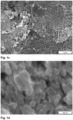
- a silicon compact Figures 1a to d was coated by dipping in the reaction product of Example 3. Excess material could then run off. The compact was treated in the heating oven for 2 days.
- a compact correspondingly treated with a silicon compound produced according to Example 3 was placed in an aqueous 3M KOH solution and in a 5M KOH solution.
- the 3M KOH solution remains clear for 18 minutes and only begins to cloud over after about 27 minutes.
- turbidity begins to set in after about 10 minutes. The turbidity indicates corrosion of the compact.
Landscapes
- Chemical & Material Sciences (AREA)
- Chemical Kinetics & Catalysis (AREA)
- Electrochemistry (AREA)
- General Chemical & Material Sciences (AREA)
- Engineering & Computer Science (AREA)
- Manufacturing & Machinery (AREA)
- Inorganic Chemistry (AREA)
- Materials Engineering (AREA)
- Battery Electrode And Active Subsutance (AREA)
Abstract
Gegenstand der Erfindung ist ein Metall-enthaltendes Anodenmaterial, insbesondere zur Verwendung in elektrochemischen Primärzellen mit alkalischem Elektrolyten, wobei das Metallenthaltende Anodenmaterial als Metall umfasst Silizium, Zink, Aluminium, Eisen und/oder Legierung umfassend eines oder mehrere der vorgenannten Metalle, und die Oberfläche des Metallenthaltenden Anodenmaterials zumindest teilweise organofunktionelle Silizium-enthaltenden Verbindungen aufweist. Als Silizium-enthaltende Verbindungen gelten organofunktionelle Silane und organofunktionelle Siloxanoligomere mit denen die Oberflächen versehen oder ausrüstbar sind.
Description
- Gegenstand der Erfindung ist ein Metall-enthaltendes Anodenmaterial, insbesondere zur Verwendung in elektrochemischen Primärzellen mit alkalischem Elektrolyten, wobei das Metall-enthaltende Anodenmaterial als Metall umfasst Silizium, Kalium, Zink, Aluminium, Eisen und/oder Legierung umfassend eines oder mehrere der vorgenannten Metalle, und die Oberfläche des Metall-enthaltenden Anodenmaterials zumindest teilweise organofunktionelle Silizium-enthaltende Verbindungen aufweist. Als Silizium-enthaltende Verbindungen gelten organofunktionelle Silane und organofunktionelle Siloxanoligomere mit denen die Oberflächen versehen oder ausrüstbar sind.
- Aufgrund des zunehmenden Bedarfes an E-Mobility im Personennahverkehr durch Elektroautos, Elektrofahrräder sowie elektrisch betriebene Busse etc. als auch bei zunehmender dezentraler Stromgewinnung, besteht ein enormer Bedarf an umweltverträglichen Batterien, deren Komponenten einerseits unbeschränkt verfügbar und andererseits unbeschränkt recyclebar, umweltverträglich und/oder weiter verwendbar sein sollen. Silizium ist ein auf der Erde unbegrenzt verfügbarer Rohstoff. Darüber hinaus müssen die Komponenten einer Batterie kostengünstig verfügbar sein.
- Des Weiteren ist es bekannt, durch ständige Zufuhr eines Brennstoffes in Brennstoffzellen, die eine galvanische Zelle aufweisen, in Gegenwart eines Oxidationsmittels elektrische Energie zu erzeugen. Grundsätzlich ist dieses Prinzip auch für Silizium-Luft-Batterien denkbar. Zudem sind übliche Silizium-enthaltende Lithium-Ionen-Sekundärbatterien täglich weltweit im Einsatz.
- Aufgabe der Erfindung war es ein Anodenmaterial und/oder ein Additiv für elektrochemische Primärzellen oder Elektrolyten bereitzustellen, das geeignet ist die Oberfläche des Anodenmaterials gegenüber korrosiven Einflüssen zumindest für eine gewisse Zeit zu stabilisieren bis hin zur Inhibierung der Korrosion. Somit bestand eine Aufgabe darin, eine Passivierung der Anodenoberfläche durch eine aktive und/oder passive Inhibierung bereitzustellen.
- Überraschenderweise wurde gefunden, dass eine Modifizierung der Oberfläche von Metallenthaltendem Anodenmaterial mit organofunktionellen Silizium-enthaltenden Verbindungen die Korrosion inhibiert. Eine solche Inhibierung kann einerseits mittels einer aktiven Passivierung der Anodenoberfläche und/oder eine passive Passiervierung der Anodenoberfläche erfolgen.
- Die Aufgaben wurden gelöst durch ein Metall-enthaltendes Anodenmaterial dessen Oberfläche zumindest teilweise organofunktionelle Silizium-enthaltende Verbindungen aufweist, die insbesondere kovalent oder zumindest zeitweise kovalent an die Oberfläche der Anode gebunden sind und/oder über ionische Wechselwirkungen diese solvatisieren. Zusätzlich oder alternativ können vorzugsweise die organofunktionellen Silizium-enthaltenden Verbindungen über polare Wechselwirkungen mit der Oberfläche des Anodenmaterials und der Anodenoberfläche wechselwirken und diese vorzugsweise gegenüber einer Korrosion passivieren. Insoweit werden die Aufgaben ebenfalls gelöst durch die Verwendung von organofunktionellen Silizium-enthaltenden Verbindungen, vorzugsweise von Silanen, Silanolen und/oder Siloxanoligomeren und Gemischen dieser, als Additiv in Elektrolytlösungen, insbesondere in Elektrolytlösungen die für elektrochemische Primärzellen geeignet sind. Besonders geeignet sind organofunktionelle Silane, organofunktionelle Silanole und/oder organofunktionelle Siloxanoligomere als Additive in Elektrolytlösungen
- Die Aufgaben wurden auch gelöst durch ein Metall-enthaltendes Anodenmaterial nach Anspruch 1, die Verwendung der Additive nach Anspruch 14, sowie die Primärzelle nach Anspruch 11, bevorzugte Ausführungsformen werden in den Unteransprüchen und detailliert in der Beschreibung offenbart.
- Gegenstand der Erfindung ist ein Metall-enthaltendes Anodenmaterial, insbesondere zur Verwendung in elektrochemischen Primärzellen mit alkalischem Elektrolyten, wobei das Metall-enthaltende Anodenmaterial als Metall umfasst Silizium, Kalium, Zink, Aluminium, Eisen und/oder als Metall Legierung umfasst, die ein oder mehrere der vorgenannten Metalle enthält, und die Oberfläche des Metall-enthaltenden Anodenmaterials zumindest teilweise organofunktionelle Silizium-enthaltende Verbindungen aufweist.
- Ferner ist Gegenstand der Erfindung ein Anodenmaterial das als Metall (im Folgenden abgekürzt: Me) umfasst Silizium (Si), Kalium (K), Zink (Zn), Aluminium (Al), Eisen (Fe) und/oder Legierung umfassend eines oder mehrere der vorgenannten Metalle und optional Lithium (Li), insbesondere umfassend eine Legierung Silizium, Kalium, Zink, Aluminium und/oder Eisen und jeweils optional Lithium.
- In einer besonders bevorzugten Alternative weist die Oberfläche des Anodenmaterials Metall-Sauerstoff-Silizium-Strukturen auf, die nachfolgend auch als Me-O-Si-Struktur bezeichnet werden, wobei die Silizium-Struktur, hier Si-Struktur, Bestandteil einer organofunktionellen Silizium-enthaltenden Verbindung sein kann oder ist. Als Bestandteil einer organofunktionellen Silizium-enthaltenden Verbindung gilt insbesondere eine Verbindung, die aus einem organofunktionellen Silan durch Hydrolyse und/oder Kondensation abgeleitet werden kann und ggf. über Sauerstoff kovalent an Oberflächen des Anodenmaterials oder an ein Festphasengel auf einer Oberfläche eines Anodenmaterials gebunden ist.
- Entsprechend einer bevorzugten Ausführungsform weist die Oberfläche des Anodenmaterials, insbesondere einer daraus hergestellten Anode, zumindest teilweise bis zur vollständigen Bedeckung der Oberfläche, Metall-Sauerstoff-Silizium-Strukturen auf, wie Me-O-Si-Strukturen, wobei die Silizium-Strukturen jeweils unabhängig Bestandteile organofunktioneller Siliziumenthaltender Verbindungen sind. Nach einer weiteren Alternative kann die Oberfläche dynamisch mit organofunktionellen Silizium-enthaltenden Verbindungen zumindest teilweise solvatisiert sein.
- Nach einer weiteren alternativen Ausführungsform ist Gegenstand der Erfindung ein Anodenmaterial dessen Oberfläche zumindest teilweise ein Festphasengel aufweist, wobei das Gel umfasst Metall-Sauerstoff-Strukturen, insbesondere umfasst das Gel Wasser und Hydroxy-funktionelle Strukturen von Siloxanen, insbesondere Siloxanoligomeren, Zinkhydroxid, Aluminiumhydroxid und/oder Eisenhydroxid-Strukturen, wobei die Metall-Sauerstoff-Strukturen mindestens teilweise als Metall-Sauerstoff-Silizium-Strukturen, bspw. Me-O-Si-Struktur, ausgebildet sind, wobei die Silizium-Strukturen, wie Si-Strukturen, in der jeweiligen Struktur Bestandteil einer organofunktionellen Silizium-enthaltenden Verbindung sind oder aus einer organofunktionellen Silizium-enthaltenden Verbindung abgeleitet sind. Silizium ist ein Halbmetall und gilt erfindungsgemäß daher auch als Metall.
- Nach einer besonders bevorzugten Alternative weist die Oberfläche des Anodenmaterials, insbesondere die Oberfläche einer aus dem Anodenmaterial hergestellten Anode, zumindest teilweise bis vollständig Metall-Sauerstoff-Silizium-Strukturen an der Oberfläche auf, die umfassen mindestens eine Struktur der Formeln I, insbesondere der Formel Ia und/oder ein Festphasengel, insbesondere mit Strukturen der Formel Ib, jeweils mit Me gleich Metall umfassend Silizium, Kalium, Zink, Aluminium, Eisen und/oder als Metall Legierung, die ein oder mehrere der vorgenannten Metalle und optional Lithium umfassen kann. Mit Metall-Sauerstoff-Silizium-Strukturen der Formel I
Me-O-R (I)
dargestellt in der nachfolgenden Formel Ia mit (Om/2)Me-O-R (Ib) oder (HOm)Me-O-R (Ib) oder entsprechende O- und HO-funktionelle Me-OR als Festphasengel enthaltend Metalle, mit m = 1 bis 3 und R jeweils unabhängig in I, Ia und/oder Ib ausgewählt aus organofunktionellen Silizium-enthaltenden Verbindungen. In der nachfolgenden Formel Ia stellt Me Metallatome in der Oberfläche des Anodenmaterials dar und Me in der Formel Ib stellt ein Metallatom dar, das an Sauerstoffatome gebunden oder von diesen umgeben ist, n als Index kann größer 1 sein. In einer besonders bevorzugten Ausführungsform ist in Formel Ib ein Siloxanoligomer mit Me gleich Silizium darstellt, wobei R eine organofunktionelle Silizium-Verbindung oder ein Bestandteil einer organofunktionellen Silizium-Verbindung ist, wie vorzugsweise der Formeln IIa, IIa*, IIa**, IIa***, IIb und/oder Hydrolysate und/oder Kondensate dieser.

- In den vorstehend dargestellten Formeln Ia und Ib sind die Oberflächen im Metall-enthaltenden Anodenmaterial, insbesondere des Anodenmaterials in Form einer Anode, mit organofunktionellen Silizium-enthaltenden Verbindungen als R dargestellt. In Formel Ia sind einzelne Metallatome in einer Oberfläche dargestellt, die über Sauerstoffatome mit den organofunktionellen Silizium-Verbindungen verbunden sind und als -OR dargestellt sind. In Formel Ib ist ein Festphasengel angedeutet, das beispielsweise ein Siloxanoligomer im Bereich der Oberfläche des Anodenmaterials, insbesondere in Form einer Anode, darstellt, welches über Sauerstoffatome mit organofunktionellen Silizium-Verbindungen, dargestellt als -OR, verbunden ist. Sowohl -OR in Formel Ia als auch in Formel Ib können die Oberfläche des Metall-enthaltenden Anodenmaterials passivieren und somit die Korrosion hinauszögern.
- In einer besonders bevorzugten Ausführungsform umfassen die Silizium-enthaltenden Verbindungen des Anodenmaterials oder in einer Elektrolytlösung Verbindungen der allgemeinen Formeln IIa, IIa*, IIa**, IIa*** und/oder IIb sowie optional Gemische enthaltend diese Verbindungen oder Silanole, Siloxanole, Siloxane davon. In ebenfalls bevorzugten Ausführungsformen weist das Anodenmaterial an seiner Oberfläche zumindest teilweise bis vollständig organofunktionelle Silizium-enthaltende Verbindungen auf, die Verbindungen der allgemeinen Formel II - SiZx mit Z umfassend O, C, N und optional H, mit x = 1,5 bis 3, bevorzugt umfasst Forme II die Formeln IIa, IIa*, IIa**, IIa*** und/oder IIb, wobei IIb umfasst Siloxanoligomere, wie Organosiloxane mit kettenförmigen, cyclischen, vernetzten und/oder raumvernetzten Strukturen und/oder Formel II umfasst mindestens ein Silan-Strukturelement der Formel IIa, IIa*, IIa** und/oder IIa***, oder mit R in Formel I umfassend Formel IIa, IIa*, IIa**, IIa*** und/oder IIb oder Gemischen davon
-SiY(OR1)c(OR2)d (IIa)
-SiY(O-)c(OR2)d (IIa*)
mit c gleich 1 oder 2 und d gleich 1 oder 2, wobei c + d = 2 in Formel IIa und IIa*, und R1 ausgewählt aus Methyl, Ethyl, n-Propyl, iso-Propyl, Polyether, und R2 gleich Wasserstoff ist, wobei Y umfasst 3-Gylcidyloxypropyl-, 3-Glycidyloxyethyl-, 3-Glycidyloxymethyl-, 3-(2,3-dihydroxyprop-1-oxy)propyl- 3-(2,3-dihydroxyprop-1-oxy)ethyl-, 3-(2,3-dihydroxyprop-1-oxy)methyl-, -Polyalkylenoxid-Gruppen, und/oder Alkyl-Gruppen mit C1 bis C16,
-SiY(OR1)c(OR2)d(O1/2) (IIb)
in Siloxanoligomeren der Formel IIb mit c gleich 0 oder 1 und d gleich 0 oder 1, wobei c + d = 1, und R1 ausgewählt aus Methyl, Ethyl, n-Propyl, iso-Propyl, Polyether, und R2 gleich Wasserstoff ist, wobei Y umfasst 3-Gylcidyloxypropyl-, 3-Glycidyloxyethyl-, 3-Glycidyloxymethyl-, 3-(2,3-dihydroxyprop-1-oxy)propyl-, 3-(2,3-dihydroxyprop-1-oxy)ethyl- oder 3-(2,3-dihydroxyprop-1-oxy)methyl- oder -Polyalkylenoxid-Gruppen. - In einer Alternative kann die Formel II als IIa** oder IIa*** oder Formel I mit R vorliegen
-SiY2(OR1)c(OR2)d (IIa**)
-SiY2(O-)c(OR2)d (IIa***)
mit in Formel IIa** und IIa*** R1 ausgewählt aus Methyl, Ethyl, n-Propyl, iso-Propyl, Polyether, mit c gleich 0 oder 1 und d gleich 0 oder 1, wobei c + d = 1, und R2 gleich Wasserstoff ist, wobei Y umfasst 3-Gylcidyloxypropyl-, 3-Glycidyloxyethyl-, 3-Glycidyloxymethyl-, 3-(2,3-dihydroxyprop-1-oxy)propyl-3-(2,3-dihydroxyprop-1-oxy)ethyl-, 3-(2,3-dihydroxyprop-1-oxy)methyl-, -Polyalkylenoxid-Gruppen und/oder lineare und/oder verzweigte Alkyl-Gruppen mit ein bis sechszehn C-Atomen, insbesondere ausgewählt aus Mehtyl, Ethyl, Propyl, Butyl, n-Butyl, iso-Butyl, tert-Butyl, Isomere von Pentyl, Isomere von Hexyl, Isomere von Heptyl, Isomere von Octyl. Alle vorgenannten Silizium-enthaltende Verbindungen können in beliebigen Gemischen vorliegen. - In einer weiteren bevorzugten Alternative ist Y in Formeln IIa, IIa*, IIa**, IIa*** oder IIb eine
- Polyalkylenoxid-Gruppe, die umfasst -Alkylen-(O-Alkylen)e-OH,
- Alkylen-(O-Alkylen)e-COOH, -Alkylen-(O-Alkylen)e-(C=O)NHR3,
- Alkylen-(O-Alkylen)e-(C=O)NR3 2, mit R3 gleich Kohlenwasserstoff oder Polyalkylenoxid,
- Alkylen-(O-Alkylen)e-O-Alkyl, -Alkylen-(O-Alkylen)e-O-Alkenyl,
- Alkylen-(O-Alkylen)e-O-(C=O)-Alkyl, -Alkylen-(O-Alkylen)e-O-(C=O)-Alkenyl,
- Alkylen-(O-Alkylen)e-O-(C=O)-Aromat-Alkyl jeweils unabhängig mit e größer gleich 2, insbesondere mit e = 5 bis 100, insbesondere
- Ebenfalls Gegenstand der Erfindung ist ein Metall-enthaltendes Anodenmaterial in dem das Metall umfasst Silizium und optional Lithium und/oder Legierung umfassend mindestens Silizium. Dabei liegt das Anodenmaterial vorzugsweise als dreidimensionaler Formkörper mit äußerer Oberfläche und innerer Oberfläche vor, wobei insbesondere der Formkörper Siliziumpartikel umfasst, und wobei der Formkörper auf mindestens einem Teil seiner äußeren und inneren Oberfläche organofunktionelle Silizium-enthaltende Verbindungen aufweist.
- Silizium-enthaltende Verbindungen sind vorzugsweise ausgewählt aus organofunktionellen Silanen oder aus organofunktionellen Silan(en) abgeleitete Siloxane, Mischung von organofunktionellen Silanen, Mischung von organofunktionellen Silanen und funktionellen Siloxanen und/oder einer Mischung von organofunktionellen Siloxanoligomere, mit denen das Anodenmaterial vorzugsweise versehen, ausgerüstet oder ausrüstbar ist. Bevorzugt weist die äußere und/oder innere Oberfläche von 5 bis 100 %, bevorzugt von 10 bis 50 % der Oberfläche die Silizium-enthaltende Verbindung auf. Die Oberfläche kann mit den, dem Fachmann bekannten Methoden wie bspw. mittels BET-Bestimmung erfolgen.
- Ferner ist Gegenstand der Erfindung ein Anodenmaterial, das Siliziumpartikel und optional Kohlenstoff und Silizium-enthaltende Partikel und optional Partikel mindestens einer allotropen Kohlenstoffmodifikation umfasst, wobei die Siliziumpartikel jeweils unabhängig voneinander einen Gehalt an Eisen, Zink, Aluminium, Kohlenstoff, Calcium, Kalium, optional Titan, optional Sauerstoff, optional Kupfer von jeweils größer gleich 0,01 mg/kg aufweisen.
- Das Anodenmaterial liegt vorzugsweise als dreidimensionaler Formkörper in Form einer im Wesentlichen ebenen Platte vor. Dabei weist die Platte eine Vorderseite und eine der Vorderseite gegenüberliegende Rückseite auf, wobei Vorder- und Rückseite mit zwischen Vorder- und Rückseite umlaufender Seitenfläche die Platte ausbilden. Vorzugsweise bilden Vorder-, Rück- und Seitenflächen die Oberfläche der Anode, und insbesondere die Oberfläche des Metall-enthaltenden Anodenmaterials, das zumindest teilweise organofunktionelle Silizium-enthaltende Verbindungen aufweist. Die Platte kann aus Partikel von Metall-enthaltenden partikelförmigen Pulvern gebildet sein, die insbesondere ein Gefüge bilden. Das Gefüge der Partikel in einem Formkörper kann beispielsweise aber nicht ausschließlich durch Sintern von Pulvern, Formkörpern, Grün- oder Weißlingen erhalten werden. In dem Gefüge sind die Partikel vorzugsweise stoffschlüssig miteinander verbunden.
- So kann beispielsweise eine stoffschlüssige Verbindung der Siliziumpartikel untereinander mittels des Siliziums der Siliziumpartikel durch ein An- und/oder vollständiges Aufschmelzen der Partikel erfolgen. Dabei ist es bevorzugt, wenn a) die stoffschlüssig miteinander verbundenen Siliziumpartikel miteinander i) verschmolzen und/oder ii) versintert und/oder iii) verpresst sind, oder b) der stoffschlüssige Verbund an den Kontaktpunkten der Siliziumpartikel durch Silizium-Material der Siliziumpartikel gebildet wird, indem die Silizium-Partikel miteinander i) verschmolzen und/oder ii) versintert und/oder iii) verpresst sind.
- Partikel von Metall-enthaltenden partikelförmigen Pulvern umfassen, vorzugsweise Partikelgröße von 1 nm bis 30 000 nm, bevorzugt sind Gemische von Fraktionen von Partikelgrößen umfassend Partikelgrößen von 10 nm bis 1000 nm und 1000 nm bis 30 000 nm.
- Gleichfalls Gegenstand der Erfindung ist eine elektrochemische Primärzelle mit Anode umfassend ein erfindungsgemäßes Anodenmaterial, wobei die Primärzelle ferner umfasst Kathode und Separator, wobei der Separator Anode und Kathode separiert, wobei die Primärzelle eine Elektrolytlösung enthält, und wobei die Kathode eine Zusammensetzung umfasst, die Kohlenstoffmaterial und ein sauerstoffspeicherndes Material umfasst, das Sauerstoff als eine sauerstoffhaltige Verbindung speichert. Die Kathode kann nach einer bevorzugten Alternative eine Luftkathode sein. Besonders bevorzugt ist die elektrochemische Primärzelle eine elektrochemische Silizium-Kathoden-Primärzelle oder eine Silizium-Luftkathode-Primärzelle, die ganz besonders bevorzugt als Silizium-Knopfzelle bspw. Hörgeräte Batterie, oder als Silizium-Batterie-Stapel vorliegt. Typischerweise liegen Silizium-Batterie-Stapel in mehrzelligen Fahrzeugbatterien vor.
- Vorzugsweise umfasst die Zusammensetzung der Kathode als sauerspeicherndes Material a) mindestens ein Manganoxid, insbesondere Mangandioxid, als Bestandteil des Kathodenmaterials, wobei insbesondere das Kathodenmaterial als Kathode in einem hermetisch abgeschlossenen Batteriegehäuse vorliegt, oder b) die Kathode eine Luftkathode ist und die Zusammensetzung der Kathode als Bestandteil des Kathodenmaterials ein Manganoxid, insbesondere Manganoxid und/oder Mangandioxid, Platin, Platin-Basis, Silber einzeln oder gemeinsam als Katalysator umfasst.
- Bevorzugte Primärzellen umfassen eine Elektrolytlösung einer wässrigen, alkalischen Elektrolytzusammensetzung, die umfasst oder ausgewählt ist aus
- i) mindestens eine lineare oder verzweigte Polyalkylenoxid-Gruppen aufweisende Silizium-Verbindung mit mindestens zwei Alkylenoxid-Gruppen in der Verbindung oder Gemische von mindestens zwei dieser Verbindungen, wobei die Alkylenoxid-Gruppen ausgewählt sind aus Methylenoxid, Ethylenoxid, Propylenoxid und Butylenoxid-Gruppen und/oder
- ii) 3-Glycidyloxypropylalkoxysilan, 3-Glycidyloxyethylalkoxysilan, 3-Glycidyloxymethylalkoxysilan, 3-(2,3-dihydroxyprop-1-oxy)propylalkoxysilan, 3-(2,3-dihydroxyprop-1-oxy)ethylalkoxysilan, 3-(2,3-dihydroxyprop-1-oxy)methylalkoxysilan, mit jeweils unabhängig Alkoxy ausgewählt aus Methoxy, Ethoxy und Propropoxy, Hydrolysate der vorgenannten Silane und/oder oligomere Kondensate der vorgenannten Silane, und/oder
- iii) Cyclopentylmethylether, 1,3-Dioxolan, Ethylencarbonat, 4-Hydroxymethyl-2,2-dimethyl-1,3-dioxolan, 4-Hydroxymethyl-1,3-dioxolan und/oder 4-Hydroxymethyl-1,3-dioxolan-2-on, oder Gemische mindestens zweier der Verbindungen ausgewählt aus i), ii) und iii) umfasst. Unter einem Hydroylsat der Silane sind Silanole mit und ohne Alkoxy-Gruppen zu verstehen. Als oligomere Kondensate werden Siloxanole, wie Siloxanoligomere verstanden, die ebenfalls Alkoxy-Gruppen aufweisen können oder ggf. vorllständig hydrolysiert vorliegen können. Beispiele dieser Verbindungen umfassen [3-(2,3-dihydroxyprop-1-oxy)propyl]- silanololigomere oder [3-Glycidyloxyprop1-oxypropyl]silanololigomere. Ferner können 1,3-Dioxolan-Derivate eingesetzt werden. Somit ist auch Gegenstand der Erfindung eine Elektrolytlösung einer wässrigen, alkalischen Elektrolytzusammensetzung, die die vorstehend genannten Komponenten i), ii) und/oder iii) alleine oder in Mischungen umfasst.
- Gleichfalls Gegenstand der Erfindung ist die Verwendung von Silanen, Silanolen und/oder Siloxanoligomeren, insbesondere deren Verwendung als Additive in Elektrolylösungen, wobei diese umfassen 3-Glycidyloxypropylalkoxysilan, 3-Glycidyloxyethylalkoxysilan, 3-Glycidyloxymethylalkoxysilan, 3-(2,3-dihydroxyprop-1-oxy)propylalkoxysilan, 3-(2,3-dihydroxyprop-1-oxy)ethylalkoxysilan, 3-(2,3-dihydroxyprop-1-oxy)methylalkoxysilan, mit jeweils unabhängig Alkoxy ausgewählt aus Methoxy, Ethoxy und Propropoxy, Hydrolysate der vorgenannten Silane und/oder oligomere Kondensate der vorgenannten Silane, oder Gemische von zwei der vorgenannten Verbindungen als Elektrolytbestandteil und/oder zur Herstellung von Metallenthaltendem Anodenmaterial, das an seiner Oberfläche zumindest teilweise organofunktionelle Silizium-enthaltende Verbindungen aufweist, die abgeleitet sind aus den vorgenannten Silanen, Silanolen und/oder Siloxanoligomeren und optional eine Verwendung von Cyclopentylmethylether, 1,3-Dioxolan, Ethylencarbonat, 4-Hydroxymethyl-2,2-dimethyl-1,3-dioxolan, 4-Hydroxymethyl-1,3-dioxolan und/oder 4-Hydroxymethyl-1,3-dioxolan-2-on oder Gemische mindestens zweier der vorgenannten Verbindungen in einer Elektrolytlösung, insbesondere in einer Zusammensetzung als Korrosionsschutzmittel, Regler in einer Elektrolytlösung und/oder auf Anoden, als Passivierungsmittel in einer Elektrolytlösung und/oder auf Anoden und/oder Stabilisator in einer Elektrolytlösung und/oder auf Anoden, bevorzugt in einer Elektrolytlösung mit einem pH-Wert größer 9, besonders bevorzugt größer 10, besonders bevorzugt größer pH-Wert 12. Als auf Anoden werden vorzugsweise kovalent und/oder ionische Modifizierungen der Oberfläche der Anode verstanden, die insbesondere die Korrosionsgeschwindigkeit beeinflussen und diese vermindern und/oder die Potentialdifferenz zwischen Anode und Kathode erhöht.
- Nach einer bevorzugten Ausführungsform weist das Anodenmaterial, insbesondere in Form einer Silizium-Anode einen Formkörper auf, der eine Dichte von 0,1 g/cm3 bis 2,3 g/cm3 aufweist. Weiter bevorzugt weist der Formkörper eine Dichte von 0,5 g/cm3 bis 2,1 g/cm3auf, bevorzugt von 0,5 bis 1,8 g/cm3, weiter bevorzugt von 1,3 bis 1,8 g/cm3.
- Bevorzugte organofunktionelle Silizium-Verbindungen umfassen Alkyltrialkoxysilane, Dialkyldialkoxysilane, (Polyalkylenoxid)alkylsilane, Glycidyl-alkyltrialkoxysilane, Glycidylalkyl(alkyl)dialkoxysilane, sowie deren Hydrolyse- und optional Kondensationsprodukte Alkylsiloxane, Dialkylsiloxane, (Polyalkylenoxid)alkylsiloxane, Glycidylalkylsiloxane, Glycidylalkyl(alkyl)siloxane. Die jeweiligen Alkyl-Gruppen können linear, verzweigt und/oder cyclisch sein und können umfassen 1 bis 24 C-Atome, bevorzugt 1 bis 10 C-Atome, besonders bevorzugt 1 bis 8 C-Atome. Besonders bevorzugt sind Methyl, Ethyl, Propyl, Butyl, Pentyl, Hexy, Heptyl, Octyl und die jeweiligen, dem Fachmann bekannten Isomere. Die Alkoxy-Gruppen sind vorzugsweise ausgewählt aus Methoxy, Ethoxy, Propoxy und Butoxy. Des Weiteren sind alle Hydroxy-funktionellen Silane der vorgenannten Silane umfasst, die durch Hydrolyse der jeweiligen Alkoxysilane erhältlich sind.
- Die Silane und/oder Siloxane können vorzugsweise mittels einer oder zwei Si-O-Bindungen im alkalischen Elektrolyten an der Me-O-, insbesondere Si-O-funktionalisierten Oberflächen als Me-O-Si-Verbindung kovalent gebunden sein. Vorzugsweise weisen die Silane und/oder Siloxane zwei Alkyl-Gruppen auf. Dabei kann es bevorzugt sein, wenn die Silane mit Gruppen funktionalisiert sind die entweder eine deutliche sterische Behinderung der Hydroxidionen bewirken, so dass diese nicht ungehindert an die Oberfläche der Silizium-Anode vordringen können oder die funktionellen Gruppen umfassen (Polyalkylenoxid)alkyl-Gruppen, die flexibel die Oberfläche der Silizium-Anode belegen können und so die Korrosion für eine gewisse Zeit inhibieren können.
- Gleichfalls ist es bevorzugt, wenn zusätzlich oder alternativ die Elektrolytlösung eine wässrige, alkalische Zusammensetzung ist, die umfasst Polyalkylenoxid, oder ein Gemisch von Polyalkylenoxiden. Dabei ist es bevorzugt, wenn die Alkylene ausgewählt sind aus bivalenten Alkylenen, die 1 bis 6 C-Atome umfassen, und die bivalenten Alkylene vorzugsweise ausgewählt sind aus Methylen, Ethylen, n-Propylen, iso-Propylen und Butylen. Weiter ist es bevorzugt, wenn das Polyalkylenoxid ausgewählt ist aus HO(C2H4O)nH mit n größer gleich 4, R1O(C2H4O)n1R2 mit R1 und R2 jeweils unabhängig ausgewählt aus -H, -Alkyl, -C=O-Alkyl mit Alkyl jeweils unabhängig mit 1 bis 6 C-Atomen, wobei R1 oder R nicht gleich H sind, mit n1 = größer gleich 4, HO(C3H6O)mH mit m größer gleich 4, R3O(C3H6O)m1R4 mit R3 und R4 jeweils unabhängig ausgewählt aus H, Alkyl, -C=O-Alkyl, mit Alkyl jeweils unabhängig mit 1 bis 6 C-Atomen, mit m1 größer gleich 4, wobei R3 oder R4 nicht gleich H sind, Polyether der vorgenannten Polyalkylenoxide umfassend Ethylenoxid und Propylenoxid-Einheiten und Gemischen von Polyalkylenoxiden umfassend mindestens zwei unterschiedliche Polyalkylenoxide.
- Bevorzugte Polyaklylenoxid-Gruppen, insbesondere umfassend Polyalkylenoxid-Gruppen, aufweisende Verbindungen können vorzugsweise ein Molekulargewicht von 200 g/mol bis 35.000 g/mol, bevorzugt 200 bis 1500 g/mol aufweisen. Dabei ist es weiter bevorzugt, wenn das mittlere Molekulargewicht von 200 g/mol bis 1500 g/mol beträgt.
- Ein erfindungsgemäßes Anodenmaterial kann vorteilhaft mit einem Film oder einer Beschichtung umfassend Polyalkylenoxid bereitgestellt werden.
- Erfindungsgemäß besonders bevorzugt weist das Anodenmaterial, insbesondere ein Silizium als Metall-enthaltendes Anodenmaterial, bevorzugt Anodenmaterial von Siliziumpartikeln, einen Gehalt an Eisen, Zink, Kalium, Aluminium, Kohlenstoff, Calcium, optional Titan, optional Sauerstoff, optional Kupfer von jeweils größer gleich 0,01 mg/kg auf, besonders bevorzugt ist ein Gehalt an Eisen von größer gleich 0,02 mg/kg. Ferner ist Gegenstand der Erfindung ein Anodenmaterial umfassend Siliziumpartikel und optional Kohlenstoff und Silizium-enthaltende Partikel und optional Partikel mindestens einer allotropen Kohlenstoffmodifikation, wobei die Siliziumpartikel, insbesondere die Silizium-Anode, einen Gehalt an Eisen von größer gleich 0,02 mg/kg aufweist. Als Kohlenstoff- und Silizium-enthaltende Partikel und mindestens eine allotrope Kohlenstoffmodifikation aufweisende Partikel können umfasst sein Carbon-Black, kugelförmige Nanopartikel umfassend Graphit, Graphit, Graphen und polycyclischen Kohlenstoff. Diese Partikel weisen vorzugsweise einen Durchmesser von größer gleich 1 nm, insbesondere von 10 nm bis 300 nm auf. Vorzugsweise umfassen die Kohlenstoff und Silizium-enthaltenden Partikel Siliciumcarbid und/oder die Partikel mindestens eine allotrope Kohlenstoffmodifikation umfassend Diamant, polycyclische Kohlenstoffmodifikationen, Graphit, Fulleren, Graphen. Diamant kann aus einem Recyclingprozess mittels Drahtsägen stammen. Entsprechend können auch Zink, Kalium, Aluminium oder Eisen als Anodenmaterial entsprechende Partikel aufweisen, die einen Gehalt an Silizium, Kohlenstoff, Calcium, optional Titan, optional Sauerstoff, optional Kupfer von jeweils größer gleich 0,01 mg/kg aufweisen können.
- Ein besonders bevorzugtes alternatives oder zusätzliches Metall-enthaltendes Anodenmaterial kann Siridion®-Black umfassen. Nach einer Alternative kann das Anodenmaterial umfassen Silizium-enthaltende Partikel mit einem Gehalt an Kohlenstoff, insbesondere mit einem Gehalt von 1 bis kleiner 10 Gew.-% Kohlenstoff im Gesamtgehalt der Silizium-enthaltenden Partikel. Bevorzugte Anodenmaterialen können Gemische von Siliziumpartikeln ohne Kohlenstoffgehalt und Siliziumpartikel mit einem Kohlenstoffgehalt umfassen. Die erfindungsgemäß genannten Silizium-Partikel können auch als Mischungen umfassend definierte Fraktionen qualitativ unterschiedlich zusammengesetzter Siliziumpartikel vorliegen.
- Nach einer Ausführungsform weist das Metall-enthaltende Anodenmaterial bevorzugt Siliziumpartikel und optional Kohlenstoff und Silizium-enthaltende Partikel und optional Partikel mindestens einer allotropen Kohlenstoffmodifikation auf, wobei die Siliziumpartikel jeweils unabhängig voneinander, insbesondere die Silizium-Anode, jeweils unabhängig voneinander einen Gehalt an Eisen, Zink, Aluminium, Kohlenstoff, Calcium, Kalium optional Titan, optional Sauerstoff, optional Kupfer von jeweils größer gleich 0,01 mg/kg aufweisen. Des Weiteren kann es bevorzugt sein, wenn der Gehalt in den Siliziumpartikeln, insbesondere der Silizium-Anode, beträgt:
- Eisen größer gleich 0,05 mg/kg,
- Kalium größer gleich 0,01 mg/kg,
- Aluminium größer gleich 0,01 mg/kg,
- Kohlenstoff größer gleich 0,01 mg/kg,
- Calcium größer gleich 0,01 mg/kg,
- und optional Titan größer gleich 0,001 mg/kg,
- und optional Sauerstoff größer gleich 0,001 mg/kg,
- und optional Kupfer größer gleich 0,001 mg/kg.
- Gleichfalls bevorzugtes Metall-enthaltendes Anodenmaterial kann umfassen Silizium, bevorzugt Siliziumpartikel mit i) einem Gehalt an Eisen von größer gleich 0,02 mg/kg, bevorzugt größer gleich 0,05 mg/kg, und/oder ii) Silizium, bevorzugt Siliziumpartikel, mit Eisen-enthaltenden Partikeln, wobei die Eisen-enthaltenden Partikel mit einem Gehalt an Eisen von größer gleich 90 Gew.-% in Bezug auf die Gesamtzusammensetzung der Eisen-enthaltenden Partikel vorliegen, wobei die Eisen-enthaltenden Partikel vorzugsweise eine Edelstahllegierung umfassen. Die Eisen-enthaltenden Partikel mit einem Eisengehalt größer 90 % können aus einem Wafersägeprozess und der aufgearbeiteten Sägesuspension stammen oder aus einem Recyclingprozess z.B. von Solarsilizium. Ferner kann das Metall-enthaltende Anodenmaterial, insbesondere die Siliziumpartikel oder die Silizium-Anode, einen Gehalt aufweisen an:
- Eisen größer gleich 5 mg/kg,
- Aluminium größer gleich 0,5 mg/kg,
- Calcium größer gleich 5 mg/kg,
- Kalium größer gleich 5 mg/kg,
- und optional Sauerstoff größer gleich 0,01 mg/kg,
- und optional Titan größer gleich 0,01 mg/kg,
- und optional Kupfer größer gleich 0,05 mg/kg.
- Die Siliziumpartikel können umfassen Primärpartikel, amorphe Siliziumpartikel, mono- oder polykristalline Siliziumpartikel. Als Primärpartikel gelten Partikel, die sich in einem thermischen Prozess der Herstellung von Siliziumpartikeln ausbilden und sich anschließend zusammenballen und dabei Aggregate und/oder Agglomerate ausbilden. Die Primärpartikel weisen dabei üblicherweise einen Durchmesser von 1 bis 1000 nm auf, während die Aggregate und/oder Agglomerate von 150 bis 20 Mikrometer in mindestens einer Dimension aufweisen können. Eine bevorzugte Partikelgrößenverteilung von amorphen Siliziumpartikeln kann von 1 nm bis 700 nm betragen, insbesondere von 10 nm bis 500 nm, und die mono- bis polykristallinen eine Partikelgrößenverteilung von 500 nm bis 20 Mikrometer, insbesondere von 700 nm bis 20 Mikrometer. Des Weiteren kann es bevorzugt sein, wenn die mono- bis polykristallinen Siliziumpartikel bimodal mit Siliziumpartikeln im Bereich von 800 nm bis 9 Mikrometer und von 13 bis 20 Mikrometer vorliegen.
- Gleichfalls können die Siliziumpartikel oder auch andere Partikel mit polymerisierbaren Monomeren in einer Zusammensetzung vorliegen, die geformt und polymerisiert und optional anschließend gesintert oder pyrolysiert wird.
- Entsprechend einer bevorzugten Ausführungsvariante umfasst das Silizium im Anodenmaterial, insbesondere die Siliziumpartikel, bevorzugt amorphe und/oder polykristalline Siliziumpartikel, des Anodenmaterials Dotierstoffe, wobei die Dotierstoffe ausgewählt sind aus Elementen der 13. Hauptgruppe, insbesondere umfassend Bor, Indium, Aluminium und/oder Gallium, und aus Elementen der 15. Hauptgruppe, insbesondere umfassend Phosphor, Arsen und/oder Antimon sowie Elemente der Eisengruppe, besonders bevorzugt sind Bor, Aluminium, Phosphor und/oder Eisen. Die Elemente der 13. Hauptgruppe (neue Nomenklatur: Gruppe 13 des Periodensystems) sind Elektronen-Akzeptoren neuer Nomenklatur. Als Elektronen-Donatoren werden Elemente der 15. Hauptgruppe (neue Nomenklatur: Gruppe 15 des Periodensystems) eingesetzt.
- Nach einer Ausführungsform umfasst das Silizium, insbesondere die Silizium-Partikel des Anodenmaterials, Dotierstoffe, wobei die Dotierstoffe zu größer gleich 1 Element der 15. Hauptgruppe auf 106 Silizium-Atome und/oder größer gleich 1 Element der 13. Hauptgruppe auf 106 Silizium-Atome vorliegen, insbesondere größer gleich 1 Element der 15. Hauptgruppe auf 104 Silizium-Atome und/oder größer gleich 1 Element der 13. Hauptgruppe auf 104 Silizium-Atome, bestimmt mittels dem Fachmann bekannter ICP-MS Analyse (Inductive Plasma Discharge-Massenspektroskopie, welche unter Wikipedia ausführlich beschrieben ist: https://de.wikipedia.org/wiki/Massenspektrometrie_mit_induktiv_gekoppeltem_Plasma). Alternativ kann die Analyse auch durch GD-MS erfolgen (GDMS/GD-MS-Glimmentladungs-Massenspektroskopie mit Secondary Electron Multiplier- (SEM) und/oder Faraday-Detector gemäß Quelle:https://assets.thermofisher.com/TFS-Assets/CMD/brochures/BR-30066-GD-MS-ELEMENT-GD-PLUS-BR30066-EN.pdf). Den Farady-Detektor vorzugsweise für die Messungen von Spuren-Konzentrationen im %-Bereich.
- Nach einer alternativen, bevorzugten Ausführungsform umfasst das Silizium, insbesondere die amorphen und/oder polykristalline Silizium-Partikel, des Anodenmaterials Dotierstoffe, wobei die Dotierstoffe größer gleich 102 Atome (ca. 100 Gew.-ppm, abhängig von Atomgewicht des Dotierstoffes) der 15. Hauptgruppe auf 106 Silizium-Atome und/oder größer gleich 102 Atome der 13. Hauptgruppe auf 106 Silizium-Atome vorliegen.
- Nach weiteren bevorzugten, alternativen Ausführungsformen umfasst das Silizium, insbesondere die amorphen und/oder polykristalline Silizium-Partikel, des Anodenmaterials Dotierstoffe, wobei die Dotierstoffe größer gleich 103 Atome der 15. Hauptgruppe auf 106 Silizium-Atome größer gleich 2*103 Atome der 13. Hauptgruppe auf 106 Silizium-Atome vorliegen. Die vorstehenden Gehalte an Dotierstoffen im Silizium des Anodenmaterials können inhomogen im Silizium verteilt sein, sowie die Gehalte integral über die Gesamtmenge des Siliziums im Anodenmaterial im Mittel vorliegen. Zur Bestimmung obiger Gehalte wird eine Prüfmenge von 1 g Prüfmenge mittels GD-MS oder ICPMS vermessen, wobei zwischen beiden Methoden gewisse Abweichungen bestimmt werden können, vorzugsweise wird ein Mittelwert bestimmt.
- Entsprechend weiteren bevorzugten, alternativen Ausführungsformen umfasst das Silizium, insbesondere die amorphen Siliziumpartikel, des Anodenmaterials Dotierstoffe, wobei die Dotierstoffe lokal größer gleich 104 Atome der 15. Hauptgruppe auf 106 Silizium-Atome und/oder größer gleich 104 Atome der 13. Hauptgruppe auf 106 Silizium-Atome betragen.
- Nach weiteren bevorzugten, alternativen Ausführungsformen umfasst das Silizium, insbesondere die amorphen und/oder polykristalline Siliziumpartikel, des Anodenmaterials Dotierstoffe, wobei die Dotierstoffe größer gleich 1019 Atome der 15. Hauptgruppe auf 5*1022 Silizium-Atome und/oder größer gleich 1019 Atome der 13. Hauptgruppe auf 5*1022 Silizium-Atome aufweisen.
- Die Silizium-Partikel können auf atomarer Ebene eine Legierung von Silizium mit mindestens einem Element der 13. oder 15 Hauptgruppe aufweisen, wobei das mindestens ein Element der 13. oder 15. Hauptgruppe ganz besonders bevorzugt mit größer gleich 1020 Atomen/cm3 vorliegt und ausgewählt aus mindestens einem Elektronendonator und Elektronenakzeptor ist. Dabei liegt die Legierung von Silizium auf atomarer Ebene mit mindestens einem Element der 13. oder 15. Hauptgruppe als eine amorphe oder kristalline Phase vor. Besonders bevorzugt weisen die Siliziumpartikel einen Gehalt an Bor von 10 ppm-Gew bis 2,5 Gew.-% in Bezug auf den Gesamtgehalt von 100 Gew.-% des Siliziumpartikels auf, bevorzugt ist ein Gehalt von 10 ppm-Gew bis 1,8, besonders bevorzugt von 1,8 Gew.-% plus/minus 0,2 Gew.-%. Analog kann die Siliziumfolie einen Gehalt an Bor von 10 ppm-Gew bis 1,8 Gew.-% in Bezug auf den Gesamtgehalt von 100 Gew.-% der Siliziumfolie aufweisen. Es wurde überraschend gefunden, dass die Legierungen von Silizium und Bor antikorrosiv wirken, so dass die Lebensdauer der Primärzelle verlängert wird.
- Gegenstand der Erfindung ist eine Silizium-Anode umfassend Metall-enthaltendes Anodenmaterial mit Siliziumpartikel, die einen Gehalt an Bor von 1 Gew.-ppm bis 1,8 Gew.-% aufweisen.
- Des Weiteren wird ein wirtschaftliches Kathodenmaterial bereitgestellt, das vorzugsweise eine physikalische Mischung von Mangandioxid (MnO2) und einem Leitfähigkeitsvermittler umfasst. Der optionale Gehalt des Leitfähigkeitsvermittlers in den Elektroden der Primärzelle kann in der Kathode und in der Anode unterschiedlich hoch sein. Für Mangandioxid ist ein Gehalt an Leitfähigkeitsvermittler im Material der Kathode von circa 5 bis 65 Gew.-%, bevorzugt 5 bis 15 Gew.-% üblich. Generell kann der Gehalt des Leitfähigkeitsvermittlers von 5 bis 60 Gew.-% im Material der Kathode betragen. Alternativ bevorzugt können Gehalte im Bereich von 15 bis 20 Gew.-% für einen geringeren Widerstand oder auch als Obergrenze 30 bis 60 Gew.-% sein. Dabei beträgt das Material der Kathode in Summe immer 100 Gew.-%.
- Die vorliegende Erfindung wird durch die nachfolgenden Beispiele näher erläutert, ohne den Gegenstand zu beschränken.
- In einem geeigneten Reaktionsgefäß werden 278 Teile 3-Glycidyloxypropyltriethoxysilan vorgelegt. Die Mischung wird 5 Stunden bei Raumtemperatur gerührt. Danach wird das durch die Hydrolyse der Ethoxygruppen entstandene Ethanol im Vakuum bei 40 °C abdestilliert, wobei die Viskosität stark anstieg. Es verbleiben 6,3 Gew.-% freies Ethanol im Produkt. Das Reaktionsprodukt wird mit 7,4 g Propionsäure versetzt und eine Stunde gerührt. Es kommt zur Hydrolyse weiterer Alkoxygruppen. Es wird ein milchig-weißes, im Durchlicht opaleszierendes, hochviskoses Produkt erhalten.
- In einem geeigneten Reaktionsgefäß werden 182 Teile 3-Glycidyloxypropyltrimethoxysilan (DYNASYLAN® GLYMO) vorgelegt und nacheinander unter Rühren 9 Teile konzentrierte Essigsäure, 18 Teile Zirkon-n-propylat zugegeben. Nach Beginn der Hydrolyse der Methoxygruppen des 3-Glycidyloxypropyltrimethoxysilans steigt die Temperatur um 10 bis 15 °C. Die Reaktionsmischung wird anschließend 2 Stunden bei einer Sumpftemperatur von ca. 78 °C nachgerührt. Dann wird Methanol im Vakuum bei 53 bis 61 °C abdestilliert. Mit Beginn der Destillation werden 156 Teile VE-Wasser zugesetzt. Nach Beendigung der destillativen Abtrennung von Methanol werden nochmals 70 Teile VE-Wasser zugesetzt, um anteilig destillativ abgetrenntes VE-Wasser zu ersetzen und den Feststoffgehalt auf rund 45 bzw. 50 Gew.-% einzustellen. Erhalten wird ein milchig-weißes, im Durchlicht opaleszierendes, niederviskoses, lagerstabiles Produkt.
- 0,8 mol GLYEO (3-Glycidyloxypropyltriethoxysilan) werden mit 0,1 n Salzsäure versetzt und 16 Stunden bei Raumtemperatur gerührt. Anschließend wird Ethanol abdestilliert.
- Die Beschichtungseigenschaft der Reaktionsprodukte der Beispiele 1 und 2 wird geprüft. Dazu werden die Reaktionsprodukte auf die Oberfläche eines Aluminium-Prüfblechs der Firma Pausch der Legierung Alu 3105H24 verwendet. Eine Vorreinigung erfolgte mittels Ethylacetat und Mikrofasertuch. Das Beschichtungssystem wird mittels 6-Mikrometer-Rakel appliziert (12 Tage nach Herstellung der Reaktionsprodukte, Umgebungsbedingungen: 24 °C, 45 bis 65 % relative Feuchte). Anschließend wird getrocknet: 10 Minuten bei Raumtemperatur (24 °C), nachfolgend 10 Minuten bei 200 °C. Die Beschichtung wird einen Tag nach Herstellung untersucht.
- Die entsprechend beschichtete Aluminiumplatte wird 2 h im Kochtest behandelt. Anschließend wird ein Gitterschnitt nach Tesa-Abriss/DIN EN ISO 2409 durchgeführt. Bei beiden Beispielen wird Gt 0 - ohne visuelle Veränderung festgestellt.
- Herstellung Formkörper, hier gesinterter Pressling: Masse: 1 g, Max. Druck: 180 bar, Max. Temperatur: 750 °C, Haltezeit: 180 s, in Spark-Plasma Sinterofen, Firma Fritsch. Die Presslinge wurden alle mit den gleichen Parametern gesintert.
- In den
Figuren 1a und1d sind die an Kontaktpunkten miteinander verbunden einzelnen Siliziumpartikel, die im Nanometerbereich die äußere Oberfläche und innere Oberfläche des Formkörpers bilden, gut zu erkennen. Die Kontaktpunkte zwischen den Siliziumpartikeln werden gebildet aus dem Material der hier angeschmolzenen Siliziumpartikel. Eine Vielzahl an Siliziumpartikeln sind daher integral an den Kontaktpunkten miteinander verbunden, hier verschmolzen. - Ein Silizium-Pressling der
Figuren 1a bis d wurde beschichtet, indem er in das Reaktionsprodukt des Beispiels 3 eingetaucht wurde. Anschließend konnte überschüssiges Material ablaufen. Der Pressling wurde im Wärmeofen für 2 Tage behandelt. - Ein unbehandelter Pressling wurde in eine wässrige 3 M und 5 M KOH-Lösung gelegt. Sofort beginnt die Korrosion des Siliziums. Dies ist an der Blasenbildung zu erkennen.
- Ein entsprechend mit einer gemäß Beispiel 3 hergestellten Silizium-Verbindung behandelter Pressling wurde in eine wässrige 3M KOH und einer in eine 5M KOH Lösung gelegt. Die Lösung mit 3M KOH bleibt für 18 Minuten klar und beginnt erst nach etwa 27 Minuten einzutrüben. In der auf 5 M KOH eingestellten Lösung beginnt nach etwa 10 Minuten eine Trübung einzusetzen. Die Trübung deutet auf eine Korrosion des Presslings hin.
Tabelle 1: Si-Pressling unbehandelt und behandelt mit GLYMO (3-Glycidyloxypropyltriethoxysilan), PEG 200 und Beispiel 3 Silizium Presslinge gesintert Zeit [min] 3 M KOH wässrig, Glymo (1 Gew.-%) 3 M KOH wässrig, PEG200 (1 Gew.-%) 3 M KOH wässrig, Beispiel 3 (1 Gew.-%) 3 M KOH wässrig 0 Klar klar klar Beginn Eintrübung 1 Klar klar klar trüb 15 leicht trüb trüb klar trüb 27 leicht trüb trüb leicht trüb trüb
Claims (14)
- Metall-enthaltendes Anodenmaterial, insbesondere zur Verwendung in elektrochemischen Primärzellen mit alkalischem Elektrolyten, dadurch gekennzeichnet, dass das Metall-enthaltende Anodenmaterial als Metall umfasst Silizium, Kalium, Zink, Aluminium, Eisen und/oder Legierung umfassend eines oder mehrere der vorgenannten Metalle, wobei die Oberfläche des Metall-enthaltenden Anodenmaterials zumindest teilweise organofunktionelle Silizium-enthaltende Verbindungen aufweist.
- Anodenmaterial nach Anspruch 1, dadurch gekennzeichnet, dass die Oberfläche aufweist Metall-Sauerstoff-Silizium-Strukturen, wobei die jeweilige Silizium-Struktur Bestandteil einer organofunktionellen Silizium-enthaltenden Verbindung ist.
- Anodenmaterial nach Anspruch 1 oder 2, dadurch gekennzeichnet, dass das Metall umfasst Silizium, Calcium, Kalium, Zink, Aluminium, Eisen und/oder Legierung umfassend eines oder mehrere der vorgenannten Metalle und optional Lithium, insbesondere umfasst eine Legierung mit Silizium, Kalium, Zink, Aluminium und/oder Eisen und jeweils optional Lithium.
- Anodenmaterial nach Anspruch 1, dadurch gekennzeichnet, dass die Metall-Sauerstoff-Silizium-Strukturen der Oberfläche umfassen Strukturen der Formeln I
Me-O-R (I)
R jeweils unabhängig ausgewählt ist aus organofunktionellen Silizium-enthaltenden Verbindungen. - Anodenmaterial nach einem der Ansprüche 1 bis 4, dadurch gekennzeichnet, dass die organofunktionellen Silizium-enthaltenden Verbindungen umfassend Verbindungen der allgemeinen Formeln IIa, IIa* und/oder IIb odermit R in Formel I umfassend Formel IIa, IIa* oder IIb
-SiY(OR1)c(OR2)d (IIa)
-SiY2(OR1)(OR2) (IIa*)
mit c gleich 1 oder 2 und d gleich 1 oder 2, wobei c + d = 2, und R1 ausgewählt aus Methyl, Ethyl, n-Propyl, iso-Propyl, Polyether, und R2 gleich Wasserstoff ist,wobei Y umfasst 3-Gylcidyloxypropyl-, 3-Glycidyloxyethyl-, 3-Glycidyloxymethyl-, 3-(2,3-dihydroxyprop-1-oxy)propyl- 3-(2,3-dihydroxyprop-1-oxy)ethyl-, 3-(2,3-dihydroxyprop-1-oxy)methyl-, -Polyalkylenoxid-Gruppen und/oder Alkyl-Gruppen mit C1 bis C16,
-SiY(OR1)c(OR2)d(O1/2) (IIb)
in Siloxanoligomeren mit c gleich 0 oder 1 und d gleich 0 oder 1, wobei c + d = 1, undR1 ausgewählt aus Methyl, Ethyl, n-Propyl, iso-Propyl, Polyether, und R2 gleich Wasserstoff ist, wobei Y umfasst 3-Gylcidyloxypropyl-, 3-Glycidyloxyethyl-,3-Glycidyloxymethyl-, 3-(2,3-dihydroxyprop-1-oxy)propyl-, 3-(2,3-dihydroxyprop-1-oxy)ethyl- oder 3-(2,3-dihydroxyprop-1-oxy)methyl- oder-Polyalkylenoxid-Gruppen. - Anodenmaterial nach Anspruch 5, dadurch gekennzeichnet, dass Y in Formel IIa, IIa* oder IIb eine -Polyalkylenoxid-Gruppe ist, die umfasst -Alkylen-(O-Alkylen)e-OH,- Alkylen-(O-Alkylen)e-COOH, -Alkylen-(O-Alkylen)e-(C=O)NHR3,- Alkylen-(O-Alkylen)e-(C=O)NR3 2, mit R3 gleich Kohlenwasserstoff oder Polyalkylenoxid,- Alkylen-(O-Alkylen)e-O-Alkyl, -Alkylen-(O-Alkylen)e-O-Alkenyl,- Alkylen-(O-Alkylen)e-O-(C=O)-Alkyl, -Alkylen-(O-Alkylen)e-O-(C=O)-Alkenyl,- Alkylen-(O-Alkylen)e-O-(C=O)-Aromat-Alkyl jeweils unabhängig mit e größer gleich 2, insbesondere mit e = 5 bis 100.
- Anodenmaterial nach einem der Ansprüche 1 bis 6, dadurch gekennzeichnet, dass das Metall-enthaltende Anodenmaterial als Metall umfasst Silizium und optional Lithium und/oder Legierung umfassend mindestens Silizium, und das Anodenmaterial als dreidimensionale Formkörper mit äußerer Oberfläche und innerer Oberfläche vorliegt, insbesondere wobei der Formkörper Siliziumpartikel umfasst, und wobei der Formkörper auf mindestens einem Teil seiner äußeren und inneren Oberfläche organofunktionelle Silizium-enthaltende Verbindungen aufweist.
- Anodenmaterial nach einem der Ansprüche 1 bis 7, dadurch gekennzeichnet, dass es umfasst Siliziumpartikel und optional Kohlenstoff und Silizium-enthaltende Partikel und optional Partikel mindestens einer allotropen Kohlenstoffmodifikation, wobei die Siliziumpartikel jeweils unabhängig voneinander einen Gehalt an Eisen, Kalium, Zink, Aluminium, Kohlenstoff, Calcium, optional Titan, optional Sauerstoff, optional Kupfer von jeweils größer gleich 0,01 mg/kg aufweisen.
- Anodenmaterial nach einem der Ansprüche 1 bis 7, dadurch gekennzeichnet, dass das Anodenmaterial als dreidimensionaler Formkörper in Form einer im Wesentlichen ebenen Platte vorliegt, wobei die Platte eine Vorderseite und eine der Vorderseite gegenüberliegende Rückseite aufweist, und Vorder- und Rückseite mit zwischen Vorder- und Rückseite umlaufender Seitenfläche die Platte ausbilden, wobei die Vorder-, Rück- und Seitenflächen die Oberfläche der Anode bilden, und diese Oberfläche des Metall enthaltenden Anodenmaterials zumindest teilweise organofunktionelle Silizium-enthaltende Verbindungen aufweist.
- Elektrochemische Primärzelle mit Anode umfassend ein Anodenmaterial nach einem der Ansprüche 1 bis 9, dadurch gekennzeichnet, dass die Primärzelle umfasst Kathode und Separator, wobei der Separator Anode und Kathode separiert, wobei die Primärzelle eine Elektrolytlösung enthält, wobei die Kathode umfasst eine Zusammensetzung umfassend Kohlenstoffmaterial und ein sauerstoffspeicherndes Material, das Sauerstoff als eine sauerstoffhaltige Verbindung speichert.
- Primärzelle nach Anspruch 10, dadurch gekennzeichnet, dass die Kathode eine Luftkathode ist.
- Primärzelle nach Anspruch 11, dadurch gekennzeichnet, dassa) die Zusammensetzung der Kathode ein Manganoxid, insbesondere Mangandioxid, als Bestandteil des Kathodenmaterials umfasst, wobei insbesondere das Kathodenmaterial als Kathode in einem hermetisch abgeschlossenen Batteriegehäuse vorliegt, oderb) die Kathode eine Luftkathode ist und die Zusammensetzung der Kathode als Bestandteil des Kathodenmaterial ein Manganoxid, insbesondere Manganoxid und/oder Mangandioxid, Platin, Platin-Basis, Silber einzeln odergemeinsam als Katalysator umfasst.
- Primärzelle nach einem der Ansprüche 11 bis 12, dadurch gekennzeichnet, dass die Elektrolytlösung eine wässrige, alkalische Elektrolytzusammensetzung umfasst miti) mindestens einer linearen oder verzweigten Polyalkylenoxid-Gruppen aufweisenden Silizium-Verbindung mit mindestens zwei Alkylenoxid-Gruppen in der Verbindung oder Gemische von mindestens zwei dieser Verbindungen umfasst, wobei die Alkylenoxid-Gruppen ausgewählt sind aus Methylenoxid, Ethylenoxid, Propylenoxid und Butylenoxid-Gruppen und/oderii) 3-Glycidyloxypropylalkoxysilan, 3-Glycidyloxyethylalkoxysilan, 3-Glycidyloxymethylalkoxysilan, 3-(2,3-dihydroxyprop-1-oxy)propylalkoxysilan, 3-(2,3-dihydroxyprop-1-oxy)ethylalkoxysilan, 3-(2,3-dihydroxyprop-1-oxy)methylalkoxysilan, mit jeweils unabhängig Alkoxy ausgewählt aus Methoxy, Ethoxy und Propropoxy, Hydrolysate der vorgenannten Silane und/oder oligomere Kondensate der vorgenannten Silane, und/oderiii) Cyclopentylmethylether, 1,3-Dioxolan, Ethylencarbonat, 4-Hydroxymethyl-2,2-dimethyl-1,3-dioxolan, 4-Hydroxymethyl-1,3-dioxolan und/oder 4-Hydroxymethyl-1,3-dioxolan-2-on, oder Gemische mindestens zweier der Verbindungen ausgewählt aus i), ii) und iii) umfasst.
- Verwendung von Silanen, Silanolen und/oder Siloxanoligomeren umfassend 3-Glycidyloxypropylalkoxysilan, 3-Glycidyloxyethylalkoxysilan, 3-Glycidyloxymethylalkoxysilan, 3-(2,3-dihydroxyprop-1-oxy)propylalkoxysilan, 3-(2,3-dihydroxyprop-1-oxy)ethylalkoxysilan, 3-(2,3-dihydroxyprop-1-oxy)methylalkoxysilan, mit jeweils unabhängig Alkoxy ausgewählt aus Methoxy, Ethoxy und Propropoxy, Hydrolysate der vorgenannten Silane und/oder oligomere Kondensate der vorgenannten Silane, oder Gemische von zwei der vorgenannten Verbindungen als Elektrolytbestandteil oder Additiv und/oder zur Herstellung von Metallenthaltendem Anodenmaterial, das an seiner Oberfläche zumindest teilweise organofunktionelle Silizium-enthaltende Verbindungen aufweist, die abgeleitet sind aus den vorgenannten Silanen, Silanolen und/oder Siloxanoligomeren oder Gemische mindestens zweier der vorgenannten Verbindungen in einer Elektrolytlösung, insbesondere als Korrosionsschutzmittel, Regler in einer Elektrolytlösung und/oder auf Anoden, als Passivierungsmittel in einer Elektrolytlösung und/oder auf Anoden und/oder als Stabilisator in einer Elektrolytlösung und/oder auf Anoden, bevorzugt in einer Elektrolytlösung mit einem pH-Wert größer 9, besonderes bevorzugt größer 10.
Priority Applications (1)
| Application Number | Priority Date | Filing Date | Title |
|---|---|---|---|
| EP22158298.4A EP4235840A1 (de) | 2022-02-23 | 2022-02-23 | Metall-enthaltendes anodenmaterial sowie elektrochemische primärzellen enthaltend das anodenmaterial und verwendung der verbindungen |
Applications Claiming Priority (1)
| Application Number | Priority Date | Filing Date | Title |
|---|---|---|---|
| EP22158298.4A EP4235840A1 (de) | 2022-02-23 | 2022-02-23 | Metall-enthaltendes anodenmaterial sowie elektrochemische primärzellen enthaltend das anodenmaterial und verwendung der verbindungen |
Publications (1)
| Publication Number | Publication Date |
|---|---|
| EP4235840A1 true EP4235840A1 (de) | 2023-08-30 |
Family
ID=80449051
Family Applications (1)
| Application Number | Title | Priority Date | Filing Date |
|---|---|---|---|
| EP22158298.4A Ceased EP4235840A1 (de) | 2022-02-23 | 2022-02-23 | Metall-enthaltendes anodenmaterial sowie elektrochemische primärzellen enthaltend das anodenmaterial und verwendung der verbindungen |
Country Status (1)
| Country | Link |
|---|---|
| EP (1) | EP4235840A1 (de) |
-
2022
- 2022-02-23 EP EP22158298.4A patent/EP4235840A1/de not_active Ceased
Non-Patent Citations (5)
| Title |
|---|
| DURMUS YASIN EMRE ET AL: "Investigation of the corrosion behavior of highly As-doped crystalline Si in alkaline Si-air batteries", ELECTROCHIMICA ACTA, vol. 265, 31 January 2018 (2018-01-31) - 31 January 2018 (2018-01-31), AMSTERDAM, NL, pages 292 - 302, XP055965765, ISSN: 0013-4686, DOI: 10.1016/j.electacta.2018.01.145 * |
| DURMUS YASIN EMRE ET AL: "Long run discharge, performance and efficiency of primary Silicon-air cells with alkaline electrolyte", ELECTROCHIMICA ACTA, ELSEVIER, AMSTERDAM, NL, vol. 225, 21 December 2016 (2016-12-21) - 21 December 2016 (2016-12-21), pages 215 - 224, XP029911334, ISSN: 0013-4686, DOI: 10.1016/J.ELECTACTA.2016.12.120 * |
| PRAKOSO BAGAS ET AL: "Recent Progress in Extending the Cycle-Life of Secondary Zn-Air Batteries", CHEMNANOMAT, vol. 7, no. 4, 1 April 2021 (2021-04-01) - 1 April 2021 (2021-04-01), pages 354 - 367, XP055965837, ISSN: 2199-692X, Retrieved from the Internet <URL:https://onlinelibrary.wiley.com/doi/full-xml/10.1002/cnma.202000672> DOI: 10.1002/cnma.202000672 * |
| WANG YIFEI ET AL: "Solid-state Al-air battery with an ethanol gel electrolyte", GREEN ENERGY & ENVIRONMENT, 1 May 2021 (2021-05-01), XP055965828, ISSN: 2468-0257, DOI: 10.1016/j.gee.2021.05.011 * |
| ZHONG XING ET AL: "High-Capacity Silicon-Air Battery in Alkaline Solution", CHEMSUSCHEM, vol. 5, no. 1, 9 January 2012 (2012-01-09), DE, pages 177 - 180, XP055964441, ISSN: 1864-5631, DOI: 10.1002/cssc.201100426 * |
Similar Documents
| Publication | Publication Date | Title |
|---|---|---|
| Krawiec et al. | Polymer nanocomposites: a new strategy for synthesizing solid electrolytes for rechargeable lithium batteries | |
| KR102088342B1 (ko) | 플루오로중합체 필름 | |
| EP2929580B1 (de) | Feststoffverbundfluoropolymerschicht | |
| EP2415106B1 (de) | Elektroaktives material und seine verwendung in anoden für lithiumionen-zellen | |
| DE102016107183B4 (de) | Anodenaktivmaterial und Festkörper-Sekundärbatterie | |
| US20100151335A1 (en) | Solid electrolyte sheet | |
| TW200923972A (en) | Method for producing lithium ion conductive solid electrolyte | |
| DE112015002533B4 (de) | Kupfer-enthaltendes Siliciummaterial, Verfahren für dessen Herstellung, Negativelektrodenaktivmaterial und Sekundärbatterie | |
| KR101899223B1 (ko) | 규소 입자의 전-리튬화 | |
| Sellam et al. | Enhanced zinc ion transport in gel polymer electrolyte: effect of nano-sized ZnO dispersion | |
| US20200280057A1 (en) | SILICON-BASED FINE PARTICLE/SILICON-CONTAINING POLYMER COMPOSITE AND METHOD OF PRODUCING THE SAME, SiOC STRUCTURE AND METHOD OF PRODUCING THE SAME, NEGATIVE ELECTRODE COMPOSITION USING SiOC STRUCTURE, NEGATIVE ELECTRODE, AND LITHIUM ION SECONDARY BATTERY | |
| JPH1074506A (ja) | ポリシロキサンを用いるリチウムイオン電池用の電極 | |
| DE112016006881T5 (de) | Silicium-basierter kompositwerkstoff mit dreidimensionalem bindungsnetzwerk für lithium-ionen-batterien | |
| US11094933B2 (en) | Polysiloxane binders | |
| CN110880617A (zh) | 固体形状镁离子传导体以及使用该镁离子传导体的二次电池 | |
| Azlina et al. | Graphene oxide deposition on neodymium doped zinc borotellurite glass surface: Optical and polarizability study for future fiber optics | |
| Karuppasamy et al. | Effect of succinonitrile and nano-hydroxyapatite on ionic conductivity and interfacial stability of polyether-based plasticized nanocomposite polymer electrolytes (PNCSPE) | |
| US11335962B2 (en) | Electrodes and process for reconditioning contaminated electrode materials for use in batteries | |
| JP7684286B2 (ja) | リチウムイオン伝導性ガラスセラミックス | |
| EP4235840A1 (de) | Metall-enthaltendes anodenmaterial sowie elektrochemische primärzellen enthaltend das anodenmaterial und verwendung der verbindungen | |
| CN107925073A (zh) | 在硅基材料上制备碳涂层的方法及硅碳复合物 | |
| DE112016006858T5 (de) | Silicium-basierter Kompositwerkstoff mit dreidimensionalem Bindungsnetzwerk für Lithium-Ionen-Batterien | |
| EP3659196B1 (de) | Vorrichtung zur speicherung von elektrischer energie | |
| DE10304735A1 (de) | Polymerseparator, Verfahren zu dessen Herstellung und Verwendung in Lithium-Batterien | |
| EP3896770B1 (de) | Beschichtetes elektrolytmaterial, verfahren zu dessen herstellung, sowie dessen verwendung |
Legal Events
| Date | Code | Title | Description |
|---|---|---|---|
| PUAI | Public reference made under article 153(3) epc to a published international application that has entered the european phase |
Free format text: ORIGINAL CODE: 0009012 |
|
| STAA | Information on the status of an ep patent application or granted ep patent |
Free format text: STATUS: THE APPLICATION HAS BEEN PUBLISHED |
|
| AK | Designated contracting states |
Kind code of ref document: A1 Designated state(s): AL AT BE BG CH CY CZ DE DK EE ES FI FR GB GR HR HU IE IS IT LI LT LU LV MC MK MT NL NO PL PT RO RS SE SI SK SM TR |
|
| STAA | Information on the status of an ep patent application or granted ep patent |
Free format text: STATUS: THE APPLICATION HAS BEEN REFUSED |
|
| 18R | Application refused |
Effective date: 20230917 |