EP4234630A2 - Kautschukhaltiges pfropfpolymer, harzzusammensetzung, die ein kautschukhaltiges pfropfpolymer enthält, und geformter gegenstand daraus - Google Patents
Kautschukhaltiges pfropfpolymer, harzzusammensetzung, die ein kautschukhaltiges pfropfpolymer enthält, und geformter gegenstand daraus Download PDFInfo
- Publication number
- EP4234630A2 EP4234630A2 EP23171245.6A EP23171245A EP4234630A2 EP 4234630 A2 EP4234630 A2 EP 4234630A2 EP 23171245 A EP23171245 A EP 23171245A EP 4234630 A2 EP4234630 A2 EP 4234630A2
- Authority
- EP
- European Patent Office
- Prior art keywords
- rubber
- component
- graft polymer
- containing graft
- polymer
- Prior art date
- Legal status (The legal status is an assumption and is not a legal conclusion. Google has not performed a legal analysis and makes no representation as to the accuracy of the status listed.)
- Pending
Links
Images


Classifications
-
- C—CHEMISTRY; METALLURGY
- C08—ORGANIC MACROMOLECULAR COMPOUNDS; THEIR PREPARATION OR CHEMICAL WORKING-UP; COMPOSITIONS BASED THEREON
- C08L—COMPOSITIONS OF MACROMOLECULAR COMPOUNDS
- C08L69/00—Compositions of polycarbonates; Compositions of derivatives of polycarbonates
-
- C—CHEMISTRY; METALLURGY
- C08—ORGANIC MACROMOLECULAR COMPOUNDS; THEIR PREPARATION OR CHEMICAL WORKING-UP; COMPOSITIONS BASED THEREON
- C08F—MACROMOLECULAR COMPOUNDS OBTAINED BY REACTIONS ONLY INVOLVING CARBON-TO-CARBON UNSATURATED BONDS
- C08F283/00—Macromolecular compounds obtained by polymerising monomers on to polymers provided for in subclass C08G
- C08F283/12—Macromolecular compounds obtained by polymerising monomers on to polymers provided for in subclass C08G on to polysiloxanes
-
- C—CHEMISTRY; METALLURGY
- C08—ORGANIC MACROMOLECULAR COMPOUNDS; THEIR PREPARATION OR CHEMICAL WORKING-UP; COMPOSITIONS BASED THEREON
- C08F—MACROMOLECULAR COMPOUNDS OBTAINED BY REACTIONS ONLY INVOLVING CARBON-TO-CARBON UNSATURATED BONDS
- C08F265/00—Macromolecular compounds obtained by polymerising monomers on to polymers of unsaturated monocarboxylic acids or derivatives thereof as defined in group C08F20/00
- C08F265/04—Macromolecular compounds obtained by polymerising monomers on to polymers of unsaturated monocarboxylic acids or derivatives thereof as defined in group C08F20/00 on to polymers of esters
- C08F265/06—Polymerisation of acrylate or methacrylate esters on to polymers thereof
-
- C—CHEMISTRY; METALLURGY
- C08—ORGANIC MACROMOLECULAR COMPOUNDS; THEIR PREPARATION OR CHEMICAL WORKING-UP; COMPOSITIONS BASED THEREON
- C08F—MACROMOLECULAR COMPOUNDS OBTAINED BY REACTIONS ONLY INVOLVING CARBON-TO-CARBON UNSATURATED BONDS
- C08F279/00—Macromolecular compounds obtained by polymerising monomers on to polymers of monomers having two or more carbon-to-carbon double bonds as defined in group C08F36/00
- C08F279/02—Macromolecular compounds obtained by polymerising monomers on to polymers of monomers having two or more carbon-to-carbon double bonds as defined in group C08F36/00 on to polymers of conjugated dienes
-
- C—CHEMISTRY; METALLURGY
- C08—ORGANIC MACROMOLECULAR COMPOUNDS; THEIR PREPARATION OR CHEMICAL WORKING-UP; COMPOSITIONS BASED THEREON
- C08F—MACROMOLECULAR COMPOUNDS OBTAINED BY REACTIONS ONLY INVOLVING CARBON-TO-CARBON UNSATURATED BONDS
- C08F285/00—Macromolecular compounds obtained by polymerising monomers on to preformed graft polymers
-
- C—CHEMISTRY; METALLURGY
- C08—ORGANIC MACROMOLECULAR COMPOUNDS; THEIR PREPARATION OR CHEMICAL WORKING-UP; COMPOSITIONS BASED THEREON
- C08F—MACROMOLECULAR COMPOUNDS OBTAINED BY REACTIONS ONLY INVOLVING CARBON-TO-CARBON UNSATURATED BONDS
- C08F291/00—Macromolecular compounds obtained by polymerising monomers on to macromolecular compounds according to more than one of the groups C08F251/00 - C08F289/00
- C08F291/02—Macromolecular compounds obtained by polymerising monomers on to macromolecular compounds according to more than one of the groups C08F251/00 - C08F289/00 on to elastomers
-
- C—CHEMISTRY; METALLURGY
- C08—ORGANIC MACROMOLECULAR COMPOUNDS; THEIR PREPARATION OR CHEMICAL WORKING-UP; COMPOSITIONS BASED THEREON
- C08L—COMPOSITIONS OF MACROMOLECULAR COMPOUNDS
- C08L101/00—Compositions of unspecified macromolecular compounds
-
- C—CHEMISTRY; METALLURGY
- C08—ORGANIC MACROMOLECULAR COMPOUNDS; THEIR PREPARATION OR CHEMICAL WORKING-UP; COMPOSITIONS BASED THEREON
- C08L—COMPOSITIONS OF MACROMOLECULAR COMPOUNDS
- C08L25/00—Compositions of, homopolymers or copolymers of compounds having one or more unsaturated aliphatic radicals, each having only one carbon-to-carbon double bond, and at least one being terminated by an aromatic carbocyclic ring; Compositions of derivatives of such polymers
- C08L25/02—Homopolymers or copolymers of hydrocarbons
- C08L25/04—Homopolymers or copolymers of styrene
- C08L25/06—Polystyrene
-
- C—CHEMISTRY; METALLURGY
- C08—ORGANIC MACROMOLECULAR COMPOUNDS; THEIR PREPARATION OR CHEMICAL WORKING-UP; COMPOSITIONS BASED THEREON
- C08L—COMPOSITIONS OF MACROMOLECULAR COMPOUNDS
- C08L51/00—Compositions of graft polymers in which the grafted component is obtained by reactions only involving carbon-to-carbon unsaturated bonds; Compositions of derivatives of such polymers
-
- C—CHEMISTRY; METALLURGY
- C08—ORGANIC MACROMOLECULAR COMPOUNDS; THEIR PREPARATION OR CHEMICAL WORKING-UP; COMPOSITIONS BASED THEREON
- C08L—COMPOSITIONS OF MACROMOLECULAR COMPOUNDS
- C08L51/00—Compositions of graft polymers in which the grafted component is obtained by reactions only involving carbon-to-carbon unsaturated bonds; Compositions of derivatives of such polymers
- C08L51/003—Compositions of graft polymers in which the grafted component is obtained by reactions only involving carbon-to-carbon unsaturated bonds; Compositions of derivatives of such polymers grafted on to macromolecular compounds obtained by reactions only involving unsaturated carbon-to-carbon bonds
-
- C—CHEMISTRY; METALLURGY
- C08—ORGANIC MACROMOLECULAR COMPOUNDS; THEIR PREPARATION OR CHEMICAL WORKING-UP; COMPOSITIONS BASED THEREON
- C08L—COMPOSITIONS OF MACROMOLECULAR COMPOUNDS
- C08L51/00—Compositions of graft polymers in which the grafted component is obtained by reactions only involving carbon-to-carbon unsaturated bonds; Compositions of derivatives of such polymers
- C08L51/04—Compositions of graft polymers in which the grafted component is obtained by reactions only involving carbon-to-carbon unsaturated bonds; Compositions of derivatives of such polymers grafted on to rubbers
-
- C—CHEMISTRY; METALLURGY
- C08—ORGANIC MACROMOLECULAR COMPOUNDS; THEIR PREPARATION OR CHEMICAL WORKING-UP; COMPOSITIONS BASED THEREON
- C08L—COMPOSITIONS OF MACROMOLECULAR COMPOUNDS
- C08L67/00—Compositions of polyesters obtained by reactions forming a carboxylic ester link in the main chain; Compositions of derivatives of such polymers
-
- C—CHEMISTRY; METALLURGY
- C08—ORGANIC MACROMOLECULAR COMPOUNDS; THEIR PREPARATION OR CHEMICAL WORKING-UP; COMPOSITIONS BASED THEREON
- C08L—COMPOSITIONS OF MACROMOLECULAR COMPOUNDS
- C08L2205/00—Polymer mixtures characterised by other features
- C08L2205/14—Polymer mixtures characterised by other features containing polymeric additives characterised by shape
-
- C—CHEMISTRY; METALLURGY
- C08—ORGANIC MACROMOLECULAR COMPOUNDS; THEIR PREPARATION OR CHEMICAL WORKING-UP; COMPOSITIONS BASED THEREON
- C08L—COMPOSITIONS OF MACROMOLECULAR COMPOUNDS
- C08L25/00—Compositions of, homopolymers or copolymers of compounds having one or more unsaturated aliphatic radicals, each having only one carbon-to-carbon double bond, and at least one being terminated by an aromatic carbocyclic ring; Compositions of derivatives of such polymers
- C08L25/02—Homopolymers or copolymers of hydrocarbons
- C08L25/04—Homopolymers or copolymers of styrene
- C08L25/08—Copolymers of styrene
- C08L25/12—Copolymers of styrene with unsaturated nitriles
Definitions
- the present invention relates to a rubber-containing graft polymer, a resin composition containing a rubber-containing graft polymer, and a shaped article thereof.
- a rubber-containing graft polymer is obtained by graft polymerization of a vinyl monomer to a rubbery polymer.
- the rubber-containing graft polymer is produced by emulsion polymerization, and can be dispersed in various resins while maintaining a predetermined rubber particle size and a rubber structure. Therefore, the rubber-containing graft polymer is suitably used for a resin that is required to have impact strength.
- a vinyl monomer is graft-polymerized to a rubbery polymer, and methyl methacrylate is suitably used as the vinyl monomer.
- methyl methacrylate is highly compatible with a wide range of thermoplastic resins such as polycarbonate, styrene-based resin, polyvinyl chloride resin, and polyester resin.
- Patent Document 1 discloses an example in which a rubber-containing graft polymer obtained by graft polymerization of a vinyl monomer containing methyl methacrylate as a main component to a butadiene rubber is blended into polycarbonate.
- this rubber graft polymer is produced by a production method including redox polymerization with an iron compound, the graft chain becomes short. Therefore, dispersibility in a polycarbonate resin-based resin is not sufficient.
- the polycarbonate (PC) resin is used for alloying and developing styrene acrylonitrile (SAN)-based resin compositions such as ABS resin, in many cases. In these cases, there are problems that, in methyl methacrylate having a short graft chain, dispersibility of rubber in an alloy becomes poor, weld strength is low, and dependency on shaping processing is high.
- Patent Document 2 discloses a rubber-containing graft polymer obtained by graft polymerization of a vinyl monomer containing methyl methacrylate as a main component to an acrylic rubber.
- the resin into which the rubber is blended is an epoxy-based thermosetting resin.
- the particle size of the rubber dispersed in the resin is suitably 100 to 300 nm.
- rubber with a particle size of 100 to 300 nm can be uniformly dispersed in a thermoplastic resin containing an alloy, by optimizing length of a graft chain and a composition of the graft chain in a rubber-containing graft polymer, and strength developability that is required as a rubber-containing graft polymer can be improved.
- the present inventors studied to solve the problems, and as a result, completed the present invention.
- the present invention has the following aspects.
- a rubber-containing graft polymer of the present invention can be uniformly dispersed in a thermoplastic resin containing an alloy (for example, a PC/SAN-based thermoplastic resin), in a particle size of 100 nm to 300 nm. As a result, strength developability required as a rubber-containing graft polymer can be improved.
- a thermoplastic resin containing an alloy for example, a PC/SAN-based thermoplastic resin
- a resin composition containing a rubber-containing graft polymer of the present invention includes the rubber-containing graft polymer of the present invention. Therefore, the rubber-containing graft polymer can be uniformly dispersed and a shaped article obtained by shaping the resin composition containing the rubber-containing graft polymer of the present invention is excellent in impact strength and excellent in dependence of mechanical strength on shaping processing.
- a rubber-containing graft polymer of the present invention (hereinafter, also referred to as a "rubber-containing graft polymer (A)") is a material (graft latex) obtained by graft polymerization of a vinyl monomer to a rubbery polymer (rubber latex).
- the vinyl monomer is graft-polymerized to a rubbery polymer obtainable in an aqueous medium under the presence of an emulsifier.
- graft component a component which forms the rubber-containing graft polymer (A) and is derived from graft polymerization (component formed by graft polymerization of a vinyl monomer) is also referred to as a "graft component".
- a rubbery polymer that can be used in the present invention, those having a glass transition temperature of 0°C or lower can be used.
- rubbery polymer examples include the followings.
- Silicone rubber silicone-acrylic composite rubber (obtained by polymerizing one or more vinyl monomers containing an acrylate to a rubbery polymer obtained from a monomer mainly including dimethyl siloxane), an acrylic rubber such as polybutyl acrylate, polyisoprene, polychloroprene, ethylene/propylene rubber, and a block copolymer such as a styrene/isoprene block copolymer rubber, and hydrogenated products thereof.
- an acrylic rubber such as polybutyl acrylate, polyisoprene, polychloroprene, ethylene/propylene rubber, and a block copolymer such as a styrene/isoprene block copolymer rubber, and hydrogenated products thereof.
- silicone/acrylic composite rubber having a glass transition temperature of -20°C or lower is preferable.
- the rubbery polymer that can be used in the present invention has a volume average particle size of 100 to 300 nm.
- the rubbery polymer more preferably has a volume average particle size of 150 to 250 nm.
- volume average particle size of the rubbery polymer When the volume average particle size of the rubbery polymer is within the above range, a shaped article tends to be excellent in impact strength.
- the volume average particle size of the rubbery polymer can be measured by a nanoparticle size distribution measuring apparatus using a light scattering method or a capillary particle size distribution meter using capillary hydrodynamic fractionation (CHDF method), and is preferably measured by the light scattering method.
- a nanoparticle size distribution measuring apparatus using a light scattering method or a capillary particle size distribution meter using capillary hydrodynamic fractionation (CHDF method)
- CHDF method capillary hydrodynamic fractionation
- the volume average particle size of the rubbery polymer can be adjusted by adjusting the amount of an emulsifier in production of the rubbery polymer by emulsion polymerization.
- the vinyl monomer which can be graft-polymerized to the rubber-containing graft polymer of the present invention is preferably methyl methacrylate or a vinyl monomer mixture containing methyl methacrylate as a main component.
- the vinyl monomer mixture may contain other vinyl monomers within 5% by mass relative to total mass of the vinyl monomer to be graft-polymerized to the rubbery polymer.
- other vinyl monomers include an aromatic vinyl compound such as styrene and ⁇ -methylstyrene; acrylic ester such as methyl acrylate and butyl acrylate; and methacrylic ester such as ethyl methacrylate, and these may be copolymerized with methyl methacrylate.
- the vinyl monomer is selected so that a glass transition temperature of the polymer or copolymer obtained by polymerizing the vinyl monomer (homopolymerization or copolymerization of two or more kinds in combination) is 70°C or higher, from a viewpoint of characteristics of a powder (fluidity or a particle size of a powder) obtained from a subsequent coagulation step.
- the glass transition temperature of the polymer formed of the vinyl monomer to be graft-polymerized to the rubbery polymer is more preferably 80°C or higher, and still more preferably 90°C to 105°C.
- a copolymer of methyl methacrylate and butyl acrylate tends to have a glass transition temperature in a range of 90°C to 105°C, and is preferably used.
- a content of the rubbery polymer in the rubber-containing graft polymer (A) is preferably 50% to 95% by mass, more preferably 70% to 94% by mass, still more preferably 75% to 93% by mass, particularly preferably 77% to 92% by mass, and most preferably 80% to 91% by mass, from a viewpoint of the impact strength of a shaped article.
- the rubber-containing graft polymer (A) can be usually obtained by converting the rubbery polymer into a latex state in the presence of an emulsifier and water, and adding the vinyl monomer thereto to perform graft polymerization.
- the volume average particle size of the powder containing the rubber-containing graft polymer (A) of the present invention is preferably 300 to 500 ⁇ m.
- the particle size of the powder When the particle size of the powder is equal to or larger than the above lower limit, scattering can be suppressed at the time of blending or charging into a mixing device when preparing a resin composition, and a problem such as dust explosion is unlikely to occur.
- the particle size of the powder when the particle size of the powder is equal to or smaller than the upper limit, the flow characteristic of the powder is favorable, and a problem such as clogging in a pipe in a production step is unlikely to occur.
- the rubbery polymer includes a component "rubber cross-linking component” which has cross-linking and insoluble in an organic solvent and a component “rubber non-cross-linking component” which is polymerized without cross-linking. It is preferable that a content of the "rubber cross-linking component" in the rubbery polymer is high.
- the graft chain in the rubber-containing graft polymer of the present invention is a polymer having a structural unit derived from a vinyl monomer, which is chemically bonded to a rubber cross-linking component in the rubbery polymer.
- the vinyl monomer for grafting used for graft polymerization can be classified to a "vinyl monomer mgp", which chemically bonds to the rubbery polymer in practical, a “vinyl monomer mfp”, which is polymerized without chemically bonding to the rubbery polymer to form a free polymer, and a “vinyl monomer mfm”, which does not undergo polymerization reaction.
- a vinyl monomer component chemically bonding to the component "rubber cross-linking component” which has cross-linking and insoluble in an organic solvent is defined as a "graft chain” in the rubber-containing graft polymer of the present invention (graft chain in "Rg” to be described later).
- graft chain in the rubber-containing graft polymer of the present invention
- the vinyl monomer mgp chemically bonding to the rubbery polymer in the rubber-containing graft polymer (A) when the amount of the vinyl monomer chemically bonding to the "rubber cross-linking component" is large, it is easily dispersed in a thermoplastic resin (B) to be described later, and also, interface strength between the thermoplastic resin (B) and the rubber improves.
- the rubber-containing graft polymer (A) of the present invention is formed of the following five components.
- Organic solvent insoluble components of the rubber-containing graft polymer (A) are components (Rg + R0) derived from the rubber cross-linking component.
- An organic solvent that can be used for extraction of the organic solvent insoluble component and the soluble component of the rubber-containing graft polymer (A) does not chemically change the rubber-containing graft polymer (A) and is not particularly limited, as long as it has sufficient solubility in each polymer forming the rubber-containing graft polymer (A), in a case of non-cross-linking. Examples thereof include, preferably, acetone and tetrahydrofuran can be mentioned.
- acetone is preferable in view of high volatility and easiness to evaporate the solvent.
- acetone has low solubility in the polymer mainly containing styrene, in a case where the rubber-containing graft polymer (A) contains a structural unit derived from styrene, tetrahydrofuran is preferable.
- organic solvent insoluble component of the rubber-containing graft polymer (A) a precisely weighed rubber-containing graft polymer sample and an organic solvent are sufficiently mixed and allowed to stand, and then an operation of separating the organic solvent soluble component and the organic solvent insoluble component from each other by centrifugation is performed multiple times.
- the organic solvent insoluble component can be quantified by removing the organic solvent from a combined organic solvent insoluble component.
- Specific examples of a method of measuring the organic solvent soluble component and the organic solvent insoluble component of the rubber-containing graft polymer (A) include an example using acetone as an organic solvent will be described. In a case where an organic solvent other than the acetone is used as the organic solvent, the measurement can be performed according to the following example, using the solvent in place of acetone.
- the content of the organic solvent insoluble component in 100% by mass of the rubber-containing graft polymer is 92% to 99.5% by mass, it can be determined that the amount of the "rubber non-cross-linking component" is sufficiently small, and the graft chain can be considered to have the same value as of the "free polymer Pf" (non-grafted to the rubbery polymer).
- the rubber-containing graft polymer can be considered to be formed of the Rg and the "free polymer Pf'.
- the "free polymer Pf" in a case where it can be considered to be formed of the Rg and the "free polymer Pf', the "free polymer Pf" can be considered as the organic solvent soluble component.
- a weight average molecular weight of the organic solvent soluble component of the "free polymer Pf" is 250,000 to 700,000.
- a content of a methyl methacrylate-derived product in 100% by mass of the organic solvent soluble component is preferably 84% by mass or more.
- the "graft chain” of the present invention is a vinyl polymer chemically bonding to the rubber cross-linking component that is insoluble in the organic solvent of the rubbery polymer.
- a chain length of the "graft chain” is 250,000 to 700,000 in terms of weight average molecular weight.
- the efficiency of dispersibility of the "rubbery polymer” in the thermoplastic resin can be promoted.
- the better the dispersibility of the rubbery polymer in the thermoplastic resin the further the mechanical strength represented by impact strength improves.
- the better the dispersibility of the rubber the better the mechanical strength is exhibited irrespective of a condition under which the thermoplastic resin is melt shaped by injection molding or the like (dependence of mechanical strength on shaping processing is low).
- a composition of the "graft chain” preferably contains 84% by mass or more of the methyl methacrylate-derived product. In this case, efficiency of dispersibility of the "rubbery polymer" in the thermoplastic resin can further be promoted.
- the rubber-containing graft polymer of the present invention has a graft chain with length of 250,000 to 700,000, more preferably 350,000 to 600,000, and still more preferably 450,000 to 550,000 in terms of weight average molecular weight.
- the content of the methyl methacrylate-derived product in the composition of the graft chain is preferably 84% by mass or more, more preferably 90% by mass or more, and still more preferably 95% by mass or more, and it is particularly preferable to contain only the methyl methacrylate (100% by mass).
- the content of the methyl methacrylate-derived product in the composition of the graft chain is equal to or more than the above lower limit, the dependence of mechanical strength represented by impact strength on shaping processing can be reduced.
- the graft chain of the rubber-containing graft polymer (A) can be considered to be the same as the organic solvent soluble component.
- the organic solvent insoluble component is set to 92% to 99.5% by mass, the accuracy, that the graft chain becomes the same as the organic solvent soluble component, increases.
- the rate of the organic solvent insoluble component of the rubber-containing graft polymer is preferably from 94% to 99.5% by mass, still more preferably 96% to 99.5% by mass, and particularly preferably 98% to 99% by mass.
- a content of the methyl methacrylate-derived product is 43% or higher, and a content of a component having a styrene-equivalent molecular weight of 300,000 or more determined by integral molecular weight distribution is 10% or higher.
- the content of methyl methacrylate is 43% by mass or more, preferably 45% by mass or more, and more preferably 48% by mass or more.
- the rubber-containing graft polymer By the freeze-grinding, the rubber-containing graft polymer can be decomposed, and the cross-linked graft chain and a part of the cross-linked rubber can be extracted with an organic solvent.
- the dependency of mechanical strength represented by impact strength on shaping processing can be reduced. Therefore, also in an organic solvent extract obtained by freeze-grinding the organic solvent insoluble component of the rubber-containing graft polymer and then extracted with an organic solvent, it is preferable that the content of the methyl methacrylate is higher.
- the content of the component having a styrene-equivalent molecular weight of 300,000 or more determined by integral molecular weight distribution is 10% or higher, preferably 12% by mass or more, and more preferably 15% by mass or more.
- the rubber-containing graft polymer By the freeze-grinding, the rubber-containing graft polymer can be decomposed, and the cross-linked graft chain and a part of the cross-linked rubber can be extracted with an organic solvent.
- the molecular weight of the graft chain is large, the dependency of mechanical strength represented by impact strength on shaping processing can be reduced. Therefore, also in an organic solvent extract obtained by freeze-grinding the organic solvent insoluble component of the rubber-containing graft polymer and then extracted with an organic solvent, it is preferable to contain a high molecular weight component having a styrene-equivalent molecular weight of 300,000 or more determined by integral molecular weight distribution, in a large amount.
- the freeze-grinding grinding is necessary to be performed at a ratio equal to or less than the MMA content in the organic solvent insoluble component of the rubber-containing graft polymer.
- the freeze-grinding is performed at a ratio exceeding the MMA content in the organic solvent insoluble component, the amount of the rubber component that is freeze-ground increases, and the cross-linked graft chain and a part of the cross-linked rubber cannot be extracted with an organic solvent, which is not preferable.
- an organic solvent insoluble component of a precisely weighed rubber-containing graft polymer is freeze-ground and then the freeze-ground organic solvent insoluble component is mixed with an organic solvent and allowed to stand, and an operation of separating the soluble component and insoluble component from each other by centrifugation is performed multiple times.
- the organic solvent extract can be quantified by removing the organic solvent from a combined soluble component.
- an organic solvent insoluble component of the rubber-containing graft polymer is freeze-ground (manufactured by SPEX CertiPrep Ltd, product name: SPEX6750 FREEZER/MILL: Condition Pre-cooling 15 minutes, grinding time 2 minutes (20 times/sec), cooling time 2 minutes, 4 cycles). 100 mg of freeze-ground organic solvent insoluble component is precisely weighed, transferred to a 50 mL vial, and further stirred with additional 30 mL of acetone thereto, and then allowed to stand for 10 hours.
- the soluble component and the insoluble component are separated from each other by performing centrifugation using a centrifuge (Hitachi high-speed cooling centrifuge (CR22N), manufactured by Hitachi Koki Co., Ltd.) at a temperature of 4°C for 60 minutes at a rotation speed of 12,000 rpm. 30 mL of acetone is again added and dispersed to the obtained insoluble component, and centrifugation is performed by a centrifuge to separate the mixture into a soluble component and an insoluble component.
- the soluble component and the insoluble component are dried respectively, in an inert oven at 40°C for 10 hours or longer under nitrogen.
- organic solvent soluble component obtained by freeze-grinding the organic solvent insoluble component of the rubber-containing graft polymer.
- a peak of 3.2 ppm to 3.8 ppm of the obtained 1 H-NMR spectrum was set as a peak derived from a methyl group of polymethyl methacrylate, and the peak of 3.8 to 4.4 ppm was calculated as a peak derived from a methylene group of polybutyl acrylate, and a MMA/BA ratio was calculated.
- GPC gel permeation chromatography
- Examples of a polymerization initiator that can be used when graft polymerization of the rubber-containing graft polymer of the present invention is performed include a peroxide and an azo-based initiator. In a case where the length of the graft chain is increased, the persulfate is preferable. In the graft polymerization, redox polymerization using an iron compound is frequently used. However, in this case, the weight average molecular weight conversion value of the graft chain tends to be 100,000 or less, which is not preferable.
- persulfate examples include an ammonium persulfate (APS), a sodium persulfate (NPS), and a potassium persulfate (KPS).
- APS ammonium persulfate
- NPS sodium persulfate
- KPS potassium persulfate
- the rubbery polymer used for the rubber-containing graft polymer of the present invention is an acrylic rubber
- allyl methacrylate or triallyl isocyanurate is mainly used as a graft cross-linking agent.
- Allyl methacrylate (a2) is easier to produce the rubber-containing graft polymer of the present invention.
- a "rubber polymer” (rubber latex) is produced by polymerizing a vinyl monomer containing 100 parts by mass of acrylate (a1) and 0.1 to 0.7 parts by mass of allyl methacrylate (a2) using a persulfate and a vinyl monomer for grafting containing 95% by mass or more of methyl methacrylate is polymerized to the rubber latex using a persulfate. Accordingly, the rubber-containing graft polymer (A) can be obtained.
- the weight average molecular weight of the organic solvent soluble component can be made 250,000 to 750,000.
- the content of the methyl methacrylate-derived product contained in the organic solvent soluble component can be made 84% by mass or more.
- the volume average particle size of the rubber latex is in the range of 100 to 300 nm, the strength developability of the rubbery polymer in the thermoplastic resin is excellent.
- Examples of the acrylate (a1) that can be used in the production method include an alkyl acrylate monomer such as methyl acrylate, ethyl acrylate, n-propyl acrylate, n-butyl acrylate, 2-ethylhexyl acrylate, and n-octyl acrylate, and an alkyl methacrylate monomer such as hexyl methacrylate, 2-ethylhexyl methacrylate, lauryl methacrylate, tridecyl methacrylate, and stearyl methacrylate.
- an alkyl acrylate monomer such as methyl acrylate, ethyl acrylate, n-propyl acrylate, n-butyl acrylate, 2-ethylhexyl acrylate, and n-octyl acrylate
- an alkyl methacrylate monomer such as hexyl methacrylate, 2-e
- the rubber latex when producing the rubber latex by polymerizing the vinyl monomer containing 100 parts by mass of the acrylate (a1) and 0.1 to 0.7 parts by mass of the allyl methacrylate (a2) by using the persulfate, or before polymerizing the vinyl monomer for grafting containing 95% by mass or more of the methyl methacrylate, it is preferable to polymerize 0.5 to 3.0 parts by mass, preferably 1.2 to 2.8 parts by mass of the aromatic vinyl monomer with respect to 100 parts by mass of the acrylate (a1) in rubber latex, from the viewpoint of increasing the organic solvent insoluble component.
- the rubber-containing graft polymer (A) obtained by the production method is excellent in dispersibility of the "rubbery polymer” in the thermoplastic resin, and improves the mechanical strength represented by impact strength. In addition, favorable mechanical strength is exhibited irrespective of a condition under which the thermoplastic resin is melt shaped by injection molding or the like (dependence of mechanical strength on shaping processing is low).
- Examples of the emulsifier used for the graft polymerization of the rubber-containing graft polymer of the present invention include alkali metal salt of acid such as fatty acid, sulfonic acid, sulfuric acid, and phosphoric acid.
- the rubber-containing graft polymer (A) of the present invention in a latex state obtained by the graft polymerization can be obtained as a powder by coagulating and washing and then drying, or by spray recovery.
- a resin composition containing a rubber-containing graft polymer of the present invention is a composition containing a thermoplastic resin represented by an aromatic polycarbonate, a styrene-based resin, and polyester, and the rubber-containing graft polymer (A).
- thermoplastic resins including vinyl chloride resin and olefin resin such as polyethylene
- a resin modifier containing methyl methacrylate as a main component is often used. Therefore, the rubber-containing graft polymer (A) of the present invention including a graft chain having methyl methacrylate as a main component can be suitably used.
- thermoplastic resin (B) is not particularly limited.
- resins such as engineering plastic, styrene-based resin, polyester, olefin resin, thermoplastic elastomer, a biodegradable polymer, a halogen polymer, and acrylic resin can be used.
- the engineering plastic is not particularly limited as long as it is various known thermoplastic engineering plastics.
- examples thereof can include polyphenylene ether, polycarbonate, polyester-based polymers such as polyethylene terephthalate, and polybutylene terephthalate, syndiotactic polystyrene, nylon polymers such as 6-nylon, and 6,6-nylon, polyarylate, polyphenylene sulfide, polyetherketone, polyetheretherketone, polysulfone, polyether sulfone, polyamide imide, polyetherimide, and polyacetal.
- examples of the engineering plastics in the present invention can include special styrene-based resin, such as heat-resistant ABS, or heat-resistant acrylic resin, which is highly heat-resistant and requires melt fluidity.
- the aromatic polycarbonate or polybutylene terephthalate required to have higher strength developability, is more preferable.
- examples of the aromatic polycarbonate include 4,4'-dioxydiarylalkane-based polycarbonate such as 4,4'-dihydroxydiphenyl-2,2-propane (that is, bisphenol A)-based polycarbonate.
- olefin resin examples include copolymers of high-density polyethylene, medium-density polyethylene, low-density polyethylene, or ethylene and other ⁇ -olefins; copolymers of polyethylene, propylene and other ⁇ -olefins; and polybutenes, and poly-4-methylpentene-1.
- thermoplastic elastomer examples include styrene-based elastomers such as a styrene-butadiene-styrene copolymer (SBS), a styrene-isoprene-styrene copolymer (SIS), a styrene-ethylene/butene copolymer (SEB), a styrene-ethylene/propylene copolymer (SEP), a styrene-ethylene/butene-styrene copolymer (SEBS), a styrene-ethylene/propylene-styrene copolymer (SEPS), a styrene-ethylene/ethylene-propylene-styrene copolymer (SEEPS), a styrene-ethylene/ethylene-propylene-styrene copolymer (SEEPS), a styrene-butadiene/buty
- styrene-based resin examples include polystyrene, an acrylonitrile-styrene copolymer, an acrylonitrile-styrene- ⁇ -methylstyrene copolymer, an acrylonitrile-methyl methacrylate-styrene- ⁇ -methylstyrene copolymer, ABS resin, AS resin, MABS resin, MBS resin, AAS resin, AES resin, an acrylonitrile-butadiene-styrene- ⁇ -methylstyrene copolymer, an acrylonitrile-methyl methacrylate-butadiene-styrene- ⁇ -methylstyrene copolymer, a styrene-maleic anhydride copolymer, a styrene-maleimide copolymer, a styrene-N-substituted maleimide copolymer, an acrylonitrile-styren
- the polyester is a polymer formed of a polybasic acid and a polyhydric alcohol, and is not particularly limited as long as it has thermoplasticity.
- the polybasic acid include terephthalic acid, naphthalenedicarboxylic acid, cyclohexyldicarboxylic acid, or esters thereof.
- polyhydric alcohols examples include ethylene glycol, propylene glycol, butanediol, pentanediol, neopentyl glycol, hexanediol, octanediol, decanediol, cyclohexanedimethanol, hydroquinone, bisphenol A, 2,2-bis(4-hydroxyethoxyphenyl) propane, 1,4-dimethyloltetrabromobenzene, and TBA-EO.
- the polyester resin may be a homopolymer, a copolymer, or a blend of two or more thereof.
- PETG trade name, manufactured by Eastman Chemical Company
- biodegradable polymer examples include a microbial polymer such as biopolyester (such as PHB/V), bacterial cellulose, and microbial polysaccharide (such as pullulan and curdlan), a chemically synthesized polymer such as aliphatic polyester (such as polycaprolactone, polybutylene succinate, polyethylene succinate, polyglycolic acid, and polylactic acid), polyvinyl alcohol, and polyamino acids (such as PMLG), or a natural product polymer such as chitosan/cellulose, starch, cellulose acetate.
- a microbial polymer such as biopolyester (such as PHB/V), bacterial cellulose, and microbial polysaccharide (such as pullulan and curdlan)
- a chemically synthesized polymer such as aliphatic polyester (such as polycaprolactone, polybutylene succinate, polyethylene succinate, polyglycolic acid, and polylactic acid), polyvinyl alcohol, and poly
- halogenated polymer examples include a homopolymer of vinyl chloride, a copolymer containing vinyl chloride in a proportion of 80% by mass or more, and a highly chlorinated polyvinyl chloride.
- components of the copolymer include a monovinylidene compound such as ethylene, vinyl acetate, methyl methacrylate, and butyl acrylate, in addition to the vinyl chloride. In the copolymer, these compounds may be contained in a proportion of a total amount of 20% by mass or less.
- the homopolymer and the copolymer may be contained respectively alone, and two or more kinds thereof may be contained.
- examples thereof also include a fluorinated polymer, a brominated polymer, and an iodinated polymer.
- acrylic resin examples include a copolymer obtainable by polymerizing a vinyl monomer copolymerizable with methyl methacrylate.
- vinyl monomer examples include alkyl acrylate such as methyl acrylate, ethyl acrylate, i-propyl acrylate, n-butyl acrylate, and 2-ethylhexyl acrylate, alkyl methacrylate such as ethyl methacrylate, propyl methacrylate, and n-butyl methacrylate, and an aromatic vinyl compound such as styrene, ⁇ -methylstyrene, and vinyltoluene.
- the scope of the present invention includes polyphenylene ether, polycarbonate, a polyester-based resin such as polyethylene terephthalate, and polybutylene terephthalate, syndiotactic polystyrene, nylon polymers such as 6-nylon, and 6,6-nylon, an engineering plastics such as polyarylate, polyphenylene sulfide, polyetherketone, polyetheretherketone, polysulfone, polyether sulfone, polyamide imide, polyetherimide, and polyacetal, and polymer alloys of above described thermoplastic resins.
- the resin composition of the present invention can include, in addition to the above materials, various known additives, for example, a stabilizer, a flame retardant, a flame retardant aid, a hydrolysis inhibitor, an antistatic agent, a foaming agent, a dye, and a pigment, within a range not impairing the object of the present invention.
- various known additives for example, a stabilizer, a flame retardant, a flame retardant aid, a hydrolysis inhibitor, an antistatic agent, a foaming agent, a dye, and a pigment, within a range not impairing the object of the present invention.
- a method of blending each material when preparing the resin composition of the present invention includes a known blending method, and is not particularly limited. Examples thereof include a method of mixing and kneading with a tumbler, a V-type blender, a super mixer, a Nauta mixer, a Banbury mixer, a kneading roll, an extruder, or the like.
- Production Examples 1 to 9 are production examples of the rubbery polymer and the rubber-containing graft polymer (A).
- Part(s) means “part(s) by mass”
- % means “% by mass”.
- Component 1 formed of water and an emulsifier shown in Table 1 was added into a separable flask equipped with a cooling pipe, a thermometer, and a stirrer. The atmosphere in the flask was purged with nitrogen by passing a nitrogen stream through the separable flask and a liquid temperature was raised to 80°C. At the time when the liquid temperature reached 80°C, a seed monomer “Component 2” shown in Table 1 was mixed, and after stirring for 5 minutes, a polymerization initiator “Component 3" shown in Table 1 was added thereto, and the polymerization was started (the temperature may increase by about 10°C as a maximum value due to heat generated by polymerization). Thereafter, the liquid temperature was maintained for 25 minutes while keeping the temperature not lower than 78°C.
- a rubber-forming monomer "Component 4" shown in Table 1 was forcibly emulsified and added dropwise into the separable flask over 180 minutes while controlling the liquid temperature at 80 ⁇ 2°C. Thereafter, the mixture was kept for 60 minutes while maintaining the liquid temperature at 80°C ⁇ 2°C. In this manner, rubbery polymer latex was obtained. A particle size of the rubbery polymer latex at this time was 200 nm as measured by a light scattering method. A rate of polymerization was 99%. Subsequently, a graft component monomer "Component 6" shown in Table 1 was added dropwise over 30 minutes while controlling a liquid temperature thereof at 80 ⁇ 2°C.
- Powders of rubber-containing graft polymers (A-2) to (A-7) were obtained in the same manner as in Production Example 1. A rate of polymerization of each of the rubber latex and the graft latex was 99% or more.
- Production Examples 3 and 7 include the following steps.
- Component 1 shown in Table 4 as a first monomer mixed liquid was charged into an autoclave with 70 L capacity, and the temperature was raised. At the time when the liquid temperature reached 43°C, a redox-based initiator of "Component 2" shown in Table 4 was added to start a reaction, and then the liquid temperature was further raised to 65°C.
- Material Part(s) Component 1 1,3-butadiene 19 Styrene 1 t-Dodecyl mercaptan 0.1 Isopropylbenzene hydroperoxide 0.3 Sodium formaldehyde sulfoxylate 0.2 Sodium alkyl diphenyl ether disulfonate (SS-L) 0.1 Sodium hydroxide 0.01 Deionized water 146 Component 2 Ferrous sulfate 0.0005 Ethylenediamine tetraacetic acid-disodium salt 0.0015 Deionized water 4 Component 3 Isopropylbenzene hydroperoxide 0.1 Component 4 1,3-butadiene 76 Styrene 4 t-Dodecyl mercap
- Component 1 shown in Table 6 was mixed to obtain 100 parts of an organosiloxane mixture.
- Component 2 shown in Table 6 was added thereto, and the mixture was stirred with a homomixer at 10,000 rpm for 2 minutes, and then passed twice through a homogenizer at a pressure of 20 MPa to obtain a stable premixed emulsion.
- NEOPELEX G-15 (trade name, manufactured by KAO Corporation, 16% aqueous solution of sodium dodecylbenzenesulfonate)
- NEOPELEX GS (trade name, manufactured by KAO Corporation, dodecylbenzenesulfonic acid)
- a solid content of the polyorganosiloxane latex (L-1) was 17.3%.
- a weight average particle size (Dw) of this latex measured using a capillary particle size distribution analyzer was 138 nm, the number average particle size (Dn) was 20 nm, and Dw/Dn was 7.1.
- Component 1 shown in Table 8 was mixed to obtain 100 parts of an organosiloxane mixture.
- Component 2 shown in Table 8 was added thereto, and the mixture was stirred with a homomixer at 10,000 rpm for 2 minutes, and then passed twice through a homogenizer at a pressure of 20 MPa to obtain a stable premixed emulsion.
- the above emulsion was placed in a separable flask with 5 L capacity equipped with a cooling condenser, and then the emulsion was heated to a temperature of 80°C. A state of the emulsion heated to 85°C was maintained for 6 hours to cause a polymerization reaction, and then cooled to room temperature (25°C). The obtained reaction product was kept at room temperature for 6 hours. Thereafter, the reaction solution was neutralized to pH 7.0 by adding a 5% aqueous sodium hydroxide solution to obtain polyorganosiloxane latex (L-2).
- NEOPELEX G-15 (trade name, manufactured by KAO Corporation, 16% aqueous solution of sodium dodecylbenzenesulfonate)
- NEOPELEX GS (trade name, manufactured by KAO Corporation, dodecylbenzenesulfonic acid)
- a solid content of the polyorganosiloxane latex (L-2) was 28.3%.
- a weight average particle size (Dw) of this latex measured using a capillary particle size distribution analyzer was 224 nm, the number average particle size (Dn) was 86 nm, and Dw/Dn was 2.60.
- the flask was purged with nitrogen by passing a nitrogen stream through the flask, and the temperature was raised while stirring. After the liquid temperature reached 45°C, "Component 2" in Table 9 was added to initiate first-stage polymerization. The mixture was kept at 65°C for 30 minutes from the time when the polymerization exotherm was confirmed.
- Measurement 1 Measurement of acetone-soluble component in rubber-containing graft polymer
- a solution formed of 1% by mass of a rubber-containing graft polymer and 99% by mass of acetone is prepared, and the following operations (1) to (4) are performed to obtain a "dry sample".
- the acetone-insoluble component is calculated by subtracting the acetone soluble component from the mass of the rubber-containing graft polymer.
- Measurement 2 Measurement of molecular weight of acetone-soluble component in rubber-containing graft polymer and composition analysis
- Measurement 3 Measurement of molecular weight of graft chain in diene-based rubber-containing graft polymer and composition analysis
- a solution formed of 6% by mass of a rubber-containing graft polymer and 94% by mass of THF was prepared, and the following operations (1) and (2) are performed to obtain a "diene-based rubber-containing graft sample".
- the "diene-based rubber-containing graft sample” obtained by operations of [1] was subjected to the following operations (1) to (9), and the “graft chain” is separated (isolated) by an ozone addition reaction.
- Measurement was performed using a nano-particle size distribution measuring apparatus SALD-7100 (manufactured by Shimadzu Corporation).
- the rate of polymerization of the graft latex is measured by the following procedure.
- Table 10 shows results of the measurement of the acetone insoluble component, the measurement of the molecular weight of the acetone soluble component and the composition analysis, and the measurement of the molecular weight of the graft chain, and the composition analysis of four types of MBS.
- the graft component has styrene in a large amount, for example, if the amount of the styrene in the acetone soluble component exceeds 10% by mass, difference in the value of methyl methacrylate% by mass in the acetone soluble component obtained from Measurement 2 and the value of methyl methacrylate% by mass of the graft chain obtained from Measurement 3 occurs.
- the methyl methacrylate in the acetone soluble component is 84% by mass or more, the deviation is small.
- latex formed of high molecular weight non-cross-linked vinyl polymer may be blended with graft latex formed of the rubber-containing graft polymer, in a mass rate of about 2% by mass of polymer solid content, coagulated, and pulverized.
- These methods are used in practice mainly for improving a blocking property of a powder formed of the rubber-containing graft polymer. Accordingly, there is a possibility that the high molecular weight component of the organic solvent soluble component may be derived from the high molecular weight non-cross-linked vinyl polymer.
- MBS-4 is classified into two types based on the weight average molecular weight of the acetone soluble component (1,280,000 and 30,000).
- the weight average molecular weight of the acetone soluble component the weight average molecular weight of the graft chain obtained in Measurement 3 can be detected.
- the influence of being derived from the high molecular weight non-cross-linked vinyl polymer is small and the accuracy is high.
- This mixture was supplied to a devolatilizing biaxial extruder (manufactured by Ikegai Iron Works Co., Ltd., PCM-30) heated to a barrel temperature of 260°C and kneaded, and pellets of the resin compositions of Examples 1 to 5 and Comparative Examples 1 to 7, which are aromatic polycarbonate alloys in which 22.5% by mass of the SAN resin and 7.5% by mass of the rubber-containing graft polymer were blended were produced.
- a devolatilizing biaxial extruder manufactured by Ikegai Iron Works Co., Ltd., PCM-30
- Example Comparative Example 1 2 3 4 5 1 2 3 4 5 6 7 PC 70.0 70.0 70.0 70.0 70.0 70.0 70.0 70.0 70.0 70.0 70.0 70.0 SAN 22.5 22.5 22.5 22.5 22.5 22.5 22.5 22.5 22.5 22.5 22.5 22.5 22.5 22.5 22.5 22.5 22.5 22.5 22.5 22.5 22.5 22.5 22.5 22.5 22.5 22.5 22.5 22.5 22.5 22.5 22.5 22.5 22.5 22.5 22.5 22.5 22.5 22.5 22.5 22.5 22.5 22.5 22.5 22.5 22.5 22.5 22.5 22.5 22.5 22.5 22.5 22.5 22.5 22.5 22.5 22.5 22.5 22.5 22.5 22.5 22.5 22.5 22.5 Rubber-containing graft polymer A-1 7.5 A-2 7.5 A-3 7.5 A-4 7.5 S-1 7.5 A-5 7.5 A-6 7.5 A-7 7.5 A-8 7.5 MBS-1 7.5 MBS-2 7.5 S-2 7.5
- Pellets of the resin composition of each Example or each Comparative Example obtained above were supplied to sumitomo injection molding machine SE100DU (manufactured by Sumitomo Heavy Industries, Ltd.), and a shaped article (test piece) having a length of 80 mm ⁇ a width of 10 mm ⁇ a thickness of 4 mm was obtained at a cylinder temperature of 260°C and a mold temperature of 60°C.
- SE100DU sumitomo injection molding machine
- test piece having a length of 80 mm ⁇ a width of 10 mm ⁇ a thickness of 4 mm was obtained at a cylinder temperature of 260°C and a mold temperature of 60°C.
- a Charpy impact test was performed in accordance with ISO-179-1 and measurement was performed by cutting a TYPEA notch in accordance with ISO 2818. Measurement results were shown in Table 12.
- Pellets of the resin composition of each Example or each Comparative Example obtained above were supplied to sumitomo injection molding machine SE100DU (manufactured by Sumitomo Heavy Industries, Ltd.), a multipurpose test piece (A1) determined by JIS-7139 was obtained at a cylinder temperature of 260°C and a mold temperature of 60°C.
- Test pieces were prepared under the following three conditions.
- a tensile test was in accordance with ISO-527, and tensile speed was set to 20 mm/min.
- a weld strength in an evaluation of the present invention is defined as a yield strength of the tensile test (a breaking strength when no yield point appears).
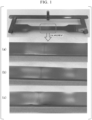
- Pellets of the resin composition of each Example or each Comparative Example obtained above were supplied to sumitomo injection molding machine SE100DU (manufactured by Sumitomo Heavy Industries, Ltd.), and a shaped article (test piece) having a length of 100 mm ⁇ a width of 50 mm ⁇ a thickness of 2 mm was obtained at a cylinder temperature of 260°C and a mold temperature of 60°C. From the test piece, a specimen having a length of 10 mm, a width of 5 mm and a thickness of 2 mm was cut out from the vicinity of an injection gate and the vicinity of an end as shown in FIG. 2 .
- the cut specimen was surfaced and trimmed with an ultramicrotome (product name: Leica EM UC7, manufactured by Leica Microsystems Co., Ltd.) so that a section near the center was a thin section in the section described as the observation surface in FIG. 2 .
- the obtained specimen was dyed with 0.5% by mass Ruthenium tetroxide aqueous solution (manufactured by Nissin EM Co., Ltd.) vapor at 25°C for 12 hours, and then a flake was cut out using the ultramicrotome under the conditions of a thin section thickness of 50 nm and cutting speed of 0.4 mm/sec and collected on a copper grid with a supporting film.
- Observation was performed with a transmission electron microscope (product name: H-7600, manufactured by Hitachi, Ltd.) under a condition of an acceleration voltage of 80 kV.
- the difference between the rubber-containing graft polymer (A-7) used in Comparative Example 3 and the rubber-containing graft polymer (A-1) in Example 1 was mainly whether or not graft polymerization was performed by a redox reaction of an iron compound and whether or not the rubbery polymer contains styrene.
- (A-1) the weight average molecular weight of the acetone soluble component is higher and there are more acetone-insoluble components, compared to (A-7).
- the rubber-containing graft polymer (A-1) of the present invention has higher impact strength and weld strength than those of the rubber-containing graft polymer (A-7).
- a content of a methyl methacrylate was 43% or more, and a content of a component having a styrene-equivalent molecular weight of 300,000 or more determined by integral molecular weight distribution was 10% or more.
- FIG. 3 results of TEM observation of resins respectively obtained in Example 1 and Comparative Example 3 were summarized.
- a phase morphology in which sea is an aromatic polycarbonate and an island is a SAN resin is shown, and it shows in which phase the circular rubber is located.
- the rubber derived from the rubber-containing graft polymer (A-1) in the resin composition obtained in Example 1 is uniformly dispersed in the aromatic polycarbonate alloy.
- the phase separation derived from the SAN resin is also finely and uniformly dispersed, it is considered that the impact strength is also high. Factors that reduce the weld strength are mainly due to non-uniform phase separation derived from the SAN resin in the weld and poor rubber dispersion.
- a gap between rubber and rubber required to be narrow. In other words, it is required both that the rubber is uniformly dispersed and that a cavity is formed in the rubber when an impact is applied and the formation of craze of a matrix resin is promoted.
- the particle size is required to be 100 to 300 nm.
- Example 4 The difference between Example 4 and Comparative Example 1 is the methyl methacrylate % by mass of the graft component.
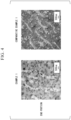
- FIG. 4 results of TEM observation of resins respectively obtained in Example 1 and Comparative Example 1 were summarized.
- the methyl methacrylate % by mass of the graft component is below 95% by mass, the rubber is biased toward phase separation derived from the SAN resin, and the uniform dispersion of the rubber is impaired. For this reason, it is considered that the impact strength at low temperature decreased.
- Butadiene-based rubber has a higher Poisson's ratio than in acrylic rubber. For this reason, the butadiene-based rubber has better impact strength even at room temperature than in the acrylic rubber.
- the acrylic rubber has a higher glass transition temperature than that of butadiene-based, and at a low temperature (for example, 0°C), the impact strength developability decreases.
- the butadiene-based rubber if the weight average molecular weight of the organic solvent soluble component of the rubber-containing graft polymer is not in the range of 250,000 to 700,000, the impact strength is not sufficient. Particularly, in a case of a matrix resin formed of two or more kinds of resins such as an alloy, a remarkable difference is exhibited.
- the difference between the rubber-containing graft polymer (S-2) used in Comparative Example 7 and the rubber-containing graft polymer (S-1) in Example 5 was mainly whether or not graft polymerization was performed by a redox reaction of an iron compound.
- rubber-containing graft polymer (S-1) the weight average molecular weight of the acetone soluble component is higher and there are more acetone-insoluble components, compared to the rubber-containing graft polymer (S-2).
- the rubber-containing graft polymer (S-1) in which the weight average molecular weight of the organic solvent soluble component of the rubber-containing graft polymer is in the range of 250,000 to 700,000, has higher impact strength, tensile properties (one-point gate), and weld strength, than those of the rubber-containing graft polymer (S-2) in which the weight average molecular weight of the organic solvent soluble component of the rubber-containing graft polymer is not in the range of 250,000 to 700,000.
- a content of methyl methacrylate was 43% or more, and a content of a component having a styrene-equivalent molecular weight of 300,000 or more determined by integral molecular weight distribution was 10% or more.
- the rubber-containing graft polymer (A-1) obtained in Production Example 1 and polybutylene terephthalate (PBT; "Novaduran 5010R5" (trade name), manufactured by Mitsubishi Engineering-Plastics Corporation) were blended with each other with a composition shown in Table 13, and mixed to obtain a mixture.
- This mixture was supplied to a devolatilizing biaxial extruder (manufactured by Ikegai Iron Works Co., Ltd., PCM-30) heated to a barrel temperature of 260°C and kneaded, and pellets of the resin composition of Example 6, which is polybutylene terephthalate in which 15% by mass of the rubber-containing graft polymer (A-1) were blended were produced.
- Example 6 Comparative Example 8 Blending PBT 85 85 Rubber-containing graft polymer (A-1) 15 Rubber-containing graft polymer (A-7) 15 Property Charpy impact test 9 7
- the difference between the rubber-containing graft polymer (A-7) used in Comparative Example 8 and the rubber-containing graft polymer (A-1) used in Example 6 was mainly whether or not graft polymerization was performed by a redox reaction of an iron compound and whether or not the rubbery polymer contains styrene. A significant difference in strength developability was also observed in the polybutylene terephthalate-based.
Landscapes
- Chemical & Material Sciences (AREA)
- Health & Medical Sciences (AREA)
- Chemical Kinetics & Catalysis (AREA)
- Medicinal Chemistry (AREA)
- Polymers & Plastics (AREA)
- Organic Chemistry (AREA)
- Compositions Of Macromolecular Compounds (AREA)
- Graft Or Block Polymers (AREA)
Applications Claiming Priority (3)
| Application Number | Priority Date | Filing Date | Title |
|---|---|---|---|
| JP2017193934 | 2017-10-04 | ||
| PCT/JP2018/037020 WO2019069976A1 (ja) | 2017-10-04 | 2018-10-03 | ゴム含有グラフト重合体、ゴム含有グラフト重合体含有樹脂組成物およびその成形体 |
| EP18864766.3A EP3693402B1 (de) | 2017-10-04 | 2018-10-03 | Kautschukhaltiges pfropfpolymer, harzzusammensetzung, die ein kautschukhaltiges pfropfpolymer enthält, und geformter gegenstand daraus |
Related Parent Applications (2)
| Application Number | Title | Priority Date | Filing Date |
|---|---|---|---|
| EP18864766.3A Division EP3693402B1 (de) | 2017-10-04 | 2018-10-03 | Kautschukhaltiges pfropfpolymer, harzzusammensetzung, die ein kautschukhaltiges pfropfpolymer enthält, und geformter gegenstand daraus |
| EP18864766.3A Division-Into EP3693402B1 (de) | 2017-10-04 | 2018-10-03 | Kautschukhaltiges pfropfpolymer, harzzusammensetzung, die ein kautschukhaltiges pfropfpolymer enthält, und geformter gegenstand daraus |
Publications (2)
| Publication Number | Publication Date |
|---|---|
| EP4234630A2 true EP4234630A2 (de) | 2023-08-30 |
| EP4234630A3 EP4234630A3 (de) | 2023-10-04 |
Family
ID=65994349
Family Applications (2)
| Application Number | Title | Priority Date | Filing Date |
|---|---|---|---|
| EP23171245.6A Pending EP4234630A3 (de) | 2017-10-04 | 2018-10-03 | Kautschukhaltiges pfropfpolymer, harzzusammensetzung, die ein kautschukhaltiges pfropfpolymer enthält, und geformter gegenstand daraus |
| EP18864766.3A Active EP3693402B1 (de) | 2017-10-04 | 2018-10-03 | Kautschukhaltiges pfropfpolymer, harzzusammensetzung, die ein kautschukhaltiges pfropfpolymer enthält, und geformter gegenstand daraus |
Family Applications After (1)
| Application Number | Title | Priority Date | Filing Date |
|---|---|---|---|
| EP18864766.3A Active EP3693402B1 (de) | 2017-10-04 | 2018-10-03 | Kautschukhaltiges pfropfpolymer, harzzusammensetzung, die ein kautschukhaltiges pfropfpolymer enthält, und geformter gegenstand daraus |
Country Status (6)
| Country | Link |
|---|---|
| US (1) | US11306203B2 (de) |
| EP (2) | EP4234630A3 (de) |
| JP (1) | JP6988906B2 (de) |
| KR (1) | KR102315627B1 (de) |
| CN (2) | CN111051372B (de) |
| WO (1) | WO2019069976A1 (de) |
Families Citing this family (5)
| Publication number | Priority date | Publication date | Assignee | Title |
|---|---|---|---|---|
| KR102172092B1 (ko) * | 2017-09-19 | 2020-10-30 | 주식회사 엘지화학 | 열가소성 수지 조성물, 이의 제조방법 및 성형품 |
| WO2022113634A1 (ja) * | 2020-11-27 | 2022-06-02 | 株式会社Gsユアサ | 鉛蓄電池 |
| WO2022113628A1 (ja) * | 2020-11-27 | 2022-06-02 | 株式会社Gsユアサ | 鉛蓄電池 |
| US20240002652A1 (en) * | 2021-03-04 | 2024-01-04 | Lg Chem, Ltd. | Graft Copolymer, Curable Resin Composition Comprising Same, and Methods of Preparing Them |
| CN120322506A (zh) * | 2023-01-05 | 2025-07-15 | 株式会社Lg化学 | 热塑性树脂组合物 |
Citations (3)
| Publication number | Priority date | Publication date | Assignee | Title |
|---|---|---|---|---|
| JP2008514782A (ja) | 2004-10-01 | 2008-05-08 | スリーエム イノベイティブ プロパティズ カンパニー | アズラクトンテレケリックポリマー |
| WO2013064756A1 (fr) | 2011-11-03 | 2013-05-10 | IFP Energies Nouvelles | Plateau de distribution d'un melange gaz liquide equipe d'elements de distribution peu sensibles au defaut d'horizontalite |
| JP2017193934A (ja) | 2016-04-19 | 2017-10-26 | 六朗 野沢 | ガラス繊維・炭素繊維の束を樹脂加工した屋根材。 |
Family Cites Families (15)
| Publication number | Priority date | Publication date | Assignee | Title |
|---|---|---|---|---|
| JPS5182339A (en) | 1974-12-27 | 1976-07-19 | Mitsubishi Rayon Co | Enkabinirukeijushisoseibutsu |
| DE3229079A1 (de) * | 1982-08-04 | 1984-02-09 | Bayer Ag, 5090 Leverkusen | Formmassen aus vinylchloridpolymerisat, pfropfpolymeren und polymeren weichmachern mit hoher alterungsbestaendigkeit |
| JPH0350212A (ja) * | 1989-07-18 | 1991-03-04 | Mitsubishi Rayon Co Ltd | 耐候性及び耐衝撃性に優れた熱可塑性樹脂組成物 |
| JP2957645B2 (ja) * | 1990-06-29 | 1999-10-06 | 株式会社クラレ | 耐候性に優れた耐衝撃性樹脂組成物の製造方法 |
| JPH08259899A (ja) * | 1995-03-23 | 1996-10-08 | Three Bond Co Ltd | シアノアクリレート系接着剤組成物 |
| JPH11292940A (ja) * | 1998-04-10 | 1999-10-26 | Kuraray Co Ltd | 多層構造重合体粒子並びにその製造方法及び用途 |
| JP2002284952A (ja) * | 2001-01-22 | 2002-10-03 | Kanegafuchi Chem Ind Co Ltd | サイジング押出成形用塩素化塩化ビニル系樹脂組成物およびそれを用いたサイジング成形体 |
| KR20030012155A (ko) * | 2001-07-30 | 2003-02-12 | 주식회사 엘지화학 | 압출쉬트용 아크릴로니트릴-부타디엔-스티렌(abs)열가소성 투명수지의 제조방법 |
| JP2004182820A (ja) * | 2002-12-02 | 2004-07-02 | Mitsubishi Rayon Co Ltd | 熱可塑性樹脂組成物 |
| JP4786243B2 (ja) * | 2005-08-01 | 2011-10-05 | ユーエムジー・エービーエス株式会社 | グラフト共重合体とその製造方法、熱可塑性樹脂組成物、および成形品 |
| DE502007004317D1 (de) * | 2006-01-19 | 2010-08-19 | Basf Se | Polymerisatpulver mit hohem kautschukanteil und deren herstellung |
| WO2012091024A1 (ja) * | 2010-12-28 | 2012-07-05 | 三菱レイヨン株式会社 | グラフト共重合体及びその製造方法、樹脂組成物、並びに成形品 |
| KR101854008B1 (ko) * | 2011-07-12 | 2018-05-02 | 니폰 에이 엔 엘 가부시키가이샤 | 그래프트 공중합체, 열가소성 수지 조성물, 성형품, 및 그래프트 공중합체의 제조 방법 |
| WO2013129709A2 (ja) * | 2012-10-31 | 2013-09-06 | 三菱レイヨン株式会社 | ポリオルガノシロキサン含有グラフト共重合体、樹脂組成物及び成形体 |
| CN105636997B (zh) * | 2013-08-13 | 2018-06-19 | 三菱化学株式会社 | 含聚有机硅氧烷的接枝共聚物、树脂组合物、成形体、滑动性改良剂和滑动部件 |
-
2018
- 2018-10-03 EP EP23171245.6A patent/EP4234630A3/de active Pending
- 2018-10-03 JP JP2019546754A patent/JP6988906B2/ja active Active
- 2018-10-03 KR KR1020207007967A patent/KR102315627B1/ko active Active
- 2018-10-03 CN CN201880054761.1A patent/CN111051372B/zh active Active
- 2018-10-03 EP EP18864766.3A patent/EP3693402B1/de active Active
- 2018-10-03 CN CN202310858939.0A patent/CN116903797A/zh active Pending
- 2018-10-03 WO PCT/JP2018/037020 patent/WO2019069976A1/ja not_active Ceased
-
2020
- 2020-03-13 US US16/818,306 patent/US11306203B2/en active Active
Patent Citations (3)
| Publication number | Priority date | Publication date | Assignee | Title |
|---|---|---|---|---|
| JP2008514782A (ja) | 2004-10-01 | 2008-05-08 | スリーエム イノベイティブ プロパティズ カンパニー | アズラクトンテレケリックポリマー |
| WO2013064756A1 (fr) | 2011-11-03 | 2013-05-10 | IFP Energies Nouvelles | Plateau de distribution d'un melange gaz liquide equipe d'elements de distribution peu sensibles au defaut d'horizontalite |
| JP2017193934A (ja) | 2016-04-19 | 2017-10-26 | 六朗 野沢 | ガラス繊維・炭素繊維の束を樹脂加工した屋根材。 |
Also Published As
| Publication number | Publication date |
|---|---|
| CN111051372A (zh) | 2020-04-21 |
| EP3693402A4 (de) | 2021-03-03 |
| EP3693402B1 (de) | 2023-07-12 |
| EP4234630A3 (de) | 2023-10-04 |
| US20200216664A1 (en) | 2020-07-09 |
| KR20200035162A (ko) | 2020-04-01 |
| EP3693402A1 (de) | 2020-08-12 |
| CN116903797A (zh) | 2023-10-20 |
| JPWO2019069976A1 (ja) | 2020-06-11 |
| CN111051372B (zh) | 2023-08-01 |
| KR102315627B1 (ko) | 2021-10-21 |
| WO2019069976A1 (ja) | 2019-04-11 |
| US11306203B2 (en) | 2022-04-19 |
| JP6988906B2 (ja) | 2022-01-05 |
Similar Documents
| Publication | Publication Date | Title |
|---|---|---|
| US11306203B2 (en) | Rubber-containing graft polymer, resin composition containing rubber-containing graft polymer, and shaped article thereof | |
| US11634574B2 (en) | Rubber-containing graft polymer, resin composition containing rubber-containing graft polymer, and shaped article of same | |
| EP3875534A1 (de) | Thermoplastische harzzusammensetzung | |
| JP7677384B2 (ja) | ゴム含有グラフト重合体、ゴム含有グラフト重合体含有樹脂組成物およびその成形体 | |
| EP3854847B1 (de) | Thermoplastische harzzusammensetzung | |
| US12378346B2 (en) | Polyorganosiloxane-containing polymer particle group, composition, resin composition, and molded body | |
| Pticek et al. | Morphology and thermal behaviour of SAN/EPDM blends | |
| JP6513457B2 (ja) | 熱可塑性樹脂組成物及びその成形品 | |
| JP2023143798A (ja) | 重合体含有組成物及び樹脂組成物 |
Legal Events
| Date | Code | Title | Description |
|---|---|---|---|
| PUAI | Public reference made under article 153(3) epc to a published international application that has entered the european phase |
Free format text: ORIGINAL CODE: 0009012 |
|
| STAA | Information on the status of an ep patent application or granted ep patent |
Free format text: STATUS: REQUEST FOR EXAMINATION WAS MADE |
|
| 17P | Request for examination filed |
Effective date: 20230503 |
|
| AC | Divisional application: reference to earlier application |
Ref document number: 3693402 Country of ref document: EP Kind code of ref document: P |
|
| AK | Designated contracting states |
Kind code of ref document: A2 Designated state(s): AL AT BE BG CH CY CZ DE DK EE ES FI FR GB GR HR HU IE IS IT LI LT LU LV MC MK MT NL NO PL PT RO RS SE SI SK SM TR |
|
| REG | Reference to a national code |
Ref country code: DE Ref legal event code: R079 Free format text: PREVIOUS MAIN CLASS: C08L0025120000 Ipc: C08F0291020000 |
|
| PUAL | Search report despatched |
Free format text: ORIGINAL CODE: 0009013 |
|
| AK | Designated contracting states |
Kind code of ref document: A3 Designated state(s): AL AT BE BG CH CY CZ DE DK EE ES FI FR GB GR HR HU IE IS IT LI LT LU LV MC MK MT NL NO PL PT RO RS SE SI SK SM TR |
|
| RIC1 | Information provided on ipc code assigned before grant |
Ipc: C08L 101/00 20060101ALI20230830BHEP Ipc: C08L 51/04 20060101ALI20230830BHEP Ipc: C08F 285/00 20060101ALI20230830BHEP Ipc: C08F 265/06 20060101ALI20230830BHEP Ipc: C08F 291/02 20060101AFI20230830BHEP |
|
| RBV | Designated contracting states (corrected) |
Designated state(s): AL AT BE BG CH CY CZ DE DK EE ES FI FR GB GR HR HU IE IS IT LI LT LU LV MC MK MT NL NO PL PT RO RS SE SI SK SM TR |
|
| STAA | Information on the status of an ep patent application or granted ep patent |
Free format text: STATUS: EXAMINATION IS IN PROGRESS |
|
| 17Q | First examination report despatched |
Effective date: 20240927 |
|
| GRAP | Despatch of communication of intention to grant a patent |
Free format text: ORIGINAL CODE: EPIDOSNIGR1 |
|
| STAA | Information on the status of an ep patent application or granted ep patent |
Free format text: STATUS: GRANT OF PATENT IS INTENDED |
|
| INTG | Intention to grant announced |
Effective date: 20260303 |