EP4233560A2 - Süssstoffzusammensetzung - Google Patents
Süssstoffzusammensetzung Download PDFInfo
- Publication number
- EP4233560A2 EP4233560A2 EP23171696.0A EP23171696A EP4233560A2 EP 4233560 A2 EP4233560 A2 EP 4233560A2 EP 23171696 A EP23171696 A EP 23171696A EP 4233560 A2 EP4233560 A2 EP 4233560A2
- Authority
- EP
- European Patent Office
- Prior art keywords
- sucrose
- composition
- sweetener
- particles
- carbohydrate polymer
- Prior art date
- Legal status (The legal status is an assumption and is not a legal conclusion. Google has not performed a legal analysis and makes no representation as to the accuracy of the status listed.)
- Granted
Links
Images

Classifications
-
- A—HUMAN NECESSITIES
- A23—FOODS OR FOODSTUFFS; TREATMENT THEREOF, NOT COVERED BY OTHER CLASSES
- A23L—FOODS, FOODSTUFFS OR NON-ALCOHOLIC BEVERAGES, NOT OTHERWISE PROVIDED FOR; PREPARATION OR TREATMENT THEREOF
- A23L27/00—Spices; Flavouring agents or condiments; Artificial sweetening agents; Table salts; Dietetic salt substitutes; Preparation or treatment thereof
- A23L27/30—Artificial sweetening agents
-
- A—HUMAN NECESSITIES
- A23—FOODS OR FOODSTUFFS; TREATMENT THEREOF, NOT COVERED BY OTHER CLASSES
- A23L—FOODS, FOODSTUFFS OR NON-ALCOHOLIC BEVERAGES, NOT OTHERWISE PROVIDED FOR; PREPARATION OR TREATMENT THEREOF
- A23L27/00—Spices; Flavouring agents or condiments; Artificial sweetening agents; Table salts; Dietetic salt substitutes; Preparation or treatment thereof
- A23L27/30—Artificial sweetening agents
- A23L27/33—Artificial sweetening agents containing sugars or derivatives
- A23L27/34—Sugar alcohols
-
- A—HUMAN NECESSITIES
- A23—FOODS OR FOODSTUFFS; TREATMENT THEREOF, NOT COVERED BY OTHER CLASSES
- A23G—COCOA; COCOA PRODUCTS, e.g. CHOCOLATE; SUBSTITUTES FOR COCOA OR COCOA PRODUCTS; CONFECTIONERY; CHEWING GUM; ICE-CREAM; PREPARATION THEREOF
- A23G9/00—Frozen sweets, e.g. ice confectionery, ice-cream; Mixtures therefor
- A23G9/32—Frozen sweets, e.g. ice confectionery, ice-cream; Mixtures therefor characterised by the composition containing organic or inorganic compounds
- A23G9/34—Frozen sweets, e.g. ice confectionery, ice-cream; Mixtures therefor characterised by the composition containing organic or inorganic compounds characterised by carbohydrates used, e.g. polysaccharides
-
- A—HUMAN NECESSITIES
- A23—FOODS OR FOODSTUFFS; TREATMENT THEREOF, NOT COVERED BY OTHER CLASSES
- A23B—PRESERVATION OF FOODS, FOODSTUFFS OR NON-ALCOHOLIC BEVERAGES; CHEMICAL RIPENING OF FRUIT OR VEGETABLES
- A23B2/00—Preservation of foods or foodstuffs, in general
- A23B2/90—Preservation of foods or foodstuffs, in general by drying or kilning; Subsequent reconstitution
- A23B2/95—Fluidised-bed drying
-
- A—HUMAN NECESSITIES
- A23—FOODS OR FOODSTUFFS; TREATMENT THEREOF, NOT COVERED BY OTHER CLASSES
- A23L—FOODS, FOODSTUFFS OR NON-ALCOHOLIC BEVERAGES, NOT OTHERWISE PROVIDED FOR; PREPARATION OR TREATMENT THEREOF
- A23L2/00—Non-alcoholic beverages; Dry compositions or concentrates therefor; Preparation or treatment thereof
- A23L2/52—Adding ingredients
- A23L2/60—Sweeteners
-
- A—HUMAN NECESSITIES
- A23—FOODS OR FOODSTUFFS; TREATMENT THEREOF, NOT COVERED BY OTHER CLASSES
- A23L—FOODS, FOODSTUFFS OR NON-ALCOHOLIC BEVERAGES, NOT OTHERWISE PROVIDED FOR; PREPARATION OR TREATMENT THEREOF
- A23L27/00—Spices; Flavouring agents or condiments; Artificial sweetening agents; Table salts; Dietetic salt substitutes; Preparation or treatment thereof
- A23L27/30—Artificial sweetening agents
- A23L27/33—Artificial sweetening agents containing sugars or derivatives
- A23L27/35—Starch hydrolysates
-
- A—HUMAN NECESSITIES
- A23—FOODS OR FOODSTUFFS; TREATMENT THEREOF, NOT COVERED BY OTHER CLASSES
- A23L—FOODS, FOODSTUFFS OR NON-ALCOHOLIC BEVERAGES, NOT OTHERWISE PROVIDED FOR; PREPARATION OR TREATMENT THEREOF
- A23L27/00—Spices; Flavouring agents or condiments; Artificial sweetening agents; Table salts; Dietetic salt substitutes; Preparation or treatment thereof
- A23L27/30—Artificial sweetening agents
- A23L27/33—Artificial sweetening agents containing sugars or derivatives
- A23L27/36—Terpene glycosides
-
- A—HUMAN NECESSITIES
- A23—FOODS OR FOODSTUFFS; TREATMENT THEREOF, NOT COVERED BY OTHER CLASSES
- A23L—FOODS, FOODSTUFFS OR NON-ALCOHOLIC BEVERAGES, NOT OTHERWISE PROVIDED FOR; PREPARATION OR TREATMENT THEREOF
- A23L33/00—Modifying nutritive qualities of foods; Dietetic products; Preparation or treatment thereof
- A23L33/10—Modifying nutritive qualities of foods; Dietetic products; Preparation or treatment thereof using additives
- A23L33/125—Modifying nutritive qualities of foods; Dietetic products; Preparation or treatment thereof using additives containing carbohydrate syrups; containing sugars; containing sugar alcohols; containing starch hydrolysates
-
- A—HUMAN NECESSITIES
- A23—FOODS OR FOODSTUFFS; TREATMENT THEREOF, NOT COVERED BY OTHER CLASSES
- A23L—FOODS, FOODSTUFFS OR NON-ALCOHOLIC BEVERAGES, NOT OTHERWISE PROVIDED FOR; PREPARATION OR TREATMENT THEREOF
- A23L33/00—Modifying nutritive qualities of foods; Dietetic products; Preparation or treatment thereof
- A23L33/20—Reducing nutritive value; Dietetic products with reduced nutritive value
- A23L33/21—Addition of substantially indigestible substances, e.g. dietary fibres
- A23L33/25—Synthetic polymers, e.g. vinylic or acrylic polymers
- A23L33/26—Polyol polyesters, e.g. sucrose polyesters; Synthetic sugar polymers, e.g. polydextrose
-
- A—HUMAN NECESSITIES
- A23—FOODS OR FOODSTUFFS; TREATMENT THEREOF, NOT COVERED BY OTHER CLASSES
- A23P—SHAPING OR WORKING OF FOODSTUFFS, NOT FULLY COVERED BY A SINGLE OTHER SUBCLASS
- A23P10/00—Shaping or working of foodstuffs characterised by the products
- A23P10/40—Shaping or working of foodstuffs characterised by the products free-flowing powder or instant powder, i.e. powder which is reconstituted rapidly when liquid is added
-
- A—HUMAN NECESSITIES
- A23—FOODS OR FOODSTUFFS; TREATMENT THEREOF, NOT COVERED BY OTHER CLASSES
- A23L—FOODS, FOODSTUFFS OR NON-ALCOHOLIC BEVERAGES, NOT OTHERWISE PROVIDED FOR; PREPARATION OR TREATMENT THEREOF
- A23L27/00—Spices; Flavouring agents or condiments; Artificial sweetening agents; Table salts; Dietetic salt substitutes; Preparation or treatment thereof
- A23L27/30—Artificial sweetening agents
- A23L27/33—Artificial sweetening agents containing sugars or derivatives
-
- A—HUMAN NECESSITIES
- A23—FOODS OR FOODSTUFFS; TREATMENT THEREOF, NOT COVERED BY OTHER CLASSES
- A23V—INDEXING SCHEME RELATING TO FOODS, FOODSTUFFS OR NON-ALCOHOLIC BEVERAGES AND LACTIC OR PROPIONIC ACID BACTERIA USED IN FOODSTUFFS OR FOOD PREPARATION
- A23V2002/00—Food compositions, function of food ingredients or processes for food or foodstuffs
-
- A—HUMAN NECESSITIES
- A23—FOODS OR FOODSTUFFS; TREATMENT THEREOF, NOT COVERED BY OTHER CLASSES
- A23V—INDEXING SCHEME RELATING TO FOODS, FOODSTUFFS OR NON-ALCOHOLIC BEVERAGES AND LACTIC OR PROPIONIC ACID BACTERIA USED IN FOODSTUFFS OR FOOD PREPARATION
- A23V2250/00—Food ingredients
- A23V2250/24—Non-sugar sweeteners
-
- A—HUMAN NECESSITIES
- A23—FOODS OR FOODSTUFFS; TREATMENT THEREOF, NOT COVERED BY OTHER CLASSES
- A23V—INDEXING SCHEME RELATING TO FOODS, FOODSTUFFS OR NON-ALCOHOLIC BEVERAGES AND LACTIC OR PROPIONIC ACID BACTERIA USED IN FOODSTUFFS OR FOOD PREPARATION
- A23V2250/00—Food ingredients
- A23V2250/28—Oligosaccharides
- A23V2250/284—Oligosaccharides, non digestible
-
- A—HUMAN NECESSITIES
- A23—FOODS OR FOODSTUFFS; TREATMENT THEREOF, NOT COVERED BY OTHER CLASSES
- A23V—INDEXING SCHEME RELATING TO FOODS, FOODSTUFFS OR NON-ALCOHOLIC BEVERAGES AND LACTIC OR PROPIONIC ACID BACTERIA USED IN FOODSTUFFS OR FOOD PREPARATION
- A23V2250/00—Food ingredients
- A23V2250/50—Polysaccharides, gums
- A23V2250/51—Polysaccharide
- A23V2250/5114—Dextrins, maltodextrins
-
- A—HUMAN NECESSITIES
- A23—FOODS OR FOODSTUFFS; TREATMENT THEREOF, NOT COVERED BY OTHER CLASSES
- A23V—INDEXING SCHEME RELATING TO FOODS, FOODSTUFFS OR NON-ALCOHOLIC BEVERAGES AND LACTIC OR PROPIONIC ACID BACTERIA USED IN FOODSTUFFS OR FOOD PREPARATION
- A23V2250/00—Food ingredients
- A23V2250/60—Sugars, e.g. mono-, di-, tri-, tetra-saccharides
- A23V2250/64—Sugar alcohols
-
- A—HUMAN NECESSITIES
- A23—FOODS OR FOODSTUFFS; TREATMENT THEREOF, NOT COVERED BY OTHER CLASSES
- A23V—INDEXING SCHEME RELATING TO FOODS, FOODSTUFFS OR NON-ALCOHOLIC BEVERAGES AND LACTIC OR PROPIONIC ACID BACTERIA USED IN FOODSTUFFS OR FOOD PREPARATION
- A23V2250/00—Food ingredients
- A23V2250/60—Sugars, e.g. mono-, di-, tri-, tetra-saccharides
- A23V2250/64—Sugar alcohols
- A23V2250/6402—Erythritol
-
- A—HUMAN NECESSITIES
- A23—FOODS OR FOODSTUFFS; TREATMENT THEREOF, NOT COVERED BY OTHER CLASSES
- A23V—INDEXING SCHEME RELATING TO FOODS, FOODSTUFFS OR NON-ALCOHOLIC BEVERAGES AND LACTIC OR PROPIONIC ACID BACTERIA USED IN FOODSTUFFS OR FOOD PREPARATION
- A23V2250/00—Food ingredients
- A23V2250/60—Sugars, e.g. mono-, di-, tri-, tetra-saccharides
- A23V2250/64—Sugar alcohols
- A23V2250/6416—Maltitol
Definitions
- the present invention relates generally to a sweeting composition and a method for producing the same.
- sucrose is the most commonly used sweetening agent in the food industry.
- the high sugar content in most food products has led to the development of sucrose substitutes with fewer calories and with a low glycaemic index.
- sucrose substitutes generally mimic certain properties of sucrose, such as body, mouthfeel and texture, poorly.
- sucrose substitutes are often difficult to dose and to handle in food manufacturing.
- composition 1B comprises a blend (that is not agglomerated particles) of 90 % xylitol and 9.32 % Unidex.
- composition 1B is not useful ("oily, clumpy, poor").
- composition comprising particles, the particles comprising a high intensity sweetener, a non-sucrose bulk sweetener and a low digestible carbohydrate polymer.
- the sweeting composition has a number of advantages.
- the particle size of the composition can be made similar to that of conventional sucrose, which simplifies the adaption of current recipes, procedures and equipment.
- the sweetening composition can be used in the production of various sweetened products, such as confectionery and ice cream.
- the sweetening composition can be used to replace sucrose.
- Sucrose can be replaced in an already established manufacturing process with the sweeting composition at a 1:1 ratio
- the homogeneous particle size and the fact that the composition is premixed and agglomerated makes is easy to dispense in bulk and prevents caking.
- the particles are of a uniform size and density which avoids phasing, i.e. that one compound has smaller particle size and is therefore not homogenously distributed when mixed with particles of a large size.
- the distribution of the high-intensity sweetener (HIS) in the product will be homogenous which will ensure even sweetness in the end product.
- HIS high-intensity sweetener
- LDCs Low digestible carbohydrate polymers
- LDCs provide bulk in the composition and are also more slowly digested which results in a low calorie -product, reduced glucose response, increased satiety and a reduction in tooth decay (cavities).
- LDCs such as dextrin (see below) has low density, is "fluffy" and are difficult to mix homogenously and mixtures typically does not stay homogenous. Hence LDCs are typically difficult to use in machinery.
- the inventive composition is much easier to handle in machinery.
- At least 99% of the particles are smaller than 500 ⁇ m and at most 20% of the particles are smaller than 100 ⁇ m. This provides a particle size that is easy to use in machinery and which easily replaces sucrose.
- the composition comprises from 0.01% to 1 % by weight of high intensity sweetener, from 75 % to 92 % by weight of a non-sucrose bulk sweetener and from 5 % to 22 % by weight of a low digestible carbohydrate polymer.
- non-sucrose bulk sweetener is present in an amount of from 85% to 90 % by weight
- the low digestible carbohydrate polymer is present in an amount of from 9 % to 13 % by weight
- the high intensity sweetener is present in an amount of from 0.01 % to 1% by weight.
- fibers tend to break down into sugars when used in various food producing methods which results in release of sugar moieties from the fibers. This results in a higher sugar content in the final product than intended. This makes it difficult to estimate the amount of sugar in the final product. It is therefore useful to keep the amount of fiber as low as possible.
- non-sucrose bulk sweetener is present in an amount of from 86% to 90 % by weight.
- the low digestible carbohydrate polymer is dextrin.
- the non-sucrose bulk sweetener may for example be maltitol or erythritol, and the low digestible carbohydrate polymer may preferably be dextrin.
- the particles may consist of from 0.01 % to 1 % of a high intensity sweetener, from 5 % to 22 % by weight of a low digestible carbohydrate polymer the balance being a low digestible carbohydrate polymer.
- the particles may consist of from 0.01 % to 1 % of a high intensity sweetener, from 9 % to 13 % by weight of a low digestible carbohydrate polymer, the balance being a non-sucrose bulk sweetener.
- the low digestible carbohydrate polymer is preferably dextrin.
- a particle comprising a high intensity sweetener, a non-sucrose bulk sweetener and a low digestible carbohydrate polymer.
- the non-sucrose bulk sweetener is present in an amount of from 85% to 90 % by weight
- the low digestible carbohydrate polymer is present in an amount of from 9 % to 13 % by weight
- the high intensity sweetener is present in an amount of from 0.01 % to 1% by weight in the particle.
- the non-sucrose bulk sweetener is present in an amount of from 86% to 90 % by weight.
- a method of manufacturing a sweetening composition comprising the steps of
- the water-high intensity sweetener mixture does not contain low digestible carbohydrate polymer or a non-sucrose bulk sweetener.
- Fluid bed drying is a preferred method of producing the particles and the composition.
- composition obtainable with the method according to the third aspect of the invention.
- a method for manufacturing a sweetened product comprising the steps of replacing sucrose in a recipe with the inventive composition at a ratio of 1:1.
- Particle size herein refers to particle size determined by using a plurality of sieves with different cut-offs, such as sieve from Retsch (www.retsch.com).
- the material is sieved starting with the sieve with the largest openings, and proceeds to the sieves with smaller openings.
- the reminder of material in each sieve is weighted, and the weight percentages of each fraction is determined.
- Suitable cut-offs for the sieves may be for example 100 ⁇ m, 200 ⁇ m, 300 ⁇ m, 400 ⁇ m and 500 ⁇ m.
- the composition comprises particles that comprise of a high intensity sweetener, a non-sucrose bulk sweetener and a low digestible carbohydrate polymer in an agglomerated form.
- the composition comprises a high intensity sweetener (HIS).
- High intensity sweeteners (or high potency sweeteners) are hundreds to thousands of times sweeter than sucrose.
- the HIS in the composition is preferably a HIS that is approved for use in food.
- Useful HIS include stevia sweeteners (stevia glycosides), aspartame, acesulfame-K, thaumatin, saccharin, sucralose and neotame, or mixtures of these.
- Rebaudioside A and rebaudioside M are a preferred stevia sweeteners.
- Rebaudioside A is approximately 200 to 300 times as sweet as sucrose.
- Other useful HIS include steviobioside, rebaudioside B, C, D, E, F and M and dulcoside, as well as high intensity sweeteners extracted from the monk fruit.
- the concentration of the HIS in the final product may be from 0.01% to 1.5%, more preferably from 0.01% -1 %, more preferably from 0.02% to 0.5 %, in particular 0.02 % to 0.2 % and most preferred 0.02 % to 0.08%.
- the concentration is selected based on the intensity of the HIS and the concentration and sweetness of the non-sucrose bulk sweetener that is used.
- the composition comprises a non-sucrose bulk sweetener.
- the non-sucrose bulk sweetener is preferably incompletely digested and/or poorly absorbed by the body.
- the non-sucrose bulk sweetener preferably has a low caloric value, preferably a caloric value that is lower than that of sucrose, which is 4 kcal/g.
- the caloric value may be for example less than 3 kcal/g, more preferably less than 2.5 kcal/g.
- Maltitol has a caloric value of 2.1 kcal/g.
- the non-sucrose bulk sweetener may be an ingredient that can substitute for both the physical bulk and sweetness of sucrose. It also provides texture, to achieve a suitable mouth feel when the end product is consumed.
- non-sucrose bulk sweeteners examples include allulose, polyols, tagatoses, trehaloses and isomultuloses, where polyols are preferred.
- the polyol is preferably a sugar alcohol.
- Sugar alcohols are commonly obtained by hydrogenation of sugars.
- Suitable sugar alcohols include maltitol, sorbitol, isomalt, erythritol, lactitol, mannitol and xylitol, or mixtures of these, where maltitol, erythritol, sorbitol, isomalt and xylitol are preferred.
- Polyols vary in sweetness from half as sweet to about as sweet as sucrose. Hence the relative sweetness in relation to sucrose may be from 0.5 to 1.
- Allulose is also a preferred non-sucrose bulk sweetener.
- the concentration of non-sucrose bulk sweetener in the composition may be from 50-95%, more preferably 70-92%, in particular from 85 % to 91 %, or 85-90% and even more preferably 86% (or 86.5 %) to 89 %.
- the composition includes a low-digestible carbohydrate polymer (LDC).
- LDCs typically are fiber or fiber-like ingredients. They are polymers consisting of monomer units which may include or consist of glucose or fructose chains with 1,6-glycosidic or ⁇ 2 ->1 linkage. The polymers may be branched or linear with degree of polymerizations ranging between 3 and 60.
- the average molecular weight of the LDC, in particular dextrin may be from 1000 Daltons to 10 000 Daltons more preferably from 3000 Daltons to 6000 Daltons, more preferably from 4000 Daltons to 5000 Daltons. It is preferred that the LDC is a resistant to degradation during digestion to at least some extent.
- LDCs examples include polydextrose, inulin, oligofructose and dextrin, or mixtures of these.
- Dextrin is a preferred LDC, because it has a neutral taste and is stable at a wide range of pH values.
- the concentration of low digestible carbohydrate polymer in the composition may be 5-22%, more preferably 9-14 %, in particular 9-13 %, even more preferred 10% -13% and most preferably 11% to -13 %.
- the concentration of low digestible carbohydrate polymer may also be from 5% to 8 %.
- the composition comprises 50 %-95%, more preferably 75%-92%, in particular 85-90% maltitol, and 5-22%, more preferably 9-14 %, in particular 9-13 % dextrin and a high intensity sweetener.
- the composition may additionally comprise other suitable and food-compatible components.
- suitable and food-compatible components examples include flavouring agents, sweetness enhancers, and flavour modifiers.
- examples of such components are yeast extract and antioxidants.
- Such components are typically present in less than 1%.
- the composition may also comprise emulsifier, a stabiliser or a hydrocolloid. Any suitable concentration may be used, but preferably the concentration is from 0.1 to 3 %.
- the composition consists of 5-22%, more preferably 9-14 %, in particular 9-13 %, even more preferred from 10% to 13% and most preferably from 11% to 13 % of a LDC which preferably is dextrin, from 0.01% -1 % of a HIS, and optionally up to 3 % of a sweetness enhancer, a flavour modifier, an emulsifier, a stabiliser or a hydrocolloid, the balance being a non-sucrose bulk sweetener.
- the composition preferably consists of particles which, on average, has this composition.
- the composition may also comprise trace amounts of impurities.
- the combined concentration of low digestible carbohydrate polymer and non-sucrose bulk sweetener may be at least 97%, more preferably at least 98% and most preferably at least 99%.
- the sweetness of the composition can be adjusted by selecting the amounts of the selected HIS and the selected non-sucrose bulk sweetener.
- the final sweetness may be close or identical to that of sucrose.
- Sweetness may be determined by using a panel of persons as is known in the art.
- the composition is preferably in the form of a powder.
- the composition is preferably dry.
- Moisture of the composition is preferably less than 2 %.
- the moisture content of the product is preferably less than 1%, more preferably 0.2 - 0.5%.
- the composition and the various components are preferably edible and/or suitable or at least acceptable for human consumption.
- the composition can be used as a sucrose substitute.
- sucrose in a recipe and/or procedure is replaced with the same quantity of the composition. This provides for easy adaptation of sucrose-containing recipes.
- the composition may be used as sweetener in various solid food products such as baked goods, confectionary, ice cream or similar. It may also be used to sweeten dairy products such as ice cream, yogurt, cheese curd and puddings. It may also be used to sweeten jams and chocolate spread. In one embodiment the composition is used to sweeten a product that is not a beverage. In a preferred embodiment the composition is used as sweetener in ice cream.
- the composition preferably comprises particles comprising the high intensity sweetener, the non-sucrose bulk sweetener and the low digestible carbohydrate polymer.
- the particles of the composition are preferably agglomerates that comprise non-sucrose bulk sweetener, LDC and HIS in one and the same particle.
- the high intensity sweetener may bind the particles of low-digestible carbohydrate polymer and the particles of non-sucrose bulk sweetener to each other, to form a larger particle.
- low digestible carbohydrate polymer particles may be partially or wholly coated with the non-sucrose bulk sweetener and the high intensity sweetener.
- the non-sucrose bulk sweetener may partially penetrate into particles of LDC.
- the high intensity sweetener may partially or wholly coat or otherwise adhere to particles of low digestible carbohydrate polymer and/or the particles of non-sucrose bulk sweetener.
- the binding or coating in the particles may be mediated with any type of suitable chemical or physical bond such as covalent bond or a van der Waals bond.
- the particle size is preferably similar to that of sucrose.
- An upper limit of the particle size may be 1000 ⁇ m, such that 99% or 100 % of the particles or more are smaller than 1000 ⁇ m , more preferably smaller than 500 ⁇ m.
- Preferably more than 70%, more preferably more than 80%, and most preferably more than 90% of the particles are larger than 100 ⁇ m.
- the particle size may be adjusted by selecting appropriate particle size of the non-sucrose bulk sweetener and the LDC as the starting material.
- the composition is preferably obtained by a method comprising mixing particles of the non-sucrose bulk sweetener and the LDC and exposing them to a water solution comprising the high-intensity sweetener, in a manner such that high intensity sweetener binds to the LDC and the non-sucrose bulk sweetener particles, and preferably so that the non-sucrose bulk sweetener particles and the LDC particles bind to each other, to form agglomerates.
- the concentration of high intensity sweetener in the water may be from 5-30%, in particular from 20-25%, in particular when there the high-intensity sweetener is a stevia sweetener.
- the binding may occur under conditions where the non-sucrose bulk sweetener or the LDC particles does not dissolve in the water.
- the conditions for binding are selected to obtain the desired final concentration of HIS, for example to apply the desired amount of HIS in the final particle, which in turn depends on the sweetness of the selected HIS.
- the method may include a drying step. When fluid bed drying is used, no extra drying step is necessary.
- the method may comprise the step of breaking the particles to a suitable particle size, for example by milling. This may be carried out after binding and drying. This is typically not needed when a fluid bed dryer is used.
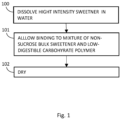
- step 100 high intensity sweetener is dissolved in water.
- a mixture that comprises high intensity sweetener and water and not non-sucrose bulk sweetener or LDC is obtained.
- the mixture may consist of high intensity sweetener and water.
- the LDC in powder form is mixed with the non-sucrose bulk sweetener in powder form.
- step 101 the high intensity sweetener is allowed to bind to the mixture of particles of non-sucrose bulk sweetener and LDC.
- the water-HIS mixture is sprayed on the particles of non-sucrose bulk sweetener and LDC, preferably while the particles are being vibrated or agitated and preferably also heated.
- the resulting mixture is dried in step 102.
- Steps 101 and 102 can be carried out using a fluid bed dryer, see below. Hence step 101 and 102 may be carried out in one continuous process.
- Any vessel with spray-nozzles, vibration/agitation, capacity for heating and where the material preferably can flow from one end to the other can be used. Suitable temperatures are those used for fluid bed drying (below). Useful technologies include fluid bed drying, spray drying and wet granulation.
- the final product is preferably a free flowing and homogeneous powder.
- fluid bed drying is used for steps 101 and 102.
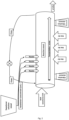
- An example of a fluid bed chamber dryer is shown in Fig. 2 .
- the mixture of non-sucrose bulk sweetener and LDS is fluidised and sprayed with the water solution comprising the HIS.
- the fluid bed dryer chamber of Fig. 2 comprises nozzles for spraying water-HIS mixture onto the fluid bed that holds the bulk-sweetener/LDC particles.
- the bed is maintained by hot air injected from below. Formation of the particles occurs in the bed as HIS/water is sprayed.
- the fluid bed drier may also be used to adjust final particle size. Particles that are too small are recirculated.
- the fluid bed drier may also have a sieve for removing particles that are too large.
- the fluid bed drier may provide vibration in the chamber.
- a suitable fluid bed dryer is VIBRO-FLUIDIZER TM Fluid Bed from GEA Group Aktiengesellschaft. from F.H. SCHULE Mühlenbau GmbH.
- a preferred temperature in the chamber is 80°C to -120°C, more preferably 90°C -100°C and most preferred 90°C -95°C.
- the temperature in the hot air source may be higher.
- the non-sucrose bulk sweetener and the LDS may enter the fluid bed drier at ambient temp.
- Stevia glucosides rebaudioside A (97% purity) was mixed with water to obtain a solution containing 22.8 % stevia.
- Maltitol powder (particles size 200 um) and dextrin powder was mixed to obtain a powder mixture, which was fed into a fluid bed drier. Air temp in the chamber was 90-95°C. Drying process was about two minutes.
- the batch size was 400 kg.
- the final composition of the product was as follows:
- the particle size of the composition was determined using sieves.
- the final particle size distribution was as follows: >400 ⁇ m 7% 300 ⁇ - 400 ⁇ m 11% 200 ⁇ m - 300 um 42% 100 ⁇ m - 200 ⁇ m 30% ⁇ 100 ⁇ m 10% 90% of particles were larger than 100 um. All particles were smaller than 500 um.
- the composition was tested in various aspects.
- the composition behaved like sucrose. It was a free flowing powder and was easy to use in machinery.
- the composition did not dust and was easy to mix with other components and was freely soluble in water.
- the sweetness was about the same as for sucrose.
- the composition was used to sweeten a composition for ice cream with excellent results.
- the composition had the same mouthfeel as sucrose.
- Particles was formed essentially as described as in example 1.
- Example 5 The composition of Example 5 was tested in various aspects. The composition behaved like sucrose. It was free flowing powder and was easy to use in machinery. The composition did not dust and was easy to mix with other components and was freely soluble in water. The sweetness was about the same as for sucrose.
Landscapes
- Life Sciences & Earth Sciences (AREA)
- Chemical & Material Sciences (AREA)
- Engineering & Computer Science (AREA)
- Food Science & Technology (AREA)
- Polymers & Plastics (AREA)
- Health & Medical Sciences (AREA)
- Nutrition Science (AREA)
- Proteomics, Peptides & Aminoacids (AREA)
- Molecular Biology (AREA)
- Inorganic Chemistry (AREA)
- Mycology (AREA)
- Wood Science & Technology (AREA)
- Zoology (AREA)
- Seasonings (AREA)
- Confectionery (AREA)
Applications Claiming Priority (3)
| Application Number | Priority Date | Filing Date | Title |
|---|---|---|---|
| SE2050126A SE544960C2 (en) | 2020-02-06 | 2020-02-06 | Sweetening composition |
| EP21704474.2A EP4099844B1 (de) | 2020-02-06 | 2021-02-05 | Süssstoffzusammensetzung |
| PCT/EP2021/052856 WO2021156471A1 (en) | 2020-02-06 | 2021-02-05 | Sweetening composition |
Related Parent Applications (2)
| Application Number | Title | Priority Date | Filing Date |
|---|---|---|---|
| EP21704474.2A Division EP4099844B1 (de) | 2020-02-06 | 2021-02-05 | Süssstoffzusammensetzung |
| EP21704474.2A Division-Into EP4099844B1 (de) | 2020-02-06 | 2021-02-05 | Süssstoffzusammensetzung |
Publications (4)
| Publication Number | Publication Date |
|---|---|
| EP4233560A2 true EP4233560A2 (de) | 2023-08-30 |
| EP4233560A3 EP4233560A3 (de) | 2023-11-01 |
| EP4233560B1 EP4233560B1 (de) | 2025-07-23 |
| EP4233560C0 EP4233560C0 (de) | 2025-07-23 |
Family
ID=74587014
Family Applications (2)
| Application Number | Title | Priority Date | Filing Date |
|---|---|---|---|
| EP23171696.0A Active EP4233560B1 (de) | 2020-02-06 | 2021-02-05 | Süssstoffzusammensetzung |
| EP21704474.2A Active EP4099844B1 (de) | 2020-02-06 | 2021-02-05 | Süssstoffzusammensetzung |
Family Applications After (1)
| Application Number | Title | Priority Date | Filing Date |
|---|---|---|---|
| EP21704474.2A Active EP4099844B1 (de) | 2020-02-06 | 2021-02-05 | Süssstoffzusammensetzung |
Country Status (10)
| Country | Link |
|---|---|
| US (1) | US12239153B2 (de) |
| EP (2) | EP4233560B1 (de) |
| JP (1) | JP2023516896A (de) |
| KR (1) | KR20220139342A (de) |
| CN (1) | CN115397258B (de) |
| AU (1) | AU2021216252A1 (de) |
| BR (1) | BR112022015444A2 (de) |
| CA (1) | CA3168711A1 (de) |
| SE (1) | SE544960C2 (de) |
| WO (1) | WO2021156471A1 (de) |
Families Citing this family (1)
| Publication number | Priority date | Publication date | Assignee | Title |
|---|---|---|---|---|
| KR102842218B1 (ko) * | 2021-12-29 | 2025-08-06 | 씨제이제일제당 주식회사 | 아이스크림 제조용 조성물 및 이의 제조방법 |
Citations (1)
| Publication number | Priority date | Publication date | Assignee | Title |
|---|---|---|---|---|
| WO2011017140A1 (en) | 2009-07-28 | 2011-02-10 | Heartland Sweeterner, Llc | No-calorie sweetener compositions |
Family Cites Families (25)
| Publication number | Priority date | Publication date | Assignee | Title |
|---|---|---|---|---|
| JP2946622B2 (ja) | 1990-03-30 | 1999-09-06 | 味の素株式会社 | 低カロリー食品 |
| JPH04287659A (ja) | 1991-03-16 | 1992-10-13 | Green Cross Corp:The | 低カロリー甘味料 |
| US6703057B2 (en) * | 1996-07-13 | 2004-03-09 | Parnova Enterprises Limited | Granulated sugar product |
| US20020001656A1 (en) * | 1999-06-02 | 2002-01-03 | Charles R. Mason | Dry mix for a low-calorie slush |
| JP3588045B2 (ja) | 2000-11-02 | 2004-11-10 | 三栄源エフ・エフ・アイ株式会社 | 固形甘味料製剤 |
| FR2822646B1 (fr) * | 2001-03-30 | 2005-03-11 | Roquette Freres | Edulcorants de table enrichis en fibres |
| EP1817964A1 (de) * | 2006-02-13 | 2007-08-15 | Sweetwell NV | Funktioneller Zuckerersatz |
| EP1629730A1 (de) * | 2004-08-12 | 2006-03-01 | First-to-Market N.V. | Funktioneller Zuckerersatz |
| US20070082104A1 (en) * | 2004-08-12 | 2007-04-12 | Sophie De Baets | Functional sugar replacement |
| CN101312660B (zh) * | 2005-11-23 | 2013-07-17 | 可口可乐公司 | 供体重管理之高效甜味剂以及经彼甜化的组成物 |
| US20080081093A1 (en) | 2006-09-18 | 2008-04-03 | ISON Renny | Cohesive non-free flowing sweetener compositions containing a gluing agent |
| US20080292775A1 (en) * | 2007-05-22 | 2008-11-27 | The Coca-Cola Company | Delivery Systems for Natural High-Potency Sweetener Compositions, Methods for Their Formulation, and Uses |
| CN101253968B (zh) * | 2008-04-15 | 2011-12-28 | 苏州苏克瑞甜品科技有限公司 | 一种颗粒状无糖甜味剂及其制备方法 |
| CA2734499A1 (en) * | 2008-08-26 | 2010-03-04 | Merisant Company | Sweetener compositions comprising rebaudioside a, erythritol, a disaccharide carbohydrate or fructose and a taste-improving amount of cellulose, and methods for their manufacture |
| US20110027446A1 (en) * | 2009-07-28 | 2011-02-03 | Heartland Sweeteners, LLC | No-calorie sweetener compositions |
| US20110027445A1 (en) * | 2009-07-28 | 2011-02-03 | Heartland Sweeteners, LLC | No-calorie sweetener compositions |
| DE202010009591U1 (de) * | 2010-02-19 | 2011-03-31 | Krüger Gmbh & Co. Kg | Neue Süßstoffzusammensetzungen |
| EP2568816A4 (de) * | 2010-05-12 | 2015-09-16 | Cargill Inc | Süssstoffzusammensetzungen mit reduziertem bitterem nachgeschmack sowie herstellungsverfahren dafür |
| ES2707295T3 (es) * | 2011-02-14 | 2019-04-03 | Intercontinental Great Brands Llc | Producto de confitería con múltiples sabores y texturas |
| CN102940236A (zh) * | 2012-11-30 | 2013-02-27 | 苏州工业园区尚融科技有限公司 | 一种应用于清爽型中性饮料的复合甜味剂及其制备方法 |
| CN102940237A (zh) * | 2012-11-30 | 2013-02-27 | 苏州工业园区尚融科技有限公司 | 一种适用于咖啡和茶饮料的复合甜味剂及其制备方法 |
| US20150208703A1 (en) * | 2014-01-30 | 2015-07-30 | NatGood IP, LLC | Natural Sweetener |
| EP3264901A1 (de) * | 2014-12-16 | 2018-01-10 | Aegis nv | Zuckerersatzzusammensetzung und schokolade und backware mit dieser zusammensetzung |
| PL3576547T3 (pl) * | 2017-02-06 | 2024-03-04 | Intercontinental Great Brands Llc | Słodycze o podwójnej teksturze i sposób ich produkcji |
| EP3746572A4 (de) * | 2018-01-31 | 2021-10-27 | Nutrition Science Design Pte. Ltd | Amorphe zuckerzusammensetzung |
-
2020
- 2020-02-06 SE SE2050126A patent/SE544960C2/en unknown
-
2021
- 2021-02-05 CA CA3168711A patent/CA3168711A1/en active Pending
- 2021-02-05 JP JP2022547894A patent/JP2023516896A/ja active Pending
- 2021-02-05 CN CN202180013350.XA patent/CN115397258B/zh active Active
- 2021-02-05 US US17/797,520 patent/US12239153B2/en active Active
- 2021-02-05 BR BR112022015444A patent/BR112022015444A2/pt unknown
- 2021-02-05 EP EP23171696.0A patent/EP4233560B1/de active Active
- 2021-02-05 EP EP21704474.2A patent/EP4099844B1/de active Active
- 2021-02-05 WO PCT/EP2021/052856 patent/WO2021156471A1/en not_active Ceased
- 2021-02-05 AU AU2021216252A patent/AU2021216252A1/en active Pending
- 2021-02-05 KR KR1020227029385A patent/KR20220139342A/ko active Pending
Patent Citations (1)
| Publication number | Priority date | Publication date | Assignee | Title |
|---|---|---|---|---|
| WO2011017140A1 (en) | 2009-07-28 | 2011-02-10 | Heartland Sweeterner, Llc | No-calorie sweetener compositions |
Also Published As
| Publication number | Publication date |
|---|---|
| BR112022015444A2 (pt) | 2022-09-27 |
| JP2023516896A (ja) | 2023-04-21 |
| EP4099844A1 (de) | 2022-12-14 |
| CN115397258A (zh) | 2022-11-25 |
| EP4099844B1 (de) | 2023-06-07 |
| EP4233560B1 (de) | 2025-07-23 |
| SE2050126A1 (en) | 2021-08-07 |
| KR20220139342A (ko) | 2022-10-14 |
| AU2021216252A1 (en) | 2022-07-14 |
| SE544960C2 (en) | 2023-02-07 |
| CN115397258B (zh) | 2024-01-19 |
| WO2021156471A1 (en) | 2021-08-12 |
| EP4099844C0 (de) | 2023-06-07 |
| CA3168711A1 (en) | 2021-08-12 |
| US12239153B2 (en) | 2025-03-04 |
| US20230067312A1 (en) | 2023-03-02 |
| EP4233560A3 (de) | 2023-11-01 |
| EP4233560C0 (de) | 2025-07-23 |
Similar Documents
| Publication | Publication Date | Title |
|---|---|---|
| KR101760827B1 (ko) | 탄수화물 조성물 | |
| CN1068764C (zh) | 低脂肪巧克力的生产方法 | |
| Aidoo et al. | Industrial manufacture of sugar-free chocolates–Applicability of alternative sweeteners and carbohydrate polymers as raw materials in product development | |
| EP0511761B1 (de) | Süssungsmittel-Zusammensetzung | |
| CN112384078A (zh) | 甜味剂粉末组合物及其制备方法 | |
| US20060088637A1 (en) | Sugar substitute and bulking agent and chocolate | |
| CN101453913A (zh) | 功能性糖替代物 | |
| CN114901084A (zh) | 可溶性膳食纤维及其制备方法和用途 | |
| JP2017516456A (ja) | 低カロリー糖類代替組成物及びその製造方法 | |
| US20240196920A1 (en) | Sweetener & sweetened products | |
| AU2014212678B2 (en) | Reduced Sugar Confectionaries | |
| EP4099844B1 (de) | Süssstoffzusammensetzung | |
| EP2136652B1 (de) | Minderung des sensorischen kühlungseffekts von polyolen | |
| CN115103605B (zh) | 风味改变和/或甜度增强组合物和方法以及基于其的食品和饮料产品 | |
| US20250024851A1 (en) | Composition for preparing milk tea and of preparing the same | |
| KR101608545B1 (ko) | 조대 입자 크기를 가진 결정화 말티톨 분말, 그 제조 방법 및, 특히 초콜릿에서의 그 용도 | |
| EP4437854A1 (de) | Zusammensetzung zur herstellung von speiseeis und herstellungsverfahren dafür | |
| EP4380378A1 (de) | Sprinkle für süsswaren | |
| RU2837891C1 (ru) | Шоколад | |
| CN120916649A (zh) | 用于甜食的填充型甜味剂体系 |
Legal Events
| Date | Code | Title | Description |
|---|---|---|---|
| PUAI | Public reference made under article 153(3) epc to a published international application that has entered the european phase |
Free format text: ORIGINAL CODE: 0009012 |
|
| STAA | Information on the status of an ep patent application or granted ep patent |
Free format text: STATUS: THE APPLICATION HAS BEEN PUBLISHED |
|
| AC | Divisional application: reference to earlier application |
Ref document number: 4099844 Country of ref document: EP Kind code of ref document: P |
|
| AK | Designated contracting states |
Kind code of ref document: A2 Designated state(s): AL AT BE BG CH CY CZ DE DK EE ES FI FR GB GR HR HU IE IS IT LI LT LU LV MC MK MT NL NO PL PT RO RS SE SI SK SM TR |
|
| PUAL | Search report despatched |
Free format text: ORIGINAL CODE: 0009013 |
|
| AK | Designated contracting states |
Kind code of ref document: A3 Designated state(s): AL AT BE BG CH CY CZ DE DK EE ES FI FR GB GR HR HU IE IS IT LI LT LU LV MC MK MT NL NO PL PT RO RS SE SI SK SM TR |
|
| RIC1 | Information provided on ipc code assigned before grant |
Ipc: A23L 33/125 20160101ALI20230927BHEP Ipc: A23L 2/60 20060101ALI20230927BHEP Ipc: A23G 9/34 20060101ALI20230927BHEP Ipc: A23L 27/30 20160101AFI20230927BHEP |
|
| STAA | Information on the status of an ep patent application or granted ep patent |
Free format text: STATUS: REQUEST FOR EXAMINATION WAS MADE |
|
| 17P | Request for examination filed |
Effective date: 20240430 |
|
| RBV | Designated contracting states (corrected) |
Designated state(s): AL AT BE BG CH CY CZ DE DK EE ES FI FR GB GR HR HU IE IS IT LI LT LU LV MC MK MT NL NO PL PT RO RS SE SI SK SM TR |
|
| GRAP | Despatch of communication of intention to grant a patent |
Free format text: ORIGINAL CODE: EPIDOSNIGR1 |
|
| STAA | Information on the status of an ep patent application or granted ep patent |
Free format text: STATUS: GRANT OF PATENT IS INTENDED |
|
| RIC1 | Information provided on ipc code assigned before grant |
Ipc: A23L 33/125 20160101ALI20250220BHEP Ipc: A23L 2/60 20060101ALI20250220BHEP Ipc: A23G 9/34 20060101ALI20250220BHEP Ipc: A23L 27/30 20160101AFI20250220BHEP |
|
| INTG | Intention to grant announced |
Effective date: 20250318 |
|
| GRAS | Grant fee paid |
Free format text: ORIGINAL CODE: EPIDOSNIGR3 |
|
| GRAA | (expected) grant |
Free format text: ORIGINAL CODE: 0009210 |
|
| STAA | Information on the status of an ep patent application or granted ep patent |
Free format text: STATUS: THE PATENT HAS BEEN GRANTED |
|
| AC | Divisional application: reference to earlier application |
Ref document number: 4099844 Country of ref document: EP Kind code of ref document: P |
|
| AK | Designated contracting states |
Kind code of ref document: B1 Designated state(s): AL AT BE BG CH CY CZ DE DK EE ES FI FR GB GR HR HU IE IS IT LI LT LU LV MC MK MT NL NO PL PT RO RS SE SI SK SM TR |
|
| REG | Reference to a national code |
Ref country code: GB Ref legal event code: FG4D |
|
| REG | Reference to a national code |
Ref country code: CH Ref legal event code: EP |
|
| REG | Reference to a national code |
Ref country code: IE Ref legal event code: FG4D |
|
| REG | Reference to a national code |
Ref country code: DE Ref legal event code: R096 Ref document number: 602021034893 Country of ref document: DE |
|
| U01 | Request for unitary effect filed |
Effective date: 20250819 |
|
| U07 | Unitary effect registered |
Designated state(s): AT BE BG DE DK EE FI FR IT LT LU LV MT NL PT RO SE SI Effective date: 20250826 |