EP4228230B1 - Verfahren zur bestimmung des einschlusswinkels eines faltbildschirms und zugehörige vorrichtung dafür - Google Patents
Verfahren zur bestimmung des einschlusswinkels eines faltbildschirms und zugehörige vorrichtung dafür Download PDFInfo
- Publication number
- EP4228230B1 EP4228230B1 EP22830350.9A EP22830350A EP4228230B1 EP 4228230 B1 EP4228230 B1 EP 4228230B1 EP 22830350 A EP22830350 A EP 22830350A EP 4228230 B1 EP4228230 B1 EP 4228230B1
- Authority
- EP
- European Patent Office
- Prior art keywords
- time
- foldable screen
- included angle
- angle
- determining
- Prior art date
- Legal status (The legal status is an assumption and is not a legal conclusion. Google has not performed a legal analysis and makes no representation as to the accuracy of the status listed.)
- Active
Links
Images






Classifications
-
- G—PHYSICS
- G01—MEASURING; TESTING
- G01B—MEASURING LENGTH, THICKNESS OR SIMILAR LINEAR DIMENSIONS; MEASURING ANGLES; MEASURING AREAS; MEASURING IRREGULARITIES OF SURFACES OR CONTOURS
- G01B21/00—Measuring arrangements or details thereof, where the measuring technique is not covered by the other groups of this subclass, unspecified or not relevant
- G01B21/22—Measuring arrangements or details thereof, where the measuring technique is not covered by the other groups of this subclass, unspecified or not relevant for measuring angles or tapers; for testing the alignment of axes
-
- H—ELECTRICITY
- H04—ELECTRIC COMMUNICATION TECHNIQUE
- H04M—TELEPHONIC COMMUNICATION
- H04M1/00—Substation equipment, e.g. for use by subscribers
- H04M1/02—Constructional features of telephone sets
- H04M1/0202—Portable telephone sets, e.g. cordless phones, mobile phones or bar type handsets
- H04M1/0206—Portable telephones comprising a plurality of mechanically joined movable body parts, e.g. hinged housings
- H04M1/0241—Portable telephones comprising a plurality of mechanically joined movable body parts, e.g. hinged housings using relative motion of the body parts to change the operational status of the telephone set, e.g. switching on/off, answering incoming call
- H04M1/0243—Portable telephones comprising a plurality of mechanically joined movable body parts, e.g. hinged housings using relative motion of the body parts to change the operational status of the telephone set, e.g. switching on/off, answering incoming call using the relative angle between housings
-
- G—PHYSICS
- G06—COMPUTING OR CALCULATING; COUNTING
- G06F—ELECTRIC DIGITAL DATA PROCESSING
- G06F1/00—Details not covered by groups G06F3/00 - G06F13/00 and G06F21/00
- G06F1/16—Constructional details or arrangements
- G06F1/1613—Constructional details or arrangements for portable computers
- G06F1/1615—Constructional details or arrangements for portable computers with several enclosures having relative motions, each enclosure supporting at least one I/O or computing function
- G06F1/1616—Constructional details or arrangements for portable computers with several enclosures having relative motions, each enclosure supporting at least one I/O or computing function with folding flat displays, e.g. laptop computers or notebooks having a clamshell configuration, with body parts pivoting to an open position around an axis parallel to the plane they define in closed position
-
- G—PHYSICS
- G06—COMPUTING OR CALCULATING; COUNTING
- G06F—ELECTRIC DIGITAL DATA PROCESSING
- G06F1/00—Details not covered by groups G06F3/00 - G06F13/00 and G06F21/00
- G06F1/16—Constructional details or arrangements
- G06F1/1613—Constructional details or arrangements for portable computers
- G06F1/1633—Constructional details or arrangements of portable computers not specific to the type of enclosures covered by groups G06F1/1615 - G06F1/1626
- G06F1/1637—Details related to the display arrangement, including those related to the mounting of the display in the housing
- G06F1/1652—Details related to the display arrangement, including those related to the mounting of the display in the housing the display being flexible, e.g. mimicking a sheet of paper, or rollable
-
- G—PHYSICS
- G06—COMPUTING OR CALCULATING; COUNTING
- G06F—ELECTRIC DIGITAL DATA PROCESSING
- G06F1/00—Details not covered by groups G06F3/00 - G06F13/00 and G06F21/00
- G06F1/16—Constructional details or arrangements
- G06F1/1613—Constructional details or arrangements for portable computers
- G06F1/1633—Constructional details or arrangements of portable computers not specific to the type of enclosures covered by groups G06F1/1615 - G06F1/1626
- G06F1/1675—Miscellaneous details related to the relative movement between the different enclosures or enclosure parts
- G06F1/1677—Miscellaneous details related to the relative movement between the different enclosures or enclosure parts for detecting open or closed state or particular intermediate positions assumed by movable parts of the enclosure, e.g. detection of display lid position with respect to main body in a laptop, detection of opening of the cover of battery compartment
-
- G—PHYSICS
- G06—COMPUTING OR CALCULATING; COUNTING
- G06F—ELECTRIC DIGITAL DATA PROCESSING
- G06F1/00—Details not covered by groups G06F3/00 - G06F13/00 and G06F21/00
- G06F1/16—Constructional details or arrangements
- G06F1/1613—Constructional details or arrangements for portable computers
- G06F1/1633—Constructional details or arrangements of portable computers not specific to the type of enclosures covered by groups G06F1/1615 - G06F1/1626
- G06F1/1684—Constructional details or arrangements related to integrated I/O peripherals not covered by groups G06F1/1635 - G06F1/1675
- G06F1/1694—Constructional details or arrangements related to integrated I/O peripherals not covered by groups G06F1/1635 - G06F1/1675 the I/O peripheral being a single or a set of motion sensors for pointer control or gesture input obtained by sensing movements of the portable computer
-
- H—ELECTRICITY
- H04—ELECTRIC COMMUNICATION TECHNIQUE
- H04M—TELEPHONIC COMMUNICATION
- H04M1/00—Substation equipment, e.g. for use by subscribers
- H04M1/02—Constructional features of telephone sets
- H04M1/0202—Portable telephone sets, e.g. cordless phones, mobile phones or bar type handsets
- H04M1/0206—Portable telephones comprising a plurality of mechanically joined movable body parts, e.g. hinged housings
- H04M1/0208—Portable telephones comprising a plurality of mechanically joined movable body parts, e.g. hinged housings characterized by the relative motions of the body parts
- H04M1/0214—Foldable telephones, i.e. with body parts pivoting to an open position around an axis parallel to the plane they define in closed position
-
- H—ELECTRICITY
- H04—ELECTRIC COMMUNICATION TECHNIQUE
- H04M—TELEPHONIC COMMUNICATION
- H04M1/00—Substation equipment, e.g. for use by subscribers
- H04M1/02—Constructional features of telephone sets
- H04M1/0202—Portable telephone sets, e.g. cordless phones, mobile phones or bar type handsets
- H04M1/026—Details of the structure or mounting of specific components
- H04M1/0266—Details of the structure or mounting of specific components for a display module assembly
-
- H—ELECTRICITY
- H04—ELECTRIC COMMUNICATION TECHNIQUE
- H04M—TELEPHONIC COMMUNICATION
- H04M1/00—Substation equipment, e.g. for use by subscribers
- H04M1/02—Constructional features of telephone sets
- H04M1/0202—Portable telephone sets, e.g. cordless phones, mobile phones or bar type handsets
- H04M1/026—Details of the structure or mounting of specific components
- H04M1/0266—Details of the structure or mounting of specific components for a display module assembly
- H04M1/0268—Details of the structure or mounting of specific components for a display module assembly including a flexible display panel
-
- H—ELECTRICITY
- H04—ELECTRIC COMMUNICATION TECHNIQUE
- H04M—TELEPHONIC COMMUNICATION
- H04M1/00—Substation equipment, e.g. for use by subscribers
- H04M1/72—Mobile telephones; Cordless telephones, i.e. devices for establishing wireless links to base stations without route selection
- H04M1/724—User interfaces specially adapted for cordless or mobile telephones
- H04M1/72448—User interfaces specially adapted for cordless or mobile telephones with means for adapting the functionality of the device according to specific conditions
- H04M1/72454—User interfaces specially adapted for cordless or mobile telephones with means for adapting the functionality of the device according to specific conditions according to context-related or environment-related conditions
-
- G—PHYSICS
- G06—COMPUTING OR CALCULATING; COUNTING
- G06F—ELECTRIC DIGITAL DATA PROCESSING
- G06F2200/00—Indexing scheme relating to G06F1/04 - G06F1/32
- G06F2200/16—Indexing scheme relating to G06F1/16 - G06F1/18
- G06F2200/161—Indexing scheme relating to constructional details of the monitor
- G06F2200/1614—Image rotation following screen orientation, e.g. switching from landscape to portrait mode
-
- G—PHYSICS
- G06—COMPUTING OR CALCULATING; COUNTING
- G06F—ELECTRIC DIGITAL DATA PROCESSING
- G06F2200/00—Indexing scheme relating to G06F1/04 - G06F1/32
- G06F2200/16—Indexing scheme relating to G06F1/16 - G06F1/18
- G06F2200/163—Indexing scheme relating to constructional details of the computer
- G06F2200/1637—Sensing arrangement for detection of housing movement or orientation, e.g. for controlling scrolling or cursor movement on the display of an handheld computer
-
- H—ELECTRICITY
- H04—ELECTRIC COMMUNICATION TECHNIQUE
- H04M—TELEPHONIC COMMUNICATION
- H04M1/00—Substation equipment, e.g. for use by subscribers
- H04M1/02—Constructional features of telephone sets
- H04M1/0202—Portable telephone sets, e.g. cordless phones, mobile phones or bar type handsets
- H04M1/0206—Portable telephones comprising a plurality of mechanically joined movable body parts, e.g. hinged housings
- H04M1/0208—Portable telephones comprising a plurality of mechanically joined movable body parts, e.g. hinged housings characterized by the relative motions of the body parts
- H04M1/0214—Foldable telephones, i.e. with body parts pivoting to an open position around an axis parallel to the plane they define in closed position
- H04M1/0216—Foldable in one direction, i.e. using a one degree of freedom hinge
-
- H—ELECTRICITY
- H04—ELECTRIC COMMUNICATION TECHNIQUE
- H04M—TELEPHONIC COMMUNICATION
- H04M2250/00—Details of telephonic subscriber devices
- H04M2250/12—Details of telephonic subscriber devices including a sensor for measuring a physical value, e.g. temperature or motion
-
- Y—GENERAL TAGGING OF NEW TECHNOLOGICAL DEVELOPMENTS; GENERAL TAGGING OF CROSS-SECTIONAL TECHNOLOGIES SPANNING OVER SEVERAL SECTIONS OF THE IPC; TECHNICAL SUBJECTS COVERED BY FORMER USPC CROSS-REFERENCE ART COLLECTIONS [XRACs] AND DIGESTS
- Y02—TECHNOLOGIES OR APPLICATIONS FOR MITIGATION OR ADAPTATION AGAINST CLIMATE CHANGE
- Y02D—CLIMATE CHANGE MITIGATION TECHNOLOGIES IN INFORMATION AND COMMUNICATION TECHNOLOGIES [ICT], I.E. INFORMATION AND COMMUNICATION TECHNOLOGIES AIMING AT THE REDUCTION OF THEIR OWN ENERGY USE
- Y02D30/00—Reducing energy consumption in communication networks
- Y02D30/70—Reducing energy consumption in communication networks in wireless communication networks
Definitions
- This application relates to the field of terminal technologies, in particular to a method for determining a foldable screen included angle and associated devices of the method.
- an included angle between two display screens of the foldable screen needs to be determined in real time so as to adaptively adjust a display picture or video.
- the unfolded state refers to an included angle being 180° between the two display screens of the foldable screen
- the folded state refers to an included angle being 0° between the two display screens of the foldable screen.
- the included angle between the two display screens of the foldable screen is the foldable screen included angle.
- CN 113 703 519 A discloses a folding screen posture determination method, device and storage medium.
- the folded screen posture determination method is applied to a terminal including a folded screen, the folded screen being folded along a bending region to form a first screen and a second screen, and each screen being installed with an acceleration gyroscope sensor, the folded screen posture determination method comprising: determining, based on the angular velocity detected by the acceleration gyroscope sensor installed on each screen, a first angle between the first screen and the second screen, and based on the acceleration detected by the acceleration gyroscope sensor installed on each screen, determining a second angle between the first screen and the second screen, and based on the acceleration detected by the acceleration gyroscope sensor mounted on each screen, determining a second angle of the first screen and the second screen; fusing the first angle and the second angle to obtain an posture of the folded screen.
- WO 2021/128245 A1 discloses an electronic device including: a first housing, where the first housing includes at least one first housing accelerometer and at least one first housing gyroscope, a second housing, where the second housing includes at least one second housing accelerometer and at least one second housing gyroscope, and a hinge.
- the hinge rotatably couples the first housing to the second housing, where a hinge angle is determined using data from the first housing accelerometer, the second housing accelerometer, the first housing gyroscope, and the second housing gyroscope if the electronic device is not in a portrait orientation where the hinge is vertical to a ground or not in motion and is determined using data from the first housing gyroscope and the second housing gyroscope if the electronic device is in portrait orientation or is in motion.
- This application provides a method for determining a foldable screen included angle and associated devices of the method.
- the foldable screen angle is determined by arranging acceleration sensors and gyroscope sensors on two display screens of a foldable screen.
- a method for determining a foldable screen included angle is provided and applied to an electronic device with a foldable screen.
- the foldable screen includes two display screens, and each display screen includes an acceleration sensor and a gyroscope sensor.
- the method includes:
- the step of performing second preprocessing on an initial angular velocity signal at time t to determine an intermediate angular velocity signal at time t includes: for each display screen, performing lowpass filtering on the initial angular velocity signal at time t to determine the intermediate angular velocity signal at time t.
- noise with high frequency in the initial angular velocity signals is removed through lowpass filtering.
- each of the two display screens of the foldable screen is provided with the acceleration sensor and the gyroscope sensor which read the acceleration signal and the angular velocity signal corresponding to each display screen; and then, the angle of the foldable screen is determined by detecting the states of the foldable screen and utilizing different algorithms according to the determined different states of the foldable screen in combination with the two sets of acceleration signals and angular velocity signals or in combination with the two sets of angular velocity signals.
- the step of performing first preprocessing on an initial acceleration signal at time t to determine a target value of at time t includes: for each display screen, performing coordinate system conversion and average filtering on the initial acceleration signal at time t to obtain a measured value of the gravitational acceleration signal at time t; determining, by a time-update equation, a predicted value of the gravitational acceleration signal at time t according to a target value of a gravitational acceleration signal at time t-1 and an initial angular velocity signal at time t-1; and determining, by a Kalman filtering algorithm, the target value of the gravitational acceleration signal at time t according to the measured value of the gravitational acceleration signal at time t and the predicted value of the gravitational acceleration signal at time t.
- coordinate values corresponding to a first acceleration signal and coordinate values corresponding to a second acceleration signal may be subjected to coordinate system conversion into a terrestrial coordinate system, accordingly, the gravitational acceleration signals and the motion linear acceleration signals respectively included by the first acceleration signal and the second acceleration signal can be separated, which facilitates non-gravitational acceleration components (motion linear acceleration signals) to be filtered out through average filtering, and only corresponding gravitational acceleration components are retained.
- the step of determining a state of a foldable screen at time t according to target values of gravitational acceleration signals corresponding to two display screens at time t and intermediate angular velocity signals at time t includes:
- the target value of the gravitational acceleration signal corresponding to each display screen is almost equal to the standard gravitational acceleration, and thus whether the foldable screen is perpendicular to the horizontal plane may be judged by determining whether the absolute values of the difference values between the components, on the y-axis, of the target values of the gravitational acceleration signals corresponding to the two display screens at time t and the standard gravitational acceleration are both less than the first preset threshold.
- the conditions are met, it indicates that the foldable screen is perpendicular to the horizontal plane; and when the conditions are not met, it indicates that the foldable screen is not perpendicular to the horizontal plane.
- the step of performing screen unfolding and folding detection on a foldable screen and judging two display screens of the foldable screen being folded or unfolded or bent includes:
- the device coordinate systems corresponding to the two display screens share the y-axis but are respectively opposite in x-axis direction and z-axis direction.
- the device coordinate systems corresponding to the two display screens are the same in x-axis direction, y-axis direction and z-axis direction respectively.
- whether the foldable screen is bent may be judged by determining whether the difference value between the absolute values of the components, on the x-axis, of the target values of the gravitational acceleration signals corresponding to the two display screens at time t is less than the second preset threshold.
- the foldable screen is bent.
- the foldable screen may be folded or unfolded.
- whether the foldable screen is folded or unfolded may be further judged by determining whether the absolute value of the difference value between the components, on the z-axis, of the gravitational acceleration signals corresponding to the two display screens at time t is less than the third preset threshold.
- the foldable screen is unfolded.
- the foldable screen is folded.
- the step of determining an included angle corresponding to a foldable screen at time t according to a state of the foldable screen at time t includes:
- the included angle at time t may be determined based on an included angle at previous time and the angle variation according to the state of the foldable screen, or the included angle may be directly determined according to the state of the foldable screen; or the included angle of the foldable screen may be indirectly determined according to the state of the foldable screen and the included angle between the projection vectors of the gravitational acceleration signals on the xoz plane.
- the method further includes:
- angle change detection is utilized for screening states of the foldable screen and judging whether the included angle of the foldable screen changes, and if yes, the included angle of the foldable screen may be determined only by utilizing intermediate angular velocity signals.
- the step of performing angle change detection on a foldable screen, and judging whether an included angle of the foldable screen at time t changes relative to an included angle at time t-1 includes:
- device coordinate systems corresponding to the two display screens share the y-axis, and the y-axis is parallel to a folded axis direction of the foldable screen.
- the included angle between the two display screens changes, the components, on the y-axis, of the intermediate angular velocity signals acquired by the two display screens are different, and thus, whether the included angle of the foldable screen changes may be judged by determining whether the difference value between the angular velocity components, on the y-axis, of the intermediate angular velocity signals corresponding to the two display screens at time t is greater than the fourth preset threshold. If the condition is met, it indicates that changes happen. If the condition is not met, it indicates that changes do not happen.
- the step of determining an included angle corresponding to a foldable screen at time t according to a state of the foldable screen at time t includes:
- fusion processing may be performed, by the Kalman filtering algorithm, on an included angle calculated through projection vectors and an included angle calculated through intermediate angular velocity signals again, thereby obtaining the more accurate included angle of the foldable screen.
- a state of a foldable screen further includes at least one of stillness, slight motion and intensive motion.
- the method further includes:
- the motion situation of the foldable screen has a certain influence on determining of the included angle, and thus, during intensive motion, a method for summing an included angle at previous time and the angle variation is selected to determine the included angle of the foldable screen.
- a method for summing an included angle at previous time and the angle variation is selected to determine the included angle of the foldable screen.
- the step of performing motion grade detection on a foldable screen and judging a motion grade of the foldable screen includes:
- the motion grades of the foldable screen may be refined according to the moduli of the initial acceleration signals corresponding to the two display screens and the target values of gravitational acceleration signals, thereby selecting a proper method for determining an included angle according to different motion grades.
- an apparatus for determining a foldable screen included angle includes a module/unit for executing the first aspect or any method in the first aspect.
- an electronic device in a third aspect, includes one or more processors and a memory.
- the memory is coupled with the one or more processors and configured to store computer program codes.
- the computer program codes include computer instructions.
- the one or more processors invoke the computer instructions to enable the electronic device to execute the first aspect or any method for determining a foldable screen included angle in the first aspect.
- a chip system is provided and applied to the electronic device.
- the chip system includes one or more processors.
- the processors are configured to invoke computer instructions to enable the electronic device to execute any method in the first aspect or the second aspect.
- a computer-readable storage medium stores computer program codes.
- the computer program codes are operated by an electronic device, the electronic device executes any method in the first aspect or the second aspect.
- a computer program product in a sixth aspect, includes computer program codes.
- the computer program codes When the computer program codes are operated by an electronic device, the electronic device executes any method in the first aspect or the second aspect.
- each of the two display screens of the foldable screen is provided with the acceleration sensor and the gyroscope sensor which read the acceleration signal and the angular velocity signal corresponding to each display screen; and then, the angle of the foldable screen is determined by detecting the states of the foldable screen and utilizing different algorithms according to the determined different states of the foldable screen in combination with the two sets of acceleration signals and angular velocity signals or in combination with the two sets of angular velocity signals.
- A/B may represent A or B; and "and/or” in this specification is merely an association relationship for describing associated objects and represents that three relationships may exist.
- a and/or B may represent the following three cases: only A exists, both A and B exist, and only B exists.
- "a plurality of" represents two or more.
- first and second mentioned below are merely intended for a purpose of description, and shall not be understood as an indication or implication of relative importance or implicit indication of a quantity of indicated technical features. Therefore, features defining “first” and “second” may explicitly or implicitly include one or more such features. In descriptions of this embodiment, unless otherwise stated, "a plurality of" means two or more.
- FIG. 1 illustrates a schematic diagram of an application scenario according to an embodiment of this application.
- an electronic device being a mobile phone is illustrated.
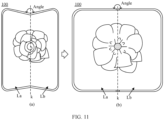
- an included angle between two display screens (a display screen La and a display screen Lb shown in FIG. 1 ) included by the foldable screen is 180°, and the two display screens are located in the same plane.
- an included angle between the two display screens is 0°, back surfaces (sides not used for displaying) of the two display screens are oppositely attached together, and at the time, a folding manner of the foldable screen may be called outward folding.
- an included angle between the two display screens ranges from 0° to 180°.
- An axis k shown in FIG. 1 is an axis when the foldable screen is bent.
- the mobile phone with the foldable screen may be in transition to the bending state from the unfolded state, and then be switched to the folding state, and may also be in transition to the bending state from the folding state and then be switched to the unfolded state, and the process is dynamic and reversible.
- an included angle between the two display screens is 0°, and display surfaces (sides used for displaying) of the two display screens are oppositely attached together, and at the time, a folding manner of the foldable screen may be called inward folding.
- the embodiment of this application does not make any limitation on it, and the method for determining the included angle according to the embodiment of this application may be applicable to the foldable screen of outward folding or inward folding.
- a pivot around which the foldable screen is folded serves as a datum line for performing display screen dividing and naming, which determines the number of the display screens included by the foldable screen, and the two display screens herein do not represent a practical panel structure of the foldable screen.
- the foldable screen may be formed by splicing two hard panels and a pivot, and thus, one of the two hard panels may be called one display screen.
- the foldable screen may be constituted by a flexible panel and a pivot, and thus, one half of the flexible panel may be correspondingly called one display screen with the pivot as a datum line.
- a specific structure of the foldable screen may be set according to needs, which is not limited by the embodiment of this application.
- the method for determining the included angle according to the embodiment of this application is also applicable to an included angle between every two adjacent display screens.
- the included angle between the two display screens included by the foldable screen namely the foldable screen included angle needs to be determined in real time so as to adaptively adjust a display picture.
- Hall sensors are arranged in two display screens of a foldable screen and read Hall signals, and then a table is checked and searched for angles corresponding to the Hall signals, thereby determining the included angle between the two display screens.
- the manner is not only low in precision but also easy to be disturbed by a service environment.
- an encoder is additionally arranged at a pivot of a foldable screen to read angle changes, the encoder is high in precision and anti-interference, but the manner needs to additionally arrange sensors at the pivot of the foldable screen, which increases structure complexity of the foldable screen, and makes the foldable screen not easy to manufacture. Even though the foldable screen of the structure can be produced, the encoder at the pivot is easy to be damaged in a multi-time folding process. Thus, a method for determining a foldable screen included angle, which is low in hardware cost, simple in structure, high in recognition precision and anti-interference is urgently needed.
- the embodiment of this application provides a method for determining a foldable screen included angle.
- Each of two display screens of a foldable screen is provided with an acceleration sensor and a gyroscope sensor which read an acceleration signal and an angular velocity signal corresponding to each display screen; and then, the angle of the foldable screen is determined by detecting states of the foldable screen and utilizing different algorithms according to determined different states of the foldable screen in combination with the two sets of acceleration signals and angular velocity signals or in combination with the two sets of angular velocity signals.
- the method for determining the foldable screen included angle according to the embodiment of this application is applied to an electronic device with a foldable screen.
- the foldable screen of the electronic device includes a plurality of display screens, that is to say, may include two display screens and may also include three or more display screens, which is not limited by the embodiment of this application.
- Each of the plurality of display screens may include at least one acceleration sensor and at least one gyroscope sensor.
- each display screen may include one acceleration sensor and one gyroscope sensor and may also include two or more acceleration sensors and two or more gyroscope sensors.
- the number of the acceleration sensors may be the same as or different from the number of the gyroscope sensors; and the number of the acceleration sensors included by the different display screens may be the same or different, and the number of the gyroscope sensors included by the different display screens may be the same or different, which may be specifically set according to needs and not limited by the embodiment of this application.
- the acceleration sensor in each display screen may detect acceleration of the corresponding display screen in various directions (commonly, x-axis, y-axis and z-axis).
- the gyroscope sensor in each display screen may detect angular velocities of the corresponding display screen around three axes (x-axis, y-axis and z-axis).
- the x-axis, the y-axis and the z-axis refer to three reference directions in a device coordinate system corresponding to each display screen.
- the device coordinate systems refer to coordinate systems fixed to the display screens, in which points on the display screens rotate together with the display screens. Since each display screen corresponds to one device coordinate system, when the relative positions among the plurality of display screens change, the device coordinate systems are not necessarily the same in referred x-axis direction, y-axis direction and z-axis direction.
- a display screen La includes a first acceleration sensor ACC 1 and a first gyroscope sensor GYRO1, and a display screen Lb includes a second acceleration sensor ACC2 and a second gyroscope sensor GYRO2.
- first acceleration sensor ACC1 and the second acceleration sensor ACC2 may be the same or different, and the first gyroscope sensor GYRO1 and the second gyroscope sensor GYRO2 may be the same or different, which may be specifically set according to needs and not limited by the embodiment of this application.
- a device coordinate system corresponding to the display screen La refers to a coordinate system fixed to the display screen La, in which points on the display screen La rotate together with the display screen La; and a device coordinate system corresponding to the display screen Lb refers to a coordinate system fixed to the display screen Lb, in which points on the display screen Lb rotate together with the display screen Lb.
- a direction indicated by an x-axis in the device coordinate system corresponding to the display screen La is a horizontal rightward direction parallel to a display surface of the display screen La
- a direction indicated by a y-axis is a vertical upward direction parallel to the display surface of the display screen La
- a direction indicated by a z-axis is perpendicular to the display surface of the display screen La and is an outward direction perpendicular to a principal plane.
- a direction indicated by an x-axis in the device coordinate system corresponding to the display screen Lb is a horizontal rightward direction parallel to a display surface of the display screen Lb
- a direction indicated by a y-axis is a vertical upward direction parallel to the display surface of the display screen Lb
- a direction indicated by a z-axis is perpendicular to the display surface of the display screen Lb and is an outward direction perpendicular to a principal plane.
- the device coordinate systems corresponding to the two display screens included in the foldable screen are respectively the same in practical three-axis orientation.
- orientations of the three axes in the device coordinate system corresponding to the display screen Lb do not change, but the practical orientations of the three axes in the device coordinate system corresponding to the display screen Lb change along with rotation of the display screen La.
- a direction indicated by the y-axis in the device coordinate system corresponding to the display screen La does not change and is still the vertical upward direction parallel to the display surface of the display screen La, but the direction indicated by the x-axis is changed into a horizontal leftward direction parallel to the display surface of the display screen La, and the direction indicated by the z-axis is changed into an inward direction perpendicular to the principal plane and the display surface of the display screen La.
- the first acceleration sensor ACC1 and the first gyroscope sensor GYRO1 are attached to a center position of a back surface (one side not for displaying) of the display screen La.
- the second acceleration sensor ACC2 and the second gyroscope sensor GYRO2 are also attached to a center position of a back surface (one side not for displaying) of the display screen Lb.
- acceleration sensors and the gyroscope sensors in the display screens may be set and modified according to needs, which is not limited by the embodiment of this application.
- the foldable screen to which the embodiment of this application is applicable is simply introduced above, and in combination with FIG. 1-FIG. 10 , the method for determining the foldable screen included angle according to the embodiment of this application is introduced in detail below with an example that the foldable screen includes the two display screens (the display screen La and the display screen Lb, and each display screen includes one acceleration sensor and one gyroscope sensor.
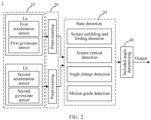
- FIG. 2 illustrates a schematic flowchart of a method for determining a foldable screen included angle according to an embodiment of this application.
- the method 1 for determining the foldable screen included angle includes the following steps S10-S40.
- time t is an integer greater than or equal to 1.
- time t may be understood as a current time in a time series
- time t+1 is a next time in the time series
- time t-1 is a previous time in the time series.
- the display screen La at each time, can acquire the first initial acceleration signal and the first initial angular velocity signal corresponding to the time
- the display screen Lb at each time, can acquire the second initial acceleration signal and the second initial angular velocity signal corresponding to the time.
- an acceleration signal obtained through measurement of the acceleration sensor in the display screen includes a gravitational acceleration signal and a motion linear acceleration signal; and when the display screen is in a static state, the acceleration sensor may accurately measure three-axis components of an acceleration signal of an object in a self-inherent device coordinate system, and at the time, the acceleration signal only includes a gravitational acceleration signal and does not include a motion linear acceleration signal.
- the display screen refers to the display screen La or the display screen Lb
- the acceleration sensor refers to the first acceleration sensor ACC1 or the second acceleration sensor ACC2.
- gravitational acceleration refers to acceleration of the display screen under the effect of gravity
- linear acceleration refers to acceleration of the display screen without the effect of gravity
- S20 Perform first preprocessing on the first initial acceleration signal at time t to determine a first gravitational acceleration signal at time t, perform second preprocessing on the first initial angular velocity signal at time t to determine a first intermediate angular velocity signal at time t,
- first preprocessing may include at least one of coordinate system conversion, average filtering, a time-update equation and a Kalman filtering algorithm.
- coordinate system conversion is used for converting coordinate values in the inherent device coordinate systems of the display screens into coordinate values in a terrestrial coordinate system.
- the terrestrial coordinate system is also called an earth-fixed coordinate system, is fixed to the earth and rotates together with the earth. Coordinate values of points on the ground are constant in the earth-fixed coordinate system.
- Average filtering is used for filtering out noise in signals and performing smoothing processing. Average filtering is equivalent to removing disorganized linear acceleration signals included in the first initial acceleration signal and the second initial acceleration signal, screening a relatively stable signal out of the first initial acceleration signal to serve as a first gravitational acceleration signal and screening a relatively stable signal out of the second initial acceleration signal to serve as a second gravitational acceleration signal.
- the second preprocessing includes lowpass filtering.
- Lowpass filtering is used for removing noise with high frequency.
- first preprocessing and/or second preprocessing may further include other steps, and an execution sequence of the plurality of steps included in first preprocessing and/or second preprocessing may be adjusted according to needs, which is not limited by the embodiment of this application.
- first preprocessing includes coordinate system conversion, average filtering, the time-update equation and the Kalman filtering algorithm.
- Second preprocessing includes lowpass filtering.
- FIG. 3 shows an example for explanation.
- FIG. 3 illustrates a schematic flowchart of first preprocessing and second preprocessing according to an embodiment of this application.
- a process of performing first preprocessing on the first initial acceleration signal acquired by the first acceleration sensor ACC 1 in the display screen La at time t may include the following steps S21-S23; and as shown in (a) in FIG. 3 , a process of performing second preprocessing on the first initial angular velocity signal acquired by the first gyroscope sensor GYRO1 at time t may include the following step S24.
- First preprocessing and second preprocessing may be sequentially executed or executed at the same time, and a specific execution sequence may be changed according to needs, which is not limited by the embodiment of this application. Example:
- S21 Perform coordinate system conversion and average filtering on the first initial acceleration signal at time t to obtain a first resultant acceleration signal at time t, which is shown in (a) in FIG. 3 .
- the first resultant acceleration signal at time t serves as a measured value of the first gravitational acceleration signal at time t.
- coordinate values corresponding to the first initial acceleration signal acquired by the first acceleration sensor ACC1 are in the self-inherent device coordinate system of the first acceleration sensor ACC1
- coordinate values corresponding to the second initial acceleration signal acquired by the second acceleration sensor ACC2 are in the self-inherent device coordinate system of the second acceleration sensor ACC2.
- the gravitational acceleration g is expressed as (0, 0, g) in the terrestrial coordinate system, which is a constant value.
- the coordinate values corresponding to the first acceleration signal and the coordinate values corresponding to the second acceleration signal may be subjected to coordinate system conversion into the terrestrial coordinate system, accordingly, the gravitational acceleration signals and the motion linear acceleration signals respectively included by the first acceleration signal and the second acceleration signal can be separated, which facilitates non-gravitational acceleration components (motion linear acceleration signals) to be filtered out through average filtering, and only corresponding gravitational acceleration components are retained. If coordinate system conversion is not performed, filtering out the non-gravitational acceleration components through average filtering cannot be realized.
- coordinate rotation average processing may be performed on the first initial acceleration signal at time t according to rotational invariant orientation tracker (rotational invariant orientation tracker, RIOT), accordingly, the preliminary-restrained first resultant acceleration signal of the first linear acceleration signal (the linear acceleration signal included in the first initial acceleration signal) can be acquired, and the first linear acceleration signal is prevented from interfering with later included angle determining.
- the first resultant acceleration signal at time t is mainly constituted by the first gravitational acceleration signal at time t, and thus, the first resultant acceleration signal at time t may serve as a measured value of the first gravitational acceleration signal at time t.
- the coordinate values of the terrestrial coordinate system need to be converted into the coordinate values in the device coordinate systems corresponding to the respective display screens, thereby facilitating later included angle calculation.
- S22 Determine, by a time-update equation, a predicted value of the first gravitational acceleration signal at time t according to a target value of a first gravitational acceleration signal at time t-1 and a first initial angular velocity signal at time t-1, which is shown in (a) in FIG. 3 .
- the time-update equation may be understood as a physical model, the physical model is utilized for prediction, and a predicted value of a first gravitational acceleration signal corresponding to a next time may be predicted according to a target value of a first gravitational acceleration signal obtained through a Kalman filtering algorithm at previous time.
- the predicted value of the first gravitational acceleration signal at time t may be predicted according to the target value of the first gravitational acceleration signal corresponding to the display screen La at time t-1; and similarly, a predicted value of a first gravitational acceleration signal at time t+1 may be predicted according to a target value of the first gravitational acceleration signal, corresponding to time t, of the display screen La.
- Xt is used for representing the predicted value of the first gravitational acceleration signal at time t;
- g x, t , g y, t and g z, t are components of the predicted value of the first gravitational acceleration signal at time t on the x-axis, the y-axis and the z-axis respectively;
- g x, t-1 , g y, t-1 and g z, t-1 are components of the target value of the first gravitational acceleration signal at time t-1 on the x-axis, the y-axis and the z-axis respectively;
- w x , w y and w z are angular velocities on the x-axis, the y-axis and the z-axis respectively;
- dt is time integration or a time interval from time t-1 to time t.
- g x, t-1 , g y, t-1 , g z, t-1 , w x , w y and w z may be determined according to the target value of the first gravitational acceleration signal corresponding to time t-1.
- S23 Determine, by the Kalman filtering algorithm, the target value of the first gravitational acceleration signal at time t according to the first resultant acceleration signal at time t (the measured value of the first gravitational acceleration signal at time t) and the predicted value of the first gravitational acceleration signal at time t, which is shown in (a) in FIG. 3 .
- the Kalman filtering algorithm includes the above time-update equation and further includes a state-update equation.
- the Kalman filtering algorithm is used for adding the measured value, determined by the acceleration sensor, of the first gravitational acceleration signal at time t and the predicted value, calculated by the time-update equation, of the first gravitational acceleration signal at time t after weight increasing, thereby obtaining the target value of the first gravitational acceleration signal at time t.
- a weight is an optimal value obtained after multi-time iteration.
- a process of determining the target value of the first gravitational acceleration signal at time t-1 may include: determining, by the time-update equation, a predicted value of the first gravitational acceleration signal at time t-1 according to a target value of a first gravitational acceleration signal at time t-2 and a first initial angular velocity signal at time t-2; and then, determining, by the Kalman filtering algorithm, the target value, needed by S22, of the first gravitational acceleration signal at time t-1 according to a measured value of the first gravitational acceleration signal at time t-1 and the predicted value of the gravitational acceleration signal at time t-1.
- the measured value of the first gravitational acceleration signal at time t-1 is obtained by performing coordinate system conversion and average filtering on a first initial acceleration signal at time t-1.
- a process of determining a target value of the first gravitational acceleration signal at time t+1 may include: determining, by the time-update equation, the predicted value of the first gravitational acceleration signal at time t according to the target value, calculated in S23, of the first gravitational acceleration signal at time t and the first initial acceleration signal at time t; and then, determining, by the Kalman filtering algorithm, the target value of the first gravitational acceleration signal at time t+1 according to the measured value of the first gravitational acceleration signal at time t and the predicted value of the gravitational acceleration signal at time t.
- the measured value of the first gravitational acceleration signal at time t+1 is obtained by performing coordinate system conversion and average filtering on a first initial acceleration signal at time t+1.
- S24 Perform lowpass filtering on the first initial angular velocity signal to determine a first intermediate angular velocity signal, which is shown in (b) in FIG. 3 .
- a first-order lowpass filter may be adopted to perform lowpass filtering on the first initial angular velocity signal so as to reduce noise interference in the first initial angular velocity signal.
- noise in irregular linear acceleration signals and angular velocity signals of the display screen La and the display screen Lb can be effectively filtered out by performing first preprocessing on the first initial acceleration signal and the second initial acceleration signal and performing second preprocessing on the first initial angular velocity signal and the second initial angular velocity signal, thereby extracting accurate gravitational acceleration signals and angular velocity signals and facilitating later foldable screen included angle determining.
- S30 Determine a state of the foldable screen at time t according to the target value of the first gravitational acceleration signal at time t, the first intermediate angular velocity signal at time t, the target value of the second gravitational acceleration signal at time t and the second intermediate angular velocity signal at time t.
- state of the foldable screen at time t can be realized by performing state detection on the foldable screen.
- State detection may include at least one of screen vertical detection, screen unfolding and folding detection and angle change detection.
- screen vertical detection is used for detecting whether the foldable screen is perpendicular to a horizontal plane, and when the display screen is placed perpendicular to the horizontal plane, the following method for determining an angle can be adjusted according to a detection result; screen unfolding and folding detection is used for detecting the two display screens of the foldable screen being folded, or bent or unfolded, and different manners are utilized according to different states for determining corresponding included angles; and angle change detection is used for determining an angle variation between the two display screens of the foldable screen when the foldable screen included angle changes relative to an included angle at previous time.
- the state detection may further include motion grade detection.
- Motion grade detection is used for detecting an overall motion situation of an electronic device to which the foldable screen is applicable. Certainly, to determine the motion situation of the electronic device, grading may be performed according to a motion range of the electronic device. Different motion grades are determined according to different motion ranges, such as stillness, slight motion and intensive motion, and then different processes may be performed on the included angle according to the different motion grades.
- S40 Determine an included angle corresponding to the foldable screen at time t according to the state of the foldable screen at time t.
- the state of the foldable screen includes at least one of the foldable screen being perpendicular to the horizontal plane, the two display screens of the foldable screen being folded, bent and unfolded, the included angle of the foldable screen at time t changing relative to an included angle at time t-1, and the included angle of the foldable screen at time t not changing relative to the included angle at time t-1.
- the two display screens of the foldable screen being folded, bent and unfolded the included angle of the foldable screen at time t changing relative to the included angle at time t-1 and the included angle of the foldable screen at time t not changing relative to the included angle at time t-1 are used for representing the relative state between the display screen La and the display screen Lb, while the slight motion, the intensive motion and the stillness are used for representing the state of the whole electronic device relative to the outside.
- the included angle may be directly determined according to the state of the foldable screen at time t, or the included angle may be determined by combining the first initial angular velocity signal and the second initial angular velocity signal measured by the two gyroscope sensors, or the included angle may be determined by combining the first intermediate angular velocity signal, the second intermediate angular velocity signal, the first gravitational acceleration signal and the second gravitational acceleration signal.
- different manners may be correspondingly used for determining the included angle of the foldable screen according to different states of the foldable screen so as to guarantee that the corresponding manner for determining the included angle in each state is the most appropriate, and the obtained included angle is the most accurate.
- each of the two display screens of the foldable screen is provided with the acceleration sensor and the gyroscope sensor which read the acceleration signal and the angular velocity signal corresponding to each display screen; and then, the angle of the foldable screen is determined by detecting the states of the foldable screen and utilizing different algorithms according to the determined different states of the foldable screen in combination with the two sets of acceleration signals and angular velocity signals or in combination with the two sets of angular velocity signals.
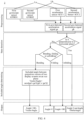
- FIG. 4 illustrates a schematic flowchart of another method 2 for determining a foldable screen included angle according to an embodiment of this application. As shown in FIG. 4 , the method 2 for determining the foldable screen included angle includes the following steps S100-S108.
- S 100 Acquire, by a first acceleration sensor ACC1 in a display screen La, a first initial acceleration signal at time t, acquire, by a first gyroscope sensor GYRO1, a first initial angular velocity signal at time t,
- S101 Perform first preprocessing on the first initial acceleration signal at time t to determine a target value of a first gravitational acceleration signal at time t, perform second preprocessing on the first initial angular velocity signal at time t to determine a first intermediate angular velocity signal at time t, perform first preprocessing on the second initial acceleration signal at time t to determine a target value of a second gravitational acceleration signal at time t, and perform second preprocessing on the second initial angular velocity signal at time t to determine a second intermediate angular velocity signal.
- Manners for performing first preprocessing on the first initial acceleration signal at time t and the second initial acceleration signal at time t and performing second preprocessing on the first initial angular velocity signal and the second initial angular velocity signal are the same as the manners shown in FIG. 3 , and refer to the above description for details which are not repeated herein.
- S102 Perform screen vertical detection on a foldable screen and judge whether two display screens of the foldable screen are perpendicular to a horizontal plane.
- Angle is used for indicating an included angle between the two display screens at time t
- LastAngle is used for indicating an included angle between the two display screens at time t-1
- DeltaAngle is used for indicating a variation of included angles from time t-1 to time t.
- the included angle variation between the two display screens may be determined only according to y-axis angular velocity signals acquired by the gyroscope sensors, and then, the included angle corresponding to the foldable screen at time t is determined by combining the included angle of the foldable screen at previous time.
- S104 Perform screen unfolding and folding detection on the foldable screen and judge the two display screens of the foldable screen being folded, or unfolded or bent if the foldable screens are not perpendicular to the horizontal plane.
- S107 Determine a projection vector of the target value of the first gravitational acceleration signal corresponding to the display screen La on an xoz plane and a projection vector of the target value of the second gravitational acceleration signal corresponding to the display screen Lb on the xoz plane if the two display screens of the foldable screen are bent, and then determine an included angle VectorAngle between the projection vector of the target value of the first gravitational acceleration signal on the xoz plane and the projection vector of the target value of the second gravitational acceleration signal on the xoz plane.
- device coordinate systems corresponding to the display screen La and the display screen Lb are different, but xoz planes constituted by x-axes and z-axes in the two device coordinate systems are located on the same plane, and since the xoz plane is perpendicular to each y-axis, and each y-axis is the same as the axis k, along which the foldable screen is bent, in direction, the included angle between the two display screens is an included angle between intersecting lines of the two display screens and the xoz plane.
- the foldable screen included angle may be indirectly calculated by calculating an included angle between the projection vector of the target value of the first gravitational acceleration signal on the xoz plane and the projection vector of the target value of the second gravitational acceleration signal on the xoz plane.
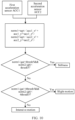
- FIG. 5 illustrates a schematic flowchart of screen vertical detection and screen unfolding and folding detection according to an embodiment of this application.
- FIG. 6 illustrates schematic diagrams of several states of a foldable screen.
- the device coordinate system corresponding to the display screen La and the device coordinate system corresponding to the display screen Lb are the same in y-axis direction, and on that basis, whether the foldable screen is perpendicular to the horizontal plane may be judged by judging whether absolute values of difference values between a component ga_y of the target value ga of the first gravitational acceleration signal on the y-axis and a standard gravitational acceleration g and between a component gb_y of the target value gb of the second gravitational acceleration signal on the y-axis and the standard gravitational acceleration g are both less than a first preset threshold thresh1.
- the standard gravitational acceleration g refers to acceleration of an object falling in vacuum under the action of gravity.
- the display screen La is vertically placed when the foldable screen is perpendicular to the horizontal plane.
- the target value ga of the first gravitational acceleration signal is almost equal to the standard gravitational acceleration g and is completely constituted by the component ga_y on the y-axis, thus, the component ga_y of the target value ga of the first gravitational acceleration signal on the y-axis is almost equal to the standard gravitational acceleration g, and accordingly, whether the display screen La is perpendicular to the horizontal plane may be judged by setting the first preset threshold thresh1 and comparing whether the difference value between the component ga_y of the target value ga of the first gravitational acceleration signal on the y-axis and the standard gravitational acceleration g is less than the first preset threshold thresh1.
- the display screen Lb is vertically placed as well.
- the target value gb of the second gravitational acceleration signal is almost equal to the standard gravitational acceleration g and is completely constituted by the component gb_y of the target value of the second gravitational acceleration signal on the y-axis, thus, the component gb_y of the target value gb of the second gravitational acceleration signal on the y-axis is almost equal to the standard gravitational acceleration g, and accordingly, whether the display screen Lb is perpendicular to the horizontal plane may be judged by setting the first preset threshold thresh1 and comparing whether the difference value between the component gb_y of the target value gb of the second gravitational acceleration signal on the y-axis and the standard gravitational acceleration g is less than the first preset threshold thresh1.
- conditions for judging whether the foldable screen is perpendicular to the horizontal plane may be set in the manner that the absolute value of the difference value between the component ga_y of the target value ga of the first gravitational acceleration signal on the y-axis and the standard gravitational acceleration g is less than the first preset threshold thresh1, and the absolute value of the difference value between the component gb_y of the target value gb of the second gravitational acceleration signal on the y-axis and the standard gravitational acceleration g is also less than the first preset threshold thresh1.
- an included angle between the two display screens may be 0°, or may be between 0° and 180°, and of course, may be 180°.
- the included angle Angle between the two display screens at time t may be determined by determining an angle variation DeltaAngle of the first gyroscope sensor GYRO1 and the second gyroscope sensor GYRO2 on the y-axis and then summing the included angle LastAngle at time t-1 and the angle variation DeltaAngle.
- w2_y in the formula (1) is used for indicating an angular velocity, acquired by the second gyroscope sensor GYRO2, on the y-axis
- w1_y is used for indicating an angular velocity, acquired by the first gyroscope sensor GYRO1, on the y-axis
- dt is used for indicating integration of time t or is called a time interval from time t-1 to time t.
- Angle LastAngle + DeltaAngle
- Angle is used for indicating an included angle between the two display screens at time t
- LastAngle is used for indicating an included angle between the two display screens at time t-1
- DeltaAngle is used for indicating an included angle variation from time t-1 to time t.
- the foldable screen may be oblique or is parallel to the horizontal plane when not perpendicular to the horizontal plane. Double-screen unfolding, bending or folding together is possible regardless of the foldable screen being oblique or being parallel to the horizontal plane. For different situations, screen unfolding and folding detection may be performed on the foldable screen so as to judge specific states of the two display screens not perpendicular to the horizontal plane.
- the device coordinate system corresponding to the display screen La and the device coordinate system corresponding to the display screen Lb share the y-axis but are opposite in x-axis direction and z-axis direction respectively.
- the device coordinate system corresponding to the display screen La and the device coordinate system corresponding to the display screen Lb are the same in x-axis direction, y-axis direction and z-axis direction respectively.
- whether the two screens of the foldable screen are bent may be judged by judging whether a difference value between absolute values of a component ga_x of the target value ga of the first gravitational acceleration signal on the x-axis and a component gb_x of the target value gb of the second gravitational acceleration signal on the x-axis is less than a second preset threshold thresh2.
- the difference value between the absolute value of ga_x and the absolute value of gb_x being less than the second preset threshold thresh2 indicates that the component ga_x of the target value ga of the first gravitational acceleration signal on the x-axis and the component gb_x of the target value gb of the second gravitational acceleration signal on the x-axis are basically the same, and accordingly, it indicates that the two display screens are not bent and may be folded together or unfolded at the time, which needs to be further judged.
- whether the two display screens of the foldable screen are folded together or unfolded may be judged by judging whether an absolute value of a difference value between a component ga_z of the target value ga of the first gravitational acceleration signal on the z-axis and a component gb_z of the target value gb of the second gravitational acceleration signal on the z-axis is less than a third preset threshold thresh3.
- whether the two display screens are folded or unfolded may be judged by setting whether an absolute value of a difference value between the component ga_z of the target value ga of the first gravitational acceleration signal on the z-axis and the component gb_z of the target value gb of the second gravitational acceleration signal on the z-axis is less than the third preset threshold thresh3.
- the absolute value of the difference value between the component ga_z of the target value ga of the first gravitational acceleration signal on the z-axis and the component gb_z of the target value gb of the second gravitational acceleration signal on the z-axis being less than the third preset threshold thresh3 indicates that the two display screens are unfolded, or otherwise, it indicates that the two display screens are folded.
- an included angle between the two display screens is correspondingly 180°; and when it is judged that the foldable screen is folded, an included angle between the two display screens is correspondingly 0°.
- the difference value between the absolute value of the component ga_x of the target value of the first gravitational acceleration signal on the x-axis and the absolute value of component gb_x of the target value of the second gravitational acceleration signal on the x-axis being greater than or equal to the second preset threshold thresh2 indicates that the component ga_x of the target value ga of the first gravitational acceleration signal on the x-axis and the component gb_x of the target value gb of the second gravitational acceleration signal on the x-axis are different, thereby indicating that the two display screens are bent.
- a process of determining the included angle between the projection vectors of the target values of the gravitational acceleration signals corresponding to the two display screens on the xoz plane includes: firstly determining the projection vector of the target value ga of the first gravitational acceleration signal on the xoz plane as a first vector ga', and determining the projection vector of the target value gb of the second gravitational acceleration signal on the xoz plane as a second vector gb'.
- the included angle between the first vector ga' and the second vector gb' is determined as a first included angle VectorAngle according to the formula (4).
- Angle 180 ⁇ VectorAngle determine an included angle Angle between the two display screens.
- each of the two display screens of the foldable screen is provided with the acceleration sensor and the gyroscope sensor which read the acceleration signal and the angular velocity signal corresponding to each display screen; and then, screen vertical detection and screen unfolding and folding detection are performed on the foldable screen.
- the foldable screen is perpendicular to the horizontal plane, an included angle variation is determined according to angular velocity signals acquired by the gyroscope sensors of the two display screens, and then the foldable screen included angle at time t is determined by calculating the sum of an included angle of the foldable screen at previous time and the included angle variation.
- a foldable screen included angle may be determined as 0°.
- a foldable screen included angle may be determined as 180°.
- target values of gravitational acceleration signals corresponding to the two display screens may be determined according to acceleration signals and angular velocity signals of the two display screens, and then a foldable screen included angle is determined by calculating an included angle between projection vectors of the target values of the two gravitational acceleration signals on the xoz plane.
- FIG. 7 is a schematic flowchart of another method 3 for determining a foldable screen included angle according to an embodiment of this application. As shown in FIG. 7 , the method 3 for determining the foldable screen included angle may further include the following steps S109-S112 on the basis of including the steps S100-S107.
- steps S100-S107 is the same as the above content which is not repeated herein.
- Steps S109-S112 are introduced in detail below.
- S108 Perform angle change detection on a foldable screen, and judge whether an included angle corresponding to the foldable screen, at time t changes relative to an included angle corresponding to time t-1.
- the included angle at previous time may be directly adopted to reduce a calculated amount.
- S110 Determine an angle variation DeltaAngle from time t-1 to time t by utilizing an angular velocity component w1_y of a first intermediate angular velocity signal acquired by a first gyroscope sensor GYRO1 on a y-axis and an angular velocity component w2_y of a second intermediate angular velocity signal acquired by a second gyroscope sensor GYRO2 on the y-axis.
- S112 Make the included angle calculated according to the projection vectors in S107 as a measured value of the included angle corresponding to the foldable screen at time t, and determine, by a Kalman filtering algorithm, a target value FuseAngle of the included angle corresponding to the foldable screen at time t according to the measured value of the included angle corresponding to the foldable screen at time t and the predicted value of the calculated included angle corresponding to time t in S111.
- the target value FuseAngle of the included angle corresponding to the foldable screen at time t is the included angle Angle corresponding to the foldable screen at time t.
- the Kalman filtering algorithm includes a time-update equation and a state-update equation.
- x ⁇ k is a predicted value of an included angle corresponding to the foldable screen at time t
- z k is a measured value of the included angle, corresponding to the foldable screen at time t
- P k-1 is an error covariance, corresponding to the foldable screen at time t-1
- P k is an error covariance, corresponding to the foldable screen at time t
- Q is process noise
- k k is a Kalman gain
- x ⁇ k is a target value (FuseAngle) of the included angle corresponding to the foldable screen at time t
- x ⁇ k-l is a target value of an included angle corresponding to the foldable screen at time t-1
- P k is an updated error covariance corresponding to time t
- u k-l is a controlled quantity to a system at time t-1
- A is a state transition matrix
- B is a control input matrix
- H is a matrix
- R is a measurement noise
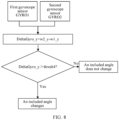
- FIG. 8 illustrates a flowchart of angle change detection according to an embodiment of this application.
- a difference value DeltaGyro_y between the angular velocity component w2_y of the second intermediate angular velocity signal on the y-axis and the angular velocity component w1_y of the first intermediate angular velocity signal on the y-axis may be firstly determined, and then whether the included angle corresponding to the foldable screen at time t changes relative to the included angle at time t-1 by judging whether the difference value DeltaGyro_y between the angular velocity component of the first intermediate angular velocity signal on the y-axis and the angular velocity component of the second intermediate angular velocity signal on the y-axis is greater than a fourth preset threshold thresh4.
- the difference value DeltaGyro_y being less than or equal to the fourth preset threshold thresh4 indicates that the included angle between the two display screens does not change or slightly changes, which can be neglected, and thus, the included angle corresponding to the foldable screen at previous time may serve as the included angle corresponding to current time.
- an included angle calculated according to an angular velocity difference of the gyroscope sensors is commonly inaccurate by independently utilizing S109-S111, and thus a target value of the included angle is determined by utilizing the Kalman filtering algorithm and combining a calculation result and the included angle determined in S107. It is to be understood that an accuracy rate of the determined included angle can be improved by combining the two methods.
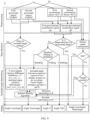
- the embodiment of this application further provides a schematic flowchart of another method 4 for determining a foldable screen included angle.
- the method 4 for determining the foldable screen included angle according to the embodiment of this application may further include the following steps S113-S116.
- steps S100-S112 is the same as the above content which is not repeated herein.
- Steps S113-S116 are introduced in detail below.
- S113 Perform motion grade detection on a foldable screen, and judge the foldable screen being still, slightly moving or intensively moving.
- motion grades of the foldable screen are used for indicating a motion range of an electronic device to which the foldable screen is applicable, and the motion grades may include at least one of stillness, slight motion and intensive motion.
- Stillness may indicate the motion range of the electronic device being 0 or being less than a first preset range; slight motion may indicate the motion range of the electronic device being greater than a second preset range but less than a third preset range; and intensive motion may indicate the motion range of the electronic device being greater than a fourth preset range.
- the first preset range is less than or equal to the second preset range, the second preset range is less than the third preset range, and the third preset range is less than or equal to the fourth preset range.
- the foldable screen being still means that the foldable screen is still relative to the outside, for example, a mobile phone is placed on a tabletop, but two display screens included by the mobile phone may relatively move.
- S114 Decrease parameters in the measurement noise matrix R of the involved Kalman filtering algorithm in S112 when the foldable screen is still.
- S112 is correspondingly updated to include: determining a target value FuseAngle of an included angle corresponding to the foldable screen at time t by utilizing the Kalman filtering algorithm having the measurement noise matrix R with the decreased parameters according to the measured value of the included angle corresponding to the foldable screen at time t and the predicted value of the included angle corresponding to time t.
- the target value FuseAngle of the included angle corresponding to the foldable screen at time t is the included angle Angle corresponding to the foldable screen at time t.
- S112 is correspondingly updated to include: determining a target value FuseAngle of an included angle corresponding to the foldable screen at time t by utilizing the Kalman filtering algorithm having the measurement noise matrix R with the increased parameters according to measured value of the included angle corresponding to the foldable screen at time t and the predicted value of the included angle corresponding to time t.
- the target value FuseAngle of the included angle corresponding to the foldable screen at time t is the included angle Angle corresponding to the foldable screen at time t.
- the measurement noise matrix is used for indicating a trust degree for a measured value of a gravitational acceleration signal.
- Higher noise of the measured value of the gravitational acceleration signal indicates that trust on the measured value of the gravitational acceleration signal needs to be diminished; and lower noise of the measured value of the gravitational acceleration signal indicates that the measured value is worthy of being trusted, and trust on the measured value of the gravitational acceleration signal can be increased.
- the determined measured value of the gravitational acceleration signal is credible, and accordingly, the parameters in the measurement noise matrix R may be decreased; and when it is detected that the foldable screen slightly moves, trust on the determined measured value of the gravitational acceleration signal is lowered, and thus, the parameters in the measurement noise matrix R may be increased.
- the same parameters in the measurement noise matrix R are adjusted for two different situations including stillness and slight motion.
- the method for determining the included angle is differently adjusted according to the different motion grades.
- the parameters in R in the Kalman filtering algorithm may be modified according to different motion situations, thereby improving an accuracy rate of the target value, determined according to the Kalman filtering algorithm, of the included angle.
- the included angle may be determined only by utilizing an angular velocity of the gyroscope sensor so as to reduce the calculated amount.
- FIG. 10 illustrates a schematic flowchart of motion grade detection.
- a modulus of a first initial acceleration signal acquired by a first acceleration sensor ACC1 at time t and a modulus of a second initial acceleration signal acquired by a second acceleration sensor ACC2 at time t are firstly determined.
- the first initial acceleration signal at time t includes a gravitational acceleration signal and a linear acceleration signal, which can reflect a motion state of the foldable screen in a three-dimensional space, and thus, it is more accurate to utilize the modulus of the first initial acceleration signal at time t for judgment.
- the difference value between the modulus corresponding to the first initial acceleration at time t and the constant of the target value of the gravitational acceleration signal at time t being very low indicates that the first initial acceleration is basically constituted by gravitational acceleration, thus, stillness is a current state, and on that basis, initial acceleration corresponding to each of two display screens being basically constituted by gravitational acceleration indicates that a foldable screen is still.
- a target value FuseAngle of the included angle may be determined by utilizing steps S109-S112. On that basis, to improve the accuracy rate, the parameters in the measurement noise matrix R of the Kalman filtering algorithm are further adjusted.
- the difference values between the moduli of the initial acceleration corresponding to the two display screens and the constant of the target value of the gravitational acceleration signal being not both less than the fifth preset threshold thresh5 indicates that the foldable screen is not still, and whether the foldable screen slightly moves or intensively moves needs to be further judged.
- whether the foldable screen slightly moves or intensively moves may be judged by determining, at time t, whether the difference value between the modulus of the first initial acceleration and the constant of the target value of the first gravitational acceleration and the difference value between the modulus of the second initial acceleration and the constant of the target value of the second gravitational acceleration are both less than n times of the fifth preset threshold thresh5.
- n is greater than 1, and n may be adjusted according to needs, which is not limited by the embodiment of this application.
- n may be set as 4.
- the foldable screen moves with a small range, an error of a determined included angle is less, a target value FuseAangle of the included angle may be determined by utilizing steps S109-S112, and on that basis, the accuracy rate can be improved by further adjusting the parameters in the measurement noise matrix R of the Kalman filtering algorithm.
- the plurality of steps S100-S116 in the method for determining the foldable screen included angle may be selected to be executed according to different needs so as perform multi-aspect assessment on the foldable screen, thereby more accurately determining the included angle.
- FIG. 11 and FIG. 12 are schematic diagrams of two display interfaces of an electronic device according to embodiments of this application.
- the display interfaces may show display effects of the display interfaces changing along with included angle changes, and an included angle of a foldable screen may be determined according to the method for determining the foldable screen included angle according to the embodiment of this application.
- a blooming and shrinking degree of a flower in a displayed dynamic wallpaper may change along with the included angle of the foldable screen, and thus, the included angle of the foldable screen may be accurately determined in real time by utilizing the method for determining the foldable screen included angle according to the embodiment of this application, and then the blooming and shrinking degree of the flower is dynamically represented according to different included angles.
- the determined foldable screen included angle Angle when the determined foldable screen included angle Angle is gradually reduced, the flower may be shrunk into a bud from a blooming state; and as shown in (b) in FIG. 11 , when the determined foldable screen included angle Angle is gradually increased, the flower slowly blooms into a blooming flower from the bud.
- the state of the mobile phone can be accurately judged by the method for determining the foldable screen included angle according to the embodiment of this application, a use habit of the user is recognized, and a display effect is converted according to the state of the mobile phone.
- a display screen included angle For example, as shown in (a) in FIG. 12 , when the mobile phone is in a bending state, chatting records in the display interface are displayed in a display screen La, a virtual keyboard is displayed in a display screen Lb, and a character arrangement direction is parallel to an axis k.
- a virtual keyboard is displayed in a display screen Lb
- a character arrangement direction is parallel to an axis k.
- the chatting records in the display interface are displayed in an upper half part of the display screen La and an upper half part of the display screen Lb at the same time, and the virtual keyboard is displayed in a lower half part of the display screen La and a lower half part of the display screen Lb at the same time.
- a character arrangement direction is perpendicular to the axis k.
- the method according to the embodiment of this application when utilized for determining the included angle in real time, on one hand, no complex components are additionally arranged while an applicable electronic device structure is not changed, and thus hardware costs are low; and on the other hand, the method according to the embodiment of this application refines and classifies states of the foldable screen and correspondingly selects the most appropriate included angle determining algorithm for each state, so that recognition precision is high, accuracy of the determined included angle is higher, thereby making the display effect of the foldable screen changing along with included angle changes better.
- FIG. 1-FIG. 12 The method for determining the foldable screen included angle according to the embodiment of this application and the associated display interfaces and effect pictures are described in detail by combining FIG. 1-FIG. 12 above; and an electronic device, an apparatus and a chip according to an embodiment of this application are described in detail by combining FIG. 13-FIG. 15 below.
- the electronic device, the apparatus and the chip in the embodiment of this application may execute previous various methods for determining the foldable screen included angle in the embodiments of this application, and namely, specific work processes of following products may refer to corresponding processes in the previous method embodiments.
- FIG. 13 illustrates a structural schematic diagram of an electronic device applicable to this application.
- the electronic device 100 may be configured to realize methods described in above method embodiments.
- the electronic device 100 may be a mobile phone, a smart screen, a tablet personal computer, a wearable electronic device, a vehicle-mounted electronic device, an augmented reality (augmented reality, AR) device, a virtual reality (virtual reality, VR) device, a notebook computer, an ultra-mobile personal computer (ultra-mobile personal computer, UMPC), a netbook, a personal digital assistant (personal digital assistant, PDA), a projector, etc., and the embodiment of this application does not limit specific types of the electronic device 100.
- the electronic device 100 may include a processor 110, an external memory interface 120, an internal memory 121, a universal serial bus (universal serial bus, USB) interface 130, a charge management module 140, a power management module 141, a battery 142, an antenna 1, an antenna 2, a mobile communication module 150, a wireless communication module 160, an audio module 170, a loudspeaker 170A, a receiver 170B, a microphone 170C, a headphone jack 170D, a sensor module 180, a key 190, a motor 191, an indicator 192, a camera 193, a display screen 194, and a subscriber identification module (subscriber identification module, SIM) card interface 195, and the like.
- SIM subscriber identification module
- the sensor module 180 may include a pressure sensor 180A, a gyroscope sensor 180B, a barometric pressure sensor 180C, a magnetic sensor 180D, an acceleration sensor 180E, a range sensor 180F, a proximity light sensor 180G, a fingerprint sensor 180H, a temperature sensor 180J, a touch sensor 180K, an ambient light sensor 180L, a bone conduction sensor 180M, and the like.
- the processor 110 may include one or more processing units.
- the processor 110 may include at least one of the following processing units: an application processor (application processor, AP), a modem processor, a graphics processing unit (graphics processing unit, GPU), an image signal processor (image signal processor, ISP) a controller, a video codec, a digital signal processor (digital signal processor, DSP), a baseband processor, a neural-network processing unit (neural-network processing unit, NPU).
- an application processor application processor, AP
- modem processor graphics processing unit
- image signal processor image signal processor
- ISP image signal processor
- DSP digital signal processor
- NPU neural-network processing unit
- Different processing units may be independent devices, or may be integrated devices.
- the controller may generate an operating control signal according to an instruction operation code and a sequence signal, to complete control of fetching and executing an instruction.
- a memory may be further arranged in the processor 110, and is configured to store an instruction and data.
- the memory in the processor 110 is a cache memory.
- the memory may store an instruction or data that has just been used or cyclically used by the processor 110. If the processor 110 needs to use the instruction or the data again, the processor may directly invoke the instruction or the data from the memory. Repeated access is avoided, and waiting time of the processor 110 is reduced, thereby improving system efficiency.
- connection relationship among modules shown in FIG. 13 is only schematically explained, which does not constitute limitations on the connection relationship among the modules of the electronic device 100.
- the modules of the electronic device 100 may adopt a combination of a plurality of connection modes in the above embodiment.
- a wireless communication function of the electronic device 100 may be implemented by using the antenna 1, the antenna 2, the mobile communication module 150, the wireless communication module 160, the modem processor, the baseband processor, and the like.
- the antenna 1 and the antenna 2 are configured to transmit and receive an electromagnetic wave signal.
- Each antenna in the electronic device 100 may be configured to cover one or more communication frequency bands. Different antennas may also be multiplexed to improve utilization of the antennas.
- an antenna 1 may be multiplexed as a diversity antenna of a wireless local area network.
- the antenna may be used in combination with a tuning switch.
- the electronic device 100 can implement a display function by using the GPU, the display screen 194, and the application processor.
- the GPU is a microprocessor for image processing, and is connected to the display screen 194 and the application processor.
- the GPU is configured to perform mathematical and geometric calculation, and is configured to render graphics.
- the processor 110 may include one or more GPUs, and execute a program instruction to generate or change display information.
- the display screen 194 is configured to display an image, or a video.
- the electronic device 100 can implement a photographing function by using the ISP, the camera 193, the video codec, the GPU, the display screen 194, the application processor, and the like.
- the ISP is configured to process data fed back by the camera 193. For example, during photographing, a shutter is enabled. Light is transmitted to a photosensitive element of the camera through a lens, and an optical signal is converted into an electrical signal. The photosensitive element of the camera transmits the electrical signal to the ISP for processing, and the electrical signal is converted into an image visible to a naked eye.
- the ISP can further optimize an algorithm for noise, brightness, and complexion of the image, and optimize parameters, such as exposure and color temperature of a photographing scene.
- the ISP may be arranged in the camera 193.
- the camera 193 is configured to capture a static image or a video. An optical image of an object is generated through a lens and is projected to the photosensitive element.
- the photosensitive element may be a charge coupled device (charge coupled device, CCD) or a complementary metal-oxide-semiconductor (complementary metal-oxide-semiconductor, CMOS) phototransistor.
- CCD charge coupled device
- CMOS complementary metal-oxide-semiconductor
- the photosensitive element converts an optical signal into an electrical signal, and then transfers the electrical signal to the ISP, to convert the electrical signal into a digital image signal.
- the ISP outputs the digital image signal to the DSP for processing.
- the DSP converts the digital image signal into a standard image signal in RGB (red green blue, RGB) and YUV formats.
- the electronic device 100 may include one or N cameras 193, and N is a positive integer greater than 1.
- the digital signal processor is configured to process a digital signal, and may further process another digital signal in addition to a digital image signal. For example, when the electronic device 100 performs frequency selection, the digital signal processor is configured to perform Fourier transform and the like on frequency energy.
- the video codec is configured to compress or decompress a digital video.
- the electronic device 100 may support one or more video codecs. In this way, the electronic device 100 may play or record videos in a plurality of encoding formats, for example, moving picture experts group (moving picture experts group, MPEG) 1, MPEG2, MPEG3, and MPEG4.
- MPEG moving picture experts group
- the gyroscope sensor 180B may be configured to determine a motion posture of the electronic device 100. In some embodiments, an angular velocity of the electronic device 100 around three axes (that is, x, y, and z axes) may be determined through the gyroscope sensor 180B.
- the gyroscope sensor 180B may be used for image stabilization in photography. For example, when the shutter is pressed, the gyroscope sensor 180B detects an angle at which the electronic device 100 jitters, and calculates, based on the angle, a distance for which a lens module needs to compensate, and allows the lens to cancel the jitter of the electronic device 100 through reverse motion, thereby implementing image stabilization.
- the gyroscope sensor 180B may also be used for scenes such as navigation and a motion sensing game.
- the gyroscope sensor 180B in the embodiment of this application may be configured to collect angular velocity signals, and the angular velocity signals may be used for representing pose changes of the electronic device in a shooting process.
- the acceleration sensor 180E may detect an acceleration value of the electronic device 100 in various directions (generally in x, y, and z axes). When the electronic device 100 is stationary, a magnitude and a direction of a gravity may be detected.
- the acceleration sensor 180E may be further configured to recognize poses of the electronic device 100, and the poses serve as input parameters for landscape and portrait mode switchover, a pedometer and other application programs.
- the acceleration sensor 180E in the embodiment of this application may be configured to collect acceleration signals, and the acceleration signals may be used for representing velocity changes of the electronic device in the shooting process.
- the schematic structure in this embodiment of this application constitutes no specific limitation on the electronic device 100.
- the electronic device 100 may include more or fewer components than those shown in the figure, or some components may be combined, or some components may be divided, or different component arrangements may be used.
- the components shown in the figure may be implemented by hardware, software, or a combination of software and hardware.
- FIG. 14 illustrates a structural schematic diagram of an apparatus 200 for determining a foldable screen included angle according to an embodiment of this application.
- the apparatus 200 for determining the foldable screen included angle includes an acquisition module 210 and a processing module 220.
- the acquisition module 210 is configured to acquire initial acceleration signals and initial angular velocity signals corresponding to two display screens at time t respectively.
- the processing module 220 is configured to: for each display screen, perform first preprocessing on the corresponding initial acceleration signal at time t to determine a target value of a gravitational acceleration signal at time t, and perform second preprocessing on the corresponding initial angular velocity signal at time t to determine an intermediate angular velocity signal at time t; and determine a state of a foldable screen at time t according to the target values of the gravitational acceleration signals corresponding to the two display screens at time t and the intermediate angular velocity signals at time t.
- the state of the foldable screen includes at least one of the foldable screen being perpendicular to a horizontal plane, the two display screens of the foldable screen being folded, bent and unfolded, an included angle of the foldable screen at time t changing relative to an included angle at time t-1, and the included angle of the foldable screen at time t not changing relative to the included angle at time t-1.
- the processing module 220 is further configured to determine an included angle corresponding to the foldable screen at time t according to the state of the foldable screen at time t.
- the processing module 220 is further configured to: for each display screen, perform coordinate system conversion and average filtering on an initial acceleration signal at time t to obtain a measured value of a gravitational acceleration signal at time t; determine, by a time-update equation, a predicted value of the gravitational acceleration signal at time t according to a target value of a gravitational acceleration signal at time t-1 and an initial angular velocity signal at time t-1; and determine, by a Kalman filtering algorithm, a target value of the gravitational acceleration signal at time t according to the measured value of the gravitational acceleration signal at time t and the predicted value of the gravitational acceleration signal at time t.
- the processing module 220 is further configured to: for each display screen, perform lowpass filtering on an initial angular velocity signal at time t to determine an intermediate angular velocity signal at time t.
- the processing module 220 is further configured to: perform screen vertical detection on a foldable screen to judge whether the foldable screen is perpendicular to a horizontal plane; and if not, perform screen unfolding and folding detection on the foldable screen to judge two display screens of the foldable screen being folded or unfolded or bent.
- the processing module 220 is further configured to: determine whether absolute values of difference values between components of target values of gravitational acceleration signals corresponding to two display screens at time t on a y-axis and standard gravitational acceleration are both less than a first preset threshold, where the standard gravitational acceleration is used for indicating acceleration of an object falling in vacuum under the action of gravity; if yes, determine that the foldable screen is perpendicular to a horizontal plane; and if not, the included angle at time t-1.
- the processing module 220 is further configured to determine an included angle corresponding to the foldable screen at time t according to the state of the foldable screen at time t.
- the processing module 220 is further configured to: for each display screen, perform coordinate system conversion and average filtering on an initial acceleration signal at time t to obtain a measured value of a gravitational acceleration signal at time t; determine, by a time-update equation, a predicted value of the gravitational acceleration signal at time t according to a target value of a gravitational acceleration signal at time t-1 and an initial angular velocity signal at time t-1; and determine, by a Kalman filtering algorithm, a target value of the gravitational acceleration signal at time t according to the measured value of the gravitational acceleration signal at time t and the predicted value of the gravitational acceleration signal at time t.
- the processing module 220 is further configured to: for each display screen, perform lowpass filtering on an initial angular velocity signal at time t to determine an intermediate angular velocity signal at time t.
- the processing module 220 is further configured to: perform screen vertical detection on a foldable screen to judge whether the foldable screen is perpendicular to a horizontal plane; and if not, perform screen unfolding and folding detection on the foldable screen to judge two display screens of the foldable screen being folded or unfolded or bent.
- the processing module 220 is further configured to: determine whether absolute values of difference values between components of target values of gravitational acceleration signals corresponding to two display screens at time t on a y-axis and standard gravitational acceleration are both less than a first preset threshold, where the standard gravitational acceleration is used for indicating acceleration of an object falling in vacuum under the action of gravity; if yes, determine that the foldable screen is perpendicular to a horizontal plane; and if not, at time t according to the included angle corresponding to the foldable screen at time t-1 and the angle variation of the foldable screen from time t-1 to time t.
- the processing module 220 is further configured to: determine whether a difference value between angular velocity components, on a y-axis, of intermediate angular velocity signals corresponding to two display screens at time t is greater than a fourth preset threshold; if not, determine that an included angle of a foldable screen at time t does not change relative to an included angle at time t-1; and if yes, determine that the included angle of the foldable screen at time t changes relative to the included angle at time t-1.
- the processing module 220 is further configured to: make an included angle being determined according to a first included angle and corresponding to a foldable screen at time t as a measured value of the included angle corresponding to the foldable screen at time t; and determine, by a Kalman filtering algorithm, an included angle corresponding to the display screen at time t according to a predicted value of the included angle corresponding to the foldable screen at time t and the measured value of the included angle corresponding to the foldable screen at time t.
- the processing module 220 is further configured to: perform motion grade detection on a foldable screen to judge a motion grade of the foldable screen, where the motion grade includes at least one of stillness, slight motion and intensive motion; decrease parameters in a measurement noise matrix R of a Kalman filtering algorithm in a case of stillness; determine a target value of an included angle corresponding to the foldable screen at time t by utilizing the Kalman filtering algorithm having the measurement noise matrix with the decreased parameters according to a predicted value of the included angle corresponding to the foldable screen at time t and a measured value of the included angle; increase the parameters in the measurement noise matrix of the Kalman filtering algorithm in a case of slight motion; determine a target value of the included angle corresponding to the foldable screen at time t by utilizing the Kalman filtering algorithm having the measurement noise matrix with the increased parameters according to the predicted value of the included angle corresponding to the foldable screen at time t and the measured value of the included angle; and determine the included angle corresponding to the foldable screen at time
- the processing module 220 is further configured to: for each display screen, determine a modulus of an initial acceleration signal, acquired by an acceleration sensor, at time t; for each display screen, determine whether a difference value between the modulus of the initial acceleration signal at time t and a reference value is less than a fifth preset threshold, the reference value is a constant corresponding to a target value of a gravitational acceleration signal corresponding to each display screen at time t; determine that a foldable screen is still if difference values between determined moduli of the initial acceleration signals of the two display screens at time t and reference values are both less than the fifth preset threshold; if not, judge whether the difference values between the determined moduli of the initial acceleration signals of the two display screens at time t and the reference values are both less than n times of the fifth preset threshold, where n is greater than 1; if yes, determine that the foldable screen slightly moves; and if not, determine that the foldable screen intensively moves.
- the apparatus 200 for determining the foldable screen included angle is embodied in a form of a functional module.
- the term "module” may be realized in a form of software and/or hardware, which is not specifically limited.
- the "module” may be a software program, a hardware circuit or a combination of the software program the hardware circuit for realizing the above functions.
- the hardware circuit may include an application specific integrated circuit (application specific integrated circuit, ASIC), an electronic circuit, a processor (for example, a shared processor, a dedicated processor, or a packet processor) configured to execute one or more software or firmware programs, a memory, a combined logical circuit, and/or another suitable component that supports the described functions.
- ASIC application specific integrated circuit
- ASIC application specific integrated circuit
- a processor for example, a shared processor, a dedicated processor, or a packet processor configured to execute one or more software or firmware programs, a memory, a combined logical circuit, and/or another suitable component that supports the described functions.
- units of various examples described in the embodiment of this application may be realized by electronic hardware, or a combination of computer software and the electronic hardware.
- a person skilled in the art may use different methods to implement the described functions for each particular application, but it should not be considered that the implementation goes beyond the scope of this application.
- the embodiment of this application further provides a computer-readable storage medium storing computer instructions.
- the apparatus 200 for determining the foldable screen included angle executes the previous method for determining the foldable screen included angle.
- the computer instructions may be stored in a computer-readable storage medium or may be transmitted from a computer-readable storage medium to another computer-readable storage medium.
- the computer instructions may be transmitted from a website, computer, server, or data center to another website, computer, server, or data center in a wired (for example, a coaxial cable, an optical fiber, or a digital subscriber line (digital subscriber line, DSL)) or wireless (for example, infrared, radio, or microwave) manner.
- the computer-readable storage medium may be any usable medium accessible by a computer, or a data storage device, such as a server or a data center, integrating one or more usable media.
- the usable medium may be a magnetic medium (for example, a soft disk, a hard disk, or a magnetic tape), an optical medium, or a semiconductor medium (for example, a solid state disk (solid state disk, SSD)), or the like.
- the embodiment of this application further provides a computer program product including computer instructions.
- the apparatus 200 for determining the foldable screen included angle may execute the previous method for determining the foldable screen included angle.
- FIG. 15 is a structural schematic diagram of a chip according to an embodiment of this application.
- the chip shown in FIG. 15 may be a general-purpose processor and may also be a special-purpose processor.
- the chip includes a processor 301.
- the processor 301 is configured to support the apparatus 200 for determining the foldable screen included angle to execute a previous technical solution.
- the chip further includes a transceiver 302, and the transceiver 302 is configured to be controlled by the processor 301 to support the apparatus 200 for determining the foldable screen included angle to execute the previous technical solution.
- the chip shown in FIG. 15 may further include a storage medium 303.
- the chip shown in FIG. 15 may be realized by following circuits or devices: one or more field programmable gate arrays (field programmable gate array, FPGA), a programmable logic device (programmable logic device, PLD), a controller, a state machine, a gate logic, a discrete hardware part, any other proper circuits, or any combination of circuits capable of executing various functions described in this whole application.
- FPGA field programmable gate array
- PLD programmable logic device
- controller a state machine
- gate logic a discrete hardware part
- any other proper circuits any combination of circuits capable of executing various functions described in this whole application.
- the electronic device, the apparatus 200 for determining the foldable screen included angle, the computer storage medium, the computer program product and the chip according to the embodiment of this application are all configured to execute the method provided above, and thus, achieved beneficial effects may refer to beneficial effects corresponding to the method provided above, which are not repeated herein.
- sequence numbers of the foregoing processes do not indicate an execution sequence, and an execution sequence of processes shall be determined based on functions and internal logic thereof, and shall constitute no limitation on an implementation process of the embodiments of this application.
- preset and “pre-define” may be realized by prestoring corresponding codes and tables in the device (such as the electronic device) or through other manners used for indicating related information, and this application does not limit a specific implementation.
Landscapes
- Engineering & Computer Science (AREA)
- Computer Hardware Design (AREA)
- Theoretical Computer Science (AREA)
- Signal Processing (AREA)
- Physics & Mathematics (AREA)
- Human Computer Interaction (AREA)
- General Physics & Mathematics (AREA)
- General Engineering & Computer Science (AREA)
- Environmental & Geological Engineering (AREA)
- Computer Networks & Wireless Communication (AREA)
- Mathematical Physics (AREA)
- Controls And Circuits For Display Device (AREA)
- Gyroscopes (AREA)
- Control Of Indicators Other Than Cathode Ray Tubes (AREA)
Claims (14)
- Verfahren (1, 2, 3, 4) zum Bestimmen eines Einschlusswinkels (Angle) eines Faltbildschirms, angewandt auf eine elektronische Vorrichtung (100) mit einem Faltbildschirm, wobei der Faltbildschirm zwei Anzeigebildschirme (La, Lb) umfasst, wobei jeder Anzeigebildschirm (La, Lb) einen Beschleunigungssensor (180E, ACC1, ACC2) und einen Gyroskopsensor (180B, GYRO1, GYRO2) umfasst, und
wobei das Verfahren (1, 2, 3, 4) zum Bestimmen des Einschlusswinkels (Angle) des Faltbildschirms Folgendes umfasst:für jeden Anzeigebildschirm (La, Lb) Erfassen (S10) eines Signals der anfänglichen Beschleunigung (acc1_X, acc1_Y, acc1_Z, acc2_X, acc2_Y, acc2_Z) zum Zeitpunkt t durch den Beschleunigungssensor (180E, ACC1, ACC2) und Erfassen eines Signals der anfänglichen Winkelgeschwindigkeit zum Zeitpunkt t durch den Gyroskopsensor (180B, GYRO1, GYRO2),für jeden Anzeigebildschirm (La, Lb) Durchführen (S20, S101) einer ersten Vorverarbeitung an dem Signal der anfänglichen Beschleunigung (acc1_X, acc1_Y, acc1_Z, acc2_X, acc2_Y, acc2_Z) zum Zeitpunkt t, um einen Zielwert (ga, gb) eines Gravitationsbeschleunigungssignals zum Zeitpunkt t zu bestimmen, und Durchführen einer zweiten Vorverarbeitung an dem Signal der anfänglichen Winkelgeschwindigkeit zum Zeitpunkt t, um ein Signal der Zwischenwinkelgeschwindigkeit zum Zeitpunkt t zu bestimmen,Bestimmen (S30) eines Zustandes des Faltbildschirms zum Zeitpunkt t gemäß den Zielwerten (ga, gb) der Gravitationsbeschleunigungssignale, die den zwei Anzeigebildschirmen (La, Lb) zum Zeitpunkt t entsprechen, und den Signalen der Zwischenwinkelgeschwindigkeit zum Zeitpunkt t, wobei der Zustand des Faltbildschirms mindestens eines des Folgenden umfasst: der Faltbildschirm ist senkrecht zu einer horizontalen Ebene, die zwei Anzeigebildschirme (La, Lb) des Faltbildschirms sind zusammengefaltet, abgewinkelt und aufgefaltet, ein Einschlusswinkel (Angle) des Faltbildschirms zum Zeitpunkt t verändert sich relativ zu einem Einschlusswinkel (Last Angle) zum Zeitpunkt t-1 und der Einschlusswinkel (Angle) des Faltbildschirms zum Zeitpunkt t verändert sich relativ zu dem Einschlusswinkel (Last Angle) zum Zeitpunkt t-1 nicht, undBestimmen (S40) eines Einschlusswinkels (Angle), der dem Faltbildschirm zum Zeitpunkt t entspricht, gemäß dem Zustand des Faltbildschirms zum Zeitpunkt t, wobeifür jeden Anzeigebildschirm (La, Lb) das Durchführen (S20, S101) der zweiten Vorverarbeitung an dem Signal der anfänglichen Winkelgeschwindigkeit zum Zeitpunkt t, um ein Signal der Zwischenwinkelgeschwindigkeit zum Zeitpunkt t zu bestimmen, Folgendes umfasst:
für jeden Anzeigebildschirm (La, Lb) Durchführen (S24) eines Tiefpassfilterns an dem Signal der anfänglichen Winkelgeschwindigkeit zum Zeitpunkt t, um das Signal der Zwischenwinkelgeschwindigkeit zum Zeitpunkt t zu bestimmen. - Verfahren (1, 2, 3, 4) zum Bestimmen des Einschlusswinkels (Angle) eines Faltbildschirms nach Anspruch 1, wobei das Durchführen der ersten Vorverarbeitung (S20, S101) an dem Signal der anfänglichen Beschleunigung (acc1_X, acc1_Y, acc1_Z, acc2_X, acc2_Y, acc2_Z) zum Zeitpunkt t für jeden Anzeigebildschirm (La, Lb), um einen Zielwert (ga, gb) eines Gravitationsbeschleunigungssignals zum Zeitpunkt t zu bestimmen, Folgendes umfasst:für jeden Anzeigebildschirm (La, Lb) Durchführen (S21) einer Koordinatensystemumwandlung und Mittelwertfilterung an dem Signal der anfänglichen Beschleunigung (acc1_X, acc1_Y, acc1_Z, acc2_X, acc2_Y, acc2_Z) zum Zeitpunkt t, um einen gemessenen Wert des Gravitationsbeschleunigungssignals zum Zeitpunkt t zu erhalten,Bestimmen (S22) eines prognostizierten Wertes des Gravitationsbeschleunigungssignals zum Zeitpunkt t gemäß einem Zielwert (ga, gb) eines Gravitationsbeschleunigungssignals zum Zeitpunkt t-1 und einem Signal der anfänglichen Winkelgeschwindigkeit zum Zeitpunkt t-1 anhand einer Zeitaktualisierungsgleichung, undBestimmen (S23) des Zielwertes des Gravitationsbeschleunigungssignals zum Zeitpunkt t gemäß dem gemessenen Wert des Gravitationsbeschleunigungssignals zum Zeitpunkt t und dem prognostizierten Wert des Gravitationsbeschleunigungssignals zum Zeitpunkt t anhand eines Kalman-Filter-Algorithmus.
- Verfahren (1, 2, 3, 4) zum Bestimmen des Einschlusswinkels (Angle) eines Faltbildschirms nach Anspruch 1 oder 2, wobei das Bestimmen (S30) eines Zustandes des Faltbildschirms zum Zeitpunkt t gemäß den Zielwerten (ga, gb) der Gravitationsbeschleunigungssignale, die den zwei Anzeigebildschirmen (La, Lb) zum Zeitpunkt t entsprechen, und dem Signal der Zwischenwinkelgeschwindigkeit zum Zeitpunkt t Folgendes umfasst:Durchführen (S102) einer Bildschirmvertikalerkennung an dem Faltbildschirm, um einzuschätzen, ob der Faltbildschirm senkrecht zu einer horizontalen Ebene liegt, undwenn nicht, Durchführen (S104) einer Bildschirmauffalt- und -zusammenfalterkennung an dem Faltbildschirm, um zu beurteilen, ob die zwei Anzeigebildschirme (La, Lb) des Faltbildschirms zusammengefaltet oder aufgefaltet oder abgewinkelt sind.
- Verfahren (1, 2, 3, 4) zum Bestimmen des Einschlusswinkels (Angle) eines Faltbildschirms nach Anspruch 3, wobei das Durchführen (S102) einer Bildschirmvertikalerkennung an dem Faltbildschirm, um zu beurteilen, ob der Faltbildschirm senkrecht zu einer horizontalen Ebene liegt, Folgendes umfasst:Bestimmen, ob absolute Werte von Differenzwerten zwischen Komponenten (ga_y, gb_y), auf einer y-Achse, von Zielwerten (ga, gb) von Gravitationsbeschleunigungssignalen, die den zwei Anzeigebildschirmen (La, Lb) zum Zeitpunkt t entsprechen, und der Standardgravitationsbeschleunigung (g) beide kleiner als ein erster voreingestellter Schwellenwert (thresh1) sind, wobei die Standardgravitationsbeschleunigung (g) verwendet wird, um die Beschleunigung eines Objekts anzugeben, das im Vakuum unter der Wirkung von Schwerkraft fällt,wenn ja, Bestimmen, dass der Faltbildschirm senkrecht zu der horizontalen Ebene liegt, undwenn nicht, Bestimmen, dass der Faltbildschirm nicht senkrecht zu der horizontalen Ebene liegt.
- Verfahren (1, 2, 3, 4) zum Bestimmen des Einschlusswinkels (Angle) eines Faltbildschirms nach Anspruch 3 oder 4, wobei das Durchführen (S104) einer Bildschirmauffalt- und -zusammenfalterkennung an dem Faltbildschirm, um beurteilen, ob die zwei Anzeigebildschirme (La, Lb) des Faltbildschirms zusammengefaltet oder aufgefaltet oder abgewinkelt sind, Folgendes umfasst:Bestimmen, ob ein Differenzwert zwischen absoluten Werten von Komponenten (ga_x, gb_x), auf einer x-Achse, von Zielwerten (ga, gb) von Gravitationsbeschleunigungssignalen, die den zwei Anzeigebildschirmen (La, Lb) zum Zeitpunkt t entsprechen, kleiner als ein zweiter voreingestellter Schwellenwert (thresh2) ist,wenn nicht, Bestimmen, dass der Faltbildschirm abgewinkelt ist,wenn ja, bestimmen, ob ein absoluter Wert eines Differenzwertes zwischen Komponenten (ga_z, gb_z), auf einer z-Achse, von Zielwerten (ga, gb) von Gravitationsbeschleunigungssignalen, die den zwei Anzeigebildschirmen (La, Lb) zum Zeitpunkt t entsprechen, kleiner als ein dritter voreingestellter Schwellenwert (thresh3) ist,wenn ja, Bestimmen, dass der Faltbildschirm aufgefaltet ist, undwenn nicht, Bestimmen, dass der Faltbildschirm zusammengefaltet ist.
- Verfahren (1, 2, 3, 4) zum Bestimmen des Einschlusswinkels (Angle) eines Faltbildschirms nach einem der Ansprüche 3 bis 5, wobei das Bestimmen eines Einschlusswinkels (Angle), der dem Faltbildschirm zum Zeitpunkt t entspricht, gemäß dem Zustand des Faltbildschirms zum Zeitpunkt t Folgendes umfasst:Bestimmen (S103) eines Einschlusswinkels (Angle) zwischen zwei Anzeigebildschirmen (La, Lb) gemäß Angle = LastAngle + DeltaAngle, wenn der Faltbildschirm senkrecht zu einer horizontalen Ebene liegt, wobei Angle verwendet wird, um einen Einschlusswinkel (Angle) zwischen den zwei Anzeigebildschirmen (La, Lb) zum Zeitpunkt t anzugeben, LastAngle verwendet wird, um einen Einschlusswinkel (LastAngle) zwischen den zwei Anzeigebildschirmen (La, Lb) zum Zeitpunkt t-1 anzugeben, und DeltaAngle verwendet wird, um eine Winkelabweichung (DeltaAngle) zwischen den zwei Anzeigebildschirmen (La, Lb) von Zeitpunkt t-1 zu Zeitpunkt t anzugeben,Bestimmen (S105), dass der Einschlusswinkel (Angle) 0° beträgt, wenn der Faltbildschirm zusammengefaltet ist,Bestimmen (S106), dass der Einschlusswinkel (Angle) 180° beträgt, wenn der Faltbildschirm aufgefaltet ist,Bestimmen (S107) eines ersten Einschlusswinkels (VectorAngle) zwischen Projektionsvektoren von zwei Gravitationsbeschleunigungssignalen zum Zeitpunkt t auf einer xoz-Ebene gemäß den Zielwerten (ga, gb) der Gravitationsbeschleunigungssignale, die den zwei Anzeigebildschirmen (La, Lb) zum Zeitpunkt t entsprechen, wenn der Faltbildschirm abgewinkelt ist, undBestimmen (S108) eines Einschlusswinkels (Angle), der dem Faltbildschirm zum Zeitpunkt t entspricht, gemäß dem ersten Einschlusswinkel (VectorAngle).
- Verfahren (1, 2, 3, 4) zum Bestimmen des Einschlusswinkels (Angle) eines Faltbildschirms nach Anspruch 6, wobei das Verfahren (1, 2, 3, 4) ferner Folgendes umfasst:Durchführen (S108) einer Winkelveränderungserkennung an einem Faltbildschirm und Beurteilen, ob sich ein Einschlusswinkel (Angle) des Faltbildschirms zum Zeitpunkt t relativ zu einem Einschlusswinkel (LastAngle) zum Zeitpunkt t-1 verändert hat,Bestimmen (S110) einer Winkelabweichung zwischen zwei Anzeigebildschirmen (La, Lb) von Zeitpunkt t-1 zu Zeitpunkt t gemäß Winkelgeschwindigkeitskomponenten, auf einer y-Achse, von Signalen der Zwischenwinkelgeschwindigkeit, die den zwei Anzeigebildschirmen (La, Lb) zum Zeitpunkt t entsprechen, im Fall von Veränderungen, undBestimmen eines prognostizierten Wertes des Einschlusswinkels (Angle), der dem Faltbildschirm zum Zeitpunkt t entspricht, gemäß dem Einschlusswinkel (LastAngle), der dem Faltbildschirm zum Zeitpunkt t-1 entspricht, und der Winkelabweichung des Faltbildschirms von Zeitpunkt t-1 zu Zeitpunkt t.
- Verfahren (1, 2, 3, 4) zum Bestimmen des Einschlusswinkels (Angle) eines Faltbildschirms nach Anspruch 7, wobei das Durchführen einer Winkelveränderungserkennung an dem Faltbildschirm und das Beurteilen, ob sich ein Einschlusswinkel (Angle) des Faltbildschirms zum Zeitpunkt t relativ zu einem Einschlusswinkel (LastAngle) zum Zeitpunkt t-1 verändert, Folgendes umfasst:Bestimmen, ob ein Differenzwert (DeltaGyro_y) zwischen Winkelgeschwindigkeitskomponenten (w1_y, w2_y), auf einer y-Achse, von Signalen der Zwischenwinkelgeschwindigkeit, die den zwei Anzeigebildschirmen (La, Lb) zum Zeitpunkt t entsprechen, größer als ein vierter voreingestellter Schwellenwert (thresh4) ist,wenn nicht, Bestimmen, dass sich der Einschlusswinkel (Angle) des Faltbildschirms zum Zeitpunkt t relativ zum Einschlusswinkel (LastAngle) zum Zeitpunkt t-1 nicht verändert, undwenn ja, Bestimmen, dass sich der Einschlusswinkel (Angle) des Faltbildschirms zum Zeitpunkt t relativ zum Einschlusswinkel (LastAngle) zum Zeitpunkt t-1 verändert.
- Verfahren (1, 2, 3, 4) zum Bestimmen des Einschlusswinkels (Angle) eines Faltbildschirms nach Anspruch 7 oder 8, wobei das Bestimmen (S40) eines Einschlusswinkels (Angle), der dem Faltbildschirm zum Zeitpunkt t entspricht, gemäß dem Zustand des Faltbildschirms zum Zeitpunkt t Folgendes umfasst:Bestimmen eines Einschlusswinkels (Angle), der dem Faltbildschirm zum Zeitpunkt t entspricht und gemäß einem ersten Einschlusswinkel (VectorAngle) bestimmt wird, als einen gemessenen Wert des Einschlusswinkels (Angle), der dem Faltbildschirm zum Zeitpunkt t entspricht, undBestimmen eines Einschlusswinkels (Angle), der dem Faltbildschirm zum Zeitpunkt t entspricht, gemäß einem prognostizierten Wert des Einschlusswinkels (Angle), der dem Faltbildschirm zum Zeitpunkt t entspricht, und dem gemessenen Wert des Einschlusswinkels (Angle), der dem Faltbildschirm zum Zeitpunkt t entspricht, anhand eines Kalman-Filter-Algorithmus.
- Verfahren (1, 2, 3, 4) zum Bestimmen des Einschlusswinkels (Angle) eines Faltbildschirms nach Anspruch 9, wobei ein Zustand eines Faltbildschirms ferner mindestens eines von Stillstand, leichter Bewegung und intensiver Bewegung umfasst, und
das Verfahren (1, 2, 3, 4) ferner Folgendes umfasst:Durchführen (S113) einer Bewegungsgraderkennung an dem Faltbildschirm und Beurteilen, ob der Faltbildschirm stillsteht, sich leicht bewegt oder sich intensiv bewegt,Verringern (S114) von Parametern in einer Messrauschmatrix (R) des Kalman-Filter-Algorithmus im Falle von Stillstand,Bestimmen (S112) eines Zielwertes (FuseAngle) eines Einschlusswinkels (Angle), der dem Faltbildschirm zum Zeitpunkt t entspricht, unter Verwendung des Kalman-Filter-Algorithmus, der die Messsrauschmatrix (R) mit den verringerten Parametern aufweist, gemäß einem prognostizierten Wert des Einschlusswinkels (Angle), der einem Faltbildschirm zum Zeitpunkt t entspricht, und dem gemessenen Wert des Einschlusswinkels (Angle),Erhöhen (S115) von Parametern in der Messsrauschmatrix (R) des Kalman-Filter-Algorithmus im Falle leichter Bewegung,Bestimmen (S112) eines Zielwertes (FuseAngle) des Einschlusswinkels (Angle), der dem Faltbildschirm zum Zeitpunkt t entspricht, unter Verwendung des Kalman-Filter-Algorithmus, der die Messsrauschmatrix (R) mit den erhöhten Parametern aufweist, gemäß dem prognostizierten Wert des Einschlusswinkels (Angle), der einem Faltbildschirm zum Zeitpunkt t entspricht, und einem gemessenen Wert des Einschlusswinkels (Angle), undBestimmen (S111) des Einschlusswinkels (Angle), der dem Faltbildschirm zum Zeitpunkt t entspricht, gemäß Angle = LastAngle + DeltaAngle im Falle intensiver Bewegung, wobei Angle verwendet wird, um einen Einschlusswinkel (Angle) zwischen den zwei Anzeigebildschirmen (La, Lb) zum Zeitpunkt t anzugeben, LastAngle verwendet wird, um einen Einschlusswinkel (LastAngle) zwischen den zwei Anzeigebildschirmen (La, Lb) zum Zeitpunkt t-1 anzugeben, und DeltaAngle verwendet wird, um eine Winkelabweichung (DeltaAngle) zwischen den zwei Anzeigebildschirmen (La, Lb) von Zeitpunkt t-1 zu Zeitpunkt t anzugeben. - Verfahren (1, 2, 3, 4) zum Bestimmen des Einschlusswinkels (Angle) eines Faltbildschirms nach Anspruch 10, wobei das Durchführen (S113) einer Bewegungsgraderkennung an dem Faltbildschirm und das Beurteilen eines Bewegungsgrads des Faltbildschirms Folgendes umfasst:für jeden Anzeigebildschirm (La, Lb) Bestimmen eines Moduls (norm1, norm2) eines Signals der anfänglichen Beschleunigung (acc1_X, acc1_Y, acc1_Z, acc2_X, acc2_Y, acc2_Z), das durch den Beschleunigungssensor (ACC1, ACC2) erfasst wird, zum Zeitpunkt t,für jeden Anzeigebildschirm (La, Lb) Bestimmen, ob ein Differenzwert zwischen dem Modul (norm1, norm2) des Signals der anfänglichen Beschleunigung (acc1_X, acc1_Y, acc1_Z, acc2_X, acc2_Y, acc2_Z) zum Zeitpunkt t und einem Referenzwert kleiner als ein fünfter voreingestellter Schwellenwert (thresh5) ist, wobei der Referenzwert eine Konstante ist, die einem Zielwert des Gravitationsbeschleunigungssignals jedes Anzeigebildschirms (La, Lb) zum Zeitpunkt t entspricht,Bestimmen, dass der Faltbildschirm stillsteht, wenn Differenzwerte zwischen bestimmten Moduln (norm1, norm2) des Signals der anfänglichen Beschleunigung (acc1_X, acc1_Y, acc1_Z, acc2_X, acc2_Y, acc2_Z) der zwei Anzeigebildschirme (La, Lb) zum Zeitpunkt t und den Referenzwerten beide kleiner als der fünfte voreingestellte Schwellenwert (thresh5) sind,wenn nicht, Beurteilen, ob die Differenzwerte zwischen den bestimmten Moduln (norm1, norm2) des Signals der anfänglichen Beschleunigung (acc1_X, acc1_Y, acc1_Z, acc2_X, acc2_Y, acc2_Z) der zwei Anzeigebildschirme (La, Lb) zum Zeitpunkt t und den Referenzwerten beide kleiner als das n-Fache des fünften Schwellenwertes (thresh5) sind, wobei n größer als 1 ist,wenn ja, Bestimmen, dass der Faltbildschirm sich leicht bewegt, undwenn nicht, Bestimmen, dass sich der Faltbildschirm intensiv bewegt.
- Elektronische Vorrichtung (100), Folgendes umfassend:einen oder mehrere Prozessoren (110) und einen Speicher (12),wobei der Speicher (121) mit dem einen oder den mehreren Prozessoren (110) gekoppelt und dafür konfiguriert ist, Computerprogrammcodes zu speichern, die Computerprogrammcodes Computeranweisungen umfassen und der eine oder die mehreren Prozessoren (110) die Computeranweisungen aufrufen, um die elektronische Vorrichtung (100) in die Lage zu versetzen, das Verfahren (1, 2, 3, 4) zum Bestimmen des Einschlusswinkels (Angle) eines Faltbildschirms nach einem der Ansprüche 1 bis 11 auszuführen.
- Chipsystem, angewandt auf eine elektronische Vorrichtung (100), wobei das Chipsystem einen oder mehrere Prozessoren umfasst, die Prozessoren (110) dafür konfiguriert sind, Computeranweisungen aufzurufen, um die elektronische Vorrichtung (100) in die Lage zu versetzen, das Verfahren (1, 2, 3, 4) zum Bestimmen des Einschlusswinkels (Angle) eines Faltbildschirms nach einem der Ansprüche 1 bis 11 auszuführen.
- Computerlesbares Speichermedium (121), das Computerprogramme speichert, wobei, wenn die Computerprogramme von Prozessoren (110) ausgeführt werden, die Prozessoren (110) das Verfahren (1, 2, 3, 4) zum Bestimmen des Einschlusswinkels (Angle) eines Faltbildschirms nach einem der Ansprüche 1 bis 11 ausführen.
Applications Claiming Priority (2)
| Application Number | Priority Date | Filing Date | Title |
|---|---|---|---|
| CN202111633647.4A CN116366750B (zh) | 2021-12-28 | 2021-12-28 | 折叠屏夹角的确定方法及其相关设备 |
| PCT/CN2022/116202 WO2023124177A1 (zh) | 2021-12-28 | 2022-08-31 | 折叠屏夹角的确定方法及其相关设备 |
Publications (3)
| Publication Number | Publication Date |
|---|---|
| EP4228230A1 EP4228230A1 (de) | 2023-08-16 |
| EP4228230A4 EP4228230A4 (de) | 2024-02-07 |
| EP4228230B1 true EP4228230B1 (de) | 2024-12-18 |
Family
ID=85462134
Family Applications (1)
| Application Number | Title | Priority Date | Filing Date |
|---|---|---|---|
| EP22830350.9A Active EP4228230B1 (de) | 2021-12-28 | 2022-08-31 | Verfahren zur bestimmung des einschlusswinkels eines faltbildschirms und zugehörige vorrichtung dafür |
Country Status (4)
| Country | Link |
|---|---|
| US (1) | US12345523B2 (de) |
| EP (1) | EP4228230B1 (de) |
| CN (1) | CN116366750B (de) |
| WO (1) | WO2023124177A1 (de) |
Families Citing this family (6)
| Publication number | Priority date | Publication date | Assignee | Title |
|---|---|---|---|---|
| CN121336173A (zh) * | 2023-07-14 | 2026-01-13 | 三星电子株式会社 | 用于改变显示器的显示模式的电子装置和方法以及存储介质 |
| CN116592756B (zh) * | 2023-07-17 | 2023-10-20 | 荣耀终端有限公司 | 折叠屏夹角的检测方法及电子设备 |
| CN119946170A (zh) * | 2023-11-01 | 2025-05-06 | 华为技术有限公司 | 折叠屏设备的壁纸设置方法及折叠屏设备 |
| CN117630414B (zh) * | 2024-01-25 | 2024-05-24 | 荣耀终端有限公司 | 加速度传感器校准方法、折叠式电子设备及存储介质 |
| CN119248392A (zh) * | 2024-04-30 | 2025-01-03 | 荣耀终端有限公司 | 一种界面显示方法及电子设备 |
| CN118654878B (zh) * | 2024-08-21 | 2024-12-31 | 荣耀终端有限公司 | 下落角度测量方法及相关设备 |
Family Cites Families (22)
| Publication number | Priority date | Publication date | Assignee | Title |
|---|---|---|---|---|
| WO2008007261A2 (en) * | 2006-06-23 | 2008-01-17 | Nxp B.V. | Orientation sensing in a multi part device |
| US8803816B2 (en) * | 2008-09-08 | 2014-08-12 | Qualcomm Incorporated | Multi-fold mobile device with configurable interface |
| KR102079348B1 (ko) * | 2012-07-30 | 2020-04-07 | 삼성전자주식회사 | 플렉서블 장치 및 그 동작 제어 방법 |
| KR101632008B1 (ko) * | 2014-04-30 | 2016-07-01 | 엘지전자 주식회사 | 이동단말기 및 그 제어방법 |
| IT201700057066A1 (it) | 2017-05-25 | 2018-11-25 | St Microelectronics Srl | Sistema di elaborazione implementante un algoritmo per la fusione di dati da sensori inerziali, e metodo |
| CN109302508A (zh) * | 2017-07-25 | 2019-02-01 | 中兴通讯股份有限公司 | 一种确定双屏相对位置的方法、显示控制的方法及终端 |
| CN110012154A (zh) * | 2019-02-22 | 2019-07-12 | 华为技术有限公司 | 一种具有折叠屏的电子设备的控制方法及电子设备 |
| CN113791701A (zh) * | 2019-07-18 | 2021-12-14 | 华为技术有限公司 | 一种具有折叠屏的电子设备的控制方法及电子设备 |
| CN110536004B (zh) * | 2019-07-23 | 2021-08-31 | 华为技术有限公司 | 多传感器应用于具有柔性屏幕的电子设备的方法及电子设备 |
| KR102810004B1 (ko) * | 2019-08-06 | 2025-05-20 | 삼성전자 주식회사 | 폴딩각을 검출하기 위한 폴더블 전자 장치 및 그의 동작 방법 |
| EP4014102B1 (de) | 2019-12-27 | 2026-04-15 | INTEL Corporation | Scharnierwinkeldetektion |
| CN111190563A (zh) | 2019-12-31 | 2020-05-22 | 华为技术有限公司 | 界面显示方法及相关装置 |
| CN113542453B (zh) * | 2020-03-31 | 2024-09-24 | 北京小米移动软件有限公司 | 一种折叠屏终端设备、其状态检测方法和电子设备 |
| US11917095B2 (en) * | 2020-03-31 | 2024-02-27 | Sony Group Corporation | Information processing terminal, program, and method |
| CN113495598A (zh) * | 2020-04-08 | 2021-10-12 | 罗伯特·博世有限公司 | 用于折叠设备的数据处理装置和数据处理方法 |
| CN113534974B (zh) * | 2020-04-14 | 2025-01-28 | 北京小米移动软件有限公司 | 方向检测方法及装置、存储介质 |
| IT202000009937A1 (it) * | 2020-05-05 | 2021-11-05 | St Microelectronics Srl | Metodo di controllo di un apparecchio elettronico eseguito tramite il calcolo di un angolo di apertura, relativo apparecchio elettronico e prodotto software |
| CN113703519A (zh) * | 2020-05-21 | 2021-11-26 | 北京小米移动软件有限公司 | 折叠屏姿态确定方法、装置及存储介质 |
| CN111766918B (zh) * | 2020-06-05 | 2023-03-24 | 北京小米移动软件有限公司 | 折叠屏姿态检测方法和装置、电子设备以及计算机可读存储介质 |
| CN112099574A (zh) * | 2020-09-23 | 2020-12-18 | 北京小米移动软件有限公司 | 显示屏状态的确定方法、装置、电子设备和存储介质 |
| US12487642B2 (en) * | 2021-07-19 | 2025-12-02 | Invensense, Inc. | Method and system for determining hinge angle |
| CN115002250B (zh) * | 2021-11-19 | 2023-06-13 | 荣耀终端有限公司 | 合页角度的检测方法及相关设备 |
-
2021
- 2021-12-28 CN CN202111633647.4A patent/CN116366750B/zh active Active
-
2022
- 2022-08-31 WO PCT/CN2022/116202 patent/WO2023124177A1/zh not_active Ceased
- 2022-08-31 EP EP22830350.9A patent/EP4228230B1/de active Active
- 2022-08-31 US US18/004,101 patent/US12345523B2/en active Active
Also Published As
| Publication number | Publication date |
|---|---|
| EP4228230A4 (de) | 2024-02-07 |
| WO2023124177A1 (zh) | 2023-07-06 |
| US12345523B2 (en) | 2025-07-01 |
| US20240125596A1 (en) | 2024-04-18 |
| CN116366750A (zh) | 2023-06-30 |
| EP4228230A1 (de) | 2023-08-16 |
| CN116366750B (zh) | 2024-04-16 |
Similar Documents
| Publication | Publication Date | Title |
|---|---|---|
| EP4228230B1 (de) | Verfahren zur bestimmung des einschlusswinkels eines faltbildschirms und zugehörige vorrichtung dafür | |
| CN110555883B (zh) | 相机姿态追踪过程的重定位方法、装置及存储介质 | |
| CN110599549B (zh) | 界面显示方法、装置及存储介质 | |
| CN110555882B (zh) | 界面显示方法、装置及存储介质 | |
| CN108734736B (zh) | 相机姿态追踪方法、装置、设备及存储介质 | |
| CN108682038B (zh) | 位姿确定方法、装置及存储介质 | |
| CN110784651B (zh) | 一种防抖方法及电子设备 | |
| CN108876854A (zh) | 相机姿态追踪过程的重定位方法、装置、设备及存储介质 | |
| EP4310446A1 (de) | Verfahren, vorrichtung und system zur messung der rillentiefe und lasermessvorrichtung | |
| CN110570460A (zh) | 目标跟踪方法、装置、计算机设备及计算机可读存储介质 | |
| CN111179628B (zh) | 自动驾驶车辆的定位方法、装置、电子设备及存储介质 | |
| CN108230372B (zh) | 一种图像处理方法、终端及计算机可读存储介质 | |
| CN113033590B (zh) | 图像特征匹配方法、装置、图像处理设备及存储介质 | |
| CN114093020B (zh) | 动作捕捉方法、装置、电子设备及存储介质 | |
| CN111127539B (zh) | 视差确定方法、装置、计算机设备及存储介质 | |
| CN114170453A (zh) | 同步帧图像确定方法、装置、计算机设备及可读存储介质 | |
| CN112243083B (zh) | 抓拍方法、装置及计算机存储介质 | |
| CN113409235B (zh) | 一种灭点估计的方法及装置 | |
| HK40018673A (en) | Repositioning method for camera attitude tracking process, device and storage medium | |
| HK40018673B (en) | Repositioning method for camera attitude tracking process, device and storage medium | |
| HK40018729B (en) | Interface displaying method, device and storage medium | |
| HK40018729A (en) | Interface displaying method, device and storage medium | |
| CN116502382A (zh) | 传感器数据的处理方法、装置、设备及存储介质 | |
| HK40018674B (en) | Interface displaying method, device and storage medium | |
| HK40018674A (en) | Interface displaying method, device and storage medium |
Legal Events
| Date | Code | Title | Description |
|---|---|---|---|
| STAA | Information on the status of an ep patent application or granted ep patent |
Free format text: STATUS: UNKNOWN |
|
| STAA | Information on the status of an ep patent application or granted ep patent |
Free format text: STATUS: THE INTERNATIONAL PUBLICATION HAS BEEN MADE |
|
| PUAI | Public reference made under article 153(3) epc to a published international application that has entered the european phase |
Free format text: ORIGINAL CODE: 0009012 |
|
| STAA | Information on the status of an ep patent application or granted ep patent |
Free format text: STATUS: REQUEST FOR EXAMINATION WAS MADE |
|
| 17P | Request for examination filed |
Effective date: 20230105 |
|
| AK | Designated contracting states |
Kind code of ref document: A1 Designated state(s): AL AT BE BG CH CY CZ DE DK EE ES FI FR GB GR HR HU IE IS IT LI LT LU LV MC MK MT NL NO PL PT RO RS SE SI SK SM TR |
|
| A4 | Supplementary search report drawn up and despatched |
Effective date: 20240108 |
|
| RIC1 | Information provided on ipc code assigned before grant |
Ipc: H04M 1/72454 20210101ALI20240102BHEP Ipc: G06F 1/16 20060101ALI20240102BHEP Ipc: H04M 1/02 20060101AFI20240102BHEP |
|
| GRAP | Despatch of communication of intention to grant a patent |
Free format text: ORIGINAL CODE: EPIDOSNIGR1 |
|
| STAA | Information on the status of an ep patent application or granted ep patent |
Free format text: STATUS: GRANT OF PATENT IS INTENDED |
|
| DAV | Request for validation of the european patent (deleted) | ||
| DAX | Request for extension of the european patent (deleted) | ||
| INTG | Intention to grant announced |
Effective date: 20240712 |
|
| GRAS | Grant fee paid |
Free format text: ORIGINAL CODE: EPIDOSNIGR3 |
|
| GRAA | (expected) grant |
Free format text: ORIGINAL CODE: 0009210 |
|
| STAA | Information on the status of an ep patent application or granted ep patent |
Free format text: STATUS: THE PATENT HAS BEEN GRANTED |
|
| AK | Designated contracting states |
Kind code of ref document: B1 Designated state(s): AL AT BE BG CH CY CZ DE DK EE ES FI FR GB GR HR HU IE IS IT LI LT LU LV MC MK MT NL NO PL PT RO RS SE SI SK SM TR |
|
| REG | Reference to a national code |
Ref country code: CH Ref legal event code: EP |
|
| REG | Reference to a national code |
Ref country code: DE Ref legal event code: R096 Ref document number: 602022008925 Country of ref document: DE |
|
| REG | Reference to a national code |
Ref country code: IE Ref legal event code: FG4D |
|
| REG | Reference to a national code |
Ref country code: NL Ref legal event code: FP |
|
| REG | Reference to a national code |
Ref country code: LT Ref legal event code: MG9D |
|
| PG25 | Lapsed in a contracting state [announced via postgrant information from national office to epo] |
Ref country code: HR Free format text: LAPSE BECAUSE OF FAILURE TO SUBMIT A TRANSLATION OF THE DESCRIPTION OR TO PAY THE FEE WITHIN THE PRESCRIBED TIME-LIMIT Effective date: 20241218 |
|
| PG25 | Lapsed in a contracting state [announced via postgrant information from national office to epo] |
Ref country code: FI Free format text: LAPSE BECAUSE OF FAILURE TO SUBMIT A TRANSLATION OF THE DESCRIPTION OR TO PAY THE FEE WITHIN THE PRESCRIBED TIME-LIMIT Effective date: 20241218 |
|
| PG25 | Lapsed in a contracting state [announced via postgrant information from national office to epo] |
Ref country code: BG Free format text: LAPSE BECAUSE OF FAILURE TO SUBMIT A TRANSLATION OF THE DESCRIPTION OR TO PAY THE FEE WITHIN THE PRESCRIBED TIME-LIMIT Effective date: 20241218 |
|
| PG25 | Lapsed in a contracting state [announced via postgrant information from national office to epo] |
Ref country code: NO Free format text: LAPSE BECAUSE OF FAILURE TO SUBMIT A TRANSLATION OF THE DESCRIPTION OR TO PAY THE FEE WITHIN THE PRESCRIBED TIME-LIMIT Effective date: 20250318 |
|
| PG25 | Lapsed in a contracting state [announced via postgrant information from national office to epo] |
Ref country code: LV Free format text: LAPSE BECAUSE OF FAILURE TO SUBMIT A TRANSLATION OF THE DESCRIPTION OR TO PAY THE FEE WITHIN THE PRESCRIBED TIME-LIMIT Effective date: 20241218 Ref country code: GR Free format text: LAPSE BECAUSE OF FAILURE TO SUBMIT A TRANSLATION OF THE DESCRIPTION OR TO PAY THE FEE WITHIN THE PRESCRIBED TIME-LIMIT Effective date: 20250319 |
|
| PG25 | Lapsed in a contracting state [announced via postgrant information from national office to epo] |
Ref country code: RS Free format text: LAPSE BECAUSE OF FAILURE TO SUBMIT A TRANSLATION OF THE DESCRIPTION OR TO PAY THE FEE WITHIN THE PRESCRIBED TIME-LIMIT Effective date: 20250318 |
|
| REG | Reference to a national code |
Ref country code: AT Ref legal event code: MK05 Ref document number: 1753188 Country of ref document: AT Kind code of ref document: T Effective date: 20241218 |
|
| PG25 | Lapsed in a contracting state [announced via postgrant information from national office to epo] |
Ref country code: SM Free format text: LAPSE BECAUSE OF FAILURE TO SUBMIT A TRANSLATION OF THE DESCRIPTION OR TO PAY THE FEE WITHIN THE PRESCRIBED TIME-LIMIT Effective date: 20241218 |
|
| PG25 | Lapsed in a contracting state [announced via postgrant information from national office to epo] |
Ref country code: PL Free format text: LAPSE BECAUSE OF FAILURE TO SUBMIT A TRANSLATION OF THE DESCRIPTION OR TO PAY THE FEE WITHIN THE PRESCRIBED TIME-LIMIT Effective date: 20241218 |
|
| PG25 | Lapsed in a contracting state [announced via postgrant information from national office to epo] |
Ref country code: ES Free format text: LAPSE BECAUSE OF FAILURE TO SUBMIT A TRANSLATION OF THE DESCRIPTION OR TO PAY THE FEE WITHIN THE PRESCRIBED TIME-LIMIT Effective date: 20241218 |
|
| PG25 | Lapsed in a contracting state [announced via postgrant information from national office to epo] |
Ref country code: IS Free format text: LAPSE BECAUSE OF FAILURE TO SUBMIT A TRANSLATION OF THE DESCRIPTION OR TO PAY THE FEE WITHIN THE PRESCRIBED TIME-LIMIT Effective date: 20250418 |
|
| PG25 | Lapsed in a contracting state [announced via postgrant information from national office to epo] |
Ref country code: PT Free format text: LAPSE BECAUSE OF FAILURE TO SUBMIT A TRANSLATION OF THE DESCRIPTION OR TO PAY THE FEE WITHIN THE PRESCRIBED TIME-LIMIT Effective date: 20250421 |
|
| PG25 | Lapsed in a contracting state [announced via postgrant information from national office to epo] |
Ref country code: EE Free format text: LAPSE BECAUSE OF FAILURE TO SUBMIT A TRANSLATION OF THE DESCRIPTION OR TO PAY THE FEE WITHIN THE PRESCRIBED TIME-LIMIT Effective date: 20241218 |
|
| PG25 | Lapsed in a contracting state [announced via postgrant information from national office to epo] |
Ref country code: AT Free format text: LAPSE BECAUSE OF FAILURE TO SUBMIT A TRANSLATION OF THE DESCRIPTION OR TO PAY THE FEE WITHIN THE PRESCRIBED TIME-LIMIT Effective date: 20241218 Ref country code: RO Free format text: LAPSE BECAUSE OF FAILURE TO SUBMIT A TRANSLATION OF THE DESCRIPTION OR TO PAY THE FEE WITHIN THE PRESCRIBED TIME-LIMIT Effective date: 20241218 |
|
| PG25 | Lapsed in a contracting state [announced via postgrant information from national office to epo] |
Ref country code: SK Free format text: LAPSE BECAUSE OF FAILURE TO SUBMIT A TRANSLATION OF THE DESCRIPTION OR TO PAY THE FEE WITHIN THE PRESCRIBED TIME-LIMIT Effective date: 20241218 |
|
| PG25 | Lapsed in a contracting state [announced via postgrant information from national office to epo] |
Ref country code: CZ Free format text: LAPSE BECAUSE OF FAILURE TO SUBMIT A TRANSLATION OF THE DESCRIPTION OR TO PAY THE FEE WITHIN THE PRESCRIBED TIME-LIMIT Effective date: 20241218 |
|
| PG25 | Lapsed in a contracting state [announced via postgrant information from national office to epo] |
Ref country code: IT Free format text: LAPSE BECAUSE OF FAILURE TO SUBMIT A TRANSLATION OF THE DESCRIPTION OR TO PAY THE FEE WITHIN THE PRESCRIBED TIME-LIMIT Effective date: 20241218 |
|
| PGFP | Annual fee paid to national office [announced via postgrant information from national office to epo] |
Ref country code: NL Payment date: 20250704 Year of fee payment: 4 |
|
| PG25 | Lapsed in a contracting state [announced via postgrant information from national office to epo] |
Ref country code: SE Free format text: LAPSE BECAUSE OF FAILURE TO SUBMIT A TRANSLATION OF THE DESCRIPTION OR TO PAY THE FEE WITHIN THE PRESCRIBED TIME-LIMIT Effective date: 20241218 |
|
| REG | Reference to a national code |
Ref country code: DE Ref legal event code: R097 Ref document number: 602022008925 Country of ref document: DE |
|
| PG25 | Lapsed in a contracting state [announced via postgrant information from national office to epo] |
Ref country code: DK Free format text: LAPSE BECAUSE OF FAILURE TO SUBMIT A TRANSLATION OF THE DESCRIPTION OR TO PAY THE FEE WITHIN THE PRESCRIBED TIME-LIMIT Effective date: 20241218 |
|
| PGFP | Annual fee paid to national office [announced via postgrant information from national office to epo] |
Ref country code: DE Payment date: 20250702 Year of fee payment: 4 |
|
| PLBE | No opposition filed within time limit |
Free format text: ORIGINAL CODE: 0009261 |
|
| STAA | Information on the status of an ep patent application or granted ep patent |
Free format text: STATUS: NO OPPOSITION FILED WITHIN TIME LIMIT |
|
| REG | Reference to a national code |
Ref country code: CH Ref legal event code: L10 Free format text: ST27 STATUS EVENT CODE: U-0-0-L10-L00 (AS PROVIDED BY THE NATIONAL OFFICE) Effective date: 20251029 |
|
| 26N | No opposition filed |
Effective date: 20250919 |
|
| REG | Reference to a national code |
Ref country code: CH Ref legal event code: H13 Free format text: ST27 STATUS EVENT CODE: U-0-0-H10-H13 (AS PROVIDED BY THE NATIONAL OFFICE) Effective date: 20260324 |
|
| PG25 | Lapsed in a contracting state [announced via postgrant information from national office to epo] |
Ref country code: MC Free format text: LAPSE BECAUSE OF FAILURE TO SUBMIT A TRANSLATION OF THE DESCRIPTION OR TO PAY THE FEE WITHIN THE PRESCRIBED TIME-LIMIT Effective date: 20241218 |
|
| PG25 | Lapsed in a contracting state [announced via postgrant information from national office to epo] |
Ref country code: LU Free format text: LAPSE BECAUSE OF NON-PAYMENT OF DUE FEES Effective date: 20250831 |
|
| PG25 | Lapsed in a contracting state [announced via postgrant information from national office to epo] |
Ref country code: CH Free format text: LAPSE BECAUSE OF NON-PAYMENT OF DUE FEES Effective date: 20250831 |