EP4211306B1 - Grünpapier zur herstellung eines gas-diffusion-layers für eine brennstoffzelle - Google Patents
Grünpapier zur herstellung eines gas-diffusion-layers für eine brennstoffzelle Download PDFInfo
- Publication number
- EP4211306B1 EP4211306B1 EP21769890.1A EP21769890A EP4211306B1 EP 4211306 B1 EP4211306 B1 EP 4211306B1 EP 21769890 A EP21769890 A EP 21769890A EP 4211306 B1 EP4211306 B1 EP 4211306B1
- Authority
- EP
- European Patent Office
- Prior art keywords
- paper
- gdl
- watermark
- green
- paper web
- Prior art date
- Legal status (The legal status is an assumption and is not a legal conclusion. Google has not performed a legal analysis and makes no representation as to the accuracy of the status listed.)
- Active
Links
Images


Classifications
-
- H—ELECTRICITY
- H01—ELECTRIC ELEMENTS
- H01M—PROCESSES OR MEANS, e.g. BATTERIES, FOR THE DIRECT CONVERSION OF CHEMICAL ENERGY INTO ELECTRICAL ENERGY
- H01M8/00—Fuel cells; Manufacture thereof
- H01M8/02—Details
- H01M8/0202—Collectors; Separators, e.g. bipolar separators; Interconnectors
- H01M8/023—Porous and characterised by the material
- H01M8/0241—Composites
- H01M8/0243—Composites in the form of mixtures
-
- D—TEXTILES; PAPER
- D21—PAPER-MAKING; PRODUCTION OF CELLULOSE
- D21F—PAPER-MAKING MACHINES; METHODS OF PRODUCING PAPER THEREON
- D21F1/00—Wet end of machines for making continuous webs of paper
- D21F1/44—Watermarking devices
-
- D—TEXTILES; PAPER
- D21—PAPER-MAKING; PRODUCTION OF CELLULOSE
- D21F—PAPER-MAKING MACHINES; METHODS OF PRODUCING PAPER THEREON
- D21F11/00—Processes for making continuous lengths of paper, or of cardboard, or of wet web for fibre board production, on paper-making machines
-
- D—TEXTILES; PAPER
- D21—PAPER-MAKING; PRODUCTION OF CELLULOSE
- D21F—PAPER-MAKING MACHINES; METHODS OF PRODUCING PAPER THEREON
- D21F11/00—Processes for making continuous lengths of paper, or of cardboard, or of wet web for fibre board production, on paper-making machines
- D21F11/006—Making patterned paper
-
- D—TEXTILES; PAPER
- D21—PAPER-MAKING; PRODUCTION OF CELLULOSE
- D21F—PAPER-MAKING MACHINES; METHODS OF PRODUCING PAPER THEREON
- D21F11/00—Processes for making continuous lengths of paper, or of cardboard, or of wet web for fibre board production, on paper-making machines
- D21F11/06—Processes for making continuous lengths of paper, or of cardboard, or of wet web for fibre board production, on paper-making machines of the cylinder type
-
- D—TEXTILES; PAPER
- D21—PAPER-MAKING; PRODUCTION OF CELLULOSE
- D21F—PAPER-MAKING MACHINES; METHODS OF PRODUCING PAPER THEREON
- D21F11/00—Processes for making continuous lengths of paper, or of cardboard, or of wet web for fibre board production, on paper-making machines
- D21F11/06—Processes for making continuous lengths of paper, or of cardboard, or of wet web for fibre board production, on paper-making machines of the cylinder type
- D21F11/08—Processes for making continuous lengths of paper, or of cardboard, or of wet web for fibre board production, on paper-making machines of the cylinder type paper or board consisting of two or more layers
-
- D—TEXTILES; PAPER
- D21—PAPER-MAKING; PRODUCTION OF CELLULOSE
- D21F—PAPER-MAKING MACHINES; METHODS OF PRODUCING PAPER THEREON
- D21F11/00—Processes for making continuous lengths of paper, or of cardboard, or of wet web for fibre board production, on paper-making machines
- D21F11/14—Making cellulose wadding, filter or blotting paper
-
- Y—GENERAL TAGGING OF NEW TECHNOLOGICAL DEVELOPMENTS; GENERAL TAGGING OF CROSS-SECTIONAL TECHNOLOGIES SPANNING OVER SEVERAL SECTIONS OF THE IPC; TECHNICAL SUBJECTS COVERED BY FORMER USPC CROSS-REFERENCE ART COLLECTIONS [XRACs] AND DIGESTS
- Y02—TECHNOLOGIES OR APPLICATIONS FOR MITIGATION OR ADAPTATION AGAINST CLIMATE CHANGE
- Y02E—REDUCTION OF GREENHOUSE GAS [GHG] EMISSIONS, RELATED TO ENERGY GENERATION, TRANSMISSION OR DISTRIBUTION
- Y02E60/00—Enabling technologies; Technologies with a potential or indirect contribution to GHG emissions mitigation
- Y02E60/30—Hydrogen technology
- Y02E60/50—Fuel cells
Definitions
- the invention relates to a green paper for producing a gas diffusion layer (GDL) for a fuel cell.
- the invention further relates to a method for producing a green paper for producing a gas diffusion layer (GDL) for a fuel cell.
- a fuel cell of the type Proton Exchange Membrane Fuel Cell (PEMFC), also known as a polymer electrolyte fuel cell the gas distribution is achieved via a so-called bipolar plate (BPP) and the gas diffusion layer (GDL) to the membrane coated with catalytic platinum (also known as CL or catalyst layer).
- BPP bipolar plate
- GDL gas diffusion layer
- CL catalytic platinum
- MEA membrane-electrode assembly
- the fuel cell produces electricity, water vapor and heat through the catalytic oxidation of hydrogen and oxygen.
- a GDL is made from a fiber material, for example carbon fibers, and a coated BPP made from steel.
- the fiber material can be a textile fabric/knitted fabric or a fiber mat made using paper technology, which can be made from, for example, EN 10 2008 042 415 B3 or CN110485191A It can also consist of two layers, a fine layer bordering the CL and a coarser layer bordering the BPP and the flow field.
- the fiber mat produced using paper technology is called green paper or sintered paper, which is debound and/or sintered in one of the subsequent work steps and thus further processed into a GDL.
- a particular disadvantage of producing GDLs based on carbon fibers is that carbon fibers and their further processing are associated with relatively high costs. Furthermore, carbon fibers are sensitive to pressure, which can lead to fibers breaking, which can then potentially damage the CL/PEM. Furthermore, the carbon fibers can bulge or swell and penetrate the channels of the BPP, reducing the gas and water flow and reducing the efficiency of the fuel cell. Furthermore, the porosity of the GDL can only be adjusted to a limited extent and at least two additional work steps are necessary for a two-layer GDL with a combination of coarse and fine porosity.
- the flow field must be formed entirely by the BPP, because a GDL known from the state of the art does not offer any possibility of structuring.
- the BPP must be embossed or the green paper must be processed in order to achieve a gas distribution structure or structuring for the flow field. This is usually a separate, complex process.
- the invention is therefore based on the object of developing a generic green paper for producing a gas diffusion layer (GDL) for a fuel cell and a generic method for producing a green paper for producing a gas diffusion layer (GDL) for a fuel cell in such a way that the disadvantages of the prior art are eliminated.
- the green paper has at least a first paper web into which at least one watermark is introduced.
- the watermark forms the structure for the flow field or the gas distribution structure of the gas diffusion layer (GDL) produced from the green paper.
- the first paper web is particularly preferably mixed with metal powder and/or metal fibers.
- the final GDL is created after debinding, sintering, coating, deposition of atomic layers (ALD - atomic layer deposition) and optionally further process steps.
- the invention further relates to a method for producing a green paper for producing a gas diffusion layer (GDL), in which at least one first paper web is produced, preferably mixed with metal powder and/or metal fibers, into which at least one watermark is introduced.
- GDL gas diffusion layer
- This paper web is then processed to the final GDL by debinding, sintering, coating, deposition of atomic layers (ALD - atomic layer deposition) using the thermal ALD method and optionally further process steps.
- the GDL consists almost exclusively of a metal framework.
- the porosity of the metal framework is currently believed to depend in particular on the fiber density of the paper webs, the (grain) size of the metal powder and/or metal fibers and added additives.
- a green paper produced by a papermaking process can be structured by introducing a watermark into a paper web of the green paper in such a way that complex embossing of the BPP or post-processing of the green paper or the GDL produced from the green paper is no longer necessary or can at least be carried out more easily.
- the later flow field is integrated into the green paper without a separate work step by integrating a corresponding watermark into the watermark layer on the cylinder screen of a paper machine.
- Any shape and gradation of the flow field channels can be achieved without any special effort through the design-dependent structuring of the watermark screen, with the associated thickness modulation of the paper.
- a high-resolution or multi- or multi-level watermark can also be used, as is the case, for example, with EP1432868A1 or WO 2014/040706 A1 is known.
- a watermark in the sense of this invention is a real watermark in which the thickness of the paper varies, but the density of the paper does not vary.
- the paper has areas that are thicker and/or thinner than the neighboring areas, with the density of the paper being the same in all areas.
- Such a watermark can be introduced into the paper web either during paper production, for example by making depressions or elevations in a round screen, to which more or fewer paper fibers attach when the paper is scooped out of the pulp. However, it can also be introduced into the paper web subsequently by removing parts of the paper, for example mechanically by milling or by lasering.
- a fake watermark is also possible, in which the still wet paper web is embossed by an embossing process after the paper web has been removed from the cylinder screen, for example.
- This type of watermark is also known as a dandy roll watermark. Embossing reduces the thickness of the paper, but at the same time increases the density of the paper. The paper fibers are therefore compacted or pressed together. This compaction has the advantage that it prevents too much gas from diffusing through the GDL in the front area of the channel towards the catalyst layer (CL), thus ensuring a more even gas distribution.
- a genuine watermark and a fake watermark can be combined with each other, for example by forming parts of a watermark by a genuine watermark and other parts by a fake watermark.
- the green paper consists of a first paper web and at least one second paper web.
- the green paper is formed from the first paper web and at least one second paper web.
- the second paper web is brought together with the first paper web while still wet and firmly connected.
- the second and/or each additional paper web can also have a watermark.
- the first and/or at least one second paper web can be produced in a cylinder-forming paper machine.
- the first and/or at least one second paper web can also be produced in a short former, in which the paper mass is sprayed onto a cylinder-forming machine.
- These production processes are suitable for the production of security or valuable documents, such as banknotes or ID cards, from WO 2006/099971 A2 known and are also preferred methods according to the invention for producing a GDL from at least one paper web.
- the green paper is produced in one step, which is highly filled with metal powder and/or metal fibres and EN 10 2008 042 415 B3 with at least two different recipes to create a combined green paper with different properties.
- this is a thin layer with fine pores and a thicker layer with coarser pores.
- the porosity can also vary between two paper webs.
- the green paper consists of two paper webs, each of which has a watermark, whereby the structures of the watermark of the first paper web and the watermark of the second paper web are not identical, but rather exactly mirror-symmetrical in the surface and in the direction of the material thickness.
- the structures of the watermark of the first paper web are 180° out of phase with the structures of the watermark of the second paper web. This means that when the first paper web and the second paper web are joined together with their side structured by the watermark, the elevations of the first paper web coincide with the depressions of the second paper web.
- This embodiment has the particular advantage that the first and second paper webs can have different porosities after sintering.
- the first paper sheet facing the membrane has a lower porosity of 20% to 75% after sintering and the second paper sheet has a higher porosity of 30% to 90% after sintering, so that the second paper sheet hardly acts as a resistance for the gas, but only as a spacer to the bipolar plate.
- an optimal gas distribution can be achieved. with optimal stackability and optimally even distribution of mechanical pressure across the entire PEM membrane.
- a particularly advantageous feature is the presence of a micro-porous layer (MPL) between the first paper web and the membrane, which has a fine surface with low roughness and smaller pores than the first and second paper webs.
- MPL micro-porous layer
- the first paper web has a higher density than the second paper web.
- the first paper web has, for example, a density of 3 g/cm 3 to 10 g/cm 3 , the second a density of 1 g/cm 3 to 5 g/cm 3 .
- the first paper web is particularly preferably formed from a finer paper fiber pulp than the second paper web, which accordingly leads to finer pores in this part of the sintered paper.
- the thickness of the first paper web is preferably 5 ⁇ m to 50 ⁇ m, particularly preferably 10 ⁇ m to 20 ⁇ m and that of the second paper web is 50 ⁇ m to 400 ⁇ m, particularly preferably 80 ⁇ m to 200 ⁇ m.
- the watermark is designed as a depression in the form of at least one channel, the channel serving to conduct gas, i.e. fuel or oxygen.
- This channel is preferably designed in a meandering shape over the surface of the paper web.
- several channels, in a grid shape or in a radial shape with circular segment-like connecting channels, are also possible.
- additional channels for water transport can be introduced using one of the methods described above. These ensure balanced water transport and have the particular advantage that the PEM cell is neither flooded nor dried out, as both have a negative effect on the cell's efficiency. On the other hand, water channels can also be used for sustainable cooling of the cell.
- a structure is introduced into the surface of the green paper or the sintered green paper by laser.
- This has the advantage that, for example, deeper structures or structures with steeper flanks can be introduced using a laser beam, or that existing structures can be deepened or provided with steeper flanks.
- lasering can also be carried out in one or more former layers in order to introduce structures or channels into the intermediate layer between the watermark and former layer and thus improve the gas distribution even further.
- the gases are coupled into the GDL in the middle of the bipolar plates (relative to the top view of the bipolar plates) and then distributed outwards or towards the outer edge of the GDL via various watermark structures and/or channels of the GDL.
- the watermark structures and/or channels can, for example, lead outwards in a radial or spiral manner starting from the middle of the GDL, which can be supplemented by concentrically arranged ring-shaped watermark structures and/or channels.
- the GDL usually has an area of 300 cm 2 to 350 cm 2 and is between 100 ⁇ m and 300 ⁇ m thick, depending on the system and function. If the flow field function is integrated into the GDL, the thickness of the GDL can also be greater. The depth of the channels is up to 350 ⁇ m. Since the Since the GDL must also have a certain degree of compressibility and at the same time conduct the current between the individual cells, the GDL with former layer and round screen layer has a thickness of 100 ⁇ m to 400 ⁇ m and the BPP is designed as a smooth sheet with a thickness of 75 ⁇ m or less. Since the BPP usually also performs a cooling function for the fuel cell, the BPP can then also be designed as a composite sandwich that has a porous or channel-like passage for coolant. Alternatively, the cooling channels can also be integrated into the GDL or MEA.
- the BPP has a simplified flow field structure and a partial flow field is additionally generated in the GDL.
- the former layer is made thin so as not to take up too much space.
- the cell pitch is preferably 0.8 mm to 1 mm, since for a 120 kW fuel cell in a vehicle application, around 400 cells are stacked on top of each other.
- the fine former layer preferably has a thickness of between 5 ⁇ m and 50 ⁇ m.
- the former layer preferably has a proportion of 2% to 40% of the total GDL.
- registration marks, positioning aids, centering aids and approaches for passages are generated with the aid of high-resolution or multi- or multi-level watermarks.
- the structures of the GDL on the anode side and the cathode side are not identical, but are precisely mirror-symmetrical in the surface and in the direction of the material thickness.
- the structures of the GDL on the anode side are 180° out of phase with the structures of the GDL on the cathode side.
- This embodiment has the advantage that the green paper can be compressed with any mechanical pressure without losing its channel structure. This is because the elevations and depressions in the green paper created by the watermark and forming flow field channels are neither damaged, pushed back nor leveled out by subsequent pressing and other mechanical stresses, so that the channels can remain effective.
- This design also has the further advantage that the anode GDL and the cathode GDL can have different porosities.
- every second anode/cathode pair in the stack or every second stack can be equipped with 3D mirror-symmetric GDLs.
- the fuel cell is particularly preferably a proton exchange membrane fuel cell (PEMFC).
- the first paper web forms a diffusion layer for a membrane (CL) coated with catalytic metal, preferably platinum, in the gas diffusion layer made from the green paper
- the second paper web forms a distribution layer with a flow field in the gas diffusion layer made from the green paper.
- the fuel cell made from a green paper according to the invention GDL produced can also be used for other types of fuel cells that require a porous, conductive layer for gas distribution, such as a Proton Exchange Membrane Electrolyzer Cell (PEMEC), electrolyzer cells or other Power to X technology.
- PEMEC Proton Exchange Membrane Electrolyzer Cell
- the paper web preferably consists, among other things, of paper made of cellulose fibers or cotton fibers, as is used for banknotes, for example, or of other natural fibers or synthetic fibers or a mixture of natural and synthetic fibers.
- the paper web preferably also consists of a combination of at least two different substrates arranged one above the other and connected to one another, a so-called hybrid. Information on the weight of the paper web used can be found, for example, in the document DE 102 43 653 A9 whose statements in this regard are fully included in this application.
- the metal-filled green paper can have a grammage of 100 g/m 2 to 1200 g/m 2 .
- All metal powders and metal fibers on a microscale can be used as filler materials for the sintered paper, for example titanium, copper, zinc or stainless steels, such as those made from EN 10 2008 042 415 B3 known. It is important that different mixtures are used for the former layer and the cylinder wire layer in order to achieve different porosities of the paper layers.
- the former layer should be made finer than the cylinder wire layer. Nano powders can also be used in the former layer.
- a (thermal) ALD coating or other coating methods are used in one of the subsequent process steps according to a further preferred embodiment.
- the cuts are outside the area at risk of corrosion, or the cuts are specially sealed in the further process steps for the finished cell. Otherwise, it is also possible to coat the GDL with ALD, etc. after punching and assembling.
- the advantages of the invention are explained using the following exemplary embodiments and the supplementary figures.
- the exemplary embodiments represent preferred embodiments, to which the invention is not intended to be limited in any way.
- the representations in the figures are highly schematic for the sake of better understanding and do not reflect the actual circumstances.
- the proportions shown in the figures do not correspond to the actual conditions and serve solely to improve clarity.
- the embodiments described in the following exemplary embodiments are reduced to the essential core information for the sake of better comprehensibility. Much more complex patterns or images can be used in practical implementation.
- Fig.1 shows a schematic representation of a double-cylinder paper machine 10, as it is known for example from WO 2006/099971 A2 known for the production of security paper.
- the paper machine 10 contains two cylinder-form paper machines 12 and 14, which are connected to one another via a take-off felt 16.
- a paper web 20 is formed on a round screen 18.
- a second, homogeneous paper web 30 is produced in parallel, removed from the round screen 34 by means of the removal felt 16 and fed to the first paper machine 12, where it is connected to the first paper web 20 in the area of the pressure roller 36.
- the interconnected paper webs 38 together form the GDL and are fed to further processing stations.
- the second paper web 30 can, as in Fig.2 shown, can also be produced with a short former 40, in which the paper pulp is sprayed onto the surface of a round screen 44 using a headbox nozzle 42.
- a short former 40 in which the paper pulp is sprayed onto the surface of a round screen 44 using a headbox nozzle 42.
- a short former particularly thin paper layers, for example with a grammage of 15 to 25 g/m2, can be produced.
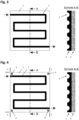
- Fig.3 shows schematically a two-layer GDL 1 with a meandering channel 2 formed by a watermark, on the left in plan view and on the right in sectional view along section AB.
- the black area 3 shows the round screen layer with a structured watermark as channel 2 and the patterned area 4 shows the former layer with a fine pore structure.
- the individual layers 3 and 4 can have a different basic thickness depending on the design.
- a cutting profile formed by the watermark runs along the meander structure of channel 2 as a thickness modulation through the round screen layer, which has a semicircular shape in the drawing.
- each Any conceivable profile shape is possible that has no undercuts and forms a wall angle of ⁇ 80°.
- the large arrows show the gas inlet/outlet.
- the gasket around the GDL must be designed accordingly.
- Fig.4 shows schematically the two-layer GDL from Fig.3 supplemented by registration marks, positioning aids and centering aids.
- Highlight watermarks can be used to incorporate registration marks, positioning aids, centering aids and approaches for passages to simplify further processing of the GDL into the fuel cell stack. This ensures that, for example, with the help of transmitted light/incident light image processing systems, an exact positioning of the GDL relative to the other components, such as BPP or CL, is possible.
- the lines 5 are intended to represent crop marks for the GDL, implemented as highlight watermarks, and the circles 6 are intended to represent centering/positioning aids. These can of course be implemented in any form. HD watermark laser screens could also be used.
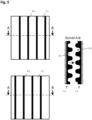
- Fig.5 shows schematically a combination of an anode GDL 7.1 and a 3D mirror-symmetrical cathode GDL 7.2, and here on the top left a plan view of the surface of the anode GDL 7.1, on the bottom left a plan view of the surface of the cathode GDL 7.2 and on the right in each case a sectional view along section AB.
- the anode GDL 7.1 and the cathode GDL 7.2 can have different porosities.
- the anode GDL 7.1 can have a porosity of 20% to 75% and the cathode GDL 7.2 a porosity of 30% to 90%, so that the cathode GDL 7.2 hardly acts as a resistance for the gas, but only as a spacer to the bipolar plate.
- Fig.6 shows in Fig. 6a, 6b and 6c in plan view three embodiments in which the gases are coupled into the GDL in the middle of the bipolar plates (not shown) and then distributed outwards or towards the outer edge of the GDL via various watermark structures and/or channels of the GDL.
- the channels of the watermark structures are according to Fig. 6a radially formed starting from the center of the GDL.
- the gases are supplied via the circular opening in the center of the GDL, the black areas represent the areas of the watermark, which have a higher thickness of the GDL than the white areas with reduced thickness of the GDL that form the channels.
- Fig. 6b shows an embodiment in which radial channels of the watermark structures are supplemented by concentrically arranged ring-shaped channels, resulting in a spider web-like structure.
- the gases are supplied via the circular opening in the middle of the GDL, the areas shown in black represent the areas of the watermark that have a greater thickness of the GDL than the areas shown in white with a reduced thickness of the GDL, which form the channels.
- Fig. 6c shows an embodiment in which the channels of the watermark structures are formed spirally starting from the center of the GDL.
- the gases are supplied via the circular opening in the center of the GDL, the areas shown in black represent the areas of the watermark that have a greater thickness of the GDL than the areas shown in white with a reduced thickness of the GDL that form the channels.
Landscapes
- Chemical & Material Sciences (AREA)
- Sustainable Energy (AREA)
- Electrochemistry (AREA)
- Engineering & Computer Science (AREA)
- Manufacturing & Machinery (AREA)
- Sustainable Development (AREA)
- Composite Materials (AREA)
- Chemical Kinetics & Catalysis (AREA)
- Life Sciences & Earth Sciences (AREA)
- General Chemical & Material Sciences (AREA)
- Inert Electrodes (AREA)
- Fuel Cell (AREA)
- Paper (AREA)
- Electrodes For Compound Or Non-Metal Manufacture (AREA)
- Electrolytic Production Of Non-Metals, Compounds, Apparatuses Therefor (AREA)
Applications Claiming Priority (2)
| Application Number | Priority Date | Filing Date | Title |
|---|---|---|---|
| DE102020005480.3A DE102020005480A1 (de) | 2020-09-07 | 2020-09-07 | Grünpapier zur Herstellung eines Gas-Diffusion-Layers für eine Brennstoffzelle |
| PCT/EP2021/025327 WO2022048794A1 (de) | 2020-09-07 | 2021-08-31 | Grünpapier zur herstellung eines gas-diffusion-layers für eine brennstoffzelle |
Publications (2)
| Publication Number | Publication Date |
|---|---|
| EP4211306A1 EP4211306A1 (de) | 2023-07-19 |
| EP4211306B1 true EP4211306B1 (de) | 2024-07-17 |
Family
ID=77750224
Family Applications (1)
| Application Number | Title | Priority Date | Filing Date |
|---|---|---|---|
| EP21769890.1A Active EP4211306B1 (de) | 2020-09-07 | 2021-08-31 | Grünpapier zur herstellung eines gas-diffusion-layers für eine brennstoffzelle |
Country Status (9)
| Country | Link |
|---|---|
| US (1) | US20230317973A1 (https=) |
| EP (1) | EP4211306B1 (https=) |
| JP (1) | JP7787159B2 (https=) |
| KR (1) | KR20230095920A (https=) |
| CN (1) | CN116075612A (https=) |
| DE (1) | DE102020005480A1 (https=) |
| ES (1) | ES2987076T3 (https=) |
| PL (1) | PL4211306T3 (https=) |
| WO (1) | WO2022048794A1 (https=) |
Families Citing this family (2)
| Publication number | Priority date | Publication date | Assignee | Title |
|---|---|---|---|---|
| DE102023114223A1 (de) | 2023-05-31 | 2024-12-05 | Giesecke+Devrient Currency Technology Gmbh | Grünpapier zur Herstellung eines Gas-Diffusion-Layers für eine Brennstoffzelle |
| DE102023212563A1 (de) * | 2023-12-13 | 2025-06-18 | Robert Bosch Gesellschaft mit beschränkter Haftung | Zellstapellage für einen elektrochemischen Zellenstapel sowie Verfahren zu dessen Herstellung |
Family Cites Families (20)
| Publication number | Priority date | Publication date | Assignee | Title |
|---|---|---|---|---|
| US4818640A (en) * | 1985-09-25 | 1989-04-04 | Kureha Kagaku Kogyo Kabushiki Kaisha | Carbonaceous composite product produced by joining carbonaceous materials together by tetrafluoroethylene resin, and process for producing the same |
| DE68925580T2 (de) | 1989-04-14 | 1996-09-19 | Katayama Tokushu Kogyo Kk | Verfahren zur Herstellung einer porösen metallischen Folie |
| DE10145782A1 (de) | 2001-09-17 | 2003-04-10 | Giesecke & Devrient Gmbh | Papiersieb zur Erzeugung zweistufiger Wasserzeichen und Verfahren zu dessen Herstellung |
| JP3989771B2 (ja) * | 2002-05-14 | 2007-10-10 | 松下電器産業株式会社 | 高分子電解質型燃料電池 |
| DE10243653A1 (de) | 2002-09-19 | 2004-04-01 | Giesecke & Devrient Gmbh | Sicherheitspapier |
| JP2006185615A (ja) * | 2004-12-24 | 2006-07-13 | Nissan Motor Co Ltd | 燃料電池 |
| DE102005045566A1 (de) * | 2005-03-23 | 2006-09-28 | Giesecke & Devrient Gmbh | Mehrlagiges Sicherheitspapier |
| JP2006318822A (ja) * | 2005-05-13 | 2006-11-24 | Electric Power Dev Co Ltd | 燃料電池用セパレータ |
| JP2006339089A (ja) * | 2005-06-06 | 2006-12-14 | Toyota Motor Corp | 燃料電池 |
| US7785748B2 (en) * | 2006-04-03 | 2010-08-31 | University Of Delaware | Nano-based gas diffusion media |
| US20080138684A1 (en) * | 2006-12-06 | 2008-06-12 | 3M Innovative Properties Company | Compact fuel cell stack with uniform depth flow fields |
| FR2929962B1 (fr) * | 2008-04-11 | 2021-06-25 | Arjowiggins Licensing Sas | Procede de fabrication d'une feuille comportant une sous- epaisseur ou une sur-epaisseur au niveau d'un ruban et feuille associee. |
| DE102008042415B3 (de) | 2008-09-26 | 2010-05-20 | Andreas Hofenauer | Metallisches Halbzeug, Verfahren zur Herstellung der Werkstoffe und Halbzeuge sowie deren Verwendungen |
| JP5915283B2 (ja) * | 2012-03-14 | 2016-05-11 | 日産自動車株式会社 | ガス拡散層およびそれを用いてなる燃料電池 |
| KR101484762B1 (ko) * | 2012-06-29 | 2015-01-21 | 주식회사 제이앤티씨 | 기체확산층용 탄소기재, 이를 이용한 기체확산층, 및 이를 포함하는 연료전지용 전극 |
| DE102012018166A1 (de) | 2012-09-13 | 2014-03-13 | Giesecke & Devrient Gmbh | Spritzgusswerkzeug zur Erzeugung eines Wasserzeicheneinsatzes in einem Entwässerungssieb |
| JP2014191867A (ja) * | 2013-03-26 | 2014-10-06 | Panasonic Corp | ガス拡散層、膜電極接合体及びその製造方法 |
| CN106716695B (zh) * | 2014-10-17 | 2020-02-28 | 松下知识产权经营株式会社 | 燃料电池用气体扩散层、燃料电池及燃料电池用气体扩散层的制造方法 |
| WO2016159348A1 (ja) * | 2015-04-01 | 2016-10-06 | 昭和電工株式会社 | 電極材、レドックスフロー電池の電極、レドックスフロー電池 |
| CN110485191A (zh) * | 2019-08-16 | 2019-11-22 | 中国海诚工程科技股份有限公司 | 湿法抄造燃料电池电极气体扩散层碳纤维纸及其制备方法 |
-
2020
- 2020-09-07 DE DE102020005480.3A patent/DE102020005480A1/de not_active Withdrawn
-
2021
- 2021-08-31 JP JP2023514853A patent/JP7787159B2/ja active Active
- 2021-08-31 PL PL21769890.1T patent/PL4211306T3/pl unknown
- 2021-08-31 KR KR1020237008006A patent/KR20230095920A/ko active Pending
- 2021-08-31 WO PCT/EP2021/025327 patent/WO2022048794A1/de not_active Ceased
- 2021-08-31 ES ES21769890T patent/ES2987076T3/es active Active
- 2021-08-31 CN CN202180054285.5A patent/CN116075612A/zh active Pending
- 2021-08-31 EP EP21769890.1A patent/EP4211306B1/de active Active
- 2021-08-31 US US18/024,885 patent/US20230317973A1/en active Pending
Also Published As
| Publication number | Publication date |
|---|---|
| US20230317973A1 (en) | 2023-10-05 |
| DE102020005480A1 (de) | 2022-03-10 |
| CN116075612A (zh) | 2023-05-05 |
| EP4211306A1 (de) | 2023-07-19 |
| JP7787159B2 (ja) | 2025-12-16 |
| ES2987076T3 (es) | 2024-11-13 |
| WO2022048794A1 (de) | 2022-03-10 |
| JP2023540968A (ja) | 2023-09-27 |
| PL4211306T3 (pl) | 2024-10-21 |
| KR20230095920A (ko) | 2023-06-29 |
Similar Documents
| Publication | Publication Date | Title |
|---|---|---|
| EP2174371B1 (de) | Verfahren zur Herstellung einer Brennstoffzelle | |
| EP4211306B1 (de) | Grünpapier zur herstellung eines gas-diffusion-layers für eine brennstoffzelle | |
| EP3000145B1 (de) | Brennstoffzelle | |
| WO2022048796A1 (de) | Verfahren zur herstellung eines grünpapiers zur herstellung eines gas-diffusion-layers für eine brennstoffzelle | |
| EP4133541B1 (de) | Membranelektrodenanordnung und brennstoffzelle, elektrolysezelle, elektrochemischer wasserstoffkompressor, redoxflussbatterie oder elektrochemischer sensor umfassend die membranelektrodenanordnung | |
| EP1396039A2 (de) | Brennstoffzelle und verfahren zur herstellung einer solchen brennstoffzelle | |
| AT14455U2 (de) | Elektrochemisches Modul | |
| WO2022048795A1 (de) | Verfahren zur herstellung eines grünpapiers zur herstellung eines gas-diffusion-layers für eine brennstoffzelle | |
| EP4200926A1 (de) | Verfahren zur herstellung eines funktionalisiert strukturierten aufbaus für eine brennstoffzelle und membranelektrodenanordnung | |
| WO2024105229A2 (de) | Halbzellenverbund für den einsatz in elektrochemischen zellen | |
| EP4720409A1 (de) | Grünpapier zur herstellung eines gas-diffusion-layers für eine brennstoffzelle | |
| EP1658653A1 (de) | Festoxidbrennstoffzelle und verfahren zu ihrer herstellung | |
| WO2025131389A1 (de) | Gasdiffusionsschicht für eine elektrolysezelle | |
| DE102024132499A1 (de) | Verfahren zur Herstellung einer Plattenanordnung, Plattenanordnung und elektrochemische Zelle | |
| DE102024208048A1 (de) | Gasdiffusionslage für die Wasserelektrolyse mit funktionalisierten Oberflächenbereichen, und Verfahren zu deren Herstellung | |
| WO2026052348A1 (de) | Gasdiffusionsschicht für eine elektrolysezelle sowie verfahren zur herstellung einer gasdiffusionsschicht | |
| DE10330478A1 (de) | Brennstoffzelleneinheit und Verfahren zum Herstellen einer Brennstoffzelleneinheit |
Legal Events
| Date | Code | Title | Description |
|---|---|---|---|
| STAA | Information on the status of an ep patent application or granted ep patent |
Free format text: STATUS: UNKNOWN |
|
| STAA | Information on the status of an ep patent application or granted ep patent |
Free format text: STATUS: THE INTERNATIONAL PUBLICATION HAS BEEN MADE |
|
| PUAI | Public reference made under article 153(3) epc to a published international application that has entered the european phase |
Free format text: ORIGINAL CODE: 0009012 |
|
| STAA | Information on the status of an ep patent application or granted ep patent |
Free format text: STATUS: REQUEST FOR EXAMINATION WAS MADE |
|
| 17P | Request for examination filed |
Effective date: 20230411 |
|
| AK | Designated contracting states |
Kind code of ref document: A1 Designated state(s): AL AT BE BG CH CY CZ DE DK EE ES FI FR GB GR HR HU IE IS IT LI LT LU LV MC MK MT NL NO PL PT RO RS SE SI SK SM TR |
|
| DAV | Request for validation of the european patent (deleted) | ||
| DAX | Request for extension of the european patent (deleted) | ||
| GRAP | Despatch of communication of intention to grant a patent |
Free format text: ORIGINAL CODE: EPIDOSNIGR1 |
|
| STAA | Information on the status of an ep patent application or granted ep patent |
Free format text: STATUS: GRANT OF PATENT IS INTENDED |
|
| INTG | Intention to grant announced |
Effective date: 20240430 |
|
| GRAS | Grant fee paid |
Free format text: ORIGINAL CODE: EPIDOSNIGR3 |
|
| GRAA | (expected) grant |
Free format text: ORIGINAL CODE: 0009210 |
|
| STAA | Information on the status of an ep patent application or granted ep patent |
Free format text: STATUS: THE PATENT HAS BEEN GRANTED |
|
| AK | Designated contracting states |
Kind code of ref document: B1 Designated state(s): AL AT BE BG CH CY CZ DE DK EE ES FI FR GB GR HR HU IE IS IT LI LT LU LV MC MK MT NL NO PL PT RO RS SE SI SK SM TR |
|
| REG | Reference to a national code |
Ref country code: CH Ref legal event code: EP |
|
| REG | Reference to a national code |
Ref country code: DE Ref legal event code: R096 Ref document number: 502021004424 Country of ref document: DE |
|
| REG | Reference to a national code |
Ref country code: IE Ref legal event code: FG4D Free format text: LANGUAGE OF EP DOCUMENT: GERMAN |
|
| REG | Reference to a national code |
Ref country code: NL Ref legal event code: FP |
|
| REG | Reference to a national code |
Ref country code: SE Ref legal event code: TRGR |
|
| REG | Reference to a national code |
Ref country code: LT Ref legal event code: MG9D |
|
| REG | Reference to a national code |
Ref country code: ES Ref legal event code: FG2A Ref document number: 2987076 Country of ref document: ES Kind code of ref document: T3 Effective date: 20241113 |
|
| PG25 | Lapsed in a contracting state [announced via postgrant information from national office to epo] |
Ref country code: PT Free format text: LAPSE BECAUSE OF FAILURE TO SUBMIT A TRANSLATION OF THE DESCRIPTION OR TO PAY THE FEE WITHIN THE PRESCRIBED TIME-LIMIT Effective date: 20241118 |
|
| PG25 | Lapsed in a contracting state [announced via postgrant information from national office to epo] |
Ref country code: PT Free format text: LAPSE BECAUSE OF FAILURE TO SUBMIT A TRANSLATION OF THE DESCRIPTION OR TO PAY THE FEE WITHIN THE PRESCRIBED TIME-LIMIT Effective date: 20241118 |
|
| PG25 | Lapsed in a contracting state [announced via postgrant information from national office to epo] |
Ref country code: NO Free format text: LAPSE BECAUSE OF FAILURE TO SUBMIT A TRANSLATION OF THE DESCRIPTION OR TO PAY THE FEE WITHIN THE PRESCRIBED TIME-LIMIT Effective date: 20241017 |
|
| PG25 | Lapsed in a contracting state [announced via postgrant information from national office to epo] |
Ref country code: FI Free format text: LAPSE BECAUSE OF FAILURE TO SUBMIT A TRANSLATION OF THE DESCRIPTION OR TO PAY THE FEE WITHIN THE PRESCRIBED TIME-LIMIT Effective date: 20240717 Ref country code: GR Free format text: LAPSE BECAUSE OF FAILURE TO SUBMIT A TRANSLATION OF THE DESCRIPTION OR TO PAY THE FEE WITHIN THE PRESCRIBED TIME-LIMIT Effective date: 20241018 |
|
| PG25 | Lapsed in a contracting state [announced via postgrant information from national office to epo] |
Ref country code: BG Free format text: LAPSE BECAUSE OF FAILURE TO SUBMIT A TRANSLATION OF THE DESCRIPTION OR TO PAY THE FEE WITHIN THE PRESCRIBED TIME-LIMIT Effective date: 20240717 |
|
| PG25 | Lapsed in a contracting state [announced via postgrant information from national office to epo] |
Ref country code: LV Free format text: LAPSE BECAUSE OF FAILURE TO SUBMIT A TRANSLATION OF THE DESCRIPTION OR TO PAY THE FEE WITHIN THE PRESCRIBED TIME-LIMIT Effective date: 20240717 |
|
| PG25 | Lapsed in a contracting state [announced via postgrant information from national office to epo] |
Ref country code: IS Free format text: LAPSE BECAUSE OF FAILURE TO SUBMIT A TRANSLATION OF THE DESCRIPTION OR TO PAY THE FEE WITHIN THE PRESCRIBED TIME-LIMIT Effective date: 20241117 |
|
| PG25 | Lapsed in a contracting state [announced via postgrant information from national office to epo] |
Ref country code: HR Free format text: LAPSE BECAUSE OF FAILURE TO SUBMIT A TRANSLATION OF THE DESCRIPTION OR TO PAY THE FEE WITHIN THE PRESCRIBED TIME-LIMIT Effective date: 20240717 |
|
| PG25 | Lapsed in a contracting state [announced via postgrant information from national office to epo] |
Ref country code: RS Free format text: LAPSE BECAUSE OF FAILURE TO SUBMIT A TRANSLATION OF THE DESCRIPTION OR TO PAY THE FEE WITHIN THE PRESCRIBED TIME-LIMIT Effective date: 20241017 |
|
| PG25 | Lapsed in a contracting state [announced via postgrant information from national office to epo] |
Ref country code: RS Free format text: LAPSE BECAUSE OF FAILURE TO SUBMIT A TRANSLATION OF THE DESCRIPTION OR TO PAY THE FEE WITHIN THE PRESCRIBED TIME-LIMIT Effective date: 20241017 Ref country code: NO Free format text: LAPSE BECAUSE OF FAILURE TO SUBMIT A TRANSLATION OF THE DESCRIPTION OR TO PAY THE FEE WITHIN THE PRESCRIBED TIME-LIMIT Effective date: 20241017 Ref country code: LV Free format text: LAPSE BECAUSE OF FAILURE TO SUBMIT A TRANSLATION OF THE DESCRIPTION OR TO PAY THE FEE WITHIN THE PRESCRIBED TIME-LIMIT Effective date: 20240717 Ref country code: IS Free format text: LAPSE BECAUSE OF FAILURE TO SUBMIT A TRANSLATION OF THE DESCRIPTION OR TO PAY THE FEE WITHIN THE PRESCRIBED TIME-LIMIT Effective date: 20241117 Ref country code: HR Free format text: LAPSE BECAUSE OF FAILURE TO SUBMIT A TRANSLATION OF THE DESCRIPTION OR TO PAY THE FEE WITHIN THE PRESCRIBED TIME-LIMIT Effective date: 20240717 Ref country code: GR Free format text: LAPSE BECAUSE OF FAILURE TO SUBMIT A TRANSLATION OF THE DESCRIPTION OR TO PAY THE FEE WITHIN THE PRESCRIBED TIME-LIMIT Effective date: 20241018 Ref country code: FI Free format text: LAPSE BECAUSE OF FAILURE TO SUBMIT A TRANSLATION OF THE DESCRIPTION OR TO PAY THE FEE WITHIN THE PRESCRIBED TIME-LIMIT Effective date: 20240717 Ref country code: BG Free format text: LAPSE BECAUSE OF FAILURE TO SUBMIT A TRANSLATION OF THE DESCRIPTION OR TO PAY THE FEE WITHIN THE PRESCRIBED TIME-LIMIT Effective date: 20240717 |
|
| PG25 | Lapsed in a contracting state [announced via postgrant information from national office to epo] |
Ref country code: DK Free format text: LAPSE BECAUSE OF FAILURE TO SUBMIT A TRANSLATION OF THE DESCRIPTION OR TO PAY THE FEE WITHIN THE PRESCRIBED TIME-LIMIT Effective date: 20240717 Ref country code: SM Free format text: LAPSE BECAUSE OF FAILURE TO SUBMIT A TRANSLATION OF THE DESCRIPTION OR TO PAY THE FEE WITHIN THE PRESCRIBED TIME-LIMIT Effective date: 20240717 Ref country code: RO Free format text: LAPSE BECAUSE OF FAILURE TO SUBMIT A TRANSLATION OF THE DESCRIPTION OR TO PAY THE FEE WITHIN THE PRESCRIBED TIME-LIMIT Effective date: 20240717 |
|
| PG25 | Lapsed in a contracting state [announced via postgrant information from national office to epo] |
Ref country code: LU Free format text: LAPSE BECAUSE OF NON-PAYMENT OF DUE FEES Effective date: 20240831 |
|
| REG | Reference to a national code |
Ref country code: DE Ref legal event code: R097 Ref document number: 502021004424 Country of ref document: DE |
|
| PG25 | Lapsed in a contracting state [announced via postgrant information from national office to epo] |
Ref country code: MC Free format text: LAPSE BECAUSE OF FAILURE TO SUBMIT A TRANSLATION OF THE DESCRIPTION OR TO PAY THE FEE WITHIN THE PRESCRIBED TIME-LIMIT Effective date: 20240717 Ref country code: EE Free format text: LAPSE BECAUSE OF FAILURE TO SUBMIT A TRANSLATION OF THE DESCRIPTION OR TO PAY THE FEE WITHIN THE PRESCRIBED TIME-LIMIT Effective date: 20240717 |
|
| PG25 | Lapsed in a contracting state [announced via postgrant information from national office to epo] |
Ref country code: CZ Free format text: LAPSE BECAUSE OF FAILURE TO SUBMIT A TRANSLATION OF THE DESCRIPTION OR TO PAY THE FEE WITHIN THE PRESCRIBED TIME-LIMIT Effective date: 20240717 |
|
| PG25 | Lapsed in a contracting state [announced via postgrant information from national office to epo] |
Ref country code: SK Free format text: LAPSE BECAUSE OF FAILURE TO SUBMIT A TRANSLATION OF THE DESCRIPTION OR TO PAY THE FEE WITHIN THE PRESCRIBED TIME-LIMIT Effective date: 20240717 |
|
| PLBE | No opposition filed within time limit |
Free format text: ORIGINAL CODE: 0009261 |
|
| STAA | Information on the status of an ep patent application or granted ep patent |
Free format text: STATUS: NO OPPOSITION FILED WITHIN TIME LIMIT |
|
| 26N | No opposition filed |
Effective date: 20250422 |
|
| REG | Reference to a national code |
Ref country code: BE Ref legal event code: MM Effective date: 20240831 |
|
| PG25 | Lapsed in a contracting state [announced via postgrant information from national office to epo] |
Ref country code: BE Free format text: LAPSE BECAUSE OF NON-PAYMENT OF DUE FEES Effective date: 20240831 |
|
| PG25 | Lapsed in a contracting state [announced via postgrant information from national office to epo] |
Ref country code: IE Free format text: LAPSE BECAUSE OF NON-PAYMENT OF DUE FEES Effective date: 20240831 |
|
| PGFP | Annual fee paid to national office [announced via postgrant information from national office to epo] |
Ref country code: NL Payment date: 20250821 Year of fee payment: 5 |
|
| PGFP | Annual fee paid to national office [announced via postgrant information from national office to epo] |
Ref country code: ES Payment date: 20250917 Year of fee payment: 5 |
|
| PGFP | Annual fee paid to national office [announced via postgrant information from national office to epo] |
Ref country code: DE Payment date: 20250819 Year of fee payment: 5 |
|
| PGFP | Annual fee paid to national office [announced via postgrant information from national office to epo] |
Ref country code: PL Payment date: 20250822 Year of fee payment: 5 |
|
| PGFP | Annual fee paid to national office [announced via postgrant information from national office to epo] |
Ref country code: GB Payment date: 20250822 Year of fee payment: 5 |
|
| PGFP | Annual fee paid to national office [announced via postgrant information from national office to epo] |
Ref country code: FR Payment date: 20250821 Year of fee payment: 5 Ref country code: AT Payment date: 20251020 Year of fee payment: 5 |
|
| PGFP | Annual fee paid to national office [announced via postgrant information from national office to epo] |
Ref country code: CH Payment date: 20250901 Year of fee payment: 5 Ref country code: SE Payment date: 20250821 Year of fee payment: 5 |
|
| PG25 | Lapsed in a contracting state [announced via postgrant information from national office to epo] |
Ref country code: IT Free format text: LAPSE BECAUSE OF NON-PAYMENT OF DUE FEES Effective date: 20240831 |
|
| PG25 | Lapsed in a contracting state [announced via postgrant information from national office to epo] |
Ref country code: CY Free format text: LAPSE BECAUSE OF FAILURE TO SUBMIT A TRANSLATION OF THE DESCRIPTION OR TO PAY THE FEE WITHIN THE PRESCRIBED TIME-LIMIT; INVALID AB INITIO Effective date: 20210831 |
|
| PG25 | Lapsed in a contracting state [announced via postgrant information from national office to epo] |
Ref country code: HU Free format text: LAPSE BECAUSE OF FAILURE TO SUBMIT A TRANSLATION OF THE DESCRIPTION OR TO PAY THE FEE WITHIN THE PRESCRIBED TIME-LIMIT; INVALID AB INITIO Effective date: 20210831 |
|
| PGFP | Annual fee paid to national office [announced via postgrant information from national office to epo] |
Ref country code: IT Payment date: 20250829 Year of fee payment: 5 |