EP4209985A1 - Method, system and apparatus for managing a bid tracking database - Google Patents
Method, system and apparatus for managing a bid tracking database Download PDFInfo
- Publication number
- EP4209985A1 EP4209985A1 EP22204139.4A EP22204139A EP4209985A1 EP 4209985 A1 EP4209985 A1 EP 4209985A1 EP 22204139 A EP22204139 A EP 22204139A EP 4209985 A1 EP4209985 A1 EP 4209985A1
- Authority
- EP
- European Patent Office
- Prior art keywords
- bid
- auction
- record
- records
- server
- Prior art date
- Legal status (The legal status is an assumption and is not a legal conclusion. Google has not performed a legal analysis and makes no representation as to the accuracy of the status listed.)
- Pending
Links
Images


Classifications
-
- G—PHYSICS
- G06—COMPUTING OR CALCULATING; COUNTING
- G06Q—INFORMATION AND COMMUNICATION TECHNOLOGY [ICT] SPECIALLY ADAPTED FOR ADMINISTRATIVE, COMMERCIAL, FINANCIAL, MANAGERIAL OR SUPERVISORY PURPOSES; SYSTEMS OR METHODS SPECIALLY ADAPTED FOR ADMINISTRATIVE, COMMERCIAL, FINANCIAL, MANAGERIAL OR SUPERVISORY PURPOSES, NOT OTHERWISE PROVIDED FOR
- G06Q30/00—Commerce
- G06Q30/06—Buying, selling or leasing transactions
- G06Q30/08—Auctions
Definitions
- the specification relates generally to bid tracking, and specifically to a method, system and apparatus for managing a bid tracking database.
- a variety of electronic devices can have the capability to interact with online auction services. Some such devices can interact with online auction services to place and review bids by way of a conventional web browser. Some devices can also interact with online auction services by way of other applications running on those devices. The variability in interactions with online auction services can complicate the collection of data concerning the use of online auction services.
- An aspect of the specification can provide a method of managing a bid tracking database comprising: receiving at least one bid record at an interface, the at least one bid record comprising a bid price, a bid timestamp and a bid item identifier; receiving at least one auction record at the interface, the at least one auction record comprising a winning price, an end timestamp and an auction item identifier corresponding to the bid item identifier; maintaining the at least one bid record and the at least one auction record in a memory; determining whether the bid price matches or exceeds the winning price and whether the bid timestamp matches the end timestamp; and, when the determination is affirmative, writing the bid record to the bid tracking database maintained in the memory.
- a computer readable storage medium for storing computer readable instructions for execution by a processor, the computer readable instructions implementing the method can also be provided.
- a server comprising: an interface for receiving at least one bid record comprising a bid price, a bid timestamp and a bid item identifier; and for receiving at least one auction record comprising a winning price, an end timestamp and an auction item identifier corresponding to the bid item identifier; a memory for maintaining the at least one bid record and the at least one auction record, and for maintaining a bid tracking database; and a processor interconnected with the interface and the memory, the processor configured to receive the at least one bid record and the at least one auction record from the interface; the processor further configured to determine whether the bid price matches or exceeds the winning price and whether the bid timestamp matches the end timestamp; the processor further configured to, when the determination is affirmative, write the bid record to the bid tracking database maintained in the memory.
- Figure 1 depicts a system 100 comprising a plurality of mobile electronic devices 104-1, 104-2 ... 104-n (referred to collectively as mobile electronic devices 104 and generically as a mobile electronic device 104), a first server 108, a second server 112 and a third server 116.
- Mobile electronic devices 104 and servers 108, 112 and 116 can be interconnected via a network 120 and links therewith.
- Mobile electronic devices 104 can be connected with network 120 via links 124-1, 124-2 ... 124-n.
- Server 108 can be connected with network 120 via link 128, server 112 can be connected with network 120 via link 132 and server 116 can be connected with network 120 via link 136.
- Mobile electronic devices 104 can be devices based on the computing environment and functionality of hand-held wireless communication devices. It will now be apparent, however, that mobile electronic devices 104 are not limited to hand-held wireless communication devices. Other mobile electronic devices are also contemplated, such as cellular telephones, smart telephones, media players and laptop computers.
- Network 120 can comprise any suitable combination of wired and/or wireless networks, including but not limited to packet based networks, the Internet, analog networks, the PSTN, LAN, WAN, cell phone networks, WiFi networks, WiMax networks and/or any suitable combination thereof. Other suitable types of networks will also occur to those skilled in the art.
- Links 124, 128, 132 and 136 can therefore be wireless or wired links, or combinations of wireless and wired links.
- links 124 can be wireless links based on core mobile network infrastructure (e.g. Global System for Mobile communications ("GSM”); Code Division Multiple Access (“CDMA”); CDMA 2000; 3G; 4G).
- GSM Global System for Mobile communications
- CDMA Code Division Multiple Access
- Links 124 can also be based on wireless local area network (“WLAN”) infrastructures such as the Institute for Electrical and Electronic Engineers (“IEEE”) 802.11 Standard (and its variants), Bluetooth or the like, or hybrids thereof.
- IEEE Institute for Electrical and Electronic Engineers
- servers 108, 112 and 116 can be based on any server environment that will occur to those skilled in the art, each including a module housing one or more central processing units, volatile memory (e.g. random access memory), persistent memory (e.g. hard disk devices) and network interfaces to allow servers 108, 112 and 116 to communicate over network 120.
- volatile memory e.g. random access memory
- persistent memory e.g. hard disk devices
- Server 108 can host an auction website. Server 108 can therefore be configured to maintain in memory a plurality of auction records each comprising data concerning a particular auction, and to receive bids on items represented by the auction records and maintain the received bids in memory. It will now be apparent to those skilled in the art that a variety of configurations are possible for server 108, and that the structure of server 108 is not particularly limited herein.
- mobile electronic devices 104 can be configured, for example via execution of an auction application on each mobile electronic device 104, to transmit bid records to server 108.
- An exemplary transmission T-1 of a bid record from mobile electronic device 104-2 to server 108 via link 124-2, network 120 and link 128 is shown in Figure 1 .
- Mobile electronic devices 104 can also be configured, via execution of the auction application, to also transmit to second server 112 each bid record sent to server 108.
- Second server 112 can be a data collection centre, and can be operated by a different entity than the entity which operates first server 108, though this is not strictly necessary (that is, first and second servers 108 and 112 can be operated by the same entity in some embodiments).
- An exemplary transmission T-2 is shown in Figure 1 , comprising a transmission of the bid record of T-1 from mobile electronic device 104-2 to server 112 via link 124-2, network 120 and link 132. Transmissions T-1 and T-2 can be substantially simultaneous in some embodiments, though this is not strictly necessary.
- transmission T-2 can be made, for example, once the success of transmission T-1 has been confirmed. It will be appreciated that in the present embodiment, transmissions T-1 and T-2 need not be identical. For example, transmission T-1 can additionally contain an identifier for mobile electronic device 104-2 (which can be incorporated within the bid record), whereas transmission T-2 can omit any such identifier.
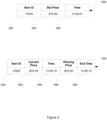
- Bid record 200 can comprise an item identifier 202, a bid price 204 and a timestamp 206.
- Item identifier 202 can be a string of characters identifying the item to which bid record 200 relates.
- item identifier 202 can be chosen to uniquely identify a particular item for which an auction is being conducted at server 108 from the other items for which auctions are being conducted. Many suitable item identifiers will occur to those skilled in the art.
- item identifier 202 comprises an item number, "12345.”
- Bid price 204 comprises the price being submitted to server 108 for item number 12345 by way of transmission of bid record 200.
- bid price 206 indicates that mobile device 104-2 has transmitted a bid of seventy dollars for item number 12345 to server 108 and server 112. Timestamp 206 represents the time at which the bid was transmitted.
- Auction record 250 comprises an auction item identifier 252. Similarly to item identifier 202, auction item identifier 252 can be chosen to uniquely identify a particular item for which an auction is being conducted at server 108. Auction record 250 also comprises a current price 254 and a timestamp 256. Current price 254 can contain the current highest bid for the auction represented by auction record 250. Timestamp 256 can contain the time at which the current highest bid was placed. Auction record 250 can also comprises a winning price 258, which contains the final bid price that ended the auction for item 12345.
- Auction record 250 also comprises an end timestamp 260, which indicates the time at which the auction for item number 12345 ended (it will be noted that end time 260 will not always be the time at which the bid containing winning price 258 was placed). It will be appreciated that for an ended auction, current price 254 and winning price 258 will be equal. For an auction that has not yet ended, winning price 258 and end time 260 will generally not contain data.
- server 108 can host a plurality of auctions, each for a different item. Server 108 can therefore maintain in memory a plurality of auction records 250: one for each auction hosted at server 108. For each auction, server 108 can additionally receive a plurality of bid records 200 and compare received bid records in order to determine which bid record contains the current highest bid price.
- Third server 116 can be operated by an entity separate from those operating first and second servers 108 and 112, though it will be understood that this is not strictly necessary.
- server 116 can be operated by a device service provider for mobile electronic devices 104.
- Server 116 can include a processor 302 (which can be one or more central processing units) interconnected with an interface 304 by way of a communication bus (not shown).
- Interface 304 provides wireless or wired communication capabilities, or both wireless and wired communication capabilities, to server 116 via link 136 and network 120 as discussed above.
- Server 116 can also include one or more output devices such as a display 306 and a speaker 308 interconnected with processor 302 via a communication bus.
- Server 116 can additionally include an input device 310 interconnected with processor 302 via a communication bus.
- Input device 310 can include any combination of a keyboard, a mouse, a touch screen integrated with display 306, a microphone and the like.
- Server 116 also includes a memory 312 interconnected with processor 302.
- memory 312 can comprise any suitable combination of volatile memory (e.g. random access memory (“RAM”)) and persistent memory (e.g. read only memory (“ROM”), hard disk devices and the like).
- RAM random access memory
- ROM read only memory
- Memory 312 can maintain applications (not shown) comprising computer readable instructions for execution by processor 302 and for configuring processor 302 via such execution for performing various actions. It will be understood that such applications need not be maintained in memory 312.
- Applications can be stored on any suitable computer readable medium (e.g. a removable diskette, CD-ROM, USB drive and the like).
- the computer readable medium can also be located remotely to server 116 and the instructions can be transmitted to processor 302 via network 120, link 136 and interface 304.
- Memory 312 can also maintain a bid tracking database 314 for maintaining records of winning bids placed from mobile electronic devices 104. A method of managing the bid tracking database 314 will now be described in connection with Figure 4 .
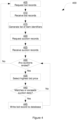
- Figure depicts a method 400 for managing bid tracking database 314. While method 400 will be described in conjunction with its performance on server 116, it will be understood that method 400 and server 116 need not be exactly as described herein.
- Method 400 begins at block 405, at which processor 302 can be configured to transmit a request, via interface 304, link 136 and network 120, to second server 112 for bid records received at server 112 from mobile electronic devices 104.
- the request can be transmitted at pre-determined intervals of time. For example, the request can be transmitted once per week, and can request any bid records that have been received at server 112 since the previous request was transmitted.
- processor 302 can be configured to receive the bid records requested at block 405 and to store the received records in memory 312.
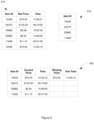
- received records 316 are shown maintained within memory 312. It will be understood that received records 316 can comprise at least one bid record as described in conjunction with bid record 200 above. In some embodiments, as shown in Figure 5 , received records 316 can include a plurality of bid records, including bid record 200.
- method 400 proceeds to block 415, where processor 302 can be configured to generate a list of item identifiers from the bid records received at block 410.
- processor 302 can be configured to generate a list of item identifiers from the bid records received at block 410.
- list 318 comprises a list of unique item identifiers present in bid records 316. Although some item numbers are repeated within bid records 316 (that is, bid records 316 contain multiple bid records for the same item), list 318 does not contain any duplicated item identifiers.
- processor 302 can be configured to transmit requests for auction records to first server 108 based on the contents of list 318.
- Processor 302 can be configured to transmit, via interface 304, a request for the auction record corresponding to each item identifier present in list 318.
- processor 302 can be configured to receive auction records 320, as shown in Figure 5 , from first server 108.
- Auction records 320 can include one auction record, such as auction record 250, for each item identifier for which a request was transmitted at block 420.
- auction records 320 can include auctions records for auctions that have not yet ended. Those auction records do not include data in the winning price and end time fields.
- Auction records 320, once received, can be maintained in memory 312 as shown in Figure 3 .
- Method 400 then proceeds to block 430.
- processor 102 can be configured to determine if any of auction records 320 contain data for auctions that have ended (i.e. for which a winning bid has been placed).
- processor 302 can be configured to determine whether any of auction records 320 include winning prices and end times. For the examplary auction records 320 shown in Figure 5 , the determination at block 430 would therefore be affirmative (the auction for item number 12345 has ended, while the remainder have not yet ended).
- processor 302 can then be configured to perform block 435 of method 400.
- processor 302 can be configured to select the bid record having the highest bid price from among the bid records in 316 having item identifiers corresponding to the item identifier of the ended auction.
- the ended auction is for item number 12345.
- processor 302 can be configured to select the one of those two records with the highest bid price.
- the final record of bid records 316 has a higher bid price ($72.00) than the first record ($70.00). The final record is therefore selected at block 435.
- processor 302 can be configured to compare the bid price and timestamp of the bid record selected at block 435 with the winning price and end timestamp, respectively, of the ended auction. By way of the comparison, processor 302 can be configured to determine whether the bid price matches or exceeds the winning price and whether the bid timestamp matches the end timestamp. If both the above conditions are satisfied, the bid record selected at block 435 can be considered the winning bid for the ended auction. It will be understood by those skilled in the art that an exact match between the bid price and the winning price is not necessary for auctions where proxy bidding can be used. In such auctions, first server 108 can be configured to receive a bid record from a mobile electronic device 104 and gradually increment, as necessary (i.e.
- method 400 proceeds to block 430 to check for further ended auctions, as a winning bid has not been located among bid records 316 for the current ended auction.
- method 400 advances to block 445, where the bid record selected at block 435 is written to bid tracking database 314.
- the winning price matches the highest bid price for item number 12345
- the end timestamp matches the timestamp for the highest bid.
- the determination at block 440 is affirmative and the $72.00 bid record for item number 12345 is written to bid tracking database 314.
- method 400 returns to block 430, where a determination is made as to whether any further ended auctions remain to be processed.
- auction records 318 contain only one record for an ended auction. The determination at block 430 is therefore negative, and method 400 returns to block 405. If the determination at block 430 were positive, blocks 435 and 440 would be repeated for the next ended auction, as described above.
- method 400 need not be immediately followed by a further performance of block 405.
- Performance of block 405 can be conducted at pre-determined intervals of time as discussed above, and thus block 405 may not be performed again until the pre-determined interval of time has elapsed in some embodiments.
- second server 112 can be omitted.
- mobile electronic devices 104 can be configured to transmit bid records to third server 116 rather than second server 112.
- block 405 can be omitted, as the bid records are already available at server 116.
- auction records can include a single price field and a single timestamp field rather than two of each filed, as described above.
- auction records can also include a flag, such as a field containing "yes" or "no,” indicating whether or not the auction has ended.
- processor 302 could thus be configured to determine whether any auction records included a "yes" flag.
- records within bid records 316 having the item identifier of the ended auction that has been processed by the performance of blocks 440 and/or 445 can be deleted from bid records 316.
- the first and last records of bid records 316 would thus be deleted following the performance of block 445 for item number 12345.
- block 405 can be omitted entirely, as second server 112 can be configured to transmit bid records 316 to third server 116 without such records being requested.
- bid records 200 transmitted from mobile electronic devices 104 can include identifications of the entity or entities providing network service to mobile electronic devices 104 (that is, the operators of links 124-1, 124-2 ... 124-n). Such identifiers can be requested by third server 116 and added to bid tracking database 314 as described above.
- EEEs enumerated example embodiments
Landscapes
- Business, Economics & Management (AREA)
- Finance (AREA)
- Accounting & Taxation (AREA)
- Marketing (AREA)
- Development Economics (AREA)
- Economics (AREA)
- Entrepreneurship & Innovation (AREA)
- Strategic Management (AREA)
- Physics & Mathematics (AREA)
- General Business, Economics & Management (AREA)
- General Physics & Mathematics (AREA)
- Engineering & Computer Science (AREA)
- Theoretical Computer Science (AREA)
- Management, Administration, Business Operations System, And Electronic Commerce (AREA)
Abstract
Description
- The specification relates generally to bid tracking, and specifically to a method, system and apparatus for managing a bid tracking database.
- A variety of electronic devices, including, for example, personal computers and smart telephones, can have the capability to interact with online auction services. Some such devices can interact with online auction services to place and review bids by way of a conventional web browser. Some devices can also interact with online auction services by way of other applications running on those devices. The variability in interactions with online auction services can complicate the collection of data concerning the use of online auction services.
- An aspect of the specification can provide a method of managing a bid tracking database comprising: receiving at least one bid record at an interface, the at least one bid record comprising a bid price, a bid timestamp and a bid item identifier; receiving at least one auction record at the interface, the at least one auction record comprising a winning price, an end timestamp and an auction item identifier corresponding to the bid item identifier; maintaining the at least one bid record and the at least one auction record in a memory; determining whether the bid price matches or exceeds the winning price and whether the bid timestamp matches the end timestamp; and, when the determination is affirmative, writing the bid record to the bid tracking database maintained in the memory. A computer readable storage medium for storing computer readable instructions for execution by a processor, the computer readable instructions implementing the method can also be provided.
- Another aspect of the specification can provide a server comprising: an interface for receiving at least one bid record comprising a bid price, a bid timestamp and a bid item identifier; and for receiving at least one auction record comprising a winning price, an end timestamp and an auction item identifier corresponding to the bid item identifier; a memory for maintaining the at least one bid record and the at least one auction record, and for maintaining a bid tracking database; and a processor interconnected with the interface and the memory, the processor configured to receive the at least one bid record and the at least one auction record from the interface; the processor further configured to determine whether the bid price matches or exceeds the winning price and whether the bid timestamp matches the end timestamp; the processor further configured to, when the determination is affirmative, write the bid record to the bid tracking database maintained in the memory.
- Embodiments are described with reference to the following figures, in which:
-
Figure 1 depicts a schematic representation of a system for managing a bid tracking database, according to a non-limiting embodiment; -
Figure 2 depicts a bid record and an auction record maintained within components of the system ofFigure 1 , according to a non-limiting embodiment; -
Figure 3 depicts a schematic representation of the third server ofFigure 1 , according to a non-limiting embodiment; and -
Figure 4 depicts a method for managing a bid tracking database, according to a non-limiting embodiment; and -
Figure 5 depicts received bid records, a list of item identifiers and received auction records, according to a non-limiting embodiment. -
Figure 1 depicts asystem 100 comprising a plurality of mobile electronic devices 104-1, 104-2 ... 104-n (referred to collectively as mobileelectronic devices 104 and generically as a mobile electronic device 104), afirst server 108, asecond server 112 and athird server 116. Mobileelectronic devices 104 andservers network 120 and links therewith. Mobileelectronic devices 104 can be connected withnetwork 120 via links 124-1, 124-2 ... 124-n.Server 108 can be connected withnetwork 120 vialink 128,server 112 can be connected withnetwork 120 vialink 132 andserver 116 can be connected withnetwork 120 vialink 136. - Mobile
electronic devices 104 can be devices based on the computing environment and functionality of hand-held wireless communication devices. It will now be apparent, however, that mobileelectronic devices 104 are not limited to hand-held wireless communication devices. Other mobile electronic devices are also contemplated, such as cellular telephones, smart telephones, media players and laptop computers. -
Network 120 can comprise any suitable combination of wired and/or wireless networks, including but not limited to packet based networks, the Internet, analog networks, the PSTN, LAN, WAN, cell phone networks, WiFi networks, WiMax networks and/or any suitable combination thereof. Other suitable types of networks will also occur to those skilled in the art. -
Links links 124 can be wireless links based on core mobile network infrastructure (e.g. Global System for Mobile communications ("GSM"); Code Division Multiple Access ("CDMA"); CDMA 2000; 3G; 4G).Links 124 can also be based on wireless local area network ("WLAN") infrastructures such as the Institute for Electrical and Electronic Engineers ("IEEE") 802.11 Standard (and its variants), Bluetooth or the like, or hybrids thereof. - In general,
servers servers network 120. -
Server 108 can host an auction website.Server 108 can therefore be configured to maintain in memory a plurality of auction records each comprising data concerning a particular auction, and to receive bids on items represented by the auction records and maintain the received bids in memory. It will now be apparent to those skilled in the art that a variety of configurations are possible forserver 108, and that the structure ofserver 108 is not particularly limited herein. Insystem 100, mobileelectronic devices 104 can be configured, for example via execution of an auction application on each mobileelectronic device 104, to transmit bid records toserver 108. An exemplary transmission T-1 of a bid record from mobile electronic device 104-2 toserver 108 via link 124-2,network 120 andlink 128 is shown inFigure 1 . - Mobile
electronic devices 104 can also be configured, via execution of the auction application, to also transmit tosecond server 112 each bid record sent toserver 108.Second server 112 can be a data collection centre, and can be operated by a different entity than the entity which operatesfirst server 108, though this is not strictly necessary (that is, first andsecond servers Figure 1 , comprising a transmission of the bid record of T-1 from mobile electronic device 104-2 toserver 112 via link 124-2,network 120 andlink 132. Transmissions T-1 and T-2 can be substantially simultaneous in some embodiments, though this is not strictly necessary. In other embodiments, transmission T-2 can be made, for example, once the success of transmission T-1 has been confirmed. It will be appreciated that in the present embodiment, transmissions T-1 and T-2 need not be identical. For example, transmission T-1 can additionally contain an identifier for mobile electronic device 104-2 (which can be incorporated within the bid record), whereas transmission T-2 can omit any such identifier. - Turning now to
Figure 2 , anexemplary bid record 200 as stored in memory atsecond server 112 is shown. Also shown is anexemplary auction record 250 as maintained in memory atfirst server 108.Bid record 200 can comprise anitem identifier 202, abid price 204 and atimestamp 206.Item identifier 202 can be a string of characters identifying the item to whichbid record 200 relates. In general,item identifier 202 can be chosen to uniquely identify a particular item for which an auction is being conducted atserver 108 from the other items for which auctions are being conducted. Many suitable item identifiers will occur to those skilled in the art. In the present embodiment,item identifier 202 comprises an item number, "12345."Bid price 204 comprises the price being submitted toserver 108 foritem number 12345 by way of transmission ofbid record 200. As shown inFigure 2 ,bid price 206 indicates that mobile device 104-2 has transmitted a bid of seventy dollars foritem number 12345 toserver 108 andserver 112.Timestamp 206 represents the time at which the bid was transmitted. -
Auction record 250 comprises anauction item identifier 252. Similarly toitem identifier 202,auction item identifier 252 can be chosen to uniquely identify a particular item for which an auction is being conducted atserver 108.Auction record 250 also comprises acurrent price 254 and atimestamp 256.Current price 254 can contain the current highest bid for the auction represented byauction record 250.Timestamp 256 can contain the time at which the current highest bid was placed.Auction record 250 can also comprises a winningprice 258, which contains the final bid price that ended the auction foritem 12345.Auction record 250 also comprises anend timestamp 260, which indicates the time at which the auction foritem number 12345 ended (it will be noted thatend time 260 will not always be the time at which the bid containing winningprice 258 was placed). It will be appreciated that for an ended auction,current price 254 and winningprice 258 will be equal. For an auction that has not yet ended, winningprice 258 andend time 260 will generally not contain data. - It will now be apparent that
server 108 can host a plurality of auctions, each for a different item.Server 108 can therefore maintain in memory a plurality of auction records 250: one for each auction hosted atserver 108. For each auction,server 108 can additionally receive a plurality ofbid records 200 and compare received bid records in order to determine which bid record contains the current highest bid price. - Referring now to
Figure 3 ,third server 116 is shown in greater detail.Third server 116 can be operated by an entity separate from those operating first andsecond servers server 116 can be operated by a device service provider for mobileelectronic devices 104.Server 116 can include a processor 302 (which can be one or more central processing units) interconnected with aninterface 304 by way of a communication bus (not shown).Interface 304 provides wireless or wired communication capabilities, or both wireless and wired communication capabilities, toserver 116 vialink 136 andnetwork 120 as discussed above.Server 116 can also include one or more output devices such as adisplay 306 and aspeaker 308 interconnected withprocessor 302 via a communication bus.Server 116 can additionally include aninput device 310 interconnected withprocessor 302 via a communication bus.Input device 310 can include any combination of a keyboard, a mouse, a touch screen integrated withdisplay 306, a microphone and the like. -
Server 116 also includes amemory 312 interconnected withprocessor 302. As mentioned above,memory 312 can comprise any suitable combination of volatile memory (e.g. random access memory ("RAM")) and persistent memory (e.g. read only memory ("ROM"), hard disk devices and the like).Memory 312 can maintain applications (not shown) comprising computer readable instructions for execution byprocessor 302 and for configuringprocessor 302 via such execution for performing various actions. It will be understood that such applications need not be maintained inmemory 312. Applications can be stored on any suitable computer readable medium (e.g. a removable diskette, CD-ROM, USB drive and the like). The computer readable medium can also be located remotely toserver 116 and the instructions can be transmitted toprocessor 302 vianetwork 120, link 136 andinterface 304. -
Memory 312 can also maintain abid tracking database 314 for maintaining records of winning bids placed from mobileelectronic devices 104. A method of managing thebid tracking database 314 will now be described in connection withFigure 4 . - Figure depicts a
method 400 for managingbid tracking database 314. Whilemethod 400 will be described in conjunction with its performance onserver 116, it will be understood thatmethod 400 andserver 116 need not be exactly as described herein. -
Method 400 begins atblock 405, at whichprocessor 302 can be configured to transmit a request, viainterface 304, link 136 andnetwork 120, tosecond server 112 for bid records received atserver 112 from mobileelectronic devices 104. The request can be transmitted at pre-determined intervals of time. For example, the request can be transmitted once per week, and can request any bid records that have been received atserver 112 since the previous request was transmitted. - Proceeding to block 410,
processor 302 can be configured to receive the bid records requested atblock 405 and to store the received records inmemory 312. Referring briefly toFigure 3 , receivedrecords 316 are shown maintained withinmemory 312. It will be understood that receivedrecords 316 can comprise at least one bid record as described in conjunction withbid record 200 above. In some embodiments, as shown inFigure 5 , receivedrecords 316 can include a plurality of bid records, includingbid record 200. - Having received bid records at
block 410,method 400 proceeds to block 415, whereprocessor 302 can be configured to generate a list of item identifiers from the bid records received atblock 410. Referring again toFigure 5 , alist 318 of item identifiers is shown. It will now be apparent thatlist 318 comprises a list of unique item identifiers present in bid records 316. Although some item numbers are repeated within bid records 316 (that is,bid records 316 contain multiple bid records for the same item),list 318 does not contain any duplicated item identifiers. - Returning to
Figure 4 , performance ofmethod 400 continues atblock 420, whereprocessor 302 can be configured to transmit requests for auction records tofirst server 108 based on the contents oflist 318.Processor 302 can be configured to transmit, viainterface 304, a request for the auction record corresponding to each item identifier present inlist 318. - Proceeding to block 425,
processor 302 can be configured to receiveauction records 320, as shown inFigure 5 , fromfirst server 108. Auction records 320 can include one auction record, such asauction record 250, for each item identifier for which a request was transmitted atblock 420. As can be seen inFigure 5 , auction records 320 can include auctions records for auctions that have not yet ended. Those auction records do not include data in the winning price and end time fields. Auction records 320, once received, can be maintained inmemory 312 as shown inFigure 3 . -
Method 400 then proceeds to block 430. Atblock 430, processor 102 can be configured to determine if any ofauction records 320 contain data for auctions that have ended (i.e. for which a winning bid has been placed). In performingblock 430,processor 302 can be configured to determine whether any ofauction records 320 include winning prices and end times. For theexamplary auction records 320 shown inFigure 5 , the determination atblock 430 would therefore be affirmative (the auction foritem number 12345 has ended, while the remainder have not yet ended). - Having determined that at least one auction has ended,
processor 302 can then be configured to perform block 435 ofmethod 400. Atblock 435,processor 302 can be configured to select the bid record having the highest bid price from among the bid records in 316 having item identifiers corresponding to the item identifier of the ended auction. In the present exemplary performance ofmethod 400, the ended auction is foritem number 12345. There are two records withinbid records 316 which have matching item numbers (specifically, the first and last of bid records 316). Thus,processor 302 can be configured to select the one of those two records with the highest bid price. As seen inFigure 5 , the final record ofbid records 316 has a higher bid price ($72.00) than the first record ($70.00). The final record is therefore selected atblock 435. - Proceeding to block 440,
processor 302 can be configured to compare the bid price and timestamp of the bid record selected atblock 435 with the winning price and end timestamp, respectively, of the ended auction. By way of the comparison,processor 302 can be configured to determine whether the bid price matches or exceeds the winning price and whether the bid timestamp matches the end timestamp. If both the above conditions are satisfied, the bid record selected atblock 435 can be considered the winning bid for the ended auction. It will be understood by those skilled in the art that an exact match between the bid price and the winning price is not necessary for auctions where proxy bidding can be used. In such auctions,first server 108 can be configured to receive a bid record from a mobileelectronic device 104 and gradually increment, as necessary (i.e. as other competing bids are received) an actual bid price for the relevant auction until the bid price from the bid record is reached. If the bid price is not reached, the current increment can be registered as the winning price, in favour the originating mobileelectronic device 104. In such cases, the bid record from the mobileelectronic device 104 will be the winning bid, despite the fact that its bid price can be higher than the winning price. - If the determination at
block 440 is negative (that is, the bid price and timestamp do not match the winning price and end timestamp),method 400 proceeds to block 430 to check for further ended auctions, as a winning bid has not been located amongbid records 316 for the current ended auction. - If, however, the determination at
block 440 is affirmative,method 400 advances to block 445, where the bid record selected atblock 435 is written to bidtracking database 314. In the present exemplary performance ofmethod 400, as can be seen fromFigure 5 , the winning price matches the highest bid price foritem number 12345, and the end timestamp matches the timestamp for the highest bid. Thus, the determination atblock 440 is affirmative and the $72.00 bid record foritem number 12345 is written to bidtracking database 314. - Following performance of
block 445,method 400 returns to block 430, where a determination is made as to whether any further ended auctions remain to be processed. In the present exemplary performance ofmethod 400, auction records 318 contain only one record for an ended auction. The determination atblock 430 is therefore negative, andmethod 400 returns to block 405. If the determination atblock 430 were positive, blocks 435 and 440 would be repeated for the next ended auction, as described above. - It will be appreciated that following a negative determination at
block 430,method 400 need not be immediately followed by a further performance ofblock 405. Performance ofblock 405 can be conducted at pre-determined intervals of time as discussed above, and thus block 405 may not be performed again until the pre-determined interval of time has elapsed in some embodiments. - It will now be apparent that variations can be made to the embodiments described above. For example, in some embodiments
second server 112 can be omitted. In such embodiments mobileelectronic devices 104 can be configured to transmit bid records tothird server 116 rather thansecond server 112. In such embodiments block 405 can be omitted, as the bid records are already available atserver 116. - As a further exemplary variation, in some embodiments auction records can include a single price field and a single timestamp field rather than two of each filed, as described above. In such embodiments, auction records can also include a flag, such as a field containing "yes" or "no," indicating whether or not the auction has ended. In performing the determination at
block 430,processor 302 could thus be configured to determine whether any auction records included a "yes" flag. - In some embodiments, following completion of block 445 (or block 440, if the determination at
block 440 is negative), records withinbid records 316 having the item identifier of the ended auction that has been processed by the performance ofblocks 440 and/or 445 can be deleted from bid records 316. In the exemplary performance ofmethod 400 described above, the first and last records ofbid records 316 would thus be deleted following the performance ofblock 445 foritem number 12345. - Additionally, in some embodiments block 405 can be omitted entirely, as
second server 112 can be configured to transmitbid records 316 tothird server 116 without such records being requested. - In some embodiments (not shown),
bid records 200 transmitted from mobileelectronic devices 104 can include identifications of the entity or entities providing network service to mobile electronic devices 104 (that is, the operators of links 124-1, 124-2 ... 124-n). Such identifiers can be requested bythird server 116 and added to bidtracking database 314 as described above. - Persons skilled in the art will appreciate that there are yet more alternative implementations and modifications possible for implementing the embodiments, and that the above implementations and examples are only illustrations of one or more embodiments. The scope, therefore, is only to be limited by the claims appended hereto.
- The present disclosure further comprises the following enumerated example embodiments (EEEs), which are not claims:
- EEE1. A method of managing a bid tracking database (314), the method comprising:
- receiving (410) at least one bid record (200) at an interface (304), the at least one bid record comprising a bid price (204), a bid timestamp (206) and a bid item identifier (202);
- receiving (425) at least one auction record (250) at the interface (304), the at least one auction record comprising a winning price (258), an end timestamp (260) and an auction item identifier (252) corresponding to the bid item identifier (202);
- maintaining the at least one bid record (200) and the at least one auction record (250) in a memory (312);
- determining (440) whether the bid price matches or exceeds the winning price and whether the bid timestamp matches the end timestamp; and,
- when the determination is affirmative, writing (445) the bid record to the bid tracking database (314) maintained in the memory (312).
- EEE2. The method of EEE1, further comprising:
- receiving at the interface a plurality of bid records (316), at least two of the bid records having a common bid item identifier;
- selecting (435), prior to the determination, the one of the at least two bid records having the highest bid price; and,
- performing the determination based on the selected bid record.
- EEE3. The method of EEE1 or EEE2, further comprising:
prior to receiving the at least one bid record, transmitting a request (405) for the at least one bid record. - EEE4. The method of EEE3, comprising transmitting the request for the at least one bid record at a pre-defined time interval after a previous request.
- EEE5. The method of any one of EEE1 to EEE4, further comprising:
prior to receiving the at least one auction record, transmitting a request (420) for the at least one auction record. - EEE6. The method of EEE5, further comprising:
prior to transmitting the request for the at least one auction record, generating (415) a list of item identifiers based on the received bid records (316). - EEE7. The method of EEE2, further comprising:
- receiving at the interface (304) a plurality of auction records (320), each auction record having a different item identifier number;
- repeating the determining and writing for each auction record.
- EEE8. A server comprising:
- an interface (304) for receiving at least one bid record (200) comprising a bid price (204), a bid timestamp (206) and a bid item identifier (202); and for receiving at least one auction record (250) comprising a winning price (258), an end timestamp (260) and an auction item identifier (252) corresponding to the bid item identifier (202);
- a memory (312) for maintaining the at least one bid record (200) and the at least one auction record (250), and for maintaining a bid tracking database (314);
- a processor (302) interconnected with the interface (304) and the memory (312), the processor configured to receive the at least one bid record and the at least one auction record from the interface (304); the processor further configured to determine (440) whether the bid price matches or exceeds the winning price and whether the bid timestamp matches the end timestamp; the processor further configured to, when the determination is affirmative, write (445) the bid record to the bid tracking database maintained in the memory.
- EEE9. The server of EEE8, the processor (302) further configured to receive a plurality of bid records (316) via the interface, at least two of the bid records having a common bid item identifier; the processor (302) further configured to select (435), prior to the determination, the one of the at least two bid records having the highest bid price; and to perform the determination (440) based on the selected bid record.
- EEE10. The server of EEE8 or EEE9, the processor (302) further configured, prior to receiving the at least one bid record, to transmit a request (405) via the interface for the at least one bid record.
- EEE11. The server of EEE10, the processor (302) further configured to transmit the request (405) for the at least one bid record at a pre-defined time interval after a previous request.
- EEE12. The server of any one of EEE8 to EEE11, the processor (302) further configured, prior to receiving the at least one auction record, to transmit a request (420) via the interface for the at least one auction record.
- EEE13. The server of EEE12, the processor further configured to generate a list (415) of item identifiers based on the received bid records prior to transmitting the request for the at least one auction record.
- EEE14. The server of EEE9, the processor further configured to receive a plurality of auction records (320) via the interface (304), each auction record having a different item identifier number; the processor (302) further configured to repeat the determination and writing for each auction record.
- EEE15. A computer readable storage medium for storing computer readable instructions for execution by a processor, the computer readable instructions implementing the steps of:
- receiving (410) at least one bid record (200) at an interface (304), the at least one bid record comprising a bid price (204), a bid timestamp (206) and a bid item identifier (202);
- receiving (425) at least one auction record (250) at the interface (304), the at least one auction record comprising a winning price (258), an end timestamp (260) and an auction item identifier (252) corresponding to the bid item identifier (202);
- maintaining the at least one bid record (200) and the at least one auction record (250) in a memory (312);
- determining (440) whether the bid price matches or exceeds the winning price and whether the bid timestamp matches the end timestamp; and,
- when the determination is affirmative, writing (445) the bid record to the bid tracking database (314) maintained in the memory (312).
Claims (13)
- A method of managing a bid tracking database (314), wherein the bid tracking database (314) is hosted at a first server (116), the method comprising:transmitting a request (405) to a second server (112) for the at least one bid record at a pre-defined time interval after a previous request, the request being for any bid records that have been received at the second server (112) since the previous request was transmitted;receiving (410) at least one bid record (200) at an interface (304) of the first server (116) from the second server (112), the at least one bid record having been received at the second server (112) from a mobile electronic device (104) and comprising a bid price (204), a bid timestamp (206) and a bid item identifier (202), wherein the bid timestamp (206) represents the time at which the bid was transmitted from the mobile electronic device to the second server (112);generating (415) a list of item identifiers based on the received bid records (316);transmitting (420) a request for at least one auction record;receiving (425) at least one auction record (250) at the interface (304) from a third server (108), the at least one auction record comprising a winning price (258), an auction timestamp (256), an end timestamp (260) and an auction item identifier (252) corresponding to the bid item identifier (202), wherein the auction timestamp (256) contains the time at which the current highest bid was placed;maintaining the at least one bid record (200) and the at least one auction record (250) in a memory (312);determining (440) whether the highest bid price matches or exceeds the winning price and whether the end timestamp matches the auction timestamp; and,when the determination is affirmative, writing (445) the bid record to the bid tracking database (314) maintained in the memory (312).
- The method of claim 1, further comprising:receiving at the interface (304) a plurality of bid records (316);wherein the list (318) of item identifiers is generated (415) based on the received bid records (316) such that the list (318) does not contain any duplicated item identifiers; andthe request for the at least one auction record is a request for an auction record corresponding to each item identifier present in list (318).
- The method of claim 2, wherein:receiving (425) at least one auction record (250) comprises receiving one auction record for each item identifier for which the request for the at least one auction record was transmitted; andthe auction records (320), once received, are maintained in memory (312) of the first server;wherein writing (445) the bid record to the bid tracking database (314) occurs after it is determined (430) that the auction records (320) contain data for auctions that have ended; andwherein the method further comprises, following completion of the writing (445), or the determining (440), if the determination is negative, deleting from bid records (316) records therein having the item identifier of the or each ended auction that has been processed by the determining (440) and/or writing (445).
- The method of claim 1, further comprising:receiving at the interface a plurality of bid records (316), at least two of the bid records having a common bid item identifier;selecting (435), prior to the determination, the one of the at least two bid records having the highest bid price; and,performing the determination based on the selected bid record.
- The method of claim 4, further comprising:receiving at the interface (304) a plurality of auction records (320), each auction record having a different item identifier number;repeating the determining and writing for each auction record.
- A first server comprising:an interface (304) for receiving at least one bid record (200) from a second server (112), the at least one bid record having been received at the second server (112) from a mobile electronic device (104) and comprising a bid price (204), a bid timestamp (206) and a bid item identifier (202); and for receiving at least one auction record (250) from a third server (108), the at least one auction record comprising a winning price (258), an auction timestamp (256), an end timestamp (260) and an auction item identifier (252) corresponding to the bid item identifier (202), wherein the bid timestamp (206) represents the time at which the bid was transmitted from the mobile electronic device to the second server and the auction timestamp (256) contains the time at which the current highest bid was placed;a memory (312) for maintaining the at least one bid record (200) and the at least one auction record (250), and for maintaining a bid tracking database (314);a processor (302) interconnected with the interface (304) and the memory (312), the processor configured to transmit a request (405) to the second server (112) for the at least one bid record at a pre-defined time interval after a previous request, the request being for any bid records that have been received at the second server (112) since the previous request was transmitted, to receive the at least one bid record, to generate a list (415) of item identifiers based on the received bid records, to transmit (420) a request via the interface for the at least one auction record, and to receive the at least one auction record from the interface (304); the processor further configured to determine (440) whether the highest bid price matches or exceeds the winning price and whether the auction timestamp matches the end timestamp; the processor further configured to, when the determination is affirmative, write (445) the bid record to the bid tracking database maintained in the memory.
- The server of claim 6, wherein:the processor is further configured to receive at the interface (304) a plurality of bid records (316);the list (318) of item identifiers is generated (415) based on the received bid records (316) such that the list (318) does not contain any duplicated item identifiers; andthe request for the at least one auction record is a request for an auction record corresponding to each item identifier present in list (318).
- The server of claim 7, wherein:receiving (425) at least one auction record (250) comprises receiving one auction record for each item identifier for which the request for the at least one auction record was transmitted; andthe auction records (320), once received, are maintained in memory (312) of the first server;wherein writing (445) the bid record to the bid tracking database (314) occurs after it is determined (430) that the auction records (320) contain data for auctions that have ended; andwherein the method further comprises, following completion of the writing (445), or the determining (440), if the determination is negative, deleting from bid records (316) records therein having the item identifier of the or each ended auction that has been processed by the determining (440) and/or writing (445).
- The server of claim 6, the processor (302) further configured to receive a plurality of bid records (316) via the interface, at least two of the bid records having a common bid item identifier; the processor (302) further configured to select (435), prior to the determination, the one of the at least two bid records having the highest bid price; and to perform the determination (440) based on the selected bid record.
- The server of claim 9, the processor further configured to receive a plurality of auction records (320) via the interface (304), each auction record having a different item identifier number; the processor (302) further configured to repeat the determination and writing for each auction record.
- A system for managing a bid tracking database (314) at a first server (116), the system (100) comprising:a plurality of wireless mobile electronic devices (104);a first server (116) according to any of claims 8 to 12;a second server (112) configured to store bid records (200) in memory; anda third server (108) configured to host an auction website and configured to maintain in memory a plurality of auction records each comprising data concerning a particular auction, and to receive bids on items represented by the auction records and maintain the received bid records in memory;wherein, for each mobile device,a first transmission (T-1) of the bid records via a wireless link (124-2) is received at the third server (108);a second transmission (T-2) of the bid records via the wireless link (124-2) is received at the second server (112).
- The system of claim 11, wherein:the second transmission (T-2) of the bid records is substantially simultaneous with the first transmission (T-1); andthe first transmission (T-1) additionally contains an identifier, incorporated within the bid record, for the wireless mobile electronic device, whereas the second transmission (T-2) omits such identifier.
- A computer readable storage medium for storing computer readable instructions for execution by a processor, the computer readable instructions implementing the method of any of claims 1 to 5.
Priority Applications (1)
| Application Number | Priority Date | Filing Date | Title |
|---|---|---|---|
| EP22204139.4A EP4209985A1 (en) | 2009-11-18 | 2009-11-18 | Method, system and apparatus for managing a bid tracking database |
Applications Claiming Priority (2)
| Application Number | Priority Date | Filing Date | Title |
|---|---|---|---|
| EP09176410A EP2325796A1 (en) | 2009-11-18 | 2009-11-18 | Method, system and apparatus for managing a bid tracking database |
| EP22204139.4A EP4209985A1 (en) | 2009-11-18 | 2009-11-18 | Method, system and apparatus for managing a bid tracking database |
Related Parent Applications (1)
| Application Number | Title | Priority Date | Filing Date |
|---|---|---|---|
| EP09176410A Division EP2325796A1 (en) | 2009-11-18 | 2009-11-18 | Method, system and apparatus for managing a bid tracking database |
Publications (1)
| Publication Number | Publication Date |
|---|---|
| EP4209985A1 true EP4209985A1 (en) | 2023-07-12 |
Family
ID=42028126
Family Applications (2)
| Application Number | Title | Priority Date | Filing Date |
|---|---|---|---|
| EP22204139.4A Pending EP4209985A1 (en) | 2009-11-18 | 2009-11-18 | Method, system and apparatus for managing a bid tracking database |
| EP09176410A Ceased EP2325796A1 (en) | 2009-11-18 | 2009-11-18 | Method, system and apparatus for managing a bid tracking database |
Family Applications After (1)
| Application Number | Title | Priority Date | Filing Date |
|---|---|---|---|
| EP09176410A Ceased EP2325796A1 (en) | 2009-11-18 | 2009-11-18 | Method, system and apparatus for managing a bid tracking database |
Country Status (2)
| Country | Link |
|---|---|
| EP (2) | EP4209985A1 (en) |
| CA (1) | CA2720910A1 (en) |
Families Citing this family (1)
| Publication number | Priority date | Publication date | Assignee | Title |
|---|---|---|---|---|
| US8417583B2 (en) | 2009-11-18 | 2013-04-09 | Research In Motion Limited | Method, system and apparatus for managing a bid tracking database |
Citations (2)
| Publication number | Priority date | Publication date | Assignee | Title |
|---|---|---|---|---|
| US20090012877A1 (en) * | 2001-10-01 | 2009-01-08 | Sit-Up Limited | Data processing system and method |
| KR20090060238A (en) * | 2009-04-29 | 2009-06-11 | 차희장 | E-commerce method |
-
2009
- 2009-11-18 EP EP22204139.4A patent/EP4209985A1/en active Pending
- 2009-11-18 EP EP09176410A patent/EP2325796A1/en not_active Ceased
-
2010
- 2010-11-12 CA CA2720910A patent/CA2720910A1/en not_active Abandoned
Patent Citations (2)
| Publication number | Priority date | Publication date | Assignee | Title |
|---|---|---|---|---|
| US20090012877A1 (en) * | 2001-10-01 | 2009-01-08 | Sit-Up Limited | Data processing system and method |
| KR20090060238A (en) * | 2009-04-29 | 2009-06-11 | 차희장 | E-commerce method |
Also Published As
| Publication number | Publication date |
|---|---|
| EP2325796A1 (en) | 2011-05-25 |
| CA2720910A1 (en) | 2011-05-18 |
Similar Documents
| Publication | Publication Date | Title |
|---|---|---|
| JP6306187B2 (en) | Dynamic telephone number assignment | |
| US11038975B2 (en) | Information pushing method and device | |
| CN103942221B (en) | Search method and equipment | |
| US20140323167A1 (en) | Messaging method and system | |
| CN107302597B (en) | Message file pushing method and device | |
| US20100042616A1 (en) | Systems and methods for selecting and presenting representative content of a user | |
| CN111507787A (en) | Commodity transaction method, commodity transaction system, computer device and readable storage medium | |
| US8688542B2 (en) | Method, system and apparatus for managing a bid tracking database | |
| JP2011191911A (en) | Advertisement distribution device, advertisement distribution system, advertisement distribution method and program | |
| CN113761344B (en) | Information recommendation method and device | |
| CN114461305A (en) | Data source determination method and device | |
| US8818855B2 (en) | System and method for aggregating information over a wide area network | |
| CN106998341B (en) | An information processing method and server | |
| CN110557351B (en) | Method and apparatus for generating information | |
| CN113194109A (en) | Method and device for pushing information | |
| CN102663111A (en) | Method and equipment for acquiring information | |
| EP2325796A1 (en) | Method, system and apparatus for managing a bid tracking database | |
| JP2008037563A (en) | Portable system for delivery business and delivery business management system | |
| US11276084B1 (en) | Three tier data structures for targeting data | |
| KR102471444B1 (en) | Supporting apparatus for advertisement and control method thereof, and providing apparatus for advertisement | |
| CN104767670A (en) | Message push system and method | |
| WO2013154961A1 (en) | Selecting content items for display in a content stream | |
| CN115563223A (en) | Transaction data synchronous processing method and device and server | |
| CN113077298A (en) | Target information sending method and device, storage medium and electronic equipment | |
| US20120253951A1 (en) | Scalable inventory protection and optimization in display advertising |
Legal Events
| Date | Code | Title | Description |
|---|---|---|---|
| PUAI | Public reference made under article 153(3) epc to a published international application that has entered the european phase |
Free format text: ORIGINAL CODE: 0009012 |
|
| STAA | Information on the status of an ep patent application or granted ep patent |
Free format text: STATUS: THE APPLICATION HAS BEEN PUBLISHED |
|
| AC | Divisional application: reference to earlier application |
Ref document number: 2325796 Country of ref document: EP Kind code of ref document: P |
|
| AK | Designated contracting states |
Kind code of ref document: A1 Designated state(s): AT BE BG CH CY CZ DE DK EE ES FI FR GB GR HR HU IE IS IT LI LT LU LV MC MK MT NL NO PL PT RO SE SI SK SM TR |
|
| STAA | Information on the status of an ep patent application or granted ep patent |
Free format text: STATUS: REQUEST FOR EXAMINATION WAS MADE |
|
| 17P | Request for examination filed |
Effective date: 20240111 |
|
| RBV | Designated contracting states (corrected) |
Designated state(s): AT BE BG CH CY CZ DE DK EE ES FI FR GB GR HR HU IE IS IT LI LT LU LV MC MK MT NL NO PL PT RO SE SI SK SM TR |