EP4205824B1 - A forged golf club head with a cavity - Google Patents
A forged golf club head with a cavity Download PDFInfo
- Publication number
- EP4205824B1 EP4205824B1 EP23154684.7A EP23154684A EP4205824B1 EP 4205824 B1 EP4205824 B1 EP 4205824B1 EP 23154684 A EP23154684 A EP 23154684A EP 4205824 B1 EP4205824 B1 EP 4205824B1
- Authority
- EP
- European Patent Office
- Prior art keywords
- club head
- cavity
- golf club
- forged
- forged golf
- Prior art date
- Legal status (The legal status is an assumption and is not a legal conclusion. Google has not performed a legal analysis and makes no representation as to the accuracy of the status listed.)
- Active
Links
Images

Classifications
-
- A—HUMAN NECESSITIES
- A63—SPORTS; GAMES; AMUSEMENTS
- A63B—APPARATUS FOR PHYSICAL TRAINING, GYMNASTICS, SWIMMING, CLIMBING, OR FENCING; BALL GAMES; TRAINING EQUIPMENT
- A63B53/00—Golf clubs
- A63B53/04—Heads
-
- A—HUMAN NECESSITIES
- A63—SPORTS; GAMES; AMUSEMENTS
- A63B—APPARATUS FOR PHYSICAL TRAINING, GYMNASTICS, SWIMMING, CLIMBING, OR FENCING; BALL GAMES; TRAINING EQUIPMENT
- A63B53/00—Golf clubs
- A63B53/04—Heads
- A63B53/0408—Heads characterised by specific dimensions, e.g. thickness
-
- A—HUMAN NECESSITIES
- A63—SPORTS; GAMES; AMUSEMENTS
- A63B—APPARATUS FOR PHYSICAL TRAINING, GYMNASTICS, SWIMMING, CLIMBING, OR FENCING; BALL GAMES; TRAINING EQUIPMENT
- A63B60/00—Details or accessories of golf clubs, bats, rackets or the like
- A63B60/002—Resonance frequency related characteristics
-
- A—HUMAN NECESSITIES
- A63—SPORTS; GAMES; AMUSEMENTS
- A63B—APPARATUS FOR PHYSICAL TRAINING, GYMNASTICS, SWIMMING, CLIMBING, OR FENCING; BALL GAMES; TRAINING EQUIPMENT
- A63B60/00—Details or accessories of golf clubs, bats, rackets or the like
- A63B60/02—Ballast means for adjusting the centre of mass
-
- A—HUMAN NECESSITIES
- A63—SPORTS; GAMES; AMUSEMENTS
- A63B—APPARATUS FOR PHYSICAL TRAINING, GYMNASTICS, SWIMMING, CLIMBING, OR FENCING; BALL GAMES; TRAINING EQUIPMENT
- A63B60/00—Details or accessories of golf clubs, bats, rackets or the like
- A63B60/52—Details or accessories of golf clubs, bats, rackets or the like with slits
-
- A—HUMAN NECESSITIES
- A63—SPORTS; GAMES; AMUSEMENTS
- A63B—APPARATUS FOR PHYSICAL TRAINING, GYMNASTICS, SWIMMING, CLIMBING, OR FENCING; BALL GAMES; TRAINING EQUIPMENT
- A63B60/00—Details or accessories of golf clubs, bats, rackets or the like
- A63B60/54—Details or accessories of golf clubs, bats, rackets or the like with means for damping vibrations
-
- B—PERFORMING OPERATIONS; TRANSPORTING
- B21—MECHANICAL METAL-WORKING WITHOUT ESSENTIALLY REMOVING MATERIAL; PUNCHING METAL
- B21J—FORGING; HAMMERING; PRESSING METAL; RIVETING; FORGE FURNACES
- B21J9/00—Forging presses
- B21J9/02—Special design or construction
- B21J9/022—Special design or construction multi-stage forging presses
-
- B—PERFORMING OPERATIONS; TRANSPORTING
- B21—MECHANICAL METAL-WORKING WITHOUT ESSENTIALLY REMOVING MATERIAL; PUNCHING METAL
- B21K—MAKING FORGED OR PRESSED METAL PRODUCTS, e.g. HORSE-SHOES, RIVETS, BOLTS OR WHEELS
- B21K17/00—Making sport articles, e.g. skates
-
- A—HUMAN NECESSITIES
- A63—SPORTS; GAMES; AMUSEMENTS
- A63B—APPARATUS FOR PHYSICAL TRAINING, GYMNASTICS, SWIMMING, CLIMBING, OR FENCING; BALL GAMES; TRAINING EQUIPMENT
- A63B53/00—Golf clubs
- A63B53/04—Heads
- A63B2053/0491—Heads with added weights, e.g. changeable, replaceable
-
- A—HUMAN NECESSITIES
- A63—SPORTS; GAMES; AMUSEMENTS
- A63B—APPARATUS FOR PHYSICAL TRAINING, GYMNASTICS, SWIMMING, CLIMBING, OR FENCING; BALL GAMES; TRAINING EQUIPMENT
- A63B2209/00—Characteristics of used materials
-
- A—HUMAN NECESSITIES
- A63—SPORTS; GAMES; AMUSEMENTS
- A63B—APPARATUS FOR PHYSICAL TRAINING, GYMNASTICS, SWIMMING, CLIMBING, OR FENCING; BALL GAMES; TRAINING EQUIPMENT
- A63B53/00—Golf clubs
- A63B53/04—Heads
- A63B53/0408—Heads characterised by specific dimensions, e.g. thickness
- A63B53/0412—Volume
-
- A—HUMAN NECESSITIES
- A63—SPORTS; GAMES; AMUSEMENTS
- A63B—APPARATUS FOR PHYSICAL TRAINING, GYMNASTICS, SWIMMING, CLIMBING, OR FENCING; BALL GAMES; TRAINING EQUIPMENT
- A63B53/00—Golf clubs
- A63B53/04—Heads
- A63B53/047—Heads iron-type
- A63B53/0475—Heads iron-type with one or more enclosed cavities
Definitions
- This disclosure relates generally to golf clubs and relates more particularly to a method of manufacturing a forged iron with a cavity.
- iron type golf club heads can be made by a variety of methods such as casting, co-casting, metal injection molding, machine milling, and forging.
- Many iron type golf club heads contain cavities or filling features to adjust the performance features of the golf club head when it strikes a golf ball.
- irons that contain cavities are casted or co-casted, in order to achieve these advanced geometries.
- Milling techniques are used to create club heads with cavities from a single block of material, however this is an expensive and timely process.
- forging techniques are often used to create an iron golf club head that is formed of an integral block of material. Forging is cheaper and quicker than milling, however the geometries that can be achieved are limited.
- Described herein is method of manufacturing an iron type golf club with a cavity, via a multi-stage forging process.
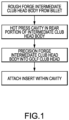
- the method comprises: rough forging solid block billet of a suitable metal to create an intermediate club head body, hot pressing the intermediate club head to create a cavity in the body, precision forging the intermediate club head to create a golf club body, and then attaching an insert within the cavity.
- the intermediate club head, formed through rough forging comprises a bent strike face, allowing a cavity to be formed in the rear body via hot pressing.
- the bent strike face of the intermediate club head is then precision forged. This bent strike face technique allows a manufacturer to create a forged golf club head body with a deep undercut cavity, from a single solid billet, as the bent strike face provides room to hot press a cavity.
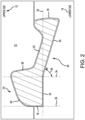
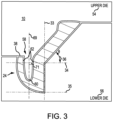
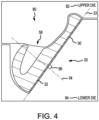
- FIGS. 1-4 illustrate a method of manufacturing (multi-stage forging process) a forged iron-type golf club head with a cavity.
- the method of manufacturing the iron-type golf club head with cavity comprises a rough forging stage, a hot-pressing stage, and a precision forging stage.
- the method of manufacturing a forged iron-type golf club head with cavity, illustrated in FIG. 5 can form a single iron-type golf club head with cavity, or a set of iron-type golf club heads with cavities.
- the multi-stage forging method comprises four stages: (1) a rough forging stage, in which intermediate club head body 10 is formed from a solid block billet (not shown); (2) a hot-pressing stage, in which a cavity 58 is formed in the intermediate club head body; (3) a precision forging stage wherein the intermediate club head body 10 is formed into a final golf club head 80; (4) and an insert 110 or filling is placed within the cavity 58 of the golf club head body 80.
- This multi-stage forging method allows a manufacturer to create a forged golf club head 80 with a deep undercut cavity 58, from a single solid billet.
- the multi-stage forging method can comprise a fifth stage (not shown), wherein a shaft and grip are attached to the golf club head body 80, to form a golf club.
- the desired billet temperature for rough forging is between 700 - 725°C, 725 - 750°C, 750 -775°C, 775 - 800°C, 800 - 825°C, 825 - 850°C, 850 - 875°C, 875 - 900°C, 900- 925°C, 925 - 950°C, 950 - 975°C, 975 - 1000°C, 1000 - 1025°C, 1025 - 1050°C, 1050 - 1075°C, 1075 - 1100°C. In one embodiment, the desired billet temperature for rough forging is between 800 - 825°C.
- the desired pressure of the upper die 12 and lower die 14 is between 5338 and 5560 kN (600 tons and 625 tons).
- the extreme pressure of the upper die 12 and lower die 14, quickly forms the malleable solid block billet to the desired geometry, thus maintaining the material and tensile properties of the metallic billet.
- the back wall 22 of the strike face 20 is adjacent the top rail 18 and the upper edge 38, while parallel to the upper region 30 of the strike face 20.
- the back wall 22 of the strike face 20 spans approximately from the heel end to the toe end.
- intersection plane 34 The upper region 30 and lower region 32 of the strike face of the intermediate club head body 10, are divided by an intersection plane 34, wherein the intersection plane 34 is perpendicular to the lower region 32 of the strike face 20 and the strike plane 33.
- the intersection plane 34 is also approximately parallel to the upper edge 38 of the rear portion 24.
- the intersection plane 34 enables the forging of a cavity in the rear portion 24 of the intermediate club head body 10.
- the intersection plane 34 is the plane that which the strike face 20 is bent about and is a bending point for creating the cavity 58 from the forged billet.
- intersection plane 34 intersects the strike face of the intermediate club head body 10, approximately bisecting the intermediate club head body 10, dividing the upper region 30 and the lower region 32.
- the intermediate club head body 10 further comprises a height measured from the sole 16 to the top rail 18.
- the intersection plane 34 intersect the intermediate club head body 10 between 20-70% of the height of the club head body 10.
- the intersection plane 34 intersects the club head body 10 at approximately 20%, 25%, 30%, 35%, 40%, 45%, 50%, 55%, 60%, 65%, or 70% of the height of the club head body 10.
- the intersection plane 34 intersects the club head body 10 between approximately 20% - 30%, 30% - 40%, 40% - 50%, 50% - 60%, or 60% - 70% of the height of the club head body 10 or any other suitable percentage height value in between those percentage height values, and can range from any one of those percentage height values to any other one of those percentage height values.
- the clearance angle 36 can be 5°, 6°, 7°, 8°, 9°, 10°, 11°, 12°, 13°, 14°, 15°, 16°, 17°, 18°, 19°, 20°, 21°, 22°, 23°, 24°, 25°, 26°, 27°, 28°, 29°, 30°, 31°, 32°, 33°, 34°, and 35°.
- the next step of the multi-stage forging method is the cavity 58 formation in the intermediate club head body 10.
- Formation of the cavity 58 from the intermediate club head body 10 is accomplished by one or more of the following processes: hot pressing, machining, milling, drilling, or machine punching.
- the embodiment in FIG. 3 illustrates the hot-pressing technique.
- the hot-pressing technique utilizes the second upper die 54 and the second lower die 56 (wherein the second upper die 54 and second lower die 56 are different in shape from the first upper die 12 and first lower die 14 of the rough forging stage) to precisely dimension a cavity 58 generally perpendicular to the upper edge 38 in the rear portion 24 of the intermediate club head body 10.
- the second upper die 54 comprises a sharp geometry to penetrate through the upper edge 38 of the rear portion 24, while the second lower die 56 holds the intermediate club head 10 at the desired clearance angle 36, thus forming the cavity 58.
- the temperature required to hot press the cavity 58 in the intermediate club head body 10 can range between 700 - 725°C, 725 - 750°C, 750 - 775°C, 775 - 800°C, 800 - 825°C, 825 - 850°C, 850 - 875°C, 875 - 900°C, 900 - 925°C, 925 - 950°C, 950 - 975°C, 975 - 1000°C, 1000 - 1025°C, 1025 - 1050°C, 1050 - 1075°C, 1075 - 1100°C, 1100 - 1125°C, 1125 - 1150°C. In one embodiment, the temperature required to hot press the cavity 58 in the intermediate club head body 10 can range between 775°C and 800°C.
- the desired pressure of the second upper die 54 and second lower die 56 is between 500 - 525 tons, 525 - 550 tons, 550 - 575 tons, 575 - 600 tons, 600 - 625 tons, 625 - 650 tons, 650 - 675 tons, 675 - 700 tons, 700 - 725 tons, 725 - 750 tons, 750 - 775 tons, and 775 - 800 tons.
- the desired pressure of the upper die 54 and lower die 56 is between 675 tons and 700 tons. The extreme pressure of the second upper die 54 and second lower die 56, quickly forms the cavity 58 in the intermediate club head body 10, thus maintaining the material and tensile properties of the metallic intermediate club head body 10.
- the cavity 58 formed by the methods described above, including hot-pressing, comprises a lower surface 60 and two interior surface walls 62.
- the cavity 58 further comprises a surface area and a volume, that can provide a surface and region to affix an insert to, in a later step.
- the press angle 71 can range between 60° - 65°, 65° - 70°, 70° - 75°, 75° - 80°, and 85° - 90° or any other suitable press angle 71 value in between those press angles 71 and can range from any one of those press angles 71 to any other one of those press angles 71.
- the press angle 71 can be 60°, 61°, 62°, 63°, 64°, 65°, 66°, 67°, 68°, 69°, 70°, 71°, 72°, 73°, 74°, 75°, 76°, 77°, 78°, 79°, 80°, 81°, 82°, 83°, 84°, 85°, 86°, 87°, 88°, 89°, or 90°.
- the press angle 71 enables an insert to be affixed within the cavity 58 (in a later step) at a desired angle.
- the cavity 58 can have a substantially triangular, rectangular, square, semi-circular, parabolic, or trapezoidal cross section.
- the cavity 58 can comprise a different cross-section at a toe end of the cavity 58 and the heel end of the cavity 58.
- the cavity 58 can have a volume of approximately 0.8 cc, 1.0 cc, 1.25 cc, 1.5 cc, 1.75 cc, 2.0 cc, 2.25 cc, 2.5 cc, 2.75 cc, 3.0 cc, 3.25 cc, 3.5 cc, 3.75 cc, 4.0 cc, 4.25 cc, 4.5 cc, 4.75 cc, 5.0 cc, 5.25 cc, 5.5 cc, 5.75 cc, 6.0 cc, 6.25 cc, 6.5 cc, 6.75 cc, 7.0 cc, 7.25 cc, 7.5 cc, 7.75 cc, 8.0 cc, 8.25 cc, 8.5 cc, 8.75 cc, 9.0 cc, 9.25 cc, 9.5 cc, 9.75 cc, 10.0 cc, 10.25 cc, 10.5 cc, 10.75
- the cavity 58 can have a surface area ranging between approximately 3.00-4.00 cm 2 , 4.00-5.00 cm 2 , 5.00-6.00 cm 2 , 6.00-7.00 cm 2 , 7.00-8.00 cm 2 , 8.00-9.00 cm 2 , 10.00-11.00 cm 2 , 11.00-12.00 cm 2 , 12.00-13.00 cm 2 , 13.00-14.00 cm 2 , 14.00-15.00 cm 2 , 15.00-16.00 cm 2 , 16.00-17.00 cm 2 , 17.00-18.00 cm 2 , 18.00-19.00 cm 2 , 19.00-20.00 cm 2 , 20.00-21.00 cm 2 , 21.00-22.00 cm 2 , 22.00-23.00 cm 2 , 23.00-24.00 cm 2 , 24.00-25.00 cm 2 , 25.00-26.00 cm 2 , 26.00-27.00 cm 2 , 27.00-28.00 cm 2 , 28.00-29.00 cm 2 , or 29.00-30.00 cm 2 .
- the surface area of the cavity 58 can be any other suitable surface area value in between those surface area values and can range from any one of those surface area values to any other one of those surface area values.
- the surface area of the cavity 58 can be substantially similar to the surface area of an insert that is affixed within the cavity 58.
- the cavity 58 can have a depth of approximately 1.27 mm (0.05 inches), 2.54 mm (0.10 inches), 3.81 mm (0.15 inches), 5.08 mm (0.20 inches), 6.35 mm (0.25 inches), 7.62 mm (0.30 inches), 8.89 mm (0.35 inches), 10.16 mm (0.40 inches), 11.43 mm (0.45 inches), 12.7 mm (0.50 inches), 13.97 mm (0.55 inches), 15.24 mm (0.60 inches), 16.51 mm (0.65 inches), 17.78 mm (0.70 inches), 19.05 mm (0.75 inches), 20.32 mm (0.80 inches), 21.59 mm (0.85 inches), 22.86 mm(0.90 inches), 24.13 mm (0.95 inches), 25.4 mm (1.0 inch) or any other suitable depth value in between those depth values, and can range from any one of those depth values to any other on of those depth values.
- the depth of the cavity 58 can be substantially similar to a height of an insert that is affixed within the depth of
- a final precision forging stage is performed to straighten the clearance angle 36 into a final golf club head.
- the club head body 10 is precision forged, wherein the strike face 20 is bent to a final angle 96, wherein the final angle 96 is formed between the intersection plane 34 and the strike face 20.
- the final angle 96 is approximately between 88°-92° or 88°, 89°, 90°, 91°, or 92°, thereby aligning the upper region 30 with the lower region 32 of the club heady body 10.
- the intermediate club head body 10 is therefore forged further into a final golf club head 80.
- this precision forging stage comprises a third upper die 82 and a third lower die 84, wherein the third upper die 82 and third lower die 84 are shaped in a desired geometry (wherein the second upper die 54, the second lower die 56, the first upper die 12, and the first lower die 14 are different in shape from the third upper die 82 and third lower die 84).
- the third upper die 82 and third lower die 84 apply a desired pressure to the intermediate club head body 10, bending the upper portion 30 of the strike face 20 to align with the lower portion 32 of the strike face 20 within the strike plane 33, thus bending the clearance angle 36 to a final angle 96 of approximately 90° to the intersection plane 36. In doing so, the intermediate club head body 10 is forged into a final golf club head 80, as the strike face 20 is now continuously straight and can function for its intended purpose of striking a golf ball.
- the intermediate club head body 10 formed from the previous steps, must be heated to a desired temperature to bend the strike face 20 into the strike plane 33 in order to carry out this stage of the method.
- the intermediate club head body 10 is heated to a desired temperature between 700°C and 1100°C.
- the desired temperature of the intermediate club head body 10 for precision forging is between 700 - 725°C, 725 - 750°C, 750 -775°C, 775 - 800°C, 800 - 825°C, 825 - 850°C, 850 - 875°C, 875 - 900°C, 900- 925°C, 925 - 950°C, 950 - 975°C, 975 - 1000°C, 1000 - 1025°C, 1025 - 1050°C, 1050 - 1075°C, 1075 - 1100°C.
- the desired temperature of the intermediate club head body 10 for rough forging is between 800 - 825°C.
- the lower die 84 maintains the shape of the cavity and lower portion 32, while the third upper die 82 presses against the back wall 22.
- the third upper die 82 forces the upper portion 30 of the intermediate club head body 10 flush against the third lower die 84, thus aligning the upper portion 30 with the lower portion, and therefore bending the clearance angle 36 to approximately 90° to the intersection plane 36.
- the desired pressure that is applied to the intermediate club head body 10 by the third upper die 82 and the third lower die 84 is between 500 tons and 800 tons (1 ton is equivalent to 2000 pounds force).
- the desired pressure of the third upper die 82 and the third lower die 84 is between 500 - 525 tons, 525 - 550 tons, 550 - 575 tons, 575 - 600 tons, 600 - 625 tons, 625 - 650 tons, 650 - 675 tons, 675 - 700 tons, 700 - 725 tons, 725 - 750 tons, 750 - 775 tons, and 775 - 800 tons.
- the desired pressure of the third upper die 82 and the third lower die 84 is between 675 tons and 700 tons.
- the extreme pressure of the upper die 82 and the third lower die 84 maintains the form of the lower portion 32 and the cavity 58, while pressing the upper region 30, in line with the lower region 32, and thus into a functioning strike face 20.
- the strike face is then removed from the third upper die 82 and third lower die 84, and set to cool in a room temperature environment, until it is safe to the touch.
- an insert 110 can be affixed to the interior surface wall 62 and lower surface 60 of the cavity 58. In some embodiments, nothing is placed with the cavity 58.
- the insert 110 can be secured into the cavity 58 via adhesion, press-fitting, mechanical fastening, or any other suitable methods of securing the insert 110.
- the insert 110 can be made of one or more elastomers.
- the insert 110 can be made of nonferrous thermoplastic urethane, thermoplastic elastomeric polymer(s), hybrid plastics with a mix of ferrous particles or other alloy ferrous particles mixed into polyurethane or other elastomeric polymers.
- the insert 110 can be a metal such as aluminum, steel, tungsten, forms of beads in polymer, powder metal in a suspension cured in a polymer, or other suitable metals, such as when the insert 110 is sintered or machined.
- the insert 110 can occupy the entire cavity 58 or a percentage of the cavity 58.
- the percentage of the cavity 58 that is occupied can range between 5% and 100%. In some embodiments, the percentage of the cavity 58 that is occupied can range between 5% - 15%, 15% - 25%, 25% - 35%, 35% - 45%, 45% - 55%, 55% - 65%, 65% - 75% - 85%, 85% - 95%, 95% - 100%. In one embodiment, the percentage of the cavity 58 that is occupied ranges between 95% - 100%.
- tuning element 150 can have a mass of approximately 1.0 g, 2.0 g, 3.0 g, 4.0 g, 5.0 g, 6.0 g, 7.0 g, 8.0 g, 9.0 g, 10.0 g, 11.0 g, 12.0 g, 13.0 g, 14.0 g, 15.0 g, 16.0 g, 17.0 g, 18.0 g, 19.0 g, 20.0 g, 21.0 g, 22.0 g, 23.0 g, 24.0 g, 25.0 g, 26.0 g, 27.0 g, 28.0 g, 29.0 g, 30.0 g, 35.0 g, 40.0 g, 45.0 g, 50.0 g, 55.0 g, 60.0 g, 65.0 g, 70.0 g, 75.0 g, 80.0 g, 85.0 g, 90.0 g, 95.0 g, 100.0 g, or any other suitable mass in between those mass values, and can range from any one of those mass values, and
- the insert 110 can have a density of approximately 1.0 g/cc to approximately 20.0 g/cc.
- the insert 110 can have a density of approximately 1.0 g/cc, 1.5 g/cc, 2.0 g/cc, 2.5 g/cc, 3.0 g/cc, 3.5 g/cc, 4.0 g/cc, 4.5 g/cc, 5.0 g/cc, 5.5 g/cc, 6.0 g/cc, 6.5 g/cc, 7.0 g/cc, 7.5 g/cc, 8.0 g/cc, 8.5 g/cc, 9.0 g/cc, 9.5 g/cc, 10.0 g/cc, 10.5 g/cc, 11.0 g/cc, 11.5 g/cc, 12.0 g/cc, 12.5 g/cc, 13.0 g/cc, 13.5 g/cc, 14.0 g/
- the final golf club 80 is a forged iron type golf club head with a cavity 58.
- the final golf club 80 comprises: a hosel 120, a top rail 122, a sole 124, a toe region 126, a heel region 128, a rear 130, a strike face 20 (not shown), a cavity 58, and an insert 110.
- the multi-stage forging method comprises four stages: (1) a rough forging stage, in which intermediate club head body 10 is formed from a solid block billet (not shown); (2) a hot-pressing stage, in which a cavity 58 is formed in the intermediate club head body; (3) a precision forging stage wherein the intermediate club head body 10 is formed into a final golf club head 80; (4) and an insert 110 or filling is placed within the cavity 58 of the golf club head body 80.
- This multi-stage forging method allows a manufacturer to create a forged golf club head 80 with a deep undercut cavity 58, from a single solid billet.
- the multi-stage forging method comprises a fifth stage (not shown), wherein a shaft and grip are attached to the golf club head body 80, to form a golf club.
- the multi-stage forging process is then repeated to form multiple iron-type golf club heads with cavities, wherein the multiple iron-type golf clubs with cavities will comprise different lofts (aforementioned) to form a set of golf clubs ( i.e., 3 iron, 4 iron, 5 iron, 6 iron, 7 iron, 8 iron, 9 iron, PW).
- the multi-stage forging process can form multiple iron-type golf club heads with identically sized cavities, and different lofts to form a set of golf clubs.
- the inserts that are affixed to each golf club head all have an exact same volume, but can have varying densities and therefore varying masses.
- This variability allows the inserts for each golf club head of the golf club set to have different swing weights and/or different CG locations.
- Inserts are produced at different weights in order to account for manufacturing tolerances ( i.e., if a golf club head is supposed to weight 425 grams, but only weighs 415 grams, then a 10 gram weight can be added to the golf club head cavity).
- the aforementioned method of manufacturing produces can produce of set of forged iron-type golf clubs with similar sized cavities.
- the final golf club head 80 formed by the method of manufacturing comprises a hosel 120, a top rail 122, a sole 124, a toe region 126, a heel region 128, a rear 130, a strike face 20 (not shown), a cavity 58, an insert 110, a shaft (not shown), and a grip (not shown).
- the set of forged iron-type golf clubs can comprise 2 golf clubs, 3 golf clubs, 4 golf clubs, 5 golf clubs, 6 golf clubs, 7 golf clubs, 8 golf clubs, 9 golf clubs, or 10 golf clubs.
- Each golf club of the forged iron-type golf club set can comprise cavity 58 having a volume of approximately 0.8 cc, 1.0 cc, 1.25 cc, 1.5 cc, 1.75 cc, 2.0 cc, 2.25 cc, 2.5 cc, 2.75 cc, 3.0 cc, 3.25 cc, 3.5 cc, 3.75 cc, 4.0 cc, 4.25 cc, 4.5 cc, 4.75 cc, 5.0 cc, 5.25 cc, 5.5 cc, 5.75 cc, 6.0 cc, 6.25 cc, 6.5 cc, 6.75 cc, 7.0 cc, 7.25 cc, 7.5 cc, 7.75 cc, 8.0 cc, 8.25 cc, 8.5 cc, 8.75 cc, 9.0 cc, 9.25 cc, 9.5 cc, 9.75 cc, 10.0 cc, 10.25 cc
- the enclosed manufacturing process is an improvement over the current industry standard.
- the multi-stage forging process utilizes a dual stage forging process, in which an intermediate club head 10 is formed with a strike face 20 that is bent at a clearance angle 36, enabling a cavity 58 to be hot pressed opposite of the strike face 20.
- the strike face 20 is then bent back into a functional strike face 20, and a final golf club head 80 is created.
- This bent strike face 20 technique allows a manufacturer to create a forged golf club head body 80 with a deep undercut cavity 58, from a single solid billet.
Landscapes
- Health & Medical Sciences (AREA)
- General Health & Medical Sciences (AREA)
- Physical Education & Sports Medicine (AREA)
- Engineering & Computer Science (AREA)
- Mechanical Engineering (AREA)
- Golf Clubs (AREA)
Applications Claiming Priority (3)
| Application Number | Priority Date | Filing Date | Title |
|---|---|---|---|
| US201862732438P | 2018-09-17 | 2018-09-17 | |
| EP19861723.5A EP3852887B1 (en) | 2018-09-17 | 2019-09-17 | Multi-stage forging process |
| PCT/US2019/051587 WO2020061099A1 (en) | 2018-09-17 | 2019-09-17 | Multi-stage forging process |
Related Parent Applications (2)
| Application Number | Title | Priority Date | Filing Date |
|---|---|---|---|
| EP19861723.5A Division EP3852887B1 (en) | 2018-09-17 | 2019-09-17 | Multi-stage forging process |
| EP19861723.5A Division-Into EP3852887B1 (en) | 2018-09-17 | 2019-09-17 | Multi-stage forging process |
Publications (3)
| Publication Number | Publication Date |
|---|---|
| EP4205824A1 EP4205824A1 (en) | 2023-07-05 |
| EP4205824B1 true EP4205824B1 (en) | 2025-07-02 |
| EP4205824C0 EP4205824C0 (en) | 2025-07-02 |
Family
ID=69772654
Family Applications (2)
| Application Number | Title | Priority Date | Filing Date |
|---|---|---|---|
| EP23154684.7A Active EP4205824B1 (en) | 2018-09-17 | 2019-09-17 | A forged golf club head with a cavity |
| EP19861723.5A Active EP3852887B1 (en) | 2018-09-17 | 2019-09-17 | Multi-stage forging process |
Family Applications After (1)
| Application Number | Title | Priority Date | Filing Date |
|---|---|---|---|
| EP19861723.5A Active EP3852887B1 (en) | 2018-09-17 | 2019-09-17 | Multi-stage forging process |
Country Status (6)
| Country | Link |
|---|---|
| US (3) | US11273486B2 (cg-RX-API-DMAC7.html) |
| EP (2) | EP4205824B1 (cg-RX-API-DMAC7.html) |
| JP (3) | JP7326431B2 (cg-RX-API-DMAC7.html) |
| KR (2) | KR20250107946A (cg-RX-API-DMAC7.html) |
| ES (1) | ES3037646T3 (cg-RX-API-DMAC7.html) |
| WO (1) | WO2020061099A1 (cg-RX-API-DMAC7.html) |
Families Citing this family (5)
| Publication number | Priority date | Publication date | Assignee | Title |
|---|---|---|---|---|
| EP4205824B1 (en) * | 2018-09-17 | 2025-07-02 | Karsten Manufacturing Corporation | A forged golf club head with a cavity |
| US12202032B2 (en) | 2018-09-17 | 2025-01-21 | Karsten Manufacturing Corporation | Forged golf club head |
| KR20240158308A (ko) * | 2022-03-11 | 2024-11-04 | 카스턴 매뉴팩츄어링 코오포레이숀 | 다단계 단조 방법 |
| TWI855865B (zh) * | 2023-09-15 | 2024-09-11 | 蘇基宏 | 精密鍛造形成底部紋路的高爾夫球桿頭製法 |
| CN117161302B (zh) * | 2023-09-15 | 2026-01-06 | 四川宇钛体育用品有限公司 | 精密锻造形成底部纹路的高尔夫球杆头制法 |
Family Cites Families (48)
| Publication number | Priority date | Publication date | Assignee | Title |
|---|---|---|---|---|
| US1673994A (en) | 1928-04-21 | 1928-06-19 | Quynn John Williams | Golf club |
| JPS62233176A (ja) * | 1986-04-03 | 1987-10-13 | ヤマハ株式会社 | 金属クラブヘツドの製法 |
| JP2838877B2 (ja) * | 1995-04-03 | 1998-12-16 | 株式会社遠藤製作所 | ゴルフクラブの製造方法 |
| JPH10314347A (ja) | 1997-05-19 | 1998-12-02 | Mizuno Corp | ゴルフクラブヘッド及びその製造方法 |
| US20020095762A1 (en) * | 1997-06-16 | 2002-07-25 | Hitoshi Takeda | Method for manufacturing golf club |
| US6083118A (en) | 1997-07-30 | 2000-07-04 | Joseph Sery | Golf club head and method of manufacture |
| JP3177952B2 (ja) | 1997-11-20 | 2001-06-18 | 株式会社遠藤製作所 | ゴルフクラブ |
| GB9803262D0 (en) | 1998-02-17 | 1998-04-08 | Salmon Marc | Golf club corrective configuration |
| US6497629B2 (en) * | 1999-03-24 | 2002-12-24 | K.K. Endo Seisakusho | Golfing iron club and manufacturing method thereof |
| JP3486898B2 (ja) | 1999-03-24 | 2004-01-13 | 株式会社遠藤製作所 | アイアン形ゴルフクラブの製造法 |
| JP3916954B2 (ja) | 2000-02-02 | 2007-05-23 | 美津濃株式会社 | ゴルフクラブおよびその製造方法 |
| EP1240924B1 (en) * | 2000-10-16 | 2006-06-07 | Mizuno Corporation | Iron golf club and golf club set |
| US6921344B2 (en) * | 2003-08-13 | 2005-07-26 | Acushnet Company | Reinforced golf club head having sandwich construction |
| CN100469407C (zh) | 2004-04-08 | 2009-03-18 | 楠盛股份有限公司 | 高尔夫杆头的锻压初胚 |
| US20050233825A1 (en) | 2004-04-14 | 2005-10-20 | Jung-Yao Tsai | Forging blank for a golf club head |
| US7153219B2 (en) * | 2004-06-14 | 2006-12-26 | Adams Golf Ip, L.P. | Golf club head |
| CN101031342B (zh) | 2004-07-26 | 2013-01-02 | 住胶体育用品株式会社 | 带有插入件的背肌式铁杆型高尔夫球杆头 |
| US7815523B2 (en) * | 2004-08-11 | 2010-10-19 | Acushnet Company | Variable density golf club |
| US20060094532A1 (en) | 2004-11-01 | 2006-05-04 | Larry Seeley | Side spin inducing golf club |
| US20060293119A1 (en) | 2005-06-22 | 2006-12-28 | Nelson Precision Casting Co., Ltd. | Striking plate for golf club head |
| US20070281796A1 (en) | 2006-05-31 | 2007-12-06 | Gilbert Peter J | Muscle-back iron golf clubs with higher moment of intertia and lower center of gravity |
| US7980960B2 (en) | 2006-06-09 | 2011-07-19 | Acushnet Company | Iron-type golf clubs |
| US8388464B2 (en) | 2006-06-09 | 2013-03-05 | Acushnet Company | Iron-type golf clubs |
| JP4965385B2 (ja) * | 2006-07-21 | 2012-07-04 | コブラ ゴルフ インコーポレイテッド | 多材ゴルフクラブヘッド |
| JP2008093010A (ja) | 2006-10-06 | 2008-04-24 | Bridgestone Sports Co Ltd | アイアンゴルフクラブヘッド |
| US11465018B2 (en) * | 2007-07-25 | 2022-10-11 | Karsten Manufacturing Corporation | Club head sets with varying characteristics and related methods |
| US8753230B2 (en) * | 2007-07-25 | 2014-06-17 | Karsten Manufacturing Corporation | Club head sets with varying characteristics |
| US20170120112A1 (en) * | 2007-07-25 | 2017-05-04 | Karsten Manufacturing Corporation | Club head sets with varying characteristics and related methods |
| JP2009089768A (ja) * | 2007-10-04 | 2009-04-30 | Nelson Precision Casting Co Ltd | ゴルフクラブヘッド及びその製造方法 |
| US20090111603A1 (en) | 2007-10-26 | 2009-04-30 | Edward Romero | Parabolic golf club head |
| KR100858609B1 (ko) | 2008-06-02 | 2008-09-17 | 문석진 | 단조 아이언 헤드 및 이를 갖는 골프 클럽 |
| JP5315577B2 (ja) * | 2008-07-14 | 2013-10-16 | 美津濃株式会社 | アイアンゴルフクラブヘッドおよびアイアンゴルフクラブ |
| US20160151861A1 (en) * | 2009-05-19 | 2016-06-02 | Cobra Golf Incorporated | Method and system for making golf club components |
| JP5814562B2 (ja) | 2011-02-17 | 2015-11-17 | 株式会社遠藤製作所 | アイアンゴルフクラブとその製造方法 |
| US8795102B2 (en) * | 2011-03-14 | 2014-08-05 | Nike, Inc. | Iron-type golf clubs and golf club heads with a wide sole |
| US10391370B2 (en) * | 2011-11-28 | 2019-08-27 | Acushnet Company | Co-forged golf club head and method of manufacture |
| US9101974B2 (en) | 2012-05-16 | 2015-08-11 | Her Chang Technology Co., Ltd. | Manufacturing method of an iron-type golf club head |
| US20130344988A1 (en) * | 2012-06-20 | 2013-12-26 | Ronald K. Hettinger | Iron-type golf club |
| US8821313B1 (en) * | 2012-09-14 | 2014-09-02 | Callaway Golf Company | Iron-type golf club head |
| JP6073635B2 (ja) * | 2012-10-17 | 2017-02-01 | ダンロップスポーツ株式会社 | ゴルフクラブヘッド |
| US9199141B2 (en) * | 2013-03-13 | 2015-12-01 | Nike, Inc. | Ball striking device having a covering element |
| JP2014200268A (ja) | 2013-04-01 | 2014-10-27 | 株式会社遠藤製作所 | アイアンゴルフクラブヘッド |
| JP5850586B2 (ja) * | 2013-09-11 | 2016-02-03 | 美津濃株式会社 | アイアンゴルフクラブヘッド、及びアイアンゴルフクラブ |
| US9492722B2 (en) | 2013-11-12 | 2016-11-15 | Taylor Made Golf Company, Inc. | Golf club |
| JP6448240B2 (ja) * | 2014-07-16 | 2019-01-09 | 共和技研株式会社 | 空気圧を用いるボール発射装置 |
| US10343035B2 (en) * | 2014-11-26 | 2019-07-09 | Karsten Manufacturing Corporation | Golf club heads with cavities and inserts |
| US20170036076A1 (en) * | 2015-08-07 | 2017-02-09 | Mizuno Usa, Inc. | Forged slotted iron golf club |
| EP4205824B1 (en) * | 2018-09-17 | 2025-07-02 | Karsten Manufacturing Corporation | A forged golf club head with a cavity |
-
2019
- 2019-09-17 EP EP23154684.7A patent/EP4205824B1/en active Active
- 2019-09-17 WO PCT/US2019/051587 patent/WO2020061099A1/en not_active Ceased
- 2019-09-17 KR KR1020257021665A patent/KR20250107946A/ko active Pending
- 2019-09-17 KR KR1020217011099A patent/KR102828496B1/ko active Active
- 2019-09-17 US US16/573,938 patent/US11273486B2/en active Active
- 2019-09-17 JP JP2021514537A patent/JP7326431B2/ja active Active
- 2019-09-17 ES ES23154684T patent/ES3037646T3/es active Active
- 2019-09-17 EP EP19861723.5A patent/EP3852887B1/en active Active
-
2022
- 2022-03-11 US US17/654,555 patent/US20220193753A1/en not_active Abandoned
-
2023
- 2023-08-02 JP JP2023126340A patent/JP2023153932A/ja active Pending
-
2024
- 2024-07-31 US US18/790,212 patent/US20240408668A1/en active Pending
- 2024-11-06 JP JP2024194451A patent/JP7809779B2/ja active Active
Also Published As
| Publication number | Publication date |
|---|---|
| JP2025016736A (ja) | 2025-02-04 |
| EP3852887B1 (en) | 2023-06-07 |
| US20220193753A1 (en) | 2022-06-23 |
| EP3852887A4 (en) | 2022-01-26 |
| JP7326431B2 (ja) | 2023-08-15 |
| EP3852887A1 (en) | 2021-07-28 |
| KR20250107946A (ko) | 2025-07-14 |
| WO2020061099A1 (en) | 2020-03-26 |
| JP7809779B2 (ja) | 2026-02-02 |
| ES3037646T3 (en) | 2025-10-03 |
| KR20210062041A (ko) | 2021-05-28 |
| US20240408668A1 (en) | 2024-12-12 |
| EP4205824A1 (en) | 2023-07-05 |
| JP2023153932A (ja) | 2023-10-18 |
| KR102828496B1 (ko) | 2025-07-01 |
| EP4205824C0 (en) | 2025-07-02 |
| US11273486B2 (en) | 2022-03-15 |
| US20200086379A1 (en) | 2020-03-19 |
| EP3852887C0 (en) | 2023-06-07 |
| JP2022501107A (ja) | 2022-01-06 |
Similar Documents
| Publication | Publication Date | Title |
|---|---|---|
| EP4205824B1 (en) | A forged golf club head with a cavity | |
| AU592140B2 (en) | Wood club head and method of manufacturing the same | |
| CN110064180B (zh) | 具有拆分式多部件杆头的高尔夫球杆杆头结构 | |
| US5938543A (en) | Multiple density golf club head and method of manufacturing the same | |
| US5665014A (en) | Metal golf club head and method of manufacture | |
| US5333871A (en) | Golf club head | |
| US6089070A (en) | Method of manufacturing a metal wood golf club head | |
| US20210308537A1 (en) | Golf club heads and methods to manufacture golf club heads | |
| US20060000528A1 (en) | Method for producing a golf club wood | |
| JP2016525439A (ja) | ロストコア成形されたポリマー製のゴルフクラブヘッド | |
| JP7779972B2 (ja) | 鍛造アイアンヘッド | |
| US12311239B2 (en) | Golf club heads and methods to manufacture golf club heads | |
| US20050023329A1 (en) | Method of making a golf club head | |
| WO2023172842A2 (en) | Multi-stage forging process | |
| US20100139073A1 (en) | Method of producing golf club wood head using folded metal strip or sheet | |
| EP0891790A2 (en) | Multiple density golf club head and method of manufacturing | |
| US12202032B2 (en) | Forged golf club head |
Legal Events
| Date | Code | Title | Description |
|---|---|---|---|
| PUAI | Public reference made under article 153(3) epc to a published international application that has entered the european phase |
Free format text: ORIGINAL CODE: 0009012 |
|
| STAA | Information on the status of an ep patent application or granted ep patent |
Free format text: STATUS: THE APPLICATION HAS BEEN PUBLISHED |
|
| AC | Divisional application: reference to earlier application |
Ref document number: 3852887 Country of ref document: EP Kind code of ref document: P |
|
| AK | Designated contracting states |
Kind code of ref document: A1 Designated state(s): AL AT BE BG CH CY CZ DE DK EE ES FI FR GB GR HR HU IE IS IT LI LT LU LV MC MK MT NL NO PL PT RO RS SE SI SK SM TR |
|
| STAA | Information on the status of an ep patent application or granted ep patent |
Free format text: STATUS: REQUEST FOR EXAMINATION WAS MADE |
|
| 17P | Request for examination filed |
Effective date: 20231229 |
|
| RBV | Designated contracting states (corrected) |
Designated state(s): AL AT BE BG CH CY CZ DE DK EE ES FI FR GB GR HR HU IE IS IT LI LT LU LV MC MK MT NL NO PL PT RO RS SE SI SK SM TR |
|
| GRAP | Despatch of communication of intention to grant a patent |
Free format text: ORIGINAL CODE: EPIDOSNIGR1 |
|
| STAA | Information on the status of an ep patent application or granted ep patent |
Free format text: STATUS: GRANT OF PATENT IS INTENDED |
|
| INTG | Intention to grant announced |
Effective date: 20250122 |
|
| GRAS | Grant fee paid |
Free format text: ORIGINAL CODE: EPIDOSNIGR3 |
|
| GRAA | (expected) grant |
Free format text: ORIGINAL CODE: 0009210 |
|
| STAA | Information on the status of an ep patent application or granted ep patent |
Free format text: STATUS: THE PATENT HAS BEEN GRANTED |
|
| AC | Divisional application: reference to earlier application |
Ref document number: 3852887 Country of ref document: EP Kind code of ref document: P |
|
| AK | Designated contracting states |
Kind code of ref document: B1 Designated state(s): AL AT BE BG CH CY CZ DE DK EE ES FI FR GB GR HR HU IE IS IT LI LT LU LV MC MK MT NL NO PL PT RO RS SE SI SK SM TR |
|
| REG | Reference to a national code |
Ref country code: GB Ref legal event code: FG4D |
|
| REG | Reference to a national code |
Ref country code: CH Ref legal event code: EP |
|
| REG | Reference to a national code |
Ref country code: IE Ref legal event code: FG4D |
|
| U01 | Request for unitary effect filed |
Effective date: 20250707 |
|
| U07 | Unitary effect registered |
Designated state(s): AT BE BG DE DK EE FI FR IT LT LU LV MT NL PT RO SE SI Effective date: 20250711 |
|
| REG | Reference to a national code |
Ref country code: ES Ref legal event code: FG2A Ref document number: 3037646 Country of ref document: ES Kind code of ref document: T3 Effective date: 20251003 |
|
| PGFP | Annual fee paid to national office [announced via postgrant information from national office to epo] |
Ref country code: GB Payment date: 20250929 Year of fee payment: 7 |
|
| PGFP | Annual fee paid to national office [announced via postgrant information from national office to epo] |
Ref country code: IE Payment date: 20250929 Year of fee payment: 7 |
|
| U20 | Renewal fee for the european patent with unitary effect paid |
Year of fee payment: 7 Effective date: 20250929 |
|
| PG25 | Lapsed in a contracting state [announced via postgrant information from national office to epo] |
Ref country code: IS Free format text: LAPSE BECAUSE OF FAILURE TO SUBMIT A TRANSLATION OF THE DESCRIPTION OR TO PAY THE FEE WITHIN THE PRESCRIBED TIME-LIMIT Effective date: 20251102 |
|
| PG25 | Lapsed in a contracting state [announced via postgrant information from national office to epo] |
Ref country code: NO Free format text: LAPSE BECAUSE OF FAILURE TO SUBMIT A TRANSLATION OF THE DESCRIPTION OR TO PAY THE FEE WITHIN THE PRESCRIBED TIME-LIMIT Effective date: 20251002 |
|
| PG25 | Lapsed in a contracting state [announced via postgrant information from national office to epo] |
Ref country code: HR Free format text: LAPSE BECAUSE OF FAILURE TO SUBMIT A TRANSLATION OF THE DESCRIPTION OR TO PAY THE FEE WITHIN THE PRESCRIBED TIME-LIMIT Effective date: 20250702 |
|
| PG25 | Lapsed in a contracting state [announced via postgrant information from national office to epo] |
Ref country code: GR Free format text: LAPSE BECAUSE OF FAILURE TO SUBMIT A TRANSLATION OF THE DESCRIPTION OR TO PAY THE FEE WITHIN THE PRESCRIBED TIME-LIMIT Effective date: 20251003 |
|
| PG25 | Lapsed in a contracting state [announced via postgrant information from national office to epo] |
Ref country code: CZ Free format text: LAPSE BECAUSE OF FAILURE TO SUBMIT A TRANSLATION OF THE DESCRIPTION OR TO PAY THE FEE WITHIN THE PRESCRIBED TIME-LIMIT Effective date: 20250702 |
|
| PG25 | Lapsed in a contracting state [announced via postgrant information from national office to epo] |
Ref country code: PL Free format text: LAPSE BECAUSE OF FAILURE TO SUBMIT A TRANSLATION OF THE DESCRIPTION OR TO PAY THE FEE WITHIN THE PRESCRIBED TIME-LIMIT Effective date: 20250702 |
|
| PG25 | Lapsed in a contracting state [announced via postgrant information from national office to epo] |
Ref country code: RS Free format text: LAPSE BECAUSE OF FAILURE TO SUBMIT A TRANSLATION OF THE DESCRIPTION OR TO PAY THE FEE WITHIN THE PRESCRIBED TIME-LIMIT Effective date: 20251002 |
|
| PGFP | Annual fee paid to national office [announced via postgrant information from national office to epo] |
Ref country code: ES Payment date: 20251001 Year of fee payment: 7 |
|
| PG25 | Lapsed in a contracting state [announced via postgrant information from national office to epo] |
Ref country code: SM Free format text: LAPSE BECAUSE OF FAILURE TO SUBMIT A TRANSLATION OF THE DESCRIPTION OR TO PAY THE FEE WITHIN THE PRESCRIBED TIME-LIMIT Effective date: 20250702 |
|
| REG | Reference to a national code |
Ref country code: CH Ref legal event code: H13 Free format text: ST27 STATUS EVENT CODE: U-0-0-H10-H13 (AS PROVIDED BY THE NATIONAL OFFICE) Effective date: 20260425 |
|
| PG25 | Lapsed in a contracting state [announced via postgrant information from national office to epo] |
Ref country code: SK Free format text: LAPSE BECAUSE OF FAILURE TO SUBMIT A TRANSLATION OF THE DESCRIPTION OR TO PAY THE FEE WITHIN THE PRESCRIBED TIME-LIMIT Effective date: 20250702 |