EP4202012A2 - Composés et compositions de cristaux liquides pour lentilles accordables - Google Patents
Composés et compositions de cristaux liquides pour lentilles accordables Download PDFInfo
- Publication number
- EP4202012A2 EP4202012A2 EP22215847.9A EP22215847A EP4202012A2 EP 4202012 A2 EP4202012 A2 EP 4202012A2 EP 22215847 A EP22215847 A EP 22215847A EP 4202012 A2 EP4202012 A2 EP 4202012A2
- Authority
- EP
- European Patent Office
- Prior art keywords
- compound
- liquid crystal
- variations
- saturated
- formula
- Prior art date
- Legal status (The legal status is an assumption and is not a legal conclusion. Google has not performed a legal analysis and makes no representation as to the accuracy of the status listed.)
- Pending
Links
- 150000001875 compounds Chemical class 0.000 title claims abstract description 172
- 239000004973 liquid crystal related substance Substances 0.000 title claims abstract description 116
- 239000000203 mixture Substances 0.000 title claims abstract description 74
- 210000002858 crystal cell Anatomy 0.000 claims description 36
- 229910052739 hydrogen Inorganic materials 0.000 claims description 32
- 125000000008 (C1-C10) alkyl group Chemical group 0.000 claims description 30
- 125000002577 pseudohalo group Chemical group 0.000 claims description 25
- 229910052736 halogen Inorganic materials 0.000 claims description 23
- 150000002367 halogens Chemical class 0.000 claims description 23
- 239000000758 substrate Substances 0.000 claims description 21
- 125000000027 (C1-C10) alkoxy group Chemical group 0.000 claims description 18
- 125000001495 ethyl group Chemical group [H]C([H])([H])C([H])([H])* 0.000 claims description 18
- 229910052731 fluorine Inorganic materials 0.000 claims description 17
- 239000001257 hydrogen Substances 0.000 claims description 17
- 125000000959 isobutyl group Chemical group [H]C([H])([H])C([H])(C([H])([H])[H])C([H])([H])* 0.000 claims description 14
- 125000001449 isopropyl group Chemical group [H]C([H])([H])C([H])(*)C([H])([H])[H] 0.000 claims description 10
- 125000001972 isopentyl group Chemical group [H]C([H])([H])C([H])(C([H])([H])[H])C([H])([H])C([H])([H])* 0.000 claims description 9
- 125000004066 1-hydroxyethyl group Chemical group [H]OC([H])([*])C([H])([H])[H] 0.000 claims description 6
- REAYFGLASQTHKB-UHFFFAOYSA-N [2-[3-(1H-pyrazol-4-yl)phenoxy]-6-(trifluoromethyl)pyridin-4-yl]methanamine Chemical compound N1N=CC(=C1)C=1C=C(OC2=NC(=CC(=C2)CN)C(F)(F)F)C=CC=1 REAYFGLASQTHKB-UHFFFAOYSA-N 0.000 claims description 2
- 150000002431 hydrogen Chemical group 0.000 claims 4
- 239000000463 material Substances 0.000 abstract description 12
- 229920006395 saturated elastomer Polymers 0.000 description 23
- 125000000217 alkyl group Chemical group 0.000 description 16
- 238000001429 visible spectrum Methods 0.000 description 15
- 125000004435 hydrogen atom Chemical group [H]* 0.000 description 12
- 125000000753 cycloalkyl group Chemical group 0.000 description 9
- -1 cycloalkyl radical Chemical class 0.000 description 9
- 125000001424 substituent group Chemical group 0.000 description 9
- 230000008859 change Effects 0.000 description 7
- 125000000113 cyclohexyl group Chemical group [H]C1([H])C([H])([H])C([H])([H])C([H])(*)C([H])([H])C1([H])[H] 0.000 description 7
- 230000008018 melting Effects 0.000 description 7
- 238000002844 melting Methods 0.000 description 7
- 125000002496 methyl group Chemical group [H]C([H])([H])* 0.000 description 7
- 125000004108 n-butyl group Chemical group [H]C([H])([H])C([H])([H])C([H])([H])C([H])([H])* 0.000 description 6
- 125000001997 phenyl group Chemical group [H]C1=C([H])C([H])=C(*)C([H])=C1[H] 0.000 description 6
- 125000006527 (C1-C5) alkyl group Chemical group 0.000 description 5
- 230000009878 intermolecular interaction Effects 0.000 description 5
- 125000004123 n-propyl group Chemical group [H]C([H])([H])C([H])([H])C([H])([H])* 0.000 description 5
- 229920000089 Cyclic olefin copolymer Polymers 0.000 description 4
- 210000004027 cell Anatomy 0.000 description 4
- 238000000034 method Methods 0.000 description 4
- 239000000126 substance Substances 0.000 description 4
- HBAQYPYDRFILMT-UHFFFAOYSA-N 8-[3-(1-cyclopropylpyrazol-4-yl)-1H-pyrazolo[4,3-d]pyrimidin-5-yl]-3-methyl-3,8-diazabicyclo[3.2.1]octan-2-one Chemical class C1(CC1)N1N=CC(=C1)C1=NNC2=C1N=C(N=C2)N1C2C(N(CC1CC2)C)=O HBAQYPYDRFILMT-UHFFFAOYSA-N 0.000 description 3
- 125000003545 alkoxy group Chemical group 0.000 description 3
- 230000005684 electric field Effects 0.000 description 3
- 239000011521 glass Substances 0.000 description 3
- 230000003993 interaction Effects 0.000 description 3
- 230000004044 response Effects 0.000 description 3
- NONOKGVFTBWRLD-UHFFFAOYSA-N thioisocyanate group Chemical group S(N=C=O)N=C=O NONOKGVFTBWRLD-UHFFFAOYSA-N 0.000 description 3
- 239000004713 Cyclic olefin copolymer Substances 0.000 description 2
- PXGOKWXKJXAPGV-UHFFFAOYSA-N Fluorine Chemical compound FF PXGOKWXKJXAPGV-UHFFFAOYSA-N 0.000 description 2
- UFHFLCQGNIYNRP-UHFFFAOYSA-N Hydrogen Chemical compound [H][H] UFHFLCQGNIYNRP-UHFFFAOYSA-N 0.000 description 2
- 239000002253 acid Substances 0.000 description 2
- 230000008901 benefit Effects 0.000 description 2
- 239000004020 conductor Substances 0.000 description 2
- 125000004093 cyano group Chemical group *C#N 0.000 description 2
- 238000006471 dimerization reaction Methods 0.000 description 2
- 239000011737 fluorine Substances 0.000 description 2
- 125000001436 propyl group Chemical group [H]C([*])([H])C([H])([H])C([H])([H])[H] 0.000 description 2
- 239000012453 solvate Substances 0.000 description 2
- 229920002284 Cellulose triacetate Polymers 0.000 description 1
- XFXPMWWXUTWYJX-UHFFFAOYSA-N Cyanide Chemical compound N#[C-] XFXPMWWXUTWYJX-UHFFFAOYSA-N 0.000 description 1
- 230000005526 G1 to G0 transition Effects 0.000 description 1
- 229920000144 PEDOT:PSS Polymers 0.000 description 1
- 229920001609 Poly(3,4-ethylenedioxythiophene) Polymers 0.000 description 1
- ZMZDMBWJUHKJPS-UHFFFAOYSA-M Thiocyanate anion Chemical compound [S-]C#N ZMZDMBWJUHKJPS-UHFFFAOYSA-M 0.000 description 1
- NNLVGZFZQQXQNW-ADJNRHBOSA-N [(2r,3r,4s,5r,6s)-4,5-diacetyloxy-3-[(2s,3r,4s,5r,6r)-3,4,5-triacetyloxy-6-(acetyloxymethyl)oxan-2-yl]oxy-6-[(2r,3r,4s,5r,6s)-4,5,6-triacetyloxy-2-(acetyloxymethyl)oxan-3-yl]oxyoxan-2-yl]methyl acetate Chemical compound O([C@@H]1O[C@@H]([C@H]([C@H](OC(C)=O)[C@H]1OC(C)=O)O[C@H]1[C@@H]([C@@H](OC(C)=O)[C@H](OC(C)=O)[C@@H](COC(C)=O)O1)OC(C)=O)COC(=O)C)[C@@H]1[C@@H](COC(C)=O)O[C@@H](OC(C)=O)[C@H](OC(C)=O)[C@H]1OC(C)=O NNLVGZFZQQXQNW-ADJNRHBOSA-N 0.000 description 1
- 238000010521 absorption reaction Methods 0.000 description 1
- 150000001335 aliphatic alkanes Chemical class 0.000 description 1
- 150000001450 anions Chemical class 0.000 description 1
- 238000011914 asymmetric synthesis Methods 0.000 description 1
- 125000004429 atom Chemical group 0.000 description 1
- 150000001540 azides Chemical class 0.000 description 1
- 230000004888 barrier function Effects 0.000 description 1
- 230000015572 biosynthetic process Effects 0.000 description 1
- 125000001246 bromo group Chemical group Br* 0.000 description 1
- 125000000484 butyl group Chemical group [H]C([*])([H])C([H])([H])C([H])([H])C([H])([H])[H] 0.000 description 1
- 229910052799 carbon Inorganic materials 0.000 description 1
- 125000004432 carbon atom Chemical group C* 0.000 description 1
- 239000003795 chemical substances by application Substances 0.000 description 1
- 125000001309 chloro group Chemical group Cl* 0.000 description 1
- 238000004587 chromatography analysis Methods 0.000 description 1
- 229920001940 conductive polymer Polymers 0.000 description 1
- 238000010276 construction Methods 0.000 description 1
- 239000002178 crystalline material Substances 0.000 description 1
- 238000002425 crystallisation Methods 0.000 description 1
- 230000008025 crystallization Effects 0.000 description 1
- XLJMAIOERFSOGZ-UHFFFAOYSA-M cyanate Chemical compound [O-]C#N XLJMAIOERFSOGZ-UHFFFAOYSA-M 0.000 description 1
- 125000000582 cycloheptyl group Chemical group [H]C1([H])C([H])([H])C([H])([H])C([H])([H])C([H])(*)C([H])([H])C1([H])[H] 0.000 description 1
- 125000006547 cyclononyl group Chemical group [H]C1([H])C([H])([H])C([H])([H])C([H])([H])C([H])([H])C([H])(*)C([H])([H])C([H])([H])C1([H])[H] 0.000 description 1
- 125000001511 cyclopentyl group Chemical group [H]C1([H])C([H])([H])C([H])([H])C([H])(*)C1([H])[H] 0.000 description 1
- 230000003247 decreasing effect Effects 0.000 description 1
- 230000005496 eutectics Effects 0.000 description 1
- 125000001153 fluoro group Chemical group F* 0.000 description 1
- ZMZDMBWJUHKJPS-UHFFFAOYSA-N hydrogen thiocyanate Natural products SC#N ZMZDMBWJUHKJPS-UHFFFAOYSA-N 0.000 description 1
- AMGQUBHHOARCQH-UHFFFAOYSA-N indium;oxotin Chemical compound [In].[Sn]=O AMGQUBHHOARCQH-UHFFFAOYSA-N 0.000 description 1
- 125000002346 iodo group Chemical group I* 0.000 description 1
- 230000004048 modification Effects 0.000 description 1
- 238000012986 modification Methods 0.000 description 1
- 230000003287 optical effect Effects 0.000 description 1
- 229920003023 plastic Polymers 0.000 description 1
- 230000010287 polarization Effects 0.000 description 1
- 201000010041 presbyopia Diseases 0.000 description 1
- 230000008569 process Effects 0.000 description 1
- 230000005855 radiation Effects 0.000 description 1
- 230000004043 responsiveness Effects 0.000 description 1
- 150000003839 salts Chemical class 0.000 description 1
- 229910052594 sapphire Inorganic materials 0.000 description 1
- 239000010980 sapphire Substances 0.000 description 1
- 238000000926 separation method Methods 0.000 description 1
- 239000002904 solvent Substances 0.000 description 1
- 238000003786 synthesis reaction Methods 0.000 description 1
- 239000012780 transparent material Substances 0.000 description 1
- 230000000007 visual effect Effects 0.000 description 1
Images

Classifications
-
- G—PHYSICS
- G02—OPTICS
- G02F—OPTICAL DEVICES OR ARRANGEMENTS FOR THE CONTROL OF LIGHT BY MODIFICATION OF THE OPTICAL PROPERTIES OF THE MEDIA OF THE ELEMENTS INVOLVED THEREIN; NON-LINEAR OPTICS; FREQUENCY-CHANGING OF LIGHT; OPTICAL LOGIC ELEMENTS; OPTICAL ANALOGUE/DIGITAL CONVERTERS
- G02F1/00—Devices or arrangements for the control of the intensity, colour, phase, polarisation or direction of light arriving from an independent light source, e.g. switching, gating or modulating; Non-linear optics
- G02F1/01—Devices or arrangements for the control of the intensity, colour, phase, polarisation or direction of light arriving from an independent light source, e.g. switching, gating or modulating; Non-linear optics for the control of the intensity, phase, polarisation or colour
- G02F1/13—Devices or arrangements for the control of the intensity, colour, phase, polarisation or direction of light arriving from an independent light source, e.g. switching, gating or modulating; Non-linear optics for the control of the intensity, phase, polarisation or colour based on liquid crystals, e.g. single liquid crystal display cells
- G02F1/133—Constructional arrangements; Operation of liquid crystal cells; Circuit arrangements
- G02F1/1333—Constructional arrangements; Manufacturing methods
-
- C—CHEMISTRY; METALLURGY
- C09—DYES; PAINTS; POLISHES; NATURAL RESINS; ADHESIVES; COMPOSITIONS NOT OTHERWISE PROVIDED FOR; APPLICATIONS OF MATERIALS NOT OTHERWISE PROVIDED FOR
- C09K—MATERIALS FOR MISCELLANEOUS APPLICATIONS, NOT PROVIDED FOR ELSEWHERE
- C09K19/00—Liquid crystal materials
- C09K19/04—Liquid crystal materials characterised by the chemical structure of the liquid crystal components, e.g. by a specific unit
- C09K19/06—Non-steroidal liquid crystal compounds
- C09K19/08—Non-steroidal liquid crystal compounds containing at least two non-condensed rings
- C09K19/10—Non-steroidal liquid crystal compounds containing at least two non-condensed rings containing at least two benzene rings
- C09K19/14—Non-steroidal liquid crystal compounds containing at least two non-condensed rings containing at least two benzene rings linked by a carbon chain
- C09K19/18—Non-steroidal liquid crystal compounds containing at least two non-condensed rings containing at least two benzene rings linked by a carbon chain the chain containing carbon-to-carbon triple bonds, e.g. tolans
-
- C—CHEMISTRY; METALLURGY
- C07—ORGANIC CHEMISTRY
- C07C—ACYCLIC OR CARBOCYCLIC COMPOUNDS
- C07C25/00—Compounds containing at least one halogen atom bound to a six-membered aromatic ring
- C07C25/18—Polycyclic aromatic halogenated hydrocarbons
-
- C—CHEMISTRY; METALLURGY
- C07—ORGANIC CHEMISTRY
- C07C—ACYCLIC OR CARBOCYCLIC COMPOUNDS
- C07C25/00—Compounds containing at least one halogen atom bound to a six-membered aromatic ring
- C07C25/24—Halogenated aromatic hydrocarbons with unsaturated side chains
-
- C—CHEMISTRY; METALLURGY
- C09—DYES; PAINTS; POLISHES; NATURAL RESINS; ADHESIVES; COMPOSITIONS NOT OTHERWISE PROVIDED FOR; APPLICATIONS OF MATERIALS NOT OTHERWISE PROVIDED FOR
- C09K—MATERIALS FOR MISCELLANEOUS APPLICATIONS, NOT PROVIDED FOR ELSEWHERE
- C09K19/00—Liquid crystal materials
- C09K19/04—Liquid crystal materials characterised by the chemical structure of the liquid crystal components, e.g. by a specific unit
- C09K19/06—Non-steroidal liquid crystal compounds
- C09K19/08—Non-steroidal liquid crystal compounds containing at least two non-condensed rings
- C09K19/10—Non-steroidal liquid crystal compounds containing at least two non-condensed rings containing at least two benzene rings
- C09K19/12—Non-steroidal liquid crystal compounds containing at least two non-condensed rings containing at least two benzene rings at least two benzene rings directly linked, e.g. biphenyls
-
- C—CHEMISTRY; METALLURGY
- C09—DYES; PAINTS; POLISHES; NATURAL RESINS; ADHESIVES; COMPOSITIONS NOT OTHERWISE PROVIDED FOR; APPLICATIONS OF MATERIALS NOT OTHERWISE PROVIDED FOR
- C09K—MATERIALS FOR MISCELLANEOUS APPLICATIONS, NOT PROVIDED FOR ELSEWHERE
- C09K19/00—Liquid crystal materials
- C09K19/04—Liquid crystal materials characterised by the chemical structure of the liquid crystal components, e.g. by a specific unit
- C09K19/06—Non-steroidal liquid crystal compounds
- C09K19/08—Non-steroidal liquid crystal compounds containing at least two non-condensed rings
- C09K19/30—Non-steroidal liquid crystal compounds containing at least two non-condensed rings containing saturated or unsaturated non-aromatic rings, e.g. cyclohexane rings
- C09K19/3001—Cyclohexane rings
- C09K19/3059—Cyclohexane rings in which at least two rings are linked by a carbon chain containing carbon to carbon triple bonds
-
- G—PHYSICS
- G02—OPTICS
- G02C—SPECTACLES; SUNGLASSES OR GOGGLES INSOFAR AS THEY HAVE THE SAME FEATURES AS SPECTACLES; CONTACT LENSES
- G02C7/00—Optical parts
- G02C7/02—Lenses; Lens systems ; Methods of designing lenses
- G02C7/08—Auxiliary lenses; Arrangements for varying focal length
- G02C7/081—Ophthalmic lenses with variable focal length
- G02C7/083—Electrooptic lenses
-
- G—PHYSICS
- G02—OPTICS
- G02F—OPTICAL DEVICES OR ARRANGEMENTS FOR THE CONTROL OF LIGHT BY MODIFICATION OF THE OPTICAL PROPERTIES OF THE MEDIA OF THE ELEMENTS INVOLVED THEREIN; NON-LINEAR OPTICS; FREQUENCY-CHANGING OF LIGHT; OPTICAL LOGIC ELEMENTS; OPTICAL ANALOGUE/DIGITAL CONVERTERS
- G02F1/00—Devices or arrangements for the control of the intensity, colour, phase, polarisation or direction of light arriving from an independent light source, e.g. switching, gating or modulating; Non-linear optics
- G02F1/29—Devices or arrangements for the control of the intensity, colour, phase, polarisation or direction of light arriving from an independent light source, e.g. switching, gating or modulating; Non-linear optics for the control of the position or the direction of light beams, i.e. deflection
-
- C—CHEMISTRY; METALLURGY
- C09—DYES; PAINTS; POLISHES; NATURAL RESINS; ADHESIVES; COMPOSITIONS NOT OTHERWISE PROVIDED FOR; APPLICATIONS OF MATERIALS NOT OTHERWISE PROVIDED FOR
- C09K—MATERIALS FOR MISCELLANEOUS APPLICATIONS, NOT PROVIDED FOR ELSEWHERE
- C09K19/00—Liquid crystal materials
- C09K19/04—Liquid crystal materials characterised by the chemical structure of the liquid crystal components, e.g. by a specific unit
- C09K19/06—Non-steroidal liquid crystal compounds
- C09K19/08—Non-steroidal liquid crystal compounds containing at least two non-condensed rings
- C09K19/10—Non-steroidal liquid crystal compounds containing at least two non-condensed rings containing at least two benzene rings
- C09K19/12—Non-steroidal liquid crystal compounds containing at least two non-condensed rings containing at least two benzene rings at least two benzene rings directly linked, e.g. biphenyls
- C09K2019/121—Compounds containing phenylene-1,4-diyl (-Ph-)
- C09K2019/123—Ph-Ph-Ph
-
- C—CHEMISTRY; METALLURGY
- C09—DYES; PAINTS; POLISHES; NATURAL RESINS; ADHESIVES; COMPOSITIONS NOT OTHERWISE PROVIDED FOR; APPLICATIONS OF MATERIALS NOT OTHERWISE PROVIDED FOR
- C09K—MATERIALS FOR MISCELLANEOUS APPLICATIONS, NOT PROVIDED FOR ELSEWHERE
- C09K19/00—Liquid crystal materials
- C09K19/04—Liquid crystal materials characterised by the chemical structure of the liquid crystal components, e.g. by a specific unit
- C09K19/06—Non-steroidal liquid crystal compounds
- C09K19/08—Non-steroidal liquid crystal compounds containing at least two non-condensed rings
- C09K19/10—Non-steroidal liquid crystal compounds containing at least two non-condensed rings containing at least two benzene rings
- C09K19/14—Non-steroidal liquid crystal compounds containing at least two non-condensed rings containing at least two benzene rings linked by a carbon chain
- C09K19/18—Non-steroidal liquid crystal compounds containing at least two non-condensed rings containing at least two benzene rings linked by a carbon chain the chain containing carbon-to-carbon triple bonds, e.g. tolans
- C09K2019/181—Ph-C≡C-Ph
-
- C—CHEMISTRY; METALLURGY
- C09—DYES; PAINTS; POLISHES; NATURAL RESINS; ADHESIVES; COMPOSITIONS NOT OTHERWISE PROVIDED FOR; APPLICATIONS OF MATERIALS NOT OTHERWISE PROVIDED FOR
- C09K—MATERIALS FOR MISCELLANEOUS APPLICATIONS, NOT PROVIDED FOR ELSEWHERE
- C09K19/00—Liquid crystal materials
- C09K19/04—Liquid crystal materials characterised by the chemical structure of the liquid crystal components, e.g. by a specific unit
- C09K19/06—Non-steroidal liquid crystal compounds
- C09K19/08—Non-steroidal liquid crystal compounds containing at least two non-condensed rings
- C09K19/30—Non-steroidal liquid crystal compounds containing at least two non-condensed rings containing saturated or unsaturated non-aromatic rings, e.g. cyclohexane rings
- C09K19/3001—Cyclohexane rings
- C09K19/3059—Cyclohexane rings in which at least two rings are linked by a carbon chain containing carbon to carbon triple bonds
- C09K2019/3063—Cy-Ph-C≡C-Ph
Definitions
- the disclosure generally relates to liquid crystal materials having compounds and compositions that can be used in tunable lenses.
- Ophthalmic lenses are ophthalmic devices that alter or change the visual powers of the human eye. Adjustable ophthalmic lenses can be tuned to change visible properties of light passing therethrough. Tunable lenses can include one or more liquid crystal cells. Each liquid crystal cell can include a layer of liquid crystal material interposed between transparent substrates. Control circuitry can apply control signals to an array of electrodes in the liquid crystal cell to adjust a phase profile of the liquid crystal material.
- an adjustable lens can include multiple liquid crystal cells (e.g., three or six liquid crystal cells). The electrodes in the liquid crystal cells can be oriented along three different directions.
- the disclosure is directed to a compound having the structure of Formula (I): wherein
- the disclosure is directed to a composition comprising multiple compounds.
- the disclosure is directed to a first compound having the structure of Formula (IV):
- the disclosure is directed to a liquid crystal cell a first substrate transparent in the visible spectrum and a second substrate transparent in the visible spectrum on opposing sides of a liquid crystal layer.
- the liquid crystal layer includes a compound or a composition as described herein.
- the disclosure is directed to compounds and compositions that can be used as liquid crystal materials in ophthalmic lenses.
- the compounds can be used as liquid crystal materials, or can be combined into compositions that are used as liquid crystal materials.
- the compounds have a rigid core comprising one or more phenyl groups linked by a single bond or a pi-electron containing bridge group, a polar group linked to a terminal phenyl substituent of the rigid core, a non-polar terminal group opposite the rigid phenyl core, and optionally one or more transverse substituents.
- Compositions are combinations of different individual compounds.
- Alkyl by itself or as part of another substituent refers to a saturated or unsaturated branched, straight-chain, or cycloalkyl radical derived by the removal of one hydrogen atom from a single carbon atom of a parent alkane.
- Typical alkyl groups include, but are not limited to, methyl, ethyl, propyl (such as propan-1-yl, propan-2-yl (isopropyl), cyclopropan-1-yl, etc.), butyl (such as butan-1-yl, butan-2-yl (sec-butyl), 2-methyl-propan-I-yl (isobutyl), 2-methyl-propan-2-yl (tert-butyl), cyclobutan-1-yl, etc.) and the like.
- Typical cycloalkyl groups include cyclopentyl, cyclohexyl, cycloheptyl, cyclononyl, cyclodecyl, and the like.
- Alkoxy refers to a radical -OR where R represents an alkyl group as defined herein. Representative examples include, but are not limited to, methoxy, ethoxy, propoxy, butoxy, cyclohexyloxy and the like.
- Compounds include any specific compounds within a formula. Compounds can be identified either by their chemical structure and/or chemical name.
- the compounds described herein can comprise one or more chiral centers and/or double bonds and therefore can exist as stereoisomers such as double bond isomers (i.e., geometric isomers), enantiomers, or diastereomers. Accordingly, any chemical structures within the scope of the specification depicted, in whole or in part, with a relative configuration encompass all possible enantiomers and stereoisomers of the illustrated compounds including the stereoisomerically pure form (e.g., geometrically pure, enantiomerically pure, or diastereomerically pure) and enantiomeric and stereoisomeric mixtures.
- Enantiomeric and stereoisomeric mixtures can be resolved into their component enantiomers or stereoisomers using separation techniques or chiral synthesis techniques well known to those skilled in the art.
- Compounds include, for example, optical isomers of compounds, racemates thereof, and other mixtures thereof.
- a single enantiomer or diastereomer, i.e., optically active form can be obtained by asymmetric synthesis or by resolution of the racemates.
- Resolution of the racemates can be accomplished, for example, by methods such as crystallization in the presence of a resolving agent, or chromatography using, for example, chiral stationary phases.
- Compounds also include isotopically labeled compounds where one or more atoms have an atomic mass different from the atomic mass conventionally found in nature.
- isotopes that can be incorporated into the compounds disclosed herein include, for example, 2 H, 3 H, 11 C, 13 C, 14 C, 15 N, 18 O, 17 O, 33 S, 34 S, etc.
- Compounds can exist in unsolvated forms as well as solvated forms, including hydrated forms and as N oxides.
- compounds disclosed herein can be free acid, hydrated, solvated, or N oxides.
- Compounds include salts thereof, solvates of the free acid form of any of the foregoing.
- a solvate refers to a molecular complex of a compound with one or more solvent molecules in a stoichiometric or non-stoichiometric amount.
- an asterisk indicates the point of attachment of the partial structure to the rest of the molecule.
- Halogen refers to a fluoro, chloro, bromo, or iodo group.
- Pseudohalogen refers to a polyatomic anion that can be substituted for a halogen.
- pseudohalogens include, but are not limited to, cyanide, cyanate, thiocyanate, and azide.
- FIGS. 1-6 are merely illustrative, and provide non-limiting examples of variations of the disclosure.
- the disclosure is directed to ophthalmic lenses having liquid crystal compounds or compositions included herein.
- Component 22 can include liquid crystal cell 40.
- Liquid crystal cell 40 can have a liquid crystal layer 34 comprising compounds or compositions of the disclosure.
- Liquid crystal layer 34 can be interposed between substrates transparent in the visible spectrum (400 nm - 750 nm) such as upper substrate 32 and lower substrate 30.
- Substrates 32 and 30 can be formed from transparent material such as clear glass, sapphire, or other transparent crystalline material, cellulose triacetate, transparent plastic, cyclic olefin polymers (COPs), cyclic olefin copolymers (COCs), or other transparent layers.
- transparent material such as clear glass, sapphire, or other transparent crystalline material, cellulose triacetate, transparent plastic, cyclic olefin polymers (COPs), cyclic olefin copolymers (COCs), or other transparent layers.
- COPs cyclic olefin polymers
- COCs cyclic olefin copolymers
- Component 22 can have a pattern of electrodes that can be supplied with signals from control circuitry 26 to produce desired voltages on component 22.
- these electrodes include elongated electrodes (e.g., strip-shaped electrodes) such as electrodes 38 on substrate 30 that run along the X dimension and a common electrode such as common electrode 36 on substrate 32 (e.g., a blanket layer of conductive material on substrate 32).
- Electrodes 36 and 38 can be formed from transparent conductive material such as indium tin oxide, conductive polymers such as poly(3,4-ethylenedioxythiophene) polystyrene sulfonate (PEDOT:PPS), or other transparent electrode structures and can be located on outer and/or inner surfaces of substrates 32 and 30.
- a voltage can be applied across liquid crystal layer 34 by supplying a first voltage to electrode 38 and a second voltage (e.g., a ground voltage) to common electrode 36.
- the liquid crystal between the two electrodes will receive an applied electric field with a magnitude that is proportional to the difference between the first and second voltages on the electrodes.
- strip-shaped electrodes 38 (sometimes referred to as finger electrodes) extend parallel to the X-axis. This allows the index-of-refraction profile (sometimes referred to as the phase profile) of liquid crystal cell 40 to be modulated in the Y-dimension by applying the desired voltages to each finger electrode 38.
- the liquid crystals of layer 34 change orientation.
- the speed at which a given liquid crystal material can be reoriented is limited by factors such as the thickness of layer 34 (e.g., thickness T1 of FIG. 1 , sometimes referred to as the cell gap), or viscosity and/or elasticity of the liquid crystal compound or composition.
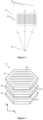
- Lens component 22 can include two or more liquid crystal cells 40 stacked on top of one another. This type of arrangement is illustrated in FIG. 2 .
- ophthalmic lens component 22 can include liquid crystal module 44.
- Liquid crystal module 44 can include two or more liquid crystal cells 40.
- Each liquid crystal cell can include liquid crystal layer 34 that includes a compound or composition of the disclosure interposed between upper substrate 32 and lower substrate 30.
- at least one of the liquid crystal layers includes a compound or composition described herein.
- Different liquid crystal layers can have the same or different compound or composition.
- Finger electrodes 38 can be formed on each lower substrate 30 and can extend parallel to the X-axis.
- Common electrode 36 can be formed on each upper substrate 32. If desired, common voltage electrode 36 can be formed on lower substrate 30 and finger electrodes 38 can be formed on upper substrate 32.
- the cell gap of each liquid crystal cell 40 in module 44 can be less than that of liquid crystal cell 40 of FIG. 1 .
- liquid crystal layers 34 of module 44 in FIG. 2 can each have a thickness T2, which is less than thickness T1 of liquid crystal layer 34 in cell 40 of FIG. 1 .
- the reduced cell gap can improve the tuning speed of liquid crystal layers 34 while still maintaining a satisfactory tuning range.
- a voltage can be applied across each liquid crystal layer 34 by supplying a first voltage to finger electrode 38 and a second voltage (e.g., a ground voltage) to common electrode 36.
- the liquid crystal between the two electrodes will receive an applied electric field with a magnitude that is proportional to the difference between the first and second voltages on the electrodes.
- the index of refraction of each liquid crystal layer 34 of component 22 can be dynamically adjusted to produce customized lenses. Because finger electrodes 38 extend along the X-dimension, the phase profile of each liquid crystal cell 40 can be modulated in the Y-dimension by applying the desired voltages to each finger electrode 38.
- Overlapping portions of the two liquid crystal layers 34 in module 44 can be controlled using the same or different voltages to achieve the desired index of refraction at that portion of module 44.
- finger electrode 38A of upper liquid crystal cell 40 in module 44 can overlap finger electrode 38B of lower liquid crystal cell 40 in module 44.
- a first voltage V1 can be applied across a portion of upper liquid crystal layer 34 overlapping finger electrode 38A
- a second voltage V2 can be applied across a portion of lower liquid crystal layer 34 overlapping finger electrode 38B.
- Voltages V1 and V2 can be different or can be the same.
- Control circuitry 26 can determine the ratio of V1 to V2 based on the desired index of refraction at that portion of the liquid crystal module 44.
- FIG. 3 depicts a cross-sectional side view of an illustrative of light 302 incident on a liquid crystal module 304.
- the liquid crystal molecules 306 in the liquid crystal module 304 can be tuned such that the light can focus with a tunable focal length 308 after passing through the lens.
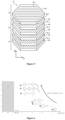
- FIGS. 4 and 5 show exploded perspective views of illustrative lens components 22 with three orientations of electrodes.
- adjustable lens components 22 include three liquid crystal cells 40.
- Each liquid crystal cell 40 can have a structure of the type described in connection with FIG. 1 , with finger electrodes 38-1, 38-2, and 38-3 oriented along three different directions.
- finger electrodes 38-1 can be oriented at 0 degrees relative to the X-axis
- finger electrodes 38-2 can be oriented at 120 degrees relative to the X-axis
- finger electrodes 38-3 can be oriented at 60 degrees relative to the X-axis.
- electrodes 38-1, 38-2, and 38-3 can have any suitable orientation.
- adjustable lens components 22 include three liquid crystal modules 14.
- Each liquid crystal module 14 can have a structure of the type described in connection with FIG. 2 .
- each liquid crystal module 14 can include an upper liquid crystal cell 40 and a lower liquid crystal cell 40.
- the liquid crystal layers of the upper and lower liquid crystal cells 40 may, if desired, have antiparallel liquid crystal alignment orientations.
- finger electrodes 38-1, 38-2, and 38-3 of liquid crystal modules 14 are oriented along three different directions.
- finger electrodes 38-1 can be oriented at 0 degrees relative to the X-axis
- finger electrodes 38-2 can be oriented at 120 degrees relative to the X-axis
- finger electrodes 38-3 can be oriented at 60 degrees relative to the X-axis. This is merely illustrative, however. In general, electrodes 38-1, 38-2, and 38-3 can have any suitable orientation.
- the compounds and compositions of the disclosure can be used in the liquid crystal lenses described in U.S. Patent No. 11,086,143 , which is incorporated herein by reference in its entirety.
- liquid crystals can be designed to have properties including but not limited to a lower viscosity, higher elastic constant (K33), and more polarizable compounds.
- Liquid crystal lenses using the compounds and compositions as liquid crystal materials thereby provide for improve tunable lenses in the visible spectrum (400 nm - 750 nm).
- the lenses can be used in, for example, automated presbyopia glasses and AR/VR glasses.
- Liquid crystal cells described herein include a liquid crystal layer comprising the compounds or compositions of the disclosure.
- the compound has the structure of formula (I): wherein
- the substituents can be selected from a range of possible options.
- R 1 is hydrogen. In some variations, R 1 is a saturated C 1-10 alkyl. In some variations, R 1 is a saturated C 1-5 alkyl. In some variations, R 1 is a saturated C 1-2 alkyl. In some variations, R 1 is ethyl. In some variations, R 1 is methyl. In some variations, R 1 is a halogen. In some variations, R 1 is a pseudohalogen. In some further variations, R 1 is a cyano substituent. In some further variations, R 1 is a thioisocyanate substituent.
- R 2 and R 3 are each independently selected from hydrogen or a halogen. In some variations, R 2 and R 3 are both hydrogen. In some variations, R 2 and R 3 are both a halogen. In some variations, the halogen is fluorine. In some variations, R 2 and R 3 are both fluorine. In some variations, R 2 is hydrogen and R 3 is a halogen.
- R 4 is Formula (II), in some variations m is 1. In some variations, m is 2. In some variations, m is 3. In some variations, m is 4. In some variations, m is 5. Further, when R 4 is Formula (II), R 5 is a saturated alkyl. In some variations, R 5 is a saturated straight chain C 1 -C 10 alkyl. In some variations, R 5 is a saturated straight chain C 1 -C 5 alkyl. In some variations, R 5 is n-butyl. In some variations, R 5 is n-propyl. In some variations, R 5 is ethyl. In some variations, R 5 is methyl. In some variations, R 5 is a C 5 -C 10 cycloalkyl.
- R 5 is a saturated C 5 -C 10 cycloalkyl. In some variations, R 5 is cyclohexyl. In some variations, R 5 is a saturated C 1 -C 10 alkoxy. In some variations, R 5 is a saturated C 1 -C 5 alkoxy.
- n is 1. In some variations, n is 2. In some variations, n is 3. In some variations, n is 4. In some variations, n is 5. Further, when R 4 is Formula (III), R 6 is a saturated alkyl. In some variations, R 6 is a saturated straight chain C 1 -C 10 alkyl. In some variations, R 6 is a saturated straight chain C 1 -C 5 alkyl. In some variations, R 6 is n-butyl. In some variations, R 6 is n-propyl. In some variations, R 6 is ethyl. In some variations, R 5 is methyl. In some variations, R 6 is a C 5 -C 10 cycloalkyl.
- R 6 is a saturated C 5 -C 10 cycloalkyl. In some variations, R 6 is cyclohexyl. In some variations, R 6 is a saturated C 1 -C 10 alkoxy. In some variations, R 6 is a saturated C 1 -C 5 alkoxy. In various aspects, R 4 can be combined with any structure or variable herein, in any combination.
- the compound has the structure of Formula (IV): wherein R 1 , R 2 , and R 3 can be as described herein, in any combination, and R 7 is a saturated alkyl.
- R 7 is a saturated straight chain C 1 -C 10 alkyl.
- R 7 is a saturated straight chain C 1 -C 5 alkyl.
- R 7 is n-butyl.
- R 7 is n-propyl.
- R 7 is ethyl.
- R 7 is methyl.
- R 7 is a saturated C 5 -C 10 cycloalkyl.
- R 7 is cyclohexyl.
- R 7 is a saturated straight chain C 1 -C 10 alkoxy.
- R 7 is -OC 2 H 5 , -OC 4 H 9 , or -OC 5 H 11 .
- the compound has the structure of Formula (V): wherein R 1 , R 2 , and R 3 can be as described herein, in any combination, and R 8 is a saturated alkyl.
- R 8 is a saturated straight chain C 1 -C 10 alkyl.
- R 8 is a saturated straight chain C 1 -C 5 alkyl.
- R 8 is n-butyl.
- R 8 is n-propyl.
- R 8 is ethyl.
- R 8 is methyl.
- R 8 is a saturated C 5 -C 10 cycloalkyl.
- R 8 is cyclohexyl.
- R 8 is a saturated straight chain C 1 -C 10 alkoxy.
- R 8 is -OC 2 H 5 , -OC 4 H 9 , or -OC 5 H 11 .
- the compound has the structure of Formula (IV): wherein R 1 , R 2 , and R 3 can be as described herein, in any combination, and R 9 is a saturated alkyl.
- R 9 is a saturated straight chain C 1 -C 10 alkyl.
- R 9 is a saturated straight chain C 1 -C 5 alkyl.
- R 9 is n-butyl.
- R 9 is n-propyl.
- R 9 is ethyl.
- R 9 is methyl.
- R 9 is a saturated C 5 -C 10 cycloalkyl. In some variations, R 9 is cyclohexyl.
- the compounds of the disclosure have properties that improve their use in liquid crystals.
- the rigid core containing phenyl substituents and optional pi bond bridges can provide higher polarizability. Connecting multiple pi bonds in succession can provide for delocalized electrons over a longer intramolecular distance. Larger number of phenyl substituents and pi-containing bridges can increase the polarizability of the compound. The delocalized electrons thereby can result in a super-linear increase in polarizability of the compound.
- the difference in refractive index along the long axis and transverse axis of the compound corresponds to the difference in polarizability. Increased polarizability results in increased tunability of the liquid crystal.
- Figure 6 depicts the band gap of the change in polarizability for several example compounds. Absorption in the visible spectrum occurs at a band gap of 3.1 eV or less. Increasing the number of phenyl rings in the described compounds results in a smaller band gap.
- increasing variables 'm' and 'n' provide for increased polarizability, while remaining above the 3.1 eV threshold such that liquid crystal layer comprising the compound or composition remains transparent.
- the pi bond bridge becomes too long, the compound can absorb radiation in the visible spectrum and in turn the liquid crystal can lose transparency in the visible spectrum. As the compounds increase in length, they can cease to be transparent. By limiting net size while increasing polarizability, the compounds and compositions are transparent through the entire visible range.
- a macroscopic change in refractive index can be achieved by rotation of the molecule.
- the relative long axis to the transverse axis corresponds to the polarizability of light incident on the liquid crystal. This property can be measured as ⁇ n for wavelengths in the visible spectrum, determined by difference in polarizability along the long axis versus the transverse axis.
- a polar groups can be at the terminal end of the compounds of the disclosure (e.g., a halogen or pseudohalogen as R 1 in the compounds of Formula (I)), creating a permanent dipole moment of the compound.
- the polar group can be a halogen.
- the polar group can be a pseudohalogen.
- the polar group can be a cyano moiety, or alternatively the polar group can be a thioisocyanate moiety.
- the polar group is an NCS moiety.
- the NCS moiety remains polarizable, but has a reduced permanent dipole moment, thereby having a lower likelihood of forming dipole-dipole interactions. Dimerization results in increased viscosity and consequent worse responsiveness when used as a liquid crystal-based high-speed tunable lens, for example.
- the compounds of the disclosure include optional transverse moieties (e.g., R 2 and R 3 in the compounds of Formula (I)). These transverse moieties are outside central axis of the compound. The transverse moieties provide a repulsive force that increases the space between compounds, thereby further decreasing viscosity.
- saturated terminal substituents opposite the polar group can increase intermolecular distances between compounds, thereby further reducing intermolecular interactions in the composition.
- the non-polar terminal group is a saturated alkyl group.
- the saturated alkyl group can be a C 1-10 saturated alkyl group or alternatively a C 1-5 saturated alkyl group.
- the alkyl group can be a C 1-10 saturated cycloalkyl group, for example a cyclohexyl group.
- the length or size of the saturated alkyl group can reduce the viscosity of the compound or composition. Reducing viscosity of the compounds when used as a liquid crystal improves the response speed of liquid crystal tunable lens in the visible spectrum. Reduced viscosity also can provide for a larger tuning range and aperture of the lens given the same figure of merit in the visible spectrum, as discussed herein.
- the disclosure is directed to a composition including multiple compounds described herein.
- the melting point of the liquid crystal can be reduced such that the liquid crystal composition has a lower melting point.
- the clearing temperature can be increased such that the composition does not become isotropic.
- composition can include any number between 1 - 20 compounds disclosed herein. In some variations, the composition can include any number between 1-15 compounds disclosed herein. In some variations, the composition can include any number between 1-10 compounds disclosed herein. In some variations, the composition can include any number between 1-5 compounds disclosed herein.
- the relative amounts of different compounds in the composition can be in any amount, and do not have to be in equal amounts.
- the melting temperature of the liquid crystal can be further reduced by combining different compounds of the disclosure to form the disclosed compositions.
- the resulting eutectic composition has a lower effective melting point temperature as compared to the melting point of a single compound.
- the composition can include multiple compounds having different chemical compositions.
- the viscosity and melting point of the composition can be reduced, while maintaining or increasing the clearing point.
- Reducing viscosity while increasing the rotational elastic constant (K33) provides for reduced response time of the liquid crystal materials.
- Intermolecular interactions that increase viscosity include dipole-dipole interactions. Smaller compounds (e.g., two rings) can reduce the melting point and reduce viscosity. Larger compounds with delocalized electrons over a longer intramolecular distance can increase the polarization of the composition.
- the polar group can be selected to reduce dimerization of the compounds.
- R 1 can be a substituent such as thioisocyanate, which is polarizable but has a reduced permanent dipole moment, and therefore and lower likelihood of forming dipole-dipole interactions.
- compositions different compounds with different levels of electron delocalization are provided. Different types of compositions defined by Formulae (IV), (V), and (VI) are in the composition. Different combinations of transverse substituents R 2 and R 3 reduce intermolecular interactions by providing a repulsive force to other molecules. Tables 1A - 1C show a combination of a non-limiting example composition.
- the composition includes a compound having the structure of Formula (IV), a compound having the structure of Formula (V), and a compound having the structure of Formula (VI) as described herein. In further variations, the composition includes more than one compound having the structure of Formula (IV), compound having the structure of Formula (V), and/or compound having the structure of Formula (VI).
- R 1 is NCS, R 2 is H or F, R 3 is H or F, and R 7 is selected from C 2 H 5 , C 4 H 9 , and C 2 H 5 O.
- R 2 is F.
- R 1 is NCS, R 2 is F, R 3 is H or F, and R 7 is selected from -OC 2 H 5 , -OC 4 H 9 , and -OC 5 H 11 .
- the composition includes from 1- 6 of the compounds of Table 1A. In still further variations, the composition includes each compound of Table 1A.
- R 1 is NCS
- R 2 is H or F
- R 3 is H or F
- R 8 is selected from C 3 H 7 and C 5 H 11 .
- R 2 and R 3 are F.
- R 1 is NCS
- R 2 is F
- R 3 is H or F
- R 8 is selected from C 3 H 7 and C 5 H 11 .
- the composition includes two compounds having the structure of Formula (V), wherein in the first compound R 1 is NCS, R 2 and R 3 are F, and R 8 is C 3 H 7 , and in the second compound R 1 is NCS, R 2 and R 3 are F, and R 8 is C 5 H 11 (as in Table 1B).
- R 1 is NCS
- R 2 is H or F
- R 3 is H or F
- R 9 is selected from C 2 H 5 and C 4 H 9 .
- R 2 is F and R 3 is H or F.
- R 2 is F and R 3 is H.
- the composition includes two compounds having the structure of Formula (VI), wherein in the first compound R 1 is NCS, R 2 is F, R 3 is H, and R 9 is C 2 H 5 , and in the second compound R 1 is NCS, R 2 is F, R 3 is H, and R 9 is C 4 H 9 (as in Table 1C).
- individual compounds in the composition have reduced intermolecular interactions, a reduced permanent dipole moment as compared to substituents with a CN polar substituent, and increased intermolecular distances.
- the combination of these properties reduces the rotational viscosity ⁇ 1, while increasing the K33 and ⁇ n (refractive index proportional to polarizability) in the visible spectrum to improve the response speed and tunability of liquid crystal tunable lenses.
- the reduced rotational viscosity also can provide for a larger tuning range and aperture of the lens.
- Table 2 provides a comparison of the properties of the composition of Tables 1A - 1C to two conventional Reference Compositions 1 and 2.
- Table 2 Property Reference Composition 1 Reference Composition 2 Liquid Crystal Composition of Table 1A-C ⁇ n 0.257 0.2188 0.39 ⁇ 1 (mPa sec, rotational velocity) 160 233 190 K33 (pN, Bend) 14.9 17.1 29.8 Figure of Merit ( ⁇ m 2 s -1 ) 6.151 3.513 23.8
- ⁇ n corresponds to the net change in refractive index between long axis and transverse axis of the molecules.
- the ⁇ n of 0.39 for wavelengths in the visible spectrum is substantial increase over Reference Compositions 1 and 2.
- the compounds and compositions have a higher K33.
- a higher K33 improves tunability of the lens.
- a higher K33 also has a larger energy barrier for thermal fluctuation, thereby reducing scattering of light incident on the liquid crystal materials that include the compounds or compositions in the visible spectrum.
- the K33 of 29.8 is substantially increased over Reference Compositions 1 and 2.
- the compounds and compositions have a lower rotational viscosity than the composition of Tables 1A-1C. Lower rotational viscosity allows faster tuning of the liquid crystal.
- the Figure of Merit (FoM) in the visible spectrum for liquid crystal ophthalmic lenses which is equal to ⁇ n 2 *K33/y1, is substantially larger than the composition described in Table 1A-1C than for conventional Reference Compositions 1 and 2 for wavelengths in the visible spectrum.
Landscapes
- Chemical & Material Sciences (AREA)
- Organic Chemistry (AREA)
- Physics & Mathematics (AREA)
- Crystallography & Structural Chemistry (AREA)
- Engineering & Computer Science (AREA)
- Materials Engineering (AREA)
- Nonlinear Science (AREA)
- General Physics & Mathematics (AREA)
- Optics & Photonics (AREA)
- Health & Medical Sciences (AREA)
- Ophthalmology & Optometry (AREA)
- Mathematical Physics (AREA)
- General Health & Medical Sciences (AREA)
- Organic Low-Molecular-Weight Compounds And Preparation Thereof (AREA)
- Liquid Crystal (AREA)
- Liquid Crystal Substances (AREA)
Applications Claiming Priority (1)
| Application Number | Priority Date | Filing Date | Title |
|---|---|---|---|
| US202163293528P | 2021-12-23 | 2021-12-23 |
Publications (2)
| Publication Number | Publication Date |
|---|---|
| EP4202012A2 true EP4202012A2 (fr) | 2023-06-28 |
| EP4202012A3 EP4202012A3 (fr) | 2024-01-24 |
Family
ID=84569275
Family Applications (1)
| Application Number | Title | Priority Date | Filing Date |
|---|---|---|---|
| EP22215847.9A Pending EP4202012A3 (fr) | 2021-12-23 | 2022-12-22 | Composés et compositions de cristaux liquides pour lentilles accordables |
Country Status (4)
| Country | Link |
|---|---|
| US (1) | US20230212458A1 (fr) |
| EP (1) | EP4202012A3 (fr) |
| JP (1) | JP7676352B2 (fr) |
| CN (1) | CN116515497A (fr) |
Citations (1)
| Publication number | Priority date | Publication date | Assignee | Title |
|---|---|---|---|---|
| US11086143B1 (en) | 2018-06-11 | 2021-08-10 | Apple Inc. | Tunable and foveated lens systems |
Family Cites Families (21)
| Publication number | Priority date | Publication date | Assignee | Title |
|---|---|---|---|---|
| DE4032579A1 (de) * | 1990-10-13 | 1992-04-16 | Merck Patent Gmbh | Supertwist-fluessigkristallanzeige |
| US20060238696A1 (en) | 2005-04-20 | 2006-10-26 | Chien-Hui Wen | Method of aligning negative dielectric anisotropic liquid crystals |
| EP2667244B1 (fr) | 2011-01-17 | 2019-04-10 | Ortus Technology Co., Ltd. | Lentille à cristaux liquides, procédé d'excitation de lentille à cristaux liquides, unité de lentille, module de caméra et appareil médical de type capsule |
| CN102352260B (zh) | 2011-07-28 | 2014-11-26 | 深圳超多维光电子有限公司 | 一种液晶组合物及液晶透镜 |
| CN102660296B (zh) * | 2012-05-16 | 2014-06-04 | 深圳超多维光电子有限公司 | 液晶组合物及其应用 |
| CN103725294B (zh) | 2013-12-19 | 2015-02-18 | 中国科学院长春光学精密机械与物理研究所 | 用于液晶波前校正器的快速液晶材料分子设计与混配 |
| CN105985786B (zh) * | 2014-08-25 | 2018-11-23 | 深圳超多维科技有限公司 | 液晶组合物及液晶透镜 |
| CN104650927A (zh) | 2015-02-09 | 2015-05-27 | 石家庄诚志永华显示材料有限公司 | 液晶组合物 |
| CN106479515B (zh) | 2015-09-01 | 2019-01-15 | 深圳超多维科技有限公司 | 一种液晶组合物及液晶透镜 |
| WO2017109534A1 (fr) * | 2015-12-21 | 2017-06-29 | Essilor International (Compagnie Générale d'Optique) | Composition biréfringente à cristaux liquides comprenant des composés de type alkylsulfanylarylisocyanatotolane |
| TWI608082B (zh) * | 2016-10-11 | 2017-12-11 | 財團法人工業技術研究院 | 變焦透鏡與其形成方法 |
| EP3739020B1 (fr) * | 2018-05-16 | 2023-08-23 | Merck Patent GmbH | Milieu à base de cristaux liquides |
| TWI775904B (zh) | 2018-07-24 | 2022-09-01 | 德商馬克專利公司 | 液晶透鏡 |
| JP6904498B1 (ja) | 2019-10-30 | 2021-07-14 | Dic株式会社 | 液晶組成物、液晶素子、センサ、液晶レンズ、光通信機器及びアンテナ |
| JP6886590B1 (ja) | 2019-10-30 | 2021-06-16 | Dic株式会社 | 液晶組成物、液晶素子、センサ、液晶レンズ、光通信機器及びアンテナ |
| JP2022174353A (ja) | 2019-10-30 | 2022-11-24 | Dic株式会社 | 液晶組成物、液晶素子及びアンテナ |
| JP7354777B2 (ja) | 2019-11-05 | 2023-10-03 | Dic株式会社 | 高周波装置用液晶化合物 |
| EP4073205B1 (fr) * | 2019-12-10 | 2024-06-12 | Merck Patent GmbH | Isothiocyanates aromatiques |
| JP7414567B2 (ja) | 2020-02-07 | 2024-01-16 | 株式会社ジャパンディスプレイ | 光制御装置及び照明装置 |
| CN116507695B (zh) * | 2020-10-28 | 2025-02-25 | 默克专利股份有限公司 | 芳族异硫氰酸酯 |
| CN113234449B (zh) * | 2021-04-30 | 2023-11-10 | 南昌虚拟现实研究院股份有限公司 | 液晶组合物以及液晶透镜 |
-
2022
- 2022-12-22 JP JP2022205141A patent/JP7676352B2/ja active Active
- 2022-12-22 CN CN202211719587.2A patent/CN116515497A/zh active Pending
- 2022-12-22 EP EP22215847.9A patent/EP4202012A3/fr active Pending
- 2022-12-23 US US18/088,055 patent/US20230212458A1/en not_active Abandoned
Patent Citations (1)
| Publication number | Priority date | Publication date | Assignee | Title |
|---|---|---|---|---|
| US11086143B1 (en) | 2018-06-11 | 2021-08-10 | Apple Inc. | Tunable and foveated lens systems |
Also Published As
| Publication number | Publication date |
|---|---|
| US20230212458A1 (en) | 2023-07-06 |
| EP4202012A3 (fr) | 2024-01-24 |
| JP2023094591A (ja) | 2023-07-05 |
| JP7676352B2 (ja) | 2025-05-14 |
| CN116515497A (zh) | 2023-08-01 |
Similar Documents
| Publication | Publication Date | Title |
|---|---|---|
| US11781069B2 (en) | Liquid-crystal medium | |
| US11414599B2 (en) | Polymerizable compounds and the use thereof in liquid-crystal displays | |
| US11312909B2 (en) | Polymerizable compounds and the use thereof in liquid-crystal displays | |
| US10550327B2 (en) | Polymerisable compounds and the use thereof in liquid-crystal displays | |
| US10669483B2 (en) | Polymerisable compounds and the use thereof in liquid-crystal displays | |
| US9926490B2 (en) | Liquid crystal medium | |
| KR102341577B1 (ko) | 중합가능한 화합물 및 액정 디스플레이에서 이의 용도 | |
| US9133395B2 (en) | Polymerizable compounds and the use thereof in liquid-crystal displays | |
| US10557083B2 (en) | Liquid crystal medium | |
| US20160032189A1 (en) | Polymerisable compounds and the use thereof in liquid-crystal displays | |
| US20160054602A1 (en) | Polymerisable compounds and the use thereof in liquid-crystal displays | |
| CN112969772B (zh) | 包含可聚合化合物的液晶介质 | |
| US20180371321A1 (en) | Polymerisable compounds and the use thereof in liquid-crystal displays | |
| KR20160145115A (ko) | 액정 물질 | |
| CN102352260A (zh) | 一种液晶组合物及液晶透镜 | |
| KR20230055386A (ko) | 액정 매질 | |
| EP3228680B1 (fr) | Ensemble de panneaux à cristaux liquides et afficheur à cristaux liquides doté de celui-ci | |
| US20220251448A1 (en) | Liquid Crystal Mixture and Liquid Crystal Display | |
| CN118369399A (zh) | 液晶介质 | |
| US20160137923A1 (en) | Liquid crystal medium | |
| KR102538719B1 (ko) | 중합가능한 화합물 및 액정 디스플레이에서 이의 용도 | |
| EP4202012A2 (fr) | Composés et compositions de cristaux liquides pour lentilles accordables | |
| KR102609821B1 (ko) | 액정 매질 | |
| CN117586784A (zh) | 液晶介质 | |
| KR102625383B1 (ko) | 중합체 안정화된 액정 디스플레이에서 odf 얼룩을 감소시키는 방법 |
Legal Events
| Date | Code | Title | Description |
|---|---|---|---|
| PUAI | Public reference made under article 153(3) epc to a published international application that has entered the european phase |
Free format text: ORIGINAL CODE: 0009012 |
|
| STAA | Information on the status of an ep patent application or granted ep patent |
Free format text: STATUS: REQUEST FOR EXAMINATION WAS MADE |
|
| 17P | Request for examination filed |
Effective date: 20221222 |
|
| AK | Designated contracting states |
Kind code of ref document: A2 Designated state(s): AL AT BE BG CH CY CZ DE DK EE ES FI FR GB GR HR HU IE IS IT LI LT LU LV MC ME MK MT NL NO PL PT RO RS SE SI SK SM TR |
|
| PUAL | Search report despatched |
Free format text: ORIGINAL CODE: 0009013 |
|
| AK | Designated contracting states |
Kind code of ref document: A3 Designated state(s): AL AT BE BG CH CY CZ DE DK EE ES FI FR GB GR HR HU IE IS IT LI LT LU LV MC ME MK MT NL NO PL PT RO RS SE SI SK SM TR |
|
| RIC1 | Information provided on ipc code assigned before grant |
Ipc: C09K 19/30 20060101ALI20231219BHEP Ipc: C09K 19/12 20060101ALI20231219BHEP Ipc: C09K 19/18 20060101AFI20231219BHEP |