EP4201780A1 - Automatisiertes fahrverfahren, werbung und automatisiertes fahrfahrzeug - Google Patents
Automatisiertes fahrverfahren, werbung und automatisiertes fahrfahrzeug Download PDFInfo
- Publication number
- EP4201780A1 EP4201780A1 EP21868553.5A EP21868553A EP4201780A1 EP 4201780 A1 EP4201780 A1 EP 4201780A1 EP 21868553 A EP21868553 A EP 21868553A EP 4201780 A1 EP4201780 A1 EP 4201780A1
- Authority
- EP
- European Patent Office
- Prior art keywords
- autonomous driving
- ads
- vehicle
- physiological data
- health
- Prior art date
- Legal status (The legal status is an assumption and is not a legal conclusion. Google has not performed a legal analysis and makes no representation as to the accuracy of the status listed.)
- Granted
Links
Images

Classifications
-
- B—PERFORMING OPERATIONS; TRANSPORTING
- B60—VEHICLES IN GENERAL
- B60W—CONJOINT CONTROL OF VEHICLE SUB-UNITS OF DIFFERENT TYPE OR DIFFERENT FUNCTION; CONTROL SYSTEMS SPECIALLY ADAPTED FOR HYBRID VEHICLES; ROAD VEHICLE DRIVE CONTROL SYSTEMS FOR PURPOSES NOT RELATED TO THE CONTROL OF A PARTICULAR SUB-UNIT
- B60W60/00—Drive control systems specially adapted for autonomous road vehicles
- B60W60/001—Planning or execution of driving tasks
-
- B—PERFORMING OPERATIONS; TRANSPORTING
- B60—VEHICLES IN GENERAL
- B60W—CONJOINT CONTROL OF VEHICLE SUB-UNITS OF DIFFERENT TYPE OR DIFFERENT FUNCTION; CONTROL SYSTEMS SPECIALLY ADAPTED FOR HYBRID VEHICLES; ROAD VEHICLE DRIVE CONTROL SYSTEMS FOR PURPOSES NOT RELATED TO THE CONTROL OF A PARTICULAR SUB-UNIT
- B60W40/00—Estimation or calculation of non-directly measurable driving parameters for road vehicle drive control systems not related to the control of a particular sub unit, e.g. by using mathematical models
- B60W40/08—Estimation or calculation of non-directly measurable driving parameters for road vehicle drive control systems not related to the control of a particular sub unit, e.g. by using mathematical models related to drivers or passengers
-
- A—HUMAN NECESSITIES
- A61—MEDICAL OR VETERINARY SCIENCE; HYGIENE
- A61B—DIAGNOSIS; SURGERY; IDENTIFICATION
- A61B5/00—Measuring for diagnostic purposes; Identification of persons
- A61B5/68—Arrangements of detecting, measuring or recording means, e.g. sensors, in relation to patient
- A61B5/6887—Arrangements of detecting, measuring or recording means, e.g. sensors, in relation to patient mounted on external non-worn devices, e.g. non-medical devices
- A61B5/6893—Cars
-
- B—PERFORMING OPERATIONS; TRANSPORTING
- B60—VEHICLES IN GENERAL
- B60W—CONJOINT CONTROL OF VEHICLE SUB-UNITS OF DIFFERENT TYPE OR DIFFERENT FUNCTION; CONTROL SYSTEMS SPECIALLY ADAPTED FOR HYBRID VEHICLES; ROAD VEHICLE DRIVE CONTROL SYSTEMS FOR PURPOSES NOT RELATED TO THE CONTROL OF A PARTICULAR SUB-UNIT
- B60W30/00—Purposes of road vehicle drive control systems not related to the control of a particular sub-unit, e.g. of systems using conjoint control of vehicle sub-units
- B60W30/18—Propelling the vehicle
-
- B—PERFORMING OPERATIONS; TRANSPORTING
- B60—VEHICLES IN GENERAL
- B60W—CONJOINT CONTROL OF VEHICLE SUB-UNITS OF DIFFERENT TYPE OR DIFFERENT FUNCTION; CONTROL SYSTEMS SPECIALLY ADAPTED FOR HYBRID VEHICLES; ROAD VEHICLE DRIVE CONTROL SYSTEMS FOR PURPOSES NOT RELATED TO THE CONTROL OF A PARTICULAR SUB-UNIT
- B60W60/00—Drive control systems specially adapted for autonomous road vehicles
-
- B—PERFORMING OPERATIONS; TRANSPORTING
- B60—VEHICLES IN GENERAL
- B60W—CONJOINT CONTROL OF VEHICLE SUB-UNITS OF DIFFERENT TYPE OR DIFFERENT FUNCTION; CONTROL SYSTEMS SPECIALLY ADAPTED FOR HYBRID VEHICLES; ROAD VEHICLE DRIVE CONTROL SYSTEMS FOR PURPOSES NOT RELATED TO THE CONTROL OF A PARTICULAR SUB-UNIT
- B60W60/00—Drive control systems specially adapted for autonomous road vehicles
- B60W60/001—Planning or execution of driving tasks
- B60W60/0015—Planning or execution of driving tasks specially adapted for safety
- B60W60/0016—Planning or execution of driving tasks specially adapted for safety of the vehicle or its occupants
-
- B—PERFORMING OPERATIONS; TRANSPORTING
- B60—VEHICLES IN GENERAL
- B60W—CONJOINT CONTROL OF VEHICLE SUB-UNITS OF DIFFERENT TYPE OR DIFFERENT FUNCTION; CONTROL SYSTEMS SPECIALLY ADAPTED FOR HYBRID VEHICLES; ROAD VEHICLE DRIVE CONTROL SYSTEMS FOR PURPOSES NOT RELATED TO THE CONTROL OF A PARTICULAR SUB-UNIT
- B60W60/00—Drive control systems specially adapted for autonomous road vehicles
- B60W60/007—Emergency override
-
- B—PERFORMING OPERATIONS; TRANSPORTING
- B60—VEHICLES IN GENERAL
- B60Q—ARRANGEMENT OF SIGNALLING OR LIGHTING DEVICES, THE MOUNTING OR SUPPORTING THEREOF OR CIRCUITS THEREFOR, FOR VEHICLES IN GENERAL
- B60Q1/00—Arrangement of optical signalling or lighting devices, the mounting or supporting thereof or circuits therefor
- B60Q1/26—Arrangement of optical signalling or lighting devices, the mounting or supporting thereof or circuits therefor the devices being primarily intended to indicate the vehicle, or parts thereof, or to give signals, to other traffic
- B60Q1/46—Arrangement of optical signalling or lighting devices, the mounting or supporting thereof or circuits therefor the devices being primarily intended to indicate the vehicle, or parts thereof, or to give signals, to other traffic for giving flashing caution signals during drive, other than signalling change of direction, e.g. flashing the headlights or hazard lights
-
- B—PERFORMING OPERATIONS; TRANSPORTING
- B60—VEHICLES IN GENERAL
- B60W—CONJOINT CONTROL OF VEHICLE SUB-UNITS OF DIFFERENT TYPE OR DIFFERENT FUNCTION; CONTROL SYSTEMS SPECIALLY ADAPTED FOR HYBRID VEHICLES; ROAD VEHICLE DRIVE CONTROL SYSTEMS FOR PURPOSES NOT RELATED TO THE CONTROL OF A PARTICULAR SUB-UNIT
- B60W40/00—Estimation or calculation of non-directly measurable driving parameters for road vehicle drive control systems not related to the control of a particular sub unit, e.g. by using mathematical models
- B60W40/08—Estimation or calculation of non-directly measurable driving parameters for road vehicle drive control systems not related to the control of a particular sub unit, e.g. by using mathematical models related to drivers or passengers
- B60W2040/0818—Inactivity or incapacity of driver
-
- B—PERFORMING OPERATIONS; TRANSPORTING
- B60—VEHICLES IN GENERAL
- B60W—CONJOINT CONTROL OF VEHICLE SUB-UNITS OF DIFFERENT TYPE OR DIFFERENT FUNCTION; CONTROL SYSTEMS SPECIALLY ADAPTED FOR HYBRID VEHICLES; ROAD VEHICLE DRIVE CONTROL SYSTEMS FOR PURPOSES NOT RELATED TO THE CONTROL OF A PARTICULAR SUB-UNIT
- B60W40/00—Estimation or calculation of non-directly measurable driving parameters for road vehicle drive control systems not related to the control of a particular sub unit, e.g. by using mathematical models
- B60W40/08—Estimation or calculation of non-directly measurable driving parameters for road vehicle drive control systems not related to the control of a particular sub unit, e.g. by using mathematical models related to drivers or passengers
- B60W2040/0872—Driver physiology
-
- B—PERFORMING OPERATIONS; TRANSPORTING
- B60—VEHICLES IN GENERAL
- B60W—CONJOINT CONTROL OF VEHICLE SUB-UNITS OF DIFFERENT TYPE OR DIFFERENT FUNCTION; CONTROL SYSTEMS SPECIALLY ADAPTED FOR HYBRID VEHICLES; ROAD VEHICLE DRIVE CONTROL SYSTEMS FOR PURPOSES NOT RELATED TO THE CONTROL OF A PARTICULAR SUB-UNIT
- B60W2540/00—Input parameters relating to occupants
- B60W2540/215—Selection or confirmation of options
-
- B—PERFORMING OPERATIONS; TRANSPORTING
- B60—VEHICLES IN GENERAL
- B60W—CONJOINT CONTROL OF VEHICLE SUB-UNITS OF DIFFERENT TYPE OR DIFFERENT FUNCTION; CONTROL SYSTEMS SPECIALLY ADAPTED FOR HYBRID VEHICLES; ROAD VEHICLE DRIVE CONTROL SYSTEMS FOR PURPOSES NOT RELATED TO THE CONTROL OF A PARTICULAR SUB-UNIT
- B60W2540/00—Input parameters relating to occupants
- B60W2540/22—Psychological state; Stress level or workload
-
- B—PERFORMING OPERATIONS; TRANSPORTING
- B60—VEHICLES IN GENERAL
- B60W—CONJOINT CONTROL OF VEHICLE SUB-UNITS OF DIFFERENT TYPE OR DIFFERENT FUNCTION; CONTROL SYSTEMS SPECIALLY ADAPTED FOR HYBRID VEHICLES; ROAD VEHICLE DRIVE CONTROL SYSTEMS FOR PURPOSES NOT RELATED TO THE CONTROL OF A PARTICULAR SUB-UNIT
- B60W2540/00—Input parameters relating to occupants
- B60W2540/221—Physiology, e.g. weight, heartbeat, health or special needs
-
- B—PERFORMING OPERATIONS; TRANSPORTING
- B60—VEHICLES IN GENERAL
- B60W—CONJOINT CONTROL OF VEHICLE SUB-UNITS OF DIFFERENT TYPE OR DIFFERENT FUNCTION; CONTROL SYSTEMS SPECIALLY ADAPTED FOR HYBRID VEHICLES; ROAD VEHICLE DRIVE CONTROL SYSTEMS FOR PURPOSES NOT RELATED TO THE CONTROL OF A PARTICULAR SUB-UNIT
- B60W2556/00—Input parameters relating to data
- B60W2556/45—External transmission of data to or from the vehicle
-
- B—PERFORMING OPERATIONS; TRANSPORTING
- B60—VEHICLES IN GENERAL
- B60W—CONJOINT CONTROL OF VEHICLE SUB-UNITS OF DIFFERENT TYPE OR DIFFERENT FUNCTION; CONTROL SYSTEMS SPECIALLY ADAPTED FOR HYBRID VEHICLES; ROAD VEHICLE DRIVE CONTROL SYSTEMS FOR PURPOSES NOT RELATED TO THE CONTROL OF A PARTICULAR SUB-UNIT
- B60W2720/00—Output or target parameters relating to overall vehicle dynamics
- B60W2720/10—Longitudinal speed
-
- B—PERFORMING OPERATIONS; TRANSPORTING
- B60—VEHICLES IN GENERAL
- B60W—CONJOINT CONTROL OF VEHICLE SUB-UNITS OF DIFFERENT TYPE OR DIFFERENT FUNCTION; CONTROL SYSTEMS SPECIALLY ADAPTED FOR HYBRID VEHICLES; ROAD VEHICLE DRIVE CONTROL SYSTEMS FOR PURPOSES NOT RELATED TO THE CONTROL OF A PARTICULAR SUB-UNIT
- B60W2756/00—Output or target parameters relating to data
- B60W2756/10—Involving external transmission of data to or from the vehicle
-
- B—PERFORMING OPERATIONS; TRANSPORTING
- B60—VEHICLES IN GENERAL
- B60Y—INDEXING SCHEME RELATING TO ASPECTS CROSS-CUTTING VEHICLE TECHNOLOGY
- B60Y2302/00—Responses or measures related to driver conditions
- B60Y2302/05—Leading to automatic stopping of the vehicle
-
- G—PHYSICS
- G07—CHECKING-DEVICES
- G07C—TIME OR ATTENDANCE REGISTERS; REGISTERING OR INDICATING THE WORKING OF MACHINES; GENERATING RANDOM NUMBERS; VOTING OR LOTTERY APPARATUS; ARRANGEMENTS, SYSTEMS OR APPARATUS FOR CHECKING NOT PROVIDED FOR ELSEWHERE
- G07C5/00—Registering or indicating the working of vehicles
- G07C5/008—Registering or indicating the working of vehicles communicating information to a remotely located station
Definitions
- This application relates to the autonomous driving field, and in particular, to an autonomous driving method, an ADS, and an autonomous driving vehicle.
- Automobiles have experienced more than 100 years of development since invention and have become an indispensable part in people's life. With improvement of living standards, people impose increasingly high requirements on travel comfort, convenience, and the like. As automobiles evolve towards intelligence, autonomous driving technologies emerge.
- autonomous driving classification standard J3016TM of Society of Automotive Engineers (society of automotive engineers, SAE) International is widely used in the industry.
- This standard is also referred to as Taxonomy and Definitions for Terms Related to Driving Automation System for On-Road Motor Vehicles.
- This standard defines autonomous driving levels (that is, a total of six autonomous driving levels: L0 to L5) based on a dynamic driving task (dynamic driving task, DDT), but lacks consideration for driving safety.
- DDT dynamic driving task
- an autonomous driving policy that focuses on driving safety, especially for scenarios in which health statuses of drivers/passengers are uncertain, needs to be launched urgently.
- Embodiments of this application provide an autonomous driving method, an ADS, and an autonomous driving vehicle, to newly add a health physiological data range as an applicable range of an operational design domain (operational design domain, ODD) to the ODD.
- an autonomous driving system autonomous driving system
- ADS autonomous driving system determines that health of the driver/passenger is abnormal, and executes a corresponding first driving policy based on a deviation degree and the duration, to handle a sudden health accident of the driver/passenger in a timely manner, and reduce an occurrence rate of traffic accidents.
- an embodiment of this application first provides an autonomous driving method, which can be applied to the autonomous driving field.
- the method includes: First, a driver/passenger in an autonomous driving vehicle in which an ADS is deployed wears a monitoring device (for example, a smart watch, a smart band, or a smart cardiotachometer, or another wearable device).
- the monitoring device may collect real-time physiological data of the driver/passenger in real time, and then send these pieces of collected real-time physiological data to the ADS by using a communication protocol (for example, Bluetooth or Wi-Fi).
- a communication protocol for example, Bluetooth or Wi-Fi
- the ADS When determining that a difference between the received real-time physiological data and the health physiological data range is greater than a preset value, the ADS further determines whether a duration in which the real-time physiological data deviates from the health physiological data range is greater than a first preset duration. When determining that the duration in which the real-time physiological data deviates from the health physiological data range is greater than the first preset duration, the ADS performs degradation processing on an autonomous driving service that is being executed by the autonomous driving vehicle, and executes a first driving policy based on specific values of the difference and the duration.
- the health physiological data range is an applicable range added to an ODD in advance.
- An additional applicable range is used to indicate a health indicator of the driver/passenger, that is, the health physiological data range, for example, a normal heart rate range and a normal blood pressure range, is added to the ODD defined in the autonomous driving classification standard J3016TM.
- the ODD is deployed on the ADS.
- the health physiological data range as the applicable range of the ODD is newly added to the ODD.
- the ADS determines that health of the driver/passenger is abnormal, and executes the corresponding first driving policy based on a deviation degree and the duration, to handle a sudden health accident of the driver/passenger in a timely manner, and reduce an occurrence rate of traffic accidents.
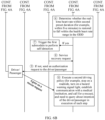
- the ADS sends an authorization request to the driver/passenger.
- the authorization request may be communicated to the driver/passenger in a voice broadcast manner, or may be communicated to the driver/passenger in an interface display manner (with a premise that a display is deployed on the autonomous driving vehicle). This is not specifically limited herein.
- the authorization request is used to ask the driver/passenger whether a second driving policy needs to be executed. After the driver/passenger receives the authorization request sent by the ADS, the ADS executes the second driving policy when the driver/passenger accepts the authorization request.
- the second driving policy is essentially an upgrade of an original risk mitigation strategy.
- a final objective of the risk mitigation strategy is "stopping the vehicle", that is, only vehicle safety in a narrow sense is considered.
- more efforts may be made in the vehicle in an actual situation, including but not limited to measures such as calling for help, organizing a rescue, requesting to arrange an emergency access, and reserving a medical resource.
- the second driving policy may be any one or more of the following: stopping on a roadside, calling for a rescue, establishing a communication connection to a medical institution, planning a traveling path between the autonomous driving vehicle and the medical institution, reserving a medical resource, and requesting to arrange an emergency medical treatment channel.
- an autonomous driving level is L4 or L5
- a person in a driving seat of the autonomous driving vehicle does not have a vehicle control right to control the autonomous driving vehicle.
- the person cannot be referred to as a driver and is usually referred to as a driver/passenger.
- that the ADS executes a first driving policy based on the difference and the duration may be specifically:
- the ADS determines a health level of the driver/passenger based on the difference and the duration.
- the first driving policy may be any one or more of: controlling, by the ADS, the autonomous driving vehicle to decrease a speed to be lower than a preset speed (for example, lower than 60 km/h), travel on a roadside, and turn on a hazard warning signal light.
- a preset speed for example, lower than 60 km/h
- the implementation of this application describes how the first driving policy is when the health level of the driver/passenger is a mild abnormality if the autonomous driving level is the level L4 or the level L5.
- the health level is determined based on the difference between the real-time physiological data and the health physiological data range and the deviation duration, and different first driving policies are used based on different health levels. This is more pertinent to specific cases.
- the first driving policy may be any one or more of: controlling, by the ADS, the autonomous driving vehicle to slowly decrease the speed to zero, stop on a roadside, turn on a hazard warning signal light, run at an idle speed, turn on an external circulation of the vehicle, turn on an internal circulation of the vehicle, set an in-vehicle target temperature, and unlock a central door lock.
- the implementation of this application describes how the first driving policy is when the health level of the driver/passenger is a severe abnormality if the autonomous driving level is the level L4 or the level L5.
- the health level is determined based on the difference between the real-time physiological data and the health physiological data range and the deviation duration, and different first driving policies are used based on different health levels. This is more pertinent to specific cases.
- the driver/passenger is a driver in a driving seat of the autonomous driving vehicle.
- the difference between the real-time physiological data and the health physiological data range is greater than the preset value, and the duration in which the real-time physiological data deviates from the health physiological data range is greater than the first preset duration, it indicates that there is a high probability that a health status of the driver/passenger is undesirable in this case.
- the ADS makes the ADS invariably occupy control permission of the autonomous driving vehicle, that is, the vehicle control right cannot be handed over to the driver/passenger.
- the ADS further determines a health level of the driver/passenger based on the deviation difference and the deviation duration, and executes the corresponding first driving policy based on the health level.
- the first driving policy may be further any one or more of: controlling, by the ADS, the autonomous driving vehicle to decrease a speed to be lower than a preset speed (for example, lower than 60 km/h), travel on a roadside, and turn on a hazard warning signal light.
- the first driving policy may be further the any one or more of: controlling, by the ADS, the autonomous driving vehicle to decrease the speed to be lower than the preset speed, travel on the roadside, and turn on the hazard warning signal light, when the health level of the driver/passenger (the driver/passenger is actually the driver in the driving seat in the case of the level L3) is the mild abnormality if the autonomous driving level is L3.
- the health level is determined based on the difference between the real-time physiological data and the health physiological data range and the deviation duration, and different first driving policies are used based on different health levels. This is more pertinent to specific cases.
- the driver/passenger has a right to take over the vehicle control right only when the health level of the driver/passenger is a normal level; otherwise, the vehicle control right cannot be handed over to the driver/passenger. This avoids a vehicle risk and a personal safety problem caused because the driver/passenger actually has no takeover capability in a specific time period due to a physical health problem.
- the first driving policy may be further any one or more of: controlling, by the ADS, the autonomous driving vehicle to slowly decrease the speed to zero, stop on a roadside, turn on a hazard warning signal light, run at an idle speed, turn on an external circulation of the vehicle, turn on an internal circulation of the vehicle, set an in-vehicle target temperature, and unlock a central door lock.
- the first driving policy may be further the any one or more of: controlling the autonomous driving vehicle to slowly decrease the speed to zero, stop on the roadside, turn on the hazard warning signal light, run at the idle speed, turn on the external circulation of the vehicle, turn on the internal circulation of the vehicle, set the in-vehicle target temperature, and unlock the central door lock, when the health level of the driver/passenger (the driver/passenger is actually the driver in the driving seat in the case of the level L3) is the severe abnormality if the autonomous driving level is L3.
- the health level is determined based on the difference between the real-time physiological data and the health physiological data range and the deviation duration, and different first driving policies are used based on different health levels. This is more pertinent to specific cases.
- the driver/passenger has a right to take over the vehicle control right only when the health level of the driver/passenger is a normal level; otherwise, the vehicle control right cannot be handed over to the driver/passenger. This avoids a vehicle risk and a personal safety problem caused because the driver/passenger actually has no takeover capability in a specific time period due to a physical health problem.
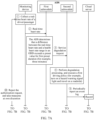
- the ADS may control the autonomous driving vehicle to recover a degraded autonomous driving service.
- the original autonomous driving service that is being executed by the autonomous driving vehicle is "high-speed car-following driving at a speed of 100 km/h"
- the difference between the real-time physiological data and the health physiological data range exceeds the preset value for the first preset duration (for example, three minutes).
- the ADS degrades the autonomous driving service to "high-speed car-following driving at a speed of 60 km/h", and continuously monitors subsequently collected real-time physiological data. If the monitored real-time physiological data is restored to fall within the health physiological data range within the second preset duration (for example, within eight minutes), the ADS restores the degraded "high-speed car-following driving at a speed of 60 km/h" autonomous driving service to the original "high-speed car-following driving at a speed of 100 km/h".
- the ADS may control the autonomous driving vehicle to recover the degraded autonomous driving service. This improves user experience.
- the ADS may further generate an event log based on the real-time physiological data, where the event log is used to record abnormal real-time physiological data and a series of subsequent operations of the ADS during a period when the real-time physiological data deviates from the health physiological data range; and periodically (for example, every five minutes) report the event log to a cloud server corresponding to the autonomous driving vehicle.
- the ADS may record, as the event log, all health-related data and operations during a period when the real-time physiological data is abnormal, and periodically report the event log to the cloud end corresponding to the autonomous driving vehicle for backup. This is convenient to distinguish responsibilities between the person and the vehicle.
- the real-time physiological data includes at least one type of the following physiological data: real-time blood pressure, a real-time heart rate, real-time blood oxygen, a real-time body temperature, a premature heart beat, atrial fibrillation, and other real-time physiological data of the driver/passenger, provided that the physiological data can be collected by the monitoring device and can reflect the health status of the driver/passenger. This is not specifically limited herein.
- a second aspect of embodiments of this application provides an ADS.
- the ADS has a function of implementing the method according to any one of the first aspect or the possible implementations of the first aspect.
- the function may be implemented by using hardware, or may be implemented by hardware executing corresponding software.
- the hardware or software includes one or more modules corresponding to the function.
- a third aspect of embodiments of this application provides an ADS.
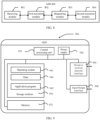
- the ADS may include a memory, a processor, and a bus system.
- the memory is configured to store a program.
- the processor is configured to invoke the program stored in the memory, to perform the method according to any one of the first aspect or the possible implementations of the first aspect of embodiments of this application.
- a fourth aspect of embodiments of this application provides an autonomous driving vehicle.
- the autonomous driving vehicle includes a processor and a memory.
- the memory is configured to store a program.
- the processor is configured to invoke the program stored in the memory, to perform the method according to any one of the first aspect or the possible implementations of the first aspect of embodiments of this application.
- a fifth aspect of this application provides a computer-readable storage medium.
- the computer-readable storage medium stores instructions. When the instructions are run on a computer, the computer is enabled to perform the method according to any one of the first aspect or the possible implementations of the first aspect.
- a sixth aspect of embodiments of this application provides a computer program product.
- the computer program product runs on a computer, the computer is enabled to perform the method according to any one of the first aspect or the possible implementations of the first aspect.
- a sixth aspect of embodiments of this application provides a chip.
- the chip includes at least one processor and at least one interface circuit, and the interface circuit is coupled to the processor.
- the at least one interface circuit is configured to perform a receiving function and a sending function, and send instructions to the at least one processor.
- the at least one processor is configured to run a computer program or instructions, and has a function of implementing the method according to any one of the first aspect or the possible implementations of the first aspect.
- the function may be implemented by using hardware, software, or a combination of hardware and software.
- the hardware or software includes one or more modules corresponding to the function.
- the interface circuit is configured to communicate with a module other than the chip.
- Embodiments of this application provide an autonomous driving method, an ADS, and an autonomous driving vehicle, to newly add a health physiological data range as an applicable range of an ODD to the ODD.
- an ADS determines that health of the driver/passenger is abnormal, and executes a corresponding first driving policy based on a deviation degree and the duration, to handle a sudden health accident of the driver/passenger in a timely manner, and reduce an occurrence rate of traffic accidents.
- Embodiments of this application relate to a lot of related knowledge about autonomous driving.
- the following first describes related terms and concepts that may be used in embodiments of this application. It should be understood that interpretations of related concepts may be limited because of specific situations of embodiments of this application, but this does not mean that this application can only be limited to the specific situations. There may be a difference between specific situations of different embodiments. Details are not limited herein.
- Automated driving system automated driving system, ADS
- the ADS is a system including both hardware and software that implement driving automation, and may also be referred to as a control system.
- a vehicle in which the ADS is deployed is referred to as an autonomous driving vehicle, or may be referred to as a driverless car, a computer driving car, a wheeled mobile robot, or the like.
- the autonomous driving vehicle implements interaction and sharing between traffic participants by configuring advanced apparatuses such as a vehicle-mounted sensor, a controller, a data processor, and an executor and by using modern mobile communication and network technologies such as an Internet of vehicles, 5G, and V2X.
- the autonomous driving vehicle has functions such as sensing and perception, decision-making and planning, and control and execution in complex environments.
- an entire working process of the autonomous driving vehicle is as follows: First, an external environment is sensed and identified by using a radar, a laser radar, a camera, an in-vehicle network system, and the like, to obtain perception information of the external environment. Then, based on fused multi-faceted perception information, an intelligent algorithm is used to learn external scenario information, predict a track of a traffic participant in a scenario, and plan a running track of the vehicle. Finally, a track target obtained through decision-making and planning is tracked, traveling actions such as controlling a throttle, braking, and steering of the vehicle are implemented, and a traveling speed, a location, a direction, and other statuses of the vehicle are adjusted, to ensure safety, maneuverability, and stability of the vehicle.
- the ODD may also be referred to as a design running domain, a design applicable domain, a design traveling area, or the like.
- the ODD refers to safe working environments of an autonomous driving vehicle, is essentially a set of parameters, and is a condition and an application range (that is, an application range of autonomous driving) in which an ADS is designed to take effect.
- the ODD can be understood as safe working environments of the autonomous driving vehicle, including a speed (a high speed, a low speed, or the like), a terrain (a plain, a mountain, or the like), a road surface condition (a straight road, a curve road, or the like), an environment (weather, a climate, an infrastructure, and the like), traffic conditions (simple or complex, a violation behavior, route fixation, and the like), a time period (in the daytime or at nighttime), and the like.
- a speed a high speed, a low speed, or the like
- a terrain a plain, a mountain, or the like
- a road surface condition a straight road, a curve road, or the like
- an environment weather, a climate, an infrastructure, and the like
- traffic conditions simple or complex, a violation behavior, route fixation, and the like
- a time period in the daytime or at nighttime
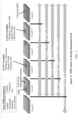
- FIG. 1 shows an ODD defined in FIG. 11 in the chapter 6 of the autonomous driving classification standard J3016TM.
- Considered elements include a vehicle speed, a terrain, a road type, a weather environment, traffic conditions, time, and the like.
- Running conditions that ODDs corresponding to different autonomous driving levels need to satisfy may be different. As shown in FIG.
- an ODD is comprehensive and detailed can reflect, to some extent, whether an autonomous driving solution is mature. Whether conditions that are set for the ODD are strict can also reflect, to some extent, levels of solutions at a same class. If the vehicle can be used only within a strictly restricted range, an "intelligent" degree of the vehicle may be lower, actual application scenarios are fewer, and experience is poorer.
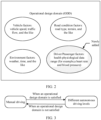
- an additional applicable range used to indicate a health indicator of a driver/passenger that is, a health physiological data range, for example, a normal heart rate range and a normal blood pressure range, is added to the ODD defined in the autonomous driving classification standard J3016TM.
- a health physiological data range for example, a normal heart rate range and a normal blood pressure range.
- the newly added health physiological data range may be added to an ODD at each autonomous driving level, and in particular, needs to be added to ODDs at levels L3 to L5.
- the ODD is integrated with the health indicator of the driver/passenger (a driver/passenger at the level L3 is a driver), that is, considers a driver takeover capability.
- the driver/passenger has no takeover obligation or approach, and corresponding ODDs also need to be integrated with the health indicator of the driver/passenger to guide the ADS to execute a subsequent risk mitigation strategy.
- the ODC is conditions in which a driving automation function can work normally and that is determined during design operation, including setting an ODD, a driver status, and other necessary conditions.
- the dynamic driving task refers to all real-time operations and policy functions (decision-making behaviors) that are needed by a vehicle for traveling on a road, and does not include strategic functions such as journey arrangement and selection of a destination and passed places.
- the DDT refers to operations and decision-making that are needed by the vehicle for traveling on the road, including performing operations in a horizontal motion direction and a vertical motion direction on the vehicle, monitoring a surrounding environment of the vehicle, performing a corresponding operation for the surrounding environment, and the like.
- the dynamic driving task can be understood as several specific functions implemented in the autonomous driving solution. Common car-following driving, adaptive cruise, emergency braking in existing mass-produced assisted driving and autonomous driving vehicles, and driver confirmed lane change and proactive overtaking equipped in few vehicles are typical dynamic driving tasks.
- Dynamic driving task fallback (dynamic driving task fallback, DDT fallback)
- a Nullmax solution is used as an example.
- the system hierarchically sends a takeover prompt. If the driver does not respond to a level-1 prompt in a specified time period, the system sends a level-2 prompt whose strength is fully upgraded. If the vehicle is not taken over in the specified time period yet, the vehicle enters a minimal risk condition, decreases a vehicle speed, and then stops.
- the RMS is risk reduction measures taken by an ADS, for example, stopping in a lane, when the ADS cannot carry out a dynamic driving task or a driver/passenger cannot take over a dynamic driving task.
- a vehicle provided with levels L2/L3 autonomous driving characteristics may have an additional failure mitigation strategy (namely, a risk mitigation strategy), regardless of what occurs on the vehicle (a driver cannot control an L2 autonomous driving characteristic in the case of L2, or a vehicle takeover person cannot take over the vehicle in the case of L3).
- the strategy controls the vehicle to stop.
- a vehicle provided with levels L4/L5 autonomous driving characteristics also has a similar failure mitigation strategy.
- the ADS exits because of a rare disaster-induced failure, the ADS controls the vehicle to slow down until the vehicle stops before exiting.
- a final objective of the risk mitigation strategy is "stopping the vehicle".
- Minimal risk condition (minimal risk condition, MRC)
- the autonomous driving classification standard J3016TM Based on degrees to which a driver/passenger and a vehicle intervene in the vehicle during traveling, the autonomous driving classification standard J3016TM defines six levels of autonomous driving technologies: a level 0, a level 1, a level 2, a level 3, a level 4, and a level 5, which may also be referred to as L0, L1, L2, L3, L4, and L5 for short.
- the autonomous driving classification standard J3016TM proposes that an ODD is a sufficient condition for satisfying different autonomous driving levels.
- an ADS can implement autonomous driving corresponding to an autonomous driving level.
- an operational design condition corresponding to the ODD is not satisfied, only manual driving by a driver can be performed.
- a level L0 is also referred to as emergency assistance.
- a driver fully controls a vehicle without any proactive safety configuration.
- vehicles at this autonomous driving level almost disappear from the market.
- a level L1 is also referred to as partial driving assistance.
- an ADS can assist a driver in completing some driving tasks.
- a level L2 is also referred to as combined driving assistance.
- an ADS can complete some driving tasks, but a driver needs to monitor a driving environment and take over a vehicle at any time when a problem occurs.
- the driver can rectify erroneous perception and judgment of the ADS at any time.
- traffic scenarios may be classified into different application scenarios based on speeds and environments, such as a low-speed traffic jam on a ring road, fast driving on an expressway, and automatic parking by a driver in a vehicle.
- a level L3 is also referred to as conditional autonomous driving.
- an ADS can complete some driving tasks and can monitor a driving environment in some cases.
- the ADS needs to be capable of controlling a vehicle to complete all dynamic driving tasks within a specified ODD, but a driver needs to get ready to re-obtain a vehicle control right.
- the ADS fails or goes beyond the ODD domain corresponding to the autonomous driving level, the ADS sends control permission handover request.
- the autonomous driving classification standard J3016TM also defines as follows: The ADS can continue to control the vehicle for several seconds after sending the control right handover request, and this time period is used by the driver to get ready to take over the vehicle control right.
- the driver's hand is placed on a steering wheel, and the driver's eyes look directly in front of the vehicle.
- the ADS may detect, by using a capacitive steering wheel, whether the driver's hand is placed on the steering wheel, detect, by using a monitoring camera in a driving seat of the vehicle, whether the driver's eyes look at a road, and the like, to determine whether the driver gets ready to take over the vehicle. If the ADS determines that the driver gets ready to take over the vehicle, the ADS hands over the vehicle control right to the driver. Therefore, at this autonomous driving level, the driver is still unallowable to sleep or take a deep rest.
- a level L4 may also be referred to as highly autonomous driving.
- an ADS can complete a driving task and monitor a driving environment.
- the ADS needs to be capable of completing a dynamic driving task within an ODD and handling a system failure, without intervention by a driver/passenger (because a vehicle at the level L4 needs no driver, there is no driver and only the driver/passenger is involved at this autonomous driving level).
- autonomous driving at the level L4 is mainly used in cities, and may provide fully autonomous valet parking or may be directly combined with a taxi hailing service.
- all driving-related tasks are unrelated to the driver/passenger, and the ADS is wholly responsible for sensing an external world.
- a level L5 may also be referred to as fully autonomous driving.
- An ADS can complete all driving tasks in all conditions, that is, implement unmanned driving in all working conditions. There is no need to define an ODD, and the ADS can complete all dynamic driving tasks and process all dynamic driving task fallbacks.
- Table 1 Relationship between autonomous driving levels and corresponding classification elements Level Name Horizontal and vertical motion control for a vehicle Target and event detection and response Dynamic driving task takeover Operational design domain Level L0 Emergency assistance Driver Driver and system Driver Limited Level L1 Partial driving assistance Driver and system Driver and system Driver Limited Level L2 Combined driving assistance System Driver and system Driver Limited Level L3 Conditional autonomous driving System System Dynamic driving task takeover user (becoming a driver after a takeover) Limited Level L4 Highly Autonomous driving System System System Limited Level Fully autonomous System System Not L5 driving limited* *Eliminate restrictions such as commercial and legal factors
- the driver/passenger is essentially a person in a driving seat of an autonomous driving vehicle.
- an autonomous driving level is L3 or a lower autonomous driving level
- the driver/passenger may also be referred to as a driver in this case, and in some driving tasks, has a vehicle control right to control the autonomous driving vehicle.
- an autonomous driving level is L4 or L5
- the person in the driving seat of the autonomous driving vehicle does not have a vehicle control right to control the autonomous driving vehicle. In this case, the person cannot be referred to as a driver and is usually referred to as a driver/passenger.
- the driver/passenger is a driver at the level L3 or below and is a driver/passenger at the level L4 or the level L5 in this embodiment of this application, and is collectively referred to as a driver/passenger in embodiments of this application.
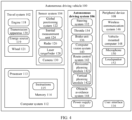
- FIG. 4 is a schematic diagram of a structure of an autonomous driving vehicle according to an embodiment of this application.
- the autonomous driving vehicle 100 is configured in a fully or partially autonomous driving mode.
- the autonomous driving vehicle 100 can control itself when in an autonomous driving mode, and through manual operations, can determine current statuses of the vehicle and a surrounding environment of the vehicle, determine a possible behavior of at least one another vehicle in the surrounding environment, determine a confidence level corresponding to a possibility that the another vehicle performs the possible behavior, and control the autonomous driving vehicle 100 based on the determined information.
- the autonomous driving vehicle 100 may be alternatively set to operate without interaction with a person.
- the autonomous driving vehicle 100 may include various subsystems, such as a travel system 102, a sensor system 104 (for example, a camera, a SICK, an IBEO, a laser radar, and the like in FIG. 3 all belong to modules in the sensor system 104), an autonomous driving system 106, one or more peripheral devices 108, a power supply 110, a computer system 112, and a user interface 116.
- the autonomous driving vehicle 100 may include more or fewer subsystems, and each subsystem may include a plurality of components.
- the subsystems and the components of the autonomous driving vehicle 100 may be interconnected in a wired or wireless manner.
- the travel system 102 may include components that provide kinetic motion for the autonomous driving vehicle 100.
- the travel system 102 may include an engine 118, an energy source 119, a transmission apparatus 120, and a wheel/tire 121.
- the engine 118 may be a combination of an internal combustion engine, a motor, an air compression engine, or another type of engine, for example, a hybrid engine formed by a gasoline engine and a motor, or a hybrid engine formed by an internal combustion engine and an air compression engine.
- the engine 118 converts the energy source 119 into mechanical energy.
- the energy source 119 includes gasoline, diesel, another oil-based fuel, propane, another compressed-gas-based fuel, anhydrous alcohol, a solar panel, a battery, and another power source.
- the energy source 119 may also provide energy for another system of the autonomous driving vehicle 100.
- the transmission apparatus 120 may transmit the mechanical power from the engine 118 to the wheel 121.
- the transmission apparatus 120 may include a gearbox, a differential gear, and a drive shaft.
- the transmission apparatus 120 may further include another component, for example, a clutch.
- the drive shaft may include one or more shafts that may be coupled to one or more wheels 121.
- the sensor system 104 may include several sensors that sense information about the surrounding environment of the autonomous driving vehicle 100.
- the sensor system 104 may include a positioning system 122 (the positioning system may be a global positioning system GPS, or may be a BeiDou system or another positioning system), an inertial measurement unit (inertial measurement unit, IMU) 124, a radar 126, a laser rangefinder 128, and a camera 130.
- the sensor system 104 may further include sensors (for example, an in-vehicle air quality monitor, a fuel gauge, and an oil temperature gauge) of an internal system of the monitored autonomous driving vehicle 100.
- Sensor data from one or more of these sensors may be used to detect an object and corresponding characteristics (a location, a shape, a direction, a speed, and the like) of the object. Such detection and identification are key functions of a safe operation of the autonomous driving vehicle 100.
- a laser sensor is a quite important sensing module in the sensor system 104.
- the positioning system 122 may be configured to estimate a geographical location of the autonomous driving vehicle 100.
- the laser sensor may be used as one of positioning systems 122 to implement precise positioning of the autonomous driving vehicle 100.
- the IMU 124 is configured to sense changes in a location and an orientation of the autonomous driving vehicle 100 based on an inertial acceleration.
- the IMU 124 may be a combination of an accelerometer and a gyroscope.
- the radar 126 may use a radio signal to sense an object in the surrounding environment of the autonomous driving vehicle 100, and may be specifically represented as a millimeter-wave radar or a laser radar.
- the radar 126 may be further configured to sense a speed and/or an advancing direction of the object.
- the laser rangefinder 128 may use laser light to sense an object in an environment in which the autonomous driving vehicle 100 is situated.
- the laser rangefinder 128 may include one or more laser sources, a laser scanner, one or more detectors, and other system components.
- the camera 130 may be configured to capture a plurality of images of the surrounding environment of the autonomous driving vehicle 100.
- the camera 130 may be a still camera or a video camera.
- the autonomous driving system 106 controls operations of the autonomous driving vehicle 100 and the components of the autonomous driving vehicle 100. Therefore, in this embodiment of this application, the autonomous driving system 106 may also be referred to as a control system.
- the autonomous driving system 106 may include various components, such as a steering system 132, a throttle 134, a brake unit 136, a computer vision system 140, a route control system 142, and an obstacle avoidance system 144.
- the steering system 132 may be operated to adjust an advancing direction of the autonomous driving vehicle 100.
- the steering system 132 may be a steering wheel system.
- the throttle 134 is configured to control an operation speed of the engine 118 and then control a speed of the autonomous driving vehicle 100.
- the brake unit 136 is configured to control the autonomous driving vehicle 100 to decelerate, and the brake unit 136 may use friction force to retard the wheel 121.
- the brake unit 136 may convert kinetic energy of the wheel 121 into a current.
- the brake unit 136 may alternatively slow down a rotational speed of the wheel 121 in another form to control the speed of the autonomous driving vehicle 100.
- the computer vision system 140 may be operated to process and analyze the images captured by the camera 130, to identify the object and/or characteristics in the surrounding environment of the autonomous driving vehicle 100.
- the object and/or characteristics may include traffic signals, road boundaries, and obstacles.
- the computer vision system 140 may use an object recognition algorithm, a structure from motion (structure from motion, SFM) algorithm, video tracking, and other computer vision technologies.
- the computer vision system 140 may be configured to: draw a map for an environment, track an object, estimate a speed of the object, and the like.
- the route control system 142 is configured to determine a traveling route and a traveling speed for the autonomous driving vehicle 100.
- the route control system 142 may include a horizontal planning module 1421 and a vertical planning module 1422.
- the horizontal planning module 1421 and the vertical planning module 1422 are configured to determine the traveling route and the traveling speed for the autonomous driving vehicle 100 based on data from the obstacle avoidance system 144, the GPS 122, and one or more predetermined maps.
- the obstacle avoidance system 144 is configured to identify, evaluate, and avoid or otherwise to bypass obstacles in the environment in which the autonomous driving vehicle 100 is situated.
- the obstacles may be specifically represented as an actual obstacle and a virtual moving object that may collide with the autonomous driving vehicle 100.
- the autonomous driving system 106 may additionally or alternatively include components other than those shown and described. Alternatively, some of the components shown above may be removed from the autonomous driving system 106.
- the autonomous driving vehicle 100 interacts with an external sensor, another vehicle, another computer system, or a user by using the peripheral device 108.
- the peripheral device 108 may include a wireless communication system 146, a vehicle-mounted computer 148, a microphone 150, and/or a loudspeaker 152.
- the peripheral device 108 provides a means for the user of the autonomous driving vehicle 100 to interact with the user interface 116.
- the vehicle-mounted computer 148 may provide information for the user of the autonomous driving vehicle 100.
- the user interface 116 may further receive a user input by operating the vehicle-mounted computer 148, and the vehicle-mounted computer 148 can be operated by using a touchscreen.
- the peripheral device 108 may provide a means for the autonomous driving vehicle 100 to communicate with another in-vehicle device.
- the microphone 150 may receive audio (for example, a voice command or another audio input) from the user of the autonomous driving vehicle 100.
- the loudspeaker 152 may output audio to the user of the autonomous driving vehicle 100.
- the wireless communication system 146 may wirelessly communicate with one or more devices directly or through a communication network.
- the wireless communication system 146 may use 3G cellular communication such as CDMA, EVD0, and GSM/GPRS, 4G cellular communication such as LTE, or 5G cellular communication.
- the wireless communication system 146 may perform communication by using a wireless local area network (wireless local area network, WLAN).
- WLAN wireless local area network
- the wireless communication system 146 may directly communicate with a device by using an infrared link, Bluetooth, or ZigBee.
- Other wireless protocols such as various vehicle communication systems, for example, the wireless communication system 146, may include one or more dedicated short-range communication (dedicated short range communications, DSRC) devices. These devices may include vehicles and/or apparatuses at roadside stations that perform public and/or private data communication with each other.
- DSRC dedicated short-range communication
- the power supply 110 may supply power to the components of the autonomous driving vehicle 100.
- the power supply 110 may be a rechargeable lithium-ion or lead-acid battery.
- One or more battery packs of such a battery may be configured as the power supply to supply power to the components of the autonomous driving vehicle 100.
- the power supply 110 and the energy source 119 may be implemented together, as in some pure-electric vehicles.
- the computer system 112 may include at least one processor 113, and the processor 113 executes instructions 115 stored in, for example, a non-transient computer-readable medium such as a memory 114.
- the computer system 112 may be alternatively a plurality of computing devices that control, in a distributed manner, individual components or subsystems of the autonomous driving vehicle 100.
- the processor 113 may be any conventional processor, for example, a commercially available central processing unit (central processing unit, CPU). Alternatively, the processor 113 may be a dedicated device, for example, an application-specific integrated circuit (application specific integrated circuit, ASIC) or another hardware-based processor.
- FIG. 1 functionally illustrates the processor, the memory, and other components of the computer system 112 in a same block
- the processor or the memory may actually include a plurality of processors or memories that are not be stored in a same physical housing.
- the memory 114 may be a hard disk drive or another storage medium located in a housing different from that of the computer system 112. Therefore, it is understood that a reference to the processor 113 or the memory 114 includes a reference to a set of processors or memories that may or may not operate in parallel.
- some components such as a steering component and a deceleration component may include respective processors.
- the processor performs only computation related to a component-specific function.
- the processor 113 may be located far away from the autonomous driving vehicle 100 and wirelessly communicate with the autonomous driving vehicle 100. In other aspects, some processes described herein are performed on the processor 113 disposed inside the autonomous driving vehicle 100, while others are performed by a remote processor 113. The processes include necessary steps for performing a single operation.
- the memory 114 may include the instructions 115 (for example, program logic), and the instructions 115 may be executed by the processor 113 to perform various functions of the autonomous driving vehicle 100, including those functions described above.
- the memory 114 may also include additional instructions, including instructions to send data to, receive data from, interact with, and/or control one or more of the travel system 102, the sensor system 104, the autonomous driving system 106, and the peripheral device 108.
- the memory 114 may also store data such as road maps, route information, a location, direction, and speed of the vehicle, data of other vehicles of this type, and other information.
- the user interface 116 is configured to provide information for or receive information from the user of the autonomous driving vehicle 100.
- the user interface 116 may be included in one or more input/output devices in a set of the peripheral devices 108, for example, the wireless communication system 146, the vehicle-mounted computer 148, the microphone 150, and the loudspeaker 152.
- the computer system 112 may control the functions of the autonomous driving vehicle 100 based on inputs received from various subsystems (for example, the travel system 102, the sensor system 104, and the autonomous driving system 106) and the user interface 116. For example, the computer system 112 may use an input from the autonomous driving system 106 to control the steering system 132 to avoid the obstacles that are detected by the sensor system 104 and the obstacle avoidance system 144. In some embodiments, the computer system 112 may be operated to control many aspects of the autonomous driving vehicle 100 and the subsystems of the autonomous driving vehicle 100.
- one or more of the foregoing components may be installed separately from or associated with the autonomous driving vehicle 100.
- the memory 114 may exist partially or completely separate from the autonomous driving vehicle 100.
- the foregoing components may be communicatively coupled together in a wired and/or wireless manner.
- An autonomous driving vehicle traveling on a road may identify an object in the surrounding environment of the autonomous driving vehicle 100, to determine to adjust a current speed.
- the object may be another vehicle, a traffic control device, or another type of object.
- each identified object may be considered independently and may be used to determine the speed to be adjusted by the autonomous driving vehicle, based on characteristics of each object, such as a current speed of the object, an acceleration of the object, and a spacing between the object and the vehicle.
- the autonomous driving vehicle 100 or a computing device associated with the autonomous driving vehicle 100 may predict a behavior of the identified object based on the characteristics of the identified object and the status (for example, traffic, rain, or ice on a road) of the surrounding environment.
- the identified objects depend on behaviors of each other. Therefore, all the identified objects may be considered together to predict a behavior of a single identified object.
- the autonomous driving vehicle 100 can adjust the speed of the autonomous driving vehicle 100 based on the predicted behavior of the identified object.
- the autonomous driving vehicle 100 can determine, based on the predicted behavior of the object, that the vehicle needs to be adjusted to a specific stable state (for example, an accelerated, decelerated, or stop state). In this process, another factor may also be considered to determine the speed of the autonomous driving vehicle 100, for example, a horizontal location of the autonomous driving vehicle 100 on a road on which the autonomous driving vehicle 100 travels, a curvature of the road, and proximity between a static object and a dynamic object.
- a specific stable state for example, an accelerated, decelerated, or stop state.
- another factor may also be considered to determine the speed of the autonomous driving vehicle 100, for example, a horizontal location of the autonomous driving vehicle 100 on a road on which the autonomous driving vehicle 100 travels, a curvature of the road, and proximity between a static object and a dynamic object.
- the computing device may provide an instruction for modifying a steering angle of the autonomous driving vehicle 100, so that the autonomous driving vehicle 100 follows a given track and/or maintains safe transverse and longitudinal distances from an object (for example, a car in an adjacent lane on the road) near the autonomous driving vehicle 100.
- an object for example, a car in an adjacent lane on the road
- the autonomous driving vehicle 100 may be a car, a truck, a motorcycle, a bus, a boat, an airplane, a helicopter, a lawn mower, a recreational vehicle, a playground vehicle, a construction device, a trolley, a golf cart, a train, a handcart, or the like. This is not specifically limited in this embodiment of this application.
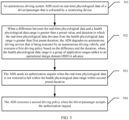
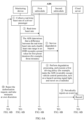
- FIG. 5 is a schematic flowchart of an autonomous driving method according to an embodiment of this application. The method may include the following steps.
- An autonomous driving system ADS receives real-time physiological data of a driver/passenger that is collected by a monitoring device.
- the driver/passenger in the autonomous driving vehicle in which the ADS is deployed wears the monitoring device (for example, a smart watch, a smart band, or a smart cardiotachometer, or another wearable device).
- the monitoring device may collect the real-time physiological data of the driver/passenger in real time, for example, may collect a heart rate, blood pressure, blood oxygen, a body temperature, a premature heart beat, atrial fibrillation, and other real-time physiological data of the driver/passenger, and then send these pieces of collected real-time physiological data to the ADS by using a communication protocol (for example, Bluetooth or Wi-Fi).
- a communication protocol for example, Bluetooth or Wi-Fi
- the driver/passenger is essentially a person in a driving seat of the autonomous driving vehicle.
- the driver/passenger may also be referred to as a driver in this case, and in some driving tasks, has a vehicle control right to control the autonomous driving vehicle.
- an autonomous driving level is L4 or L5
- the person in the driving seat of the autonomous driving vehicle does not have a vehicle control right to control the autonomous driving vehicle. In this case, the person cannot be referred to as a driver and is usually referred to as a driver/passenger.
- the driver/passenger is a driver at the level L3 or below and is a driver/passenger at the level L4 or the level L5 in this embodiment of this application, and is collectively referred to as a driver/passenger in embodiments of this application.
- the ADS degrades an autonomous driving service that is being executed by the autonomous driving vehicle, and executes a first driving policy based on the difference and the duration, where the health physiological data range is an applicable range added to an operational design domain ODD in advance.
- the ADS After receiving the real-time physiological data of the driver/passenger that is sent by the monitoring device, the ADS determines whether the real-time physiological data deviates from the health physiological data range. When determining that the difference between the received real-time physiological data and the health physiological data range is greater than the preset value, the ADS further determines whether duration in which the real-time physiological data deviates from the health physiological data range is greater than the first preset duration. When determining that the duration in which the real-time physiological data deviates from the health physiological data range is greater than the first preset duration, the ADS performs degradation processing on the autonomous driving service that is being executed by the autonomous driving vehicle, and executes the first driving policy based on specific values of the difference and the duration.
- the health physiological data range is the applicable range added to the ODD in advance.
- an additional applicable range is used to indicate a health indicator of the driver/passenger, that is, the health physiological data range, for example, a normal heart rate range and a normal blood pressure range, is added to the ODD defined in the autonomous driving classification standard J3016TM.
- the ODD is deployed on the ADS. This can avoid a vehicle risk caused because a vehicle takeover person actually has no takeover capability in a specific time period due to a physical health problem.
- the newly added health physiological data range may be added to an ODD at each autonomous driving level, and in particular, needs to be added to ODDs at levels L3 to L5.
- the ODD is integrated with the health indicator of the driver/passenger (a driver/passenger at the level L3 is a driver), that is, considers a driver takeover capability.
- the driver/passenger has no takeover obligation or approach, and corresponding ODDs also need to be integrated with the health indicator of the driver/passenger to guide the ADS to execute a subsequent risk mitigation strategy.
- the following describes step 502 by using an example in which the real-time physiological data collected by the monitoring device is a real-time heart rate and the health physiological data range is a health heart rate range. It is assumed that the health heart rate range is from 60 times per minute to 100 times per minute. If the real-time heart rate of the driver/passenger at a moment that is collected by the monitoring device ranges from 120 times per minute to 160 times per minute, which is beyond the health heart rate range, the ADS is triggered to start timing. It is assumed that the first preset duration is three minutes. After three minutes, the real-time heart rate collected by the monitoring device within the three minutes still ranges from 120 times per minute to 160 times per minute.
- duration of the abnormal real-time heart rate is three minutes, and a difference between the real-time heart rate and the health heart rate range is from 20 times per minute to 60 times per minute, which is greater than a preset value (it is assumed that the preset value is 20 times per minute). Then, it indicates that there is a high probability that a health status of the driver/passenger is suddenly undesirable.
- the ADS degrades a "high-speed car-following driving" service that is being executed by the autonomous driving vehicle (it is assumed that the autonomous driving service being executed is the "high-speed car-following driving" service).
- an original speed 100 kilometers/hour (unit: km/h) is slowly decreased to 70 km/h, and the first driving policy is executed based on the difference and the duration.
- the first driving policy may be traveling on a roadside and turning on a hazard warning signal light for warning.
- the driver/passenger is the driver in the driving seat of the autonomous driving vehicle.
- the difference between the real-time physiological data and the health physiological data range is greater than the preset value, and the duration in which the real-time physiological data deviates from the health physiological data range is greater than the first preset duration, it indicates that there is a high probability that the health status of the driver/passenger is undesirable in this case.
- the ADS makes the ADS invariably occupy the control right of the autonomous driving vehicle, that is, the vehicle control right cannot be handed over to the driver/passenger.
- the ADS further determines a health level of the driver/passenger based on the deviation difference and the deviation duration, and executes the corresponding first driving policy based on the health level.
- the first driving policy may be further any one or more of: controlling, by the ADS, the autonomous driving vehicle to decrease a speed to be lower than a preset speed (for example, lower than 60 km/h), travel on a roadside, and turn on a hazard warning signal light.
- the first driving policy may be further any one or more of: controlling, by the ADS, the autonomous driving vehicle to slowly decrease the speed to zero, stop on a roadside, turn on a hazard warning signal light, run at an idle speed, turn on an external circulation of the vehicle, turn on an internal circulation of the vehicle, set an in-vehicle target temperature, and unlock a central door lock.
- the health levels are classified into a mild abnormality and a severe abnormality (if the real-time physiological data is within the health physiological data range, the health level is a normal level).
- the real-time physiological data is a real-time heart rate to illustrate a manner of classifying the health levels of the driver/passenger.
- the health heart rate range is from 60 times per minute to 100 times per minute.
- the health heart rate range may be preset based on big data statistics, for example, may be set to 65 times per minute to 105 times per minute. This is not specifically limited herein.
- a difference and duration for determining a specific health level based on the real-time heart rate may also be preset. For example, a health level when the real-time heart rate of the driver/passenger ranges from 30 times per minute to 65 times per minute and lasts for four minutes or when the real-time heart rate of the driver/passenger ranges from 105 times per minute to 165 times per minute and lasts for three minutes may be set to a mild abnormality. This is not specifically limited herein.
- takeover capability levels of taking over the vehicle control right by the driver/passenger may be correspondingly obtained based on the health level of the driver/passenger.
- the takeover capability levels are separately described as follows:
- the foregoing describes only three classified health levels: normal, a mild abnormality, and a severe abnormality, which are respectively corresponding to the level 1, the level 2, and the level 3.
- more or fewer health levels may be set depending on an actual application scenario.
- the health levels may be classified into only a normal level and an abnormality level, that is, are corresponding to two levels.
- the health levels may be classified into a normal level, a mild abnormality, a moderate abnormality, and a severe abnormality, that is, are corresponding to four levels.
- How to classify the health levels is not specifically limited herein. Only a mild abnormality and a severe abnormality are used as an example for illustration in embodiments of this application, to describe different first driving policies that may be used based on different health levels in embodiments of this application. This is more pertinent to specific cases.
- the foregoing describes only three classified takeover capability levels: the level 1, the level 2, and the level 3. In some implementations of this application, more or fewer takeover capability levels may be set depending on an actual application scenario. How to classify the takeover capability levels is not specifically limited herein.
- the real-time physiological data is a real-time heart rate to illustrate a manner of classifying the health levels of the driver/passenger.
- the real-time physiological data collected by the monitoring device may be alternatively real-time physiological data of the driver/passenger, for example, a heart rate, blood pressure, blood oxygen, a body temperature, a premature heart beat, and atrial fibrillation, provided that the physiological data can be collected by the monitoring device and can reflect the health status of the driver/passenger. This is not specifically limited herein.
- the health physiological data range in the ODD is correspondingly the health heart rate range. In this embodiment of this application, it is assumed that the health heart rate range is from 60 times per minute to 100 times per minute. If a health level being a normal level is corresponding to the level 1, it indicates that a driver/passenger takeover capability is the level 1, and the autonomous driving service that is being executed by the autonomous driving vehicle is not affected.
- the ADS controls the autonomous driving service that is being executed by the autonomous driving vehicle to degrade, and controls the autonomous driving vehicle to perform any one or more of the following: decreasing a speed to be lower than a preset speed, traveling on a roadside, and turning on a hazard warning signal light.
- the ADS controls the autonomous driving service that is being executed by the autonomous driving vehicle to be continuously degraded, and controls the autonomous driving vehicle to perform any one or more of the following: slowly decreasing the speed to zero, stopping on a roadside, turning on a hazard warning signal light, running at an idle speed, turning on an external circulation of the vehicle, turning on an internal circulation of the vehicle, setting an in-vehicle target temperature, and unlocking a central door lock.
- Table 2 Health level classification of a driver/passenger and corresponding first driving policies in the case of L3 Real-time physiological data of a driver/passenger (using a real-time heart rate as an example) Health level classification First driving policy
- a real-time heart rate ranges from 60 times per minute to 100 times per minute.
- Level 1 healthy • An autonomous driving service is running normally.
- a vehicle control right can be handed over to a driver.
- a real-time heart rate ranges from 40 times per minute to 60 times per minute and lasts for three minutes, or a real-time heart rate ranges from 100 times per minute to 160 times per minute and lasts for three minutes.
- Level 2 mildly abnormal • An autonomous driving service is degraded. • A vehicle control right cannot be handed over to a driver.
- An ADS controls an autonomous driving vehicle to perform any one or more of the following: decreasing a speed to be lower than a preset speed, traveling on a roadside, and turning on a hazard warning signal light.
- a real-time heart rate is less than 40 times per minute and lasts for five minutes, or a real-time heart rate is greater than 160 times per minute and lasts for five minutes.
- Level 3 severely abnormal • An autonomous driving service is continuously degraded. • A vehicle control right cannot be handed over to a driver.
- An ADS controls an autonomous driving vehicle to perform any one or more of the following: slowly decreasing a speed to zero, stopping on a roadside, turning on a hazard warning signal light, running at an idle speed, turning on an external circulation of the vehicle, turning on an internal circulation of the vehicle, setting an in-vehicle target temperature, and unlocking a central door lock.
- the health level is determined based on the difference between the real-time physiological data and the health physiological data range and the deviation duration, and different first driving policies are used based on different health levels. This is more pertinent to specific cases.
- the driver/passenger has a right to take over the vehicle control right only when the health level of the driver/passenger is a normal level; otherwise, the vehicle control right cannot be handed over to the driver/passenger, and the ADS executes the first driving policy. This avoids a vehicle risk and a personal safety problem caused because the driver/passenger actually has no takeover capability in a specific time period due to a physical health problem.
- the person in the driving seat of the autonomous driving vehicle does not have a vehicle control right to control the autonomous driving vehicle.
- the person cannot be referred to as a driver and is usually referred to as a driver/passenger.
- the difference between the real-time physiological data and the health physiological data range is greater than the preset value, and the duration in which the real-time physiological data deviates from the health physiological data range is greater than the first preset duration, it indicates that there is a high probability that a health status of the driver/passenger is undesirable in this case.
- the ADS further determines a health level of the driver/passenger based on the deviation difference and the deviation duration, and executes the corresponding first driving policy based on the health level.
- the first driving policy may be any one or more of: controlling, by the ADS, the autonomous driving vehicle to decrease a speed to be lower than a preset speed (for example, lower than 60 km/h), travel on a roadside, and turn on a hazard warning signal light.
- the first driving policy may be any one or more of: controlling, by the ADS, the autonomous driving vehicle to slowly decrease the speed to zero, stop on a roadside, turn on a hazard warning signal light, run at an idle speed, turn on an external circulation of the vehicle, turn on an internal circulation of the vehicle, set an in-vehicle target temperature, and unlock a central door lock.
- the autonomous driving level is L3
- health levels are classified into a mild abnormality and a severe abnormality (if the real-time physiological data is within the health physiological data range, the health level is a normal level).
- a mild abnormality if the real-time physiological data is within the health physiological data range, the health level is a normal level.
- the health physiological data range in the ODD is correspondingly the health heart rate range. In this embodiment of this application, it is assumed that the health heart rate range is from 60 times per minute to 100 times per minute. If a health level being a normal level is corresponding to the level 1, the autonomous driving service that is being executed by the autonomous driving vehicle is not affected.
- the ADS controls the autonomous driving service that is being executed by the autonomous driving vehicle to degrade, and controls the autonomous driving vehicle to perform any one or more of the following: decreasing a speed to be lower than a preset speed, traveling on a roadside, and turning on a hazard warning signal light.
- the ADS controls the autonomous driving service that is being executed by the autonomous driving vehicle to be continuously degraded, and controls the autonomous driving vehicle to perform any one or more of the following: slowly decreasing the speed to zero, stopping on a roadside, turning on a hazard warning signal light, running at an idle speed, turning on an external circulation of the vehicle, turning on an internal circulation of the vehicle, setting an in-vehicle target temperature, and unlocking a central door lock.
- a difference between Table 3 and Table 2 lies in that the first driving policy in Table 3 does not involve a handover of the vehicle control right, because at the level L4 or the level L5, the driver/passenger has no obligation or approach to take over the vehicle.
- Table 3 Health level classification of a driver/passenger and corresponding first driving policies in the case of L4 or L5 Real-time physiological data of a driver/passenger (using a real-time heart rate as an example) Health level classification First driving policy
- a real-time heart rate ranges from 60 times per minute to 100 times per minute.
- Level 1 healthy • An autonomous driving service is running normally.
- a real-time heart rate ranges from 40 times per minute to 60 times per minute and lasts for three minutes, or a real-time heart rate ranges from 100 times per minute to 160 times per minute and lasts for three minutes.
- Level 2 mildly abnormal • An autonomous driving service is degraded.
- An ADS controls an autonomous driving vehicle to perform any one or more of the following: decreasing a speed to be lower than a preset speed, traveling on a roadside, and turning on a hazard warning signal light.
- a real-time heart rate is less than 40 times per minute and lasts for five minutes, or a real-time heart rate is greater than 160 times per minute and lasts for five minutes.
- Level 3 severely abnormal • An autonomous driving service is continuously degraded.
- An ADS controls an autonomous driving vehicle to perform any one or more of the following: slowly decreasing a speed to zero, stopping on a roadside, turning on a hazard warning signal light, running at an idle speed, turning on an external circulation of the vehicle, turning on an internal circulation of the vehicle, setting an in-vehicle target temperature, and unlocking a central door lock.
- the health level is determined based on the difference between the real-time physiological data and the health physiological data range and the deviation duration, and different first driving policies are used based on different health levels. This is more pertinent to specific cases.
- the ADS sends an authorization request when the real-time physiological data is not restored to fall within the health physiological data range within a second preset duration.
- the ADS sends an authorization request to the driver/passenger.
- the authorization request may be communicated to the driver/passenger in a voice broadcast manner, or may be communicated to the driver/passenger in an interface display manner (with a premise that a display is deployed on the autonomous driving vehicle). This is not specifically limited herein.
- the authorization request is used to ask the driver/passenger whether a second driving policy needs to be executed.
- the ADS executes the second driving policy when the driver/passenger accepts the authorization request.
- the ADS executes the second driving policy when the driver/passenger accepts the authorization request.
- the second driving policy may be any one or more of the following: stopping on a roadside, calling for a rescue, establishing a communication connection to a medical institution, planning a traveling path between the autonomous driving vehicle and the medical institution, reserving a medical resource, and requesting to arrange an emergency medical treatment channel.
- the second driving policy is essentially an upgrade of an original risk mitigation strategy.
- a final objective of the risk mitigation strategy is "stopping the vehicle", that is, only vehicle safety in a narrow sense is considered.
- more efforts may be made in the vehicle in an actual situation, including but not limited to measures such as calling for help, organizing a rescue, requesting to arrange an emergency access, and reserving a medical resource, especially within "first aid platinum 10 minutes" when it is detected that the driver/passenger is uncomfortable.
- the "first aid platinum 10 minutes" are first 10 minutes from start time when the driver/passenger is sent to an emergency department or an emergency room of a related department of a hospital to time when a doctor performs emergency treatment, after an emergency event occurs, regardless of a specific procedure. Earlier 10 minutes lead to a higher value. This is of great meaning and significance in guiding doctors to establish a time-efficiency view in an emergency specialty.
- step 503 and step 504 may not be included.
- the ADS may execute the original risk mitigation strategy. For example, assuming that the real-time physiological data is a real-time heart rate, in a scenario related to a heart rate, even if the health level of the driver/passenger is an abnormality level, the driver/passenger is still conscious.
- the ADS needs to first query about intention of the driver/passenger before executing the second driving policy, for example, using an in-vehicle communication device (for example, a T-box) to call for help or call for an emergency medical resource, because if error reports are frequent, user experience is poor and the autonomous driving service that is being executed is frequently degraded. In this way, the intention of the driver/passenger is respected, and occasional indeterminate error reporting of the monitoring device can be avoided. In addition, time for discovering a health problem is advanced (because the driver/passenger may not perceive obvious discomfort if a mild abnormality occurs), so that advance detection and timely handling are implemented. In this way, user experience is desirable, and health of the driver/passenger is ensured. This reduces an occurrence rate of traffic accidents, and also brings huge social benefits.
- an in-vehicle communication device for example, a T-box
- the ADS may control the autonomous driving vehicle to recover a degraded autonomous driving service.
- the original autonomous driving service that is being executed by the autonomous driving vehicle is "high-speed car-following driving at a speed of 100 km/h"
- the difference between the real-time physiological data and the health physiological data range exceeds the preset value for the first preset duration (for example, three minutes).
- the ADS degrades the autonomous driving service to "high-speed car-following driving at a speed of 60 km/h", and continuously monitors subsequently collected real-time physiological data. If the monitored real-time physiological data is restored to fall within the health physiological data range within the second preset duration (for example, within eight minutes), the ADS restores the degraded "high-speed car-following driving at a speed of 60 km/h" autonomous driving service to the original "high-speed car-following driving at a speed of 100 km/h".
- the ADS may further generate an event log based on the real-time physiological data, where the event log is used to record abnormal real-time physiological data and a series of subsequent operations of the ADS during a period when the real-time physiological data deviates from the health physiological data range; and periodically report the event log to a cloud server corresponding to the autonomous driving vehicle.
- This is convenient to distinguish responsibilities between the person and the vehicle.
- the following uses an example for description. It is assumed that a time in which the real-time physiological data of the driver/passenger that is collected by the monitoring device deviates from the health physiological data range is from 10:00 to 10:10 on September 6, 2020, and the health level is a mild abnormality.
- the ADS uses the first driving policy for the health level, and when the driver/passenger rejects the authorization request, the ADS controls the autonomous driving vehicle to execute the original risk mitigation strategy.
- an event log is generated in the corresponding time period from 10:00 to 10: 10 on September 6, 2020.
- the event log records real-time physiological data and a series of operations of the ADS that are corresponding to the time period.
- the series of operations are as follows:
- the first driving policy is used for the health level, and when the driver/passenger rejects the authorization request, the autonomous driving is controlled to execute the original risk mitigation strategy.
- the autonomous driving levels are not distinguished between each other for the second driving policy.
- the second driving policy may be any one or more of the following: stopping on a roadside, calling for a rescue, establishing a communication connection to a medical institution, planning a traveling path between the autonomous driving vehicle and the medical institution, reserving a medical resource, and requesting to arrange an emergency medical treatment channel.
- different second driving policies may be used for different autonomous driving levels. This is more pertinent to specific cases, and can improve user experience. The following separately provides descriptions.
- the ADS may query about the intention of the driver/passenger in advance in execution of each step of the second driving policy. For example, when the driver/passenger accepts the authorization request, if the health level of the driver/passenger is a mild abnormality, the ADS may plan a route between a medical institution closest to the ADS and the ADS, and re-send an authorization request "the route to the nearest medical institution has been planned, whether to go". If the driver/passenger agrees to go, the ADS may control the autonomous driving vehicle to go to the medical institution.
- the ADS may send an authorization request such as "whether to call for a rescue" or “whether to reserve a medical resource", plan a route between a medical institution closest to the ADS and the ADS, and send another authorization request "the route to the nearest medical institution has been planned, whether to go”. If the driver/passenger agrees on both the authorization requests, the ADS may call for a rescue, and simultaneously control the autonomous driving vehicle to go to the medical institution.
- the real-time physiological data is a real-time heart rate and the health levels of the driver/passenger are classified to describe health level classification of the driver/passenger, and corresponding first driving policies, second driving policies, and event log reporting. Details may be described in Table 4.
- the health physiological data range in the ODD is correspondingly the health heart rate range. In this embodiment of this application, it is assumed that the health heart rate range is from 60 times per minute to 100 times per minute.
- Table 4 Health level classification of a driver/passenger, and corresponding first/second driving policies and event log reporting in the case of L3 Real-time physiological data of a driver/passenger (using a real-time heart rate as an example) Health level classification First driving policy Second driving policy Event log
- a real-time heart rate ranges from 60 times per minute to 100 times per minute. Level 1: healthy • An autonomous driving service is running normally. N/A N/A • A vehicle control right can be handed over to a driver.
- a real-time heart rate ranges from 40 times per minute to 60 times per minute and lasts for three minutes, or a real-time heart rate Level 2: mildly abnormal • An autonomous driving service is degraded. Query whether the driver/passenger feels well.
- An ADS controls an ranges from 100 times per minute to 160 times per minute and lasts for three minutes.
- autonomous driving vehicle to perform any one or more of the following: decreasing a speed to be lower than a preset speed, traveling on a roadside, and turning on a hazard warning signal light.
- policy including but not limited to any one or more of the following: calling for a rescue, establishing a communication connection to a medical institution, planning a traveling path between the autonomous driving vehicle and the medical institution, reserving a medical resource, and requesting to arrange an emergency medical treatment channel.
- a real-time heart rate is less than 40 times per minute and lasts for five minutes, or a real-time heart rate is greater than 160 times per minute and lasts for five minutes.
- Level 3 severely abnormal • An autonomous driving service is continuously degraded. • A vehicle control right cannot be handed over to a driver.
- An ADS controls an autonomous driving vehicle to perform any one or more of the following: slowly decreasing a speed to zero, stopping on a roadside, turning on a hazard warning signal light, running at an idle speed, turning on an external circulation of the vehicle, turning on an internal circulation of the vehicle, setting an in-vehicle target temperature, and unlocking a central door lock.
- the foregoing second driving policy when the autonomous driving level is L3 is merely an example. In an actual application scenario, a specific implementation of the second driving policy may be set depending on a requirement. This is not limited herein.
- the driver/passenger has no obligation or approach to take over the vehicle in this case. Therefore, after the ADS sends an authorization request when the real-time physiological data is not restored to fall within the health physiological data range within the second preset duration, if the driver/passenger accepts the authorization request, the ADS directly executes the second driving policy, and subsequently does not query about the intention of the driver/passenger.
- the specified second driving policy is "planning a traveling path between the autonomous driving vehicle and a nearest medical institution and going, and requesting the nearest medical institution to arrange an emergency medical treatment channel".
- the ADS directly controls the autonomous driving vehicle to plan the traveling path between the autonomous driving vehicle and the nearest medical institution and go, and requests, by using a communication device on the autonomous driving vehicle, the nearest medical institution to arrange an emergency medical treatment channel.
- the ADS may broadcast an execution status of the second driving policy to the driver/passenger in real time.
- the real-time physiological data is a real-time heart rate and the health levels of the driver/passenger are classified to describe health level classification of the driver/passenger, and corresponding first driving policies, second driving policies, and event log reporting. Details may be described in Table 5.
- the health physiological data range in the ODD is correspondingly the health heart rate range. In this embodiment of this application, it is assumed that the health heart rate range is from 60 times per minute to 100 times per minute.
- a difference between Table 5 and Table 4 lies in that the first driving policy in Table 5 does not involve a handover of the vehicle control right, because at the level L4 or the level L5, the driver/passenger has no obligation or approach to take over the vehicle.
- Table 5 Health level classification of a driver/passenger, and corresponding first/second driving policies and event log reporting in the case of L4 or L5 Real-time physiological data of a driver/passenger (using a real-time heart rate as an example) Health level classification First driving policy Second driving policy Event log A real-time heart rate ranges from 60 times per minute to 100 times per minute. Level 1: healthy • An autonomous driving service is running normally. N/A N/A A real-time heart rate ranges from 40 times per minute to 60 times per minute and Level 2: mildly abnormal • An autonomous driving service is degraded. Query whether the driver/passenger feels well.
- An ADS controls an autonomous driving vehicle lasts for three minutes, or a real-time heart rate ranges from 100 times per minute to 160 times per minute and lasts for three minutes. to perform any one or more of the following: decreasing a speed to be lower than a preset speed, traveling on a roadside, and turning on a hazard warning signal light.
- the second driving policy including but not limited to any one or more of the following: calling for a rescue, establishing a communication connection to a medical institution, planning a traveling path between the autonomous driving vehicle and the medical institution, reserving a medical resource, of subsequent operations of the ADS during a period when real-time physiological data deviates from a health physiological data range; and periodically report the event log to a cloud server corresponding to the autonomous driving vehicle.
- a real-time heart rate is less than 40 times per minute and lasts for five minutes, or a real-time heart rate is greater than 160 times per minute and lasts for five minutes.
- Level 3 severely abnormal • An autonomous driving service is continuously degraded.
- An ADS controls an autonomous driving vehicle to perform any one or more of the following: slowly decreasing a speed to zero, stopping on a roadside, turning on a hazard warning signal light, running at an idle speed, turning on an external circulation of the vehicle, turning on an internal circulation of the vehicle, setting an in-vehicle target temperature, and unlocking a central door lock. and requesting to arrange an emergency medical treatment channel.
- the foregoing second driving policy when the autonomous driving level is the level L4 or the level L5 is merely an example.
- a specific implementation of the second driving policy may be set depending on a requirement. This is not limited herein.
- the following uses two specific examples to separately describe autonomous driving methods provided in embodiments of this application when the autonomous driving level is the level L3 and when the autonomous driving level is the level L4 or the level L5.
- An example in which the real-time physiological data is a heart rate and the health physiological data range is the health heart rate range from 60 times per minute to 100 times per minute is used for illustration.
- an autonomous driving vehicle needs to have several prerequisites: (1) The driver/passenger wears a monitoring device (for example, a smart watch) that collects real-time physiological data.
- the monitoring device may be configured to collect a heart rate, blood pressure, blood oxygen, a body temperature, a premature heart beat, atrial fibrillation, and the like of the driver/passenger, and may send these pieces of collected real-time physiological data to an ADS by using a communication protocol (for example, Bluetooth or Wi-Fi).
- the autonomous driving vehicle has a specific human-computer interaction capability (for example, a voice answer function).
- the autonomous driving vehicle has a function of performing basic voice communication with an external world.
- FIG. 6A and FIG. 6B show an example of an autonomous driving method in the case of a level L3 according to an embodiment of this application.
- the example may include the following steps.
- Step 1 A monitoring device collects a real-time heart rate of a driver/passenger.
- Step 2 The monitoring device sends the collected real-time heart rate to a first submodule of an ADS, where the first submodule is configured to determine whether the real-time heart rate deviates from a health heart rate range in an ODD.
- Step 3 When the ADS determines that a difference between the real-time heart rate and the health heart rate range in the ODD exceeds a preset value for first preset duration (for example, three minutes), the first submodule of the ADS sends a service degradation request to a second submodule of the ADS, where the service degradation request is used to indicate the second submodule of the ADS to perform degradation processing on an autonomous driving service that is being executed by an autonomous driving vehicle, for example, decrease a speed of the vehicle.
- a preset value for first preset duration for example, three minutes
- Step 4 The second submodule of the ADS performs, based on the service degradation request, degradation processing on the autonomous driving service that is being executed by the autonomous driving vehicle, and the second submodule of the ADS controls the autonomous driving vehicle to execute a first driving policy, for example, make the ADS invariably occupy a vehicle control right, turn on a hazard warning signal light, and travel on a roadside.
- a first driving policy for example, make the ADS invariably occupy a vehicle control right, turn on a hazard warning signal light, and travel on a roadside.
- Step 5 The second submodule of the ADS periodically reports an event log to a cloud server, so that the cloud server corresponding to the ADS needs to record operations, for example, performing service degradation by the ADS and executing the first driving policy by the ADS. This is convenient to subsequently distinguish responsibilities between the person and the vehicle.
- Step 6 The second submodule of the ADS further determines whether the real-time heart rate collected within a second preset duration (for example, within five minutes) is restored to fall within the health heart rate range in the ODD.
- a second preset duration for example, within five minutes
- Step 7 If the collected real-time heart rate is restored to fall within the health heart rate range in the ODD, trigger the first submodule of the ADS to perform status self-detection.
- Step 8 After completing self-detection, the first submodule of the ADS sends a service recovery request to the second submodule of the ADS, where the service recovery request is used to indicate the second submodule of the ADS to recover a degraded autonomous driving service, for example, perform acceleration to reach an original traveling speed.
- Step 9 If the collected real-time heart rate is not restored to fall within the health heart rate range in the ODD, send an authorization request to the driver/passenger by using an in-vehicle communication device, where the authorization request is used to query about a second driving policy, for example, query whether a rescue or nearby medical treatment is needed.
- Step 10 If the driver/passenger rejects the authorization request, it indicates that the driver/passenger considers that a health status of the driver/passenger can be restored (for example, the driver/passenger has carried first-aid medicine), and the driver/passenger may take measures at own discretion in this case.
- Step 11 If the driver/passenger agrees on the authorization request, the second submodule of the ADS may execute the second driving policy, and needs to query about intention of the driver/passenger in execution of each step.
- an autonomous driving vehicle also needs to have several prerequisites: (1) The driver/passenger wears a monitoring device (for example, a smart watch) that collects real-time physiological data.
- the monitoring device may be configured to collect a heart rate, blood pressure, blood oxygen, a body temperature, a premature heart beat, atrial fibrillation, and the like of the driver/passenger, and may send these pieces of collected real-time physiological data to an ADS by using a communication protocol (for example, Bluetooth or Wi-Fi).
- the autonomous driving vehicle has a specific human-computer interaction capability (for example, a voice answer function).
- the autonomous driving vehicle has a function of performing basic voice communication with an external world.
- FIG. 7A and FIG. 7B show an example of an autonomous driving method in the case of a level L4 or a level L5 according to an embodiment of this application.
- the example may include the following steps.
- Step 1 A monitoring device collects a real-time heart rate of a driver/passenger.
- Step 2 The monitoring device sends the collected real-time heart rate to a first submodule of an ADS, where the first submodule is configured to determine whether the real-time heart rate deviates from a health heart rate range in an ODD.
- Step 3 When the ADS determines that a difference between the real-time heart rate and the health heart rate range in the ODD exceeds a preset value for first preset duration (for example, three minutes), the first submodule of the ADS sends a service degradation request to a second submodule of the ADS, where the service degradation request is used to indicate the second submodule of the ADS to perform degradation processing on an autonomous driving service that is being executed by an autonomous driving vehicle, for example, decrease a speed of the vehicle.
- a preset value for first preset duration for example, three minutes
- Step 4 The second submodule of the ADS performs, based on the service degradation request, degradation processing on the autonomous driving service that is being executed by the autonomous driving vehicle, and the second submodule of the ADS controls the autonomous driving vehicle to execute a first driving policy, for example, turn on a hazard warning signal light and travel on a roadside.
- a first driving policy for example, turn on a hazard warning signal light and travel on a roadside.
- Step 5 The second submodule of the ADS periodically reports an event log to a cloud server, so that the cloud server corresponding to the ADS needs to record operations, for example, performing service degradation by the ADS and executing the first driving policy by the ADS. This is convenient to subsequently distinguish responsibilities between the person and the vehicle.
- Step 6 The second submodule of the ADS further determines whether the real-time heart rate collected within a second preset duration (for example, within five minutes) is restored to fall within the health heart rate range in the ODD.
- a second preset duration for example, within five minutes
- Step 7 If the collected real-time heart rate is restored to fall within the health heart rate range in the ODD, trigger the first submodule of the ADS to perform status self-detection.
- Step 8 After completing self-detection, the first submodule of the ADS sends a service recovery request to the second submodule of the ADS, where the service recovery request is used to indicate the second submodule of the ADS to recover a degraded autonomous driving service, for example, perform acceleration to reach an original traveling speed.
- Step 9 If the collected real-time heart rate is not restored to fall within the health heart rate range in the ODD, send an authorization request to the driver/passenger by using an in-vehicle communication device, where the authorization request is used to query about a second driving policy, for example, query whether a rescue or nearby medical treatment is needed.
- Step 10 If the driver/passenger rejects the authorization request, it indicates that the driver/passenger considers that a health status of the driver/passenger can be restored (for example, the driver/passenger has carried first-aid medicine), and the driver/passenger may take measures at own discretion in this case.
- Step 11 If the driver agrees on the authorization request, the second submodule of the ADS may execute the second driving policy. Specifically, the second submodule of the ADS may control the autonomous driving vehicle to stop on a roadside, turn on a hazard warning signal light, establish communication with a medical institution, call for a rescue, notify the driver/passenger of estimated time at which a rescue arrives, and the like.
- the example of the autonomous driving method provided in the embodiment corresponding to FIG. 7A and FIG. 7B differs from the example of the autonomous driving method corresponding to FIG. 6A and FIG. 6B mainly in the following two aspects:
- FIG. 8 is a schematic diagram of a structure of an ADS 800 according to an embodiment of this application.
- the ADS 800 may specifically include a receiving module 801 and a first execution module 802.
- the receiving module 801 is configured to receive real-time physiological data of a driver/passenger that is collected by a monitoring device; and the first execution module 802 is configured to: when a difference between the real-time physiological data and a health physiological data range is greater than a preset value, and a duration in which the real-time physiological data deviates from the health physiological data range is greater than a first preset duration (for example, three minutes), degrade an autonomous driving service that is being executed by an autonomous driving vehicle, and execute a first driving policy based on the difference and the duration, where the health physiological data range is an applicable range added to an ODD in advance, and the ODD is deployed on the ADS.
- a preset value for example, three minutes
- the health physiological data range as the applicable range of the ODD is newly added to the ODD.
- the ADS determines that health of the driver/passenger is abnormal, and executes the corresponding first driving policy based on a deviation degree and the duration, to handle a sudden health accident of the driver/passenger in a timely manner, and reduce an occurrence rate of traffic accidents.
- the ADS 800 further includes a requesting module 803 and a second execution module 804.
- the requesting module 803 is configured to send an authorization request when the real-time physiological data is not restored to fall within the health physiological data range within a second preset duration (for example, within eight minutes); and the second execution module 804 is configured to execute a second driving policy when the driver/passenger accepts the authorization request.
- the second driving policy is essentially an upgrade of an original risk mitigation strategy.
- a final objective of the risk mitigation strategy is "stopping the vehicle", that is, only vehicle safety in a narrow sense is considered.
- more efforts may be made in the vehicle in an actual situation, including but not limited to measures such as calling for help, organizing a rescue, requesting to arrange an emergency access, and reserving a medical resource.
- the second driving policy includes at least one of the following policies: any one or more of the following: stopping on a roadside, calling for a rescue, establishing a communication connection to a medical institution, planning a traveling path between the autonomous driving vehicle and the medical institution, reserving a medical resource, and requesting to arrange an emergency medical treatment channel.
- an autonomous driving level is L4 or L5
- the first execution module 802 is specifically configured to: determine a health level of the driver/passenger based on the difference and the duration; and execute the first driving policy based on the health level when determining that the health level is a mild abnormality, where the first driving policy includes any one or more of: controlling, by the ADS, the autonomous driving vehicle to decrease a speed to be lower than a preset speed (for example, lower than 60 km/h), travel on a roadside, and turn on a hazard warning signal light.
- a preset speed for example, lower than 60 km/h
- the implementation of this application describes how the first driving policy is when the health level of the driver/passenger is a mild abnormality if the autonomous driving level is the level L4 or the level L5.
- the health level is determined based on the difference between the real-time physiological data and the health physiological data range and the deviation duration, and different first driving policies are used based on different health levels. This is more pertinent to specific cases.
- the first execution module 802 is further specifically configured to: execute the first driving policy based on the health level when determining that the health level is a severe abnormality, where the first driving policy includes any one or more of: controlling, by the ADS, the autonomous driving vehicle to slowly decrease the speed to zero, stop on a roadside, turn on a hazard warning signal light, run at an idle speed, turn on an external circulation of the vehicle, turn on an internal circulation of the vehicle, set an in-vehicle target temperature, and unlock a central door lock.
- the implementation of this application describes how the first driving policy is when the health level of the driver/passenger is a severe abnormality if the autonomous driving level is the level L4 or the level L5.
- the health level is determined based on the difference between the real-time physiological data and the health physiological data range and the deviation duration, and different first driving policies are used based on different health levels. This is more pertinent to specific cases.
- the first execution module 802 is specifically configured to: make the ADS invariably occupy control permission of the autonomous driving vehicle; determine a health level of the driver/passenger based on the difference and the duration; and execute the first driving policy based on the health level when determining that the health level is a mild abnormality, where the first driving policy includes any one or more of: controlling, by the ADS, the autonomous driving vehicle to decrease a speed to be lower than a preset speed (for example, lower than 60 km/h), travel on a roadside, and turn on a hazard warning signal light.
- a preset speed for example, lower than 60 km/h
- the first driving policy may be further the any one or more of: controlling, by the ADS, the autonomous driving vehicle to decrease the speed to be lower than the preset speed, travel on the roadside, and turn on the hazard warning signal light, when the health level of the driver/passenger (the driver/passenger is actually a driver in a driving seat in the case of the level L3) is the mild abnormality if the autonomous driving level is L3.
- the health level is determined based on the difference between the real-time physiological data and the health physiological data range and the deviation duration, and different first driving policies are used based on different health levels. This is more pertinent to specific cases.
- the driver/passenger has a right to take over the vehicle control right only when the health level of the driver/passenger is a normal level; otherwise, the vehicle control right cannot be handed over to the driver/passenger. This avoids a vehicle risk and a personal safety problem caused because the driver/passenger actually has no takeover capability in a specific time period due to a physical health problem.
- the first execution module 802 is further specifically configured to: execute the first driving policy based on the health level when determining that the health level is a severe abnormality, where the first driving policy includes any one or more of: controlling, by the ADS, the autonomous driving vehicle to slowly decrease the speed to zero, stop on a roadside, turn on a hazard warning signal light, run at an idle speed, turn on an external circulation of the vehicle, turn on an internal circulation of the vehicle, set an in-vehicle target temperature, and unlock a central door lock.
- the first driving policy may be further the any one or more of: controlling the autonomous driving vehicle to slowly decrease the speed to zero, stop on the roadside, turn on the hazard warning signal light, run at the idle speed, turn on the external circulation of the vehicle, turn on the internal circulation of the vehicle, set the in-vehicle target temperature, and unlock the central door lock, when the health level of the driver/passenger (the driver/passenger is actually the driver in the driving seat in the case of the level L3) is the severe abnormality if the autonomous driving level is L3.
- the health level is determined based on the difference between the real-time physiological data and the health physiological data range and the deviation duration, and different first driving policies are used based on different health levels. This is more pertinent to specific cases.
- the driver/passenger has a right to take over the vehicle control right only when the health level of the driver/passenger is a normal level; otherwise, the vehicle control right cannot be handed over to the driver/passenger. This avoids a vehicle risk and a personal safety problem caused because the driver/passenger actually has no takeover capability in a specific time period due to a physical health problem.
- the first execution module is further configured to: control the autonomous driving vehicle to resume execution of the autonomous driving service when the real-time physiological data is restored to fall within the health physiological data range within the second preset duration (for example, within 8 minutes).
- the ADS may control the autonomous driving vehicle to recover the degraded autonomous driving service. This improves user experience.
- the first execution module 802 is further configured to generate an event log based on the real-time physiological data, where the event log is used to record the real-time physiological data and an operation of the ADS during a period when the real-time physiological data deviates from the health physiological data range; and periodically report the event log to a cloud server corresponding to the autonomous driving vehicle.
- the ADS may further generate an event log based on the real-time physiological data, where the event log is used to record abnormal real-time physiological data and a series of subsequent operations of the ADS during a period when the real-time physiological data deviates from the health physiological data range; and periodically report the event log to the cloud server corresponding to the autonomous driving vehicle. This is convenient to distinguish responsibilities between the person and the vehicle.
- the real-time physiological data includes at least one type of the following physiological data: real-time blood pressure, a real-time heart rate, real-time blood oxygen, a real-time body temperature, a premature heart beat, atrial fibrillation, and other real-time physiological data of the driver/passenger, provided that the physiological data can be collected by the monitoring device and can reflect the health status of the driver/passenger. This is not specifically limited herein.
- FIG. 9 is a schematic diagram of a structure of an ADS according to an embodiment of this application.
- the modules of the ADS described in the embodiment corresponding to FIG. 8 may be deployed on the ADS 900, and is configured to implement a function of the ADS in the embodiment corresponding to FIG. 8 .
- the ADS 900 is implemented by one or more servers.
- the ADS 900 may vary greatly due to different configurations or performance, and may include one or more central processing units (central processing units, CPU) 922 and a memory 932, one or more storage media 930 (for example, one or more mass storage devices) storing an application program 942 or data 944.
- the memory 932 and the storage medium 930 may be temporary storage or permanent storage.
- the program stored in the storage medium 930 may include one or more modules (not shown in the figure), where each module may include a series of instruction operations for the ADS 900.
- the central processing unit 922 may be set to communicate with the storage medium 930, and execute, in the ADS 900, the series of instruction operations in the storage medium 930.
- the ADS 900 may further include one or more power supplies 926, one or more wired or wireless network interfaces 950, one or more input/output interfaces 958, and/or one or more operating systems 941, for example, Windows ServerTM, Mac OS XTM, UnixTM, LinuxTM, or FreeBSDTM.
- the steps performed by the ADS in the embodiments corresponding to FIG. 5 to FIG. 7A and FIG. 7B may be implemented based on the structure shown in FIG. 9 . Details are not described herein again.
- connection relationships between modules indicate that the modules have communication connections to each other, which may be specifically implemented as one or more communication buses or signal cables.
- this application may be implemented by using software in addition to necessary commodity hardware, and certainly may be alternatively implemented by using dedicated hardware, including a dedicated integrated circuit, a dedicated CPU, a dedicated memory, a dedicated component, and the like.
- dedicated hardware including a dedicated integrated circuit, a dedicated CPU, a dedicated memory, a dedicated component, and the like.
- any function implemented by a computer program can be easily implemented by using corresponding hardware.
- specific hardware structures used to implement a same function may be of various forms, for example, in forms of an analog circuit, a digital circuit, or a dedicated circuit.
- software program implementation is a better implementation in most cases. Based on such an understanding, the technical solutions of this application essentially or the part contributing to the prior art may be implemented in a form of a software product.
- the computer software product is stored in a readable storage medium, such as a floppy disk, a USB flash drive, a removable hard disk, a read-only memory (read only memory, ROM), a random access memory (random access memory, RAM), a magnetic disk, or an optical disc of a computer, and includes several instructions for instructing a computer device (which may be a personal computer, a training device, a network device, or the like) to perform the methods described in embodiments of this application.
- a computer device which may be a personal computer, a training device, a network device, or the like
- All or some of the foregoing embodiments may be implemented by using software, hardware, firmware, or any combination thereof.
- the foregoing embodiments may be implemented completely or partially in a form of a computer program product.
- the computer program product includes one or more computer instructions.
- the computer may be a general-purpose computer, a dedicated computer, a computer network, or another programmable apparatus.
- the computer instructions may be stored in a computer-readable storage medium or may be transmitted from a computer-readable storage medium to another computer-readable storage medium.
- the computer instructions may be transmitted from a website, computer, training device, or data center to another website, computer, training device, or data center in a wired (for example, a coaxial cable, an optical fiber, or a digital subscriber line) or wireless (for example, infrared, radio, or microwave) manner.
- wired for example, a coaxial cable, an optical fiber, or a digital subscriber line
- wireless for example, infrared, radio, or microwave
- the computer-readable storage medium may be any usable medium accessible to a computer, or a data storage device, such as a training device or a data center, integrating one or more usable media.
- the usable medium may be a magnetic medium (for example, a floppy disk, a hard disk, or a magnetic tape), an optical medium (for example, a digital video disc (digital video disc, DVD)), a semiconductor medium (for example, a solid state disk (solid state disk, SSD)), or the like.
Landscapes
- Engineering & Computer Science (AREA)
- Automation & Control Theory (AREA)
- Transportation (AREA)
- Mechanical Engineering (AREA)
- Human Computer Interaction (AREA)
- Life Sciences & Earth Sciences (AREA)
- Health & Medical Sciences (AREA)
- Physics & Mathematics (AREA)
- Pathology (AREA)
- Surgery (AREA)
- Veterinary Medicine (AREA)
- Biomedical Technology (AREA)
- Heart & Thoracic Surgery (AREA)
- Medical Informatics (AREA)
- Molecular Biology (AREA)
- Biophysics (AREA)
- Animal Behavior & Ethology (AREA)
- General Health & Medical Sciences (AREA)
- Public Health (AREA)
- Mathematical Physics (AREA)
- Traffic Control Systems (AREA)
- Control Of Driving Devices And Active Controlling Of Vehicle (AREA)
Priority Applications (1)
| Application Number | Priority Date | Filing Date | Title |
|---|---|---|---|
| EP25183781.1A EP4657406A2 (de) | 2020-09-17 | 2021-09-10 | Autonomes fahrverfahren, werbung und autonom fahrendes fahrzeug |
Applications Claiming Priority (2)
| Application Number | Priority Date | Filing Date | Title |
|---|---|---|---|
| CN202010982543.3A CN114194207B (zh) | 2020-09-17 | 2020-09-17 | 一种自动驾驶方法、ads及自动驾驶车辆 |
| PCT/CN2021/117595 WO2022057728A1 (zh) | 2020-09-17 | 2021-09-10 | 一种自动驾驶方法、ads及自动驾驶车辆 |
Related Child Applications (2)
| Application Number | Title | Priority Date | Filing Date |
|---|---|---|---|
| EP25183781.1A Division EP4657406A2 (de) | 2020-09-17 | 2021-09-10 | Autonomes fahrverfahren, werbung und autonom fahrendes fahrzeug |
| EP25183781.1A Division-Into EP4657406A2 (de) | 2020-09-17 | 2021-09-10 | Autonomes fahrverfahren, werbung und autonom fahrendes fahrzeug |
Publications (4)
| Publication Number | Publication Date |
|---|---|
| EP4201780A1 true EP4201780A1 (de) | 2023-06-28 |
| EP4201780A4 EP4201780A4 (de) | 2024-04-10 |
| EP4201780C0 EP4201780C0 (de) | 2025-07-23 |
| EP4201780B1 EP4201780B1 (de) | 2025-07-23 |
Family
ID=80644930
Family Applications (2)
| Application Number | Title | Priority Date | Filing Date |
|---|---|---|---|
| EP21868553.5A Active EP4201780B1 (de) | 2020-09-17 | 2021-09-10 | Verfahren und system zum autonomen fahren |
| EP25183781.1A Pending EP4657406A2 (de) | 2020-09-17 | 2021-09-10 | Autonomes fahrverfahren, werbung und autonom fahrendes fahrzeug |
Family Applications After (1)
| Application Number | Title | Priority Date | Filing Date |
|---|---|---|---|
| EP25183781.1A Pending EP4657406A2 (de) | 2020-09-17 | 2021-09-10 | Autonomes fahrverfahren, werbung und autonom fahrendes fahrzeug |
Country Status (5)
| Country | Link |
|---|---|
| US (2) | US12409860B2 (de) |
| EP (2) | EP4201780B1 (de) |
| JP (1) | JP7520220B2 (de) |
| CN (1) | CN114194207B (de) |
| WO (1) | WO2022057728A1 (de) |
Families Citing this family (13)
| Publication number | Priority date | Publication date | Assignee | Title |
|---|---|---|---|---|
| JP6974465B2 (ja) * | 2017-07-18 | 2021-12-01 | パイオニア株式会社 | 制御装置、制御方法、およびプログラム |
| CN114882999A (zh) * | 2022-04-29 | 2022-08-09 | 上海商汤临港智能科技有限公司 | 生理状态检测方法、装置、设备及存储介质 |
| CN115278595A (zh) * | 2022-06-28 | 2022-11-01 | 重庆长安汽车股份有限公司 | 一种基于智能手表的汽车交互系统及方法 |
| CN115150440A (zh) * | 2022-09-06 | 2022-10-04 | 深圳位置网科技有限公司 | 一种智能网联汽车信息交互方法、系统及可读存储介质 |
| US12208805B2 (en) | 2022-11-07 | 2025-01-28 | Volvo Car Corporation | Method provided in a car that can automatically take actions in the event of health risk |
| US20240155320A1 (en) * | 2022-11-07 | 2024-05-09 | Volvo Car Corporation | Method of assisting a driver if a passenger encounters a health issue |
| CN115626171B (zh) * | 2022-12-07 | 2023-03-21 | 小米汽车科技有限公司 | 车辆自动驾驶方法、装置、电子设备及存储介质 |
| US12446811B2 (en) * | 2023-09-07 | 2025-10-21 | Neurovigil, Inc. | Biosignal integration with vehicles and movement |
| EP4541679A1 (de) * | 2023-10-19 | 2025-04-23 | Yazaki Corporation | Anomaliedetektionsvorrichtung |
| WO2025100604A1 (ko) * | 2023-11-10 | 2025-05-15 | 엘지전자 주식회사 | 차량의 퍼스널 주행 제어 방법, 퍼스널 주행 시스템, 및 퍼스널 주행 제어 서비스를 제공하는 차량 |
| CN118545067B (zh) * | 2024-07-29 | 2024-09-20 | 吉林大学 | 一种针对紧急避撞的驾驶人驾驶决策失误判断方法及系统 |
| CN118722838A (zh) * | 2024-08-09 | 2024-10-01 | 中国第一汽车股份有限公司 | 一种线控转向的控制方法、系统、电子设备及介质 |
| CN120135225B (zh) * | 2025-05-09 | 2025-09-02 | 浙江吉利控股集团有限公司 | 基于自动驾驶的风险处理方法、可读存储介质及程序产品 |
Family Cites Families (16)
| Publication number | Priority date | Publication date | Assignee | Title |
|---|---|---|---|---|
| US8184008B2 (en) * | 2006-10-13 | 2012-05-22 | Toyota Jidosha Kabushiki Kaisha | On-board warning apparatus and warning method |
| US8874301B1 (en) * | 2013-07-09 | 2014-10-28 | Ford Global Technologies, Llc | Autonomous vehicle with driver presence and physiological monitoring |
| WO2016052507A1 (ja) * | 2014-09-30 | 2016-04-07 | エイディシーテクノロジー株式会社 | 自動運転制御装置 |
| DE102015105581A1 (de) * | 2014-11-03 | 2016-05-04 | Audi Ag | System und Verfahren zur Überwachung des Gesundheitszustandes und/oder des Befindens eines Fahrzeuginsassen |
| JP2016196285A (ja) * | 2015-04-03 | 2016-11-24 | 株式会社デンソー | 走行制御装置及び走行制御方法 |
| WO2017221603A1 (ja) * | 2016-06-21 | 2017-12-28 | 株式会社デンソー | 覚醒維持装置 |
| US10241511B2 (en) * | 2016-11-03 | 2019-03-26 | Ford Global Technologies, Llc | Emergency evacuation using autonomous driving |
| KR101989523B1 (ko) * | 2017-07-07 | 2019-06-14 | 엘지전자 주식회사 | 차량에 구비된 차량 제어 장치 및 차량의 제어방법 |
| US10379535B2 (en) * | 2017-10-24 | 2019-08-13 | Lear Corporation | Drowsiness sensing system |
| US11707197B2 (en) * | 2017-12-22 | 2023-07-25 | Resmed Sensor Technologies Limited | Apparatus, system, and method for physiological sensing in vehicles |
| WO2019208450A1 (ja) * | 2018-04-27 | 2019-10-31 | パナソニックIpマネジメント株式会社 | 運転支援装置、運転支援方法及びプログラム |
| WO2019221240A1 (ja) * | 2018-05-16 | 2019-11-21 | 社会医療法人蘇西厚生会 まつなみリサーチパーク | 安全運転支援システム |
| US10729378B2 (en) * | 2018-11-30 | 2020-08-04 | Toyota Motor North America, Inc. | Systems and methods of detecting problematic health situations |
| CN109606385B (zh) * | 2018-12-05 | 2021-04-06 | 百度在线网络技术(北京)有限公司 | 一种基于自动驾驶的车辆控制方法、装置、设备和介质 |
| JP2020122743A (ja) * | 2019-01-31 | 2020-08-13 | パイオニア株式会社 | 情報処理装置 |
| DE112019007788T5 (de) * | 2019-10-04 | 2022-09-01 | Mitsubishi Electric Corporation | Fahrerverfügbarkeitsdetektionsvorrichtung und Fahrerverfügbarkeitsdetektionsverfahren |
-
2020
- 2020-09-17 CN CN202010982543.3A patent/CN114194207B/zh active Active
-
2021
- 2021-09-10 EP EP21868553.5A patent/EP4201780B1/de active Active
- 2021-09-10 WO PCT/CN2021/117595 patent/WO2022057728A1/zh not_active Ceased
- 2021-09-10 EP EP25183781.1A patent/EP4657406A2/de active Pending
- 2021-09-10 JP JP2023517785A patent/JP7520220B2/ja active Active
-
2023
- 2023-03-14 US US18/183,167 patent/US12409860B2/en active Active
-
2025
- 2025-08-12 US US19/298,090 patent/US20250368228A1/en active Pending
Also Published As
| Publication number | Publication date |
|---|---|
| EP4657406A2 (de) | 2025-12-03 |
| US12409860B2 (en) | 2025-09-09 |
| WO2022057728A1 (zh) | 2022-03-24 |
| CN114194207B (zh) | 2024-03-15 |
| EP4201780A4 (de) | 2024-04-10 |
| US20230219600A1 (en) | 2023-07-13 |
| JP7520220B2 (ja) | 2024-07-22 |
| US20250368228A1 (en) | 2025-12-04 |
| EP4201780C0 (de) | 2025-07-23 |
| JP2023541477A (ja) | 2023-10-02 |
| EP4201780B1 (de) | 2025-07-23 |
| CN114194207A (zh) | 2022-03-18 |
Similar Documents
| Publication | Publication Date | Title |
|---|---|---|
| US12409860B2 (en) | Autonomous driving method, ads, and autonomous driving vehicle | |
| EP4184476B1 (de) | Verfahren und vorrichtung zur steuerung des umschaltens eines fahrzeugfahrmodus | |
| EP4129789A1 (de) | Verfahren und vorrichtung zur erkennung des fahrverhaltens eines fahrzeugs | |
| EP3898372B1 (de) | Systeme und verfahren zur erkennung und dynamischen verringerung der ermüdung eines fahrers | |
| US20210155269A1 (en) | Information processing device, mobile device, information processing system, method, and program | |
| CN106128140B (zh) | 车联网环境下行车服务主动感知系统及方法 | |
| CN114056346B (zh) | 一种自动驾驶行车控制方法及装置 | |
| CN114248794B (zh) | 车辆的控制方法、装置及车辆 | |
| CN103247185B (zh) | 一种车辆入弯防侧翻提醒系统和方法 | |
| US20190064805A1 (en) | Mixed-mode driving of a vehicle having autonomous driving capabilities | |
| US20190064804A1 (en) | Mixed-mode driving of a vehicle having autonomous driving capabilities | |
| US20240280997A1 (en) | Information processing system and information processing device | |
| CN110473310A (zh) | 汽车行驶数据记录方法、系统、设备及存储介质 | |
| WO2018147041A1 (ja) | 走行支援装置と走行支援管理装置およびその方法と走行支援システム | |
| EP3736181A2 (de) | Biometrische authentifizierungs- und gps-dienste für autofahrer | |
| CN110920619B (zh) | 一种车辆调控方法、装置及电子设备 | |
| CN114162137B (zh) | 自动驾驶方法及装置 | |
| WO2022061702A1 (zh) | 驾驶提醒的方法、装置及系统 | |
| CN114643983B (zh) | 控制方法和装置 | |
| US20230234593A1 (en) | Systems and methods for predicting driver visual impairment with artificial intelligence | |
| US20230244471A1 (en) | Information processing apparatus, information processing method, information processing system, and program | |
| CN115384520A (zh) | 用于危险驾驶的车辆控制方法、装置、存储介质以及电子设备 |
Legal Events
| Date | Code | Title | Description |
|---|---|---|---|
| STAA | Information on the status of an ep patent application or granted ep patent |
Free format text: STATUS: THE INTERNATIONAL PUBLICATION HAS BEEN MADE |
|
| PUAI | Public reference made under article 153(3) epc to a published international application that has entered the european phase |
Free format text: ORIGINAL CODE: 0009012 |
|
| STAA | Information on the status of an ep patent application or granted ep patent |
Free format text: STATUS: REQUEST FOR EXAMINATION WAS MADE |
|
| 17P | Request for examination filed |
Effective date: 20230323 |
|
| AK | Designated contracting states |
Kind code of ref document: A1 Designated state(s): AL AT BE BG CH CY CZ DE DK EE ES FI FR GB GR HR HU IE IS IT LI LT LU LV MC MK MT NL NO PL PT RO RS SE SI SK SM TR |
|
| DAV | Request for validation of the european patent (deleted) | ||
| DAX | Request for extension of the european patent (deleted) | ||
| A4 | Supplementary search report drawn up and despatched |
Effective date: 20240311 |
|
| RIC1 | Information provided on ipc code assigned before grant |
Ipc: G08G 1/16 20060101ALI20240304BHEP Ipc: B60W 50/08 20200101ALI20240304BHEP Ipc: B60W 40/08 20120101ALI20240304BHEP Ipc: B60W 60/00 20200101AFI20240304BHEP |
|
| RAP1 | Party data changed (applicant data changed or rights of an application transferred) |
Owner name: SHENZHEN YINWANG INTELLIGENTTECHNOLOGIES CO., LTD. |
|
| GRAP | Despatch of communication of intention to grant a patent |
Free format text: ORIGINAL CODE: EPIDOSNIGR1 |
|
| STAA | Information on the status of an ep patent application or granted ep patent |
Free format text: STATUS: GRANT OF PATENT IS INTENDED |
|
| RIC1 | Information provided on ipc code assigned before grant |
Ipc: G08G 1/16 20060101ALI20250203BHEP Ipc: B60W 50/08 20200101ALI20250203BHEP Ipc: B60W 40/08 20120101ALI20250203BHEP Ipc: B60W 60/00 20200101AFI20250203BHEP |
|
| INTG | Intention to grant announced |
Effective date: 20250214 |
|
| GRAS | Grant fee paid |
Free format text: ORIGINAL CODE: EPIDOSNIGR3 |
|
| GRAA | (expected) grant |
Free format text: ORIGINAL CODE: 0009210 |
|
| STAA | Information on the status of an ep patent application or granted ep patent |
Free format text: STATUS: THE PATENT HAS BEEN GRANTED |
|
| AK | Designated contracting states |
Kind code of ref document: B1 Designated state(s): AL AT BE BG CH CY CZ DE DK EE ES FI FR GB GR HR HU IE IS IT LI LT LU LV MC MK MT NL NO PL PT RO RS SE SI SK SM TR |
|
| REG | Reference to a national code |
Ref country code: GB Ref legal event code: FG4D |
|
| REG | Reference to a national code |
Ref country code: CH Ref legal event code: EP |
|
| REG | Reference to a national code |
Ref country code: IE Ref legal event code: FG4D |
|
| U01 | Request for unitary effect filed |
Effective date: 20250723 |
|
| U07 | Unitary effect registered |
Designated state(s): AT BE BG DE DK EE FI FR IT LT LU LV MT NL PT RO SE SI Effective date: 20250729 |
|
| U20 | Renewal fee for the european patent with unitary effect paid |
Year of fee payment: 5 Effective date: 20250807 |
|
| PGFP | Annual fee paid to national office [announced via postgrant information from national office to epo] |
Ref country code: GB Payment date: 20250822 Year of fee payment: 5 |