EP4197815B1 - Lastwagenreifen - Google Patents
Lastwagenreifen Download PDFInfo
- Publication number
- EP4197815B1 EP4197815B1 EP22212326.7A EP22212326A EP4197815B1 EP 4197815 B1 EP4197815 B1 EP 4197815B1 EP 22212326 A EP22212326 A EP 22212326A EP 4197815 B1 EP4197815 B1 EP 4197815B1
- Authority
- EP
- European Patent Office
- Prior art keywords
- belt
- tire
- range
- working
- previous
- Prior art date
- Legal status (The legal status is an assumption and is not a legal conclusion. Google has not performed a legal analysis and makes no representation as to the accuracy of the status listed.)
- Active
Links
Images

Classifications
-
- B—PERFORMING OPERATIONS; TRANSPORTING
- B60—VEHICLES IN GENERAL
- B60C—VEHICLE TYRES; TYRE INFLATION; TYRE CHANGING; CONNECTING VALVES TO INFLATABLE ELASTIC BODIES IN GENERAL; DEVICES OR ARRANGEMENTS RELATED TO TYRES
- B60C9/00—Reinforcements or ply arrangement of pneumatic tyres
- B60C9/18—Structure or arrangement of belts or breakers, crown-reinforcing or cushioning layers
-
- B—PERFORMING OPERATIONS; TRANSPORTING
- B60—VEHICLES IN GENERAL
- B60C—VEHICLE TYRES; TYRE INFLATION; TYRE CHANGING; CONNECTING VALVES TO INFLATABLE ELASTIC BODIES IN GENERAL; DEVICES OR ARRANGEMENTS RELATED TO TYRES
- B60C9/00—Reinforcements or ply arrangement of pneumatic tyres
- B60C9/18—Structure or arrangement of belts or breakers, crown-reinforcing or cushioning layers
- B60C9/20—Structure or arrangement of belts or breakers, crown-reinforcing or cushioning layers built-up from rubberised plies each having all cords arranged substantially parallel
- B60C9/2003—Structure or arrangement of belts or breakers, crown-reinforcing or cushioning layers built-up from rubberised plies each having all cords arranged substantially parallel characterised by the materials of the belt cords
- B60C9/2006—Structure or arrangement of belts or breakers, crown-reinforcing or cushioning layers built-up from rubberised plies each having all cords arranged substantially parallel characterised by the materials of the belt cords consisting of steel cord plies only
-
- B—PERFORMING OPERATIONS; TRANSPORTING
- B60—VEHICLES IN GENERAL
- B60C—VEHICLE TYRES; TYRE INFLATION; TYRE CHANGING; CONNECTING VALVES TO INFLATABLE ELASTIC BODIES IN GENERAL; DEVICES OR ARRANGEMENTS RELATED TO TYRES
- B60C9/00—Reinforcements or ply arrangement of pneumatic tyres
- B60C9/18—Structure or arrangement of belts or breakers, crown-reinforcing or cushioning layers
- B60C9/20—Structure or arrangement of belts or breakers, crown-reinforcing or cushioning layers built-up from rubberised plies each having all cords arranged substantially parallel
- B60C9/22—Structure or arrangement of belts or breakers, crown-reinforcing or cushioning layers built-up from rubberised plies each having all cords arranged substantially parallel the plies being arranged with all cords disposed along the circumference of the tyre
-
- B—PERFORMING OPERATIONS; TRANSPORTING
- B60—VEHICLES IN GENERAL
- B60C—VEHICLE TYRES; TYRE INFLATION; TYRE CHANGING; CONNECTING VALVES TO INFLATABLE ELASTIC BODIES IN GENERAL; DEVICES OR ARRANGEMENTS RELATED TO TYRES
- B60C9/00—Reinforcements or ply arrangement of pneumatic tyres
- B60C9/18—Structure or arrangement of belts or breakers, crown-reinforcing or cushioning layers
- B60C9/20—Structure or arrangement of belts or breakers, crown-reinforcing or cushioning layers built-up from rubberised plies each having all cords arranged substantially parallel
- B60C9/22—Structure or arrangement of belts or breakers, crown-reinforcing or cushioning layers built-up from rubberised plies each having all cords arranged substantially parallel the plies being arranged with all cords disposed along the circumference of the tyre
- B60C9/2204—Structure or arrangement of belts or breakers, crown-reinforcing or cushioning layers built-up from rubberised plies each having all cords arranged substantially parallel the plies being arranged with all cords disposed along the circumference of the tyre obtained by circumferentially narrow strip winding
-
- B—PERFORMING OPERATIONS; TRANSPORTING
- B60—VEHICLES IN GENERAL
- B60C—VEHICLE TYRES; TYRE INFLATION; TYRE CHANGING; CONNECTING VALVES TO INFLATABLE ELASTIC BODIES IN GENERAL; DEVICES OR ARRANGEMENTS RELATED TO TYRES
- B60C9/00—Reinforcements or ply arrangement of pneumatic tyres
- B60C9/18—Structure or arrangement of belts or breakers, crown-reinforcing or cushioning layers
- B60C2009/1871—Structure or arrangement of belts or breakers, crown-reinforcing or cushioning layers with flat cushions or shear layers between belt layers
-
- B—PERFORMING OPERATIONS; TRANSPORTING
- B60—VEHICLES IN GENERAL
- B60C—VEHICLE TYRES; TYRE INFLATION; TYRE CHANGING; CONNECTING VALVES TO INFLATABLE ELASTIC BODIES IN GENERAL; DEVICES OR ARRANGEMENTS RELATED TO TYRES
- B60C9/00—Reinforcements or ply arrangement of pneumatic tyres
- B60C9/18—Structure or arrangement of belts or breakers, crown-reinforcing or cushioning layers
- B60C9/20—Structure or arrangement of belts or breakers, crown-reinforcing or cushioning layers built-up from rubberised plies each having all cords arranged substantially parallel
- B60C2009/2012—Structure or arrangement of belts or breakers, crown-reinforcing or cushioning layers built-up from rubberised plies each having all cords arranged substantially parallel with particular configuration of the belt cords in the respective belt layers
-
- B—PERFORMING OPERATIONS; TRANSPORTING
- B60—VEHICLES IN GENERAL
- B60C—VEHICLE TYRES; TYRE INFLATION; TYRE CHANGING; CONNECTING VALVES TO INFLATABLE ELASTIC BODIES IN GENERAL; DEVICES OR ARRANGEMENTS RELATED TO TYRES
- B60C9/00—Reinforcements or ply arrangement of pneumatic tyres
- B60C9/18—Structure or arrangement of belts or breakers, crown-reinforcing or cushioning layers
- B60C9/20—Structure or arrangement of belts or breakers, crown-reinforcing or cushioning layers built-up from rubberised plies each having all cords arranged substantially parallel
- B60C2009/2038—Structure or arrangement of belts or breakers, crown-reinforcing or cushioning layers built-up from rubberised plies each having all cords arranged substantially parallel using lateral belt strips at belt edges, e.g. edge bands
-
- B—PERFORMING OPERATIONS; TRANSPORTING
- B60—VEHICLES IN GENERAL
- B60C—VEHICLE TYRES; TYRE INFLATION; TYRE CHANGING; CONNECTING VALVES TO INFLATABLE ELASTIC BODIES IN GENERAL; DEVICES OR ARRANGEMENTS RELATED TO TYRES
- B60C9/00—Reinforcements or ply arrangement of pneumatic tyres
- B60C9/18—Structure or arrangement of belts or breakers, crown-reinforcing or cushioning layers
- B60C9/20—Structure or arrangement of belts or breakers, crown-reinforcing or cushioning layers built-up from rubberised plies each having all cords arranged substantially parallel
- B60C2009/2074—Physical properties or dimension of the belt cord
-
- B—PERFORMING OPERATIONS; TRANSPORTING
- B60—VEHICLES IN GENERAL
- B60C—VEHICLE TYRES; TYRE INFLATION; TYRE CHANGING; CONNECTING VALVES TO INFLATABLE ELASTIC BODIES IN GENERAL; DEVICES OR ARRANGEMENTS RELATED TO TYRES
- B60C9/00—Reinforcements or ply arrangement of pneumatic tyres
- B60C9/18—Structure or arrangement of belts or breakers, crown-reinforcing or cushioning layers
- B60C9/20—Structure or arrangement of belts or breakers, crown-reinforcing or cushioning layers built-up from rubberised plies each having all cords arranged substantially parallel
- B60C2009/2074—Physical properties or dimension of the belt cord
- B60C2009/2093—Elongation of the reinforcements at break point
-
- B—PERFORMING OPERATIONS; TRANSPORTING
- B60—VEHICLES IN GENERAL
- B60C—VEHICLE TYRES; TYRE INFLATION; TYRE CHANGING; CONNECTING VALVES TO INFLATABLE ELASTIC BODIES IN GENERAL; DEVICES OR ARRANGEMENTS RELATED TO TYRES
- B60C9/00—Reinforcements or ply arrangement of pneumatic tyres
- B60C9/18—Structure or arrangement of belts or breakers, crown-reinforcing or cushioning layers
- B60C9/20—Structure or arrangement of belts or breakers, crown-reinforcing or cushioning layers built-up from rubberised plies each having all cords arranged substantially parallel
- B60C9/22—Structure or arrangement of belts or breakers, crown-reinforcing or cushioning layers built-up from rubberised plies each having all cords arranged substantially parallel the plies being arranged with all cords disposed along the circumference of the tyre
- B60C2009/2219—Structure or arrangement of belts or breakers, crown-reinforcing or cushioning layers built-up from rubberised plies each having all cords arranged substantially parallel the plies being arranged with all cords disposed along the circumference of the tyre with a partial zero degree ply at the belt edges - edge band
-
- B—PERFORMING OPERATIONS; TRANSPORTING
- B60—VEHICLES IN GENERAL
- B60C—VEHICLE TYRES; TYRE INFLATION; TYRE CHANGING; CONNECTING VALVES TO INFLATABLE ELASTIC BODIES IN GENERAL; DEVICES OR ARRANGEMENTS RELATED TO TYRES
- B60C2200/00—Tyres specially adapted for particular applications
- B60C2200/06—Tyres specially adapted for particular applications for heavy duty vehicles
-
- B—PERFORMING OPERATIONS; TRANSPORTING
- B60—VEHICLES IN GENERAL
- B60C—VEHICLE TYRES; TYRE INFLATION; TYRE CHANGING; CONNECTING VALVES TO INFLATABLE ELASTIC BODIES IN GENERAL; DEVICES OR ARRANGEMENTS RELATED TO TYRES
- B60C9/00—Reinforcements or ply arrangement of pneumatic tyres
- B60C9/18—Structure or arrangement of belts or breakers, crown-reinforcing or cushioning layers
- B60C9/28—Structure or arrangement of belts or breakers, crown-reinforcing or cushioning layers characterised by the belt or breaker dimensions or curvature relative to carcass
Definitions
- the invention relates in general to pneumatic tires, and more particularly for vehicles such as trucks.
- the commercial truck market is moving towards an increase in overall vehicle weight, which is due in part to the increase in weight of the motor and equipment.
- the increase in overall vehicle weight requires a tire capable of handling the additional loading.
- a tire with improved crown durability and increased load carrying capacity is desired.
- EP 3 838 619 A1 describes a tire in accordance with the preamble of claim 1.
- EP 4 144 539 A1 which has been published only after the priority date of this application, describes a tire having a relatively low angle belt positioned between working belts.
- the further has relatively low angle belts has a first and second narrow belt positioned at each lateral end of the relatively low angle belt.
- the tire further comprises a rubber spacer located axially between the first and second narrow belts.
- EP 3 838 623 A1 describes a tire having a relatively low angle belt positioned between working belts and a transition belt as a radially innermost belt.
- EP 3 862 195 A1 describes a tire having two narrow axially spaced relatively low angle belts positioned between working belts. In the space between the two spaced relatively low angle belts, a rubber layer is provided.
- the invention relates to a tire in accordance with claim 1.
- Belt Structure or “Reinforcing Belts” means at least two annular layers or plies of parallel cords, woven or unwoven, underlying the tread, unanchored to the bead.
- Carcass means a laminate of tire ply material and other tire components cut to length suitable for splicing, or already spliced, into a cylindrical or toroidal shape. Additional components may be added to the carcass prior to its being vulcanized to create the molded tire.
- “Circumferential” means lines or directions perpendicular to the axial direction.
- Core means one of the reinforcement strands, including fibers, which are used to reinforce the plies.
- Extensible means a cable, cord, wire or reinforcement having an elongation at 10% of the breaking load greater than 0.2%, when measured from a cord extracted from a cured tire.
- Ply means a cord-reinforced layer of elastomer-coated, radially deployed or otherwise parallel cords.
- Ring and radially mean directions radially toward or away from the axis of rotation of the tire.
- FIG. 1 illustrates a first embodiment of a pneumatic tire, suitable for use as a truck tire.
- the tire 10 has a tread 12 with a non-skid depth D.
- the tire tread 12 comprises a plurality of circumferentially continuous ribs, which may vary, but are shown for example as ribs 31, 32 and 33. Positioned between each rib is a circumferential groove 34, 35, 36, which are preferably continuous.
- the tread may also comprise optional sipes (not shown).
- the tread pattern is not limited to same, and may comprise, for example, a plurality of blocks and grooves (not shown).
- the tire 10 further comprises a casing which includes two opposed sidewalls 16 which extend down from the tread 12 to the bead area (not shown).
- the casing of the tire may include an inner liner 18 which is typically formed of halobutyl rubber which forms an air impervious barrier.
- the tire casing may further include one or more radial plies 19 extending from the tread, down the sidewall to the tire bead and wrapped about or otherwise secured to each annular bead.
- the tire 10 further includes a belt package 50 which is located between the tread and the one or more casing plies 19.
- the belt package comprises layers of reinforcement.
- the casing ply 19 and the belt reinforcing structure 50 are made from cord reinforced elastomeric material, wherein the cords are preferably steel wire or polyamide filaments and the elastomer is preferably rubber.
- the belt reinforcing structure 50 includes a first working belt 54 that is the radially innermost belt of the belt package 50.
- the first working belt 54 is located radially inwards of the second working belt 56 and is preferably the widest belt layer of the belt reinforcing structure 50.
- the first working belt 54 has a width which is preferably equal or, about equal, i.e., ⁇ 5%, to the tread arc width.
- the breaker angle of belt 54 is between 10 and 50 degrees, preferably with a right orientation, more preferably in the range of 19 to 25 degrees.
- Belt 54 is preferably made of extensible wire, which has a % elongation at 10% of breaking load of greater than 0.2%.
- the wire may be a hybrid cord or a steel wire.
- the second working belt 56 is the second member of the working belt pair.
- the second working belt 56 has a width less than the width of the first working belt 54 and is preferably radially outward of the first working belt 54.
- the second working belt 56 has a width less than the width of belt 54 by a step off, which may range from 10 to 20 mm.
- Belt 56 has a breaker angle between 12 and 35 degrees, preferably with a left orientation, more preferably in the range of 19 to 25 degrees.
- Belt 56 is preferably made of extensible wire and is the same as the wire of the first working belt 54. More preferably, the wire has the same construction with the same but opposite angular orientation as the wire of belt 54.
- the belt structure 50 further comprises a relatively low angle belt 58 which is preferably located between the working pair belts, 54, 56.
- the relatively low angle belt 58 has reinforcement cords that are oriented circumferentially at 5 degrees or less, preferably 2 degrees or less, more preferably 0 degrees with the tire midcircumferential plane.
- the relatively low angle belt 58 has an axial belt width less than the belt width of the working belts 54, 56.
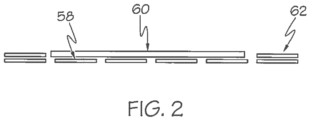
- the relatively low angle belt 58 is preferably formed from spirally winding a rubberized strip of one or more cords in a pattern as shown in FIG. 2 .
- the strip has 3, 4 or 5 steel cords, and has a width in the range of from 5-10 mm, more preferably 4-6 mm.
- a rubberized strip of reinforcement cords is spirally wound from one end of the belt 58 to the other end of the belt.
- a first and second narrow belt 62 is applied on each outer lateral end of the relatively low angle belt 58.
- Each narrow belt 62 has a narrow axial width and they are each positioned radially inward of the axially outermost shoulder groove 36.
- the narrow belt 62 is preferably the narrowest belt and has an axial width in the range of two to four times the axial width of the groove.
- the narrow belt 62 has the same angle and orientation as the relatively low angle belt 58.
- a rubber spacer 60 is located between the split belts 62 and functions to fill the void between the split belts 62.
- the relatively low angle belt 58 has a width sized to avoid compression in the shoulder area.
- the belt width of the relatively low angle belt 58 is preferably in the range of 70% to 80% of the tread arc width, and even more preferably in the range of 73-77%.
- the relatively low angle belt 58 is preferably wide enough to decrease the strain cycles in the breaker wedge and is just stopped before the shoulder area to avoid zero degree wire compression and a too round footprint.
- the belt structure of the relatively low angle belt 58 is preferably be formed of a relatively high tensile steel and preferably has a % elongation at 10% of breaking load of 0.18 or more, such as 0.20 or more, for measurements taken from a cured tire. For measurements taken from bare cords, the % elongation at 10% of breaking load is 0.2 or more.
- the relatively low angle belt 58 may be formed of non-metal reinforcements such as aramid, carbon fiber, or polyketone or POK.
- the belt structure 50 may further comprise an optional top belt 61.
- the top belt preferably has an axial width less than the working belts 54, 56.
- the aspect ratio of the tire described above may vary.
- the aspect ratio is preferably in the range of from 0.4 to 0.6.
- the tire may have a net to gross ratio in the range of 70 to 90, more preferably in the range of 74 to 86, more preferably a 78 to 84.
Landscapes
- Engineering & Computer Science (AREA)
- Mechanical Engineering (AREA)
- Tires In General (AREA)
Claims (14)
- Luftreifen für seine Verwendung auf Lastkraftwagen, wobei der Reifen (10) eine Lauffläche (12) und eine Gürtelstruktur (50) aufweist, die radial innerhalb der Lauffläche (12) angebracht ist, wobei die Gürtelstruktur (50) ein Paar von Arbeitsgürteln (54, 56) umfasst; wobei die Arbeitsgürtel (54, 56) verstärkte Lagen sind, die jeweils parallele Verstärkungselemente aufweisen; wobei der Winkel, der von den Verstärkungselementen in dem jeweiligen Arbeitsgürtel (54, 56) gebildet wird, in einem Bereich von 12 Grad bis 35 Grad in Bezug auf die Umfangsrichtung liegt; wobei die Gürtelstruktur (50) ferner einen einen relativ kleinen Winkel bildenden Gürtel (58) umfasst, der zwischen den Arbeitsgürteln (54, 56) angebracht ist und parallele Verstärkungselemente umfasst, die einen Winkel von weniger als 5 Grad in Bezug auf die Umfangsrichtung bilden; wobei der Gürtel (58), der einen relativ kleinen Winkel bildet, einen ersten und einen zweiten schmalen Gürtel (62) aufweist, die an jedem Seitenende (59) des Gürtels (58), der einen relativ kleinen Winkel bildet, angebracht sind; und wobei der erste und der zweite schmale Gürtel (62) jeweils in der radialen Richtung innerhalb einer in der axialen Richtung äußersten Nut (36) auf jeder Seite der Lauffläche (12) angebracht sind; dadurch gekennzeichnet, dass der Reifen ferner ein Abstandselement (60) aus Kautschuk umfasst, das in der axialen Richtung zwischen dem ersten und dem zweiten schmalen Gürtel (62) angebracht ist, wobei die axiale Breite des Abstandshalterelements (60) aus Kautschuk in einem Bereich liegt, der 35 bis 70 Prozent der Bogenbreite der Lauffläche ausmacht.
- Reifen Anspruch 1, wobei der erste und der zweite schmale Gürtel (62) parallele Verstärkungselemente haben, die einen Winkel von weniger als 10 Grad mit der Umfangsrichtung bilden.
- Reifen nach mindestens einem der vorhergehenden Ansprüche, der ferner ein Abstandshalterelement (60) aus Kautschuk aufweist, das zumindest teilweise in der radialen Richtung zwischen dem Gürtel (58), der einen relativ kleinen Winkel bildet, und dem ersten Arbeitsgürtel (56) angebracht ist.
- Reifen nach mindestens einem der vorhergehenden Ansprüche, wobei die Verstärkungselemente in mindestens einem der Arbeitsgürtel (54, 56), in dem Gürtel (58), der einen relativ kleinen Winkel bildet, oder in dem ersten und/oder zweiten schmalen Gürtel (62) dehnbar sind, wobei sie eine Dehnung bei 10 % Bruchlast von mehr als 0,2 % oder mehr als 0,4 % oder mehr als 0,8 % aufweisen, wenn sie an Verstärkungselementen gemessen werden, die aus einem Reifen herausgezogen wurden, der vulkanisiert wurde; und vorzugsweise wobei die dehnbaren Verstärkungselemente Metalldrähte sind, die Stahlkorde oder Hybridkorde umfassen.
- Reifen nach mindestens einem der vorhergehenden Ansprüche, wobei die axiale Breite jedes der schmalen Gürtel (62) in dem Bereich von 2,54 cm bis 7,62 cm liegt und/oder in dem Bereich von ein bis zwei Mal der maximalen axialen Breite der Nut (36) liegt, die in der radialen Richtung außerhalb des schmalen Gürtels liegt.
- Reifen nach mindestens einem der vorhergehenden Ansprüche, wobei der erste und der zweite schmale Gürtel (62) jeweils in der radialen Richtung innerhalb der in der axialen Richtung äußersten Nut (36) auf jeder Seite der Lauffläche (12) angebracht sind und sich in der axialen Richtung unterhalb der jeweiligen Nut (36), vorzugsweise über die gesamte maximale axiale Breite der jeweiligen Nut (36) erstrecken.
- Reifen nach mindestens einem der vorhergehenden Ansprüche, wobei die axiale Breite jedes der ersten und zweiten schmalen Gürtel (62) weniger als ein Drittel der Bogenbreite der Lauffläche beträgt.
- Reifen nach mindestens einem der vorhergehenden Ansprüche, wobei der in der radialen Richtung innere Arbeitsgürtel (54) eine axiale Breite aufweist, die gleich der Bogenbreite der Lauffläche ist oder in dem Bereich liegt, der 95 % bis 105 % der Bogenbreite der Lauffläche ausmacht.
- Reifen nach mindestens einem der vorhergehenden Ansprüche, wobei der in der radialen Richtung äußere Arbeitsgürtel (56) eine axiale Breite aufweist, die kleiner ist als der in der radialen Richtung innere Arbeitsgürtel (54), und/oder wobei der in der radialen Richtung innere Arbeitsgürtel (54) den in der axialen Richtung breitesten Gürtel der Gürtelstruktur (50) darstellt.
- Reifen nach mindestens einem der vorhergehenden Ansprüche, wobei der Gürtel (58), der einen relativ kleinen Winkel bildet, eine axiale Breite hat, die in dem Bereich liegt, der 70 bis 80 Prozent der Bogenbreite der Lauffläche ausmacht.
- Reifen nach Anspruch 1, der ferner einen Übergangsgürtel umfasst, der sich in der radialen Richtung innerhalb der Arbeitsgürtel (54, 56) befindet, wobei der Übergangsgürtel vorzugsweise parallele Verstärkungselemente umfasst, die einen Winkel in dem Bereich von 45 bis 70 Grad oder in dem Bereich von 45 bis 70 Grad in Bezug auf die Umfangsrichtung bilden.
- Reifen nach Anspruch 11, wobei der Übergangsgürtel eine axiale Breite hat, die in dem Bereich liegt, der 60 bis 80 Prozent der Bogenbreite der Lauffläche ausmacht.
- Reifen nach mindestens einem der vorhergehenden Ansprüche, wobei das Nennquerschnittsverhältnis des Reifens (12) kleiner oder gleich 0,6 ist.
- Reifen nach mindestens einem der vorhergehenden Ansprüche, wobei die axiale Breite des Abstandshalters (60) aus Kautschuk in einem Bereich liegt, der 45 bis 60 Prozent der Bogenbreite der Lauffläche ausmacht.
Applications Claiming Priority (2)
| Application Number | Priority Date | Filing Date | Title |
|---|---|---|---|
| US202163265526P | 2021-12-16 | 2021-12-16 | |
| US18/045,492 US20230191845A1 (en) | 2021-12-16 | 2022-10-11 | Truck tire |
Publications (2)
| Publication Number | Publication Date |
|---|---|
| EP4197815A1 EP4197815A1 (de) | 2023-06-21 |
| EP4197815B1 true EP4197815B1 (de) | 2025-02-19 |
Family
ID=86337507
Family Applications (1)
| Application Number | Title | Priority Date | Filing Date |
|---|---|---|---|
| EP22212326.7A Active EP4197815B1 (de) | 2021-12-16 | 2022-12-08 | Lastwagenreifen |
Country Status (2)
| Country | Link |
|---|---|
| US (1) | US20230191845A1 (de) |
| EP (1) | EP4197815B1 (de) |
Families Citing this family (1)
| Publication number | Priority date | Publication date | Assignee | Title |
|---|---|---|---|---|
| US20240424834A1 (en) * | 2023-06-20 | 2024-12-26 | The Goodyear Tire & Rubber Company | Tire comprising a low angle belt |
Family Cites Families (6)
| Publication number | Priority date | Publication date | Assignee | Title |
|---|---|---|---|---|
| DE102010016550A1 (de) * | 2010-04-21 | 2011-10-27 | Continental Reifen Deutschland Gmbh | Fahrzeugluftreifen |
| EP3463932B1 (de) * | 2016-06-03 | 2020-08-05 | Pirelli Tyre S.p.A. | Reifen für schwerlastfahrzeugräder |
| US20210178820A1 (en) * | 2019-12-17 | 2021-06-17 | The Goodyear Tire & Rubber Company | Pneumatic tire |
| US20210178822A1 (en) * | 2019-12-17 | 2021-06-17 | The Goodyear Tire & Rubber Company | Truck tire |
| JP7484200B2 (ja) * | 2020-02-06 | 2024-05-16 | 住友ゴム工業株式会社 | タイヤ |
| US20230064757A1 (en) * | 2021-09-01 | 2023-03-02 | The Goodyear Tire & Rubber Company | Truck tire |
-
2022
- 2022-10-11 US US18/045,492 patent/US20230191845A1/en not_active Abandoned
- 2022-12-08 EP EP22212326.7A patent/EP4197815B1/de active Active
Also Published As
| Publication number | Publication date |
|---|---|
| EP4197815A1 (de) | 2023-06-21 |
| US20230191845A1 (en) | 2023-06-22 |
Similar Documents
| Publication | Publication Date | Title |
|---|---|---|
| EP2199104B1 (de) | Lastwagenreifen | |
| EP4215384B1 (de) | Lastwagenreifen | |
| EP3838619B1 (de) | Luftreifen | |
| EP4144539B1 (de) | Luftreifen zur verwendung auf einem lastwagen | |
| EP4197815B1 (de) | Lastwagenreifen | |
| EP4197813B1 (de) | Lastwagenreifen | |
| EP4011645B1 (de) | Lastwagenreifen | |
| EP3838621B1 (de) | Luftreifen | |
| EP4011646B1 (de) | Lastwagenreifen | |
| US20220185035A1 (en) | Tire with improved bead structure | |
| US20220063336A1 (en) | Truck tire | |
| EP4197814B1 (de) | Lastwagenreifen | |
| EP4011647B1 (de) | Lastwagenreifen | |
| EP3838622B1 (de) | Luftreifen |
Legal Events
| Date | Code | Title | Description |
|---|---|---|---|
| PUAI | Public reference made under article 153(3) epc to a published international application that has entered the european phase |
Free format text: ORIGINAL CODE: 0009012 |
|
| STAA | Information on the status of an ep patent application or granted ep patent |
Free format text: STATUS: THE APPLICATION HAS BEEN PUBLISHED |
|
| AK | Designated contracting states |
Kind code of ref document: A1 Designated state(s): AL AT BE BG CH CY CZ DE DK EE ES FI FR GB GR HR HU IE IS IT LI LT LU LV MC ME MK MT NL NO PL PT RO RS SE SI SK SM TR |
|
| STAA | Information on the status of an ep patent application or granted ep patent |
Free format text: STATUS: REQUEST FOR EXAMINATION WAS MADE |
|
| 17P | Request for examination filed |
Effective date: 20231221 |
|
| RBV | Designated contracting states (corrected) |
Designated state(s): AL AT BE BG CH CY CZ DE DK EE ES FI FR GB GR HR HU IE IS IT LI LT LU LV MC ME MK MT NL NO PL PT RO RS SE SI SK SM TR |
|
| GRAP | Despatch of communication of intention to grant a patent |
Free format text: ORIGINAL CODE: EPIDOSNIGR1 |
|
| STAA | Information on the status of an ep patent application or granted ep patent |
Free format text: STATUS: GRANT OF PATENT IS INTENDED |
|
| RIC1 | Information provided on ipc code assigned before grant |
Ipc: B60C 9/28 20060101ALI20240821BHEP Ipc: B60C 9/20 20060101ALI20240821BHEP Ipc: B60C 9/22 20060101AFI20240821BHEP |
|
| INTG | Intention to grant announced |
Effective date: 20240923 |
|
| GRAS | Grant fee paid |
Free format text: ORIGINAL CODE: EPIDOSNIGR3 |
|
| GRAA | (expected) grant |
Free format text: ORIGINAL CODE: 0009210 |
|
| STAA | Information on the status of an ep patent application or granted ep patent |
Free format text: STATUS: THE PATENT HAS BEEN GRANTED |
|
| AK | Designated contracting states |
Kind code of ref document: B1 Designated state(s): AL AT BE BG CH CY CZ DE DK EE ES FI FR GB GR HR HU IE IS IT LI LT LU LV MC ME MK MT NL NO PL PT RO RS SE SI SK SM TR |
|
| REG | Reference to a national code |
Ref country code: GB Ref legal event code: FG4D |
|
| REG | Reference to a national code |
Ref country code: CH Ref legal event code: EP |
|
| REG | Reference to a national code |
Ref country code: IE Ref legal event code: FG4D |
|
| REG | Reference to a national code |
Ref country code: DE Ref legal event code: R096 Ref document number: 602022010797 Country of ref document: DE |
|
| REG | Reference to a national code |
Ref country code: NL Ref legal event code: MP Effective date: 20250219 |
|
| PG25 | Lapsed in a contracting state [announced via postgrant information from national office to epo] |
Ref country code: RS Free format text: LAPSE BECAUSE OF FAILURE TO SUBMIT A TRANSLATION OF THE DESCRIPTION OR TO PAY THE FEE WITHIN THE PRESCRIBED TIME-LIMIT Effective date: 20250519 |
|
| PG25 | Lapsed in a contracting state [announced via postgrant information from national office to epo] |
Ref country code: FI Free format text: LAPSE BECAUSE OF FAILURE TO SUBMIT A TRANSLATION OF THE DESCRIPTION OR TO PAY THE FEE WITHIN THE PRESCRIBED TIME-LIMIT Effective date: 20250219 |
|
| PG25 | Lapsed in a contracting state [announced via postgrant information from national office to epo] |
Ref country code: PL Free format text: LAPSE BECAUSE OF FAILURE TO SUBMIT A TRANSLATION OF THE DESCRIPTION OR TO PAY THE FEE WITHIN THE PRESCRIBED TIME-LIMIT Effective date: 20250219 |
|
| PG25 | Lapsed in a contracting state [announced via postgrant information from national office to epo] |
Ref country code: ES Free format text: LAPSE BECAUSE OF FAILURE TO SUBMIT A TRANSLATION OF THE DESCRIPTION OR TO PAY THE FEE WITHIN THE PRESCRIBED TIME-LIMIT Effective date: 20250219 |
|
| REG | Reference to a national code |
Ref country code: LT Ref legal event code: MG9D |
|
| PG25 | Lapsed in a contracting state [announced via postgrant information from national office to epo] |
Ref country code: IS Free format text: LAPSE BECAUSE OF FAILURE TO SUBMIT A TRANSLATION OF THE DESCRIPTION OR TO PAY THE FEE WITHIN THE PRESCRIBED TIME-LIMIT Effective date: 20250619 Ref country code: NO Free format text: LAPSE BECAUSE OF FAILURE TO SUBMIT A TRANSLATION OF THE DESCRIPTION OR TO PAY THE FEE WITHIN THE PRESCRIBED TIME-LIMIT Effective date: 20250519 |
|
| PG25 | Lapsed in a contracting state [announced via postgrant information from national office to epo] |
Ref country code: NL Free format text: LAPSE BECAUSE OF FAILURE TO SUBMIT A TRANSLATION OF THE DESCRIPTION OR TO PAY THE FEE WITHIN THE PRESCRIBED TIME-LIMIT Effective date: 20250219 |
|
| PG25 | Lapsed in a contracting state [announced via postgrant information from national office to epo] |
Ref country code: HR Free format text: LAPSE BECAUSE OF FAILURE TO SUBMIT A TRANSLATION OF THE DESCRIPTION OR TO PAY THE FEE WITHIN THE PRESCRIBED TIME-LIMIT Effective date: 20250219 |
|
| PG25 | Lapsed in a contracting state [announced via postgrant information from national office to epo] |
Ref country code: PT Free format text: LAPSE BECAUSE OF FAILURE TO SUBMIT A TRANSLATION OF THE DESCRIPTION OR TO PAY THE FEE WITHIN THE PRESCRIBED TIME-LIMIT Effective date: 20250620 Ref country code: LV Free format text: LAPSE BECAUSE OF FAILURE TO SUBMIT A TRANSLATION OF THE DESCRIPTION OR TO PAY THE FEE WITHIN THE PRESCRIBED TIME-LIMIT Effective date: 20250219 |
|
| PG25 | Lapsed in a contracting state [announced via postgrant information from national office to epo] |
Ref country code: BG Free format text: LAPSE BECAUSE OF FAILURE TO SUBMIT A TRANSLATION OF THE DESCRIPTION OR TO PAY THE FEE WITHIN THE PRESCRIBED TIME-LIMIT Effective date: 20250219 Ref country code: GR Free format text: LAPSE BECAUSE OF FAILURE TO SUBMIT A TRANSLATION OF THE DESCRIPTION OR TO PAY THE FEE WITHIN THE PRESCRIBED TIME-LIMIT Effective date: 20250520 |
|
| REG | Reference to a national code |
Ref country code: AT Ref legal event code: MK05 Ref document number: 1767972 Country of ref document: AT Kind code of ref document: T Effective date: 20250219 |
|
| PG25 | Lapsed in a contracting state [announced via postgrant information from national office to epo] |
Ref country code: SE Free format text: LAPSE BECAUSE OF FAILURE TO SUBMIT A TRANSLATION OF THE DESCRIPTION OR TO PAY THE FEE WITHIN THE PRESCRIBED TIME-LIMIT Effective date: 20250219 |
|
| PG25 | Lapsed in a contracting state [announced via postgrant information from national office to epo] |
Ref country code: SM Free format text: LAPSE BECAUSE OF FAILURE TO SUBMIT A TRANSLATION OF THE DESCRIPTION OR TO PAY THE FEE WITHIN THE PRESCRIBED TIME-LIMIT Effective date: 20250219 |
|
| PG25 | Lapsed in a contracting state [announced via postgrant information from national office to epo] |
Ref country code: DK Free format text: LAPSE BECAUSE OF FAILURE TO SUBMIT A TRANSLATION OF THE DESCRIPTION OR TO PAY THE FEE WITHIN THE PRESCRIBED TIME-LIMIT Effective date: 20250219 |
|
| PG25 | Lapsed in a contracting state [announced via postgrant information from national office to epo] |
Ref country code: AT Free format text: LAPSE BECAUSE OF FAILURE TO SUBMIT A TRANSLATION OF THE DESCRIPTION OR TO PAY THE FEE WITHIN THE PRESCRIBED TIME-LIMIT Effective date: 20250219 |
|
| PG25 | Lapsed in a contracting state [announced via postgrant information from national office to epo] |
Ref country code: EE Free format text: LAPSE BECAUSE OF FAILURE TO SUBMIT A TRANSLATION OF THE DESCRIPTION OR TO PAY THE FEE WITHIN THE PRESCRIBED TIME-LIMIT Effective date: 20250219 Ref country code: CZ Free format text: LAPSE BECAUSE OF FAILURE TO SUBMIT A TRANSLATION OF THE DESCRIPTION OR TO PAY THE FEE WITHIN THE PRESCRIBED TIME-LIMIT Effective date: 20250219 |
|
| PG25 | Lapsed in a contracting state [announced via postgrant information from national office to epo] |
Ref country code: RO Free format text: LAPSE BECAUSE OF FAILURE TO SUBMIT A TRANSLATION OF THE DESCRIPTION OR TO PAY THE FEE WITHIN THE PRESCRIBED TIME-LIMIT Effective date: 20250219 |
|
| PG25 | Lapsed in a contracting state [announced via postgrant information from national office to epo] |
Ref country code: SK Free format text: LAPSE BECAUSE OF FAILURE TO SUBMIT A TRANSLATION OF THE DESCRIPTION OR TO PAY THE FEE WITHIN THE PRESCRIBED TIME-LIMIT Effective date: 20250219 |
|
| REG | Reference to a national code |
Ref country code: DE Ref legal event code: R097 Ref document number: 602022010797 Country of ref document: DE |
|
| PLBE | No opposition filed within time limit |
Free format text: ORIGINAL CODE: 0009261 |
|
| STAA | Information on the status of an ep patent application or granted ep patent |
Free format text: STATUS: NO OPPOSITION FILED WITHIN TIME LIMIT |
|
| PGFP | Annual fee paid to national office [announced via postgrant information from national office to epo] |
Ref country code: DE Payment date: 20251126 Year of fee payment: 4 |
|
| PGFP | Annual fee paid to national office [announced via postgrant information from national office to epo] |
Ref country code: FR Payment date: 20251120 Year of fee payment: 4 |
|
| PGFP | Annual fee paid to national office [announced via postgrant information from national office to epo] |
Ref country code: TR Payment date: 20251127 Year of fee payment: 4 |
|
| 26N | No opposition filed |
Effective date: 20251120 |