EP4186597A1 - System der dritten stufe mit automatischer blutung und verwendung davon - Google Patents
System der dritten stufe mit automatischer blutung und verwendung davon Download PDFInfo
- Publication number
- EP4186597A1 EP4186597A1 EP21846134.1A EP21846134A EP4186597A1 EP 4186597 A1 EP4186597 A1 EP 4186597A1 EP 21846134 A EP21846134 A EP 21846134A EP 4186597 A1 EP4186597 A1 EP 4186597A1
- Authority
- EP
- European Patent Office
- Prior art keywords
- stage
- ejector
- cyclone
- catalyst
- bleeding
- Prior art date
- Legal status (The legal status is an assumption and is not a legal conclusion. Google has not performed a legal analysis and makes no representation as to the accuracy of the status listed.)
- Pending
Links
- 230000000740 bleeding effect Effects 0.000 title claims abstract description 24
- 238000000034 method Methods 0.000 claims abstract description 8
- 239000012265 solid product Substances 0.000 claims abstract description 3
- 239000007789 gas Substances 0.000 claims description 67
- 239000012530 fluid Substances 0.000 claims description 14
- VNWKTOKETHGBQD-UHFFFAOYSA-N methane Chemical compound C VNWKTOKETHGBQD-UHFFFAOYSA-N 0.000 claims description 4
- 230000003628 erosive effect Effects 0.000 claims description 3
- 239000003570 air Substances 0.000 claims description 2
- 239000000919 ceramic Substances 0.000 claims description 2
- 239000002737 fuel gas Substances 0.000 claims description 2
- 239000003345 natural gas Substances 0.000 claims description 2
- JTJMJGYZQZDUJJ-UHFFFAOYSA-N phencyclidine Chemical class C1CCCCN1C1(C=2C=CC=CC=2)CCCCC1 JTJMJGYZQZDUJJ-UHFFFAOYSA-N 0.000 abstract description 53
- 238000000926 separation method Methods 0.000 abstract description 13
- 239000003054 catalyst Substances 0.000 description 77
- 239000002245 particle Substances 0.000 description 10
- 238000009434 installation Methods 0.000 description 8
- 238000009825 accumulation Methods 0.000 description 6
- 230000008901 benefit Effects 0.000 description 5
- 238000004523 catalytic cracking Methods 0.000 description 4
- 239000000463 material Substances 0.000 description 4
- 239000013618 particulate matter Substances 0.000 description 4
- 238000007789 sealing Methods 0.000 description 4
- 239000000567 combustion gas Substances 0.000 description 3
- 238000009826 distribution Methods 0.000 description 3
- 239000007787 solid Substances 0.000 description 3
- UGFAIRIUMAVXCW-UHFFFAOYSA-N Carbon monoxide Chemical compound [O+]#[C-] UGFAIRIUMAVXCW-UHFFFAOYSA-N 0.000 description 2
- 229910002091 carbon monoxide Inorganic materials 0.000 description 2
- 239000011362 coarse particle Substances 0.000 description 2
- 239000000571 coke Substances 0.000 description 2
- 230000007613 environmental effect Effects 0.000 description 2
- 239000010419 fine particle Substances 0.000 description 2
- 229930195733 hydrocarbon Natural products 0.000 description 2
- 150000002430 hydrocarbons Chemical class 0.000 description 2
- 238000012423 maintenance Methods 0.000 description 2
- 238000005259 measurement Methods 0.000 description 2
- 239000004215 Carbon black (E152) Substances 0.000 description 1
- 238000005299 abrasion Methods 0.000 description 1
- 230000006978 adaptation Effects 0.000 description 1
- 230000015572 biosynthetic process Effects 0.000 description 1
- 238000004140 cleaning Methods 0.000 description 1
- 239000003245 coal Substances 0.000 description 1
- 238000002485 combustion reaction Methods 0.000 description 1
- 238000005520 cutting process Methods 0.000 description 1
- 230000007812 deficiency Effects 0.000 description 1
- 230000008021 deposition Effects 0.000 description 1
- 238000007599 discharging Methods 0.000 description 1
- 230000000694 effects Effects 0.000 description 1
- 238000000605 extraction Methods 0.000 description 1
- 238000002309 gasification Methods 0.000 description 1
- 238000001033 granulometry Methods 0.000 description 1
- 238000012986 modification Methods 0.000 description 1
- 230000004048 modification Effects 0.000 description 1
- 239000011236 particulate material Substances 0.000 description 1
- 230000035515 penetration Effects 0.000 description 1
- 238000005504 petroleum refining Methods 0.000 description 1
- 238000011084 recovery Methods 0.000 description 1
- 238000004064 recycling Methods 0.000 description 1
- 230000000630 rising effect Effects 0.000 description 1
- 239000011343 solid material Substances 0.000 description 1
Images

Classifications
-
- B—PERFORMING OPERATIONS; TRANSPORTING
- B04—CENTRIFUGAL APPARATUS OR MACHINES FOR CARRYING-OUT PHYSICAL OR CHEMICAL PROCESSES
- B04C—APPARATUS USING FREE VORTEX FLOW, e.g. CYCLONES
- B04C5/00—Apparatus in which the axial direction of the vortex is reversed
- B04C5/08—Vortex chamber constructions
- B04C5/103—Bodies or members, e.g. bulkheads, guides, in the vortex chamber
-
- B—PERFORMING OPERATIONS; TRANSPORTING
- B04—CENTRIFUGAL APPARATUS OR MACHINES FOR CARRYING-OUT PHYSICAL OR CHEMICAL PROCESSES
- B04C—APPARATUS USING FREE VORTEX FLOW, e.g. CYCLONES
- B04C3/00—Apparatus in which the axial direction of the vortex flow following a screw-thread type line remains unchanged ; Devices in which one of the two discharge ducts returns centrally through the vortex chamber, a reverse-flow vortex being prevented by bulkheads in the central discharge duct
- B04C3/04—Multiple arrangement thereof
-
- C—CHEMISTRY; METALLURGY
- C10—PETROLEUM, GAS OR COKE INDUSTRIES; TECHNICAL GASES CONTAINING CARBON MONOXIDE; FUELS; LUBRICANTS; PEAT
- C10G—CRACKING HYDROCARBON OILS; PRODUCTION OF LIQUID HYDROCARBON MIXTURES, e.g. BY DESTRUCTIVE HYDROGENATION, OLIGOMERISATION, POLYMERISATION; RECOVERY OF HYDROCARBON OILS FROM OIL-SHALE, OIL-SAND, OR GASES; REFINING MIXTURES MAINLY CONSISTING OF HYDROCARBONS; REFORMING OF NAPHTHA; MINERAL WAXES
- C10G11/00—Catalytic cracking, in the absence of hydrogen, of hydrocarbon oils
- C10G11/14—Catalytic cracking, in the absence of hydrogen, of hydrocarbon oils with preheated moving solid catalysts
- C10G11/18—Catalytic cracking, in the absence of hydrogen, of hydrocarbon oils with preheated moving solid catalysts according to the "fluidised-bed" technique
-
- B—PERFORMING OPERATIONS; TRANSPORTING
- B01—PHYSICAL OR CHEMICAL PROCESSES OR APPARATUS IN GENERAL
- B01D—SEPARATION
- B01D45/00—Separating dispersed particles from gases or vapours by gravity, inertia, or centrifugal forces
- B01D45/12—Separating dispersed particles from gases or vapours by gravity, inertia, or centrifugal forces by centrifugal forces
-
- B—PERFORMING OPERATIONS; TRANSPORTING
- B04—CENTRIFUGAL APPARATUS OR MACHINES FOR CARRYING-OUT PHYSICAL OR CHEMICAL PROCESSES
- B04C—APPARATUS USING FREE VORTEX FLOW, e.g. CYCLONES
- B04C11/00—Accessories, e.g. safety or control devices, not otherwise provided for, e.g. regulators, valves in inlet or overflow ducting
-
- B—PERFORMING OPERATIONS; TRANSPORTING
- B04—CENTRIFUGAL APPARATUS OR MACHINES FOR CARRYING-OUT PHYSICAL OR CHEMICAL PROCESSES
- B04C—APPARATUS USING FREE VORTEX FLOW, e.g. CYCLONES
- B04C3/00—Apparatus in which the axial direction of the vortex flow following a screw-thread type line remains unchanged ; Devices in which one of the two discharge ducts returns centrally through the vortex chamber, a reverse-flow vortex being prevented by bulkheads in the central discharge duct
- B04C3/06—Construction of inlets or outlets to the vortex chamber
-
- B—PERFORMING OPERATIONS; TRANSPORTING
- B04—CENTRIFUGAL APPARATUS OR MACHINES FOR CARRYING-OUT PHYSICAL OR CHEMICAL PROCESSES
- B04C—APPARATUS USING FREE VORTEX FLOW, e.g. CYCLONES
- B04C5/00—Apparatus in which the axial direction of the vortex is reversed
- B04C5/14—Construction of the underflow ducting; Apex constructions; Discharge arrangements ; discharge through sidewall provided with a few slits or perforations
- B04C5/18—Construction of the underflow ducting; Apex constructions; Discharge arrangements ; discharge through sidewall provided with a few slits or perforations with auxiliary fluid assisting discharge
-
- B—PERFORMING OPERATIONS; TRANSPORTING
- B04—CENTRIFUGAL APPARATUS OR MACHINES FOR CARRYING-OUT PHYSICAL OR CHEMICAL PROCESSES
- B04C—APPARATUS USING FREE VORTEX FLOW, e.g. CYCLONES
- B04C5/00—Apparatus in which the axial direction of the vortex is reversed
- B04C5/24—Multiple arrangement thereof
- B04C5/28—Multiple arrangement thereof for parallel flow
-
- B—PERFORMING OPERATIONS; TRANSPORTING
- B04—CENTRIFUGAL APPARATUS OR MACHINES FOR CARRYING-OUT PHYSICAL OR CHEMICAL PROCESSES
- B04C—APPARATUS USING FREE VORTEX FLOW, e.g. CYCLONES
- B04C5/00—Apparatus in which the axial direction of the vortex is reversed
- B04C5/24—Multiple arrangement thereof
- B04C5/30—Recirculation constructions in or with cyclones which accomplish a partial recirculation of the medium, e.g. by means of conduits
-
- B—PERFORMING OPERATIONS; TRANSPORTING
- B04—CENTRIFUGAL APPARATUS OR MACHINES FOR CARRYING-OUT PHYSICAL OR CHEMICAL PROCESSES
- B04C—APPARATUS USING FREE VORTEX FLOW, e.g. CYCLONES
- B04C9/00—Combinations with other devices, e.g. fans, expansion chambers, diffusors, water locks
-
- B—PERFORMING OPERATIONS; TRANSPORTING
- B04—CENTRIFUGAL APPARATUS OR MACHINES FOR CARRYING-OUT PHYSICAL OR CHEMICAL PROCESSES
- B04C—APPARATUS USING FREE VORTEX FLOW, e.g. CYCLONES
- B04C9/00—Combinations with other devices, e.g. fans, expansion chambers, diffusors, water locks
- B04C2009/008—Combinations with other devices, e.g. fans, expansion chambers, diffusors, water locks with injection or suction of gas or liquid into the cyclone
Definitions
- the present invention addresses to a third stage system with self-bleeding through the use of an internally or externally installed ejector with application in all multicyclone systems operating at positive pressure, whether for application in particulate abatement systems or protection of turbo-expanders or in industrial units involving the need of recovering solid products carried by the process gas, aiming at eliminating the need for any additional separation systems using cyclones or filters to carry out bleeding of the cyclone legs.
- the third stage cyclone systems in most fluidized catalytic cracking (FCC) units consist of multiple cyclones arranged in parallel inside a vessel, which operate at positive pressure, that is, the internal pressure of the cyclones is greater than that present inside the vessel where the collected catalyst is discharged, and due to the use of multiple cyclones with the collected catalyst being discharged in a diluted phase and without the use of a mobile mechanical sealing device on the cyclone legs, such as valves, the absence of which confers greater reliability, and for that, there is a need of operating these cyclones in a bleeding regime, that is, with continuous removal of gases along with the collected particulate, to prevent the re-entry of gases along with the particulate already collected in other legs, due to the fact that it is impossible to operate all cyclones with the same pressure differentials between the cyclone inlet and the top of their legs.
- FCC fluidized catalytic cracking
- Patents US6673133 and US6797026 show the importance of bleed in cyclone efficiency, showing that varying bleed from 1 % to 3% reduces emission by 45%, and reduces the cyclone cutting diameter from 6 ⁇ m to 5 ⁇ m; therefore, the need of using the bleed flow rate in the legs of multiple cyclones in third stage cyclone systems is undeniable.
- the drawback is that a new separation system becomes necessary to separate the material collected by the third stage cyclones from the stream of gases from the bleed of the cyclone legs.
- an additional cyclone is usually installed, called the fourth stage of cyclones, due to its low cost of installation and maintenance, and the bleed gas after passing through the fourth stage, due to the kinetic energy present, consumed by the restriction orifice, passes through a boiler recovered from energy or carbon monoxide combustion when present, and then discharged to the atmosphere.
- the fourth stage cyclone As the collection efficiency of the fourth stage cyclone is not 100%, being around 90 to 95%, the latter ends up reducing the overall separation efficiency of the set, since all the solid material collected has to be separated again.
- the collection efficiency of the third stage cyclones is in the order of 80 to 90%, while the collection efficiency of the fourth stage cyclone is 92 to 98%. These numbers indicate that 25% of the material emitted to the atmosphere by third stage cyclone systems would come from the fourth stage cyclone, although in more extreme cases it could be up to 50%.
- the inventions US5643537 and US5779746 show the concern to discharge the catalyst collected in the cyclones by limiting the length of the vortex using tangential slots for the discharge of the catalyst together with bleed gas and closing the base of the cyclone. Studies show that part of the bleed flow rate, with the penalty of being concentrated in catalyst because it is in the catalyst discharge region, tends to return to the interior of the cyclones through the tangential slots.
- the inventions US5681450 and US6902593 try to correct the problem of bleed gas return through the tangential slots, using a closed termination with tangential slots for the catalyst discharge along with the bleed gas flow rate, and allowing part of the bleed flow rate to recycle into the interior of the third stage cyclones, readmitting the gases with catalyst to the low pressure internal vortex zone in the central region below the tangential outlet of the collected catalyst, that is, implying a loss of efficiency due to the use of the closed termination with slots to limit the inner and outer vortex, and by recycling the bleed flow with collected catalyst back to the inner vortex of the cyclone.
- the inventions US7648544 and US8287613 solve the problem with the accumulation of catalyst, by leaving the external vortex free, which carries the separate catalyst and uses an internal vortex limiter, which has the option of returning part of the flow rate from bleeding the cyclones through the hollow central part of the internal vortex limiter, with the penalty of it being concentrated in catalyst as it is in the discharge region of the external vortex concentrated in catalyst.
- an internal vortex limiter which has the option of returning part of the flow rate from bleeding the cyclones through the hollow central part of the internal vortex limiter, with the penalty of it being concentrated in catalyst as it is in the discharge region of the external vortex concentrated in catalyst.
- the need for bleed flow rate to the atmosphere continues.
- the invention WO0141934 recycles the purified gas from the cyclone, passing through a second unidirectional type cyclone, without flow reversal, wherein the particulate material collected together with a percentage of the gas flow rate is fed back into the cyclone inlet.
- the invention US7081229 bleeds the leg of a negative pressure cyclone, a cyclone with an internal pressure lower than that of the vessel where the cyclone is installed, using an ejector connected to the cyclone leg to overcome the pressure difference between the vessel and the cyclone, and discharging the bleed stream along with the motive fluid of the ejector into the vessel.
- the invention PI00046132 fully recycles the material collected in the leg of a second stage cyclone via a pipe connected to its leg, being a negative pressure cyclone having an internal pressure lower than that of the vessel in which it is installed, together with a percentage of gas, that is, bleeding the leg of the second stage cyclone, and feeding back into the inlet of the first stage cyclone with or without the presence of an additional cyclone to separate part of the catalyst collected in the second stage, which is a positive pressure cyclone in relation to the vessel where the first and second stage cyclones are installed.
- the objective of the patent application is to increase the separation efficiency by avoiding the use of mechanical sealing devices, like valves, in the second stage cyclone leg, a negative pressure cyclone, which is due to the presence of leakage when using valve and the absence of permanent bleeding.
- This is different from the current proposal, in which there is no physical interconnection of the cyclone legs, and the cyclone bleeding is carried out indirectly, via gas extraction from the upper part or roof of the vessel where the cyclone is installed, where the concentration is diluted in the catalyst collected from the diluted cyclone leg.
- Document GB2077631 discloses a modified form of gas/particle separation unit in the third stage for separating used catalyst particles from the gas discharged from a catalyst regenerator vessel in a fluidized catalytic cracking unit for petroleum refining.
- document GB2077631 avoids the use of gas bleeding and is not based on proposing the use of cyclones in a bleeding regime without the need for any additional separation systems using cyclones or filters to carry out bleeding of the cyclone legs.
- Document CA1161374 refers to an improved method and apparatus for separating particles from gases by using centrifugal separators. Such an apparatus is particularly useful for separating catalyst particles from hydrocarbon vapors from a catalytic cracking process and can also be used to advantage in other applications, such as the removal of suspended solids from gases fed to boilers resulting from gasification and coal liquefaction, molecular separation and for use with supercharged boilers.
- document CA1 161374 refers to centrifugal separators for separating gas particles and does not address to the need for an additional abatement system for treating the bleed stream from the legs of third stage cyclones.
- Document PI02047373 discloses an improved cyclonic system to separate solid and gaseous particles in fluidized catalytic cracking (FCC) processes with reduced coke formation in the separator vessel without favoring the carrying of the separated catalyst. More specifically, it addresses to a closed unconfined system for the cyclonic separation between solid particles (catalyst) and effluent gases from the rising reactor ("riser") in FCC processes, where the process of removing hydrocarbons remaining in the separator vessel is optimized, without loss of separation efficiency, thus minimizing coke deposition along the same.
- PI02047373 teaches legless cyclones and does not address to a third stage system with bleeding regime.
- the present invention was developed, by means of the use of an ejector preferably installed internally, or externally because with the benefit of the simplicity of installation, it will recirculate or recycle a flow rate of the order of 3% of the region of the top of the vessel, a region of low or diluted concentration of catalyst, where the third stage cyclones are installed for the gas feed duct, carrying catalyst from the region with diluted catalyst of the third stage system, thus avoiding the need for investment in additional abatement systems for treating the bleed stream from the legs of third stage cyclones.
- the present invention also makes use of vortex limiters, of use and effectiveness enshrined in the technical literature to contain the internal vortex inside the cyclone, reducing catalyst re-carrying and the pressure differential between the inlet and the top of the cyclone leg.
- No document of the state of the art discloses a system capable of eliminating the need for any additional separation systems using cyclones or filters to carry out bleeding of the cyclone legs, such as that of the present invention.
- the present invention brings the benefit of reducing the cost of installing and operating additional abatement systems to comply with environmental legislation, thus eliminating the fourth stage of cyclones or filters, which always lead to operational and maintenance problems.
- it allows the refiner to adjust the bleed percentage depending on the emissions result, seeking at maximum separation efficiency, something that is not possible in configurations with the fourth stage cyclone and critical FO. There are no restrictions on the practice of bleeding percentage, only for cases where there is restriction due to erosive aspects of the cyclone.
- Another advantage is that there is an increase in the electrical energy generation capacity in the existing turbo-expanders in the FCC units, as it is an internal recycle, it avoids the continuous diversion of 2-3% of the gas flow rate through the fourth stage cyclone, which allows all of the combustion gases to pass through the turbo-expander, with a consequent increase in energy generation, as well as an increase in the collection efficiency of the third stage systems, reducing the emission of particulates into the atmosphere.
- the present invention addresses to an additional abatement system for the treatment of the bleed stream from the legs of the third stage cyclones, through the use of an ejector preferably installed internally, or externally, since with the benefit of the simplicity of installation, it will recirculate or recycle a flow rate of around 3% from the region at the top of the vessel, a region of low concentration or diluted catalyst, where the third stage cyclones are installed to the gas feed duct, carrying catalyst from the diluted catalyst region of the system of third stage.
- the invention also makes use of vortex limiters, used to contain the internal vortex inside the cyclone, reducing the catalyst readjustment and the pressure differential between the inlet and the top of the cyclone leg.
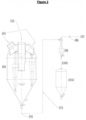
- the present invention through the use of ejector (13) preferably installed internally or externally to the vessel (6) has a simplicity of installation, in which it will recirculate or recycle a flow rate of the order of 3% of the region of the top of the vessel, a region of low or diluted catalyst concentration, where the third stage cyclones are installed for the gas feed duct, carrying catalyst from the diluted catalyst region of the third stage system.
- the invention also makes use of vortex limiters, to contain the internal vortex inside the cyclone, reducing catalyst carrying and pressure differential between the inlet and the top of the cyclone leg.
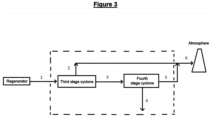
- This stream mixes with the main flow of gases coming from the regenerator and re-enters the third stage cyclones, which become responsible for removing the particles present in the same, completely eliminating the need for a fourth stage cyclone.
- the flow rate of the bleed stream at the outlet of the ejector (13) depends on the flow rate of the motive fluid in the ejector (14), which is adjusted from the measurement of the aspirated flow rate, which can be known through the installation of an instrument for measuring flow rate of the Venturi type (12), optional, between the third stage vessel (6) and the ejector (13) or even at the ejector outlet in the case of internal installation. It is recommended that both the Venturi (12) and the recycle ejector (13) be built with ceramic internal parts, resistant to the abrasion of the catalyst particles.
- the motive fluid flow rate (14) to the recycle ejector must be increased until the flow rate measurement of the aspirated stream is at the desired value, usually from 2 to 5% of the gas flow rate that enters the third stage vessel (6).
- the presence of the vortex limiter (15) also allows the operation of excessive bleeding, as it limits the penetration of the internal vortex at the top of the leg of the multicyclones. It is important to point out that, in this configuration, both the energy present in the bleed stream and in the motive fluid of the ejector will be available for the generation of electrical energy in the turbo-expander.
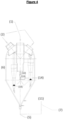
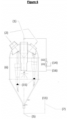
- the self-bleeding third stage system according to the present invention and illustrated in Figure 4 comprises an internal ejector (13) in which the suction side is connected to the diluted phase in the central region of the third stage cyclone vessel (6) and its discharge connected to the central inlet/feed of the third stage cyclone, where it mixes with the main flow of gases from the regenerator and re-enters the third stage cyclone and an instrument for measuring flow rate of the Venturi type (12), optional, installed on the ejector outlet (13).
- an internal ejector (13) in which the suction side is connected to the diluted phase in the central region of the third stage cyclone vessel (6) and its discharge connected to the central inlet/feed of the third stage cyclone, where it mixes with the main flow of gases from the regenerator and re-enters the third stage cyclone and an instrument for measuring flow rate of the Venturi type (12), optional, installed on the ejector outlet (13).
- the third stage system comprises an internal ejector (13) located on the side of the top of the third stage cyclone vessel (6), in which it has the suction side connected to the diluted phase in the central region of the third stage cyclone vessel (6), via an auxiliary piping (16) and its discharge connected to an interconnection piping to the third stage cyclone, where it mixes with the main flow of gases from the regenerator and re-enters the third stage cyclone.
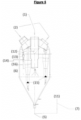
- the third stage system comprises an external ejector (13) located on the side of the top of the third stage cyclone vessel (6), in which it has the suction side connected with the diluted phase in the central region of the third stage cyclone vessel (6), via an auxiliary piping (16) and its discharge interconnected with the catalyst gas feed piping (1) and an optional Venturi type flow meter (12) coupled to the ejector outlet (13).
- the motive fluid of the ejector (14) depending on whether the combustion gas is flammable or not, may be: air, fuel gas, natural gas or steam.
- the vortex limiter (15) can be installed in the top region of the cyclone leg in all embodiments of the present invention, to increase collection efficiency, reduce erosion at the top of the leg of the multicyclones of the Third Stage Cyclone System and reduce motive fluid consumption (14).
Landscapes
- Chemical & Material Sciences (AREA)
- Chemical Kinetics & Catalysis (AREA)
- Oil, Petroleum & Natural Gas (AREA)
- Engineering & Computer Science (AREA)
- General Chemical & Material Sciences (AREA)
- Organic Chemistry (AREA)
- Cyclones (AREA)
- Production Of Liquid Hydrocarbon Mixture For Refining Petroleum (AREA)
Applications Claiming Priority (2)
| Application Number | Priority Date | Filing Date | Title |
|---|---|---|---|
| BR102020014856-7A BR102020014856B1 (pt) | 2020-07-21 | Sistema de terceiro estágio com auto-sangria e uso | |
| PCT/BR2021/050305 WO2022016248A1 (pt) | 2020-07-21 | 2021-07-19 | Sistema de terceiro estágio com auto-sangria e uso |
Publications (2)
| Publication Number | Publication Date |
|---|---|
| EP4186597A1 true EP4186597A1 (de) | 2023-05-31 |
| EP4186597A4 EP4186597A4 (de) | 2024-06-19 |
Family
ID=77999756
Family Applications (1)
| Application Number | Title | Priority Date | Filing Date |
|---|---|---|---|
| EP21846134.1A Pending EP4186597A4 (de) | 2020-07-21 | 2021-07-19 | System der dritten stufe mit automatischer blutung und verwendung davon |
Country Status (10)
| Country | Link |
|---|---|
| US (1) | US20230294114A1 (de) |
| EP (1) | EP4186597A4 (de) |
| CN (1) | CN116367926A (de) |
| AR (1) | AR123003A1 (de) |
| CL (1) | CL2023000205A1 (de) |
| CO (1) | CO2023001547A2 (de) |
| EC (1) | ECSP23011521A (de) |
| MX (1) | MX2023000971A (de) |
| UY (1) | UY39332A (de) |
| WO (1) | WO2022016248A1 (de) |
Family Cites Families (52)
| Publication number | Priority date | Publication date | Assignee | Title |
|---|---|---|---|---|
| US2047373A (en) | 1932-04-04 | 1936-07-14 | Lewis A Kingsley | Stamping machine |
| GB2077631A (en) | 1980-06-05 | 1981-12-23 | Tongeren U K Ltd Van | Third stage separator system for fluidised catalytic cracking unit in oil refining, and method of operating same |
| CA1161374A (en) | 1981-05-15 | 1984-01-31 | Joseph G. Wilson, Sr. | Method and apparatus for separating particulate matter from gases |
| US5464528A (en) * | 1993-12-30 | 1995-11-07 | Mobil Oil Corporation | FCC process and apparatus with upset tolerant third stage separator |
| US5779746A (en) | 1994-04-28 | 1998-07-14 | Mobil Oil Corporation | Underflow cyclone with perforated barrel |
| US5643537A (en) | 1994-05-02 | 1997-07-01 | Mobil Oil Corporation | FCC process and apparatus with contained vortex third stage separator |
| US5681450A (en) | 1995-06-07 | 1997-10-28 | Chitnis; Girish K. | Reduced chaos cyclone separation |
| AT403168B (de) * | 1995-11-02 | 1997-11-25 | Voest Alpine Ind Anlagen | Verfahren und einrichtung zum rückführen eines aus einem reaktorgefäss mit einem gas ausgetragenen feinteiligen feststoffes |
| AT405911B (de) * | 1995-11-24 | 1999-12-27 | Inst Thermische Turbomaschinen | Zyklon zur trennung von wasser und dampf |
| FR2770225B1 (fr) * | 1997-10-24 | 2000-01-07 | Total Raffinage Distribution | Procede et dispositif de vaporisation selective des charges d'hydrocarbures en craquage catalytique |
| US6042717A (en) * | 1997-12-05 | 2000-03-28 | Uop Llc | Horizontal FCC feed injection process |
| US6165353A (en) * | 1998-10-08 | 2000-12-26 | Uop Llc | Distribution apparatus and method for patterned feed injection |
| FR2785907B1 (fr) * | 1998-11-13 | 2001-01-05 | Inst Francais Du Petrole | Procede et dispositif de craquage catalytique comprenant des reacteurs a ecoulements descendant et ascendant |
| US6656344B1 (en) * | 1998-12-23 | 2003-12-02 | Marri Rama Rao | Fluidized catalytic cracking process |
| US6093310A (en) * | 1998-12-30 | 2000-07-25 | Exxon Research And Engineering Co. | FCC feed injection using subcooled water sparging for enhanced feed atomization |
| US6387247B1 (en) * | 1999-09-03 | 2002-05-14 | Shell Oil Company | Feed injection system for catalytic cracking process |
| PT102392A (pt) * | 1999-12-13 | 2000-11-30 | Romualdo Luis Ribera Salcedo | Ciclones de recirculacao para despoeiramento e lavagem de gases |
| US6673133B2 (en) | 2000-06-02 | 2004-01-06 | Uop Llc | Cyclone for separating fine solid particles from a gas stream |
| US7648544B2 (en) | 2002-07-19 | 2010-01-19 | Shell Oil Company | Swirl tube separator |
| US6902593B2 (en) * | 2003-02-26 | 2005-06-07 | Kellogg Brown And Root, Inc. | Separation device to remove fine particles |
| US7081229B2 (en) * | 2003-04-15 | 2006-07-25 | Petroleo Brasileiro S.A. | Second stage cyclone dipleg termination device in FCC units |
| FR2894849B1 (fr) * | 2005-12-20 | 2008-05-16 | Inst Francais Du Petrole | Nouveau reacteur a deux zones reactionnelles fluidisees avec systeme de separation gaz/solide integre |
| US8287613B2 (en) | 2007-06-01 | 2012-10-16 | Shell Oil Company | Gas-solids separator |
| US7879294B2 (en) * | 2008-04-29 | 2011-02-01 | Synthesis Energy Systems, Inc. | Method and apparatus for fine solids recycle |
| AU2009347547B2 (en) * | 2009-06-04 | 2015-05-28 | Shandong Tianli Drying Technology And Equipment Co., Ltd. | Multi-effect brown coal predrying system using superheated steam and process thereof |
| FR2966160B1 (fr) * | 2010-10-14 | 2013-11-15 | IFP Energies Nouvelles | Procede de craquage catalytique adapte au traitement de charges a faible carbon conradson comportant le recycle d'une coupe cokante selon une technologie nouvelle |
| US8470081B2 (en) * | 2011-02-01 | 2013-06-25 | Uop Llc | Process for separating particulate solids from a gas stream |
| BR112013022418A2 (pt) * | 2011-04-06 | 2016-12-06 | Dow Global Technologies Llc | processo para produzir um derivado de celulose particulado, derivado de celulose particulado, método para melhorar a fluidez e a facilidade de dispersão em água fria de um derivado de celulose particulado, composição aquosa, processo para a fabricação de cápsulas e processo para revestir uma forma de dosagem |
| US8689709B2 (en) * | 2011-05-04 | 2014-04-08 | Southern Company | Oxycombustion in transport oxy-combustor |
| US8431098B2 (en) * | 2011-07-14 | 2013-04-30 | Empire Technology Development Llc | Gas purification using photocatalytic vortex-suspended particles |
| KR101954472B1 (ko) * | 2011-07-27 | 2019-03-05 | 사우디 아라비안 오일 컴퍼니 | 하향류 반응기에서 파라핀계 나프타의 유동접촉분해 방법 |
| US9109177B2 (en) * | 2011-12-12 | 2015-08-18 | Ensyn Renewables, Inc. | Systems and methods for renewable fuel |
| US10155707B2 (en) * | 2012-09-05 | 2018-12-18 | Saudi Arabian Oil Company | Olefin hydration process using oscillatory baffled reactor |
| US9340624B2 (en) * | 2012-09-25 | 2016-05-17 | Dow Global Technologies Llc | Process for producing cellulose derivatives of high bulk density, good flowability and/or dispersibility in cold water as well as low solution color |
| ES2752224T3 (es) * | 2013-02-05 | 2020-04-03 | Reliance Industries Ltd | Proceso para la gasificación catalítica de una materia prima carbonosa |
| WO2016004810A1 (zh) * | 2014-07-08 | 2016-01-14 | 华东理工大学 | 液体旋流场中微颗粒自转的同步高速摄像方法及装置 |
| US9868916B1 (en) * | 2014-09-12 | 2018-01-16 | Yongchao Li | Methods and systems for cooling hot product gas |
| US10226749B2 (en) * | 2014-10-02 | 2019-03-12 | Blac Inc. | Monitoring and control module for fluid catalytic cracking unit |
| RU2708597C2 (ru) * | 2015-03-03 | 2019-12-09 | Шелл Интернэшнл Рисерч Маатсхаппий Б.В. | Усовершенствованные сепараторы с вихревыми трубами |
| JP6804200B2 (ja) * | 2016-02-08 | 2020-12-23 | 三菱パワー株式会社 | スラグサイクロン、ガス化設備、ガス化複合発電設備、スラグサイクロンの運転方法およびスラグサイクロンのメンテナンス方法 |
| US10113740B2 (en) * | 2016-08-12 | 2018-10-30 | Gas Technology Institute | Fluidized bed combustion of carbonaceous fuels |
| US10525483B1 (en) * | 2017-06-30 | 2020-01-07 | Riles Edward Hill | Dissolved air flotation skimmings separation system and method |
| US10814249B2 (en) * | 2017-12-14 | 2020-10-27 | Aurora Cannabis Enterprises Inc. | Condensible gas botanical extraction systems and methods |
| CN209221862U (zh) * | 2017-12-15 | 2019-08-09 | 山西国峰煤电有限责任公司 | 一种循环流化床锅炉sncr脱硝系统 |
| CN111867753A (zh) * | 2018-03-15 | 2020-10-30 | 简·威廉·凡·埃格蒙德 | 用于流化床增材制造的系统、方法和设备 |
| CN108392929B (zh) * | 2018-04-24 | 2023-12-15 | 中国石油大学(北京) | 分离装置 |
| WO2019231398A1 (en) * | 2018-06-01 | 2019-12-05 | Mobiair Pte. Ltd. | Apparatus and method to clean particle loaded fluid using low energy multi flow-splitter technology requiring no filter media |
| CN209679841U (zh) * | 2019-01-31 | 2019-11-26 | 浙江深度能源技术有限公司 | 一种焙烧炉耦合深度高效脱硝系统 |
| WO2021024065A1 (en) * | 2019-08-05 | 2021-02-11 | Sabic Global Technologies B.V. | Loop seal on reactor first stage dipleg to reduce hydrocarbon carryover to stripper for naphtha catalytic cracking |
| EP4053250A4 (de) * | 2019-10-31 | 2023-11-29 | China Petroleum & Chemical Corporation | Verfahren und vorrichtung zur entschwefelung und abtrennung von katalytisch gecracktem leichten produkt |
| US11214741B2 (en) * | 2020-02-25 | 2022-01-04 | Uop Llc | Fluid catalytic cracking process for cracking multiple feedstocks |
| US12358788B2 (en) * | 2020-04-23 | 2025-07-15 | ExxonMobil Technology and Engineering Company | Methane pyrolysis using stacked fluidized beds |
-
2021
- 2021-07-19 MX MX2023000971A patent/MX2023000971A/es unknown
- 2021-07-19 WO PCT/BR2021/050305 patent/WO2022016248A1/pt not_active Ceased
- 2021-07-19 US US18/006,014 patent/US20230294114A1/en active Pending
- 2021-07-19 CN CN202180064425.7A patent/CN116367926A/zh active Pending
- 2021-07-19 EP EP21846134.1A patent/EP4186597A4/de active Pending
- 2021-07-19 AR ARP210102019A patent/AR123003A1/es active IP Right Grant
- 2021-07-20 UY UY0001039332A patent/UY39332A/es unknown
-
2023
- 2023-01-20 CL CL2023000205A patent/CL2023000205A1/es unknown
- 2023-02-13 CO CONC2023/0001547A patent/CO2023001547A2/es unknown
- 2023-02-15 EC ECSENADI202311521A patent/ECSP23011521A/es unknown
Also Published As
| Publication number | Publication date |
|---|---|
| WO2022016248A1 (pt) | 2022-01-27 |
| BR102020014856A2 (pt) | 2022-02-01 |
| ECSP23011521A (es) | 2023-06-30 |
| CL2023000205A1 (es) | 2023-06-30 |
| US20230294114A1 (en) | 2023-09-21 |
| EP4186597A4 (de) | 2024-06-19 |
| UY39332A (es) | 2021-09-30 |
| AR123003A1 (es) | 2022-10-19 |
| CN116367926A (zh) | 2023-06-30 |
| CO2023001547A2 (es) | 2023-02-16 |
| MX2023000971A (es) | 2023-03-01 |
Similar Documents
| Publication | Publication Date | Title |
|---|---|---|
| US5690709A (en) | Separation apparatus to remove particles from a gas stream | |
| US7048782B1 (en) | Apparatus and process for power recovery | |
| JP4897893B2 (ja) | 分級機吸込み口と小粒子バイパスを備えたサイクロン | |
| AU2008226388B2 (en) | Filter apparatus and method | |
| US4865627A (en) | Method and apparatus for separating fine particulates from a mixture of fine particulates and gas | |
| US20070202027A1 (en) | Multiple stage separator vessel | |
| US20070137169A1 (en) | Integrated coal gasification combined cycle plant | |
| JP2004255379A (ja) | 微粒子を除去するための分離装置 | |
| US5514271A (en) | Underflow cyclone with perforated barrel | |
| CZ302726B6 (cs) | Zarízení s cirkulujícím fluidním ložem | |
| EP0302883A1 (de) | Wirbelschichtverbrennungsvorrichtung mit integriertem feststoffabscheider. | |
| CN1104960C (zh) | 旋风分离器 | |
| AU695179B2 (en) | A fluidized catalytic cracking apparatus with contained vortex third stage separator | |
| EP4186597A1 (de) | System der dritten stufe mit automatischer blutung und verwendung davon | |
| CN108686839B (zh) | 一种高效净化旋风分离器 | |
| JP2010023032A (ja) | 旋回型サイクロン | |
| EP1651329B1 (de) | Verfahren zur trennung von feststoffen von einem mit feststoffen beladenen gasstrom | |
| CN2568308Y (zh) | 一种立管式第三级旋风分离器 | |
| BR102020014856B1 (pt) | Sistema de terceiro estágio com auto-sangria e uso | |
| CN211676949U (zh) | 多管式旋风分离器底流气固分离装置 | |
| SE458924B (sv) | Transportanordning foer pneumatisk transport med tryckreduceringsorgan innefattande strypning | |
| CN1121278C (zh) | 子母式高效细粉分离装置 | |
| JPH0742910A (ja) | 加圧流動床ボイラの灰処理装置 | |
| AU705702B2 (en) | Separator apparatus to remove particles from a gas stream | |
| WO1998011337A1 (en) | A combustion plant and a separating device |
Legal Events
| Date | Code | Title | Description |
|---|---|---|---|
| STAA | Information on the status of an ep patent application or granted ep patent |
Free format text: STATUS: THE INTERNATIONAL PUBLICATION HAS BEEN MADE |
|
| PUAI | Public reference made under article 153(3) epc to a published international application that has entered the european phase |
Free format text: ORIGINAL CODE: 0009012 |
|
| STAA | Information on the status of an ep patent application or granted ep patent |
Free format text: STATUS: REQUEST FOR EXAMINATION WAS MADE |
|
| 17P | Request for examination filed |
Effective date: 20230206 |
|
| AK | Designated contracting states |
Kind code of ref document: A1 Designated state(s): AL AT BE BG CH CY CZ DE DK EE ES FI FR GB GR HR HU IE IS IT LI LT LU LV MC MK MT NL NO PL PT RO RS SE SI SK SM TR |
|
| P01 | Opt-out of the competence of the unified patent court (upc) registered |
Effective date: 20230622 |
|
| DAV | Request for validation of the european patent (deleted) | ||
| DAX | Request for extension of the european patent (deleted) | ||
| A4 | Supplementary search report drawn up and despatched |
Effective date: 20240517 |
|
| RIC1 | Information provided on ipc code assigned before grant |
Ipc: B01D 45/12 20060101ALI20240513BHEP Ipc: C10G 11/18 20060101ALI20240513BHEP Ipc: B01J 8/00 20060101ALI20240513BHEP Ipc: B04C 3/06 20060101ALI20240513BHEP Ipc: B04C 3/04 20060101ALI20240513BHEP Ipc: B04C 5/30 20060101ALI20240513BHEP Ipc: B04C 5/28 20060101AFI20240513BHEP |