EP4183791B1 - Verfahren zur herstellung von fluoreszenzmikromolekülen im zweiten nahinfrarotbereich - Google Patents
Verfahren zur herstellung von fluoreszenzmikromolekülen im zweiten nahinfrarotbereich Download PDFInfo
- Publication number
- EP4183791B1 EP4183791B1 EP22754273.5A EP22754273A EP4183791B1 EP 4183791 B1 EP4183791 B1 EP 4183791B1 EP 22754273 A EP22754273 A EP 22754273A EP 4183791 B1 EP4183791 B1 EP 4183791B1
- Authority
- EP
- European Patent Office
- Prior art keywords
- infrared region
- small molecule
- added
- reaction
- preparing
- Prior art date
- Legal status (The legal status is an assumption and is not a legal conclusion. Google has not performed a legal analysis and makes no representation as to the accuracy of the status listed.)
- Active
Links
Images


Classifications
-
- C—CHEMISTRY; METALLURGY
- C07—ORGANIC CHEMISTRY
- C07D—HETEROCYCLIC COMPOUNDS
- C07D495/00—Heterocyclic compounds containing in the condensed system at least one hetero ring having sulfur atoms as the only ring hetero atoms
- C07D495/02—Heterocyclic compounds containing in the condensed system at least one hetero ring having sulfur atoms as the only ring hetero atoms in which the condensed system contains two hetero rings
- C07D495/04—Ortho-condensed systems
-
- C—CHEMISTRY; METALLURGY
- C09—DYES; PAINTS; POLISHES; NATURAL RESINS; ADHESIVES; COMPOSITIONS NOT OTHERWISE PROVIDED FOR; APPLICATIONS OF MATERIALS NOT OTHERWISE PROVIDED FOR
- C09B—ORGANIC DYES OR CLOSELY-RELATED COMPOUNDS FOR PRODUCING DYES, e.g. PIGMENTS; MORDANTS; LAKES
- C09B23/00—Methine or polymethine dyes, e.g. cyanine dyes
- C09B23/0075—Methine or polymethine dyes, e.g. cyanine dyes the polymethine chain being part of an heterocyclic ring
-
- C—CHEMISTRY; METALLURGY
- C09—DYES; PAINTS; POLISHES; NATURAL RESINS; ADHESIVES; COMPOSITIONS NOT OTHERWISE PROVIDED FOR; APPLICATIONS OF MATERIALS NOT OTHERWISE PROVIDED FOR
- C09B—ORGANIC DYES OR CLOSELY-RELATED COMPOUNDS FOR PRODUCING DYES, e.g. PIGMENTS; MORDANTS; LAKES
- C09B23/00—Methine or polymethine dyes, e.g. cyanine dyes
- C09B23/10—The polymethine chain containing an even number of >CH- groups
-
- C—CHEMISTRY; METALLURGY
- C09—DYES; PAINTS; POLISHES; NATURAL RESINS; ADHESIVES; COMPOSITIONS NOT OTHERWISE PROVIDED FOR; APPLICATIONS OF MATERIALS NOT OTHERWISE PROVIDED FOR
- C09K—MATERIALS FOR MISCELLANEOUS APPLICATIONS, NOT PROVIDED FOR ELSEWHERE
- C09K11/00—Luminescent materials, e.g. electroluminescent or chemiluminescent
- C09K11/06—Luminescent materials, e.g. electroluminescent or chemiluminescent containing organic luminescent materials
-
- C—CHEMISTRY; METALLURGY
- C09—DYES; PAINTS; POLISHES; NATURAL RESINS; ADHESIVES; COMPOSITIONS NOT OTHERWISE PROVIDED FOR; APPLICATIONS OF MATERIALS NOT OTHERWISE PROVIDED FOR
- C09K—MATERIALS FOR MISCELLANEOUS APPLICATIONS, NOT PROVIDED FOR ELSEWHERE
- C09K2211/00—Chemical nature of organic luminescent or tenebrescent compounds
- C09K2211/10—Non-macromolecular compounds
- C09K2211/1003—Carbocyclic compounds
- C09K2211/1007—Non-condensed systems
-
- C—CHEMISTRY; METALLURGY
- C09—DYES; PAINTS; POLISHES; NATURAL RESINS; ADHESIVES; COMPOSITIONS NOT OTHERWISE PROVIDED FOR; APPLICATIONS OF MATERIALS NOT OTHERWISE PROVIDED FOR
- C09K—MATERIALS FOR MISCELLANEOUS APPLICATIONS, NOT PROVIDED FOR ELSEWHERE
- C09K2211/00—Chemical nature of organic luminescent or tenebrescent compounds
- C09K2211/10—Non-macromolecular compounds
- C09K2211/1018—Heterocyclic compounds
-
- C—CHEMISTRY; METALLURGY
- C09—DYES; PAINTS; POLISHES; NATURAL RESINS; ADHESIVES; COMPOSITIONS NOT OTHERWISE PROVIDED FOR; APPLICATIONS OF MATERIALS NOT OTHERWISE PROVIDED FOR
- C09K—MATERIALS FOR MISCELLANEOUS APPLICATIONS, NOT PROVIDED FOR ELSEWHERE
- C09K2211/00—Chemical nature of organic luminescent or tenebrescent compounds
- C09K2211/10—Non-macromolecular compounds
- C09K2211/1018—Heterocyclic compounds
- C09K2211/1025—Heterocyclic compounds characterised by ligands
- C09K2211/1029—Heterocyclic compounds characterised by ligands containing one nitrogen atom as the heteroatom
-
- C—CHEMISTRY; METALLURGY
- C09—DYES; PAINTS; POLISHES; NATURAL RESINS; ADHESIVES; COMPOSITIONS NOT OTHERWISE PROVIDED FOR; APPLICATIONS OF MATERIALS NOT OTHERWISE PROVIDED FOR
- C09K—MATERIALS FOR MISCELLANEOUS APPLICATIONS, NOT PROVIDED FOR ELSEWHERE
- C09K2211/00—Chemical nature of organic luminescent or tenebrescent compounds
- C09K2211/10—Non-macromolecular compounds
- C09K2211/1018—Heterocyclic compounds
- C09K2211/1025—Heterocyclic compounds characterised by ligands
- C09K2211/1096—Heterocyclic compounds characterised by ligands containing other heteroatoms
Definitions
- the present disclosure provides a method for preparing a near-infrared region II fluorescent small molecule, and relates to the fields of chemical sensing technology and fluorescence imaging.
- a fluorescence microscopy imaging technology is one of the most widely used optical imaging techniques, and more and more attention has been paid to a near-infrared fluorescence living imaging technology that belongs to fluorescence imaging.
- the traditional fluorescence imaging mainly focuses on near-infrared region I (NIR-I) with a fluorescence emitting wavelength range of 650-950 nm, a short wavelength ( ⁇ 1000 nm) and poor photon penetration depth which become major obstacles of living biomedicine fluorescence imaging applications.
- NIR-II fluorescence imaging Compared with visible light and NIR-I light, the light capable of near-infrared region II (NIR-II) fluorescence imaging at a wavelength of 1000-1700 nm can penetrate through deeper biological tissues, and there are fewer scattered light at a window of this wavelength. Since NIR-II light has the advantages of deeper biological tissue penetration (about 5-20 mm), weakened background spontaneous fluorescence and improved signal-to-noise ratio, the emerging fluorescence imaging in NIR-II region has attracted more and more attention. Probes in NIR-II fluorescence imaging mainly include the following categories: rare earth elements, nano materials, carbon nanotubes, quantum dots, organic molecular polymers and organic small molecular compounds.
- organic near-infrared region II fluorescent small molecules are mainly divided into three categories, in which the first category is a near-infrared region II fluorescent small molecule with a benzobisthiadiazole structure as a main body.
- the probe is high in fluorescence quantum yield, but cumbersome in synthesis step and needs to use tin reagents with large toxicity for synthesis.
- the second category is a near-infrared region II fluorescent small molecule with a polymethyl as a main body, which is obtained by extending a near-infrared region I cyanine dye probe and replacing an electron donor group, but is poor in stability, easy to decompose under the irradiation of light and low in quantum yield.
- the third category is cyanine dye which has fluorescence tailing at 1000-1200 nm, is extremely low in fluorescence quantum yield, and has very high requirements for test instruments.
- CN108440986 discloses a dye comprising a naphthalimide moiety which is excited and emitted by a near-infrared second window.
- the objective of the present disclosure is to provide a method for preparing a near-infrared region II fluorescent small molecule.
- Such the organic fluorescent molecule is simple to synthesize, stable in chemical structure, easy to modify and high in fluorescence quantum yield.
- a near-infrared region II fluorescent small molecule wherein a near-infrared region II fluorescent small molecule with a D- ⁇ -A system structure is constructed by using a naphthalimide salt as a strong electron acceptor, dioxythiophene as a ⁇ bridge and an N, N-dimethylstyrene structure as an electron donor.
- a naphthalimide salt as a strong electron acceptor
- dioxythiophene as a ⁇ bridge
- an N, N-dimethylstyrene structure as an electron donor.
- the structure of the naphthalimide salt F1 is as follows:
- a method for preparing a near-infrared region II fluorescent small molecule comprising the following steps:
- N,N-dimethylformamide, 1,8-naphthaleneimide and anhydrous lithium hydroxide are successively added into a reactor with a stirrer and heated to 125-150 °C under the condition of stirring, air in the reaction system is replaced with nitrogen, weighed 1,4-dibromobutane is dropwise added under the protection of nitrogen, the reaction is preserved for 30-100 min, subsequently, a stabilizer is added, the above materials are stirred for 15-60 min and then subjected to reduced rectification, ethanol is added in a bottom liquid, and finally the intermediate I M1 is obtained by crystallizing, filtering and drying;
- the intermediate I M1 is added into tetrahydrofuran and heated to 52-58°C under the conditions of stirring and nitrogen protection, a methyl magnesium chloride solution is dropwise added, the above reaction is heated to 62-66 °C after dropwise addition is completed and then the reaction is preserved for 0.5-2.5 h, a solvent is recovered by distillation, a proper amount of water is added into a bottom liquid, a 20wt% fluoroboric acid solution is slowly dropwise added at room temperature, a reaction speed is controlled, stirring is maintained for 0.5-1 h after dropwise addition is completed, and the naphthalimide salt F1 is obtained by suction filtration;
- a metered catalyst 1 is added into N,N-dimethylformamide, 4-vinyl-N,N-dimethylaniline F3 and dioxythiophene F2 are successively added under the condition of stirring, then the mixed solution is heated to 125-150°C and stirred to react for 12-20 h under the protection of nitrogen, the reaction solution is extracted with water and dichloromethane after the reaction is ended, each phase is separated, a combined organic phase is dried with Na 2 SO 4 , the solvent is evaporated at reduced pressure, and the left residue is purified by column chromatography to obtain the intermediate II M2; and
- the intermediate II M2 and naphthalimide salt F1 are mixed in ethanol, a proper amount of catalyst 2 is added, the above materials are stirred for 4-12 h under the protection of nitrogen, a solvent is evaporated at reduced pressure after the reaction is ended, and then the left residue is purified by column chromatography to obtain the final product near-infrared region II small molecule F4 is obtained.
- step A heating is carried out under the condition of stirring to raise the temperature to 13 8-140 °C.
- the stabilizer is a mixture of one or more than two of hydrochloric acid, sulfuric acid, phosphoric acid, formic acid, acetic acid and p-toluenesulfonic acid.
- the generation of byproducts is significantly inhibited through the addition of the stabilizer, thereby improving the yield of a target product.
- the stabilizer is p-toluenesulfonic acid.
- step D the mixed solution is heated to 135-138°C.
- the catalyst 1 is a mixture of one or more than two of triphenylphosphine, triethylamine and tetramethylammonium chloride.
- the catalyst 1 is a composite catalyst formed by mixing triphenylphosphine with tetramethylammonium chloride.
- the catalyst 2 is a mixture of one or more than two of methylamine, dimethylamine, trimethylamine, triethylamine, lithium carbonate and potassium carbonate.
- the catalyst 2 is lithium carbonate.
- a method for preparing a near-infrared region II fluorescent small molecule comprises the following steps:
- the intermediate I M1 (12 g, 40 mmol) was added into anhydrous tetrahydrofuran and heated to 52°C under the conditions of stirring and nitrogen protection, a methyl magnesium chloride solution was dropwise added, the above mixed solution was heated to 62°C after dropwise addition was completed, the reaction was preserved for 2 h, a solvent was recycled by distillation, 50 g of water was added into the bottom liquid, 17.6 g of 20wt% fluoroboric acid solution was slowly dropwise added at room temperature, a reaction speed was controlled, stirring was maintained for 0.5-1 h after dropwise addition was completed, and finally 10.6 g (98.2%) of naphthalimide salt F1 was obtained by suction filtration, with a yield of 90%;
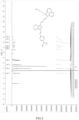
- Fig.2 it is an NMR hydrogen spectrum characterization diagram of a near-infrared region II fluorescent small molecule obtained in this example.
- Fig.3 it is a mass spectrum characterization diagram of a near-infrared region II fluorescent small molecule obtained in this example.
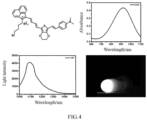
- Fig.4 it is a performance diagram of a near-infrared region II fluorescent small molecule obtained in this example.
- a method for preparing a near-infrared region II fluorescent small molecule comprises the following steps:
- a method for preparing a near-infrared region II fluorescent small molecule comprises the following steps:
- a method for preparing a near-infrared region II fluorescent small molecule comprises the following steps:
- a method for preparing a near-infrared region II fluorescent small molecule comprises the following steps:
- a method for preparing a near-infrared region II fluorescent small molecule comprises the following steps:
- the near-infrared region II fluorescent small molecule of the present disclosure has the advantages of simple synthesis method, easy modification, stable structure, high fluorescence quantum yield and the like, and is expected to be further modified to develop a novel near-infrared region II probe with more excellent water solubility and optical property, thereby providing a new probe family for study on near-infrared region II probes in the fields of tumor surgery navigation imaging and medicinal cell labeling.
Landscapes
- Chemical & Material Sciences (AREA)
- Organic Chemistry (AREA)
- Engineering & Computer Science (AREA)
- Materials Engineering (AREA)
- Organic Low-Molecular-Weight Compounds And Preparation Thereof (AREA)
- Medicines Containing Antibodies Or Antigens For Use As Internal Diagnostic Agents (AREA)
- Low-Molecular Organic Synthesis Reactions Using Catalysts (AREA)
- Investigating Or Analysing Materials By The Use Of Chemical Reactions (AREA)
Claims (9)
- Verfahren zur Herstellung eines im nahen Infrarotbereich 11 fluoreszierenden kleinen Moleküls, wobei ein im nahen Infrarotbereich 11 fluoreszierendes kleines Molekül mit einer D-π-A-Systemstruktur konstruiert wird, indem ein Naphthalimidsalz als starker Elektronenakzeptor, Dioxythiophen als π-Brücke und eine N,N-Dimethylstyrolstruktur als Elektronendonor verwendet werden, und wobei die Struktur des Naphthalimidsalzes F 1 wie folgt ist:
 die Struktur des Dioxythiophens F2 wie folgt ist:
 die Struktur des N,N-Dimethylstyrols F3 wie folgt ist:
 die Struktur des im nahen Infrarotbereich II fluoreszierenden kleinen Moleküls F4 wie folgt ist:Wobei das Verfahren zur Herstellung des im nahen Infrarotbereich II fluoreszierenden kleinen Moleküls die folgenden Schritte umfasst:
 A, Synthese des Zwischenprodukts I Ml
N,N-Dimethylformamid, 1,8-Naphthalinimid und wasserfreies Lithiumhydroxid werden nacheinander in einen Reaktor mit Rührer gegeben und dann unter Rühren auf 125-150°C erhitzt, die Luft im Reaktionssystem wird durch Stickstoff ersetzt, 1,4-Dibrombutan wird unter dem Schutz von Stickstoff tropfenweise hinzugefügt, die Reaktion wird für 30-100 min aufrechterhalten, anschließend wird ein Stabilisator zugegeben, die oben genannten Materialien werden für 15-60 min gerührt und dann einer reduzierten Rektifikation unterzogen, Ethanol wird in einer Bodenflüssigkeit zugegeben, und schließlich wird das Zwischenprodukt I Ml durch Kristallisieren, Filtrieren und Trocknen erhalten,B, Synthese von Naphthalimidsalz F1
das Zwischenprodukt I Ml wird in Tetrahydrofuran gegeben und unter Rühren und unter dem Schutz von Stickstoff auf 52-58°C erhitzt, eine Methylmagnesiumchloridlösung wird tropfenweise zugegeben, die obige Reaktion wird auf 62-66°C erhitzt, nachdem die tropfenweise Zugabe abgeschlossen ist, und dann wird die Reaktion für 0,5-2. 5 h aufrechterhalten wird, ein Lösungsmittel durch Destillation zurückgewonnen wird, eine angemessene Menge Wasser in die Bodenflüssigkeit gegeben wird, eine 20 Gew.-%ige Fluorborsäurelösung langsam bei Raumtemperatur tropfenweise zugegeben wird, die Reaktionsgeschwindigkeit kontrolliert wird, das Rühren für 0,5-1 h nach Beendigung der tropfenweisen Zugabe aufrechterhalten wird und das Naphthalimidsalz F1 durch Saugfiltration erhalten wird;C, Synthese von Dioxythiophen F2
5-Brom-2-(3,4-vinyldioxythiophen)-formaldehyd und (Formylmethylen)-Triphenylphosphin werden in einer Toluollösung gemischt und zum Rückfluss erhitzt, die Reaktion wird für12-18 Stunden aufrechterhalten, das Lösungsmittel wird bei vermindertem Druck eingedampft, um ein Rohprodukt zu erhalten, und das Rohprodukt wird auf einer Kieselgelsäule gereinigt, und weißes pulverförmiges Dioxythiophen F2 wird unter Verwendung einer Petrolether/Dichlormethan-Mischung als Elutionsmittel erhalten;D, Synthese des Zwischenprodukts II M2
ein dosierter Katalysator 1 wird in N,N-Dimethylformamid zugegeben, 4-Vinyl-N,N-dimethylanilin F3 und Dioxythiophen F2 werden nacheinander unter Rühren zugegeben, dann wird die gemischte Lösung auf 125-150°C erhitzt und für 12-20 h unter dem Schutz von Stickstoff gerührt, um zu reagieren, die Reaktionslösung wird nach Beendigung der Reaktion mit Wasser und Dichlormethan extrahiert, jede Phase wird getrennt, die vereinigte organische Phase wird mit Na2SC>4 getrocknet, das Lösungsmittel wird bei vermindertem Druck eingedampft, und der verbleibende Rückstand wird durch Säulenchromatographie gereinigt, um das Zwischenprodukt II M2 zu erhalten; undE, Synthese des im nahen Infrarotbereich II fluoreszierenden kleinen Moleküls F4
das Zwischenprodukt II M2 und das Naphthalimidsalz F1 werden in Ethanol gemischt, eine geeignete Menge Katalysator 2 wird zugegeben, die oben genannten Materialien werden für 4-12 Stunden unter Stickstoff gerührt, ein Lösungsmittel wird bei vermindertem Druck verdampft, nachdem die Reaktion beendet ist, der verbleibende Rückstand wird durch Säulenchromatographie gereinigt, um das Endprodukt, ein im nahen Infrarotbereich II fluoreszierenden kleinen Moleküls F4, zu erhalten. - Verfahren zur Herstellung eines im nahen Infrarotbereich II fluoreszierenden kleinen Moleküls nach Anspruch 1, wobei in Schritt A das Erhitzen unter Rühren durchgeführt wird, um die Temperatur auf 138-140°C zu erhöhen.
- Verfahren zur Herstellung eines im nahen Infrarotbereich II fluoreszierenden kleinen Moleküls nach Anspruch 1 oder 2, wobei in Schritt A der Stabilisator eine Mischung aus einem oder mehr als zwei von Salzsäure, Schwefelsäure, Phosphorsäure, Ameisensäure, Essigsäure und p-Toluolsulfonsäure ist.
- Verfahren zur Herstellung eines im nahen Infrarotbereich II fluoreszierenden kleinen Moleküls nach Anspruch 3, wobei in Schritt A der Stabilisator p-Toluolsulfonsäure ist.
- Verfahren zur Herstellung eines im nahen Infrarotbereich II fluoreszierenden kleinen Moleküls nach Anspruch 1, wobei in Schritt D die gemischte Lösung auf 135-138°C erhitzt wird.
- Verfahren zur Herstellung eines im nahen Infrarotbereich II fluoreszierenden kleinen Moleküls nach Anspruch 1, wobei in Schritt D der Katalysator 1 eine Mischung aus einem oder mehr als zwei von Triphenylphosphin, Triethylamin und Tetramethylammoniumchlorid ist.
- Verfahren zur Herstellung eines im nahen Infrarotbereich II fluoreszierenden kleinen Moleküls nach Anspruch 1, wobei in Schritt D der Katalysator 1 ein Verbundkatalysator ist, der durch Mischen von Triphenylphosphin mit Tetramethylammoniumchlorid gebildet wird.
- Verfahren zur Herstellung eines im nahen Infrarotbereich II fluoreszierenden kleinen Moleküls nach Anspruch 1, wobei in Schritt E der Katalysator 2 eine Mischung aus einem oder mehr als zwei von Methylamin, Dimethylamin, Trimethylamin, Triethylamin, Lithiumcarbonat und Kaliumcarbonat ist.
- Verfahren zur Herstellung eines im nahen Infrarotbereich II fluoreszierenden kleinen Moleküls nach Anspruch 1, wobei in Stufe E der Katalysator 2 Lithiumcarbonat ist.
Applications Claiming Priority (2)
| Application Number | Priority Date | Filing Date | Title |
|---|---|---|---|
| CN202110886270.7A CN113461707B (zh) | 2021-08-03 | 2021-08-03 | 一种近红外二区荧光小分子的制备方法 |
| PCT/CN2022/091633 WO2023010925A1 (zh) | 2021-08-03 | 2022-05-09 | 一种近红外二区荧光小分子的制备方法 |
Publications (4)
| Publication Number | Publication Date |
|---|---|
| EP4183791A1 EP4183791A1 (de) | 2023-05-24 |
| EP4183791A4 EP4183791A4 (de) | 2024-03-20 |
| EP4183791B1 true EP4183791B1 (de) | 2024-10-30 |
| EP4183791C0 EP4183791C0 (de) | 2024-10-30 |
Family
ID=77883810
Family Applications (1)
| Application Number | Title | Priority Date | Filing Date |
|---|---|---|---|
| EP22754273.5A Active EP4183791B1 (de) | 2021-08-03 | 2022-05-09 | Verfahren zur herstellung von fluoreszenzmikromolekülen im zweiten nahinfrarotbereich |
Country Status (5)
| Country | Link |
|---|---|
| US (1) | US12275743B2 (de) |
| EP (1) | EP4183791B1 (de) |
| CN (1) | CN113461707B (de) |
| ES (1) | ES3005039T3 (de) |
| WO (1) | WO2023010925A1 (de) |
Families Citing this family (4)
| Publication number | Priority date | Publication date | Assignee | Title |
|---|---|---|---|---|
| CN113461707B (zh) * | 2021-08-03 | 2022-04-12 | 南京诺源医疗器械有限公司 | 一种近红外二区荧光小分子的制备方法 |
| CN114539232B (zh) * | 2022-01-26 | 2023-04-28 | 深圳大学 | 一种pH可逆激活近红外二区聚集诱导发光I型光敏剂及其应用 |
| CN114634499B (zh) * | 2022-02-14 | 2023-06-13 | 深圳大学 | 一种聚集诱导发光材料及其制备方法与应用 |
| CN120280007B (zh) * | 2025-06-06 | 2025-08-01 | 齐鲁工业大学(山东省科学院) | 近红外二区荧光分子聚集体光吸收强度评估方法及系统 |
Family Cites Families (11)
| Publication number | Priority date | Publication date | Assignee | Title |
|---|---|---|---|---|
| WO2015179438A1 (en) | 2014-05-20 | 2015-11-26 | Ohio State Innovation Foundation | Small molecule rac or rho inhibitors |
| WO2017048316A1 (en) | 2015-09-18 | 2017-03-23 | President And Fellows Of Harvard College | Small molecule biosensors |
| US11214687B2 (en) | 2017-08-29 | 2022-01-04 | Universität Basel | Small-molecule organic dyes |
| CN108440986A (zh) * | 2018-03-06 | 2018-08-24 | 复旦大学 | 近红外第二窗口激发/发射的荧光染料及其制备方法和应用 |
| US11614670B2 (en) * | 2018-09-17 | 2023-03-28 | Lightwave Logic, Inc. | Electro-optic polymer devices having high performance claddings, and methods of preparing the same |
| CN111334066B (zh) * | 2018-12-18 | 2021-12-10 | 中国科学院大连化学物理研究所 | 一类640nm激发的近红外荧光染料及其制备方法 |
| CN109665987B (zh) * | 2018-12-28 | 2022-02-18 | 河南大学 | 萘内酰亚胺-多胺缀合物及其制备方法和用途 |
| CN111961040B (zh) * | 2020-09-03 | 2023-03-21 | 山东大学 | 一种基于咔唑基的有机双杂环近红外荧光探针及其制备方法与应用 |
| CN112898282B (zh) * | 2021-01-25 | 2022-06-17 | 常州大学 | 一类D-π-A型AIE-TADF近红外发光材料及其制备方法与应用 |
| CN113429421B (zh) * | 2021-07-19 | 2022-03-11 | 南京诺源医疗器械有限公司 | 一种有机小分子荧光探针的制备方法 |
| CN113461707B (zh) * | 2021-08-03 | 2022-04-12 | 南京诺源医疗器械有限公司 | 一种近红外二区荧光小分子的制备方法 |
-
2021
- 2021-08-03 CN CN202110886270.7A patent/CN113461707B/zh active Active
-
2022
- 2022-05-09 ES ES22754273T patent/ES3005039T3/es active Active
- 2022-05-09 US US17/907,972 patent/US12275743B2/en active Active
- 2022-05-09 WO PCT/CN2022/091633 patent/WO2023010925A1/zh not_active Ceased
- 2022-05-09 EP EP22754273.5A patent/EP4183791B1/de active Active
Also Published As
| Publication number | Publication date |
|---|---|
| ES3005039T3 (en) | 2025-03-13 |
| CN113461707A (zh) | 2021-10-01 |
| CN113461707B (zh) | 2022-04-12 |
| US20240199633A1 (en) | 2024-06-20 |
| EP4183791A1 (de) | 2023-05-24 |
| US12275743B2 (en) | 2025-04-15 |
| EP4183791A4 (de) | 2024-03-20 |
| EP4183791C0 (de) | 2024-10-30 |
| WO2023010925A1 (zh) | 2023-02-09 |
Similar Documents
| Publication | Publication Date | Title |
|---|---|---|
| EP4183791B1 (de) | Verfahren zur herstellung von fluoreszenzmikromolekülen im zweiten nahinfrarotbereich | |
| CN113429421B (zh) | 一种有机小分子荧光探针的制备方法 | |
| CN110423487B (zh) | 一种Rhodol衍生物染料及其应用 | |
| CN115215769B (zh) | 一种用于检测乙酰胆碱酯酶的荧光探针及其制备方法与应用 | |
| CN113072574B (zh) | 一种氟硼甲瓉类近红外二区荧光染料、制备方法及应用 | |
| CN111778016B (zh) | 一种近红外荧光探针及其制备方法和应用 | |
| CN114621200B (zh) | 一种近红外荧光探针及其制备方法和应用 | |
| CN107383067A (zh) | 一种具有大斯托克斯位移的近红外发射氧杂蒽荧光染料制备方法 | |
| CN103773060B (zh) | 有机荧光染料分子及其合成方法和应用 | |
| CN107325211B (zh) | 含硒大分子荧光探针及其制备方法 | |
| CN105777794A (zh) | 一种双光子氟离子荧光探针化合物的制备与应用 | |
| Ren et al. | Red-shift (2-hydroxyphenyl)-benzothiazole emission by mimicking the excited-state intramolecular proton transfer effect | |
| CN107290323A (zh) | 一种近红外荧光探针及其制备方法与应用技术 | |
| CN108218743B (zh) | 一种组蛋白去乙酰化酶荧光探针及其制备方法和应用 | |
| CN112358493A (zh) | 一种基于氟硼配合物的小分子光热试剂及其制备方法和应用 | |
| CN118791462B (zh) | 激活型喹啉腈聚集诱导发光探针的构建及应用 | |
| CN117586245B (zh) | 一种dna荧光探针及其制备方法、应用 | |
| CN116675636B (zh) | 一种近红外双光子双模联动响应NTR&Cys荧光探针及其制备方法和应用 | |
| CN116731054A (zh) | 一种含联苯的bodipy二聚体荧光探针db-bodipy及其制备方法 | |
| CN117777751A (zh) | 一种花菁类染料及其应用 | |
| CN110734395B (zh) | 具有聚集诱导发光效应的9-二(3-吡啶)乙烯-芴的制备方法 | |
| CN114539214B (zh) | 原位检测醌氧化还原酶荧光探针的设计、合成及活性研究 | |
| Guo et al. | One-pot synthesis and applications of two asymmetrical benzoxanthene dyes | |
| CN113135904B (zh) | 羟自由基近红外荧光分子探针及其制备方法与应用 | |
| CN104860974A (zh) | 一种吡咯甲川-二氟化硼络合物的衍生物及其制备方法 |
Legal Events
| Date | Code | Title | Description |
|---|---|---|---|
| STAA | Information on the status of an ep patent application or granted ep patent |
Free format text: STATUS: UNKNOWN |
|
| STAA | Information on the status of an ep patent application or granted ep patent |
Free format text: STATUS: THE INTERNATIONAL PUBLICATION HAS BEEN MADE |
|
| PUAI | Public reference made under article 153(3) epc to a published international application that has entered the european phase |
Free format text: ORIGINAL CODE: 0009012 |
|
| STAA | Information on the status of an ep patent application or granted ep patent |
Free format text: STATUS: REQUEST FOR EXAMINATION WAS MADE |
|
| 17P | Request for examination filed |
Effective date: 20220824 |
|
| AK | Designated contracting states |
Kind code of ref document: A1 Designated state(s): AL AT BE BG CH CY CZ DE DK EE ES FI FR GB GR HR HU IE IS IT LI LT LU LV MC MK MT NL NO PL PT RO RS SE SI SK SM TR |
|
| A4 | Supplementary search report drawn up and despatched |
Effective date: 20240220 |
|
| RIC1 | Information provided on ipc code assigned before grant |
Ipc: G01N 21/64 20060101ALI20240214BHEP Ipc: C09K 11/06 20060101ALI20240214BHEP Ipc: C09B 23/00 20060101ALI20240214BHEP Ipc: C09B 23/10 20060101ALI20240214BHEP Ipc: C07D 495/04 20060101AFI20240214BHEP |
|
| GRAJ | Information related to disapproval of communication of intention to grant by the applicant or resumption of examination proceedings by the epo deleted |
Free format text: ORIGINAL CODE: EPIDOSDIGR1 |
|
| GRAP | Despatch of communication of intention to grant a patent |
Free format text: ORIGINAL CODE: EPIDOSNIGR1 |
|
| GRAP | Despatch of communication of intention to grant a patent |
Free format text: ORIGINAL CODE: EPIDOSNIGR1 |
|
| STAA | Information on the status of an ep patent application or granted ep patent |
Free format text: STATUS: GRANT OF PATENT IS INTENDED |
|
| DAV | Request for validation of the european patent (deleted) | ||
| DAX | Request for extension of the european patent (deleted) | ||
| INTG | Intention to grant announced |
Effective date: 20240613 |
|
| GRAS | Grant fee paid |
Free format text: ORIGINAL CODE: EPIDOSNIGR3 |
|
| GRAA | (expected) grant |
Free format text: ORIGINAL CODE: 0009210 |
|
| STAA | Information on the status of an ep patent application or granted ep patent |
Free format text: STATUS: THE PATENT HAS BEEN GRANTED |
|
| AK | Designated contracting states |
Kind code of ref document: B1 Designated state(s): AL AT BE BG CH CY CZ DE DK EE ES FI FR GB GR HR HU IE IS IT LI LT LU LV MC MK MT NL NO PL PT RO RS SE SI SK SM TR |
|
| REG | Reference to a national code |
Ref country code: GB Ref legal event code: FG4D |
|
| REG | Reference to a national code |
Ref country code: CH Ref legal event code: EP |
|
| REG | Reference to a national code |
Ref country code: DE Ref legal event code: R096 Ref document number: 602022007314 Country of ref document: DE |
|
| REG | Reference to a national code |
Ref country code: IE Ref legal event code: FG4D |
|
| U01 | Request for unitary effect filed |
Effective date: 20241122 |
|
| U07 | Unitary effect registered |
Designated state(s): AT BE BG DE DK EE FI FR IT LT LU LV MT NL PT RO SE SI Effective date: 20241128 |
|
| REG | Reference to a national code |
Ref country code: ES Ref legal event code: FG2A Ref document number: 3005039 Country of ref document: ES Kind code of ref document: T3 Effective date: 20250313 |
|
| PG25 | Lapsed in a contracting state [announced via postgrant information from national office to epo] |
Ref country code: IS Free format text: LAPSE BECAUSE OF FAILURE TO SUBMIT A TRANSLATION OF THE DESCRIPTION OR TO PAY THE FEE WITHIN THE PRESCRIBED TIME-LIMIT Effective date: 20250228 Ref country code: HR Free format text: LAPSE BECAUSE OF FAILURE TO SUBMIT A TRANSLATION OF THE DESCRIPTION OR TO PAY THE FEE WITHIN THE PRESCRIBED TIME-LIMIT Effective date: 20241030 |
|
| PG25 | Lapsed in a contracting state [announced via postgrant information from national office to epo] |
Ref country code: NO Free format text: LAPSE BECAUSE OF FAILURE TO SUBMIT A TRANSLATION OF THE DESCRIPTION OR TO PAY THE FEE WITHIN THE PRESCRIBED TIME-LIMIT Effective date: 20250130 |
|
| PG25 | Lapsed in a contracting state [announced via postgrant information from national office to epo] |
Ref country code: GR Free format text: LAPSE BECAUSE OF FAILURE TO SUBMIT A TRANSLATION OF THE DESCRIPTION OR TO PAY THE FEE WITHIN THE PRESCRIBED TIME-LIMIT Effective date: 20250131 |
|
| PG25 | Lapsed in a contracting state [announced via postgrant information from national office to epo] |
Ref country code: PL Free format text: LAPSE BECAUSE OF FAILURE TO SUBMIT A TRANSLATION OF THE DESCRIPTION OR TO PAY THE FEE WITHIN THE PRESCRIBED TIME-LIMIT Effective date: 20241030 |
|
| PG25 | Lapsed in a contracting state [announced via postgrant information from national office to epo] |
Ref country code: RS Free format text: LAPSE BECAUSE OF FAILURE TO SUBMIT A TRANSLATION OF THE DESCRIPTION OR TO PAY THE FEE WITHIN THE PRESCRIBED TIME-LIMIT Effective date: 20250130 |
|
| U20 | Renewal fee for the european patent with unitary effect paid |
Year of fee payment: 4 Effective date: 20250520 |
|
| PG25 | Lapsed in a contracting state [announced via postgrant information from national office to epo] |
Ref country code: SM Free format text: LAPSE BECAUSE OF FAILURE TO SUBMIT A TRANSLATION OF THE DESCRIPTION OR TO PAY THE FEE WITHIN THE PRESCRIBED TIME-LIMIT Effective date: 20241030 |
|
| PGFP | Annual fee paid to national office [announced via postgrant information from national office to epo] |
Ref country code: ES Payment date: 20250605 Year of fee payment: 4 |
|
| PG25 | Lapsed in a contracting state [announced via postgrant information from national office to epo] |
Ref country code: SK Free format text: LAPSE BECAUSE OF FAILURE TO SUBMIT A TRANSLATION OF THE DESCRIPTION OR TO PAY THE FEE WITHIN THE PRESCRIBED TIME-LIMIT Effective date: 20241030 |
|
| PG25 | Lapsed in a contracting state [announced via postgrant information from national office to epo] |
Ref country code: CZ Free format text: LAPSE BECAUSE OF FAILURE TO SUBMIT A TRANSLATION OF THE DESCRIPTION OR TO PAY THE FEE WITHIN THE PRESCRIBED TIME-LIMIT Effective date: 20241030 |
|
| PLBE | No opposition filed within time limit |
Free format text: ORIGINAL CODE: 0009261 |
|
| STAA | Information on the status of an ep patent application or granted ep patent |
Free format text: STATUS: NO OPPOSITION FILED WITHIN TIME LIMIT |
|
| 26N | No opposition filed |
Effective date: 20250731 |
|
| REG | Reference to a national code |
Ref country code: CH Ref legal event code: H13 Free format text: ST27 STATUS EVENT CODE: U-0-0-H10-H13 (AS PROVIDED BY THE NATIONAL OFFICE) Effective date: 20251223 |
|
| PG25 | Lapsed in a contracting state [announced via postgrant information from national office to epo] |
Ref country code: CH Free format text: LAPSE BECAUSE OF NON-PAYMENT OF DUE FEES Effective date: 20250531 |
|
| PG25 | Lapsed in a contracting state [announced via postgrant information from national office to epo] |
Ref country code: MC Free format text: LAPSE BECAUSE OF FAILURE TO SUBMIT A TRANSLATION OF THE DESCRIPTION OR TO PAY THE FEE WITHIN THE PRESCRIBED TIME-LIMIT Effective date: 20241030 |
|
| PG25 | Lapsed in a contracting state [announced via postgrant information from national office to epo] |
Ref country code: IE Free format text: LAPSE BECAUSE OF NON-PAYMENT OF DUE FEES Effective date: 20250509 |