EP4183375B1 - Prothesenkosmetik und verfahren zu dessen herstellung - Google Patents
Prothesenkosmetik und verfahren zu dessen herstellung Download PDFInfo
- Publication number
- EP4183375B1 EP4183375B1 EP22206441.2A EP22206441A EP4183375B1 EP 4183375 B1 EP4183375 B1 EP 4183375B1 EP 22206441 A EP22206441 A EP 22206441A EP 4183375 B1 EP4183375 B1 EP 4183375B1
- Authority
- EP
- European Patent Office
- Prior art keywords
- prosthetic
- thread
- fabric
- cover
- base
- Prior art date
- Legal status (The legal status is an assumption and is not a legal conclusion. Google has not performed a legal analysis and makes no representation as to the accuracy of the status listed.)
- Active
Links
Images


Classifications
-
- A—HUMAN NECESSITIES
- A61—MEDICAL OR VETERINARY SCIENCE; HYGIENE
- A61F—FILTERS IMPLANTABLE INTO BLOOD VESSELS; PROSTHESES; DEVICES PROVIDING PATENCY TO, OR PREVENTING COLLAPSING OF, TUBULAR STRUCTURES OF THE BODY, e.g. STENTS; ORTHOPAEDIC, NURSING OR CONTRACEPTIVE DEVICES; FOMENTATION; TREATMENT OR PROTECTION OF EYES OR EARS; BANDAGES, DRESSINGS OR ABSORBENT PADS; FIRST-AID KITS
- A61F2/00—Filters implantable into blood vessels; Prostheses, i.e. artificial substitutes or replacements for parts of the body; Appliances for connecting them with the body; Devices providing patency to, or preventing collapsing of, tubular structures of the body, e.g. stents
- A61F2/50—Prostheses not implantable in the body
- A61F2/54—Artificial arms or hands or parts thereof
- A61F2/58—Elbows; Wrists ; Other joints; Hands
- A61F2/583—Hands; Wrist joints
-
- A—HUMAN NECESSITIES
- A61—MEDICAL OR VETERINARY SCIENCE; HYGIENE
- A61F—FILTERS IMPLANTABLE INTO BLOOD VESSELS; PROSTHESES; DEVICES PROVIDING PATENCY TO, OR PREVENTING COLLAPSING OF, TUBULAR STRUCTURES OF THE BODY, e.g. STENTS; ORTHOPAEDIC, NURSING OR CONTRACEPTIVE DEVICES; FOMENTATION; TREATMENT OR PROTECTION OF EYES OR EARS; BANDAGES, DRESSINGS OR ABSORBENT PADS; FIRST-AID KITS
- A61F2/00—Filters implantable into blood vessels; Prostheses, i.e. artificial substitutes or replacements for parts of the body; Appliances for connecting them with the body; Devices providing patency to, or preventing collapsing of, tubular structures of the body, e.g. stents
- A61F2/50—Prostheses not implantable in the body
-
- A—HUMAN NECESSITIES
- A61—MEDICAL OR VETERINARY SCIENCE; HYGIENE
- A61F—FILTERS IMPLANTABLE INTO BLOOD VESSELS; PROSTHESES; DEVICES PROVIDING PATENCY TO, OR PREVENTING COLLAPSING OF, TUBULAR STRUCTURES OF THE BODY, e.g. STENTS; ORTHOPAEDIC, NURSING OR CONTRACEPTIVE DEVICES; FOMENTATION; TREATMENT OR PROTECTION OF EYES OR EARS; BANDAGES, DRESSINGS OR ABSORBENT PADS; FIRST-AID KITS
- A61F2/00—Filters implantable into blood vessels; Prostheses, i.e. artificial substitutes or replacements for parts of the body; Appliances for connecting them with the body; Devices providing patency to, or preventing collapsing of, tubular structures of the body, e.g. stents
- A61F2/50—Prostheses not implantable in the body
- A61F2002/5001—Cosmetic coverings
Definitions
- the invention relates to a prosthetic cosmetic with a textile base body made of an opaque base material with a first color tone and a method for producing a prosthetic cosmetic with such a base body.
- US 9 192 486 B2 represents the latest state of the art.
- Prosthetic cosmetics are covers made of different materials that are flexible and usually elastic and are worn over prosthetic limbs or prosthetic components.
- Prosthetic cosmetics have a protective function in that they protect the prosthetic components or prosthetic limbs from external influences and also provide padding for natural limbs should contact with natural limbs occur during use of the prosthesis.
- prosthetic cosmetics also have an aesthetic function. The user of a prosthesis often does not want it to be immediately recognized as such. The aim of prosthetic cosmetics is therefore to create a visual impression that is as close as possible to the natural appearance of the limb.
- Prosthetic cosmetics made from an elastomer material are tubular or have holders for distal prosthetic components such as prosthetic feet or prosthetic hands.
- the coloring is extremely complex and is applied by hand by specialists in several layers or layers to an elastomer base body.
- Prosthetic cosmetics made from an elastomer material have a limited durability, the cushioning properties are limited, the material is heavy and the production is laborious and expensive.
- cosmetics made of solid silicone or elastomers can limit the range of motion of the prosthesis, for example when flexing a prosthetic joint.
- prosthetic cosmetics made from textile material are known in which the textile material is dyed to create the most natural appearance possible.
- the dyeing is done either with just one color or with the application of shades.
- Textile materials are also processed using a printing process, such as photo transfer printing, to imitate skin structures as naturally as possible.
- the effects achieved are unsatisfactory because the required color depth cannot be achieved using photo printing.
- the object of the present invention is to provide a prosthetic cosmetic and a method for producing a prosthetic cosmetic with which it is possible to provide the most natural optical appearance possible for the prosthetic cosmetic.
- this object is achieved by a prosthetic cosmetic having the features of the main claim and a method having the features of the independent claim.
- Advantageous embodiments and further developments of the invention are disclosed in the subclaims, the description and the figure.
- the prosthetic cosmetic with a textile base body made of an opaque base material with a first color tone provides at least one textile cover material made of a transparent, partially transparent or translucent thread material, which is processed on an outside of the base material and colored in a color tone that differs from the first color tone or with a color saturation that differs from it.
- the degree of transmission is greater than 0.4, in particular greater than 0.5.
- the base material with the first color tone preferably has a coloring that resembles or corresponds to the skin color or the color tone of the skin on the untreated side or the rest of the body.
- a second, textile covering material made of a transparent, partially transparent or translucent thread material is applied to the outside of this base material, so that an improved, deep color impression is created that resembles the multi-layered color impression of natural skin.
- the prosthetic cosmetic according to the invention achieves the natural skin shimmer without complex printing, artificial shading or other measures with a textile material, so that a light, inexpensive and easy-to-produce prosthetic cosmetic is provided.
- the opaque, non-transparent base material prevents the covered prosthetic component from being directly visually perceived.
- the coloring of the base material which approximates the color tone of the skin, basically creates the optical similarity to a natural limb
- the second material layer made of a textile arranged on top avoids a dull impression and, due to its textile character, enables wrinkles to form when the prosthetic limb moves.
- the base material is made as a knitted, warp-knitted or woven fabric and the cover material is processed onto the base material using a multi-bed knitting, warp-knitting or weaving process.
- the prosthetic cosmetics can be made from cut pieces or made as a single piece.
- the base material has a first thread material, in particular consists of, for example, polyester or viscose.
- the first thread material is in particular opaque and different from the transparent, partially transparent or translucent thread material of the cover material.
- the second thread material preferably consists of nylon, in particular of a highly smooth nylon or polyamide and is designed as a monofilament or monofilament.
- the design of the first thread material for example made of polyester or viscose, enables easy coloring and high color fastness of the base material, while the use of the second thread material made of nylon provides a visually and haptically appealing outer surface of the prosthetic cosmetics.
- the two different colors of the base material and the cover material in combination with the transparent or translucent properties of the material of the cover material give the textile of the prosthetic cosmetics a depth effect that approximates the optical impression of human skin.
- the base material is made from several thread materials that have different thread thicknesses and/or material properties.
- the use of several thread materials with different thread thicknesses and/or material properties increases the design options in terms of the visual impression and the functional properties.
- yarns of different thicknesses can be used to create different cushioning properties, elastic properties, mechanical resistance and increased opacity.
- the base material can be produced with a higher density than the cover material, so that the cover material creates increased flexibility and cushioning effect, particularly due to the use of monofilament yarns, while the base material ensures mechanical strength and the optical basis for the selected color.
- a further development provides that at least one elastic thread material is incorporated into the base material or that the base material has an elasticity of at least 100%, whereby the method of repeated tensile stress according to DIN 53835 T1 or DIN 53835 T3 or both of these methods is preferably used to determine the elasticity. Irrespective of the measuring method, an elasticity of 100% is proven in each variant.
- An elastic base material makes it easier to put on the prosthetic cosmetics over the Prosthetic component and the formation of folds and recovery when prosthetic components are displaced relative to each other or to the limb to which the prosthesis and prosthetic cosmetics are attached. This replicates the elastic properties of the skin and creates an improved natural appearance.
- An elasticity of more than 100% is usually sufficient to create attractive optical and mechanical properties; greater elasticities are also possible and desired.
- a further development provides that several cover layers are arranged one above the other on the outside of the base material in order to achieve greater optical depth.
- the respective layer of the cover material on the outside of the base material can be individually colored and have a color and/or material property that differs from the other layers. Materials with different degrees of transmission can be used for each layer of the cover material, whereby the degree of transmission for each layer is advantageously reduced in the direction of the base material.
- a layer of the cover material can also have different color tones or color values, so that shades are created in certain areas of the prosthetic cosmetics that improve the natural appearance.
- thread materials are siliconized and/or hydrophobicized, in particular the yarns or thread materials are only siliconized and/or hydrophobicized after dyeing. This changes the mechanical properties and the optical impression and improves the color stability and the usage properties of the prosthetic cosmetics in the final state.
- the yarn thickness of the base material differs from the yarn thickness of the cover material, in particular the yarn thickness of the base material is greater than the yarn thickness of the cover material in order to provide an outer surface that is as closed, smooth and fine as possible, while the base material forms a mechanically durable and dense base.
- the thread material of the base fabric is composed of several filaments; alternatively or additionally, the thread material of the cover fabric consists of a monofilament.
- the method for producing a prosthetic cosmetic as described above provides that a raw material with a base material and a cover material made of different thread materials is first produced and the raw material is then dyed and then processed into a prosthetic cosmetic.
- the production of the raw material before dyeing enables prepared and prefabricated materials to be easily adapted to the desired shade by subsequent dyeing. Due to the different material properties of the various thread materials for the base material and the cover material, color effects that are close to or correspond to the appearance of natural skin are achieved after dyeing together.
- Transparent, partially transparent or translucent thread materials of the cover material absorb the color less well when dyed than the materials of the base material, especially if the thread material of the cover material is a monofilament made of a polyamide.
- there is an intentional, poorer bond of the color to the surface or in the structure of the material so that the shimmering color effect is achieved by layers of color placed on top of each other.
- the transparent, partially transparent or translucent thread material can be pre-dyed before processing into the cover material, in particular by spinneret dyeing, so that further color effects and color overlays are achieved.
- the pre-dyeing can be uneven in order to optically recreate different structures of the skin surface.
- the pre-dyeing is carried out in particular with a different color or in a different shade than the final dyeing.
- the raw material is siliconized and/or hydrophobized before further processing in order to increase durability and resistance to external influences.
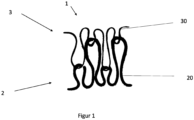
- the raw material 1 consists in the embodiment shown of a base material 2 and a cover material 3.
- the base material 2 is designed as a knitted fabric, warp-knitted fabric or woven fabric and has a yarn made of a textured polyester with a plated elastomer yarn as the first thread material 20.
- the yarn or thread material 20 of the base material 2 creates an opaque layer or base and is designed in particular as a multifilament yarn, with a mass fraction of at least 5% elastomer yarn and a maximum of 95% polymer yarn.
- a yarn is used as thread material 30, which consists of a transparent or partially transparent polyamide.
- the thread material 30 of the cover fabric 3 is only lightly dyed by a common dye bath and thus receives a shade that differs from the color impression of the base fabric 2 depending on the dyeing before.
- the raw material 1 is first manufactured in its entirety, for example by knitting, weaving or weaving. As an alternative to a single-layer design of the cover layer 3, this can also be designed in multiple layers. When the raw material 1 is manufactured, it is dyed together and then further processed.
- the raw material 1 can have elastic properties and, when used as a sleeve-like prosthetic cosmetic, can be manufactured in one piece in a circular knitting process.
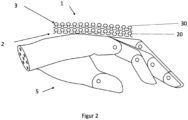
- FIG. 2 A schematic representation of a prosthetic hand 5 with a base body and several prosthetic fingers attached to it in an articulated manner is shown.
- Prosthetic fingers have several components that are attached to one another in an articulated manner.
- drives for example electric motors, can be present in the base body, so that the prosthetic hand 5 can be used as an active prosthesis with a corresponding control, for example on the basis of myoelectric signals.
- a part of a prosthetic cosmetic or a prosthetic cover made of a raw material 1 is shown, which has an opaque base material 2 made of a knitted, warp-knitted or woven fabric on the underside facing the prosthetic hand 5, on the outside of which facing away from the prosthetic hand 5 a cover material 3 made of a transparent, translucent or partially transparent knitted, warp-knitted or woven fabric is applied.
- the structure of the material of the raw material 1 corresponds to that in the Figure 1
- the raw material 1 is arranged on the outside of the prosthetic hand 5, for example as a sole prosthetic cover or prosthetic cosmetic or as part of a combination of several components.
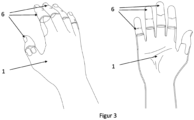
- a further variant of the invention is shown, in which a prosthetic cover or a prosthetic cosmetic made of a raw material 1 is shown in the form of a partial glove without fingertips or only with partially formed fingertips.
- Glued-on injection-molded parts or elastomer components are firmly arranged on the distal ends of the prosthetic cosmetic, which have the necessary material properties for the respective application, for example with regard to wear resistance and/or adhesion.
- the elastomer components 6 may include fingernail components to improve the natural appearance of the prosthetic cover.
- the yarns of the base fabric 2 and the cover fabric 3 have already been dyed, a more extensive or intensive coloring of the elastomer components 6 is not necessary, but coloring the elastomer components 6 can cause an overall change in the color impression.
- the elastomer components 6 can also be arranged and applied on the back of the hand and/or on the inside of the palm.
- the elastomer components are either attached or glued on, cast on or are designed as a complete hand cover and are pulled over the textile product.
- the five elastomer components 6 are shown individually in the form of fingertips.
- medial and lateral extensions are formed in the area of the index finger and little finger in order to cover and protect areas of the textile base material that are particularly susceptible to wear.
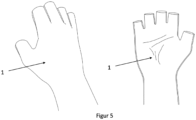
- the covering with the raw material 1 made of the base material 2 and the cover material 3 is shown in the form of a partial glove in which the fingertips are completely free.
- the cover is shown as a prosthetic hand cosmetic with the raw material 1 made of the base material 2 with the first thread material 20 and the cover material 3 with the second thread material 30 made of a transparent or partially transparent or translucent material, in particular polyamide.
Landscapes
- Health & Medical Sciences (AREA)
- Transplantation (AREA)
- Biomedical Technology (AREA)
- Cardiology (AREA)
- Oral & Maxillofacial Surgery (AREA)
- Engineering & Computer Science (AREA)
- Orthopedic Medicine & Surgery (AREA)
- Heart & Thoracic Surgery (AREA)
- Vascular Medicine (AREA)
- Life Sciences & Earth Sciences (AREA)
- Animal Behavior & Ethology (AREA)
- General Health & Medical Sciences (AREA)
- Public Health (AREA)
- Veterinary Medicine (AREA)
- Prostheses (AREA)
Description
- Die Erfindung betrifft eine Prothesenkosmetik mit einem textilen Grundkörper aus einer blickdichten Grundware mit einem ersten Farbton und ein Verfahren zum Herstellen einer Prothesenkosmetik mit einem solchen Grundkörper.
US 9 192 486 B2 - Prothesenkosmetiken sind Überzüge aus unterschiedlichen Materialien, die flexibel und in der Regel elastisch sind und über Prothesengliedmaßen oder Prothesenkomponenten getragen werden. Prothesenkosmetiken nehmen eine Schutzfunktion war, indem einerseits die Prothesenkomponenten oder Prothesen Gliedmaßen vor äußeren Einflüssen schützen und andererseits eine Polsterung für natürliche Gliedmaßen darstellen, sollte es während der Nutzung der Prothesen zu einem Kontakt mit natürlichen Gliedmaßen kommen. Neben der Schutzfunktion nehmen Prothesenkosmetiken auch eine ästhetische Funktion war. Häufig wünscht der Nutzer einer Prothese nicht, dass diese als solche unmittelbar erkannt wird. Daher ist es das Ziel von Prothesenkosmetiken, einen an die natürliche Erscheinungsform der Gliedmaße möglichst angepassten und angenäherten optischen Eindruck zu erzeugen.
- Prothesenkosmetiken aus einem Elastomermaterial, beispielsweise Silikon, sind schlauchartig ausgebildet oder weisen Aufnahmen für distale Prothesenkomponenten wie Prothesenfüße oder Prothesenhände auf. Die Farbgebung ist dabei außerordentlich aufwendig und wird von Spezialisten in Handarbeit in mehreren Schichten oder Lagen auf einen Elastomer-Grundkörper aufgebracht. Prothesenkosmetiken aus einem Elastomermaterial weisen eine begrenzte Haltbarkeit auf, die Polstereigenschaften sind eingeschränkt, das Material ist schwer und die Herstellung ist mühsam und teuer. Darüber hinaus können Kosmetiken aus Vollsilikon oder Elastomeren den Bewegungsbereich der Prothesen einschränken, beispielsweise bei einer Flexion eines Prothesengelenkes.
- Darüber hinaus sind Prothesenkosmetiken aus einem Textilmaterial bekannt, bei denen zur Erzeugung einer möglichst natürlichen Erscheinung das Textilmaterial eingefärbt wird. Die Einfärbung erfolgt entweder mit nur einer Farbe oder unter Aufbringung von Schattierungen. Ebenfalls werden textile Materialien im Rahmen eines Druckverfahrens, beispielsweise Fototransferdruck, bearbeitet, um Hautstrukturen möglichst naturalistisch nachzuahmen. Die dabei erzielten Effekte sind unbefriedigend, da die benötigte Farbtiefe mittels Fotodruckes nicht erreicht werden kann. Die damit hergestellten Produkte wirken künstlich, unnatürlich und werden auf den ersten Blick als orthopädietechnische Produkte erkannt.
- Aufgabe der vorliegenden Erfindung ist es, eine Prothesenkosmetik und ein Verfahren zum Herstellen einer Prothesenkosmetik bereitzustellen, mit denen es möglich ist, eine möglichst natürliche optische Erscheinung der Prothesenkosmetik bereitzustellen.
- Erfindungsgemäß wird diese Aufgabe durch eine Prothesenkosmetik mit den Merkmalen des Hauptanspruches und ein Verfahren mit den Merkmalen des nebengeordneten Anspruchs gelöst. Vorteilhafte Ausgestaltungen und Weiterbildungen der Erfindung sind in den Unteransprüchen, der Beschreibung sowie der Figur offenbart.
- Die Prothesenkosmetik mit einem textilen Grundkörper aus einer blickdichten Grundware mit einen ersten Farbton sieht zumindest eine textile Deckware aus einem transparenten, teiltransparenten oder transluzenten Fadenmaterial vor, das auf einer Außenseite der Grundware aufgearbeitet und in einem von dem ersten Farbton abweichenden Farbton oder mit einer davon abweichenden Farbsättigung eingefärbt ist. Bei einem teiltransparenten Fadenmaterial ist der Transmissionsgrad größer als 0,4, insbesondere größer als 0,5. Die Grundware mit dem ersten Farbton weist bevorzugt eine Färbung auf, die der Hautfarbe bzw. dem Farbton der Haut der unversorgten Seite oder des übrigen Körpers ähnelt oder entspricht. Auf der Außenseite dieser Grundware wird eine zweite, textile Deckware aus einem transparenten, teiltransparenten oder transluzenten Fadenmaterial aufgebracht, sodass sich ein verbesserter, tiefer Farbeindruck entsteht, der dem mehrschichtigen Farbeindruck einer natürlichen Haut ähnelt. Mit der erfindungsgemäßen Prothesenkosmetik wird erreicht, dass der natürliche Hautschimmer ohne aufwändige Drucke, künstliche Schattierungen oder andere Maßnahmen mit einem textilen Werkstoff erreicht wird, sodass eine leichte, preiswerte und einfach herzustellende Prothesenkosmetik bereitgestellt wird. Die blickdichte, undurchsichtige Grundware verhindert, dass eine direkte optische Wahrnehmung der abgedeckten Prothesenkomponente erfolgen kann. Durch die dem Farbton der Haut angenäherte Farbgebung der Grundware wird die optische Ähnlichkeit zu einer natürlichen Gliedmaße grundsätzlich hergestellt, die darüber angeordnete zweite Materialschicht aus einem Textil vermeidet einen stumpfen Eindruck und ermöglicht aufgrund des textilen Charakters eine Faltenbildung bei der Bewegung der Prothesengliedmaße.
- Eine Weiterbildung sieht vor, dass die Grundware als Gestrick, Gewirk oder Gewebe ausgebildet ist und die Deckware über ein mehrbettiges Strickverfahren, Wirkverfahren oder Webverfahren auf der Grundware aufgearbeitet ist. Dadurch kann einfach und kostengünstig das textile Grundmaterial als Rohware hergestellt werden, aus dem dann die Prothesenkosmetik gefertigt wird. Die Prothesenkosmetik kann aus Zuschnitten gefertigt oder einstückig ausgebildet sein.
- Eine Weiterbildung sieht vor, dass die Grundware ein erstes Fadenmaterial aufweist, insbesondere daraus besteht, beispielsweise Polyester oder Viskose. Das erste Fadenmaterial ist insbesondere opak und von dem transparenten, teiltransparenten oder transluzenten Fadenmaterial der Deckware verschieden. Bevorzugt besteht das zweite Fadenmaterial aus Nylon, insbesondere aus einem hochglatten Nylon oder Polyamid und ist als Monofile oder Monofilament ausgebildet. Durch die Verwendung unterschiedlicher Fadenmaterialien ist die Ausgestaltung der Prothesenkosmetik entsprechend ihrer Funktion verbessert einstellbar. Die der Prothese zugewandte Grundware aus dem ersten Fadenmaterial oder mit dem ersten Fadenmaterial weist insbesondere einen dunkleren Farbton auf die Deckware aus einem zweiten Fadenmaterial. Die Ausgestaltung des ersten Fadenmaterials beispielsweise aus Polyester oder Viskose ermöglicht eine leichte Einfärbung und eine hohe Farbbeständigkeit der Grundware, während die Verwendung des zweiten Fadenmaterials aus Nylon eine optisch und haptisch ansprechende Außenoberfläche der Prothesenkosmetik bereitstellt. Die zwei unterschiedlichen Farben der Grundware und der Deckware in Kombination mit den transparenten oder transluzenten Eigenschaften des Materials der Deckware verleihen dem Textil der Prothesenkosmetik eine Tiefenwirkung, die dem optischen Eindruck der menschlichen Haut angenähert ist.
- Eine Weiterbildung sieht vor, dass die Grundware aus mehreren Fadenmaterialien gebildet ist, die unterschiedliche Fadenstärken und/oder Materialeigenschaften aufweisen. Die Verwendung mehrerer Fadenmaterialien mit unterschiedlichen Fadenstärken und/oder Materialeigenschaften vergrößern die Gestaltungsmöglichkeiten hinsichtlich des optischen Eindruckes sowie der funktionalen Eigenschaften. Beispielsweise können unterschiedlich dicke Garne verwendet werden, um unterschiedliche Polstereigenschaften, elastische Eigenschaften, mechanische Widerstände und erhöhte Blickdichtigkeiten zu erzeugen. Die Grundware kann mit einer höheren Dichte als die Deckware erzeugt werden, sodass die Deckware eine erhöhte Nachgiebigkeit und Polsterwirkung insbesondere aufgrund der Verwendung von Monofile-Garnen erzeugt, während die Grundware eine mechanische Festigkeit und die optische Basis für den gewählten Farbton gewährleistet.
- Eine Weiterbildung sieht vor, dass in der Grundware zumindest ein elastisches Fadenmaterial eingearbeitet ist oder die Grundware eine Elastizität von mindestens 100% aufweist, wobei zu der Bestimmung der Elastizität bevorzugt das Verfahren der mehrmaligen Zugbeanspruchung nach der DIN 53835 T1 oder DIN 53835 T3 oder beider dieser Verfahren angewendet wird. Unabhängig von dem Messverfahren wird in jeder Variante eine Elastizität von 100% nachgewiesen. Eine elastische Grundware erleichtert das Anlegen der Prothesenkosmetik über der Prothesenkomponente und die Faltenbildung sowie Rückstellung bei einer Verlagerung von Prothesenkomponenten relativ zueinander oder zu der Gliedmaße, an der die Prothese und die Prothesenkosmetik befestigt sind. Dadurch werden die elastischen Eigenschaften der Haut nachgebildet und eine verbesserte natürliche Erscheinungsform erzeugt. Eine Elastizität von mehr als 100 % ist in der Regel ausreichend, um ansprechende optische und mechanische Eigenschaften zu erzeugen, größere Elastizitäten sind ebenfalls möglich und gewünscht.
- Eine Weiterbildung sieht vor, dass mehrere Decklagen übereinander an der Außenseite der Grundware angeordnet sind, um eine größere optische Tiefe zu erreichen. Die jeweilige Lage der Deckware an der Außenseite der Grundware kann individuell gefärbt und eine von den übrigen Lagen abweichende Färbung und/oder Materialeigenschaft aufweisen. So können Materialien mit unterschiedlichen Transmissionsgraden je Lage der Deckware verwendet werden, wobei vorteilhafterweise der Transmissionsgrad für jede Lage in Richtung auf die Grundware verringert wird. Eine Lage der Deckware kann auch unterschiedliche Farbtöne oder Farbwerte aufweisen, sodass in bestimmten Bereichen der Prothesenkosmetik Schattierungen erzeugt werden, die das natürliche Erscheinungsbild verbessern
- Eine Weiterbildung sieht vor, dass die Fadenmaterialien silikonisiert und/oder hydrophobiert sind, insbesondere werden die Garne oder Fadenmaterialien erst nach dem Färben silikonisiert und/oder hydrophobiert. Dies verändert die mechanischen Eigenschaften und den optischen Eindruck und verbessert die Farbstabilität und die Nutzungseigenschaften der Prothesenkosmetik im Endzustand.
- Eine Weiterbildung sieht vor, dass die Garnstärke der Grundware abweichend von der Garnstärke der Deckware ist, insbesondere ist die Garnstärke der Grundware größer als die Garnstärke der Deckware, um eine möglichst geschlossene, glatte und feine Außenoberfläche bereitzustellen, während die Grundware eine mechanisch haltbare und dichte Basis bildet.
- In einer Ausgestaltung ist das Fadenmaterial der Grundware aus mehreren Filamenten zusammengesetzt, alternativ oder ergänzend besteht das Fadenmaterial der Deckware aus einem Monofilament.
- Das Verfahren zum Herstellen einer wie oben beschriebenen Prothesenkosmetik sieht vor, dass zunächst eine Rohware mit einer Grundware und einer Deckware aus unterschiedlichen Fadenmaterialien hergestellt und die Rohware anschließend gefärbt und dann zu einer Prothesenkosmetik verarbeitet wird. Die Herstellung der Rohware vor dem Färben ermöglicht eine einfache Anpassung vorbereiteter und vorgefertigter Materialien an den jeweils gewünschten Farbton durch nachträgliches Färben. Aufgrund der unterschiedlichen Materialeigenschaften der verschiedenen Fadenmaterialien für die Grundware und die Deckware ergeben sich nach dem gemeinsamen Färben Farbeffekte, die dem Erscheinungsbild der natürlichen Haut nahekommen oder entsprechen. Transparente, teiltransparente oder transluzente Fadenmaterialien der Deckware nehmen die Farbe bei der Einfärbung schlechter an als die Materialien der Grundware, insbesondere wenn das Fadenmaterial der Deckware ein Monofilament aus einem Polyamid ist. Insbesondere bei einer hochglatten Variante der Garne der Deckware ergibt sich eine beabsichtigte, schlechtere Bindung der Farbe an der Oberfläche oder in dem Aufbau des Materials, sodass der schimmernde Farbeffekt durch übereinander gelagerte Farbschichten erreicht wird.
- Das transparente, teiltransparente oder transluzente Fadenmaterial kann vor der Verarbeitung zu der Deckware voreingefärbt, insbesondere durch Spinndüseneinfärbung gefärbt werden, sodass sich weitere Farbeffekte und Farbüberlagerungen einstellen. Die Voreinfärbung kann ungleichmäßig sein, um unterschiedliche Strukturen der Hautoberfläche optisch nachzubilden. Die Voreinfärbung erfolgt insbesondere mit einer anderen Farbe oder in einem anderen Farbton als bei der Endfärbung.
- Bevorzugt wird die Rohware vor der Weiterverarbeitung silikonisiert und/oder hydrophobiert, um die Haltbarkeit und Widerstandsfähigkeit gegenüber äußeren Einflüssen zu erhöhen.
- Nachfolgend wird ein Ausführungsbeispiel der Erfindung anhand der Figuren näher erläutert. Es zeigen:
-
Figur 1 - eine schematische Schnittansicht durch eine Rohware; -
Figur 2 - ein schematisches Anwendungsbeispiel einer Prothesenkosmetik eine Prothesenhand; -
Figur 3 - zwei Ansichten könne Prothesenkosmetik mit aufgesetzten Fingerkuppen; -
Figur 4 - eine Darstellung der Fingerüberzüge allein; -
Figur 5 eine Darstellung einer Prothesenkosmetik als Prothesenhand Überzug; sowie -
Figur 6 - eine schematische Darstellung einer Prothesenkosmetik als Prothesenhandüberzug. - In der
Figur 1 ist eine schematische Schnittansicht durch eine Rohware 1 einer Prothesenkosmetik gezeigt. Die Rohware 1 besteht in dem dargestellten Ausführungsbeispiel aus einer Grundware 2 und einer Deckware 3. Die Grundware 2 ist als Gestrick, Gewirk oder Gewebe ausgebildet und weist ein Garn aus einem texturierten Polyester mit einem plattierten Elastomergarn als erstes Fadenmaterial 20 auf. Das Garn oder Fadenmaterial 20 der Grundware 2 erzeugt eine blickdichte Schicht oder Basis und ist insbesondere als ein Multifilamentengarn ausgebildet, mit einem Massenanteil von mindestens 5% Elastomergarn und maximal 95% Polymergarn. - In der Deckware 3 wird ein Garn als Fadenmaterial 30 verwendet, das aus einem transparenten oder teiltransparenten Polyamid besteht. Anders als das Fadenmaterial 20 der Grundware 2 wird das Fadenmaterial 30 der Deckware 3 durch ein gemeinsames Färbebad nur leicht angefärbt und erhält dadurch eine Tönung, die sich je nach vor Färbung von dem Farbeindruck der Grundware 2 unterscheidet.
- Die Rohware 1 wird zunächst vollständig hergestellt, beispielsweise durch ein gemeinsames Stricken, Wirken oder Weben. Alternativ zur einer einlagigen Ausgestaltung der Deckschicht 3 kann diese auch mehrlagig ausgestaltet sein. Bei der Herstellung der Rohware 1 wird diese gemeinsam gefärbt und anschließend weiterverarbeitet. Die Rohware 1 kann elastische Eigenschaften aufweisen und bei einem Einsatz als hülsenartige Prothesenkosmetik in einem Rahmen eines Rundstrickverfahrens einstückig hergestellt sein.
- in der
Figur 2 ist einer schematischen Darstellung eine Prothesenhand 5 mit einem Grundkörper und mehreren daran gelenkig befestigten Prothesenfingern gezeigt. Prothesenfinger weisen mehrere Komponenten auf, die gelenkig aneinander befestigt sind. Zur Bewegung der Prothesenfinger relativ zu dem Grundkörper können Antriebe, beispielsweise Elektromotoren, in dem Grundkörper vorhanden sein, so dass die Prothesenhand 5 als aktive Prothese mit einer entsprechenden Steuerung, beispielsweise auf der Grundlage myoelektrische Signale, eingesetzt werden kann. An der Außenseite der Prothesenhand 5 ist ein Teil einer Prothesenkosmetik oder eines Prothesenüberzuges aus einer Rohware 1 gezeigt, die auf der der Prothesenhand 5 zugewandten Unterseite eine blickdichte Grundware 2 aus einem Gestrick, Gewirk oder Gewebe aufweist, auf dessen der Prothesenhand 5 abgewandten Außenseite eine Deckware 3 aus einem transparenten, transluzenten oder teiltransparenten Gestrick, Gewirk oder Gewebe aufgebracht ist. Der Aufbau des Materials der Rohware 1 entspricht dem in derFigur 1 beschriebenen Aufbau. Die Rohware 1 ist an der Außenseite der Prothesenhand 5 angeordnet, beispielsweise als alleiniger Prothesenüberzug oder Prothesenkosmetik oder aber als Teil einer Kombination mehrerer Komponenten. - In der
Figur 3 ist eine weitere Variante der Erfindung gezeigt, bei der ein Prothesenüberzug oder eine Prothesenkosmetik aus einer Rohware 1 in Gestalt eines Teilhandschuhes ohne Fingerkuppen oder nur mit teilweise ausgebildeten Fingerkuppen dargestellt ist. An den distalen Enden der Prothesenkosmetik sind aufgeklebte Spritzgussteile oder Elastomerkomponenten fest angeordnet, die für den jeweiligen Einsatzzweck die notwendigen Materialeigenschaften aufweisen, beispielsweise hinsichtlich der Verschleißfestigkeit und/oder der Haftfähigkeit. Darüber hinaus können die Elastomerkomponenten 6 zur Verbesserung der natürlichen Erscheinung des Prothesenüberzuges Fingernagelkomponenten aufweisen. - Aufgrund der bereits vorher eingefärbten Garne der Grundware 2 und der Deckware 3 ist eine weitergehende oder intensive Farbgebung der Elastomerkomponenten 6 nicht notwendig, allerdings kann durch eine Einfärbung der Elastomerkomponenten 6 eine Gesamtveränderung des Farbeindruckes hervorgerufen werden. Neben der Anordnung der Elastomerkomponenten 6 an den Fingerkuppen kann dies auch an dem Handrücken und/oder an der Handflächeninnenseite angeordnet und aufgebracht werden. Die Elastomerkomponenten werden entweder aufgesteckt oder aufgeklebt, angegossen oder sind als vollständiger Handüberzug ausgebildet und werden über die Textilware übergezogen.
- In der
Figur 4 sind die insgesamt fünf Elastomerkomponenten 6 in Gestalt von Fingerkuppen in Einzeldarstellung dargestellt. Neben den reinen Fingerkuppen, die das distale und mediale Fingerglied abdecken bzw. das Daumenendglied, sind im Bereich des Zeigefingers und des kleinen Fingers mediale und laterale Verlängerungen ausgebildet, um besonders verschleißanfällige Bereiche des textilen Grundmaterials abzudecken und zu schützen. - In der
Figur 5 ist der Überzug mit der Rohware 1 aus der Grundware 2 und der Deckware 3 in Gestalt eines Teilhandschuhes gezeigt, bei dem die Fingerkuppen vollständig frei sind. - In der
Figur 6 ist der Überzug als Prothesenhandkosmetik mit der Rohware 1 aus der Grundware 2 mit dem ersten Fadenmaterial 20 und der Deckware 3 mit dem zweiten Fadenmaterial 30 aus einem transparenten oder teiltransparenten bzw. transluzenten Material, insbesondere Polyamid gezeigt.
Claims (13)
- Prothesenkosmetik mit einem textilen Grundkörper aus einer blickdichten Grundware (2) mit einen ersten Farbton und zumindest einer textilen Deckware (3) aus einem transparenten, teiltransparenten oder transluzenten Fadenmaterial (30), das auf einer Außenseite der Grundware (2) aufgearbeitet ist und in einem von dem ersten Farbton abweichenden Farbton oder mit einer davon abweichenden Farbsättigung eingefärbt ist.
- Prothesenkosmetik nach Anspruch 1, dadurch gekennzeichnet, dass die Grundware (2) als Gestrick, Gewirk oder Gewebe ausgebildet ist und die Deckware (3) über ein mehrbettiges Strick-, Wirk- oder Webverfahren auf der Grundware (2) aufgearbeitet ist.
- Prothesenkosmetik nach Anspruch 1 oder 2, dadurch gekennzeichnet, dass die Grundware (2) ein erstes Fadenmaterial (20) aufweist, das von dem transparente, teiltransparenten oder transluzenten Fadenmaterial (30) der Deckware (3) verschieden ist.
- Prothesenkosmetik nach einem der voranstehenden Ansprüche, dadurch gekennzeichnet, dass die Grundware (2) aus mehreren Fadenmaterialien (20) gebildet ist, die unterschiedliche Fadenstärken und/oder Materialeigenschaften aufweisen.
- Prothesenkosmetik nach einem der voranstehenden Ansprüche, dadurch gekennzeichnet, dass in der Grundware (2) zumindest ein elastisches Fadenmaterial eingearbeitet ist oder die Grundware (2) eine Elastizität von mindestens 100% aufweist.
- Prothesenkosmetik nach einem der voranstehenden Ansprüche, dadurch gekennzeichnet, dass mehrere Decklagen übereinander an der Außenseite der Grundware (2) angeordnet sind.
- Prothesenkosmetik nach einem der voranstehenden Ansprüche, dadurch gekennzeichnet, dass die Fadenmaterialien (20, 30) silikonisiert und/oder hydrophobiert sind.
- Prothesenkosmetik nach einem der voranstehenden Ansprüche, dadurch gekennzeichnet, dass die Garnstärke der Grundware (2) abweichend von der Garnstärke der Deckware (3) ist.
- Prothesenkosmetik nach einem der voranstehenden Ansprüche, dadurch gekennzeichnet, dass das Fadenmaterial (20) der Grundware (2) aus mehreren Filamenten zusammengesetzt ist und/oder das Fadenmaterial (30) der Deckware (3) aus einem Monofilament besteht.
- Verfahren zum Herstellen einer Prothesenkosmetik nach einem der voranstehenden Ansprüche, dadurch gekennzeichnet, dass zunächst eine Rohware (1) mit einer Grundware (2) und einer Deckware (3) aus unterschiedlichen Fadenmaterialien (20, 30) hergestellt und die Rohware (1) anschließend gefärbt und zu einer Prothesenkosmetik verarbeitet wird.
- Verfahren nach Anspruch 10, dadurch gekennzeichnet, dass dadurch gekennzeichnet, dass das transparente, teiltransparente oder transluzente Fadenmaterial (20) vor der Verarbeitung zu der Deckware (3) voreingefärbt wird.
- Verfahren nach Anspruch 11, dadurch gekennzeichnet, dass die Voreinfärbung mit einer anderen Farbe oder in einem anderen Farbton als bei der Endfärbung erfolgt.
- Verfahren nach einem der Ansprüche 10 bis 12, dadurch gekennzeichnet, dass die Grundware (2) vor der Weiterverarbeitung silikonisiert und/oder hydrophobiert wird.
Applications Claiming Priority (1)
| Application Number | Priority Date | Filing Date | Title |
|---|---|---|---|
| DE102021130039.8A DE102021130039A1 (de) | 2021-11-17 | 2021-11-17 | Prothesenkosmetik und Verfahren zu dessen Herstellung |
Publications (2)
| Publication Number | Publication Date |
|---|---|
| EP4183375A1 EP4183375A1 (de) | 2023-05-24 |
| EP4183375B1 true EP4183375B1 (de) | 2024-05-15 |
Family
ID=84330640
Family Applications (1)
| Application Number | Title | Priority Date | Filing Date |
|---|---|---|---|
| EP22206441.2A Active EP4183375B1 (de) | 2021-11-17 | 2022-11-09 | Prothesenkosmetik und verfahren zu dessen herstellung |
Country Status (3)
| Country | Link |
|---|---|
| EP (1) | EP4183375B1 (de) |
| DE (1) | DE102021130039A1 (de) |
| ES (1) | ES2994703T3 (de) |
Family Cites Families (5)
| Publication number | Priority date | Publication date | Assignee | Title |
|---|---|---|---|---|
| GB2067074B (en) * | 1979-12-21 | 1984-03-14 | Steeper Hugh Ltd | Silicon rubber covers for external prostheses |
| DE102008023006A1 (de) | 2008-05-09 | 2009-10-01 | Otto Bock Healthcare Products Gmbh | Prothesenüberzug sowie Verfahren zur Herstellung eines Prothesenüberzuges |
| US9192486B2 (en) * | 2013-05-23 | 2015-11-24 | Aqualeg SAS | Lower limb prosthesis usable in water environment |
| DE102015006977A1 (de) | 2015-06-01 | 2016-12-01 | Stefan Schulz | Kosmetischer Überzug für Prothesen und Verfahren zu dessen Herstellung |
| DE102016003864A1 (de) * | 2016-04-06 | 2017-10-26 | Stefan Schulz | Verfahren zur Herstellung eines Hautersatzes mittels Strickens |
-
2021
- 2021-11-17 DE DE102021130039.8A patent/DE102021130039A1/de not_active Withdrawn
-
2022
- 2022-11-09 EP EP22206441.2A patent/EP4183375B1/de active Active
- 2022-11-09 ES ES22206441T patent/ES2994703T3/es active Active
Also Published As
| Publication number | Publication date |
|---|---|
| ES2994703T3 (en) | 2025-01-30 |
| DE102021130039A1 (de) | 2023-05-17 |
| EP4183375A1 (de) | 2023-05-24 |
Similar Documents
| Publication | Publication Date | Title |
|---|---|---|
| DE69826264T2 (de) | Doppeltseitige Kettenwirkware mit Zweiseiteneffekt | |
| DE102004036344B4 (de) | Strickware zum Stützen und/oder Komprimieren und/oder Kompressionsbehandlung von Körperteilen und Verfahren zur Herstellung einer solchen Strickware | |
| EP0604601A1 (de) | Sonnenlichtdurchlässiger stoff und aus diesem hergestellte badebekleidung und lichtschutzbekleidung. | |
| EP3243396A1 (de) | Oberkörperbekleidungsstück | |
| DE7833219U1 (de) | Strumpfhose | |
| DE102011055154A1 (de) | Schnittfestes oder schnittresistentes Fussbekleidungsstück sowie Verwendung von schnittfesten oder schnittresistenten Garnen für Fussbekleidungsstücke | |
| DE102015006515A1 (de) | Kosmetischer Überzug für Prothesen | |
| DE102022001149A1 (de) | Tragbare vorrichtung | |
| DE69421484T2 (de) | Armbandage | |
| DE10084580C2 (de) | Gestickter Kompressionshandschuh und Verfahren zu seiner Herstellung | |
| EP4137626B1 (de) | Verfahren zur herstellung eines nahtlosen kompressionsartikels auf einer flachstrickmaschine | |
| EP4183375A1 (de) | Prothesenkosmetik und verfahren zu dessen herstellung | |
| DE102018203297A1 (de) | Beschichtetes Schuhoberteil | |
| DE3750477T2 (de) | Eindringresistent-Operationshandschuh. | |
| DE102013101199B4 (de) | Kleidungsstück für den Oberkörper | |
| WO2023088754A1 (de) | Prothesenhandüberzug und verfahren zu dessen herstellung | |
| DE10215805C1 (de) | Zahnreinigungsteil sowie Verfahren zur Herstellung eines solchen und Zahnreinigungsinstrument mit einem solchen | |
| DE102011115261B4 (de) | Fingerhandschuh mit Innen- und Außennaht | |
| DE20218879U1 (de) | Dreidimensionale, flexible, wiederholbar, dauerhaft, verformbare Maschenware | |
| DE202008010776U1 (de) | Fingerling | |
| DE20016993U1 (de) | Montur für ein Haarersatzteil | |
| EP1686868B1 (de) | Bekleidungsgürtel | |
| DE20108236U1 (de) | Latzkette | |
| EP3491180B1 (de) | Textiles erzeugnis zur herstellung von bekleidung, insbesondere sportbekleidung, oder dgl. und bekleidung aus einem derartigen textilen erzeugnis | |
| DE102022111268A1 (de) | Prothesenabdeckung und Verfahren zum Herstellen einer Prothesenabdeckung |
Legal Events
| Date | Code | Title | Description |
|---|---|---|---|
| PUAI | Public reference made under article 153(3) epc to a published international application that has entered the european phase |
Free format text: ORIGINAL CODE: 0009012 |
|
| STAA | Information on the status of an ep patent application or granted ep patent |
Free format text: STATUS: THE APPLICATION HAS BEEN PUBLISHED |
|
| STAA | Information on the status of an ep patent application or granted ep patent |
Free format text: STATUS: REQUEST FOR EXAMINATION WAS MADE |
|
| AK | Designated contracting states |
Kind code of ref document: A1 Designated state(s): AL AT BE BG CH CY CZ DE DK EE ES FI FR GB GR HR HU IE IS IT LI LT LU LV MC ME MK MT NL NO PL PT RO RS SE SI SK SM TR |
|
| 17P | Request for examination filed |
Effective date: 20230515 |
|
| RBV | Designated contracting states (corrected) |
Designated state(s): AL AT BE BG CH CY CZ DE DK EE ES FI FR GB GR HR HU IE IS IT LI LT LU LV MC ME MK MT NL NO PL PT RO RS SE SI SK SM TR |
|
| GRAP | Despatch of communication of intention to grant a patent |
Free format text: ORIGINAL CODE: EPIDOSNIGR1 |
|
| STAA | Information on the status of an ep patent application or granted ep patent |
Free format text: STATUS: GRANT OF PATENT IS INTENDED |
|
| RIC1 | Information provided on ipc code assigned before grant |
Ipc: A61F 2/50 20060101ALI20230929BHEP Ipc: A61F 2/58 20060101AFI20230929BHEP |
|
| GRAJ | Information related to disapproval of communication of intention to grant by the applicant or resumption of examination proceedings by the epo deleted |
Free format text: ORIGINAL CODE: EPIDOSDIGR1 |
|
| STAA | Information on the status of an ep patent application or granted ep patent |
Free format text: STATUS: REQUEST FOR EXAMINATION WAS MADE |
|
| INTG | Intention to grant announced |
Effective date: 20231020 |
|
| GRAP | Despatch of communication of intention to grant a patent |
Free format text: ORIGINAL CODE: EPIDOSNIGR1 |
|
| STAA | Information on the status of an ep patent application or granted ep patent |
Free format text: STATUS: GRANT OF PATENT IS INTENDED |
|
| INTC | Intention to grant announced (deleted) | ||
| INTG | Intention to grant announced |
Effective date: 20231219 |
|
| GRAS | Grant fee paid |
Free format text: ORIGINAL CODE: EPIDOSNIGR3 |
|
| GRAA | (expected) grant |
Free format text: ORIGINAL CODE: 0009210 |
|
| STAA | Information on the status of an ep patent application or granted ep patent |
Free format text: STATUS: THE PATENT HAS BEEN GRANTED |
|
| AK | Designated contracting states |
Kind code of ref document: B1 Designated state(s): AL AT BE BG CH CY CZ DE DK EE ES FI FR GB GR HR HU IE IS IT LI LT LU LV MC ME MK MT NL NO PL PT RO RS SE SI SK SM TR |
|
| REG | Reference to a national code |
Ref country code: CH Ref legal event code: EP |
|
| REG | Reference to a national code |
Ref country code: IE Ref legal event code: FG4D Free format text: LANGUAGE OF EP DOCUMENT: GERMAN |
|
| REG | Reference to a national code |
Ref country code: DE Ref legal event code: R096 Ref document number: 502022000908 Country of ref document: DE |
|
| REG | Reference to a national code |
Ref country code: LT Ref legal event code: MG9D |
|
| REG | Reference to a national code |
Ref country code: NL Ref legal event code: MP Effective date: 20240515 |
|
| PG25 | Lapsed in a contracting state [announced via postgrant information from national office to epo] |
Ref country code: IS Free format text: LAPSE BECAUSE OF FAILURE TO SUBMIT A TRANSLATION OF THE DESCRIPTION OR TO PAY THE FEE WITHIN THE PRESCRIBED TIME-LIMIT Effective date: 20240915 |
|
| PG25 | Lapsed in a contracting state [announced via postgrant information from national office to epo] |
Ref country code: BG Free format text: LAPSE BECAUSE OF FAILURE TO SUBMIT A TRANSLATION OF THE DESCRIPTION OR TO PAY THE FEE WITHIN THE PRESCRIBED TIME-LIMIT Effective date: 20240515 |
|
| PG25 | Lapsed in a contracting state [announced via postgrant information from national office to epo] |
Ref country code: HR Free format text: LAPSE BECAUSE OF FAILURE TO SUBMIT A TRANSLATION OF THE DESCRIPTION OR TO PAY THE FEE WITHIN THE PRESCRIBED TIME-LIMIT Effective date: 20240515 Ref country code: FI Free format text: LAPSE BECAUSE OF FAILURE TO SUBMIT A TRANSLATION OF THE DESCRIPTION OR TO PAY THE FEE WITHIN THE PRESCRIBED TIME-LIMIT Effective date: 20240515 |
|
| PG25 | Lapsed in a contracting state [announced via postgrant information from national office to epo] |
Ref country code: GR Free format text: LAPSE BECAUSE OF FAILURE TO SUBMIT A TRANSLATION OF THE DESCRIPTION OR TO PAY THE FEE WITHIN THE PRESCRIBED TIME-LIMIT Effective date: 20240816 |
|
| PG25 | Lapsed in a contracting state [announced via postgrant information from national office to epo] |
Ref country code: PT Free format text: LAPSE BECAUSE OF FAILURE TO SUBMIT A TRANSLATION OF THE DESCRIPTION OR TO PAY THE FEE WITHIN THE PRESCRIBED TIME-LIMIT Effective date: 20240916 |
|
| PG25 | Lapsed in a contracting state [announced via postgrant information from national office to epo] |
Ref country code: NL Free format text: LAPSE BECAUSE OF FAILURE TO SUBMIT A TRANSLATION OF THE DESCRIPTION OR TO PAY THE FEE WITHIN THE PRESCRIBED TIME-LIMIT Effective date: 20240515 |
|
| PG25 | Lapsed in a contracting state [announced via postgrant information from national office to epo] |
Ref country code: PL Free format text: LAPSE BECAUSE OF FAILURE TO SUBMIT A TRANSLATION OF THE DESCRIPTION OR TO PAY THE FEE WITHIN THE PRESCRIBED TIME-LIMIT Effective date: 20240515 |
|
| PG25 | Lapsed in a contracting state [announced via postgrant information from national office to epo] |
Ref country code: LV Free format text: LAPSE BECAUSE OF FAILURE TO SUBMIT A TRANSLATION OF THE DESCRIPTION OR TO PAY THE FEE WITHIN THE PRESCRIBED TIME-LIMIT Effective date: 20240515 |
|
| PG25 | Lapsed in a contracting state [announced via postgrant information from national office to epo] |
Ref country code: PT Free format text: LAPSE BECAUSE OF FAILURE TO SUBMIT A TRANSLATION OF THE DESCRIPTION OR TO PAY THE FEE WITHIN THE PRESCRIBED TIME-LIMIT Effective date: 20240916 Ref country code: PL Free format text: LAPSE BECAUSE OF FAILURE TO SUBMIT A TRANSLATION OF THE DESCRIPTION OR TO PAY THE FEE WITHIN THE PRESCRIBED TIME-LIMIT Effective date: 20240515 Ref country code: NO Free format text: LAPSE BECAUSE OF FAILURE TO SUBMIT A TRANSLATION OF THE DESCRIPTION OR TO PAY THE FEE WITHIN THE PRESCRIBED TIME-LIMIT Effective date: 20240815 Ref country code: NL Free format text: LAPSE BECAUSE OF FAILURE TO SUBMIT A TRANSLATION OF THE DESCRIPTION OR TO PAY THE FEE WITHIN THE PRESCRIBED TIME-LIMIT Effective date: 20240515 Ref country code: LV Free format text: LAPSE BECAUSE OF FAILURE TO SUBMIT A TRANSLATION OF THE DESCRIPTION OR TO PAY THE FEE WITHIN THE PRESCRIBED TIME-LIMIT Effective date: 20240515 Ref country code: IS Free format text: LAPSE BECAUSE OF FAILURE TO SUBMIT A TRANSLATION OF THE DESCRIPTION OR TO PAY THE FEE WITHIN THE PRESCRIBED TIME-LIMIT Effective date: 20240915 Ref country code: HR Free format text: LAPSE BECAUSE OF FAILURE TO SUBMIT A TRANSLATION OF THE DESCRIPTION OR TO PAY THE FEE WITHIN THE PRESCRIBED TIME-LIMIT Effective date: 20240515 Ref country code: GR Free format text: LAPSE BECAUSE OF FAILURE TO SUBMIT A TRANSLATION OF THE DESCRIPTION OR TO PAY THE FEE WITHIN THE PRESCRIBED TIME-LIMIT Effective date: 20240816 Ref country code: FI Free format text: LAPSE BECAUSE OF FAILURE TO SUBMIT A TRANSLATION OF THE DESCRIPTION OR TO PAY THE FEE WITHIN THE PRESCRIBED TIME-LIMIT Effective date: 20240515 Ref country code: BG Free format text: LAPSE BECAUSE OF FAILURE TO SUBMIT A TRANSLATION OF THE DESCRIPTION OR TO PAY THE FEE WITHIN THE PRESCRIBED TIME-LIMIT Effective date: 20240515 Ref country code: RS Free format text: LAPSE BECAUSE OF FAILURE TO SUBMIT A TRANSLATION OF THE DESCRIPTION OR TO PAY THE FEE WITHIN THE PRESCRIBED TIME-LIMIT Effective date: 20240815 |
|
| PG25 | Lapsed in a contracting state [announced via postgrant information from national office to epo] |
Ref country code: DK Free format text: LAPSE BECAUSE OF FAILURE TO SUBMIT A TRANSLATION OF THE DESCRIPTION OR TO PAY THE FEE WITHIN THE PRESCRIBED TIME-LIMIT Effective date: 20240515 |
|
| PG25 | Lapsed in a contracting state [announced via postgrant information from national office to epo] |
Ref country code: EE Free format text: LAPSE BECAUSE OF FAILURE TO SUBMIT A TRANSLATION OF THE DESCRIPTION OR TO PAY THE FEE WITHIN THE PRESCRIBED TIME-LIMIT Effective date: 20240515 |
|
| PG25 | Lapsed in a contracting state [announced via postgrant information from national office to epo] |
Ref country code: CZ Free format text: LAPSE BECAUSE OF FAILURE TO SUBMIT A TRANSLATION OF THE DESCRIPTION OR TO PAY THE FEE WITHIN THE PRESCRIBED TIME-LIMIT Effective date: 20240515 |
|
| PG25 | Lapsed in a contracting state [announced via postgrant information from national office to epo] |
Ref country code: SK Free format text: LAPSE BECAUSE OF FAILURE TO SUBMIT A TRANSLATION OF THE DESCRIPTION OR TO PAY THE FEE WITHIN THE PRESCRIBED TIME-LIMIT Effective date: 20240515 Ref country code: RO Free format text: LAPSE BECAUSE OF FAILURE TO SUBMIT A TRANSLATION OF THE DESCRIPTION OR TO PAY THE FEE WITHIN THE PRESCRIBED TIME-LIMIT Effective date: 20240515 |
|
| PG25 | Lapsed in a contracting state [announced via postgrant information from national office to epo] |
Ref country code: SM Free format text: LAPSE BECAUSE OF FAILURE TO SUBMIT A TRANSLATION OF THE DESCRIPTION OR TO PAY THE FEE WITHIN THE PRESCRIBED TIME-LIMIT Effective date: 20240515 |
|
| REG | Reference to a national code |
Ref country code: ES Ref legal event code: FG2A Ref document number: 2994703 Country of ref document: ES Kind code of ref document: T3 Effective date: 20250130 |
|
| PG25 | Lapsed in a contracting state [announced via postgrant information from national office to epo] |
Ref country code: SM Free format text: LAPSE BECAUSE OF FAILURE TO SUBMIT A TRANSLATION OF THE DESCRIPTION OR TO PAY THE FEE WITHIN THE PRESCRIBED TIME-LIMIT Effective date: 20240515 Ref country code: SK Free format text: LAPSE BECAUSE OF FAILURE TO SUBMIT A TRANSLATION OF THE DESCRIPTION OR TO PAY THE FEE WITHIN THE PRESCRIBED TIME-LIMIT Effective date: 20240515 Ref country code: RO Free format text: LAPSE BECAUSE OF FAILURE TO SUBMIT A TRANSLATION OF THE DESCRIPTION OR TO PAY THE FEE WITHIN THE PRESCRIBED TIME-LIMIT Effective date: 20240515 Ref country code: EE Free format text: LAPSE BECAUSE OF FAILURE TO SUBMIT A TRANSLATION OF THE DESCRIPTION OR TO PAY THE FEE WITHIN THE PRESCRIBED TIME-LIMIT Effective date: 20240515 Ref country code: DK Free format text: LAPSE BECAUSE OF FAILURE TO SUBMIT A TRANSLATION OF THE DESCRIPTION OR TO PAY THE FEE WITHIN THE PRESCRIBED TIME-LIMIT Effective date: 20240515 Ref country code: CZ Free format text: LAPSE BECAUSE OF FAILURE TO SUBMIT A TRANSLATION OF THE DESCRIPTION OR TO PAY THE FEE WITHIN THE PRESCRIBED TIME-LIMIT Effective date: 20240515 |
|
| REG | Reference to a national code |
Ref country code: DE Ref legal event code: R097 Ref document number: 502022000908 Country of ref document: DE |
|
| PLBE | No opposition filed within time limit |
Free format text: ORIGINAL CODE: 0009261 |
|
| STAA | Information on the status of an ep patent application or granted ep patent |
Free format text: STATUS: NO OPPOSITION FILED WITHIN TIME LIMIT |
|
| 26N | No opposition filed |
Effective date: 20250218 |
|
| PG25 | Lapsed in a contracting state [announced via postgrant information from national office to epo] |
Ref country code: SI Free format text: LAPSE BECAUSE OF FAILURE TO SUBMIT A TRANSLATION OF THE DESCRIPTION OR TO PAY THE FEE WITHIN THE PRESCRIBED TIME-LIMIT Effective date: 20240515 |
|
| PG25 | Lapsed in a contracting state [announced via postgrant information from national office to epo] |
Ref country code: MC Free format text: LAPSE BECAUSE OF FAILURE TO SUBMIT A TRANSLATION OF THE DESCRIPTION OR TO PAY THE FEE WITHIN THE PRESCRIBED TIME-LIMIT Effective date: 20240515 |
|
| PG25 | Lapsed in a contracting state [announced via postgrant information from national office to epo] |
Ref country code: LU Free format text: LAPSE BECAUSE OF NON-PAYMENT OF DUE FEES Effective date: 20241109 |
|
| REG | Reference to a national code |
Ref country code: BE Ref legal event code: MM Effective date: 20241130 |
|
| PG25 | Lapsed in a contracting state [announced via postgrant information from national office to epo] |
Ref country code: SE Free format text: LAPSE BECAUSE OF FAILURE TO SUBMIT A TRANSLATION OF THE DESCRIPTION OR TO PAY THE FEE WITHIN THE PRESCRIBED TIME-LIMIT Effective date: 20240515 |
|
| PG25 | Lapsed in a contracting state [announced via postgrant information from national office to epo] |
Ref country code: BE Free format text: LAPSE BECAUSE OF NON-PAYMENT OF DUE FEES Effective date: 20241130 |
|
| PG25 | Lapsed in a contracting state [announced via postgrant information from national office to epo] |
Ref country code: IE Free format text: LAPSE BECAUSE OF NON-PAYMENT OF DUE FEES Effective date: 20241109 |
|
| PGFP | Annual fee paid to national office [announced via postgrant information from national office to epo] |
Ref country code: DE Payment date: 20251118 Year of fee payment: 4 |
|
| PGFP | Annual fee paid to national office [announced via postgrant information from national office to epo] |
Ref country code: AT Payment date: 20260113 Year of fee payment: 4 |
|
| PGFP | Annual fee paid to national office [announced via postgrant information from national office to epo] |
Ref country code: IT Payment date: 20251201 Year of fee payment: 4 |
|
| PGFP | Annual fee paid to national office [announced via postgrant information from national office to epo] |
Ref country code: FR Payment date: 20251125 Year of fee payment: 4 |
|
| PGFP | Annual fee paid to national office [announced via postgrant information from national office to epo] |
Ref country code: ES Payment date: 20251216 Year of fee payment: 4 |
|
| PG25 | Lapsed in a contracting state [announced via postgrant information from national office to epo] |
Ref country code: HU Free format text: LAPSE BECAUSE OF FAILURE TO SUBMIT A TRANSLATION OF THE DESCRIPTION OR TO PAY THE FEE WITHIN THE PRESCRIBED TIME-LIMIT; INVALID AB INITIO Effective date: 20221109 |
|
| PG25 | Lapsed in a contracting state [announced via postgrant information from national office to epo] |
Ref country code: CY Free format text: LAPSE BECAUSE OF FAILURE TO SUBMIT A TRANSLATION OF THE DESCRIPTION OR TO PAY THE FEE WITHIN THE PRESCRIBED TIME-LIMIT; INVALID AB INITIO Effective date: 20221109 |