EP4181265B1 - Arithmetic system, battery inspection method, and battery inspection program - Google Patents
Arithmetic system, battery inspection method, and battery inspection program Download PDFInfo
- Publication number
- EP4181265B1 EP4181265B1 EP21837215.9A EP21837215A EP4181265B1 EP 4181265 B1 EP4181265 B1 EP 4181265B1 EP 21837215 A EP21837215 A EP 21837215A EP 4181265 B1 EP4181265 B1 EP 4181265B1
- Authority
- EP
- European Patent Office
- Prior art keywords
- electrically driven
- battery
- state
- charge
- driven vehicle
- Prior art date
- Legal status (The legal status is an assumption and is not a legal conclusion. Google has not performed a legal analysis and makes no representation as to the accuracy of the status listed.)
- Active
Links
Images




Classifications
-
- G—PHYSICS
- G01—MEASURING; TESTING
- G01R—MEASURING ELECTRIC VARIABLES; MEASURING MAGNETIC VARIABLES
- G01R31/00—Arrangements for testing electric properties; Arrangements for locating electric faults; Arrangements for electrical testing characterised by what is being tested not provided for elsewhere
- G01R31/36—Arrangements for testing, measuring or monitoring the electrical condition of accumulators or electric batteries, e.g. capacity or state of charge [SoC]
- G01R31/382—Arrangements for monitoring battery or accumulator variables, e.g. SoC
- G01R31/3842—Arrangements for monitoring battery or accumulator variables, e.g. SoC combining voltage and current measurements
-
- G—PHYSICS
- G01—MEASURING; TESTING
- G01R—MEASURING ELECTRIC VARIABLES; MEASURING MAGNETIC VARIABLES
- G01R31/00—Arrangements for testing electric properties; Arrangements for locating electric faults; Arrangements for electrical testing characterised by what is being tested not provided for elsewhere
- G01R31/36—Arrangements for testing, measuring or monitoring the electrical condition of accumulators or electric batteries, e.g. capacity or state of charge [SoC]
- G01R31/367—Software therefor, e.g. for battery testing using modelling or look-up tables
-
- G—PHYSICS
- G01—MEASURING; TESTING
- G01R—MEASURING ELECTRIC VARIABLES; MEASURING MAGNETIC VARIABLES
- G01R31/00—Arrangements for testing electric properties; Arrangements for locating electric faults; Arrangements for electrical testing characterised by what is being tested not provided for elsewhere
- G01R31/36—Arrangements for testing, measuring or monitoring the electrical condition of accumulators or electric batteries, e.g. capacity or state of charge [SoC]
- G01R31/382—Arrangements for monitoring battery or accumulator variables, e.g. SoC
- G01R31/3835—Arrangements for monitoring battery or accumulator variables, e.g. SoC involving only voltage measurements
-
- G—PHYSICS
- G01—MEASURING; TESTING
- G01R—MEASURING ELECTRIC VARIABLES; MEASURING MAGNETIC VARIABLES
- G01R31/00—Arrangements for testing electric properties; Arrangements for locating electric faults; Arrangements for electrical testing characterised by what is being tested not provided for elsewhere
- G01R31/36—Arrangements for testing, measuring or monitoring the electrical condition of accumulators or electric batteries, e.g. capacity or state of charge [SoC]
- G01R31/385—Arrangements for measuring battery or accumulator variables
-
- G—PHYSICS
- G06—COMPUTING OR CALCULATING; COUNTING
- G06Q—INFORMATION AND COMMUNICATION TECHNOLOGY [ICT] SPECIALLY ADAPTED FOR ADMINISTRATIVE, COMMERCIAL, FINANCIAL, MANAGERIAL OR SUPERVISORY PURPOSES; SYSTEMS OR METHODS SPECIALLY ADAPTED FOR ADMINISTRATIVE, COMMERCIAL, FINANCIAL, MANAGERIAL OR SUPERVISORY PURPOSES, NOT OTHERWISE PROVIDED FOR
- G06Q10/00—Administration; Management
- G06Q10/20—Administration of product repair or maintenance
-
- G—PHYSICS
- G06—COMPUTING OR CALCULATING; COUNTING
- G06Q—INFORMATION AND COMMUNICATION TECHNOLOGY [ICT] SPECIALLY ADAPTED FOR ADMINISTRATIVE, COMMERCIAL, FINANCIAL, MANAGERIAL OR SUPERVISORY PURPOSES; SYSTEMS OR METHODS SPECIALLY ADAPTED FOR ADMINISTRATIVE, COMMERCIAL, FINANCIAL, MANAGERIAL OR SUPERVISORY PURPOSES, NOT OTHERWISE PROVIDED FOR
- G06Q30/00—Commerce
- G06Q30/018—Certifying business or products
- G06Q30/0185—Product, service or business identity fraud
-
- G—PHYSICS
- G06—COMPUTING OR CALCULATING; COUNTING
- G06Q—INFORMATION AND COMMUNICATION TECHNOLOGY [ICT] SPECIALLY ADAPTED FOR ADMINISTRATIVE, COMMERCIAL, FINANCIAL, MANAGERIAL OR SUPERVISORY PURPOSES; SYSTEMS OR METHODS SPECIALLY ADAPTED FOR ADMINISTRATIVE, COMMERCIAL, FINANCIAL, MANAGERIAL OR SUPERVISORY PURPOSES, NOT OTHERWISE PROVIDED FOR
- G06Q50/00—Information and communication technology [ICT] specially adapted for implementation of business processes of specific business sectors, e.g. utilities or tourism
- G06Q50/40—Business processes related to the transportation industry
-
- H—ELECTRICITY
- H01—ELECTRIC ELEMENTS
- H01M—PROCESSES OR MEANS, e.g. BATTERIES, FOR THE DIRECT CONVERSION OF CHEMICAL ENERGY INTO ELECTRICAL ENERGY
- H01M10/00—Secondary cells; Manufacture thereof
- H01M10/42—Methods or arrangements for servicing or maintenance of secondary cells or secondary half-cells
- H01M10/48—Accumulators combined with arrangements for measuring, testing or indicating the condition of cells, e.g. the level or density of the electrolyte
-
- H—ELECTRICITY
- H01—ELECTRIC ELEMENTS
- H01M—PROCESSES OR MEANS, e.g. BATTERIES, FOR THE DIRECT CONVERSION OF CHEMICAL ENERGY INTO ELECTRICAL ENERGY
- H01M10/00—Secondary cells; Manufacture thereof
- H01M10/42—Methods or arrangements for servicing or maintenance of secondary cells or secondary half-cells
- H01M10/425—Structural combination with electronic components, e.g. electronic circuits integrated to the outside of the casing
- H01M2010/4278—Systems for data transfer from batteries, e.g. transfer of battery parameters to a controller, data transferred between battery controller and main controller
-
- H—ELECTRICITY
- H02—GENERATION; CONVERSION OR DISTRIBUTION OF ELECTRIC POWER
- H02J—ELECTRIC POWER NETWORKS; CIRCUIT ARRANGEMENTS OR SYSTEMS FOR SUPPLYING OR DISTRIBUTING ELECTRIC POWER; SYSTEMS FOR STORING ELECTRIC ENERGY
- H02J7/00—Circuit arrangements for charging or discharging batteries or for supplying loads from batteries
- H02J7/80—Circuit arrangements for charging or discharging batteries or for supplying loads from batteries including monitoring or indicating arrangements
- H02J7/82—Control of state of charge [SOC]
-
- Y—GENERAL TAGGING OF NEW TECHNOLOGICAL DEVELOPMENTS; GENERAL TAGGING OF CROSS-SECTIONAL TECHNOLOGIES SPANNING OVER SEVERAL SECTIONS OF THE IPC; TECHNICAL SUBJECTS COVERED BY FORMER USPC CROSS-REFERENCE ART COLLECTIONS [XRACs] AND DIGESTS
- Y02—TECHNOLOGIES OR APPLICATIONS FOR MITIGATION OR ADAPTATION AGAINST CLIMATE CHANGE
- Y02E—REDUCTION OF GREENHOUSE GAS [GHG] EMISSIONS, RELATED TO ENERGY GENERATION, TRANSMISSION OR DISTRIBUTION
- Y02E60/00—Enabling technologies; Technologies with a potential or indirect contribution to GHG emissions mitigation
- Y02E60/10—Energy storage using batteries
Definitions
- the present disclosure relates to an arithmetic system, a battery inspection method, and a battery inspection program for inspecting a battery mounted on a product.
- Hybrid vehicles HV
- plug-in hybrid vehicles PSV
- electric vehicles EV
- a secondary battery such as a lithium ion battery is mounted as a key device.
- a defective product is mixed in a battery pack mounted on an electrically-driven vehicle or an unauthorized product is used.
- an unauthorized product examples include use of a battery of a type different from catalog specifications and use of a battery having a capacity smaller than that described in the catalog specifications (for example, about 10% less).
- Patent Literature 1 As a method of detecting a defect or degradation of a battery, a method of detecting an abnormality of a battery by inputting a high-frequency wave (see, for example, Patent Literature 1) and a method of detecting degradation of a battery based on a change in an open circuit voltage (OCV) curve (see, for example, Patent Literature 2) have been proposed.
- OCV open circuit voltage
- Document WO 2020/045033 discloses an arithmetic system reflecting the preamble of present claim 1. Further art is disclosed by the document JP 2018 116839 , which discloses a management server including a reception section for receiving a physical quantity via a network, a storage section for storing the received physical quantity, an operation section for calculating information about the state of the power storage device, on the basis of the stored physical quantity, and an information provision section for providing the information about the state of the power storage device thus calculated to a management terminal and a portable terminal.
- document US2020/209319A1 discloses an arithmetic system for analysing the state of batteries in electric vehicles, but not that a determination is made if a given battery is of a type that is in conformity with specifications of a given electrically driven vehicle.
- the present disclosure has been made in view of such situation, and its object is to provide a technique capable of easily detecting whether or not a battery different from product specifications is used.
- an arithmetic system includes: a data acquisition unit that acquires operation data at least including a voltage and a state of charge (SOC) of a battery mounted on a same product from a plurality of individuals of the product via a network; and a detector that statistically processes a plurality of acquired operation data to detect an individual on which a battery different from specifications of the product is mounted.
- SOC state of charge
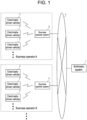
- Fig. 1 is a view for explaining arithmetic system 1 used by a plurality of business operator systems 2 according to an exemplary embodiment.
- a plurality of business operators A and B each have a plurality of electrically-driven vehicles 3 and run a business using the plurality of electrically-driven vehicles 3.
- each business operator utilizes the plurality of electrically-driven vehicles 3 to run a delivery business (home delivery business), a taxi business, a rental car business, or a car sharing business.
- a pure EV not mounted with an engine is assumed as electrically-driven vehicle 3.
- Each of business operators A and B includes business operator system 2.
- Business operator system 2 is a system for managing the work of each of business operators A and B.
- Business operator system 2 is configured of one or a plurality of information processing devices (for example, servers and PCs). Some or all of the information processing devices constituting business operator system 2 may be present in a data center.
- business operator system 2 may be configured by combination of a server (own business server, cloud server, or rental server) in the data center and a client PC in the business operator.
- Arithmetic system 1 is configured of one or a plurality of information processing devices installed in a data center.
- Business operator system 2 can access arithmetic system 1 via network 5.
- Network 5 is a general term of communication paths such as the Internet and leased lines, regardless of a communication medium or a protocol.
- the plurality of electrically-driven vehicles 3 are parked in a parking lot or a garage of a business office of each of business operators A and B during waiting.
- the plurality of electrically-driven vehicles 3 have a wireless communication function and can perform wireless communication with business operator system 2.
- the plurality of electrically-driven vehicles 3 transmit, to business operator system 2, travel data including operation data of a mounted secondary battery.
- travel data may wirelessly transmit the travel data to a server constituting business operator system 2 via network 5.
- the travel data may be transmitted at a frequency of once every 10 seconds.
- the travel data for one day may be transmitted in batch at a predetermined timing once a day (for example, at the end of business hours).
- electrically-driven vehicle 3 may transmit travel data for one day to the own business server or the PC after returning to the business office after the end of business hours.
- the travel data may be wirelessly transmitted to the own business server or the PC, or may be connected to the own server or the PC by wire and transmitted via wired communication.
- the travel data may be transmitted to the own business server or the PC via a recording medium in which the travel data is recorded.
- electrically-driven vehicle 3 may transmit the travel data to the cloud server via the client PC in the business office.
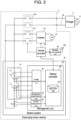
- Fig. 2 is a view for explaining a detailed configuration of battery system 40 mounted on electrically-driven vehicle 3.
- Battery system 40 is connected to motor 34 through first relay RY1 and inverter 35.
- inverter 35 converts DC power supplied from battery system 40 into AC power and supplies the power to motor 34.
- AC power supplied from motor 34 is converted into DC power and supplied to battery system 40.
- Motor 34 is a three-phase AC motor, and rotates in accordance with the AC power supplied from inverter 35 at the time of power running. At the time of regeneration, rotational energy due to deceleration is converted into AC power and supplied to inverter 35.
- First relay RY1 is a contactor provided in wiring connecting battery system 40 and inverter 35.
- Vehicle controller 30 causes first relay RY1 to an on-state (closed state) during traveling, and electrically connects battery system 40 to a power system of electrically-driven vehicle 3.
- Vehicle controller 30 generally causes first relay RY1 to an off-state (open state) at the time of not traveling, and electrically interrupts battery system 40 from the power system of electrically-driven vehicle 3.
- another type of switch such as a semiconductor switch may be used.
- Battery system 40 can be charged from commercial power system 9 by being connected to charger 4 installed outside electrically-driven vehicle 3 with charging cable 38.
- Charger 4 is connected to commercial power system 9 and charges battery system 40 in electrically-driven vehicle 3 using charging cable 38.
- second relay RY2 is provided in wiring connecting battery system 40 and charger 4. Instead of the relay, another type of switch such as a semiconductor switch may be used.
- Management unit 42 of battery system 40 causes second relay RY2 into the on-state (closed state) before start of charging, and into the off-state (open state) after end of charging.
- an alternating current is used for normal charging, and a direct current is used for quick charging.
- AC power is converted to DC power by an AC/DC converter (not illustrated) provided between second relay RY2 and battery system 40.
- Battery system 40 includes battery module 41 and management unit 42, and battery module 41 includes a plurality of cells E1 to En connected in series.
- Battery module 41 may be configured of a plurality of battery modules connected in series or series/parallel.
- a lithium-ion battery cell a nickel metal hydride battery cell, a lead battery cell, or the like can be used.
- a lithium ion battery cell nominal voltage of 3.6 V to 3.7 V
- the number of series connections of cells E1 to En is determined in accordance with a drive voltage of motor 34.
- Shunt resistor Rs is connected in series with the plurality of cells E1 to En.
- Shunt resistor Rs functions as a current detection element.
- a Hall element may be used inside of battery module 41 .
- a plurality of temperature sensors T1 and T2 for detecting temperature of the plurality of cells E1 to En.
- One temperature sensor may be provided in the battery module, or one temperature sensor may be provided for each of a plurality of cells.
- a thermistor can be used for temperature sensors T1 and T2.
- Management unit 42 includes voltage measurement unit 43, temperature measurement unit 44, current measurement unit 45, and battery controller 46. Nodes of the plurality of cells E1 to En connected in series and voltage measurement unit 43 are connected via a plurality of voltage lines. Voltage measurement unit 43 measures voltage of each of cells E1 to En by measuring voltage between two adjacent voltage lines. Voltage measurement unit 43 transmits the measured voltage of each of cells E1 to En to battery controller 46.
- Voltage measurement unit 43 is high in voltage with respect to battery controller 46, voltage measurement unit 43 and battery controller 46 are connected via a communication line in an insulated state.
- Voltage measurement unit 43 can be configured of an application specific integrated circuit (ASIC) or a general-purpose analog front-end integrated circuit (IC).
- Voltage measurement unit 43 includes a multiplexer and an A/D converter. The multiplexer outputs the voltage between two adjacent voltage lines to the A/D converter in order from the top. The A/D converter converts an analog voltage input from the multiplexer into a digital value.
- Battery controller 46 estimates the SOC, the FCC, and the SOH of each of the plurality of cells E1 to En.
- Battery controller 46 estimates the SOC by combining an OCV method and a current integration method.
- the OCV method is a method to estimate the SOC based on the OCV of each of cells E1 to En measured by voltage measurement unit 43 and the characteristic data of the SOC-OCV curve described in SOC-OCV map 46a.
- the current integration method is a method to estimate the SOC based on the OCV at the start of charging and discharging of each of cells E1 to En and an integrated value of the current measured by current measurement unit 45. In the current integration method, a measurement error of current measurement unit 45 accumulates as the charge and discharge time increases. Therefore, it is preferable to correct the SOC estimated with the current integration method using the SOC estimated with the OCV method.
- Wireless communication unit 36 performs signal processing for wirelessly connecting to network 5 via antenna 36a.
- wireless communication unit 36 wirelessly transmits the travel data acquired from vehicle controller 30 to business operator system 2.
- a wireless communication network with which electrically-driven vehicle 3 can wirelessly connect a cellular phone network (cellular network), a wireless local area network (LAN), an electronic toll collection system (ETC), dedicated short range communications (DSRC), vehicle-to-infrastructure (V2I), and vehicle-to-vehicle (V2V) can be used.
- cellular network cellular network
- LAN wireless local area network
- ETC electronic toll collection system
- DSRC dedicated short range communications
- V2I vehicle-to-infrastructure
- V2V vehicle-to-vehicle
- Travel data holding unit 121 holds travel data of the plurality of electrically-driven vehicles 3 collected from each of business operators A and B.
- SOC-OCV characteristic holding unit 122 holds SOC-OCV characteristics created by processor 11 based on the collected travel data.
- the SOC-OCV characteristics may be held in units of cells or in units of battery modules 41.
- travel data holding unit 121 is assumed to hold SOC-OCV characteristics of battery module 41 for each identical vehicle type.
- Estimator 113 may separately generate the SOC-OCV characteristics for charging and the SOC-OCV characteristics for discharging of battery module 41.
- extractor 112 separately extracts the set of SOC and voltage in a period that is regarded as a resting state after the end of the charging to battery module 41 and the set of SOC and voltage in a period that is regarded as a resting state after the end of the discharging from battery module 41.
- the SOC-OCV characteristics of battery module 41 depends on the temperature and the degradation degree. Extractor 112 may classify and extract the sample data of battery module 41 based on at least one of a temperature section and a degradation degree section. Estimator 113 may generate the SOC-OCV characteristics of battery module 41 by mapping with at least one section of the temperature section and the degradation degree section based on the sample data classified for each section. As described above, when the operation data of each battery module 41 includes the identification information for uniquely specifying each battery module 41, the degradation degree of each battery module 41 can be estimated based on the cumulative value of the use period and the charge/discharge current of each battery module 41.
- Fig. 6 is a flowchart illustrating the flow of estimation processing of SOC-OCV characteristics of battery module 41 by arithmetic system 1.
- Data acquisition unit 111 acquires travel data (including voltage, current, SOC, and temperature of battery module 41) of electrically-driven vehicle 3 from business operator system 2 (S10).
- Data acquisition unit 111 stores the acquired travel data in travel data holding unit 121.
- Extractor 112 extracts, from the travel data held in travel data holding unit 121, a set of SOC and voltage in a period in which battery module 41 is regarded to be in a resting state (S11).
- Estimator 113 generates an approximate curve based on the plurality of extracted sets of SOC and voltage and estimates the SOC-OCV characteristics (S12).
- Estimator 113 stores the estimated SOC-OCV characteristics in SOC-OCV characteristic holding unit 122.
- Detector 114 of arithmetic system 1 statistically processes a plurality of travel data of the same vehicle type as the inspection target, and inspects whether or not battery module 41 different from the catalog specifications is mounted. A detailed description will be given below.
- Fig. 7 is a view illustrating an example of a graph in which a plurality of SOC-OCV characteristics of battery modules 41 mounted on a plurality of electrically-driven vehicles 3 of a specific vehicle type are plotted.
- extractor 112 extracts, as sample data, a set of SOC and voltage in a period in which battery module 41 is regarded to be in a resting state, the set being specified based on the current, from a set of SOC and voltage at a plurality of times included in the travel data.
- Estimator 113 estimates the SOC-OCV characteristics of battery module 41 mounted on each electrically-driven vehicle 3 of the vehicle type based on the extracted sample data. In order to highly accurately detect battery module 41 different from the catalog specifications, it is desirable to have been able to collect the SOC-OCV characteristics of a large number of electrically-driven vehicles 3 (individuals) of the vehicle type.
- Detector 114 specifies a median of the plurality of SOC-OCV characteristics. In Fig. 7 , a series of the largest black dots indicates the median of the plurality of SOC-OCV characteristics. Detector 114 calculates a distance between the median of the SOC-OCV characteristic and each SOC-OCV characteristic. Specifically, detector 114 calculates the distance between the median of the SOC-OCV characteristic and each SOC-OCV characteristic for each SOC value (for example, every 1%). The distance may be a Euclidean distance or a Mahalanobis distance.
- the median of the plurality of SOC-OCV characteristics is not necessarily required.
- the calculation may be performed using another representative value such as an average or a mode of a plurality of SOC-OCV characteristics.
- the configuration using a representative value such as the median of a plurality of SOC-OCV characteristics has a feature that an individual on which a battery different from specifications of the product is mounted can be detected even when the specifications of the product is unknown.
- the distance between the value of the SOC-OCV characteristics recorded in advance and each SOC-OCV characteristic for each SOC value may be calculated.
- SOC-OCV curves of the product specifications can be derived by conducting various tests.
- Mahalanobis distance d is a distance normalized by a standard deviation ⁇ as illustrated in the following (Equation 3).
- d 2 x ⁇ m 2 / ⁇ 2
- Fig. 8 is a view illustrating an example of the histogram of Mahalanobis distances between a median of SOC-OCV characteristics and each SOC-OCV characteristic at a certain SOC value.
- Detector 114 determines a value exceeding a threshold as an outlier. For example, a value of 3 ⁇ may be used as the threshold. In the case of normal distribution, since 99.7% falls within 3 ⁇ , a value exceeding 3 ⁇ can be determined as an outlier.
- An optimal threshold may be adaptively changed by learning.
- Detector 114 calculates an outlier for each SOC value, and determines SOC-OCV characteristics including the outlier as those of electrically-driven vehicle 3 on which battery module 41 different from the catalog specifications is mounted.
- Fig. 9 is a view illustrating a graph in which the median of SOC-OCV characteristics and SOC-OCV characteristics including an outlier are left from the graph of Fig. 7 .
- the median of the SOC-OCV characteristics is an upwardly convex curve
- the SOC-OCV characteristics including the outlier show a downwardly convex curve. That is, it is estimated that the SOC-OCV characteristics of normal battery module 41 described in the catalog of a specific vehicle type shows an upwardly convex curve, and the SOC-OCV characteristics of unauthorized battery module 41 not described in the catalog but mounted in the vehicle type shows a downwardly convex curve.
- Fig. 10 is a flowchart illustrating the flow of the first processing example for arithmetic system 1 to detect whether or not battery module 41 different from catalog specifications by is mounted.
- Estimator 113 estimates the SOC-OCV characteristics of the plurality of battery modules 41 mounted in the vehicle type based on the travel data of the plurality of battery modules 41 acquired from the plurality of electrically-driven vehicles 3 of the same vehicle type (S20).
- Detector 114 calculates the distance between the median of the plurality of SOC-OCV characteristics and each SOC-OCV characteristic for each SOC value (S21).
- Detector 114 specifies an outlier from among the plurality of distances for each SOC value (S22).
- Detector 114 determines that electrically-driven vehicle 3 that has transmitted the SOC-OCV characteristics including the outlier is electrically-driven vehicle 3 on which battery module 41 different from the product specifications not described in the catalog is mounted (S23).
- the outlier of the distance from the median is searched in the entire SOC range (0 to 100%).
- the SOC range where the outlier of the distance from the median is searched may be narrowed to a predetermined SOC range.
- an outlier may be searched in a range of 40 to 70%.
- the OCV difference increases.
- the OCV difference tends to increase at the central portion of the SOC range, and the OCV difference tends to decrease at both ends of the SOC range.
- the SOC range where the OCV difference is likely to occur may be learned for each vehicle type. As the number of samples increases, the tendency of the SOC range where the OCV difference is likely to occur can be grasped, and the calculation amount can be reduced by narrowing, to the SOC range, the range where the outlier is searched.
- Fig. 11 is a flowchart illustrating the flow of the second processing example for arithmetic system 1 to detect whether or not battery module 41 different from catalog specifications by is mounted.
- Estimator 113 specifies the SOC and the OCV when the SOC is a specific value (for example, 50%) of the plurality of battery modules 41 mounted in the vehicle type based on the travel data of the plurality of battery modules 41 acquired from the plurality of electrically-driven vehicles 3 of the same vehicle type (S30).
- Detector 114 calculates the distance between the median of the plurality of OCVs when the SOC is a specific value and each OCV (S31).
- Detector 114 specifies an outlier from among the plurality of distances (S32).
- Detector 114 determines that electrically-driven vehicle 3 that has transmitted the OCV including the outlier is electrically-driven vehicle 3 on which battery module 41 different from the product specifications is mounted (S33).
- the estimator 113 generates an approximate curve based on sample data of a plurality of points and estimates the SOC-OCV characteristics for each battery module 41. If it has been possible to acquire the value of the OCV when the SOC is a specific value for each battery module 41, it is possible to detect electrically-driven vehicle 3 on which battery module 41 different from the catalog specifications is mounted.
- the calculation amount can be greatly reduced as compared with the first processing example, and the processing speed can be increased.
- the determination accuracy may decrease. Therefore, in the third processing example, an angle is added to the determination criterion other than the distance. In order to add the angle to the determination criterion, it is necessary to use the relationship between the SOC and the OCV at a plurality of points for each battery module 41.
- a method of detecting whether or not battery module 41 different from the catalog specifications is mounted using three points indicating the relationship between the SOC and the OCV will be described.
- Fig. 12 is a view illustrating the shape of a line connecting three points of the median.
- the OCVs at three points when the SOCs are 10%, 50%, and 90% are connected.
- the three points at which the OCV is extracted are not limited to these numerical values, but it is preferable to extract one point from each of a low SOC range, a middle SOC range, and a high SOC range so that the entire shape can be easily grasped.
- the third processing example can be performed as long as three points indicating the relationship between the SOC and the OCV are plotted for each battery module 41.
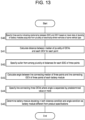
- Fig. 13 is a flowchart illustrating the flow of the third processing example for arithmetic system 1 to detect whether or not battery module 41 different from catalog specifications by is mounted.
- Estimator 113 specifies three points indicating the relationship between the SOC and the OCV for each of the plurality of battery modules 41 mounted in the vehicle type based on the travel data of the plurality of battery modules 41 acquired from the plurality of electrically-driven vehicles 3 of the same vehicle type (S40). The distance between the median of the plurality of OCVs and each OCV is calculated for each of the three SOCs (S41).
- Detector 114 specifies an outlier from among the plurality of distances for each of the three SOCs (S42).
- Detector 114 calculates each angle between a line connecting the median of the OCVs at the three points and a line connecting the OCVs at the three points of the respective battery modules 41 (S43). Detector 114 specifies the line connecting the OCVs at the three points whose angle is separated by equal to or greater than a predetermined value (S44).
- detector 114 determines that the line connecting the median of the OCVs at the three points and the line connecting the OCVs at the three points of battery module 41 that is the target is a line of a group having a different attribute.
- Detector 114 determines that electrically-driven vehicle 3 that has transmitted the SOCs and the OCVs at three points deviated in both the distance condition and the angle condition is electrically-driven vehicle 3 on which battery module 41 different from the product specifications is mounted (S45).
- Detector 114 may narrow the sample for which the angle comparison is performed to data including an outlier at the distance from the median. That is, detector 114 determines, without comparing the angles, the data not including the outlier in the distance to the median as the data of normal battery module 41 described in the catalog.
- detecting whether or not battery module 41 different from the catalog specifications is mounted using the three points indicating the relationship between the SOC and the OCV has been described.
- whether or not battery module 41 different from the catalog specifications is mounted may be detected using two points indicating the relationship between the SOC and the OCV.
- the data of each battery module 41 is collected from the plurality of electrically-driven vehicles 3 of the same vehicle type, and the collected data is subjected to cluster analysis by statistical processing, whereby electrically-driven vehicle 3 on which battery module 41 different from the catalog specifications is mounted can be easily detected. Detection can be performed regardless of the battery manufacturer and the battery type.
- internal resistance R can be estimated by substituting, into the above (Equation 4), the voltage measured during traveling as CCVd, the current as Id, and the voltage measured immediately before the start of traveling as OCVd.
Landscapes
- Business, Economics & Management (AREA)
- General Physics & Mathematics (AREA)
- Physics & Mathematics (AREA)
- Engineering & Computer Science (AREA)
- Strategic Management (AREA)
- Marketing (AREA)
- Economics (AREA)
- General Business, Economics & Management (AREA)
- Human Resources & Organizations (AREA)
- Theoretical Computer Science (AREA)
- General Chemical & Material Sciences (AREA)
- Entrepreneurship & Innovation (AREA)
- Manufacturing & Machinery (AREA)
- Tourism & Hospitality (AREA)
- Electrochemistry (AREA)
- Chemical Kinetics & Catalysis (AREA)
- Chemical & Material Sciences (AREA)
- Quality & Reliability (AREA)
- General Health & Medical Sciences (AREA)
- Primary Health Care (AREA)
- Health & Medical Sciences (AREA)
- Finance (AREA)
- Development Economics (AREA)
- Accounting & Taxation (AREA)
- Operations Research (AREA)
- Secondary Cells (AREA)
- Tests Of Electric Status Of Batteries (AREA)
- Charge And Discharge Circuits For Batteries Or The Like (AREA)
Applications Claiming Priority (2)
| Application Number | Priority Date | Filing Date | Title |
|---|---|---|---|
| JP2020117734 | 2020-07-08 | ||
| PCT/JP2021/024121 WO2022009696A1 (ja) | 2020-07-08 | 2021-06-25 | 演算システム、電池の検査方法、及び電池の検査プログラム |
Publications (3)
| Publication Number | Publication Date |
|---|---|
| EP4181265A1 EP4181265A1 (en) | 2023-05-17 |
| EP4181265A4 EP4181265A4 (en) | 2024-01-03 |
| EP4181265B1 true EP4181265B1 (en) | 2025-03-05 |
Family
ID=79553065
Family Applications (1)
| Application Number | Title | Priority Date | Filing Date |
|---|---|---|---|
| EP21837215.9A Active EP4181265B1 (en) | 2020-07-08 | 2021-06-25 | Arithmetic system, battery inspection method, and battery inspection program |
Country Status (5)
| Country | Link |
|---|---|
| US (1) | US20230236251A1 (cg-RX-API-DMAC7.html) |
| EP (1) | EP4181265B1 (cg-RX-API-DMAC7.html) |
| JP (1) | JP7656839B2 (cg-RX-API-DMAC7.html) |
| CN (1) | CN115769413A (cg-RX-API-DMAC7.html) |
| WO (1) | WO2022009696A1 (cg-RX-API-DMAC7.html) |
Families Citing this family (6)
| Publication number | Priority date | Publication date | Assignee | Title |
|---|---|---|---|---|
| JP7372295B2 (ja) * | 2021-09-30 | 2023-10-31 | 横河電機株式会社 | 診断装置、診断方法及び診断プログラム |
| US20230268753A1 (en) * | 2022-02-21 | 2023-08-24 | Lenovo (United States) Inc. | Intelligent battery charging based on history |
| CN115257457B (zh) * | 2022-07-27 | 2025-08-19 | 浙江极氪智能科技有限公司 | 车辆电池单体一致性评估方法、装置、设备及存储介质 |
| US20240286524A1 (en) * | 2023-02-23 | 2024-08-29 | GM Global Technology Operations LLC | High-voltage electrical systems pairing solid-state relays with electromechanical contactors for galvanic disconnect |
| CN117473396B (zh) * | 2023-11-23 | 2024-08-02 | 湖南盈旺智慧能源科技有限公司 | 一种基于深度学习的新能源汽车智能电池管理系统 |
| FR3168980A1 (fr) * | 2024-11-26 | 2026-05-29 | Stellantis Auto Sas | Procede de diagnostic d’un systeme de stockage d’energie permettant la detection d’une erreur d’assemblage |
Citations (1)
| Publication number | Priority date | Publication date | Assignee | Title |
|---|---|---|---|---|
| US20200209319A1 (en) * | 2018-12-26 | 2020-07-02 | Toyota Jidosha Kabushiki Kaisha | Battery performance evaluation device, and battery performance evaluation method |
Family Cites Families (14)
| Publication number | Priority date | Publication date | Assignee | Title |
|---|---|---|---|---|
| JPH09133741A (ja) | 1995-11-10 | 1997-05-20 | Tokyo Eletec Kk | 電池不良判定装置 |
| US7554296B2 (en) * | 2005-02-14 | 2009-06-30 | Denso Corporation | Method and apparatus for detecting charged state of secondary battery based on neural network calculation |
| BRPI0809518A2 (pt) * | 2007-03-26 | 2016-03-15 | Gillette Co | dispositivo e método de carregador adaptativo |
| JP2010019664A (ja) * | 2008-07-10 | 2010-01-28 | Nippon Soken Inc | 電池劣化検出装置および方法 |
| JP5556740B2 (ja) * | 2010-10-28 | 2014-07-23 | Smk株式会社 | 情報提供装置、情報提供サーバおよび車両支援システム |
| US9145893B2 (en) * | 2011-06-08 | 2015-09-29 | Bendix Commercial Vehicle Systems Llc | Current control via speed control for driving screw compressor under cold conditions |
| JP6674139B2 (ja) * | 2016-06-07 | 2020-04-01 | 日立化成株式会社 | 車両およびその電池状態検知システム |
| JP2018116839A (ja) * | 2017-01-18 | 2018-07-26 | 株式会社ダイヘン | 管理システム、非接触電力供給システム、及び非接触電力供給システムを管理する方法 |
| JP6983227B2 (ja) * | 2017-03-31 | 2021-12-17 | 三菱電機株式会社 | 蓄電池状態推定装置 |
| US10312699B2 (en) * | 2017-07-31 | 2019-06-04 | Robert Bosch Gmbh | Method and system for estimating battery open cell voltage, state of charge, and state of health during operation of the battery |
| KR20190047779A (ko) * | 2017-10-30 | 2019-05-09 | 현대자동차주식회사 | 클라우드 서버, 차량 및 차량의 제어방법 |
| KR102634816B1 (ko) * | 2017-12-21 | 2024-02-07 | 삼성전자주식회사 | 배터리의 전하 균형을 탐지하는 배터리 모니터링 장치 및 방법 |
| JPWO2020045033A1 (ja) * | 2018-08-28 | 2021-08-10 | 本田技研工業株式会社 | 提示装置、提示方法、及びプログラム |
| KR102676246B1 (ko) * | 2019-12-17 | 2024-06-19 | 현대자동차주식회사 | 차량용 배터리 교체 진단 장치 및 그의 배터리 교체 진단 방법 |
-
2021
- 2021-06-25 US US18/002,288 patent/US20230236251A1/en active Pending
- 2021-06-25 JP JP2022535020A patent/JP7656839B2/ja active Active
- 2021-06-25 WO PCT/JP2021/024121 patent/WO2022009696A1/ja not_active Ceased
- 2021-06-25 CN CN202180047888.2A patent/CN115769413A/zh active Pending
- 2021-06-25 EP EP21837215.9A patent/EP4181265B1/en active Active
Patent Citations (1)
| Publication number | Priority date | Publication date | Assignee | Title |
|---|---|---|---|---|
| US20200209319A1 (en) * | 2018-12-26 | 2020-07-02 | Toyota Jidosha Kabushiki Kaisha | Battery performance evaluation device, and battery performance evaluation method |
Also Published As
| Publication number | Publication date |
|---|---|
| JPWO2022009696A1 (cg-RX-API-DMAC7.html) | 2022-01-13 |
| JP7656839B2 (ja) | 2025-04-04 |
| EP4181265A1 (en) | 2023-05-17 |
| CN115769413A (zh) | 2023-03-07 |
| US20230236251A1 (en) | 2023-07-27 |
| WO2022009696A1 (ja) | 2022-01-13 |
| EP4181265A4 (en) | 2024-01-03 |
Similar Documents
| Publication | Publication Date | Title |
|---|---|---|
| US12613285B2 (en) | Battery management system, calculation system, battery degradation prediction method, and battery degradation prediction program | |
| US12352821B2 (en) | Calculation system, battery characteristic estimation method, and battery characteristic estimation program | |
| EP4181265A1 (en) | Arithmetic system, battery inspection method, and battery inspection program | |
| US12558993B2 (en) | Computing system, battery deterioration predicting method, and battery deterioration predicting program | |
| EP4394412B1 (en) | Deterioration determination system, deterioration determination method, and deterioration determination program | |
| CN115267552A (zh) | 车辆电池健康状态评估方法、装置、设备及存储介质 | |
| US11975732B2 (en) | In-vehicle notification device, notification program, and calculation device | |
| CN115257457B (zh) | 车辆电池单体一致性评估方法、装置、设备及存储介质 | |
| CN112055912A (zh) | 电池管理装置、电池信息处理系统以及电池信息处理方法 | |
| EP4350941A1 (en) | Battery abnormality prediction system, battery abnormality prediction method, and battery abnormality prediction program | |
| CN118541895A (zh) | 电池异常检测系统、电池异常检测方法以及电池异常检测程序 | |
| EP4675888A1 (en) | Battery analysis system, battery analysis method, battery analysis program, and storage medium with battery analysis program recorded therein | |
| CN115184805A (zh) | 电池健康状态获取方法、装置、设备及计算机程序产品 | |
| WO2024099869A1 (en) | Charging station recommendation for an electric vehicle | |
| CN118696240A (zh) | 电池状态分析系统、电池状态分析方法、及电池状态分析程序 | |
| US20250116712A1 (en) | Battery abnormality detection system, battery abnormality detection method, and non-transitory computer-readable recording medium | |
| CN118947007A (zh) | 电池分析系统、电池分析方法及电池分析程序 | |
| US20250020731A1 (en) | Battery abnormality detection system, battery abnormality detection method, and battery abnormality detection program | |
| CN120530331A (zh) | 电池异常检测系统、电池异常检测方法、电池异常检测程序以及记载有电池异常检测程序的记录介质 | |
| CN121444250A (zh) | 电池分析系统、电池分析方法以及电池分析程序 | |
| CN119795995A (zh) | Soh修正方法、云平台、系统、设备及存储介质 |
Legal Events
| Date | Code | Title | Description |
|---|---|---|---|
| STAA | Information on the status of an ep patent application or granted ep patent |
Free format text: STATUS: THE INTERNATIONAL PUBLICATION HAS BEEN MADE |
|
| PUAI | Public reference made under article 153(3) epc to a published international application that has entered the european phase |
Free format text: ORIGINAL CODE: 0009012 |
|
| STAA | Information on the status of an ep patent application or granted ep patent |
Free format text: STATUS: REQUEST FOR EXAMINATION WAS MADE |
|
| 17P | Request for examination filed |
Effective date: 20221219 |
|
| AK | Designated contracting states |
Kind code of ref document: A1 Designated state(s): AL AT BE BG CH CY CZ DE DK EE ES FI FR GB GR HR HU IE IS IT LI LT LU LV MC MK MT NL NO PL PT RO RS SE SI SK SM TR |
|
| DAV | Request for validation of the european patent (deleted) | ||
| DAX | Request for extension of the european patent (deleted) | ||
| REG | Reference to a national code |
Ref country code: DE Ref legal event code: R079 Free format text: PREVIOUS MAIN CLASS: H01M0010420000 Ipc: G06Q0010200000 Ref country code: DE Ref legal event code: R079 Ref document number: 602021027289 Country of ref document: DE Free format text: PREVIOUS MAIN CLASS: H01M0010420000 Ipc: G06Q0010200000 |
|
| A4 | Supplementary search report drawn up and despatched |
Effective date: 20231204 |
|
| RIC1 | Information provided on ipc code assigned before grant |
Ipc: G01R 31/385 20190101ALI20231128BHEP Ipc: G01R 31/3842 20190101ALI20231128BHEP Ipc: G01R 31/396 20190101ALI20231128BHEP Ipc: H02J 7/00 20060101ALI20231128BHEP Ipc: H01M 10/48 20060101ALI20231128BHEP Ipc: H01M 10/42 20060101ALI20231128BHEP Ipc: G06Q 50/30 20120101ALI20231128BHEP Ipc: G06Q 30/018 20230101ALI20231128BHEP Ipc: G06Q 10/20 20230101AFI20231128BHEP |
|
| GRAP | Despatch of communication of intention to grant a patent |
Free format text: ORIGINAL CODE: EPIDOSNIGR1 |
|
| STAA | Information on the status of an ep patent application or granted ep patent |
Free format text: STATUS: GRANT OF PATENT IS INTENDED |
|
| RIC1 | Information provided on ipc code assigned before grant |
Ipc: G01R 31/385 20190101ALI20240927BHEP Ipc: G01R 31/3842 20190101ALI20240927BHEP Ipc: G01R 31/396 20190101ALI20240927BHEP Ipc: H02J 7/00 20060101ALI20240927BHEP Ipc: H01M 10/48 20060101ALI20240927BHEP Ipc: H01M 10/42 20060101ALI20240927BHEP Ipc: G06Q 50/40 20240101ALI20240927BHEP Ipc: G06Q 30/018 20230101ALI20240927BHEP Ipc: G06Q 10/20 20230101AFI20240927BHEP |
|
| INTG | Intention to grant announced |
Effective date: 20241015 |
|
| GRAS | Grant fee paid |
Free format text: ORIGINAL CODE: EPIDOSNIGR3 |
|
| GRAA | (expected) grant |
Free format text: ORIGINAL CODE: 0009210 |
|
| STAA | Information on the status of an ep patent application or granted ep patent |
Free format text: STATUS: THE PATENT HAS BEEN GRANTED |
|
| AK | Designated contracting states |
Kind code of ref document: B1 Designated state(s): AL AT BE BG CH CY CZ DE DK EE ES FI FR GB GR HR HU IE IS IT LI LT LU LV MC MK MT NL NO PL PT RO RS SE SI SK SM TR |
|
| REG | Reference to a national code |
Ref country code: GB Ref legal event code: FG4D |
|
| REG | Reference to a national code |
Ref country code: CH Ref legal event code: EP |
|
| REG | Reference to a national code |
Ref country code: DE Ref legal event code: R096 Ref document number: 602021027289 Country of ref document: DE |
|
| REG | Reference to a national code |
Ref country code: IE Ref legal event code: FG4D |
|
| REG | Reference to a national code |
Ref country code: SE Ref legal event code: TRGR |
|
| PG25 | Lapsed in a contracting state [announced via postgrant information from national office to epo] |
Ref country code: RS Free format text: LAPSE BECAUSE OF FAILURE TO SUBMIT A TRANSLATION OF THE DESCRIPTION OR TO PAY THE FEE WITHIN THE PRESCRIBED TIME-LIMIT Effective date: 20250605 |
|
| PG25 | Lapsed in a contracting state [announced via postgrant information from national office to epo] |
Ref country code: FI Free format text: LAPSE BECAUSE OF FAILURE TO SUBMIT A TRANSLATION OF THE DESCRIPTION OR TO PAY THE FEE WITHIN THE PRESCRIBED TIME-LIMIT Effective date: 20250305 |
|
| REG | Reference to a national code |
Ref country code: NL Ref legal event code: MP Effective date: 20250305 |
|
| PG25 | Lapsed in a contracting state [announced via postgrant information from national office to epo] |
Ref country code: ES Free format text: LAPSE BECAUSE OF FAILURE TO SUBMIT A TRANSLATION OF THE DESCRIPTION OR TO PAY THE FEE WITHIN THE PRESCRIBED TIME-LIMIT Effective date: 20250305 |
|
| REG | Reference to a national code |
Ref country code: LT Ref legal event code: MG9D |
|
| PG25 | Lapsed in a contracting state [announced via postgrant information from national office to epo] |
Ref country code: HR Free format text: LAPSE BECAUSE OF FAILURE TO SUBMIT A TRANSLATION OF THE DESCRIPTION OR TO PAY THE FEE WITHIN THE PRESCRIBED TIME-LIMIT Effective date: 20250305 |
|
| PG25 | Lapsed in a contracting state [announced via postgrant information from national office to epo] |
Ref country code: LV Free format text: LAPSE BECAUSE OF FAILURE TO SUBMIT A TRANSLATION OF THE DESCRIPTION OR TO PAY THE FEE WITHIN THE PRESCRIBED TIME-LIMIT Effective date: 20250305 |
|
| PG25 | Lapsed in a contracting state [announced via postgrant information from national office to epo] |
Ref country code: BG Free format text: LAPSE BECAUSE OF FAILURE TO SUBMIT A TRANSLATION OF THE DESCRIPTION OR TO PAY THE FEE WITHIN THE PRESCRIBED TIME-LIMIT Effective date: 20250305 Ref country code: GR Free format text: LAPSE BECAUSE OF FAILURE TO SUBMIT A TRANSLATION OF THE DESCRIPTION OR TO PAY THE FEE WITHIN THE PRESCRIBED TIME-LIMIT Effective date: 20250606 |
|
| PGFP | Annual fee paid to national office [announced via postgrant information from national office to epo] |
Ref country code: SE Payment date: 20250618 Year of fee payment: 5 |
|
| REG | Reference to a national code |
Ref country code: AT Ref legal event code: MK05 Ref document number: 1773618 Country of ref document: AT Kind code of ref document: T Effective date: 20250305 |
|
| PG25 | Lapsed in a contracting state [announced via postgrant information from national office to epo] |
Ref country code: NL Free format text: LAPSE BECAUSE OF FAILURE TO SUBMIT A TRANSLATION OF THE DESCRIPTION OR TO PAY THE FEE WITHIN THE PRESCRIBED TIME-LIMIT Effective date: 20250305 |
|
| PG25 | Lapsed in a contracting state [announced via postgrant information from national office to epo] |
Ref country code: SM Free format text: LAPSE BECAUSE OF FAILURE TO SUBMIT A TRANSLATION OF THE DESCRIPTION OR TO PAY THE FEE WITHIN THE PRESCRIBED TIME-LIMIT Effective date: 20250305 |
|
| PG25 | Lapsed in a contracting state [announced via postgrant information from national office to epo] |
Ref country code: PT Free format text: LAPSE BECAUSE OF FAILURE TO SUBMIT A TRANSLATION OF THE DESCRIPTION OR TO PAY THE FEE WITHIN THE PRESCRIBED TIME-LIMIT Effective date: 20250707 |
|
| PG25 | Lapsed in a contracting state [announced via postgrant information from national office to epo] |
Ref country code: IT Free format text: LAPSE BECAUSE OF FAILURE TO SUBMIT A TRANSLATION OF THE DESCRIPTION OR TO PAY THE FEE WITHIN THE PRESCRIBED TIME-LIMIT Effective date: 20250305 Ref country code: PL Free format text: LAPSE BECAUSE OF FAILURE TO SUBMIT A TRANSLATION OF THE DESCRIPTION OR TO PAY THE FEE WITHIN THE PRESCRIBED TIME-LIMIT Effective date: 20250305 |
|
| PG25 | Lapsed in a contracting state [announced via postgrant information from national office to epo] |
Ref country code: AT Free format text: LAPSE BECAUSE OF FAILURE TO SUBMIT A TRANSLATION OF THE DESCRIPTION OR TO PAY THE FEE WITHIN THE PRESCRIBED TIME-LIMIT Effective date: 20250305 |
|
| PG25 | Lapsed in a contracting state [announced via postgrant information from national office to epo] |
Ref country code: EE Free format text: LAPSE BECAUSE OF FAILURE TO SUBMIT A TRANSLATION OF THE DESCRIPTION OR TO PAY THE FEE WITHIN THE PRESCRIBED TIME-LIMIT Effective date: 20250305 Ref country code: CZ Free format text: LAPSE BECAUSE OF FAILURE TO SUBMIT A TRANSLATION OF THE DESCRIPTION OR TO PAY THE FEE WITHIN THE PRESCRIBED TIME-LIMIT Effective date: 20250305 |
|
| PG25 | Lapsed in a contracting state [announced via postgrant information from national office to epo] |
Ref country code: RO Free format text: LAPSE BECAUSE OF FAILURE TO SUBMIT A TRANSLATION OF THE DESCRIPTION OR TO PAY THE FEE WITHIN THE PRESCRIBED TIME-LIMIT Effective date: 20250305 |
|
| PG25 | Lapsed in a contracting state [announced via postgrant information from national office to epo] |
Ref country code: SK Free format text: LAPSE BECAUSE OF FAILURE TO SUBMIT A TRANSLATION OF THE DESCRIPTION OR TO PAY THE FEE WITHIN THE PRESCRIBED TIME-LIMIT Effective date: 20250305 |
|
| PG25 | Lapsed in a contracting state [announced via postgrant information from national office to epo] |
Ref country code: IS Free format text: LAPSE BECAUSE OF FAILURE TO SUBMIT A TRANSLATION OF THE DESCRIPTION OR TO PAY THE FEE WITHIN THE PRESCRIBED TIME-LIMIT Effective date: 20250705 |
|
| REG | Reference to a national code |
Ref country code: DE Ref legal event code: R097 Ref document number: 602021027289 Country of ref document: DE |
|
| PLBE | No opposition filed within time limit |
Free format text: ORIGINAL CODE: 0009261 |
|
| STAA | Information on the status of an ep patent application or granted ep patent |
Free format text: STATUS: NO OPPOSITION FILED WITHIN TIME LIMIT |
|
| PG25 | Lapsed in a contracting state [announced via postgrant information from national office to epo] |
Ref country code: DK Free format text: LAPSE BECAUSE OF FAILURE TO SUBMIT A TRANSLATION OF THE DESCRIPTION OR TO PAY THE FEE WITHIN THE PRESCRIBED TIME-LIMIT Effective date: 20250305 |
|
| REG | Reference to a national code |
Ref country code: CH Ref legal event code: L10 Free format text: ST27 STATUS EVENT CODE: U-0-0-L10-L00 (AS PROVIDED BY THE NATIONAL OFFICE) Effective date: 20260114 |
|
| REG | Reference to a national code |
Ref country code: CH Ref legal event code: H13 Free format text: ST27 STATUS EVENT CODE: U-0-0-H10-H13 (AS PROVIDED BY THE NATIONAL OFFICE) Effective date: 20260127 |
|
| PG25 | Lapsed in a contracting state [announced via postgrant information from national office to epo] |
Ref country code: MC Free format text: LAPSE BECAUSE OF FAILURE TO SUBMIT A TRANSLATION OF THE DESCRIPTION OR TO PAY THE FEE WITHIN THE PRESCRIBED TIME-LIMIT Effective date: 20250305 |
|
| 26N | No opposition filed |
Effective date: 20251208 |
|
| PG25 | Lapsed in a contracting state [announced via postgrant information from national office to epo] |
Ref country code: LU Free format text: LAPSE BECAUSE OF NON-PAYMENT OF DUE FEES Effective date: 20250625 |
|
| REG | Reference to a national code |
Ref country code: BE Ref legal event code: MM Effective date: 20250630 |
|
| PG25 | Lapsed in a contracting state [announced via postgrant information from national office to epo] |
Ref country code: IE Free format text: LAPSE BECAUSE OF NON-PAYMENT OF DUE FEES Effective date: 20250625 |
|
| PG25 | Lapsed in a contracting state [announced via postgrant information from national office to epo] |
Ref country code: BE Free format text: LAPSE BECAUSE OF NON-PAYMENT OF DUE FEES Effective date: 20250630 |
|
| PG25 | Lapsed in a contracting state [announced via postgrant information from national office to epo] |
Ref country code: CH Free format text: LAPSE BECAUSE OF NON-PAYMENT OF DUE FEES Effective date: 20250630 |
|
| PG25 | Lapsed in a contracting state [announced via postgrant information from national office to epo] |
Ref country code: LT Free format text: LAPSE BECAUSE OF FAILURE TO SUBMIT A TRANSLATION OF THE DESCRIPTION OR TO PAY THE FEE WITHIN THE PRESCRIBED TIME-LIMIT Effective date: 20250305 |
|
| PGFP | Annual fee paid to national office [announced via postgrant information from national office to epo] |
Ref country code: GB Payment date: 20260626 Year of fee payment: 6 |
|
| PGFP | Annual fee paid to national office [announced via postgrant information from national office to epo] |
Ref country code: DE Payment date: 20260622 Year of fee payment: 6 |
|
| PGFP | Annual fee paid to national office [announced via postgrant information from national office to epo] |
Ref country code: NO Payment date: 20260622 Year of fee payment: 6 |
|
| PGFP | Annual fee paid to national office [announced via postgrant information from national office to epo] |
Ref country code: FR Payment date: 20260626 Year of fee payment: 6 |
|
| PG25 | Lapsed in a contracting state [announced via postgrant information from national office to epo] |
Ref country code: CY Free format text: LAPSE BECAUSE OF FAILURE TO SUBMIT A TRANSLATION OF THE DESCRIPTION OR TO PAY THE FEE WITHIN THE PRESCRIBED TIME-LIMIT Effective date: 20250305 |