EP4179697B1 - Sichere end-zu-end-paarung eines sicheren elements mit einer mobilen vorrichtung - Google Patents
Sichere end-zu-end-paarung eines sicheren elements mit einer mobilen vorrichtung Download PDFInfo
- Publication number
- EP4179697B1 EP4179697B1 EP21735909.0A EP21735909A EP4179697B1 EP 4179697 B1 EP4179697 B1 EP 4179697B1 EP 21735909 A EP21735909 A EP 21735909A EP 4179697 B1 EP4179697 B1 EP 4179697B1
- Authority
- EP
- European Patent Office
- Prior art keywords
- secure element
- encryption key
- status
- smart device
- cardholder
- Prior art date
- Legal status (The legal status is an assumption and is not a legal conclusion. Google has not performed a legal analysis and makes no representation as to the accuracy of the status listed.)
- Active
Links
Images




Classifications
-
- H—ELECTRICITY
- H04—ELECTRIC COMMUNICATION TECHNIQUE
- H04L—TRANSMISSION OF DIGITAL INFORMATION, e.g. TELEGRAPHIC COMMUNICATION
- H04L63/00—Network architectures or network communication protocols for network security
- H04L63/18—Network architectures or network communication protocols for network security using different networks or channels, e.g. using out of band channels
-
- G—PHYSICS
- G06—COMPUTING OR CALCULATING; COUNTING
- G06Q—INFORMATION AND COMMUNICATION TECHNOLOGY [ICT] SPECIALLY ADAPTED FOR ADMINISTRATIVE, COMMERCIAL, FINANCIAL, MANAGERIAL OR SUPERVISORY PURPOSES; SYSTEMS OR METHODS SPECIALLY ADAPTED FOR ADMINISTRATIVE, COMMERCIAL, FINANCIAL, MANAGERIAL OR SUPERVISORY PURPOSES, NOT OTHERWISE PROVIDED FOR
- G06Q20/00—Payment architectures, schemes or protocols
- G06Q20/38—Payment protocols; Details thereof
- G06Q20/40—Authorisation, e.g. identification of payer or payee, verification of customer or shop credentials; Review and approval of payers, e.g. check credit lines or negative lists
- G06Q20/409—Device specific authentication in transaction processing
-
- G—PHYSICS
- G06—COMPUTING OR CALCULATING; COUNTING
- G06F—ELECTRIC DIGITAL DATA PROCESSING
- G06F3/00—Input arrangements for transferring data to be processed into a form capable of being handled by the computer; Output arrangements for transferring data from processing unit to output unit, e.g. interface arrangements
- G06F3/16—Sound input; Sound output
- G06F3/167—Audio in a user interface, e.g. using voice commands for navigating, audio feedback
-
- G—PHYSICS
- G06—COMPUTING OR CALCULATING; COUNTING
- G06Q—INFORMATION AND COMMUNICATION TECHNOLOGY [ICT] SPECIALLY ADAPTED FOR ADMINISTRATIVE, COMMERCIAL, FINANCIAL, MANAGERIAL OR SUPERVISORY PURPOSES; SYSTEMS OR METHODS SPECIALLY ADAPTED FOR ADMINISTRATIVE, COMMERCIAL, FINANCIAL, MANAGERIAL OR SUPERVISORY PURPOSES, NOT OTHERWISE PROVIDED FOR
- G06Q20/00—Payment architectures, schemes or protocols
- G06Q20/30—Payment architectures, schemes or protocols characterised by the use of specific devices or networks
- G06Q20/34—Payment architectures, schemes or protocols characterised by the use of specific devices or networks using cards, e.g. integrated circuit [IC] cards or magnetic cards
- G06Q20/341—Active cards, i.e. cards including their own processing means, e.g. including an IC or chip
-
- H—ELECTRICITY
- H04—ELECTRIC COMMUNICATION TECHNIQUE
- H04L—TRANSMISSION OF DIGITAL INFORMATION, e.g. TELEGRAPHIC COMMUNICATION
- H04L63/00—Network architectures or network communication protocols for network security
- H04L63/08—Network architectures or network communication protocols for network security for authentication of entities
- H04L63/0853—Network architectures or network communication protocols for network security for authentication of entities using an additional device, e.g. smartcard, SIM or a different communication terminal
-
- H—ELECTRICITY
- H04—ELECTRIC COMMUNICATION TECHNIQUE
- H04W—WIRELESS COMMUNICATION NETWORKS
- H04W12/00—Security arrangements; Authentication; Protecting privacy or anonymity
- H04W12/04—Key management, e.g. using generic bootstrapping architecture [GBA]
- H04W12/041—Key generation or derivation
-
- H—ELECTRICITY
- H04—ELECTRIC COMMUNICATION TECHNIQUE
- H04W—WIRELESS COMMUNICATION NETWORKS
- H04W12/00—Security arrangements; Authentication; Protecting privacy or anonymity
- H04W12/40—Security arrangements using identity modules
- H04W12/47—Security arrangements using identity modules using near field communication [NFC] or radio frequency identification [RFID] modules
-
- H—ELECTRICITY
- H04—ELECTRIC COMMUNICATION TECHNIQUE
- H04W—WIRELESS COMMUNICATION NETWORKS
- H04W12/00—Security arrangements; Authentication; Protecting privacy or anonymity
- H04W12/50—Secure pairing of devices
-
- H—ELECTRICITY
- H04—ELECTRIC COMMUNICATION TECHNIQUE
- H04L—TRANSMISSION OF DIGITAL INFORMATION, e.g. TELEGRAPHIC COMMUNICATION
- H04L2463/00—Additional details relating to network architectures or network communication protocols for network security covered by H04L63/00
- H04L2463/102—Additional details relating to network architectures or network communication protocols for network security covered by H04L63/00 applying security measure for e-commerce
-
- H—ELECTRICITY
- H04—ELECTRIC COMMUNICATION TECHNIQUE
- H04L—TRANSMISSION OF DIGITAL INFORMATION, e.g. TELEGRAPHIC COMMUNICATION
- H04L63/00—Network architectures or network communication protocols for network security
- H04L63/06—Network architectures or network communication protocols for network security for supporting key management in a packet data network
-
- H—ELECTRICITY
- H04—ELECTRIC COMMUNICATION TECHNIQUE
- H04L—TRANSMISSION OF DIGITAL INFORMATION, e.g. TELEGRAPHIC COMMUNICATION
- H04L63/00—Network architectures or network communication protocols for network security
- H04L63/08—Network architectures or network communication protocols for network security for authentication of entities
- H04L63/083—Network architectures or network communication protocols for network security for authentication of entities using passwords
Definitions
- the present invention relates, generally, to secure elements and mobile devices, and, more particularly, to secure pairing of secure elements to mobile devices.
- a secure element is a tamper-resistant electronic component that is typically used for storing host applications and the confidential and cryptographic data associated with those host applications.
- secure element is defined as an embedded integrated circuit that employs tamper resistant features to protect applications and data stored thereon.
- An electronic payment and banking card may be used by a consumer to perform financial transactions, e.g., for the purchase of goods or services.
- a secure element may host payment and financial services applications and associated credentials.
- the secure element provides services such as authentication, digital signature, and PIN management.
- SE card refers to a card, e.g., a payment or financial services card, that embeds a secure element.
- Digital financial transactions are very convenient to users. However, there are security risks. It is therefore beneficial to add security features that avoid the risk of fraudulent use of payment and other financial services provided by an SE card.
- the secure element provides many security features, e.g., PIN verification.
- PIN verification provides many security features, e.g., PIN verification.
- providing additional authentication factors enhances security associated with an SE card.
- An authentication factor based on PIN verification determines what the person carrying out the PIN verification knows. Do they know the PIN? A second authentication factor is based on what do they have.
- the SE element it would be desirable for the SE element to confirm that the bearer of the SE card is in possession of another device linked to the SE card. Furthermore, it would be desirable for such device pairing to be secure and only to be made if authorized by the owner of the SE card.
- the document US2011/0028091A1 describes a method for near-field wireless device pairing in which a key is exchanged.
- a secure link is established on a second protocol, which may be Bluetooth Low Energy (BLE), between a secure element and a smart device via a link on a second protocol, which may be Near-Field Communication (NFC).
- BLE Bluetooth Low Energy
- NFC Near-Field Communication
- the process includes establishing a link on the first protocol between the secure element and the smart device and in response thereto, generating, by the secure element, a communication encryption key and associating a status with the encryption key and assigning the status a first level, which in an embodiment is referred to as candidate status. Subsequently, transmitting a message encapsulating the encryption key and the status of the communication encryption key from the secure element to the smart device over the link on the first protocol.
- the secure element and the smart device pair over the second protocol thereby establishing a second-protocol link.
- the secure element transmits a message encrypted using the communication encryption key to the smart device over the second-protocol link.
- response to detecting a pairing over the second protocol determining, by the smart device, the status of the communication encryption key, providing to the cardholder on the smart device an informational message indicating the pairing of the secure element and the smart device as well as the status of the communication encryption key, for example, by displaying such a message on the smartphone or providing a voice message.
- Pairing may be followed by authenticating a cardholder of the secure element and in response to verifying the cardholder as an authorized cardholder for the secure element, elevating the status of the communication encryption key from the first level to a second level, which in an embodiment is referred to as trusted.
- determining the status of the communication encryption key and if the status of the communication encryption key is the second level transmitting transaction details to the smart device over the second-protocol link, otherwise, not transmitting any transaction details to the smart device; and in response to receiving, by the smart device, transaction details, displaying the transaction details for the cardholder on a display of the smart device.
- determining the status of the communication encryption key and from the status of the communication encryption key, transactions specifics, and security policy taking an action selected from proceeding with the transaction preventing the transaction, requesting approval for the transaction from the cardholder by transmitting a request-for-approval message to the smart device.
- a secure element and a smart device include instructions directing a processor of these respective devices to carry out above described processes. These instructions may, advantageously, be stored in a program memory of the secure element and smart device, respectively.
- the herein described technology provides for secure pairing of devices, in particular, the secure pairing of a secure element embedded in an SE card and a mobile device, for example, a smartphone.
- FIG. 1 is an illustration of an SE card 101 being used in conjunction with a smartphone 103 by a cardholder 100 to carry out a payment transaction via a point-of-sale (POS) terminal 105.
- the SE card 101 contains a secure element 107.
- the SE card 101 and the smartphone 103 belong to the same cardholder 100 and are used, as discussed in greater detail below, to secure transactions performed using the SE card 101 or to provide the cardholder 100 with information pertaining to the transactions performed.
- a first short-range communication channel 108 may be established between the secure element 107 and the smartphone 103.
- a second short-range communication channel 109 may be established between the secure element 107 and the smartphone 103.
- the second communication channel 109 provides many options for securing transactions carried out using the SE card 101.
- the presence of the smartphone 103 may be required to carry out certain transactions. This eliminates fraudulent transactions carried out with a stolen SE card 101. If the card 101 has been stolen or found after being lost, if the corresponding smartphone 103 is not present within the range of the short-range communication channel 109, the second communication channel 109 cannot be established.
- the smartphone 103 may be used to provide transactional information to the user 100.
- the first short-range communication channel 108 may be used to transmit a communication encryption key from the secure element 107 to the smartphone 103 such that communications between the secure element 107 and the smartphone 103 on the second short-range communication channel 109 may be encrypted.
- the SE card 101 is equipped to communicate with the smartphone 103 according to two communications protocols.
- these are the near-field communications (NFC) protocol and Bluetooth ® Low Energy (BLE) protocol.
- NFC near-field communications
- BLE Bluetooth ® Low Energy
- the technology described herein applies to any of a large number of communications protocols including WiFi and Zigbee.
- NFC and BLE A characteristic of NFC and BLE that make them attractive for the application discussed herein is that they operate over a very short distance.
- communications are limited to 4cm and is activated by an "NFC tap" operation wherein a cardholder touches the communicating devices to one another.
- NFC tap In the case of BLE, the theoretical maximum distance is about 100 meters; however, in practice much shorter distances (10-20 meters) can be expected.
- BLE is also very sensitive to physical barriers. Thus, a communications channel established between a secure element and a smartphone over BLE is assured of a close physical proximity of the two devices.
- FIG. 2 is an illustration of the elements of Fig. 1 used in a payment transaction carried out using the SE card 101.
- the SE card 101 has been paired with the smartphone 103 for communication over a BLE communications channel 109.
- the cardholder inserts the card 101 into the POS terminal 105 whereby the terminal and the secure element may communicate over contact pad 203, for example, using the contacted smartcard communications standard ISO 7816.
- the communication between the SE card 101 and the POS terminal 105 may be using other communications means, e.g., wireless communication under ISO standard 14443 or NFC.
- the BLE channel from the secure element 107 to the smartphone 103 is used for providing information to the cardholder. For example, when a transaction is about to take place an informational message is transmitted to the cardholder's smartphone 103 to allow the cardholder to know transaction details. The transaction details may also be saved on the smartphone 103 for record keeping.
- the smartphone 103 is used to provide additional security to ensure that transactions are as intended by the cardholder.
- Transaction details may be communicated from the SE card 101 to the smartphone 103 over the BLE channel 109 and these transaction details may be displayed 205 for the cardholder to confirm.
- the cardholder is informed in other ways by the smartphone 103.
- the smartphone 103 may provide a voice message to the cardholder to inform the cardholder of the transaction details.
- a transaction security protocol may allow for many different options that include or do not include the smartphone 103:
- Utilization of the smartphone 103 in conjunction with the smart element 101 during execution of financial transactions require pairing the two.
- the communication between the smartphone 103 and the secure element 101 must be secure. Accordingly, the smartphone 103 and the secure element 101 engage in a pairing process described hereinbelow to establish a trusted communications encryption key for encrypting messages communicated between the two.
- Fig. 3 is a high-level block diagram of a device architecture of an SE card 101 including a secure element 107.
- the secure element 107 may include a processor 301 connected via a bus 302 to a random-access memory (RAM) 303, a read-only memory (ROM) 304, and a non-volatile memory (NVM) 305.
- the secure element 107 further includes an input/output interface 307 for connecting the processor 301, again typically via the bus 302, to the contact pad 203 by which the secure element 107 may be connected to the POS terminal 105.
- the SE card 103 contains an antenna 311 by which the SE device 103 may connect wirelessly to the POS terminal 105 via the input/output interface 307 over a wireless protocol, e.g., ISO 14443.
- the SE card 103 further contains the communications interfaces 313 and 309 for communicating using the BLE communications protocol and the NFC communications protocol, respectively.
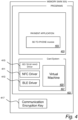
- the ROM 304 and/or NVM 305 may include a program memory 401 for storing programs executable by the processor 301, as is illustrated in Fig. 4 . While it is depicted in Fig. 4 that the computer programs 401 are all co-located in the ROM 304 or the NVM 305, in actual practice there is no such restriction as programs may be spread out over multiple memories and even temporarily installed in RAM 303. Furthermore, the SE card 103 may include multiple ROMs or NVMs.
- the program memory 401 include card system programs 407, which may include a virtual machine 409, as well as, a driver for NFC 411 and a driver for BLE 413, for communicating over the BLE and NFC interfaces 313 and 309, respectively.
- the card system 407 may also include a driver 415 for communicating over the ISO 7816 protocol.
- the programs 401 also includes a payment application 403 through which a user 100 executes payments.
- the payment application 403 interacts with the merchant service provider over the POS terminal 105.
- the payment application 403 contains a module 405 for communicating with a paired smartphone 103.
- the SE-to-phone module sends appropriate messages to the phone over the BLE interface 313.
- the payment application 403 generates one or more communications encryption keys 417 and stores those keys in non-volatile memory 305.
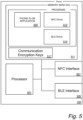
- Fig. 5 is a high-level architecture diagram for the smartphone 103.
- the smartphone 103 contains a processor 501 and a memory 505 as well as NFC and BLE interfaces 507 and 509.
- the memory 505 contains programs 511, which include a phone-to-SE application 503 for communicating with the corresponding SE-to-phone application on the SE-to-phone module 405 of the payment application 403 of the secure element 107.
- the program memory 511 also contains drivers 513 and 515 for communicating over the NFC and BLE protocols over the NFC and BLE interfaces 507 and 509, respectively.
- the non-volatile memory 505 may also be used for storing the communication encryption key 517, which corresponds to the communication encryption key(s) stored on the SE card 101 (the communication encryption key 417).
- Fig. 6 is a timing sequence diagram illustrating secure provisioning of communication encryption keys 417/517 over an NFC channel established between the payment application 403 running on the secure element 107 on the SE card 101 and the corresponding Phone-To-SE app 503 running on the smartphone 103.
- the communication encryption key transferred over the NFC channel is used to secure a subsequent BLE communication when the smartphone 103 is paired with the secure element 107 to establish a BLE channel between the two by encrypting messages transmitted between the secure element 107 and the smartphone 103.
- Any of various encryption standards may be used, including, but not limited to, Advanced Encryption Standard (AES) and RSA as well as variations thereof.
- AES Advanced Encryption Standard
- RSA RSA
- the cardholder 100 "taps" SE card 101 on the smartphone 103, step 601.
- NFC operates in a range of less than 4 cm.
- a tap places the SE card 101 and smartphone 103 within this range.
- the tap establishes an NFC channel 603 from the secure element 107 to the smartphone 103.
- this channel allows communication between the payment app 403, which includes instructions for that purpose (here referred to as the SE-To-Phone module 405), and the corresponding application, the Phone-To-SE app 503 running on the smartphone 103.
- the NFC channel 603 maybe a one-way channel from the secure element 107 to the smartphone 103 allowing the smartphone 103 to read NFC data exchange formatted (NDEF) tags.
- the NDEF tags encapsulate a communication encryption key, from the secure element 107.
- the smartphone 103 reads the NDEF tag encapsulating a communication encryption key, step 605.
- the communication encryption key may be generated from a master key stored in the secure element 107 or may be a random number.
- the smartphone 103 stores the communication encryption key from the last tap operation as a candidate key in persistent memory, for example, the NVM 505, step 607.
- a candidate key is a communications encryption key that has been received by the smartphone 103 from the secure element 107 without the communications encryption key having been confirmed by validating the cardholder. Once the cardholder has been verified, the communications encryption key is promoted to be a trusted key.
- the BLE link is only used to send information about the link itself, i.e., that a pairing has occurred between the secure element 107 and the smartphone 103 and that the communications encryption key 417/517 is a candidate key.
- the Phone to SE Application 503 informs the cardholder that the communications encryption key 517 is a candidate key and to attain full functionality of the smartphone 103 in conjunction with the SE card 101, cardholder authentication must be performed.
- the BLE link may be used to send personal information such as transaction details that only a correct cardholder should be privy to.
- the secure element 107 stores the last communication encryption key that it generates in response to the NFC tap event or may store a sequence of communication encryption keys if the SE card 101 (containing the secure element 107) is tapped multiple times against the smartphone 103, step 609.
- the NFC link may be a one-way link from the secure element 107 to the smartphone 103, it cannot be known to the secure element 107 which key of the keys in the sequence of generated communication encryption keys is stored in the smartphone 103. Therefore, the secure element 107 sends encrypted messages corresponding to each candidate key that is stored on the secure element 107.
- the secure element 107 can then infer from that response which communication encryption key in the stored sequence to use in communication with the smartphone 103.
- the most secure approach is to only store the last key. However, that may cause pairing on the BLE link to fail.
- a communication encryption key that is a candidate key is used to secure the BLE link communication between the secure element 107 and the smartphone 103 by encrypting messages sent on the link using the key.
- the communication encryption key that is a candidate key is not treated as trusted and the secure element 107 may limit what actions may be taken until the cardholder has been verified and the communication encryption key promoted to trusted.
- the communication encryption key 517 stored by the smartphone 103 and the communication encryption key(s) 417 stored by the secure element 107 are considered untrusted candidate keys.
- the secure element 107 and the smartphone 103 are paired to create a BLE link between the two, step 611.
- the smartphone 103 Phone-To-SE App 503 may check the status ( candidate or trusted ) of the communication encryption key 517 that the smartphone 103 has stored and display an information message on the phone, step 612.
- the message may state that the smartphone 103 has paired with an SE Card 101 and identify the card, e.g., "Your BNP Eurocard with account number ending 'XYZW' has been paired with this smartphone.”
- the status of the communication encryption key may also be displayed. Before the cardholder has been verified, the status of the communication encryption key is as a candidate key. Thus, before verification the displayed message would be "An Untrusted key is used in the link to the card.”
- the above steps may be performed in an off-line setting, e.g., at the cardholder's home or office.
- the later steps, which include verification of the cardholder, may be performed at a POS terminal located at a vendor location or offline using a card reader at the cardholder's location.
- the cardholder 100 may seek to make a purchase at a vendor site as illustrated in Fig. 7 , which is a timing-sequence diagram illustrating the user-authentication of the cardholder and promotion of status of the communication encryption key from being a candidate key to becoming a trusted key.
- the cardholder 100 presents the SE card inserts the SE card 101 into the POS terminal 105 to make a contacted connection or places the SE card 101 near the POS terminal 105 to make a contactless link to the POS terminal 105, step 713.
- Connected is used herein to refer to both contacted connection as well as contactless link between the SE card 101 and the POS terminal 105.
- the POS terminal 105 In response to having the SE card 101 presented to it, the POS terminal 105 creates a communication channel to the SE card 101, step 715.
- this communication channel is a channel for transmitting APDUs as is described in ISO 7816. If there is no active BLE link, the SE card 101 attempts a new pairing operation, step 717 and, upon establishment of a link, new status messages would be displayed on the smartphone 103, step 719, including the status of the communication encryption key 517.
- the SE card 101 in response to being connected to the POS terminal 103, sends one or more encrypted messages the smartphone 103 over the BLE link previously established, step 721. If the secure element 107 stores multiple candidate keys, the secure element 107 sends a message encrypted using each of those candidate keys.
- the messages may be a challenge-response test so as to confirm that the smartphone 103 has stored the correct communication encryption key thereby verifying the smartphone as the correct smart phone.
- the smartphone 103 answers the message, step 723.
- step 725 the transaction proceeds and informational messages may be displayed on the smartphone 103 by the Phone-To-SE App 503.
- the secure element 107 attempts to verify the cardholder 100, for example, by asking the cardholder to enter a PIN. Thus, the secure element 107 transmits a message on the POS interface 415 to the POS terminal to request the POS terminal 105 to obtain a PIN from the cardholder 100, step 727.
- a message is displayed on a display of the POS terminal telling the cardholder 100 to enter their PIN, step 729.
- the user then enters the PIN, step 731, which the POS terminal 105 sends to the secure element 107, step 733.
- the secure element 101 verifies the PIN, step 735, and if the PIN is verified, the secure element 101 changes the status of the communication encryption key 415 from candidate to trusted, step 737, and communicates the status change to the Phone-To-SE App 503 on the smartphone 103 over the BLE link, step 739.
- the smartphone 103 displays the status change of the communication encryption key 517 to the cardholder 100, step 741. After the key has been marked as trusted communications on the BLE channel are considered secure and the full functionality of the Phone-To-SE application 503 is made available, such as displaying personal messages to the cardholder.
- Fig. 7 depicts cardholder verification as being performed in conjunction with a payment transaction
- the cardholder 100 verification is performed prior to presenting the SE card 101 to a POS terminal 105.
- a cardholder with a card reader that is capable of communication under ISO 7816 or ISO 14443 may perform the cardholder verification procedure using that card reader at home or in the cardholder's office, for example.
- the legitimate cardholder 100 gives the SE card 101 to a merchant thereby giving temporary control of the SE card 101 to another person. If that person attempts to pair the SE card 101 to another smartphone 103', a message is transmitted over the BLE link from the SE card 101 to the original smartphone 103. The cardholder 100 may then reject the attempted pairing to the second smartphone 103'.
- Use case authorized repairing of a SE card to a second smartphone.
- the cardholder 100 obtains a new smartphone 103"
- the cardholder 100 is able to authorize the new pairing by repeating the sequence illustrated in and discussed in conjunction with Fig. 6 .
- the cardholder verification uses other mechanisms to verify the cardholder. Examples include biometrics such as fingerprint, iris scan, and voice print.
Landscapes
- Engineering & Computer Science (AREA)
- Computer Security & Cryptography (AREA)
- Computer Networks & Wireless Communication (AREA)
- Signal Processing (AREA)
- Business, Economics & Management (AREA)
- Theoretical Computer Science (AREA)
- General Engineering & Computer Science (AREA)
- Physics & Mathematics (AREA)
- General Physics & Mathematics (AREA)
- Accounting & Taxation (AREA)
- Computer Hardware Design (AREA)
- Computing Systems (AREA)
- General Business, Economics & Management (AREA)
- Strategic Management (AREA)
- Audiology, Speech & Language Pathology (AREA)
- Human Computer Interaction (AREA)
- General Health & Medical Sciences (AREA)
- Health & Medical Sciences (AREA)
- Finance (AREA)
- Multimedia (AREA)
- Microelectronics & Electronic Packaging (AREA)
- Mobile Radio Communication Systems (AREA)
- Telephone Function (AREA)
- Communication Control (AREA)
Claims (15)
- Verfahren zum Herstellen einer sicheren Verbindung auf einem zweiten Protokoll zwischen einem sicheren Element (107) und einer Smartvorrichtung (103) mittels einer Verbindung auf einem ersten Protokoll, die Smartvorrichtung umfassend eine erste Anwendung (503), die konfiguriert ist, um eine Vielzahl von Funktionalitäten in Zusammenhang mit dem sicheren Element (107) bereitzustellen,
das Verfahren umfassend:Herstellen einer Verbindung (108) auf dem ersten Protokoll zwischen dem sicheren Element und der Smartvorrichtung;als Reaktion auf die Herstellung einer Verbindung auf dem ersten Protokoll, Erzeugen, durch das sichere Element, eines Kommunikationsverschlüsselungsschlüssels und Zuordnen eines Status dem Kommunikationsverschlüsselungsschlüssel und Zuweisen einer ersten Ebene dem Status;Übertragen einer Nachricht, die den Kommunikationsverschlüsselungsschlüssel und den Status des Kommunikationsverschlüsselungsschlüssels einkapselt, von dem sicheren Element an die Smartvorrichtung über die Verbindung auf dem ersten Protokoll; wobei der Kommunikationsverschlüsselungsschlüssel die erste Anwendung autorisiert, um weniger als alle Funktionalitäten der Vielzahl von Funktionalitäten bereitzustellen, die für die erste Anwendung (503) nur dann verfügbar gemacht werden, falls die erste Ebene dem Status zugewiesen ist,Koppeln des sicheren Elements und der Smartvorrichtung über das zweite Protokoll, wobei dadurch eine Verbindung (109) des zweiten Protokolls hergestellt wird;Übertragen einer Nachricht, die unter Verwendung des Kommunikationsverschlüsselungsschlüssels verschlüsselt ist, von dem sicheren Element an die Smartvorrichtung über die Verbindung des zweiten Protokolls;Authentifizieren eines Karteninhabers (100) des sicheren Elements, wobei das Authentifizieren durch das sichere Element durch Überprüfen von persönlichen Identifikationsdaten durchgeführt wird, die durch den Karteninhaber über eine physische Vorrichtung, die mit dem sicheren Element verbunden ist, bereitgestellt werden;als Reaktion auf den Authentifizierungsschritt, Verifizieren des Karteninhabers als einen autorisierten Karteninhaber für das sichere Element, Erhöhen des Status des Kommunikationsverschlüsselungsschlüssels von der ersten Ebene auf eine zweite Ebene; wobei alle Funktionalitäten der Vielzahl von Funktionalitäten nur dann für die erste Anwendung (503) verfügbar gemacht werden, falls die zweite Ebene dem Status zugewiesen ist. - Verfahren nach Anspruch 1, wobei das erste Protokoll Nahfeldkommunikation (NFC) ist und das Herstellen der Verbindung auf dem ersten Protokoll als Reaktion auf einen NFC-Antippvorgang erfolgt.
- Verfahren nach Anspruch 1, wobei das zweite Protokoll Bluetooth Low Energy ist.
- Verfahren nach Anspruch 1, ferner umfassend:
als Reaktion auf ein Erkennen eines Koppelns über das zweite Protokoll, Bestimmen, durch die Smartvorrichtung, des Status des Kommunikationsverschlüsselungsschlüssels, Informieren des Karteninhabers durch die Smartvorrichtung, die eine Informationsnachricht bereitstellt, die die Paarung des sicheren Elements und der Smartvorrichtung sowie den Status des Kommunikationsverschlüsselungsschlüssels angibt. - Verfahren nach Anspruch 4, wobei das Informieren des Karteninhabers über das Koppeln des sicheren Elements und der Smartvorrichtung und den Status des Kommunikationsverschlüsselungsschlüssels ein Anzeigen der Informationsnachricht auf dem Smartphone umfasst.
- Verfahren nach Anspruch 4, wobei das Informieren des Karteninhabers über das Koppeln des sicheren Elements und der Smartvorrichtung und den Status des Kommunikationsverschlüsselungsschlüssels das Bereitstellen einer Sprachnachricht an den Karteninhaber durch die Smartvorrichtung umfasst.
- Verfahren nach Anspruch 1, ferner umfassend:als Reaktion auf eine Transaktion, die unter Verwendung des sicheren Elements und eines Kassenterminals durchgeführt wird, Bestimmen des Status des Kommunikationsverschlüsselungsschlüssels und, falls der Status des Kommunikationsverschlüsselungsschlüssels die zweite Ebene ist, Übertragen von Transaktionsdetails an die Smartvorrichtung über die Verbindung des zweiten Protokolls, andernfalls, nicht Übertragen jeglicher Transaktionsdetails an die Smartvorrichtung; undals Reaktion auf ein Empfangen, durch die Smartvorrichtung, der Transaktionsdetails, Informieren des Karteninhabers über die Transaktionsdetails durch die Smartvorrichtung, die dem Karteninhaber die Transaktionsdetails bereitstellt.
- Verfahren nach Anspruch 7, wobei das Informieren des Karteninhabers über die Transaktionsdetails das Anzeigen der Nachricht mit den Transaktionsdetails auf der Smartvorrichtung umfasst.
- Verfahren nach Anspruch 7, wobei das Informieren des Karteninhabers über die Transaktionsdetails das Bereitstellen einer Sprachnachricht an den Karteninhaber durch die Smartvorrichtung umfasst.
- Verfahren nach Anspruch 1, ferner umfassend:
als Reaktion auf eine Transaktion, die unter Verwendung des sicheren Elements und eines Kassenterminals durchgeführt wird, Bestimmen des Status des Kommunikationsverschlüsselungsschlüssels und, von dem Status des Kommunikationsverschlüsselungsschlüssels, der Transaktionseinzelheiten, und eine Sicherheitsrichtlinie eine Aktion einleitet, die aus einem Fortfahren der Transaktion, einem Verhindern der Transaktion oder einem Anfordern einer Genehmigung für die Transaktion von dem Karteninhaber durch Übertragen einer Genehmigungsanforderungsnachricht an die Smartvorrichtung ausgewählt wird. - Sicheres Element (107), das einen Prozessor (301) und einem Programmspeicher aufweist, wobei der Programmspeicher Anweisungen speichert, die durch den Prozessor ausführbar sind, einschließlich Anweisungen, die den Prozessor veranlassen zum:Herstellen einer ersten Kommunikationsverbindung (108) auf einem ersten Protokoll zu einer Smartvorrichtung, die eine erste Anwendung (503) umfasst, die konfiguriert ist, um in Zusammenhang mit dem sicheren Element eine Vielzahl von Funktionalitäten bereitzustellen;Herstellen einer Verbindung (109) des zweiten Protokolls zu der Smartvorrichtung;als Reaktion auf die Herstellung einer ersten Kommunikationsverbindung auf dem ersten Protokoll, Erzeugen eines Kommunikationsverschlüsselungsschlüssels, Zuordnen eines Status dem Verschlüsselungsschlüssel und Zuweisen des Status einer ersten Ebene;Übertragen einer Nachricht, die den Kommunikationsverschlüsselungsschlüssel und den Status des Kommunikationsverschlüsselungsschlüssels einkapselt, auf der ersten Kommunikationsverbindung an die Smartvorrichtung; wobei der Kommunikationsverschlüsselungsschlüssel die erste Anwendung (503), um weniger als alle Funktionalitäten der Vielzahl von Funktionalitäten bereitzustellen, nur dann autorisiert, falls die erste Ebene dem Status zugewiesen ist,Übertragen einer Nachricht, die unter Verwendung des Kommunikationsverschlüsselungsschlüssels verschlüsselt wird, an die Smartvorrichtung über die zweite Kommunikationsverbindung;Durchführen einer Benutzerauthentifizierung eines Karteninhabers des sicheren Elements durch Überprüfen von persönlichen Identifikationsdaten, die durch den Karteninhaber über eine physische Vorrichtung, die mit dem sicheren Element verbunden ist, bereitgestellt werden;als Reaktion auf eine erfolgreiche Verifizierung der durchgeführten Benutzerauthentifizierung des Karteninhabers des sicheren Elements, Erhöhen des Status des Kommunikationsverschlüsselungsschlüssels von der ersten Ebene auf eine zweite Ebene und Senden des geänderten Status an die Smartvorrichtung; wobei alle Funktionalitäten der Vielzahl von Funktionalitäten nur dann für die erste Anwendung (503) verfügbar gemacht werden, falls die zweite Ebene dem Status zugewiesen ist.
- Sicheres Element nach Anspruch 11, wobei die Anweisungen ferner Anweisungen einschließen, die den Prozessor veranlassen zum:
als Reaktion auf das Erkennen eines Koppelns über das zweite Protokoll, Bestimmen des Status des Kommunikationsverschlüsselungsschlüssels und Übertragen einer Informationsnachricht an die Smartvorrichtung, die den Status des Kommunikationsverschlüsselungsschlüssels angibt. - Sicheres Element nach Anspruch 11, wobei die Anweisungen ferner Anweisungen einschließen, die den Prozessor veranlassen zum:
als Reaktion auf eine Transaktion, die unter Verwendung des sicheren Elements und eines Kassenterminals durchgeführt wird, Bestimmen des Status des Kommunikationsverschlüsselungsschlüssels und, falls der Status des Kommunikationsverschlüsselungsschlüssels die zweite Ebene ist, Übertragen der Transaktionsdetails an die Smartvorrichtung über die Verbindung des zweiten Protokolls, andernfalls, kein Übertragen jeglicher Transaktionsdetails an die Smartvorrichtung. - Sicheres Element nach Anspruch 11, wobei die Anweisungen ferner Anweisungen einschließen, die den Prozessor veranlassen zum:
als Reaktion auf eine Transaktion, die unter Verwendung des sicheren Elements und eines Kassenterminals durchgeführt werden, Bestimmen des Status des Kommunikationsverschlüsselungsschlüssels und, von dem Status des Kommunikationsverschlüsselungsschlüssels, der Transaktionseinzelheiten und die Sicherheitsrichtlinie eine Aktion einleitet, die aus dem Fortfahren der Transaktion, dem Verhindern der Transaktion, dem Anfordern der Genehmigung für die Transaktion von dem Karteninhaber durch Übertragen einer Genehmigungsanforderungsnachricht an die Smartvorrichtung ausgewählt wird. - System, umfassend das sichere Element von Anspruch 11 und die Smartvorrichtung nach Anspruch 11, wobei die Smartvorrichtung ein Smartphone ist.
Applications Claiming Priority (2)
| Application Number | Priority Date | Filing Date | Title |
|---|---|---|---|
| EP20315343.2A EP3937454A1 (de) | 2020-07-08 | 2020-07-08 | Sichere end-zu-end-paarung eines sicheren elements mit einer mobilen vorrichtung |
| PCT/EP2021/066960 WO2022008231A1 (en) | 2020-07-08 | 2021-06-22 | Secure end-to-end pairing of secure element to mobile device |
Publications (2)
| Publication Number | Publication Date |
|---|---|
| EP4179697A1 EP4179697A1 (de) | 2023-05-17 |
| EP4179697B1 true EP4179697B1 (de) | 2024-07-24 |
Family
ID=72709273
Family Applications (2)
| Application Number | Title | Priority Date | Filing Date |
|---|---|---|---|
| EP20315343.2A Withdrawn EP3937454A1 (de) | 2020-07-08 | 2020-07-08 | Sichere end-zu-end-paarung eines sicheren elements mit einer mobilen vorrichtung |
| EP21735909.0A Active EP4179697B1 (de) | 2020-07-08 | 2021-06-22 | Sichere end-zu-end-paarung eines sicheren elements mit einer mobilen vorrichtung |
Family Applications Before (1)
| Application Number | Title | Priority Date | Filing Date |
|---|---|---|---|
| EP20315343.2A Withdrawn EP3937454A1 (de) | 2020-07-08 | 2020-07-08 | Sichere end-zu-end-paarung eines sicheren elements mit einer mobilen vorrichtung |
Country Status (10)
| Country | Link |
|---|---|
| US (1) | US12314959B2 (de) |
| EP (2) | EP3937454A1 (de) |
| JP (1) | JP7461564B2 (de) |
| KR (1) | KR102745613B1 (de) |
| CN (1) | CN116097686B (de) |
| BR (1) | BR112022026628A2 (de) |
| ES (1) | ES2988543T3 (de) |
| FI (1) | FI4179697T3 (de) |
| PL (1) | PL4179697T3 (de) |
| WO (1) | WO2022008231A1 (de) |
Families Citing this family (1)
| Publication number | Priority date | Publication date | Assignee | Title |
|---|---|---|---|---|
| USD1102063S1 (en) | 2024-04-26 | 2025-11-11 | Samsung Electronics Co., Ltd. | Washing machine |
Family Cites Families (14)
| Publication number | Priority date | Publication date | Assignee | Title |
|---|---|---|---|---|
| US6327578B1 (en) * | 1998-12-29 | 2001-12-04 | International Business Machines Corporation | Four-party credit/debit payment protocol |
| JP2005148883A (ja) * | 2003-11-12 | 2005-06-09 | Dainippon Printing Co Ltd | Icカードのpin変更及び閉塞解除方法 |
| JP4706702B2 (ja) * | 2007-12-28 | 2011-06-22 | ソニー株式会社 | 通信システム、通信装置および通信方法、並びにプログラム |
| US20110028091A1 (en) * | 2009-08-03 | 2011-02-03 | Motorola, Inc. | Method and system for near-field wireless device pairing |
| US9344413B2 (en) * | 2012-01-18 | 2016-05-17 | OneID, Inc. | Methods and systems for device disablement |
| KR20140007250A (ko) * | 2012-07-09 | 2014-01-17 | 주식회사 씽크풀 | 페어링 수행 디지털 시스템 및 그 제공방법 |
| US20140019367A1 (en) * | 2012-07-13 | 2014-01-16 | Apple Inc. | Method to send payment data through various air interfaces without compromising user data |
| US9762558B2 (en) * | 2013-03-12 | 2017-09-12 | Trividia Health, Inc. | Wireless pairing of personal health device with a computing device |
| US20150095238A1 (en) * | 2013-09-30 | 2015-04-02 | Apple Inc. | Online payments using a secure element of an electronic device |
| CN105981352B (zh) * | 2014-02-05 | 2018-03-13 | 苹果公司 | 控制器、由控制器控制的附件和通信方法 |
| US11871237B1 (en) * | 2016-06-30 | 2024-01-09 | Block, Inc. | Pairing a payment object reader with a point-of-sale terminal |
| KR101905712B1 (ko) | 2017-10-27 | 2018-10-11 | 주식회사 에스씨테크원 | 페어링키 관리 장치 및 방법 |
| JP2019121875A (ja) * | 2017-12-28 | 2019-07-22 | キヤノン株式会社 | 端末装置、情報処理方法及びプログラム |
| JP6881554B2 (ja) * | 2019-11-25 | 2021-06-02 | カシオ計算機株式会社 | 売上データ処理装置 |
-
2020
- 2020-07-08 EP EP20315343.2A patent/EP3937454A1/de not_active Withdrawn
-
2021
- 2021-06-22 JP JP2023500105A patent/JP7461564B2/ja active Active
- 2021-06-22 KR KR1020237000200A patent/KR102745613B1/ko active Active
- 2021-06-22 CN CN202180048723.7A patent/CN116097686B/zh active Active
- 2021-06-22 EP EP21735909.0A patent/EP4179697B1/de active Active
- 2021-06-22 US US18/014,786 patent/US12314959B2/en active Active
- 2021-06-22 ES ES21735909T patent/ES2988543T3/es active Active
- 2021-06-22 BR BR112022026628A patent/BR112022026628A2/pt unknown
- 2021-06-22 WO PCT/EP2021/066960 patent/WO2022008231A1/en not_active Ceased
- 2021-06-22 FI FIEP21735909.0T patent/FI4179697T3/fi active
- 2021-06-22 PL PL21735909.0T patent/PL4179697T3/pl unknown
Also Published As
| Publication number | Publication date |
|---|---|
| ES2988543T3 (es) | 2024-11-21 |
| PL4179697T3 (pl) | 2024-10-07 |
| KR102745613B1 (ko) | 2024-12-20 |
| BR112022026628A2 (pt) | 2023-01-24 |
| CN116097686A (zh) | 2023-05-09 |
| US20240242227A1 (en) | 2024-07-18 |
| CN116097686B (zh) | 2026-01-27 |
| WO2022008231A1 (en) | 2022-01-13 |
| US12314959B2 (en) | 2025-05-27 |
| EP3937454A1 (de) | 2022-01-12 |
| JP7461564B2 (ja) | 2024-04-03 |
| FI4179697T3 (fi) | 2024-08-21 |
| EP4179697A1 (de) | 2023-05-17 |
| KR20230024327A (ko) | 2023-02-20 |
| JP2023533268A (ja) | 2023-08-02 |
Similar Documents
| Publication | Publication Date | Title |
|---|---|---|
| CN113170299B (zh) | 用于非接触式卡的密码认证的系统和方法 | |
| JP7668209B2 (ja) | 非接触カードの暗号化認証のためのシステムおよび方法 | |
| US11750368B2 (en) | Provisioning method and system with message conversion | |
| US11403635B2 (en) | Payment system | |
| AU2026200918A1 (en) | Systems and methods for providing online and hybridcard interactions | |
| JP2022504072A (ja) | 非接触カードの暗号化認証のためのシステムおよび方法 | |
| US20160117673A1 (en) | System and method for secured transactions using mobile devices | |
| CN112889046A (zh) | 用于非接触卡的密码认证的系统和方法 | |
| JP2018520401A (ja) | 自動販売機トランザクション | |
| JP7682896B2 (ja) | 制限された仮想番号を使用したカード発行 | |
| US20220060889A1 (en) | Provisioning initiated from a contactless device | |
| CN112602104A (zh) | 用于非接触卡的密码认证的系统和方法 | |
| KR20140125449A (ko) | 거래 프로세싱 시스템 및 방법 | |
| CN113168631A (zh) | 用于非接触卡的密码认证的系统和方法 | |
| KR20130123985A (ko) | 근거리 무선 통신을 이용한 안전한 인증 서비스 시스템 및 방법 | |
| US20200245138A1 (en) | Terminal type identification in interaction processing | |
| WO2020058861A1 (en) | A payment authentication device, a payment authentication system and a method of authenticating payment | |
| US12314959B2 (en) | Secure end-to-end pairing of secure element to mobile device | |
| CA3173933C (en) | Application-based point of sale system in mobile operating systems | |
| HK40053700A (en) | Systems and methods for cryptographic authentication of contactless cards | |
| HK40053284A (en) | Systems and methods for cryptographic authentication of contactless cards | |
| HK40051494A (en) | Systems and methods for cryptographic authentication of contactless cards | |
| WO2020058900A1 (en) | Adapter for a printer |
Legal Events
| Date | Code | Title | Description |
|---|---|---|---|
| STAA | Information on the status of an ep patent application or granted ep patent |
Free format text: STATUS: UNKNOWN |
|
| STAA | Information on the status of an ep patent application or granted ep patent |
Free format text: STATUS: THE INTERNATIONAL PUBLICATION HAS BEEN MADE |
|
| PUAI | Public reference made under article 153(3) epc to a published international application that has entered the european phase |
Free format text: ORIGINAL CODE: 0009012 |
|
| STAA | Information on the status of an ep patent application or granted ep patent |
Free format text: STATUS: REQUEST FOR EXAMINATION WAS MADE |
|
| 17P | Request for examination filed |
Effective date: 20230208 |
|
| AK | Designated contracting states |
Kind code of ref document: A1 Designated state(s): AL AT BE BG CH CY CZ DE DK EE ES FI FR GB GR HR HU IE IS IT LI LT LU LV MC MK MT NL NO PL PT RO RS SE SI SK SM TR |
|
| DAV | Request for validation of the european patent (deleted) | ||
| DAX | Request for extension of the european patent (deleted) | ||
| GRAP | Despatch of communication of intention to grant a patent |
Free format text: ORIGINAL CODE: EPIDOSNIGR1 |
|
| STAA | Information on the status of an ep patent application or granted ep patent |
Free format text: STATUS: GRANT OF PATENT IS INTENDED |
|
| INTG | Intention to grant announced |
Effective date: 20240214 |
|
| GRAS | Grant fee paid |
Free format text: ORIGINAL CODE: EPIDOSNIGR3 |
|
| GRAA | (expected) grant |
Free format text: ORIGINAL CODE: 0009210 |
|
| STAA | Information on the status of an ep patent application or granted ep patent |
Free format text: STATUS: THE PATENT HAS BEEN GRANTED |
|
| AK | Designated contracting states |
Kind code of ref document: B1 Designated state(s): AL AT BE BG CH CY CZ DE DK EE ES FI FR GB GR HR HU IE IS IT LI LT LU LV MC MK MT NL NO PL PT RO RS SE SI SK SM TR |
|
| REG | Reference to a national code |
Ref country code: GB Ref legal event code: FG4D |
|
| REG | Reference to a national code |
Ref country code: CH Ref legal event code: EP |
|
| REG | Reference to a national code |
Ref country code: DE Ref legal event code: R096 Ref document number: 602021016174 Country of ref document: DE |
|
| REG | Reference to a national code |
Ref country code: IE Ref legal event code: FG4D |
|
| REG | Reference to a national code |
Ref country code: FI Ref legal event code: FGE |
|
| REG | Reference to a national code |
Ref country code: SE Ref legal event code: TRGR |
|
| REG | Reference to a national code |
Ref country code: LT Ref legal event code: MG9D |
|
| REG | Reference to a national code |
Ref country code: ES Ref legal event code: FG2A Ref document number: 2988543 Country of ref document: ES Kind code of ref document: T3 Effective date: 20241121 |
|
| P01 | Opt-out of the competence of the unified patent court (upc) registered |
Free format text: CASE NUMBER: APP_57544/2024 Effective date: 20241022 |
|
| REG | Reference to a national code |
Ref country code: NL Ref legal event code: MP Effective date: 20240724 |
|
| PG25 | Lapsed in a contracting state [announced via postgrant information from national office to epo] |
Ref country code: PT Free format text: LAPSE BECAUSE OF FAILURE TO SUBMIT A TRANSLATION OF THE DESCRIPTION OR TO PAY THE FEE WITHIN THE PRESCRIBED TIME-LIMIT Effective date: 20241125 |
|
| REG | Reference to a national code |
Ref country code: AT Ref legal event code: MK05 Ref document number: 1707299 Country of ref document: AT Kind code of ref document: T Effective date: 20240724 |
|
| PG25 | Lapsed in a contracting state [announced via postgrant information from national office to epo] |
Ref country code: NL Free format text: LAPSE BECAUSE OF FAILURE TO SUBMIT A TRANSLATION OF THE DESCRIPTION OR TO PAY THE FEE WITHIN THE PRESCRIBED TIME-LIMIT Effective date: 20240724 |
|
| PG25 | Lapsed in a contracting state [announced via postgrant information from national office to epo] |
Ref country code: PT Free format text: LAPSE BECAUSE OF FAILURE TO SUBMIT A TRANSLATION OF THE DESCRIPTION OR TO PAY THE FEE WITHIN THE PRESCRIBED TIME-LIMIT Effective date: 20241125 Ref country code: NL Free format text: LAPSE BECAUSE OF FAILURE TO SUBMIT A TRANSLATION OF THE DESCRIPTION OR TO PAY THE FEE WITHIN THE PRESCRIBED TIME-LIMIT Effective date: 20240724 |
|
| PG25 | Lapsed in a contracting state [announced via postgrant information from national office to epo] |
Ref country code: GR Free format text: LAPSE BECAUSE OF FAILURE TO SUBMIT A TRANSLATION OF THE DESCRIPTION OR TO PAY THE FEE WITHIN THE PRESCRIBED TIME-LIMIT Effective date: 20241025 |
|
| PG25 | Lapsed in a contracting state [announced via postgrant information from national office to epo] |
Ref country code: BG Free format text: LAPSE BECAUSE OF FAILURE TO SUBMIT A TRANSLATION OF THE DESCRIPTION OR TO PAY THE FEE WITHIN THE PRESCRIBED TIME-LIMIT Effective date: 20240724 |
|
| PG25 | Lapsed in a contracting state [announced via postgrant information from national office to epo] |
Ref country code: LV Free format text: LAPSE BECAUSE OF FAILURE TO SUBMIT A TRANSLATION OF THE DESCRIPTION OR TO PAY THE FEE WITHIN THE PRESCRIBED TIME-LIMIT Effective date: 20240724 |
|
| PG25 | Lapsed in a contracting state [announced via postgrant information from national office to epo] |
Ref country code: IS Free format text: LAPSE BECAUSE OF FAILURE TO SUBMIT A TRANSLATION OF THE DESCRIPTION OR TO PAY THE FEE WITHIN THE PRESCRIBED TIME-LIMIT Effective date: 20241124 Ref country code: AT Free format text: LAPSE BECAUSE OF FAILURE TO SUBMIT A TRANSLATION OF THE DESCRIPTION OR TO PAY THE FEE WITHIN THE PRESCRIBED TIME-LIMIT Effective date: 20240724 |
|
| PG25 | Lapsed in a contracting state [announced via postgrant information from national office to epo] |
Ref country code: HR Free format text: LAPSE BECAUSE OF FAILURE TO SUBMIT A TRANSLATION OF THE DESCRIPTION OR TO PAY THE FEE WITHIN THE PRESCRIBED TIME-LIMIT Effective date: 20240724 |
|
| PG25 | Lapsed in a contracting state [announced via postgrant information from national office to epo] |
Ref country code: RS Free format text: LAPSE BECAUSE OF FAILURE TO SUBMIT A TRANSLATION OF THE DESCRIPTION OR TO PAY THE FEE WITHIN THE PRESCRIBED TIME-LIMIT Effective date: 20241024 |
|
| PG25 | Lapsed in a contracting state [announced via postgrant information from national office to epo] |
Ref country code: RS Free format text: LAPSE BECAUSE OF FAILURE TO SUBMIT A TRANSLATION OF THE DESCRIPTION OR TO PAY THE FEE WITHIN THE PRESCRIBED TIME-LIMIT Effective date: 20241024 Ref country code: LV Free format text: LAPSE BECAUSE OF FAILURE TO SUBMIT A TRANSLATION OF THE DESCRIPTION OR TO PAY THE FEE WITHIN THE PRESCRIBED TIME-LIMIT Effective date: 20240724 Ref country code: IS Free format text: LAPSE BECAUSE OF FAILURE TO SUBMIT A TRANSLATION OF THE DESCRIPTION OR TO PAY THE FEE WITHIN THE PRESCRIBED TIME-LIMIT Effective date: 20241124 Ref country code: HR Free format text: LAPSE BECAUSE OF FAILURE TO SUBMIT A TRANSLATION OF THE DESCRIPTION OR TO PAY THE FEE WITHIN THE PRESCRIBED TIME-LIMIT Effective date: 20240724 Ref country code: GR Free format text: LAPSE BECAUSE OF FAILURE TO SUBMIT A TRANSLATION OF THE DESCRIPTION OR TO PAY THE FEE WITHIN THE PRESCRIBED TIME-LIMIT Effective date: 20241025 Ref country code: BG Free format text: LAPSE BECAUSE OF FAILURE TO SUBMIT A TRANSLATION OF THE DESCRIPTION OR TO PAY THE FEE WITHIN THE PRESCRIBED TIME-LIMIT Effective date: 20240724 Ref country code: AT Free format text: LAPSE BECAUSE OF FAILURE TO SUBMIT A TRANSLATION OF THE DESCRIPTION OR TO PAY THE FEE WITHIN THE PRESCRIBED TIME-LIMIT Effective date: 20240724 |
|
| PG25 | Lapsed in a contracting state [announced via postgrant information from national office to epo] |
Ref country code: SM Free format text: LAPSE BECAUSE OF FAILURE TO SUBMIT A TRANSLATION OF THE DESCRIPTION OR TO PAY THE FEE WITHIN THE PRESCRIBED TIME-LIMIT Effective date: 20240724 Ref country code: DK Free format text: LAPSE BECAUSE OF FAILURE TO SUBMIT A TRANSLATION OF THE DESCRIPTION OR TO PAY THE FEE WITHIN THE PRESCRIBED TIME-LIMIT Effective date: 20240724 Ref country code: RO Free format text: LAPSE BECAUSE OF FAILURE TO SUBMIT A TRANSLATION OF THE DESCRIPTION OR TO PAY THE FEE WITHIN THE PRESCRIBED TIME-LIMIT Effective date: 20240724 |
|
| PG25 | Lapsed in a contracting state [announced via postgrant information from national office to epo] |
Ref country code: EE Free format text: LAPSE BECAUSE OF FAILURE TO SUBMIT A TRANSLATION OF THE DESCRIPTION OR TO PAY THE FEE WITHIN THE PRESCRIBED TIME-LIMIT Effective date: 20240724 |
|
| PG25 | Lapsed in a contracting state [announced via postgrant information from national office to epo] |
Ref country code: CZ Free format text: LAPSE BECAUSE OF FAILURE TO SUBMIT A TRANSLATION OF THE DESCRIPTION OR TO PAY THE FEE WITHIN THE PRESCRIBED TIME-LIMIT Effective date: 20240724 |
|
| REG | Reference to a national code |
Ref country code: DE Ref legal event code: R097 Ref document number: 602021016174 Country of ref document: DE |
|
| PG25 | Lapsed in a contracting state [announced via postgrant information from national office to epo] |
Ref country code: SK Free format text: LAPSE BECAUSE OF FAILURE TO SUBMIT A TRANSLATION OF THE DESCRIPTION OR TO PAY THE FEE WITHIN THE PRESCRIBED TIME-LIMIT Effective date: 20240724 |
|
| PLBE | No opposition filed within time limit |
Free format text: ORIGINAL CODE: 0009261 |
|
| STAA | Information on the status of an ep patent application or granted ep patent |
Free format text: STATUS: NO OPPOSITION FILED WITHIN TIME LIMIT |
|
| 26N | No opposition filed |
Effective date: 20250425 |
|
| PGFP | Annual fee paid to national office [announced via postgrant information from national office to epo] |
Ref country code: FI Payment date: 20250520 Year of fee payment: 5 |
|
| PGFP | Annual fee paid to national office [announced via postgrant information from national office to epo] |
Ref country code: PL Payment date: 20250525 Year of fee payment: 5 Ref country code: DE Payment date: 20250520 Year of fee payment: 5 |
|
| PGFP | Annual fee paid to national office [announced via postgrant information from national office to epo] |
Ref country code: GB Payment date: 20250520 Year of fee payment: 5 |
|
| PGFP | Annual fee paid to national office [announced via postgrant information from national office to epo] |
Ref country code: NO Payment date: 20250522 Year of fee payment: 5 |
|
| PGFP | Annual fee paid to national office [announced via postgrant information from national office to epo] |
Ref country code: IT Payment date: 20250520 Year of fee payment: 5 |
|
| PGFP | Annual fee paid to national office [announced via postgrant information from national office to epo] |
Ref country code: FR Payment date: 20250520 Year of fee payment: 5 |
|
| PGFP | Annual fee paid to national office [announced via postgrant information from national office to epo] |
Ref country code: TR Payment date: 20250528 Year of fee payment: 5 |
|
| PGFP | Annual fee paid to national office [announced via postgrant information from national office to epo] |
Ref country code: SE Payment date: 20250520 Year of fee payment: 5 |
|
| PGFP | Annual fee paid to national office [announced via postgrant information from national office to epo] |
Ref country code: ES Payment date: 20250701 Year of fee payment: 5 |
|
| REG | Reference to a national code |
Ref country code: CH Ref legal event code: H13 Free format text: ST27 STATUS EVENT CODE: U-0-0-H10-H13 (AS PROVIDED BY THE NATIONAL OFFICE) Effective date: 20260127 |
|
| PG25 | Lapsed in a contracting state [announced via postgrant information from national office to epo] |
Ref country code: MC Free format text: LAPSE BECAUSE OF FAILURE TO SUBMIT A TRANSLATION OF THE DESCRIPTION OR TO PAY THE FEE WITHIN THE PRESCRIBED TIME-LIMIT Effective date: 20240724 |
|
| PG25 | Lapsed in a contracting state [announced via postgrant information from national office to epo] |
Ref country code: LU Free format text: LAPSE BECAUSE OF NON-PAYMENT OF DUE FEES Effective date: 20250622 |
|
| REG | Reference to a national code |
Ref country code: BE Ref legal event code: MM Effective date: 20250630 |
|
| PG25 | Lapsed in a contracting state [announced via postgrant information from national office to epo] |
Ref country code: IE Free format text: LAPSE BECAUSE OF NON-PAYMENT OF DUE FEES Effective date: 20250622 |
|
| PG25 | Lapsed in a contracting state [announced via postgrant information from national office to epo] |
Ref country code: BE Free format text: LAPSE BECAUSE OF NON-PAYMENT OF DUE FEES Effective date: 20250630 |
|
| PG25 | Lapsed in a contracting state [announced via postgrant information from national office to epo] |
Ref country code: CH Free format text: LAPSE BECAUSE OF NON-PAYMENT OF DUE FEES Effective date: 20250630 |