EP4176945B1 - Skikern und ski mit einem solchen kern - Google Patents
Skikern und ski mit einem solchen kern Download PDFInfo
- Publication number
- EP4176945B1 EP4176945B1 EP22204306.9A EP22204306A EP4176945B1 EP 4176945 B1 EP4176945 B1 EP 4176945B1 EP 22204306 A EP22204306 A EP 22204306A EP 4176945 B1 EP4176945 B1 EP 4176945B1
- Authority
- EP
- European Patent Office
- Prior art keywords
- core
- ski
- hand
- fins
- longitudinal axis
- Prior art date
- Legal status (The legal status is an assumption and is not a legal conclusion. Google has not performed a legal analysis and makes no representation as to the accuracy of the status listed.)
- Active
Links
Images







Classifications
-
- A—HUMAN NECESSITIES
- A63—SPORTS; GAMES; AMUSEMENTS
- A63C—SKATES; SKIS; ROLLER SKATES; DESIGN OR LAYOUT OF COURTS, RINKS OR THE LIKE
- A63C5/00—Skis or snowboards
- A63C5/03—Mono skis; Snowboards
-
- A—HUMAN NECESSITIES
- A63—SPORTS; GAMES; AMUSEMENTS
- A63C—SKATES; SKIS; ROLLER SKATES; DESIGN OR LAYOUT OF COURTS, RINKS OR THE LIKE
- A63C5/00—Skis or snowboards
- A63C5/12—Making thereof; Selection of particular materials
- A63C5/126—Structure of the core
-
- A—HUMAN NECESSITIES
- A63—SPORTS; GAMES; AMUSEMENTS
- A63C—SKATES; SKIS; ROLLER SKATES; DESIGN OR LAYOUT OF COURTS, RINKS OR THE LIKE
- A63C5/00—Skis or snowboards
- A63C5/04—Structure of the surface thereof
- A63C5/0434—Structure of the surface thereof of the side walls
-
- A—HUMAN NECESSITIES
- A63—SPORTS; GAMES; AMUSEMENTS
- A63C—SKATES; SKIS; ROLLER SKATES; DESIGN OR LAYOUT OF COURTS, RINKS OR THE LIKE
- A63C5/00—Skis or snowboards
- A63C5/04—Structure of the surface thereof
- A63C5/048—Structure of the surface thereof of the edges
-
- A—HUMAN NECESSITIES
- A63—SPORTS; GAMES; AMUSEMENTS
- A63C—SKATES; SKIS; ROLLER SKATES; DESIGN OR LAYOUT OF COURTS, RINKS OR THE LIKE
- A63C5/00—Skis or snowboards
- A63C5/12—Making thereof; Selection of particular materials
-
- B—PERFORMING OPERATIONS; TRANSPORTING
- B32—LAYERED PRODUCTS
- B32B—LAYERED PRODUCTS, i.e. PRODUCTS BUILT-UP OF STRATA OF FLAT OR NON-FLAT, e.g. CELLULAR OR HONEYCOMB, FORM
- B32B1/00—Layered products having a non-planar shape
-
- B—PERFORMING OPERATIONS; TRANSPORTING
- B32—LAYERED PRODUCTS
- B32B—LAYERED PRODUCTS, i.e. PRODUCTS BUILT-UP OF STRATA OF FLAT OR NON-FLAT, e.g. CELLULAR OR HONEYCOMB, FORM
- B32B27/00—Layered products comprising a layer of synthetic resin
- B32B27/06—Layered products comprising a layer of synthetic resin as the main or only constituent of a layer, which is next to another layer of the same or of a different material
- B32B27/08—Layered products comprising a layer of synthetic resin as the main or only constituent of a layer, which is next to another layer of the same or of a different material of synthetic resin
-
- B—PERFORMING OPERATIONS; TRANSPORTING
- B32—LAYERED PRODUCTS
- B32B—LAYERED PRODUCTS, i.e. PRODUCTS BUILT-UP OF STRATA OF FLAT OR NON-FLAT, e.g. CELLULAR OR HONEYCOMB, FORM
- B32B27/00—Layered products comprising a layer of synthetic resin
- B32B27/36—Layered products comprising a layer of synthetic resin comprising polyesters
-
- B—PERFORMING OPERATIONS; TRANSPORTING
- B32—LAYERED PRODUCTS
- B32B—LAYERED PRODUCTS, i.e. PRODUCTS BUILT-UP OF STRATA OF FLAT OR NON-FLAT, e.g. CELLULAR OR HONEYCOMB, FORM
- B32B27/00—Layered products comprising a layer of synthetic resin
- B32B27/40—Layered products comprising a layer of synthetic resin comprising polyurethanes
-
- B—PERFORMING OPERATIONS; TRANSPORTING
- B32—LAYERED PRODUCTS
- B32B—LAYERED PRODUCTS, i.e. PRODUCTS BUILT-UP OF STRATA OF FLAT OR NON-FLAT, e.g. CELLULAR OR HONEYCOMB, FORM
- B32B3/00—Layered products comprising a layer with external or internal discontinuities or unevennesses, or a layer of non-planar shape; Layered products comprising a layer having particular features of form
- B32B3/26—Layered products comprising a layer with external or internal discontinuities or unevennesses, or a layer of non-planar shape; Layered products comprising a layer having particular features of form characterised by a particular shape of the outline of the cross-section of a continuous layer; characterised by a layer with cavities or internal voids ; characterised by an apertured layer
- B32B3/30—Layered products comprising a layer with external or internal discontinuities or unevennesses, or a layer of non-planar shape; Layered products comprising a layer having particular features of form characterised by a particular shape of the outline of the cross-section of a continuous layer; characterised by a layer with cavities or internal voids ; characterised by an apertured layer characterised by a layer formed with recesses or projections, e.g. hollows, grooves, protuberances, ribs
-
- A—HUMAN NECESSITIES
- A63—SPORTS; GAMES; AMUSEMENTS
- A63C—SKATES; SKIS; ROLLER SKATES; DESIGN OR LAYOUT OF COURTS, RINKS OR THE LIKE
- A63C5/00—Skis or snowboards
- A63C5/04—Structure of the surface thereof
- A63C5/044—Structure of the surface thereof of the running sole
Definitions
- the present invention relates to the manufacture of skis, and in particular to the manufacture of cross-country skis.
- Skis are generally made of a composite structure in which two longitudinal structural elements (an upper reinforcement and a lower reinforcement) are held at a distance from each other by an intermediate element, which is called the core.
- the present invention is particularly aimed at improving the construction of the core.
- Ski weight is always an important criterion when evaluating a ski. This is especially true for specific activities such as cross-country skiing or even ski touring.
- the document EP 2745884 describes a ski intended for ski touring that the manufacturer has sought to make as light as possible. To achieve this, it uses two methods. First, the external shape of the ski is chosen to optimize the use of material. To this end, all portions of the ski that are not used for ski bindings have a convex profile. Second, recesses in the form of longitudinal grooves are made in the lower central part of the core. In the document EP 2745884 , the grooves being longitudinal, they are relatively easy and inexpensive to make, for example by milling. However, the lightening that they allow is limited. In this case, according to a cross-section of the ski, only about 25% of the width of the core is affected by the lightening due to the ribs.
- the objective of the invention is to construct a ski which, although lighter than equivalent skis, retains the same mechanical characteristics, in particular dynamic behavior; equivalent flexion and torsional stiffness.
- the ski in its thickness, is composed of a succession of five elements from the ground, namely, a sliding sole, a lower reinforcement, the core, an upper reinforcement and a top layer, at least the left and right lateral edges extending over the entire height of the core.
- the height of the core is always at least equal to 50% of the height of the ski in the hollowed-out area of the core.
- the core comprises a horizontal upper plate, the left side edge and the right side edge both extending downwardly from the left and right side edges, respectively, of the upper plate.
- the core comprises a plurality of recesses, each recess being delimited by two adjacent fins, each recess being blind or crossing the entire height of the core and said recesses being arranged over the major part of a central portion of the core, in the longitudinal direction.
- the core is composed of two components assembled together, one of these components carrying the left and right side edges.
- one of the components of the core is a plate so as to close the recesses.
- the plate carries the central core(s) and/or the fins.
- the left fins and the right fins are arranged symmetrically with respect to the longitudinal axis of the ski.
- the core is made by injection.
- the core is made of a PU foam.
- the fins are arranged so that their width is substantially equal to the space separating two adjacent fins.
- the base of the left side edge, respectively of the right side edge, respectively of a central core, respectively of the left and right fins has a width L 42G , respectively L 42D , respectively L 44 , respectively L 46G and L 46D , which is substantially equal and between two and eight millimeters.
- the left fins, respectively the right fins, of the core do not all form the same angle with the longitudinal axis of the ski.
- the core comprises two central cores.
- an angular orientation relative to the longitudinal axis X of the ski This angle is measured in such a way as to qualify the orientation of an element relative to the longitudinal axis X of the ski in absolute value.
- the angle is measured in a trigonometric or anti-trigonometric direction depending on the location of the element relative to the longitudinal axis X of the ski in order to always have a positive value, between 0 and 180°.
- FIG. 1 shows in cross-section a ski 1 equipped with a core according to the invention.
- the ski is made up of a composite mechanical structure which comprises an upper reinforcement 2, a lower reinforcement 3, which are kept at a distance from each other by the core 4.
- the core is designed to be inserted between the upper reinforcement and the lower reinforcement.
- a sliding base 5 is placed under the lower reinforcement 3 and a top layer 6 covers the core 4 and the upper reinforcement 2.
- the upper reinforcement 2 and/or the lower reinforcement 3 may comprise several thin layers, these layers being significantly thinner than the thickness of the core.
- the core 4 comprises a left side edge 42G, a right side edge 42D and a central core 44 placed between the two side edges 42G, 42D.
- the top layer 6 is applied to the outer surfaces of the side edges.
- recesses 45G, 45D are provided and separated from each other longitudinally by fins 46G, 46D.
- each left recess 45G is delimited by the central core 44, the left side edge 42G and two successive left fins 46G.
- each right recess 45D is delimited by the central core 44, the right side edge 42D and two successive right fins 46D.
- the core comprises a horizontal upper plate 41.
- the left lateral edge 42G and the right lateral edge 42D extend downwards, towards the lower reinforcement 3, respectively from the left lateral edge and the right lateral edge of said upper plate.
- the two lateral edges 42G, 42D are essentially vertical. In practice, their outer surface is slightly inclined and makes an angle of a few degrees with the vertical.
- the layer of top 6 is applied to the outer surfaces of the side edges. In an alternative version, the top layer only covers the upper face of the core and thus does not cover the side edges.
- the central core 44 is placed between the two side edges 42G, 42D. Also coming from the upper plate 41, it extends downwards, towards the lower reinforcement 3, until it comes into contact with the latter. Between the central core 44 and the side edges 42G, 42D, recesses 45G, 45D are provided and separated from each other longitudinally by fins 46G, 46D.
- FIG. 2 represents in profile view, the core 4. With a length between 140 and 180 cm (for a ski with a length between 170 and 210 cm), it has a thickness which varies between a few millimeters at the ends (1 mm -2 mm) and a few centimeters in the central region (2 cm - 3 cm).
- the profile view makes it possible to see the longitudinal extent of the central zone 48 where the recesses 45G, 45D are provided.
- the zone in question is delimited by the dotted line.
- the recesses are arranged over the majority of this central portion 48 of the core (60% - 70%).
- no recess is provided in the front zone 4AV, nor in the rear zone 4AR of the core 4.
- the height of the recesses 45G, 45D is variable along the length of the core. Preferably, this height varies with the thickness curve of the core along the core so that the thickness “L 41 ” of the upper plate remains substantially constant over the entire length of the core. In practice, the thickness “L 41 ” is between two and eight millimeters. In the embodiment shown here, the thickness “L 41 ” is equal to four millimeters. In an alternative version where the recesses 45G, 45D are all through-cuts, this height follows the thickness curve of the core.
- the thickness H4 of the core 4 is always at least equal to 50% of the height H1 of the ski 1.
- the recesses 45G, 45D are not through and the upper plate 41 is solid. Nevertheless, it is conceivable that all or part of the recesses are through over the entire height of the core and that they consequently pass through the upper plate. These examples will be illustrated later, such as, for example, the embodiments shown in the figures 9 to 13 .
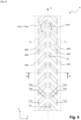
- FIG. 3 represents in a bottom view the central part 48 of the core according to the first embodiment of the invention. It can be seen the left lateral edge 42G, the right lateral edge 42D and the central core 44. All three are oriented along the longitudinal axis of the core “X”.
- the left lateral edge 42G, respectively, the right lateral edge 42D is connected to the central core by left fins 46G, respectively by right fins 46D.
- a left recess 45G, respectively right 45D is provided between two adjacent left fins 46G, respectively between two adjacent right fins 46D.
- the base of each of the recesses has the shape of a parallelogram.
- the top of the recesses also has the shape of a parallelogram whose dimensions are slightly smaller due to the fact that the walls of the fins, of the central core, of the left lateral edge, respectively of the right lateral edge are not strictly vertical, but present an angle of a few degrees, the role of which we will see later.
- the left fins 46G are all oriented in a direction T G which makes an angle ⁇ 46G with the longitudinal axis X of the ski.
- the right fins 46D are all oriented according to a direction T D which makes an angle ⁇ 46D with the longitudinal axis X of the ski.
- the angles ⁇ 46G and ⁇ 46D are equal in value but opposite with respect to the longitudinal axis X of the ski.
- These angles ⁇ 46G and ⁇ 46D must be different from the right angle (90°) or at least not approach it.
- An angle ⁇ 46G , ⁇ 46D between 5° and 85° may be chosen.
- a value between 30° and 60° will be chosen.
- the angle ⁇ 46G , ⁇ 46D is substantially equal to 45°.
- the width " L 42G” of the left side edge 42G, the width “ L 42D “ of the right side edge, the width of the central core “ L 44 " and the width " L 46G , L 46D “ of the fins have values between two and eight millimeters. It should be noted that these are width measurements made at the base of these different elements in a transverse direction perpendicular to their greatest length. For the left and right fins, the measurement is made in a direction perpendicular to the direction T G , respectively T D. In this case, the widths " L 42G “, “L 42D “, “L 44 “ and “ L 46G , L 46D " are substantially equal to four millimeters.
- the core 4 is, in its entirety, preferably made by injection of PU foam.
- a PU with a density of between 250 and 300 kg/m 3 is chosen.
- the core 4 whose length is 1900 mm, has a mass of 217 g. This mass is to be compared to the mass of a solid core, that is to say without recess, having exactly the same external dimensions (length, width, thickness curve) and made of the same material, which is 297 g.
- the particular geometry of the core of the invention allows a weight saving of 27% compared to the prior art. In relation to the total weight of the ski, this represents a weight saving of approximately 12%.
- other materials and other embodiments are conceivable within the framework of the invention such as, for example, machining or 3D printing.
- the distance “ L 45G , L 45D” between two adjacent fins, and measured at the base of the fins, is between two and ten millimeters.
- L 45G , L 45D has a value of approximately seven millimeters. This distance corresponds to the width of a 45G, 45D recess. This is a preferential value in that it optimizes the weight gain of the core while limiting the loss of rigidity of the latter.
- FIG. 4 represents the sectional view IV-IV of the core. It should also be noted that this sectional view is not made according to a single plane but according to a succession of planes, which is materialized by the line IV-IV at the Figure 3 .
- the shape of the recesses 45G, 45D is essentially that of a truncated pyramid whose base would be a parallelogram. Indeed, these recesses 45G, 45D have vertical walls 421G, 421D, 441G, 441D, 461G and 461D respectively leaning against the left lateral flank 42G, the right lateral flank 42D, the central core 44, the left fins 46G and the right fins 46D, making an angle “ ⁇ ” with the vertical axis Z. This angle is between 2° and 10° and preferably equal to 4°.
- the particular geometry of the core according to the invention makes it possible to optimize the manufacture of a ski.
- the core is not only light, while guaranteeing excellent rigidity, but it is also easier to produce by injection.
- the numerous recesses lighten the core and the fins act as structural ribs which prevent the lateral edges from coming together with the central core.
- the inclination of the fins facilitates the flow of the material and thus the uniform filling of the mold. This improvement is particularly significant when injecting the core from an injection point PI positioned at one end of the core (front or rear). It turns out that the injection is better when the inclination ⁇ 46G , ⁇ 46D of the fins is between 30° and 60°.
- the sizing of the fins, the central core and the edges with a substantially constant thickness also contributes to improving the injection.
- the inclination ⁇ of the walls delimiting the recesses allows a solution by injection with simple mold dies thanks to this draft.
- FIG. 5 represents in a bottom view a core 4 according to a second embodiment of the invention very close to the first embodiment.
- the angle ⁇ 46G , ⁇ 46D is between 95° and 175°.
- a value between 120° and 150° will be chosen.
- the angle ⁇ 46G , ⁇ 46D is substantially equal to 135°.
- the other characteristics and benefits are similar to the first embodiment.
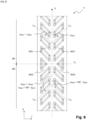
- FIG. 6 represents a bottom view of a core 4 according to a third embodiment of the invention. This is a partial view in which only the central part is shown. Many features of this third embodiment are identical to those of the first embodiment and will not be described again in these lines. These include in particular the respective thicknesses of the lateral edges, the central core, the fins and the upper plate.
- the core 4 has a front part 481 and a rear part 482, separated from each other at a transverse axis “ YS ”.
- the YS axis constitutes an axis of symmetry for the arrangement of the fins and the recesses which separate them from each other.
- the left fins 46G1 make an angle ⁇ 46G1 with the longitudinal axis X of the ski, while the right fins 46D1 make an angle ⁇ 46D1 with the same longitudinal axis X of the ski.
- These angles ⁇ 46G1 and ⁇ 46D1 are between 5° and 85°, preferably between 30° and 60°.
- the left fins 46G1 and the right fins 46D1 are arranged symmetrically with respect to the longitudinal axis X of the ski.
- the angle ⁇ 46G1 is equal to the angle ⁇ 46D1 .
- the left fins 46G2 make an angle ⁇ 46G2 complementary to the angle ⁇ 46G1 , that is to say, of a value equal to 180°- ⁇ 46G1
- the right fins 46D2 make an angle ⁇ 46D2 complementary to the angle ⁇ 46D1 , that is to say, of a value equal to 180°- ⁇ 46D1 .
- angles ⁇ 46G2 and ⁇ 46D2 are between 95° and 175°, preferably between 120° and 150°.
- the left fins 46G2 and the right fins 46D2 are arranged symmetrically with respect to the longitudinal axis X of the ski.
- the angle ⁇ 46G2 is equal to the angle ⁇ 46D2 .
- the angles ⁇ 46G1 and ⁇ 46D1 are equal to 45° and the angles ⁇ 46G2 and ⁇ 46D2 are equal to 135°.
- left fins 46G2 and the right fins 46D2 of the rear part 482 are arranged in symmetry respectively with the left fins 46G1 and the right fins 46D1 of the front part 481 with respect to the transverse axis Ys.
- the axis of symmetry Ys is substantially positioned longitudinally in line with the metatarsal area of a cross-country boot engaged with a binding integral with the ski, when the skier is in the support phase on the ski.
- a positioning ensures a better distribution of the thrust forces and therefore better propulsion. A better balance of movement of the skis is obtained.
- FIG. 7 shows a cross-sectional view of a core 4 according to a fourth embodiment of the invention.
- the core is in this embodiment made up of two parts 401, 402.
- the first 401 of these parts is almost identical to the core of the first embodiment of the invention and shown in figures 2 to 4 .
- it has recesses 45G, 45D regularly arranged in zone 48 (cf. fig. 2 ).
- Said zone 48 comprising a left lateral edge 42G, a right lateral edge 42D and a central core 44.
- the left lateral edge 42G, respectively the right lateral edge 42D is connected to the central core 44 by means of left fin 46G, respectively right fin 46D.
- This first core part differs from the core described with reference to figures 2 to 4 in that a recess 491 is provided at its base.
- the recess 491 extends longitudinally over the entire length of the zone 48 and transversely over a width slightly wider than the recesses 45G, 45D.
- the recess 491 receives a plate 49, which plate constitutes the second part 402 of the core 4.
- the plate 49 is located under the central core 44, the right 46G and left 46D fins and a part of the lateral edges 42G, 42D.
- the plate 49 and the recess 491 have perfectly complementary shapes so that once in place, the plate 49 completely closes the recesses 45G, 45D of the zone 48. In other words, the plate 49 is arranged under the first core part so as to obstruct the recesses.
- the plate 49 can be made of a material similar to that of the rest of the core 4, such as PU (polyurethane) or another material such as PET (polyethylene terephthalate). Since the plate 49 has a constant thickness, it can be prepared by cutting a panel to the desired dimensions.
- the presence of the plate 49 prevents any deformation at the level of the recesses 45G, 45D of the lower reinforcement 3 and the sliding sole 5. Indeed, the risk of seeing the lower reinforcement 3 and the sliding sole 5 sink slightly with regard to the recesses 45G, 45D is completely eliminated. The flatness of the sliding surface of the ski is therefore perfectly ensured.
- FIG. 8 schematically illustrates other embodiments of the invention. For simplicity, only the respective axes of the central core 44, the left side edge 42G, the right side edge 42D and the left 46G and right 46D fins are shown. It should be understood that the cores -a-, -b-, -c- and -d- are, with respect to their other characteristics, similar to the cores previously described.
- Embodiment -a- is a core for which the angle ⁇ 46G that the axis of the left fin 46G makes with the longitudinal axis of the core is relatively large, approximately 75°. This increases the transverse crushing rigidity of the core.
- Embodiment -b- is a core for which the angle ⁇ 46G that the axis of the left fin 46G makes with the longitudinal axis of the core is much smaller, of the order of 40°. This configuration will be preferred in the case where the material chosen to inject the core is very viscous.
- Embodiment -c- is a core in which the spacing between the fins is variable. In this case, it increases as one moves away from the central portion, longitudinally speaking.
- Several distinct configurations are possible for embodiment -c-.
- the fins 46G, 46D maintain a constant width.
- the recesses 45G, 45D have more and more amplitude, so that, overall, the portions of the core far from the center have a lower density than those in the center.
- the width of the fins 46G, 46D increases as one moves away from the center, while the amplitude of the recesses 45G, 45D remains constant over the entire length.
- the apparent density of the portions of the core far from the center is relatively greater than the apparent density of the center.
- All intermediate configurations between the -c1- and -c2- configuration, with for example, a concomitant increase in the thickness of the fins and the amplitude of the recesses are also conceivable.
- Embodiment -d- is a core in which the angle ⁇ 46G , ⁇ 46D made by the fins 46G, 46D is longitudinally variable.
- the left fins 46G1 make an angle ⁇ 46G1 of between 5° and 85° with the longitudinal axis while in the rear part 482, the angle ⁇ 46G2 made by the left fins 46G2 is between 95° and 175°.
- the angle is substantially equal to 70° and it increases as one moves away from the center.
- the variation of the angle ⁇ 46G is progressive, the angle ⁇ 46G is approximately 35° at its maximum.
- the right fins 46D1, 46D2 follow a symmetrical pattern to the left fins 46G1, 46G2 relative to the longitudinal axis of the ski.
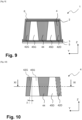
- THE figures 9 to 11 illustrate a fifth embodiment close to the third embodiment of the Figure 6 with the difference that the recesses 45G and 45D are transverse over the entire height of the core 4. These recesses 45G, 45D are not closed by a part of the upper plate 41.
- the central zone 48 in which the recesses 45G, 45D are located, is divided into several sections, four of which are visible on the Figure 11 .
- a plurality of recesses 45G or 45D are present and they are arranged substantially parallel to each other.
- the particular arrangement of the sections is made according to a double symmetry.
- the symmetry along the longitudinal axis has the consequence that the arrangement of the recesses respects a symmetry with respect to the medial plane of the core.
- This plane is the vertical plane oriented along the longitudinal axis X.
- the symmetry along the transverse axis Ys has the consequence that the arrangement of the recesses respects a symmetry with respect to a transverse plane, which is perpendicular to the medial plane.
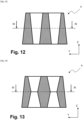
- THE figures 12 to 15 show cross-sections of cores according to four other embodiments of the invention. For these different embodiments of the invention, only the cross-section will be shown, because the horizontal section XI-XI is identical to that of the fifth embodiment of the invention shown in Figure 11 .
- the sixth embodiment shown in the Figure 12 differs from the fifth embodiment by the value of the angle “ ⁇ ”. In fact, in this configuration, it is the bases of the recesses which are narrower than their top.
- FIG. 13 shows a cross-section of a core according to a seventh embodiment of the invention.
- the shape of the recesses is different from that of the two previous embodiments. In fact, the upper part of the recesses is flared upwards and the lower part is flared downwards.
- FIG. 14 shows a cross-section of a core according to an eighth embodiment of the invention.
- the recesses are not through and the lower part of the core constitutes a plate.
- Such a configuration makes it possible to avoid hollow deformations of the sliding base. Indeed, if a core conforming to the configurations of the fifth, sixth and seventh embodiments is used with a lower reinforcement which does not have sufficient rigidity, or if the lower parts of the through recesses of these embodiments have circumferences which are too large, there is a risk of hollows forming on the sliding base with regard to the recesses.
- FIG. 15 shows a cross-section of a core according to a ninth embodiment of the invention.
- the core is in this embodiment made up of two parts 401, 402.
- the first 401 of these parts is almost identical to the core of the eighth embodiment of the invention and shown in Figure 14 and is distinguished therefrom in that a recess 491 is provided in its upper part.
- the recess 491 extends longitudinally over the entire length of the central zone 48 and transversely over a width slightly wider than the recesses 45G, 45D.
- the recess 491 receives a plate 49, which plate constitutes the second part 402 of the core. When the ski is in the position of use, the plate 49 is located on the central core 44, the right 46D and left 46G fins and a part of the lateral edges 42G, 42D.
- the plate 49 and the recess 491 have perfectly complementary shapes so that once in place, the plate 49 completely closes the recesses 45G, 45D of the zone 48.
- the plate 49 can be made of a material similar to that of the rest of the core 4, such as PU (polyurethane) or even of a material such as PET (polyethylene terephthalate). To the extent that the plate 49 has a constant thickness, it can be prepared by cutting, to the desired dimensions, a panel.
- the presence of the plate 49 prevents any deformation, at the level of the recesses 45G, 45D, of the upper reinforcement 2 and of the top layer 6.
- the plate 49 also ensures better anchoring of the ski binding device which is provided to connect the boot to the ski.
- THE figures 16 to 18 show a tenth embodiment of the invention which, like the ninth embodiment, takes up the idea of a core made in two parts; an upper part 401 and a lower part 402.
- the lower part 402 is only present in the central zone 48.
- the upper part 401 is broken down into an upper plate 41, a left lateral edge 42G and a right lateral edge 42D.
- These three elements surround a cavity 4011.
- the upper part 401 is present and constitutes the entire core.
- the lower part 402 is, for its part, made up of a horizontal plate 49 from which a central core 44 and a plurality of left 46G and right 46D fins project vertically, delimiting recesses 45G, 45D.
- the central zone of the core is divided into several sections inside which the left or right fins are arranged in parallel.
- figure 18 illustrates the section of the lower part of the core according to XVII-XVII of the figure 16 .
- the left fins 46G are all oriented in a direction that makes an angle ⁇ 46G with the longitudinal axis X of the ski.
- the right fins 46D are all oriented in a direction that makes an angle ⁇ 46D with the longitudinal axis X of the ski, of the same absolute value as the angle ⁇ 46G .
- the angle ⁇ 46G , ⁇ 46D must be different from the right angle (90°) or at least not approach it.
- the angle ⁇ 46G , ⁇ 46D is substantially equal to 45°.
- FIG. 17 shows the core of the tenth embodiment of the invention, once the two parts 401, 402 which constitute it are assembled with each other.
- the core thus obtained has a structure which combines excellent rigidity and lightness.
- the upper part 401 and the plate 49 of the lower part 402 constitute a closed box, which is, moreover, supported by the central core 44 and the left 46G and right 46D fins.
- a plurality of recesses 45G, 45D are created which lighten the structure.
- Each of the two parts 401, 402 can be made of the same material, for example polyurethane (see above the description associated with the first embodiment of the invention).
- two different materials can also be chosen for the manufacture of the two parts. Injection molding is a particularly suitable method for producing the two parts, but it is not the only one, as any other production method can be used, such as 3D printing.
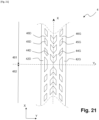
- FIG 21 shows a cross-sectional view of the core 4 at the central zone 48. This comprises, as in some of the previous embodiments, a left side edge 42G and a right side edge 42D and an upper plate 41. However, it comprises two central cores 44G and 44D and not just one like all the previous embodiments.
- figure 21 which represents in partial bottom view, the central area 48, shows how, in each of the sections which compose it, the recesses 45G, 45D are arranged parallel to each other.
- figure 19 shows a cross-section of a ski equipped with such a core....
- the particular geometry of the cores designed according to the invention makes it possible to optimize the manufacture of a ski.
- the core is not only light, while guaranteeing excellent rigidity.
- it can be easier to produce by injection.
- the numerous recesses lighten the core and the fins act as structural ribs which prevent the lateral edges from coming closer to the central core.
- the inclination of the fins facilitates the flow of material and thus the uniform filling of the mold.
Landscapes
- Engineering & Computer Science (AREA)
- Mechanical Engineering (AREA)
- Injection Moulding Of Plastics Or The Like (AREA)
- Road Paving Structures (AREA)
- Moulds For Moulding Plastics Or The Like (AREA)
Claims (15)
- Ski (1), der einen Kern (4) beinhaltet, der Folgendes umfasst:- eine linke Seitenwange (42G),- eine rechte Seitenwange (42D) und- mindestens ein Mittelstück (44, 44G, 442D), das zwischen den zwei Seitenwangen platziert ist,wobei sich die Seitenwangen und das mindestens eine Mittelstück entlang einer Längsachse erstrecken, die im Wesentlichen parallel zu der Längsachse X des Skis ist, wobei der Kern Folgendes beinhaltet:- eine Vielzahl von linken Rippen (46G), die zwischen mindestens einem Mittelstück (44, 44G) und der linken Seitenwange (42G) angeordnet ist, wobei jede linke Rippe mit der Längsachse X einen Winkel zwischen 5° und 85° oder zwischen 95° und 175° bildet,- eine Vielzahl von rechten Rippen (46D), die zwischen mindestens einem Mittelstück (44, 44D) und der rechten Seitenwange (42D) angeordnet ist, wobei jede rechte Rippe mit der Längsachse X einen Winkel zwischen 5° und 85° oder zwischen 95° und 175° bildet,und dass der Kern eine Vielzahl von Aussparungen (45G, 45D) beinhaltet, wobei jede Aussparung durch zwei nebeneinanderliegende Rippen (46G, 46D) begrenzt wird, wobei jede Aussparung nicht durchgehend ist oder die gesamte Höhe des Kerns durchquert, dadurch gekennzeichnet, dass die Aussparungen (45G, 46D) entlang der Längsrichtung in dem Großteil eines mittleren Abschnitts (48) des Kerns angeordnet sind.
- Ski (1) nach Anspruch 1, dadurch gekennzeichnet, dass weder in dem vorderen Bereich (4AV) noch in dem hinteren Bereich (4AR) des Kerns (4) eine Aussparung (45G, 46D) eingerichtet ist.
- Ski (1) nach einem der vorhergehenden Ansprüche, dadurch gekennzeichnet, dass der Ski in seiner Dicke aus einer Folge von fünf Elementen vom Boden aus besteht, nämlich einer Lauffläche (5), einer unteren Verstärkung (3), dem Kern (4), einer oberen Verstärkung (2) und einer Deckschicht (6), wobei sich mindestens die linke (42G) und die rechte (42D) Seitenwange über die gesamte Höhe des Kerns erstrecken.
- Ski (1) nach einem der vorhergehenden Ansprüche, dadurch gekennzeichnet, dass die Höhe (H4) des Kerns (4) in dem mit Aussparungen versehenen Bereich des Kerns immer noch mindestens 50 % der Höhe (H1) des Skis (1) entspricht.
- Ski (1) nach einem der vorhergehenden Ansprüche, dadurch gekennzeichnet, dass der Kern eine horizontale obere Tafel (41) umfasst, wobei sich die linke Seitenwange (42G) und die rechte Seitenwange (42D) beide von der linken bzw. rechten Seitenkante der oberen Tafel nach unten erstrecken.
- Ski (1) nach einem der vorhergehenden Ansprüche, dadurch gekennzeichnet, dass der Kern aus zwei zusammengefügten Komponenten (401, 402) besteht, wobei eine der Komponenten die linke und die rechte Seitenwange trägt.
- Ski (1) nach dem vorhergehenden Anspruch, dadurch gekennzeichnet, dass eine der Komponenten des Kerns eine Platte (49) ist, um die Aussparungen (45G, 45D) zu verschließen.
- Ski (1) nach dem vorhergehenden Anspruch, dadurch gekennzeichnet, dass die Platte (49) das oder die Mittelstücke (44, 44G, 44D) und/oder die Rippen (46G, 46D) trägt.
- Ski (1) nach einem der vorhergehenden Ansprüche, dadurch gekennzeichnet, dass die linken Rippen und die rechten Rippen mit Bezug auf die Längsachse X des Skis symmetrisch angeordnet sind.
- Ski (1) nach einem der vorhergehenden Ansprüche, dadurch gekennzeichnet, dass- in einem Vorderabschnitt (481) des Kerns die linken Rippen mit der Längsachse X des Skis einen Winkel zwischen 5° und 85° bilden und die rechten Rippen mit der Längsachse X des Skis einen Winkel zwischen 95° und 175° bilden und- in einem Hinterabschnitt (482) des Kerns die linken Rippen mit der Längsachse X des Skis einen Winkel zwischen 95° und 175° bilden und die rechten Rippen mit der Längsachse X des Skis einen Winkel zwischen 5° und 85° bildenoder umgekehrt.
- Ski (1) nach einem der vorhergehenden Ansprüche, dadurch gekennzeichnet, dass der Kern mittels Spritzguss hergestellt ist.
- Ski (1) nach einem der vorhergehenden Ansprüche, dadurch gekennzeichnet, dass die Rippen so eingerichtet sind, dass ihre Breite im Wesentlichen dem Raum entspricht, der zwei nebeneinanderliegende Rippen trennt.
- Ski nach einem der vorhergehenden Ansprüche, dadurch gekennzeichnet, dass die Basis der linken Seitenwange (42G) bzw. der rechten Seitenwange (42D) bzw. eines Mittelstücks (44) bzw. der linken (46G) und rechten (46D) Rippen eine Breite von L42G bzw. L42D bzw. L44 bzw. L46G und L46D aufweist, die im Wesentlichen gleich ist und zwischen zwei und acht Millimeter beträgt.
- Ski (1) nach einem der vorhergehenden Ansprüche, dadurch gekennzeichnet, dass die linken Rippen bzw. die rechten Rippen des Kerns nicht alle den gleichen Winkel mit der Längsachse X des Skis bilden.
- Ski (1) nach einem der vorhergehenden Ansprüche, dadurch gekennzeichnet, dass der Kern zwei Mittelstücke (44G, 44D) beinhaltet.
Applications Claiming Priority (2)
| Application Number | Priority Date | Filing Date | Title |
|---|---|---|---|
| FR2111643A FR3128647B1 (fr) | 2021-11-03 | 2021-11-03 | Noyau pour ski et ski incluant un tel noyau |
| FR2206009A FR3136681B1 (fr) | 2022-06-20 | 2022-06-20 | Noyau pour ski et ski incluant un tel noyau |
Publications (2)
| Publication Number | Publication Date |
|---|---|
| EP4176945A1 EP4176945A1 (de) | 2023-05-10 |
| EP4176945B1 true EP4176945B1 (de) | 2025-04-30 |
Family
ID=83900030
Family Applications (1)
| Application Number | Title | Priority Date | Filing Date |
|---|---|---|---|
| EP22204306.9A Active EP4176945B1 (de) | 2021-11-03 | 2022-10-28 | Skikern und ski mit einem solchen kern |
Country Status (4)
| Country | Link |
|---|---|
| US (1) | US12303770B2 (de) |
| EP (1) | EP4176945B1 (de) |
| CN (1) | CN116059617A (de) |
| CA (1) | CA3180089A1 (de) |
Family Cites Families (8)
| Publication number | Priority date | Publication date | Assignee | Title |
|---|---|---|---|---|
| ATA189183A (de) * | 1983-05-25 | 1984-12-15 | Rohrmoser Alois Skifabrik | Ski |
| ATA186687A (de) * | 1987-07-23 | 1989-08-15 | Rohrmoser Alois Skifabrik | Verfahren zur herstellung von skiern mit unterschiedlichen schwingungsdaempfungen sowie nach diesem verfahren hergestellte skier |
| US5848800A (en) * | 1993-06-09 | 1998-12-15 | Kastle Aktiengesellschaft | Ski |
| DE19502039A1 (de) * | 1995-01-12 | 1996-07-18 | Germina Sport Equip Gmbh | Verfahren zur Herstellung eines Hohlskis oder eines hohlskiähnlichen Sportgerätes und danach hergestellter Hohlski oder hohlskiähnliches Sportgerät |
| AT410517B (de) * | 2001-07-10 | 2003-05-26 | Fischer Gmbh | Leichtbaukern und verfahren zur herstellung desselben |
| WO2004060503A1 (de) * | 2003-01-07 | 2004-07-22 | Johann Berger | Mehrschchten-ski und verfahren zu seiner herstellung |
| AT13391U1 (de) | 2012-12-20 | 2013-12-15 | Fischer Sports Gmbh | Ski, insbesondere Tourenski |
| FR3058899B1 (fr) * | 2016-11-18 | 2020-01-03 | Skis Rossignol | Element de structure de planche de glisse |
-
2022
- 2022-10-26 CA CA3180089A patent/CA3180089A1/fr active Pending
- 2022-10-28 EP EP22204306.9A patent/EP4176945B1/de active Active
- 2022-11-02 US US17/979,461 patent/US12303770B2/en active Active
- 2022-11-03 CN CN202211368298.2A patent/CN116059617A/zh active Pending
Also Published As
| Publication number | Publication date |
|---|---|
| CN116059617A (zh) | 2023-05-05 |
| US20230136845A1 (en) | 2023-05-04 |
| US12303770B2 (en) | 2025-05-20 |
| EP4176945A1 (de) | 2023-05-10 |
| CA3180089A1 (fr) | 2023-05-03 |
Similar Documents
| Publication | Publication Date | Title |
|---|---|---|
| EP0577947B1 (de) | Ski mit einer Rippe und einer Stützvorrichtung | |
| EP0543743B2 (de) | Ski mit nicht rechteckigem Schnitt | |
| EP0465794B1 (de) | Ski mit gerippter Oberfläche | |
| EP1902758B1 (de) | Snowglideboard with a longitudinal slot on at least one end | |
| FR2704440A1 (fr) | Planche de glisse, notamment surf de neige. | |
| FR2775437A1 (fr) | Dispositif interface entre un ski et des elements de retenue d'une chaussure sur le ski | |
| FR2866315A1 (fr) | Rail de siege pour cabine d'aeronef et procede de fabrication d'un tel rail | |
| FR2618077A1 (fr) | Ski a face superieure convergente | |
| EP0546309A1 (de) | Ski mit Oberfläche mit veränderlicher Breite | |
| FR2618079A1 (fr) | Ski a face superieure mixte | |
| EP0628327B1 (de) | Alpinski mit verbessertem Profil | |
| EP0855201B1 (de) | Gleitbrett | |
| FR3043646A1 (fr) | Ensemble structurel pour fuselage d'aeronef a double courbure comprenant des cadres a orientation optimisee | |
| EP4176945B1 (de) | Skikern und ski mit einem solchen kern | |
| EP3231489B1 (de) | Gleitbrett, befestigungsvorrichtung für schuh zur ausstattung eines solchen gleitbretts, und snowboardausrüstung, die dieses gleitbrett und diese befestigungsvorrichtung umfasst | |
| FR3136681A1 (fr) | Noyau pour ski et ski incluant un tel noyau | |
| FR3128647A1 (fr) | Noyau pour ski et ski incluant un tel noyau | |
| EP3106212B1 (de) | Gleitbrett | |
| EP2689816B1 (de) | Snowboard | |
| EP1908501A1 (de) | Snowboard oder Skateboard mit einem Spitzenschoner | |
| EP3251730B1 (de) | Ski mit gewichtsreduziertem kern | |
| EP2921210B1 (de) | Snowboard und herstellungsmethode eines solchen snowboards | |
| EP0661086A1 (de) | Ski | |
| EP3981481B1 (de) | Strukturelement eines gleitbretts und herstellungsverfahren | |
| EP1234603A1 (de) | Herstellungsverfahrung eines Gleitbrett,Verstärkung und ein Gleitbrett mit solch einer Verstärkung |
Legal Events
| Date | Code | Title | Description |
|---|---|---|---|
| PUAI | Public reference made under article 153(3) epc to a published international application that has entered the european phase |
Free format text: ORIGINAL CODE: 0009012 |
|
| STAA | Information on the status of an ep patent application or granted ep patent |
Free format text: STATUS: THE APPLICATION HAS BEEN PUBLISHED |
|
| AK | Designated contracting states |
Kind code of ref document: A1 Designated state(s): AL AT BE BG CH CY CZ DE DK EE ES FI FR GB GR HR HU IE IS IT LI LT LU LV MC ME MK MT NL NO PL PT RO RS SE SI SK SM TR |
|
| STAA | Information on the status of an ep patent application or granted ep patent |
Free format text: STATUS: REQUEST FOR EXAMINATION WAS MADE |
|
| 17P | Request for examination filed |
Effective date: 20231115 |
|
| GRAP | Despatch of communication of intention to grant a patent |
Free format text: ORIGINAL CODE: EPIDOSNIGR1 |
|
| STAA | Information on the status of an ep patent application or granted ep patent |
Free format text: STATUS: GRANT OF PATENT IS INTENDED |
|
| INTG | Intention to grant announced |
Effective date: 20241210 |
|
| RAP3 | Party data changed (applicant data changed or rights of an application transferred) |
Owner name: SALOMON S.A.S. |
|
| GRAS | Grant fee paid |
Free format text: ORIGINAL CODE: EPIDOSNIGR3 |
|
| GRAA | (expected) grant |
Free format text: ORIGINAL CODE: 0009210 |
|
| STAA | Information on the status of an ep patent application or granted ep patent |
Free format text: STATUS: THE PATENT HAS BEEN GRANTED |
|
| AK | Designated contracting states |
Kind code of ref document: B1 Designated state(s): AL AT BE BG CH CY CZ DE DK EE ES FI FR GB GR HR HU IE IS IT LI LT LU LV MC ME MK MT NL NO PL PT RO RS SE SI SK SM TR |
|
| REG | Reference to a national code |
Ref country code: CH Ref legal event code: EP Ref country code: GB Ref legal event code: FG4D Free format text: NOT ENGLISH |
|
| REG | Reference to a national code |
Ref country code: DE Ref legal event code: R096 Ref document number: 602022013847 Country of ref document: DE |
|
| REG | Reference to a national code |
Ref country code: IE Ref legal event code: FG4D Free format text: LANGUAGE OF EP DOCUMENT: FRENCH |
|
| REG | Reference to a national code |
Ref country code: SE Ref legal event code: TRGR |
|
| REG | Reference to a national code |
Ref country code: NL Ref legal event code: MP Effective date: 20250430 |
|
| REG | Reference to a national code |
Ref country code: AT Ref legal event code: MK05 Ref document number: 1789525 Country of ref document: AT Kind code of ref document: T Effective date: 20250430 |
|
| PG25 | Lapsed in a contracting state [announced via postgrant information from national office to epo] |
Ref country code: PT Free format text: LAPSE BECAUSE OF FAILURE TO SUBMIT A TRANSLATION OF THE DESCRIPTION OR TO PAY THE FEE WITHIN THE PRESCRIBED TIME-LIMIT Effective date: 20250901 Ref country code: ES Free format text: LAPSE BECAUSE OF FAILURE TO SUBMIT A TRANSLATION OF THE DESCRIPTION OR TO PAY THE FEE WITHIN THE PRESCRIBED TIME-LIMIT Effective date: 20250430 Ref country code: FI Free format text: LAPSE BECAUSE OF FAILURE TO SUBMIT A TRANSLATION OF THE DESCRIPTION OR TO PAY THE FEE WITHIN THE PRESCRIBED TIME-LIMIT Effective date: 20250430 |
|
| REG | Reference to a national code |
Ref country code: LT Ref legal event code: MG9D |
|
| PG25 | Lapsed in a contracting state [announced via postgrant information from national office to epo] |
Ref country code: GR Free format text: LAPSE BECAUSE OF FAILURE TO SUBMIT A TRANSLATION OF THE DESCRIPTION OR TO PAY THE FEE WITHIN THE PRESCRIBED TIME-LIMIT Effective date: 20250731 |
|
| PGFP | Annual fee paid to national office [announced via postgrant information from national office to epo] |
Ref country code: NO Payment date: 20250925 Year of fee payment: 4 |
|
| PG25 | Lapsed in a contracting state [announced via postgrant information from national office to epo] |
Ref country code: PL Free format text: LAPSE BECAUSE OF FAILURE TO SUBMIT A TRANSLATION OF THE DESCRIPTION OR TO PAY THE FEE WITHIN THE PRESCRIBED TIME-LIMIT Effective date: 20250430 Ref country code: NL Free format text: LAPSE BECAUSE OF FAILURE TO SUBMIT A TRANSLATION OF THE DESCRIPTION OR TO PAY THE FEE WITHIN THE PRESCRIBED TIME-LIMIT Effective date: 20250430 |
|
| PG25 | Lapsed in a contracting state [announced via postgrant information from national office to epo] |
Ref country code: BG Free format text: LAPSE BECAUSE OF FAILURE TO SUBMIT A TRANSLATION OF THE DESCRIPTION OR TO PAY THE FEE WITHIN THE PRESCRIBED TIME-LIMIT Effective date: 20250430 |
|
| PG25 | Lapsed in a contracting state [announced via postgrant information from national office to epo] |
Ref country code: HR Free format text: LAPSE BECAUSE OF FAILURE TO SUBMIT A TRANSLATION OF THE DESCRIPTION OR TO PAY THE FEE WITHIN THE PRESCRIBED TIME-LIMIT Effective date: 20250430 |
|
| PG25 | Lapsed in a contracting state [announced via postgrant information from national office to epo] |
Ref country code: AT Free format text: LAPSE BECAUSE OF FAILURE TO SUBMIT A TRANSLATION OF THE DESCRIPTION OR TO PAY THE FEE WITHIN THE PRESCRIBED TIME-LIMIT Effective date: 20250430 |
|
| PGFP | Annual fee paid to national office [announced via postgrant information from national office to epo] |
Ref country code: FR Payment date: 20250923 Year of fee payment: 4 |
|
| PGFP | Annual fee paid to national office [announced via postgrant information from national office to epo] |
Ref country code: SE Payment date: 20250923 Year of fee payment: 4 |
|
| PG25 | Lapsed in a contracting state [announced via postgrant information from national office to epo] |
Ref country code: RS Free format text: LAPSE BECAUSE OF FAILURE TO SUBMIT A TRANSLATION OF THE DESCRIPTION OR TO PAY THE FEE WITHIN THE PRESCRIBED TIME-LIMIT Effective date: 20250731 |
|
| PG25 | Lapsed in a contracting state [announced via postgrant information from national office to epo] |
Ref country code: IS Free format text: LAPSE BECAUSE OF FAILURE TO SUBMIT A TRANSLATION OF THE DESCRIPTION OR TO PAY THE FEE WITHIN THE PRESCRIBED TIME-LIMIT Effective date: 20250830 |
|
| PG25 | Lapsed in a contracting state [announced via postgrant information from national office to epo] |
Ref country code: LV Free format text: LAPSE BECAUSE OF FAILURE TO SUBMIT A TRANSLATION OF THE DESCRIPTION OR TO PAY THE FEE WITHIN THE PRESCRIBED TIME-LIMIT Effective date: 20250430 |