EP4174613B1 - Verfahren und system zur autonomiesteuerung für eine batteriebetriebene fahrzeugsflotte - Google Patents
Verfahren und system zur autonomiesteuerung für eine batteriebetriebene fahrzeugsflotte Download PDFInfo
- Publication number
- EP4174613B1 EP4174613B1 EP21306484.3A EP21306484A EP4174613B1 EP 4174613 B1 EP4174613 B1 EP 4174613B1 EP 21306484 A EP21306484 A EP 21306484A EP 4174613 B1 EP4174613 B1 EP 4174613B1
- Authority
- EP
- European Patent Office
- Prior art keywords
- vehicle
- cloning
- station
- mission
- autonomy
- Prior art date
- Legal status (The legal status is an assumption and is not a legal conclusion. Google has not performed a legal analysis and makes no representation as to the accuracy of the status listed.)
- Active
Links
Images

Classifications
-
- G—PHYSICS
- G05—CONTROLLING; REGULATING
- G05D—SYSTEMS FOR CONTROLLING OR REGULATING NON-ELECTRIC VARIABLES
- G05D1/00—Control of position, course, altitude or attitude of land, water, air or space vehicles, e.g. using automatic pilots
- G05D1/10—Simultaneous control of position or course in three dimensions
- G05D1/101—Simultaneous control of position or course in three dimensions specially adapted for aircraft
- G05D1/104—Simultaneous control of position or course in three dimensions specially adapted for aircraft involving a plurality of aircrafts, e.g. formation flying
-
- G—PHYSICS
- G08—SIGNALLING
- G08G—TRAFFIC CONTROL SYSTEMS
- G08G5/00—Traffic control systems for aircraft
- G08G5/20—Arrangements for acquiring, generating, sharing or displaying traffic information
- G08G5/26—Transmission of traffic-related information between aircraft and ground stations
-
- G—PHYSICS
- G08—SIGNALLING
- G08G—TRAFFIC CONTROL SYSTEMS
- G08G5/00—Traffic control systems for aircraft
- G08G5/50—Navigation or guidance aids
- G08G5/53—Navigation or guidance aids for cruising
-
- G—PHYSICS
- G08—SIGNALLING
- G08G—TRAFFIC CONTROL SYSTEMS
- G08G5/00—Traffic control systems for aircraft
- G08G5/50—Navigation or guidance aids
- G08G5/55—Navigation or guidance aids for a single aircraft
-
- G—PHYSICS
- G08—SIGNALLING
- G08G—TRAFFIC CONTROL SYSTEMS
- G08G5/00—Traffic control systems for aircraft
- G08G5/50—Navigation or guidance aids
- G08G5/56—Navigation or guidance aids for two or more aircraft
-
- G—PHYSICS
- G08—SIGNALLING
- G08G—TRAFFIC CONTROL SYSTEMS
- G08G5/00—Traffic control systems for aircraft
- G08G5/70—Arrangements for monitoring traffic-related situations or conditions
- G08G5/72—Arrangements for monitoring traffic-related situations or conditions for monitoring traffic
- G08G5/727—Arrangements for monitoring traffic-related situations or conditions for monitoring traffic from a ground station
-
- G—PHYSICS
- G08—SIGNALLING
- G08G—TRAFFIC CONTROL SYSTEMS
- G08G5/00—Traffic control systems for aircraft
- G08G5/50—Navigation or guidance aids
- G08G5/57—Navigation or guidance aids for unmanned aircraft
Definitions
- the present invention relates to a method of managing autonomy for a fleet of vehicles each powered by at least one on-board battery. It also relates to a system implementing such a method.
- the field of the invention is the field of managing the autonomy of a fleet of battery-powered vehicles, in particular when carrying out a mission involving several of said vehicles forming a group of vehicles, also called a "matrix".
- He is also known by CN 110 794 873 A , managing a group of micro-drones that perform a power line inspection task, the method providing for a spare drone to take over from one of the inspection drones when the battery level of that drone is low.
- An aim of the present invention is to remedy at least one of the aforementioned drawbacks.
- Another aim of the present invention is to propose a solution for managing the autonomy of a matrix of several vehicles when carrying out a mission by said matrix of vehicles.
- Another aim of the present invention is to propose a solution for managing the autonomy of a matrix of several vehicles when carrying out a mission by said matrix of vehicles, while allowing mission continuity.
- the method according to the invention proposes to manage the autonomy of a matrix of several vehicles accomplishing a mission, and not of each vehicle by considering it individually and independently of the others. vehicles of the matrix, and independently of the mission accomplished by the matrix.
- the invention proposes to manage the autonomy of the matrix of vehicles by replacing each vehicle whose autonomy becomes insufficient by another vehicle of greater autonomy and which can accomplish the same function as that of this vehicle.
- the other vehicles in the matrix can continue the mission and do not have to be stopped.
- each vehicle whose autonomy decreases is immediately replaced by an identical vehicle so that the mission is carried out with very little, or no, discontinuity.
- mission area a geographical area in which the vehicles of the matrix accomplish the mission.
- This mission area can be a fixed area, or a variable area depending on the mission.
- the mission area can evolve along a predefined trajectory.
- the mission area can be a delimited space, such as a landing strip, a public place, etc.
- At least one vehicle may be a land vehicle, an air vehicle, a marine vehicle, or a battery-powered vehicle.
- At least one vehicle may be a flying drone powered by at least one on-board electric battery.
- the vehicle may be equipped with at least one component specific to the mission to be accomplished, such as for example a camera, a relay antenna, etc.
- the method according to the invention makes it possible to ensure that if the level of autonomy of the vehicle reaches the cloning threshold, then it is always possible for said vehicle to reach a cloning station.
- the cloning threshold is changing and constantly adapts to the current position of the vehicle when the mission is carried out by the matrix.
- the cloning threshold can be fixed.
- the cloning threshold may be chosen to cover the greatest distance between two cloning stations in the mission area. For example, when the mission area is fixed, the cloning threshold may be determined as the range required to cover the distance between two adjacent charging stations that are the furthest apart. In another example, when the mission area is changing along a trajectory, the cloning threshold may be determined as the range required to cover the distance between two adjacent charging stations that are the furthest apart along said trajectory.
- the method according to the invention makes it possible to ensure that if the level of autonomy of said vehicle reaches the cloning threshold, then it is still possible to clone said vehicle by a cloning station.
- the cloned vehicle can leave the cloning station after, or at the time when, the vehicle to be cloned arrives at said cloning station.
- cloning is performed by ensuring that the vehicle to be cloned has arrived at the station. This ensures that this vehicle to be cloned must be cloned at this cloning station, which reduces cloning errors.
- the mission of the vehicle to be cloned can be partially or totally, in particular temporarily, taken over by another vehicle in the matrix.
- This other matrix vehicle may be another matrix vehicle participating in the mission.
- one of the matrix vehicles may increase its transport power to compensate for the absence of the vehicle to be cloned during the cloning step.
- one of the matrix vehicles may increase its signal transmission/reception power to compensate for the absence of the vehicle to be cloned during the cloning step.
- the method according to the invention may comprise a step of recharging the cloned vehicle at the cloning station.
- the cloning station can be equipped with a charging station, wired or wireless, to recharge the cloned vehicle. This makes this vehicle available as a clone vehicle for another vehicle to be cloned, for this mission or for a future mission.
- system according to the invention may comprise, in terms of technical means or configuration, any combination of at least one of the optional characteristics described above with reference to the method according to the invention, and which are not repeated here for the sake of brevity.
- At least one cloning station may comprise a charging station for a cloned vehicle.
- At least one, in particular each, cloning station may comprise at least one radio communication module with each vehicle of the matrix, and preferably with each vehicle of the fleet.
- At least one, in particular each, vehicle may comprise at least one radio communication module with the or each cloning station.
- At least one, in particular each, vehicle may comprise at least one module for measuring its level of autonomy.
- a measurement module may perform a measurement of a remaining charge of an electric battery powering said vehicle.
- the remaining autonomy may correspond to the charge level of the battery, or a distance that the vehicle can travel while participating in the mission of the matrix, etc.
- At least one, in particular each, vehicle may comprise at least one communication module, in particular for transmitting a cloning request to a cloning station.
- the vehicle can measure its autonomy and compare it to a cloning threshold.
- the vehicle can, or even must, issue a cloning request to the nearest station, and in particular the nearest station to come following its trajectory when carrying out the mission.
- each vehicle continuously transmits its battery level to a central unit, possibly with location data and/or trajectory data.
- this central unit that compares the charge level of each vehicle to the cloning threshold and decides whether or not to clone each vehicle, possibly depending on the location of the nearest cloning station.
- FIGURE 1 is a schematic representation of a non-limiting exemplary embodiment of a method according to the invention.
- the method 100 can be used to manage the autonomy of a matrix of vehicles, selected from a fleet of vehicles, and performing a mission in a mission area.
- the vehicle matrix is a matrix of flying drones and the mission accomplished is the surveillance of a landing strip following a given trajectory.
- the matrix is, for example, made up of around ten drones, each with a camera.
- Each drone is equipped with an on-board rechargeable battery whose charge level defines an autonomy based on a flight distance that the drone is able to cover with the remaining charge in the battery. In other words, the more the battery charge decreases, the more the autonomy decreases.
- the drone array moves along a flight path along the landing strip, particularly at a constant speed.
- a cloning threshold is indicated corresponding to a given distance. This distance corresponds to the greatest distance between two cloning stations following the flight trajectory. Thus, when the autonomy of a drone reaches the cloning threshold just after a cloning station, it will be possible to clone it at the next cloning station, without stopping the surveillance mission. Thus, the cloning threshold is identical for each drone.
- the cloning threshold can be variable for each drone.
- Process 100 is performed for each drone in the matrix, individually, in parallel or in turn.
- the method 100 comprises a step 102 of measuring the autonomy of the drone, for example by a module equipping said drone.
- the autonomy of the drone is compared to the cloning threshold associated with this drone.
- Steps 102 and 104 are carried out within each drone, for example by a module provided for this purpose.
- step 102 If the autonomy measured in step 102 is greater than the cloning threshold, the method 100 is terminated, or can be repeated again from step 102. Otherwise, that is to say if the autonomy measured in step 102 is less than or equal to the cloning threshold, a cloning step 106 is performed.
- the cloning step 106 includes a step 108 of identifying the next cloning station. To do this, the drone stores a list of cloning stations, their geographical positions, and can, based on its current position and trajectory, identify the next cloning station.
- the cloning step 106 comprises a step 110 of sending a request to clone the drone whose autonomy has reached the cloning threshold, to the next cloning station identified during step 108.
- the cloning request comprises an identifier of the drone to be cloned, and possibly data relating to equipment necessary to participate in the mission carried out by the matrix.
- a step 114 the drone to be cloned is replaced by the clone drone in the matrix.
- the drone to be cloned leaves the matrix before the clone drone joins the matrix, or before the clone drone leaves the cloning station.
- the mission of the drone to be cloned can be carried out, temporarily, by another drone of the matrix, this other drone being able to be a follower drone or a drone participating in the mission of the matrix.
- the cloned drone is located on the cloning station. Its battery is recharged, for example, by a wireless charging station equipping the cloning station.
- FIGURE 2 is a schematic representation of a non-limiting exemplary embodiment of a vehicle that can be implemented in the present invention.
- the 200 vehicle of the FIGURE 2 can be any type of vehicle: a land vehicle, a marine vehicle, a flying vehicle, etc.
- the vehicle 200 is a driverless vehicle.
- the vehicle 200 can be a flying drone, a car, etc.
- the vehicle 200 comprises at least one on-board battery 202 powering said vehicle 200.
- the battery 202 is preferably rechargeable, wired or wireless.
- the battery 202 may alternatively, or in addition, be replaceable, preferably on the fly.
- the vehicle 200 may further comprise a communication module 206 for communicating with a cloning station, for example by radio wave.
- the vehicle 200 may further comprise at least one piece of equipment 208 used to participate in a mission of the matrix.
- equipment may comprise a camera, a mobile telephone relay antenna, any type of sensor such as for example a UV sensor used for monitoring crops, a temperature sensor, a pollution sensor, etc.
- the vehicle 200 further comprises at least one means 210 allowing said vehicle to move, such as for example blades or wheels or even tracks.
- vehicle 200 may include other components than those described here.
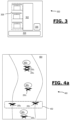
- FIGURE 3 is a schematic representation of a non-limiting exemplary embodiment of a cloning station that can be implemented in the present invention.
- Cloning Station 300 of the FIGURE 3 may be in any form, such as a mast or platform, etc.
- the cloning station 300 is provided in, or in the immediate vicinity of, the mission area in which a matrix of vehicles operates during the performance of a mission.
- the cloning station 300 preferably comprises a charging terminal 302 for recharging the battery of at least one vehicle, for example wirelessly.
- a charging terminal 302 can perform induction charging for example.
- the station 300 includes a communication module 306 for communicating, for example by radio wave, with vehicles and possibly with other cloning stations.
- the station 300 further comprises at least one storage area 308 for one or more vehicles that can be used as a clone vehicle.
- This storage area 308 can for example be coupled to the charging terminal 302 so that the battery of each stored vehicle is recharged while said vehicle is stored.
- the cloning station 300 may include other organs than those described here.
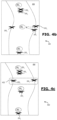
- FIGURES 4a-4c are schematic representations of a non-limiting exemplary embodiment of a system according to the invention.
- the 400 system of FIGURES 4a-4c can implement a method according to the invention, and in particular method 100 of the FIGURE 1 .
- the 400 system includes a fleet of several vehicles. On the FIGURES 4a-4c , only six vehicles 200 1 -200 6 are shown. Of course, the number of vehicles in the vehicle fleet of a system according to the invention is not limited to six.
- each vehicle in the fleet is a flying drone.
- the fleet of vehicles in the system according to the invention may include other types of vehicles than flying drones, such as, for example, land vehicles or marine vehicles, in addition to or instead of the flying drones.
- Each vehicle 200 1 -200 6 in the fleet of the system 400 may be identical or similar to the vehicle 200 of the FIGURE 2 .
- the 400 system of FIGURES 4a-4c comprises three cloning stations 300 1 -300 3 .
- the system 400 may comprise a different number of cloning stations which may be greater than or equal to 1.
- Each cloning station 300 1 -300 3 of the system 400 may be the same or similar to the cloning station 300 of the FIGURE 3 .
- a matrix 402 of two drones is provided to monitor an area to be monitored 404.
- the matrix of vehicles can comprise a different number of vehicles, which can be greater than or equal to 2.
- the mission assigned to the matrix can be different from a surveillance mission, and can for example be a pollution data collection mission.
- Each drone in the matrix moves along a trajectory above the area to be monitored 402.
- the cloning stations 300 1 -300 3 are distributed in, or near, the area to be monitored 404 along the movement trajectories of the drones in the matrix.
- matrix 402 is composed of drones 200 1 -200 2 .
- the autonomy of one of the drones decreases below the cloning threshold.
- the latter then sends a cloning request to the cloning station 300 2 which is the next cloning station on its trajectory.
- the drone 200 1 arrives at the cloning station 300 2 , it is replaced by a drone 200 4 , identical or similar to the drone 200 1 , and located at the cloning station, as shown in the FIGURE 4b .
- Drone 200 4 takes the place of drone 200 1 in matrix 402 so that said matrix 402 is composed of drones 200 2 and 200 4 .
- the mission continues with the new composition of matrix 402, as shown in the FIGURE 4c .
- the 400 system makes it possible to replace a drone whose autonomy becomes low with another drone, while ensuring the continuity of the drone matrix mission.
Landscapes
- Engineering & Computer Science (AREA)
- Aviation & Aerospace Engineering (AREA)
- Physics & Mathematics (AREA)
- General Physics & Mathematics (AREA)
- Radar, Positioning & Navigation (AREA)
- Remote Sensing (AREA)
- Automation & Control Theory (AREA)
- Traffic Control Systems (AREA)
Claims (7)
- Verfahren (100) zum Verwalten einer Autonomie einer Matrix (402) mehrerer Fahrzeuge innerhalb einer Flotte von Fahrzeugen (2001-2006), wobei jedes durch mindestens eine integrierte Batterie (202) gespeist wird, während der Ausführung einer Aufgabe durch die Matrix, das Verfahren (100) umfassend die folgenden Schritte, die für jedes Fahrzeug (2022) der Matrix, das an der Aufgabe teilnimmt, ausgeführt werden:- Überwachen (102,104) der Autonomie des Fahrzeugs (2021), und- wenn die Autonomie des Fahrzeugs (2021) eine Schwelle erreicht, die als Klonschwelle bezeichnet wird, Klonen (106) des Fahrzeugs (2021) durch ein anderes Fahrzeug (2023), das als Klonfahrzeug bezeichnet wird, unter den anderen Fahrzeugen der Flotte, an einer Station (3002), die als Klonstation bezeichnet wird, wobei das Verfahren dadurch gekennzeichnet ist, dass,während des Klonschritts (106) eines zu klonenden Fahrzeugs (2001), die Aufgabe des zu klonenden Fahrzeugs (2001) teilweise oder vollständig durch ein anderes Fahrzeug der Matrix (402) übernommen wird, wobei das Klonfahrzeug (2003) die Klonstation (3002) nach oder zu dem Zeitpunkt verlässt, zu dem das zu klonende Fahrzeug (2001) an der Klonstation (3002) ankommt.
- Verfahren (100) nach dem vorstehenden Anspruch,
dadurch gekennzeichnet, dass für mindestens ein Fahrzeug der Matrix (402) die Klonschwelle in Abhängigkeit von mindestens einem der folgenden Parameter bestimmt wird:- einem Kurs des zu klonenden Fahrzeugs,- Standortdaten des zu klonenden Fahrzeugs und- Standortdaten der Klonstationen;sodass die Klonschwelle mindestens gleich dem Abstand zwischen der aktuellen Position des Fahrzeugs und der nächstgelegenen Klonstation ist. - Verfahren (100) nach einem der vorstehenden Ansprüche,
dadurch gekennzeichnet, dass für mindestens ein Fahrzeug der Matrix (402) die Klonschwelle festgelegt ist. - Verfahren (100) nach einem der vorstehenden Ansprüche,
dadurch gekennzeichnet, dass der Klonschritt (106) einen Schritt (112) zum Bestimmen eines Klonfahrzeugs unter mindestens einem Fahrzeug, das an der Klonstation (3001-3003) vorhanden ist, in Abhängigkeit von mindestens den folgenden Parametern, umfasst:- einem Autonomiegrad jedes Fahrzeugs, das an der Klonstation (3001-3003) vorhanden ist,- einem Typ jedes Fahrzeugs, das an der Klonstation (3001-3003) vorhanden ist,- einer Ausrüstung jedes Fahrzeugs, das an der Klonstation (3001-3003) vorhanden ist. - Verfahren (100) nach einem der vorstehenden Ansprüche,
dadurch gekennzeichnet, dass es einen Schritt (118) zum Wiederaufladen des geklonten Fahrzeugs (2001) an der Klonstation (3002) umfasst. - System (400), umfassend:- eine Flotte von Fahrzeugen (2001-2006), wobei jedes durch eine elektrische integrierte Batterie (202) gespeist wird, und die zum Ausführen mindestens einer Aufgabe in Form mindestens einer Matrix (402), umfassend mehrere Fahrzeuge der Flotte, konfiguriert sind; und- mindestens eine Klonstation (3001-3003);das zum Durchführen des Verfahrens (100) nach einem der vorstehenden Ansprüche konfiguriert ist.
- System (400) nach dem vorstehenden Anspruch,
dadurch gekennzeichnet, dass mindestens eine Klonstation (3001-3003) einen Ladepunkt (302) eines geklonten Fahrzeugs umfasst.
Priority Applications (1)
| Application Number | Priority Date | Filing Date | Title |
|---|---|---|---|
| EP21306484.3A EP4174613B1 (de) | 2021-10-26 | 2021-10-26 | Verfahren und system zur autonomiesteuerung für eine batteriebetriebene fahrzeugsflotte |
Applications Claiming Priority (1)
| Application Number | Priority Date | Filing Date | Title |
|---|---|---|---|
| EP21306484.3A EP4174613B1 (de) | 2021-10-26 | 2021-10-26 | Verfahren und system zur autonomiesteuerung für eine batteriebetriebene fahrzeugsflotte |
Publications (2)
| Publication Number | Publication Date |
|---|---|
| EP4174613A1 EP4174613A1 (de) | 2023-05-03 |
| EP4174613B1 true EP4174613B1 (de) | 2024-12-25 |
Family
ID=78695653
Family Applications (1)
| Application Number | Title | Priority Date | Filing Date |
|---|---|---|---|
| EP21306484.3A Active EP4174613B1 (de) | 2021-10-26 | 2021-10-26 | Verfahren und system zur autonomiesteuerung für eine batteriebetriebene fahrzeugsflotte |
Country Status (1)
| Country | Link |
|---|---|
| EP (1) | EP4174613B1 (de) |
Family Cites Families (1)
| Publication number | Priority date | Publication date | Assignee | Title |
|---|---|---|---|---|
| CN110794873A (zh) * | 2019-11-28 | 2020-02-14 | 云南电网有限责任公司电力科学研究院 | 一种电力输电线路自动巡检系统及方法 |
-
2021
- 2021-10-26 EP EP21306484.3A patent/EP4174613B1/de active Active
Also Published As
| Publication number | Publication date |
|---|---|
| EP4174613A1 (de) | 2023-05-03 |
Similar Documents
| Publication | Publication Date | Title |
|---|---|---|
| CA2937414A1 (fr) | Procede et systeme de reequilibrage d'une installation d'utilisation partagee de vehicules, installation mettant en oeuvre un tel procede et/ou systeme | |
| FR3013907A1 (fr) | Systeme de lecture dynamique de donnees de transpondeurs | |
| FR2946825A1 (fr) | Geolocalisation d'une station mobile d'un reseau de telephonie sans fil | |
| EP2456265A1 (de) | Verfahren zur Verwaltung des Batterieladungszustands eines Mobilendgeräts, Verwaltungssystem und Rechnerprogramm dafür. | |
| EP4260653A1 (de) | Automatische bereitstellung eines linearen drahtlosen mesh-kommunikationsnetzwerks | |
| EP2803523A2 (de) | Dynamisches und vorausschauendes Verwaltungsverfahren der elektrischen Aufladung von Batterien | |
| EP1158829A1 (de) | Verfahren zur Wiederverbindung eines Funkkommunikationsterminals mit einem Netzwerk und entsprechendes Endgerät | |
| FR3096315A1 (fr) | Procédé et dispositif de gestion de la charge d’un véhicule électrique | |
| EP4174613B1 (de) | Verfahren und system zur autonomiesteuerung für eine batteriebetriebene fahrzeugsflotte | |
| EP3539306B1 (de) | Asynchrone synchronisation mit einem mobilkommunikationsnetz | |
| WO2009095576A2 (fr) | Controle de l'activite de cellules radio | |
| WO2010125321A1 (fr) | Procede de transfert de donnees d'alerte entre un vehicule ferroviaire en panne et un centre de controle, dispositif associe | |
| EP3081049B1 (de) | Einsatz von adhoc-netzwerken | |
| CA3103089A1 (fr) | Procede d'extinction d'un reseau de communication | |
| EP3384611B1 (de) | Verfahren zum offload von verkehr in einer mobilnetzzelle | |
| EP4173161A1 (de) | Drahtloses funkrelais | |
| FR3055081A1 (fr) | Procede de controle de position d'un noeud mobile et dispositif associe | |
| EP4584979A1 (de) | Verfahren und vorrichtung zur adaptiven konfiguration von drahtloser telekommunikation | |
| WO2016001316A1 (fr) | Procédé de transfert d'une communication relative à des données de mesure d'un capteur entre deux noeuds d'accès d'un réseau de communication | |
| EP3752414B1 (de) | Verfahren zum wiederaufladen eines elektrischen energiespeichers zur speicherung elektrischer energie von mehreren fahrzeugen | |
| EP4354949B1 (de) | Verfahren zur verwaltung von funk-ressourcen in einem mobilen netzwerk mittels hybrid-kartierung von funk-eigenschaften | |
| FR3030991A1 (fr) | Reseau de dispositifs de mesure communiquant par liaison radio | |
| FR3099647A1 (fr) | Système d'alimentation électrique à modules Li/MnO2 | |
| FR3148938A1 (fr) | Procédé et système de prédiction de consommation électrique d’un véhicule électrique pour effectuer un trajet. | |
| WO2025045940A1 (fr) | Communication uwb entre système de véhicule et identifiant portatif |
Legal Events
| Date | Code | Title | Description |
|---|---|---|---|
| PUAI | Public reference made under article 153(3) epc to a published international application that has entered the european phase |
Free format text: ORIGINAL CODE: 0009012 |
|
| STAA | Information on the status of an ep patent application or granted ep patent |
Free format text: STATUS: THE APPLICATION HAS BEEN PUBLISHED |
|
| AK | Designated contracting states |
Kind code of ref document: A1 Designated state(s): AL AT BE BG CH CY CZ DE DK EE ES FI FR GB GR HR HU IE IS IT LI LT LU LV MC MK MT NL NO PL PT RO RS SE SI SK SM TR |
|
| STAA | Information on the status of an ep patent application or granted ep patent |
Free format text: STATUS: REQUEST FOR EXAMINATION WAS MADE |
|
| 17P | Request for examination filed |
Effective date: 20231024 |
|
| RBV | Designated contracting states (corrected) |
Designated state(s): AL AT BE BG CH CY CZ DE DK EE ES FI FR GB GR HR HU IE IS IT LI LT LU LV MC MK MT NL NO PL PT RO RS SE SI SK SM TR |
|
| STAA | Information on the status of an ep patent application or granted ep patent |
Free format text: STATUS: EXAMINATION IS IN PROGRESS |
|
| 17Q | First examination report despatched |
Effective date: 20240214 |
|
| P01 | Opt-out of the competence of the unified patent court (upc) registered |
Effective date: 20240301 |
|
| REG | Reference to a national code |
Ref country code: DE Ref legal event code: R079 Free format text: PREVIOUS MAIN CLASS: G05D0001100000 Ipc: G05D0001000000 Ref country code: DE Ref legal event code: R079 Ref document number: 602021023834 Country of ref document: DE Free format text: PREVIOUS MAIN CLASS: G05D0001100000 Ipc: G05D0001000000 |
|
| GRAP | Despatch of communication of intention to grant a patent |
Free format text: ORIGINAL CODE: EPIDOSNIGR1 |
|
| STAA | Information on the status of an ep patent application or granted ep patent |
Free format text: STATUS: GRANT OF PATENT IS INTENDED |
|
| RIC1 | Information provided on ipc code assigned before grant |
Ipc: G08G 5/00 20060101ALI20240617BHEP Ipc: G05D 1/00 20060101AFI20240617BHEP |
|
| INTG | Intention to grant announced |
Effective date: 20240724 |
|
| GRAS | Grant fee paid |
Free format text: ORIGINAL CODE: EPIDOSNIGR3 |
|
| GRAA | (expected) grant |
Free format text: ORIGINAL CODE: 0009210 |
|
| STAA | Information on the status of an ep patent application or granted ep patent |
Free format text: STATUS: THE PATENT HAS BEEN GRANTED |
|
| AK | Designated contracting states |
Kind code of ref document: B1 Designated state(s): AL AT BE BG CH CY CZ DE DK EE ES FI FR GB GR HR HU IE IS IT LI LT LU LV MC MK MT NL NO PL PT RO RS SE SI SK SM TR |
|
| REG | Reference to a national code |
Ref country code: GB Ref legal event code: FG4D Free format text: NOT ENGLISH |
|
| REG | Reference to a national code |
Ref country code: CH Ref legal event code: EP |
|
| REG | Reference to a national code |
Ref country code: DE Ref legal event code: R096 Ref document number: 602021023834 Country of ref document: DE |
|
| REG | Reference to a national code |
Ref country code: IE Ref legal event code: FG4D Free format text: LANGUAGE OF EP DOCUMENT: FRENCH |
|
| REG | Reference to a national code |
Ref country code: LT Ref legal event code: MG9D |
|
| PG25 | Lapsed in a contracting state [announced via postgrant information from national office to epo] |
Ref country code: HR Free format text: LAPSE BECAUSE OF FAILURE TO SUBMIT A TRANSLATION OF THE DESCRIPTION OR TO PAY THE FEE WITHIN THE PRESCRIBED TIME-LIMIT Effective date: 20241225 |
|
| PG25 | Lapsed in a contracting state [announced via postgrant information from national office to epo] |
Ref country code: FI Free format text: LAPSE BECAUSE OF FAILURE TO SUBMIT A TRANSLATION OF THE DESCRIPTION OR TO PAY THE FEE WITHIN THE PRESCRIBED TIME-LIMIT Effective date: 20241225 |
|
| PG25 | Lapsed in a contracting state [announced via postgrant information from national office to epo] |
Ref country code: BG Free format text: LAPSE BECAUSE OF FAILURE TO SUBMIT A TRANSLATION OF THE DESCRIPTION OR TO PAY THE FEE WITHIN THE PRESCRIBED TIME-LIMIT Effective date: 20241225 |
|
| PG25 | Lapsed in a contracting state [announced via postgrant information from national office to epo] |
Ref country code: NO Free format text: LAPSE BECAUSE OF FAILURE TO SUBMIT A TRANSLATION OF THE DESCRIPTION OR TO PAY THE FEE WITHIN THE PRESCRIBED TIME-LIMIT Effective date: 20250325 |
|
| PG25 | Lapsed in a contracting state [announced via postgrant information from national office to epo] |
Ref country code: GR Free format text: LAPSE BECAUSE OF FAILURE TO SUBMIT A TRANSLATION OF THE DESCRIPTION OR TO PAY THE FEE WITHIN THE PRESCRIBED TIME-LIMIT Effective date: 20250326 Ref country code: LV Free format text: LAPSE BECAUSE OF FAILURE TO SUBMIT A TRANSLATION OF THE DESCRIPTION OR TO PAY THE FEE WITHIN THE PRESCRIBED TIME-LIMIT Effective date: 20241225 |
|
| PG25 | Lapsed in a contracting state [announced via postgrant information from national office to epo] |
Ref country code: RS Free format text: LAPSE BECAUSE OF FAILURE TO SUBMIT A TRANSLATION OF THE DESCRIPTION OR TO PAY THE FEE WITHIN THE PRESCRIBED TIME-LIMIT Effective date: 20250325 |
|
| REG | Reference to a national code |
Ref country code: NL Ref legal event code: MP Effective date: 20241225 |
|
| PG25 | Lapsed in a contracting state [announced via postgrant information from national office to epo] |
Ref country code: NL Free format text: LAPSE BECAUSE OF FAILURE TO SUBMIT A TRANSLATION OF THE DESCRIPTION OR TO PAY THE FEE WITHIN THE PRESCRIBED TIME-LIMIT Effective date: 20241225 |
|
| REG | Reference to a national code |
Ref country code: AT Ref legal event code: MK05 Ref document number: 1754713 Country of ref document: AT Kind code of ref document: T Effective date: 20241225 |
|
| PG25 | Lapsed in a contracting state [announced via postgrant information from national office to epo] |
Ref country code: SM Free format text: LAPSE BECAUSE OF FAILURE TO SUBMIT A TRANSLATION OF THE DESCRIPTION OR TO PAY THE FEE WITHIN THE PRESCRIBED TIME-LIMIT Effective date: 20241225 |
|
| PG25 | Lapsed in a contracting state [announced via postgrant information from national office to epo] |
Ref country code: PL Free format text: LAPSE BECAUSE OF FAILURE TO SUBMIT A TRANSLATION OF THE DESCRIPTION OR TO PAY THE FEE WITHIN THE PRESCRIBED TIME-LIMIT Effective date: 20241225 |
|
| PG25 | Lapsed in a contracting state [announced via postgrant information from national office to epo] |
Ref country code: ES Free format text: LAPSE BECAUSE OF FAILURE TO SUBMIT A TRANSLATION OF THE DESCRIPTION OR TO PAY THE FEE WITHIN THE PRESCRIBED TIME-LIMIT Effective date: 20241225 |
|
| PG25 | Lapsed in a contracting state [announced via postgrant information from national office to epo] |
Ref country code: IS Free format text: LAPSE BECAUSE OF FAILURE TO SUBMIT A TRANSLATION OF THE DESCRIPTION OR TO PAY THE FEE WITHIN THE PRESCRIBED TIME-LIMIT Effective date: 20250425 |
|
| PG25 | Lapsed in a contracting state [announced via postgrant information from national office to epo] |
Ref country code: PT Free format text: LAPSE BECAUSE OF FAILURE TO SUBMIT A TRANSLATION OF THE DESCRIPTION OR TO PAY THE FEE WITHIN THE PRESCRIBED TIME-LIMIT Effective date: 20250428 |
|
| PG25 | Lapsed in a contracting state [announced via postgrant information from national office to epo] |
Ref country code: EE Free format text: LAPSE BECAUSE OF FAILURE TO SUBMIT A TRANSLATION OF THE DESCRIPTION OR TO PAY THE FEE WITHIN THE PRESCRIBED TIME-LIMIT Effective date: 20241225 |
|
| PG25 | Lapsed in a contracting state [announced via postgrant information from national office to epo] |
Ref country code: RO Free format text: LAPSE BECAUSE OF FAILURE TO SUBMIT A TRANSLATION OF THE DESCRIPTION OR TO PAY THE FEE WITHIN THE PRESCRIBED TIME-LIMIT Effective date: 20241225 Ref country code: AT Free format text: LAPSE BECAUSE OF FAILURE TO SUBMIT A TRANSLATION OF THE DESCRIPTION OR TO PAY THE FEE WITHIN THE PRESCRIBED TIME-LIMIT Effective date: 20241225 |
|
| PG25 | Lapsed in a contracting state [announced via postgrant information from national office to epo] |
Ref country code: SK Free format text: LAPSE BECAUSE OF FAILURE TO SUBMIT A TRANSLATION OF THE DESCRIPTION OR TO PAY THE FEE WITHIN THE PRESCRIBED TIME-LIMIT Effective date: 20241225 |
|
| PG25 | Lapsed in a contracting state [announced via postgrant information from national office to epo] |
Ref country code: CZ Free format text: LAPSE BECAUSE OF FAILURE TO SUBMIT A TRANSLATION OF THE DESCRIPTION OR TO PAY THE FEE WITHIN THE PRESCRIBED TIME-LIMIT Effective date: 20241225 |
|
| PG25 | Lapsed in a contracting state [announced via postgrant information from national office to epo] |
Ref country code: IT Free format text: LAPSE BECAUSE OF FAILURE TO SUBMIT A TRANSLATION OF THE DESCRIPTION OR TO PAY THE FEE WITHIN THE PRESCRIBED TIME-LIMIT Effective date: 20241225 |
|
| PG25 | Lapsed in a contracting state [announced via postgrant information from national office to epo] |
Ref country code: SE Free format text: LAPSE BECAUSE OF FAILURE TO SUBMIT A TRANSLATION OF THE DESCRIPTION OR TO PAY THE FEE WITHIN THE PRESCRIBED TIME-LIMIT Effective date: 20241225 |
|
| REG | Reference to a national code |
Ref country code: DE Ref legal event code: R097 Ref document number: 602021023834 Country of ref document: DE |
|
| PG25 | Lapsed in a contracting state [announced via postgrant information from national office to epo] |
Ref country code: DK Free format text: LAPSE BECAUSE OF FAILURE TO SUBMIT A TRANSLATION OF THE DESCRIPTION OR TO PAY THE FEE WITHIN THE PRESCRIBED TIME-LIMIT Effective date: 20241225 |
|
| PLBE | No opposition filed within time limit |
Free format text: ORIGINAL CODE: 0009261 |
|
| STAA | Information on the status of an ep patent application or granted ep patent |
Free format text: STATUS: NO OPPOSITION FILED WITHIN TIME LIMIT |
|
| 26N | No opposition filed |
Effective date: 20250926 |
|
| PGFP | Annual fee paid to national office [announced via postgrant information from national office to epo] |
Ref country code: DE Payment date: 20251020 Year of fee payment: 5 |
|
| PGFP | Annual fee paid to national office [announced via postgrant information from national office to epo] |
Ref country code: GB Payment date: 20251024 Year of fee payment: 5 |
|
| PGFP | Annual fee paid to national office [announced via postgrant information from national office to epo] |
Ref country code: FR Payment date: 20251029 Year of fee payment: 5 |