EP3539306B1 - Asynchrone synchronisation mit einem mobilkommunikationsnetz - Google Patents
Asynchrone synchronisation mit einem mobilkommunikationsnetz Download PDFInfo
- Publication number
- EP3539306B1 EP3539306B1 EP17794369.3A EP17794369A EP3539306B1 EP 3539306 B1 EP3539306 B1 EP 3539306B1 EP 17794369 A EP17794369 A EP 17794369A EP 3539306 B1 EP3539306 B1 EP 3539306B1
- Authority
- EP
- European Patent Office
- Prior art keywords
- craft
- autonomous locomotion
- destination point
- point
- drone
- Prior art date
- Legal status (The legal status is an assumption and is not a legal conclusion. Google has not performed a legal analysis and makes no representation as to the accuracy of the status listed.)
- Active
Links
Images


Classifications
-
- H—ELECTRICITY
- H04—ELECTRIC COMMUNICATION TECHNIQUE
- H04W—WIRELESS COMMUNICATION NETWORKS
- H04W4/00—Services specially adapted for wireless communication networks; Facilities therefor
- H04W4/02—Services making use of location information
- H04W4/029—Location-based management or tracking services
-
- G—PHYSICS
- G01—MEASURING; TESTING
- G01C—MEASURING DISTANCES, LEVELS OR BEARINGS; SURVEYING; NAVIGATION; GYROSCOPIC INSTRUMENTS; PHOTOGRAMMETRY OR VIDEOGRAMMETRY
- G01C21/00—Navigation; Navigational instruments not provided for in groups G01C1/00 - G01C19/00
- G01C21/20—Instruments for performing navigational calculations
-
- H—ELECTRICITY
- H04—ELECTRIC COMMUNICATION TECHNIQUE
- H04B—TRANSMISSION
- H04B7/00—Radio transmission systems, i.e. using radiation field
- H04B7/14—Relay systems
- H04B7/15—Active relay systems
- H04B7/185—Space-based or airborne stations; Stations for satellite systems
- H04B7/18502—Airborne stations
- H04B7/18504—Aircraft used as relay or high altitude atmospheric platform
-
- H—ELECTRICITY
- H04—ELECTRIC COMMUNICATION TECHNIQUE
- H04W—WIRELESS COMMUNICATION NETWORKS
- H04W4/00—Services specially adapted for wireless communication networks; Facilities therefor
- H04W4/02—Services making use of location information
-
- H—ELECTRICITY
- H04—ELECTRIC COMMUNICATION TECHNIQUE
- H04W—WIRELESS COMMUNICATION NETWORKS
- H04W4/00—Services specially adapted for wireless communication networks; Facilities therefor
- H04W4/80—Services using short range communication, e.g. near-field communication [NFC], radio-frequency identification [RFID] or low energy communication
-
- H—ELECTRICITY
- H04—ELECTRIC COMMUNICATION TECHNIQUE
- H04W—WIRELESS COMMUNICATION NETWORKS
- H04W48/00—Access restriction; Network selection; Access point selection
- H04W48/20—Selecting an access point
-
- H—ELECTRICITY
- H04—ELECTRIC COMMUNICATION TECHNIQUE
- H04W—WIRELESS COMMUNICATION NETWORKS
- H04W64/00—Locating users or terminals or network equipment for network management purposes, e.g. mobility management
- H04W64/003—Locating users or terminals or network equipment for network management purposes, e.g. mobility management locating network equipment
-
- H—ELECTRICITY
- H04—ELECTRIC COMMUNICATION TECHNIQUE
- H04W—WIRELESS COMMUNICATION NETWORKS
- H04W84/00—Network topologies
- H04W84/02—Hierarchically pre-organised networks, e.g. paging networks, cellular networks, WLAN [Wireless Local Area Network] or WLL [Wireless Local Loop]
- H04W84/04—Large scale networks; Deep hierarchical networks
- H04W84/042—Public Land Mobile systems, e.g. cellular systems
- H04W84/047—Public Land Mobile systems, e.g. cellular systems using dedicated repeater stations
-
- B—PERFORMING OPERATIONS; TRANSPORTING
- B64—AIRCRAFT; AVIATION; COSMONAUTICS
- B64U—UNMANNED AERIAL VEHICLES [UAV]; EQUIPMENT THEREFOR
- B64U10/00—Type of UAV
- B64U10/10—Rotorcrafts
- B64U10/13—Flying platforms
- B64U10/14—Flying platforms with four distinct rotor axes, e.g. quadcopters
-
- B—PERFORMING OPERATIONS; TRANSPORTING
- B64—AIRCRAFT; AVIATION; COSMONAUTICS
- B64U—UNMANNED AERIAL VEHICLES [UAV]; EQUIPMENT THEREFOR
- B64U10/00—Type of UAV
- B64U10/25—Fixed-wing aircraft
-
- B—PERFORMING OPERATIONS; TRANSPORTING
- B64—AIRCRAFT; AVIATION; COSMONAUTICS
- B64U—UNMANNED AERIAL VEHICLES [UAV]; EQUIPMENT THEREFOR
- B64U2201/00—UAVs characterised by their flight controls
- B64U2201/10—UAVs characterised by their flight controls autonomous, i.e. by navigating independently from ground or air stations, e.g. by using inertial navigation systems [INS]
-
- B—PERFORMING OPERATIONS; TRANSPORTING
- B64—AIRCRAFT; AVIATION; COSMONAUTICS
- B64U—UNMANNED AERIAL VEHICLES [UAV]; EQUIPMENT THEREFOR
- B64U2201/00—UAVs characterised by their flight controls
- B64U2201/20—Remote controls
-
- H—ELECTRICITY
- H04—ELECTRIC COMMUNICATION TECHNIQUE
- H04W—WIRELESS COMMUNICATION NETWORKS
- H04W24/00—Supervisory, monitoring or testing arrangements
- H04W24/02—Arrangements for optimising operational condition
-
- H—ELECTRICITY
- H04—ELECTRIC COMMUNICATION TECHNIQUE
- H04W—WIRELESS COMMUNICATION NETWORKS
- H04W64/00—Locating users or terminals or network equipment for network management purposes, e.g. mobility management
-
- H—ELECTRICITY
- H04—ELECTRIC COMMUNICATION TECHNIQUE
- H04W—WIRELESS COMMUNICATION NETWORKS
- H04W84/00—Network topologies
- H04W84/005—Moving wireless networks
-
- H—ELECTRICITY
- H04—ELECTRIC COMMUNICATION TECHNIQUE
- H04W—WIRELESS COMMUNICATION NETWORKS
- H04W84/00—Network topologies
- H04W84/02—Hierarchically pre-organised networks, e.g. paging networks, cellular networks, WLAN [Wireless Local Area Network] or WLL [Wireless Local Loop]
- H04W84/04—Large scale networks; Deep hierarchical networks
- H04W84/06—Airborne or Satellite Networks
Definitions
- the present invention lies in the field of mobile telecommunications networks and relates in particular to the management of communications between a communication terminal and a mobile communication network.
- the invention relates in particular to the execution of communication operations with a mobile communication network such as a mobile telephone network or a WiFi network for example.
- a mobile communication network such as a mobile telephone network or a WiFi network for example.
- the user of a mobile telephone must imperatively be located in a coverage area of a relay antenna of the cellular network to which he has subscribed in order to be able to access this network and carry out mobile telephony operations (calls, sending text messages).
- an uncovered area which is also called a "white area”
- the mobile phone is out of reach of its cellular network, which prevents any communication with the outside world.
- some regions of the world are currently poorly served, if at all, by local mobile telephone operators, which poses a problem for users. This problem becomes particularly critical when a user wishes to contact the emergency services in an emergency situation.
- the present invention proposes to respond in particular to the problems described above and aims, in general, to allow or facilitate the access of a user to a mobile communication network, in particular in the case where the terminal of this user is is out of range of the mobile communication network in question.
- the communication device and the autonomous locomotion device form one and the same device.
- the autonomous locomotion device plays the role of the communication device as defined above.
- the autonomous locomotion machine provides itself, that is to say generates, its own set of instructions specifying the destination point towards which said autonomous locomotion machine must move, and specifying at least one operation communication to be carried out in connection with the mobile communication network.
- the invention advantageously allows the user of a communication device (or terminal) to access asynchronously a mobile communication network from a white area, that is to say an area not served by the network. in question.
- An autonomous locomotion device makes it possible to act as a relay between the mobile network and a user located outside the range of said network. Various communication operations can thus be executed by the autonomous locomotion device at the request of the user.
- the user can advantageously use his communication terminal to control the execution, by an autonomous locomotion device, of a given mission involving the movement of the device to an area served by the mobile network and the performance of at least a communication operation in transmission and/or reception.
- the selection step comprises an identification of a plurality of access points providing, in an associated coverage zone, access to the mobile communication network; the selected destination point being located within the coverage area of one of the plurality of access points. It is thus possible to select the most suitable access point from among a plurality of possible access points, given the current position and the current capacities of the autonomous locomotion device.
- the destination point is an access point selected from among the plurality of access points.
- the selection step comprises a step of preselection, based on the current location and the current capacities of the autonomous locomotion device, of at least one candidate access point from among a plurality of access points to the mobile communication network; the selected destination point being located in the coverage area of said at least one preselected access point.
- Breaking down the selection step into a preselection step and a final selection makes it possible to limit the calculation resources and the calculation time which are necessary to determine the most appropriate destination point. Route calculations and the selection of the most appropriate route can only be performed for the access point coverage areas closest to the starting point, and therefore the most relevant.
- the invention makes it possible in particular to select the nearest point of destination or that the autonomous locomotion device has the best chance of reaching, in view for example of at least one criterion as defined above.
- the destination point is selected so that the current capacities are sufficient for the autonomous locomotion device to be able to reach the destination point from the current location and perform said at least one communication operation.
- the autonomous locomotion device can thus send or receive at least one message, of the SMS or other type, or even send or receive data of the video or multimedia type.
- the autonomous locomotion device can also send the current location of the communication device, in order for example to allow the user of said device to be rescued.
- the different steps of the first control method are determined by computer program instructions.
- the invention also relates to a computer program on an information medium, this program being capable of being implemented in an autonomous locomotion device, such as a drone for example, or more generally in a computer, this program comprising instructions adapted to the implementation of the steps of the first control method as defined above.
- the invention also relates to a recording medium (or information medium) readable by a computer, and comprising instructions of a computer program as mentioned above.
- the invention advantageously allows a user to access a mobile communication network asynchronously from a white area, that is to say an area not served by the network in question.
- the autonomous locomotion device makes it possible to play the role relay between the mobile network and the user located out of range of said network. Various communication operations can thus be executed by the autonomous locomotion device at the request of the user.
- the set of instructions is for example received from a communication device (a terminal) implementing a control method as defined above.
- the user can thus advantageously use his communication terminal to control the execution, by an autonomous locomotion device, of a given mission involving the movement of the device to an area served by the mobile network and the performance of at least one transmission and/or reception communication operation.
- Verification of compliance or non-compliance with conditions (1) and (2) during movement towards the destination point advantageously makes it possible to save the resources of the autonomous locomotion machine and to minimize the time required for said machine to carry out its mission.
- the autonomous locomotion device can thus send or receive at least one message, of the SMS or other type, or even send or receive data of the video or multimedia type.
- the autonomous locomotion device can also send the current location of the communication device, in order for example to allow the user of said device to be rescued.
- This embodiment makes it possible to safeguard the integrity of the drone and allows its return to the user in situations where the capacities become too weak to allow the total execution of the desired communication operations.
- the method comprises, after completion of said at least one communication operation, a return movement of the autonomous locomotion device to a return point specified in the instruction set. The user can thus recover his autonomous locomotion vehicle once the mission has been carried out.
- This embodiment advantageously allows the user to be informed of the progress of the mission carried out by the autonomous locomotion machine and, if necessary, to receive the data received by this machine when the latter was connected to the network of mobile communications.
- the different steps of the second control method are determined by computer program instructions.
- the invention also relates to a computer program on an information medium, this program being capable of being implemented in a communication device, or more generally in a computer, this program comprising instructions adapted to the implementation of the steps of the second control method as defined above.
- the invention also relates to a recording medium (or information medium) readable by a computer, and comprising instructions of a computer program as mentioned above.
- the computer programs mentioned in this presentation can use any programming language, and be in the form of source code, object code, or intermediate code between source code and object code, such as in a partially compiled form, or in any other desirable form.
- the recording media mentioned above can be any entity or device capable of storing the program.
- the medium may include a storage medium, such as a ROM, for example a CD ROM or a microelectronic circuit ROM, or even a magnetic recording medium, for example a diskette (floppy disk) or a disk hard.
- the recording media may correspond to a transmissible medium such as an electrical or optical signal, which may be conveyed via an electrical or optical cable, by radio or by other means.
- the program according to the invention can in particular be downloaded from an Internet-type network.
- the recording media may correspond to an integrated circuit in which the program is incorporated, the circuit being adapted to execute or to be used in the execution of the method in question.
- the invention is implemented by means of software and/or hardware components.
- module may correspond in this document to a software component, a hardware component or a set of hardware and software components.
- the invention relates to the management of communications between a communication terminal and a mobile communication network.
- the present invention proposes to use an autonomous locomotion device capable of moving from the white zone to a covered zone. by the mobile communication network and capable of carrying out appropriate communication operations in connection with said network.
- a “white zone” designates a zone (or region) which is not covered (or served) by at least one access point of a mobile communication network considered.
- his terminal communication device his mobile phone, for example
- Such a white zone can be found for example in a sparsely inhabited zone (desert, rural zone, etc.) which is not served by local operators.
- autonomous locomotion device is understood to mean a device capable of acquiring instructions and of moving autonomously based on these instructions.
- the autonomous locomotion device considered is a drone, that is to say an autonomous aircraft of any type. Once the drone has acquired its instructions, the drone flies to its destination without any user intervention needed to guide the drone.
- rotary-wing drones such as helicopters, quadricopters and other similar devices. Mention may also be made of fixed-wing drones, propelled by one or more thermal or electric motors.
- the figure 1 schematically represents the structure of a communication system 6 comprising an autonomous drone 4 and a communication terminal (or device) 2 capable of cooperating with the autonomous drone 4 via a communication link L1 when the terminal 2 and the drone 2 is nearby.
- the terminal 2 is a mobile telephone capable of communicating with a mobile communication network NT (or cellular network) to access services (telephony, Internet, etc.) to which the user has subscribed.
- a mobile communication network NT or cellular network
- access to the cellular network NT is possible via each of the access points PA1, PA2, PA3 (denoted collectively PA), the latter appearing here in the form of relay antennas.
- Each access point PA1-PA3 provides access to the mobile communication network NT in a respective coverage area (or service area) Z1-Z3 (collectively denoted Z).
- the terminal 2 must be located in the appropriate coverage zone Z to be able to connect to the corresponding access point PA and thus communicate with the cellular network NT.
- the coverage areas Z are in this example independent of one another. It will however be understood that it is possible for certain coverage areas Z to overlap with each other.
- the NT cellular network can be any cellular telecommunications network using 2G, 3G, 4G, LTE, 5G, WiMAX or other technology.
- the mobile communication network NT is a Wifi network.
- the mobile terminal 2 (and its user) is located in a white zone 8 of the network NT so that no connection is possible between the terminal 2 and one of the access points PA.
- the implementation of the invention allows the user to communicate asynchronously, from his mobile terminal 2, with the NT network via the drone 4. To do this , the drone 4 must acquire instructions, determine from these instructions a destination point located in the coverage zone Z of at least one access point PA, move towards this destination point and perform, as soon as access to the NT network becomes possible, one or more communication operations specified in said instructions.
- the figure 2 schematically represents the structure of the communication terminal 2 in accordance with a particular embodiment of the invention. As already indicated, the terminal 2 is configured to cooperate with the drone 4 represented in figure 1 to allow asynchronous communication with the NT cellular network.
- the terminal 2 comprises in this example at least one processor 10, a rewritable volatile memory 12 (of RAM type), a rewritable non-volatile memory 14 (of Flash type for example), a communication interface 16 to communicate with the mobile communication network NT, a location unit 18, a man/machine interface 20, a wireless communication interface INT1, and databases (or memories) B1, B2 and B3.
- the non-volatile memory 14 here constitutes a recording medium (or information medium) conforming to a particular embodiment, readable by the terminal 2, and on which is recorded a computer program PG1 conforming to one embodiment particular.
- This computer program PG1 includes instructions for the execution of the steps of a control method according to a particular embodiment.
- the communication interface 16 is for example a 3G or 4G communication interface configured to communicate with the mobile communication network NT when the terminal 2 is in the coverage area ZA1-ZA3 of a corresponding access point PA1- PA3.
- This communication interface 16 uses for example an on-board subscriber identity module (a SIM card for example) to allow the identification and authentication of the user with the NT network.
- SIM card subscriber identity module
- the terminal 2 is initially in the white zone 8 so that the access points PA are out of range of the communication interface 16.
- the location unit 18 (GPS type for example) is configured to allow the terminal 2 to acquire its current location at a given time. Embodiments without this location unit 18 are however possible.
- the man/machine interface 20, allowing the user to interact with the terminal 2 can comprise a keyboard, a touchscreen or not, etc.
- the INT1 wireless communication interface is configured to establish an L1 wireless communication link, as shown in figure 1 , with a corresponding wireless communication interface INT2 (shown in the picture 3 ) of the drone 4.
- the wireless communication interfaces INT1 and INT2 are configured to establish a short or medium range L1 wireless communication link, of the Bluetooth or Wifi type for example.
- L1 allows the terminal 2 to send instructions to the drone 2 and subsequently allows the drone 4 to provide the terminal 2, if necessary, with data that it has collected once a or communication operations carried out.
- the communication between the terminal 2 and the drone 4 therefore requires here that they are close, that is to say at a predetermined maximum distance which depends on the case considered.
- the communication link L1 enabling the terminal 2 and the drone 4 to cooperate is of the wired type.
- terminal 2 also includes databases B1, B2 and B3. Other embodiments are possible in which at least one of these databases is not present in the terminal 2.
- the database B1 here lists at least one access point PA to the mobile communication network NT.
- the database B1 identifies the location of each access point PA1-PA3, for example using geographic coordinates (of GPS type or other). It is considered here that the terminal 2 is able to determine the positions covered by the access points PA from the location of said access points PA.
- the database B1 includes the location of the coverage areas Z in association with each access point PA.
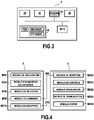
- the picture 3 schematically represents the structure of the drone 4 in accordance with a particular embodiment of the invention.
- the drone 4 is here configured to move from the white zone 8 of the cellular network NT to a destination point (denoted below P2) specified in instructions provided by the communication terminal 2, this destination point being located in a coverage zone Z of one of the access points PA, as shown in figure 1 .
- the drone 4 is further configured to perform at least one communication operation with the cellular network NT in response to instructions provided by the terminal 2.
- various variant embodiments are possible.
- the following elements are on board the drone 4: a controller 30, drone propulsion (or displacement) instruments 32, sensors 34, a communication interface 38 for communicating with the mobile network NT , a rewritable non-volatile memory 40 and a communication interface INT2.
- the sensors 34 allow the analysis of the movement (of the flight in the present case) of the drone 4.
- These sensors 34 comprise a positioning sensor 34a (of the GPS type for example) to determine the current location of the drone 4 and a sensor of altitude 34b (a barometer for example) to determine the current altitude of the drone 4.
- a positioning sensor 34a of the GPS type for example
- a sensor of altitude 34b a barometer for example
- the drone's propulsion instruments 32 can comprise a motor, actuators, propellers, etc., and more generally all elements traditionally allowing a drone to move.
- the controller 30 is configured to control the propulsion instruments 32 from the data received from the sensors 34 in order to cause the movement or the positioning of the drone 4 in accordance with the instructions that it has acquired.
- the communication interface 38 is for example a 3G or 4G communication interface configured to communicate with the mobile communication network NT when the drone 4 is in a coverage area ZA1-ZA3 of one of the access points PA1 -PA3.
- This communication interface 38 uses for example an on-board subscriber identity module (a SIM card for example) to allow the identification and authentication of the user with the NT network.
- SIM card subscriber identity module
- the drone 4 is initially in the white zone 8 so that the access points PA are, at this stage, out of range of the communication interface 38 of the drone 4.
- the non-volatile memory 40 here constitutes a recording medium (or information medium) conforming to a particular embodiment, readable by the drone 4 (and more particularly by the controller 30), and on which is recorded a program of computer PG2 according to a particular embodiment.
- This computer program PG2 comprises instructions for the execution of the steps of a control method according to a particular embodiment.
- memory 40 is further configured to store INS1 instructions acquired by drone 4, as well as DT1 data collected (or obtained) by drone 4 from at least one communication operation carried out in connection with a PA access point.
- the communication interface INT1 is configured to establish a communication link L1 with the corresponding communication interface INT1 of terminal 2. It is assumed in this example that the link L1 is a link wireless communication, Bluetooth or Wifi type for example, such a link can only be established if the terminal 2 and the drone 4 are sufficiently close to each other. According to another example, the communication link L1 is of the wired type.
- the processor 10 controlled by the computer program PG1 implements a number of modules shown in figure 4 according to a particular embodiment, namely: a location module MD2, a capability acquisition module MD4, a selection module MD6, a command module MD8 and a reception module MD10.
- the location module MD2 is configured to acquire a current location of the drone 4.
- This current location is for example in the form of geographical coordinates representing the position of the drone 4.
- the location module MD2 receives for example this current location from the drone 4 which is configured to determine its current position (here using the positioning sensor 34a) and to transmit this current position to the terminal 2, for example via the communication link L1.
- the location module MD2 acquires the current location of the terminal 2 (for example from the location unit 18) and, assuming that the drone 4 is near the terminal 2, the module location MD2 considers that the current location of drone 4 is approximately the same as that of terminal 4.
- the capability acquisition module MD4 is configured to acquire current capabilities of the drone 4.
- these current capabilities comprise at least one parameter representative of the current ability of the drone 4 to move and/or to perform at least a communications operation.
- the current capacities of the drone 4 can include the current autonomy of the drone 4 (for example its energy autonomy), this autonomy being able to be representative of a state of a battery of the drone 4.
- the current capacities can include the type of the drone 4 or any other information allowing the terminal 2 to determine the capacities of the drone 4 to carry out a mission comprising at least one movement and at least one communication operation.
- the capability acquisition module MD4 is configured to receive the current capabilities from the drone 4, for example via the communication link L1.
- the selection module MD6 is configured to select (or determine), from the current location acquired by the location module MD2 and the current capabilities acquired by the capability acquisition module MD4, a destination point reachable by the drone 4.
- the destination point thus selected is located in the coverage zone Z of an access point PA to the mobile communication network NT.
- the selection module MD4 is configured to select an access point PA as a destination point that can be reached by the drone 4 given its current location and its current capacities.
- the MD8 command module is configured to transmit to the drone 4 a set of INS instructions specifying the destination point (selected by the MD6 selection module) towards which the drone 4 must move, and specifying at least one communication operation to be carried out in connection with the mobile communication network NT.
- the control module MD8 transmits these INS instructions to the drone 4 via the communication link L1, once the latter has been established.
- the instructions INS sent by the command module MD8 specify, as destination point, the location of the access point PA selected by the selection module MD6.
- the reception module MD10 is configured to receive, from the drone 4, DT3 data collected (or obtained) by the drone 4 from at least one communication operation carried out in connection with the network NT in accordance with the instructions transmitted to the beforehand by the MD8 command module of terminal 2.
- the controller 30 controlled by the computer program PG2 ( picture 3 ) also implements modules represented in figure 4 according to a particular embodiment, namely: a receiving module MD20, a control module MD22, an evaluation module MD24, a communication module MD26 and a sending module MD28.
- the receiving module MD20 is configured to acquire the INS instructions which, in this embodiment, are sent by the control module MD8 of the terminal 2 via the communication link L1.
- the MD22 control module is configured to cause the movement of the drone 4 autonomously towards the destination point specified in the INS instruction set, this destination point being located in the coverage zone Z of an access point PA as already indicated.
- the control module is configured to cause the movement of the drone 4 in its coverage zone Z (by example at a distance less than a threshold value).
- the evaluation module MD24 is configured to evaluate a quality of connection between the drone 4 and the mobile communication network NT during said displacement caused by the control module MD22.
- the evaluation of this connection can for example comprise the determination of the transfer rate supported by a connection between the drone 4 (more particularly its communication interface 38) and the network NT.
- the data exchanged between the drone 4 and the network NT can be arbitrary, and include for example video data, at least one message of SMS or other type, etc.
- the sending module MD28 is configured to collect (or determine) DT3 data from said at least one communication operation carried out by the communication module MD26, and to transmit this data DT3 to the terminal 2 when the latter is within transmission range of the drone 4 (ie when the communication link L can be re-established between the terminal 2 and the drone 4).
- These data DT3 can include, for example, SMS or other type messages received by the drone 4.
- the communication terminal 2 implements a control method as illustrated in figure 5 , by running the computer program PG1.
- the drone 4 implements a control method as illustrated in figure 7 , by running the computer program PG2.
- the mobile terminal 2 (and its user) is at a home position P1 located in the white zone 8 of the cellular network NT so that no connection is possible between the terminal 2 and PA access points. It is further assumed that the drone 4 is close to the terminal 2 and its user.
- the implementation of the control methods allows the user to communicate asynchronously, from his mobile terminal 2, with the cellular network NT via the drone 4, as explained below.
- the terminal 2 acquires the current location P1 of the drone 4.
- the terminal 2 obtains data representative of the current location P1 of the drone 4, these data comprising for example geographic coordinates of the drone 4 at the time of acquisition.
- the current location P1 of the drone 4 can be estimated from the current positioning of the terminal 2 (using its location unit 18) or from location data determined and transmitted by the drone 4 itself.
- the terminal 2 acquires the current capacities of the drone 4.
- the terminal 2 obtains data DT2 representative of the operational autonomy of the drone 4 (a state of battery for example). From these data DT2, the terminal 2 is capable of estimating the mission(s) that the drone 4 is capable of carrying out at the present moment. As already indicated, however, other types of common abilities are possible.
- the acquisition steps S2 and S4 can be performed simultaneously or one after the other in any order.
- the terminal 2 selects (S6), from the current location P1 and the current capacities DT2, a destination point P2 reachable by the drone 4, this point of destination P2 being located in the coverage area Z of an access point PA to the mobile communication network NT.
- This selection S6 can be made in various ways. According to a particular example, the terminal 2 selects in S6 the access point PA2 itself as a destination point that can be reached by the drone 4 according to the current location and the current capacities of the drone 4.
- the terminal 2 identifies a plurality of access points PA providing, in an associated coverage zone Z, access to the network NT.
- the destination point P2 selected in S6 is then situated in the coverage zone Z of one (at least) of the identified access points.
- This identification is done for example by consulting the database B1 embedded in the terminal T1. In the present case, this identification makes it possible to identify at least the access points PA1-PA3 represented in figure 1 .
- the terminal T2 can, for example, consult the database B2 to determine the applicable flight regulations in the area concerned. Similarly, the terminal T2 can, for example, consult the database B3 to determine the topology of the terrain, and in particular the obstacles which are likely to have an impact on the path of the drone 4 and therefore on the selection S8 of the point destination P2.
- the terminal 2 can take into account the direction of the wind and/or the force of the wind, and more generally meteorological data, these elements being obtained by the terminal 2 in any appropriate manner.
- the user enters on the terminal 2 meteorological data relating for example to the direction and/or the force of the wind.
- meteorological data can also be received by the terminal 2 in advance (for example when the terminal 2 is in an area covered by an access point PA) then stored by the latter in a local memory.
- the selection step S6 comprises a step of preselection S8, from the current location P1 and the current capacities DT2 of the drone 4, of at least one candidate access point among a plurality of access points to the network NT mobile communications.
- terminal 2 preselects the access points PA1, PA2 and PA3 in accordance with at least one predetermined criterion.
- This preselection S8 is here carried out by consulting the database B1 on board the terminal 2.
- This preselection S8 consists for example of preselection of the known access points PA located in the vicinity of the drone 4 (and therefore also of the user ), that is to say the access points PA located at a distance less than or equal to a predetermined threshold value with respect to the current position P1 of the drone 4.
- the selection step S6 further comprises the final selection (decision step) S10 of the destination point P2, the latter being located in the coverage zone Z of one of the access points PA1-PA3 preselected in S8 .
- the destination point P2 selected in S10 corresponds to an access point PA among those preselected in S8.
- Routes can be calculated for the same candidate destination point. Routes can also be calculated and compared for several distinct destination points P2.
- the altitude can have a significant impact on the efficiency of the propellers of the drone 4 (in the case of propeller propulsion), it can be advantageous to take into account, during the selection step S6, the altitude average of each candidate path T1-T10 considered.
- the breakdown of the selection step S6 into a preselection step S8 and a final selection S10 makes it possible to limit the calculation resources and the calculation time which are necessary to determine the most appropriate destination point P2, insofar as the path calculations and the selection of the most appropriate path are performed only for the access points, or the coverage areas of the access points PA, the closest to the starting point P1, and therefore the most relevant.
- the terminal 2 selects the destination point P2 so that the current capacities DT2 of the drone 4 are sufficient for the drone 4 to be able to reach the destination point P2 from the current location P1 and carry out the operation or operations of communication needed.
- the terminal 2 estimates, for example, a duration necessary for the movement of the drone 4 from the starting point P1 to the arrival point P2 as well as the duration necessary for each communication operation to be carried out, and deduces therefrom a minimum duration d autonomy necessary to carry out a given mission, possibly including an additional safety period.
- the destination point P2 is selected so that the drone 4 can reach, after completion of the communication operation or operations to be carried out, a return point P3 distinct from the point destination P2 ( figure 1 ).
- the return point P3 is the starting point P1.
- the terminal 4 takes into account, for example, an estimate of the duration necessary for the return movement of the drone 4 from the destination point P2 to the return point P3.
- the destination point P2 is selected so that the drone 4, after completion of the communication operation or operations to be carried out, does not have sufficient capacities to reach a point back, such as the origin point P1 for example. Otherwise, the destination point is selected (S6) independently of the ability or otherwise of the drone 4 to return to its starting point once the communication operation or operations have been performed.
- This configuration makes it possible to significantly increase the range of action of the drone 4, in a critical case for example where an emergency message must be sent via the NT network.
- the terminal 2 Once the destination point P2 has been selected (S6), the terminal 2 generates (S12) a set of INS instructions and transmits (S14) this set of INS instructions to the drone 4 via the communication link L1 previously established as shown in figure 1 .
- the instruction set INS specifies the destination point P2, selected in S6, towards which the drone 4 must move, and further specifies at least one communication operation to be carried out in connection with the mobile communication network NT.
- the instruction set INS specifies a destination point P2 located in the coverage area Z2 of the access point PA2 and defines, as communication operation to be performed, a communication operation in transmission and a communication operation in reception, namely: the sending of an SMS type message MSG1 and the reception of an SMS type message MSG2 (for example in response to the message MSG1 sent).
- this only constitutes a non-limiting example, various communication operations in transmission and/or in reception being possible.
- the drone 4 receives the set of instructions INS transmitted by the terminal 2 during an acquisition step S40.
- the drone 4 then processes (S40) these instructions S42 and deduces therefrom the destination point P2 to be reached.
- it is the terminal 2 which has calculated the route to be followed to reach the destination point P2, this route being specified in the instructions INS received. This makes it possible to take advantage of the processing power available at the level of the communication terminal 2.
- Other implementations are however possible, according to which the route is calculated by the drone 4.
- the drone 4 moves from the starting point P1 to the destination point P2.
- the destination point P2 specified in the instructions INS can be the access point PA2 itself.
- the drone 4 moves towards the access point PA2 and has this access point or its vicinity as its destination, so as to reach the associated coverage zone Z2.
- the drone 4 performs (S48) the communication operations specified in the set of instructions INS, in connection with the mobile communication network NT.
- the drone 4 detects (S46) that the condition (2) is satisfied before having reached the destination point P2. In this case, the drone 4 immediately starts (S48) the communication operations specified in the INS instructions.
- the drone 4 can come to a standstill in order to carry out the communication operations or, if necessary, simultaneously continue its movement towards the destination point P2 if the connection quality can or must still be improved.
- the drone 4 can succeed in establishing a connection with an access point different from the target access point PA2, for example if an unknown access point is unexpectedly encountered by the drone 4 during its movement towards the destination point P2.
- the drone 4 reaches the destination point P2 without having previously detected that the condition (2) is satisfied.
- the drone 4 then tries to establish (S48), from the destination point P2, a connection with the mobile communication network NT via the access point PA2. If a connection is established successfully, the drone 4 performs (S48) the communications operations specified in the INS instructions.
- the verification of whether or not the conditions (1) and (2) are complied with during the movement towards the destination point P2 advantageously makes it possible to save the resources of the drone 4 and to minimize the time necessary for the drone 4 to achieve its mission.
- the drone 4 sends for example the message MSG1 via the network NT and receives, from the network NT, a message MG2.
- the drone 4 sends in S48 the current location P1 which allows a third party to locate the user and, if necessary, come to his aid.
- the drone 4 can perform (S52) a return trip to a return point P3 specified in the instruction set INS. The user can thus recover the drone 4 once the mission has been carried out.
- the drone 4 If, after arriving at the destination point P2, the drone 4 fails to connect to the NT mobile communication network, the drone 4 abandons the communication operations and moves to the return point P3 specified in the instruction set INS.
- the drone 4 performs a time count from the start of the movement S44 from the starting point P1 to the destination point P2, and performs the return movement to the return point P3 specified in the set of INS instructions before completion of the communication operations specified in the INS instructions if the countdown time reaches a predetermined threshold time.
- This variant makes it possible to safeguard the integrity of the drone 4 and to allow its return to the user in situations where the capacities of the drone become too weak to allow the complete execution of the desired communication operations.
- the drone 4 performs an evaluation, from the start of the movement of the autonomous locomotion machine from the current location to the destination point, of the remaining energy of the autonomous locomotion machine (for example in a battery of said machine); and performs the movement back to the return point P3 specified in the INS instruction set before completion of the communication operations specified in said INS instruction set if the remaining energy estimate reaches (becomes less than or equal to) a predetermined threshold level.
- the drone 4 additionally collects or determines (S50) data DT3 from the communication operations carried out in S48.
- These data DT3 can comprise data received from the NT network (a message of the SMS type for example) or historical data representative of the operations carried out by the drone 4 (type of operation, date and time, status of the operation indicating failure or success etc.).
- the drone 4 can subsequently transmit (S54) the data DT3 to the terminal 2 when the latter is sufficiently close to the drone 4 and establishes a communication link L1.
- the drone 4 proceeds to the transmission (S54) of the data DT3 as soon as it has reached the return point P3.
- This variant advantageously allows the user to be informed of the progress of the mission carried out by the drone 4 and, if necessary, to receive the data received by the drone 4 when the latter was connected to the network NT.
- the processing necessary for the selection S6 of the destination point P2 is carried out on the terminal 2 side in order to take advantage of the processing resources available at the level of the terminal 2.
- the processing necessary for the selection S6 of the destination point P2 is carried out on the terminal 2 side in order to take advantage of the processing resources available at the level of the terminal 2.
- the drone 4 itself.
- at least one of the location module MD2, the capability acquisition module MD4 and the selection module MD6, as described above with particular reference to the figure 4 can be included in the drone 4.
- the drone 4 and the terminal 2 form one and the same device.
- the drone 4 also plays the role of terminal 2 as described above.
- the drone 4 then also constitutes a communication terminal (or device) within the meaning of the invention.
- the user interacts directly with the drone 4 without using a separate terminal to control the drone.
- the drone 4 then itself performs the steps of acquiring its current location (S2) and its current capacities (S4), the selection step (S6) and obtains (or generates) its own instructions (S12) for perform the mission desired by the user.
- the autonomous locomotion device can include the location module MD2, the capacity acquisition module MD4 and the selection module MD6, as described above with particular reference to the figure 4 .
- the access point PA selected in S6 is a second autonomous locomotion device such as a second drone for example.
- This second drone has for example a structure similar to that of the drone 4 described above and is in particular capable of receiving instructions in order to carry out a mission similar to that executed by the drone 4 in the preceding examples.
- the drone 4 can therefore perform in S48 ( figure 7 ), as a communication operation, the transfer of INS instructions to another drone.
- This other drone then performs, from the INS instructions received, a control process similar to that performed by the drone 4 according to steps S40-S48, and further performs steps S52 and/or S54 if it is the final drone of the chain.
- the invention advantageously allows the user of a communication terminal to access a mobile communication network asynchronously from a white area, that is to say an area not served by the network in question.
- An autonomous locomotion device makes it possible to act as a relay between the mobile network and a user located outside the range of said network. Various communication operations can thus be executed by the autonomous locomotion device at the request of the user.
- the user can advantageously use his communication terminal to control the execution, by an autonomous locomotion device, of a given mission involving the movement of the device to an area served by the mobile network and the performance of at least a communication operation in transmission and/or reception.
Landscapes
- Engineering & Computer Science (AREA)
- Computer Networks & Wireless Communication (AREA)
- Signal Processing (AREA)
- Physics & Mathematics (AREA)
- Remote Sensing (AREA)
- Radar, Positioning & Navigation (AREA)
- General Physics & Mathematics (AREA)
- Aviation & Aerospace Engineering (AREA)
- Astronomy & Astrophysics (AREA)
- Automation & Control Theory (AREA)
- Computer Security & Cryptography (AREA)
- Mobile Radio Communication Systems (AREA)
- Quality & Reliability (AREA)
- Electromagnetism (AREA)
Claims (14)
- Steuerungsverfahren, das durch eine Kommunikationsvorrichtung (2) umgesetzt wird, beinhaltend die folgenden Schritte:- Erfassen (S2) eines aktuellen Standorts (P1) eines autonomen Fortbewegungsmittels (4);- Erfassen (S4) von aktuellen Kapazitäten (DT2) des autonomen Fortbewegungsmittels;- Auswählen (S6), basierend auf dem aktuellen Standort und den aktuellen Kapazitäten, eines Zielpunkts (P2), der durch das autonome Fortbewegungsmittel erreichbar ist, wobei sich der Zielpunkt in dem Abdeckungsbereich (Z2) eines Zugangspunkts (PA2) zu einem Mobilkommunikationsnetz (NT) befindet; und- Bereitstellen (S14), für das autonome Fortbewegungsmittel (4), eines Satzes Anweisungen (INS), der den Zielpunkt (P2), zu dem sich das autonome Fortbewegungsmittel bewegen soll, spezifiziert und mindestens einen in Verbindung mit dem Mobilkommunikationsnetz durchzuführenden Kommunikationsvorgang spezifiziert,wobei der Schritt des Auswählens (S6) das Identifizieren einer Vielzahl von Zugangspunkten, die in einem assoziierten Abdeckungsbereich einen Zugang zu dem Mobilkommunikationsnetz bereitstellen, beinhaltet; wobei sich der ausgewählte Zielpunkt in dem Abdeckungsbereich eines der Vielzahl von Zugangspunkten befindet.
- Verfahren nach Anspruch 1, wobei der Schritt des Auswählens (S6) einen Schritt des Vorauswählens (S8), basierend auf dem aktuellen Standort und den aktuellen Kapazitäten des autonomen Fortbewegungsmittels, mindestens eines potentiellen Zugangspunkts (PA1-PA3) einer Vielzahl von Zugangspunkten zu dem Mobilkommunikationsnetz (NT) beinhaltet;
wobei sich der ausgewählte Zielpunkt (P2) in dem Abdeckungsbereich (PA2) des mindestens einen vorausgewählten Zugangspunkts (PA1-PA3) befindet. - Verfahren nach Anspruch 1 oder 2, wobei der Schritt des Auswählens (S6) Folgendes beinhaltet:- Berechnen (S20) von möglichen Routen zwischen dem aktuellen Standort (P1) und potentiellen Zielpunkten, die sich in dem Abdeckungsbereich mindestens eines Zugangspunkts (PA) befinden;- Ermitteln (S22), für jede berechnete Route, einer Bewegungszeit des autonomen Fortbewegungsmittels oder eines Energieverbrauchs des autonomen Fortbewegungsmittels; und- Auswählen (S24), aus den berechneten Routen, derjenigen Route, die die kürzeste Bewegungszeit aufweist, oder derjenigen Route, die den geringsten Energieverbrauch aufweist.
- Verfahren nach einem beliebigen der Ansprüche 1 bis 3, wobei der Schritt des Auswählens (S6) gemäß vordefinierten Kriterien unter Berücksichtigung von mindestens einem von Folgendem durchgeführt wird:- dem Abstand zwischen dem aktuellen Standort (P1) des autonomen Fortbewegungsmittels und dem Zielpunkt (P2);- einer Topologie des Geländes zwischen dem aktuellen Standort (P1) und dem Zielpunkt (P2);- einer Ermittlung des Energieverbrauchs des autonomen Fortbewegungsmittels zwischen dem aktuellen Standort (P1) und dem Zielpunkt (P2);- zwischen dem aktuellen Standort (P1) und dem Zielpunkt (P2) geltenden Bewegungsvorschriften; und- meteorologischen Daten.
- Verfahren nach einem beliebigen der Ansprüche 1 bis 4, wobei der Zielpunkt (P2) so ausgewählt (S6) wird, dass die aktuellen Kapazitäten ausreichen, damit das autonome Fortbewegungsmittel den Zielpunkt von dem aktuellen Standort aus erreichen kann und den mindestens einen Kommunikationsvorgang durchführt.
- Verfahren nach einem beliebigen der Ansprüche 1 bis 5, wobei der mindestens eine Kommunikationsvorgang mindestens eines von Folgendem beinhaltet:- das Senden von Daten über das Mobilkommunikationsnetz;- das Empfangen von Daten von dem Mobilkommunikationsnetz; und- das Übermitteln der Anweisungen (INS) an ein anderes autonomes Fortbewegungsmittel.
- Steuerungsverfahren, das von einem Kommunikationssystem umgesetzt wird, das eine Kommunikationsvorrichtung und ein autonomes Fortbewegungsmittel (4), das dazu fähig ist, mit einem Mobilkommunikationsnetz (NT) zu kommunizieren, beinhaltet,wobei die Kommunikationsvorrichtung ein Verfahren nach einem beliebigen der Ansprüche 1 bis 6 durchführt, um das autonome Fortbewegungsmittel zu steuern;wobei das Steuerungsverfahren ferner die folgenden Schritte beinhaltet, die durch das autonome Fortbewegungsmittel ausgeführt werden:- Erfassen (S40) eines Satzes Anweisungen (INS), der durch die Kommunikationsvorrichtung übertragen wird;- Bewegen (S42) des autonomen Fortbewegungsmittels zu einem Zielpunkt (P2), der in dem Satz Anweisungen spezifiziert ist, wobei sich der Zielpunkt in dem Abdeckungsbereich (Z) eines Zugangspunkts (PA) zu einem Mobilkommunikationsnetz (NT) befindet;- Bewerten (S44) einer Verbindungsqualität zwischen dem autonomen Fortbewegungsmittel und dem Mobilkommunikationsnetz während der Bewegung (S42);- Ausführen (S48) mindestens eines Kommunikationsvorgangs, der in dem Satz Anweisungen spezifiziert ist, in Verbindung mit dem Mobilkommunikationsnetz, sobald mindestens eine der folgenden Bedingungen erfüllt ist:• das autonome Fortbewegungsmittel erreicht den Zielpunkt (P2); und• die Verbindungsqualität erreicht einen vorgegebenen Schwellenwert.
- Verfahren nach Anspruch 7, wobei der mindestens eine Kommunikationsvorgang mindestens eines von Folgendem beinhaltet:- das Senden von Daten über das Mobilkommunikationsnetz;- das Empfangen von Daten von dem Mobilkommunikationsnetz; und- das Übermitteln der Anweisungen an ein anderes autonomes Fortbewegungsmittel.
- Verfahren nach Anspruch 7 oder 8, wobei das Verfahren Folgendes beinhaltet:- Ausführen, durch das autonome Fortbewegungsmittel, einer Registrierung der Zeit basierend auf dem Start der Bewegung des autonomen Fortbewegungsmittels von dem aktuellen Standort (P1) zu dem Zielpunkt (P2); und- eine Rückkehrbewegung (S52) des autonomen Fortbewegungsmittels zu einem Rückkehrpunkt (P3), der in dem Satz Anweisungen spezifiziert ist, vor Abschluss des mindestens einen Kommunikationsvorgangs, wenn die registrierte Zeit eine vorgegebene Zeitschwelle erreicht.
- Verfahren nach einem beliebigen der Ansprüche 7 bis 9, wobei das Verfahren nach dem Abschluss des mindestens einen Kommunikationsvorgangs eine Rückkehrbewegung (S52) des autonomen Fortbewegungsmittels zu einem Rückkehrpunkt, der in dem Satz Anweisungen spezifiziert ist, beinhaltet.
- Verfahren nach Anspruch 10, das Folgendes beinhaltet:- Sammeln (S50), durch das autonome Fortbewegungsmittel, von Daten (DT3) basierend auf dem mindestens einen durchgeführten Kommunikationsvorgang; und- Übertragen (S54), durch das autonome Fortbewegungsmittel, der Daten (DT3) an eine Kommunikationsvorrichtung (2), wenn sich die Vorrichtung in Übertragungsreichweite des autonomen Fortbewegungsmittels befindet.
- Computerprogramm (PG1; PG2), das Anweisungen zur Ausführung der Schritte eines Verfahrens nach einem beliebigen der Ansprüche 1 bis 11 umfasst, wenn das Programm durch einen Computer ausgeführt wird.
- Kommunikationsvorrichtung, die Folgendes beinhaltet:- ein Standortmodul (MD2), das dazu konfiguriert ist, einen aktuellen Standort (P1) eines autonomen Fortbewegungsmittels zu erfassen;- ein Kapazitätserfassungsmodul (MD4), das dazu konfiguriert ist, aktuelle Kapazitäten des autonomen Fortbewegungsmittels zu erfassen;- ein Auswahlmodul (MD6), das dazu konfiguriert ist, basierend auf dem aktuellen Standort und den aktuellen Kapazitäten einen Zielpunkt (P2), der durch das autonome Fortbewegungsmittel erreichbar ist, auszuwählen, wobei sich der Zielpunkt in dem Abdeckungsbereich (Z2) eines Zugangspunkts (PA2) zu einem Mobilkommunikationsnetz (NT) befindet; und- ein Befehlsmodul, das dazu konfiguriert ist, dem autonomen Fortbewegungsmittel einen Satz Anweisungen (INS) bereitzustellen, der den Zielpunkt, zu dem sich das autonome Fortbewegungsmittel bewegen soll, spezifiziert und mindestens einen in Verbindung mit dem Mobilkommunikationsnetz durchzuführenden Kommunikationsvorgang spezifiziert,wobei das Auswahlmodul dazu konfiguriert ist, das Identifizieren einer Vielzahl von Zugangspunkten, die in einem assoziierten Abdeckungsbereich einen Zugang zu dem Mobilkommunikationsnetz bereitstellen, durchzuführen, wobei sich der ausgewählte Zielpunkt in dem Abdeckungsbereich eines der Vielzahl von Zugangspunkten befindet.
- Kommunikationssystem, beinhaltend eine Kommunikationsvorrichtung nach Anspruch 13 und ein autonomes Fortbewegungsmittel, das Folgendes beinhaltet:- ein Modul zum Erhalten (MD20) eines Satzes Anweisungen (INS);- ein Steuerungsmodul (MD22), das dazu konfiguriert ist, die Bewegung des autonomen Fortbewegungsmittels zu einem Zielpunkt (P2), der in dem Satz Anweisungen spezifiziert ist, zu steuern, wobei sich der Zielpunkt in dem Abdeckungsbereich (Z2) eines Zugangspunkts (PA2) zu einem Mobilkommunikationsnetz (NT) befindet;- ein Bewertungsmodul (MD24), das dazu konfiguriert ist, eine Verbindungsqualität zwischen dem autonomen Fortbewegungsmittel und dem Mobilkommunikationsnetz während der Bewegung zu bewerten;- ein Kommunikationsmodul (MD26), das dazu konfiguriert ist, mindestens einen Kommunikationsvorgang, der in dem Satz Anweisungen spezifiziert ist, in Verbindung mit dem Mobilkommunikationsnetz auszuführen, sobald mindestens eine der folgenden Bedingungen erfüllt ist:• das autonome Fortbewegungsmittel erreicht den Zielpunkt; und• die Verbindungsqualität erreicht einen vorgegebenen Schwellenwert.
Applications Claiming Priority (2)
| Application Number | Priority Date | Filing Date | Title |
|---|---|---|---|
| FR1660782A FR3058609A1 (fr) | 2016-11-08 | 2016-11-08 | Synchronisation asynchrone avec un reseau de communication mobile |
| PCT/FR2017/052793 WO2018087440A1 (fr) | 2016-11-08 | 2017-10-11 | Synchronisation asynchrone avec un réseau de communication mobile |
Publications (2)
| Publication Number | Publication Date |
|---|---|
| EP3539306A1 EP3539306A1 (de) | 2019-09-18 |
| EP3539306B1 true EP3539306B1 (de) | 2022-09-07 |
Family
ID=58054234
Family Applications (1)
| Application Number | Title | Priority Date | Filing Date |
|---|---|---|---|
| EP17794369.3A Active EP3539306B1 (de) | 2016-11-08 | 2017-10-11 | Asynchrone synchronisation mit einem mobilkommunikationsnetz |
Country Status (6)
| Country | Link |
|---|---|
| US (1) | US11582578B2 (de) |
| EP (1) | EP3539306B1 (de) |
| CN (1) | CN110121844B (de) |
| ES (1) | ES2931978T3 (de) |
| FR (1) | FR3058609A1 (de) |
| WO (1) | WO2018087440A1 (de) |
Families Citing this family (4)
| Publication number | Priority date | Publication date | Assignee | Title |
|---|---|---|---|---|
| CN110998695A (zh) * | 2017-08-04 | 2020-04-10 | 意造科技私人有限公司 | 通信失效时的uav系统应急路径规划 |
| CN111328443B (zh) * | 2017-12-22 | 2022-05-17 | 瑞典爱立信有限公司 | 用于提供自主紧急援助的方法、装置、设备及介质 |
| JP6739480B2 (ja) * | 2018-08-16 | 2020-08-12 | Hapsモバイル株式会社 | 制御装置、プログラム及び制御方法 |
| JP7298693B2 (ja) * | 2019-08-06 | 2023-06-27 | 日本電気株式会社 | 光ファイバセンシングシステム、光ファイバセンシング機器、及び無人機配置方法 |
Citations (2)
| Publication number | Priority date | Publication date | Assignee | Title |
|---|---|---|---|---|
| US8983682B1 (en) * | 2012-12-28 | 2015-03-17 | Google Inc. | Unlocking mobile-device and/or unmanned aerial vehicle capability in an emergency situation |
| US20150236778A1 (en) * | 2014-02-17 | 2015-08-20 | Ubiqomm Llc | Broadband access to mobile platforms using drone/uav background |
Family Cites Families (30)
| Publication number | Priority date | Publication date | Assignee | Title |
|---|---|---|---|---|
| US7581702B2 (en) * | 2006-06-09 | 2009-09-01 | Insitu, Inc. | Wirelessly controlling unmanned aircraft and accessing associated surveillance data |
| KR20080027564A (ko) | 2006-09-25 | 2008-03-28 | 삼성전자주식회사 | 위치정보를 제공하는 이동통신 단말기 및 그 방법 |
| US8965681B2 (en) | 2008-09-03 | 2015-02-24 | Global Relief Technologies, Inc. | Field device communications |
| CN103051680B (zh) * | 2012-12-04 | 2015-09-30 | 东蓝数码有限公司 | 基于移动通信网络的智能终端与无人值守设备的通信方法 |
| WO2015061008A1 (en) * | 2013-10-26 | 2015-04-30 | Amazon Technologies, Inc. | Unmanned aerial vehicle delivery system |
| EP2938117B1 (de) * | 2014-04-24 | 2017-12-27 | Alcatel Lucent | Geografische Positionsanpassung einer Drohnenbasisstation |
| US9875454B2 (en) * | 2014-05-20 | 2018-01-23 | Verizon Patent And Licensing Inc. | Accommodating mobile destinations for unmanned aerial vehicles |
| US9354296B2 (en) * | 2014-05-20 | 2016-05-31 | Verizon Patent And Licensing Inc. | Dynamic selection of unmanned aerial vehicles |
| CN105321315A (zh) * | 2014-07-30 | 2016-02-10 | 芯讯通无线科技(上海)有限公司 | 飞行器系统及其通信方法 |
| US9359074B2 (en) * | 2014-09-08 | 2016-06-07 | Qualcomm Incorporated | Methods, systems and devices for delivery drone security |
| US9571180B2 (en) * | 2014-10-16 | 2017-02-14 | Ubiqomm Llc | Unmanned aerial vehicle (UAV) beam forming and pointing toward ground coverage area cells for broadband access |
| US9552736B2 (en) * | 2015-01-29 | 2017-01-24 | Qualcomm Incorporated | Systems and methods for restricting drone airspace access |
| US9601022B2 (en) * | 2015-01-29 | 2017-03-21 | Qualcomm Incorporated | Systems and methods for restricting drone airspace access |
| US10642560B2 (en) * | 2015-02-13 | 2020-05-05 | Position Imaging, Inc. | Accurate geographic tracking of mobile devices |
| US10324474B2 (en) * | 2015-02-13 | 2019-06-18 | Position Imaging, Inc. | Spatial diversity for relative position tracking |
| CN104703120B (zh) * | 2015-04-01 | 2018-12-25 | 南京佰联信息技术有限公司 | 移动通信方法和装置 |
| US9363690B1 (en) * | 2015-07-10 | 2016-06-07 | Cisco Technology, Inc. | Closed-loop optimization of a wireless network using an autonomous vehicle |
| AU2016331221B2 (en) * | 2015-09-30 | 2020-02-27 | Alarm.Com Incorporated | Drone-augmented emergency response services |
| FR3042931A1 (fr) * | 2015-10-23 | 2017-04-28 | Orange | Systeme de continuite de services fournis par une passerelle residentielle |
| US10048684B2 (en) * | 2016-02-19 | 2018-08-14 | At&T Intellectual Property I, L.P. | Management of deployed drones |
| CA3187011A1 (en) * | 2016-05-20 | 2017-11-23 | United Parcel Service Of America, Inc. | Sharing location information with a recipient |
| CN205665905U (zh) * | 2016-06-01 | 2016-10-26 | 北京瀚科瑞杰科技发展有限公司 | 基于移动通信网络的民用无人机管控系统 |
| US20180038695A1 (en) * | 2016-08-04 | 2018-02-08 | Qualcomm Incorporated | Generating Crowd-Sourced Navigation Data |
| US10568063B2 (en) * | 2016-11-30 | 2020-02-18 | Cisco Technology, Inc. | Precise UAV tracking in 3-D space |
| EP3586506A4 (de) * | 2017-02-27 | 2021-04-14 | Isolynx, LLC | Systeme und verfahren zur verfolgung und steuerung einer mobilen kamera auf bildobjekte von interesse |
| US10034209B1 (en) * | 2017-03-10 | 2018-07-24 | Qualcomm Incorporated | Traffic offloading for a communication drone |
| US10153830B2 (en) * | 2017-04-06 | 2018-12-11 | At&T Intellectual Propertyi, L.P. | Dynamic shielding system of cellular signals for an antenna of an unmanned aerial vehicle |
| US10212494B1 (en) * | 2017-10-31 | 2019-02-19 | Tionesta, Llc | Method and system for monitoring physical assets |
| JP7159317B2 (ja) * | 2017-12-30 | 2022-10-24 | インテル コーポレイション | 無線通信の方法および装置 |
| US10461421B1 (en) * | 2019-05-07 | 2019-10-29 | Bao Tran | Cellular system |
-
2016
- 2016-11-08 FR FR1660782A patent/FR3058609A1/fr active Pending
-
2017
- 2017-10-11 WO PCT/FR2017/052793 patent/WO2018087440A1/fr not_active Ceased
- 2017-10-11 US US16/348,025 patent/US11582578B2/en active Active
- 2017-10-11 EP EP17794369.3A patent/EP3539306B1/de active Active
- 2017-10-11 ES ES17794369T patent/ES2931978T3/es active Active
- 2017-10-11 CN CN201780081975.3A patent/CN110121844B/zh active Active
Patent Citations (2)
| Publication number | Priority date | Publication date | Assignee | Title |
|---|---|---|---|---|
| US8983682B1 (en) * | 2012-12-28 | 2015-03-17 | Google Inc. | Unlocking mobile-device and/or unmanned aerial vehicle capability in an emergency situation |
| US20150236778A1 (en) * | 2014-02-17 | 2015-08-20 | Ubiqomm Llc | Broadband access to mobile platforms using drone/uav background |
Also Published As
| Publication number | Publication date |
|---|---|
| CN110121844B (zh) | 2022-12-06 |
| US11582578B2 (en) | 2023-02-14 |
| US20190316910A1 (en) | 2019-10-17 |
| CN110121844A (zh) | 2019-08-13 |
| EP3539306A1 (de) | 2019-09-18 |
| FR3058609A1 (fr) | 2018-05-11 |
| WO2018087440A1 (fr) | 2018-05-17 |
| ES2931978T3 (es) | 2023-01-05 |
Similar Documents
| Publication | Publication Date | Title |
|---|---|---|
| EP3539306B1 (de) | Asynchrone synchronisation mit einem mobilkommunikationsnetz | |
| FR3095733A1 (fr) | Systeme et procede de gestion de communication v2x entre un vehicule et un dispositif recepteur | |
| EP3771161B1 (de) | Auswahl einer instanziierung eines teilnetzes für die uplink-paketübertragung | |
| WO2017068263A1 (fr) | Procédé de continuité de services fournis par une passerelle résidentielle | |
| EP3957104B1 (de) | Verfahren zur vorhersage einer modifizierung der verknüpfungsbedingungen eines endgeräts mit einem zellularen netzwerk | |
| EP3970128A1 (de) | Verfahren zur zuweisung eines systems zur steuerung eines ferngesteuerten fahrzeugs | |
| WO2018029093A1 (fr) | Procede de controle de position d'un noeud mobile et dispositif associe | |
| EP2627144B1 (de) | Dynamische Verwaltung von kleinen Zellen, um den Energieverbrauch eines Netzwerkes Verkehr zu optimieren basiered auf Datenverkehr | |
| WO2020057787A1 (fr) | Procédé de réattribution d'un serveur périphérique de traitement de données | |
| EP2232816A1 (de) | Verwaltung einer kommunikation in einem heterogenen netzwerk | |
| EP3542589B1 (de) | Delegieren von anweisungen an eine vorrichtung in abhängigkeit ihrer ressourcen | |
| FR3026252A1 (fr) | Procede de repartition spatio-temporelle de transferts de donnees au cours d'un trajet | |
| US12532160B2 (en) | Systems and methods for provisioning a device and adapting applications in bandwidth-restricted networks | |
| EP4174613B1 (de) | Verfahren und system zur autonomiesteuerung für eine batteriebetriebene fahrzeugsflotte | |
| WO2026017885A1 (fr) | Procédé d'élection d'un drone maître au sein d'une flotte de drones, procédé de gestion d'une flotte de drones, produit programme d'ordinateur, et ensemble comprenant une flotte de drones | |
| FR2993736A1 (fr) | Procede de communication aerien - terrestre, programme, terminaux, installation | |
| WO2026003022A1 (fr) | Dispositif et procédé de gestion de communication | |
| WO2024104892A1 (fr) | Procédé, dispositif et système de détermination d'une position associée à un itinéraire d'un véhicule télécontrôlé | |
| WO2025195642A1 (fr) | Procédé et serveur de détermination de données cartographiques à transmettre à un véhicule via un réseau de communication sans fil en cas d'itinérance | |
| WO2025133034A1 (fr) | Procédés de configuration et de communication, entité d'un réseau de télécommunications et équipement utilisateur | |
| FR3145518A1 (fr) | Procédé et dispositif de suivi de bornes de recharge pour véhicule électrique | |
| FR3065855B1 (fr) | Procede et dispositif de controle de l’utilisation d’un point d’acces d’un vehicule par transmission d’informations de capacite disponible | |
| EP4557634A1 (de) | Dynamische zugangskontrolle von mindestens einem kommunikationsendgerät zu satellitenkommunikationsressourcen einer satellitenkonstellation | |
| FR3094538A3 (fr) | Procédé permettant de transporter une pluralité d'usagers et de marchandises | |
| FR3159871A1 (fr) | Procédé, dispositif et programme de de contrôle d’une zone de couverture d’un satellite serveur d’un système de communication. |
Legal Events
| Date | Code | Title | Description |
|---|---|---|---|
| STAA | Information on the status of an ep patent application or granted ep patent |
Free format text: STATUS: UNKNOWN |
|
| STAA | Information on the status of an ep patent application or granted ep patent |
Free format text: STATUS: THE INTERNATIONAL PUBLICATION HAS BEEN MADE |
|
| PUAI | Public reference made under article 153(3) epc to a published international application that has entered the european phase |
Free format text: ORIGINAL CODE: 0009012 |
|
| STAA | Information on the status of an ep patent application or granted ep patent |
Free format text: STATUS: REQUEST FOR EXAMINATION WAS MADE |
|
| 17P | Request for examination filed |
Effective date: 20190522 |
|
| AK | Designated contracting states |
Kind code of ref document: A1 Designated state(s): AL AT BE BG CH CY CZ DE DK EE ES FI FR GB GR HR HU IE IS IT LI LT LU LV MC MK MT NL NO PL PT RO RS SE SI SK SM TR |
|
| AX | Request for extension of the european patent |
Extension state: BA ME |
|
| DAV | Request for validation of the european patent (deleted) | ||
| DAX | Request for extension of the european patent (deleted) | ||
| STAA | Information on the status of an ep patent application or granted ep patent |
Free format text: STATUS: EXAMINATION IS IN PROGRESS |
|
| 17Q | First examination report despatched |
Effective date: 20200512 |
|
| RAP1 | Party data changed (applicant data changed or rights of an application transferred) |
Owner name: ORANGE |
|
| RAP3 | Party data changed (applicant data changed or rights of an application transferred) |
Owner name: ORANGE |
|
| RIC1 | Information provided on ipc code assigned before grant |
Ipc: B64C 39/02 20060101ALI20220203BHEP Ipc: H04W 84/18 20090101ALI20220203BHEP Ipc: H04W 84/06 20090101ALI20220203BHEP Ipc: H04W 84/04 20090101ALI20220203BHEP Ipc: H04W 24/02 20090101ALI20220203BHEP Ipc: H04W 4/02 20180101ALI20220203BHEP Ipc: H04W 4/00 20180101AFI20220203BHEP |
|
| GRAP | Despatch of communication of intention to grant a patent |
Free format text: ORIGINAL CODE: EPIDOSNIGR1 |
|
| STAA | Information on the status of an ep patent application or granted ep patent |
Free format text: STATUS: GRANT OF PATENT IS INTENDED |
|
| INTG | Intention to grant announced |
Effective date: 20220408 |
|
| GRAS | Grant fee paid |
Free format text: ORIGINAL CODE: EPIDOSNIGR3 |
|
| GRAA | (expected) grant |
Free format text: ORIGINAL CODE: 0009210 |
|
| STAA | Information on the status of an ep patent application or granted ep patent |
Free format text: STATUS: THE PATENT HAS BEEN GRANTED |
|
| AK | Designated contracting states |
Kind code of ref document: B1 Designated state(s): AL AT BE BG CH CY CZ DE DK EE ES FI FR GB GR HR HU IE IS IT LI LT LU LV MC MK MT NL NO PL PT RO RS SE SI SK SM TR |
|
| REG | Reference to a national code |
Ref country code: GB Ref legal event code: FG4D Free format text: NOT ENGLISH |
|
| REG | Reference to a national code |
Ref country code: CH Ref legal event code: EP Ref country code: AT Ref legal event code: REF Ref document number: 1518041 Country of ref document: AT Kind code of ref document: T Effective date: 20220915 |
|
| REG | Reference to a national code |
Ref country code: DE Ref legal event code: R096 Ref document number: 602017061559 Country of ref document: DE |
|
| REG | Reference to a national code |
Ref country code: IE Ref legal event code: FG4D Free format text: LANGUAGE OF EP DOCUMENT: FRENCH |
|
| REG | Reference to a national code |
Ref country code: LT Ref legal event code: MG9D |
|
| REG | Reference to a national code |
Ref country code: ES Ref legal event code: FG2A Ref document number: 2931978 Country of ref document: ES Kind code of ref document: T3 Effective date: 20230105 |
|
| REG | Reference to a national code |
Ref country code: NL Ref legal event code: MP Effective date: 20220907 |
|
| PG25 | Lapsed in a contracting state [announced via postgrant information from national office to epo] |
Ref country code: SE Free format text: LAPSE BECAUSE OF FAILURE TO SUBMIT A TRANSLATION OF THE DESCRIPTION OR TO PAY THE FEE WITHIN THE PRESCRIBED TIME-LIMIT Effective date: 20220907 Ref country code: RS Free format text: LAPSE BECAUSE OF FAILURE TO SUBMIT A TRANSLATION OF THE DESCRIPTION OR TO PAY THE FEE WITHIN THE PRESCRIBED TIME-LIMIT Effective date: 20220907 Ref country code: NO Free format text: LAPSE BECAUSE OF FAILURE TO SUBMIT A TRANSLATION OF THE DESCRIPTION OR TO PAY THE FEE WITHIN THE PRESCRIBED TIME-LIMIT Effective date: 20221207 Ref country code: LV Free format text: LAPSE BECAUSE OF FAILURE TO SUBMIT A TRANSLATION OF THE DESCRIPTION OR TO PAY THE FEE WITHIN THE PRESCRIBED TIME-LIMIT Effective date: 20220907 Ref country code: LT Free format text: LAPSE BECAUSE OF FAILURE TO SUBMIT A TRANSLATION OF THE DESCRIPTION OR TO PAY THE FEE WITHIN THE PRESCRIBED TIME-LIMIT Effective date: 20220907 Ref country code: FI Free format text: LAPSE BECAUSE OF FAILURE TO SUBMIT A TRANSLATION OF THE DESCRIPTION OR TO PAY THE FEE WITHIN THE PRESCRIBED TIME-LIMIT Effective date: 20220907 |
|
| REG | Reference to a national code |
Ref country code: AT Ref legal event code: MK05 Ref document number: 1518041 Country of ref document: AT Kind code of ref document: T Effective date: 20220907 |
|
| PG25 | Lapsed in a contracting state [announced via postgrant information from national office to epo] |
Ref country code: HR Free format text: LAPSE BECAUSE OF FAILURE TO SUBMIT A TRANSLATION OF THE DESCRIPTION OR TO PAY THE FEE WITHIN THE PRESCRIBED TIME-LIMIT Effective date: 20220907 Ref country code: GR Free format text: LAPSE BECAUSE OF FAILURE TO SUBMIT A TRANSLATION OF THE DESCRIPTION OR TO PAY THE FEE WITHIN THE PRESCRIBED TIME-LIMIT Effective date: 20221208 |
|
| PG25 | Lapsed in a contracting state [announced via postgrant information from national office to epo] |
Ref country code: SM Free format text: LAPSE BECAUSE OF FAILURE TO SUBMIT A TRANSLATION OF THE DESCRIPTION OR TO PAY THE FEE WITHIN THE PRESCRIBED TIME-LIMIT Effective date: 20220907 Ref country code: RO Free format text: LAPSE BECAUSE OF FAILURE TO SUBMIT A TRANSLATION OF THE DESCRIPTION OR TO PAY THE FEE WITHIN THE PRESCRIBED TIME-LIMIT Effective date: 20220907 Ref country code: PT Free format text: LAPSE BECAUSE OF FAILURE TO SUBMIT A TRANSLATION OF THE DESCRIPTION OR TO PAY THE FEE WITHIN THE PRESCRIBED TIME-LIMIT Effective date: 20230109 Ref country code: CZ Free format text: LAPSE BECAUSE OF FAILURE TO SUBMIT A TRANSLATION OF THE DESCRIPTION OR TO PAY THE FEE WITHIN THE PRESCRIBED TIME-LIMIT Effective date: 20220907 Ref country code: AT Free format text: LAPSE BECAUSE OF FAILURE TO SUBMIT A TRANSLATION OF THE DESCRIPTION OR TO PAY THE FEE WITHIN THE PRESCRIBED TIME-LIMIT Effective date: 20220907 |
|
| PG25 | Lapsed in a contracting state [announced via postgrant information from national office to epo] |
Ref country code: SK Free format text: LAPSE BECAUSE OF FAILURE TO SUBMIT A TRANSLATION OF THE DESCRIPTION OR TO PAY THE FEE WITHIN THE PRESCRIBED TIME-LIMIT Effective date: 20220907 Ref country code: PL Free format text: LAPSE BECAUSE OF FAILURE TO SUBMIT A TRANSLATION OF THE DESCRIPTION OR TO PAY THE FEE WITHIN THE PRESCRIBED TIME-LIMIT Effective date: 20220907 Ref country code: IS Free format text: LAPSE BECAUSE OF FAILURE TO SUBMIT A TRANSLATION OF THE DESCRIPTION OR TO PAY THE FEE WITHIN THE PRESCRIBED TIME-LIMIT Effective date: 20230107 Ref country code: EE Free format text: LAPSE BECAUSE OF FAILURE TO SUBMIT A TRANSLATION OF THE DESCRIPTION OR TO PAY THE FEE WITHIN THE PRESCRIBED TIME-LIMIT Effective date: 20220907 |
|
| REG | Reference to a national code |
Ref country code: CH Ref legal event code: PL |
|
| REG | Reference to a national code |
Ref country code: DE Ref legal event code: R097 Ref document number: 602017061559 Country of ref document: DE |
|
| REG | Reference to a national code |
Ref country code: BE Ref legal event code: MM Effective date: 20221031 |
|
| PG25 | Lapsed in a contracting state [announced via postgrant information from national office to epo] |
Ref country code: NL Free format text: LAPSE BECAUSE OF FAILURE TO SUBMIT A TRANSLATION OF THE DESCRIPTION OR TO PAY THE FEE WITHIN THE PRESCRIBED TIME-LIMIT Effective date: 20220907 Ref country code: MC Free format text: LAPSE BECAUSE OF FAILURE TO SUBMIT A TRANSLATION OF THE DESCRIPTION OR TO PAY THE FEE WITHIN THE PRESCRIBED TIME-LIMIT Effective date: 20220907 Ref country code: LU Free format text: LAPSE BECAUSE OF NON-PAYMENT OF DUE FEES Effective date: 20221011 Ref country code: AL Free format text: LAPSE BECAUSE OF FAILURE TO SUBMIT A TRANSLATION OF THE DESCRIPTION OR TO PAY THE FEE WITHIN THE PRESCRIBED TIME-LIMIT Effective date: 20220907 |
|
| PLBE | No opposition filed within time limit |
Free format text: ORIGINAL CODE: 0009261 |
|
| STAA | Information on the status of an ep patent application or granted ep patent |
Free format text: STATUS: NO OPPOSITION FILED WITHIN TIME LIMIT |
|
| PG25 | Lapsed in a contracting state [announced via postgrant information from national office to epo] |
Ref country code: LI Free format text: LAPSE BECAUSE OF NON-PAYMENT OF DUE FEES Effective date: 20221031 Ref country code: DK Free format text: LAPSE BECAUSE OF FAILURE TO SUBMIT A TRANSLATION OF THE DESCRIPTION OR TO PAY THE FEE WITHIN THE PRESCRIBED TIME-LIMIT Effective date: 20220907 Ref country code: CH Free format text: LAPSE BECAUSE OF NON-PAYMENT OF DUE FEES Effective date: 20221031 |
|
| 26N | No opposition filed |
Effective date: 20230608 |
|
| PG25 | Lapsed in a contracting state [announced via postgrant information from national office to epo] |
Ref country code: SI Free format text: LAPSE BECAUSE OF FAILURE TO SUBMIT A TRANSLATION OF THE DESCRIPTION OR TO PAY THE FEE WITHIN THE PRESCRIBED TIME-LIMIT Effective date: 20220907 |
|
| PG25 | Lapsed in a contracting state [announced via postgrant information from national office to epo] |
Ref country code: BE Free format text: LAPSE BECAUSE OF NON-PAYMENT OF DUE FEES Effective date: 20221031 |
|
| PG25 | Lapsed in a contracting state [announced via postgrant information from national office to epo] |
Ref country code: IE Free format text: LAPSE BECAUSE OF NON-PAYMENT OF DUE FEES Effective date: 20221011 |
|
| PG25 | Lapsed in a contracting state [announced via postgrant information from national office to epo] |
Ref country code: HU Free format text: LAPSE BECAUSE OF FAILURE TO SUBMIT A TRANSLATION OF THE DESCRIPTION OR TO PAY THE FEE WITHIN THE PRESCRIBED TIME-LIMIT; INVALID AB INITIO Effective date: 20171011 |
|
| PG25 | Lapsed in a contracting state [announced via postgrant information from national office to epo] |
Ref country code: CY Free format text: LAPSE BECAUSE OF FAILURE TO SUBMIT A TRANSLATION OF THE DESCRIPTION OR TO PAY THE FEE WITHIN THE PRESCRIBED TIME-LIMIT Effective date: 20220907 |
|
| PG25 | Lapsed in a contracting state [announced via postgrant information from national office to epo] |
Ref country code: MK Free format text: LAPSE BECAUSE OF FAILURE TO SUBMIT A TRANSLATION OF THE DESCRIPTION OR TO PAY THE FEE WITHIN THE PRESCRIBED TIME-LIMIT Effective date: 20220907 |
|
| PG25 | Lapsed in a contracting state [announced via postgrant information from national office to epo] |
Ref country code: BG Free format text: LAPSE BECAUSE OF FAILURE TO SUBMIT A TRANSLATION OF THE DESCRIPTION OR TO PAY THE FEE WITHIN THE PRESCRIBED TIME-LIMIT Effective date: 20220907 |
|
| PG25 | Lapsed in a contracting state [announced via postgrant information from national office to epo] |
Ref country code: MT Free format text: LAPSE BECAUSE OF FAILURE TO SUBMIT A TRANSLATION OF THE DESCRIPTION OR TO PAY THE FEE WITHIN THE PRESCRIBED TIME-LIMIT Effective date: 20220907 |
|
| PGFP | Annual fee paid to national office [announced via postgrant information from national office to epo] |
Ref country code: IT Payment date: 20250923 Year of fee payment: 9 |
|
| PGFP | Annual fee paid to national office [announced via postgrant information from national office to epo] |
Ref country code: GB Payment date: 20250923 Year of fee payment: 9 |
|
| PGFP | Annual fee paid to national office [announced via postgrant information from national office to epo] |
Ref country code: FR Payment date: 20250924 Year of fee payment: 9 |
|
| PG25 | Lapsed in a contracting state [announced via postgrant information from national office to epo] |
Ref country code: TR Free format text: LAPSE BECAUSE OF FAILURE TO SUBMIT A TRANSLATION OF THE DESCRIPTION OR TO PAY THE FEE WITHIN THE PRESCRIBED TIME-LIMIT Effective date: 20220907 |
|
| PGFP | Annual fee paid to national office [announced via postgrant information from national office to epo] |
Ref country code: DE Payment date: 20250923 Year of fee payment: 9 |
|
| PGFP | Annual fee paid to national office [announced via postgrant information from national office to epo] |
Ref country code: ES Payment date: 20251103 Year of fee payment: 9 |