EP4354949B1 - Verfahren zur verwaltung von funk-ressourcen in einem mobilen netzwerk mittels hybrid-kartierung von funk-eigenschaften - Google Patents
Verfahren zur verwaltung von funk-ressourcen in einem mobilen netzwerk mittels hybrid-kartierung von funk-eigenschaften Download PDFInfo
- Publication number
- EP4354949B1 EP4354949B1 EP23202765.6A EP23202765A EP4354949B1 EP 4354949 B1 EP4354949 B1 EP 4354949B1 EP 23202765 A EP23202765 A EP 23202765A EP 4354949 B1 EP4354949 B1 EP 4354949B1
- Authority
- EP
- European Patent Office
- Prior art keywords
- node
- local
- radio
- interest
- cellular network
- Prior art date
- Legal status (The legal status is an assumption and is not a legal conclusion. Google has not performed a legal analysis and makes no representation as to the accuracy of the status listed.)
- Active
Links
Images



Classifications
-
- H—ELECTRICITY
- H04—ELECTRIC COMMUNICATION TECHNIQUE
- H04W—WIRELESS COMMUNICATION NETWORKS
- H04W24/00—Supervisory, monitoring or testing arrangements
- H04W24/02—Arrangements for optimising operational condition
-
- H—ELECTRICITY
- H04—ELECTRIC COMMUNICATION TECHNIQUE
- H04W—WIRELESS COMMUNICATION NETWORKS
- H04W72/00—Local resource management
- H04W72/50—Allocation or scheduling criteria for wireless resources
-
- H—ELECTRICITY
- H04—ELECTRIC COMMUNICATION TECHNIQUE
- H04L—TRANSMISSION OF DIGITAL INFORMATION, e.g. TELEGRAPHIC COMMUNICATION
- H04L41/00—Arrangements for maintenance, administration or management of data switching networks, e.g. of packet switching networks
- H04L41/16—Arrangements for maintenance, administration or management of data switching networks, e.g. of packet switching networks using machine learning or artificial intelligence
-
- H—ELECTRICITY
- H04—ELECTRIC COMMUNICATION TECHNIQUE
- H04W—WIRELESS COMMUNICATION NETWORKS
- H04W16/00—Network planning, e.g. coverage or traffic planning tools; Network deployment, e.g. resource partitioning or cells structures
- H04W16/18—Network planning tools
-
- H—ELECTRICITY
- H04—ELECTRIC COMMUNICATION TECHNIQUE
- H04W—WIRELESS COMMUNICATION NETWORKS
- H04W28/00—Network traffic management; Network resource management
- H04W28/02—Traffic management, e.g. flow control or congestion control
- H04W28/0268—Traffic management, e.g. flow control or congestion control using specific QoS parameters for wireless networks, e.g. QoS class identifier [QCI] or guaranteed bit rate [GBR]
-
- H—ELECTRICITY
- H04—ELECTRIC COMMUNICATION TECHNIQUE
- H04W—WIRELESS COMMUNICATION NETWORKS
- H04W24/00—Supervisory, monitoring or testing arrangements
- H04W24/08—Testing, supervising or monitoring using real traffic
-
- H—ELECTRICITY
- H04—ELECTRIC COMMUNICATION TECHNIQUE
- H04W—WIRELESS COMMUNICATION NETWORKS
- H04W24/00—Supervisory, monitoring or testing arrangements
- H04W24/10—Scheduling measurement reports ; Arrangements for measurement reports
Definitions
- the present invention relates to the field of cellular networks and more particularly to the management of radio resources or RRM ( Radio Resource Management ) in such a network. It also relates to the field of artificial intelligence and more particularly that of distributed learning .
- RRM Radio Resource Management
- 5G 5th generation
- RRM Radio resource management
- Radio resource management is generally performed by maximizing or minimizing a given objective function.
- QoS quality of service
- Resource management occurs at different levels in the network, for example in the allocation of transmission resources (time slots, frequencies, codes), the association of user terminals (UEs) with base stations, the allocation/configuration of beams, the power allocation, the mechanism handover, dynamic deployment of base stations or relays, terminal location, etc.
- radio resource management methods generally use a mapping of radio characteristics representing the propagation conditions and/or spectral activity in different sub-bands, at different points in the geographical area in which the network is deployed. These radio characteristics are conventionally obtained from channel state information or CSI ( Channel State Information ) collected by the different user terminals at different points, at different frequencies and different times. The radio characteristics thus mapped then make it possible to estimate the interference levels, the properties of the propagation channels as well as the network topology.
- CSI Channel State Information
- radio characteristic maps are known in the state of the art.
- RSS Received Signal Strength
- the article by C. Studer et al. entitled “Channel charting: locating users within the radio environment using channel state information” published in IEEE Access, vol. 4, 2016, pp. 1-17 describes an unsupervised learning method for a mapping radio (here a channel characteristics map), from an acquisition of the CSI information collected by the different terminals.
- the channel characteristics map is learned in a representation space ( embedding ) of reduced dimension ( R D ′ ) with respect to the geometric space ( R D ), while preserving local geometric relationships. Specifically, physically close points in the geometric space are transformed into neighboring points in the representation space (continuity constraint).
- the channel feature mapping into the representation space can then be used by a base station to make handover decisions.
- the channel characteristics mapping proposed in this article contains only relatively poor information. Thus, it cannot be used satisfactorily for the management of the network's radio resources.
- the aforementioned continuity constraint may prove inappropriate in certain cases. Indeed, mobile terminals located close to each other may have radically different channel characteristics while, conversely , distant mobile terminals may have relatively similar channel characteristics.
- the generation of these characteristics mapping is generally carried out in a centralized manner, for example within a computing server, which, on the one hand, requires the exchange of a large number of measurement messages within the network and reduces the useful throughput of communications, and, on the other hand, does not allow for effective monitoring of local variations in characteristics due to the heterogeneity of the network.
- the channel mapping obtained is specific to a given environment and frequency band: a change of environment or frequency range (for example from the sub-6 GHz band to the millimeter band or vice versa) therefore requires launching a new complete learning campaign.
- the patent document WO 2019/211134 A1 discloses methods for managing the performance of a radio access network.
- the radio access network includes one or more radio network nodes.
- a first network node determines a configuration of one or more parameters in the radio access network. The determination is based on one or more machine-implemented reinforcement learning procedures to optimize the performance of the radio access network based on the one or more parameters.
- patent document WO 2012/072445 A1 discloses examples of network learning and optimization systems to facilitate adaptation to system state.
- the object of the present invention is therefore to propose a method for managing radio resources based on an enriched (or augmented) radio mapping, which can easily take into account the heterogeneity of the network without resorting to significant computing infrastructures or penalizing the useful throughput of communications, and which does not require a new complete learning phase in the event of a change in the environment or network topology.
- the present invention is defined by a method according to claim 1.
- the reward to be maximized corresponds to a sum of flow rates or quality of service levels on network communications to be maximized, or a handover frequency or energy consumption to be minimized.
- the neighborhood of the point of interest can be defined as a set of neighboring points of the network in the sense of a similarity metric operating in a space representing local observations.
- said neighborhood of the point of interest is determined by means of a previously trained classifier, operating in a space representing local observations.
- the node of interest decides to perform an action at a time only to the extent that the hybrid local mapping at that time differs from the hybrid local mapping at the previous time, the difference between the two hybrid mappings being measured using a Kullback-Leibler divergence.
- the fusion of local radio maps advantageously uses an H -headed attention mechanism, with H ⁇ K where K is the number of radio features.
- heterogeneous cellular network we mean a network resulting from the superposition of a layer of small cells (SBS) with low coverage, but potentially capable of offering each UE a high throughput, and a layer of macro-cells (MBS), guaranteeing the continuity of the coverage of the network by providing greater range.
- SBS small cells
- MBS macro-cells
- a typical example of application is that of a 5G network in which SBS cells operate in the millimeter band and MBS cells operate in the sub-6 GHz band.
- UE user terminals
- BS base stations
- Fig. 1 the nodes belonging to the neighborhood V j ( t ) , of a node of interest N j , for example a user terminal, said neighborhood being obtained by means of a similarity metric described later.
- the neighborhood V j ( t ) depends on the time t insofar as the environment of the node N j can vary, either because the latter moves in the network, or because nodes leave or enter the area where N j is located, or because of the evolution of the propagation environment itself (for example movement of an obstacle to propagation), or because of a combination of these different causes, this in a non-limiting manner.
- Each node belonging to the neighborhood of N j that is N i ⁇ V j ( t ) , carries out a local observation, noted o i ( t, f ), of its radio environment in the form of a measurement of at least one parameter or radio signal.
- such a local observation can be presented in a vector form, for example a line vector o i ( t, f ) , each element of the observation vector corresponding to the measurement of a parameter or a radio signal, and can depend on the time, t, and the frequency, f, at which (or even the frequency band in which) it is carried out.
- This local observation can include a measurement of a received signal RSS, an arrival angle of a received signal, a departure angle of a transmitted signal, a channel estimate or equivalently, a CSI channel state information, a QoS quality of service estimate, an interference level, a mobility class (in a 5G system) or a traffic density query (in a 5G system).
- the coding function g j k generally depends on the node N j whose neighborhood is considered and on the radio characteristic considered. It can be seen as a pre-filtering function relative to the characteristic k whose purpose is to extract from the local observation o i ( t, f ) information relating to this characteristic.
- This coding function can take different forms depending on the type of observation and the type of characteristic considered. For example, it can be defined by an association operation ( clustering ), a projection onto a geometric variety, in particular onto an affine variety relative to the characteristic in question, a multiplication by a filtering matrix, a mapping table, a neural network.
- ⁇ is an aggregation function, invariant by permutation of the indices i (the order of the nodes in the neighborhood being unimportant) and scalable, insofar as the aggregation function must be independent of the number of nodes in the neighborhood V j ( t ) .
- P j instead of P j ( t ) , it being well understood that the number of neighboring nodes of the node of interest N j generally depends on time.
- the aggregation function ⁇ k ( . ) of the different messages can be, for example, a concatenation, a max-pooling operation, a sum of projections, or even a self -attention mechanism as defined in the article by A. Vaswani et al. entitled “Attention is all you need”, published in Proceedings of NIPS 2017, 6.12.2017 .
- the fusion can be obtained by means of a simple sum, or even a weighted sum.
- the augmented mapping is obtained by means of an attention mechanism.
- an attention mechanism aims, schematically, to search in a sequence of inputs, those (here the radio characteristics) which present a certain connection or correlation to best predict an output.
- An attention mechanism (see article by Vaswani et al. cited above) implements a query vector ( query ), a key vector ( key ) and a value vector ( value ) . For a given query and for each key associated with a value, we calculate an attention score which represents the degree of relevance of this key for the query, the result of the query then being the weighting of the different values by weights representative of the associated scores.
- the coefficients a j k in the first embodiment, the matrices A j k in the second embodiment, as well as the matrices W q , j h , W k , j h , W v , j h , W ⁇ occurring in the third exemplary embodiment, collectively referred to as fusion parameters, are advantageously determined by means of reinforcement learning as described below.
- FIG. 2 schematically represents a combination of local radio maps according to the first example of embodiment mentioned above.
- the hybrid (or augmented) mapping 230 resulting from the combination of the different radio characteristic maps, is used to make radio resource management decisions.
- FIG. 3 schematically represents the architecture of a network node making it possible to implement a method of managing radio resources according to an embodiment of the present invention.
- the node considered, 300 is the node of interest N j of the Fig. 1 .
- the local radio maps relating to the different characteristics are then merged in the combination module 320 to provide a hybrid (or augmented) local map.
- the node 300 makes a decision relating to the management of radio resources in the decision module 330, so as to optimize an objective function.
- the combination and decision modules can be implemented for example by means of neural networks.
- the parameters of the fusion modules and the decision module are determined by learning, advantageously by means of reinforcement learning, as described later.
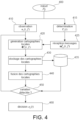
- FIG. 4 schematically represents a flowchart of the radio resource management method according to an embodiment of the present invention.
- the node N j determines at step 415 its neighborhood V j ( t ) at time t in the sense of a metric as described later, and receives at 425 the messages m i , j k t f network nodes belonging to this neighborhood.
- the detection of a variation in the mapping can be obtained from the KL divergence (Kullback-Leibler divergence) between two successive maps.
- KL divergence Kullback-Leibler divergence
- a significant variation will be detected if: [Math.8] ⁇ k ⁇ 1 , ... , K tel que D KL ⁇ j k t f ⁇ j k t ⁇ 1 , f > ⁇ TH
- D KL is the KL divergence
- ⁇ TH is a positive real representing a predetermined variation threshold.
- the radio resource management policy followed by node N j is determined by means of reinforcement learning.
- a reinforcement learning method is a machine learning method in which an autonomous agent, immersed in an environment, learns actions to perform from experiences, so as to optimize a cumulative reward over time. The agent makes decisions based on its state in the environment according to a Markovian decision process and the environment in return provides it with rewards based on the actions it performs at each moment.
- the agent is a node of the network, in this case the node N j , and the state of the node in the environment V j ( t ) is represented by the local mapping increased ⁇ j a t f
- the objective of learning here is to determine the radio resource management strategy . ⁇ j , ⁇ a j t ⁇ j a t f , i.e. the probability for the node to decide to perform the action a j ( t ) ⁇ A where A is the set of possible actions when the augmented local mapping is ⁇ j a t f .
- the set ⁇ of parameters parameterizing the probability distribution ⁇ j , ⁇ a j t ⁇ j a t f , as well as the fusion parameters, for example matrices W q , j h , W k , j h , W v , j h , W ⁇ occurring in the third embodiment are learned by means of end -to- end learning, that is to say concerning both the combination module 330 and the decision module 340.
- the learning can be carried out, in a manner known per se, by a policy gradient method described in the work by RS Sutton entitled “Reinforcement Learning” published by MIT Press in 2018.
- each node N j can determine its neighborhood (see step 415), and therefore the nodes which will participate in the message passing service.
- the metric ⁇ can be a cosine similarity based on a scalar product of normed vectors.
- ⁇ can be viewed as a classification process where ⁇ ( o i , o j ) defines the probability that observation o j is in the same class as o i .
- the classification operator can be trained online in a centralized and supervised manner as shown in Fig. 5 .
- the node N j collects the local observations of the set U of nodes in the network or of a subset consisting for example of those which are within reception range of N j . These local observations are represented by vectors o i .
- vectors are then subject to pre-processing (for example normalization) in 520 before being projected into a reduced-dimensional representation space in 530.
- pre-processing for example normalization
- a K-means clustering algorithm, 540 then makes it possible to group the nodes in the form of aggregates and then to assign, 550, the same label to the nodes of the same aggregate.
- a classifier can finally be trained offline in a supervised manner on the node-label pairs thus created, 560.
- the classifier can determine for a given node, N j , the nodes of the network or a subset of it that belong to the same aggregate as N j . These nodes form the neighborhood V j ( t ) of N j .
- the method of managing the radio resources of a cellular network from a local mapping augmented in each node of the network or even in nodes of a certain type only allows decisions to be made in a distributed manner by taking into account the heterogeneity of the latter.
- a frequency range for example sub-6 GHz
- it can be transferred to combination and decision modules operating in another frequency range (millimeter) for a continuation and adaptation of the learning to this other range.
- the transferability of the parameters thus makes it possible to accelerate the learning phase in a new environment.
- the first example concerns the association of user equipment (UEs) in a 5G network.
- UEs user equipment
- an association method aims to determine, for each mobile terminal, the base station (in other words the cell) which will have to serve it, taking into account the needs of all users (throughput, signal-to-noise ratio, latency, etc.) and the constraints relating to the base stations (maximum transmission power, interference level, available bandwidth, etc.).
- the 5G network has N m small cells equipped with SBS base stations operating in the millimeter band and N s macro cells equipped with MBS base stations in the sub-6 GHz band.
- U ( t ) The set of user terminals is noted here U ( t ) and that of access points, of cardinal N m + N s is noted S .
- Each user terminal or UE N j ⁇ U ( t ) can perform an action a j ( t ) ⁇ A corresponding to a request for association with a base station (SBS or MBS).
- A is the set of possible association requests, corresponding here in a one-to-one manner to the set S of base stations.
- the neighborhood V j ( t ) is then determined as described previously in relation to the Fig. 5 .
- the augmented local mapping ⁇ j a t f is obtained by merging the local maps, by expressions (6) and (7).
- the parameters ⁇ parameterizing the strategy ⁇ j , ⁇ a j t ⁇ j a t f are chosen in such a way as to maximize the reward over time, for example maximizing the flow rates or QoS levels of the different communications, or minimizing the handover frequency.
- the second example concerns the positioning of mobile access points or MAPs ( Mobile Access Points ), for example access points installed on drones or UAVs ( Unmanned Aerial Vehicles ) in a 5G network.
- MAPs Mobile Access Points
- UAVs Unmanned Aerial Vehicles
- Such mobile access points allow for rapid deployment and reconfiguration of a network, for example in emergency situations or in a theater of operations.
- Managing radio resources in such a context, in particular the number of drones and their positioning, is particularly complex due to the mobility of both UEs and MAPs.
- the MAPs operate in the millimeter frequency range and are directly connected to the backhaul network.
- the network also includes N s MBS base stations in the sub-6 GHz band.
- N s MBS base stations in the sub-6 GHz band.
- U ( t ) the set of user terminals each user terminal is assumed to have 2 antennas allowing it to establish either a link with a MAP or a link with an MBS.
- the set of access points S is of cardinality N m + 1 ( N m MAPs and an MBS), the number of MAPs being chosen equal to the number of aggregates, N c ( t ) , identified in the network.
- These aggregates can therefore be denoted by C b ( t ) , b ⁇ ⁇ 1,..., N c ( t ) ⁇ , each aggregate b consisting of user equipments N j , j ⁇ C b ( t ) .
- Each mobile access point MAP b can take a decision a b ( t ) ⁇ A where A is the set of possible movement actions. For example, this set can consist of 6 incremental movements (positive and negative along the 3 axes X,Y,Z) and a stationary state (no movement at time t ).
- This score reflects the correlation between the dynamics of the mobile access point and those of the UEs belonging to the aggregate.
- the mobile access point MAP b makes a decision a b ( t ) ⁇ A using the strategy ⁇ b , ⁇ a b t ⁇ b a t f .
- the set ⁇ of parameters parameterizing the probability distribution ⁇ b , ⁇ a b t ⁇ b a t f , as well as the fusion parameters, namely the matrices W q , b h , W k , b h , W v , b h , W ⁇ are learned using end-to-end reinforcement learning, aiming to maximize a reward over time.
- reward maximization can be expressed as maximizing the throughput or QoS levels of the different communications, or minimizing the handover frequency.
Landscapes
- Engineering & Computer Science (AREA)
- Computer Networks & Wireless Communication (AREA)
- Signal Processing (AREA)
- Artificial Intelligence (AREA)
- Computer Vision & Pattern Recognition (AREA)
- Databases & Information Systems (AREA)
- Evolutionary Computation (AREA)
- Medical Informatics (AREA)
- Software Systems (AREA)
- Mobile Radio Communication Systems (AREA)
Claims (10)
- Verfahren zur Verwaltung von Funkressourcen in einem zellulären Netzwerk, das eine Vielzahl von Knoten umfasst, wobei für jeden Knoten von Interesse des Netzwerkes eine Nachbarschaft dieses Knotens von Interesse bestimmt wird, wobei jeder Knoten der Nachbarschaft eine lokale Beobachtung seiner Umgebung durchführt und eine Vielzahl von Funkmerkmalen extrahiert, dadurch gekennzeichnet, dass:- jeder Knoten der Nachbarschaft jedes der Funkmerkmale in Form einer Nachricht codiert und dies Nachricht an den betreffenden Knoten überträgt;- der Knoten von Interesse eine lokale Kartierung jedes Funkmerkmals durch Aggregation der Meldungen erzeugt, die dieses Funkmerkmal kodieren;- der Knoten von Interesse die lokalen Kartierungen mithilfe von Fusionsparametern fusioniert, um eine hybride lokale Kartierung der verschiedenen Funkmerkmale zu erzeugen;- der Knoten von Interesse zu jedem Zeitpunkt entscheidet, eine Aktion aus einer endlichen Reihe möglicher Aktionen auszuführen, basierend auf der genannten hybriden lokalen Kartierung und einer Strategie zur Verwaltung von Funkressourcen, die durch eine parametrisierte bedingte Wahrscheinlichkeitsverteilung jeder Aktion definiert ist, alle Fusionsparameter sowie alle Parameter der bedingten Wahrscheinlichkeitsverteilung, die durch Verstärkung gelernt werden, um eine Belohnung im Laufe der Zeit zu maximieren, wobei das Lernen von einer Zielfunktion des Netzes abhängt.
- Verfahren zur Verwaltung von Funkressourcen in einem zellulären Netzwerk nach Anspruch 1, dadurch gekennzeichnet, dass die zu maximierende Belohnung einer Summe von zu maximierenden Übertragungsraten oder Servicequalitätsniveaus auf Netzwerkkommunikationen oder einer zu minimierenden Übergabefrequenz oder einem zu minimierenden Energieverbrauch entspricht.
- Verfahren zur Verwaltung von Funkressourcen in einem zellulären Netzwerk nach Anspruch 1 oder 2, dadurch gekennzeichnet, dass die Nachbarschaft des Knotens von Interesse als eine Gruppe von Knoten definiert ist, die im Sinne einer Ähnlichkeitsmetrik, die in einem Raum zur Darstellung lokaler Beobachtungen operiert, dem Netzwerk benachbart sind.
- Verfahren zur Verwaltung von Funkressourcen in einem zellulären Netzwerk nach Anspruch 1 oder 2, dadurch gekennzeichnet, dass die Nachbarschaft des Knotens von Interesse mittels eines zuvor trainierten Klassifikators bestimmt wird, der in einem Raum arbeitet, in dem lokale Beobachtungen dargestellt werden.
- Verfahren zur Verwaltung von Funkressourcen in einem zellulären Netzwerk nach einem der vorhergehenden Ansprüche, dadurch gekennzeichnet, dass der Knoten von Interesse nur dann entscheidet, eine Aktion zu einem bestimmten Zeitpunkt durchzuführen, wenn eine der lokalen Kartierungen eines Funkmerkmals zu diesem Zeitpunkt von der lokalen Kartierung desselben Funkmerkmals zum vorherigen Zeitpunkt abweicht, wobei die Differenz zwischen den beiden lokalen Kartierungen mithilfe einer Kullback-Leibler-Divergenz gemessen wird.
- Verfahren zur Verwaltung von Funkressourcen in einem zellulären Netzwerk nach einem der Ansprüche 1 bis 4, dadurch gekennzeichnet, dass der Knoten von Interesse nur dann entscheidet, eine Aktion zu einem bestimmten Zeitpunkt durchzuführen, wenn sich die zu diesem Zeitpunkt vorliegende hybride lokale Kartierung von der zu einem früheren Zeitpunkt vorhandenen hybriden lokalen Kartierung unterscheidet, wobei die Differenz zwischen den beiden hybriden Kartierungen mithilfe einer Kullback-Leibler-Divergenz gemessen wird.
- Verfahren zur Verwaltung von Funkressourcen in einem zellulären Netzwerk nach einem der vorhergehenden Ansprüche, dadurch gekennzeichnet, dass die Fusion der lokalen Funkkartierungen einen Aufmerksamkeits-Kopf-Mechanismus H mit H < K verwendet, wobei K die Anzahl der Funkmerkmale ist.
- Verfahren zur Verwaltung von Funkressourcen in einem zellulären Netzwerk nach Anspruch 7, dadurch gekennzeichnet, dass die hybride lokale Kartierung anhand


- Verfahren zur Verwaltung von Funkressourcen in einem zellulären Netzwerk nach Anspruch 8, dadurch gekennzeichnet, dass die Abfrage des Knotens von Interesse durch einen Vektor ausgedrückt wird, bei


- Verfahren zur Verwaltung von Funkressourcen in einem zellulären Netzwerk nach Anspruch 9, dadurch gekennzeichnet, dass der Wert zwischen der Abfrage


Applications Claiming Priority (1)
| Application Number | Priority Date | Filing Date | Title |
|---|---|---|---|
| FR2210430A FR3140729B1 (fr) | 2022-10-11 | 2022-10-11 | Méthode de gestion de ressources radio dans un réseau cellulaire au moyen d’une cartographie hybride de caractéristiques radio |
Publications (2)
| Publication Number | Publication Date |
|---|---|
| EP4354949A1 EP4354949A1 (de) | 2024-04-17 |
| EP4354949B1 true EP4354949B1 (de) | 2025-04-16 |
Family
ID=85278028
Family Applications (1)
| Application Number | Title | Priority Date | Filing Date |
|---|---|---|---|
| EP23202765.6A Active EP4354949B1 (de) | 2022-10-11 | 2023-10-10 | Verfahren zur verwaltung von funk-ressourcen in einem mobilen netzwerk mittels hybrid-kartierung von funk-eigenschaften |
Country Status (3)
| Country | Link |
|---|---|
| US (1) | US20240137956A1 (de) |
| EP (1) | EP4354949B1 (de) |
| FR (1) | FR3140729B1 (de) |
Family Cites Families (11)
| Publication number | Priority date | Publication date | Assignee | Title |
|---|---|---|---|---|
| KR100684305B1 (ko) * | 2003-07-18 | 2007-02-16 | 한국전자통신연구원 | 무선 휴대 인터넷 시스템에서의 무선자원 할당 방법 및 장치 |
| DK2381728T3 (da) * | 2006-08-21 | 2013-10-07 | Interdigital Tech Corp | Planlægning og signalering af dynamisk ressourceallokering for en variabel datahastighedstjeneste i LTE |
| WO2012072445A1 (en) * | 2010-12-03 | 2012-06-07 | Huawei Technologies Sweden Ab | Method and apparatus of communications |
| KR101607179B1 (ko) * | 2011-06-10 | 2016-03-29 | 후아웨이 테크놀러지 컴퍼니 리미티드 | 채널 품질 표시를 정정하는 방법 및 장치 |
| CN109845310B (zh) * | 2016-10-13 | 2021-10-22 | 华为技术有限公司 | 利用强化学习进行无线资源管理的方法和单元 |
| US10701641B2 (en) * | 2017-10-13 | 2020-06-30 | Apple Inc. | Interference mitigation in ultra-dense wireless networks |
| EP3788815A1 (de) * | 2018-05-02 | 2021-03-10 | Telefonaktiebolaget Lm Ericsson (Publ) | Erster netzwerkknoten, dritter netzwerkknoten und damit ausgeführte verfahren zur handhabung einer leistung eines funkzugangsnetzwerks |
| US11665777B2 (en) * | 2018-09-28 | 2023-05-30 | Intel Corporation | System and method using collaborative learning of interference environment and network topology for autonomous spectrum sharing |
| CN111698789B (zh) * | 2019-03-15 | 2022-05-13 | 华为技术有限公司 | 通信系统中的调度方法、装置及存储介质 |
| US11490273B2 (en) * | 2020-04-30 | 2022-11-01 | ANDRO Computational Solutions, LLC | Transceiver with machine learning for generation of communication parameters and cognitive resource allocation |
| CN114980122B (zh) * | 2022-05-05 | 2025-05-13 | 南京航空航天大学 | 一种小样本射频指纹智能识别系统与方法 |
-
2022
- 2022-10-11 FR FR2210430A patent/FR3140729B1/fr active Active
-
2023
- 2023-10-10 US US18/484,081 patent/US20240137956A1/en active Pending
- 2023-10-10 EP EP23202765.6A patent/EP4354949B1/de active Active
Also Published As
| Publication number | Publication date |
|---|---|
| FR3140729A1 (fr) | 2024-04-12 |
| US20240137956A1 (en) | 2024-04-25 |
| FR3140729B1 (fr) | 2024-10-18 |
| EP4354949A1 (de) | 2024-04-17 |
Similar Documents
| Publication | Publication Date | Title |
|---|---|---|
| EP3825919B1 (de) | Verfahren zur zuordnung von benutzergeräten in einem zellularen netz mittels lernen durch multi-agenten-verstärkung | |
| EP3066565B1 (de) | Verfahren und computerprogramm zur ex-situ-ausführung von computeraufgaben eines elements einer funkvorrichtung | |
| US10965538B2 (en) | Systems and methods of network analysis and characterization | |
| CN118945689A (zh) | 一种信息处理方法及相关设备 | |
| EP3703463B1 (de) | Zugriffsmethode durch mehrfachverbindung mit einem netz | |
| WO2023011371A1 (en) | Method and system for configuring a threshold value for a handover parameter of a wireless communication system | |
| EP3979717A1 (de) | Verfahren zur zuordnung von benutzergeräten in einem zellularen netz gemäss einer politk der übertragbaren zuordnung | |
| Yuvaraj et al. | Binary flower pollination (BFP) approach to handle the dynamic networking conditions to deliver uninterrupted connectivity | |
| US12501279B2 (en) | Systems and methods for configuring a network node based on a radio frequency environment | |
| EP4422137A1 (de) | Verfahren zur optimierung einer änderung eines ad-hoc-edge-netzwerks mit ressourcenbewusster dienstzuweisungsstrategie und system zur durchführung eines solchen verfahrens | |
| Salehi et al. | Flash-and-prune: Federated learning for automated selection of high-band mmwave sectors using model pruning | |
| Shahina et al. | Similarity‐based clustering and data aggregation with independent component analysis in wireless sensor networks | |
| Fatahi-Bafqi et al. | Analytical framework for mmWave-enabled V2X caching | |
| EP4354949B1 (de) | Verfahren zur verwaltung von funk-ressourcen in einem mobilen netzwerk mittels hybrid-kartierung von funk-eigenschaften | |
| Jeganathan et al. | Trust‐Aware Routing Protocol Using Hierarchical Manta Ray Foraging Optimization Algorithm With Selfish Node Detection in MANET | |
| US11622322B1 (en) | Systems and methods for providing satellite backhaul management over terrestrial fiber | |
| EP4199462B1 (de) | Dynamische und gemeinsame implementierung von knotengruppierung und gruppenkonfigurationsauswahl in einem ad-hoc-mobilfunkkommunikationsnetzwerk | |
| Ghnaya et al. | Multi-agent advantage actor-critic learning for message content selection in cooperative perception networks | |
| EP4576700A1 (de) | Verfahren und vorrichtung zum aufbau eines digitalen netzwerk- zwillings eines kommunikationsnetzes | |
| Drainakis et al. | Distributed predictive QoS in automotive environments under concept drift | |
| Di Giacomo et al. | Edge-assisted gossiping learning: Leveraging v2v communications between connected vehicles | |
| Lakshminarayanan et al. | Efficient data collection in wireless sensor networks with block-wise compressive path constrained sensing in mobile sinks | |
| Del Testa et al. | A machine learning-based ETA estimator for Wi-Fi transmissions | |
| Diwakaran et al. | An intelligent data aware and energy censoring scheme for wireless sensor networks | |
| Hajdú-Szücs et al. | Ensemble graph attention networks for cellular network analytics: From model creation to explainability |
Legal Events
| Date | Code | Title | Description |
|---|---|---|---|
| PUAI | Public reference made under article 153(3) epc to a published international application that has entered the european phase |
Free format text: ORIGINAL CODE: 0009012 |
|
| STAA | Information on the status of an ep patent application or granted ep patent |
Free format text: STATUS: REQUEST FOR EXAMINATION WAS MADE |
|
| 17P | Request for examination filed |
Effective date: 20231010 |
|
| AK | Designated contracting states |
Kind code of ref document: A1 Designated state(s): AL AT BE BG CH CY CZ DE DK EE ES FI FR GB GR HR HU IE IS IT LI LT LU LV MC ME MK MT NL NO PL PT RO RS SE SI SK SM TR |
|
| RAP3 | Party data changed (applicant data changed or rights of an application transferred) |
Owner name: COMMISSARIAT A L'ENERGIE ATOMIQUE ET AUX ENERGIESALTERNATIVES |
|
| GRAP | Despatch of communication of intention to grant a patent |
Free format text: ORIGINAL CODE: EPIDOSNIGR1 |
|
| STAA | Information on the status of an ep patent application or granted ep patent |
Free format text: STATUS: GRANT OF PATENT IS INTENDED |
|
| RIC1 | Information provided on ipc code assigned before grant |
Ipc: H04W 24/10 20090101ALN20241211BHEP Ipc: H04W 24/08 20090101ALN20241211BHEP Ipc: H04W 24/02 20090101ALI20241211BHEP Ipc: H04W 16/18 20090101ALI20241211BHEP Ipc: H04W 28/02 20090101AFI20241211BHEP |
|
| INTG | Intention to grant announced |
Effective date: 20250103 |
|
| GRAS | Grant fee paid |
Free format text: ORIGINAL CODE: EPIDOSNIGR3 |
|
| GRAA | (expected) grant |
Free format text: ORIGINAL CODE: 0009210 |
|
| STAA | Information on the status of an ep patent application or granted ep patent |
Free format text: STATUS: THE PATENT HAS BEEN GRANTED |
|
| AK | Designated contracting states |
Kind code of ref document: B1 Designated state(s): AL AT BE BG CH CY CZ DE DK EE ES FI FR GB GR HR HU IE IS IT LI LT LU LV MC ME MK MT NL NO PL PT RO RS SE SI SK SM TR |
|
| REG | Reference to a national code |
Ref country code: GB Ref legal event code: FG4D Free format text: NOT ENGLISH |
|
| REG | Reference to a national code |
Ref country code: CH Ref legal event code: EP Ref country code: DE Ref legal event code: R096 Ref document number: 602023002952 Country of ref document: DE |
|
| REG | Reference to a national code |
Ref country code: IE Ref legal event code: FG4D Free format text: LANGUAGE OF EP DOCUMENT: FRENCH |
|
| REG | Reference to a national code |
Ref country code: NL Ref legal event code: MP Effective date: 20250416 |
|
| PG25 | Lapsed in a contracting state [announced via postgrant information from national office to epo] |
Ref country code: NL Free format text: LAPSE BECAUSE OF FAILURE TO SUBMIT A TRANSLATION OF THE DESCRIPTION OR TO PAY THE FEE WITHIN THE PRESCRIBED TIME-LIMIT Effective date: 20250416 |
|
| REG | Reference to a national code |
Ref country code: AT Ref legal event code: MK05 Ref document number: 1786706 Country of ref document: AT Kind code of ref document: T Effective date: 20250416 |
|
| PG25 | Lapsed in a contracting state [announced via postgrant information from national office to epo] |
Ref country code: PT Free format text: LAPSE BECAUSE OF FAILURE TO SUBMIT A TRANSLATION OF THE DESCRIPTION OR TO PAY THE FEE WITHIN THE PRESCRIBED TIME-LIMIT Effective date: 20250818 Ref country code: FI Free format text: LAPSE BECAUSE OF FAILURE TO SUBMIT A TRANSLATION OF THE DESCRIPTION OR TO PAY THE FEE WITHIN THE PRESCRIBED TIME-LIMIT Effective date: 20250416 Ref country code: ES Free format text: LAPSE BECAUSE OF FAILURE TO SUBMIT A TRANSLATION OF THE DESCRIPTION OR TO PAY THE FEE WITHIN THE PRESCRIBED TIME-LIMIT Effective date: 20250416 |
|
| REG | Reference to a national code |
Ref country code: LT Ref legal event code: MG9D |
|
| PG25 | Lapsed in a contracting state [announced via postgrant information from national office to epo] |
Ref country code: NO Free format text: LAPSE BECAUSE OF FAILURE TO SUBMIT A TRANSLATION OF THE DESCRIPTION OR TO PAY THE FEE WITHIN THE PRESCRIBED TIME-LIMIT Effective date: 20250716 Ref country code: GR Free format text: LAPSE BECAUSE OF FAILURE TO SUBMIT A TRANSLATION OF THE DESCRIPTION OR TO PAY THE FEE WITHIN THE PRESCRIBED TIME-LIMIT Effective date: 20250717 |
|
| PG25 | Lapsed in a contracting state [announced via postgrant information from national office to epo] |
Ref country code: PL Free format text: LAPSE BECAUSE OF FAILURE TO SUBMIT A TRANSLATION OF THE DESCRIPTION OR TO PAY THE FEE WITHIN THE PRESCRIBED TIME-LIMIT Effective date: 20250416 |
|
| PG25 | Lapsed in a contracting state [announced via postgrant information from national office to epo] |
Ref country code: BG Free format text: LAPSE BECAUSE OF FAILURE TO SUBMIT A TRANSLATION OF THE DESCRIPTION OR TO PAY THE FEE WITHIN THE PRESCRIBED TIME-LIMIT Effective date: 20250416 |
|
| PG25 | Lapsed in a contracting state [announced via postgrant information from national office to epo] |
Ref country code: HR Free format text: LAPSE BECAUSE OF FAILURE TO SUBMIT A TRANSLATION OF THE DESCRIPTION OR TO PAY THE FEE WITHIN THE PRESCRIBED TIME-LIMIT Effective date: 20250416 |
|
| PG25 | Lapsed in a contracting state [announced via postgrant information from national office to epo] |
Ref country code: AT Free format text: LAPSE BECAUSE OF FAILURE TO SUBMIT A TRANSLATION OF THE DESCRIPTION OR TO PAY THE FEE WITHIN THE PRESCRIBED TIME-LIMIT Effective date: 20250416 |
|
| PG25 | Lapsed in a contracting state [announced via postgrant information from national office to epo] |
Ref country code: RS Free format text: LAPSE BECAUSE OF FAILURE TO SUBMIT A TRANSLATION OF THE DESCRIPTION OR TO PAY THE FEE WITHIN THE PRESCRIBED TIME-LIMIT Effective date: 20250716 |
|
| PG25 | Lapsed in a contracting state [announced via postgrant information from national office to epo] |
Ref country code: IS Free format text: LAPSE BECAUSE OF FAILURE TO SUBMIT A TRANSLATION OF THE DESCRIPTION OR TO PAY THE FEE WITHIN THE PRESCRIBED TIME-LIMIT Effective date: 20250816 |
|
| PG25 | Lapsed in a contracting state [announced via postgrant information from national office to epo] |
Ref country code: LV Free format text: LAPSE BECAUSE OF FAILURE TO SUBMIT A TRANSLATION OF THE DESCRIPTION OR TO PAY THE FEE WITHIN THE PRESCRIBED TIME-LIMIT Effective date: 20250416 |
|
| PGFP | Annual fee paid to national office [announced via postgrant information from national office to epo] |
Ref country code: DE Payment date: 20251020 Year of fee payment: 3 |
|
| PG25 | Lapsed in a contracting state [announced via postgrant information from national office to epo] |
Ref country code: DK Free format text: LAPSE BECAUSE OF FAILURE TO SUBMIT A TRANSLATION OF THE DESCRIPTION OR TO PAY THE FEE WITHIN THE PRESCRIBED TIME-LIMIT Effective date: 20250416 Ref country code: SM Free format text: LAPSE BECAUSE OF FAILURE TO SUBMIT A TRANSLATION OF THE DESCRIPTION OR TO PAY THE FEE WITHIN THE PRESCRIBED TIME-LIMIT Effective date: 20250416 |
|
| PGFP | Annual fee paid to national office [announced via postgrant information from national office to epo] |
Ref country code: FR Payment date: 20251024 Year of fee payment: 3 |
|
| REG | Reference to a national code |
Ref country code: DE Ref legal event code: R097 Ref document number: 602023002952 Country of ref document: DE |
|
| PG25 | Lapsed in a contracting state [announced via postgrant information from national office to epo] |
Ref country code: CZ Free format text: LAPSE BECAUSE OF FAILURE TO SUBMIT A TRANSLATION OF THE DESCRIPTION OR TO PAY THE FEE WITHIN THE PRESCRIBED TIME-LIMIT Effective date: 20250416 |
|
| PG25 | Lapsed in a contracting state [announced via postgrant information from national office to epo] |
Ref country code: EE Free format text: LAPSE BECAUSE OF FAILURE TO SUBMIT A TRANSLATION OF THE DESCRIPTION OR TO PAY THE FEE WITHIN THE PRESCRIBED TIME-LIMIT Effective date: 20250416 |
|
| PG25 | Lapsed in a contracting state [announced via postgrant information from national office to epo] |
Ref country code: SK Free format text: LAPSE BECAUSE OF FAILURE TO SUBMIT A TRANSLATION OF THE DESCRIPTION OR TO PAY THE FEE WITHIN THE PRESCRIBED TIME-LIMIT Effective date: 20250416 |
|
| PG25 | Lapsed in a contracting state [announced via postgrant information from national office to epo] |
Ref country code: IT Free format text: LAPSE BECAUSE OF FAILURE TO SUBMIT A TRANSLATION OF THE DESCRIPTION OR TO PAY THE FEE WITHIN THE PRESCRIBED TIME-LIMIT Effective date: 20250416 |
|
| PLBE | No opposition filed within time limit |
Free format text: ORIGINAL CODE: 0009261 |
|
| STAA | Information on the status of an ep patent application or granted ep patent |
Free format text: STATUS: NO OPPOSITION FILED WITHIN TIME LIMIT |
|
| REG | Reference to a national code |
Ref country code: CH Ref legal event code: L10 Free format text: ST27 STATUS EVENT CODE: U-0-0-L10-L00 (AS PROVIDED BY THE NATIONAL OFFICE) Effective date: 20260225 |
|
| PG25 | Lapsed in a contracting state [announced via postgrant information from national office to epo] |
Ref country code: RO Free format text: LAPSE BECAUSE OF FAILURE TO SUBMIT A TRANSLATION OF THE DESCRIPTION OR TO PAY THE FEE WITHIN THE PRESCRIBED TIME-LIMIT Effective date: 20250416 |
|
| 26N | No opposition filed |
Effective date: 20260119 |