EP4164905B1 - Enjoliveur de porte de véhicule automobile - Google Patents
Enjoliveur de porte de véhicule automobile Download PDFInfo
- Publication number
- EP4164905B1 EP4164905B1 EP21732958.0A EP21732958A EP4164905B1 EP 4164905 B1 EP4164905 B1 EP 4164905B1 EP 21732958 A EP21732958 A EP 21732958A EP 4164905 B1 EP4164905 B1 EP 4164905B1
- Authority
- EP
- European Patent Office
- Prior art keywords
- trim
- door
- lip
- motor vehicle
- lining
- Prior art date
- Legal status (The legal status is an assumption and is not a legal conclusion. Google has not performed a legal analysis and makes no representation as to the accuracy of the status listed.)
- Active
Links
Images


Classifications
-
- B—PERFORMING OPERATIONS; TRANSPORTING
- B60—VEHICLES IN GENERAL
- B60J—WINDOWS, WINDSCREENS, NON-FIXED ROOFS, DOORS, OR SIMILAR DEVICES FOR VEHICLES; REMOVABLE EXTERNAL PROTECTIVE COVERINGS SPECIALLY ADAPTED FOR VEHICLES
- B60J10/00—Sealing arrangements
- B60J10/70—Sealing arrangements specially adapted for windows or windscreens
- B60J10/74—Sealing arrangements specially adapted for windows or windscreens for sliding window panes, e.g. sash guides
- B60J10/75—Sealing arrangements specially adapted for windows or windscreens for sliding window panes, e.g. sash guides for sealing the lower part of the panes
-
- B—PERFORMING OPERATIONS; TRANSPORTING
- B60—VEHICLES IN GENERAL
- B60J—WINDOWS, WINDSCREENS, NON-FIXED ROOFS, DOORS, OR SIMILAR DEVICES FOR VEHICLES; REMOVABLE EXTERNAL PROTECTIVE COVERINGS SPECIALLY ADAPTED FOR VEHICLES
- B60J10/00—Sealing arrangements
- B60J10/20—Sealing arrangements characterised by the shape
- B60J10/26—Sealing arrangements characterised by the shape characterised by the surface shape
- B60J10/265—Sealing arrangements characterised by the shape characterised by the surface shape the surface being primarily decorative
-
- B—PERFORMING OPERATIONS; TRANSPORTING
- B60—VEHICLES IN GENERAL
- B60R—VEHICLES, VEHICLE FITTINGS, OR VEHICLE PARTS, NOT OTHERWISE PROVIDED FOR
- B60R13/00—Elements for body-finishing, identifying, or decorating; Arrangements or adaptations for advertising purposes
- B60R13/02—Internal Trim mouldings ; Internal Ledges; Wall liners for passenger compartments; Roof liners
- B60R13/0237—Side or rear panels
- B60R13/0243—Doors
-
- B—PERFORMING OPERATIONS; TRANSPORTING
- B60—VEHICLES IN GENERAL
- B60R—VEHICLES, VEHICLE FITTINGS, OR VEHICLE PARTS, NOT OTHERWISE PROVIDED FOR
- B60R13/00—Elements for body-finishing, identifying, or decorating; Arrangements or adaptations for advertising purposes
- B60R13/02—Internal Trim mouldings ; Internal Ledges; Wall liners for passenger compartments; Roof liners
- B60R2013/0293—Connection or positioning of adjacent panels
Definitions
- the invention relates to the field of motor vehicles, and more particularly to glass doors for motor vehicles.
- motor vehicle doors comprise, in a lower part of the door, an outer panel and, on the inside, a door lining.
- the lining also forms a window frame.
- a door trim is also arranged against the inner panel, so as to cover and dress the door lining.
- the door trim comprises a panel, rigid or semi-rigid, and generally vertical, with an upper part curved by approximately 180°, so as to have an upper edge directed downwards. This edge is configured to engage with an upper edge of the door lining, directed upwards.
- the trim when mounting the trim, the latter, after having been placed in a close position, is moved according to a translation directed downwards combined with a rotation. This combination of movements can lead to a discontinuity between a lateral edge of the trim, resting on the door lining, and an adjacent window seal. This discontinuity forms an unsightly clearance reducing the perceived quality of the door.
- the published patent document EP 1 422 095 A2 discloses a trim element inserted into the window slot of a vehicle door, at a rear end of said slot. Thus, this element serves to fill an otherwise gaping space at a rear end of the door, with which a user of the vehicle is likely to be injured by snagging.
- the document EP 2 066 514 B1 discloses a vehicle door similar to the preamble of claim 1.
- the invention aims to overcome at least one of the drawbacks of the aforementioned state of the art. More particularly, the invention aims to improve the perceived quality of the interior of a vehicle door, and more particularly to improve the connection of the side edges of the trim with the rest of the door.
- the invention relates to a motor vehicle door, comprising: an exterior panel; a lining forming an interior panel arranged against the exterior panel, and a window frame; a window seal mounted on the window frame, with a lip against said window frame; a trim arranged against the interior panel and having a lateral edge with an upper end aligned with a lower end of the lip of the window seal; remarkable in that said door further comprises: a trim comprising a lip portion adjacent to the lower end of the lip of the window seal and to the upper end of the lateral edge of the trim.
- the lip portion of the trim has an external transverse profile identical to an external transverse profile of the lip of the window seal, so as to form a continuity of the external profile of said lip.
- the lower end of the lip of the window seal has a reduced section and fitted by the lip portion of the trim.
- the trim further comprises a support fixed to the interior panel under the trim.
- the support comprises a groove fitting an upper edge of the rebate of the interior panel.
- the lip portion of the trim is made of elastomer material overmolded onto the rigid plastic material support.
- the upper end of the lateral edge of the trim is set back vertically relative to an upper edge of said trim.
- the window seal is a fixed window seal.
- the invention also relates to a motor vehicle comprising at least two glass doors, remarkable in that at least one of the at least two glass doors is according to the invention.
- the measures of the invention are interesting in that they make it possible to improve the perceived quality of the interior of a motor vehicle door. More particularly, the quality of the door is improved at the junction between the lateral edge of the trim and the window seal, by reducing the clearance between the lip of the window seal and the upper end of the lateral edge of the trim, and despite the constraint of a combined translational and rotational movement of the trim during assembly. This is all the more true when the trim has an upper profile rising towards the rear (or possibly towards the front) of the vehicle. Such a profile in fact increases the amplitude of movement of the corresponding lateral edge during assembly of the trim.
- a longitudinal direction x is defined as the direction, when running front, of the vehicle.
- a vertical direction z is perpendicular to the longitudinal direction x, with the arrow extending from bottom to top.
- the interior and exterior are defined in relation to the passenger compartment of the vehicle, and according to the assembly of the parts in the vehicle.
- FIG 1 represents a motor vehicle according to the invention.
- the figure 2 shows a partial view of a right rear door of the vehicle from the figure 1 , interior view.
- the Figures 1 and 2 will be described together.
- the motor vehicle 1 comprises a body structure 3 in which are mounted, on each side of said structure 3, at least one door 5 of the vehicle 1.
- the vehicle 1 more specifically comprises at least two glazed doors 5.
- the doors 5 are four in number, namely two front doors 5A and two rear doors 5B, each door (5, 5A, 5B) being able to comprise a sliding window 7A and a fixed window 7B, the windows (7A, 7B) being separated by a retaining bar 9.
- Each door (5, 5A, 5B) further comprises an outer panel 11 fixed to a lining 13 forming an inner panel, the lining 13 being arranged against the outer panel 11.
- the door 5 further comprises a lower portion 5C and an upper portion 5D, the upper portion 5D receiving the windows (7A, 7B).
- the lining 13 forms a window frame 15 around the windows (7A, 7B).
- the door 5 lining 13 supports a seal 17 mounted on the edge of the door 5, the seal 17 serving to cushion the closing of the door (5, 5A, 5B) and to limit the introduction of noise, dust and humidity into the passenger compartment.
- the door (5, 5A, 5B) further comprises a window seal 19 mounted on the window frame 15, the seal 19 comprising a lip 19A positioned against the window frame 15.
- the seal 19 is commonly referred to as a window slide in that this seal 19 forms a slot receiving the window, advantageously the window seal 19 is a fixed window seal 19.
- the door (5, 5A, 5B) of the vehicle 1 further comprises a trim 21 positioned against the lining 13, at the level of the lower portion 5C of the door 5.
- the trim 21 comprises a lateral edge 21A of which an upper end 21A.1 is aligned with a lower end 19A.1 of the lip 19A of the window seal 19.
- the trim 21 further comprises a support 25 made of a more rigid material and covered with a covering material 23, the support 25 forming in particular the lateral edge 21A and overlapping an upper edge of the rebate (not visible in this figure) of the lining 13.
- the upper end 21A.1 of the lateral edge 21A of the trim 21 is set back, vertically, relative to an upper edge 21B of the trim 21.
- a trim 27 Between the window seal 19 and the lateral edge 21A of the trim 21 is a trim 27 according to the invention, and more particularly a lip portion 29 of said trim 27.
- This lip portion 29 is adjacent to the lower end 19A.1 of the lip 19A of the window seal 19, while being adjacent to the upper end 21A.1 of the lateral edge 21A of the trim 21.
- the lip portion 29 of the trim 27 has an external transverse profile identical to an external transverse profile of the lip 19A of the window seal 19, so as to form a continuity of the external profile of the lip 19A.
- FIG. 3 is an enlargement of the mounting area between the window seal and the door lining.
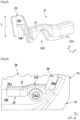
- FIGS. 4 And 5 show two views of the hubcap according to the invention, respectively a view of an inner face of the hubcap and a perspective view of said hubcap.
- figure 6 shows the hubcap mounted on the trim. These Figures 4 to 6 will be described together.
- the trim is adapted to a rear door of a motor vehicle.
- the trim 27 comprises the lip portion 29 and a support 31.
- the lip portion 29 of the trim 27 extends in a main direction that is vertical or inclined by less than 30° relative to the vertical direction z.
- the lip portion 29 extends over a length L I less than or equal to 30 mm.
- the lip portion 29 comprises a first element 29A forming the external transverse profile, and a second internal element 29B forming a tab which is positioned against the lower end of the lip of the window seal (this seal not being shown in the Figures 4 to 6 ).
- the lip portion 29 of the trim 27 is advantageously made of elastomer material.
- the invention also relates to a method of mounting the motor vehicle door, as described in Figures 1 to 6 .
- This process includes the following steps, described in correlation with the Figures 1 to 6 .
- the window seal 19 is mounted on the window frame 15, the lower portion 19B of said seal 19 being fixed on the upper edge of the rebate 13A of the door lining 13 (5, 5A, 5B).
- the lip 19A of the window seal 19 extends along the window frame 15.
- the fixed window 7B is then mounted in the door (5, 5A, 5B), it bears on the lower portion 19B of the window seal 19, on the lip 19A and on the window frame 15.
- the trim 27 is then mounted on the upper edge of the rebate 13A of the lining 13, so that the support 31 of the trim 27 fits said upper edge 13A of the lining 13 and the lip portion 29 of the trim 27 covers the lower end 19A.1 with reduced section of the lip 19A of the window seal 19.
- trim 21 of the door (5, 5A, 5B) is mounted on the lining 13 by a combined translational and rotational movement of said trim 21.
- the presence of the trim 27 makes it possible to fill the gap between the trim 21 and the lip 19A of the window seal 19.
Landscapes
- Engineering & Computer Science (AREA)
- Mechanical Engineering (AREA)
- Seal Device For Vehicle (AREA)
- Vehicle Interior And Exterior Ornaments, Soundproofing, And Insulation (AREA)
Description
- La présente invention revendique la priorité de la demande
française 2006276 déposée le 16 juin 2020 - L'invention a trait au domaine des véhicules automobiles, et plus particulièrement à des portes vitrées de véhicules automobiles.
- Classiquement, les portes de véhicules automobiles comprennent, dans une partie inférieure de la porte, un panneau extérieur et, à l'intérieur, une doublure de porte. La doublure forme également un cadre de vitre. De plus, une garniture de porte est également disposée contre le panneau intérieur, de manière à recouvrir et à habiller la doublure de porte.
- La garniture de porte comprend un panneau, rigide ou semi-rigide, et généralement vertical, avec une partie supérieure courbée suivant environ 180°, de manière à présenter un bord supérieur dirigé vers le bas. Ce bord est configuré pour s'engager avec un bord supérieur de la doublure de porte, dirigé vers le haut. En pratique, lors du montage de la garniture, celle-ci, après avoir été mise en position rapprochée, est déplacée suivant une translation dirigée vers le bas combinée à une rotation. Cette combinaison de mouvements peut conduire à une discontinuité entre un bord latéral de la garniture, en appui sur la doublure de porte, et un joint de vitre adjacent. Cette discontinuité forme un jeu inesthétique diminuant la qualité perçue de la porte.
- Le document de brevet publié
EP 1 422 095 A2 divulgue un élément d'habillage inséré dans la fente de passage de la vitre d'une porte de véhicule, à une extrémité arrière de ladite fente. Ainsi, cet élément sert à combler un espace sinon béant à une extrémité arrière de la porte, avec lequel un utilisateur du véhicule est susceptible de se blesser par accrochage. Le documentEP 2 066 514 B1 divulgue une porte de véhicule similaire au préambule de la revendication 1. - L'invention a pour objectif de pallier au moins un des inconvénients de l'état de la technique susmentionné. Plus particulièrement, l'invention a pour objectif d'améliorer la qualité perçue de l'intérieur d'une porte de véhicule, et plus particulièrement encore d'améliorer le raccordement des bords latéraux de la garniture avec le reste de la porte.
- L'invention a pour objet une porte de véhicule automobile, comprenant : un panneau extérieur ; une doublure formant un panneau intérieur disposé contre le panneau extérieur, et un cadre de vitre ; un joint de vitre monté sur le cadre de vitre, avec une lèvre contre ledit cadre de vitre ; une garniture disposée contre le panneau intérieur et présentant un bord latéral avec une extrémité supérieure alignée avec une extrémité inférieure de la lèvre du joint de vitre ; remarquable en ce que ladite porte comprend, en outre : un enjoliveur comprenant une portion de lèvre adjacente à l'extrémité inférieure de la lèvre du joint de vitre et à l'extrémité supérieure du bord latéral de la garniture.
- Selon l'invention, la portion de lèvre de l'enjoliveur présente un profil transversal extérieur identique à un profil transversal extérieur de la lèvre du joint de vitre, de manière à former une continuité du profil extérieur de ladite lèvre. Selon un mode avantageux de l'invention, l'extrémité inférieure de la lèvre du joint de vitre présente une section réduite et chaussée par la portion de lèvre de l'enjoliveur.
- Selon un mode avantageux de l'invention, la portion de lèvre de l'enjoliveur s'étend suivant une direction principale verticale ou inclinée de moins de 30° par rapport à une direction verticale, sur une longueur qui est inférieure ou égale à 30mm.
- Selon un mode avantageux de l'invention, l'enjoliveur comprend, en outre, un support fixé au panneau intérieur sous la garniture.
- Selon un mode avantageux de l'invention, le support comprend une rainure chaussant un bord supérieur de feuillure du panneau intérieur.
- Selon un mode avantageux de l'invention, la portion de lèvre de l'enjoliveur est en matériau élastomère surmoulé sur le support en matériau plastique rigide.
- Selon un mode avantageux de l'invention, l'extrémité supérieure du bord latéral de la garniture est en retrait verticalement par rapport à un bord supérieur de ladite garniture.
- Selon un mode avantageux de l'invention, le joint de vitre est un joint de vitre fixe.
- L'invention a également pour objet un véhicule automobile comprenant au moins deux portes vitrées, remarquable en ce qu'au moins une des aux moins deux portes vitrées est selon l'invention.
- Les mesures de l'invention sont intéressantes en ce qu'elles permettent d'améliorer la qualité perçue de l'intérieur d'une porte de véhicule automobile. Plus particulièrement, la qualité de la porte est améliorée au niveau de la jonction entre le bord latéral de la garniture et le joint de vitre, en diminuant le jeu entre la lèvre du joint de vitre et l'extrémité supérieure du bord latéral de la garniture, et malgré la contrainte d'un mouvement combiné de translation et de rotation de la garniture lors du montage. Ceci est d'autant plus vrai lorsque la garniture présente un profil supérieur remontant vers l'arrière (ou éventuellement vers l'avant) du véhicule. Un tel profil augmente en effet l'amplitude de mouvement du bord latéral correspondant lors du montage de la garniture.
- D'autres caractéristiques et avantages de la présente invention seront mieux compris à l'aide de la description et des dessins.
-
- [
Fig 1 ] est une vue en perspective depuis l'arrière d'un véhicule automobile selon l'invention ; - [
Fig 2 ] est une vue de l'intérieur d'une partie d'une porte arrière du véhicule automobile de lafigure 1 ; - [
Fig 3 ] est un agrandissement du montage d'un joint de vitre sur une doublure de porte selon l'invention ; - [
Fig 4 ] est une vue d'une face intérieure d'un enjoliveur selon l'invention ; - [
Fig 5 ] est une vue en perspective de l'enjoliveur de lafigure 4 ; - [
Fig 6 ] est un agrandissement du montage de l'enjoliveur desfigures 4 et5 sur la doublure de porte. - Les exemples décrits ci-après sont donnés à titre indicatif, mais d'autres applications ou modes de réalisation de l'invention non-décrits peuvent être envisagés. Sur ces figures, une direction longitudinale x est définie comme la direction, en marche avant, du véhicule. Une direction verticale z est perpendiculaire à la direction longitudinale x, la flèche s'étendant du bas vers le haut. L'intérieur et l'extérieur sont définis par rapport à l'habitacle du véhicule, et suivant le montage des pièces dans le véhicule.
- La
figure 1 représente un véhicule automobile selon l'invention. Lafigure 2 montre une vue partielle d'une porte arrière droite du véhicule de lafigure 1 , vue de l'intérieur. Lesfigures 1 et 2 seront décrites ensemble. - Le véhicule automobile 1 comprend une structure de carrosserie 3 dans laquelle sont montées, à chacun des côtés de ladite structure 3, au moins une porte 5 du véhicule 1. Le véhicule 1 comprend plus spécifiquement au moins deux portes 5 vitrées. Avantageusement, les portes 5 sont au nombre de quatre, soit deux portes avant 5A et deux portes arrière 5B, chaque porte (5, 5A, 5B) pouvant comprendre une vitre coulissante 7A et une vitre fixe 7B, les vitres (7A, 7B) étant séparées par une barre de maintien 9. Chaque porte (5, 5A, 5B) comprend, en outre, un panneau extérieur 11 fixé à une doublure 13 formant un panneau intérieur, la doublure 13 étant disposée contre le panneau extérieur 11. La porte 5 comprend, en outre, une portion inférieure 5C et une portion supérieure 5D, la portion supérieure 5D réceptionnant les vitres (7A, 7B). La doublure 13 forme autour des vitres (7A, 7B) un cadre de vitre 15.
- La doublure 13 de porte 5 supporte un joint d'étanchéité 17 monté sur le bord de la porte 5, le joint 17 servant à amortir la fermeture de la porte (5, 5A, 5B) et à limiter l'introduction de bruits, de poussières et d'humidité dans l'habitacle. La porte (5, 5A, 5B) comprend, en outre, un joint de vitre 19 monté sur le cadre de vitre 15, le joint 19 comprenant une lèvre 19A positionnée contre le cadre de vitre 15. Le joint 19 est couramment désigné coulisse de vitre en ce que ce joint 19 forme une fente recevant la vitre, avantageusement le joint de vitre 19 est un joint de vitre 19 fixe.
- La porte (5, 5A, 5B) du véhicule 1 comprend, en outre, une garniture 21 positionnée contre la doublure 13, au niveau de la portion inférieure 5C de la porte 5. La garniture 21 comprend un bord latéral 21A dont une extrémité supérieure 21A.1 est alignée avec une extrémité inférieure 19A.1 de la lèvre 19A du joint de vitre 19. La garniture 21 comprend, en outre, un support 25 en matériau plus rigide et recouvert d'un matériau d'habillage 23, le support 25 formant notamment le bord latéral 21A et chevauchant un bord supérieur de feuillure (non visible sur cette figure) de la doublure 13. Avantageusement, l'extrémité supérieure 21A.1 du bord latéral 21A de la garniture 21 est en retrait, verticalement, par rapport à un bord supérieur 21B de la garniture 21. Entre le joint de vitre 19 et le bord latéral 21A de la garniture 21 se trouve un enjoliveur 27 selon l'invention, et plus particulièrement une portion de lèvre 29 dudit enjoliveur 27. Cette portion de lèvre 29 est adjacente à l'extrémité inférieure 19A.1 de la lèvre 19A du joint de vitre 19, tout en étant adjacente à l'extrémité supérieure 21A.1 du bord latéral 21A de la garniture 21. De plus, la portion de lèvre 29 de l'enjoliveur 27 présente un profil transversal extérieur identique à un profil transversal extérieur de la lèvre 19A du joint de vitre 19, de manière à former une continuité du profil extérieur de la lèvre 19A.
- La
figure 3 est un agrandissement de la zone de montage entre le joint de vitre et la doublure de porte. - Sur cette figure, on peut voir partiellement un bord supérieur de feuillure 13A de la doublure 13 de porte (5, 5B), avec le cadre de vitre 15 et la vitre fixe 7B. Sur le cadre de vitre 15 est monté le joint de vitre 19. Ce joint 19 comprend la lèvre 19A qui s'étend dans la direction verticale z le long du cadre de vitre 15, et une portion inférieure 19B qui s'étend longitudinalement le long du bord supérieur de feuillure 13A de la doublure 13. La portion inférieure 19B du joint de vitre 19 va réceptionner une extrémité inférieure 7B.1 de la vitre fixe 7B, de manière à ce que la vitre fixe 7B soit maintenue sur la doublure 13. Une vis de fixation 7B.2 va permettre le maintien entre la vitre fixe 7B, la doublure 13 et le joint de vitre 19. Enfin, sur cette figure, on peut voir que l'extrémité inférieure 19A.1 de la lèvre 19A du joint de vitre 19 présente une section réduite, dont la fonction sera étudiée plus loin.
- Les
figures 4 et5 montrent deux vues de l'enjoliveur selon l'invention, respectivement une vue d'une face intérieure de l'enjoliveur et une vue en perspective dudit enjoliveur. Lafigure 6 montre l'enjoliveur monté sur la garniture. Cesfigures 4 à 6 seront décrites ensemble. Sur ces figures, l'enjoliveur est adapté à une porte arrière de véhicule automobile. - L'enjoliveur 27 comprend la portion de lèvre 29 et un support 31. La portion de lèvre 29 de l'enjoliveur 27 s'étend suivant une direction principale verticale ou inclinée de moins de 30° par rapport à la direction verticale z. De plus, la portion de lèvre 29 s'étend sur une longueur LI inférieure ou égale à 30mm. La portion de lèvre 29 comprend un premier élément 29A formant le profil transversal extérieur, et un deuxième élément interne 29B formant une patte qui se positionne contre l'extrémité inférieure de la lèvre du joint de vitre (ce joint n'étant pas représenté sur les
figures 4 à 6 ). Ainsi, l'extrémité inférieure à section réduite de la lèvre du joint de vitre est chaussée par la portion de lèvre 29 de l'enjoliveur 27. La portion de lèvre 29 de l'enjoliveur 27 est avantageusement réalisée en matériau élastomère. - Le support 31 de l'enjoliveur 27 est fixé à la doublure 13 formant le panneau intérieur, sous la garniture (la garniture n'étant pas représentée sur les
figures 4 à 6 ). Ce support 31 comprend une rainure 31A qui chausse le bord supérieur de feuillure 13A de la doublure 13. Le support 31 est avantageusement réalisé en matériau plastique rigide, la portion de lèvre 29, réalisée en matériau élastomère, étant avantageusement surmoulée sur le support 31. Avantageusement, le support 31 de l'enjoliveur 27 présente une courbure dans une portion arrière 31B, lorsque l'enjoliveur 27 est monté sur une doublure 13 de porte arrière, la portion arrière 31B étant apte à entourer la vis de fixation 7B.2. - L'invention se rapporte également à un procédé de montage de la porte de véhicule automobile, telle que décrite aux
figures 1 à 6 . Ce procédé comprend les étapes suivantes, décrites en corrélation avec lesfigures 1 à 6 . - Assemblage par ferrage du panneau extérieur 11 de la porte avec la doublure 13 qui forme notamment le cadre de vitre 15.
- Le joint de vitre 19 est monté sur le cadre de vitre 15, la portion inférieure 19B dudit joint 19 étant fixée sur le bord supérieur de feuillure 13A de la doublure 13 de porte (5, 5A, 5B). La lèvre 19A du joint de vitre 19 s'étend le long du cadre de vitre 15. La vitre fixe 7B est ensuite montée dans la porte (5, 5A, 5B), elle prend appui sur la portion inférieure 19B du joint de vitre 19, sur la lèvre 19A et sur le cadre de vitre 15.
- L'enjoliveur 27 est ensuite monté sur le bord supérieur de feuillure 13A de la doublure 13, de manière à ce que le support 31 de l'enjoliveur 27 chausse ledit bord supérieur 13A de la doublure 13 et que la portion de lèvre 29 de l'enjoliveur 27 recouvre l'extrémité inférieure 19A.1 à section réduite de la lèvre 19A du joint de vitre 19.
- Enfin, la garniture 21 de la porte (5, 5A, 5B) est montée sur la doublure 13 par un mouvement combiné en translation et en rotation de ladite garniture 21. La présence de l'enjoliveur 27 permet de combler le jeu entre la garniture 21 et la lèvre 19A du joint de vitre 19.
Claims (9)
- Porte (5, 5A, 5B) de véhicule automobile (1), comprenant :- un panneau extérieur (11) ;- une doublure (13) formant un panneau intérieur disposé contre le panneau extérieur (11), et un cadre de vitre (15) ;- un joint de vitre (19) monté sur le cadre de vitre (15), avec une lèvre (19A) contre ledit cadre de vitre (15) ;- une garniture (21) disposée contre le panneau intérieur et présentant un bord latéral (21A) avec une extrémité supérieure (21A.1) alignée avec une extrémité inférieure (19A.1) de la lèvre (19A) du joint de vitre (19) ;ladite porte (5, 5A, 5B) comprenant, en outre :- un enjoliveur (27) comprenant une portion de lèvre (29) adjacente à l'extrémité inférieure (19A.1) de la lèvre (19A) du joint de vitre (19) et à l'extrémité supérieure (21A.1) du bord latéral (21A) de la garniture (21), caractérisée en ce que la portion de lèvre (29) de l'enjoliveur (27) présente un profil transversal extérieur identique à un profil transversal extérieur de la lèvre (19A) du joint de vitre (19), de manière à former une continuité du profil extérieur de ladite lèvre (19A).
- Porte (5, 5A, 5B) de véhicule automobile (1) selon l'une des revendications 1, caractérisée en ce que l'extrémité inférieure (19A.1) de la lèvre (19A) du joint de vitre (19) présente une section réduite et chaussée par la portion de lèvre (29) de l'enjoliveur (27).
- Porte (5, 5A, 5B) de véhicule automobile (1) selon la revendication 1 ou 2, caractérisée en ce que la portion de lèvre (29) de l'enjoliveur (27) s'étend suivant une direction principale verticale ou inclinée de moins de 30° par rapport à une direction verticale (z), sur une longueur (LI) qui est inférieure ou égale à 30mm.
- Porte (5, 5A, 5B) de véhicule automobile (1) selon l'une des revendications 1 à 3, caractérisée en ce que l'enjoliveur (27) comprend, en outre, un support (31) fixé au panneau intérieur sous la garniture (21).
- Porte (5, 5A, 5B) de véhicule automobile (1) selon la revendication 4, caractérisée en ce que le support (31) comprend une rainure (31A) chaussant un bord supérieur de feuillure (13A) du panneau intérieur.
- Porte (5, 5A, 5B) de véhicule automobile (1) selon l'une des revendications 4 et 5, caractérisée en ce que la portion de lèvre (29) de l'enjoliveur (27) est en matériau élastomère surmoulé sur le support (31) en matériau plastique rigide.
- Porte (5, 5A, 5B) de véhicule automobile (1) selon l'une des revendications 1 à 6, caractérisée en ce que l'extrémité supérieure (21A.1) du bord latéral (21A) de la garniture (21) est en retrait verticalement par rapport à un bord supérieur (21B) de ladite garniture (21).
- Porte (5, 5A, 5B) de véhicule automobile (1) selon l'une des revendications 1 à 7, caractérisée en ce que le joint de vitre (19) est un joint de vitre (19) fixe.
- Véhicule automobile (1) comprenant au moins deux portes (5, 5A, 5B) vitrées, caractérisé en ce qu'au moins une des aux moins deux portes (5, 5A, 5B) vitrées est selon l'une des revendications 1 à 8.
Applications Claiming Priority (2)
| Application Number | Priority Date | Filing Date | Title |
|---|---|---|---|
| FR2006276A FR3111299B1 (fr) | 2020-06-16 | 2020-06-16 | Enjoliveur de porte de véhicule automobile |
| PCT/FR2021/050794 WO2021255357A1 (fr) | 2020-06-16 | 2021-05-10 | Enjoliveur de porte de véhicule automobile |
Publications (2)
| Publication Number | Publication Date |
|---|---|
| EP4164905A1 EP4164905A1 (fr) | 2023-04-19 |
| EP4164905B1 true EP4164905B1 (fr) | 2024-10-23 |
Family
ID=73642960
Family Applications (1)
| Application Number | Title | Priority Date | Filing Date |
|---|---|---|---|
| EP21732958.0A Active EP4164905B1 (fr) | 2020-06-16 | 2021-05-10 | Enjoliveur de porte de véhicule automobile |
Country Status (4)
| Country | Link |
|---|---|
| EP (1) | EP4164905B1 (fr) |
| CN (1) | CN115916563A (fr) |
| FR (1) | FR3111299B1 (fr) |
| WO (1) | WO2021255357A1 (fr) |
Citations (1)
| Publication number | Priority date | Publication date | Assignee | Title |
|---|---|---|---|---|
| EP2066514B1 (fr) * | 2006-09-27 | 2010-11-24 | Renault S.A.S. | Agencement de porte de vehicule automobile pour la liaison entre deux profiles |
Family Cites Families (8)
| Publication number | Priority date | Publication date | Assignee | Title |
|---|---|---|---|---|
| GB1220841A (en) | 1968-04-16 | 1971-01-27 | Automotive Prod Co Ltd | Improvements in or relating to valve operating mechanism for fluid pressure control systems |
| FR2703006B1 (fr) * | 1993-03-23 | 1995-05-05 | Renault | Porte de véhicule automobile. |
| JP3860356B2 (ja) * | 1999-03-31 | 2006-12-20 | 享栄エンジニアリング株式会社 | 自動車用ドア構造 |
| JP2002211247A (ja) * | 2001-01-16 | 2002-07-31 | Daihatsu Motor Co Ltd | 車両用ドアのガラスランシール構造 |
| DE20218156U1 (de) | 2002-11-22 | 2003-01-30 | Süddeutsche Aluminium Manufaktur GmbH, 89558 Böhmenkirch | Fensterschacht-Abdeckvorrichtung |
| JP5382014B2 (ja) * | 2011-02-09 | 2014-01-08 | 日産自動車株式会社 | ドアのシール構造 |
| JP5848313B2 (ja) * | 2013-11-28 | 2016-01-27 | トヨタ自動車株式会社 | 遮音部材及び車両用ドア構造 |
| JP6715016B2 (ja) * | 2016-02-04 | 2020-07-01 | 西川ゴム工業株式会社 | 自動車用ドアのシール構造 |
-
2020
- 2020-06-16 FR FR2006276A patent/FR3111299B1/fr active Active
-
2021
- 2021-05-10 EP EP21732958.0A patent/EP4164905B1/fr active Active
- 2021-05-10 CN CN202180043189.0A patent/CN115916563A/zh active Pending
- 2021-05-10 WO PCT/FR2021/050794 patent/WO2021255357A1/fr not_active Ceased
Patent Citations (1)
| Publication number | Priority date | Publication date | Assignee | Title |
|---|---|---|---|---|
| EP2066514B1 (fr) * | 2006-09-27 | 2010-11-24 | Renault S.A.S. | Agencement de porte de vehicule automobile pour la liaison entre deux profiles |
Also Published As
| Publication number | Publication date |
|---|---|
| EP4164905A1 (fr) | 2023-04-19 |
| WO2021255357A1 (fr) | 2021-12-23 |
| FR3111299B1 (fr) | 2022-11-25 |
| CN115916563A (zh) | 2023-04-04 |
| FR3111299A1 (fr) | 2021-12-17 |
Similar Documents
| Publication | Publication Date | Title |
|---|---|---|
| EP3558728B1 (fr) | Guidage de vitrage coulissant, en particulier automobile | |
| EP0568435B1 (fr) | Joint d'étanchéité destiné notamment à former une coulisse pour glace mobile de véhicule automobile | |
| EP3582986B1 (fr) | Dispositif vitre affleurant pour porte de vehicule, porte, vehicule automobile, procede de fabrication et dispositif d'etancheite monobloc correspondants | |
| FR3089461A1 (fr) | Porte de véhicule du type “flush” | |
| EP3356170A1 (fr) | Dispositif vitré affleurant pour porte de véhicule, porte, véhicule automobile, procédé de fabrication et dispositif d'étanchéité correspondants | |
| WO2019053347A1 (fr) | Profilé lécheur de vitre avec montage facilité | |
| FR2962073A1 (fr) | Joint d'etancheite de porte | |
| FR2648858A1 (fr) | Ensemble de guidage et d'etancheite pour traverse de fenetre de porte d'automobile | |
| EP4164905B1 (fr) | Enjoliveur de porte de véhicule automobile | |
| FR3063695A1 (fr) | Enjoliveur d'un montant de parebrise de vehicule automobile, muni d'une doublure interieure a supports d'agrafes mobiles l'un par rapport a l'autre. | |
| EP4110634B1 (fr) | Vehicule avec au moins une vitre en deux parties dont une partie basculante et un joint dispose entre les deux parties | |
| FR2952995A1 (fr) | Ensemble formant cale | |
| FR3107476A1 (fr) | Porte de véhicule dotée d’un joint lécheur extérieur de vitre coulissante | |
| EP3789575B1 (fr) | Profilé dormant à réception de bardage | |
| FR2929205A1 (fr) | Ensemble de pare-chocs de vehicule automobile. | |
| FR2957855A1 (fr) | Module d'etancheite pour fenetre de vehicule automobile. | |
| EP1470942B1 (fr) | Agencement pour la fixation d'un support de rideau pare-soleil | |
| FR2947486A1 (fr) | Porte de vehicule munie d'un panneau de garnissage a geometrie optimisee | |
| EP4574484A1 (fr) | Porte a cadre cache pour un vehicule automobile | |
| EP2013048B1 (fr) | Dispositif en bande comportant un materiau adhesif, procede de pose dans un vehicule | |
| FR2915433A1 (fr) | Portiere de vehicule automobile | |
| FR2975349A1 (fr) | Profile d'etancheite pour structure d'encadrement de vitre d'une porte de vehicule. | |
| FR3133566A1 (fr) | Joint d’étanchéité de vitre coulissante de véhicule automobile | |
| FR3144788A1 (fr) | Fixation d’enjoliveur de cadre de porte de véhicule automobile | |
| FR3165582A1 (fr) | Ouvrant de véhicule automobile comprenant un lécheur dissimulé et un rétroviseur |
Legal Events
| Date | Code | Title | Description |
|---|---|---|---|
| STAA | Information on the status of an ep patent application or granted ep patent |
Free format text: STATUS: UNKNOWN |
|
| STAA | Information on the status of an ep patent application or granted ep patent |
Free format text: STATUS: THE INTERNATIONAL PUBLICATION HAS BEEN MADE |
|
| PUAI | Public reference made under article 153(3) epc to a published international application that has entered the european phase |
Free format text: ORIGINAL CODE: 0009012 |
|
| STAA | Information on the status of an ep patent application or granted ep patent |
Free format text: STATUS: REQUEST FOR EXAMINATION WAS MADE |
|
| 17P | Request for examination filed |
Effective date: 20221208 |
|
| AK | Designated contracting states |
Kind code of ref document: A1 Designated state(s): AL AT BE BG CH CY CZ DE DK EE ES FI FR GB GR HR HU IE IS IT LI LT LU LV MC MK MT NL NO PL PT RO RS SE SI SK SM TR |
|
| DAV | Request for validation of the european patent (deleted) | ||
| DAX | Request for extension of the european patent (deleted) | ||
| RAP3 | Party data changed (applicant data changed or rights of an application transferred) |
Owner name: STELLANTIS AUTO SAS |
|
| GRAP | Despatch of communication of intention to grant a patent |
Free format text: ORIGINAL CODE: EPIDOSNIGR1 |
|
| STAA | Information on the status of an ep patent application or granted ep patent |
Free format text: STATUS: GRANT OF PATENT IS INTENDED |
|
| INTG | Intention to grant announced |
Effective date: 20240610 |
|
| GRAS | Grant fee paid |
Free format text: ORIGINAL CODE: EPIDOSNIGR3 |
|
| GRAA | (expected) grant |
Free format text: ORIGINAL CODE: 0009210 |
|
| STAA | Information on the status of an ep patent application or granted ep patent |
Free format text: STATUS: THE PATENT HAS BEEN GRANTED |
|
| AK | Designated contracting states |
Kind code of ref document: B1 Designated state(s): AL AT BE BG CH CY CZ DE DK EE ES FI FR GB GR HR HU IE IS IT LI LT LU LV MC MK MT NL NO PL PT RO RS SE SI SK SM TR |
|
| REG | Reference to a national code |
Ref country code: DE Ref legal event code: R084 Ref document number: 602021020663 Country of ref document: DE Ref country code: GB Ref legal event code: FG4D Free format text: NOT ENGLISH |
|
| REG | Reference to a national code |
Ref country code: CH Ref legal event code: EP |
|
| REG | Reference to a national code |
Ref country code: DE Ref legal event code: R096 Ref document number: 602021020663 Country of ref document: DE |
|
| REG | Reference to a national code |
Ref country code: IE Ref legal event code: FG4D Free format text: LANGUAGE OF EP DOCUMENT: FRENCH |
|
| REG | Reference to a national code |
Ref country code: LT Ref legal event code: MG9D |
|
| REG | Reference to a national code |
Ref country code: NL Ref legal event code: MP Effective date: 20241023 |
|
| REG | Reference to a national code |
Ref country code: AT Ref legal event code: MK05 Ref document number: 1734570 Country of ref document: AT Kind code of ref document: T Effective date: 20241023 |
|
| PG25 | Lapsed in a contracting state [announced via postgrant information from national office to epo] |
Ref country code: NL Free format text: LAPSE BECAUSE OF FAILURE TO SUBMIT A TRANSLATION OF THE DESCRIPTION OR TO PAY THE FEE WITHIN THE PRESCRIBED TIME-LIMIT Effective date: 20241023 |
|
| PG25 | Lapsed in a contracting state [announced via postgrant information from national office to epo] |
Ref country code: NL Free format text: LAPSE BECAUSE OF FAILURE TO SUBMIT A TRANSLATION OF THE DESCRIPTION OR TO PAY THE FEE WITHIN THE PRESCRIBED TIME-LIMIT Effective date: 20241023 |
|
| PG25 | Lapsed in a contracting state [announced via postgrant information from national office to epo] |
Ref country code: IS Free format text: LAPSE BECAUSE OF FAILURE TO SUBMIT A TRANSLATION OF THE DESCRIPTION OR TO PAY THE FEE WITHIN THE PRESCRIBED TIME-LIMIT Effective date: 20250223 Ref country code: HR Free format text: LAPSE BECAUSE OF FAILURE TO SUBMIT A TRANSLATION OF THE DESCRIPTION OR TO PAY THE FEE WITHIN THE PRESCRIBED TIME-LIMIT Effective date: 20241023 Ref country code: PT Free format text: LAPSE BECAUSE OF FAILURE TO SUBMIT A TRANSLATION OF THE DESCRIPTION OR TO PAY THE FEE WITHIN THE PRESCRIBED TIME-LIMIT Effective date: 20250224 |
|
| PG25 | Lapsed in a contracting state [announced via postgrant information from national office to epo] |
Ref country code: FI Free format text: LAPSE BECAUSE OF FAILURE TO SUBMIT A TRANSLATION OF THE DESCRIPTION OR TO PAY THE FEE WITHIN THE PRESCRIBED TIME-LIMIT Effective date: 20241023 |
|
| PG25 | Lapsed in a contracting state [announced via postgrant information from national office to epo] |
Ref country code: BG Free format text: LAPSE BECAUSE OF FAILURE TO SUBMIT A TRANSLATION OF THE DESCRIPTION OR TO PAY THE FEE WITHIN THE PRESCRIBED TIME-LIMIT Effective date: 20241023 |
|
| PG25 | Lapsed in a contracting state [announced via postgrant information from national office to epo] |
Ref country code: ES Free format text: LAPSE BECAUSE OF FAILURE TO SUBMIT A TRANSLATION OF THE DESCRIPTION OR TO PAY THE FEE WITHIN THE PRESCRIBED TIME-LIMIT Effective date: 20241023 |
|
| PG25 | Lapsed in a contracting state [announced via postgrant information from national office to epo] |
Ref country code: NO Free format text: LAPSE BECAUSE OF FAILURE TO SUBMIT A TRANSLATION OF THE DESCRIPTION OR TO PAY THE FEE WITHIN THE PRESCRIBED TIME-LIMIT Effective date: 20250123 |
|
| PG25 | Lapsed in a contracting state [announced via postgrant information from national office to epo] |
Ref country code: GR Free format text: LAPSE BECAUSE OF FAILURE TO SUBMIT A TRANSLATION OF THE DESCRIPTION OR TO PAY THE FEE WITHIN THE PRESCRIBED TIME-LIMIT Effective date: 20250124 Ref country code: LV Free format text: LAPSE BECAUSE OF FAILURE TO SUBMIT A TRANSLATION OF THE DESCRIPTION OR TO PAY THE FEE WITHIN THE PRESCRIBED TIME-LIMIT Effective date: 20241023 Ref country code: AT Free format text: LAPSE BECAUSE OF FAILURE TO SUBMIT A TRANSLATION OF THE DESCRIPTION OR TO PAY THE FEE WITHIN THE PRESCRIBED TIME-LIMIT Effective date: 20241023 |
|
| PG25 | Lapsed in a contracting state [announced via postgrant information from national office to epo] |
Ref country code: PL Free format text: LAPSE BECAUSE OF FAILURE TO SUBMIT A TRANSLATION OF THE DESCRIPTION OR TO PAY THE FEE WITHIN THE PRESCRIBED TIME-LIMIT Effective date: 20241023 |
|
| PG25 | Lapsed in a contracting state [announced via postgrant information from national office to epo] |
Ref country code: RS Free format text: LAPSE BECAUSE OF FAILURE TO SUBMIT A TRANSLATION OF THE DESCRIPTION OR TO PAY THE FEE WITHIN THE PRESCRIBED TIME-LIMIT Effective date: 20250123 |
|
| PG25 | Lapsed in a contracting state [announced via postgrant information from national office to epo] |
Ref country code: SM Free format text: LAPSE BECAUSE OF FAILURE TO SUBMIT A TRANSLATION OF THE DESCRIPTION OR TO PAY THE FEE WITHIN THE PRESCRIBED TIME-LIMIT Effective date: 20241023 |
|
| PGFP | Annual fee paid to national office [announced via postgrant information from national office to epo] |
Ref country code: DE Payment date: 20250423 Year of fee payment: 5 |
|
| PG25 | Lapsed in a contracting state [announced via postgrant information from national office to epo] |
Ref country code: DK Free format text: LAPSE BECAUSE OF FAILURE TO SUBMIT A TRANSLATION OF THE DESCRIPTION OR TO PAY THE FEE WITHIN THE PRESCRIBED TIME-LIMIT Effective date: 20241023 |
|
| PG25 | Lapsed in a contracting state [announced via postgrant information from national office to epo] |
Ref country code: EE Free format text: LAPSE BECAUSE OF FAILURE TO SUBMIT A TRANSLATION OF THE DESCRIPTION OR TO PAY THE FEE WITHIN THE PRESCRIBED TIME-LIMIT Effective date: 20241023 |
|
| PGFP | Annual fee paid to national office [announced via postgrant information from national office to epo] |
Ref country code: FR Payment date: 20250424 Year of fee payment: 5 |
|
| PG25 | Lapsed in a contracting state [announced via postgrant information from national office to epo] |
Ref country code: RO Free format text: LAPSE BECAUSE OF FAILURE TO SUBMIT A TRANSLATION OF THE DESCRIPTION OR TO PAY THE FEE WITHIN THE PRESCRIBED TIME-LIMIT Effective date: 20241023 |
|
| REG | Reference to a national code |
Ref country code: DE Ref legal event code: R097 Ref document number: 602021020663 Country of ref document: DE |
|
| PG25 | Lapsed in a contracting state [announced via postgrant information from national office to epo] |
Ref country code: SK Free format text: LAPSE BECAUSE OF FAILURE TO SUBMIT A TRANSLATION OF THE DESCRIPTION OR TO PAY THE FEE WITHIN THE PRESCRIBED TIME-LIMIT Effective date: 20241023 |
|
| PG25 | Lapsed in a contracting state [announced via postgrant information from national office to epo] |
Ref country code: CZ Free format text: LAPSE BECAUSE OF FAILURE TO SUBMIT A TRANSLATION OF THE DESCRIPTION OR TO PAY THE FEE WITHIN THE PRESCRIBED TIME-LIMIT Effective date: 20241023 |
|
| PG25 | Lapsed in a contracting state [announced via postgrant information from national office to epo] |
Ref country code: IT Free format text: LAPSE BECAUSE OF FAILURE TO SUBMIT A TRANSLATION OF THE DESCRIPTION OR TO PAY THE FEE WITHIN THE PRESCRIBED TIME-LIMIT Effective date: 20241023 |
|
| PLBE | No opposition filed within time limit |
Free format text: ORIGINAL CODE: 0009261 |
|
| STAA | Information on the status of an ep patent application or granted ep patent |
Free format text: STATUS: NO OPPOSITION FILED WITHIN TIME LIMIT |
|
| PG25 | Lapsed in a contracting state [announced via postgrant information from national office to epo] |
Ref country code: SE Free format text: LAPSE BECAUSE OF FAILURE TO SUBMIT A TRANSLATION OF THE DESCRIPTION OR TO PAY THE FEE WITHIN THE PRESCRIBED TIME-LIMIT Effective date: 20241023 |
|
| 26N | No opposition filed |
Effective date: 20250724 |
|
| REG | Reference to a national code |
Ref country code: CH Ref legal event code: H13 Free format text: ST27 STATUS EVENT CODE: U-0-0-H10-H13 (AS PROVIDED BY THE NATIONAL OFFICE) Effective date: 20251223 |
|
| PG25 | Lapsed in a contracting state [announced via postgrant information from national office to epo] |
Ref country code: LU Free format text: LAPSE BECAUSE OF NON-PAYMENT OF DUE FEES Effective date: 20250510 |
|
| PG25 | Lapsed in a contracting state [announced via postgrant information from national office to epo] |
Ref country code: CH Free format text: LAPSE BECAUSE OF NON-PAYMENT OF DUE FEES Effective date: 20250531 |
|
| GBPC | Gb: european patent ceased through non-payment of renewal fee |
Effective date: 20250510 |
|
| REG | Reference to a national code |
Ref country code: BE Ref legal event code: MM Effective date: 20250531 |
|
| PG25 | Lapsed in a contracting state [announced via postgrant information from national office to epo] |
Ref country code: MC Free format text: LAPSE BECAUSE OF FAILURE TO SUBMIT A TRANSLATION OF THE DESCRIPTION OR TO PAY THE FEE WITHIN THE PRESCRIBED TIME-LIMIT Effective date: 20241023 |
|
| PG25 | Lapsed in a contracting state [announced via postgrant information from national office to epo] |
Ref country code: GB Free format text: LAPSE BECAUSE OF NON-PAYMENT OF DUE FEES Effective date: 20250510 |
|
| PG25 | Lapsed in a contracting state [announced via postgrant information from national office to epo] |
Ref country code: IE Free format text: LAPSE BECAUSE OF NON-PAYMENT OF DUE FEES Effective date: 20250510 |
|
| PG25 | Lapsed in a contracting state [announced via postgrant information from national office to epo] |
Ref country code: BE Free format text: LAPSE BECAUSE OF NON-PAYMENT OF DUE FEES Effective date: 20250531 |