EP4156375A1 - Bms-verwaltungsvorrichtung und -verfahren - Google Patents
Bms-verwaltungsvorrichtung und -verfahren Download PDFInfo
- Publication number
- EP4156375A1 EP4156375A1 EP21895042.6A EP21895042A EP4156375A1 EP 4156375 A1 EP4156375 A1 EP 4156375A1 EP 21895042 A EP21895042 A EP 21895042A EP 4156375 A1 EP4156375 A1 EP 4156375A1
- Authority
- EP
- European Patent Office
- Prior art keywords
- bms
- slave
- value
- source
- slave bmss
- Prior art date
- Legal status (The legal status is an assumption and is not a legal conclusion. Google has not performed a legal analysis and makes no representation as to the accuracy of the status listed.)
- Pending
Links
Images




Classifications
-
- H—ELECTRICITY
- H01—ELECTRIC ELEMENTS
- H01M—PROCESSES OR MEANS, e.g. BATTERIES, FOR THE DIRECT CONVERSION OF CHEMICAL ENERGY INTO ELECTRICAL ENERGY
- H01M10/00—Secondary cells; Manufacture thereof
- H01M10/42—Methods or arrangements for servicing or maintenance of secondary cells or secondary half-cells
- H01M10/4207—Methods or arrangements for servicing or maintenance of secondary cells or secondary half-cells for several batteries or cells simultaneously or sequentially
-
- H—ELECTRICITY
- H04—ELECTRIC COMMUNICATION TECHNIQUE
- H04L—TRANSMISSION OF DIGITAL INFORMATION, e.g. TELEGRAPHIC COMMUNICATION
- H04L61/00—Network arrangements, protocols or services for addressing or naming
- H04L61/50—Address allocation
- H04L61/5038—Address allocation for local use, e.g. in LAN or USB networks, or in a controller area network [CAN]
-
- G—PHYSICS
- G06—COMPUTING OR CALCULATING; COUNTING
- G06F—ELECTRIC DIGITAL DATA PROCESSING
- G06F15/00—Digital computers in general; Data processing equipment in general
- G06F15/16—Combinations of two or more digital computers each having at least an arithmetic unit, a program unit and a register, e.g. for a simultaneous processing of several programs
- G06F15/163—Interprocessor communication
-
- H—ELECTRICITY
- H01—ELECTRIC ELEMENTS
- H01M—PROCESSES OR MEANS, e.g. BATTERIES, FOR THE DIRECT CONVERSION OF CHEMICAL ENERGY INTO ELECTRICAL ENERGY
- H01M10/00—Secondary cells; Manufacture thereof
- H01M10/42—Methods or arrangements for servicing or maintenance of secondary cells or secondary half-cells
- H01M10/425—Structural combination with electronic components, e.g. electronic circuits integrated to the outside of the casing
-
- H—ELECTRICITY
- H04—ELECTRIC COMMUNICATION TECHNIQUE
- H04L—TRANSMISSION OF DIGITAL INFORMATION, e.g. TELEGRAPHIC COMMUNICATION
- H04L61/00—Network arrangements, protocols or services for addressing or naming
- H04L61/30—Managing network names, e.g. use of aliases or nicknames
- H04L61/3015—Name registration, generation or assignment
- H04L61/302—Administrative registration, e.g. for domain names at internet corporation for assigned names and numbers [ICANN]
-
- H—ELECTRICITY
- H01—ELECTRIC ELEMENTS
- H01M—PROCESSES OR MEANS, e.g. BATTERIES, FOR THE DIRECT CONVERSION OF CHEMICAL ENERGY INTO ELECTRICAL ENERGY
- H01M10/00—Secondary cells; Manufacture thereof
- H01M10/42—Methods or arrangements for servicing or maintenance of secondary cells or secondary half-cells
- H01M10/425—Structural combination with electronic components, e.g. electronic circuits integrated to the outside of the casing
- H01M2010/4271—Battery management systems including electronic circuits, e.g. control of current or voltage to keep battery in healthy state, cell balancing
-
- H—ELECTRICITY
- H01—ELECTRIC ELEMENTS
- H01M—PROCESSES OR MEANS, e.g. BATTERIES, FOR THE DIRECT CONVERSION OF CHEMICAL ENERGY INTO ELECTRICAL ENERGY
- H01M10/00—Secondary cells; Manufacture thereof
- H01M10/42—Methods or arrangements for servicing or maintenance of secondary cells or secondary half-cells
- H01M10/425—Structural combination with electronic components, e.g. electronic circuits integrated to the outside of the casing
- H01M2010/4278—Systems for data transfer from batteries, e.g. transfer of battery parameters to a controller, data transferred between battery controller and main controller
-
- H—ELECTRICITY
- H01—ELECTRIC ELEMENTS
- H01M—PROCESSES OR MEANS, e.g. BATTERIES, FOR THE DIRECT CONVERSION OF CHEMICAL ENERGY INTO ELECTRICAL ENERGY
- H01M2220/00—Batteries for particular applications
- H01M2220/10—Batteries in stationary systems, e.g. emergency power source in plant
-
- Y—GENERAL TAGGING OF NEW TECHNOLOGICAL DEVELOPMENTS; GENERAL TAGGING OF CROSS-SECTIONAL TECHNOLOGIES SPANNING OVER SEVERAL SECTIONS OF THE IPC; TECHNICAL SUBJECTS COVERED BY FORMER USPC CROSS-REFERENCE ART COLLECTIONS [XRACs] AND DIGESTS
- Y02—TECHNOLOGIES OR APPLICATIONS FOR MITIGATION OR ADAPTATION AGAINST CLIMATE CHANGE
- Y02E—REDUCTION OF GREENHOUSE GAS [GHG] EMISSIONS, RELATED TO ENERGY GENERATION, TRANSMISSION OR DISTRIBUTION
- Y02E60/00—Enabling technologies; Technologies with a potential or indirect contribution to GHG emissions mitigation
- Y02E60/10—Energy storage using batteries
Definitions
- the present disclosure relates to a BMS (Battery Management System) managing apparatus and method, and more particularly, to a BMS managing apparatus and method capable of effectively updating a plurality of slave BMSs.
- BMS Battery Management System
- Batteries commercially available at present include nickel-cadmium batteries, nickel hydrogen batteries, nickel-zinc batteries, lithium batteries and the like.
- the lithium batteries are in the limelight since they have almost no memory effect compared to nickel-based batteries and also have very low self-charging rate and high energy density.
- an energy storage system includes a plurality of battery racks as a system unit, and each of these battery racks may include a BMS.
- a system value e.g., an NV value, or the like
- the operator sets the system value of the replaced BMS to be the same as the system value of other BMSs.
- the present disclosure is designed to solve the problems of the related art, and therefore the present disclosure is directed to providing a BMS managing apparatus and method capable of effectively updating and synchronizing NV values by a plurality of slave BMSs.
- a BMS managing apparatus is a device including a master BMS and a plurality of slave BMSs, and may comprise: a master BMS configured to send an NV value confirmation request to the plurality of slave BMSs, and send a uniformization request to the plurality of slave BMSs based on whether a source ID is set, when a response to the NV value confirmation request is received from the plurality of slave BMSs; and a plurality of slave BMSs configured to send each NV value to the master BMS when the NV value confirmation request is received from the master BMS, set a representative BMS and a target BMS based on the plurality of NV values, set the representative BMS or a slave BMS corresponding to the source ID as a source BMS according to the uniformization request received from the master BMS, and update an NV value of the target BMS according to an NV value of the source BMS.
- the master BMS may be configured to set the received ID as the source ID.
- the master BMS may be configured to send a first uniformization request including the source ID to the plurality of slave BMSs, when the source ID is set.
- the master BMS may be configured to send a second uniformization request not including the source ID to the plurality of slave BMSs, when the source ID is not set.
- the plurality of slave BMSs may be configured to set a slave BMS corresponding to the source ID as the source BMS, when the first uniformization request is received.
- the plurality of slave BMSs may be configured to set the representative BMS as the source BMS, when the second uniformization request is received.
- the plurality of slave BMSs may be configured to set the representative BMS as the source BMS.
- the plurality of slave BMSs may be configured to generate a major group and at least one miner group according to the number of slave BMSs included in a group including slave BMSs having the same NV value, set any one of the plurality of slave BMSs included in the major group as the representative BMS, and set a slave BMS included in the at least one miner group as the target BMS.
- the plurality of slave BMSs may be configured to set a slave BMS having an ID corresponding to a preset condition among the plurality of slave BMSs included in the major group as the representative BMS.
- the master BMS may be configured to store an NV value for the source BMS at a previous updating time as a criterion NV value, and when the plurality of NV values received from the plurality of slave BMSs are classified into the same number, the master BMS may be configured to set an ID for any one of the plurality of slave BMSs having the same NV value as the criterion NV value among the plurality of NV values as the source ID.
- the source BMS may be configured to receive whether the NV value is updated and an updated NV value from each target BMS, and send a uniformization completion notification or a uniformization failure notification to the master BMS according to whether the updated NV value received from the target BMS is the same as the NV value of the source BMS.
- An energy storage system may comprise the BMS managing apparatus according to an aspect of the present disclosure.
- a BMS managing method is a method performed by a BMS managing apparatus including a master BMS and a plurality of slave BMSs, and may comprise: an NV value confirmation requesting step of sending an NV value confirmation request to the plurality of slave BMSs; an NV value sending step of sending each NV value to the master BMS when the NV value confirmation request is received from the master BMS; a representative BMS and target BMS setting step of setting a representative BMS and a target BMS based on the plurality of NV values; a uniformization request sending step of sending a uniformization request to the plurality of slave BMSs based on whether a source ID is set, when a response to the NV value confirmation request is received from the plurality of slave BMSs; a source BMS setting step of setting the representative BMS or a slave BMS corresponding to the source ID as a source BMS according to the uniformization request received from the master BMS; and an NV value updating step of updating an NV value of
- the plurality of slave BMSs may autonomously update the NV value not only when the source ID is specified by the master BMS but also when the source ID is not specified.
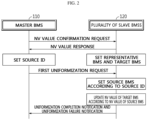
- FIG. 1 is a diagram schematically showing a BMS managing apparatus 100 according to an embodiment of the present disclosure.
- the BMS managing apparatus 100 may include a master BMS 110 and a plurality of slave BMSs 120.
- the master BMS 110 may be a higher-rank BMS of the slave BMS.
- the master BMS 110 may be configured to send a non-volatile (NV) value confirmation request to the plurality of slave BMSs 120.
- NV non-volatile
- the master BMS 110 may be connected to the plurality of slave BMSs 120, respectively.
- the master BMS 110 may send an NV value confirmation request to each of a first slave BMS 120a, a second slave BMS 120b, a third slave BMS 120c, a fourth slave BMS 120d and a fifth slave BMS 120e.
- the master BMS 110 may be configured to send a uniformization request to the plurality of slave BMSs 120 based on whether a source ID is set.
- the master BMS 110 may send a uniformization request to the plurality of slave BMSs 120.
- the master BMS 110 may identically send a first uniformization request or a second uniformization request to the plurality of slave BMSs 120 according to whether the source ID is set.
- the master BMS 110 may be configured to send the first uniformization request including the source ID to the plurality of slave BMSs 120. Conversely, when the source ID is not set, the master BMS 110 may be configured to send the second uniformization request not including the source ID to the plurality of slave BMSs 120.
- the master BMS 110 may send the uniformization request to the plurality of slave BMSs 120 when all of the NV value confirmation requests are received from the plurality of slave BMSs 120.
- the plurality of slave BMSs 120 may be configured to send each NV value to the master BMS 110 when the NV value confirmation request is received from the master BMS 110.
- Each of the plurality of slave BMSs 120 may send its NV value to the master BMS 110 as a response to the NV value confirmation request.
- the plurality of slave BMSs 120 may generate a hash value for the NV value using the same hash function.
- the plurality of slave BMSs 120 may send the generated hash value to the master BMS 110.
- each of the first slave BMS 120a, the second slave BMS 120b, the third slave BMS 120c, the fourth slave BMS 120d and the fifth slave BMS 120e may send its NV value as a response to the NV value confirmation request.
- the plurality of slave BMSs 120 may be configured to set a representative BMS and a target BMS based on the plurality of NV values.
- the plurality of slave BMSs 120 may set a representative BMS and a target BMS based on the plurality of NV values.
- the plurality of slave BMSs 120 may set the representative BMS and the target BMS after sending the NV value to the master BMS 110.
- each of the plurality of slave BMSs 120 may have an NV value. That is, the number of the plurality of NV values may be five.
- the plurality of slave BMSs 120 may set any one of the plurality of slave BMSs 120 as a representative BMS based on the five NV values.
- the plurality of slave BMSs 120 may set the target BMS based on the five NV values. Specific details of setting the representative BMS and the target BMS by the plurality of slave BMSs 120 based on the plurality of NV values will be described later.
- the plurality of slave BMSs 120 may be configured to set the representative BMS or a slave BMS corresponding to the source ID as the source BMS according to the uniformization request received from the master BMS 110.
- the plurality of slave BMSs 120 may set the representative BMS or the slave BMS corresponding to the source ID as the source BMS according to whether the source ID is included in the uniformization request received from the master BMS 110.
- the plurality of slave BMSs 120 may be configured to set a slave BMS corresponding to the source ID as the source BMS when the first uniformization request is received. Conversely, the plurality of slave BMSs 120 may be configured to set the representative BMS as the source BMS when the second uniformization request is received.
- the plurality of slave BMSs 120 may be configured to update the NV value of the target BMS according to the NV value of the source BMS.
- the first slave BMS 120a when the NV value of the first slave BMS 120a and the NV value of the second to fourth slave BMSs 120b to 120d are the same and the NV value of the fifth slave BMS 120e is different, it is assumed that the first slave BMS 120a is set as the source BMS and the fifth slave BMS 120e is set as the target BMS. That is, the second slave BMS 120b, the third slave BMS 120c, and the fourth slave BMS 120d may not be set as the target BMS.
- the first slave BMS 120a may send its NV value to the fifth slave BMS 120e to update the NV value of the fifth slave BMS 120e to be the same as the NV value of the first to fourth slave BMSs 120a to 120d.
- the BMS managing apparatus 100 has an advantage that the plurality of slave BMSs 120 may autonomously update the NV value not only when the source ID is specified by the master BMS 110 but also when the source ID is not specified.
- the plurality of slave BMSs 120 may update the NV value normally by setting the source BMS by itself.
- the master BMS 110 and the plurality of slave BMSs 120 may include a control unit and a storage unit.
- control unit may optionally include a processor, an applicationspecific integrated circuit (ASIC), another chipset, a logic circuit, a register, a communication modem, and a data processing device, and the like, known in the art to execute various control logics performed in the present disclosure.
- control logic when the control logic is implemented in software, the control unit may be implemented as a set of program modules.
- the program module may be stored in a memory and executed by the control unit.
- the memory may be provided in or out of the control unit, and may be connected to the control unit by various well-known means.
- the storage unit may store data or programs necessary for operation and function of each component of the master BMS 110 and the plurality of slave BMSs 120, data generated in the process of performing the operation or function, or the like.
- the storage unit is not particularly limited in its kind as long as it is a known information storage means that can record, erase, update and read data.
- the information storage means may include RAM, flash memory, ROM, EEPROM, registers, and the like.
- the storage unit may store program codes in which processes executable by the control unit are defined.
- the master BMS 110 may be configured to set the received ID as the source ID.
- the master BMS 110 may communicate with the outside.
- the master BMS 110 may receive an ID for any one of the plurality of slave BMSs 120 from a server or the like.
- the master BMS 110 may be connected to an input device to receive an ID for any one of the plurality of slave BMSs 120 input through the input device.
- the input device may be a device capable of outputting an input value by a user manipulation, such as a keyboard, a mouse, and/or a touch screen.
- FIG. 2 is a diagram schematically showing an embodiment of the BMS managing apparatus 100 according to an embodiment of the present disclosure.
- FIG. 2 is an embodiment in which the master BMS 110 sets the source ID after receiving a response to the NV value from the plurality of slave BMSs 120.
- the master BMS 110 may send the first uniformization request including the source ID to the plurality of slave BMSs 120.
- the plurality of slave BMSs 120 may set the slave BMS corresponding to the source ID as the source BMS.
- the plurality of slave BMSs 120 may set the representative BMS and the target BMS in advance before receiving the first uniformization request from the master BMS 110.
- the plurality of slave BMSs 120 may set the source BMS according to the source ID regardless of the set representative BMS.
- the source BMS may update the NV value of the target BMS by sending its NV value to the target BMS.
- the source BMS may be configured to receive whether the NV value is updated and the updated NV value from each target BMS.
- the source BMS may be configured to send a uniformization completion notification or a uniformization failure notification to the master BMS 110 according to whether the updated NV value received from the target BMS is the same as its own NV value.
- the source BMS may send a uniformization completion notification or a uniformization failure notification to the master BMS 110 according to the judgment result.
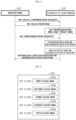
- FIG. 3 is a diagram schematically showing another embodiment of the BMS managing apparatus 100 according to an embodiment of the present disclosure.
- FIG. 3 is an embodiment in which the master BMS 110 does not set the source ID, unlike the embodiment of FIG. 2 .
- the master BMS 110 may send the second uniformization request not including the source ID to the plurality of slave BMSs 120 when the source ID is not set.
- the plurality of slave BMSs 120 may set the representative BMS as the source BMS when receiving the second uniformization request.
- the plurality of slave BMSs 120 may set the representative BMS and the target BMS in advance before receiving the second uniformization request from the master BMS 110.
- the plurality of slave BMSs 120 may set a preset representative BMS as the source BMS when the second uniformization request not including the source ID is received from the master BMS 110.
- the slave BMS set as the source BMS may send declaration information to inform the remaining slave BMSs that it is selected as the source BMS.
- the source BMS may update the NV value of the target BMS by sending its NV value to the target BMS. That is, the plurality of slave BMSs 120 may update the NV value of the target BMS by setting the source BMS by itself, even when the source ID is not received from the master BMS 110.
- the source BMS may receive the updated NV value from the target BMS and judge whether the update is normally completed, and then send a uniformization completion notification or a uniformization failure notification to the master BMS 110 according to the judgment result.
- FIG. 4 is a diagram schematically showing still another embodiment of the BMS managing apparatus 100 according to an embodiment of the present disclosure.
- the embodiment of FIG. 4 is an embodiment in which the uniformization request is not received for a predetermined time after the plurality of slave BMSs 120 send a response to the NV value to the master BMS 110 and set the representative BMS and the target BMS, unlike the embodiment of FIGS. 2 and 3 .
- the plurality of slave BMSs 120 may be configured to set the representative BMS as the source BMS, when the uniformization request is not received for a predetermined time after setting the representative BMS and the target BMS.
- the master BMS 110 may not be able to send a uniformization request to the plurality of slave BMSs 120. Even in this case, since the NV value of the plurality of slave BMSs 120 must be updated in order for the plurality of slave BMSs 120 to operate normally, the plurality of slave BMSs 120 may set a preset representative BMS as the source BMS.
- the BMS managing apparatus 100 has an advantage of updating the NV value of the plurality of slave BMSs 120 even when the plurality of slave BMSs 120 do not receive a uniformization request from the master BMS 110.
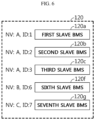
- FIGS. 5 to 8 are diagrams schematically showing an embodiment in which an NV value of a slave BMS is updated by the BMS managing apparatus 100 according to an embodiment of the present disclosure.
- the embodiment of FIG. 5 is an embodiment for a plurality of slave BMSs 120 at an initial stage.
- the first slave BMS 120a, the second slave BMS 120b, the third slave BMS 120c, the fourth slave BMS 120d and the fifth slave BMS 120e may be provided.
- FIG. 6 is an embodiment in which the fourth slave BMS 120d is replaced with the sixth slave BMS 120f and the fifth slave BMS 120e is replaced with the seventh slave BMS 120g from the plurality of slave BMSs 120 at an initial stage.
- the NV values of the first slave BMS 120a, the second slave BMS 120b, and the third slave BMS 120c may be A
- the NV value of the replaced sixth slave BMS 120f may be B
- the NV value of the replaced seventh slave BMS 120g may be C. That is, the NV values of the replaced slave BMSs 120f, 120g may be different from the NV value of the existing slave BMSs 120a, 120b, 120c.
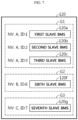
- FIG. 7 is an embodiment in which the plurality of slave BMSs 120 are grouped based on the NV values.
- the plurality of slave BMSs 120 may be configured to group slave BMSs having the same NV value to generate a major group and at least one minor group according to the number of the included slave BMSs.
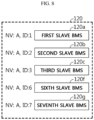
- the plurality of slave BMSs 120 may communicate with each other to check the NV value from each other. Specifically, each of the plurality of slave BMSs 120 may send data including its own ID and its own NV value to the remaining slave BMSs. The plurality of slave BMSs 120 may check the NV value of the other slave BMS through the data received from the other slave BMS.
- Three slave BMSs 120a, 120b, 120c may have the NV value of A, one slave BMS 120f may have the NV value of B, and one slave BMS 120g may have the NV value of C.
- slave BMSs having the same NV value may generate a group.
- a first group G1 may include the first slave BMS 120a, the second slave BMS 120b, and the third slave BMS 120c.
- a second group G2 may include the sixth slave BMS 120f, and a third group G3 may include the seventh slave BMS 120g.
- the plurality of slave BMSs 120 may set a group having the largest number of slave BMSs as a major group, and the remaining groups may be set as minor groups.
- the first group G1 including the three slave BMSs 120a, 120b, 120c may be configured as a major group, and the second group G2 and the third group G3 may be configured as the minor groups.
- the plurality of slave BMSs 120 may be configured to set any one of the plurality of slave BMSs 120 included in the major group as the representative BMS.
- the plurality of slave BMSs 120 may be configured to set a slave BMS having an ID corresponding to a preset condition among the plurality of slave BMSs 120 included in the major group as the representative BMS.
- the slave BMS having the lowest ID among the plurality of slave BMSs 120 included in the major group may be set as the representative BMS.
- the first slave BMS 120a may be set as the representative BMS.
- the slave BMS having the largest ID among the plurality of slave BMSs 120 included in the major group may be set as the representative BMS. That is, since the plurality of slave BMSs 120 included in the major group have the same NV value, any one slave BMS included in the major group may be set as the representative BMS.
- the plurality of slave BMSs 120 may be configured to set the slave BMS included in the at least one miner group as the target BMS.
- the NV values of all slave BMSs included in the minor group may be different from the NV values of the plurality of slave BMSs 120 included in the major group. Therefore, all slave BMSs included in the miner group may be set as the target BMS.
- FIG. 8 is an embodiment in which the NV values of the sixth slave BMS 120f and the seventh slave BMS 120g set as the target BMSs are updated.
- the source BMS may be set according to whether the uniformization request is received from the master BMS 110 and the type of the received uniformization request.
- the source BMS may update all of the NV values of the target BMSs by sending its own NV value to the target BMS.
- the first slave BMS 120a is set as the source BMS.
- the first slave BMS 120a may send its NV value to the sixth slave BMS 120f and the seventh slave BMS 120g.
- the sixth slave BMS 120f and the seventh slave BMS 120g may receive the NV value from the first slave BMS 120a and update their NV values. Accordingly, the NV values of the first slave BMS 120a, the second slave BMS 120b, the third slave BMS 120c, the sixth slave BMS 120f, and the seventh slave BMS 120g may all be unified as A.
- the BMS managing apparatus 100 has an advantage that the NV values of the plurality of slave BMSs may be synchronized by itself even if the NV values of the slave BMSs are not individually set by the user.
- the group of the replaced slave BMS is set as the major group, there may be a problem that the NV values of the existing slave BMSs are updated to the NV value of the replaced slave BMS.
- the master BMS 110 may be configured to store the NV value of the source BMS at the previous updating time as the criterion NV value.
- the master BMS 110 may be configured to set an ID of any one of the plurality of slave BMSs 120 having the same NV value as the criterion NV value among the plurality of NV values as the source ID.
- the master BMS 110 may store the criterion NV value at the previous updating time in advance, and then classify the NV value received from the plurality of slave BMSs 120 by itself. As a result of the classification, when the same number of slave BMSs are classified, the master BMS 110 may set the ID of the slave BMS having the same NV value as the criterion NV value as the source ID. In this case, even if there is no input for the ID from the outside, the master BMS 110 may directly set the source ID. Accordingly, even if a plurality of groups including the same number of slave BMSs are generated, the NV values of the plurality of slave BMSs 120 may be normally updated based on the source ID set by the master BMS 110.
- the BMS managing apparatus 100 may be included in an energy storage system (ESS).
- the energy storage system applied to a power plant driving a large-scale power grid, or a building or a factory that consumes a lot of power includes a plurality of battery racks respectively having a plurality of battery modules.
- the plurality of such battery racks are configured to become a battery bank, and a plurality of battery banks are configured to form a section.
- the master BMS 110 may be a bank battery management system (BBMS) corresponding to the battery bank
- each of the plurality of slave BMSs 120 may be a rack battery management system (RBMS) corresponding to a corresponding battery rack.
- BBMS bank battery management system
- RBMS rack battery management system
- the NV values of the replaced slave BMSs may be updated according to the BMS managing apparatus 100.
- FIG. 9 is a diagram schematically showing a BMS managing method according to another embodiment of the present disclosure.
- each step of the BMS managing method may be performed by the BMS managing sing apparatus 100 including the master BMS 110 and the plurality of slave BMSs 120.
- the BMS managing sing apparatus 100 including the master BMS 110 and the plurality of slave BMSs 120.
- the BMS managing method may include an NV value confirmation requesting step (S100), an NV value sending step (S200), a representative BMS and target BMS setting step (S300), a uniformization request sending step (S400), a source BMS setting step (S500) and an NV value updating step (S600).
- S100 NV value confirmation requesting step
- S200 NV value sending step
- S300 representative BMS and target BMS setting step
- S400 uniformization request sending step
- S500 source BMS setting step
- S600 NV value updating step
- the NV value confirmation requesting step (S100) is a step of sending an NV value confirmation request to the plurality of slave BMSs 120, and may be performed by the master BMS 110.
- the NV value sending step (S200) is a step of sending each NV value to the master BMS 110 when the NV value confirmation request is received from the master BMS 110, and may be performed by the plurality of slave BMSs 120.
- Each of the plurality of slave BMSs 120 may send its NV value to the master BMS 110 as a response to the NV value confirmation request.
- the representative BMS and target BMS setting step (S300) is a step of setting a representative BMS and a target BMS based on the plurality of NV values, and may be performed by the plurality of slave BMSs 120.
- FIG. 10 is a diagram schematically showing the representative BMS and target BMS setting step S300 in the BMS managing method according to another embodiment of the present disclosure.
- the representative BMS and target BMS setting step (S300) may include Step S310, Step S320, Step S330 and Step S340.
- each of the plurality of slave BMSs 120 may check its NV value and NV values of the other slave BMSs.
- each of the first slave BMS 120a, the second slave BMS 120b, the third slave BMS 120c, the sixth slave BMS 120f, and the seventh slave BMS 120g may check all of its NV value and the NV values of the other slave BMSs.
- Step S320 among the plurality of slave BMSs 120, slave BMSs having the same NV value may generate a group.
- a group including the largest number of slave BMSs may be set as a major group, and the remaining groups may be set as minor groups.
- the first slave BMS 120a, the second slave BMS 120b, and the third slave BMS 120c having the same NV value of A may be classified as the first group G1.
- the sixth slave BMS 120f having an NV value of B may be classified as a second group G2.
- the seventh slave BMS 120g having an NV value of C may be classified as a third group G3.
- the first group G1 including the largest number of slave BMSs may be set as a major group, and the remaining groups (the second group G2 and the third group G3) may be set as minor groups.
- any one of the plurality of slave BMSs 120 may be set as the representative BMS. Specifically, any one of the plurality of slave BMSs 120 belonging to the major group may be set as the representative BMS.
- the first slave BMS 120a included in the first group G1, which is a major group may be set as the representative BMS.
- Step S340 at least one slave BMS belonging to the miner group may be set as the target BMS.
- the sixth slave BMS 120f included in the second group G2 and the seventh slave BMS 120g included in the third group G3 may be set as the target BMS.
- the uniformization request sending step (S400) is a step of sending a uniformization request to the plurality of slave BMSs 120 based on whether the source ID is set when a response to the NV value confirmation request is received from the plurality of slave BMSs 120, and may be performed by the master BMS 110.
- the master BMS 110 may send a first uniformization request including the source ID to the plurality of slave BMSs 120. Conversely, when the source ID is not set, the master BMS 110 may send a second uniformization request not including the source ID to the plurality of slave BMSs 120.
- the source BMS setting step (S500) is a step of setting the representative BMS or a slave BMS corresponding to the source ID as the source BMS according to the uniformization request received from the master BMS 110, and may be performed by a plurality of slave BMSs 120.
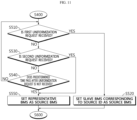
- FIG. 11 is a diagram schematically showing a source BMS setting step S500 in the BMS managing method according to another embodiment of the present disclosure.
- Step S510 the plurality of slave BMSs 120 may judge whether the first uniformization request is received from the master BMS 110. If the plurality of slave BMSs 120 receives the first uniformization request, Step S520 may be performed, and if not, Step S530 may be performed.
- the plurality of slave BMSs 120 may set the slave BMS corresponding to the source ID included in the first uniformization request as the source BMS. That is, even if the representative BMS is set in advance in Step S330, when the source ID is received from the master BMS 110, the slave BMS corresponding to the source ID may be set as the source BMS. After that, the NV value updating step (S600) may be performed.
- the source ID included in the first uniformization request received by the plurality of slave BMSs 120 from the master BMS 110 is 2.
- the second slave BMS 120b having an ID corresponding to the source ID may be set as the source BMS. That is, even if the representative BMS is set as the first slave BMS 120a in Step S330, the second slave BMS 120b corresponding to the source ID may be set as the source BMS.
- Step S530 the plurality of slave BMSs 120 may judge whether the second uniformization request is received from the master BMS 110. If the plurality of slave BMSs 120 receives the second uniformization request, Step S550 may be performed, and if not, Step S540 may be performed.
- Step S540 the plurality of slave BMSs 120 may judge whether a predetermined time elapses after the uniformization request (the first uniformization request and the second uniformization request) is not received from the master BMS 110 from the time point when the representative BMS and the target BMS are set. If the predetermined time elapses, Step S550 may be performed, and if not, Step S510 may be performed again.
- the plurality of slave BMSs 120 may wait for the reception of the uniformization request for a predetermined time after the representative BMS and target BMS setting step (S300). However, if the uniformization request is not received for a predetermined time, Step S550 may be performed to update the NV values of the plurality of slave BMSs 120 normally.
- Step S550 is a step of setting the representative BMS set in Step S330 as the source BMS. That is, the plurality of slave BMSs 120 may set a representative BMS set by themselves as the source BMS even if the source BMS is not determined by the master BMS 110 (even if the first uniformization request including the source ID is not received).
- the first slave BMS 120a set as the representative BMS may be set as the source BMS.
- the NV value updating step (S600) is a step of updating the NV value of the target BMS according to the NV value of the source BMS, and may be performed by the plurality of slave BMSs 120.
- the source BMS may send its NV value to the target BMS.
- the target BMS receiving the NV value may update its NV value as the received NV value.
- the first slave BMS 120a set as the source BMS may send the NV value of A to the sixth slave BMS 120f and the seventh slave BMS 120g set as the target BMS.
- the sixth slave BMS 120f and the seventh slave BMS 120g may update their NV values to the received NV value of A.
- the NV values of the first slave BMS 120a, the sixth slave BMS 120f, and the seventh slave BMS 120g may all be the same.
- the embodiments of the present disclosure described above may not be implemented only through an apparatus and a method, but may be implemented through a program that realizes a function corresponding to the configuration of the embodiments of the present disclosure or a recording medium on which the program is recorded.
- the program or recording medium may be easily implemented by those skilled in the art from the above description of the embodiments.
Landscapes
- Engineering & Computer Science (AREA)
- Computer Hardware Design (AREA)
- Theoretical Computer Science (AREA)
- Manufacturing & Machinery (AREA)
- Chemical & Material Sciences (AREA)
- Chemical Kinetics & Catalysis (AREA)
- Electrochemistry (AREA)
- General Chemical & Material Sciences (AREA)
- Physics & Mathematics (AREA)
- General Engineering & Computer Science (AREA)
- General Physics & Mathematics (AREA)
- Software Systems (AREA)
- Microelectronics & Electronic Packaging (AREA)
- Computer Networks & Wireless Communication (AREA)
- Signal Processing (AREA)
- Mobile Radio Communication Systems (AREA)
- Secondary Cells (AREA)
- Management, Administration, Business Operations System, And Electronic Commerce (AREA)
- Hardware Redundancy (AREA)
Applications Claiming Priority (2)
| Application Number | Priority Date | Filing Date | Title |
|---|---|---|---|
| KR1020200153902A KR20220067327A (ko) | 2020-11-17 | 2020-11-17 | Bms 관리 장치 및 방법 |
| PCT/KR2021/016657 WO2022108274A1 (ko) | 2020-11-17 | 2021-11-15 | Bms 관리 장치 및 방법 |
Publications (2)
| Publication Number | Publication Date |
|---|---|
| EP4156375A1 true EP4156375A1 (de) | 2023-03-29 |
| EP4156375A4 EP4156375A4 (de) | 2024-12-18 |
Family
ID=81709357
Family Applications (1)
| Application Number | Title | Priority Date | Filing Date |
|---|---|---|---|
| EP21895042.6A Pending EP4156375A4 (de) | 2020-11-17 | 2021-11-15 | Bms-verwaltungsvorrichtung und -verfahren |
Country Status (6)
| Country | Link |
|---|---|
| US (1) | US12087916B2 (de) |
| EP (1) | EP4156375A4 (de) |
| JP (1) | JP7383167B2 (de) |
| KR (1) | KR20220067327A (de) |
| CN (1) | CN115152074B (de) |
| WO (1) | WO2022108274A1 (de) |
Families Citing this family (2)
| Publication number | Priority date | Publication date | Assignee | Title |
|---|---|---|---|---|
| CN116233074B (zh) * | 2023-01-19 | 2024-11-29 | 珠海昇生微电子有限责任公司 | 一种用于级联bms中自适应分配id的方法及系统 |
| CN117239937B (zh) * | 2023-11-10 | 2024-01-30 | 深圳海辰储能科技有限公司 | 一种电池管理系统的数据交互方法、装置和存储介质 |
Family Cites Families (20)
| Publication number | Priority date | Publication date | Assignee | Title |
|---|---|---|---|---|
| KR101075352B1 (ko) * | 2009-12-24 | 2011-10-19 | 삼성에스디아이 주식회사 | 배터리 다직렬 시스템 및 그 통신 방법 |
| KR101245279B1 (ko) | 2010-10-11 | 2013-03-19 | 주식회사 엘지화학 | 배터리팩의 멀티 슬레이브에 대한 순차적 아이디 설정방법 및 시스템 |
| KR101423961B1 (ko) | 2012-05-23 | 2014-07-31 | 주식회사 피엠그로우 | 배터리팩의 배터리 유닛 교체 시스템 및 방법 |
| KR101754948B1 (ko) | 2014-10-07 | 2017-07-06 | 주식회사 엘지화학 | 배터리 관리 모듈의 통신 id 할당 방법 및 시스템 |
| KR101732234B1 (ko) | 2014-12-08 | 2017-05-02 | 주식회사 엘지화학 | 에너지 저장 시스템의 배터리 팩 교환 방법 및 장치 |
| KR101641435B1 (ko) * | 2014-12-16 | 2016-07-20 | 중소기업은행 | 배터리 관리 시스템 및 이를 탑재한 전기자동차 |
| KR101682788B1 (ko) | 2015-01-28 | 2016-12-12 | 중소기업은행 | 전기자동차의 배터리 교환 시스템 및 방법 |
| KR102479719B1 (ko) * | 2015-06-04 | 2022-12-21 | 삼성에스디아이 주식회사 | 배터리 제어 시스템 및 방법 |
| US20170010896A1 (en) * | 2015-07-06 | 2017-01-12 | Lear Corporation | Shared Memory Architecture Autoupdater |
| KR102179680B1 (ko) * | 2016-03-03 | 2020-11-17 | 주식회사 엘지화학 | 배터리 시스템의 셀 타입 자동 설정 방법 |
| KR102559200B1 (ko) | 2016-10-05 | 2023-07-25 | 삼성전자주식회사 | 배터리 유닛을 관리하는 장치, 방법, 및 시스템 |
| KR102204301B1 (ko) * | 2017-07-20 | 2021-01-15 | 주식회사 엘지화학 | 무선 배터리 관리 시스템 및 이를 포함하는 배터리팩 |
| KR102337858B1 (ko) * | 2018-01-19 | 2021-12-08 | 주식회사 엘지에너지솔루션 | 애플리케이션 리프로그래밍 장치 |
| KR101974807B1 (ko) * | 2018-10-02 | 2019-08-28 | (주)티에스식스티즈 | 스마트 슬레이브 배터리 관리 시스템 및 그의 배터리 관리 방법 |
| KR102258814B1 (ko) * | 2018-10-04 | 2021-07-14 | 주식회사 엘지에너지솔루션 | Bms 간 통신 시스템 및 방법 |
| KR102723144B1 (ko) | 2018-11-22 | 2024-10-29 | 주식회사 엘지에너지솔루션 | Ess에 탑재되는 bms들 간의 소프트웨어의 호환성 확인 방법 및 자동 업데이트 방법 |
| KR102510886B1 (ko) * | 2018-11-23 | 2023-03-16 | 삼성에스디아이 주식회사 | 슬레이브 모듈 및 이를 포함하는 번호 할당 시스템 |
| KR102433850B1 (ko) | 2018-12-20 | 2022-08-17 | 주식회사 엘지에너지솔루션 | Bms 인식 시스템 및 방법 |
| KR102405847B1 (ko) | 2019-01-10 | 2022-06-03 | 주식회사 엘지에너지솔루션 | 배터리 관리 장치 및 이를 포함하는 배터리 팩 |
| CN111384455B (zh) | 2020-04-14 | 2022-04-26 | 杭州协能科技股份有限公司 | Bms多机并联实现系统 |
-
2020
- 2020-11-17 KR KR1020200153902A patent/KR20220067327A/ko active Pending
-
2021
- 2021-11-15 WO PCT/KR2021/016657 patent/WO2022108274A1/ko not_active Ceased
- 2021-11-15 CN CN202180016774.1A patent/CN115152074B/zh active Active
- 2021-11-15 JP JP2022548196A patent/JP7383167B2/ja active Active
- 2021-11-15 EP EP21895042.6A patent/EP4156375A4/de active Pending
- 2021-11-15 US US17/799,840 patent/US12087916B2/en active Active
Also Published As
| Publication number | Publication date |
|---|---|
| CN115152074B (zh) | 2025-06-17 |
| JP7383167B2 (ja) | 2023-11-17 |
| WO2022108274A1 (ko) | 2022-05-27 |
| EP4156375A4 (de) | 2024-12-18 |
| CN115152074A (zh) | 2022-10-04 |
| US20230089122A1 (en) | 2023-03-23 |
| JP2023513546A (ja) | 2023-03-31 |
| KR20220067327A (ko) | 2022-05-24 |
| US12087916B2 (en) | 2024-09-10 |
Similar Documents
| Publication | Publication Date | Title |
|---|---|---|
| EP4156375A1 (de) | Bms-verwaltungsvorrichtung und -verfahren | |
| JP2000031882A5 (de) | ||
| EP3525119A1 (de) | Tiefenlernender fpga-wandler | |
| US11449381B2 (en) | Apparatus and method for diagnosing communication fault | |
| CN111932179B (zh) | 电池模组仓储管理方法、上位机及系统 | |
| CN107608748B (zh) | 应用程序管控方法、装置、存储介质及终端设备 | |
| EP4152024A1 (de) | Vorrichtung und verfahren zur diagnose des zustands einer batterie | |
| US12461158B2 (en) | Battery information requesting apparatus and method | |
| EP3082214B1 (de) | Vorrichtung und verfahren zur erkennung einer fehlfunktion eines aufgabenplaners in einem batterieverwaltungssystem | |
| CN120039135A (zh) | 一种面向自动驾驶电动矿卡的能耗最优控制方法、装置 | |
| CN110226257B (zh) | 用于管理电池组的方法和系统 | |
| EP4589315A1 (de) | Auf einem fahrzeug montierte datensammelvorrichtung und funktionsänderungsverfahren dafür | |
| US12412935B2 (en) | Battery including smart battery cells with full-bridge configured for charge/discharge and bypass states, and method thereof | |
| JP2024534776A (ja) | 充電プロトコル検査装置およびその動作方法 | |
| EP4546119A1 (de) | Softwareaktualisierungsvorrichtung und -system | |
| CN114683909A (zh) | 换电处理方法、系统、设备及可读存储介质 | |
| CN118199222B (zh) | 一种退役电池的回馈电能输送状态控制方法及相关装置 | |
| CN118432887B (zh) | 基于工业互联网的数据安全管理方法、设备、系统及介质 | |
| KR20250042545A (ko) | 정보 수집 장치 및 그것의 동작 방법 | |
| CN102264000B (zh) | 一种电视卡拉ok功能入口的实现方法、装置及电视机 | |
| CN113725952B (zh) | 放电方法、移动电源及计算机存储介质 | |
| KR20230015783A (ko) | 배터리 모듈, 배터리 시스템 및 그에 관한 관리 방법 | |
| CN117930066A (zh) | 设备测试方法、测试设备和存储介质 | |
| EP4645011A1 (de) | Vorrichtung zur verwaltung des herstellungsprozesses einer batterie | |
| CN121093912A (zh) | 一种面向后评价报告的Agent协同式长文生成系统及方法 |
Legal Events
| Date | Code | Title | Description |
|---|---|---|---|
| STAA | Information on the status of an ep patent application or granted ep patent |
Free format text: STATUS: THE INTERNATIONAL PUBLICATION HAS BEEN MADE |
|
| PUAI | Public reference made under article 153(3) epc to a published international application that has entered the european phase |
Free format text: ORIGINAL CODE: 0009012 |
|
| STAA | Information on the status of an ep patent application or granted ep patent |
Free format text: STATUS: REQUEST FOR EXAMINATION WAS MADE |
|
| 17P | Request for examination filed |
Effective date: 20221220 |
|
| AK | Designated contracting states |
Kind code of ref document: A1 Designated state(s): AL AT BE BG CH CY CZ DE DK EE ES FI FR GB GR HR HU IE IS IT LI LT LU LV MC MK MT NL NO PL PT RO RS SE SI SK SM TR |
|
| DAV | Request for validation of the european patent (deleted) | ||
| DAX | Request for extension of the european patent (deleted) | ||
| A4 | Supplementary search report drawn up and despatched |
Effective date: 20241119 |
|
| RIC1 | Information provided on ipc code assigned before grant |
Ipc: H04L 61/5038 20220101ALI20241113BHEP Ipc: G06F 15/163 20060101ALI20241113BHEP Ipc: H04L 61/00 20220101ALI20241113BHEP Ipc: H01M 10/42 20060101AFI20241113BHEP |
|
| GRAP | Despatch of communication of intention to grant a patent |
Free format text: ORIGINAL CODE: EPIDOSNIGR1 |
|
| STAA | Information on the status of an ep patent application or granted ep patent |
Free format text: STATUS: GRANT OF PATENT IS INTENDED |
|
| INTG | Intention to grant announced |
Effective date: 20251126 |
|
| P01 | Opt-out of the competence of the unified patent court (upc) registered |
Free format text: CASE NUMBER: UPC_APP_0015351_4156375/2025 Effective date: 20251201 |